
Debbie Young's Blog
April 1, 2026
Literary Easter Eggs in Books
Q. What’s a literary Easter egg?
A. It’s a little surprise tucked away in a story to amuse readers smart enough to spot it.
Today I’m going to tell you about some of the Easter eggs hidden in my books, how some of my author friends like to play the same game, and how to get a free Kindle ebook of my fun little novelette, The Clutch of Eggs – the perfect read for Easter weekend.
Easter Eggs in My BooksReferencing a book by a different author is good fun, even when you know only certain readers will get the joke. The title of my novella, Mrs Morris Changes Lanes, is an allusion to one of Christopher Isherwood’s Berlin novels, Mr Norris Changes Trains. Oh, and without spoiling the plot, my story includes a journey I’d just made with my daughter to a certain university town, where she’s now studying for her MA.
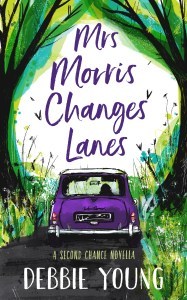 My standalone novella, Mrs Morris Changes Lanes, features a satnav with a mind of its own
In my latest novel, The Importance of Being Murdered, I was a veritable Easter Bunny, hiding Easter eggs all over the place, starting with the title.
If you’re an Oscar Wilde fan, in a game of word association, given “The Importance of Being…” as your starter, you’d almost certainly say “Earnest” – citing the title of his most famous play.
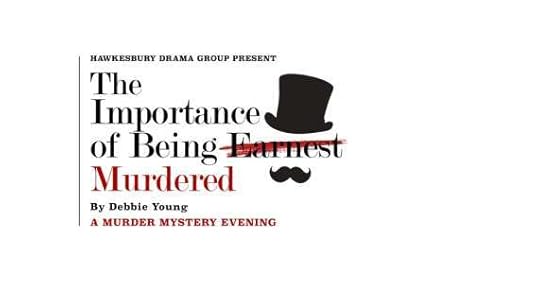 My novel started life as a play for my own village drama group
In my novel, The Bunbury Players, about to stage their production of The Importance of Being Earnest, take their name from their home village of Bunbury in the Cotswolds. (If you know, you know.) You can also have fun searching this story for other Easter eggs referencing Wildean names – and a contentious handbag. (If you know, you know.)
Easter Eggs from Other AuthorsWith Easter nearly upon us, I thought it would be fun to ask some of some of author friends who are also published by Boldwood Books to share how they choose the Easter eggs they hide in their books. Here is what they came up with.
‘I use a variation of my mum’s name in every book, so she’s always there,’ says Helen Cook. What a lovely idea!I’m a massive fan of the BBC podcast ‘Uncanny’,’ says Victoria Scott. ‘I put the line ‘I know what I saw’ in The House in the Water , which is a ghost story. It’s the last line from the ‘Uncanny’ theme tune.’Keri Beevis says, ‘My thrillers are all standalone, but characters are sometimes mentioned across stories. So for example, the slimy estate agent in Trust No One sold Ellie & Ash their house in The People Next Door, and Finn from Every Little Breath was the detective mentioned at the end of The Summer House .’Keri Beevis and Patricia Dixon also reference each other’s books in their own work. Patricia cites an example: ‘I remember my character reading Keri Beevis’s Every Little Breath in a park in Montparnasse in Paris. In fact her books have been all over Trish world.’Jessica Redland likes to cite real-life connections: ‘My debut book, New Beginnings at Seaside Blooms, was set in a florist’s. I started off by mentioning the owner, Sarah, in all of my Whitsborough Bay books as a nod to it, but I hit one book where I couldn’t find a way to get her in without it being contrived, but I could mention Seaside Blooms. So that shop is mentioned in every single Whitsborough Bay book.’Clare Marchant tucked away an Easter egg for her other half in her latest book, The Alchemist’s Secret : ‘There was yet another packet of Bombay mix in the bin that morning. He wasn’t yet old, but he was developing a snack-shaped paunch.” ‘My husband roared at that, even though I had told him that I would get his love of Bombay mix into the book. Usually it’s just a snipe at golf.’‘My Dorset-set books tend to have mentions of characters and situations from previous books in them,’ says Jane Lovering, ‘and there’s usually a Doctor Who reference somewhere.’ Samantha Tonge has fun with a Game of Thrones reference in her novel, The Game of Scones: “I have a town called Tyrionitsa. For those who didn’t watch Game of Thrones, Tyrion is a character.’Sheila Riley likes to include friends’ names as minor characters. (I once added a Madalen to one of my stories, in honour of my friend’s daughter, and to celebrate the unusual spelling of her name.)‘I’m a big BBC Ghosts fan, so if I can get “damn your eyes!” into a book, I will,’ says Alison Bonomi. ‘I also often have Georgette Heyer references that only other fans will spot.’As you can see, Easter eggs are as much fun for the authors who hide them as they are for readers to find.Free Kindle Ebook of The Clutch of Eggs (offer ends 4th April 2026)Finally, as it’s Easter, here’s a little egg-themed gift for you. From today until Saturday 4th April, you can download a free Kindle ebook of my fun quick-read novelette, The Clutch of Eggs – a spin-off from my nine-book Sophie Sayers cosy mystery series. It’s set in the spring, featuring birdwatchers, birds’ nests, birds’ eggs, and Sophie’s mischievous black cat, Blossom. What better time to read it than Easter weekend?
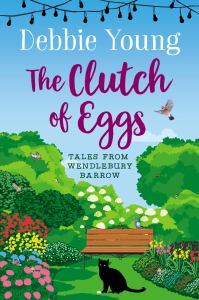
Naturally, there’s at least one Easter egg in this story, although only friends of my family will spot it: a scene with two scatty birdwatchers, named after my husband and his best friend, who are forever getting lost when they go for country walks together. I found that very pleasing!
To download your free ebook of The Clutch of Eggs now, click here.
(free until 4th April 2026)
If you read any of my books, I’d be very grateful if you could kindly leave a short review online, to help other readers discover it – or just tell your friends!
If you enjoyed this article, click the FOLLOW BLOG button in the right-hand sidebar to receive each new post in your inbox.
To receive my monthly newsletter, join my Readers’ Club here.
The post Literary Easter Eggs in Books first appeared on Debbie Young's Writing Life.


March 27, 2026
Overture & Beginners for The Importance of Being Murdered
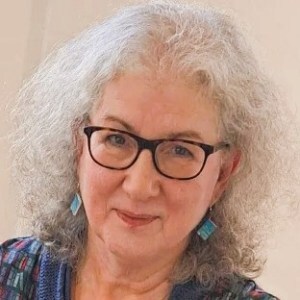 Debbie Young interviews herself to mark the launch of her 17th novel
Usually my last blog post of each month is a conversation with a fellow author, often about their new book. But this month, as I’ve just launched my latest cosy mystery novel, The Importance of Being Murdered, I’ll be talking to myself!
So, here’s a quick Q&A to whet you appetite for my new story.
Keep reading through to the end, you’ll find not only a buying link to The Importance of Being Murdered, but also a link to a FREE prequel short story that sets the scene, Overture and Beginnners.
Q: What inspired you to write The Importance of Being Murdered?A: I was asked by Hawkesbury Drama Group, based in my village, to write them a murder mystery evening in which the audience is invited to solve the mystery. I’ve seen many productions by our village drama group over the years. They’re always hilarious, and I’m friends with many of the cast, so I couldn’t resist.
I loved drama as a child (at one point I went to the Saturday morning drama club at the famous Rose Bruford College, which was literally at the end of the lane I grew up in), and I’ve also done a bit of amateur dramatics and operatics, so it was familiar territory.
Also, I relished the challenge of writing a play, which requires a different structure and skillset to fiction.
However, once I’d written the play, and seen the Hawkesbury Drama Group’s brilliant performances of it, with each actor fleshing out my characters in their own way, I was itching to expand the play into the format of a novel.
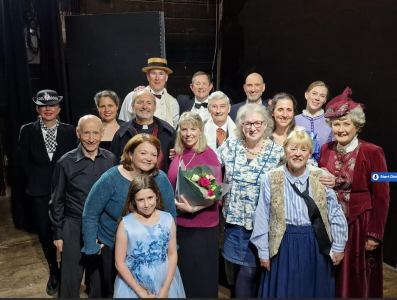 The cast of “The Importance of Being Murdered” after the final performanceQ: You usually write novels in series. Why did you suddenly decide to write a standalone?
A: This play started life as a one-off project, so it was only ever going to be a standalone story.
However, on the day of publication, one of the very first reviewers has also hinted that I should turn it into a series, as he enjoyed the characters and setting so much. I must admit I’m tempted! And – fun fact here – one of the characters from the play also has a starring role in my current work-in-progress, the fourth Cotswold Curiosity Shop mystery, Death at the Village Garden Party!
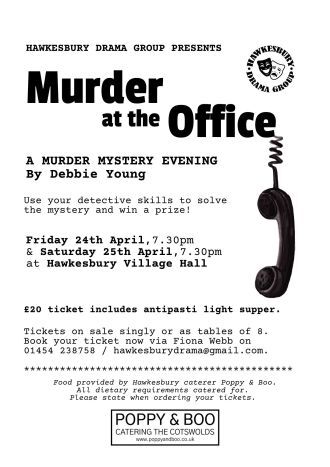
Meanwhile, the Hawkesbury Drama Group were so pleased with the script that they asked me to write another. The resulting play, Murder at the Office, set in a 1980s computer software company (complete with big mobile phones, big hair and big collars), is now in rehearsal, to be performed on 24th and 25th April at Hawkesbury Village Hall. See the group’s Facebook page for box office details.
A: I’ll let my publisher’s official blurb do the talking here.
ONE VILLAGE. TEN SUSPECTS. ONE DEADLY PERFORMANCE.
The curtain is about to rise on the Bunbury Players’ latest production, Oscar Wilde’s classic comedy, The Importance of Being Earnest.
But moments before the show starts, the leading man, retired star of stage and screen Bertram Manchester, is found dead in his dressing room.
As rumours spread throughout the Cotswold village community, Detective Constable Windermere seizes her chance to catch a killer and secure the promotion she craves.
The trouble is, every member of the cast has something to hide.
Will her front-row seat to murder enable DC Windermere to uncover the truth … or will she be the next person taking their last bow?
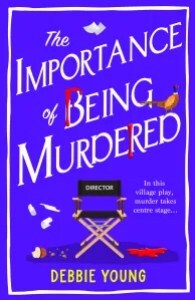 Hot off the press in ebook, paperback, hardback and audiocook
Q: The Importance of Being Murdered is a great title, and it sounds a bit familiar – where did that come from?
A: I do love a title that makes people smile! Having chosen The Importance of Being Earnest as the play-within-the-story, the novel’s title just jumped out at me. What more fitting title could there be? (with apologies to Oscar Wilde!)
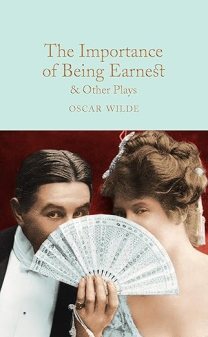 The play that inspired my playQ: Why did you choose this particular play?
A: I needed to hang my story around a production of an out-of-copyright play that would be popular with amateur drama groups – small cast, relatively simple staging, opportunity to dress up in gorgeous costumes – and this one seemed the perfect fit.
It’s an evergreen, witty comedy of manners, set mostly in rural England. Much loved by millions of theatregoers in the 131 years since it was first performed, it features many of Wilde’s most famous aphorisms.
Q: Do readers need to know Oscar Wilde’s original play to enjoy your novel?A: No, it will still make perfect sense for them. But readers who do know Wilde’s play will find a few extra chuckles via the in-jokes and Wildean references I’ve scattered along the way, not least a reference to Lady Bracknell’s famous horror at a certain handbag!
But if you haven’t ever seen the play, you’re missing a treat! Here are two great ways to experience The Importance of Being Earnest, one for a small fee and the other absolutely free:
rent the National Theatre’s production to view at home via the National Theatre at Home app here(view trailer for free here)listen to a classic BBC Radio Drama production for free, starring John Gielgud and Edith Evans, whom many consider to be the definitive Lady Bracknell
Once you start listening/watching it, you’ll probably recognise some of the most famous lines, such as:
‘The truth is rarely pure and never simple”
“To lose one parent, Mr. Worthing, may be regarded as a misfortune; to lose both looks like carelessness.”
“All women become like their mothers. That is their tragedy. No man does. That is his.”
Q: Where can I buy a copy of The Importance of Being Murdered?A: It’s available to order online here in ebook, paperback, hardback and audio, but if you prefer to buy from your local bookshop, just ask them to order it in for you.
Q: Where can I read the free prequel short story you mentioned at the start, Overture and Beginners?A: It’s here! Just click this link to download your free copy now.
If after reading the prequel, you still need persuading to read The Importance of Being Murdered, these early reviews might tip the balance for you:
‘I think this may be my favourite cosy mystery ever.’
Netgalley Reviewer
‘The writing was light and entertaining. The whole book was full of humour which made me smile. ‘
Emily Pankhurst on Amazon
‘The internal thoughts were wonderful, and worked brilliantly. The author’s notes were fascinating and added extra insight into her inspiration and clever detailing.’
T Wood, via Netgalley
‘I really enjoyed the charming setting and classic whodunnit feel. ‘
Amy Barr on Amazon
‘The setting was definitely a highlight, giving all the comfort read with a dark twist energy.’
@the_blonde_chapter on Instagram
‘An excellent pastiche of amateur dramatics, with the theatrics not confined to the stage.’
@acozymoose on Instagram
This book had me laughing out loud a lot and I loved the humour. It’s a 5 [image error] read for me, it was so entertaining, no dips in the storyline at all.’
@ukbook_reveiwer on Instagram
‘A fun read. The am dram group was a mix of characters, and during their rehearsals I felt as if I’d accidentally walked in on one. I didn’t see the reveal coming, but it was satisfying when the truth is explained.’
@avoidingrealitywithbooks on Instagram
‘From dramatic performers to gossip-loving villagers, everyone feels a little suspicious in that classic cozy mystery way. At some point, nearly everyone seems guilty, which makes the guessing game half the fun.
@bookscoffeebrews on Instagram
A: The fourth Cotswold Curiosity Shop mystery, Death at the Village Garden Party. 45k words down, 15k words to go. Speaking of which, I’d better get back to my writing desk! Thank you for reading this post.
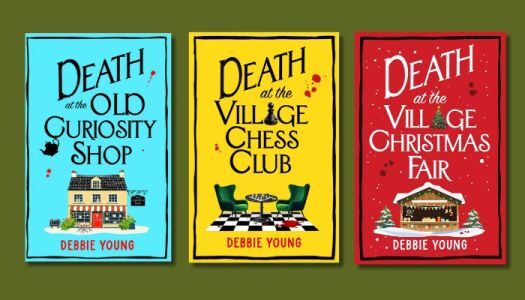 Book 4 coming soon – click image to pre-order ‘Death at the Village Garden Party’ now!
If you enjoy The Importance of Being Murdered, I’d be very grateful if you could kindly leave a short review online, to help other readers discover it – or just tell your friends!
If you enjoyed this article, click the FOLLOW BLOG button in the right-hand sidebar to receive each new post in your inbox.
To receive my monthly newsletter, join my Readers’ Club here.
The post Overture & Beginners for The Importance of Being Murdered first appeared on Debbie Young's Writing Life.
March 18, 2026
What’s an Authorpreneur and Why Am I One?
Last week, I was pleased to be a speaker at the London Book Fair as a member of the panel discussing “The Rise & Rise of the Authorpreneur”, chaired by Orna Ross, founder of the Alliance of Independent Authors and champion of indie authors everywhere.
What’s an authorpreneur anyway?It’s an author who treats their writing like a business – and, crucially, makes money from it!
Orna invited me to be part of the line-up to represent what’s known in the trade as the hybrid author. That means someone who self-publishes some of their books while licensing rights on other books to traditional publishers. Thus, they have a foot in both camps.
 One of three levels of author membership of ALLi – the others are Author and Associate
That’ll be me, then!
As you may know, I started out as entirely self-published, but after self-publishing nine novels, I licensed the English language rights for them to Boldwood Books, and other language rights selectively to other publishers around the world. My agent, Ethan Ellenberg, pitches my novels via his network of sub-agents around the world, and has so far won me five contracts in four languages – German, Italian, Japanese and Russian.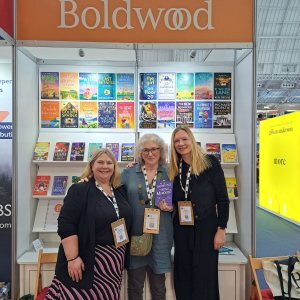 Catching up with Boldwood’s Wendy Neale and Nia Beynon on their London Book Fair stand last weekI still self-publish my short fiction – which falls outside of Boldwood’s business model – and non-fiction.
Another box I tick as an authorpreneur is that I have other income streams, not only as a paid speaker at events like the London Book Fair (and two more last week – more on those in a moment), but also by teaching and mentoring for the global writers’ group, Jericho Writers.
If you’d like to know more about the five different business models open to indie authors, read Orna’s definition here.
Of course, there is another more traditional and historica model: to have your work published solely by traditional publishers. It’s very common for that kind of author also to boost their earnings by doing other paid work.
These days, though, publishing is no longer binary – it’s increasingly common for writers like me to be a bit of both, so as to combine the autonomy of indiedom with the arguably wider reach of the traditional industry.
Why I’m an authorpreneurWhen I stepped down from my last full-time day job in 2010, I was conscious that contracts and royalties wouldn’t come pouring in straight away. So, I took the very 21st-century “portfolio career” approach. This meant pursuing opportunities to earn money in other ways related to my writing, while I built up my fiction catalogue.
As someone who is relatively cautious about money, knowing I have other income streams to smooth out the inevitable ups and downs of royalties makes it easier to relax and enjoy my writing at my own pace. To me, the hybrid route is a safer and more realistic way of pursuing writing ambitions, rather than giving everything up to write in your lonely garret and crossing your fingers that your work will be discovered and sold before you starve to death.
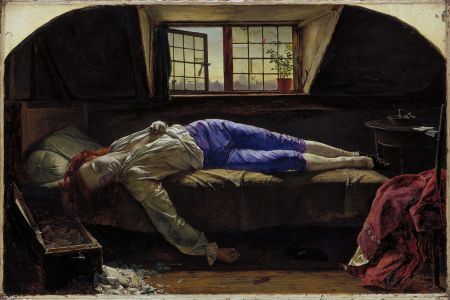 The Death of Chatterton by Henry Wallis (Public domain) – Chatterton is reputed to have poisoned himself rather than starving to death, but I couldn’t resist using this famous picture as an example of an artist’s garret!In Other News
The London Book Fair was just the beginning of a busy three days of events.
Indie Author Lab for ALLiOn Wednesday, I attended the Indie Author Lab (also organised by Orna Ross and the Alliance of Independent Authors aka ALLi) in Kensington Town Hall. At this action-packed, interactive day, about 150 indie authors enjoyed a series of talks by leading members of ALLi, such as Joanna Penn and Sacha Black, who shared the latest thinking and the likely future shape of self-publishing.
My part in the event was to head an “expert table“, answering specific questions from a group of delegates, all writing in different genres and based in several different countries.
In between the official sessions, I really enjoyed catching up with old author chums from ALLi whom I hadn’t seen for far too long.
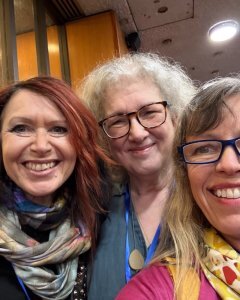 Thanks to Nancy Freund (right) for snapping this selfie of our reunion with Roz Morris (left) – a trio of longstanding ALLi members.
My agent, Ethan Ellenberg, was also there to chair an expert table. As he’s usually based in New York, the event was a welcome opportunity for me to catch up with him too. I’m kicking myself for not taking a selfie with him, not least because he was wearing a very beautiful mauve jacket!
All in all, I came away inspired and motivated, with a clearer idea of my own future as a writer.
Self-publishing Q&A for Jericho WritersThen, on the Thursday evening, back home at my desk, I answered further questions from a different group of authors at a Self Publishing Q&A, hosted by Jericho Writers, for whom I’m a course tutor and mentor. This was also an international group, with writers joining us from as far afield as the USA and Australia – and one even cited their location as “Middle Earth”, which made me chuckle.
My next Simply Self Publish course is due to start on 7th April – click here to find out more about it. This course runs twice a year (April-June and October-December), and I really enjoy helping my students to achieve their publishing ambitions.

And finally…
In between all of those events, I somehow managed to fire up my new Substack account, after a false start a few months ago. If you’re on Substack, I’d love to connect with you there. You can find me at https://substack.com/@AuthorDebbieYoung.
 Click logo to find me on Substack
What I’m Reading
I’m still soldiering on with Andrew Graham-Dixon‘s extraordinary new biography of Vermeer, which is so dense that I can only handle a few pages at a sitting (very worthwhile, though) – so Jay Larkin’s latest light-as-a-feather collection of cosy mini-mysteries was the perfect foil when I needed something a bit less taxing.
 Secrets of Appletree Lodge by Jay Larkin
A series of short mystery stories that together have an overall plot arc about cleaning lady Freda Starling’s move to help her friend run a seaside guest house back in the 1980s. With not a murder in sight, Jay Larkin still manages to intrigue the reader with old-fashioned puzzles, set around various aspects of life in a small English seaside town. With a different adventure in every short, bite-sized chapter, this makes perfect reading for winding down before bed or for a quick coffee-time treat. It’s very refreshing to get the mystery without any dead bodies along the way. A fun spin-off from the equally gentle Aunt Audrey’s Angels series by Jay Larkin.
Order your copy online here if you fancy giving it a try.
If you enjoyed this article, click the FOLLOW BLOG button in the right-hand sidebar to receive each new post in your inbox.
To receive my monthly newsletter, join my Readers’ Club here.
The post What’s an Authorpreneur and Why Am I One? first appeared on Debbie Young's Writing Life.
March 11, 2026
A Tale of Two Clutch Failures: What I Learned When My Car Broke Down
In motoring terms, if there’s one thing worse that breaking down during rush hour on a roundabout, it’s breaking down during rush-hour on a double roundabout. As I know, having done both, 40 years apart. For both incidents, the clutch was to blame.
Breaking Down on a Single RoundaboutThe first time, a loose connection silently leaked clutch fluid in my wake on my morning commute to Queen Square before I ground to halt at Stokes Croft. I could hardly believe what was happening. This was my brand-new company car, a cute metallic green Renault 5, of which I’d proudly taken delivery only the previous day. Although this was before the age of mobile phones enabling drivers to call for help, the timing was on my side. Almost immediately, a traffic officer arrived on the scene to investigate the cause of the bottleneck.
“What seems to be the problem, madam?” he asked kindly, noticing my visible distress.
“It’s my birthday!” I sobbed, which was true. “It’s not fair!”
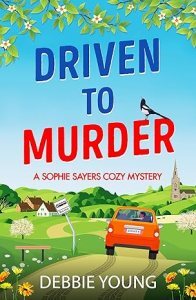 My own driving experiences have made me sympathetic to Sophie Sayers’ motoring crises in my cosy mystery novel, “Driven to Murder”Breaking Down on a Double Roundabout
On the second occasion, last Friday, a slipping clutch on the M4 from London culminated in a complete mechanical failure at the tricksy Bridgeyate junction. Despite the early evening darkness, I felt a touch of deja-vu. As I’d braked before entering the double-roundabout, my car had emitted a hideous graunching sound and cut out, refusing to restart. No policeman in sight this time, so I pulled out my phone and tapped the rescue service app. The fully automated process helpfully pinpointed my exact location on the map, but I missed the calming presence of a human being as I worked my way through a series of yes-or-no questions to which the answers weren’t obvious.
Was I ill, disabled, or going through a distressing time? Who wouldn’t find breaking down in the dark on a double-mini roundabout in rush-hour distressing? Suspecting that wasn’t what they meant, I said no.
Was I in a dangerous place? I looked around. Bridgeyate looked quite civilized to me. Besides, it was a much safer spot to break down than on the M4, on which I’d driven 80 miles earlier in the day. Another no.
My standalone novella, “Mrs Morris Changes Lanes”, features a satnav with a mind of its ownTwo Top Tips for Breaking DownEventually, when the rescue service man arrived, I asked him how I should have answered that last question, and I share his reply for your future reference.
“Ooh, yes,” he replied. “Busy traffic flow on a major junction in rush-hour? Definitely dangerous.”
Say yes to dangerous, apparently, and any rescue service will give you priority.
“Even better if you break down on the motorway,” was his cheerful recommendation.
Oh well, swings and roundabouts…
This post first appeared in the March 2026 edition of the Hawkesbury Parish News.
More Cautionary Tales for MotoristsIn Other News
This week I’ll be speaking at not one but two events in London:
On Tuesday at the London Book Fair at Olympia, as part of a panel entitled The Rise and Rise of the AuthorpreneurOn Wednesday at a special event for indie authors organised in Kensington Town Hall by the Alliance of Independent Authors (ALLi), the Indie Author Lab, where I’ll be a mentor answering questions for aspiring writers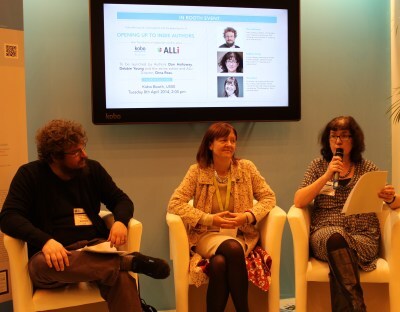 I first spoke at the London Book Fair in 2014. That’s me on the right, with Orna Ross (centre), founder of the Alliance of Independent Authors (ALLi), and Dan Holloway, ALLi’s News Editor.
By the time this blog post goes live, both events will be over, and I should be enjoying ALLi’s post-event drinks party. Cheers!
Meanwhile, if you’re interested in learning how to self-publish your books, my Simply Self Publish course, which I teach for Jericho Writers, starts on Tuesday 7th April. It’s a live, inter-active course that runs online for ten weeks, and I’m very proud of how many of my past students have gone on to self-publish their books to a professional standard.
Find out more about my Simply Self Publish course here.
What I’m ReadingI’m ploughing through a weighty non-fiction book about the Dutch artist Vermeer at the moment – more on that when I reach the end – but this week I finished reading a brand new historical novel hot off the press, whose author I’ll be interviewing for my “In Conversation” series of posts later this year. In the meantime, here’s my review to whet your appetite…
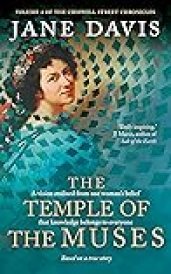 The Temple of the Muses by Jane Davis
Having enjoyed the first book of the Chiswell Street Chronicles, “The Bookseller’s Wife”, I was eager to read this sequel, “The Temple of the Muses”, which continues the story of plucky Dorcas Lackington and her determination to democratise reading, in partnership with her husband James and their evolving bookshop.
In an era in which literacy and therefore reading were restricted to the higher echelons of society, in part to suppress the political impusles of the lower classes against the backdrop of the French revolution across the Channel, Dorcas campaigns on two fronts: teaching girls and servants of both genders to read way beyond pure functional literacy (the definition of which at the time, the author tells us, was being able to sign your own name), and by the bold move of vastly reducing the price of books to make them more affordable to the masses.
Inspired by a true story, this well-researched novel is indeed a chronicle, with its emphasis on social historical details, brought vividly to life through well-drawn and believable characters.
As a 21st-century reader addicted to bookshops of all kinds, I was struck by the many parallels between the challenges facing Dorcas’s bookshop and modern bookselling issues, eg cut-throat pricing, pulping, and distribution.
A fascinating read for anyone who loves books and bookshops – and it’ll make you very glad you live in the present day without our easy and afforable access to books in many formats.
Order your copy of The Temple of the Muses here.
The post A Tale of Two Clutch Failures: What I Learned When My Car Broke Down first appeared on Debbie Young's Writing Life.
March 4, 2026
How We Can All Be Winners – Inspired by the 2026 Winter Olympics
I watched the 2026 Winter Olympics in the same spirit as I view programmes about extreme travel and exploration. By seeing someone on screen compete in risky activities, I feel as if I’ve done them by proxy. Having gained insight into how they’d make me feel, I can tick them off my bucket list. Phew!
I was daily amazed by anyone who trained and disciplined their body to the point of superhumanity. Not to mention developing the emotional strength to deliver their best in front of a global audience. Yet even for such superlative athletes, their best was not always enough. One bad landing in an otherwise perfect performance could and did snatch gold from a dead cert’s grasp. Each event yields only three medals.
Yet the crowds showed as much, if not more, support for athletes who scuppered their chance of a podium place. I was watching live when Team USA’s top downhill skier Lindsay Vonn took a catastrophic tumble requiring her to be airlifted off the course. The horrified crowd, silenced by the severity of her fall, gave her a standing ovation as the air ambulance arrived.
Not only American fans, but everyone present, including her rivals, was visibly anxious for Vonn’s well-being. For the tearful Breezy Johnson, going on to win the gold Vonn was striving for must have been bittersweet.
Vonn was deemed too badly injured to be placed inside the chopper, travelling to Innsbruck Hospital suspended beneath it. I’m sure I wasn’t the only spectator constantly refreshing their news feed until they announced her injury was not life-changing. Fortunately, she’d sustained only a broken leg, albeit it severe enough to require three subsequent operations.
Vonn, 41, still considered herself a winner. Aiming for a courageous comeback, she had earlier posted on Instagram, “While I can’t guarantee a good result, I can guarantee I will give it everything I have. But no matter what happens, I have already won.”
She was right.
All Olympic athletes are winners, as are we who watch, and anyone else who celebrates the ideals of the Olympic movement: “excellence, respect and friendship”.
According to the Olympics.com website, these qualities “constitute the foundation on which the Olympic movement builds its activities to promote sport, culture and education with a view to building a better world… This is the idea of setting your rivalries aside. There is more that unites us than divides us.”
Although the 2026 Winter Olympics will be over by the time you read this, I hope their spirit lingers.
How refreshing if Olympic principles could be applied to world government. That would put paid to tiresome and destructive political backbiting, financial greed, all forms of prejudice, superfluous wealth, and poverty.
Anyone up for forming an official Olympic Party? You’d certainly get my vote.
This post first appeared in the March 2026 edition of the Tetbury Advertiser.
In Other NewsLast Wednesday, I was excited to attend the first rehearsal for my next murder mystery play, which I wrote for the Hawkesbury Drama Group, my local amateur dramatics company. It will be performed on 24th and 25th April in Hawkesbury Village Hall, and tickets are already on sale – see details on poster below.
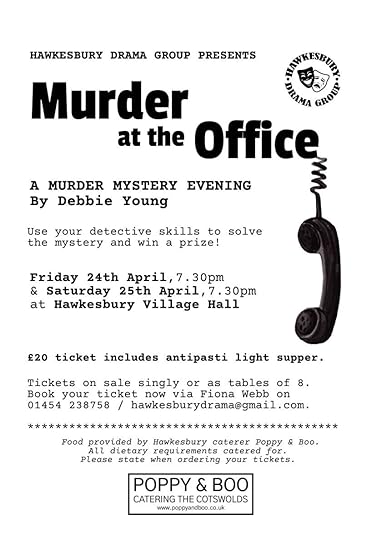
This is my second murder mystery play, the first being The Importance of Being Murdered, which I’ve since turned into a novel, to be published on 26th March by Boldwood Books. Click here to pre-order your copy now.
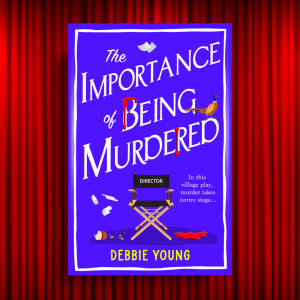 Coming soon – my cosy mystery novel inspired by Oscar Wilde’s play
Meanwhile I’m writing the fourth in the Cotswold Curiosity Shop series: Death at the Village Garden Party. Boldwood Books have also suggested I write a fifth in this series, Death at the WI. (WI = Women’s Institute – more about that here: www.thewi.org.uk.) I haven’t yet revealed this to my local WI, although, knowing them, they’re likely to suggest all sorts of ideas to help me along with that one!
What I’m ReadingWhen I was a child, some of my favourite books were by Noel Streatfeild, author of such classics as Ballet Shoes, fondly describing the lives of the three Fossil sisters, so called because they were adopted by their carer Sylvia’s paleontologist Great Uncle Matthew, aka Gum, on his travels around the world. One of the compelling features of Streatfeild’s books is that they include characters that different kinds of readers will relate to. Only one of the sisters, Posy, is a budding ballerina. Pauline is an aspiring actor. Petrova, who hates both dance and drama, wants to become an aeroplace pilot. (As Ballet Shoes was published in 1936, Petrova’s passion was probably inspired by Amelia Earhart, who tragically disappeared in 1937.)
My absolute favourite Streatfeild story was her fictionalised memoir, A Vicarage Family, in which the middle sister, Vicky, is determined to be a writer, while her older sister’s passion is art. No prizes for guessing which one I identified with.
Fun fact: the original edition of Ballet Shoes was illustrated by Noel Streatfeild’s real-life illustrator sister, Ruth Gervis.
90 years after it was published, Ballet Shoes continues to be hugely popular with readers of all ages. A new National Theatre production has received rave reviews.
Here’s my review of the first Susan Scarlett novel that I’ve read so far. I expect to read many more!
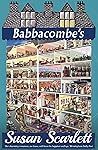 Babbacombe’s by Susan Scarlett
Having only just discovered that one of my favourite children’s authors, Noel Streatfeild, wrote a dozen romance novels for grown-ups, I chose this one as my first venture into her adult fiction because I was so taken by the cover – a cross-section of an old-fashioned department store that reminded me of a doll’s house. (Dean Street Press’s branding for this collection is really striking.)
It’s very much a product of its era, when respectable girls saved themselves for marriage, and didn’t aspire to rise beyond the class they were born into. However, the warmth of the characterisation, the vividness of the setting, and the relatable dilemmas that drive the plot, are all familiar from her children’s fiction, and work just as well at this level.
A sweet, heartwarming, escapist story – dated, it’s true, but still an enjoyable read.
The post How We Can All Be Winners – Inspired by the 2026 Winter Olympics first appeared on Debbie Young's Writing Life.
February 25, 2026
In Conversation with Hastie Salih
On the last Wednesday of every month, I share a conversation with an author friend, and this month I’m delighted to introduce you to novelist Hastie Salih.
I first met Hastie Salih last year at the London Festival of Writing, which is Jericho Writers‘ annual get-together, bringing together a huge variety of authors at different stages of their careers in a highly creative and supportive atmosphere. I’m involved as a speaker and advisor because I’m a mentor and course tutor for Jericho Writers – roles I adore, partly because I love helping other authors and partly because it introduces me to so many new author friends, such as Hastie Salih.
When Hastie told me about her books, set partly in London and partly in Iraq, featuring women of Kurdistani heritage like herself, and addressing complex issues of cultural and gender identity, I was intrigued. The stunning cover of her debut novel, Dahlia and Carys, was a bonus, and I immediately ordered a copy, followed by her second novel, The Cradle and the Cage, as soon as it was published. I also knew that I wanted to invite her onto my blog to tell us more about her work, exploring important, under-represented issues.
To set the context for our conversation, here are the descriptions of each book.
Dahlia and Carys by Hastie SalihDahlia and Carys’ tells the intriguing story of forbidden love and a woman’s heart-breaking struggle to reconcile her fragmented cultural and gender identities despite family schisms. Dahlia finds herself plagued with flashbacks of not intervening in her schoolfriend Yasmine’s kidnapping by ISIS in Iraq. Back in London, her brother Elias is showing perilous signs of affiliation with terrorists. All the while, Dahlia is slowly opening up to a captivating new presence in London: Carys. She begins to find solace in their relationship of love and trust. Yet Dahlia feels that she cannot truly move on with her life until she returns to Iraq, the place wrought with guilt. Will Carys join her on this dangerous journey to find Yasmine?
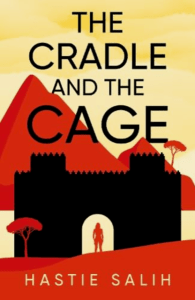
The Cradle and the Cage by Hastie Salih
Yasmine has spent her life piecing together fragmented stories of her homeland, Kurdistan—half-truths and evasions from her mother, the only remaining link to a past shrouded in silence.
Her father died long ago in a car accident, or so she was told. But the gaps in her family’s history have always felt deliberate, like a puzzle with missing pieces. Determined to uncover the truth, she embarks on her first journey to Kurdistan.
What awaits her is far from the homecoming she imagined. An embittered uncle shatters the narrative she grew up with. As Yasmine struggles to navigate the weight of her discoveries, she finds an unexpected bond with Tara, an Iranian-Kurdish sex worker whose life hangs in a fragile balance. In a land where past and present collide, Yasmine is forced to confront not just her own identity, but the harsh realities faced by those who have been silenced for too long.
The Cradle and the Cage is a haunting and powerful exploration of heritage, identity, and the meaning of family—set against the backdrop of a region where history is both an inheritance and a battleground.
Debbie: Hello and welcome, Hastie, I’m so pleased to welcome you to my blog. Your own cultural background is clearly very relevant to both books, as you are of Kurdish descent, although born in Slovakia rather than Kurdestan. Can you please tell us a little more about your own heritage and how it has shaped your view of the settings in your books – both London and Iraq.
Hastie: I was born in Bratislava, Slovakia after my parents escaped Iraq and the totalitarian Baath Regime. I then spent my childhood in Wales and Germany, moving to Britain in 1999 where my daughter was born. My mother is half Armenian. As you can imagine, I have therefore been exposed to diverse cultures and contradicting social norms from a young age. My heritage has been handed down by my mother who was a great verbal storyteller. I spent some holidays in Iraq and last visited the Kurdish region in 2023 which motivated me to write the novel The Cradle and The Cage. The title reveals that Iraq, or olden day Mesopotamia, is the setting for the Cradle of civilisation but can also portray a restrictive cage.
Debbie: To what extent are your protagonists’ journeys to Iraq journeys of self-discovery for yourself? Have you ever taken the same physical journey that they take in your books?
Hastie: My protagonists’ journeys to Iraq are fictional journeys of discovery and self-discovery as I imagined them to be for a young woman, maybe a daughter, visiting her mother’s homeland, Iraq for the first time to help find her identity and place in the world. This is more prominent in the novel The Cradle and the Cage.
My first novel Dahlia and Carys tells the story of forbidden love in London and a woman’s heart-breaking struggle to reconcile her fragmented cultural and gender identities despite family schisms. The story also takes place in Sinjar, a Kurdish Yazidi area where ISIS committed their brutalities towards Yazidi women and men simply because they belonged to a different religion. In 2014, I was working as a GP in London, far removed from the events unfolding in Iraq. Nonetheless, the massacres shocked me.
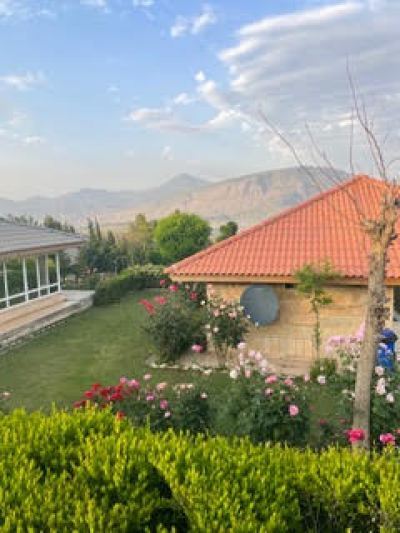 Shingelbana holiday resort, north of Erbil with the Korek mountains in the background (Photo by Hastie Salih)
Debbie: Your powerful books cover topics neglected by mainstream publishing – both in terms of oppressed ethnic minorities and in terms of same-sex relationships. Given a platform like this, what can fiction authors do about the social injustices and perils of modern-day Iraq that news reporting cannot?
Hastie: In my opinion, we have come far as a society, accepting cross cultural or same-sex love but there is still much to be done to provoke self-awareness, understanding and empathy. I think that there has been a surge in interest by publishing houses for underrepresented and non-conformist stories.
Fiction authors can build bridges using storytelling to evoke compassion and empathy by enabling readers to witness social challenges or injustices, and in my novels, perils of modern-day Iraq.
While news reporting informs us, fiction invites us inside another person’s life allowing us to feel the weight of their choices, fears and hopes. That imaginative act of stepping into someone else’s mind is where empathy begins.
Debbie: Another theme you address is family ties, identity and loyalty when political differences and ideologies pull them in different directions. How do your characters prioritise between political and family loyalties? When does it become an impossible choice?
Hastie: My characters often place their convictions and deeply held emotions above both political allegiance and family loyalty. The choice becomes impossible when those forces collide: when remaining loyal to family feels like betraying one’s beliefs, and holding onto those beliefs means losing the people closest to you.
Debbie: Your books are set in both London and Kurdestan, and as a reader, I naively expected London to be the place of safety – but you also address the potential radicalisation by ISIS of young Kurds living in London. To what extent are your themes of universal rather than regional significance?
Hastie: Sadly, radicalisation can happen anywhere including cities like London, which many people assume to be places of safety. In that sense, the themes I explore are universal rather than confined to a particular region. Issues such as people smuggling and the vulnerability of displaced or marginalised communities are global challenges. At the same time, the pressures of family, faith and societal expectations are not unique to my heritage; they exist across cultures worldwide, which I hope allows readers from many backgrounds to recognise something of their own experiences in the story.
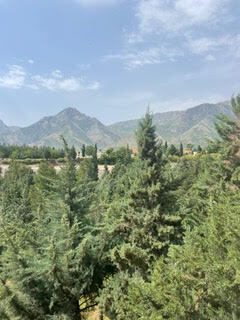 Mountains flanking the city of Sulaymaniyah in Iraq (Photo by Hastie Salih)
Debbie: The Middle East, more so than Western Europe, seems to have been a place of constant migration for the sake of safety, (I’ve just been reading another book about the plight of Jewish Syrians trying to find a safe haven, who fled first to Iraq but ultimately had to flee there too, and to further countries after that.) Can any migrant ever truly feel settled in a new country, or will it always be necessary to explore and understand one’s heritage before making peace with one’s new home?
Hastie: The Middle East has experienced waves of migration partly because borders were drawn by outside powers, most notably in the 1916 Sykes—Picot Agreement between Britain and France, with little regard for the complex mix of religions, ethnicities and identities already present in the region. The consequences of those decisions are still felt today.
For migrants, feeling settled in a new country can therefore be complicated. Integration through education, community spaces and social connection play an important role in helping people feel at home.
At the same time, exploring one’s heritage can also be meaningful – but identity is rarely singular.
Most of us carry multiple, layered identities, and learning to reconcile those layers may ultimately be what allows someone to feel at peace in a new place.
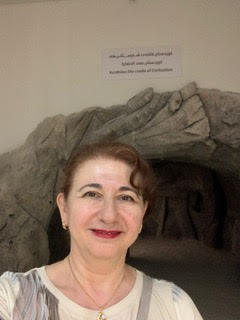 Hastie Salih in front of the Sulaymaniyah museum with the sign ‘Kurdistan— the Cradle of Civilisation’ above the archway.’ (Photo by Hastie Salih)
Debbie: Having endured the startling upheavals and perils, your protagonists reach peaceful and life-affirming endings. How achievable are these outcomes for people like them in real life?
Hastie: My protagonists endure profound and often dangerous upheavals. They are caught not only in cultural clashes and family rifts, but also in the powerful forces of desire and passion that shape human decisions. In my novels, they reach peaceful and life-affirming outcomes when they encounter compassion and care from others.
In real life, such outcomes are not always easy to achieve, but they are possible when people’s traumas and vulnerabilities are recognised rather than ignored.
In many ways it is similar to safeguarding vulnerable children: when they are given stability, care and supportive relationships, they are far more likely to flourish.
Debbie: How has your professional training and 30-year career as a GP shaped your fiction writing?
Hastie: I have been fortunate to work as a GP for more than thirty years, which has allowed me to witness many deeply personal and confidential stories. In many ways, doctors and writers share a common quality: empathy.
My experience as a GP has given me an intimate glimpse into the complexities of human behaviour, and this invariably shapes my fiction.
I tend to write about the flaws and setbacks of my protagonists with sympathy and understanding, much as a doctor hopes to approach their patients.
Debbie: These are two wonderful books that I couldn’t put down, and I felt my world-view and understanding of international affairs was enhanced by reading them – as well as being totally absorbed by the characters as individuals. Are you planning to write more books like these? What are you writing now?
Hastie: Thank you for your kind words. I’m currently writing the first draft of my third novel and hope to complete it by the end of April, when I start a creative writing course in City Lit, London. As you might expect, the themes of the new novel will echo those in my previous books.
There is a growing appetite for stories that explore the intersections of marginalised cultural and sexual identities, and my work sits within that evolving literary conversation. I’m hoping that my novels encourage readers to reflect on the assumptions, morals and prejudices that shape our societies.
Debbie: Finally, a shout-out for your stunning book covers, which arrested my attention as soon as I saw them – and having read the books, the colours and designs seemed perfect wrappers for the stories. Can you tell us how your cover designs came about? What was your brief to your cover designer?
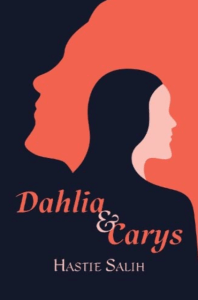
Hastie: For my first novel, Dahlia & Carys, I asked for a minimalist cover featuring the silhouette of a two women placed side by side, without revealing detailed facial features. I wanted readers to be able to project themselves onto the characters and perhaps identify with one of them.
For the cover of The Cradle and the Cage, my brief was slightly different. I wanted the design to evoke a young woman travelling towards her mother’s homeland, with an atmosphere of mystery and danger. I suggested incorporating symbols of Babylon, particularly the Ishtar Gate – the sixth-century BC gateway dedicated to the goddess Ishtar—through which the young woman would appear to pass. The red tones of the mountains were intended to suggest both danger and the emotional intensity of the journey.
I hope my novels allow readers to bear witness to what is happening in our world, while also offering the possibility of transcending pain and recovering hope. Books, after all, allow us to travel without moving our feet.
As Virginia Woolf wrote: ‘Lock up your libraries, if you like; but there is no gate, no lock, no bolt that you can set upon the freedom of my mind.’
Finally, I would like to thank you for giving me the opportunity to appear on your blog. I greatly enjoyed answering your questions and look forward to seeing you again at the London Festival of Writing in June.
Debbie: Thank you so much, Hastie, for your insightful and thoughtful answers. It’ll be great to catch up with you at Jericho’s Festival again!
Find Out More About Hastie SalihVisit her website at http://www.hastie-salih.com. Follow her on Instagram as @hastiesalih.Follow her on LinkedIn at www.linkedin.com/in/hastie-salih-201362286/ Order Hastie Salih’s BooksHastie’s books are available in paperback and ebook from all the usual outlets. I confess I bought the paperbacks because I wanted her beautiful covers to adorn my bookshelves!
Order The Cradle and the Cage from Amazon here. Order Dahlia and Carys from Amazon here.In Other NewsOn Saturday I had great fun on my stall at Bath Central Library, which was hosting an Indie Authors and Small Publishers’ Fair as the final event in the BANES (Bath and North East Somerset) two-week long Festival of Libraries. I really enjoyed catching up with longstanding author chums who had their own stalls and making new ones too. I’m always on the look-out for new speakers for my Hawkesbury Upton Literature Festival events, and I came away with a long list of candidates!
I also donated a copy of the first book in each of my cosy mystery series to Bath Central Library, and I volunteered to be a speaker at any of the BANES libraries in future.
I love doing library talks, and I don’t charge them a fee. It’s an easy and enjoyable way for me to support public libraries and to pay them back for the formative role they have had in shaping me as a writer. Read more about my love of public libraries here.
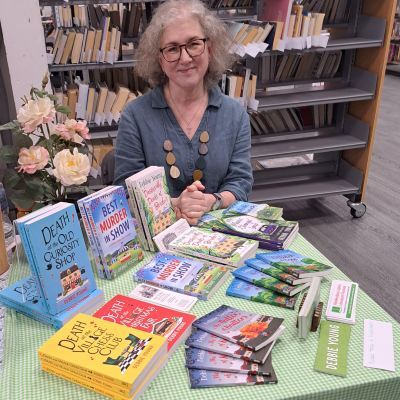 Thanks to my husband Gordon for taking the photo!What I’m Reading
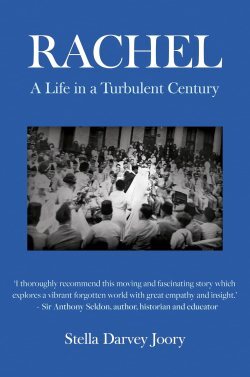 By chance, this weekend I finished reading a book about another oppressed ethnic minority: Syrian Jews. And by another coincidence, this book was also by an author I met through Jericho Writers, this time as a student on my Simply Self Publish course, which I run twice a year. (The next one starts on 7th April – more info here if you’re interested in taking part.)
The author, Stella Darvey Joory, describes her biographical novel as her life’s work, and it’s certainly an impressive achievement. Her purpose was to commemorate and celebrate her remarkable mother, Rachel, as she criss-crossed the Middle East and Europe in search of a safe home.
Here’s how I reviewed it on Amazon and Goodreads…
Rachel: A Life in a Turbulent Century by Stella Darvey JooryWow. What a huge labour of love to commemorate the author’s mother, and at the same time to shed light on the ongoing struggles of a significant minority in the Middle East: Jewish Syrians. Rachel spent her life migrating from one country to another in search of a permanent home and peace, against all the odds. Although it’s a very long book, and a detailed imagining of Rachel’s life, the format of biographical novel divided into many short chapters and sections makes it very readable. It’s also a bold assertion of women’s rights in a region and an era in which the patriarchy was very much in charge. I learned so much about twentieth century history in general, in the kind of personal detail that isn’t taught in schools or covered in history books. Very glad I took the plunge and invested the time required to read this book, which I’ll be widely recommending.
Order in hardback, paperback or ebook here.
The post In Conversation with Hastie Salih first appeared on Debbie Young's Writing Life.
February 18, 2026
Let’s Hear It for Anne Brontë
Reading The Tenant of Wildfell Hall and Agnes Grey for the first time has promoted Anne Brontë to position of my favourite Brontë sister. It has also given me a new appreciation of Sarah Gordon’s play, Underdog: The Other Other Brontë, a gripping tale of the sisterly support and sibling rivalry between the three famous authors, Charlotte, Emily and Anne Brontë, usually lauded in that order.
Like most people, I first read Charlotte’s Jane Eyre and Emily’s Wuthering Heights for the first time at school, and wasn’t especially taken by either of them. Perhaps that why I had never gone out of my way to read Anne Brontë’s two novels before.
But I’d booked tickets to see a new production of Anne Brontë’s The Tenant of Wildfell Hall by Lucy Gough in Aberystwyth next month, and laid low with a virus that stopped me from doing anything more physically demanding than reading a book, it seemed a good idea to swot up a bit beforehand and try it.
 All of the Bronte sisters’ books were published under pseudonyms
I suspect this was also a silent protest against the ubiquitous hype for the new film of “Wuthering Heights”. Yes, the title includes the inverted commas as shorthand to suggest how loosely the film is based on the original. As one reviewer wrote (whose name escapes me), it’s more a kind of 50 Shades in Crinolines than a faithful portrayal of the novel. Sigh.
To my surprise and delight, I soon found myself gripped by the story-within-a-story of the mysterious new tenant of the title, begun by a neighbour who is smitten with her, before being taken up and completed by the tenant herself. It begins almost as a social comedy, a bit like the opening of Pride and Prejudice, but with the new arrival a woman instead of a man – but then turns much darker.
I won’t go in to the details of the story – I’ll leave you to discover those for yourself – but I was blown away by the compelling storytelling, the staunch feminist tone, and the frank depiction of how utterly women were constrained and controlled in Anne Brontë’s era, and ultimately by the very satisfying ending.
 Sketch of Anne by Charlotte (Public domain via Wikimedia)
As with Anne Brontë’only other novel Agnes Grey, which I couldn’t resist starting as soon as I’d finished The Tenant of Wildfell Hall, the heroine is sustained by a strong Christian faith. As a Christian myself, that was fine by me, but if you’re not a practising Christian, don’t let that put you off. Such adversity might turn any woman to faith of some kind, when little else exists in their lives to sustain them.

As you probably know, all three Brontë sisters died tragically young, Anne Brontë at the age of 29. How I wish she’d lived to a ripe old age – how many other great novels she might have written then.
Although Anne Brontë’s novels were long less favoured than her sister’s – and Underdog explains why – I’m pleased that they’ve both crept up in popularity over the years and now rank as great classics of English literature.
From the box office description of Lucy Gough’s new adaptation, I’m confident that her play will do Anne Brontë justice. I just hope that the producers of “Wuthering Heights” don’t add a film version to their to-do list.
Different Ways to Experience Anne Brontë’s The Tenant of Wildfell HallBook your tickets here to see Lucy Gough’s new play of The Tenant of Wildfell Hall at Aberystwyth Arts Centre on 20th and 21st March.See a preview of the National Theatre’s production of Sarah Gordon’s The Other Other Brontë on YouTube. Click here to view the full play via National Theatre at Home (£9.99 per month for as many plays as you like – or just subscribe to watch the one, if you prefer.)Or indeed read the book in any of the many formats available, including this free ebook via Project Gutenberg.In Other NewsArigatao, Japan!I’m pleased to announce that thanks to my excellent agent Ethan Ellenberg and his team, I’ve just received a Japanese translation offer for Death at the Old Curiosity Shop. I’m always thrilled to know my books are reaching readers in languages other than the original English. They’re also available now or soon will be in German, Russian, and Italian.
Title Reveal for Cotswold Curiosity Shop #4In collaboration with my editor at Boldwood Books, I’ve now confirmed the title of the fourth cosy mystery in my Cotswold Curiosity Shop series: Death at the Village Garden Party. I do like to know the title before I start writing – and I’m now 13k words into it (out of a target of 60k, the usual length of my novels), and having great fun dreaming up a garden party that will, naturally, go horribly wrong. This book is already up for pre-order on Amazon here, and will launch on 5th July 2026.
Next Book: A New Standalone MysteryIn the meantime, I’m writing a short story that will serve as an introduction to the launch of my new standalone, The Importance of Being Murdered, which will be published on 26th March. The story will be available from Boldwood Books to whet your appetite – once I’ve written it!
The post Let’s Hear It for Anne Brontë first appeared on Debbie Young's Writing Life.
February 11, 2026
The Remarkable Hazards of 80s Office Life
While writing this year’s murder mystery event for the Hawkesbury Drama Group, I’ve been reminiscing about 1980s office life – the inspiration for my new play, Murder at the Office. (Tickets now on sale here.)
Back in the day, as an impressionable twenty-something fresh out of university, I assumed everything I encountered about office life to be normal practice, because I had nothing with which to compare it.
Smoking in the OfficeLooking back now, I realise a lot that went unremarked would cause an outcry in a 2026 business setting.
The ubiquitous acceptance of smoking in the office, for a start. Non-smokers like me were powerless to prevent nicotine-addicted colleagues from puffing away all day. Open-plan offices were all the rage, so each day I’d go home smelling like an ashtray, and doubtless with secondhand smoke in my lungs.

Putting aside the undoubted damage inflicted by secondary smoking, how were paper-pushers allowed to keep burning cigarettes in ashtrays on their desks? Was no-one worried about the risk of fire?
Apparently not, because when one of my colleagues, Bob, a computer programmer, started a small fire on his desk “because I was bored”, management laughed it off.
Fire alarms must have been far less sensitive in those days, or else cigarette smoke, and certainly Bob’s fire, would have set them off. How many fires from other causes were missed until they’d taken irrevocable hold, risking lives as well as harm to the blazing business?
Smoking was not the only dangerous habit that health and safety rules ignored.
Once, in a fit of frustration, my line manager hurled across the room at her boss the first missile that came to hand, coincidentally an ashtray.
Now there’s an unusual hazard of smoking. Whether she received a reprimand I do not know, but she kept her job.
Lunchtime Drinking at the OfficePerhaps the habitual boozy lunches of the time immunized management against worrying about occupational hazards. Our bosses often spent lunchtime downing pints in the pub or drinking wine in restaurants – on expenses, of course.
.jpg) Conveniently next door to one office I worked at during the 1980s
Conveniently next door to one office I worked at during the 1980sEven junior staff didn’t worry about staying alcohol-free during the working day. If my friends who worked as bank tellers in Central London restricted themselves to “only a couple of pints” at lunchtime, it was primarily because of the long queues at the bar, rather than the government’s drinking guidelines, which were not introduced until 1987.
Oh, and because if their tills didn’t tally at the end of the day, they had to stay behind and keep checking until they did. I wonder how often they sneakily added money from their own pockets or snaffled the surplus to resolve the discrepancy.
Hearing Hazards in the OfficeOther dangers lurked within the office. Desktop computers were just starting to catch on, and before the age of wifi and Bluetooth, every connection had to be hard-wired. The trailing wires to printers and hard-drives presented trip hazards, and early printers were so noisy that it’s a wonder we didn’t suffer permanent hearing loss, despite their sound-proofed hoods.
![Commodore 64 (1984) with ''Video monitor model 1702'' and a''[[Commodore 1541]]'' [[Floppy disk drive]]](https://commons.wikimedia.org/wiki/File:Commodore_64_Pisa_computers_museum.jpg) The Commodore 64, at the heart of one of the businesses I worked at, is now a museum piece.As to the telex machine, its machine-gun-fire noise earned it a separate little room. Despite the racket, I loved operating the telex, excited that when I fed in the punched-tape message I’d created, its message would print out as if by magic at its destination, even on the other side of the world.
The Commodore 64, at the heart of one of the businesses I worked at, is now a museum piece.As to the telex machine, its machine-gun-fire noise earned it a separate little room. Despite the racket, I loved operating the telex, excited that when I fed in the punched-tape message I’d created, its message would print out as if by magic at its destination, even on the other side of the world.
So next time you’re railing against health and safety regulations in your workplace, think again: at least they’ve saved us from the office hazards of the 80s.
I’m just glad I survived the dangers of that decade long enough to be able to reminisce about them.
 In case you’re wondering what the header image is… the 5 1/4″ floppy disk was everywhere in the 80s office (Image source: CC BY-SA 3.0, https://commons.wikimedia.org/w/index.php?curid=35132)
(This article first appeared in the February 2026 edition of the Hawkesbury Parish News.)
In Other News As you may have spotted from the opening paragraph, I’ve finally settled on the title for my new murder mystery playscript that I’ve written for the Hawkesbury Drama Group. Having had A Capital Murder in mind, as the plot kicks off with the arrival of a venture capitalist at a software start-up company seeking further funding, I had a change of heart to a more “Ronseal – does what it says on the tin” idea: Murder at the Office.
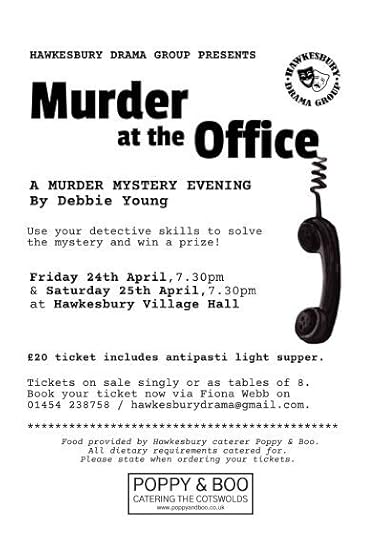
Set in the 1980s, when newfangled mobile phones were the size of a housebrick and personal computers were just starting to seem like a good idea, it’s a jolly romp inspired by various office jobs I held during that heady period – including a home computer software company which had better remain nameless! However, if anyone remembers working in Worcester Park for such a company in the mid-80s, I’d love to hear from you, so don’t hesitate to get in touch. I’d love to know what you’re up to now.
Here’s the poster advertising the play, in case you’re within reach geographically and would like to book a ticket. We’re going to have fun!
In the meantime, I’m looking forward to the launch next month of the novelisation of last year’s murder mystery play, The Importance of Being Murdered, published in all formats by Boldwood Books on 26th March.
Coming soon – my cosy mystery novel inspired by Oscar Wilde’s playWhat I’m Reading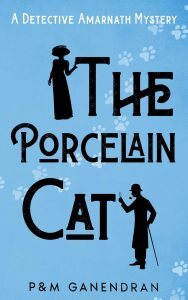 The Porcelain Cat by M & P Ganendran
What a find! Having enjoyed a contemporary mystery by M Ganendran (reviewed in last week’s post), I thought I’d give this one a go, written jointly with her husband, this time a historical detective story set in London in 1900, and with a couple of cameo appearances by Sherlock Holmes.
I thoroughly enjoyed this charming story about a young woman, Madeleine, keen to become a detective’s assistant, defying her mother’s wishes to settle down to a nice, safe job in a telephone exchange. Unable to persuade Holmes to take her on, she joins forces with Detective Amarnath, an Indian detective newly arrived in London to train the British force in the new art of fingerprinting.
Full of fascinating historical detail, with lively, well-drawn characters, this gentle, cosy mystery is warm, witty, and fun, and I am looking forward to reading more in the series as soon as Mr & Mrs Ganendran, very productive across a range of genres, find time to write them!
The post The Remarkable Hazards of 80s Office Life first appeared on Debbie Young's Writing Life.
February 4, 2026
It’s a Wilde, Wilde Life with Oscar
“There is no sin except stupidity” is the provocative Oscar Wilde epigram I chose for my page in my high school yearbook. I’ve always loved Wilde’s way with words, so last year, when writing a murder mystery playscript about an amateur dramatic society, I set it around their rehearsals for Wilde’s comedy play, The Importance of Being Earnest. Cheekily, I named my playscript The Importance of Being Murdered, and later turned it into a novel, which will be published next month.
Coming soon – my cosy mystery novel inspired by Oscar Wilde’s playAs I started writing my script, I heard that the National Theatre was reviving Wilde’s play, and I enjoyed the subsequent livestream.
Later, I learned their production would transfer with a new cast to the Noel Coward Theatre, with Stephen Fry as Lady Bracknell.
Next came news of an operatic version to be staged at the 2026 Garsington Festival.
Then last month on opening The Times’ property section I discovered a full-page profile of the “real” home of Algernon Moncrieff, one of the play’s key characters.
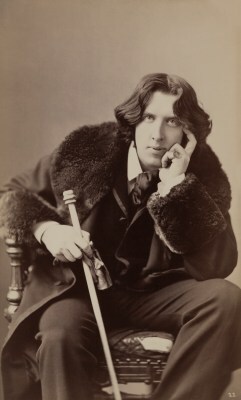 Oscar Wilde (1854-1900): Suddenly, he’s everywhere!
The Papua New Guinea SyndromePapua New Guinea Syndrome strikes again, I thought.
That’s a phrase my first, late husband taught me, because once, when offered a job in Papua New Guinea, he started spotting references to that remote country wherever he went. Subsequently, he used the term whenever a word or concept new to him became puzzlingly ubiquitous, and it never occurred to me to call this phenomenon anything else.
That’s what I’ll write about for the February issue of the Tetbury Advertiser, I decided this morning, but something told me to google “Papua New Guinea Syndrome” first.
You can imagine my horror on discovering a different, darker meaning: a rare, degenerative and fatal disease caused by eating human brains. Abolished in 1960, this tradition was practised by Papua New Guinea’s Fore tribe, who believed it released the souls of the departed.
The Baader-Meinhof PhenomenonFurther googling reassured me that my late husband wasn’t the only one to have coined an inappropriate phrase for what must be a universal occurrence. In 1994, one Terry Mullen wrote a letter to the St Paul Pilgrim Press in Minnesota, describing the same experience as the Baader-Meinhof Phenomenon. As you may know, Baader-Meinhof was a late-twentieth-century terrorist organization named after its founders in 1970. Presumably news of their activities took a while to reach St Paul, Minnesota – and then seemed to pop up everywhere.
The Frequency IllusionThankfully, a Stanford academic eventually came up with a less emotive term: “frequency illusion”. Writing in 2006, Linguistics Professor Arnold Zwicky explained that our selectively attentive brains home in on what interests us, screening out irrelevance. Confirmation bias gives us the impression that our pet word, phrase or topic is cropping up more often than in reality.
What would Oscar Wilde have made of our earlier misappropriation of language? Returning to my opening quote, I’m rather afraid he might have thought it a sin.
This post first appearedin the Tetbury Advertiser’s February 2026 edition.
PS Since I wrote this piece last month, Oscar Wilde has continued to jump out of the woodwork at me – a documentary about him popped up in PBS’s schedule and another article in The Times, this time about an art exhbition inspired by Wilde and called “Lord Arthur Savile’s Crime” after his short story of the same name.
PPS If the title of this post sounds familiar, it’s because I borrowed it from David Byrne and Talking Heads‘ song, ‘Wild, Wild Life’, which appears in his brilliant whimsical film, True Stories – one of my favourite movies of all time.
In Other NewsWith The Importance of Being Murdered now in production, I had a very enjoyable chat with my editor last week about my plans for my next book, which will be the fourth Cotswold Curiosity Shop mystery. We haven’t yet hit upon the right title, but I’ll share that with you once we have.
In this book, Alice will help Robert refurbish a crumbling manor house that he takes over in the nearby village of Bunbury, the source of much rumour and gossip in their home village of Little Pride. Alice’s friends and neighbours will provide evidence that help her uncover some strange goings-on on the Bunbury estate, including a startling murder at their welcome party. I’m very much looking forward to spending more time with Alice, Robert, Wendy, Danny, Nell, and all their friends and neighbours – and there’ll also be a guest appearance by one of my favourite charactrs from The Importance of Being Murdered!
Otherwise, in between writing, I’m busy teaching and mentoring for Jericho Writers, and on 21st February I’m going to have fun meeting readers and writer friends at my stall at the Bath and North East Somerset (BANES) Festival of Libraries.

I’ve been ploughing through several chunky non-fiction books this week, and the only book I did manage to finish reading was a cosy mystery set in Zennor, one of my favourite places in Cornwall. With mermaids and mystery thrown into the mix, I couldn’t resist.
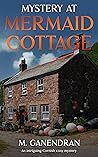 Mystery at Mermaid Cottage by M Ganendran
This engaging cosy mystery set in a naturally mysterious part of Cornwall, the village of Zennor. The Cornish village of Zennor, at the far tip of Cornwall, is a terrific setting for all kinds of novels, and when I see a book is set in Zennor – which I’ve loved since first visiting as a child – I immediately want to read it. Knowing that the local mermaid legend is an important part of Zennor’s identity was another draw.
I raced through this atmospheric cosy mystery that really brings the village and its legends to life. Added interest came from the characterisation and the sub-plot of a niece rebuilding a relationship with her estranged aunt. Interesting that it’s a very modern mystery, eg computers come into it, but also very much bound up with the village’s history. A gentle comfort read for the cold, dark January nights.
The post It’s a Wilde, Wilde Life with Oscar first appeared on Debbie Young's Writing Life.
January 29, 2026
Remembering Grandma’s Two-Sheet Solution
As I look forward to my first state pension payment landing in my bank account tomorrow, I’m thinking about the wise advice about financial economy that I received from my grandma when my grandpa was about to retire.
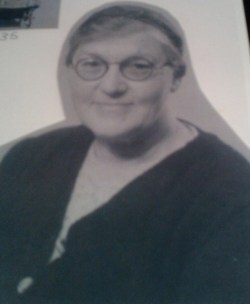 My beloved Grandma when she was aout the same age that I am now
Grandma, born in 1900, had what we’d now call a stay-at-home mum to her three children, and a wonderful wife to my hardworking Grandpa, who commuted to London every day from their dear little 1930s terraced house in Sidcup in the London Borough of Bexley. I was privileged as a child at Days Lane Primary School to be able to visit Grandma every day during the school dinner hour, as she lived within walking distance of my primary school.
Different TimesThe school day was longer then that it is now, because we had three breaks during the day – morning playtime, afternoon playtime, and an hour and twenty-five minutes at what in those days we still called dinner-time.
Now that it’s the norm for all primary schoolchildren to stay at school for lunch, whether or not they’re buying a school meal, such a long midday break may seem absurd. Even where I live now, in a Cotswold village in which most pupils live within a short walk of the village primary school, everyone stays for lunch, with a brief outdoor playtime, weather permitting, before afternoon school.
But in my day, most mothers didn’t work. Oh, and most were married to and living with their children’s fathers. It wasn’t until I went to secondary school that I made a friend whose mother was divorced. Even then, she was the only child in the class with a single parent. My mum, however, did go out to work, having trained as a primary school teacher when I was very small – a job at which she excelled, and I’m sure must have been all the happier for doing it.
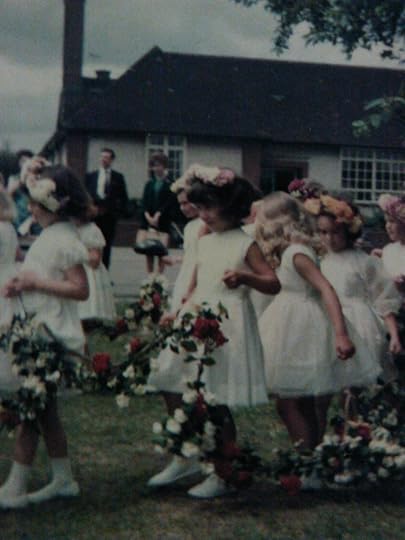 Me, aged 6, centre, being a May Maiden at Days Lane Infant School in 1966School Dinners
As a fussy eater, I was traumatised first by nursery school dinners, which I seldom stayed for – the sight and smell of baked beans still makes me nausous – and then by the food served at my otherwise idyllic primary school. Mrs Nash trying to force me to eat beetroot put me off it for life. Seeing beetroot still makes me shudder.
In those days, a decade after the end of war-time rationing (did you know that was not, astonishingly, until July 1954?), all the grown-ups around us had had it drummed into them not to waste food, so no wonder the dinner ladies – mostly lovely, kind souls – tried to make us clear our plates. Fortunately, my mum and my grandma had a better idea: that I should instead spend every school dinner-time at Grandma’s.
So, from the age of four until the age of eleven, the dinner bell prompted me to walk down the road and round the corner – thankfully, no roads to cross – to Grandma’s house. Part of the way I walked with friends who lived along the route, but the rest I traversed alone. To 21st-century parents, that may seem very young to be out and about on my own, but I felt safe. Walking down suburban streets where if I had any worries, I could have run up the nearest garden path and knocked on the door for help. Chances were that at least one adult would be at home.
 Me, aged about 9, in front of Grandma’s magnolia
Initially, the walk was 25 minutes each way, and by the time I was in the top class, with much longer legs, I could do it in 15. The timing was perfect. Grandma would have lunch ready to serve when I arrived – always two courses, usually hot, and delicious traditional meals – and we’d sit down just in time to listen to interesting programmes on BBC Radio 4 as we ate: Desert Island Discs, Down Your Way, Twenty Questions – all of which nurtured my love of words and sense of humour and my interest in the wider world.
Fun & Games with GrandmaOnce we’d finished eating, we’d clear the table and settle down to a game – Snakes and Ladders, Patience, Sevens, and Scrabble. Grandma’s word power was wonderful – she’d won prizes for her recitations as a child – and only relatively recently did I realise that Grandma must have often let me win at Scrabble to build my confidence.
An Education in LifeGrandma also kept abreast of current affairs, and I remember her teaching me about the introduction of postcodes and decimalisation. I used to pride myself on my mental arithmetic skills, but Grandma could convert sterling to decimal faster than I could.
She also introduced me to political issues. She didn’t get the vote until she was 28 (in Britain, universal women’s suffrage was introduced in 1928 in the Equal Franchise Act), and she cherished her voting rights. When I asked her which party she would be voting for in the next general election, she refused to tell me, instilling in my the importance of the privacy of the ballot box.
A Londoner who had lived through both World Wars, she told me on the day of Winston Churchill’s funeral (60 years ago tomorrow, codenamed “Operation Hope Not”) why he was such an important figure in world history. I was just six years old, but I took it all in.
Financial AdviceBut one of my favourite pieces of advice was her financial guidance: what I’ve thought of ever since as The Two-Sheet Solution. I’ve just discovered that’s now accounting jargon for using two Excel sheets at once, but I prefer Grandma’s version:
to economise, on retirement, by using two sheets of toilet paper instead of three, thus instantly cutting the cost of toilet roll by a third.
Genius.
I first wrote about her Two-Sheet Solution 15 years ago here, at another pivotal time in my finances, when I was about to step down from my day job to devote my waking hours to building a new career as a writer. Fortunately, that’s gone well enough that I haven’t yet had to resort to this particular measure of Grandma’s – but I’m grateful for her advice, and for all that was my lovely Grandma.
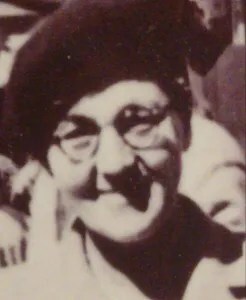 My beloved Grandma
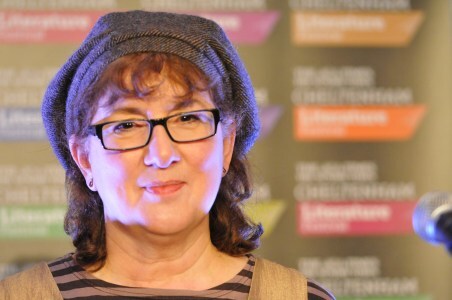 Spot the family resemblance (taken a few years ago when I was reading one of my short stories at Cheltenham Literature Festival, and channeling Grandma’s recitation skills)
In Other News
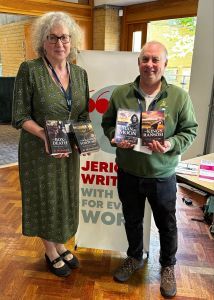 Spreading top tips about writing for Jericho Writers at Troubador’s Self-publishing Conference this summer, with course alumnus and published author R. Marsden
I’ve been working flat out this week with various writing tasks, including a couple of guest posts for Jericho Writers, for whom I teach a self-publishing course twice a year, as well as offering mentoring sessions. I was delighted to meet a new mentee this week and am looking forward to helping her set priorities and goals in her writing career.
Find out more about my Simply Self-Publish Course, which next runs from April to June, here. Jericho also manages my mentoring work, and they’re the first point of contact for any enquiries – click here to ask about mentoring.
I’ve also just finished the first draft of my new Murder Mystery event script for Hawkesbury Drama Group, which will be performed in April. I have a script meeting with the director and her deputy on Friday to fine-tune it to suit their cast.
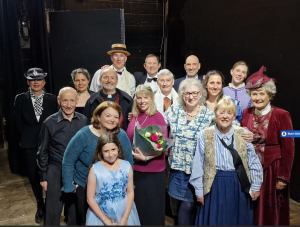 With the brilliant cast of the first production of The Importance of Being Murdered – with me in the blue and white top, centre (Photo by Bill Fairney, who played Bertram Manchester)
I’m gearing up for the March launch of my next mystery novel, which is based on last year’s play, The Importance of Being Murdered. Part of my task is to write a 1,000 word story as a teaser for the novel, and I’m going to have fun with that. Pre-order your copy of The Importance of Being Murdered here.
Then this afternoon I have a meeting with my editor to talk about my plans for the fourth Cotswold Curiosity Shop mystery, due out in July.
As you may have guessed, I may have reached state pension age, but I won’t be retiring any time soon.
What I’m ReadingWith all that going on, it’s a wonder I have any time left to read, but I make time for reading every morning, which slows me down, hones my writing skills by osmosis, and generally keeps me sane.
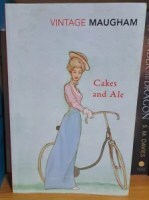
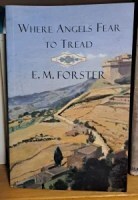
This week, I’ve had a classic vibe going, reading Cakes & Ale by W Somerset Maugham and Where Angels Fear to Tread by E M Forster – both hugely enjoyable, absorbing must-reads. I haven’t had time to post reviews of them, but trust me, they’re both wonderful!
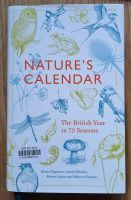
I’m also reading, very slowly, Nature’s Calendar, which breaks the British year down into 72 micro-seasons. I’m reading each section in real time as it happens, so will wait until the last day of the year to read this one.
New My Bookshelf AppTo try to keep my heaving bookshelves under control, I’ve downloaded a new app to catalogue my books, so that I can make sure I don’t buy duplicates and also to help me manage collections of certain editions, eg classic 0range-spined Graham Greene Penguins and Folio editions of my favourite books, always acquired second-hand. The app is called “My Bookshelf” and is available for Google and Android. The free version only allows for 50 books, so I’ve bought the paid edition, which allows for any number. I’ll be very interested to see how many books I own altogether, once I’ve added them all. Adding books published since ISBNs were invented in 1967, as you just scan the barcode with your phone and they magically appear in your inventory. However, about half the books I own are vintage editions with neither ISBN nor barcode, so cataloguing my whole library could take some time!
The post Remembering Grandma’s Two-Sheet Solution first appeared on Debbie Young's Writing Life.



![[image error]](https://commons.wikimedia.org/wiki/File:Siemens_T100_Telex.jpg)