
David P. Murray's Blog
May 28, 2023
Our Purpose: God’s Home
INTRODUCTION
Homelessness is a miserable experience. We see it in our big cities especially: New York, Los Angeles, San Francisco, Portland, etc. But we also see it closer to home at with homeless beggars at many Grand Rapids traffic stops, and tent encampments along the banks of the Grand River. Who cannot feel sorry for the people in these awful circumstances. To be homeless is to be uncomfortable, cold, wet, vulnerable, lonely, insecure, hungry, pitiable, unhealthy, and afraid.
But the Bible teaches us that homelessness is much closer to home than the big cities, and even Grand Rapids. It’s not just something we can see on our computer screens or through our car windows. It’s something we can see in the mirror. Yes, you are homeless. I am homeless. We are all spiritually homeless to one degree or another. That’s not how it was meant to be. That’s not how God intended it to be. This was not God’s purpose for us. We feel our homelessness from time to time. So, where is home and how do we get there? In John 14, Jesus tells us where home is and how to get there.
BACKGROUND
Sermon 1: God’s purpose is is to glorify himself in grace-and-truth filled relationships.Sermon 2: Our first purpose is to glorify God in grace-and-truth filled relationships.Sermon 3: Our second purpose is to give God pleasure.Sermon 4: Our third purpose is to receive and return God’s love.Sermon 5: Our fourth purpose is to be part of God’s family.Sermon 6: Our fifth purpose is to be like God’s Son.Sermon 7: Our sixth purpose is to be God’s servant.Sermon 8: Our seventh purpose is to be God’s missionarySermon 9: Our eighth purpose is God’s home.But I’m not homeless. I have a lovely home.
1. WE ARE HOMELESS
“Let not your hearts be troubled. Believe in God; believe also in me” (1).
Our First Home
God’s created a perfect home in a perfect world for his perfect people (Genesis 1-2). Eden was the divine paradise that God designed and created for the first human beings, Adam and Eve. It was “Home Sweet Home.”
Our Eviction
But our first parents rebelled against the home builder, disobeyed his rules, and were punished with eviction from God’s home and God’s presence (Gen. 3). They were put outside the garden, outside God’s special nearness, and exposed to all the miseries of homelessness. Since then, we’re all born outside of God’s garden and presence.
Our Homelessness
Even if we live in a big beautiful home with a big beautiful family, we are spiritually homeless. We are outside of God’s family, God’s home, God’s presence, God’s love, God’s protection. We are spiritually uncomfortable, cold, wet, vulnerable, lonely, insecure, hungry, pitiable, unhealthy, and afraid.
Thankfully God has made a way back to him and his home. In the Old Testament, he provided a Tabernacle and a Temple for the spiritually homeless to find a home with him and nearness to him by visiting his home with a sacrifice. In the New Testament, God has provided an even better way home and even greater nearness to him by providing the sacrifice of Jesus and the fellowship of his family in his church.
But even those of us who come home to God through Jesus’s sacrifice and Christian fellowship, still feel homeless at times. It’s like we’re in a halfway house. Being a Christian is better than being totally homeless and outside. We get special times of closeness and nearness to God and his family through Christ. But we still feel like pilgrims and strangers at times. God can feel distant, our enemies can feel close, our sufferings are long and deep. We sense that there must be somewhere better, somewhere that is really home.
That’s where the disciples were at in John 14. In the previous chapter, Jesus’s words about his departure through death had left them feeling alone, insecure, anxious, and disturbed. He saw their perplexity and, in John 14, he begins to comfort them with the prospect of a far better home and a far better family in the future.
CHANGING OUR STORIES WITH GOD’S STORY
Do you feel at home here? If you feel at home in this world, you have never been more homeless. You are homeless and you don’t even realize it. It’s like a homeless person living in a tent thinking that he’s living his best life. Ask God to show you your homelessness.
Do you feel homeless here? That’s good! Praise God for helping you to feel how bad that experience is. It’s the first step on the way home. Jesus tells you how to get home in John 14:1, 6. If you are not a Christian, you should be thankful that God has helped you to feel homeless and given you times of feeling at home with Jesus and his people. But that isn’t constant, is it? Like the disciples we long for more.
THE FIRST STEP HOME
IS HAVING NO HOME
Where and when will we ever feel “at home”?
2. OUR FATHER PROVIDES A HOME FOR US
“In my Father’s house are many rooms” (2).
Heaven is home
Over the past seven sermons on purpose we’ve learned that there are a number of tracks to our purpose in life. But, all of them have one great aim and destination. Home! Our greatest, ultimate, primary purpose is to get home. As Tim Keller said in some of his last words to his family (remember, this was a man who had fulfilled so much of God’s purpose on earth). But listen to his final words to his family: “He expressed many times through prayer his desire to go home to be with Jesus. His family is very sad because we all wanted more time, but we know he has very little at this point. In prayer, he said two nights ago, “I’m thankful for all the people who’ve prayed for me over the years. I’m thankful for my family, that loves me. I’m thankful for the time God has given me, but I’m ready to see Jesus. I can’t wait to see Jesus. Send me home.” Randy Van Dyk and his family have expressed similar words in recent weeks. However much Randy wishes he had more time, and his family wish they had more time, they all realize that this life is all about getting home. That’s our greatest purpose. We must get home.
Heaven is homey
What makes heaven such a wonderful house is that it’s our Father’s house. It’s not where it is or what it is but whose it is that fills us with longing and desire. If he’s there, love is there, peace is there, power is there, beauty is there, wisdom is there, provision is there, delight is there, friendship is there, family is there.
Think of the relief of getting home when we’ve been away for a long time, or if we’ve had a hospital stay, or if we’ve been serving in mission or in the military. That feeling of relief and joy as we walk into our home, is a fraction of the relief and joy we will experience when we get to our final home. However comfortable we’ve had it down here, however happy, getting to heaven will feel like getting home after fighting in a long brutal war.
Heaven is huge
Sometimes when we go to book a hotel room, we are told, “Sold out” or “No rooms available.” That will never happen in heaven. There are many, many, many rooms. The kind of homes the disciples would have in mind when they heard this was the common Middle Eastern design of a large central garden courtyard where everyone gathered with multiple rooms built around it.
CHANGING OUR STORIES WITH GOD’S STORY
Get home. Getting home is our greatest purpose. Nothing else matters. You must get home or you will become eternally homeless, eternally outside, eternally lonely. Start every day with “I must get home.”
Help home. If we know how wonderful heaven is, how homey, surely we want to do everything in our power to help others get there too. When people tell us, it’s not for them, assure them of the many rooms. There’s still room. There will always be room until the very end. As long as there is time, there’s room.
MAKE YOUR HOME
ABOUT GETTING HOME
That sounds amazing. But how do I get home?
3. OUR SAVIOR PREPARES A HOME FOR US
“I go to prepare a place for you. And if I go and prepare a place for you, I will come again and will take you to myself, that where I am you may be also” (2-3).
Jesus prepares our home
When Jesus said, “I go to prepare a place for you” he was referring firstly to clearing the road home. The greatest home is useless if the access road is blocked. Jesus went to clear the access to God and open the door of heaven by dying on the cross to remove the barriers between us and God. Secondly, he was referring to our experience of heaven when we get there. He prepared earthly rooms as a carpenter and now prepares heavenly rooms as the Savior. He’s preparing a unique place for each of his unique people so that each will have a unique experience of home.
Jesus takes us home
When our kids are away from home for a while, we miss them and long for them to return home. Perhaps they are at college or working in another state. But then the date for their return comes and you are so anxious to see them that you don’t wait for them to come home, but go and get them yourself. Jesus has that same longing to see each of his people and at the set time, he goes to get each one at just the right time and in just the right way.
Jesus welcomes us home
Jesus does not just take us home but welcomes us home and enjoys us at home. He takes us to himself and wants us to be with himself, literally “face to face” with himself. He’ll show us around and introduce us to the rest of the family. “Look at this and this! Look at her! Look at him!” He’ll take us to our room and show us around with delight. He’ll remind us that there’s no night there, no death, no sorrow, no crying, no pain, no sin, no Satan, no worry, no depression, no disease, no evil. There’s no place like home.
CHANGING OUR STORIES WITH GOD’S STORY
Praise the Preparer. He’s done so much, is still doing so much, and will yet do so much to make your home, to take you home, and to make you feel at home.
Trust the Taker. Jesus has designed our taking so that it’s best for us and the best way to get others ready for home too. Our arrival and departure times are on God’s timetable. He’s designed the road and the transport. It can be a long and rough journey, but remember where you are going and who’s taking you there.
Anticipate the welcome. We cannot imagine how welcoming Jesus will be to us and for us. “I’m so glad to have you home” he’ll say, because his prayer has been answered: “Father, I desire that they also, whom you have given me, may be with me where I am, to see my glory that you have given me because you loved me before the foundation of the world” (John 17:24).
HOME IS WHERE THE HEART IS
SUMMARY

A NEW CHAPTER
Unbelievers: You must prioritize securing a heavenly home over your earthly home. Nothing matters more than this. You cannot get there apart from Christ (John 14:6)
Believers: While thankful for finding a home with God and with his people, while thankful for moments of joy and belonging, yet we still have times when we realize we are not yet fully home. It reminds us that here we have no continuing city but seek one to come (Heb. 13:14). Every day, remind yourself, “I must get home. I must prepare for going home as Christ is preparing my home for me.”
Prayer: Home builder and home preparer, we thank you for not only providing a heavenly home, but preparing it for us so that we can be eternally at home with you and so fulfill our greatest purpose.
DISCUSSION QUESTIONS
1. What does spiritual homelessness feel like?
2. What makes a Christian feel homeless in this world?
3. How did this sermon change the way you view the church, this world, death, heaven?
4. How can you help others get home?
5. What are the parallels/differences between your earthly home and your heavenly home?
6. If “getting home” is our greatest purpose, what difference does that make to our lives?


May 21, 2023
The Spirit and our Sanctification
INTRODUCTION
“I feel so dead….spiritually.” Is that you? You used to be so spiritually alive, but now you feel so spiritually dead. You still go through the motions of the Christian life, but it’s like dragging a corpse around. It’s a drudge and a labor. What’s gone wrong? And, how can I fix it? Why am I so dead and how can I revive my soul? Paul answers both questions in Romans 8:12-13.
BACKGROUND
Romans 8 tells us a lot about the work of the Holy Spirit in our lives. What the law could not and cannot do, the Holy Spirit can and does.
The Holy Spirit transforms our conscience (1-3)The Holy Spirit transforms our minds (4-9)The Holy Spirit transforms our bodies (10-11)The Holy Spirit transforms our holiness (12-13)The Holy Spirit transforms our assurance (14-17)The Holy Spirit transforms our suffering (18-25)The Holy Spirit transforms our prayers (26-27)The Holy Spirit transforms our purpose (28-29)What’s the first step back to life? Calculating our debt to the Holy Spirit.
1. WE ARE DEBTORS TO THE SPIRIT
“…we are debtors, not to the flesh, to live according to the flesh. For if you live according to the flesh you will die” (12-13).
We are not debtors to the flesh
We don’t owe the flesh (our sinful human nature) anything. We are under no obligation to the flesh. We have no debt to the flesh. The flesh has no legal or moral hold on us. It’s not our friend or benefactor but our enemy and our mortal foe.
We therefore have no obligation to live according to the flesh, to listen to the flesh, to follow the flesh, to respond to the flesh’s promptings. If we do try to please or satisfy our flesh, we will die. Our spiritual life will die a little. Sin starves, suffocates, and strangles our spiritual life. If that becomes a lifestyle, it means we are not truly saved, and we will die eternally.
We are debtors to the Spirit
This is not stated explicitly, but it is clearly implied as a contrast. If it was to be stated explicitly, it would read: “We are debtors to the Spirit, to live according to the Spirit. For if you live according to the Spirit, you will live.”
The Spirit transforms our conscience (Rom. 8:1-3), our minds (4-9), and our bodies (10-11). We therefore owe the Spirit so much. We owe the Spirit our spiritual life and our eternal life. Therefore we dedicate our lives to the Spirit. We listen to the Spirit, we follow the Spirit, we respond to the Spirit’s promptings. If we do that, we will live like we’ve never lived before. Every time we follow the Spirit we get more of the Spirit, we get more life.
CHANGING OUR STORIES WITH GOD’S STORY
Count your debt to the Spirit. Take time to calculate how much you owe the flesh. What has it ever done for you? How has it ever benefitted you? Where has it ever helped you? How much has it added to your life? How much do you owe the flesh? Nothing! Then calculate what the Holy Spirit has done for you, given to you, helped you, added to you. How much do you owe? Everything!
Increase your life by the Spirit. As you count your debt to the Spirit, it will make you more obliged to the Spirit, more grateful to the Spirit. That in turn will make you more aware of the Spirit, more receptive to the Spirit, more responsive to the Spirit, more alive by the Spirit. We are either spiritually dead or spiritually alive, but there are degrees of spiritual life. We can be barely breathing or thriving and flourishing. If we want the latter, if we want increased life, here’s how.
BAD DEBT SLAYS
GOOD DEBT STIMULATES
What do we do with this new life? We kill.
2. WE ARE KILLERS BY THE SPIRIT
We kill by the Spirit
“…if by the Spirit you put to death the deeds of the body, you will live”? (13).
We “put to death the deeds of the body.” The deeds of the body are not only the sinful actions of the body, but also the desires, thoughts, words, and actions that precede and produce them (Matt. 15:18-20). We are to view these as murderers that we must murder first. The only debt we owe this enemy is death.
We kill sin by starving it of food (through the eye or the ear), by feeding it poison (God’s Word), by attacking it with prayer, by joining forces with others (accountability), by remembering the worst ever murder (Christ on the cross). We are to do this, we are to do the killing. But we cannot do this in our own strength or by our own power. We cannot do this by self-discipline or self-improvement. We can only do this by the power of the Holy Spirit in our lives. The Spirit of life helps us to kill the threats to his life in us.
“Until you believe that life is war — that the stakes are your soul — you will probably just play at Christianity with no blood-earnestness and no vigilance and no passion and no wartime mindset. If that is where you are this morning, your position is very precarious. The enemy has lulled you into sleep or into a peacetime mentality as if nothing serious is at stake. And God, in his mercy, has you here this morning, and had this sermon appointed to wake you up, and put you on a wartime footing.” John Piper.
We live by killing
“You will live” (13).
If we kill, we will live. Killing killers enlivens life. Christians kill sin to stimulate life. For the Christian, life follows killing. We live by killing. As you kill, you will get more life, which will energize you to kill another sin, which will give you more life, and so on. There is always another sin to kill, and each attempted murder is an opportunity for more life.
What does that life look like? It looks like greater love for God, greater assurance of salvation, greater heavenly-mindedness, greater discernment, greater guidance, greater courage, greater opportunities to witness, greater help in everyday life, greater answers to prayer, greater enjoyment of God, greater insight into Scripture, greater usefulness to others, greater hatred of sin. So much life!
CHANGING OUR STORIES WITH GOD’S STORY
Get a wartime mindset. “The only possible attitude toward out-of-control desire is a declaration of all-out war. . . There is something about war that sharpens the senses . . . You hear a twig snap or the rustling of leaves and you are in attack mode. Someone coughs and you are ready to pull the trigger. Even after days of little or no sleep, war keeps us vigilant.” Ed Welch.
Kill one sin. Instead of trying to attack all our sins at once, target one, and develop a plan to murder it this week. It might be time-wasting, lust, gossip, anger, greed, discontent. Whatever it is, identify it, target it, gather intelligence on it, build up resources, develop a plan of attack, and determine that this week you are going to murder this sin. Then target another, and another, and soon you will become a serial killer of serial sins.
KILL SIN OR
SIN WILL KILL YOU
SUMMARY

A NEW CHAPTER
Unbeliever: You will never kill sin without the help of the Holy Spirit. You might stop the acts of sin for a while, but the root is still there and only the Holy Spirit can root it out. Pray that the Holy Spirit will start new life in your soul by regeneration.
Believer: You need a wartime mentality and a killer instinct when it comes to sin. The more you kill, the more you will revive. But like, the unbeliever, you cannot do this on your own. Pray to the Holy Spirit for a murderous spirit and a ruthless merciless determination to kill sin. The weapon he uses most is the Word of God (Heb 4:12).
Prayer: Sin-killing Spirit, share your killer instinct with me so that I can murder sin and enjoy deeper, greater, and better life.
DISCUSSION QUESTIONS
1. What has killed or is killing your spiritual life?
2. What debts to you owe to the Holy Spirit? Put a value on it.
3. What have you found to give you greater spiritual life?
4. What have you found helpful in killing sin?
5. How do you know if you have increased spiritual life? What are the signs of life?
6. How did Jesus experience these verses in his earthly life?
May 14, 2023
The Spirit Transforms our Bodies
INTRODUCTION
Tech tycoon Bryan Johnson, 45, spends $2million a year to engineer his body into that of an 18-year-old. Through diet, exercise, and various high-tech devices, Johnson and his doctors claim that in two years he has reduced his overall biological age by more than five years and now has the heart of a 37-year-old, the skin of a 28-year-old and the lung capacity and fitness of an 18-year-old. Like most people, Johnson wants to delay aging or rewind the process of dying and is putting his hope in technology to achieve this.
Others are more focused on restoring life after they die. Today, nearly 200 dead patients are frozen in Alcor’s cryogenic chambers at temperatures of −196 °C, including a handful of celebrities, who have paid tens of thousands of dollars for the goal of “possible revival” and ultimately “reintegration into society.” One of the most famous is Paypal founder and tech titan Peter Thiel. Replying to a question about whether humanity can conquer death and whether it should, Thiel responded, “We haven’t even tried. We should either conquer death or at least figure out why it’s impossible.” Like most people, Thiel wants life after death and is putting his hope in technology to achieve this.
What’s the Christian hope of greater life here and hereafter? The Apostle Paul points us to the Holy Spirit not high tech.
BACKGROUND
Romans 8 tells us a lot about the work of the Holy Spirit in our lives. What the law could not and cannot do, the Holy Spirit can and does.
The Holy Spirit transforms our conscience (1-3)The Holy Spirit transforms our minds (4-9)The Holy Spirit transforms our bodies (10-11)The Holy Spirit transforms our holiness (12-14)The Holy Spirit transforms our assurance (14-17)The Holy Spirit transforms our suffering (18-25)The Holy Spirit transforms our prayers (26-27)The Holy Spirit transforms our purpose (28-29)How do we get greater life here in this dying world?
1. THE SPIRIT GIVES LIFE WHILE WE DIE
The body is dead because of sin
“Although the body is dead because of sin” (10).
“The body is dead” does not mean it is actually completely dead, but that it is sentenced to death, appointed to death, subject to death, in the realm of death, in the process of dying. There’s a deadness in our bodies. Just as we say of the condemned murderer on death row, “He’s a dead man walking.” It doesn’t matter whether we are young or old, healthy or unhealthy, strong or weak, beautiful or ugly, our bodies are dead because of sin. Sin has sown the seeds of death in every human being. God promised death as the result of sin and has fulfilled that promise (Gen. 2:17; 3:1-7).
The Spirit is life because of righteousness
“If Christ is in you…the Spirit is life because of righteousness” (10).
Christ is in us by the Spirit (9). The Holy Spirit brings Christ into our lives. Christ is in us! What an amazing truth. How can he be in us by the Spirit? “Because of righteousness.” Christ cannot and will not live in a place of condemnation. He will only live in a place of righteousness, a life that is right with God because the righteousness of Christ has been credited to us. That legal transaction results in a psychological and spiritual transaction. When Christ’s righteousness is credited to our account, Christ’s Spirit enters our lives with life.
When the Spirit of life lives in us, it does not stop the process of dying but it adds a dimension of life while we are dying. We have a dual experience of ongoing dying and increased living. We are living in two spheres, two realms, two worlds: the sphere of dying and the sphere of living.
CHANGING OUR STORIES WITH HIS STORY
Use your dead body to hate sin. It is natural to love our bodies, and therefore we should hate what is the sworn enemy of our bodies. Whenever we see the effects of death upon us, we are invited to hate sin more.
The Holy Spirit is our ally in fighting sin and its consequences. Part of our experience of dying is the disruption of our bodies: its desires, chemistry, electrics, etc. But the Spirit is our ally in fighting for life. Some of us have bodies that anger too easily, fear too easily, get addicted too easily, get confused too easily, get depressed too easily. SSA and gender dysphoria are part of human death, part of our dying. But the Spirit can give life, can balance out the death, fight the death, overcome the death, and all because of righteousness.
FIND LIFE IN SPIRITUALITY
NOT TECHNOLOGY
What about life after death?
2. THE SPIRIT GIVES LIFE AFTER WE DIE
The Spirit raised Jesus’s body from the dead
“…he who raised Christ Jesus from the dead” (10).
The Holy Spirit raised Christ from the dead. Each of the three members of the Trinity were involved in the resurrection: the Father (Acts 2:24; Rom. 6:4), the Son (Jn. 2:19; 10:18), and the Holy Spirit.
The Spirit will raise our bodies from the dead
“If the Spirit of him who raised Jesus from the dead dwells in you, he…will also give life to your mortal bodies through his Spirit who dwells in you” (10)
If (that’s a big IF we must be sure to get erased) Christ’s Spirit is in us now, he will return to breathe new life into our dead bodies on the last day of World History and the first day of Eternal History. The Spirit’s indwelling presence now is our guarantee of the Spirit resurrecting us later.
Though the body break down into a million pieces of dust, yet the Spirit will reunite, restore, and reconstitute our bodies. Though it be mortal it will become immortal. Though it be weak, it will become strong. The ugly will become handsome (Phil. 3:21; 1 Cor. 15: 42). All our death will be swallowed up by life.
CHANGING OUR STORIES WITH HIS STORY
The present Spirit will be replaced with a greater future Spirit. That same indwelling Spirit you enjoy now, that gives life to you now in the midst of death, will give you life after death when there is no more death. Death will no longer co-exist with life but will be expelled forever and replaced with the Spirit of life in all his fullness. We will live as if we’ve never lived before.
The present body will be replaced with a greater future body. The Holy Spirit will gather your remains and breathe spiritual and physical life into your dust and ashes. Death will be swallowed up with life. No more fatigue, pain, breakages, loss, or disease.
OUR MORTAL BODIES WILL
BE MIRACULOUS BODIES
SUMMARY

A NEW CHAPTER
Young: You may feel strong, healthy, and vigorous now. But these verses remind you that you are actually dying while living. Remember you are dying so that you seek greater longer life.
Sick: Use the increasing awareness of death in your body to increase awareness of sin in you.
Tempted: You have the resources of the Spirit of God to fight against moral weakness.
Saints: Think of how much more life the saints have in heaven. They went from dying to living.
Prayer: Spirit of Life, breathe life into my spirit and body so that I can enjoy greater life here and longer life hereafter.
DISCUSSION QUESTIONS
1. In what ways do people try to get more life here and hereafter?
2. What about your body has helped you to hate sin?
3. What bodily weakness has made sin easier? How can you make sin harder?
4. How were all three persons of the God head involved in Christ’s resurrection?
5. Who is more alive? Us on earth or the saints (God’s people) in heaven?
6. How can you become more aware of the Holy Spirit in you?
Our Purpose: God’s Missionary
INTRODUCTION
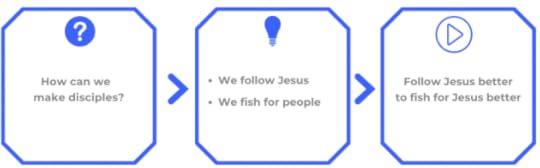
Christians are called to the most impossible mission in the world. We are to make disciples of all the nations (Matt. 28:18-20). I’m sure we’ve all felt the impossibility of this as we look at ourselves as individuals, as we look at our church, and even as we look at the worldwide church. How can we ever make disciples of anybody, never mind everybody? How can this mission impossible become mission possible? In Matthew 4:19, Jesus not only gives us our mission but makes it possible too.
BACKGROUND
Sermon 1: God’s purpose is to glorify himself in grace-and-truth filled relationships.Sermon 2: Our first purpose is to glorify God in grace-and-truth filled relationships.Sermon 3: Our second purpose is to give God pleasure.Sermon 4: Our third purpose is to receive and return God’s love.Sermon 5: Our fourth purpose is to be part of God’s familySermon 6: Our fifth purpose is to be like God’s Son.Sermon 7: Our sixth purpose is to be God’s servant.Sermon 8: Our seventh purpose is to be God’s missionaryLast week’s sermon was more about our ministry to other believers. This week’s sermon is more about our mission in the world.
Where do we start in making disciples?
1. WE FOLLOW JESUS
Jesus calls
And he said to them, “Follow me…” (19)
A direct call: Not general and vague but specifically addressed to two men.An authoritative call: He had established his authority (Luke 5:1-11) now he exercises it.A personal call: It’s follow me. Not an ideology, a philosophy, or a system but a person.A gracious call: He called the lowliest and the most uneducated – a rare kind of rabbi.A transforming call: Following him made them what they were not before in head, heart, and hands.We follow
…Immediately they left their nets and followed him (20).
To follow Jesus is to stick close to him, listen to his every word, learn his every lesson, watch his every move, put your feet in his every step, obey his every command. The first disciples do this immediately, without excuse, delay, or hesitation. They looked at their nets and said, “We’re done!” They looked at Christ and said, “We’re in!” They came under his authority from then on. This meant walking beside and behind him but never ahead of him.
CHANGING OUR STORIES WITH GOD’S STORY
Do you hear the call of Jesus? He is calling you with a direct, authoritative, personal, gracious, transforming call. “Follow me!” What’s your answer?
Are you following Jesus? There are many saying, “Follow me!” Politicians, influencers, celebrities, teachers, friends, businesses (through DEI/ESG/CRT), other religions, and cults, and even pastors and churches. But we are to follow Jesus as the disciples followed him – ALL IN.
Follow, follow, I will follow Jesus,
Anywhere, everywhere, I will follow on;
Follow, follow, I will follow Jesus,
Everywhere he leads me I will follow on.
What happens when we follow Jesus?
2. WE FISH FOR PEOPLE
“…and I will make you fishers of men” (19).
The fish
The sea is the great ocean of sin. As water is the natural environment of fish, so sin is the natural environment for sinners. They are comfortable there and have no desire to leave it no matter how dangerous or polluted it becomes. The first fish we want to target are those in our own families, then widening to friends, neighbors, colleagues, then expanding to people we don’t know in our community, our nation, and our world. We start with the fish we know best, love most, and are closest too.
The net
In Jesus the day, fisherman generally used circular nets with weights attached to trap fish underneath it. In Jesus’ mind, the net is the Gospel message. We can improve our catch rate by getting more familiar with the net and improving our use of it. The mesh is made up of law and Gospel strands – not too wide (all love) and not too narrow (all law) but just the right size for each fish.
The fishers
Like anglers, fishers of people have certain characteristics:
Optimism: They cast the Gospel net wide with great hopeTraining: As they follow Jesus more closely, they are changed, transformed into being better fishers.Skill: They use different tactics and timing for different fish (1 Cor. 9:20ff).Courage: Fishing was and is a hard and dangerous occupation.Patience: They sometimes go days, weeks, months, even years, without coming home with fish.Success: They fish not to kill but to give life to the fish by getting it out of polluted water and into pure water.CHANGING OUR STORIES WITH GOD’S STORY
Fish with the Gospel facts. Learn how to share the Gospel briefly, simply, attractively.
Fish with Gospel testimony. How did you see your need of Jesus, come to Jesus, and the difference it made.
Fish with Gospel benefits. Tell of new peace, joy, confidence, satisfaction, purpose, contentment.
Fish with Gospel living. Show the difference the Gospel makes to your marriage, job, money, suffering, etc.
Fish with Gospel commentary. Apply the Gospel to current events and questions.
FAITH IN JESUS
FOLLOW JESUS
FISH FOR JESUS
SUMMARY
THE NEXT CHAPTER
Unbelievers: Ask to be caught by Christ so that you can catch for Christ.
Teens: Learn to follow Christ then learn to fish for Christ.
Young Adults: It’s time to start fishing, to put into practice all you’ve learned.
Middle-aged: Don’t let busyness keep you from following and fishing. Take every opportunity.
Seniors: Don’t give up, coast, or wind down. There are many old fish still to be caught.
Prayer: Master Angler, help me to follow you closely so that I can fish successfully.
May 7, 2023
Our Purpose: God’s Servant
INTRODUCTION
“I’d like to be a servant when I grow up,” said no one ever. Who would ever want to be a servant? That’s a position of lowliness, weakness, and poverty rather than of prestige, power, and wealth. Why would anyone choose to be a servant rather than a master?
That’s a question that stumped the disciples too. A couple of them asked Jesus for the highest, most powerful, and most prestigious seats in heaven. When the other disciples heard this conversation, they jumped in to put them down and elevate themselves over them. They were all jockeying for position, power, and prestige.
Jesus was not impressed and therefore “called them to him and said to them, “You know that those who are considered rulers of the Gentiles lord it over them, and their great ones exercise authority over them. But it shall not be so among you. But whoever would be great among you must be your servant, and whoever would be first among you must be slave of all. For even the Son of Man came not to be served but to serve, and to give his life as a ransom for many” (Mark 10:42-45).
Jesus gave two reasons why they should seek to be servants rather than masters: (1) It’s the way to true greatness; and (2) it’s the way to great usefulness. We will look at how Jesus exemplified that and then at how we can follow that example.
BACKGROUND
Sermon 1: God’s purpose is is to glorify himself in grace-and-truth filled relationships.Sermon 2: Our first purpose is to glorify God in grace-and-truth filled relationships.Sermon 3: Our second purpose is to give God pleasure.Sermon 4: Our third purpose is to receive and return God’s love.Sermon 5: Our fourth purpose is to be part of God’s familySermon 6: Our fifth purpose is to be like God’s Son.Sermon 7: Our sixth purpose is to be God’s servantWho’s the greatest ever servant?
1. JESUS CAME TO SERVE
Jesus came to serve sinners
For even the Son of Man came not to be served but to serve (45).
World leaders rarely travel to dangerous parts of the world. If they do, they are accompanied by an army of security, staff, and other servants. When Jesus came to this earth, he came from safety to danger. from comfort to pain, from peace to hostility, from love to hate. from heaven to hell, from being served by angels to serve sinners. He was not forced to come but came willingly, freely, and enthusiastically. He did not come as a person of wealth, power, or prestige, but as a poor, weak, servant. It was a despised menial role, yet he entered into it with all of his heart. He served many different kinds of people: the poor, the blind, the lame, the rebel, the wicked. He served in so many different ways: teaching, preaching, counseling, praying, discipling, suffering, dying. He never had one selfish thought.
Jesus came to pay a ransom for sinners
The Son of man came….to give his life as a ransom for many (45).
A ransom implies a captive and a captor. In this case, sinners are the captives and the captors are Satan and sin. We were sentenced to this captivity by God as a punishment for sins committed against him (2 Tim. 2:26). We cannot find or raise our ransom price and none of our family or friends can either (Ps. 49:7).
Although we were justly sentenced to captivity and therefore had no right to be freed, Jesus came to campaign for our release. He came not because of our merits, but because of our misery and his mercy. He came not just to campaign but to pay the ransom too. His ransom was:
Valuable: He gave up his time, talents, desires, comforts, home, family, security, reputation, life, body, soul.Voluntary: He was not a victim and this was not an accident or fate. It was his conscious choiceVictorious: He campaigned, paid the ransom, reversed God’s sentence, and freed us from our kidnappers.CHANGING OUR STORIES WITH GOD’S STORY
True greatness. In this world, most are motivated by the desire to be served rather than to serve. The result may be greatness according to this world’s standards, but not by God’s. God says true greatness belongs to the greatest servant (Luke 9:48). Why won’t you ask him to serve you?
Great usefulness. The greatest Servant performed the greatest service resulting in the greatest usefulness. Someone can have the greatest power in this world yet achieve nothing useful with it. Jesus had the least power in the world on the cross and yet achieved the greatest usefulness. Why won’t you ask him to pay the ransom for you?
THE SERVANT OF ALL
IS THE GREATEST OF ALL
If that’s why Jesus came here, why are we here?
2. WE ARE HERE TO SERVE
“Whoever would be great among you must be your servant, and whoever would be first among you must be slave of all” (43-44).
We have five areas of service
God: Every day we wake, our first words should be, what will you have me to do?Family: Husbands, wives, and children should be competing to see who can serve most and best.Calling: We must frame our vocations as the place we serve God, our families, and others.Church: We do not go to church primarily to be served but to serve. Church is Servant University.Community: How can we best serve our neighbors and neighborhoods?World: If we have the ability, time, and resources, and if we’ve proven ourselves in smaller areasWe have five considerations in service
God gives each of his servants a unique SHAPE (see Purpose Driven Life by Rick Warren)
Unwrapping your spiritual gifts: These are given to benefit others not ourselves (1 Cor. 12:7)Listening to your heart: Our desires, hopes, interests, ambitions, dreams, loves, passions, enthusiasm.Applying your abilities: Where are you most effective? Try different service opportunities to find out.Using your personality: Unique combination of introvert/extrovert, thinker/feeler, optimist/pessimistEmploying your experiences: Family, education, vocational, spiritual, ministry, painful experiences“God never wastes a hurt! In fact, your greatest ministry will most likely come out of your greatest hurt. If you really desire to be used by God, you must understand a powerful truth: The very experiences that you have resented or regretted most in life — the ones you’ve wanted to hide and forget — are the experiences God wants to use to help others. They are your ministry!” Rick Warren
CHANGING OUR STORIES WITH GOD’S STORY
Discern your areas and shape of service. Prayerfully consider the places and types of service God is calling you into.
Look forward to the reward of your service. “Well done, good and faithful servant. You have been faithful over a little; I will set you over much. Enter into the joy of your master” (Matt. 25:21). There we will serve the Servant but also be served by the Servant (Lk. 12:37).
GOD DETERMINES YOUR GREATNESS
BY HOW MANY PEOPLE YOU SERVE
NOT HOW MANY PEOPLE SERVE YOU
SUMMARY

A NEW CHAPTER
Unbelievers. Jesus wants to serve you by paying your ransom and saving you. Will you humble yourself to ask for his service.Children. Your primary places of service are your family and your schoolTeens. You don’t get eight years off service in your teen years. Rather it’s a time to try various kinds of service to find out where/how/who God is calling you to serveAdults: Frame work as serving God and others to get great sense of purpose and meaningSeniors: If you are fit and able it’s a wonderful time to serve in ways you’ve always lacked the time for. If you are not fit or able, you can still serve in prayer, giving, cards.Prayer: Lord and Master, show me how you want me to serve you and others so that I can see great usefulness and show what true greatness is.
DISCUSSION QUESTIONS
What are some obstacles to viewing oneself as a servant?In which of the five areas did Jesus serve and how did he serve in them?What areas can you serve in better?Write out your SHAPE and discuss with someone else?How can you serve God better?What pain has God used in your life to guide you into his service?April 30, 2023
Two Kinds of Mind
INTRODUCTION
What kind of mind do you have? There are multiple classification methods for mind-types:
Two types of mind: creative or analytical.Three types of mind: photo-realistic visual thinking, pattern mathematical thinking, and verbal/auditory thinking.Four types of mind: the soul-mind, the body-mind, the emotional mind, or the rational mind.Five types of mind: he disciplined mind, the synthesizing mind, the creating mind, the respectful mind and the ethical mind.Six types of mind: joy oriented mind, love oriented mind, hate oriented mind, fear oriented mind, boredom oriented mind and sex oriented mind.Believe it or not, some say there are seven, some say eight, and on and on it goes. IQ or EQ is another way to divide minds into almost infinite classifications. But, according to God, there are only two types of mind: the flesh-mind and the Spirit-mind. What kind of mind do you have? Let’s get the answer from Romans 8:4-9.
Romans 8 tells us a lot about the work of the Holy Spirit in our lives. What the law could not and cannot do, the Holy Spirit can and does.
The Holy Spirit transforms our conscience (1-3)The Holy Spirit transforms our minds (4-9)The Holy Spirit transforms our bodies (9-11)The Holy Spirit transforms our holiness (12-14)The Holy Spirit transforms our assurance (14-17)The Holy Spirit transforms our suffering (18-25)The Holy Spirit transforms our prayers (26-27)The Holy Spirit transforms our purpose (28-29)Before looking at the two different kinds of mind, let’s remind ourselves of the different meanings of “flesh” in the Bible. Sometimes it means flesh and blood humanity, sometimes it means weak and frail humanity, and sometimes it means sinful humanity.
We have three of these different meanings of flesh in Romans 8:3-4. “By sending his own Son in the likeness of sinful flesh (weak humanity) and for sin, he condemned sin in the flesh (humanity), in order that the righteous requirement of the law might be fulfilled in us, who walk not according to the flesh (sinful humanity) but according to the Spirit.
Christ’s past life in human flesh (weak humanity) results in a different present life in the flesh (weak humanity) for his people. We are now much more able to live in obedience to God’s law because Christ paid the penalty of the law, satisfying both God’s law and our consciences. That transformed life comes from a transformed mind, changing us from a flesh-mind to a Spirit-mind.
What is the flesh-mind?
1. THE FLESH-MIND IS A BROKEN MIND
The flesh mind is flesh-focused
For those who live according to the flesh set their minds on the things of the flesh (5).
“Flesh” here means sinful humanity. Paul was looking at people who were living sinful lives, and concluded their primary problem was not so much their lives but their minds. Their lives simply reflected their minds. Their lives were flesh-full because their minds were flesh-prompted. Flesh dominated their lives because flesh dominated their thoughts. When their mind was not taken up with their daily work and responsibilities, it was taken up with sinful subjects. Their minds were magnetically drawn to sinful things. Their mind-set was sin-set on self, money, sex, and power.
With AI, everything depends on the prompts we enter. The prompts determine what’s produced. Paul is telling us that our mind-prompts determine our life-product. When the life-product is flesh, it tells us the mind-prompt is flesh. There’s a flesh mindset, mentality, and outlook. The dominant tendency, bent, and disposition is flesh.
The flesh-mind is death
For to set the mind on the flesh is death (6).
A flesh-mind not only ends in death but is actually dying while the person is still living. Every time their minds turned to flesh-things it died a little. There was a mini-funeral service and burial. A little gravestone was set up to memorialize the little death that had just happened.
The flesh-mind is hostile to God
For the mind that is set on the flesh is hostile to God, for it does not submit to God’s law; indeed, it cannot. Those who are in the flesh cannot please God (7-8).
The flesh mind is at war with God and rebels against God’s order, no matter how much it damages them and others. If God’s for it, they are against it. Flesh-minds want God and any of his spiritual influences eliminated from every area of life. Nothing they do at any time can please God. It’s not just difficult for them to please God; it’s impossible.
CHANGING OUR STORIES WITH GOD’S STORY
Examine yourself and pray. Does this describe you? It doesn’t matter if you don’t know your IQ; you need to know if you have a flesh-mind or a Spirit mind. If you have a flesh-mind, pray for God to give you a Spirit-mind.
Examine yourself and praise. If you don’t have a flesh-mind, praise God. You were born with one, but God has changed your mind. Any time your mind turns from the flesh to the Spirit it’s the work of the Spirit.
A FLESH-MIND
IS A FATAL MIND
I really don’t want a flesh-mind. How do I get a Spirit-mind?
2. THE SPIRIT-MIND IS A HEALTHY MIND
The Spirit-mind is Spirit-focused
…but those who live according to the Spirit set their minds on the things of the Spirit (5)
There were others in Rome who were living according to the Spirit. They lived in a way that reflected the Holy Spirit. How did they do this? They lived differently because they thought differently. They thought about the things of the Spirit. They loved to think about God’s salvation, sanctification, and service. Their automatic prompt was “Spirit.” Their minds went to the Word, worship, prayer, fellowship, mission, growth in grace, eternity, and heaven. That was their dominant bent, their tendency, their disposition. This is a perfect description of our Savior while on earth.
The Spirit-mind is life
…to set the mind on the Spirit is life (6)
Every time their minds went to spiritual things, there was a little birth of new life, a little life was generated. They lived a little more, life got more lively. The Spirit gave life to their spirit.
The Spirit-mind is God’s happy place
…to set the mind on the Spirit is…peace (6)…You, however, are not in the flesh but in the Spirit, if in fact the Spirit of God dwells in you (9).
These minds were no longer a hot-bed of sinful rebellion but of holy happiness. Peace filled these minds as God filled these minds. God loves to live in peaceful minds because peaceful minds love to be filled with God. It makes our minds a happy place for us and for him. He enjoys living there because he feels at home there, he feels welcomed and loved. It’s a little piece of heaven on earth. It’s a piece of human real estate that Christ owns (9) and invites the Spirit to live in.
CHANGING OUR STORIES WITH GOD’S STORY
Your mind can be a graveyard or a maternity ward. It can be a place of death or the birthplace of life. It all depends what you think about.
Your mind can be little hell on earth or a little piece of heaven on earth. Yes, you can have a foretaste of heaven on earth if you set your minds on the right subjects.
WHEN THE SPIRIT TAKES OVER
HE STARTS A MAKEOVER
SUMMARY

A NEW CHAPTER
Just as mental exercises improve brain function, spiritual exercises can improve mind function:
feed your mind with God’s Wordexercise your mind with meditationrefresh your mind with fellowshipgrow your mind by discipleshipelevate your mind by prayerbrighten your mind with heavenPrayer: Magnificent Mind, share your mind with us so that we have living Spirit-minds rather than dying flesh-minds.
DISCUSSION QUESTIONS
1. Describe your spiritual conversion from the viewpoint of how it changed your mind.
2. How do you know if you have a flesh-mind? A Spirit-mind?
3. What exercises have you found strengthen your Spirit-mind?
4. Why is it impossible for non-Christians to do anything to please God?
5. How would you encourage someone with a flesh-mind to seek a Spirit-mind?
6. How did this message help you understand and love Jesus better?
Our Purpose: God’s Image
INTRODUCTION
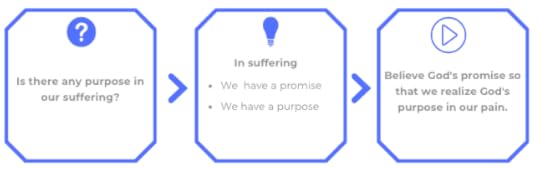
Our suffering is the greatest challenge to our faith in God’s purpose. There is no human experience that makes us question or doubt or even deny God’s purpose like our suffering. We can have 100% confidence in God’s purpose when things are going well, but then plummet to 0% confidence when suffering hits. “Why?” we protest at our pain. “What’s the point?” we complain when we lose a loved one. “Where are you God?” we yell, when family problems multiply. “Why is God doing this?” we object when we are victims of injustice. We cannot see any point, purpose, or profit in what we’re going through. Is there any purpose in our suffering? The Apostle Paul assures us that there is not only a purpose in our suffering, but we have a promise while we are suffering.
BACKGROUND
Sermon 1: God’s purpose is is to glorify himself in grace-and-truth filled relationships.Sermon 2: Our first purpose is to glorify God in grace-and-truth filled relationships.Sermon 3: Our second purpose is to give God pleasure.Sermon 4: Our third purpose is to receive and return God’s love.Sermon 5: Our fourth purpose is to be part of God’s familySermon 6: Our fifth purpose is to be like God’s Son.Romans 8 begins with the role of the Spirit in the Christian life (1-17) and then moves on to the role of suffering in the Christian life (18-37). Romans 8:28-30 contains a promise for Christian sufferers (28), a purpose for Christian sufferers (29), and a prospect for Christian sufferers (30). I want to stress the word “Christian” here because the Apostle Paul makes it crystal clear that God’s promise and God’s purpose is only for God’s people. “We know that for those who love God all things work together for good, for those who are called according to his purpose” (28). God predestined them, called them, justified them, and will glorify them” (30).
What can I hold on to in suffering?
1. WE HAVE A PROMISE IN SUFFERING (28)
And we know that for those who love God all things work together for good, for those who are called according to his purpose (28).
Our All
This little 3-letter word is one of the biggest and hardest words in the whole Bible. It’s the biggest because nothing is excluded from “all” and everything is included in “all.” It’s easy to believe “some things” work together for our good, or “good things” or “most things” but “all things?” Yes, ALL things.
That means all bad things, all hard things, all painful things, all disappointing things, all sinful things, ALL things. Let’s get more specific: all pain, all loss, all death, all poverty, all temptation, all sin, all accidents, all evil, all injustice, all slander, ALL things. Let’s get even more specific: all cancer, all MS, all heart failure, all disability, all miscarriages, all “accidents,” all job losses, all business failures, all marriage conflict, all addiction, all teen rebellion, all mental illness, all abuse, all violence, all broken friendships, all betrayals. ALL things. “All things work together for good.”
This never makes any of these bad things, hard things, evil things, painful things into good things. None of these things are in any way good in themselves. They are all bad things. But God is promising that ALL bad work together for our good. That does not make God the author or the approver of the bad.
God’s Work
Good is not the automatic result of suffering. Neither is it the accidental effect of suffering. Neither is it something we work at. It is God who thoughtfully, skillfully, and powerfully mixes the worst of evils to produce the greatest of goods. He works all things together for good for all his people at all times and in all places.
What kinds of good does he make out of bad? Although the full good will not be revealed until heaven, some of the good we do see to some extent here on earth: deeper humility, increased prayer, deeper dependence, radical gentleness, passionate compassion, vigilant watchfulness, faster obedience, impressive witness, encouraged Christians, converted unbelievers, heavenly hope, etc.
CHANGING OUR STORIES WITH GOD’S STORY
Believe the promise. Sometimes we can see some good in the suffering or after the suffering, but no time do we see all the good. It takes faith to believe in the amount of good God works together for us in and through suffering. Not until we are in heaven will we see all the good God has worked out of the bad. As Mercy Me sing, “His heart beats for our good.”
Worship the Worker. This is one of the most incredibly awesome parts of God’s providential work in the world. He is working personal bad, national bad, world bad, into good for his people. He takes the worst of ingredients and makes the best of outcomes.
ALL GOOD
ALL FOR CHRISTIANS
FOR ALL CHRISTIANS
What is the greatest good God works from suffering? God’s greatest and best purpose in our suffering is Christ-likeness.
2. WE HAVE A PURPOSE IN SUFFERING (29)
For those whom he foreknew he also predestined to be conformed to the image of his Son, in order that he might be the firstborn among many brothers (29).
God’s pattern
God’s ultimate purpose and the greatest good in our suffering is likeness to Christ. God’s greatest purpose is not our comfort, our happiness, or our usefulness, but our Christ-likeness. Suffering is like God’s toolbox which he uses to remove un-Christlikeness and shape Christ-likeness. Every day, he looks at his heavenly Son, Jesus, then at each of his earthly sons and daughters and decides how to further shape them into looking like his heavenly Son. Jesus is his prototype, his pattern, his blueprint for each and all of his children.
Our prospect
Here is a beautiful prospect in the ugliest of times, a comforting end in the midst of pain, an enticing hope in despair: God’s working to make me like Jesus. I’m getting more and more like Jesus. I’m being sawed, chipped, sanded, and painted to look like, listen like, speak like, feel like, think like, trust like, love like Jesus.
And it’s not just individuals, God’s ultimate aim is that his Son one day is surrounded by so many different and varied people who are united in their perfect Christ-likeness. All his working is with that view that Jesus “might be the firstborn among many brothers” (29). It’s not that we will be clones of Jesus, like an army of identical people. No, this perfect Christlikeness will still preserve our unique humanity, character, personality, but beautifully perfected. We will not just be partially or occasionally like him, but will be completely and forever like him. Verse 30 calls it being “glorified” and we’ll look in more detail at this heavenly purpose in another sermon.
CHANGING OUR STORIES WITH GOD’S STORY
Cooperate with God’s purpose. Although this is God’s Work, he wants us to work with him in his great purpose, not against him. We can “waste” our suffering if instead of humbly submitting to it, we fight it, resent it, argue against it. It’s like sawing a piece of wood with a knot in it. The carpenter will take longer to cut through it and may even need a tougher saw. Be a knot-free piece of soft wood for maximum Christ-likeness.
Anticipate God’s purpose. Look ahead to the great end of all suffering – Christlikeness. We go through chemo, radiation, and surgery with varying hopes that the pain of the suffering will be worth it in the end, but that doesn’t always work out, does it? In this case, though, it will definitely work out. We can look ahead to this as a certain prospect. Look up to heaven and see there so many Christians already perfectly Christ-like in their souls, and soon to have visible expression in their bodies too.
WHEN YOU FEEL YOUR PAIN
HAVE FAITH IN GOD’S PURPOSE
SUMMARY
A NEW CHAPTER
Unbelievers. If you are not one of God’s children by faith in Jesus then not only are bad things working for your bad, but good things are working for your bad.
Believers. Use Scriptural examples of this to strengthen your faith in God’s good purpose: Joseph, Ruth, Job, Esther, David, Jonah, Peter, Paul, John, Jesus.
Children: John Piper taught the children in his congregation, this little saying: “When things don’t go the way they should, God always makes them turn for good.”
Prayer: Christ-Shaper, continue your good work of making me like Christ through good things and bad things by giving me faith in your promise and hope in your purpose.
DISCUSSION QUESTIONS
1. What suffering has made you question God’s purpose?
2. If this is a promise to God’s people, what can we say about suffering to unbelievers?
3. What’s the hardest part of the “ALL” things to believe any good can come of it?
4. What do these verses tell you about God?
5. How can you help or hinder the realization of God’s purpose in your life?
6. What examples can you give of these verses in your own or others’ suffering?
April 16, 2023
The Toughest Tug of War
INTRODUCTION
“Why do I do things I don’t want to do? Why do I do the things I hate? Why don’t I do things I really want to do? Why don’t I do what I love?” Have you ever asked these questions?
I have. Sins I was sure would be defeated soon after my conversion 35 years ago, still raise their ugly heads and beat me up to this day. “Why do I do things I don’t want to do?”
When Christ found me 35 years ago, I was sure that I’d have multiple juicy fruits of the Spirit in my life, but sometimes it seems my tree doesn’t even have leaves. “Why don’t I do what I want to do?”
We hear God’s Word telling us not to gossip. We are convicted in our conscience and resolve that we will never gossip again. One hour later we are gossiping. We look back on our broken resolution with shame. “Why do I do things I don’t want to do?”
We read God’s Word about the sin of anger. We put our “Amen” to this and determine never to be angry again, but in a few days time we look back on a scene of defeat after defeat as we’ve repeatedly lost our tempers. “Why do I do the things I don’t want to do?”
We hear a sermon telling us to pray more. We know our prayer life has been lacking and therefore get up early the next day to pray before work, but we can’t concentrate on speaking to God for more than a minute without getting distracted or sleepy and we give up after a couple of days of trying. “Why don’t I do the things I want to do?”
After years of looking at porn, you look again. You promise God you will pursue purity. But, within days, purity has lost and porn as won again. Why don’t I do the things I want to do?”
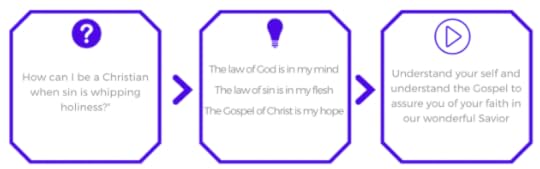
If you ask these questions, as surely every Christian does, you may lose assurance of your faith. “How can I be a Christian when I’m still doing things I hate and still not doing what I say I love? How can I be a Christian when sin is whipping holiness?”
The Apostle Paul had the same questions (Romans 7:15-20) but also offers us some encouraging answers in Romans 7:14-25.
BACKGROUND
The background and context to our passage is:
Romans 5: Grace frees us from the law’s penalty for sin.Romans 6: Grace frees us from the law’s powerlessness over sin.Romans 7: Grace frees us from the law’s provocation of sin.In chapter 7, Paul has two main messages:
Romans 7:1-13 The law cannot justify usRomans 7:13-25 The law cannot sanctify us.How can I be a Christian when sin is whipping holiness?
1. THE LAW OF GOD IS IN MY MIND
For we know that the law is spiritual (14)…I agree with the law, that it is good (16)…I want to do right (21)…I delight in the law of God, in my inner being (22)…I myself serve the law of God with my mind (25).
The Christian thinks about and loves God’s law
Verses 7-13 are in the past tense and describe Paul’s past relationship to the law before he was a Christian. God’s law convicted him and “killed” him.
Verses 14-25 are in the present tense and describe Paul’s present relationship to the law as a Christian. God’s law is his delight and yet he remains disappointed with his obedience to it.
Despite Paul’s failures as a Christian to obey God’s law, he doesn’t blame the law, critique the law, ignore the law, reject the law, or abandon the law. He describes it as spiritual, good, delightful, and the best guide for serving God.
Paul often thinks about the spirituality of the law, the Holy Spirit as the source of the law, the beauty of the law, and the benefits of the law. He agrees with the law, desires to do the law, relishes the law, and serves the law with his mind. He looks at God’s law as the perfect blueprint for how to live.
When Paul sees the law as a way of salvation, he opposes it with all his being. But when he sees it as the blueprint for sanctification, he adores it.
The non-Christian cannot think or feel about God’s law in this way
No unbeliever can say the words Paul says about God’s law. In the very next chapter, Paul asserts that “The mind that is set on the flesh is hostile to God, for it does not submit to God’s law; indeed, it cannot” (Rom. 8:7). Unbelievers can agree with God’s law to some extent. They can approve its morality, until it crosses their will, until it goes beyond the surface to their spirit, until it costs them. Then they start fighting it, ignoring it, changing it, modifying it, and disobeying it.
CHANGING OUR STORIES WITH GOD’S STORY
Be assured you are a Christian. Only a Christian can say these words about God’s law. Despite repeated failures to comply, the Christian still think positively about the law and loves the law. We say, “I know that the law is spiritual. I agree with the law, that it is good. I want to do right. I delight in the law of God, in my inner being. I myself serve the law of God with my mind.
Praise God you are a Christian. If you can say these things and recognize these experiences, then you can rejoice that by God’s grace you are a Christian. You’ve been sovereignly and savingly changed.
THE LAW OF GOD IS ENGRAVED
ON STONE AND MY BRAIN
I do view the law like this. I love it and think about how to obey it. So what explains my many failures to follow through?
2. THE LAW OF SIN IS IN MY FLESH
Our flesh is strong
“I am of the flesh, sold under sin” (14)…It is no longer I who do it, but sin that dwells within me (17). For I know that nothing good dwells in me, that is, in my flesh (18)…Now if I do what I do not want, it is no longer I who do it, but sin that dwells within me (20)
In the Bible, “flesh” can have three meanings. First, it can mean our physical body: our skin, bones, muscles, members, etc. Second, it can mean our frail and fading humanity, our physical weakness. Third, it can be the part of our humanity that opposes God and loves this sinful world (Gal. 5:19-21).
In the non-Christian, this flesh is fully in charge, it rules, and it dominates (Rom. 7:5; 8:5-8), because it has nothing to oppose it, except self-interest and common grace. In the Christian the “flesh-principle” it is still there to some extent but it has been weakened by regeneration and is continuing to be weakened by sanctification. The “flesh mind/principle” is now opposed by the “law-mind/principle.”
It’s that part of himself, the flesh-mind/principle that Paul is referring to here. He is not “in the flesh” but the flesh is still in him. He complains that part of him is still sold as a slave to sin. It’s not the major part of him though, which is why he says “It is no longer I who do it, but sin that dwells in me.” He can distinguish himself, his primary self, from this part of himself, a secondary part of himself. His flesh has “shrunk” in size and influence, but it’s no less flesh, which is why he says, “I know that nothing good dwells in me, that is, in my flesh” (18). Now, when he does what he doesn’t want to do, he doesn’t completely write himself of as a Christian, but rather points to his remaining sinful flesh as the source. He says, “It is no longer I who do it, but sin that dwells within me.” He owns his sin as his own, but his sin doesn’t own him as its own.
Our fight is fierce
I find it to be a law that when I want to do right, evil lies close at hand (21)…I see in my members another law waging war against the law of my mind and making me captive to the law of sin that dwells in my members (23)…with my flesh I serve the law of sin (25).
What would you expect if two completely opposing moral forces are found in the same person? You’d expect a collision wouldn’t you? That’s exactly what Paul experienced, an almighty battle between the law-principle/mind and the flesh principle/mind. Compared to what he was before he is spiritual and free. Compared to what he longs to be, he is still fleshly and enslaved to sin at times. Hell battles heaven in his life.
CHANGING OUR STORIES WITH GOD’S STORY
An explanation. This helps us to understand ourselves when we are perplexed about sin’s victories and virtue’s defeat in our lives. It helps us to see we are no longer sinners but not yet saints. We are saint-sinners.
An exhortation. If the flesh-principle/mind wages war against us and within us, let’s wage war against it. Paul did not intend this explanation to be an excuse for sin, and an encouragement to fight.
FIGHT YOUR FLESH
TO ASSURE OF FAITH
When will I win and this weary war end?
3. THE GOSPEL OF CHRIST IS MY HOPE
Wretched man that I am! Who will deliver me from this body of death? Thanks be to God through Jesus Christ our Lord! (24-25).
A wretched man
Which Christian hasn’t felt like this from time to time? We fall into sin again, we fail to do good again. The flesh-mind/principle wins again. The law-mind/principle fails again. The true Christian doesn’t shrug this off with a nonchalant wave of the hand, “Oh well, another flesh-win, no biggie.” Rather, true Christians mourn and grieve that they have made so little progress in holiness and have suffered so many setbacks. We look at ourselves at times and say, “Wretched man that I am! Who will deliver me from this body of death?” When will we get free from this flesh, from this fierce-fight, this body that’s like a war-zone of losses and defeats?
A wonderful man
But we don’t stop there. We don’t wallow in defeat, disappointment, despair, and death. No, we look away from the wretched man/woman that we are to the wonderful man, Jesus Christ. He was 100% law-mind and 0% flesh-mind and therefore he can increasingly deliver us from the flesh-mind in this life and totally deliver us from it in the life to come.
CHANGING OUR STORIES WITH GOD’S STORY
We are wretched at times. Wretchedness does not define us, but it does drag us down. We are often disgusted with ourselves and tempted to give up when the flesh-mind seems so strong and triumphant. It’s OK to berate ourselves and condemn ourselves for our sins. But we must never stop there.
Jesus is wonderful all the time. When we feel wretched we turn to him in grateful worship that he has already weakened our flesh-mind and strengthened our law-mind with regeneration. He is continuing to weaken our flesh-mind and strengthen our law-mind through justification and sanctification. He will one day, at our death or his second coming, completely deliver us from all flesh and all fighting through glorification so that we too will be 100% law-mind and 0% flesh-mind. Thanks be to God for Jesus Christ!
WHEN WE FEEL WRETCHED
REMEMBER WHO’S WONDERFUL
SUMMARY
A NEW CHAPTER
Defeat is not death. We will lose spiritual battles. We will be wounded and even come close to our last breath. But defeat, even bad defeats, are still consistent with the Christian life.
Fight is life. The question is not “Will I lose?” the question is “What will you do when you lose?” Do you turn to the Deliverer to strengthen you for the next battle, do you train your faith in Jesus so that next time you will win? Do you fight with confidence of complete victory?
Prayer. Wonderful deliverer, continue to deliver me from my wretchedness by helping me to fight for faith to fight the flesh until your deliverance of me is victoriously complete.
DISCUSSION QUESTIONS
1. When have you felt discouraged about how much flesh and so little fruit in your life?
2. How is the Christian view of God’s law different to the non-Christian’s?
3. How much of Paul’s Christian biography can you identify with?
4. In what ways will this passage help you to fight against sin and for holiness?
5. When is it right for a Christian to feel wretched and what do you do when you do?
6. How would you rate your fighting spirit?
Our Purpose: God’s Family
INTRODUCTION
Human beings have a fundamental need to belong. We want and need deep and long interpersonal attachments. Just as the devastating effects of the epidemic of loneliness are becoming better known, so the benefits of belonging are also becoming better known.
We see our desire to belong in our longing for stable families and strong friendships. We get a sense of belonging through our connections with political parties, the schools we attend, the sports teams we support, the hobbies we pursue, the clothes we wear, the cars we drive, the businesses we work for, the communities we belong to, and of course, our national identity.
But many or all of these connections and attachments change, weaken, break, or end as life goes on. We lose our sense of belonging and often end up feeling outside, excluded, alone. How can we find belonging that will satisfy and stay? In Ephesians 2:19-22, the Apostle Paul points us to where can can find a stable and strong sense of belonging.
BACKGROUND
Sermon 1: God’s purpose is is to glorify himself in grace-and-truth filled relationships.Sermon 2: Our first purpose is to glorify God in grace-and-truth filled relationships.Sermon 3: Our second purpose is to give God pleasure.Sermon 4: Our third purpose is to receive and return God’s love.Sermon 5: Our fourth purpose is to be part of God’s familyEphesians 2 is about how the two greatest ever gaps were bridged by the Gospel. The first chasm that the Gospel bridged was between God and sinners (Ephesians 2:1-10). The second chasm that the Gospel bridged was between Jews and Gentiles (Ephesians 2:11-22).
How can I find belonging?
1. WE ARE GOD’S NATION
So then you are no longer strangers and aliens but you are fellow citizens with the saints (19).
We were strangers and aliens
The Gentiles were born outside Israel, the nation in covenant with God. As such they were estranged and alienated from God. As Paul put it earlier in the chapter: Remember that you were at that time separated from Christ, alienated from the commonwealth of Israel and strangers to the covenants of promise, having no hope and without God in the world (Eph. 2:12).
We are fellow citizens with the saints
What caused this massive change in status from strangers and aliens to fellow-citizens and saints? But now in Christ Jesus you who once were far off have been brought near by the blood of Christ (Eph. 2:13). They didn’t pass through a bureaucratic citizenship process nor participate in a naturalization ceremony, but they passed through the supernatural blood of Christ which abolished any hostility and established peace between them and God (Eph. 2:14-18).
They are now part of God’s nation (the church) which he is building into the greatest, biggest, best, richest, holiest, happiest, strongest, longest nation that ever existed or ever will. It started weak, small, poor, imperfect, and divided. But it’s growing bigger, better, richer, closer, holier, happier, and stronger through the years. It’s attacked like no other nation, and has its defeats, setbacks, divisions, and failures. But it’s a nation that will one day occupy the whole earth for all eternity (Mat. 5:5) and will be united in every way – in its theology, spirituality, politics, faith, words, and actions.
CHANGING OUR STORIES WITH GOD’S STORY
Are you in God’s nation? Unlike the Gentiles of Paul’s day, most of us were born into the church and baptized into God’s nation. Like circumcision in the Old Testament, baptism gives us certain privileges and responsibilities that the unbaptized don’t have. However, baptism is like the naturalization certificate I received when I became a citizen. It said I was an American citizen with all the privileges and responsibilities that came with that. But it didn’t and couldn’t give me love for America. That came as I learned more about American history and the great sacrifices Americans made to secure freedom for this nation. Similarly, Baptism cannot change our hearts to love God, but the blood of Christ that founded God’s nation can. Reflect upon Christ’s sacrifice, trust in it, and you will find your heart loving God and his new nation even more than America.
Where are your loyalties? When I became a US citizen at the Gerald Ford museum, the judge told all of us (representing 70 nations), that he wasn’t asking us to stop loving the nations we came from, but simply to love America first and most. Similarly, we who are American citizens love our nation, but when we are part of God’s nation, God calls us to love his nation even more and to prioritize its interests over America’s.
CHURCH FIRST
AMERICA SECOND
It’s great to belong to such a great nation. But belonging to a family would be even better.
2. WE ARE GOD’S FAMILY
You are…members of the household of God (19).
All Christians have God as their Father, other believers as their brothers and sisters, and the church as their spiritual family. God’s family is:
A diverse family (1 Cor. 12:14-21)A united family (1 Cor. 12:12-13)A loving family (John 13:35)A caring family (Matt. 25:40)A connected family (1 Cor. 12:26)A fruitful family (John 15:5)A gifted family (Romans 12:4-8)A growing family (Eph. 4:16)A rich family (1 Pet. 1:4)A practical family (50 “one another” passages in NT).A happy family (Ps. 133:1)An imperfect family (the whole Bible and the whole of church history)A permanent family (Rev. 7:9-17)“Being part of a healthy church is essential to living a healthy life. God designed his church specifically to help you fulfill the five purposes he has for your life. He created the church to meet your five deepest needs: a purpose to live for, people to live with, principles to live by, a profession to live out, and power to live on. There is no other place on earth where you can find all five of these benefits in one place….Worship helps you focus on God; fellowship helps you face life’s problems; discipleship helps fortify your faith; ministry helps find your talents; evangelism helps fulfill your mission. There is nothing else on earth like the church!” (Rick Warren).
CHANGING OUR STORIES WITH GOD’S STORY
Are you in God’s family? If not, ask to be adopted and he guarantees your acceptance and full integration into his family. If you are, do you see how privileged you are? This is a privilege that humbles us rather than makes us arrogant and prejudiced. If you are in God’s family, you will be in the most visible expression of it, which is the local church. That’s where we find and express our purpose.
Where is your love? We are to love our natural families, but we are to love God’s family even more (Matt. 7:21; Luke 14:26; Gal. 6:10). That is one of our great purposes in life. It’s how God gives us a sense of fulfillment and fullness. God made us for this. Yes, we have squabbles and fall-outs from time to time, but we don’t let that stop our love and care for one another. Love should be your top priority, primary objective, and greatest ambition (1 Cor.14:1). Our relationships with other Christians are far more important than our career, our bank balance, our vacations. As Rick Warren wrote, “The best way to spell love is T-I-M-E.” We are not only called to believe but to belong (Rom. 12:5). The Christian life involves commitment to Christ and to other Christians.
GOD’S FAMILY IS
OUR FULFILLMENT
Families are vulnerable and weak. How can we secure and strengthen God’s family?
3. WE ARE GOD’S TEMPLE
You are…built on the foundation of the apostles and prophets, Christ Jesus himself being the cornerstone, in whom the whole structure, being joined together, grows into a holy temple in the Lord. In him you also are being built together into a dwelling place for God by the Spirit (20-22).
The Cornerstone: In the ancient East, the cornerstone was the first stone set in any construction project. All other stones were set in reference to this stone, and therefore it influenced the whole structure. Sometimes they were engraved with the construction date together with the names of the architect and builders. When it was laid, it was often accompanied with an animal sacrifice, and wine and oil were poured upon the stone. Jesus Christ is our cornerstone, the first stone of God’s building, the reference point for all other stones, influencing all other stones. If you look closely you’ll see the names of the divine architect and builder. It was laid with the costly blood of the greatest ever sacrifice as he poured out his life to secure the building’s eternal strength.
The Foundation: The apostles and prophets are the undergirding of this building. Their infallible teaching is the sure and certain base of everything built above ground. There are no cracks or weaknesses in this foundation. Nothing more and nothing less than this is required to provide the sub-structure for the superstructure.
The Building: On top of this are God’s people, each one a nail, a brick, a 2×4, the glue, cement, a pipe, a window, etc. We are part of something much bigger and better than ourselves. We have a much greater purpose than to buy or build our own homes. We are part of building the greatest structure ever. It will never fall apart but will continue to grow closer, stronger, bigger, holier.
The Occupant: Who comes to live in this place? God! God comes to live in this building by his Spirit. We love it when our families fill our own homes, but we get even greater delight when God fills us as his home. He doesn’t just visit, he dwells, he comes to stay, to occupy, and to bless.
CHANGING OUR STORIES WITH GOD’S STORY
Are you God’s house? What a glorious honor! To be part of something much bigger and better than ourselves is so fulfilling and satisfying. We honor all who were and are part of this building. And we are continually seeking new building materials, even among the least promising and most broken people.
Where are your priorities? For many, their primary purpose in life is a bigger, better, more beautiful house. But that’s not the Christian’s priority. Our priority is being God’s house, being part of the building that he loves to live in, and looking out for its interests above all other properties.
GOD’S PROPERTY
IS OUR PRIORITY

A NEW CHAPTER
Find purpose in prioritizing God’s family. We will miss our purpose if we do not make God’s family our priority. Ask yourself what can you do to move God’s family up your list of priorities?
Find purpose by participating in a small group. It is impossible to even know everybody in a church of our size. That’s why we strongly encourage everyone to be part of a small group of no more than 10-12 people. This is where the deepest relationships can be formed and the greatest sense of belonging enjoyed. Warren identifies different levels of fellowship: fellowship of sharing, of studying, of serving, of suffering.
Prayer: Governor, father, builder, thank you for giving me a deep and delightful sense of belonging in your nation, your family, and your temple.
DISCUSSION QUESTIONS
Warren lists nine characteristics of a small group covenant. How will you cultivate them?
We will share our true feelings (authenticity)We will encourage each other (mutuality)We will support each other (sympathy)We will forgive each other (mercy)We will speak the truth in love (honesty)We will admit our weaknesses (humility)We will respect our differences (courtesy)We will not gossip (confidentiality)We will make our small group a priority (frequency).April 2, 2023
Are you a heretic?
INTRODUCTION
“What is your hope of heaven?” I asked this dying 80+ year old lady who’d been a faithful church attender all of her life. She must have heard the Gospel thousands of times and yet her answer to this question was “Well I’ve always gone to church and tried to support the church. I’ve been good to my family and neighbors. I worked hard and haven’t hurt anyone.” It was early in my ministry and I was devastated that someone who’d heard the Gospel so many times from her earliest years in Sunday school right up to Bible studies in her eighties could still have some faith in herself. Almost 30 years on, I’m no longer shocked at such answers because I’ve heard multiple versions of it on multiple continents from multiple people.
These experiences have changed the way I now answer the question, What is the most common heresy? A heresy is a belief or teaching that contradicts one of the primary doctrines of orthodox Christianity. It’s not a mere mistake and it’s not a simple error in belief or practice. Mistakes and errors in our faith are dangerous and damaging but not necessarily disastrous and damning. A heresy is a willful and serious departure from historic Christian faith in a central important area of truth that is spiritually disastrous and eternally damning.
So what is the most common heresy? In seminary I would have said, “Rejection of the Trinity,” or “Denial of Christ’s divinity or humanity” or “Rebuttal of Christ’s resurrection,” or “Refusal to accept the deity of the Holy Spirit.” All of these are serious heresies, but as I learned in pastoral ministry, they are not the most common. The most common heresy is the denial of salvation by grace alone through faith alone in Christ alone. To put it another way, the most common heresy is the false doctrine/belief that we can be saved by being good enough or doing good enough.
I’ve met very few people in the church over the years who have denied Christ’s virgin birth, Christ’s deity, Christ’s humanity, Christ’s resurrection, and so on; but I’ve met many thousands who have denied Christ’s sufficiency as their Savior by putting some of their faith in their being good enough or doing good enough. I cannot tell you the number of conversations I’ve had with people who have been in faithful churches for decades and yet are still putting at least some of their faith in being good enough or doing good enough.
My experience has taught me that there’s a high probability that some of these heretics are sitting here in this church. I want to use Romans 7:7-13 to turn you from soul-damning heresy to soul-saving truth. If you are sound in the faith in this area, I hope you will use this sermon to warn you about the very real dangers of veering away from faith alone, by grace alone, in Christ alone. Use these words to keep you firm in the faith.
BACKGROUND
The background and context to Romans 7:7-13 Romans is as follows:
Romans 5: Grace frees us from the law’s penalty for sin.Romans 6: Grace frees us from the law’s powerlessness over sin.Romans 7: Grace frees us from the law’s provocation of sin.Given this background and context, we may understandably ask the question: Is the law sin? If grace frees us from the law’s penalty for sin, the law’s powerlessness over sin, and the law’s provocation of sin, “What then shall we say? That the law is sin?” (Romans 7:7) That’s the question the Roman believers were asking. Paul gives a short answer in three words, “By no means!” then a longer answer in verses 7-13.
Is the law sin?
1. THE LAW REVEALS SIN
Yet if it had not been for the law, I would not have known sin. For I would not have known what it is to covet if the law had not said, “You shall not covet” (7).
Outward perfection
Speaking of his pre-conversion life as Saul of Tarsus, the Apostle Paul says he did not know the law or sin. This cannot mean that he had no knowledge of the law or of sin. In another biographical section he tells us he was “circumcised on the eighth day, of the people of Israel, of the tribe of Benjamin, a Hebrew of Hebrews; as to the law, a Pharisee; as to zeal, a persecutor of the church; as to righteousness under the law, blameless” (Phil. 3:5-6). He could go through the ten commandments ticking nine of the boxes and giving himself a 4.0 GPA. But there were times when he hesitated over the tenth box. He could say he kept all the others because he could keep them all externally. But the tenth had no external component. It was not about outward perfection.
Inward imperfection
Unlike the other nine commandments which could be interpreted outwardly, and even kept outwardly, the tenth was all inward, invisible, inaudible. “You shall not covet,” dealt with secret thoughts, private passions, hidden delights, invisible lusts. Saul viewed all the other nine commandments as merely external and therefore laws he could obey. But the tenth said, it was wrong to even love, desire, or want what the other commandments forbad.
CHANGING OUR STORIES WITH GOD’S STORY
Praise God for his Law. Although the law cannot save from sin, or sanctify from sin, yet the 10th commandment shows us what sin in a way that nothing else can. You can be a perfect Pharisee with the first 9 commandments, but the 10th punctures and deflates the Pharisaical balloon and leaves us flat on the floor.
Share God’s view of sin. The Christian Reformed Church passed a Human Sexuality Report last year that made many clear courageous points. But one thing it got wrong was asserting that homosexual activity was wrong but not homosexual desire. The report says as follows:
The Christian Reformed Church’s 1973 synodical report on homosexuality made an important distinction between homosexual orientation and homosexual activity: “We must distinguish between the person who is homosexual in [their] sexual orientation and the person who engages in explicit sexual acts with persons of the same sex.” In other words, there is no sin in being attracted to the same sex. We only sin if we act on our sexual attractions.
Paul would say, “You need the 10th commandment here, brothers and sisters, if you want to align with God’s view of sin being not only external but also internal. Men look on the outward appearance but God looks on the heart.
THE LAW CAN ONLY SHOW SIN
IT CANNOT SAVE FROM SIN
When law reveals sin, does that make us want to stop sinning? The opposite. It makes us want to sin all the more.
2. THE LAW FUELS SIN (8-11)
Paul was alive
“I was once alive apart from the law” (9). “Apart from the law” does not mean Paul had no knowledge of the law or that he never practiced it. He had his Bar Mitzvah at aged 12 making him a “Child of the Law.” To be “apart from the law” meant to know only the outward meaning and yet be totally ignorant of it’s spirituality, it’s reach into the thoughts, desires, loves of our hearts and minds. It’s not just the visible tip of the iceberg that’s sin but all the stuff below the surface we can’t see.
“I was once alive” does not mean Paul actually was spiritually and morally alive and healthy. Rather, in his own opinion, he was. He could see no sin in his life, he had no conviction of sin, no painful conscience, no guilt, no fear of judgment. He was a picture of tranquility, peace, and security. He was complacent, patted himself on the back and said, “Congratulations Saul. You are a perfect man!”
Sin came alive
“When the commandment came, sin came alive” (9). When Paul refers to the time “the commandment came,” he is not saying he did not know the commandments before this time, but that they now came with deep understanding, and painful conviction. Paul’s little ship sailed easily past the first nine rocks but was shipwrecked on the tenth. Nothing of this rock was above the water. It was all underwater and addressed motives, aims, attitudes.
“Sin came alive” does not only mean that as Paul grew in his understanding of the law, he saw more of his sin, guilt, and condemnation. It’s not just that he saw more sin; he did more sin. Sins that had lain dormant and inactive before he knew the law in this deeper way, suddenly were stirred up and started spouting hell on earth. Like a poker stirs up a fire, so the law stirred up sin. The law poked Paul’s sinful nature and kindled a fire that previously looked stone cold dead. Just as a weightlifter has to exert more strength the heavier the weight he’s lifting, so those feeling the weight of conviction fight harder against conviction to resist it and do the opposite.
The law kindles in a corrupt nature the very desires it’s designed to suppress. “But sin, seizing an opportunity through the commandment, produced in me all kinds of covetousness. For apart from the law, sin lies dead” (8). Prohibition increases the desire for the prohibited. There’s nothing so attractive to us as the forbidden, as even perfect Adam and Eve found out.
Paul died
“Sin came alive, and I died” (9). The law did not kill Paul, but revealed he was already spiritually dead and doomed to die eternally. This killed his confidence, his pride, his self-image, his arrogance, his religion, his hopes. The law knocked him morally and spiritually flat on his back. He saw himself dead in sin, desiring sin, doing sin. “The very commandment that promised life proved to be death to me” (10). Sin picked up the law that he was relying on and turned it into a weapon against him. “For sin, seizing an opportunity through the commandment, deceived me and through it killed me” (11).
CHANGING OUR STORIES WITH GOD’S STORY
God’s law is not the problem. It is “holy and righteous and good” (11). There’s nothing wrong with God’s law, and everything right with it if used in the right way.
We and our sin are the problem. When the law comes into our lives to do us good, sin seizes it as a weapon and takes the opportunity to produce more sin (8), to deceive us (10), and to kill us (10).
God overrules the problem. God uses the law’s deadly results “that sin might be shown to be sin, and through the commandment might become sinful beyond measure” (13). The sinfulness of sin is clearly seen in its making the worst conceivable use of the best things (like the law). But then when we see how bad we and our sin are, we realize we cannot save ourselves from sin and hell, but only Christ can.
THE LAW SHOULD PUT A BRAKE ON SIN
BUT INSTEAD PRESSES THE ACCELERATOR

A NEW CHAPTER
See the seriousness of this heresy. It’s dangerous, damaging, damning. It’s not something to tolerate or trifle with. It’s not something to have as a back up plan or insurance policy. It’s something to abandon immediately and guard against constantly. If it wasn’t such a fatal danger, Paul would not address it so frequently
See the beauty of truth. As we are repulsed by this heresy, let’s embrace the beautiful soul-satisfying, heart-exciting truth of Christ is more than enough.
Prayer. Lawmaker, Lawgiver, and Law-judger, turn me and keep me from the good-enough heresy, and help me to embrace the Christ-enough truth.
DISCUSSION QUESTIONS
1. Why is “good enough” such a dangerous heresy?
2. How did the law show you your sin?
3. What’s the problem with the CRC statement on immoral sexual desires?
4. Can you tell your story of (1) I was alive; (2) Sin came alive; (3) I died
5. Give an example of how the law fueled sin in your life (or someone else’s)
6. How will you protect yourself and others from the “good-enough” heresy?
David P. Murray's Blog

- David P. Murray's profile
- 96 followers

