
Alexandra Lehmann's Blog
December 4, 2017
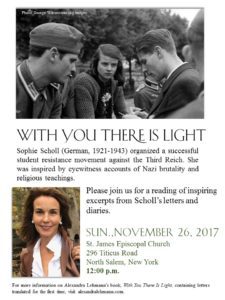
Reading to the Religious: With You There Is Light

Reading at St. James in North Salem, New York
November 26, 2017
After Service at the St. James Episcopal Church, North Salem, New York
The first excerpt I read last Sunday came from Chapter Three of “With You There Is Light.” Sophie Scholl attended St. Georges, the Protestant Church in Ulm, with her mother. Sophie noted reading Exodus 17:11 in her journal so I imagined and wrote about a sermon where the Pastor may have preached from it.
The second excerpt that I read is quoted below. These two excerpts led to an interesting dialogue about the difference between religion and spirituality. Sophie Scholl was motivated by both.
Excerpt from Chapter Four. It is the winter of 1941. The German Army and Fritz Hartnagel are pushing into the endless freezing Russian steppe. The quotes inside this passage (part of conversation) are from Sophie Scholl’s journal and are reproduced with the permission of S. Fischer Verlag, Frankfurt.
“Even though Hans’ new girlfriend wasn’t from Schwabia, Sophie was pleased that Traute Lafrenz could keep up. Hans led them down the snowy slopes most of the day, and they bellowed and laughed from the fresh air and friendship. At nightfall, when they reached the cabin, they gathered around the fire and read passages out loud from a Dostoevsky novel. Their protest against the war, Hitler, and his insanity, consisted of reading the enemy’s finest writer.
Before the clock struck twelve on New Year’s Eve, they ran outside and observed the full moon illuminating the stone-blue mountain. The pine trees cast long shadows. Sophie shivered, trying to name the constellations. She was the first to hurry back inside the warm cabin.
As Traute fed the crackling fire with twigs fragrant with sap, she recited a few lines from Novalis’ poem “Hymns to the Night.”
The light from the fireplace illuminated the sharp lines on Traute’s aristocratic face.
“Novalis has cured my hunger,” she added, trying to break the spell cast by her beauty.
“What hunger?” Hans asked, wrinkling his forehead, and sat down on the ledge of the fireplace beside her, throwing his finished cigarette into the fire.
“Spiritual hunger,” she answered.
Hans shook his head in disagreement. Traute said nothing in her defense. Sophie picked up the thread of her idea.
“Art, literature, and music can help us wake from indifference and supply us with food for our soul. For me, if anything can raise passion in my frozen heart, it’s music. And that’s essential—a prerequisite for everything else. It can distance me a little from this turmoil around me, from the glutinous, hostile mush.”
Hans interrupted his little sister and put his finger in the air as if to say, “Yes, but.”
He had spent enough hours discussing this with the renowned religious Professors Carl Muth and Theodor Haecker in Munich. Both had been banned from publishing and teaching, but they still held secret student talks. That’s all Hans said about them. He continued in an authoritative tone.
“Spiritual hunger can’t be satisfied by music or any other art form. Nothing derived from man can. Only God Himself can.”
Sophie was unprepared to accept his strict religious opinion. She straightened her back and choosing her words with care, she spoke in a strong and clear voice.
“Music softens my heart, by resolving its confusions and relaxing it. Then it enables my mind, which has previously knocked in vain on the locked portals of the soul, to operate within it. Yes, music quietly and gently unlocks the doors of my soul. Now the doors are open! Now it’s receptive. The reward is a liberated and uninhibited heart, a heart that has become receptive to harmony and things harmonious, a heart that has opened its doors to the workings of the mind.”
Sophie strung the words together like pearls. She continued.
“While pondering the hunger that exists in mankind, for which music represents neither more nor less than the air that enables a flame to burn more brightly still, I’ve become aware that we would starve to death if not sustained by God.”
When she finished speaking, she looked up at the cabin’s wooden ceiling and put her fingers to her mouth as if she might have forgotten something. Satisfied that she had completed her thoughts, she smiled back at the silent group. The months that Sophie had spent isolated at the women’s camp and alone in the village strengthened her. The lonely hours had exposed her deepest fears and darkest thoughts. There was an answer to all of this fear. This newfound strength would be what defined her.
“The reward,” she repeated, “is a liberated and uninhibited heart.”
The fire, left unattended during her elegy to music and a Higher Power, continued to burn down in an orange glow.”
The post Reading to the Religious: With You There Is Light appeared first on With You There Is Light: The True Story About Sophie Scholl and Fritz Hartnagel.


December 1, 2017
Reading to Media Students from “With You There Is Light: Based on the True Story about Sophie Scholl and Fritz Hartnagel”
November 17, 2017. Books & Books in Grand Cayman, B.V.I.
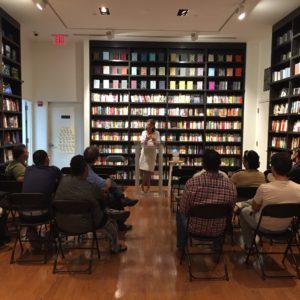
A reading from “With You There Is Light” led to a discussion of today’s media environment

Located in Camana Bay, this is a great independent bookstore with an adjoining cafe.
“What would Sophie Scholl have done with today’s information overload?”
We were discussing Nazi Germany’s censorship and elimination of personal freedoms. The Party controlled all media. The newly easily accessible radio was used as a propaganda tool. It was a punishable offense to listen to any station not “sanctioned” by the Reich.
But what if Sophie was living today? How would she have sorted through all of the Internet’s “fake news” and/or bias? How would she know what was true?
I did not have an answer – perhaps because I struggle with what news to trust, too. In Monday’s 12/4/17 Wall Street Journal’s Bookshelf, L. Gordon Crovitz reviewed War In 140 Characters (Basic, 301 pages, $30.). David Patrikarakos’ expose about his life as a news troll addresses our audience member’s question. Apparently the Russians created a digital publishing company whose first floor peddled disinformation, a second floor created propaganda posts for Facebook and Twitter, and a third floor wrote fake news items.
Since we are at the beginning of the Age of (Dis) Information, it is doubtful we will approach a solution soon. Control is not the answer. Education will be part of it. Young people must be taught the definition of journalism and bias has no place in the classroom.
Writers, like myself, need to be held accountable (I like this better than “censored”). In Patrikarakos’ words, this happens with editorial guidelines, institutional policy and a need to remain impartial and unbiased. My decision to remain unbiased stems from a decision to be an observer of history and not a commentator.
The post Reading to Media Students from “With You There Is Light: Based on the True Story about Sophie Scholl and Fritz Hartnagel” appeared first on With You There Is Light: The True Story About Sophie Scholl and Fritz Hartnagel.
October 6, 2017
Dietrich Bonhoeffer (German, 1906-1945)
Dietrich Bonhoeffer was a German theologian, pastor and political resistance activist involved in Berlin’s July 1944 plot to kill Hitler. Bonhoeffer assisted in providing intelligence that led to the uprising. Executed before the war’s end, he left behind diaries and letters written while in prison that testify to an enduring and unwavering faith. Here below is one of his prayer poems translated by the author in remembrance for those who died and were injured in Las Vegas, Nevada on October 1, 2017, the deadliest massacre in U.S. modern history.
Gott, Zu Dir Rufe Ich am fruehen Morgen
God, to You, I call in the morning
hilf mir beten und meine Gedanken sammeln;
help me to pray and to collect my thoughts
ich kann es nicht allein
I cannot do it alone
In mir ist es finster, aber bei dir ist Licht
In me it is dark, but with you there is light
Ich bin einsam, aber du verlaesst mich nicht
I am alone, but you don’t leave me
Ich bin kleinmuetig, aber bei dir ist Hilfe
I am afraid, but with you there is help
Ich bin unruhig, aber bei dir ist Geduld
I am restless, but with you there is patience
In mir ist Bitterlichkeit, aber bei dir ist Geduld
In me is bitterness, but with you there is patience
Ich verstehe deine Wege nicht
I don’t understand the way
aber du weisst den rechten Weg fuer mich
But you know the right way for me.
Vater im Himmel,
Father in Heaven
Lob und Dank sei dir fuer die Ruhe der Nacht
Praise and thankfulness to you in the quiet of the night
Lob und Dank sei dir fuer den neuen Tag
Praise and thankfulness to you for the new day.
The post Dietrich Bonhoeffer (German, 1906-1945) appeared first on With You There Is Light: The True Story About Sophie Scholl and Fritz Hartnagel.
September 22, 2017
#Resistance during the Age of Trump: Not at all like German Resistance during World War II
Note: The below personal essay describing a reading experience in September, 2017 provided this writer with the opportunity to further define “With You There Is Light” and its publicity platform. Although “resistance” is a popular word at present, future author readings will not address today’s appropriation and the attempt to often equate it with its past usage.
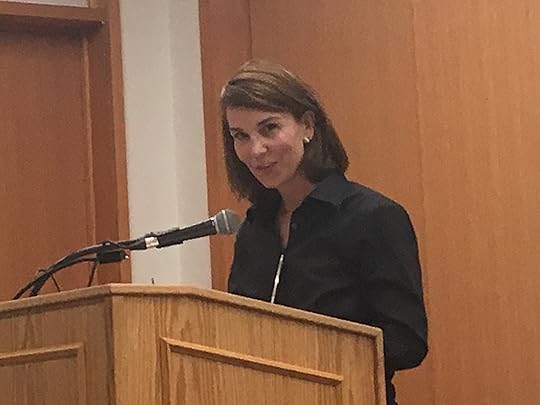
September 12, Ridgefield. “You of all people…,” the woman in the front row of the auditorium was the first to speak. I was the evening’s local author at my hometown library with forty people staring back at the lectern with interested but worried faces.
The reception of “With You There Is Light: Based on the True Story about Sophie Scholl and Fritz Hartnagel” had gone well and the Q&A on German resistance during World War II was only just beginning. As a first generation German-American working in this subject for close to two decades, I’ve encountered a lot worse. Still, one never quite gets used to it.
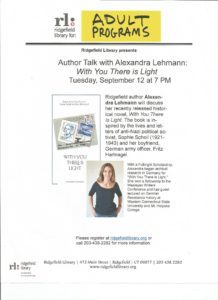
Ridgefield Author Series
“2017 America cannot be equated with 1933 Germany,” I answered with a practiced tone. “We as a people, owe it to ourselves, especially those who want a change in leadership, to create a new vocabulary for our unprecedented President. New and more positive language will cause the emergence of more qualified leadership.” It amazed me, often nervous at a podium and lectern, how I delivered this statement with clarity and purpose.
WHY 2017 AMERICA IS UNLIKE 1933 GERMANY …IN ONE EASY PRINCIPLE
Would I ever forget the day my graduate adviser told me that for my writing about contemporary German history to be grounded in authority, I would have to know it backwards and forwards? I had taken that as a challenge. Within a year, I was studying the years 1933-1945 in the country and in the language World War II started in. Already fluent, and after three years of primary research, I went back to the States to write. The story I wrote about Sophie Scholl and Fritz Hartnagel had always been meant for an American audience, perhaps this very one.
The woman in the front row persisted. She sat forward now in her seat, and with her husband by her side showing support, she postured and continued. The whole room was growing increasingly uncomfortable.
“Don’t you know that today is becoming how Nazi Germany was, and people like you are sleeping?” I raised my eyebrows. “First, it’s the Muslims, then it will be camps and control of the media.” For her, the unstable, 18-year-old German republic defeated in World War I could easily be compared to an over 200 year democracy of the United States with its federal and state powers, checks and balances and the new Fifth Estate in the Age of Information.

Historical and political arguments are stronger without false equivalencies.
Finally, someone in the back of the room spoke up.
“There is no way today is like Germany was, not even close. Never with social media,” the voice in the back called out, loud enough so we could hear it up front.
Quite suddenly, as if immediately wasn’t soon enough, I shut the discussion down. It was going to get crazy fast. But why would I ask the woman supporting my position to be silent?
WHAT IS MORAL RELATIVISM AND/OR FALSE EQUIVALENCY?
The problem with starting a sentence with “you of all people…” or calling someone the “N” word is an attempt at creating moral high ground in which the person doing the name calling has the only legitimate position. Equating the perpetrators of the worst systematic crime against humanity of all time with the Trump Administration is a problem of moral relativism or false equivalency. To understand this sentence may require a dictionary. Shouldn’t we at least try?
The victims of the Second World War, of whom Sophie Scholl and the students of the White Rose are among them, are worth that. Are we not capable of reasoning more deeply? The most concerning, however, is the type of name calling that stops conversation. When the “N-word” is suggested or used carelessly, people shut down. Discourse becomes impossible.
AN OPPORTUNITY TO CREATE NEW LANGUAGE AND HENCE NEW LEADERSHIP
I continued re-stating my earlier position, trying to find common ground.
“Let’s develop a new vocabulary that fits the U.S. political landscape today – not Europe in the twentieth century. Protest will be more effective and less divisive if we can find calls-to-action stemming from positive words. From debate and discussion, new and more qualified leadership will emerge. I think we can all agree that we don’t deserve the candidates we got in the 2016 Election. We can also agree that our identity politics are also splitting our respective parties.”
“No, you create the vocabulary,” she lashed back. “If you don’t want us to use words like Nazi or Hitler. You tell us what words we should use.”
“No, you define it, if you are so worried,” I answered quite plainly, keeping my tone even. “I am more than confident that I will be able to use my vote in three plus years and this is the voice I depend on. And now, if you don’t mind, we have a full room of people who wish to speak.” I lifted my eyes back to the crowd. Had I won the debate by not resorting to insinuations or using words that shut down conversations? I had no idea. No one else uttered a word.
The questions turned back to history and not politics. The woman in the front row left without buying a book. I sold out of them. Interestingly, with every copy that I was asked to sign, people commented that they too, did not believe we were living in 1933 Germany. But they too had been too afraid to speak up.
Note: The following personal essay is a departure from the regular format found here. This blog is primarily about historical context and excerpts from “With You There Is Light: The True Story about Sophie Scholl and Fritz Hartnagel.”
The post #Resistance during the Age of Trump: Not at all like German Resistance during World War II appeared first on With You There Is Light: The True Story About Sophie Scholl and Fritz Hartnagel.
August 20, 2017
Political Resistance History and Context in the Age of Trump, Part 2 of 4
For the liberal elite, Progressives, and #NeverTrumpers, resistance means opposition to the country’s sitting President.
Referring to this ray of light in World War II history along with shouting “Nazi” and instilling fear in those who do not think or believe as strongly in another group’s identity politics obstructs the unification of this country.* Journalists and writers like myself can help correct this mis appropriated usage. We must also work to form a new vocabulary – that both sides of the aisle can use – to define the unprecedented Trump Administration.
Domestic terrorism, chaotic, and “un-Presidential” may all fit – whereas resistance, Nazi and Fascist do not. Germany’s student resistance group in Munich, the White Rose, and Sophie Scholl’s letters and writings may serve as lessons for today but leave its nomenclature to history. The relevance of German Resistance during World War II lies in providing analogies or references that are helpful to a functioning republic – not ones that are harmful.
Is “Country First” and “Common Good” terms that both parties and all Americans can agree on? Isn’t that what the resistance during World War II fought for? The return of Germany to the Germans? France to the French?
Why President Trump Is Not A Nazi
(And Thereby Engaging in So-Called Resistance Is Ridiculous)
“Trump threatens the welfare of women, immigrants, LGBTQ, and through climate change denial, the health of the planet itself” writes Tim Dickinson in The Rolling Stone (1/13/17) in “Meet the Leaders of the Trump Resistance.” Dickinson goes on to write that “immigrant rights activists are calling on citizens to harbor and protect those without legal status, evoking the French resistance.”
It is exactly this kind of language that burdens Trump’s opposition. In an otherwise thoughtful argument, Dickinson forgets that “French resistance” harkens back to one of the darkest histories known to humankind. It is doubtful if not impossible that those harboring an illegal immigrant will be forced into a concentration camp or beaten into submission by the Department of Homeland Security. The French resistance movement sprung out of its country’s foreign occupation by the Nazi dictatorship.
France, a once free country, suffered the immediate destruction of personal freedoms when Hitler stormed into Paris in 1940. Its citizens were forced to collaborate in the annihilation of political opposition and an entire race under penalty of death and/or imprisonment.
President Trump may have gotten elected on nationalism – which did not use to be a dirty word – and the United States is not in the same position as France or Germany was from 1933 to 1945. The President of the United States is neither the legislature nor the courts. The Trump Administration does not control the media. Checks and balances will prevail, as will our constitutional republic.
How Re-Introducing Civil Discourse Will Save The Country
Today’s increasingly violent political protest that employs strategies of intimidation and fear, on both sides, will undoubtedly have serious consequences and negative effects (see “The Rise of the Violent Left in September’s Atlantic Monthly and Mark Lilla’s “The Liberal Crack-Up” in August 12-13 Wall Street Journal).
The most positive outcome of the 2016 Presidential Election will be the rise of more qualified candidates and political leaders who understand that identity politics (a.k.a ‘movements’), inverted taglines and falsely appropriated historical slurs divide their own parties and make them more fanatical and divisive. Only conversation and negotiation will right our nation. See the madness explained to the younger generation in a trending YouTube video, “Punch a Nazi.”)
Hans and Sophie Scholl and the other members of the White Rose resistance discussed among themselves that they had to appeal to a common base to overthrow Nazism. They therefore started with the most obvious rhetoric – return Germany to the Germans.
Return America to the Americans. I am not a white supremacist. I am not a Nazi nor a nationalist. I did not go to the women’s march on Washington because I see enough gender division in my own little life, both in personal relationships and the workplace.
I am a first generation American wishing to be safe, especially with the words I write here.
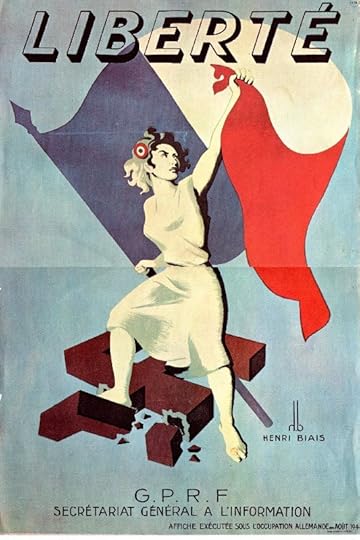
French Resistance protested foreign occupation and their country’s President who sided with it.
*Personal identity politics refer to movements like “Black Lives Matter,” Pro-Choicers/Anti-Abortion Groups, Planned Parenthood, Sierra Club/environmentalists/climate change deniers, gun control advocates/NRA, etc.
Excerpt from Chapter 8, “We Will Be Not Be Silent,” in With You There Is Light:
Sophie thought again about freedom and God. She thought about all of their late-night discussions and debates, all the books she read to find the answers. The fifth leaflet summed it up best: Where there is no individual responsibility, there is no freedom. Freedom only exists when one can articulate and express it. The State can guarantee freedom, but freedom is always a question of the individual citizen. These leaflets were a culmination of everything she had learned. And now, everything that she was actually doing. The recipients of the leaflets would know what to do. They would break out of their denial. They would help return Germany to the Germans.
To purchase this book about Germans living under Hitler, please click here.
The post Political Resistance History and Context in the Age of Trump, Part 2 of 4 appeared first on With You There Is Light: The True Story About Sophie Scholl and Fritz Hartnagel.
August 2, 2017
Civil Disobedience as Resistance
Civil Disobedience As Resistance in
America and Europe during the 19th and 20th Centuries
“We should be men first, and subjects afterwards.” -Henry David Thoreau, American (1817-1862)
“Laws change; our conscience does not.” -Sophie Scholl, German (1921-1943)
It is doubtful that Sophie Scholl read the American transcendentalist, Henry David Thoreau’s Civil Disobedience (Resistance to Civil Government). All books by the enemy, in this case, the United States, were banned by the Reich’s Cultural Directorate. [Scholl documented her intellectual history in her diaries and letters and did not mention reading Thoreau.] The similarity, however, in their lines of thought as they relate to civil disobedience as resistance bear discussion.
First given as a speech and then published in 1849, Thoreau protested against slavery and the Mexican War by urging Americans not to allow government (or its laws) to govern over their consciences. Not only should citizens place their morals, ethics and beliefs before the law, but Thoreau also posited that individuals had a duty not to acquiesce to laws that could make them agents of injustice.
Thoreau subsequently refused to pay a poll tax in service of the slave trade and was put in prison.
[image error]
John Brown was charged with treason for his revolt at Harper’s Ferry in protest of slavery.
Thoreau was released when a good friend bailed him out of jail. In 1859 he supported John Brown’s actions against the Commonwealth of Virginia and wrote, “Some eighteen hundred years ago Christ was crucified; this morning, perchance, Captain Brown was hung. These are the two ends of a chain which is not without its links. He is not Old Brown any longer; he is an angel of light.”
Thoreau lived to see the beginning of the Civil War but not the Emancipation Proclamation. He died at 44 of tuberculosis.
Sophie Scholl died in service of her conscience when she was executed for treason against the Third Reich. Her acts of civil disobedience as resistance were punishable by death.
The below excerpt from With You There Is Light is from Chapter 11, “The Law That Never Changes”:
[Gestapo Chief of Police Robert Mohr was Sophie’s interrogator after she was arrested at the University of Munich for distributing anti-Hitler leaflets. The below bolded quotes are actual excerpted translations from the Gestapo Interrogation Notes (translated into English by Alexandra Lehmann and used with permission).]
Robert Mohr’s eyes grew wide. Not only did he have the power to convert this girl gone astray, he also would be able to save her life by converting her back to the truth. He continued.
“During this entire interrogation, hasn’t it once occurred to you that your behavior and actions, especially during this critical phase of the war, are a crime against your very own community, your countrymen, your soldiers?”
Sophie thought carefully before answering. After some time, she spoke.
“The crimes you speak of—you mean the right to freedom of speech? And all of the other freedoms that were possible in Germany before your Führer came to power?”
“No, Fraulein Scholl. I am speaking of the law. You broke the law.”
“Laws always change, Herr Mohr. You know that. I obeyed the law of my conscience. The law that never changes. It is the law that must be obeyed when political law breaks all moral authority.”
Mohr smiled thinly. He answered back with conviction, “Not every conscience can determine what’s right and what’s wrong. That would result in absolute chaos.”
“No one has the right to take innocent lives because he alone decides what is right. Only God is allowed to do that.”
“And, what if, what if, Fraulein Scholl, there is no God?”
“Well, Herr Mohr, every argument that we will ever have will end exactly here. I’m as convinced as ever that I did the best that I could for my country. I don’t regret my behavior, and I will take the consequences for what I have done.”
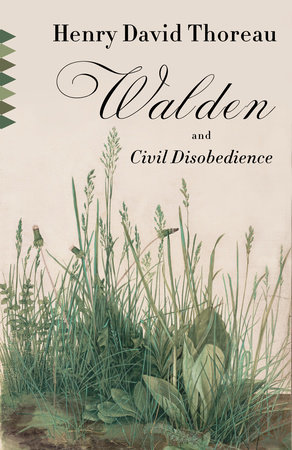
In honor of Thoreau’s 200th birthday, you may purchase his book below. Or, if you are interested in reading more about Sophie Scholl, please purchase “With You There Is Light.”
The post Civil Disobedience as Resistance appeared first on With You There Is Light: The True Story About Sophie Scholl and Fritz Hartnagel.
June 10, 2017
Re-Visiting The White Rose Student Resistance Movement in Munich
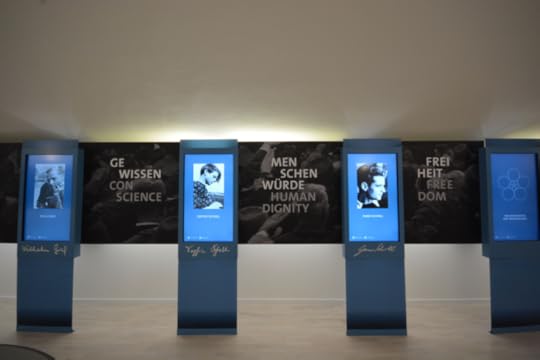
New Munich Student Resistance Installation (LMU, 2/17)
Munich, June 10, 2017. Re-visiting the new installation at the University of Munich (LMU) furthered my commitment to sharing the history of the White Rose student resistance movement. During World War II, siblings Hans and Sophie Scholl, and Alexander Schmorell, began active opposition against Hitler and the Nazi Party. Informed by their eye witness of war crimes in occupied territories and from Captain Hartnagel fighting on both fronts, these students recruited fellow activists and distributed thousands of copies of anti-Hitler leaflets to over sixteen cities before their capture in 1943.
ANY NEW INFORMATION?
By war's end, sixty of these resistors would be either executed or imprisoned for treason against the Third Reich (a new statistic for me). After over ten years of studying and writing about this history, was there anything else for me to learn? Of course. I was pleased to read that Willi Graf's choral group supported the Munich student resistors (the White Rose). I had thought otherwise. Both scholars and those first introduced to these remarkable and important figures will likely benefit from this brand new conception. This exhibition is free and can be easily found in the foyer of the University of Munich.
INTERATIVE, ENGAGING CONTENT
An elegant blue and splendidly lit glass cases guide the visitor through the installation which feels like both a work of art and exhibition. New eyewitness interviews can be watched along with hearing audiotapes from the actual show trials. Notably, all content is in English. Although it was a German holiday (Pentacost), the exhibition was well-attended on the day I visited. Hinz & Kunst, the agency responsible for this new presentation, has done an excellent job of combining both languages so that it often appears like one. Perhaps this insight comes from someone reasonably fluent in German and English. I couldn't help feeling, however, that words like "freedom" and "human dignity" mean the same thing in all languages and that Hinz & Kunst assisted in this formulation.
Since attracting same age students to this material is obviously its mission, the English translation along with interactive panels makes it entirely possible.
LITERATURE
When I worked on the research for my book, I was struck by Sophie Scholl's intellectual history. Always a rebel, Sophie read books that were banned by the state in 1933. I sought to write her story in a chronological way alongside with the books that she experienced, often together with her best friend, Fritz Hartnagel. Seeing the "Lesetisch" (Reading Table) in the center of the exhibition affirmed my own thinking. If you are truly interested in understanding how a young person said "NO" and became brave enough to stand up against tyranny and injustice, one must read the books she did. In conclusion, this new exhibition states this case plain enough.
SHARE THIS ON FACEBOOK
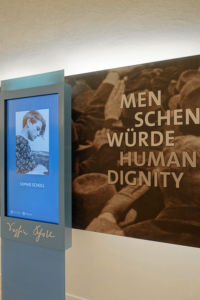
New Munich Student Resistance Installation
The post Re-Visiting The White Rose Student Resistance Movement in Munich appeared first on With You There Is Light: The True Story About Sophie Scholl and Fritz Hartnagel.
May 9, 2017
Sophie Scholl (German, 1921-1943)
Born on May 9, 1921 in Forchtenberg (Baden-Wuerttemberg), Sophie Scholl was the third child after her siblings Hans and Inge. She was followed by Elizabeth ("Liesel") and Werner. Sophie's father, Robert, had just been elected as a "democratic" Mayor of this small town. Many townspeople violently opposed his election as hanger-ons of the German monarchy. Robert refused to fight in the Great War whereas her mother saw the horrors of the war close up serving as a nurse.
 The Scholl children's father became an accountant and started his own firm after failing to receive a second term as Mayor. The family moved to the larger city of Ulm. Germany's new Fuehrer had just been elected and Sophie was 12 years old.
"Sophie's upbringing played an important role in my own understanding about her unique character. Very early on in my research I came to the conclusion that her mother and father greatly influenced her decisions. Sophie Scholl's love of art and literature, drawing and playing piano, relationship with Fritz, and thirst for spiritual and religious understanding were key characteristics of this timeless resistance hero." - Alexandra Lehmann
For more information about Sophie's relationship with Fritz, please visit www.alexandralehmann.com.
The post Sophie Scholl (German, 1921-1943) appeared first on With You There Is Light: The True Story About Sophie Scholl and Fritz Hartnagel.
March 13, 2017
German Cultural Studies, February 2017
The last question came from a very bright student at the end of the fifth class I taught on “Sophie Scholl and the German Resistance against Hitler.”
[image error] Commissions/Communications Brigade
During the last two hours, ten students in this German Cultural Studies Class had engaged attentively in the subject of German Resistance. Our syllabus consisted of both learning about the content and the context in which Sophie Scholl and Fritz Hartnagel wrote one another letters.
This word, Nazi, rightfully never goes away, and even now it is commonly being used to describe a sitting President. To have the question so honestly asked, and therefore demanding close examination was a reversal of an experienced prejudice deeply embedded in our society and educational system. With this one asked question, my years dedicated to Sophie Scholl and Fritz Hartnagel’s story felt redeemed.
Sophie Scholl
[image error] Active Duty/Medical Examination Upon Conscription, Dec. 16, 1940
Sophie Scholl (1921-1943) was, at the end of her life, not a Nazi. Most people know she was executed fighting against the Third Reich. As a teenager, however, Sophie was a Nazi as a group leader in the girls’ Hitler Youth. Her transformation involved several factors and her dying beliefs are totally clear. For her actions she is remembered for an unmatched courage and as an enduring example of principle and morality.
Fritz Hartnagel
Fritz Hartnagel (1917- 2001) demands a thorough study but ultimately reveals a clear answer. Fritz grew up in the Hitler Youth and graduated as an officer from the Prussian military academy. Field Marshall Rommel was his teacher. He swore the revised Fuehrer Oath. As Germany annexed Austria, Lieutenant Hartnagel led a communications company in the Black Forest. During the Blitzkrieg, he was stationed in Belgium, Holland, and France. As Hitler declared war on Russia, Fritz took part in Operation Barbarossa. With the invasion, his communications company followed the infantry through to Moscow. He was then moved and “forgotten” in Weimar (near Buchenwald) where he was ordered to set up a company for Africa. Later in the summer of 1942, Hartnagel was sent again to Russia. The Battle of Stalingrad would follow that winter. Starving and surviving subzero temperatures, he was one of the last officers flown out of the surrounded city. Even with a partly amputated hand, he was sent back again to France where he finally commanded, under the penalty of death, the remains of his company to desert and surrender to the American forces.
All during these time, Fritz wrote letters to his girlfriend, Sophie Scholl. Uncustomary, and under the penalty of death, he wrote to her about German army atrocities. After Sophie’s execution, he was accused of being a co-conspirator. After the war, he was accused of being a Nazi collaborator. What was he?
The post German Cultural Studies, February 2017 appeared first on With You There Is Light: The True Story About Sophie Scholl and Fritz Hartnagel.
February 22, 2017
What we said and thought, so did you, only we were capable of saying it
-Sophie Scholl (1921-1943) speaking to the crowd of onlookers during her show trial where she was convicted of treason.
Seventy-four years ago on February 22, Sophie Scholl was sentenced to death by the notoriously delusional President of the Peoples’ Court, Judge Roland Freisler. Notes from the Scholl’s siblings and Christoph Probst’s trial did not survive the war. Research for the below scene comes from the trials of the military men convicted in the plot to kill Hitler in Berlin (known as “Valkyrie“), also presided over by Freisler.
 Justizpalast, Munich (where Sophie Scholl’s trial and sentencing took place.)
Below is an excerpt from “With You There Is Light.”
Munich, February 22, 1943
“These cowards betrayed our cause when we needed them most. These useless slobs want to rob our way of life—our National Socialism. This is the greatest insult against us.”
One of the uniformed and decorated men in the small courtroom coughed uncomfortably. It would be the only sign of resistance throughout the whole proceeding.
“Their treason means death. We will someday march after the Führer into the world of freedom. Everything we are is contained in this universe. It is incomprehensible that they’ve even been able to think what they thought, never mind attempted to realize it.
They have committed treason against the German people!”
Freisler paused for a moment and caught his breath. Captivated by his speech, the courtroom was completely spellbound. This time the words hadn’t vomited out of him, each one assaulting his listeners like arrows piercing the flesh. They came out as though they made perfect sense, as though this was the philosophy of the ages. There never were words uttered so profound and applicable. They flowed together and in their fluidity, gathered momentum and speed.
He continued in this peaceful tone.
“It is treason against the dead of this war. It is treason against the dead of the National Socialist movement. It is treason against all those who died from all other wars in the last 2,000 years, and also those who have died so that their young German sons could not be born. It is also treason against those who will follow, who haven’t been born yet. It is treason against our children and our children’s children. It is treason against everything that we have, that we are, for what we are living for, for what we are fighting for. It is the most complete treason that we have ever witnessed in our history.”
Freisler paused, looked around at the crowd and totally satisfied, breathed deeply and sat back in his chair.
“I have studied the leaflets over the last few days and can only marvel at the pure stupidity of them. Did they really think that the German people would be stupid enough to believe their lies?” Hans was the first of them to interrupt the mad judge.
“Herr President, they did listen to us, and they would have acted very soon as we instructed them if we hadn’t been caught by your henchmen,” Hans spoke in a less than convinced voice. His voice waivered. “You will all pay the price for not standing up to men like him,” Hans continued, pointing to the crowd of onlookers. “Your conscience will never leave you alone, long after the war is over.”
For more information on “With You There Is Light,” visit www.alexandralehmann.com.
The post What we said and thought, so did you, only we were capable of saying it appeared first on With You There Is Light: The True Story About Sophie Scholl and Fritz Hartnagel.



![[image error]](https://i1.wp.com/sophieandfritzletters.alexandralehmann.com/wp-content/uploads/2017/03/german-military-papers.jpg?ssl=1)
![[image error]](https://i2.wp.com/sophieandfritzletters.alexandralehmann.com/wp-content/uploads/2017/03/german-army-papers.jpg?ssl=1)