
Lynne Hugo's Blog
November 6, 2017
Unfinished Stories
 Nancy’s husband sent a picture two days before she died. In that one, she wore a white sleeveless nightgown. Her grown sons leaned over either side of her, a hospice tray with a cup of applesauce in the foreground. She was sleeping. Perhaps she’d slipped into the mercy of a coma.
Nancy Johnson Pinard was her name. Is her name. She was a novelist. I know she also had many other roles–aren’t we all many things to many people? She would have finished all her works in progress if she possibly could have.
Her first grandson was born three weeks ago.
The people killed on the west side of New York this week were living stories they and no one who loves them will get to finish. Each of those lives has its singular details, poignant, tender, unbearable. I think of them, all those unique details, and of the unfillable gaps that open like black holes when we lose people we love and need.
“We thought we’d have years together,” Ron said to me, making a quarter turn to look at his wife in her coffin. We were in the chapel of the funeral home. I had the feeling he wanted me to look at her, too. I couldn’t. I didn’t, and I hope it wasn’t hurtful to him. I didn’t think she’d want me to. Ron and I hadn’t met in person before, though he “knew” me in the same way I did him.
The novel she was working on was about Albert Einstein’s first wife, Mileva, an accomplished physicist, and the mother of his two sons. Their daughter, Lieserl, disappeared from history when she was about two. It’s unknown what happened to her, why her story never continued. There’s no record that she died.
I want to know what happened to Lieserl, or more accurately, what scenario Nancy would use, based on all she’d learned, to create a plausible outcome. I was reading and editing the novel for her, chapter by chapter, the same way she’d read and edited my books. Her Einstein novel is still untitled, between half and two thirds written. I was a good reader for her. She was a brilliant editor for me. She could line edit a weather report and sharpen it. We could tell each other what was wasn’t on the page yet and suggest a fix.
When she said that all she could eat was Ramen noodles, I edited that to homemade soup. Change that at least, I said, even though by then I knew, because she’d told me, she couldn’t change anything that mattered.
It wasn’t acid reflux. Prilosec doesn’t help pancreatic cancer.
Shadow Dancing, her first novel was titled, and the second was Butterfly Soup. Then The Confession of Emma Darwin, which hadn’t found a publisher yet. And the work in progress, the unfinished story of Mileva, Albert and Lieserl Einstein. It was her finest work. I know the grace of transcendent writing when I read it, and that of a story that lifts and carries you downstream on its back. Mileva’s story is all that and more. Years of research was woven in, the mysteries of physics and Serbian superstition, the desperation of human love and what we do in our attempts to earn its return. The relentless drive to do work that has meaning.
Maybe that’s some of why we write novels. As Nancy always said, it’s not for the money. There’d be much easier things to do for money. Wash windows on a skyscraper, say, harnessed to your work by the tenuous ropes of your faith. At least you could see, then, when you’d cleared away the muck and let in the bright clarity of daylight. You’d know something for sure about what you’d accomplished.
Nancy had dark hair and eyes. Her sons look like her. The oncologist told her she could live two to three years with chemo. At the time, she told me her family was ecstatic, grateful for that much. It was less than six months.
In the memorial folder put out at the funeral home, “The Road Not Taken,” by Robert Frost was printed on the inside left. But really, Nancy took a familiar route, the novelist’s, following a map she’d studied, memorized and trusted, until late, after the diagnosis, when she sent me the last chapter she’d worked on. After that, she couldn’t type any more, she said. Her hands shook too much, maybe from the chemo. She didn’t offer a hypothesis.
She loved her mini dachsund unreasonably. The dog used to sit on her lap while she wrote. Starting in May, instead of virtually every day, I heard from her less and less. Her texts—done by voice—were sometimes garbled. In August she said, “I can’t write yet.” She never could again. In September she said she could read by listening to audio short stories. The last text I have from her is October 12. She died on the thirtieth.
I have a new sense of urgency in my work, like tripping over the feet of strangers while you gather yourself up and hasten from your seat on the train to get off, carrying the precious cargo of your soul. Will the automatic doors shut just as you are walking through? Will you be able to step onto the platform safe, intact, or will you stumble and fall into the crevice between the train and the tracks where no one can get to you, no one can know what you were trying to finish because no one else knows the story you carried in your heart?
Here’s the poem I’d offer for Nancy, and for the unfinished stories others mourn today. It’s by Raymond Carver, a novelist and poet who also died of cancer.
AT LEAST
I want to get up early one more morning,
Before sunrise. Before the birds, even.
I want to throw cold water on my face
And be at my work table
When the sky lightens and smoke
Begins to rise from the chimneys
Of other houses.
I want to see the waves break
On this rocky beach, not just hear them
Break as I did all night in my sleep.
I want to see again the ships
That pass through the Strait from every
Seafaring country in the world—
Old, dirty freighters just barely moving along,
And the swift new cargo vessels
Painted every color under the sun
That cut the water as they pass.
I want to keep an eye out for them.
And for the little boat that plies
The water between the ships
And the pilot station near the lighthouse.
I want to see them take a man off the ship
And put another up on board.
I want to spend the day watching this happen
And reach my own conclusions.
I hate to seem greedy—I have so much
to be thankful for already
But I want to get up early one more morning, at least.
And go to my place with some coffee and wait.
Just wait, to see what’s going to happen.


August 28, 2017
Our Recalcitrant Robot
We were recently with our daughter’s family. They have two kids, two dogs–one of which is a Labrador retriever–and astonishingly immaculate hardwood floors. We have no little kids at home, one Labrador retriever, and hardwood floors that make people wonder if we’re running an unlicensed barber shop. Labs shed. Forget that myth about twice a year. If I could sell the dog hair I sweep up daily, I could save the world with the proceeds. It turned out that our daughter and son-in-law, who, yes, used to have floors that looked like ours, bought a robot vacuum cleaner (brand shall be unnamed by me to avoid a lawsuit) that they program to run while they’re at work. It thoroughly cleans their floors on its own, returns to its docking station in a pleasant and polite manner, recharges itself, and does its thing again the next day. (They do have to empty it, a quick little process they can do at their convenience.) It even talks to them nicely if it encounters a problem. They are all in love with this new family member, which they named Rosie.
 So, of course, a nanosecond after leaving their house, we bought one, and in a burst of writerly originality, I named it Rosie “too”. We plugged her in, charged her up, and told her to clean the house while we took Scout the Lab (he who is the reason we need the house cleaned every day) on a nice long hike in the woods. Expecting to be dazzled by floors as clean as our daughter’s, we came back. I inspected. Hmmm. The failure was especially egregious since the late afternoon sun slanted through the window and all the dog hair was highlighted as it sparkled in brilliant array on the walnut flooring.
“ROSIE!” I yelled. “What the hell?” She wasn’t on the docking station and the house was silent. “Why aren’t you working!”
I started looking for the slacker.
Thirty minutes later, I still hadn’t found her.
“Rosie ran away from home already,” I told my husband, hands on my hips and making it clear that I was quite outraged.
“Well, that was a great use of money,” he said, while pouring himself a well-fermented beverage, his helpful response to domestic crises.
I finally found her. She was jammed was under a bed in one of the guest rooms, tangled in a 1997 high school graduation tassel. And I’d heard she was smart. Turns out you have to read the directions, which is plain annoying, and set up virtual walls to keep her out of trouble. Lord, I might as well get a teenager.
So I sighed deeply and sort of read them, and put Rosie to work again the next day. It ended in another yelling match.
She didn’t run away (she couldn’t; I stayed home  and stalked her), but she flat refused to go where I told her. Instead she kept redoing the exact same area even though I kept shouting that it was already fine, and, “Dammit, go over there where there’s whole pillows of dog hair you totally missed!”
I finally got out the broom and did it myself. It’s a work in progress. I don’t know which one of us will be trained first.
June 6, 2017
Heroism: It All Counts, Right?
I’ve spent a couple of years trying to figure out how my very smart dog—who can remember and break into any place food is stored—can have such an extremely short memory. Every day, when Scout the Lab sees the horrible menace of the mail truck as it stops in front of the house, we have a frenzied barkfest: look! That truck! What’s it doing on my road? I’ve never seen that before! Very dangerous! I’ll scare it away for you right now. And it works every time. The truck goes away, the home is safe. He expects a treat. (He also saves us from birds that fly into his territory. God help the UPS delivery man and people who walk their dogs in front of our house.) Obviously, he’s a hero. So I should have known Scout would throw himself in harm’s way for us.
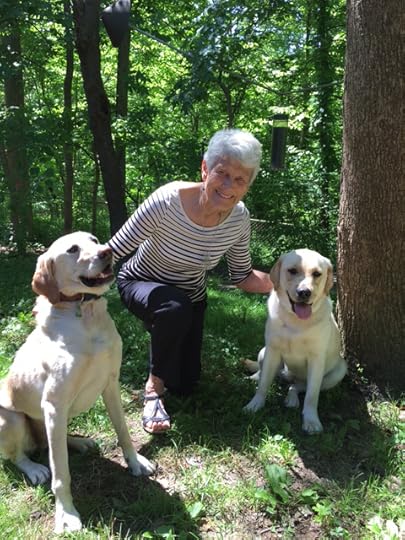 (Left to right) Scout, Barb, and Roxy
Yesterday we were out hiking in the woods as usual, Scout, me, my husband, Alan, and dear friend, Barb, with one of her two Labs. Here’s what you need to know about Barb’s dog. She’s only had her for two days. Part of an extensive program, Roxy is a gorgeous one-year-old yellow female; she’ll be used for several cycles as a breeding dog for Lab puppies that will ultimately be raised in other homes and trained as service dogs for handicapped people. Roxy’s special—exceptional health and calm temperament. Barb and her husband were likewise chosen as exceptional people, able to give her a forever home while allowing her to be bred for this purpose. They signed multiple agreements.
Roxy was fully leashed yesterday, while Scout was off leash, carrying his ever-present tennis ball. Did I mention that Roxy is strong? She is remarkably obedient, remarkably calm, remarkably strong.
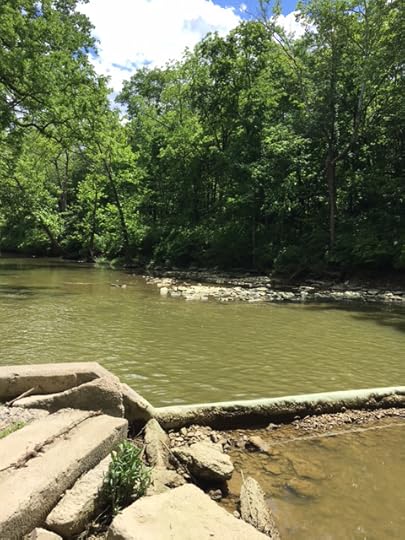 Above the spillway on a day when the river is slow and low.
Everything was peachy–a lush day of hot afternoon sun–until we stupidly decided to head through the woods to let the panting dogs get a drink from the river. Even more stupidly, we went to a section just above the spillway. Did I mention how much rain we’ve had recently? How high and hard the river is running?
Apparently, Roxy was pretty thirsty. She caught a glimpse of that water and took off, dragging Barb relentlessly over the rocky embankment. Have I mentioned how strong Roxy is? Barb was about to be pitched head first into the river when Roxy jumped for the water, and the leash was jerked from Barb’s hand. That would have been fine; Labs are great swimmers. Except that the current was so unusually fast, Roxy was almost immediately swept over the spillway.
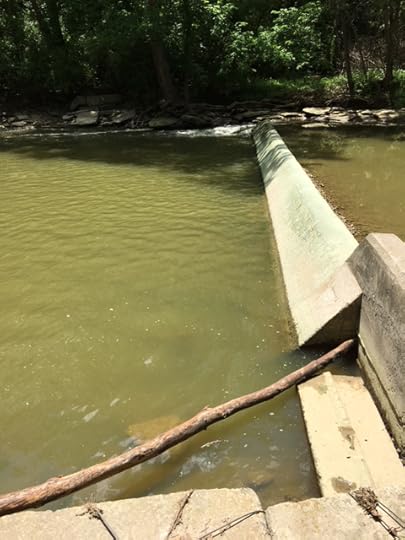 The spillway as it normally looks!
Well, Roxy could have still been fine. But, swimming like mad, she kept trying to climb back up the spillway, which isn’t possible. What she needed to do was turn around and swim downstream with the current to get to the side. This generally comes naturally to our Labs, but maybe not with three humans and a barking dog screaming instructions at you? When Roxy didn’t turn right away, unwilling to chance that she wasn’t going to, Alan climbed down the bank below the spillway, and into the river he plunged after her.
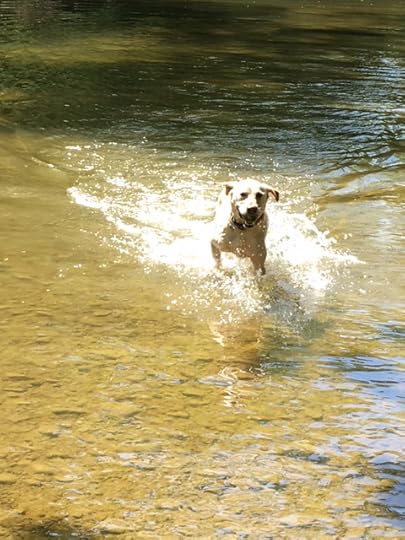 Scout in the shallows.
No, he didn’t stop to discuss it. Or take off his shoes. Or to toss his wallet, car keys, or watch down first. This was a man and dog code red. Into the river. “It’s okay,” he yelled, in to his waist: “I’m fine! Not deep!” Oops, suddenly chest deep. Then, over his head. Did I mention Alan’s not a world champion swimmer? (He’ll now deny this true fact forevermore. Not that a beautiful freestyle was a great possibility in the roiling current, anyway.)
Well, Scout would have none of that. What’s hero practice for after all? He saw Alan and Roxy in the water, barked I’ll save you! and leapt in the river. No, he wasn’t smart enough to throw himself in below the spillway. He jumped in exactly where Roxy had, and the racing water shot him over the spillway, which clearly hadn’t been part of his plan.
Now there were two dogs and one man in the river, and two women on the bank pointing and screaming the only sensible thing: go downstream, go downstream!
As luck (and honestly, it was luck) would have it, there was a large branch floating in the middle of the river. Alan grabbed for it. He got himself behind Roxy, got them both downstream enough to work her over to the bank and shove her onto land from behind.
(Scout later pointed out that he swam downstream and climbed out on his own after seeing that he’d saved Alan and Roxy, thank you very much. He swims that river every damn day, after all. You just have to stand ready for emergencies at all times.)
My heroes.
P.S. Kids, please don’t try this at home.
The post Heroism: It All Counts, Right? appeared first on Lynne Hugo.
December 7, 2016
I Hope You Dance
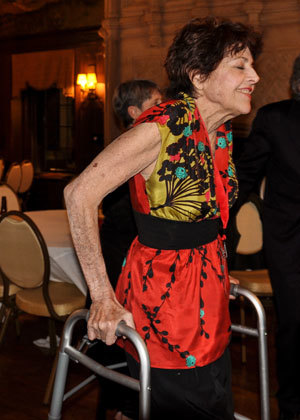 Janet S. Dwyer in Connecticut, Oct. 2015
Do you remember Lee Ann Womack’s hit song “I Hope You Dance?” One of the lines goes, “… And when you get the choice to sit it out or dance, I hope you dance.” Here’s a story that I hope makes you not only want to dance, but just as importantly, to extend your hand to someone sitting on the sidelines.
A year ago, I went to my high school reunion in Connecticut. Although I ignore invitations to college and graduate school events, I never miss it when my class gets together every five years, way more fun than actual high school ever was. Go figure. We’re a bunch of passionate achievers who separated for distant colleges and lives, but never lost touch. Marked by the Vietnam war years, we’ve shared pain and too many terrible early deaths. We’ve also shared some unspeakably beautiful memories and moments.
One of these times now involves a star of our class, Jan. Smart, popular, she even did sports and was on the committees that make things happen. Homecoming Queen and Prom Queen junior year. The kind of girl who knew all the new dance crazes and actually did them, and then, when the slow music started, danced with her eyes closed, arms around her boyfriend’s neck and his around her waist while her gardenia corsage got crushed between them and even the air grew heavenly. I really think everyone liked her. I certainly did. I remember very dark hair–it must have been long (wasn’t everyone’s in high school?)–and perfectly arched eyebrows, not too thick, not too thin, color-matched to her eyes and hair. I can’t remember where she went to college, nor where she went after. New York City, maybe, or Washington D.C. where she ended up. She was a consultant to commercial architects on sustainable building practices. She didn’t marry. Six years ago, at the reunion before the most recent one, she and I talked for quite a while but I have no memory of what it was about other than that she told me I have pretty teeth. She was gorgeous as ever, dressed exquisitely, her hair still long and dark. She wouldn’t have been out of place at a reunion for people fifteen, even twenty years younger than we, always one of the cool kids, but warm, fun, real. She loved Broadway shows, New York City, and all things French, which she spoke beautifully.
As I’ve confessed in another post, my class is an exuberant (okay, maybe rowdy) bunch when we get together. Last year, Jan’s younger sister brought her to the Friday night gathering and then to the big Saturday night dinner dance, because Jan was on a walker, unable to make the trip by herself. She didn’t want to miss the main event, even though she was almost indescribably frail, rib-thin, being ravaged by something I’ve since heard was Lou Gehrig’s disease (but am not positive that’s correct information). She was cheerful, engaged and engaging. After dinner, there was, again this year, an open mike for us to honor the classmates we’ve lost. This time, the Choraleers reprised a song in their memory, one we’d done in concert our junior year, “Brother James Air.” After that, well–I told you we’re a rowdy bunch: a live rock n’roll band, The Tire Biters.
Then, the dancing. We are dancing fools. Not that Jan sat alone; people variously sat one out clustered at tables, talking, having maybe just a little more from the bar. Jan talked and watched the dancers, maybe remembering, keeping the beat with her hand on the table. At one point–I really don’t remember who started it–and my memory of this is not sharp, warmed and fuzzed as it is by time and her smile, but we noticed what looked like longing, and encouraged her to stand and dance, meaning just bounce a little to the music however she wanted, using the walker. A bunch of us danced across from, around, and with her to our old, fun music. She was radiant.
It lasted a couple of songs before the band switched to ballad tempo and she sat back down. People cut in on old friends, couples switched up partners; every song was one we knew. These were not songs to which a person on a walker could feel comfortable dancing by herself. Not when everyone else on the floor was slow dancing in couples.
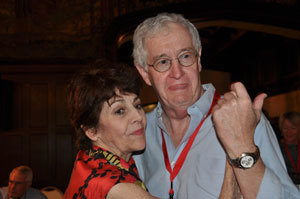 Jan with Bill Hartman
Then a classmate, Bill, went over and picked her up. He just picked her up, held her against his body, her feet not touching the floor, not needing to. No need for her walker: all she had to do was hold on, and let him do it. She did. He isn’t someone to whom she’d been very close in high school. Just a good man who saw her and risked kindness. I saw her close her eyes for a while, her head on his shoulder. And I saw the light on her face as they slow danced.
That night, Bill lifted her, and Jan danced. Now I have a note from our class president that Jan has died. I hope that in this climate of frequent unkindness, more of us can be like Bill who saw someone alone and moved toward a different possibility. “When you get the choice to sit it out or dance, I hope you dance.” She could have said no; he could have held back–but neither one of them sat it out. They danced. Let’s all of us, whenever we can, be kind. And dance.
Photos courtesy of Douglas Howe
The post I Hope You Dance appeared first on Lynne Hugo.
November 15, 2016
All I (Don’t) Know
This happened before the election, when I wasn’t so worried about the country. My daughter and son-in-law claimed they still have only a three-year old girl and a six-year old boy, but they lied. They suddenly have nine kids, maybe more. I know this because my husband and I spent several days taking care of them and we could tell. Here’s what really wore me out, though: the first grader is reading subversive chapter books that our kids weren’t reading until at least fourth grade. Books by highly suspect authors like Beverly Cleary. And worse, Andrew asks questions about what he reads. A lot of questions.
 I know what you’re thinking. Big deal. Well, try this example: Andrew, reading out loud to his little sister, reads “hydraulic pressure,” without even hesitating. Then he looks up and says, “How would that be different from how a piston works?” (So not only can he read hydraulic pressure, but the boy has a working knowledge of how a piston works. I have absolutely none. I blame his engineer father for this one.) Having discovered my intellectual deficiency, Andrew persists and gives me one chance to spell chameleon correctly. Since I’m not allowed to consult my iphone, I am a dismal failure.
He senses my weakness and stomps on it. After a rousing spelling bee while they are on the swings, Andrew and his sister, who repeated spelling words after Andrew rather than me since she wanted to get them right, each conclude that Nana did not get a gold star and Andrew did. Andrew awards second place to his little sister. I’m informed that I’ve come in last.
He changes to another academic subject, which at first I think is a good thing. Or perhaps merciful. Wrong. While he and his sister are jumping on their trampoline and watching them is putting me into a state of acute orthopedic-injury anticipatory anxiety, Andrew wants me to give him “times” problems. He means multiplication. By me, notice I don’t mean “we,” since my husband has now slunk off into hiding. (He also failed spelling.) He might have been carrying a bottle of gin with him, too. But okay, although I might have failed algebra a couple of times, I actually know the multiplication tables so I stop sweating momentarily. Until I make the mistake of explaining that to multiply by ten, you can just add a zero. Add two zeros to multiply by 100. Knowing I’d be in personally treacherous mathematical territory if I continue, I decide to be smart and stop. I am thrilled that I have finally impressed him with my brainy magic.
Too late.
“Nana, how many groups of 100 are in a billion?”
“Don’t you two want a nice snack?” I parry. “And let’s have a test: what’s ten times ten?”
“O-N-E. H-U-N-D-R-E-D,” Andrew spells it slowly, for the benefit of the dim-witted, as he and his sister jump in continuous circles. There’s a big net around them that does not reassure me; I recognize a canny threat: do I want another spelling bee?
Using a crayon and a coloring book on the patio table, I take a stab at figuring out how many damn groups of 100 are in a billion. It’s a good thing I can spell D-O-O-M.
Since we’ve come home though, I’ve had time to think. Even though a lot of my brain cells have already committed preemptive suicide in dread of long division, I’m proud. There’ll be history and science coming. I take hope for the future where I find it, starting with intelligence and reason and love. Such love.
The post All I (Don’t) Know appeared first on Lynne Hugo.
April 14, 2016
REMEMBER MY BEAUTIES Publication Day
 I’m excited to let you know that Remember My Beauties is published today.
I think this novel will particularly appeal to animal lovers as well as to readers who are interested in how people with the best of intentions can make a mess of everything and the surprising ways they sometimes find their way back on track. As literary fiction–like life–often does, this book deals with tough issues. I imagine I’ll take some heat about that from a few readers. But, for me, at its best, literature grapples with what we all find most difficult but ultimately most tender and meaningful in our lives. I still believe that some people read not only to be entertained, but to get a different perspective on the human condition. It’s what good stories may do for us, and I so hope you’ll find this a really good story.
Here’s a bit about the book: it’s set in the bluegrass region of Kentucky, home of the Kentucky Derby and one of the finest Thoroughbred breeding and training areas in the world. The protagonist, Jewel, is the adult daughter of an aged and blind trainer, Hack Wheeler. Their small family horse farm has fallen on hard times, not that it was ever much of a success thanks to Hack’s drinking. Jewel remains passionate about the four remaining horses and dutifully cares for her invalid parents, though she’s married and has her own troubled teenager and stepchildren to worry about. But she keeps it all going. Until she can’t: what she never planned was the return of the older brother she loathes with reason. It’s the one thing she can’t handle. When Cal arrives, everything goes from impossible to worse.
Long ago, I used to have a horse–he was a gentle half-Arab, half-Quarter Horse—a black gelding named Spice. I couldn’t resist bringing him back to life as one of the horses in the novel. One of the other horses, Charyzma, the Thoroughbred, is also sentimentally named: the real Charyzma was owned by a dear friend of mine who helped with some of the original research for the novel. But that’s where my (and my family’s) resemblance to Jewel abruptly ends. I would have doubtless killed myself within seconds had I attempted jumping. But I loved taking those memories of the world I was part of as a “horse person” and a rider and extract what I’d found most true and beautiful in it to apply to a fictional situation.
Here’s the video book trailer, which captures the spirit of the novel really well:
If you go from this page over to the Remember My Beauties page of this website you’ll see some of the advance reviews the publisher (Northern Illinois University Press) put on the cover. And, of course, links to places it’s being sold. If you like to see other reactions first, Goodreads has more advance reviews posted; I’m happy to say they’re quite good overall.
I really hope you’ll let me know what you think of Remember My Beauties. If you read and like it, I can’t tell you how much even the briefest of review comments on Amazon and/or Goodreads help a book find its readership. I’ll be so grateful if you take a minute to do that. And thank you again for your interest and support!
The post REMEMBER MY BEAUTIES Publication Day appeared first on Lynne Hugo.
March 18, 2016
It’s A Small Town Thing
 Here’s what I love about this small university town I’ve lived in so long: the townies. Half are university professors and staff, and half work the businesses and services of our tree-lined, brick-paved uptown with its intersecting Main Street and High Street. We pretty much know and trust each other, whether we are one of the tree-hugging progressives (probably the majority of town residents) or the often more conservative bunch from the surrounds. We know each other. We look out for each other.
Here’s a small example: last summer my four-year-old grandson used the rung of a fragile dining chair as a personal launching pad. He was shocked and very upset when it broke. Actually, the wood splintered, which he tearfully assumed was a permanent and serious problem. “We’ll get it fixed,” I reassured him. I knew I could stick the chair in my car and run it to John down at the local Ace. John, as townies know, is a good guy who does stuff like woodworking on the side. It did take him a whole day to get to it, and he did grossly overcharge me ($5.00) but it’s perfect now, and I guess it was fair because he also fixed the joints, polished the chair and told me how to take better care of the wood in addition to suggesting that we get Andrew a suitable trampoline.
Today I went into the post office where Kim and Carey are the smart, funny women who really run the place. They are always telling me the safest and/or quickest and/or cheapest way to send something, and their advice is always sound. Today I had a sympathy card for a friend in my exercise class whose husband died suddenly. Her phone is unlisted, and I don’t know her address. I took it to Carey and said, “Hey, Carey, I’m pretty sure she lives on Contreras. Can you ask the mail carrier if I’m right?”
“Sure,” she said, and took the stamped envelope with my friend’s name on it to the back. A minute later she returned to the counter without the card. “Yep. Done. He’s got it.”
See my point? I don’t mean to romanticize; I admit we have a limited choice of restaurants, and there’s no mall. Also no movie theater. Of course we have problems, too. Every locale does, I imagine. We work ours out. And we have fifteen miles of spectacular nature trails with creeks and ponds, great free concerts in the uptown park every Thursday night all summer, the cultural advantages of the university, and there are trees and flowers everywhere. Schools are good. Our children are safe. But it’s really the people. We know each other.
Is there something positive you can tell us about where you find yourself? Please mention it in Comments. These days we can all stand to hear about anyplace people work together with basic trust and good will.
The post It’s A Small Town Thing appeared first on Lynne Hugo.
February 22, 2016
The Colonel, My Sister, and The Barber at the Base
Here’s a sweet story.
 Circa 1987
My parents retired south from New England where they’d grown up, married, raised their family and had a huge network of friends. They moved primarily because my Dad developed a particular loathing for snow. This isn’t really the point, I just thought many of you would empathize since it’s February. Anyway, they moved to North Carolina. No snow, and they could be near a military base, Dad’s second criteria. Not only did Dad loathe snow, he really really liked being able to drive up to the guards and have everyone he outranked jerk to attention and snap off a salute (he was a colonel, after all, and he’d earned it, having started as a private shortly before Pearl Harbor). He’d slowly proceed to the PX where he’d read every word on the labels until my mother thought her head would explode. Finally, she quit going with him. This suited Dad just fine; he could buy more weird things like pickled pig knuckles that Mom wouldn’t stand for. Besides, she would go along with what he really preferred anyway: a second base trip to the Officer’s Club for the Sunday Brunch. (Another opportunity to be saluted!) Back in the eighties and early nineties, they used to fall all over Dad at the Officer’s Club. I imagine they did any World War II vet, but Dad was a very friendly, outgoing guy who loved to joke and got to know people wherever he went. The Officer’s Club was right up his alley. He’d let them know he and Mom were coming to the Brunch, and there was always a white matchbook embossed with gold script that read “Welcome Col and Mrs Hugo,” at their linen-covered table. Along with flowers. Dad was a well-loved guy. I still have one of those matchbooks.
His jocularity aside though, there was another side of Dad: his kindness. He never forgot what it had been like either to grow up poor, the oldest of eight, during the Depression, or to start at the bottom. Much as he’d come to enjoy the finer things, he never wanted to pay a cent more than he absolutely had to for anything, and he was always drawn back to the men who were what he’d once been: young, broke, far from home. So on those trips to the base for groceries, he’d go to the big base barbershop and pay five dollars for a military haircut. Toward the end of his life, we teased him about it. His barber—there was one in particular he really liked and would wait for–might as well have just brushed off the top of his head with a towel and called it done, Dad had about that much hair. Still, he always went, and when he was finished his chat with his barber-friend, he’d take out his wallet and he’d ask how many privates were in the shop right then. It seems he’d once been a private first class himself, right before Pearl Harbor, and a colonel had paid for his haircut. So the barber would find out how many privates were in the shop and Dad would pay for all their haircuts. How could you not love a man like that?
 Jan and Heuston
Before he died, my Dad told my sister and me that there were a few people he wanted us to “remember him to.” (Did this mean with a monetary gift? He wasn’t in a condition to discuss it, and maybe we thought his written instructions would be clear.) After he died, we found the scrap of paper on which he’d jotted the names that included “my barber at the base.” At the time, Jan and I realized: we couldn’t get on the base without Dad with us. We didn’t know the barber’s name or how to contact him. It was one of few requests of his we were unable to fulfill. Another was to “remember him” to our mother’s hairdresser. She’d gone out of business, and we didn’t know her last name or have any idea how to reach her.
Dad died six years ago. Last week, my sister—who bought Mom and Dad’s beautiful home on the inland waterway in North Carolina and has the same landline they had for thirty years—answered her phone. Here’s the amazement. It was Heuston, Dad’s barber, whose name we had never gotten. It wasn’t clear to Jan when Hueston learned of Dad’s death. He sure remembered that Dad would have turned 100 in October and said he knew Dad hadn’t been in “for a long time” and that he missed him. He doesn’t use computers, but apparently someone looked Dad up for him, found his obituary and located Jan’s name. Somehow he got her number, the same landline Mom and Dad had for over thirty years. And Heuston called that number just to say he missed Dad.
When Jan told him we’d wanted to meet him when Dad died, Heuston said he could sponsor Jan to get on the base (no salutes for her car, however). Well, it turned out that security is so tight he wasn’t allowed to do that, but he drove off the base just to be able to meet that good Colonel’s daughter, who also took him what she knew would be a surprise: a gift she told him was from The Colonel (as he loved to be called) who had wanted to “be remembered” to his friend, and a picture of him, which Hueston said will hang in the shop. She also gave Hueston enough to pay for the haircuts for every private that day. Exactly what Dad would want done in his name.
The post The Colonel, My Sister, and The Barber at the Base appeared first on Lynne Hugo.
January 22, 2016
Of Horses, Humans, and Healing
Of course, it’s not only horses; it’s most animals that respond to human attention, nurture, and love on what is very much a two-way street. I wrote about my beautiful therapy Labrador retriever, Hannah, in Where The Trail Grows Faint, a memoir of her antics while she and I worked in a nursing home at the same time my sister and I were coping with our own parents’ decline. I believe in the therapeutic power of animals. I wanted my new novel to highlight how sometimes special animals are at the heart of how we save ourselves in remarkable and surprising ways.
 Remember My Beauties will be published by the literary fiction imprint of Northern Illinois University Press, Switchgrass Books, on April 18. It’s set in the bluegrass country of Kentucky on a small, ramshackle horse breeding farm, peopled by a falling-apart family. The protagonist, Jewel, is part of the sandwich generation, struggling with her own job, home, marriage, drug-troubled daughter, and step-children at the same time she’s trying desperately to take care of her disabled parents and the last of the horses on the family farm, ten miles away. She’s not only a skilled horsewoman herself, she’s a devoted one. Nothing’s easy, but she manages. But then her brother, Cal, shows up. He’d disappeared seven years ago, but comes back hoping to hit his parents up for money now that the statute of limitations has expired. Jewel tells her parents that if they let him in, she’ll quit caring for them.
You might guess this much: they let him in. Here’s what you might not guess: Jewel knows how to use a gun.
The publisher just put Remember My Beauties up for pre-order on Amazon, and it will soon be on other online outlets, too. I’d love it if you take a minute to browse around my new website (many thanks to Lucinda and Bryan of Nodebud Authors!) and be so appreciative if you let me know what you think.
The post Of Horses, Humans, and Healing appeared first on Lynne Hugo.
January 7, 2016
Reunions
I’ve just come home from a big family reunion in Florida. It was actually my second reunion of the year, the first having been in Connecticut, a three-day extravaganza of my high school graduating class. Fortunately, that one was in October and I’ve had two months to recover from a great deal of laughter, dancing, and live rock n’roll, perhaps accompanied by a tiny bit of wine. I know what you’re thinking: two days should have been enough, but the passage of a few years has affected my bounce-back time.
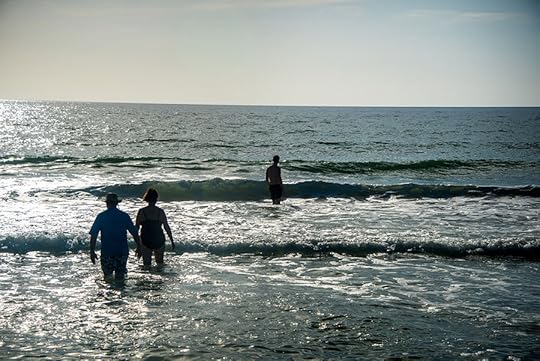
The family reunion was almost eighteen months in the planning. Just our process of deciding on the time and place (through the use of survey monkey and death threats between certain siblings) has likely qualified us to negotiate between the United States and Syria. But consider this: we got one high school and three college students, one person highly-placed in major league baseball and additional lawyers, a couple of college administrators, one corporate executive, a business owner, an elementary school principal, a social worker, a civil engineer, one writer and a couple of other degenerates, five gol-den kids and a partridge in a pear tree all together on an island accessible only by ferry for five days. We traveled from all over the country. The weather was spectacular, beach-perfect. Dolphins played right in front of us and so did very, very happy little ones aged five and under. At night, our family singer/guitarists took requests while we grilled out; afterward we played Trivial Pursuit and no one pulled a weapon, not even during Risk. Mexican Train was downright tame. We all connected again.
Sometimes things don’t work out the way you want them to. Take, for example, the last time this family gathered. It was for my father-in-law’s memorial service after his very sudden death two years ago. I had shattered my kneecap and was in an ankle to thigh brace, which doesn’t exactly facilitate emergency airline travel. The biggest blizzard of the year hit the northeast, stranding family members variously and forcing the postponement of the service by a day—even devoted local friends couldn’t have gotten there when it was scheduled because the governor of Connecticut had banned driving for over twenty-four hours. And then the norovirus hit our family.
But this reunion? Well, it fell into the opposite category: sometimes just everything works out exactly the way you most hoped, and what stays with you is a heart full of gratitude.
May 2016 be good to you!
The post Reunions appeared first on Lynne Hugo.


