
Robin Winter's Blog
September 13, 2017
of education
For university students to indulge the knee-jerk reaction, “This concept or idea offends me, I don’t like this, so take it away,” is not progressive or adventurous. It’s weak, solipsistic. It’s treating a vital endeavor as equal to the ‘Like’ button on Facebook.
In all disciplines students should grow to understand what they don’t like as well as what they do. Education is not a following-your-bliss haze of unchallenging indulgence. Education necessitates knowing your enemies as well as your loves, earning all the tools to fight the battle you will choose to fight. Foolish to embrace your own ignorance as a friend. Impossible to hope to make a difference in that wider world that education should open to you if you keep slamming the door.
Any institution of learning belongs in the razor-edged real world. This is where ideas contend. Battle. Bleed. It’s not a sanctuary of pleasant pastures and contented agreement.
Pain is a great teacher.


August 20, 2017
Moments of Truth

Books. How can you have too many books? So many minds and ideas, stories told, wonder shared. Someone asked me the other day how I wanted to write, so I said, “…like Max Brand mixed with Dickens, Jane Austen with Robert Parker, T.E. Lawrence and some Gerald Durrell.” In other words the only way I could find to say what I wanted was to give other names, look to other writers. People who’ve filled my brain with images and sounds, smells and textures I never had for myself. Who through analogue and suggestion have populated my memory, made me who I am.
And I have no shame. I will read anything I want to read, trashy, ludicrous, profound and staggeringly beautiful. I don’t care if you sneer, this is my pleasure and my inspiration. Have you ever read Slippy McGee? Or the U.S. Naval Institute’s Division Officer’s Guide from 1959 (fourth edition. Snyder’s The Changeling, or Autobiography of a Recovering Skinhead?
But there comes a time when the bookshelves fill up. If you have my luck, you have a spouse who can build bookshelves. Nice new book shelves smelling of beeswax polish, the ghosts of wood stain and sawdust. Still there comes a time when you fill all the walls that can take bookshelves. Then you begin to stack books on their sides atop the rows, or double up the runs of paperbacks on each shelf. (Hardbacks aren’t sufficiently forgiving.) But that too, runs abruptly to an end. Space so far as my house is concerned, is not infinite. So do you go down the dubious path– do you let the first few volumes lie on the floor? In a discrete corner somewhere? Only few odd-sized hardbacks… just temporarily of course, until you have the intestinal fortitude to actually get rid of some books.
Just, until. Talk about slippery slopes.
So two weeks ago I went to my mystery section and weeded. I figured this was a start of reform. Culled duplicates, took out stories I felt I wouldn’t lend or read again. Books which may have held my attention once, but didn’t have that haunting quality that brings me back for a repeat read. Some in which I had tried forty pages or so, but they never held me. (This latter group is tricky because I certainly have had the experience of trying a book, rejecting it, but perhaps years later picking it up and finding it a page turner, hilarious or grave, but riveting.)
How many books could I bear to let go? Two boxes. Not bad, you say, getting ready to applaud me, but stop right there! How much space did this earn me? Enough to get the books onto shelves that had been lying athwart the tops of their chums. Enough to remove the books stacked sideways. Plus perhaps enough space to go to a book sale and buy ten more paperbacks. That’s it. That’s all.
Maybe, instead of resolution and reform, it’s time for blatant recidivism and revolt.
July 9, 2017
Reflections from a Writer
Today I’m sharing a friend’s guidelines for a meaningful critique. I’ve mentioned many times how strongly I believe in solid critique groups, and that all of my work owes much of its strength (and none of its errors,) to writers’ groups to which I’ve belonged. At the Santa Barbara Writers Conference some weeks ago, I met Nicholas Deitch with whom I’ve been friends for years on Facebook, but never previously met in person. He wrote the following discussion of what he sees in a good critique process. For those of you interested in establishing constructive critique groups, here are some great principles.
Guiding Principles for the Meaningful Critique
Nicholas Deitch
(Not copyrighted, free to share and evolve)
The following principles come from my years of experience in the creative realms of architecture and design, both as a teacher and a practitioner, and more recently from my endeavors in creative writing, as a participant in some wonderfully supportive writer’s groups and the Santa Barbara Writer’s Conference.
Successful critique is rooted in mutual trust. This trust is not always readily established, but may be nurtured through a brief but honest introduction of the participants, why they are present, and what they hope to gain or share. In the context of meaningful critique, we are not concerned with finding fault, but with understanding the creative intention and supporting success.
Creative Intention
At the core of any creative endeavor, there is some root basis of intention. What is the maker–the Creative–seeking to achieve? What story, impact, emotion or transformation is the Creative seeking to impart? The critiquer should, above all else, seek to understand this intent and offer critique aimed at strengthening the work. In this way, the critiquer becomes an ally and even a guardian of the creative intention.
Through the principles offered here, I have witnessed the power of this creative alliance, when several people come together to share their work, and support each other through meaningful critique. In such critiques, all participants will learn and grow through the process, often in surprising and unexpected ways. In fact, the meaningful critique should be considered a creative process in and of itself. Author Matt Pallamary has referred to the phenomenon of the ‘morphogenic field’ in reference to the escalating creativity that can result in the midst of these gatherings, wherein the Creative and the Critiquers find a place of creative resonance, out of which some wonderful and surprising ideas often emerge that would otherwise likely remain unexplored or unrecognized.
This is a wonderful and exhilarating thing to experience, and the best critiques leave all participants feeling energized and enthused.
Principles for the Meaningful Critique
There are always at least two participants in a meaningful critique: the Creative–the person sharing their creative work to receive a critique, and the Critiquer–the person listening or observing the work with thoughtful intention to offer constructive feedback. Note that there is a benefit to three or more participants, as a way of balancing the critical feedback. Critique is the realm of opinion, not fact nor dictum.
Seek the Creative’s consent before offering anything but praise. The Creative must be in a spirit of reception to hear and receive the critique. Note that by participating in a Critique Session, such as a Writer’s Group, there is implied consent.
The intention of a meaningful critique is always about supporting the Creative in doing the best work of which they are capable. The emphasis should be on finding the strengths of the work, and then offering ideas to strengthen it further.
A meaningful critique requires an openness on the part of the Critiquer–to first listen, observe or read fully, and comprehend the work before offering any feedback.
A solid critique is inclusive, speaking to strengths and challenges of the work with balance.
Meaningful critique comes from a place of honesty, and a desire to build up the Creative in their work. Honesty requires courage on the part of all participants, to be open to hearing the truth of others, and the willingness to be truthful in the offering. This is not always easy, but is essential if the goal is growth and the bettering of the work.
There is rarely a right or wrong in a critique. There are opinions, ideas, conventions and perspectives. A good critique leaves room for the unorthodox, the innovative, the divergent.
If the Critiquer has no critical feedback to offer, they are likely not trying hard enough, or may be concerned with imposing distress on the Creative through the process. Learning to critique, and to receive critique, is an art in itself, and requires practice. Most every creative work leaves some opportunity for improvement, or even for continued evolution in the body of work yet to come. However, on some occasions, likely after much hard work, accolades my be the most honest response. This is cause for celebration.
Remember that the Creative remains the sole arbiter of the critique, with the authority to use, modify or discard any of the information shared by the Critiquer.
The measure of success of a meaningful critique is the level of gratitude shared by all participants at the conclusion. The greater the gratitude, the greater is the measure of success.
This material is offered without copyright or reservation. Use, share and evolve freely.
Nicholas Deitch, Ventura, CA, 2016
March 6, 2017
The Suitcases
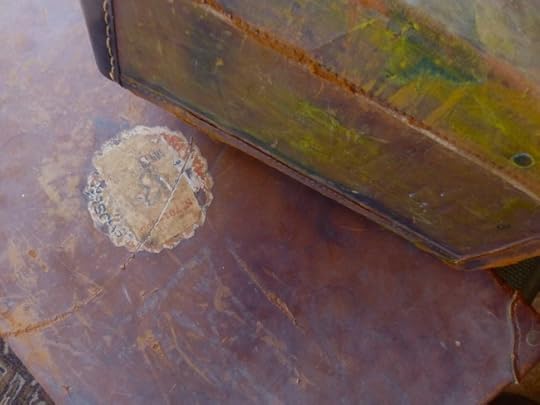
They sent her overseas to save her life. A small-boned young woman just beginning her twenties, hair fashionably short in the American style swinging against her strong jaw, her black eyes proud and watchful, ranging over the seething common crowd of Chinese at the dock. She moved, flanked by the black and white of two nuns, her protectors. I imagine her standing on deck while the vessel moved slowly out from the dock, clad in a slim navy wool coat, her gloved hand raised to shield her against the sunlight, controlled in every gesture, contained.
Her blood ran arrogant in her veins, and in the changing China they had none of them invited, my mother’s family feared she would not survive. Some day too soon, she would say a thing that would be unforgivable, in public, with the snap of authority, with the precision she had learned from tutors before she went to the nun’s school, and she would die for it. So they sent her away, with the two leather suitcases her father had owned during his years in the diplomatic service, and in time she came by ship to America. I see her small height strung straight, balanced on her tiny feet by the railing with perfect pride and defiance, her hair neat, her face wisely giving nothing away, her short gloves matching the jacket over her simple dress. She probably didn’t touch those leather suitcase handles until the end of the trip. Some ship crewman would have carried everything for her, carted her trunks packed with silk, cotton and wool, and her beloved books.
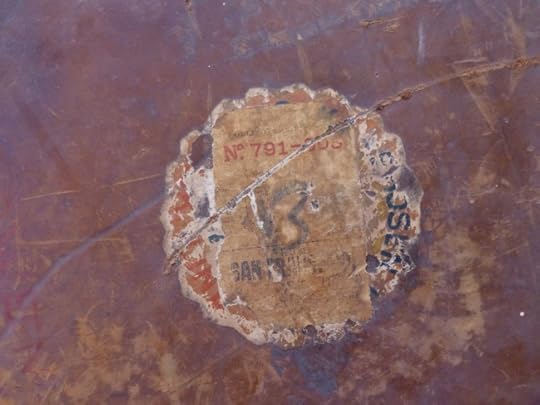
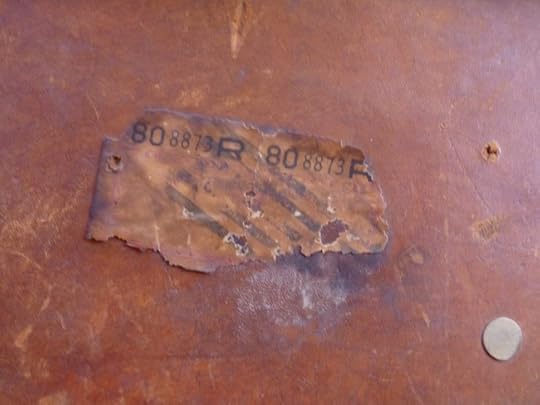
Today the two suitcases lie stored in our closet in America. I look at the imprint of her father’s name upon one, and I touch the stamped in letters. He was a modern gentleman who refused staunchly his mother’s pressure to have his daughters’ feet bound. He had them educated, and in the long nights they fell asleep to the sound of their cousins weeping at the pain of broken feet when they thought no one could hear them give way.
There are stories to tell that I will not, now, because I have one particular night upon my mind. All gold lights and black shadows, a blue so deep the sky seemed to fall away between the buildings and the leaning skyscrapers; a New York City night. The night I met my uncle by marriage, Xiao Qian.
My mother left family in China when she clutched those leather suitcases and went away. One of that family staying and studying in Beijing was a younger sister, who had the temper of a dragon, the patience of a tiger, the double cowlick that means these things, and when she fell in love with a writer much her elder in the torn China of those times, the family wrote to my mother and asked her what to do. My mother had by then married a New Hampshire farm boy–scientist and poet, and she said, it does not matter– if Margaret loves him, let her marry. Thus, younger sister Margaret married her beloved mentor, teacher and inspiration, Xiao Qian. He was of peasant origins, but had grown to be a writer of repute, and as the years passed he continued a correspondence of great liveliness with the English writer E. M. Forster.
My husband and I entered the New York hotel room to find several older Chinese gentlemen there to whom we must have seemed nearly children, and my aunt Margaret. We settled to seats once the greetings had passed, and listened as my uncle spoke to his old friends and to us.
“You know it has been fifty years since we last sat together,” Uncle said, his round friendly face making his dark eyes look even larger. The lines of years of smiles marked his face, his alert glance moved from one to another of us. His quiff of silver hair gave him a look of humor, reminded me of a panda. “Fifty years, my friends! These were my students,” he said to us, gesturing at the gentlemen around him, and they murmured a deep note of assent and pride.
When the tide of the Cultural Revolution rose, E. M. Forster arranged a position for Xiao Qian in England, inviting him and his family to come and take up a new life. But Xiao Qian said “No, it is now, more than ever, that my country needs me, and I must stand by her and see her through these hard times.”
“I was such a fool,” Xiao Qian said, looking from one to another of us in the hotel room. “So proud of myself with my noble words.”
“My neighbors came to our house and they destroyed it, broke my daughter’s piano, smashed chairs, tore the books. Pulled us about and beat at us with their familiar hands. Stood us on the table and struck us, villified us. Our friends, the people we knew. That was only a beginning. I cannot tell you it all.
“They beat us into the street and in the days that came and went I fell into such despair. I didn’t remember my hopes for China, I could see only my own sufferings. There came a day when I decided to die rather than bear this, took pills I had hidden and swallowed them and my wife Maggie when she realized, went to beg the doctors for help but they were afraid. In spite of myself, and them, she made me live. Maggie, Maggie. My stubborn fierce Maggie,” he looked at her and she pretended not to be listening, she was like stone and fire, all the pride that she would not share implicit in the quiet lift of her head.
“They sent us to the country to tend the pigs. It was a hard life, but the abuse became less over time until it was only a hard life and no longer an impossible one. And the years passed.”
He paused, and I could not take my gaze from his homely face and huge black intense eyes. He made a little nod, a tender broken smile, a gesture of open hands.
“But you must understand this,” he said. “On that first night of our new reality when I looked upon my friends and neighbors, shouting and yelling in the night with their fists raised, with broken brooms and knives, I understood that if there had been any way to change places with them I would have been so glad to do it. I would have acted as they did, maybe shouted and hit harder whoever they gave me to strike. That old saying was true for me no matter how proud I was. How idealistic. There but for the grace of God would I have gone. Yes, there, I too, would have gone. There but for the grace of God. But the choice was never offered, that it was not, was all that kept me from being them.
“Now I am born again into the land of the living, of the remembered.” He gestured with his square old man’s hand and there was such liveliness and self-knowledge in his black eyes. “I am known now for the work I did long years ago, they do not even require that I write more. Here I am a guest in America, and I come with a message to you,” he looked about at his old friends, his former students. “You who are known as the overseas-Chinese…”
I had heard that term in my Chinese language classes.
“You are invited back to our country with honor, with welcome. None of your belongings will be touched or taxed, you will be greeted with joy for the knowledge and skills you have gained in this wide outside world. There, I have said it, and I will testify to the truth of it. Already I know families who have come back, many doubting, but they came home. So I bring you this welcome, I convey it to you all.”
“The letters,” one gentleman spoke into the silence that followed. “Your correspondence with E. M. Forster, what became of it?”
“A few years ago I received a letter from Cambridge,” Xiao Qian said, “enquiring that very thing. When I was first reinstated by the government, this letter came to me. But the letters E. M. had sent me were burned. My wife’s sister panicked when she saw how the neighbors behaved and she took all the letters from their hiding place and burned them.”
The men in the room caught their breaths in shock.
“But think,” Xiao Qian said, “for great though our sufferings were, how much more terrible would they have been if I had in my possession my friendship correspondence with an English intellectual? Treason, no less, all the arrangements he tried to make on our behalf to find us sanctuary in his land.”
“But let us talk of your lives and what has happened in the and how you have been happy my friends.”
Voices rose and fell, but I kept replaying his past words, looked over at my new husband and knew he did the same, saw how moved he was, his hand gripping the arm of his chair. Tears in his blue eyes.
“Yes, let us go and eat then,” my uncle agreed, turning to us.
“We will catch our train, we had not meant to stay so long, but this was wonderful Thank you, ” I said and we nodded; we rose, but Xiao Qian raised his hand and such was his authority that we stopped.
“Share the meal with us,” he said. “This is a special occasion. This is once in a lifetime,” and the crowd murmured agreement. They swept us along, down to where a line of chauffeured cars waited, navy and black and gleaming, crowded on the street. One of these men it seemed, owned a restaurant in Chinatown and he had swept a table for his old teacher and mentor, Xiao Qian. I sat silent in the back of our limo, gripping my husband’s hand as the chauffeur wove us our way through the magic streets, and our throats were filled with tears.
1706 WORDS
BACKDRAFTS3
robinwinter
robinwinter.wordpress.com
DRAFT SAVEDA FEW SECONDS AGO
Preview
Publish
Categories & TagsUncategorized
A Stranger’s Blood
blog
camping
cat pictures
cats
cooking tools
counseling
Domestic Violence
Drawings
education
experiences
food
food processing
free novel
friends
gardening
homework, school,
medicine
Morchella esculenta
morels
movies
mushrooms
Featured Image
Sharing
Post FormatStandard
More Options
SEO
February 27, 2017
Interview Dinners
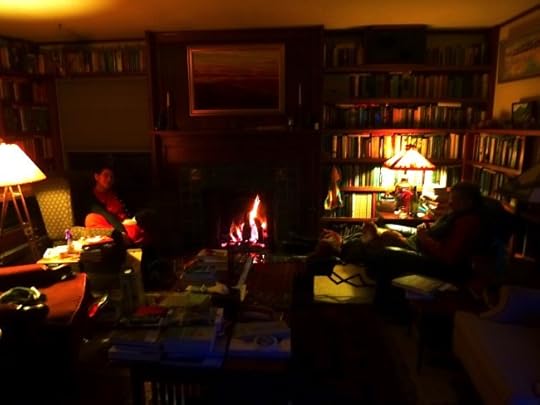
Our geology department has faculty job candidates coming through and to hold down costs, candidates will not be put up in hotels but in faculty guest accommodations. The advantages? Casual discussions over coffee in the morning and with that a far better sense of what living and working here is like.
As I used to crack when I was involved in interviews for Resident Administrator positions, Attila the Hun could be charming for a twenty minute interview. One wants a lot more than an interview before we invite someone in to our geology family. The increased exposure, thus, is all good.
I’ve offered our house and food for interview dinners, as I have in some past job searches, so each candidate will come and share our home for one evening. Anyone familiar with the whirlwind of interviews knows what it is like to have a dinner interview in a public restaurant. Too-loud, inappropriate music that you have to shout over, polite and necessary but utterly derailing wait staff interruptions, problems with logistics and how to get everyone who shows up at the event a chair close enough to hear and be heard. Cross-chat inevitably ensues, the decibel level rises. The only really useful thing is if the candidate is rude to the wait staff, because if that happens, you know this is not a person you want in the family.
Home dinners can offer quieter conversations and reflection, plus time to observe the candidate when he or she or they are tired and have most guards down. This can be a chance to see personality. After nearly sixty years of meeting and greeting and talking, I would hire on character, not accomplishments. You can still make a mistake, there is no perfect method, but you’re less likely to end up lying awake in bed wondering when the knife will slide into your back. Metaphorically speaking, of course.
Now for the good stuff. Food. You bet there will be no caterer. I must make up a set of menus, not too repetitive, because many of the department participants will be coming to most if not all of these dinners. Five dinners, with leeway for the vegetarians among us. Only one candidate is a vegetarian, as if so happens, but I am well-aware that while most of the department are omnivores, some prefer to eat low on the food chain.
Color this picture with an oak fire in the fireplace and everyone sitting casually about in comfy chairs. Quiet light, no need for music or wait staff, for I always do these events buffet style. Anyone who leaves hungry has only him her or their self to blame!
So I’m thinking a North African meal, a vegetarian/pescavorian meal, a Middle Eastern meal derived in part from the Ottolenghi cookbooks, an Italian meal– polenta and mushrooms and then, perhaps a Thai dinner. Always enough vegetarian options so that no vegetarian may go hungry!
In the next few days I will share some specific menus, and perhaps even if you don’t want to make a batch of interview meals you may want to try one of these options for home and family.
October 2, 2016
What the choices are…
Warning– this is a post that includes cleaning, garbage, purity, diapers and a rant. It’s not about our trip to Ramsey Canyon in Arizona and what we saw there… I will get to that after the clean up.
We hosted our Earth Sciences Department party yesterday and about seventy people attended. We prepared and cooked racks of ribs, slabs of salmon, fresh breads and vegetarian beans while our guests provided all kinds of vegetable and salad dishes, plus plenty of drinkables. I baked nine pies– apples from our orchard, grapes from our vines for the grape pies, boysenberries from the neighbor’s baked into a pie, and one huge four layer boysenberry filled cake with a cream cheese frosting. I probably should not tell how many packages of cream cheese I peeled for that job!
On such occasions we try to do our bit for sustainability, with designated bins for recyclables, and bins lined with the right type of compostable bag to take the compostable plates and utensils plus food waste, which we will later deliver to the processing center. A separate batch of bins stand ready for the non-compostables– paper napkins and waxed paper goods or whatever plastics people wrapped their contributions in.
So, this is a group of people who have spent their lives being students. Yet despite clear labeling on these bins, every year, the morning after finds me in my much-reused latex gloves sorting the garbage because somehow people can’t read those labels. But this year brought an even more disturbing variant.
I met single-serving squeezable plastic/foil baby food units. All “pure”, “organic” food in plasticized squeeze containers, one serving each. To be precise, plastic-covered foil pouches none of which is recyclable. The plastic lids are very large, and recyclable. I found two of these with their lids deep in our bin labeled ‘Compostables’. If you detect a hint of offense in my tone, you are so correct. I am worried about the parent who chooses to buy pure organic food for his or her baby in such a package. That you might absentmindedly throw it in exactly the wrong container is one of those things that can easily happen by mistake. But you do not choose single serving disposable aluminum and plastic pouches without shelling out a good bit of cash and having some time to select and think. So you want organic purity for your baby? Great. But what’s the impact of this choice? How could this company not have thought further in producing these expensive and wasteful items? Pure, organic and plastic present me with a serious disconnect.
I went to the website for this product and they claim that their containers have recyclable lids– well that’s just great! Indeed, they made the lids bigger in order to make them recyclable! Next, they say the production of one of their containers has a smaller environmental footprint than that of a glass bottle– but you often have the option to choose multiple serving sized glass bottles, which could change that equation. More, I am not sure if they are saying that only the original processing to produce a glass jar is more costly and if they have calculated the incalculable recycling in the lifetime of the glass jar? Or do they mean that the environmental cost of recycling the glass is greater than the environmental cost of production for each of their one-use pouches? With foil involved? This, I doubt. I also note that a glass bottle is composed of the third most common element on our planet — silica makes up ~15% of Earth. If the glass ends up back in the soil, it changes none of the chemistry of that soil. Plastics are manufactured materials that do not readily decompose, and have consequences in their smaller particulate form after years of disaggregation, for all animals, including us.
Yes, I understand that caring for a baby is a lot of work. I did it too, cloth diapers (and a diaper service as much as possible because at the end of the equation – sterilizing and washing all your own is more costly to the environment than using a diaper service.) I made baby food at home, except for times we travelled and I had to use bottled baby food. But the bottles and lids of what I bought were all recyclable. The glass meant a stable container with no risk of container molecules separating into the food, even acidic food.
I know a majority of my audience here is not having babies right now, but this isn’t just about baby food. It’s about thinking. I think that what I want to ask is that we try not to have that single serving plastic disposable choice be every day’s choice. No one likes a sermon much, especially when it asks for something, so I’ll return to my soggy gloves and my garbage sort.
July 30, 2016
The Sequel to All for Pie
Time has passed and we are harvesting the concord grapes. My little rat proofs have worked. If you try it, I have a couple of observations.
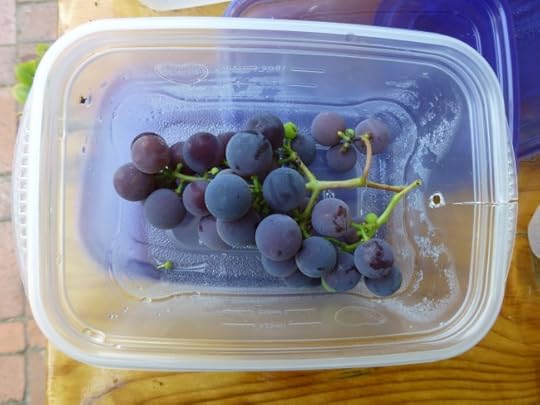
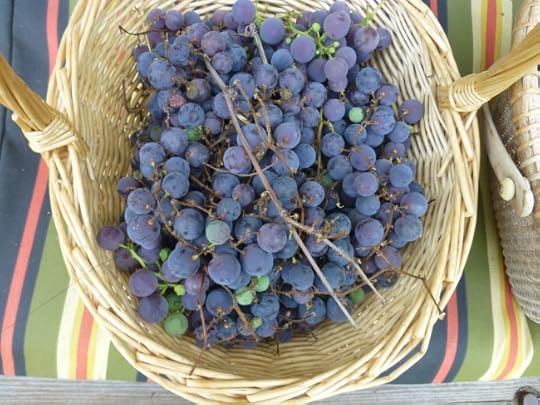
One, simply having these strange objects in the vines will decrease rat activity. It won’t stop the little brats, but there will be less damage. Two, a trick I learned over the past week is that if some bunches ripen and you take then out, re-use the rat proof, and the moving about of these containers will also dismay the rats. Every day that I made such changes, the activity of rats decreased markedly the following night, and then increased again the night after. Last of all, we were right to say that some grapes might ‘cook’ in the plastic containers– but this only affected grape clusters out in the full sun. All of this said– we have three baskets of grapes and I plan to initiate processing tomorrow to freeze up the makings for a passel of grape pies for fall and winter!
July 21, 2016
Rats!
I am done with these rats. Traps do not suffice, poison feels unethical and gives a horrible death, the tricks of radios and deterrents are fantasies. Plus, I refuse to have an outdoors cat because of traffic, coyotes, parasites, and the mass slaughter of birds and my delightful lizards. But these rats are eating my Concord grapes– even before they ripen….
Of course I must backtrack and say that if you have been reading this blog for recipes, you will have seen my post about the wonders of Concord grape pie, complete with recipe. We love that pie. Consider therefore, our dismay this spring when I reached for two of my frozen Concord grape pie fillings and could only find one bag. I could have sworn I had at least another couple stashed in the big chest freezer. Our dismay inspired a defrost– it was time anyway, but still after a complete clean-out, only one little pie’s worth of grape filling remained in hand.
So these are desperate times, and despite our drought I have had it in mind that this year’s harvest of Concords will be carefully husbanded for future grape pies.
Now, enter the rats. No not the ones you are thinking of, these are our lovely little Neotoma fuscipes, the dusky footed woodrat. also known as the Trade Rat, Roof Rat, or Pack rat. A charming elegant creature fond of climbing in trees, indeed, with some habits that might make you think of tree squirrels. This is the fellow who is known for filching treasures from campers and, in the old days prospectors and miners, leaving treasures in apparent exchange. (Thus ‘trade’ rat.) They have a fondness for bright, shiny, or odd things– in fact I may have already mentioned that I found a nest in my studio that contained many pink, white and blue plastic beads, a cheap wristwatch, a number of nuts and pebbles, plus forty three (yes, I counted them,) clear-head plastic push pins. The mere idea of the rat carrying these in his or her mouth makes my lips hurt.
But the bad news is that Neotoma likes fruit. Thus I have the little fellows gracefully scampering through my orange trees and hollowing out the sweetest fruit, and they even eat my tomatoes. No gardener is going to take that without a struggle. The tomatoes put me into the red zone, so to speak, and I started trapping. But Nature is infinite and hates a vacuum, so you can trap rats all you like, yet in a drought year the sources for new ones are infinite.
I bring you to the morning I step out, brimming steaming coffee cup in hand, to see the tell-tale signs of knocked-down grapes on my side patio by the kitchen garden.
Rage. Council of war with my spouse who is possibly even more fond of grape pie than I … maybe. Possibly not.
If you cannot take out the enemy, take away access. Cheap plastic food containers, drilled to accommodate the stem,
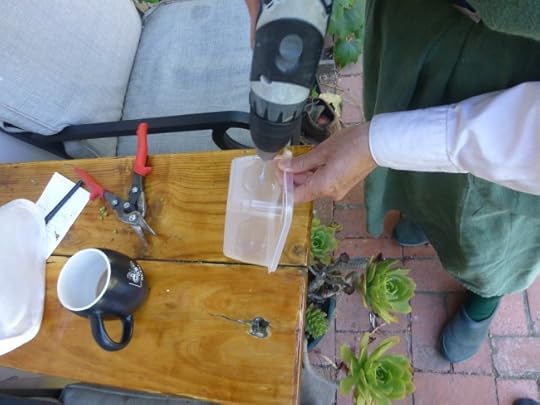
cut so that you can open and slide the stem in,
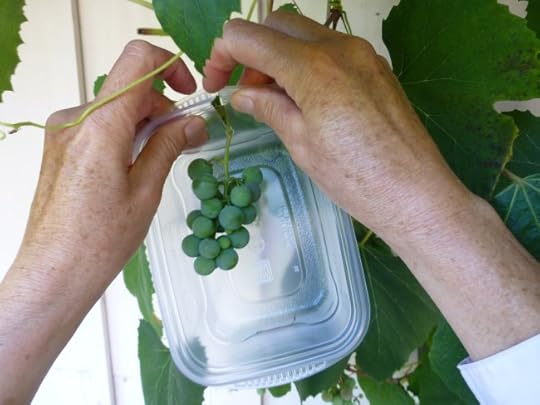
then cap with the tight fitting lid. Try not to have these hang too much in the sun because you don’t want pre-cooked grapes.
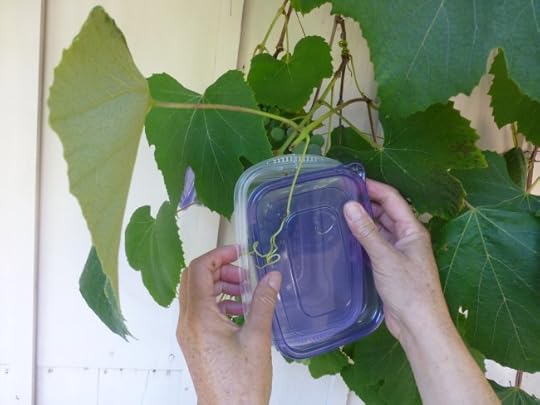
Triumph. A solution for the pie hungry family!
June 25, 2016
Portrait
I’m posting this one because I came across it in the pursuit of something quite different in my files. However, it illustrates what I think portraits should do– depict body language more than features, and give a sense of context. Here are three people I know well, exploring the land and the plants they love.

May 19, 2016
Chapter Twenty Seven: Upon a Field
We assembled before the dawn was more than a suggestion, and ate our cold breakfast with slow care. As color entered the world, sunlight touching the golden leaves of the woodland, we checked our swords and other weapons, pulled on our chill helmets and settled the straps snugly. Berann muttered to herself her regret that she had not brought an extra quiver of arrows, and though I wondered how she hoped to buy time enough to use them all at such close proximity, I decided to say nothing.
I could see the enemy camp astir, and slowly but in orderly fashion, they came out. Orders passed and so did they, into the Arena, lining rank on rank as formally as if they came to perform an execution, not engage in battle. Close enough to truth, their hundreds in blue and silver, brightening with the sunlight of the growing day, against our hundred odd. We looked so motley, mostly in black and brown but with the few brighter clad of the citizens mixed in. As if by prior arrangement, we stood and looked at each other for a little, enemy to enemy before Evandir stepped forward from his place at my left, two strides into the Arena. He set the point of his sword in the dust and leaned his hands across his hilts, looking over that space at his men, and then I saw a strange thing.
Our enemies laid down swords and spears. Like a wave of motion, contagious, compelling, weapons went down into the dust, and even before the first rank had completed the gesture, there erupted a sound like a bellow and the Knight Rebmun charged to the fore, straight at Prince Evandir.
But I was before him; I leapt out screaming.
Mell says I howled something foolish on the order of ‘He’s mine!’ But I think I shouted more properly, “I challenge!” so that he had no choice but to swivel from the Prince and square himself to me.
I remembered what Thane Gehir had said, and how he had shown me the spot to strike. I hoped then, as Knight Rebmun loomed before me, that he was not too perfect, that in his complexities there could occur an error of vanity, or confidence, and I came out to meet him, catlike. He might be faster and better, he might be unbeatable, but right now to believe in any of those things would destroy my hope. This time, I had knowledge, and that had to do.
A baby was crying somewhere among the camp followers within the woodland. I let my eyes flick to one side and in that second of my apparent distraction Knight Rebmun struck. But I skipped, swung, missed, and stood beyond his reach for a breath. I must not let him guess my purpose, so now I set to making a good fight, my best fight.
I kept away from him as if afraid, trying him out, estimating what his speed could do. He had inhibitions against displaying his best, of course, so I delayed and danced, and did him no harm. He nearly caught me when he used that wrist trick of his double-joint and I darted in to feint a cut across his neck.
“Gren Del: Number 7091339. Dis en gage. stop. Implement auto shut down, Code 101 N,” I shouted, and I drove the point of my blade with every ounce of force I had right into the crevice of his armor at the inner part of his elbow. My whole arm jerked and buzzed as it had with the little black box in the hidden room, and I fell on my knees. But I had done it. Knight Rebmun stopped in mid gesture at my magic words. His left arm hung half-severed at the joint. Smoke poured from the wound, bright flashes as if I’d released hidden fire, and I smelled a dreadful scorching medicine. I yanked my buzzing sword free, and the disjoined limb fell onto the dirt.
The Thane had known not only the identity of this machine, but an incantation to cut its sinews. How I blessed his name in that moment. I saw the faces of Evandir’s troops as they backed away, a huge terror blossoming in their eyes. They had not known the nature of the leader they obeyed, and then at the last, disobeyed.
The rest of King Saahr’s army flung down weapons, knelt in the dirt, raised their hands in ancient gestures of forfeiture, supplication, renunciation. Many caught dust in their fists and threw it over their heads in rituals of cleansing, and I heard the moan of their voices rising to the Gods. They begged pardon in the many languages of their lands.
I turned to the golden Wall all awash with the sunlight, and the stilled soldiers on the top stood up like little black spikes above the sandstone height. Riveted, like spikes indeed. Then the Gates creaked open wide, and a discordant sound, of voices and cries contending swelled distantly in the City. Nothing erupted from those open gates. I began to walk to them, like a puppet whose strings are pulled by an unseen master. Feet thudded. I sensed Evandir just behind me, with Mell and Cascada and all my people after. Still, it sounded like more than that, and when I glanced back I saw with a shock of alarm that all the armies, it seemed, came at my back. They had left all weapons except their swords in the dust of the Arena, and I saw that Evandir carried with an effort, the heavy, severed arm of our enemy, and it dripped blue blood. It took both his hands to bear it.
We walked into the City, over the cobbles. The people met then parted for us, seething around the margins of the armies in strained silence save for the sounds of our feet and armor.
In the center of the first large intersection lay the body of an old man clad in maroon robes, unmarked save by the force of his fall, his gold crown a little dented, his far-sight fallen from his empty hand. No scavenger had approached the body, as though it must be unclean beyond the claims of greed. Had he leapt from the high room he had chosen to observe the ‘entertainment’ from, or had he been pushed? My own guess would be that he fell by his own choice, and no one has ever told me otherwise. After we passed him we began to make noise, people talking, louder and louder so they could hear themselves. I heard some horses behind me. The cold morning air tasted good and I felt a huge hunger wake in my stomach. I heard myself laugh at nothing, and looked back to meet Evandir’s glance.
We rode and stomped shouting through the streets, some of my people on commandeered carthorses and ponies, and Evandir’s troops mingling with mine. Up the steps of the Fortress we surged, a wave of delirious humanity, in through the doors flung open to welcome us, for news has a swiftness nothing but rumor can beat.
Through the halls of the Fortress we marched, and the sound of feet came like thunder. So strange to me, whose people had always walked with all the silence we could command, like the cats to which Prince Evandir had compared us, that seemed so long ago. But civilians and boots make noise, and within these holy walls the rumble rose. We stopped in the wide double doorway of the Assembly Room, and I saw our new King, King Daniel sitting quietly upon the throne. Behind him, his lady mother, Queen Heme in the garb of a soldier of the Wall, her bare sword in her right hand held in salute as she awaited us. I saw Kinspater, his hand raised in formal blessing and warning, his bearded face in holy ecstasy. He could not have been so happy, but he played happy very well. The ministers of the court and crowding Burgmasters stood behind and about the open walls, cringing a little, as if they could not feel confident of what we came to do.
Prince Evandir stepped past me.
He threw the arm down upon the floor where it leaked a smoking fluid that corroded the limestone as we stared. The fingers twitched a few times and a little sparking sound came from the limb.
Prince Evandir turned to the crowd that surged in behind us, the muscles in his jaw working as if he fought for words. He swallowed hard.
“People,” he shouted. “People look upon Abomination. This is what lies behind the friendship offered to you. This is the true hand of Saahr. The arm of Grendel.”
He strode to the massive fireplace in the abrupt silence, lifting his sword, and plunged it into the heart of the fire. Then he spun about and I saw the raw tears on his grimy face, running down into his beard and across his dirty cheeks. Ten long strides and he knelt before the throne, drawing his personal blade from the sheath on his breast. He lifted his big hand to King Daniel and slowly drew the gleaming sharpness over his own palm. As the generous drops fell, he waited, head raised, looking into King Daniel’s face.
King Daniel took the knife from his hand and as deliberately as Evandir, as unflinching, he drew it across his palm, and set wound to wound to claim his warrior.
The silence shattered around us.
“The time has come,” the voice of Thane Gehir spoke into my ear. “You are released from your oath. Burn your sword with my blessing, for your King Daniel awaits you upon his throne.”
“Will you come again?”
“Do you think I would miss seeing your daughter when she is born? Or the son who will look so much like his father that people will tease you about the resemblance and ask why his nose isn’t quite as crooked as his father’s? You will always be my own. Not because of any oath, but because of what and who we are.”
I turned my head but he was gone, not even the sight of his departing form visible in the seething crowd.
I went up to the fire by myself. I looked upon my sword, and raised it high, saluting its service in my heart before I plunged it to its ruin. Beautiful and shining, the steel permitting a line of orange to run brilliant along the sharpened edge. In my eyes also rose the tears of loss and of renewal. It hurt my heart to turn and thrust it into the hottest part of the flames, but it had good company.The two swords wavered blackly in the yellow heat. There they would rest. Only we two would burn our swords, for Evandir’s men were sworn to him and never turned from that loyalty. My people too, had been true to the Wall of their oaths.
Evandir’s officers and men gave way as I walked to the King’s throne and knelt. King Daniel had a certainty too grave for smiling upon his thin face but our eyes met and his held welcome. As I took out my personal blade and cut across my old scar, he extended his bleeding hand to mine, and so I made my second Oath, then I stepped to the side, taking my place with Evandir. My old enemy with the broken nose looked down at me, his smile like a promise full of warmth and pride. The other soldiers formed up, each in turn reforging the oath, my people and Evandir’s renewing ritual, erasing all old betrayals in their own and their young King’s blood.
The justice denied one people turns to working in another, the wound dealt
becomes wound taken.
End


