Sebastian Slovin's Blog
April 3, 2018
Lessons from a Suicide
After my father died by suicide I spent years avoiding and running away from the pain and loss associated with his death. It wasn’t until I reached a turning point, a life changing conversation with a family friend, that I recognized I couldn’t run away any longer. Additionally, the conversation helped me see that perhaps there was something meaningful to uncover if I could find a way to face his death. That conversation and realization was the beginning of a journey to understand why my father died by suicide and what, if anything, could be learned from it.
This became my passion and personal research project. I made it my mission to meet with as many of my father's friends and family members as I could. One fo the first challenges I encountered was that his friends and family were spread out all over the place. Fortunately, I began my career as a professional bodyboarder and had the opportunity to travel extensively during that time. While I desperately wanted to come away from my research with an understanding of why he took his own life, I knew that I’d never know the complete story. That information and story died along with my father.
Over the years, I came to learn that my dad had some wonderful qualities. He had incredible willpower and determination. He was witty, funny, and charismatic. And at the same time, it became clear that many of his qualities did not serve him well. In some ways, he gave me a blueprint for how not to live—and in turn, how to live well from there. He became my greatest teacher.
I spent five years traveling and learning about my father. Eventually, I could boil down everything into four main lessons. The following is a synopsis from my book Ashes in the Ocean.
Lesson 1: Slow DownOne of the most prevalent themes that I heard from nearly every person I spoke with was how goal-oriented my father was. This tied right in with his intensely competitive spirit and his relentless and stubborn quest to be the best in whatever he was doing. Like most people, he set goals relating to many aspects of his life, including his finances, fitness, living situation, etc. Once the goal was set, he would put the blinders on and race toward it. He took what worked for him in competitive swimming and applied those same principles to life. He had been wonderfully successful in the water. In swimming, there is a singular goal in mind, to be first to the finish line, and that is accomplished by charging forward faster than anyone else. In a race, that is a very sound strategy. In life, however, it didn’t seem to translate so well.
My dad spent much of his life racing from one goal to the next. He raced forward, putting all his attention on the finish line and missing much of the scenery passing him by. Of course, planning things out and creating goals is useful and necessary. The issue, I came to understand, was how extreme my dad was in his focus on the goal and the future. He was using the present moment as a means for reaching his goal and nothing more. He wasn’t happy until he achieved his goal, and whenever he did reach his goal, that happiness or satisfaction was short lived. He was always on to the next thing. This was a great reminder for me to take time to appreciate the present moment, which of course, is the only moment we ever actually experience.
Lesson 2: Focus on Personal Growth, Relationships, and Helping OthersIt became apparent that my dad placed a great deal of importance on his looks, physical ability, and financial status. My dad was, for the most part, very successful at what he did. He also happened to be a good-looking guy. From a young age, he was a successful swimmer and took great pride in his physical ability. He found financial prosperity in the business world. For a time, everything was going great; he had his looks, and he was young and wealthy.
Of course, life isn’t one straight arrow to the top; there are highs and lows, peaks and valleys. The problem arose when my dad experienced the natural ebb in the cycles of life. When he lost a lot of his money, he reacted to that as if it were a direct blow to his sense of self, which in his mind, it was. As he aged, his looks began to fade and he slowed down physically, and the same thing happened; it was a direct hit to his core identity. It was as if he needed his youth, looks, and money in order to be happy.
The issue wasn’t in the material things themselves. Money, good looks, and athletic prestige are wonderful things. The issue was that at his very core, my dad found his sense of self-worth (his personal value) in those extrinsic things, and because of that, he held on to them tightly. In his mind his wealth, societal status, and image made him who he was. Seeing the results of my dad’s attachment to and identification with material things and what happened when those things eventually faded or changed was a monumental takeaway for me.
Lesson 3: Both/AndBased on the information I had gathered and the stories I heard, it seemed my dad had an all-or-nothing type of mindset. For example, to him, winning was everything. He was only happy when he was winning, which he did most of the time. To him it was black and white: “You’re either a winner or a loser.” You were either on top of the world or in the gutter. He didn’t get the point of doing something unless he was the best. He certainly instilled this mindset in me when I was young.
Of course, life isn’t all or nothing, winning or losing, success or failure, black or white. There are many different shades and nuances. It’s important to be able to take various perspectives. Instead of either/or, consider approaching things with the mindset of both/and.
Lesson 4: Making Friends with RealityMy father’s lack of acceptance was another overarching theme that came up frequently. It manifested in a number of ways, but most noticeably in his vision of a future utopia and fighting with life when things didn’t go his way, or resisting the process of getting older. In many ways, his willpower and perseverance served him well: when it came to the determination to win a race, for example. It certainly served as a motivator to get better and to push toward his goals. However, there is a big difference between perseverance and non acceptance or stubbornness. Perseverance is defined as “continued effort to do or achieve something despite difficulties,” and is useful and healthy. On the other hand, lack of acceptance and stubbornness is a resistance to change and doing the same thing repeatedly and expecting different results. My dad spent a great deal of his life and his energy fighting with what is.
Toward the end of his life he was in bad financial shape, he wasn’t living in the home or location he had dreamed of, many of his relationships were strained, and he was getting older and slowing down physically. Things certainly weren’t going according to his plan. Instead of yielding and looking at other options, he put his head down and drove forward, as if he could change his situation through sheer force. As one of his closest friends described it, it was as if he had run right into a brick wall, and instead of lifting his head and looking for a way around, he kept charging forward trying to break through.
Reality is going to keep on doing its thing with or without you. Accepting what is beyond your control is empowering. I’m not saying to be complacent or to stay stuck in situations you don’t like and can change. Go after what you want and practice acceptance. In the long run, it’s much easier (and more peaceful) to make friends with what “is” rather than oppose it.
-------
When I set out on this journey, I began with the intention of seeking information and lessons that would help me from following in his fatal footsteps. In the end, I came to see that the lessons I learned were much more than ways to avoid suicide. They were reminders on how to thrive and live a fulfilled life.
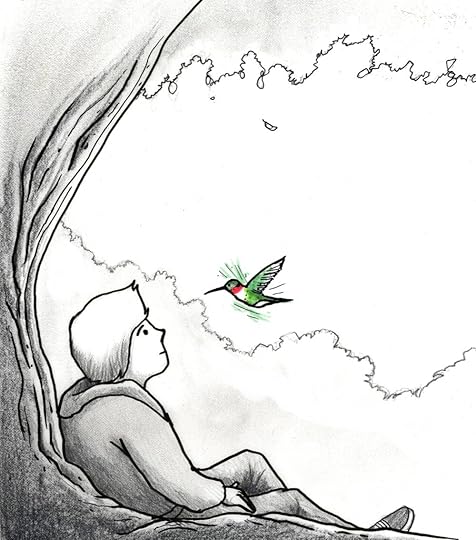
Boy and Hummingbird from The Adventures of Enu. Illustration by Blaze Syka.


March 2, 2018
The Story Behind the Cover Photo
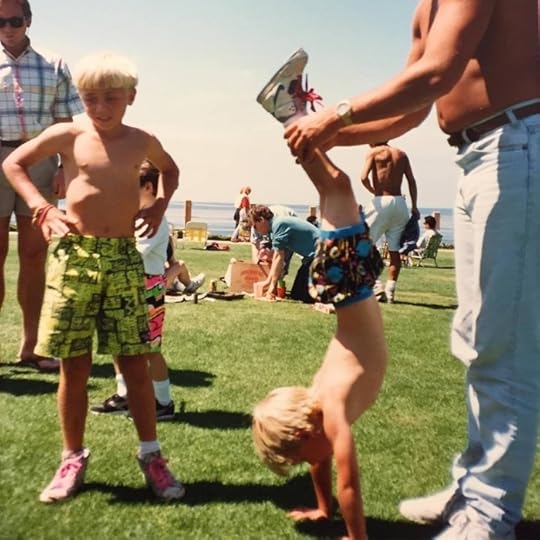
Photo from Ashes in the Ocean: Early yoga days with John Maher. La Jolla, Ca. Circa 1990
I’ve known John Maher for as long as I can remember. We grew up together in La Jolla and his family and mine were very close. There was no shortage of opportunities (beach gatherings, family picnics and barbecues, surfing and boogie boarding, etc.), to hang out and adventure around together as little tykes. John was not only a close friend but in many ways like an older brother to me. He looked out for me at school, on the swim team, and in and around the ocean.
When my dad died by suicide, the Mahers were incredibly supportive to my mom, sister, and me. My sister and I would go to their house before and after school in order to give my mom a break and allow her to continue to work and provide for us. During that time, it felt like John’s family was an extension of my family. His parents, Michael and Lisa, were like parents to my sister and me. His younger sister, Page, looked after my younger sister. Even John’s grandfather, the late Richard Farson, was there for us and remained a close friend and mentor for many years.
A little while after my dad’s death we moved out of La Jolla and up the coast to be closer to my mom’s work. While we were in different towns our families remained close. John and I kept in touch as we grew up, albeit much less often.
Looking back, it’s interesting to see that John and I ended up pursuing similar paths both centered in and around the ocean. John pursued competitive surfing and me bodyboarding. John became a lifeguard in La Jolla and I joined the Del Mar Lifeguards. We both developed a love for travel and adventure and were given the opportunity to travel extensively through our prospective sports (surfing and bodyboarding). We stayed in touch throughout and regardless of how much time had passed when we got together the bond from our youth was still there, as strong as ever. We even collaborated with work, leading groups on surf and yoga travel expeditions for a time.
John remains an amazing friend and one of best humans I know. He’s an incredible waterman putting his ocean skills and knowledge to great use helping people and saving lives as Lifeguard in La Jolla. He is a talented artist sharing his unique perspective of the world through his photography: John Maher Photography. I could go on and on with the list of his skills and talents.
When I first started writing Ashes in the Ocean I had a vision for the cover photograph. I wanted some element of individual water drops on the surface of the ocean. I wanted a photograph of the ocean that showed both light and dark. And, I wanted to use a photograph by John. When I came across this photo of John’s titled “Waterdrops” of the back of a wave off of the Mentawai Islands, I knew it was the one. I am grateful and honored to use this piece for the cover of Ashes in the Ocean. Thank you John.

February 19, 2018
All Things Are One
After my father died I felt completely lost and alone. I was very young at the time and didn't understand what had happened. I just knew my dad was gone and wasn't coming back. That was my experience on dry land at least. Everything changed when I was at the beach or in the ocean.
Shortly after his death, my father was cremated and we spread part of his ashes in the ocean at the La Jolla Cove. The Cove was the place where most of my memories of my dad took place. It was also where I learned how to swim. Going to the Cove had always been a favorite pastime of mine. But after we spread my father's ashes my visits to the beach and ocean were different. They became sacred experience for me. In Ashes in the Ocean I wrote, " From that moment on [after spreading his ashes], I saw my father and the ocean as one. The idea of loving the ocean as if it were family took on a whole new meaning. It was no longer just a concept to me; it was real. At the beach or in the ocean, I knew my dad was right there with me. I saw him in the sand, the water, the seaweed, in the dolphins, fish, and seals swimming by; he was there in every aspect of that wild world."
It wasn't long before I felt this connection while visiting other beaches in and around La Jolla. As I got older, that feeling of connection with my father extended to all the beaches and oceans (and bodies of water) I had the opportunity to travel to. Eventually, I was able to see him in all aspects of the natural world: in the clouds, the grass, and the trees.
My relationship with nature was deeply inspired by my memories of my dad and of spreading his ashes in the ocean. This relationship is what has inspired me to write The Adventures of Enu and the work I do with Nature Unplugged. It also serves as a wonderful reminder to me that everything is connected, and all things are one.
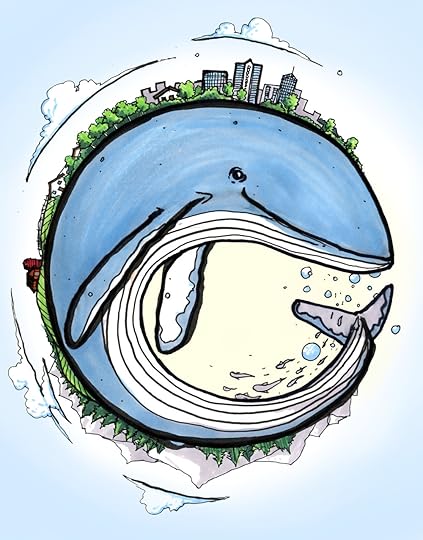
Cover Illustration by Blaze Syka from The Adventures of Enu
February 8, 2018
Why I Wrote Ashes in the Ocean
When I think back on what inspired me to write this book there are several reasons that come to mind but one that rises clear above the rest. I wrote this book to help the younger version of myself, and by extension others who have dealt with the loss of a parent or loved one by suicide.
When I was 17 years old (and in a whirlwind of denial and shame around my father's suicide) I had the opportunity to visit family friends in Perth, Australia. During that trip I had a conversation with a one of my father's closest friends, John David. My father had died 11 years earlier and at that point I hardly spoke about him at all, let alone his suicide. John David's father also died by suicide when he was a boy. A fact that I was unaware of prior to this trip. During our conversation, he shared with me some of the experiences and lessons which he had learned over the years from his father's suicide. When John David shared his experience with me it completely changed my life. For the first time in my life (since my father died) I felt like I wasn't alone. I felt like my past no longer controlled my present and future. One conversation was enough to plant the seeds of change.
I wrote this book because I wanted to offer to others what John David offered me. A space to have a conversation about a difficult topic and an invitation to face one's fears and start on a new path to a lighter and fuller future.
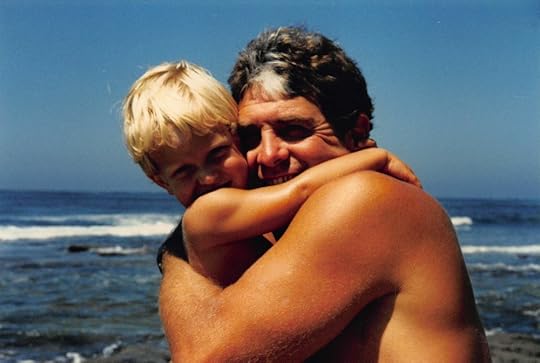
Dad and me at Windansea Beach. La Jolla, California. Circa 1988
February 6, 2018
The Logo

When I was a teenager I wanted to get a tattoo of a V with a circle around it on the inside of my left upper arm. The V was for my father Vernon who died when I was six years old by suicide. This interest/obsession started when I was about 15 years old and went on several years. While I came close, I never did end up getting the tattoo.
Over the past two years while writing Ashes in the Ocean, I’ve had time to reflect in depth on my father’s life and death, as well as the impact it had on my family and me. I didn’t write about this desire of commemorating my dad on my body but it’s something I reflected on often.
My adolescents and teenage years were full of all sorts of mixed emotions around my father and his death. Many of which I tried my hardest to suppress and avoid. My V tattoo was going to be a dedication to my father and what he stood for. I wrote about this phase of my life and understanding in my book saying, “He became a martyr to me, and in a way I began to worship him, or at least my memory of him and what he stood for. In my mind, this is what he stood for: Always be in control, always be the best; if things don’t go your way, just keep charging forward, and if they still don’t go your way, you can always check out. To me he represented control, power, and incredible will.”
Upon first glance, this dedication (the V) may look like it was coming from a sense of strength and power. However, I can assure you that my experience during that time of my life was full of fear and a sense of powerlessness. Instead of the V representing strength it may as well have been V for victim. This was a time of my life when I thought my dad’s suicide would control my path in life and ultimately my destiny.
Of course, much of this I was unaware of at the time and this victim mentality was going on mostly under the radar. Fast forward fifteen or so years to a recent conversation I had about this teenage phase of almost getting my V tattoo. I shared with my friend, Derek Abbey, about my dad and the tattoo and he rolled up his sleeve to show me a large tattoo of an upside down V with a circle around it on his left bicep. It was essentially the same tattoo I had wanted to get but with the V upside down instead of right side up. Derek went on to explain that his tattoo had multiple meanings for him. It was a Spartan shield which protected him during his service in the Marine Corps. And then he said, “and the upside down V is my reminder to never be a victim.” My mind was blown.
Hearing that helped me connect back to my time as a teenager and playing my role of perineal victim. If I were to get a tattoo today it would be the upside down V, with it the reminder to continue to cultivate a mindset of “Never a victim.”