Raven Corbin's Blog
September 6, 2026
Betrayal at Bitterport Bank: A Cosy Mystery Awaits

Post written by KL Paterson (Kerrie Paterson)
The cover for Book 3: Betrayal at Bitterport Bank is here after much anticipation, and I couldn’t be more thrilled with it! It’s so atmospheric and it fits in with the rest of the series perfectly.
I love Australian history, old buildings, reading and watching mysteries, so having the chance to write a book combining all three was so much fun. Especially when I got to do it with my two closest writing friends, Juanita Kees (writing as Raven Corbin) and Suzanne Gilchrist!
You might know me better as Kerrie Paterson from my romance books. I changed to a slightly different pen name of KL Paterson this time since this isn’t simply a small-town romance. But like many of my romance books, my hero and heroine in Betrayal are in their 50s, and the romance is sweet. The mystery in Betrayal (and all of the Bitterport books) veers more towards the cosy – it’s light on violence and gore, and the paranormal encounters aren’t too spooky. I’m a bit scaredy-cat when it comes to ghosts, so my ghost (Mad Henry) is definitely not scary! I think the only time I’ve ever been on a ghost tour – at Port Arthur in Tasmania – I thought I’d never sleep again!
Are you intrigued? Here’s the blurb:
A crumbling inheritance. A centuries-old secret. And a mystery that refuses to stay buried.
In the abandoned Tasmanian ghost town of Bitterport, the old bank has been waiting. When unemployed journalist Lucy Harwood inherits the crumbling nineteenth-century building, she sees her last chance to build something that matters. What she doesn’t expect is evidence that the man shot dead inside it in 1844 may not have been the criminal history remembers.
Acoustic engineer David Bell arrives to restore the space. He doesn’t plan on getting tangled in a cold case nearly two centuries old. He definitely doesn’t plan on falling for Lucy.
But the official story has holes. And the building’s ghostly inhabitant seems reluctant to let them ignore it.
As Lucy and David chase the truth through yellowed diaries, hidden letters, and discoveries that raise more questions than answers, Bitterport’s darkest secrets surface one devastating layer at a time. Someone worked hard to make sure the lie outlasted everyone who knew the truth.
They almost succeeded.
In Bitterport, the past doesn’t stay buried. It just waits for the right person to start digging.
Betrayal releases on 30th November, and pre-order links for your favourite retailers are already available on the Tule Publishing site. https://tulepublishing.com/books/betrayal-at-bitterport-bank/
You can also find an excerpt from the book on that page if you’d like a sneaky peek!
If you want to catch up with Books 1 and 2, you can find the buy links on Tule’s website as well – https://tulepublishing.com/series/bitterport-mysteries/
Now keep your eyes peeled for Book 4 – Death at Moorstone Manor!


August 31, 2026
Dipping our Toes in the Water
 Episode Two: Mercy Galanis & Zac Alexander — The Body in the Bath House
If you’ve been following along, you’ll remember I left the Woodburys’ shop alone last time, out of respect. Well, respect only gets a skeleton so far, because the next stop on my rounds is the Seacrest Bath House, and there’s a body, a benefactor, and a fair bit of unfinished plumbing waiting for me there. I do love a working title that undersells the chaos.
Let’s get into it.
Mr Bones: Right, settle in. This one starts with a body in a basement, so I feel right at home.
Mercy: (raising her eyebrows) It also starts with me nearly being buried alive in a cellar, so let’s not undersell the drama.
Mr Bones: Mercy Galanis, freelance accountant, inherited a derelict bath house from a benefactor you’ve never met, and found considerably more than dry rot in the walls.
Mercy: (shuddering) It was like something out of a nightmare! I really did just want to fix the plumbing.
Mr Bones: Speaking of … Zac Alexander, plumber by trade. Rumour has it you’re hiding a second career under that tool belt.
Zac: (snorting) Hardly a state secret. It’s a part-time history degree. Very above board.
Mr Bones: Convenient, given the amount of amateur detective work you two got up to. Though I’ll say, most contractors I know stop at “the pipes are fixed.” You two took it a fair bit further.
Mercy: (straightens in her chair, chin lifting) Someone had to identify a body the police can’t put a name to.
Mr Bones: Fair point, love. Now, before we get to the grim stuff, I want the readers to understand what you actually inherited here, because it’s not just an old building with good bones. There’s a hundred year clause on the sale, isn’t there? And every renovation dollar has to go through your lawyer’s office first.
Mercy: That’s right. George Denakis handles the money side. I’ve got full say over who I hire, but nothing gets paid out unless it goes through him first.
Mr Bones: A hundred years. That’s not a condition, that’s a life sentence with good lighting.
Zac: She took it anyway.
Mr Bones: Bold move for a woman who’d never set foot on the Apple Isle before signing the papers.
Mercy: In my defence, I didn’t know about the body when I signed.
Mr Bones: Small mercies. Now, Zac, you were meant to be here fixing pipes, not chasing cold cases through the Bitterport Book Club. How’d you end up roped into all this?
Zac: Zero and I turned up in answer to a call for help from Mercy.
Mercy: (interjecting with a roll of her eyes) Imagine arriving at a deserted house in the middle of a thunderstorm – and at night – only to find there’s no working plumbing! Or water!
Zac: So a few minutes later we’re standing in the basement watching Mercy’s little dog dig up a human skull that had been hidden behind a secret wall.
Mr Bones: Not what you were expecting to find?
Zac: You can say that again. I couldn’t just high-tail it out of there leaving Mercy to face whatever was coming next by herself. Besides, I had a contract to fulfill.
Mr Bones: (shifting in his chair and causing his bones to rattle) Speaking of the book club, I hear you two have been making the rounds of the Woodburys’ shop rather a lot. Getting your fill of tinned goods and gossip?
Mercy: More the gossip than the tinned goods, if I’m honest. Mrs Woodbury’s book club meets right there at the back of the shop, and between her and the fishing crowd, half of what we know about this town came from that kitchen table.
Mr Bones: And did the Woodburys have anything useful to say about your basement guest?
Zac: (carefully) Let’s just say everyone in that shop’s got a theory. Not all of them are wrong.
Mr Bones: Cagey. I approve. Now, there’s also a reclusive fisherwoman living wild down on Tiger Point, isn’t there, who’s about as fond of visitors as I am of daylight.
Mercy: Dee. She keeps to herself, does a bit of fishing and crabbing, doesn’t love being asked questions.
Mr Bones: And yet you asked her plenty.
Mercy: I asked her enough to get myself thinking harder about that boat of hers.
Mr Bones: I do love a woman who won’t let a mystery lie. And your birth mother’s got a story tangled up in all this too, doesn’t she, Mercy? Something about a train, and a name that changed twice before it landed on you.
Mercy: (quietly) That’s not really something I talk about for fun.
Mr Bones: Fair, love, fair. I’ll leave that thread alone. Let’s talk about something lighter. That tunnel under the cliffs. Anyone want to tell me what’s actually down there?
Zac: Cold water. A lot of cold water.
Mr Bones: And?
(Both Zac and Mercy share glances full of mischief.)
Mercy: And we’re not telling you the rest.
Mr Bones: Cruel. Absolutely cruel. All right, I’ll take what I can get. Zero’s had quite the adventure through all this too, by the sound of it. Best supporting dog in Bitterport?
Zac: (grinning) He’d want that in dog treats or even better, a big meaty bone. No pun intended, Mr Bones.
Mercy: He’s earned it. Between the tide, the tunnel, and everything else, that dog’s done more fieldwork than half the police force. Of course, my Pip has contributed her fair share to our adventures, too.
Mr Bones: Last question, and I want an honest answer. Owen thinks you two should end up living and working the Seacrest Bath House together. Is the kid onto something?
Zac: (clears throat) Owen has excellent instincts.
Mercy: (smiling into her tea) He really does.
Mr Bones: Before I let you two get back to your renovations, one more thing, purely for my own nosiness. Have either of you been past the old Savings Bank lately?
Zac: (frowning) Funny you mention it. I drove past on the way to a job last week and could’ve sworn there were lights on.
Mercy: That place has been shut up for years. There’s no one to leave lights on.
Zac: That’s what I thought too.
Mr Bones: (to camera) Interesting, isn’t it? Filing that one away for later.
See you at the shop. I’ll be the one loitering by the tinned goods.
The second book in the Bitterport Mysteries series, The Body in the Bath House, is available now: Author website link, Tule website link.
August 17, 2026
Tour Millmerran House with Mr Bones
 Come on in…
Right, coat off, tour guide’s hat on. Nobody asked me to wear it, but a skeleton giving tours needs some credibility, and frankly the cap does wonders for my cheekbones.
Marielle and Aiden are off arguing with a builder, which means the house is mine for the next half hour. Follow me. Mind the front steps, they’re still a little slippery.
The GroundsYou’ll want to take a second here before we go in. Millmerran House sits up above the water with a view that makes you understand exactly why Captain Robert Millmerran thought this was the spot to build something special. Formal gardens and soon-to-be-clipped hedges, and a fountain that’s finally running again after Marielle spent a fortnight swearing at the pump. Somewhere under all those roses is a hundred and fifty years of history nobody’s bothered to dig up yet.
We will. Eventually. Come on.
 Atrist’s impression of what it will look like when the renovation is completeGround Floor — The Main Level
Through the front doors and you’re standing in the entrance hall, grand staircase and all, the kind of space built to make visitors feel very aware of how much money they didn’t have. Peel off to the left and you’ve got the drawing room, all fireplace and good light, then the study and library tucked in behind it. It’s the only room in the house that doesn’t currently have a dust sheet over the good furniture.
Head right instead and you’ll find the front parlour, formal as anything, and the dining room next to it set up for a dinner party that hasn’t happened since 1945. Round the back, the kitchen where Elvira did a little of her own renovating recently. There’s a pantry with a hatch in the floor leading straight down to the cellar.
We’ll get to the cellar. Patience.
First Floor — Above the Main LevelUp the staircase and the whole left side opens into the ballroom, which is, without argument, the best room in this house. Two chandeliers, one of which is currently held together with hope and electrical tape, and enough floor space that you can picture exactly what this room looked like mid-waltz in its glory days. Elvira certainly can. She’s fond of this room. Fonder of it than she is of me, if we’re honest.
Across the gallery you’ve got the smoking room and the ladies’ sitting room, both currently smelling more of paint stripper than cigars, and a nursery tucked in beside them that nobody’s quite worked out what to do with yet.

 Second Floor — The Bedrooms
Eight bedrooms up here, four a side, all with views either out to the water or back over the gardens. With bathrooms, of course. I’ll let you work out which one is Elvira’s. Don’t open any doors…
Top Level — The AtticNow this is where it gets interesting for anyone who likes their history a bit more honest. Servants’ quarters, four rooms of six beds each, plus the housekeeper’s and butler’s rooms tucked off to either side. This is the engine room that ran the house, day to day, and it’s the part most visitors never think to ask about.
Millmerran’s Lookout — Above the AtticUp through a hatch in the attic roof, ship’s ladder and all, and you’ll find the turret room, glass on every side and a proper old telescope still set up like someone’s expecting a ship any minute. Best view on the property, bar none. Also the coldest room in the house, so don’t linger unless you’ve got Aiden’s coat to borrow.


 The Cellar — Below Ground
Right. Last stop, and the one I’ve been saving.
Down through the pantry hatch, and you’ll find the cellar’s split into two chambers, one for wine storage and tasting, the other stacked with barrels and old workbenches nobody’s touched in years. Both lovely, both perfectly ordinary. Nothing to see here…
It’s what’s past the gate at the far end I want you to notice.
There’s a tunnel network down there, stone-cut, old enough to predate half the house above it, and it splits three ways before it reaches the cliffs. Nobody currently living in this house has walked all three branches. Nobody’s entirely sure they want to.
I have my theories about where they lead, and who might have used them, and why a house this grand needed a way out that didn’t involve the front door. I’m not sharing those theories yet. But I’d keep an eye on that gate if I were you.

That’s the tour. Mind the front steps on your way out, and if the chandelier so much as flickers, that’s just Elvira saying goodbye.
See you at the next haunting.
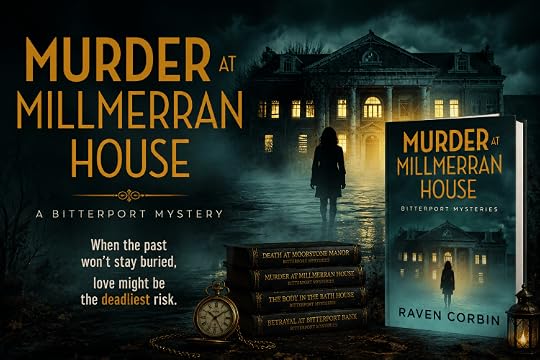
August 3, 2026
Rattling Closet Doors at Millmerran House
 Episode One: Marielle McGregor & Aiden Bellingan — Murder at Millmerran House
I’ve been rattling around Bitterport a long time, and I can tell you, nothing gets the town talking like a stranger in an Armani suit turning up to inherit the most notoriously unlucky house on the peninsula. So naturally, I invited myself over. Turns out the ballroom’s still got exactly one working chandelier, half a ceiling, and two people who are far too busy bickering to notice I’ve let myself in.
Grab a seat. Mind the dust sheets. Let’s talk.
Mr Bones: Right, before we start, I want it on the record that this ballroom used to host the best parties on the east coast. Whale oil money, dancing till dawn, the lot. Now it’s got a hole in the roof and wiring dangling like it’s auditioning for a horror film.
Aiden: In my defence, I didn’t put the hole there.
Mr Bones: No, but you did inherit it, along with the rest of Millmerran House, and from what I hear, a condition attached that’s got half of Bitterport placing bets on how long you’ll last.
Aiden: Long enough to prove them wrong. That’s the plan, anyway.
Mr Bones: Aiden Bellingan, hotelier, great-grandson of a man who apparently didn’t make it out of this town’s history in one piece either. Explain to the readers what possessed you to take this on rather than simply, I don’t know, selling it and running for the hills.
Aiden: That’s the part I can’t explain. I’d love to sell it. I’d love to never think about this place again. Turns out the terms of the inheritance had other ideas.
Mr Bones: Ah yes, the fine print. Never trust a dead man’s paperwork. Marielle, you’re the one actually holding this project together with your bare hands, I’m told, much to Mr Bellingan’s initial scepticism.
Marielle: He took one look at my nails and decided I couldn’t hold a paint roller, let alone renovate an entire mansion.
Aiden: I’ve since revised that opinion. Extensively.
Marielle: He has. It only took him watching me strip three rooms of wallpaper single-handed. Although, I did have help from Elvira.
Mr Bones: I do love a redemption arc. Marielle, your family’s been in this town a fair while too, haven’t they? McGregors aren’t exactly new blood round these parts.
Marielle: Generations of us. Mum’s in Hobart these days. She keeps an interior decorating shop there, though she’s still got half of Bitterport’s gossip on speed dial somehow. If you want the local version, though, you’ll want the Woodburys’ place on Main Street. Nothing gets past that shop.
Mr Bones: Ah, Wayne and Sharon. Now there’s an institution. Tinned goods, a bit of home cooking on the hot plate if you’re lucky, and enough town history behind that counter to fill a library.
Marielle: Mrs Woodbury runs the book club too. Between the two of them, they’ve kept half this town’s public buildings standing. Cemetery, church grounds, you name it, if it needs tending, one of the Woodburys is there with a rake.
Mr Bones: Salt of the earth, that pair. Though I will say, love, every time I’ve drifted past that shop, Sharon’s got this look about her. Like she’s waiting for someone to walk through that door she’d rather not see.
Marielle: I’ve noticed that too. I don’t think it’s my business to ask, though.
Mr Bones: Mine either. But I do love a mystery I’m not personally required to solve. We’ll leave the Woodburys be for now. There’s history closer to home for you too, though, isn’t there. Family history, tied up with this house.
Marielle: There is. I’m still working out exactly how much.
Mr Bones: Now that’s interesting, because I happen to know there was a McGregor wrapped up in this house’s business a long time back too. A police officer, if memory serves. Coincidence?
Marielle: (exchanging a look with Aiden) We’re not ruling anything out.
Mr Bones: Cagey. I like it. Let’s talk about the elephant in the room, or rather the ghost in the ballroom. Word is this house comes with a rather glamorous former resident who’s not thrilled about the renovation plans.
Aiden: Elvira keeps her own schedule. She’s made her feelings about the wallpaper very clear.
Mr Bones: Has she made her feelings about you two clear as well?
Aiden: She has feelings about everything. Including things that are absolutely none of her business.
Marielle: She danced under that chandelier once. I think that’s part of why she’s still here. Something happened in this house that she could never let go.
Mr Bones: Now we’re getting somewhere. There’s a bloke in Hobart, isn’t there, who’s got a very personal stake in finding out what happened to her. A lawyer in a drab suit wearing a newsboy cap. I hear he has terrible taste in surprises?
Aiden: George. He’s been dropping hints about this house since the day I signed the paperwork.
Mr Bones: And has he told you why he’s so invested?
Aiden: No. And I’ve stopped asking, because every time I do, he just tells me to enjoy the surprises.
Mr Bones: Delicious. Now, the pair of you have a plan for this house beyond not falling through the floor, haven’t you? I heard a rumour about weddings.
Marielle: That’s the vision, yes. Full restoration. The gardens brought back, the ballroom fit for a bridal party, the whole place turned into somewhere people actually want to be, instead of somewhere they’re afraid to walk past after dark.
Mr Bones: A wedding venue with an unsolved mystery and a resident ghost. Bold. I respect it.
Aiden: It’s either genius or a catastrophe. We won’t know which until we’ve dealt with what’s actually buried in Millmerran’s past.
Mr Bones: And there it is. Now, I’ve heard whispers, and I do mean whispers, about a name that keeps surfacing in the old records. Someone George very much wants found. Care to share?
Aiden: Not a chance.
Marielle: Some things are better left for readers to dig up themselves. Pun intended, apparently, since you seem fond of them.
Mr Bones: I taught you well. Last question, and I want the truth. Aiden, first impressions. Did you think Marielle McGregor was going to be trouble the moment she walked in here?
Aiden: I thought she was going to be trouble the moment she told me she’d be holding the sledgehammer herself.
Marielle: And was I?
Aiden: (a beat too long) Absolutely.
Marielle: I plead the fifth. Or whatever the Tasmanian equivalent is.
Mr Bones: Fine, fine, keep your secrets. But tell me this. Elvira danced under that chandelier once. Any chance history’s about to repeat itself?
Marielle: (glancing at Aiden) Ask us again after the wedding season launch.
Mr Bones: Is that a yes?
Aiden: That’s a “read the book.“
Mr Bones: (to camera) Readers, I’d keep an eye on this one. Millmerran House has swallowed bigger secrets than a couple falling for each other under a broken chandelier, but I’ve got a feeling this is the one worth watching.
See you next time. Try not to disturb Elvira on your way out.
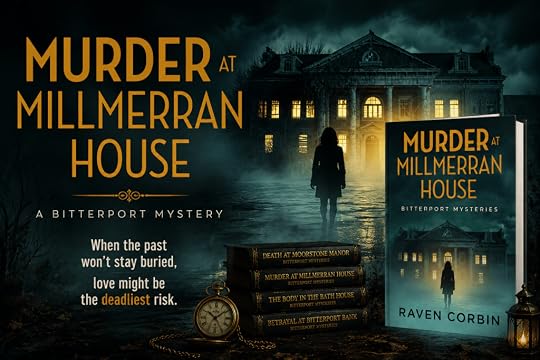
July 15, 2026
Researching The Body in the Bath House – A peek into our Convict Past
One of the most intriguing aspects of writing in the Bitterport Mysteries series is the concept of intertwining through each story, historical facts about colonial Tasmania (where the Bitterport Mysteries series are set) and ensuring each book is linked to a past tragedy, crime or miscarriage of justice that has haunted the small township for far too long.
In researching The Body in the Bath House, I was able to indulge my life-long love of history and I’d like to share with you a few fascinating facts I discovered of the convict days. During the years of 1788 and 1868 over 162,000 men, women and children were punished by transportation to Australia. The sentences were for 7 and 14 years and for the more ‘serious’ crimes such as forgery, highway robbery, political agitation (for example) the sentence was life or as it became known, for the term of their natural life.
Many were transported for petty crimes such as theft of anything with a value of more than 1 shilling, and – (how crazy is this!) – setting fire to a haystack.
To commemorate specific voyages ship, coin medallions were made. One such medallion is the Charlotte Medallion, a silver coin which on its obverse has etched an image of the ship and its name. On the reverse, a minute description of the voyage itself is inscribed. This medallion is on display in the Australian National Maritime Museum, Sydney and dates back to 1788 when it was made by Thomas Barrett (a convict) whilst The First Fleet was at anchor in Botany Bay.
 “Image courtesy of The Australian National Maritime Museum”
Of course, I just had to use this beautiful artifact so in The Body in the Bath House, my intrepid main characters, Mercy and Zac, discover a medallion from a convict ship (that really did exist), The Minerva, that transported Irish convicts to Van Dieman’s Land (Tasmania’s original name) in 1818.
They also uncovered a convict love token – where the initials are somewhat difficult to decipher (spoiler alert – the origins of this particular love token form part of my next book in this series, working title which is ‘The Grave at Gull Cottage’). These tokens were made around the time of a person’s sentencing and were given to loved ones as a memento. The Museum of History New South Wales houses 315 love tokens which can be viewed by the public should you ever get the opportunity to visit.
I find the idea of love tokens to be particularly poignant. Imagine how precious these small momentoes would have been to the recipients; the majority of whom were separated from their loved ones forever as most convicts never returned to England.
Here are a few images of convict love tokens:


 “Images courtesy of the National Museum of Australia”
Since I love history all this research was like manna from heaven for me and I hope that you found these snippets of the past just as interesting as I did.
If you’d like to read how these fascinating peaks into our convict past appear in my story, The Body in the Bath House (book 2 in the Bitterport Mysteries series) is available now.
Buy links / view my website here.

July 12, 2026
Bitterport – the town that time forgot
 How it started
How a ghost screaming down a chimney became a Gothic mystery series and why I needed two very good friends, a hand-drawn map, and a lot of video calls to build it.
Most of my books start with a character. Or a situation. Or, occasionally, a single line of dialogue that lodges itself in my brain and refuses to leave until I write around it. This one started with a dream.
July 3, 2026
The Real History Behind Bitterport
 Map drawn by Suzanne Gilchrist, overlay by K.L. Paterson, aged by Raven Corbin
With Raven, K.L and Suzanne
Bitterport isn’t a real place. But almost everything that haunts it is.
When we started building this town, we didn’t want a generic spooky Gothic setting. We wanted somewhere that felt like it could have existed.
Ghost towns are not a metaphor here.
Tasmania has dozens of them. Mining settlements, whaling stations, port towns that boomed for a while and then simply stopped, abandoned almost overnight when an industry collapsed or a better harbour was found. Walk through some of them today and you’ll find exactly what we imagined for Bitterport: stone buildings with nobody in them, streets that still follow the shape of a town that hasn’t existed in generations, and a strange quiet that hangs in the air like a storm about to break.
That emptiness was the whole starting point. What happens to all the stories a town doesn’t get to finish telling, when everyone just leaves?
The Female Factory system
Several threads running through the Bitterport Mysteries — reputations quietly destroyed, women written out of official records, small injustices nobody thought worth investigating — are pulled directly from Tasmania’s female convict history, and specifically the Female Factory system: the network of workhouses where transported women were assigned labour, punishment, and in many cases, very little say in what happened to them next.
The official records from these institutions are often clinical to the point of erasure — a name, an offence, a sentence, nothing else. We’ve always found that gap unsettling in the right way for fiction: an entire life reduced to three lines, with everything that made it a life left for someone else to imagine, generations later. That’s more or less the job description of every ghost in Bitterport.
Wartime Tasmania
The 1940s thread running through the series — Arthur Carruthers’ munitions factory, the wartime economy, the kind of corruption that thrives when a country needs supplies fast and isn’t asking too many questions about how they’re sourced — is grounded in a real, less-discussed side of Australia’s home front. Wartime manufacturing boomed in unexpected regional pockets, oversight was often thin, and the men running it answered to very little beyond their own bookkeeping.
We didn’t have to invent much. We just had to ask what a town like that would look like if nobody ever came back to fix what got broken.
What we changed (on purpose)
Bitterport itself, its buildings, and every named character are entirely fictional. We’re not claiming any real town, family, or unsolved case as the basis for these books. What’s real is the texture: the kind of place this could have been, the weight of the silence that settles over a town once it’s abandoned, and the history that doesn’t get written down properly the first time.
We think that’s more interesting than a purely invented setting. Fiction gets to ask “what if someone finally went back and looked properly?” History, mostly, doesn’t get that option.
Why this matters for the series
Every book in the Bitterport Mysteries pairs a present-day story with a historical wrong that was never resolved, because that’s genuinely how most of these towns work. The buildings stay. The paperwork, if it survives at all, is incomplete. The people who could have explained what really happened are long gone. We can’t fix that for the real Tasmania. But we can, at least, make sure nobody in Bitterport stays silent for good.
Welcome to the town. There’s a lot more where this came from.