
Penelope J. Stokes's Blog
March 29, 2025
On Wabi-Sabi and Acceptance
On the eclectic altar in our house we have a number of objects, some created and others found. We have stones of remembrance, a cross fashioned from a World War II artillery shell, a broken and glued back together ceramic Buddha, a prayer stone from Mecca, a Tibetan singing bowl, a string of prayer beads. And our favorite Wabi-Sabi, a broken bowl from Nicaragua that holds a candle.
It was years ago that I learned of the ancient Japanese philosophy of Wabi-Sabi: Finding beauty in the broken, the worn, the less-than-perfect. Wabi-Sabi teaches us that life itself is “perfectly imperfect,” and that the unfinished, undervalued, undiscovered aspects of our lives, relationships, and personalities have untapped riches—if we only have eyes to see.
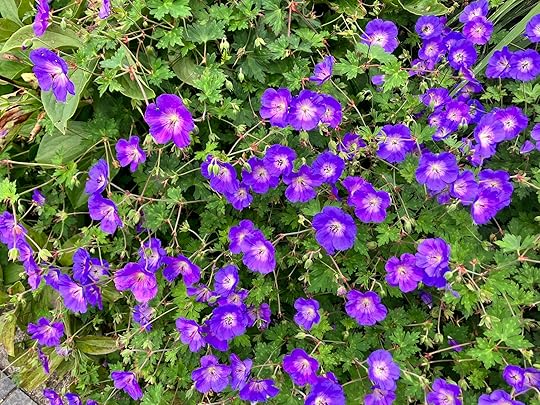
My wife Pam loves to take photographs of flowers. Now, I have a different perspective about photos: After you’ve taken three hundred shots of that mountain or that flower bed, they all seem to run together. But then Pam made this observation about her pictures. “They’re all imperfect,” she said. “Every one of my photos has a wilted leaf, or a broken bud, or a blossom past its prime.”
Right. That was the whole point. Pam has the ability to see beauty where others cannot. She knows that perfection is not the goal—in fact, the desire for perfection can be one of the biggest roadblocks to a life of peace, contentment, and authenticity.
Wabi-Sabi. The cracks, the broken places, the wounds and scars we bear—this is what makes us truly real, truly beautiful.
As the wise Skin Horse tells the Velveteen Rabbit:
“By the time you are real, most of your hair has been loved off, and your eyes drop out and you get loose in the joints and very shabby. But these things don’t matter at all, because once you are Real you can’t be ugly, except to people who don’t understand.”
–Margery Williams
The Velveteen Rabbit
My own Wabi-Sabi story is not an easy one to tell. For much of my life I exerted a great deal of energy trying to maintain an image of who I thought I was supposed to be. I conformed myself to other people’s expectations—or what I assumed were their expectations. I lived with constant anxiety, always in defense mode, keeping up appearances, maintaining the pretense.
I was like the Enterprise under attack in Star Trek: “We can’t keep up our shields much longer, Captain. It’s draining our energy banks.”
My energy banks were being drained. I could never just relax and be myself. I couldn’t sleep. I worried all the time whether I was doing it right, being good enough, being worthy of being loved. And even though I believed—theoretically—in grace, I was living by works. Trying to deserve love. To earn it.
It took me a very long time—and a lot of brutal self-examination—to discover that I did not, after all, have to earn love. That I was okay just as I am, with all the scars and wounds that come with a lifetime of experience, with all the regrets and bad decisions and cracks in my carefully-crafted façade.
On my last blog I wrote about another Japanese practice: Kintsugi, the art of repairing shattered things with gold. Not hiding the scars or covering over the broken places, but highlighting them, creating something beautiful in the brokenness.
We all have fault lines—cracks in the outward image, failures we’d rather not admit, decisions we’d like to revisit, choices we desperately wish we’d made differently. But we can’t change the past. We can only go forward with the wisdom and strength we’ve absorbed from the experiences life brings us.
One lesson I’m trying to learn, at this late stage in life, is the power of acceptance. Acceptance of myself, with my own failures and foibles. Acceptance of my shadow side, and my ability to do harm as well as good. Acceptance of others, with their mixed bags of kindness and cruelty.
I don’t always do it well—some days, better than others. I’m not always as mindful as I’d like to be of my own emotions, or as empathetic toward the feelings of others. This broken old body will never manage the Lotus position. This broken old soul will never manage to be perfectly aware, perfectly generous, or perfectly kind.
But maybe I can be perfectly imperfect. Maybe I can be Wabi-Sabi, broken but still beautiful. Maybe I can be Kintsugi, with my scars and wounds made lovely in the mending. Maybe I can be. . .
Well, human.
So I’ll take a lesson from Leonard Cohen:

Ring the bells that still can ring,
Forget your perfect offering.
There is a crack in everything,
That’s how the light gets in.
–from “Anthem”


February 25, 2025
The Grace of Ambiguity
I read an article recently about the unfinished moments in our lives, the unresolved conflicts, the unanswered questions—what the author called “the silent good-byes.” The idea resonated with me, especially in regard to one particular relationship, and how it ended with so many unanswered questions.
And so I began to think about ambiguity. The unknowable. The uncontrollable. The uncertainties of life as we know it. And I began to see ambiguity as a grace rather than a curse.
I have been a writer of novels, and I know all too well that in fiction, ambiguity is essential. A novel without conflict is. . .well, boring. Easy answers don’t make for good stories. Happy relationships are tiresome, tedious, and downright dull—at least in a novel. Readers don’t care about balancing the budget or planning for retirement or what to make for dinner. They care about drama, conflict, and resolution. When a story bogs down, you ask yourself: How can I make it worse? How can I put these characters into a situation that challenges them to their limits? And then, before you can get to The End, you have to untangle those conflicts, resolve the challenges, unite (or break) the relationships.
But life doesn’t tidy itself up in nice little packages. The murderer doesn’t always confess on the witness stand. Sometimes the killer goes free to kill again. The hero doesn’t always ride off into the sunset after slaying the dragon and saving the fair maiden. The boy doesn’t always get the girl—on occasion, he gets the boy. On other occasions, he goes home alone to a frozen pizza and a movie.
Life is messy, and lots of unraveled threads never get woven back into the tapestry. Almost none of us get to the end of our lives without some broken relationships, some regrets, some unfulfilled dreams, some unanswered longings. If you’ve never had your heart broken, you’re either very young, or you haven’t risked very much. We live, if we live long at all, with a great deal of ambiguity, a lot of “whys,” and more questions than answers.
So what do we do with our “silent good-byes,” the questions without answers, the broken relationships, the spiritual dilemmas, the paradoxes of good and evil? How do we live with ambiguity?
One place to begin, perhaps, is to acknowledge that control is an illusion. Anyone who has been married or in a committed relationship knows that you cannot control what your spouse does—not even if you’ve asked them a thousand times not to throw their dirty socks on the floor when the clothes hamper is two feet away. Anyone who has ever raised a child knows that at some point you have to let go, let them learn to walk on their own, let them skin their knees, wreck their bikes, fall in love with the wrong person. Anyone who has ever had a reactive dog knows that you can’t even control yourself: When the dog barks, you bark back, even though you realize that shouting doesn’t help the situation.
We are all bamboozled by the illusion of control. And if we are fortunate (or unfortunate) enough to have a bit of therapy under our belts and a few psychological buzzwords in our vocabularies, we may become tempted to think we’ve got it covered, that we have at last found the secret of—at least—a modicum of self control.
What we really need to learn—what I need, to learn, in daily practice rather than some mind-altering epiphany—is that Life IS Ambiguity, and that opening our death-grip on the need to understand everything sets us free from a great deal of anxiety.
I don’t even understand myself. How, then, can I possibly believe I can understand all of my partner’s motives, or why my friend ghosted me, or whether there’s life on other planets? How can I expect all of my questions to be answered—in this life, or any other?
Instead of obsessing about answers, I’m trying to live with the grace of ambiguity.
Most of us dislike ambiguity, if we’re honest about it. We’d prefer easy answers—or at least concrete ones that don’t keep slipping through our fingers like water. We’d rather our partners didn’t keep surprising us with aspects of their character that we find less than attractive. We’d rather ignore the aspects of our own lives that mess with the image of our own perfection. But look in the mirror. Like it or not, the unanswerable is always with us—around us, and in us.
It’s a gift, really. Ambiguity is the Universe reminding me I’m not in charge. That I’m not perfect, nor was I intended to be. That we’re all composites of light and darkness, and that shadows are what give depth and dimension to the portrait.
Light and shadow. . .ah, therein lies the conundrum.
We like to think of ourselves with our faces lifted toward the sun, drinking in the light, bathed in it, filled with it. But behind us lies the shadow side, the parts of us we’d like to keep hidden, the times we behaved in ways that did not reflect the values we claim, the moments when jealousy or rage or insecurity got the better of us and left wreckage in our wake.
If we dare to look behind, to face squarely the rubble of lost dreams, the dregs of past relationships, the less than brilliant moments that hover in the background of all of our lives, we can begin to appreciate—to bless, even—the ways in which we’ve faltered and fallen, the times we broke another’s heart or had our own hearts broken, the lessons we’ve learned, not in glorious success, but in inglorious failure.
The Japanese have a name for it: Kintsugi.
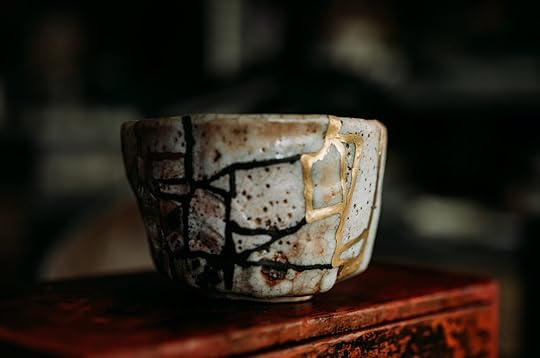
Kintsugi is the art of repairing broken things with gold, so that the cracked and broken places create beautiful designs.
Beauty emerges out of brokenness. Blessings come from the silent good-byes. New growth springs out of ambiguity. Shadows lend depth and dimension to the portrait.
When we open ourselves to the grace of ambiguity, our cracks can be mended with gold.
February 8, 2025
Why Imagination Matters
Something terrible is happening these days. A lot of somethings, if I’m telling it honestly. The world—my world, at least, the one I’ve always depended upon—seems to be imploding and crashing in upon itself. Nothing feels reliable any more. Not the government, not the law, not the financial plans I set in place to carry me through retirement. Everything I believe about Civil Rights, Women’s Rights, Diversity, Equity, and Inclusion is being dismantled before my eyes.
It is, in short, pretty damned depressing. Not to mention scary.
Then recently, in two separate quotations, I found words that changed everything.
“Imagination is a danger. Thus every totalitarian regime is frightened of the artist. It is the vocation of the prophet to keep alive the ministry of imagination. . . to nurture, nourish, and evoke a consciousness and perception alternative to the consciousness and perception of the dominant culture around us.”
Walter Brueggemann
The Prophetic Imagination
“Your inner artist invites you to participate in the great work of healing the world by lifting out of your senses creative images, words, and actions that inspire others to live lives of wonder and surprise.”
Macrina Wiederkehr, O.S.B
Foreword, The Artist’s Rule, p. xii.
Imagination is dangerous.

It is dangerous because it cannot be controlled. Imagination is a gateway, the power within us to envision something beyond what we already know—colors finer, brighter, more lustrous; music so lovely it makes the soul weep; poetry so gripping it can call us to rise up, stand strong, and change the world.
Imagination, in spiritual terms, is the Ruah—the breath of the Divine, breathed into us with our first breath on earth. The Spirit which enlivens and transforms everything.
Imagination is dangerous precisely because it is the power and spirit of Love It makes us co-creators with the Universe in reshaping the world we live in. We look around us and see smallness, meanness, viciousness, greed, and lack of empathy. We see the rich getting richer and the poor struggling to keep life and limb together. We see a callousness that crushes all hope out of the soul. We see, in the words of Yeats, how “the best lack all conviction, while the worst are full of passionate intensity.”
But that is not the end of the story.
We can imagine a better world. We can envision equity and community, even if we can’t see how to get there just yet. We can conjure up a life where our Black and brown brothers and sisters live unafraid, in peace and tranquility. A world of acceptance inclusion for Trans people, for the non-binary, for Gays and Lesbians and all who do not fit in straight white society. A place where women find respect, autonomy, and equality. A place where courage marks our days, and sweet dreams take the place of restless nights.
We can write it. We can paint it. We can sing it. We can plant a garden. We can build a treehouse. We can make pies, and inhale the invigorating scent of fresh laundry. We can do the smallest positive act with intention and love. We can let our hearts soar on the winds of imagination to places our earthbound bodies cannot yet go.
Imagination is dangerous, because it gives us hope. It feeds positive energy into the Universe—energy which returns to us, in true karmic fashion, as a richness of spirit, a calling of the heart and soul, a passion which cannot be extinguished by the sordidness of the world.

Whatever our spiritual or religious upbringing, we can all envision and relate to the Universal Spirit who is within us all. In every breath, in every creative longing of the soul, in every passionate idea, and every unrealized dream, lies the Spirit who binds us together in the luminous, unbreakable web of life. You can call it God or Buddha or Spirit or Goddess, and it is all the same—the varying paths toward the same goal: Oneness with the One who created us, loves us, and reminds us with every tiny miraculous glimmer of life, that we belong.
We belong, and so we create. We sing our songs, we write our poems, we paint our landscapes. We make our pies and build our treehouses. We use whatever gifts we have at hand and offer them on a sterling platter of love to the Universe, expecting nothing back, but trusting that somehow, on some undreamt-of path, the offering will return to us in greater passion, deeper introspection, more creative energy.
The world as we know it does not appreciate imagination. It mocks the creative spirit that gives without hope or expectation of repayment. It reminds us, regularly and with increasing insistence, that acquisition is the path to fulfillment—the only path. That success lies in amassing millions and billions. That there is no such thing as enough, and the one who dies with the most toys wins.
But life is not a contest of winners and losers. And toys, like millions and billions, rot in the ground with the flesh of those who acquired them. We all go the same way, in the end. The difference is that some of us give back to the world what cannot be bought or sold: the fruit of our creative impulses, the spirit-breath that goes on in positive energy long after we have breathed our last.
In The Great Divorce, C.S. Lewis says that our smallest choices, ultimately, are the choice between heaven and hell.
“At the end of all things, the Blessed will say, ‘We have never lived anywhere except in Heaven,’ and the lost, ‘We were always in Hell.’ And both will speak truly.”
What can we do to be a force of resistance against the tide of lies, negativity, and destruction in the world around us?
We can breathe. We can create beauty. We can inject positive energy into the world.
We can love.
April 3, 2019
55 Cents to Change the World
Fifty-five cents.
That’s what it costs to change a life.
[image error]
Pam and I have lived in the Andes mountains of Ecuador for almost four years. We love the simple lifestyle, the slow pace, the gentle climate. But more than that, we love the people–especially the kind-hearted Indigenous people whose villages surround our little town of Cotacachi.
Ecuador is rich in culture and heritage and community. It is rich in family unity and honest values and a life of open-hearted welcome. But in material things, most people are poor. Some are so poor they can barely acquire basic necessities of life. Some cannot afford the books and supplies needed to send their children to school.
Pam and both I grew up in families where education was highly valued, where learning was recognized as an important key to a better life. And so, when we came to Cotacachi, we became involved with It’s About Children, a wonderful organization whose sole purpose is to help promising Ecuadorian children gain an education.
[image error]
Meet Andy. He’s in the 11th grade. He wants to be a doctor. This semester, his grade point average was 10.0—on a 10 point scale. That’s perfect! But without the help of the scholarship program at It’s About Children, Andy might not be able to go to school at all. And what a loss that would be!
Here in Ecuador, education is free, but many Indigenous families cannot afford the cost of books, uniforms, supplies, and other expenses associated with sending their children to school. For 55 cents a day, less than the price of a cup of coffee, a sponsor can send a child to school. $200 a year is all it takes for a child to get the education that can help to lift a family out of poverty and create a better future for everyone.
At It’s About Children, www.itsaboutchildren.org, we’re all about helping to change the world, one student at a time. Our scholarship students are bright and ambitious. They are required to maintain an 8.0 average to continue in the program. They are motivated. And they are appreciative:
There are many ways to say thank you to you for giving me an opportunity, for helping me, for helping young people with their learning, and helping these parents who don’t have money for the education of their children. I don’t have words to thank you enough for what you are doing for us. Many thanks. Samia.
When we give to It’s About Children, 100% of our donation goes to help promising children in the villages around Cotacachi, Ecuador. It’s a tangible, hands-on way to make the world a better place.
At the moment we provide scholarship money for some 75 Indigenous students. But we can’t fund them all. More are waiting.
Maybe they’re waiting for you.
Won’t you join us? Go to www.itsaboutchildren.org to find out more and sign up to help.
Do it today. Your fifty-five cents can make all the difference.
June 4, 2018
Slaughter of the Innocents, 2018
[image error]
And are you still so certain,
Mighty One,
you upon whose sword
so many have been slain,
that this brown child,
this terrified, abandoned one,
torn from a mother’s arms
and wailing
at the half-built wall,
is not the Second Coming
of the One whose name you claim,
disguised among the Least of These,
helpless, innocent,
waiting
to be seen?
© 2018 Penelope J. Stokes
May 9, 2018
The Mountains Are Always There
[image error]
For the past three days, it’s been raining. A lot. Three inches, according to the gauge in the garden. The two mountains that flank our new home vanished in the mist. Last night the fog closed in, shrouding us in gray.
Our little Andean paradise, our Shangri-La nestled between the volcanoes, disappeared, as if in some South American version of a David Copperfield show: Now you see it, now you don’t.
And yet.
And yet.
The mountains are always there.
Last night the rain ended. This morning the sun rose over the strong left shoulder of Mt. Imbabura, just out our front door. Water droplets hung like liquid diamonds on the trees and pooled in the throats of the hibiscus and calla lilies. Behind us, Mt. Cotacachi showed herself in all her snow-clad glory, white hair of wisdom crowning the Great Mother.
[image error]I learned a lesson from our dog Yapa this week. I was sitting on the front porch, watching the clouds scudding across the mountains, and noticed her, standing there motionless, staring into the flower bed. Nothing there, of course, but the detritus of the garden—some dried leaves, black earth, fallen blooms. But I knew immediately what she was up to. Every night, there’s a frog outside our bedroom window who croaks us to sleep.
Yapa wants that frog. Badly. She’s never seen it—none of us has—but she can’t stop herself from looking. From waiting. From hoping.
On those days when I feel a twinge of dissatisfaction, a momentary longing for some imaginary something I do not possess, these words from an anonymous prisoner in a Nazi camp put me to shame:
“I believe in the sun
even when it is not shining.
I believe in love
even when no one’s there.
I believe in God
even when God is silent. . . .”
The truth is, I have everything anyone could possibly need, and more than I ever hoped for or dreamed of.
I have love. I have security. I have a home in a place that takes my breath away, every single day. I open my eyes to light on the mountains and lush green all around me. I listen to the birds and the wind and the laughter and conversation of my neighbors beyond the fence. I can pick avocados and lemons in my own back yard. There is nothing—nothing—that anyone could offer me that I don’t already have. Everything that’s important in life is here already. Around me. Within me.
But I forget.
And you do too, probably. Sometimes we all lose sight of what we have in the quest for some greener pasture. And so today, in this present moment, I pause to celebrate the amazing gift I call my life. The wonders of the natural world around me. The fulfillment of love I’ve discovered in the woman I share my life with. The laughter. The tears. The adventure. The mundane. All of it.
Every bit.
Every moment.
Every day.
FROG PATROL
At the edge of the porch
our little black dog
holds vigil,
searching for the source
of the nightly frog song
from the flower beds.
Serenaded, we three—
my love, our dog, and I,
in this stunning Andean valley
where swallows dance
and mockingbirds sing
and hummingbirds whir and glint
like living jewels
among the flowers.
I lift my eyes to the mountains,
eighteen thousand feet above,
as morning sun flows down
like molten gold
within the folds.
The dog,
intent and focused
as only dogs can be,
stares into earth,
dried leaves,
and desiccated blossoms,
hoping for the music
to return.
How often
have I been like her,
intent on what I hoped for,
missing it all?
©2018 Penelope J. Stokes
April 1, 2018
Easter: Reprise, 2018
[image error]
Eight years ago (Eight years? Can it be that long?) I wrote a poem about Resurrection. Pam and I hadn’t been together very long, and everything in life was fresh and new.
The backstory goes like this: One spring morning Pam had gotten up early, as usual, and was on her way to work, when she discovered our cat Moses cornering a baby rabbit in the carport. She woke me up, and while she held Moses at bay, I rescued the bunny and sent him on his way. Out of that brief but memorable experience came the poem.
In the years since then, life has changed radically. Our marriage has settled into a lovely routine of togetherness, tranquility, and adventure. We’ve moved to South America–to Cuenca, Ecuador–and this week we’re preparing for another move, this time to the small town of Cotacachi, nestled between two volcanoes two hours north of Quito.
But life hasn’t been all tranquilidad. We’ve had our times of struggle and conflict. Living as an expat in a foreign culture brings its share of challenges and frustrations. And it occurs to me that, wherever we are, whoever we’re with, whatever our life circumstances, we live with the reality of Death and Resurrection. The death of How We Envisioned It, and the resurrection of How Much Better It Can Be. The death of What I Thought I Wanted and the resurrection of Unexpected Gifts of Grace.
And so, on this Easter Sunday morning, I reprise the poem I wrote eight years ago, in gratitude for recent resurrections, for new dreams, for love beyond imagining. And this I pray: May my eyes always be open to What Might Be, and my heart attuned to Who I Might Become.
EASTER BUNNY
“The breeze at dawn has secrets to tell you;
don’t go back to sleep.”
Crouched in the darkness
with its back to the predator,
the prey shivers,
waiting
for the final blow
of tooth and claw.
I take it in my hands,
stroke the brown baby fur
between its ears,
whisper a word of comfort,
and feel the panicked heartbeat
thrumming against my lifeline.
How safe it is
cradled between my palms,
it cannot comprehend;
cannot understand
the assurances I murmur,
cannot know
the love I feel.
And so I release it to the woods,
prod its furry backside
and send it hopping
toward its mama,
toward the dawn.
In this moment
at cockcrow,
standing at the verge of the trees
in my pajamas,
I bear witness to the ultimate grace:
resurrection
without a death.
(Not nearly so dramatic, perhaps,
but easier on the bunny.)
And I wonder:
How many Easter mornings
have dawned without me
because
I was asleep?
© 2010 by Penelope J. Stokes
December 2, 2017
For Pam’s Birthday
[image error]
In the midst of the chaos
and darkness in the world,
you are the light of this life of mine,
my True North,
my Guiding Star.
Yours is the hand
that leads me to adventure
and beyond,
yours the embrace
that comforts and sustains.
By some miracle,
we found each other,
two souls in a vast universe,
whose gravity changed
everything.
Your birth,
your life,
your heart and soul
are holy offerings to me,
and on this day,
I can give no greater gift
to celebrate
than all my heart.
© Penelope J. Stokes
December 2, 2017

November 21, 2017
Requiem for Christianity
[image error]
Christianity is dead. One version of it, anyway.
The nails are in the coffin. The box is being lowered into the ground. The funeral is under way. But the mourners—where are the mourners? Where are those who weep for this loss of faith?
This Christianity did not die a quiet death from natural causes. It did not succumb to the inevitable demise of old age, or the ravages of attrition, or even some predictable but lamentable disease. No, this version of the faith was murdered. Violently, with premeditation. Killed by its own leaders. Leaders with famous names, television shows, huge churches, and millions of followers . Leaders who ripped the heart out of their religion with bloody bare hands and posted the snuff film on social media.
The slow torture began years ago, with an ill-conceived and illicit union between conservative Christian leaders and a political party. A party whose guiding values lie in direct opposition to those of the Deity whose name is invoked. Waterboarded into submission through intimidation, lies, and misguided patriotism, its followers banded together to elect a national leader who embodies the very worst qualities of human existence: narcissism, greed, spitefulness, and all-consuming self-interest.
This president—their president—has boasted openly about his domination of the weak and vulnerable. He has admitted to abusing women, using the nastiest, most deplorable, most demeaning language possible. He has cheated business partners out of money he owed them. He has exalted himself and used his positions of influence for self-aggrandizement. He has insulted international leaders and threatened nuclear warfare. He has opened the floodgates of racism, homophobia, misogyny, anti-Semitism, and xenophobia. He has tacitly condoned acts of violence against women, immigrants, blacks, Latinos, Muslims, gays, lesbians, transgender people. He has turned a blind eye to the abominations of the Ku Klux Klan, the alt-right, and the Neo-Nazi Party. He has shown disdain and contempt for the poor, the weak, the disabled, and the discouraged.
He is vile, vulgar, and violent. Nothing in his character or action suggests so much as a hint of compassion, tenderness, or concern for others. His henchmen systematically engage in murder by lack of health care, thievery by tax code, and the rape and plunder of millions of American dreams. This Egomaniac-in-Chief is the person whose values conservative Christian leaders embrace. And now, in a small state in the Deep South, those same leaders have signed their names to an affirmation for a candidate who, according to all evidence, is a sexual predator, a pedophile who excuses his actions and dismisses the accusations against him as unworthy of attention.
Make no mistake: I am not saying that all the followers of this movement are vile, vulgar, and violent, or that they are deliberately and consciously abandoning the precepts and principles of Jesus. Quite the opposite. I believe that many are well-meaning, good-hearted people who have been blinded by their devotion to a single issue, and by their reliance upon leaders who lie to them. They have been used, abused, and irreparably damaged by those entrusted with their care. Their so-called caregivers have abdicated to the seductions of money, power, sex, and fame. The shepherds have become wolves.
And so the question arises: Where is God in such a travesty? Where is the Jesus who said, “Follow me,” and proceeded to walk among the poor and the sick and the hurting and the outcast, to touch them and heal them and make their lives better? Where is the protection for widows and orphans and strangers among us? Where is the Messiah who taught that the last shall be first and the first last, and that the one who desires to lead must be the servant of all? Where is the One who washed feet and fed multitudes and taught care and compassion for the least of these?
I think I know where that Jesus is: In the dust among the hurting and outcast and disenfranchised. Nailed to a cross of the church’s own making. Out there in the darkness, mourning for a people who have turned their backs on Truth.
There are other brands of Christianity, of course. Christians who do the work of God without fanfare in the world. Christians who feed the hungry and care for the homeless and helpless. Christians who open their arms to embrace people whose looks or language or manner of loving is different. Christians who join hands with Jews and Buddhists and Muslims and Hindus and declare that there is one God, whose name is Love. Christians who know that being true to their faith has nothing to do with borders or nationalities or sexual identities or racial divides.
So don’t tell me that those leaders, the ones who have abdicated their principles for the sake of personal gain or political power, represent a Christianity that reflects anything like the life that Jesus modeled. No one with a shred of conscience would have anything to do with such a religion. No one who has ever read the Bible and taken it seriously could believe that Jesus would affirm the values of these so-called Christian leaders.
No, there’s a new faith on the horizon. A religion of self-service rather than self-sacrifice, of loathing rather than loving, of hatred rather than helping.
And only one Bible verse applies:
“Jesus wept.”

October 19, 2017
Why Words Matter, Part 1
[image error]
Words matter because, for better or worse, language is a mirror of the soul.
In Autumn of 1941, with the world at war, author Upton Sinclair wrote the following dedication to his novel, Dragon’s Teeth—a book that eventually won the Pulitzer Prize in 1943:
In tragic times like these, an elderly author has nothing to give but words. This collection of words is dedicated to the men and woman in many parts of the world who are giving their lives in the cause of freedom and human decency.
Sinclair’s crystalline sentiment strikes like a gong in my soul, vibrates in the very core of my being.
For most of my life I have felt that I have little to offer to the world except my words, and that offering has usually felt woefully inadequate, insufficient, as if words could never, never be enough.
I have a lot of friends who are social activists. Some are angry, strident people. Some are downright mean-spirited. Some, like peace activist David Lamott, are gentle, sensitive poets. Some, like my wife Pam, add to the Yes in the world with a quiet passion. Some are preachers. Some are organizers. Some work for systemic change, while others prefer the hands-on individual type of help: feeding the hungry, sheltering the homeless, welcoming the outcasts, and caring for the Least of These.
And what about me?
I write.
In her song, “The Work of Our Hands,” singer-songwriter Carrie Newcomer declares,
“I make something barely there; music is little more than air. . .”
It’s an apt description for one who weaves syllables and guitar strings into a life’s work.
Unlike Newcomer, I don’t even have notes. Only letters, twenty-six of them, and a few assorted punctuation marks, to arrange and re-arrange into something substantial and meaningful and, God willing, life changing. At least for one life, even if it is only my own.
So I wonder–always, always I wonder: Do words matter? Can they make a difference? Can they, in some invisible, inscrutable way, help to create a better, kinder, more welcoming world?
Well, yes and no.
Words do have power. Mightier than the sword, some have said. My own metaphor would come closer to fire—painstakingly kindled or carelessly dropped into dry tinder, a source of warmth and comfort or death and destruction, depending upon who wields the match.
Words matter, for words both reflect and inform the state of the human heart.
Words matter, for language is a mirror of the soul.
Words matter, because words generate light or darkness, blessing or curse.
If you see much of social media these days, you’ll quickly be convinced that there’s more cursing than blessing going on in the world. More negative energy than positive being pumped into the universe. More conflict than connection. More division than diversity.
But it doesn’t have to be that way.
Words can make a difference. Words can change the world, every bit as much as action.
Thoughtful words.
Compassionate words.
Words of peace and understanding and empathy.
Words of affirmation and acceptance.
Words like “Love.”
Like “Care.”
Like “Come.”
[image error]
The sweetest word
upon the tongue
is
“Come.”
Come back to where
you once belonged,
back to those who
knew you,
loved you,
believed the best of you.
Row, if your ship has sailed,
Swim, if all your bridges have been burned,
Fly, if the chasm seems too wide or deep.
But come.
© Penelope J. Stokes
Upcoming:
Power, Patriarchy, and the Language of Dominance (Why Words Matter, Part 2)
God-Language and Imaging the Divine (Why Words Matter, Part 3)


