Jake Darst's Blog
August 23, 2026
The Lie That Passed Every Security Test
An off-the-books counterterrorism unit is in position. The meet has been confirmed, their target identified.
Then a data transmission is received—secure and encrypted. The target is on the move.
That’s unexpected, but no plan survives first contact with the enemy, so the team adapts. Confident in the intel sent from task force HQ, they move up their planned interdiction and mobilize.
Right into an ambush.
The message was encrypted.
It was authenticated.
It was trusted.
It was also a lie.
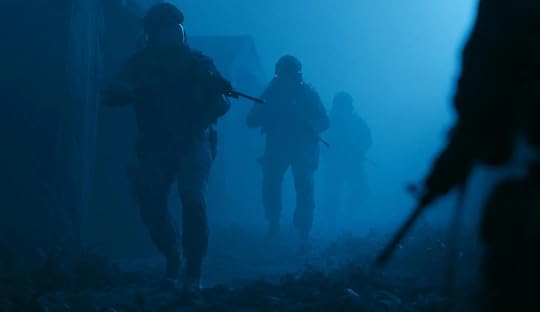
Stories like this make for great thrillers.
They’re also becoming a real concern for nations and their militaries.
The team trusted the message because every security check passed.
They believed it came from their task force’s secure command bunker in Pennsylvania.
It didn’t.
Even perfect encryption has a blind spot: it protects the contents of a message, but it doesn’t necessarily confirm its point of origin.
So how can you prove a message really came from where it says it did?
What if location itself became part of the security check?
That’s the idea behind Quantum Position Verification, or QPV.
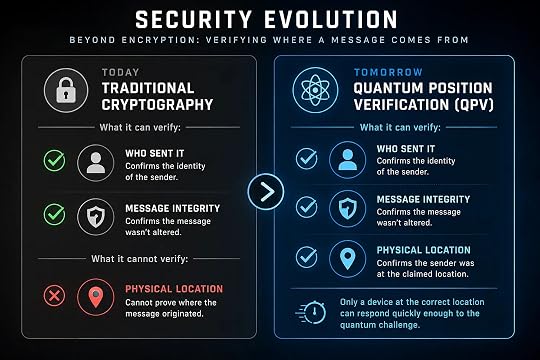
The physics gets complicated. The basic idea doesn’t.
Rule #1: Quantum information can’t simply be copied.
Imagine someone intercepts your message.
Normally, they could make a perfect copy, keep one, and send the other on its way.
Quantum information doesn’t let you do that. Trying to measure an unknown quantum state changes it. And because unknown quantum states can’t be perfectly copied, an attacker can’t simply duplicate the message and replay it later.
Rule #2: The speed of light has no exceptions.
You can thank Einstein for this one: Nothing travels faster than light.
Suppose a response is expected to come from a bunker in Pennsylvania. Physics tells you the earliest possible moment it could arrive.
If it comes from somewhere else—even a few miles away—it arrives a tiny fraction of a second too late because the signal has farther to travel. That delay becomes evidence that the sender wasn’t where they claimed to be.
This isn’t just a thought experiment.
While QPV remains an active area of research, the problem it addresses is very real. Governments are already hardening their communications against future quantum threats through post-quantum cryptography and other quantum technologies.
Once again, fiction is being chased by reality.
Then a data transmission is received—secure and encrypted. The target is on the move.
That’s unexpected, but no plan survives first contact with the enemy, so the team adapts. Confident in the intel sent from task force HQ, they move up their planned interdiction and mobilize.
Right into an ambush.
The message was encrypted.
It was authenticated.
It was trusted.
It was also a lie.
Stories like this make for great thrillers.
They’re also becoming a real concern for nations and their militaries.
The team trusted the message because every security check passed.
They believed it came from their task force’s secure command bunker in Pennsylvania.
It didn’t.
Even perfect encryption has a blind spot: it protects the contents of a message, but it doesn’t necessarily confirm its point of origin.
So how can you prove a message really came from where it says it did?
What if location itself became part of the security check?
That’s the idea behind Quantum Position Verification, or QPV.
The physics gets complicated. The basic idea doesn’t.
Rule #1: Quantum information can’t simply be copied.
Imagine someone intercepts your message.
Normally, they could make a perfect copy, keep one, and send the other on its way.
Quantum information doesn’t let you do that. Trying to measure an unknown quantum state changes it. And because unknown quantum states can’t be perfectly copied, an attacker can’t simply duplicate the message and replay it later.
Rule #2: The speed of light has no exceptions.
You can thank Einstein for this one: Nothing travels faster than light.
Suppose a response is expected to come from a bunker in Pennsylvania. Physics tells you the earliest possible moment it could arrive.
If it comes from somewhere else—even a few miles away—it arrives a tiny fraction of a second too late because the signal has farther to travel. That delay becomes evidence that the sender wasn’t where they claimed to be.
This isn’t just a thought experiment.
While QPV remains an active area of research, the problem it addresses is very real. Governments are already hardening their communications against future quantum threats through post-quantum cryptography and other quantum technologies.
Once again, fiction is being chased by reality.


July 6, 2026
Mission Update: OPSEC failed Spectacularly.
To all my Goodreads winners in the US... my apologies in advance.
The bright pink envelopes weren't my idea. Credit goes to Allie. I lost the procurement battle, and OPSEC was... not a consideration.
It gets worse. I missed today's post office run because the girls recruited me to troubleshoot a hair jewelry gadget.
And before anyone asks: absolutely not. There are no photos.
Books go out first thing tomorrow morning. Hope you enjoy the read!
The bright pink envelopes weren't my idea. Credit goes to Allie. I lost the procurement battle, and OPSEC was... not a consideration.
It gets worse. I missed today's post office run because the girls recruited me to troubleshoot a hair jewelry gadget.
And before anyone asks: absolutely not. There are no photos.
Books go out first thing tomorrow morning. Hope you enjoy the read!
July 2, 2026
When Fiction Falls Behind Reality
One of the biggest misconceptions about technothrillers is that the hardest part is keeping up with science.
It isn’t.
Keeping pace with the military can be just as challenging.
While Flash Point is built around a scientific breakthrough, I spend just as much time watching how militaries adapt to emerging technologies as I do following the technologies themselves.
Take the Army’s new M7 rifle.
It has been in widespread service for barely a year, yet SIG SAUER and the Army are already evolving the design. The result is the M8—a lighter, more maneuverable refinement shaped by feedback from soldiers in the field.
What fascinated me wasn’t the rifle itself.
It was the speed.
For decades, military procurement was measured in years—sometimes decades. Today, operational feedback can drive meaningful improvements almost immediately.
For military planners, that’s modernization.
For thriller writers, it’s a reminder that reality refuses to sit still.
One of the hardest parts of writing near-future fiction isn’t predicting breakthrough technologies. It’s deciding which emerging technologies will mature quickly enough to matter.
Sometimes a capability that seems experimental while I’m outlining a novel becomes operational before the manuscript is finished.
Other times, the breakthrough everyone expects never arrives.
That’s part of what makes writing technothrillers so rewarding.
The goal isn’t to predict the future perfectly.
It’s to explore what happens when today’s emerging technologies collide with tomorrow’s geopolitical realities.
That’s exactly where Flash Point begins.
It isn’t.
Keeping pace with the military can be just as challenging.
While Flash Point is built around a scientific breakthrough, I spend just as much time watching how militaries adapt to emerging technologies as I do following the technologies themselves.
Take the Army’s new M7 rifle.
It has been in widespread service for barely a year, yet SIG SAUER and the Army are already evolving the design. The result is the M8—a lighter, more maneuverable refinement shaped by feedback from soldiers in the field.
What fascinated me wasn’t the rifle itself.
It was the speed.
For decades, military procurement was measured in years—sometimes decades. Today, operational feedback can drive meaningful improvements almost immediately.
For military planners, that’s modernization.
For thriller writers, it’s a reminder that reality refuses to sit still.
One of the hardest parts of writing near-future fiction isn’t predicting breakthrough technologies. It’s deciding which emerging technologies will mature quickly enough to matter.
Sometimes a capability that seems experimental while I’m outlining a novel becomes operational before the manuscript is finished.
Other times, the breakthrough everyone expects never arrives.
That’s part of what makes writing technothrillers so rewarding.
The goal isn’t to predict the future perfectly.
It’s to explore what happens when today’s emerging technologies collide with tomorrow’s geopolitical realities.
That’s exactly where Flash Point begins.
BookLife Just Weighed In on Flash Point
This week, The BookLife Prize, operated by Publishers Weekly, released its Critic's Report for Flash Point.
It marks the second major independent professional review for the novel.
The report awarded Flash Point an overall score of 9.75/10, including perfect 10/10 scores for Plot/Idea, Prose, and Character/Execution.
One line, in particular, stood out to me:
"An exciting adventure thriller... that will keep readers fixated until the very last page."
The report also described Flash Point as:
"An exciting thriller... that melds futuristic technologies, military might, and enjoyable characters into one cohesive, riveting read."
It comes just weeks after Kirkus Reviews described Flash Point as:
"A breathless tech thriller... Our verdict: Get it."
It's gratifying to see two independent editorial teams respond so positively to the same story.
Professional reviews don't determine whether a book resonates. Readers do.
But thoughtful editorial feedback is always encouraging, especially for the launch of a brand-new series.
If you've already picked up Flash Point, thank you for giving a new series a chance.
If not, I hope these reviews help you decide whether it's the kind of technothriller you'd enjoy.
—Jake
Link to review: https://booklife.com/project/flash-po...
It marks the second major independent professional review for the novel.
The report awarded Flash Point an overall score of 9.75/10, including perfect 10/10 scores for Plot/Idea, Prose, and Character/Execution.
One line, in particular, stood out to me:
"An exciting adventure thriller... that will keep readers fixated until the very last page."
The report also described Flash Point as:
"An exciting thriller... that melds futuristic technologies, military might, and enjoyable characters into one cohesive, riveting read."
It comes just weeks after Kirkus Reviews described Flash Point as:
"A breathless tech thriller... Our verdict: Get it."
It's gratifying to see two independent editorial teams respond so positively to the same story.
Professional reviews don't determine whether a book resonates. Readers do.
But thoughtful editorial feedback is always encouraging, especially for the launch of a brand-new series.
If you've already picked up Flash Point, thank you for giving a new series a chance.
If not, I hope these reviews help you decide whether it's the kind of technothriller you'd enjoy.
—Jake
Link to review: https://booklife.com/project/flash-po...
May 15, 2026
The Asymmetric War for the Ocean Floor: Why the seabed is the new "Grey Zone" battlefield.
Let me start by dropping some data on you.
• The vast majority (some say 95%+) of intercontinental internet traffic
travels through undersea cables.
• Most people never think about them.
• Militaries think about them constantly.
• Mines are one of the cheapest, most asymmetric ways to disrupt global trade and military movement.
• A $5,000 naval mine can threaten a $13 billion aircraft carrier.
That imbalance is why the next major maritime conflict may belong not to destroyers or stealth fighters — but to autonomous underwater drones hunting silently beneath the world’s shipping lanes.
We like to think of the internet as something floating invisibly in a cloud. In reality, modern civilization runs through pipelines and fiber-optic cables lying exposed on the ocean floor.
The Baltic Sea has become a testing ground for that vulnerability. Over the past year, multiple undersea cables—including the C-Lion1 link between Finland and Germany—have been severed in suspicious incidents involving commercial vessels tied to Russia’s shadow fleet.
Maybe accidents. Maybe sabotage. That uncertainty is part of their strategy.
Modern seabed warfare is cheap, deniable, and incredibly difficult to police.
One response is Greyshark, an autonomous underwater drone, jointly developed by Euroatlas, and EvoLogics, and Fassmer Defence.
Powered by hydrogen fuel cells, it can remain submerged for up to four months with a range of over 10,000 nautical miles while patrolling pipelines, shipping lanes, and communications cables.
Its mission is simple: detect mines, monitor infrastructure, and identify disturbances along the seabed before they become a crisis.
And this isn’t just a Baltic problem.
Chokepoints like the Strait of Hormuz, the Malacca Strait, and the English Channel contain dense clusters of vulnerable subsea infrastructure critical to global trade and energy distribution.
That creates a dangerous asymmetry: nations spend billions building offshore infrastructure, while sabotage may require little more than a commercial vessel, a dragged anchor, and plausible deniability.
We spent decades building a hyper-connected world, but forgot one uncomfortable fact:
The cloud still depends on physical cables resting in dark water.
And for the first time in decades, militaries are preparing for the next conflict to begin there first.
The idea that critical infrastructure could become the frontline of a future conflict isn’t theoretical anymore. It was one of the core concepts that inspired my techno-thriller, FLASH POINT, built around how fragile modern systems become when invisible networks beneath the surface start to fail.
Because the deeper you look into modern warfare, the clearer it becomes:
some of the most important battlefields of the future may be completely invisible.
• The vast majority (some say 95%+) of intercontinental internet traffic
travels through undersea cables.
• Most people never think about them.
• Militaries think about them constantly.
• Mines are one of the cheapest, most asymmetric ways to disrupt global trade and military movement.
• A $5,000 naval mine can threaten a $13 billion aircraft carrier.
That imbalance is why the next major maritime conflict may belong not to destroyers or stealth fighters — but to autonomous underwater drones hunting silently beneath the world’s shipping lanes.
We like to think of the internet as something floating invisibly in a cloud. In reality, modern civilization runs through pipelines and fiber-optic cables lying exposed on the ocean floor.
The Baltic Sea has become a testing ground for that vulnerability. Over the past year, multiple undersea cables—including the C-Lion1 link between Finland and Germany—have been severed in suspicious incidents involving commercial vessels tied to Russia’s shadow fleet.
Maybe accidents. Maybe sabotage. That uncertainty is part of their strategy.
Modern seabed warfare is cheap, deniable, and incredibly difficult to police.
One response is Greyshark, an autonomous underwater drone, jointly developed by Euroatlas, and EvoLogics, and Fassmer Defence.
Powered by hydrogen fuel cells, it can remain submerged for up to four months with a range of over 10,000 nautical miles while patrolling pipelines, shipping lanes, and communications cables.
Its mission is simple: detect mines, monitor infrastructure, and identify disturbances along the seabed before they become a crisis.
And this isn’t just a Baltic problem.
Chokepoints like the Strait of Hormuz, the Malacca Strait, and the English Channel contain dense clusters of vulnerable subsea infrastructure critical to global trade and energy distribution.
That creates a dangerous asymmetry: nations spend billions building offshore infrastructure, while sabotage may require little more than a commercial vessel, a dragged anchor, and plausible deniability.
We spent decades building a hyper-connected world, but forgot one uncomfortable fact:
The cloud still depends on physical cables resting in dark water.
And for the first time in decades, militaries are preparing for the next conflict to begin there first.
The idea that critical infrastructure could become the frontline of a future conflict isn’t theoretical anymore. It was one of the core concepts that inspired my techno-thriller, FLASH POINT, built around how fragile modern systems become when invisible networks beneath the surface start to fail.
Because the deeper you look into modern warfare, the clearer it becomes:
some of the most important battlefields of the future may be completely invisible.
The Future of War Might Not Be Weapons—It Might Be Blood
When people imagine the future of warfare, they think about weapons, drones, missiles, even AI. But one of the most important developments happening right now isn’t a weapon at all.
It’s blood.
But the most critical breakthrough isn't designed to destroy. It’s designed to sustain. The innovation?
Shelf-stable, portable blood substitutes.
If it sounds dramatic, maybe even a little futuristic, that’s because it is.
The Logistics of Survival
On the battlefield, survival often comes down to minutes.
For decades, the "Golden Hour" has been dictated by a brutal constraint: real blood expires, requires refrigeration, and demands precise type-matching. Even in modern warfare, something basic, like blood, can be the difference between life and death.
Changing the Constraint
A shelf-stable substitute removes the timer.
• Zero Refrigeration: Ready anywhere, instantly.
• Universal Use: No typing, no delay.
• Extended Reach: Units can operate further and longer from medical hubs.
When the window between injury and treatment widens, the tactical map chan
The Quiet Arms Race
We often ignore the unglamorous side of war: the logistics, the support frameworks, the stabilization kits. But this is the ultimate “leave no one behind” technology.
It’s a different kind of arms race. We aren’t just building better weapons; we’re perfecting the tech that keeps our most important asset—the warfighter—alive.
It’s blood.
But the most critical breakthrough isn't designed to destroy. It’s designed to sustain. The innovation?
Shelf-stable, portable blood substitutes.
If it sounds dramatic, maybe even a little futuristic, that’s because it is.
The Logistics of Survival
On the battlefield, survival often comes down to minutes.
For decades, the "Golden Hour" has been dictated by a brutal constraint: real blood expires, requires refrigeration, and demands precise type-matching. Even in modern warfare, something basic, like blood, can be the difference between life and death.
Changing the Constraint
A shelf-stable substitute removes the timer.
• Zero Refrigeration: Ready anywhere, instantly.
• Universal Use: No typing, no delay.
• Extended Reach: Units can operate further and longer from medical hubs.
When the window between injury and treatment widens, the tactical map chan
The Quiet Arms Race
We often ignore the unglamorous side of war: the logistics, the support frameworks, the stabilization kits. But this is the ultimate “leave no one behind” technology.
It’s a different kind of arms race. We aren’t just building better weapons; we’re perfecting the tech that keeps our most important asset—the warfighter—alive.
Most People Get This Wrong About the Moon
NASA released the first images from Artemis II’s lunar flyby recently.
They’re incredible—especially the views from the far side of the Moon, including a rare in-space solar eclipse.
There’s one detail, though, that most people don’t think about when they see those images.
From the Moon’s surface, Earth wouldn’t rise or set.
Because the Moon is tidally locked, the same side always faces us. From that surface, Earth just hangs there—almost motionless in the sky, shifting only slightly over time.
The reason we get images like “Earthrise” at all is because the spacecraft is moving.
From the ground, it would feel very different.
Not a moment.
A constant.
There’s something about that idea that sticks with me—the sense of something always present, always just… there.
Quiet. Unmoving. Watching.
• • •
QOTD — Artemis II
Artemis/Reid Wiseman:
“We just realized we have… Earth out window 4 and Moon out window 3, and it just gives you the best idea of scale we’ve had yet…”
Mission Control:
“Amaze. Amaze. Amaze. 👎”
(If you’ve read — or seen — Project Hail Mary, you know.)
They’re incredible—especially the views from the far side of the Moon, including a rare in-space solar eclipse.
There’s one detail, though, that most people don’t think about when they see those images.
From the Moon’s surface, Earth wouldn’t rise or set.
Because the Moon is tidally locked, the same side always faces us. From that surface, Earth just hangs there—almost motionless in the sky, shifting only slightly over time.
The reason we get images like “Earthrise” at all is because the spacecraft is moving.
From the ground, it would feel very different.
Not a moment.
A constant.
There’s something about that idea that sticks with me—the sense of something always present, always just… there.
Quiet. Unmoving. Watching.
• • •
QOTD — Artemis II
Artemis/Reid Wiseman:
“We just realized we have… Earth out window 4 and Moon out window 3, and it just gives you the best idea of scale we’ve had yet…”
Mission Control:
“Amaze. Amaze. Amaze. 👎”
(If you’ve read — or seen — Project Hail Mary, you know.)