Samantha Stemler's Blog
March 25, 2019
Does Self-Publishing Still Work?
Does Self-Publishing Still Work in 2019? Maybe. Here's What You Need to Know In our last writing chat session, Jon Stars and I discussed methods and trends in self-publishing. Tune in Mondays at 7:00 to see the next live session. If you'd like to be a part of the next discussion, tune in or drop a comment!
Self-publishing has been around as long as rebel writers have existed. But self-publishing as we think of it now started with the rise of the internet and, most pointedly, with Amazon’s self-publishing platform, now called Kindle Direct Publishing (KDP). Like many things Amazon has done, it started out great. And then... Well. We'll get to that. You may be wondering, does self-publishing still work in 2019?
Self-publishing presents terrific opportunities for budding authors and eliminates gatekeepers that have been know to suppress alternative viewpoints and minority groups. More writers are self-publishing than ever before, and many are wondering why readers aren’t finding them when they self-publish. I’ve self-published eight books now and, while I definitely don’t claim to have all the answers, I could write an additional book about what not to do.
The Danger: Vanity Publishers
As the uncomplimentary name might suggest, vanity publishers are not groups you want to go to. Unfortunately, many vanity publishers disguise themselves—or attempt to—as legitimate publishers. There is one big red flag that marks vanity publishers: you pay them up front.
Does that sound like a scam? It should. Because it is.
Of course, nobody works for free. But traditional publishers work on a royalty basis, which means they take a cut of the sales post-publishing. That, in turn, explains why traditional publishers aren’t crazy about new, untested ideas or viewpoints unsupported by a large audience. Today, this is also why traditional publishers need authors to show they have support from readers beforehand.
Vanity publishers, on the other hand, turn profits from authors, not from the sale of books. Sadly, this often means deceiving and exploiting authors, claiming to provide editing, marketing, formatting, posting to particular platforms and a number of other shoddy, overpriced or unnecessary services. They use annoying and deceptive tactics, including mass amounts of spam and unwelcome phone calls.
 The start of one such promotional email. Working in internet marketing by day and a writer by night, I know this is a marketing tool designed to get me to move to the next "buyer funnel" stage. Note the vague language ("educate, motivate, and support" how?) and odd promises ("reach your goal of becoming a published author"). Stay away!
It’s good to know in this case that all businesses must follow the CAN-SPAM act. The CAN-SPAM act means, among other things, every business that sends you emails must give you a way to opt out (it’s supposed to be obvious, but it’s usually in tiny “unsubscribe” or “manage these emails” text at the bottom of each email). You can report CAN-SPAM violations to the Federal Trade Commission, and if a vanity publisher ran away with your cash, consider reporting false advertising to the FTC or Federal Communications Commission (FCC) as well. https://www.consumer.ftc.gov/articles/0038-spam#report
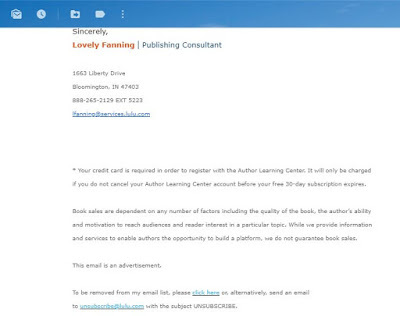 Note the "unsubscribe" option at the bottom of the email. I received these emails--and calls, though I never submitted my phone number, which is super creepy--from a print on demand service I previously liked, and actually vouched for in our recent livechat. Not impressed, Lulu, not impressed--and I won't be making future recommendations. Long story short, listen to your fellow writers to find reputable services, and never, ever give money up front!
Not a Scam: Print on Demand Publishers
Print on demand publishers are similar to vanity presses, but they provide a real function: they actually print your books. Some, like my previously beloved Lulu, have recently blurred the lines between print on demand publisher and vanity publisher.
Print on demand publishers are not really publishers at all, but printing presses. The process is fairly simple; you submit your manuscript as a PDF or similar file, do some formatting, and then purchase paper copies complete with the covers you uploaded. Your books are priced based on the length of the book, and other features. Since they operate on the advantage of economies of scale, each book costs less per book when you order more.
Be careful how many books you order.
It’s tempting to take advantage of discounts and get dozens of copies of your beautiful finished book. But, save some trees and order less. It doesn’t make your friends or family bad or uncaring if they don't read your book—many people just don’t enjoy reading, don’t enjoy the genre you’re writing, or they’re just busy. Don’t take it personally. Also, if you are a friend or family member to an author, do them and yourself a favor and don't make promises to read a book when you know you won't. It's okay.
Sadly, some print on demand publishers have become vanity publishers.
I’ve published my previous books with Lulu.com, and I had previously had a good experience with them. Unfortunately and very recently, Lulu has blurred the line between print on demand publisher and vanity press, sending unwelcome calls and emails from “publishing consultants" (see pictures above from recent emails). I’ve never used Lulu’s others services, including editing, formatting and “marketing,” but they weren't pushy about these services before. For printing, I’ve always got what I paid for, but their recent scammy tactics have frankly disappointed me. The previous point still stands: pay for printing, but don’t pay for things like marketing, exposure, anything associated with social media, education courses, "connections" with agents, posting to this platform or that one, blog tours, press releases, webpages, etc. etc. etc. The “publisher” may actually do these things to some extent, but it won’t help your book sales.
Another popular platform is CreateSpace, which Amazon bought in 2005. I would not recommend them either. Which brings me to my next point.
Is Self-Publishing on Amazon Worth it? The Short Answer is No.
Long story short, self-publishing on Amazon no longer works and isn't worth it. The company is covered in bad press and bad books, takes too much of your royalties and brings you no readers. Let's explain that further.
Full disclosure: I have published all my previous books with Amazon. I will not publish any more and I'm working on moving all books to a new platform permanently. While I personally don't agree with supporting businesses that use harmful business strategies, the simple truth is Amazon just doesn't work for authors anymore.
You don’t have to dig very deep to see the dirt covering Amazon. In fact, a lot of journalists a lot smarter than me have written volumeson it:
The Relentless Misery of Working Inside an Amazon Warehouse https://onezero.medium.com/relentless-com-life-as-a-cog-in-amazons-e-tail-machine-d46b3ef05eb8 Is Amazon Undercutting Third Party Sellers Using Their Own Data? https://www.forbes.com/sites/retailwire/2014/10/30/is-amazon-undercutting-third-party-sellers-using-their-own-data/ Amazon Will Pay 0$ in Taxes on $11,200,000,000 in Profit https://finance.yahoo.com/news/amazon-taxes-zero-180337770.html Wrist Watching: Amazon Patents System To Track, Guide Employees' Hands https://www.npr.org/sections/thetwo-way/2018/02/01/582370715/wrist-watching-amazon-patents-system-to-track-guide-employees-hands?t=1553140832494 Inside Amazon: Wrestling Big Ideas in a Bruising Workplace https://www.nytimes.com/2015/08/16/technology/inside-amazon-wrestling-big-ideas-in-a-bruising-workplace.html How Whole Foods Betrayed Employees’ Trust with Amazon https://onezero.medium.com/whole-foods-worker-mid-level-people-dont-trust-whole-foods-corporate-anymore-307bc4e97120 How Amazon’s Wooing of Chinese Sellers is Kiling American Business https://www.forbes.com/sites/wadeshepard/2017/02/14/how-amazons-wooing-of-chinese-sellers-is-hurting-american-innovation/ Why Sellers Are Fed Up With Amazon https://medium.com/public-market/in-their-own-words-why-sellers-are-fed-up-with-amazon-e97da44f7f18 It’s Actually Pretty Much Impossible to Stop Using Amazon https://www.huffingtonpost.com/2014/05/29/impossible-to-quit-amazon_n_5406916.html Amazon Killed the Bookstore. So It’s Opening a Bookstore. https://www.wired.com/2015/11/amazon-killed-the-bookstore-so-its-opening-a-bookstore/ 7 Ways Amazon Uses Big Data To Stalk You https://www.investopedia.com/articles/insights/090716/7-ways-amazon-uses-big-data-stalk-you-amzn.asp Startups Beware: If You Use AWS Amazon May Have You in Its Crosshairs https://www.inc.com/sonya-mann/aws-startups-conflict.html Amazon HQ2 Will Cost Taxpayers at Least $4.6 Billion, More Than Twice What the Company Claimed https://theintercept.com/2018/11/15/amazon-hq2-long-island-city-virginia-subsidies/
Perhaps the saddest part is that this took me only about seven minutes to compile. That’s because you can look in any direction—fair pay, employment practices, privacy, free enterprise, taxes, and more—and Amazon is terrible.
You may be wondering how Amazon could be so horrible--they just sell books and do-dads online, right? Well, no.
“Despite Amazon's dominance in e-commerce, online sales are not actually a main profit engine for the company. Instead, its cloud computing division, Amazon Web Services, has actually generated the majority of Amazon's operating income since 2016. Profits from advertising and third-party sellers are also booming.” https://www.cnbc.com/2019/02/12/how-amazon-makes-money.html
Have you ever wondered where your data goes when you submit it? When post a picture, when you read an article on an online publication, when you submit a review, when countless companies track your movements across their site to send you ads later—where is all that information stored? It goes to Amazon. Amazon Web Services (AWS) is the largest cloud-service data storage provider, meaning they store more data than anyone else in the world. An estimated 70% of everything you do online touches Amazon.
AWS is so ubiquitous in fact that a journalist tried to stop using it—and it was impossible. https://gizmodo.com/i-tried-to-block-amazon-from-my-life-it-was-impossible-1830565336
Amazon's empire is enormous, spanning everything from logistics to food to robotics to pharmaceticals and much more. This deeply concerning level of unchecked vertical and horizontal integration—combined with the fact that one of their services has actually become impossible to stop using—is the number one reason I, personally, avoid Amazon services in every way that is possible.
https://www.marketwatch.com/story/its-not-just-amazon-and-whole-foods-heres-jeff-bezos-enormous-empire-in-one-chart-2017-06-21
Why am I writing all of this in a post about self-publishing? Because Amazon Kindle Direct Services (KDP) is the go-to platform for aspiring authors. And it shouldn’t be.
You spend at least months, probably years on your book. For most writers, it’s an important part of who you are and an expression of yourself. It’s your art.
Is this the type of business you want your art to support?
If you’re not moved by my (and many, many others writers’) Amazon chronicle, there’s another very obvious and perhaps more practical reason: publishing on Amazon doesn’t work.
Publishing on Amazon Doesn't Work
As the largest platform for self-publishing marketplace, Amazon seems like a good place to reach readers directly, organically. When I self-published my first book in 2011, that was my hope. And, to some degree, it did work. I was 18 years old, didn’t know anything about book marketing, but readers, strangers, found my work.
Unfortunately, now that there’s over 3,000,000 books in the Kindle Store alone, this frankly doesn’t happen anymore. If you do not direct people to your book, no one will find it organically on Amazon. About 95% of self-published books on Amazon are hardly ever seen by readers.
In fact, Amazon’s own data bears this out. I found this using Kindle data from one of my older books, but any author using the platform can find this info in Author Central under the Sales Info tab and Sales Rank selection. The book is a far cry from a bestseller, but it provides some interesting insights.
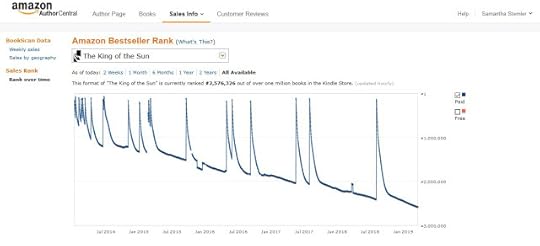
From these images, it looks like the book is getting weird activity spikes. In August 2018, for example, The King of the Sun goes from #2,400,000 in the Kindle store to #135,000. What makes the book jump over two million places in the sales rank? Must get a lot of sales all of a sudden, right?
Well, no. Less than 1 reader a month.
While Amazon does explain (though not clearly) that changes in sales rank are also caused by sales of other books, it still doesn't bode well for every book lower than spot #135,000. Any book selling significantly better would not be surpassed and not subject to these volatile swings, so these lower spots must have comparably low activity. The more modest jumps earlier in the book's shelf-life also bode badly. The sales activity didn't change significantly over the book's life--the reason the swings become more dramatic is because about four times as many books were published from 2014 til now.
What does this mean?
It indicates that less than a book a month in sales can consistently make the difference between the bottom spot and spot #135,000. Spot #135,000 and higher represents less than 5% of the Kindle Store. So,95% of books in the Kindle Store get less than a reader a month.
Amazon Discredits Your Book
One last point. Amazon makes your book look bad.
First off, most publishers will refuse to read any self-published works. Self-publishing on Amazon has become synonymous with cheap and badly-written. Since Amazon uses no apparent editorial process and enforces no content guidelines, the platform has attracted hundreds of thousands of books which are unedited, careless, ridiculous, even disgusting. I won’t list any of these books by name so as to not give them any further credit, but these topics vary from the eye-rolling—like the so-called ‘monster porn’—to the disgusting, including incest and rape. Amazon removed some of these books following strong public backlash, but many still exist between the holes in the approval process—bots looking for no-no words in the text. https://www.businessinsider.com/monster-porn-amazon-crackdown-sex-fantasy-bigfoot-2013-12
So, this begs the question, if Amazon is a terrible business to support, takes 30% of your profits, brings you no readers and puts your book next to garbage smut—why would you use that platform?
If Not Amazon, Where? 12 Alternatives to Amazon
If not Amazon, many authors wonder—what else? How can we avoid the Big 5 publishing gatekeepers and still get in front of readers? This essentially becomes a question of beating capitalism and monopolies, and there’s never been an easy answer to that. In publishing, many claim to have one (spoiler alert: they don’t) and, of course, try to sell it.
While I can’t easily answer this question, I can provide a few alternative methods that provide the same advantages as Amazon--making your book available for sale online--without putting your book next to the likes of dinosaur porn. (I wish I was kidding)
Most businesses wouldn't consider it very smart to compete with Amazon, so there aren't many other exactly similar platforms. However, there are other strategies that can be just as effective or more effective. Here are a few ideas to look into more. With each method, there are many sites, platforms, plugins etc. that can support it.I look forward to expounding on these more in future posts.
Sell via Social: You certainly won’t get any ethical high ground using Facebook, but you can sell products directly to your followers on the platform. Instagram (owned by Facebook) and Twitter offer similar functions. Crowdfunding:Crowdfunding platforms are traditionally used to fund business ideas or charities, but they essentially connect supporters and creators and process sale transactions. These could be used during a book launch to fulfill pre-orders, or any orders after. GoFundMe, FundRazr and Indiegogo have low processing fees. Website: if you already have a website, you can use plugins or addons like WooCommerce or Shopify to sell your books from your website. Blog: Release your book on your blog and you can monetize through advertisements. The more readers you have, the more your ads will be worth. Membership: Services like Patreon operate on subscription services and allow patrons to support creators directly (Patreon takes 5% and charges a 5% processing fee). Other Ecommerce: Lulu (despite my aforementioned reservations, Lulu does make your book for sale online if you choose), Etsy (while welcoming authors and entrepreneurs, Etsy also emphasizes environmental responsibility as an added bonus), and Scribd are all options here. Other Ebook platforms: Apple’s iBooks, Barnes & Noble, Kobo, Google Play Books, Smashwords (no guarantee these platforms don’t also showcase smut) Podcast: similar to a blog, you can read your book on a podcast, get listeners and monetize your podcast eventually with advertisements Livestream: similar to a blog, you can read your book aloud on a livestream and monetize through subscribers. (However, the largest livestreaming platform, Twitch, is owned by Amazon, so you risk walking the same path from a different start using this method) Magazine: make your story into a magazine with platforms like Issuu, MagLoft, Joomag or others and you can monetize with a large readership. Monetized articles: Platforms like Medium award small amounts of money for articles, including fiction, based on the approval of their readers. IRL: I'm not really good at real-life networking, but it's effective for some. Talk to libraries, local book sellers, coffeeshops, community centers, go to local events--go where readers are.
Self-publishing authors aren’t big publishers, and won’t benefit from copying their strategies. Connecting to your audience and like-minded people, being authentic, and thinking creatively are new authors’ best assets. That means thinking outside the box and working outside of the same strategies and platforms. And don’t forget to enjoy writing along the way.
Despite all this this, don't let your hobbies and your outlets become a business. In our next writing chat session, we'll be discussing the importance of taking pleasure in writing, and how to keep today's "side hustle" culture from going too far. Tune in Mondays at 7:00 to see the next live session and share your thoughts.
Self-publishing has been around as long as rebel writers have existed. But self-publishing as we think of it now started with the rise of the internet and, most pointedly, with Amazon’s self-publishing platform, now called Kindle Direct Publishing (KDP). Like many things Amazon has done, it started out great. And then... Well. We'll get to that. You may be wondering, does self-publishing still work in 2019?
Self-publishing presents terrific opportunities for budding authors and eliminates gatekeepers that have been know to suppress alternative viewpoints and minority groups. More writers are self-publishing than ever before, and many are wondering why readers aren’t finding them when they self-publish. I’ve self-published eight books now and, while I definitely don’t claim to have all the answers, I could write an additional book about what not to do.
The Danger: Vanity Publishers
As the uncomplimentary name might suggest, vanity publishers are not groups you want to go to. Unfortunately, many vanity publishers disguise themselves—or attempt to—as legitimate publishers. There is one big red flag that marks vanity publishers: you pay them up front.
Does that sound like a scam? It should. Because it is.
Of course, nobody works for free. But traditional publishers work on a royalty basis, which means they take a cut of the sales post-publishing. That, in turn, explains why traditional publishers aren’t crazy about new, untested ideas or viewpoints unsupported by a large audience. Today, this is also why traditional publishers need authors to show they have support from readers beforehand.
Vanity publishers, on the other hand, turn profits from authors, not from the sale of books. Sadly, this often means deceiving and exploiting authors, claiming to provide editing, marketing, formatting, posting to particular platforms and a number of other shoddy, overpriced or unnecessary services. They use annoying and deceptive tactics, including mass amounts of spam and unwelcome phone calls.
 The start of one such promotional email. Working in internet marketing by day and a writer by night, I know this is a marketing tool designed to get me to move to the next "buyer funnel" stage. Note the vague language ("educate, motivate, and support" how?) and odd promises ("reach your goal of becoming a published author"). Stay away!
 It’s good to know in this case that all businesses must follow the CAN-SPAM act. The CAN-SPAM act means, among other things, every business that sends you emails must give you a way to opt out (it’s supposed to be obvious, but it’s usually in tiny “unsubscribe” or “manage these emails” text at the bottom of each email). You can report CAN-SPAM violations to the Federal Trade Commission, and if a vanity publisher ran away with your cash, consider reporting false advertising to the FTC or Federal Communications Commission (FCC) as well. https://www.consumer.ftc.gov/articles/0038-spam#report
 Note the "unsubscribe" option at the bottom of the email. I received these emails--and calls, though I never submitted my phone number, which is super creepy--from a print on demand service I previously liked, and actually vouched for in our recent livechat. Not impressed, Lulu, not impressed--and I won't be making future recommendations. Long story short, listen to your fellow writers to find reputable services, and never, ever give money up front!
Not a Scam: Print on Demand Publishers
Print on demand publishers are similar to vanity presses, but they provide a real function: they actually print your books. Some, like my previously beloved Lulu, have recently blurred the lines between print on demand publisher and vanity publisher.
Print on demand publishers are not really publishers at all, but printing presses. The process is fairly simple; you submit your manuscript as a PDF or similar file, do some formatting, and then purchase paper copies complete with the covers you uploaded. Your books are priced based on the length of the book, and other features. Since they operate on the advantage of economies of scale, each book costs less per book when you order more.
Be careful how many books you order.
It’s tempting to take advantage of discounts and get dozens of copies of your beautiful finished book. But, save some trees and order less. It doesn’t make your friends or family bad or uncaring if they don't read your book—many people just don’t enjoy reading, don’t enjoy the genre you’re writing, or they’re just busy. Don’t take it personally. Also, if you are a friend or family member to an author, do them and yourself a favor and don't make promises to read a book when you know you won't. It's okay.
Sadly, some print on demand publishers have become vanity publishers.
I’ve published my previous books with Lulu.com, and I had previously had a good experience with them. Unfortunately and very recently, Lulu has blurred the line between print on demand publisher and vanity press, sending unwelcome calls and emails from “publishing consultants" (see pictures above from recent emails). I’ve never used Lulu’s others services, including editing, formatting and “marketing,” but they weren't pushy about these services before. For printing, I’ve always got what I paid for, but their recent scammy tactics have frankly disappointed me. The previous point still stands: pay for printing, but don’t pay for things like marketing, exposure, anything associated with social media, education courses, "connections" with agents, posting to this platform or that one, blog tours, press releases, webpages, etc. etc. etc. The “publisher” may actually do these things to some extent, but it won’t help your book sales.
Another popular platform is CreateSpace, which Amazon bought in 2005. I would not recommend them either. Which brings me to my next point.
Is Self-Publishing on Amazon Worth it? The Short Answer is No.
Long story short, self-publishing on Amazon no longer works and isn't worth it. The company is covered in bad press and bad books, takes too much of your royalties and brings you no readers. Let's explain that further.
Full disclosure: I have published all my previous books with Amazon. I will not publish any more and I'm working on moving all books to a new platform permanently. While I personally don't agree with supporting businesses that use harmful business strategies, the simple truth is Amazon just doesn't work for authors anymore.
You don’t have to dig very deep to see the dirt covering Amazon. In fact, a lot of journalists a lot smarter than me have written volumeson it:
The Relentless Misery of Working Inside an Amazon Warehouse https://onezero.medium.com/relentless-com-life-as-a-cog-in-amazons-e-tail-machine-d46b3ef05eb8 Is Amazon Undercutting Third Party Sellers Using Their Own Data? https://www.forbes.com/sites/retailwire/2014/10/30/is-amazon-undercutting-third-party-sellers-using-their-own-data/ Amazon Will Pay 0$ in Taxes on $11,200,000,000 in Profit https://finance.yahoo.com/news/amazon-taxes-zero-180337770.html Wrist Watching: Amazon Patents System To Track, Guide Employees' Hands https://www.npr.org/sections/thetwo-way/2018/02/01/582370715/wrist-watching-amazon-patents-system-to-track-guide-employees-hands?t=1553140832494 Inside Amazon: Wrestling Big Ideas in a Bruising Workplace https://www.nytimes.com/2015/08/16/technology/inside-amazon-wrestling-big-ideas-in-a-bruising-workplace.html How Whole Foods Betrayed Employees’ Trust with Amazon https://onezero.medium.com/whole-foods-worker-mid-level-people-dont-trust-whole-foods-corporate-anymore-307bc4e97120 How Amazon’s Wooing of Chinese Sellers is Kiling American Business https://www.forbes.com/sites/wadeshepard/2017/02/14/how-amazons-wooing-of-chinese-sellers-is-hurting-american-innovation/ Why Sellers Are Fed Up With Amazon https://medium.com/public-market/in-their-own-words-why-sellers-are-fed-up-with-amazon-e97da44f7f18 It’s Actually Pretty Much Impossible to Stop Using Amazon https://www.huffingtonpost.com/2014/05/29/impossible-to-quit-amazon_n_5406916.html Amazon Killed the Bookstore. So It’s Opening a Bookstore. https://www.wired.com/2015/11/amazon-killed-the-bookstore-so-its-opening-a-bookstore/ 7 Ways Amazon Uses Big Data To Stalk You https://www.investopedia.com/articles/insights/090716/7-ways-amazon-uses-big-data-stalk-you-amzn.asp Startups Beware: If You Use AWS Amazon May Have You in Its Crosshairs https://www.inc.com/sonya-mann/aws-startups-conflict.html Amazon HQ2 Will Cost Taxpayers at Least $4.6 Billion, More Than Twice What the Company Claimed https://theintercept.com/2018/11/15/amazon-hq2-long-island-city-virginia-subsidies/
Perhaps the saddest part is that this took me only about seven minutes to compile. That’s because you can look in any direction—fair pay, employment practices, privacy, free enterprise, taxes, and more—and Amazon is terrible.
You may be wondering how Amazon could be so horrible--they just sell books and do-dads online, right? Well, no.
“Despite Amazon's dominance in e-commerce, online sales are not actually a main profit engine for the company. Instead, its cloud computing division, Amazon Web Services, has actually generated the majority of Amazon's operating income since 2016. Profits from advertising and third-party sellers are also booming.” https://www.cnbc.com/2019/02/12/how-amazon-makes-money.html
Have you ever wondered where your data goes when you submit it? When post a picture, when you read an article on an online publication, when you submit a review, when countless companies track your movements across their site to send you ads later—where is all that information stored? It goes to Amazon. Amazon Web Services (AWS) is the largest cloud-service data storage provider, meaning they store more data than anyone else in the world. An estimated 70% of everything you do online touches Amazon.
AWS is so ubiquitous in fact that a journalist tried to stop using it—and it was impossible. https://gizmodo.com/i-tried-to-block-amazon-from-my-life-it-was-impossible-1830565336
Amazon's empire is enormous, spanning everything from logistics to food to robotics to pharmaceticals and much more. This deeply concerning level of unchecked vertical and horizontal integration—combined with the fact that one of their services has actually become impossible to stop using—is the number one reason I, personally, avoid Amazon services in every way that is possible.
https://www.marketwatch.com/story/its-not-just-amazon-and-whole-foods-heres-jeff-bezos-enormous-empire-in-one-chart-2017-06-21
Why am I writing all of this in a post about self-publishing? Because Amazon Kindle Direct Services (KDP) is the go-to platform for aspiring authors. And it shouldn’t be.
You spend at least months, probably years on your book. For most writers, it’s an important part of who you are and an expression of yourself. It’s your art.
Is this the type of business you want your art to support?
If you’re not moved by my (and many, many others writers’) Amazon chronicle, there’s another very obvious and perhaps more practical reason: publishing on Amazon doesn’t work.
Publishing on Amazon Doesn't Work
As the largest platform for self-publishing marketplace, Amazon seems like a good place to reach readers directly, organically. When I self-published my first book in 2011, that was my hope. And, to some degree, it did work. I was 18 years old, didn’t know anything about book marketing, but readers, strangers, found my work.
Unfortunately, now that there’s over 3,000,000 books in the Kindle Store alone, this frankly doesn’t happen anymore. If you do not direct people to your book, no one will find it organically on Amazon. About 95% of self-published books on Amazon are hardly ever seen by readers.
In fact, Amazon’s own data bears this out. I found this using Kindle data from one of my older books, but any author using the platform can find this info in Author Central under the Sales Info tab and Sales Rank selection. The book is a far cry from a bestseller, but it provides some interesting insights.

From these images, it looks like the book is getting weird activity spikes. In August 2018, for example, The King of the Sun goes from #2,400,000 in the Kindle store to #135,000. What makes the book jump over two million places in the sales rank? Must get a lot of sales all of a sudden, right?
Well, no. Less than 1 reader a month.
While Amazon does explain (though not clearly) that changes in sales rank are also caused by sales of other books, it still doesn't bode well for every book lower than spot #135,000. Any book selling significantly better would not be surpassed and not subject to these volatile swings, so these lower spots must have comparably low activity. The more modest jumps earlier in the book's shelf-life also bode badly. The sales activity didn't change significantly over the book's life--the reason the swings become more dramatic is because about four times as many books were published from 2014 til now.
What does this mean?
It indicates that less than a book a month in sales can consistently make the difference between the bottom spot and spot #135,000. Spot #135,000 and higher represents less than 5% of the Kindle Store. So,95% of books in the Kindle Store get less than a reader a month.
Amazon Discredits Your Book
One last point. Amazon makes your book look bad.
First off, most publishers will refuse to read any self-published works. Self-publishing on Amazon has become synonymous with cheap and badly-written. Since Amazon uses no apparent editorial process and enforces no content guidelines, the platform has attracted hundreds of thousands of books which are unedited, careless, ridiculous, even disgusting. I won’t list any of these books by name so as to not give them any further credit, but these topics vary from the eye-rolling—like the so-called ‘monster porn’—to the disgusting, including incest and rape. Amazon removed some of these books following strong public backlash, but many still exist between the holes in the approval process—bots looking for no-no words in the text. https://www.businessinsider.com/monster-porn-amazon-crackdown-sex-fantasy-bigfoot-2013-12
So, this begs the question, if Amazon is a terrible business to support, takes 30% of your profits, brings you no readers and puts your book next to garbage smut—why would you use that platform?
If Not Amazon, Where? 12 Alternatives to Amazon
If not Amazon, many authors wonder—what else? How can we avoid the Big 5 publishing gatekeepers and still get in front of readers? This essentially becomes a question of beating capitalism and monopolies, and there’s never been an easy answer to that. In publishing, many claim to have one (spoiler alert: they don’t) and, of course, try to sell it.
While I can’t easily answer this question, I can provide a few alternative methods that provide the same advantages as Amazon--making your book available for sale online--without putting your book next to the likes of dinosaur porn. (I wish I was kidding)
Most businesses wouldn't consider it very smart to compete with Amazon, so there aren't many other exactly similar platforms. However, there are other strategies that can be just as effective or more effective. Here are a few ideas to look into more. With each method, there are many sites, platforms, plugins etc. that can support it.I look forward to expounding on these more in future posts.
Sell via Social: You certainly won’t get any ethical high ground using Facebook, but you can sell products directly to your followers on the platform. Instagram (owned by Facebook) and Twitter offer similar functions. Crowdfunding:Crowdfunding platforms are traditionally used to fund business ideas or charities, but they essentially connect supporters and creators and process sale transactions. These could be used during a book launch to fulfill pre-orders, or any orders after. GoFundMe, FundRazr and Indiegogo have low processing fees. Website: if you already have a website, you can use plugins or addons like WooCommerce or Shopify to sell your books from your website. Blog: Release your book on your blog and you can monetize through advertisements. The more readers you have, the more your ads will be worth. Membership: Services like Patreon operate on subscription services and allow patrons to support creators directly (Patreon takes 5% and charges a 5% processing fee). Other Ecommerce: Lulu (despite my aforementioned reservations, Lulu does make your book for sale online if you choose), Etsy (while welcoming authors and entrepreneurs, Etsy also emphasizes environmental responsibility as an added bonus), and Scribd are all options here. Other Ebook platforms: Apple’s iBooks, Barnes & Noble, Kobo, Google Play Books, Smashwords (no guarantee these platforms don’t also showcase smut) Podcast: similar to a blog, you can read your book on a podcast, get listeners and monetize your podcast eventually with advertisements Livestream: similar to a blog, you can read your book aloud on a livestream and monetize through subscribers. (However, the largest livestreaming platform, Twitch, is owned by Amazon, so you risk walking the same path from a different start using this method) Magazine: make your story into a magazine with platforms like Issuu, MagLoft, Joomag or others and you can monetize with a large readership. Monetized articles: Platforms like Medium award small amounts of money for articles, including fiction, based on the approval of their readers. IRL: I'm not really good at real-life networking, but it's effective for some. Talk to libraries, local book sellers, coffeeshops, community centers, go to local events--go where readers are.
Self-publishing authors aren’t big publishers, and won’t benefit from copying their strategies. Connecting to your audience and like-minded people, being authentic, and thinking creatively are new authors’ best assets. That means thinking outside the box and working outside of the same strategies and platforms. And don’t forget to enjoy writing along the way.
Despite all this this, don't let your hobbies and your outlets become a business. In our next writing chat session, we'll be discussing the importance of taking pleasure in writing, and how to keep today's "side hustle" culture from going too far. Tune in Mondays at 7:00 to see the next live session and share your thoughts.


March 5, 2019
7 Reasons to Join a Writers Group
In our last writing chat session, Jon Stars and I discussed writers groups and critiques. Tune in Mondays at 7:00 to see the next live session. If you'd like to be a part of the next discussion, tune in or drop a comment!
Should I join a writers group?
If you’re a shy writer like me, you’ve asked yourself this question before. Is it worth it to put myself out there? Can it really make me a better writer?
In short, yes!
Last Monday on our Facebook live chat, fellow Lansing author Jon Stars and I discussed writer’s groups. As long-standing residents of local Lansing writers groups ourselves, we’ve both learned the value that these micro-communities of authors can offer. We’ve also learned some of the best techniques and practices from other authors. If you’re considering it, here are 7 reasons to join a writers group. I’ve also included some helpful links and resources to find writers groups in Greater Lansing to help you get started.
7 Reasons to Join a Writers Group 1. Learn Other Styles
Just like we all have a certain way of talking or walking, we also have a certain style of writing. Your style may be detailed, descriptive and poetic. Or it may be sharp, sudden, and striking. Or witty, casual and familiar. It’s difficult to actively change your writing style. That’s a bit like trying to change your handwriting; you can do it if you focus on it, but it’s hard and it won’t last.
(28:27) “You’re not stealing their style, you’re borrowing the things that they do really well.”
You can get a taste of another writer’s style by actively and attentively reading a book, but it’s difficult to enjoy the story and give it in-depth analysis at the same time. At some point, you’ll probably get lost in the story and forget what you’re looking for. In a writers group, you get to ask the author about their style face-to-face and take a moment to analyze, sentence by sentence, what they do and why it works. Since you read a series of small sections from different authors one after the next, you also get to compare several different styles. The similarities and contrasts between them can help you see more clearly which elements are particularly striking, and which you might like to borrow from. This will help you to evolve your own style as well.
2. Build Your Confidence
(25:00) “It was hard to heard. But when I thought about it, I realized they were right.”
My first day at writers group was, I’ll admit, pretty jarring. But, I also have social anxiety and I’d never shared my work, in person, with strangers before attending writers group. Though it’s true that that sort of isolation will protect you from anything critical, it also prevents you from gaining any confidence. If you’re afraid that you’ll hear bad things about your work, you’ll never heard praise either.
Regularly going to writers group, reading my work, hearing critiques and approval, giving critiques and being listened to has all helped me to believe in my work, stand behind it, and feel good about sharing it. Part of what makes this possible is listening to critical comments as well as positive ones. With a balanced view, you know your fellow writers are being honest, so you can really feel good when you get the coveted “I really liked this.”
The other important part of this is giving critiques and being listened to. When other writers respect your point of view and trust your knowledge, you can trust yourself.
3. Improve Your Writing
The most obvious and common reason to go to a writers group is to improve your writing. Even the most famous, prolific and successful writers in the industry don’t know everything there is to know about writing. Besides that, best practices and trends are constantly changing. A writers group gives you the chance to combine the knowledge of every member—every book they’ve read, talk or conference they’ve attended, every book they’ve written and critique they’ve heard. Whether you’re debating about the Oxford comma, whether to use “said” or “exclaimed,” or wondering whether your entire plot works or not, your writers group can help you.
4. Get Encouragement and Solidarity
(26:20) There are many different kinds of writers groups, and each dynamic is a bit different. Some prefer fewer critiques and more enthusiasm, with a focus on what the writer does well instead of what they can improve. Others focus on the opposite, pointing out mechanical errors, improving or removing descriptions, adding action or smoothing the pacing, and so on. There are benefits to either one. The first will keep you going, and is great for finding encouragement when you just feel like burying your notebooks forever. The second will actively improve your writing and help you work on errors. The ideal combination might be a bit of both.
Writing, like anything you’re passionate about, has some frustrations. Either writers group, whether focused on enthusiasm or improvement, will provide solidarity. If you’re frustrated about getting readers, appealing to publishers, finding time to write, balancing your job and your creative energy, and a dozen other obstacles, your writers group will sympathize in a way that no one else can.
5. Personal and Professional Growth
(16:00) Learning to take and apply a critique is a universal skill everyone should have, however many do not. Though my day job also involves writing, being able to listen to and learn from others is a skill that is imperative in any profession (and a valuable personal skill too). This is a valuable listening skill, but it’s also an exercise in patience and personal confidence. To effectively apply a critique, you have to set aside your own pride and what you think you know in order to listen to others. You also have to have the confidence and patience to understand that your critic is trying to help, not trying to personally insult you. Learning not to take critiques personally and using them instead to improve will help you learn and enjoy any pursuit.
6. Learning How to Disagree(Silently)
Most writers groups have a rule: You have to be silent while the group offers critiques. This means you don’t get to voice your defense or explain whatever you were doing or trying to do. Since you wouldn’t be able to sit in a room with a reader and explain yourself, this makes sense. .
(9:45) Going to a writers group means listening to others, knowing you’re not the smartest person in the room, and shutting up about it. However, it’s also important to know when to stick to your own style, message, and even your own quirks. Finding this balance is perhaps one of the best reasons to join a writers group, because it will help you better understand your own style, the reason you write, and what you want to say.
“If everybody liked the same books we wouldn’t have any variety of books.”
Remember that everyone has different tastes, and some writers in your group may not enjoy your message, style, topic or characters. That’s okay. But this means you have to decide when to ignore a critique, and stick to what feels right for you. Generally, technical issues like grammar should always be fixed. If your fellow writers tell you something doesn’t make sense, or isn’t clear, that should also probably be fixed. It’s helpful here to look for consensus. If more than two people point out the same problem, especially if they have different tastes and styles, it probably isn’t a matter of opinion.
No matter what you chose, making this decision internally, silently, is a good skill to learn.
7. The Crap Sandwich
Giving critiques is an exercise in tact. Tact is another learned skill, and not everyone has it. The Crap Sandwich technique, in my opinion, is a quick shortcut to effective tact. Exercising this technique is also a great reason to join a writers group.
(6:00) “Say a nice thing to start, put in the crap—the harsh thing you have—then put in another nice thing. It’s the perfect package for a writingcritique.And anywhere in life, really.”
The Crap Sandwich is a simple, but elegant construction. Before saying something critical, point out something the author did well. This softens the blow of something hard to hear, especially if it’s a major point, like a character that isn’t three-dimensional or a scene that turned out boring. Then, add another point of approval. This leaves the author with a good feeling, so they don’t dwell on an issue.
Where to Find Writers Groups in Greater Lansing
There are a variety of writers groups all around Greater Lansing. The first place to look is your local library. Ask a librarian if they know of groups that meet regularly. Most, including the Delta Library, East Lansing Library, and MSU Creative Writing Center. Many other libraries also host groups, though they may not be posted online. You might also ask your local bookstore, or even many cafes. If you’re not sure, these groups can also help you get connected to others. If you are a part of a Greater Lansing writer’s group that isn’t listed, leave a comment and I’ll add it! Greater Lansing Writers Groups
Delta LibraryEast Lansing Library MSU Creative Writing CenterREO Town Reading Series at Blue Owl Coffeehttps://lansingcitypulse.com/article-16934-Today-in-Lansing-REO-Town-Reading-Series-at-Blue-Owl-Coffee.htmlLansing Writers and Readers Guild on Meetuphttps://www.meetup.com/Lansing-Writers-Readers-Guild/Williamston Library Scribblers Club (ages 11 – 14 only) https://hulafrog.com/greater-lansing-mi/scribblers-writers-group-ages-11-14-williamston-library-williamstonSkaaldic Society, LCC TLC Building Room 127 https://skaalds.wordpress.com/Rally of Writers Event April 6thhttps://www.arallyofwriters.com/Capital City Writers on Facebook https://www.facebook.com/pg/CapitalCityWriters/about/?ref=page_internal
February 20, 2019
The Psychology of Characterization: Writing Characters We Love and Hate
In our last writing chat session, Jon Stars and I discussed characterization, and the psychology behind it. Tune in Mondays at 7:00 to see the next live session. If you'd like to be a part of the next discussion, send in your questions about the new topic: WRITER'S BLOCK.
The best characters in fiction feel more real to us than some real people, and sometimes they are. One of the things that I love about writing, perhaps the thing I love most, is writing characters. Perhaps because it’s sometimes difficult to be genuine in real life. That’s where the psychology of characterization comes in.
Many writers--whether you're just starting writing or you've been at it for years--wonder how to write real characters in fiction, and what makes the best characters. These people, animals, entities, come out of nowhere withfeelings, thoughts, actions, that drive your story. If they’re not consistent, the story starts to feel like cardboard. Fellow author Jon Stars and I sat down to discuss characters in our last writing chat video. Watch the video to listen to the chat, or read below for some takeaways.
How do you know if your characters are consistent? Three-dimensional? Interesting? What if readers don’t like your character?
How to Write Characters We Love
What People Really Care About
“If it’s not the characters, you might as well have a camera going across landscapes.”
The importance of characters must be understood. And cannot, I don’t think, be overstated.
(4:40) When people describe a book they really like, they may tell you about the plot, but they attach to the characters. That’s what drives the thousands of pages of fanficiton produced every day. Characters are what people really like to read, what keeps them turning the page. Why is this? Why do we care about these made-up entities springing from other people’s brains?
Relateability. We love movies, shows, books, plays because we can see ourselves in them.
And this doesn’t mean that every person sees all of themselves in every character. But a reader may see a part of themselves, or something they wish they were, or fear to become. They may see their friend in a character. Or their enemy. And, little by little, they become engrossed in the story, wondering as the character wonders; what do I do? What should I do? What will happen if I don’t do the right thing?
“For me, if the idea doesn’t have a strong character, it doesn’t go anywhere.”
 Snape knows a thing or two about being the star of fanfiction.
The moral quandaries, the uphill battles, the tests of strength and patience are as thrilling to us as they are tests tothe characters. And as we read (or watch, or listen), we approach the edgeof challenges that we may only know a small piece of.
Relateability is a part of the reason why diversity is so important in storytelling. If you never see yourself in the stories around you, if everyone is always different than you, what hero do you find? Can you approach the challenges these heroes approach? Sometimes. But you’ll never have a hero that is your hero. And everyone needs a hero.
Tune in Mondays at 7:00 to see the next live session. Leave a comment, or send me a message on Instagram @stemlersam about our upcoming topic, WRITER'S BLOCK!
A Stand-In for the Reader
(9:00) How much do you want your reader to know? This partly depends on how you want them to feel. Tense? Certain? Outraged? Your characters can help you do this.
In a first-person narrative, we look directly through the character’s eyes. From third-person, we oten look just over a character’s shoulder. Even with theknowledge of an omniscient narrator, readers know what is happening around a character, or several. The information this gives us tells us how to—or, often, makes us—react.
Your central character, in this sense, is the reader.
This, however, presents a challenge. Your reader knows nothing about the story, other characters, setting, and conflict. Your character may know all about them. To create a realistic knowledgeable character—a sensei, wizard, king, commander, captain—they can’t easily repeat their knowledge for the reader without sounding obvious and redundant (maybe even a little brain-damaged). So how do you tell the reader about the story without being obvious? There are several ways to deal with this conundrum.
“You don’t want your readers to be in the dark. But you don’t want your characters repeating things, either.”

The Beginner: The Beginner character archetype has spanned genres and time. They’re the apprentice, padawan, young cop, new doctor—they know just about the same amount as the reader knows. And reiterating their knowledge—perhaps with confidence, perhaps with fear—can make sense for the reader and for story. Be careful not to make this character ask too many questions, or explain too much. They should still be a character, they should be a person, not a prop. This is the part of your reader that doesn’t know, but wants to.
“Make sure your character isn’t a sounding board for readers. They shouldn’t say ‘Oh my God, what’s over there?’”

All-Knowing Sensei: Your knowledgeable character knows what’s going on. The more they know, the more power and authority they have. Put the camera on this character’s shoulder, in their mind, and you can give your reader the knowledge—and the power, the authority—your character has. As the character reviews the situation, the past, considers the future, and their options, they do the same for the reader. The way in which the character considers these things (Bitterly? Cynically? With control and certainty?) also invitesthe reader into their personality, and make the exposition less obvious.
 This is clearly a very mysterious book...
“What’s he up to? A big part of the mystery is what IS he up to?”
Dark Mysterious Leader: This is, admittedly, a character archetype I can’t stay away from. The Dark Mysterious Leader(DML) may know everything, but conveys very little. This is, of course, the key to their mysterious charm. This also makes room for exposition in a number of ways. The other characters wonder—and can sensibly expound upon—the DML’s motives, past, actions, and intentions without being redundant. The information the DML does decide to give away can also serve as exposition. Again, the way in which they do this (Begrudgingly? Annoyed? Frustrated? Regretful? Deceitful?) will show the readers who they really are.
I Don’t Like Your Main Character Very Much
(12:00) Ouch. That’s a tough one to hear.

Everyone wants to write a main character that is likeable. And this doesn’t always mean they’re good. But they must be interesting.
It’s tempting to write a perfect person, especially if this character is a big part of you (and don’t we all write ourselves into our books in some way?). It’s even therapeutic to write characters the way we would like to be, or hope to be. However, can you think of a character in a book or show you related to, who was perfect? Probably not. If you’re like me, they irritated you. You wantedsomething bad to happen to them, just so they weren’tso damn perfect.
It can be equally tempting (and, oddly, equally therapeutic) to write a character who’s 110% evil, one who is the worst of ourselves. There’s something peaceful about hating a character who absolutely deserves it. But this evil incarnation suffers the same effect as the flawless hero; the reader wants something bad to happen to them.
“You can create unlikeable characters both ways. When readers want the character to fail, they don’t like them.”
This returns to the psychology of character-building, and how we, as readers and writers, relate to these characters. All writers know that complexcharacters are essential. Readers quickly become bored with characters whose existence hinges on one attribute (Writers of the Uber Macho Female Warrior, I’m looking at you). But what really makes a character three-dimensional? Where is the line between consistent and simplistic?
Weaknesses and flaws, in storytelling, are not the same. A hero has a weakness so the villain can defeat them (or hope to). A character’s flaw is one that they must confront in themselves. A weakness is an avenue to move the plot forward. A flaw is the road to character growth.
Fully-realized characters often carry opposite, but equal flaws and strengths. This may be conveyed through Competence, Actionability, and Likeability. The Sensei character often knows too much and has become too detached or cynical to aid in the story’s conflict. They are the reader’s still knowledge. The Beginner character often moves too fast, with obvious and laudable good intentions, but too little knowledge to be effective. They are the reader’s impulse to action. Characters that are both competent and effective are often isolated, either too strong, proud, unpleasant, or even afraid to ask for help. They are the reader’s personality flaws.
Another way to visualize this continuum is through behavior and circumstance. A passionate lover, for example, might be beautifully loyal when adored, but vicious when spurned. A confident leader may pull the characters through a tough situation, but lash out when questioned. A shy friend may be a good listener and reliable shoulder to lean on, but little good when push comes to shove. The lively partier is fun and dynamic, but won’t let the party stop.
The same traits that make a character good can, in other circumstances, make them bad. But these traits together make them human.
“If you have flaws in a character and people see themselves in that character, they can’t help but like them…. Even if they hate themselves, they’ll like the character.”
Flawed characters—especially flawed heroes—reassure us that we don’t have to be perfect, and we can still be heroes.
Was this helpful? Interesting? Ridiculous? Feel free to share! And don't forget to Tune in Mondays at 7:00 to Facebook live to chat about a dreaded topic—writer’s block. What is it? How does it happen? How can we solve it? If you like, write questions in the comments, send me one on Instagram @stemlersam, or send your question during Facebook live.

April 12, 2017
CH 5: The Boogeyman and His Lawyer
The plot thickens!
My travels have, oddly, brought me back around to Asakusa, a neighborhood of Tokyo that I've become particularly fond of. Between work and traveling, I've spent too long away from my new book though! A friend recently asked me what she needed to know to catch up in the story. I told her, "Detectives apprehend the Boogeyman, who has allegedly kidnapped 3 children. They want to nail him, but everyone deserves a defense. Attorney Nabila Sangare has come to defend Dis, the incubus, the Boogeyman."
***I should also note that this is a crime/dark fantasy story. If you are not comfortable with fiction dealing with sex crimes, this probably isn't for you.
DUN DUN
Burgundy Monster Force Interrogation Room
4:34 AM
Waiting until the heavy steel door closed behind the detectives, attorney Nabila Sangare sat down in the stiff chair across from the monster. As she opened her leather-bound folder on the table, she tried to look it in the eyes. Even hunched over, its black eyes fixed on the table, it was hard to look at. “Dis, is it?” She forced herself to look at the tall, skeletal thing. With a black sweatshirt and sweatpants draped over its emaciated body, it wore the clothes of a human like an unconvincing costume. Sangare had dealt with many strange cases, strange creatures, but nothing like this. The young girl had warned her that her “adoptive father”—Dis, the monster handcuffed to the table—looked frightening. He looked like a creature that haunted nightmares. And he might’ve been exactly that. He looked up, his eyelids shifting with his glistening gaze. There was life in those oil-black eyes. There shouldn’t have been, but there was. “Dis, I’m here to help you. Do you know how attorney-client privilege works? Do you know what I’m here to do?” He was silent, his black and red face not moving. Sangare wondered if there was some kind of magic hidden in that stillness. “I’m here to give you a legal defense. The prosecution, the state,” she gestured to the door, “those detectives are going to do everything they can to put these charges on you.” She looked down at the folder and swallowed a grimace. “Five counts of assaulting a police officer, resisting arrest, three counts of kidnapping, one count of indecent conduct with a minor child. I’m here to help you tell your side of the story.” It kept looking at her, but didn’t answer. Sangare avoided its obsidian gaze. “You can tell me everything or you can tell me nothing, it’s your choice, but the less you tell me the less I can help.” It blinked. “That’s what they said.” “The detectives? I’m sure they did. They wanted you to confess. But I’m not a cop. I’m your advocate in the courtroom. Did they tell you that you had a right to an attorney?” She waited. She needed the thing to trust her and that started with dialogue. If it wouldn’t at least talk to her, it would never trust her. “Yes, I think so.”“I’m that attorney. Anything you tell me, I can give you your legal options and make a defense for you. I cannot prosecute you, I cannot put you in jail, I cannot tell anyone anything about what you’ve told me. Do you understand?”Its eyes narrowed. “Why would you help me?”Sangare blinked, taken aback. “I’m a public defender, that’s my job.” That narrow-eyed look remained. “Everyone accused of a crime gets a defense, they get a defender. That’s how the justice system works.” The angry incredulity turned to confusion. Its gaze fell. “Even me?”“Yes. Even you. And I will give you the best defense I can.” The creature was quiet. Sangare opened her mouth to speak again, but it looked up. “Do you think I did the things they say?”Sangare shook her head. “It doesn’t matter what I think.” “If you think I hurt the children—did what they accuse me of—you’d never defend me.” She took a breath. “To be honest, I don’t know you. But I can see Violet cares about you. All the children do. So, no, I don’t think you hurt them.” She hoped it couldn’t see through her practiced lie. She hoped it didn’t have some kind of magic to see through her. It looked at the table. The chains on the cuffs clinked as the monster scratched at the eight punctures on the table. Sangare eyed the marks, realizing with a start that the creature’s fingernails made the marks. It punctured the steel? Skeletal thin, it didn’t look capable of that kind of strength. It had to be magic. “Did they tell you what I am?” it asked. Sangare held her breath, looking up from the gouges in the table. “Yes.” “And you still think I’m innocent?”“I don’t judge people on what they are.” It’s enough to know what they’ve done. He looked up at her again. In its gaunt, red-painted face and black eyes, something broke through the monstrous mask. Desperation. Fear. “I didn’t do what they say. I didn’t. I swear I didn’t. I never hurt them.” Sangare gave a firm nod she knew was convincing. “I believe you.” He leaned in and his voice got quiet. Sangare resisted the urge to pull away. “Don’t let them put me in a cell. I’ll lose my mind. Please.”
Telling the officers that she didn’t feel she was in any danger from the incubus, nor was Dis in danger of fleeing, they begrudgingly unlocked his handcuffs. Sangare watched it—It? Him? She hadn’t decided—massage its thin wrists and gratefully flex its long, wide hands, the same way every other defendant did. It looked down at the snaked chains on the floor with a glint of fear in its eyes. Him, she determined. Though her client was not human, he had fear. And if he had fear, he might have remorse, which was more than she could say about some of her human clients. And, for that matter, some of her human colleagues. “Dis, that is your name, correct? Or is it a nickname?”The incubus folded his hands in his lap. “It’s my name.” He spoke quietly, slowly, as if unsure of the words. In the glaring fluorescent light, he kept his head low, bony shoulders hunched. At first, the posture appeared to be the natural shape of his skeleton, a tall monster that loomed over others. But when she looked closer, she saw nervousness in his flickering gaze. He glanced sidelong at the close brick walls and scrunched inward, as if afraid he might be crushed. “What’s your last name?”It took him a moment to speak. “I don’t have one.” “What was your father’s last name?”He glanced up, but said nothing. “Your father was an incubus, is that right?”He nodded. “Did you ever see…” she paused. Him? It? That question again. “Him?” If it rapes, it’s a man, no matter what else it is.Dis shook his head. “What about your mother, what was her last name? Your mother was human, correct?”He considered it. “I don’t want to say.”“Why not?”“She didn’t want anyone to know. About me.” Sangare made a note on the page in front of her. “Is you mother still alive?”“No.”He killed her. It was a sudden thought she was glad didn’t show on her face. “How did she die?”He hesitated. “She killed herself.” “I’m sorry to hear that.” He didn’t respond. “If she’s gone though, I think you can say her last name.”He shook his head again. “I don’t want to say.” At the top of the file, she wrote Dis Smith. Productive start, she thought sourly. I don’t even know his real name. “All right. Can you tell me the kids’ names?”A moment of consideration slipped by. “Violet, Theo and Ruby.” She made a note. “Last names?”He looked up. “No.” “Dis, you must know that, even if you’re somehow cleared of the charges against you tomorrow, those kids won’t come back with you. If they don’t go back to their families, they’ll go to foster care. If you really care about them…” She studied the creature. “What do you think is best?”His eyes flickered, polished black gems shifting in the light. “They can’t go back.” Sangare was about to argue, but stopped. There was something dark in his voice. “What do you mean? Why not?”He took a breath, his thin shoulders rising. Sangare realized it was the first time she’d seen him breathe. “I can’t say.” She set the pen down. The rows of blank whiteness and empty lines on the papers in front of her glared. “Dis, if you don’t help me, I can’t defend you. I can tell you that returning those kids to their families is the only thing that will make bail possible. As it is, a dark magic cre—humanoid,” she quickly corrected, “they will hold you in remand. Ninety percent of defendants accused of a violent crime—like assaulting a police officer—who also use black magic are held in remand.” He shook his head. “What does that mean?”Sangare’s brow furrowed. Doesn’t he watch TV? “It means without bail. You stay in jail until your trial.” His eyes widened, a true show of fear on his terrifying face that seemed impossible. “But if the kids are returned to their families, we may be able to negotiate bail.” With one clawed finger, he picked at the gouges in the steel table. “So, tell me their names.” She raised her pen. He kept picking, making a screeching sound that scratched Sangare’s skull. “I can’t.” “Why not?”“I promised them I wouldn’t.” “Who? The kids?” He nodded. Sangare studied his face, black eyes, crimson ridges sticking out of charcoal skin, a red frown. She cocked her head. “Were the kids abused? In their homes?”His eyes flickered. “I can’t say.” She paused. “Sexually abused?”His hands pulled inward and his shoulders sank, like he wanted to retreat into his own skeletal body. Either he has no guile whatsoever and the prosecution will pick him apart, she bit the inside of her lip, or he’s a perfect liar. She wasn’t sure which she preferred. “Ok, in that case, let me tell you what will happen. If they were sexually abused, the child psychologist will find out. They will attribute the trauma they all have to you. But if you volunteer the information, that will make a much better case for you protecting the kids. So, is that what happened? You were protecting them?” Not a bad story, but still won’t excuse kidnapping. “I can’t say what happened,” he said, after a moment. “But, yes, I protect them.” “All right, so, assuming you protect them,” and you’re not playing me for a fool “how did you find out? How did you meet them? Who was first?”“I met Violet first. She…” he stopped, as if reconsidering. “Go on. Like I said, I’m here to help. I can’t bring other charges against you, even if I wanted to.” He nodded, but didn’t look convinced. “She was nine.” Five years. He’s had her for five years. She straightened, a cold realization icing her spine. Almost the same age as Ruby. Coincidence? Or preference? “How did you meet her?”“I… um.” Sangare looked up. “Did you lure her in some way?”“No. Not really.” He lured her. Great. “It was… I can dreamwalk. It was while she slept. In her dreams.” She felt a souring in her stomach, a feeling she thought she’d become numb to after years of defending killers and rapists. An incubus stalked a nine year old girl in her dreams. And I’m defending him. She continued in her same mechanical tone, her expression showing nothing. “What happened? While you were dreamwalking?”“I saw her nightmares. They weren’t like other children’s nightmares. I see those all the time. These were something else.” “What were they?”“Hideous. Things that… I can’t describe dream monsters, but they didn’t belong in a little girl’s head.” “What did you do?”“I got rid of them. First, just one night.” He met her eyes. “I didn’t intend to come back. I didn’t speak to her, she didn’t see me. I just… I felt bad for her. She was so scared. And guilty.” He looked back at the table. “I know what that feels like.” Don’t say that in the courtroom. “But you did come back.” “The monsters got worse. Every night. So I came back and got rid of them. And then, all alone, she’d cry.” He paused. “I felt bad. I knew I shouldn’t have approached her but… I felt bad.” “At that point, did you use any sort of magic on her?”He drew a breath again and held it, his shoulders rising. “Yes. I controlled her dreams. Made hers a part of mine.” Sangare set her teeth to keep her face void. “What do you mean?”“I can control my dreams. Go anywhere, do anything. I took her places. Nice places. Place I’d seen in other people’s dreams.” “What sort of places?”His head tilted, something wistful coming over his monster face. “The beach. That was first. An apple orchard. Somewhere far away with big trees and rivers and things—I don’t know what that place is. The zoo. Places like that.” “What did you do there?”“We walked around. Played hide and seek a lot. Swam in the water. Made sand castles. Rode an elephant a few times.” It took Sangare a moment to reply. She couldn’t picture this skeletal thing making sand castles, but it did sound like the types of rewards other predators offered their young victims. “Had you done this with any other children before Violet?”“No.” “Adults?”“No.” “Had you interacted with anyone in dreams before this?”He nodded. “Sometimes. I can see other dreamwalkers. Other incubi. Sometimes vampires. Ghosts. I try to keep humans away from them.” Sangare blinked. All these things hunt humans in their sleep?She knew she wouldn’t sleep at all that night. Or maybe any night. “How?”He half-shrugged. “I turn into someone they trust or something they like and lead them away.” “You can do that?”He nodded. “I can do anything in dreamworld.” He said it as if it bored him. “Anything?”He nodded.“Can you possess someone?”He nodded again. “Kill someone?”He glanced quickly and didn’t respond. Mind control and murder. Two death penalty crimes. I’m sorry I asked.“Back to Violet. Did she know what you were when you appeared to her?”“No. For a while she thought I was just another dream thing.” “And when did that change?” “One night she told me she didn’t want to go home anymore. She wanted to stay in dreamworld with me.” “Did she say why?”“No, but I knew.” “How did you know?”“I could see her fears. Her thoughts.” Unlicensed mind reading. Life in prison. Just gets better and better. “What was she afraid of?”He almost answered, his thin, dark lips parting, but stopped. “I told you. I can’t say.” “When she said she didn’t want to go home, then what happened?”“I…” he shrunk inward again. “I told her to come live with me.” “Were you in Burgundy at that time?”“No. Chicago.” “Where was she?”“Chicago.” A kidnapped Violet from Chicago five years ago. Can’t be many of those. I won’t need her last name after all. “How did you get her?”He shook his head. “I didn’t. I told her how to come find me—I was in the lower quarter—and she did.” “So you didn’t ever go to her home?”“No. I was—afraid to.” “Why?”“If they caught me,” he pulled in further “I knew they’d lock me up.” “Did you go to any of the children’s homes?”He shook his head. “None of them?” “No.” “You told them how to find you?” “Yes.” If he was telling the truth, it was the first glimmer of hope in his story. “What did that entail?”“They’d get on a train or a bus. I’d tell them how, where to go. Never very far.” Looking down at the papers, pen in hand, Sangare didn’t look at him or pause, hoping to catch him off-guard. “What cities?”“Violet was in Chicago. Theo was in Minneapolis. Ruby was in Burgundy.” “I see.” She set the pen down and leaned in. “Dis, this is very important and I need you to tell me the truth. Whatever you answer, I can develop a defense, but I can’t do it properly if you lie. Do you understand?”He pulled away, uncertain. “Tell the truth about what?”“Listen to me carefully: Did you ever at any time, touch the girls or the boy in an inappropriate way?”His red brows pulled down, darkening his eyes. “No.” “You’re sure?” His eyes narrowed and he glared. His gaze didn’t falter. “I have never done that.” “Did any of the kids—the boy or the girls—ever touch you in an inappropriate way?”His glare hardened for a moment—then broke. He blinked. “No. Never.” Sangare almost sighed. My God, he’s so transparent. “Dis, are you lying?”“No.” “I think you’re lying. Tell me the truth or I can’t help you. Did you tell one of them—or all of them—to perform a sexual act on you?”“No!” Both clawed hands screeched across the table. Sangare leaned back, the heat in the monster’s gaze forcing her back like a billowing fire. Seeing her reaction, he moved back and his voice evened. “I’m sorry. But it wasn’t like that. It really wasn’t. It was, it was a misunderstanding.” Sangare blinked. In the end, he really is another monster. Another pedophile. She picked up her pen. “Tell me exactly what happened.” “I can’t.” Sangare frowned. Enough of this guilty charade. “Was it Violet?”He looked away. Sangare studied him. But how can it be an act if he’s so terrible at it? “What happened?”“It was a misunderstanding,” he muttered to the table. “She, she’s young. She’s—there are things that… she’s gotten confused.” “Ok, let me explain. If you really didn’t molest them—as you say—you can undergo a mind-reading and you can be cleared of all charges. This is your best possible option if you are innocent of these crimes. However, if you agree to a reading and you did molest them, you’re looking at a very long, very difficult sentence and I can’t help you.”
He considered it a moment, looking down at his hands. Then, he met her eyes. “I didn’t molest them.” “Tell me what happened with Violet,” she insisted. He leaned back, pulling his hands in again. “I’ve told her I love her. And I do. I know what love is, whether you or anyone else believe me or not, and I love her.” Sangare waited. That’s not an excuse. Or a defense. “She said she loved me too. I, I didn’t… when she said that…” he shook his head. “I knew I’d always protect her. But I didn’t know...” He grimaced, struggling with the words. Sangare blinked, feeling her heart shrivel at the thought of defending another guilty man. When he spoke again, his voice was quiet. “She gets frightened at night sometimes. Still.” He paused. “I kept telling her she was too old to sleep in bed with me. But then she’d lay awake and cry. I hate hearing her cry. I hate it. I’d always say it was the last time, but…” Sangare raised an eyebrow. “She asked to sleep in bed with you?”He nodded slowly. “I knew it wasn’t right. When she was so young, though, it wasn’t… but she grew up so fast. When she said she loved me I didn’t think…” He fell quiet. “What happened?”“She came into my room again, said she was scared. I tried to say no, but…” He shook his head. “Dis. What happened?”“I… she kissed me. On the mouth. It seemed odd, but… I don’t know.” “Ok, she kissed you.” He kissed her. “Then what?”“I turned away, but she was close, very close. She, um, reached for me.” Sangare blinked. “What do you mean?”“Um. Not in a way that, not in a way that was really, I guess, appropriate.” She nodded. “Ok, so it was sexual?” How would a fourteen year old get an idea like that? It was a hard story to believe. It would be harder for a jury. He was quiet. “I guess so.” “How long did that go on?”“I was surprised. Shocked. I pushed her away and told her to go back to her room.”Sangare didn’t believe it. “How did you feel? When she touched you?”He whispered something. Sangare leaned in. “What?”“Disgusting,” he said quietly. She sat back. She believed he felt guilty about whatever had really happened, but guilty because it was inappropriate or guilty because he enjoyed it? It was difficult to say. She wasn’t sure he knew. “I tried to explain,” he went on softly. “What was ok and what wasn’t. But she… I… I got angry with her.” His shoulders pulled in again, shrinking into himself. “I wish I wouldn’t have.” “Did you hit her? When you got angry?”He shook his head. “No, I’d never hit her. I just, I should’ve explained. She needed that, but I didn’t know how.” Sangare tilted her head, watching his downcast face. “So, she kissed you, touched you, you told her to leave, then you got angry, is that right?”He nodded. “What made you angry? Something she said? Or did?” Or didn’t do?It took him a long moment. Sangare waited in the heavy silence. “She said I could hurt her if I wanted. Said she’d let me do it. Or she’d fight me. Whatever I 'liked'. She knew what I was, but I didn’t think…” One clawed hand covered his forehead. He got quiet and, even in the silence, Sangare scarcely heard him. “That she thought that of me… I felt so fucking ugly.” She watched the creature, his long, looming form scrunched, trying to hide his nightmarish face. Either he was a great liar or a terrible one, but it couldn’t be both. And if he was a great liar, why tell the story at all? Why admit to anything? She found herself on a strange, risky precipice. She was close to believing a monster. There was just one question left. “Dis,” she said, after a considering silence, “she’s fourteen years old. Why would she act that way towards you? Where would she get that idea?”His hands fell back to the table, knife-tip claws balanced on the metal. His soft voice turned suddenly dark. Dangerous. “She got the idea long before me.” She could barely see his black eyes staring at the table, but she saw the hate in them. “Was it her father? That abused her?”He glanced up quickly, eyes narrow. Then he looked away. “I can’t say.” Silence filled the room again. She thought the incubus might speak, might confirm her suspicions with more than a look. When he didn’t, she asked, “Is her father still alive?”He looked at the wall. “No.” “Did you kill him?”He scratched at the gouges in the metal table again. “Yes.” His claws slipped into the holes like nails in a board. “I didn’t mean to.” He took a breath and held it. “But I wanted to.” “How did you kill him?”He fell deadly still. “I haunted him. I terrorized him. In his sleep.” She shook her head slowly. “Terrorized how?”“Nightmares.” A snarl slipped over his lips and Sangare saw his needle teeth clenched. “Sometimes I’d hurt him. Not only fear, but pain, real pain. When she’d cry… then I’d hurt him.” Sangare swallowed, struggling to keep fear from showing on her face. “What did you do to hurt him?”The snarl faded and his gaze dropped to his hands. “I ripped his skin off once. More than once.” He paused. “When I made the nightmare, he wouldn’t die unless I let him. So he just felt pain.”“What made you finally kill him?”“I didn’t. He shot himself.”Didn’t he say his mother killed herself too? “Dis, tell me the truth—have you haunted other people?”Slowly, he confessed a nod. “People close to the kids?”He nodded again. “People close to you?”He gave a soft sigh. “They’re the only ones close to me.” “Have you killed other people? Or have the people you’ve haunted killed themselves?”“No. And I didn’t mean to kill him.”Sangare leaned in, studying him closely. “Is that the truth?”He nodded and frowned, his thin, dark red lips pulling down like melting wax. “She told me not to.” He pulled his hands in and scrunched. “I am—ashamed of that. What I did to him. It really was monstrous.” He looked up without moving his head, unwilling to uncurl from his shrinking state. “I am a criminal. I have done terrible things. But I didn’t do what they say I did.”
My travels have, oddly, brought me back around to Asakusa, a neighborhood of Tokyo that I've become particularly fond of. Between work and traveling, I've spent too long away from my new book though! A friend recently asked me what she needed to know to catch up in the story. I told her, "Detectives apprehend the Boogeyman, who has allegedly kidnapped 3 children. They want to nail him, but everyone deserves a defense. Attorney Nabila Sangare has come to defend Dis, the incubus, the Boogeyman."
***I should also note that this is a crime/dark fantasy story. If you are not comfortable with fiction dealing with sex crimes, this probably isn't for you.
DUN DUN
Burgundy Monster Force Interrogation Room
4:34 AM
Waiting until the heavy steel door closed behind the detectives, attorney Nabila Sangare sat down in the stiff chair across from the monster. As she opened her leather-bound folder on the table, she tried to look it in the eyes. Even hunched over, its black eyes fixed on the table, it was hard to look at. “Dis, is it?” She forced herself to look at the tall, skeletal thing. With a black sweatshirt and sweatpants draped over its emaciated body, it wore the clothes of a human like an unconvincing costume. Sangare had dealt with many strange cases, strange creatures, but nothing like this. The young girl had warned her that her “adoptive father”—Dis, the monster handcuffed to the table—looked frightening. He looked like a creature that haunted nightmares. And he might’ve been exactly that. He looked up, his eyelids shifting with his glistening gaze. There was life in those oil-black eyes. There shouldn’t have been, but there was. “Dis, I’m here to help you. Do you know how attorney-client privilege works? Do you know what I’m here to do?” He was silent, his black and red face not moving. Sangare wondered if there was some kind of magic hidden in that stillness. “I’m here to give you a legal defense. The prosecution, the state,” she gestured to the door, “those detectives are going to do everything they can to put these charges on you.” She looked down at the folder and swallowed a grimace. “Five counts of assaulting a police officer, resisting arrest, three counts of kidnapping, one count of indecent conduct with a minor child. I’m here to help you tell your side of the story.” It kept looking at her, but didn’t answer. Sangare avoided its obsidian gaze. “You can tell me everything or you can tell me nothing, it’s your choice, but the less you tell me the less I can help.” It blinked. “That’s what they said.” “The detectives? I’m sure they did. They wanted you to confess. But I’m not a cop. I’m your advocate in the courtroom. Did they tell you that you had a right to an attorney?” She waited. She needed the thing to trust her and that started with dialogue. If it wouldn’t at least talk to her, it would never trust her. “Yes, I think so.”“I’m that attorney. Anything you tell me, I can give you your legal options and make a defense for you. I cannot prosecute you, I cannot put you in jail, I cannot tell anyone anything about what you’ve told me. Do you understand?”Its eyes narrowed. “Why would you help me?”Sangare blinked, taken aback. “I’m a public defender, that’s my job.” That narrow-eyed look remained. “Everyone accused of a crime gets a defense, they get a defender. That’s how the justice system works.” The angry incredulity turned to confusion. Its gaze fell. “Even me?”“Yes. Even you. And I will give you the best defense I can.” The creature was quiet. Sangare opened her mouth to speak again, but it looked up. “Do you think I did the things they say?”Sangare shook her head. “It doesn’t matter what I think.” “If you think I hurt the children—did what they accuse me of—you’d never defend me.” She took a breath. “To be honest, I don’t know you. But I can see Violet cares about you. All the children do. So, no, I don’t think you hurt them.” She hoped it couldn’t see through her practiced lie. She hoped it didn’t have some kind of magic to see through her. It looked at the table. The chains on the cuffs clinked as the monster scratched at the eight punctures on the table. Sangare eyed the marks, realizing with a start that the creature’s fingernails made the marks. It punctured the steel? Skeletal thin, it didn’t look capable of that kind of strength. It had to be magic. “Did they tell you what I am?” it asked. Sangare held her breath, looking up from the gouges in the table. “Yes.” “And you still think I’m innocent?”“I don’t judge people on what they are.” It’s enough to know what they’ve done. He looked up at her again. In its gaunt, red-painted face and black eyes, something broke through the monstrous mask. Desperation. Fear. “I didn’t do what they say. I didn’t. I swear I didn’t. I never hurt them.” Sangare gave a firm nod she knew was convincing. “I believe you.” He leaned in and his voice got quiet. Sangare resisted the urge to pull away. “Don’t let them put me in a cell. I’ll lose my mind. Please.”
Telling the officers that she didn’t feel she was in any danger from the incubus, nor was Dis in danger of fleeing, they begrudgingly unlocked his handcuffs. Sangare watched it—It? Him? She hadn’t decided—massage its thin wrists and gratefully flex its long, wide hands, the same way every other defendant did. It looked down at the snaked chains on the floor with a glint of fear in its eyes. Him, she determined. Though her client was not human, he had fear. And if he had fear, he might have remorse, which was more than she could say about some of her human clients. And, for that matter, some of her human colleagues. “Dis, that is your name, correct? Or is it a nickname?”The incubus folded his hands in his lap. “It’s my name.” He spoke quietly, slowly, as if unsure of the words. In the glaring fluorescent light, he kept his head low, bony shoulders hunched. At first, the posture appeared to be the natural shape of his skeleton, a tall monster that loomed over others. But when she looked closer, she saw nervousness in his flickering gaze. He glanced sidelong at the close brick walls and scrunched inward, as if afraid he might be crushed. “What’s your last name?”It took him a moment to speak. “I don’t have one.” “What was your father’s last name?”He glanced up, but said nothing. “Your father was an incubus, is that right?”He nodded. “Did you ever see…” she paused. Him? It? That question again. “Him?” If it rapes, it’s a man, no matter what else it is.Dis shook his head. “What about your mother, what was her last name? Your mother was human, correct?”He considered it. “I don’t want to say.”“Why not?”“She didn’t want anyone to know. About me.” Sangare made a note on the page in front of her. “Is you mother still alive?”“No.”He killed her. It was a sudden thought she was glad didn’t show on her face. “How did she die?”He hesitated. “She killed herself.” “I’m sorry to hear that.” He didn’t respond. “If she’s gone though, I think you can say her last name.”He shook his head again. “I don’t want to say.” At the top of the file, she wrote Dis Smith. Productive start, she thought sourly. I don’t even know his real name. “All right. Can you tell me the kids’ names?”A moment of consideration slipped by. “Violet, Theo and Ruby.” She made a note. “Last names?”He looked up. “No.” “Dis, you must know that, even if you’re somehow cleared of the charges against you tomorrow, those kids won’t come back with you. If they don’t go back to their families, they’ll go to foster care. If you really care about them…” She studied the creature. “What do you think is best?”His eyes flickered, polished black gems shifting in the light. “They can’t go back.” Sangare was about to argue, but stopped. There was something dark in his voice. “What do you mean? Why not?”He took a breath, his thin shoulders rising. Sangare realized it was the first time she’d seen him breathe. “I can’t say.” She set the pen down. The rows of blank whiteness and empty lines on the papers in front of her glared. “Dis, if you don’t help me, I can’t defend you. I can tell you that returning those kids to their families is the only thing that will make bail possible. As it is, a dark magic cre—humanoid,” she quickly corrected, “they will hold you in remand. Ninety percent of defendants accused of a violent crime—like assaulting a police officer—who also use black magic are held in remand.” He shook his head. “What does that mean?”Sangare’s brow furrowed. Doesn’t he watch TV? “It means without bail. You stay in jail until your trial.” His eyes widened, a true show of fear on his terrifying face that seemed impossible. “But if the kids are returned to their families, we may be able to negotiate bail.” With one clawed finger, he picked at the gouges in the steel table. “So, tell me their names.” She raised her pen. He kept picking, making a screeching sound that scratched Sangare’s skull. “I can’t.” “Why not?”“I promised them I wouldn’t.” “Who? The kids?” He nodded. Sangare studied his face, black eyes, crimson ridges sticking out of charcoal skin, a red frown. She cocked her head. “Were the kids abused? In their homes?”His eyes flickered. “I can’t say.” She paused. “Sexually abused?”His hands pulled inward and his shoulders sank, like he wanted to retreat into his own skeletal body. Either he has no guile whatsoever and the prosecution will pick him apart, she bit the inside of her lip, or he’s a perfect liar. She wasn’t sure which she preferred. “Ok, in that case, let me tell you what will happen. If they were sexually abused, the child psychologist will find out. They will attribute the trauma they all have to you. But if you volunteer the information, that will make a much better case for you protecting the kids. So, is that what happened? You were protecting them?” Not a bad story, but still won’t excuse kidnapping. “I can’t say what happened,” he said, after a moment. “But, yes, I protect them.” “All right, so, assuming you protect them,” and you’re not playing me for a fool “how did you find out? How did you meet them? Who was first?”“I met Violet first. She…” he stopped, as if reconsidering. “Go on. Like I said, I’m here to help. I can’t bring other charges against you, even if I wanted to.” He nodded, but didn’t look convinced. “She was nine.” Five years. He’s had her for five years. She straightened, a cold realization icing her spine. Almost the same age as Ruby. Coincidence? Or preference? “How did you meet her?”“I… um.” Sangare looked up. “Did you lure her in some way?”“No. Not really.” He lured her. Great. “It was… I can dreamwalk. It was while she slept. In her dreams.” She felt a souring in her stomach, a feeling she thought she’d become numb to after years of defending killers and rapists. An incubus stalked a nine year old girl in her dreams. And I’m defending him. She continued in her same mechanical tone, her expression showing nothing. “What happened? While you were dreamwalking?”“I saw her nightmares. They weren’t like other children’s nightmares. I see those all the time. These were something else.” “What were they?”“Hideous. Things that… I can’t describe dream monsters, but they didn’t belong in a little girl’s head.” “What did you do?”“I got rid of them. First, just one night.” He met her eyes. “I didn’t intend to come back. I didn’t speak to her, she didn’t see me. I just… I felt bad for her. She was so scared. And guilty.” He looked back at the table. “I know what that feels like.” Don’t say that in the courtroom. “But you did come back.” “The monsters got worse. Every night. So I came back and got rid of them. And then, all alone, she’d cry.” He paused. “I felt bad. I knew I shouldn’t have approached her but… I felt bad.” “At that point, did you use any sort of magic on her?”He drew a breath again and held it, his shoulders rising. “Yes. I controlled her dreams. Made hers a part of mine.” Sangare set her teeth to keep her face void. “What do you mean?”“I can control my dreams. Go anywhere, do anything. I took her places. Nice places. Place I’d seen in other people’s dreams.” “What sort of places?”His head tilted, something wistful coming over his monster face. “The beach. That was first. An apple orchard. Somewhere far away with big trees and rivers and things—I don’t know what that place is. The zoo. Places like that.” “What did you do there?”“We walked around. Played hide and seek a lot. Swam in the water. Made sand castles. Rode an elephant a few times.” It took Sangare a moment to reply. She couldn’t picture this skeletal thing making sand castles, but it did sound like the types of rewards other predators offered their young victims. “Had you done this with any other children before Violet?”“No.” “Adults?”“No.” “Had you interacted with anyone in dreams before this?”He nodded. “Sometimes. I can see other dreamwalkers. Other incubi. Sometimes vampires. Ghosts. I try to keep humans away from them.” Sangare blinked. All these things hunt humans in their sleep?She knew she wouldn’t sleep at all that night. Or maybe any night. “How?”He half-shrugged. “I turn into someone they trust or something they like and lead them away.” “You can do that?”He nodded. “I can do anything in dreamworld.” He said it as if it bored him. “Anything?”He nodded.“Can you possess someone?”He nodded again. “Kill someone?”He glanced quickly and didn’t respond. Mind control and murder. Two death penalty crimes. I’m sorry I asked.“Back to Violet. Did she know what you were when you appeared to her?”“No. For a while she thought I was just another dream thing.” “And when did that change?” “One night she told me she didn’t want to go home anymore. She wanted to stay in dreamworld with me.” “Did she say why?”“No, but I knew.” “How did you know?”“I could see her fears. Her thoughts.” Unlicensed mind reading. Life in prison. Just gets better and better. “What was she afraid of?”He almost answered, his thin, dark lips parting, but stopped. “I told you. I can’t say.” “When she said she didn’t want to go home, then what happened?”“I…” he shrunk inward again. “I told her to come live with me.” “Were you in Burgundy at that time?”“No. Chicago.” “Where was she?”“Chicago.” A kidnapped Violet from Chicago five years ago. Can’t be many of those. I won’t need her last name after all. “How did you get her?”He shook his head. “I didn’t. I told her how to come find me—I was in the lower quarter—and she did.” “So you didn’t ever go to her home?”“No. I was—afraid to.” “Why?”“If they caught me,” he pulled in further “I knew they’d lock me up.” “Did you go to any of the children’s homes?”He shook his head. “None of them?” “No.” “You told them how to find you?” “Yes.” If he was telling the truth, it was the first glimmer of hope in his story. “What did that entail?”“They’d get on a train or a bus. I’d tell them how, where to go. Never very far.” Looking down at the papers, pen in hand, Sangare didn’t look at him or pause, hoping to catch him off-guard. “What cities?”“Violet was in Chicago. Theo was in Minneapolis. Ruby was in Burgundy.” “I see.” She set the pen down and leaned in. “Dis, this is very important and I need you to tell me the truth. Whatever you answer, I can develop a defense, but I can’t do it properly if you lie. Do you understand?”He pulled away, uncertain. “Tell the truth about what?”“Listen to me carefully: Did you ever at any time, touch the girls or the boy in an inappropriate way?”His red brows pulled down, darkening his eyes. “No.” “You’re sure?” His eyes narrowed and he glared. His gaze didn’t falter. “I have never done that.” “Did any of the kids—the boy or the girls—ever touch you in an inappropriate way?”His glare hardened for a moment—then broke. He blinked. “No. Never.” Sangare almost sighed. My God, he’s so transparent. “Dis, are you lying?”“No.” “I think you’re lying. Tell me the truth or I can’t help you. Did you tell one of them—or all of them—to perform a sexual act on you?”“No!” Both clawed hands screeched across the table. Sangare leaned back, the heat in the monster’s gaze forcing her back like a billowing fire. Seeing her reaction, he moved back and his voice evened. “I’m sorry. But it wasn’t like that. It really wasn’t. It was, it was a misunderstanding.” Sangare blinked. In the end, he really is another monster. Another pedophile. She picked up her pen. “Tell me exactly what happened.” “I can’t.” Sangare frowned. Enough of this guilty charade. “Was it Violet?”He looked away. Sangare studied him. But how can it be an act if he’s so terrible at it? “What happened?”“It was a misunderstanding,” he muttered to the table. “She, she’s young. She’s—there are things that… she’s gotten confused.” “Ok, let me explain. If you really didn’t molest them—as you say—you can undergo a mind-reading and you can be cleared of all charges. This is your best possible option if you are innocent of these crimes. However, if you agree to a reading and you did molest them, you’re looking at a very long, very difficult sentence and I can’t help you.”
He considered it a moment, looking down at his hands. Then, he met her eyes. “I didn’t molest them.” “Tell me what happened with Violet,” she insisted. He leaned back, pulling his hands in again. “I’ve told her I love her. And I do. I know what love is, whether you or anyone else believe me or not, and I love her.” Sangare waited. That’s not an excuse. Or a defense. “She said she loved me too. I, I didn’t… when she said that…” he shook his head. “I knew I’d always protect her. But I didn’t know...” He grimaced, struggling with the words. Sangare blinked, feeling her heart shrivel at the thought of defending another guilty man. When he spoke again, his voice was quiet. “She gets frightened at night sometimes. Still.” He paused. “I kept telling her she was too old to sleep in bed with me. But then she’d lay awake and cry. I hate hearing her cry. I hate it. I’d always say it was the last time, but…” Sangare raised an eyebrow. “She asked to sleep in bed with you?”He nodded slowly. “I knew it wasn’t right. When she was so young, though, it wasn’t… but she grew up so fast. When she said she loved me I didn’t think…” He fell quiet. “What happened?”“She came into my room again, said she was scared. I tried to say no, but…” He shook his head. “Dis. What happened?”“I… she kissed me. On the mouth. It seemed odd, but… I don’t know.” “Ok, she kissed you.” He kissed her. “Then what?”“I turned away, but she was close, very close. She, um, reached for me.” Sangare blinked. “What do you mean?”“Um. Not in a way that, not in a way that was really, I guess, appropriate.” She nodded. “Ok, so it was sexual?” How would a fourteen year old get an idea like that? It was a hard story to believe. It would be harder for a jury. He was quiet. “I guess so.” “How long did that go on?”“I was surprised. Shocked. I pushed her away and told her to go back to her room.”Sangare didn’t believe it. “How did you feel? When she touched you?”He whispered something. Sangare leaned in. “What?”“Disgusting,” he said quietly. She sat back. She believed he felt guilty about whatever had really happened, but guilty because it was inappropriate or guilty because he enjoyed it? It was difficult to say. She wasn’t sure he knew. “I tried to explain,” he went on softly. “What was ok and what wasn’t. But she… I… I got angry with her.” His shoulders pulled in again, shrinking into himself. “I wish I wouldn’t have.” “Did you hit her? When you got angry?”He shook his head. “No, I’d never hit her. I just, I should’ve explained. She needed that, but I didn’t know how.” Sangare tilted her head, watching his downcast face. “So, she kissed you, touched you, you told her to leave, then you got angry, is that right?”He nodded. “What made you angry? Something she said? Or did?” Or didn’t do?It took him a long moment. Sangare waited in the heavy silence. “She said I could hurt her if I wanted. Said she’d let me do it. Or she’d fight me. Whatever I 'liked'. She knew what I was, but I didn’t think…” One clawed hand covered his forehead. He got quiet and, even in the silence, Sangare scarcely heard him. “That she thought that of me… I felt so fucking ugly.” She watched the creature, his long, looming form scrunched, trying to hide his nightmarish face. Either he was a great liar or a terrible one, but it couldn’t be both. And if he was a great liar, why tell the story at all? Why admit to anything? She found herself on a strange, risky precipice. She was close to believing a monster. There was just one question left. “Dis,” she said, after a considering silence, “she’s fourteen years old. Why would she act that way towards you? Where would she get that idea?”His hands fell back to the table, knife-tip claws balanced on the metal. His soft voice turned suddenly dark. Dangerous. “She got the idea long before me.” She could barely see his black eyes staring at the table, but she saw the hate in them. “Was it her father? That abused her?”He glanced up quickly, eyes narrow. Then he looked away. “I can’t say.” Silence filled the room again. She thought the incubus might speak, might confirm her suspicions with more than a look. When he didn’t, she asked, “Is her father still alive?”He looked at the wall. “No.” “Did you kill him?”He scratched at the gouges in the metal table again. “Yes.” His claws slipped into the holes like nails in a board. “I didn’t mean to.” He took a breath and held it. “But I wanted to.” “How did you kill him?”He fell deadly still. “I haunted him. I terrorized him. In his sleep.” She shook her head slowly. “Terrorized how?”“Nightmares.” A snarl slipped over his lips and Sangare saw his needle teeth clenched. “Sometimes I’d hurt him. Not only fear, but pain, real pain. When she’d cry… then I’d hurt him.” Sangare swallowed, struggling to keep fear from showing on her face. “What did you do to hurt him?”The snarl faded and his gaze dropped to his hands. “I ripped his skin off once. More than once.” He paused. “When I made the nightmare, he wouldn’t die unless I let him. So he just felt pain.”“What made you finally kill him?”“I didn’t. He shot himself.”Didn’t he say his mother killed herself too? “Dis, tell me the truth—have you haunted other people?”Slowly, he confessed a nod. “People close to the kids?”He nodded again. “People close to you?”He gave a soft sigh. “They’re the only ones close to me.” “Have you killed other people? Or have the people you’ve haunted killed themselves?”“No. And I didn’t mean to kill him.”Sangare leaned in, studying him closely. “Is that the truth?”He nodded and frowned, his thin, dark red lips pulling down like melting wax. “She told me not to.” He pulled his hands in and scrunched. “I am—ashamed of that. What I did to him. It really was monstrous.” He looked up without moving his head, unwilling to uncurl from his shrinking state. “I am a criminal. I have done terrible things. But I didn’t do what they say I did.”
March 18, 2017
Ch 4: Interrogating the Boogieman
I am writing to you today from Asakusa, Tokyo, Japan. My adventures have brought me to this big, bright, beautiful city, and my new novel continues. For those just tuning in, or who are keeping up, our detectives have caught the real-life kidnapper boogie-man and are determined to get a confession out of it. (want to learn more about my adventures in Australia and Japan? Check out my blog on niume.com)
DUN DUN.
Burgundy Monster Force Police Headquarters
2:34 AM
Ollie stared at the thing sitting across from him in the interrogation cell. The four brick walls and metal table had never felt so small. The monster was made for the dark, but it was more grotesque in the light. With black, scaled skin half-covering the red ridges echoing its bones, it looked like the skeleton of a demon covered in a deadly snake’s skin. Ollie had interrogated humans, vamps, even giants and green-skinned goblins, but nothing like the monster in front of him. It didn’t make sense. It shouldn’t have existed. The word incubus shouldn’t have meant anything to him. It didn’t to most people. But Ollie knew these monsters. They weren’t just ghosts, didn’t just haunt people, didn’t just drive them from their homes, drive them out of their minds. They did that and more. Nightghosts of lechery, an incubus preyed on one women—sometimes more—and haunted her incessantly, raping her, terrorizing her, turning dreams into nightmares again and again. Sometimes at night, like his own haunting, the scene came back to Ollie; two small, sheeted lumps of children, dead in their bed, the room painted in their blood; the husband facedown on the bedroom floor in a glistening red swamp; the frail, dead wife curled up in the marital bed with a hole in her head, a pistol in one hand and a note in the other—“I had to stop him.” “Him” wasn’t the husband. From her diary, Ollie and his then-partner, Norman Lestwinger, found the real perpetrator; pages and pages over months and months describing a malignant ghost haunting her sleep, turning her against her husband and her kids, driving her mad. An incubus. An incubus was responsible for the family murder-suicide, there was no doubt of that. But how could they catch a creature that only hunted in nightmares? With no leads, no spells, no further clues of any kind, the police, detectives, even the Holy Office had no solution. The monster got away, free to haunt and hunt more women. In front of him, Ollie glared into the monster’s bottomless black eyes. He didn’t know how, but this one was real, solid, not some kind of phantasm. Kids. This one hunts kids. He ground his teeth together. You’re gonna burn, you bastard. El tossed the folder she’d been pretending to read on the metal table. “This doesn’t look good for you, Dis.” She shook her head. Given an incubi’s predatory lust for women, El agreed to play the soft role, try and be the thing’s friend. She put on a hell of a good act, but Ollie still noticed, around the strained edges of her nonchalance, that she wanted to strangle the beast.“That’s your name, right?” She tilted her head, regarding the creature with feigned interest. “That’s what the kids said they called you. D. Dis.” She waited for a response, but the black-and-red-faced thing just stared at the scratched steel table. “They said you look after them. Is that true?”No response. It might as well have been a hideous statute. The interrogation had gone on and on like that. El buddied up to it, flirted with it, even—nothing. Ollie intimidated, threatened—nothing. It was silent. The burns still stood out on its face, a trail of blistered bubbles, proving it either couldn’t heal itself like a vamp could or couldn’t heal UV damage. Ollie wanted to tear its disgusting skin off. “I know what you are,” Ollie said darkly. He felt El’s glance without looking. He’d gone off their script. Enough fucking games. “You’re an incubus.” It’s oil-black eyes flickered. Only its lids and the smear of shine in its eyes told Ollie its gaze moved. “Yeah. I know you. I’ve hunted your kind before. You rape women. But not you, specifically.” He paused, feeling his lips curl. “You rape children.” Its gaze stayed on the table. “Those kids are going to tell us what you did to them,” El said. She took up his tactic with ease. Ollie loved how well she knew him. She knew by his voice what angle he was playing. “Once they realize they’re safe, that you can’t hurt them anymore, they’ll tell us what happened.” She even managed to sound sorry for it. “Then, you’re going to prison, Dis.” Ollie glared, but it wouldn’t look at him. “You know what vamps, giants, humans and pretty much everything with a conscience have in common? They hate pedophiles. They kill pedophiles. Worse than kill them.” “That’s true,” El grimly agreed. “I’ve seen that. Do you know how child sex offenders survive prison, Dis? They make deals. Deals that include separation from general pop. And we can do that for you.” They both waited, letting the offer sink in. But the monster didn’t speak. “Which one did you do first? Did you do the girls? An incubus likes girls, right?” Ollie paused. He wanted to spit into its eyes. “Did the teenager get too old? Violet, right? You didn’t like to fuck her anymore?” The steel handcuffs screeched against the metal table as the creature lunged at him, long fingers tipped with inch-long claws reaching for his throat. The chains welded underneath the table strained, but Ollie didn’t move. Seeing its spiny teeth bared, its eyes narrow, Ollie gave a sly grin. Swallowing the snarl, the monster exhaled and lowered its hands. It looked away. “So that’s what happened, huh?” Ollie folded his arms over his chest. “Did you use her to get Ruby?”The beast returned to motionless silence. “Did you fuck her too?”No response. Ollie scowled. Answer me, you little bitch. “The older one, Violet—she kinda likes it, doesn’t she?”The monster’s glare flashed to him, black like the hollow barrel of a gun. Ollie drew a quick breath. “You shut your mouth,” it said through clenched teeth. That’s its sore spot. The older girl. Ollie exhaled slowly, hoping the creature didn’t notice. “Yeah, she’s pretty, huh? I can see why you like her.” “Don’t talk about Violet.” The claws appeared again, dagger tips balanced on the edge of the table, forearms pulling against the steel cuffs. “So how do you do it? Do you do it while she sleeps or while she’s awake? Or both?” A deep growl, like a Rottweiler, rose from its chest. “She says she loves you.” Ollie gave a snide laugh. “I bet she does.” Handcuffed to the bottom of the table, the incubus had just enough slack to grab the edge. Four claws on each hand sank through the steel with a sound like a guillotine. It looked up at Ollie over a snarl. “Don’t—talk—about Violet.” Ollie blinked, trying not to look at the monster’s claws submersed in the steel. Can this thing snap those cuffs? He waved a hand, struggling to maintain indifference. “She’s yourgirl, huh? Keep her just for yourself?” “I have never touched her. I never would, you fucking pig.” With its lips curled back, eyes black slits in its red skull face, Ollie was glad to see he finally had the thing’s attention. “Ok, then, educate me, Dis. What does an incubus want with two pre-teens and an eight-year-old? An eight-year-old you were caught in bed with, by the way.” “I would never hurt them.” “Oh, that’s right.” Either unable to hold the friendly act any longer or realizing it wasn’t working, El surrendered to disdain. “Rapists never think they’re hurting anyone. That’s how you love them, right?”“No. I never touched them. Never.” Ollie raised an eyebrow. “Can you explain why you were in bed with a kidnapped eight-year-old, then?”Silence. The monster pulled its fingers from the table, leaving eight narrow cuts in the steel. “Dis, if you don’t tell us what happened, we can’t help you,” El said and waited. “If you weren’t molesting her, tell me what you were doing, then,” Ollie said. And waited. Nothing. Ollie bit his lip. Two dead children and the crumpled note in the dead mother’s hand flashed through his head. I had to stop him. Jumping up, Ollie threw his fists on the table. “Do you think you’re getting out of here? You’re not! You can sing or you can sit there, either way you’re going to fry, you sick son of a bitch!” For a moment, everything was still. “I’m not,” the creature said quietly. Ollie’s glower flared, his anger boiling to a dangerous rim. “What did you say?” Don’t test me, you fuck. “An incubus. I’m not. You’re wrong.” Ollie sat back down, exhaling through his teeth. He leaned back, crossing his arms. “Oh, really?”It just stared at the table. “You’re just a human at the wrong painting party, right?” El said and looked at Ollie. “What do you think, Ollie, Halloween costume gone wrong?”“I’m half-incubus,” it said. Ollie snorted. “Ok, I’ll bite. So, what, your dad get busy with a succubus? That’s a fun family dinner.” “Succubi only produce other incubi and succubi, idiot,” the creature snapped. “Just as human women produce other humans. Or—almost humans.” Ollie leaned back, shaking his head. “So?”The monster’s eyes narrowed. “Fuck, you cops really are stupid. Do I have to spell it out for you? My mother was haunted by an incubus. She had a tainted child.” Ollie ran his tongue behind his teeth, frowning. “Uh-huh, yeah, I got that part. What I don’t get is how you expect me to believe that horseshit. There has never been a report of a ‘half-incubus’ being born, ever.” “And no true incubus has ever been seen in the flesh,” it argued. “That’s because they can’t exist in your world, they live in the Darkness, the nightmare realm. Why do you think you’ve never caught one? And how many have been reported? Hundreds. Thousands.” Ollie gestured to the monster. “Yet, here you are. In the flesh.” “I’m not a true incubus.” “Well, then, where are all the other half-incubi?” “Do you think a mother wants anyone to know they had a child that looks like me?” The monster pointed its black claws at itself. “If they are ever born, the mothers drown them, suffocate them, burn them. And no cop would prosecute a mother who did, or get justice for the spawn of an incubus.” Ollie snorted. “Ok, yeah, that’s probably true, you are eight kinds of ugly.” He waved a hand. “So why are you special? How’d you survive?”“My mother hated me, but she was not a murderer. And I’m not special. There are others like me. Half breeds. We stay hidden.” Ollie wasn’t convinced. “If I knew a woman who had a kid that looked like you, I think I’d fucking notice.” The creature’s eyes fell. “Not if she kept it locked in a basement.” Its long hands flexed and impossibly thin wrists, as thin as bone, pulled against the handcuffs. “Is that what happened? She locked you in a basement?”It didn’t answer. “That’s a sad story, Dis.” Ollie cocked his head. “Is that why you prey on children?”It looked up, eyes narrow. “The incubus ruined my mother’s life, destroyed her soul, drove her insane, I watched it happen. I would never do what it did, not to anyone.”Ollie threw up his hands. “Well then, help me out, because I’m having trouble putting this together. What were you doing with the kids?”“Nothing,” it said, reaching with open hands. Ollie pointed a finger. “No, not nothing, not fucking nothing, or they’d still be in their homes. So, I’ll ask you again—what are you doing with them?”The monster shook its head and Ollie read exasperation on its skull face. He didn’t like it—the thing shouldn’t have been able to express anything. “What’s the point in telling you?” it said. “You won’t believe me.” “Probably not. But, hey,” he shrugged “look at where you are. What have you got to lose?”The creature turned away, looking at the wall. “They came to you first,” it said quietly. “Parents. Teachers. Cops. And you returned them to their abusers. I protect them.” Ollie studied the creature. “What are you talking about?”“The people that hit them. Violated them. Humiliated them. Other humans did those things. You look around for a monster to blame—look in the fucking mirror. Where were you when they asked for help?” It looked back, eyes flashing like black daggers, and its quiet voice turned to a snarl. “Nowhere. You never gave a shit about the child hiding in the basement.” Ollie took a breath. “You know, with a face like yours, a history of abuse won’t win sympathy with a jury.” “I wasn’t talking about me.” Ollie’s gaze drifted across the table, dark in thought. “These kids were abused, so you kidnapped them to save them, is that what you’re telling me?” He looked back up. “Ok, fine. Why would you do that? What’s in it for you?”“Nothing.” “Then why bother?”The creature shook its head, outrage glowing on its disfigured face. “Why bother? Why bother? Because I know what it’s like to sit in the dark. I know what it’s like to fear your parents, to wake up every day and wonder if today is the day they’ll kill you. I know what it’s like to know that no one is coming to help you, no one cares.” Leaning in, its claws screeched down the table. “Why did I bother? Because I starved in a basement for fourteen years. So I knew you wouldn’t bother.”
March 4, 2017
Detectives Vs Boogieman Ch 3
I'm writing today from Cairns, Australia, the last location on my outback destinations, then I will be on to Tokyo! Still hard at work writing, writing, writing, but--for better or worse--this scenic paradise has not taken the darkness out of my writing. It's still dark shit, so if you're into that, read on, my friend! This is the first big action scene, so if you're just tuning in, you've come at the right time--the detectives take on The Boogieman, and figure out what he really is.
(in traditional Law and Order style... DUN DUN)
134 Franklin Street, Burgundy 1:04 AM
After a week more research and stakeouts, Ollie knew they already had all the information they were going to find. The alleged kidnapper fit some categories—he could disappear like a ghost, he was active at night like a vampire—but not others—he didn’t cause a foul odor or a presence of terror like a phantom would have, he commanded more dark magic than a vamp should have. Saphim revised his initial hypothesis in an official report: “Subject exhibits behavior similar to a wraith, an elder vampire and a dark magician. Species analysis inconclusive. Confront the subject only with the utmost caution. Recommend organization of raid to catch the subject off-guard. Recommend use of white magicians trained in offensive and defensive magic, detection, control, magic suppression and healing.” Ollie was both glad and surprised to see the cold man take the case so seriously. He half-expected the Senior Agent to chalk it up to a haunting, give him a new magician half-trained in séances and a “good luck.” But the plan Saphim outlined included himself and four other well-trained white magicians. Captain Reeves signed off on the operation and added six Monster Force officers. They planned the raid for one o’ clock AM, when surveillance had shown the monster and the children would be in the house, after the powerful dark magic hour of midnight, and before the second one at three AM. Standing under the cover of the slumped elm in front of 134 Franklin Street, Ollie watched the dark windows of the house. He glanced up at the second story window where he’d seen the orange light peeking through so many nights. This night, everything was dark. El kept watch next to him, her dark eyes running over the front yard to the door of the house. Between them, Saphim knelt on one knee, drawing a spell in white dust on the grass. If the monster could vanish into darkness, it had to be assumed it could disappear from the house, possibly taking the children with him. That was unacceptable. The sorcerers, Saphim at the front of the house and three other agents on each side, devised a white magic perimeter to trap the subject inside. The Monster Force cops accompanying them, El and Ollie included, made a physical barrier, to stop the creature from running out. Throwing another quick glance at the upstairs window, half-expecting a dark shape to look down at him, Ollie looked back at Saphim as he carefully—slowly—drew a cross inside the circle. Sure is taking his damn time. “What is that?” Ollie hissed. Saphim didn’t look up. “Salt.” Ollie glanced at El, reflecting his raised eyebrow. “Salt?” “Yes.” “Why?” He kept drawing the tidy circle, unperturbed. “Ghosts, wraiths, undead, they can’t cross salt.” Ollie expected something like holy water, silver or fire, the things that hurt vamps. “Why?” he said again. “You really want to know the history of salt as a spiritual cleansing device?” Ollie frowned. “No. Just hurry it up.” The short, thin man’s pace didn’t change. He made an array of white symbols on the ground, murmured something Ollie couldn’t make out, and scattered red petals over the design. “Rose petals?” Some salty flowers are going to keep this thing contained? “Rose petals once laid over a grave.” Saphim looked up askance. “I could explain every spell we’ll use against the subject, but I don’t think this is a very good time.” Ollie closed his mouth with a snap. He saw El try and fail to bite back a smirk. Looking back up at the window, Ollie ran his thumb reassuringly over his gun. Crafted by the Burgundy chapter of the Holy Office, the intricate spells etched into the metal made it possible to incapacitate—and kill—any vampire, undead, giant and a slew of other monsters just as well as any person. The Holy Office also made each gun with a unique signature, so it was irrefutable which gun did the shooting—or the killing. Like all Monster Force officers, Ollie didn’t shoot for no reason, though he had used the gun before. And he’d use it again if he had to. Saphim stood up and put a finger to his earpiece. “Main entrance secure. Agents, perimeter check.”“East secure, sir,” Ollie heard through his earpiece. “West secure.” A pause. “South secure. Surveillance confirms the children and the subject are inside.” Saphim nodded to Ollie and El. “Perimeter secure, detectives. Proceed with caution.” Ollie signaled to the cop outfitted in a helmet and flack jacket, protective spells on the front glinting in the moonlight. The cop moved swiftly to the front door, Ollie, El and Saphim following. Though Saphim didn’t carry a weapon, wasn’t licensed to use one, he didn’t need it. Certified in offensive and defense spells, the Senior Agent had all the weapons he needed tattooed on his hands. The first cop kept a gloved fist aloft, as if he carried a bomb. On the palm of the yellow glove was a single black symbol, a powerful spell and the only one Ollie knew the meaning of: BREAK. Standing across from the cop by the front door, Ollie pounded a fist on the wood. “Burgundy police, open the door. We have a warrant to search the premises.” He waited a moment, listening for shuffling sounds of hurried running, but heard nothing. “Burgundy PD, open the door or we will break it down.” He waited again for a response, but got nothing. This time, he did hear footsteps. Stepping back, Ollie nodded to the officer. He flung his open, yellow-gloved hand against the wood and the door burst open, the lock splintering. A dark room yawned beyond. Flashlights cutting the gloom, Ollie followed the first cop inside. The white beams ran over a small, empty foyer, a staircase to the right, a large painting on one wall, and an archway in front of them revealing the living room beyond. A figure ran past the archway. With long hair flying behind, Ollie assumed it was a woman, or maybe a girl. “This is Burgundy PD, we are here to help,” Ollie announced. “We are not here to harm you. Come into the light slowly. “Dis!” she cried. It must be the teenage girl. The monster’s victim? Or a complicit conspirator?Ollie wished he could have found out more from the stake-outs. It was too late now. Her footsteps rushed towards the back, where the back door to the yard would be. Whether victim, a possessed co-conspirator or the creature’s willing partner, she wouldn’t get far, not with the cops and agents waiting outside the backdoor. Ollie signaled to El and the other officer to pursue the girl through the next room.Looking towards the stairs, Ollie nodded to Saphim. He nodded back. Moving sideways with his back against the wall, Ollie eyed the upper hallway. His flashlight moved across the wall to the far door. Behind that door was the room where the orange light shined through every night. As he stalked down the hall, Saphim behind him, Ollie thought of small, frightened Ruby, trapped in the monster’s claws. “Ruby? This is the police, we’re here to help.” He leaned close to the door. Behind, bed springs creaked. Ollie twisted the knob. It opened, unlocked. Stepping into the room, holding his gun and flashlight up, the beam crossed over an unmade bed, a chair, an open closet door, and two entwined figures. He lurched the beam back, spotlighting them. At first, Ollie thought it was a shadow, some trick of the light that made the strange shape he saw. But it wasn’t. The stark light illuminated a black and red figure, stooped, holding a clawed hand in front of its face. It wore clothes like a human, but draped over too-long, too-thin limbs it looked like a perverse skeleton. Behind its long, spider limbs and stretched out torso, a child cowered. Ruby. “Give me the child, monster.” Ollie trained his gun and flashlight on the beast. Pushing the girl back with one clawed hand, it stepped slowly away. Ollie glimpsed red ridges, like exposed, bloodied bone, sticking out of its hands, arms and legs. “We have one child secure, female, teen,” Ollie heard in his earpiece. Then, a different voice, “Second, male, teen, secure.” Just Ruby left. I hope. “The house is surrounded by white magic and cops,” Ollie said. “There’s nowhere to go. Give it up.” A low growl rose from the creature’s chest. “D, I’m scared,” Ruby uttered behind it. “It’ll be all right.” At first, Ollie wasn’t sure who’d spoken. The voice was low and soft, but so human. For an uncertain moment, everything was still. He realized it was the monster’s voice.Downstairs, something shattered. “Let go of me!” A girl screamed below. “D, help me! Help me!” The monster straightened, its shielding hand dropping from its face. The creature’s glaring countenance, a red skull with oil-black eyes and hollow cheeks, almost knocked Ollie back a step. “Violet!” The monster shouted. “Help me!” she pleaded again from downstairs. The soulless eyes narrowed and the dark red lips curled back over thin, splinter teeth. The monster glowered at him and snarled, a face full of hate. When it pulled Ruby up with one arm, Ollie thought at first the beast meant to use her as a shield. An instant later, the monster—and Ruby—vanished. Tendrils of black smoke writhed in the air, evidence of black magic. Ollie turned on Saphim. “You said it couldn’t leave!”“It’s can’t.” Saphim spun towards the door. “It’s downstairs, it wants the other girl.” Ollie dodged past Saphim, down the hall to the stairs. On the staircase, he heard the older girl cry out again from the back of the house. “Subject on the ground floor,” El said into the earpiece. “Using dark magic.” Something slammed against a wall. The house shuddered. “El!” Ollie hurried down the stairs, back into the foyer. His flashlight lit on El, standing just inside the archway in a solid stance, holding her gun up towards the darkness in the next room. “Stand down or I will shoot,” she declared. Lowering his gun, Ollie moved towards her. She fired a shot and he stopped, watching her back. In an instant, he saw the monster appear behind her, a looming shape of snarled black limbs. “El, look out!” She half-turned just as its distended fingers slapped against her head. It pushed her back, headfirst, into the archway and she let out a cry that scratched at Ollie’s spine. She crumpled to the floor and the creature turned. Finger on the trigger, Ollie raised his gun, but the monster vanished before he could fire. “Damn it!” He searched the room quickly, but the monster was gone. Ollie crouched down next to El. “El, you all right?” Propping her up, she winced and hissed. “Not now, detective!” Saphim snapped, moving into the room behind him. He put a finger to his earpiece. “Healers, officer down on the ground floor.” His flashlight ran past another officer, face-down on the carpet. “Two officers down, ground floor. Assailant—”“Dis!” a boy’s voice called from the back yard. “Help! We’re in the back!” “Assailant is in the backyard,” Saphim continued. “Using black magic teleportation to attack officers. Agents, contain if possible, use force if necessary.” Gritting his teeth, Ollie stood up, leaving El moaning on the floor. The Healers will help her. His grip tightened on his gun. This son of bitch is going down. A small kitchen extended from the living room. At the end of the corridor of appliances and counters was the back door. Shouting rang out from behind. “Ollie.” Saphim held him back as he moved towards the door. “Switch your flashlight to UV.” Ollie glanced, but didn’t argue. He twisted the head of the flashlight and the long, white, electric beam turned to a wider, gentler spread of ultraviolet light. “Assailant attacking!” Ollie heard behind the door and through his earpiece. A shot snapped the air and a girl screamed. Goddamn it, they’re shooting at the kids! “Officers, check your fire!” he said into the communicator. “Backya—ugh!” The voice cut off with a sharp crack and a thump on the ground outside. Hand on the doorknob, Ollie listened. Nothing moved on the other side of the door. “Theo, Violet, take Ruby,” That somehow-human voice said. “Run.” The older girl tried to protest, “D, what about—” Ollie flung open the door. “Nobody move!”In the dark backyard, two cops and an agent sprawled in the grass. Ollie’s UV light fell on a teenage boy and girl, little Ruby between them, and then the monster, a tall, thin, twisted shape like a dead tree. It spun around to face him, it’s furious face illuminated only an instant before it recoiled, hissing. Saphim jumped on the creature’s weakness. “Adiuro vos! Adiuro vos cum sanctum!” He threw out a hand. “Adiuro vos!” The monster stumbled back a step, then dropped to its knees, hands behind its back. Ollie trained the sun-powered flashlight on it. It screamed. It should’ve been a snarling, bestial cry, but it wasn’t. It was a human’s scream in agony. “Stop it!” The older girl stepped in front of the creature and reached down on the ground. “Don’t!” Ollie tried to stop her, but too late. She snatched up a fallen officer’s gun. Standing up, she leveled the weapon at him. “Stop it or I’ll kill you, I swear to God!” Ollie turned the flashlight towards the sky. The undirected light painted the teen’s face in gray, making shadowed gullies of her narrowed eyes, her hard, straight mouth. Behind her, the monster moaned, rolling on the ground. Ollie kept his gun pointed at the monster, but looked at the girl. “All right now, listen to me,” he said evenly, calmly. “You don’t want to do that.” “I will, I swear to God I will. You hurt him and I’ll shoot you.” She was just a kid, not even sixteen, but Ollie saw the look on her face and believed her. “Look, I know you think this thing is looking out for you, but it isn’t.” “You don’t know anything about it.” “He’s brainwashed you. Taken you from your family, your home. But it’s over now, okay? We can take you back. To—”Her stern face turned into a teeth-baring snarl. She raised the gun. Ollie held his breath. “Violet,” a quiet voice entreated behind her. “Listen, he can’t hurt you anymore, all right?” Ollie said slowly. “It’s over.” “He is the only person that has ever loved me!” Tears filled her eyes, choking her voice. “I won’t let you hurt him!” Ollie felt control of the situation slipping away. Whether the creature had brainwashed her or she was complicit in his crimes, she was willing to die for him and probably kill for him too. All he had to do was say the word. The gun felt suddenly heavy in Ollie’s grasp, only a slight turn away from killing a teenager. “Violet,” the creature repeated. “Don’t listen to him,” Ollie argued, growing desperate. “I know you think—”“Shut up!” she shouted. “Violet, put the gun down.” Outside the light, the shadowy shape of the monster struggled to its knees. She glanced at the creature. The weapon shook in her hands. “What?”“Put the gun down, Violet,” it said. “This isn’t you.” She hesitated and looked back at Ollie. “Look, just leave us alone, all right? We’re not hurting anybody, we just want to be left alone.” Ollie shook his head. “I can’t do that. I know you don’t think so, but you’re in danger. It’s my job to protect you.” “You never protected me! Any of us! We—”“Violet.” Hands locked behind its back, the monster leaned its head against her. “Put the gun down. Please. Do it for me.” Tears rolled down her cheeks. “But they’ll hurt you.” Her stern voice was suddenly small. “I’m not hurt. I’m all right. I’m fine. Put it down, Violet, please.” It waited and then it pleaded, “Please.” The teenager looked from the monster behind her to Ollie, to Saphim and back to Ollie. “I’ll put it down. But only if you swear not to hurt him. And stop doing whatever you were doing.” “Ok, you got it.” Ollie slowly holstered his weapon and twisted the flashlight back to electric. “That was UV light, sunlight, that’s why it did that. Now it’s just a regular flashlight, can’t hurt anybody. Okay?”She didn’t lower the weapon. She looked at Saphim. “Undo the spell.” “No.” He didn’t hesitate.She turned the gun on him. “Undo it!”Ollie intervened. “Look, it’s just a safety precaution, so nobody gets hurt. I know everyone is really, um, excited right now. We just want to de-escalate, okay? The handcuffs won’t hurt him. We won’t hurt him. Nobody’s gonna get hurt.” Nobody’s gonna get shot. I hope. “It’s all right, Violet,” the creature said, a voice so tragically human. “I don’t want to fight anymore.” New tears ran down her face as she crouched and set the gun down. Before Ollie could move, she dashed away. At first, he thought she’d flee. But she didn’t. She threw her arms around the monster and sobbed. “I’m sorry, D. I’m sorry I couldn’t protect you.” It laid its head on her shoulder. “You did great. You were very brave. I love you, Violet. Everything will be all right.” Before Ollie turned the flashlight on it and saw it’s squinting demon face, an odd thought startled him. That’s what I’d tell my kids. The monster grimaced in the light, its black and red face twisting. “I give up. You got me. Just leave the kids out of it. They were just doing what I told them.” “That’s not true!” the girl protested. Saphim took her by the arm, pulling her away from the creature. The monster looked Ollie in the eyes. Blistered burns bubbled on half its face. “You’re right. I brainwashed them, her most of all. She didn’t know what she was doing.” “Dis, don’t say that!” She tried to push Saphim away, who looked a second away from putting her in a binding spell as well. “Why are you saying that?”Ollie frowned and hauled the handcuffed monster to its feet. “Oh, don’t worry. We’ll get to the bottom of it.” As it stood up, standing more than a foot taller than him, Ollie saw more burns on its neck and arms. “It was all me,” it said. “I admit it. Let her go.” “You have the right to remain silent,” Ollie began. As he recited the monster’s Miranda rights, a poisonous question pricked his mind. If he controlled the kids, why didn’t he tell her to shoot me? Ollie had gotten used to shutting sub-human criminals into the back of the police car. He’d stuffed in vampires, dark wizards and witches, goblins, even a giant or two, though with considerably more difficulty. He’d worked ghost cases, but they ended in a séance or an exorcism, not with a ghost in the back of a car. He’d never filled a police car with a creature like that. But there it was. A phantom, a wraith, an evil apparition handcuffed in the back of the cruiser. “How’s El?” Walking up behind him, Saphim interrupted his reverie. “The Healers have her. They said she’ll be fine.” “What did it do to her?”Ollie glanced at him. “It smashed her head into a wall, you saw it. Looks like it did that to all the officers. What else would it have done?”Saphim didn’t answer. “Your agents did a lot of good, by the way.” Ollie crossed his arms. “About as well as your cops,” he said dryly. “Your people have magic.” “Yours have guns.” Ollie took a breath, ready to storm into an argument, but stopped. Through the police car windshield, through the grate, he looked into the captured monster’s face. It stared back at him, black eyes not blinking. “It’s not a phantom, is it?” Ollie said. “No.” “Do you know what it is?”“I think so.” Ollie waited. He finally tore his gaze from the monster and attempted a laugh. “Well, don’t keep me in suspense, Agent.” “It’s an incubus.” His weak smile evaporated. Saphim met his eyes. “You know what that is.” “Yeah. I do. Worked a case as a rookie.” The uncertainty crawling under his skin turned to rotten disgust. “They’re evil ghosts. They hunt women. Rape women. In their sleep.” “I think this one hunts—” Saphim’s white eyes shifted to the sobbing eight-year-old and two grim-faced teens in the back of police cars “—something else.” Ollie swallowed. Not a child-eater. He glared at the monster, still looking at him, but couldn’t hold its evil gaze. A child-raper.
(in traditional Law and Order style... DUN DUN)
134 Franklin Street, Burgundy 1:04 AM
After a week more research and stakeouts, Ollie knew they already had all the information they were going to find. The alleged kidnapper fit some categories—he could disappear like a ghost, he was active at night like a vampire—but not others—he didn’t cause a foul odor or a presence of terror like a phantom would have, he commanded more dark magic than a vamp should have. Saphim revised his initial hypothesis in an official report: “Subject exhibits behavior similar to a wraith, an elder vampire and a dark magician. Species analysis inconclusive. Confront the subject only with the utmost caution. Recommend organization of raid to catch the subject off-guard. Recommend use of white magicians trained in offensive and defensive magic, detection, control, magic suppression and healing.” Ollie was both glad and surprised to see the cold man take the case so seriously. He half-expected the Senior Agent to chalk it up to a haunting, give him a new magician half-trained in séances and a “good luck.” But the plan Saphim outlined included himself and four other well-trained white magicians. Captain Reeves signed off on the operation and added six Monster Force officers. They planned the raid for one o’ clock AM, when surveillance had shown the monster and the children would be in the house, after the powerful dark magic hour of midnight, and before the second one at three AM. Standing under the cover of the slumped elm in front of 134 Franklin Street, Ollie watched the dark windows of the house. He glanced up at the second story window where he’d seen the orange light peeking through so many nights. This night, everything was dark. El kept watch next to him, her dark eyes running over the front yard to the door of the house. Between them, Saphim knelt on one knee, drawing a spell in white dust on the grass. If the monster could vanish into darkness, it had to be assumed it could disappear from the house, possibly taking the children with him. That was unacceptable. The sorcerers, Saphim at the front of the house and three other agents on each side, devised a white magic perimeter to trap the subject inside. The Monster Force cops accompanying them, El and Ollie included, made a physical barrier, to stop the creature from running out. Throwing another quick glance at the upstairs window, half-expecting a dark shape to look down at him, Ollie looked back at Saphim as he carefully—slowly—drew a cross inside the circle. Sure is taking his damn time. “What is that?” Ollie hissed. Saphim didn’t look up. “Salt.” Ollie glanced at El, reflecting his raised eyebrow. “Salt?” “Yes.” “Why?” He kept drawing the tidy circle, unperturbed. “Ghosts, wraiths, undead, they can’t cross salt.” Ollie expected something like holy water, silver or fire, the things that hurt vamps. “Why?” he said again. “You really want to know the history of salt as a spiritual cleansing device?” Ollie frowned. “No. Just hurry it up.” The short, thin man’s pace didn’t change. He made an array of white symbols on the ground, murmured something Ollie couldn’t make out, and scattered red petals over the design. “Rose petals?” Some salty flowers are going to keep this thing contained? “Rose petals once laid over a grave.” Saphim looked up askance. “I could explain every spell we’ll use against the subject, but I don’t think this is a very good time.” Ollie closed his mouth with a snap. He saw El try and fail to bite back a smirk. Looking back up at the window, Ollie ran his thumb reassuringly over his gun. Crafted by the Burgundy chapter of the Holy Office, the intricate spells etched into the metal made it possible to incapacitate—and kill—any vampire, undead, giant and a slew of other monsters just as well as any person. The Holy Office also made each gun with a unique signature, so it was irrefutable which gun did the shooting—or the killing. Like all Monster Force officers, Ollie didn’t shoot for no reason, though he had used the gun before. And he’d use it again if he had to. Saphim stood up and put a finger to his earpiece. “Main entrance secure. Agents, perimeter check.”“East secure, sir,” Ollie heard through his earpiece. “West secure.” A pause. “South secure. Surveillance confirms the children and the subject are inside.” Saphim nodded to Ollie and El. “Perimeter secure, detectives. Proceed with caution.” Ollie signaled to the cop outfitted in a helmet and flack jacket, protective spells on the front glinting in the moonlight. The cop moved swiftly to the front door, Ollie, El and Saphim following. Though Saphim didn’t carry a weapon, wasn’t licensed to use one, he didn’t need it. Certified in offensive and defense spells, the Senior Agent had all the weapons he needed tattooed on his hands. The first cop kept a gloved fist aloft, as if he carried a bomb. On the palm of the yellow glove was a single black symbol, a powerful spell and the only one Ollie knew the meaning of: BREAK. Standing across from the cop by the front door, Ollie pounded a fist on the wood. “Burgundy police, open the door. We have a warrant to search the premises.” He waited a moment, listening for shuffling sounds of hurried running, but heard nothing. “Burgundy PD, open the door or we will break it down.” He waited again for a response, but got nothing. This time, he did hear footsteps. Stepping back, Ollie nodded to the officer. He flung his open, yellow-gloved hand against the wood and the door burst open, the lock splintering. A dark room yawned beyond. Flashlights cutting the gloom, Ollie followed the first cop inside. The white beams ran over a small, empty foyer, a staircase to the right, a large painting on one wall, and an archway in front of them revealing the living room beyond. A figure ran past the archway. With long hair flying behind, Ollie assumed it was a woman, or maybe a girl. “This is Burgundy PD, we are here to help,” Ollie announced. “We are not here to harm you. Come into the light slowly. “Dis!” she cried. It must be the teenage girl. The monster’s victim? Or a complicit conspirator?Ollie wished he could have found out more from the stake-outs. It was too late now. Her footsteps rushed towards the back, where the back door to the yard would be. Whether victim, a possessed co-conspirator or the creature’s willing partner, she wouldn’t get far, not with the cops and agents waiting outside the backdoor. Ollie signaled to El and the other officer to pursue the girl through the next room.Looking towards the stairs, Ollie nodded to Saphim. He nodded back. Moving sideways with his back against the wall, Ollie eyed the upper hallway. His flashlight moved across the wall to the far door. Behind that door was the room where the orange light shined through every night. As he stalked down the hall, Saphim behind him, Ollie thought of small, frightened Ruby, trapped in the monster’s claws. “Ruby? This is the police, we’re here to help.” He leaned close to the door. Behind, bed springs creaked. Ollie twisted the knob. It opened, unlocked. Stepping into the room, holding his gun and flashlight up, the beam crossed over an unmade bed, a chair, an open closet door, and two entwined figures. He lurched the beam back, spotlighting them. At first, Ollie thought it was a shadow, some trick of the light that made the strange shape he saw. But it wasn’t. The stark light illuminated a black and red figure, stooped, holding a clawed hand in front of its face. It wore clothes like a human, but draped over too-long, too-thin limbs it looked like a perverse skeleton. Behind its long, spider limbs and stretched out torso, a child cowered. Ruby. “Give me the child, monster.” Ollie trained his gun and flashlight on the beast. Pushing the girl back with one clawed hand, it stepped slowly away. Ollie glimpsed red ridges, like exposed, bloodied bone, sticking out of its hands, arms and legs. “We have one child secure, female, teen,” Ollie heard in his earpiece. Then, a different voice, “Second, male, teen, secure.” Just Ruby left. I hope. “The house is surrounded by white magic and cops,” Ollie said. “There’s nowhere to go. Give it up.” A low growl rose from the creature’s chest. “D, I’m scared,” Ruby uttered behind it. “It’ll be all right.” At first, Ollie wasn’t sure who’d spoken. The voice was low and soft, but so human. For an uncertain moment, everything was still. He realized it was the monster’s voice.Downstairs, something shattered. “Let go of me!” A girl screamed below. “D, help me! Help me!” The monster straightened, its shielding hand dropping from its face. The creature’s glaring countenance, a red skull with oil-black eyes and hollow cheeks, almost knocked Ollie back a step. “Violet!” The monster shouted. “Help me!” she pleaded again from downstairs. The soulless eyes narrowed and the dark red lips curled back over thin, splinter teeth. The monster glowered at him and snarled, a face full of hate. When it pulled Ruby up with one arm, Ollie thought at first the beast meant to use her as a shield. An instant later, the monster—and Ruby—vanished. Tendrils of black smoke writhed in the air, evidence of black magic. Ollie turned on Saphim. “You said it couldn’t leave!”“It’s can’t.” Saphim spun towards the door. “It’s downstairs, it wants the other girl.” Ollie dodged past Saphim, down the hall to the stairs. On the staircase, he heard the older girl cry out again from the back of the house. “Subject on the ground floor,” El said into the earpiece. “Using dark magic.” Something slammed against a wall. The house shuddered. “El!” Ollie hurried down the stairs, back into the foyer. His flashlight lit on El, standing just inside the archway in a solid stance, holding her gun up towards the darkness in the next room. “Stand down or I will shoot,” she declared. Lowering his gun, Ollie moved towards her. She fired a shot and he stopped, watching her back. In an instant, he saw the monster appear behind her, a looming shape of snarled black limbs. “El, look out!” She half-turned just as its distended fingers slapped against her head. It pushed her back, headfirst, into the archway and she let out a cry that scratched at Ollie’s spine. She crumpled to the floor and the creature turned. Finger on the trigger, Ollie raised his gun, but the monster vanished before he could fire. “Damn it!” He searched the room quickly, but the monster was gone. Ollie crouched down next to El. “El, you all right?” Propping her up, she winced and hissed. “Not now, detective!” Saphim snapped, moving into the room behind him. He put a finger to his earpiece. “Healers, officer down on the ground floor.” His flashlight ran past another officer, face-down on the carpet. “Two officers down, ground floor. Assailant—”“Dis!” a boy’s voice called from the back yard. “Help! We’re in the back!” “Assailant is in the backyard,” Saphim continued. “Using black magic teleportation to attack officers. Agents, contain if possible, use force if necessary.” Gritting his teeth, Ollie stood up, leaving El moaning on the floor. The Healers will help her. His grip tightened on his gun. This son of bitch is going down. A small kitchen extended from the living room. At the end of the corridor of appliances and counters was the back door. Shouting rang out from behind. “Ollie.” Saphim held him back as he moved towards the door. “Switch your flashlight to UV.” Ollie glanced, but didn’t argue. He twisted the head of the flashlight and the long, white, electric beam turned to a wider, gentler spread of ultraviolet light. “Assailant attacking!” Ollie heard behind the door and through his earpiece. A shot snapped the air and a girl screamed. Goddamn it, they’re shooting at the kids! “Officers, check your fire!” he said into the communicator. “Backya—ugh!” The voice cut off with a sharp crack and a thump on the ground outside. Hand on the doorknob, Ollie listened. Nothing moved on the other side of the door. “Theo, Violet, take Ruby,” That somehow-human voice said. “Run.” The older girl tried to protest, “D, what about—” Ollie flung open the door. “Nobody move!”In the dark backyard, two cops and an agent sprawled in the grass. Ollie’s UV light fell on a teenage boy and girl, little Ruby between them, and then the monster, a tall, thin, twisted shape like a dead tree. It spun around to face him, it’s furious face illuminated only an instant before it recoiled, hissing. Saphim jumped on the creature’s weakness. “Adiuro vos! Adiuro vos cum sanctum!” He threw out a hand. “Adiuro vos!” The monster stumbled back a step, then dropped to its knees, hands behind its back. Ollie trained the sun-powered flashlight on it. It screamed. It should’ve been a snarling, bestial cry, but it wasn’t. It was a human’s scream in agony. “Stop it!” The older girl stepped in front of the creature and reached down on the ground. “Don’t!” Ollie tried to stop her, but too late. She snatched up a fallen officer’s gun. Standing up, she leveled the weapon at him. “Stop it or I’ll kill you, I swear to God!” Ollie turned the flashlight towards the sky. The undirected light painted the teen’s face in gray, making shadowed gullies of her narrowed eyes, her hard, straight mouth. Behind her, the monster moaned, rolling on the ground. Ollie kept his gun pointed at the monster, but looked at the girl. “All right now, listen to me,” he said evenly, calmly. “You don’t want to do that.” “I will, I swear to God I will. You hurt him and I’ll shoot you.” She was just a kid, not even sixteen, but Ollie saw the look on her face and believed her. “Look, I know you think this thing is looking out for you, but it isn’t.” “You don’t know anything about it.” “He’s brainwashed you. Taken you from your family, your home. But it’s over now, okay? We can take you back. To—”Her stern face turned into a teeth-baring snarl. She raised the gun. Ollie held his breath. “Violet,” a quiet voice entreated behind her. “Listen, he can’t hurt you anymore, all right?” Ollie said slowly. “It’s over.” “He is the only person that has ever loved me!” Tears filled her eyes, choking her voice. “I won’t let you hurt him!” Ollie felt control of the situation slipping away. Whether the creature had brainwashed her or she was complicit in his crimes, she was willing to die for him and probably kill for him too. All he had to do was say the word. The gun felt suddenly heavy in Ollie’s grasp, only a slight turn away from killing a teenager. “Violet,” the creature repeated. “Don’t listen to him,” Ollie argued, growing desperate. “I know you think—”“Shut up!” she shouted. “Violet, put the gun down.” Outside the light, the shadowy shape of the monster struggled to its knees. She glanced at the creature. The weapon shook in her hands. “What?”“Put the gun down, Violet,” it said. “This isn’t you.” She hesitated and looked back at Ollie. “Look, just leave us alone, all right? We’re not hurting anybody, we just want to be left alone.” Ollie shook his head. “I can’t do that. I know you don’t think so, but you’re in danger. It’s my job to protect you.” “You never protected me! Any of us! We—”“Violet.” Hands locked behind its back, the monster leaned its head against her. “Put the gun down. Please. Do it for me.” Tears rolled down her cheeks. “But they’ll hurt you.” Her stern voice was suddenly small. “I’m not hurt. I’m all right. I’m fine. Put it down, Violet, please.” It waited and then it pleaded, “Please.” The teenager looked from the monster behind her to Ollie, to Saphim and back to Ollie. “I’ll put it down. But only if you swear not to hurt him. And stop doing whatever you were doing.” “Ok, you got it.” Ollie slowly holstered his weapon and twisted the flashlight back to electric. “That was UV light, sunlight, that’s why it did that. Now it’s just a regular flashlight, can’t hurt anybody. Okay?”She didn’t lower the weapon. She looked at Saphim. “Undo the spell.” “No.” He didn’t hesitate.She turned the gun on him. “Undo it!”Ollie intervened. “Look, it’s just a safety precaution, so nobody gets hurt. I know everyone is really, um, excited right now. We just want to de-escalate, okay? The handcuffs won’t hurt him. We won’t hurt him. Nobody’s gonna get hurt.” Nobody’s gonna get shot. I hope. “It’s all right, Violet,” the creature said, a voice so tragically human. “I don’t want to fight anymore.” New tears ran down her face as she crouched and set the gun down. Before Ollie could move, she dashed away. At first, he thought she’d flee. But she didn’t. She threw her arms around the monster and sobbed. “I’m sorry, D. I’m sorry I couldn’t protect you.” It laid its head on her shoulder. “You did great. You were very brave. I love you, Violet. Everything will be all right.” Before Ollie turned the flashlight on it and saw it’s squinting demon face, an odd thought startled him. That’s what I’d tell my kids. The monster grimaced in the light, its black and red face twisting. “I give up. You got me. Just leave the kids out of it. They were just doing what I told them.” “That’s not true!” the girl protested. Saphim took her by the arm, pulling her away from the creature. The monster looked Ollie in the eyes. Blistered burns bubbled on half its face. “You’re right. I brainwashed them, her most of all. She didn’t know what she was doing.” “Dis, don’t say that!” She tried to push Saphim away, who looked a second away from putting her in a binding spell as well. “Why are you saying that?”Ollie frowned and hauled the handcuffed monster to its feet. “Oh, don’t worry. We’ll get to the bottom of it.” As it stood up, standing more than a foot taller than him, Ollie saw more burns on its neck and arms. “It was all me,” it said. “I admit it. Let her go.” “You have the right to remain silent,” Ollie began. As he recited the monster’s Miranda rights, a poisonous question pricked his mind. If he controlled the kids, why didn’t he tell her to shoot me? Ollie had gotten used to shutting sub-human criminals into the back of the police car. He’d stuffed in vampires, dark wizards and witches, goblins, even a giant or two, though with considerably more difficulty. He’d worked ghost cases, but they ended in a séance or an exorcism, not with a ghost in the back of a car. He’d never filled a police car with a creature like that. But there it was. A phantom, a wraith, an evil apparition handcuffed in the back of the cruiser. “How’s El?” Walking up behind him, Saphim interrupted his reverie. “The Healers have her. They said she’ll be fine.” “What did it do to her?”Ollie glanced at him. “It smashed her head into a wall, you saw it. Looks like it did that to all the officers. What else would it have done?”Saphim didn’t answer. “Your agents did a lot of good, by the way.” Ollie crossed his arms. “About as well as your cops,” he said dryly. “Your people have magic.” “Yours have guns.” Ollie took a breath, ready to storm into an argument, but stopped. Through the police car windshield, through the grate, he looked into the captured monster’s face. It stared back at him, black eyes not blinking. “It’s not a phantom, is it?” Ollie said. “No.” “Do you know what it is?”“I think so.” Ollie waited. He finally tore his gaze from the monster and attempted a laugh. “Well, don’t keep me in suspense, Agent.” “It’s an incubus.” His weak smile evaporated. Saphim met his eyes. “You know what that is.” “Yeah. I do. Worked a case as a rookie.” The uncertainty crawling under his skin turned to rotten disgust. “They’re evil ghosts. They hunt women. Rape women. In their sleep.” “I think this one hunts—” Saphim’s white eyes shifted to the sobbing eight-year-old and two grim-faced teens in the back of police cars “—something else.” Ollie swallowed. Not a child-eater. He glared at the monster, still looking at him, but couldn’t hold its evil gaze. A child-raper.
February 22, 2017
Detectives Vs Boogieman Chapt 2
Hello again. Back for more, eh? Or in for the first time? Don't worry, we're not in too deep yet. Writing today from Townsville, Australia and my recent adventures climbing up mountains and swimming with sharks have relit the writing flame. This is the second installment of Law and Order meets Harry Potter, detectives Ollie and El tracking a Boogieman. (More interested in Australian adventures? Check out my other blog)
DUHN DUHN!
1:34 AM 134 Franklin Street, Burgundy
Two weeks worth of stake-outs and they were no closer to figuring out what the hell the creature haunting 134 Franklin Street was. Nor were they able to figure out who the other two children were—there were too many missing, kidnapped or simply lost children in police files to identify them. Ollie did know, however, that little red-headed Ruby had been kidnapped almost a year ago from her bed. The missing child report detailed that the window was open when her mother came into the room the next morning. Local detectives determined the kidnapper could have climbed the tree outside, lifted the window and snatched the little girl from her bed, all without waking anyone in the house or alerting neighbors, but probably didn’t. Police turned to suspects within the family; an estranged step-brother, an overly helpful family friend, a close uncle. The investigation yielded nothing. The eight-year-old had vanished. But the local cops never considered the kidnapper was a dark magic monster. Ollie stared at the house through night-vision binoculars, this time looking at the back. The small back yard was fenced and tall trees grappling together overhead mostly covered the space, along with a good view of the windows. Between the branches Ollie glimpsed dark curtains, or perhaps blankets, over the windows. In one corner, meager yellow light shined through. “They’re up,” he muttered. Next to him, El tilted her binoculars up. “Upstairs?”“Yeah.” They watched the house. “It’s late,” El said. “Kids shouldn’t be up.” Ollie chewed on his lip. “Nope.” He tried not to think of what was happening in that yellow light. He knew a number of monsters preyed on children. Humans were one of them, some said the most common group, but Ollie couldn’t figure it that way. Vampires also hunted—and kept—children. Some vampires even kept them relatively well, Ollie knew, keeping them fed and clothed—though always at a price. He remembered a case last year started by a nurse who called Monster Force when the same child kept coming in to the office, treated for anemia again and again. The boy, crisscrossed in red bite marks, swore the vampire that kept him loved him. Ollie might’ve assumed the creature on 134 Franklin Street was a similar vampire degenerate—and part of him still suspected it was—but vamps didn’t vanish into darkness the way this monster did. Vamps, some vamps, had the power to disappear, among other magic, but they used it carefully, deliberately. This thing, it folded into the shadows like it belonged there. He wasn’t sure how he knew, but he was certain it wasn’t a ghost. It has to be some sort of devil. There were plenty of those. Though civilized society kept a better watch over their children than they had when child-eating monsters roved, unabated, there were still plenty of the sinister creatures left. Russian agents caught and killed the infamous Baba Yaga as recently as 1986. Wisconsin police captured Kinderfedder in 1991. Both had kidnapped, terrorized and eaten children for decades, perhaps longer, and used black magic to evade police. The real number of their victims would never be known. If the Franklin Street monster was a child-eater—and Ollie and El could connect it to other disappearances—it would be the biggest case of their career. How long have you preyed on kids, you son of a bitch? The light turned out and darkness filled the space again. Ollie lowered the binoculars. This time, you won’t get away.
2:20 PM Monster Force Headquarters, Downtown Burgundy
El made the preliminary report to deliver to Monster Force Captain Rane Reeves and Ollie—wondering how he got stuck with the unfortunate job—made the information report to deliver to the Monster Force white magician, Senior Agent and Mind Reader Saphim Serk. In Ollie’s opinion, he’d already had to deal with the new Senior Agent too much on their last assignment; taking down the degenerate vamp who murdered his vampire Father, his Father’s fiancé and three cops, all in the name of a jealous rage and vampire supremacy. Saphim had been helpful enough—he was, after all, the one who actually uncovered where the sadistic vamp holed up. Though Ollie noticed no one else in the precinct made any mention of that fact. Saphim was also an insufferable know-it-all, an icy, encyclopedia of a man that seemed to enjoy his own intelligence and little else. In his first few weeks after taking over for Agent Lor, Saphim certainly hadn’t made any friends. The other cops surely didn’t overlook the black magic scars on the man’s face either. Ollie certainly hadn’t. How a white magician had scars commonly displayed on dark magicians, Ollie didn’t know—it was forbidden for a white magician to practice black magic and they didn’t graduate the Holy Office if there was any suspicion they were practicing on both sides. Saphim didn’t explain how he got the long, thin scars carved under his eyes and no one asked, but Ollie had a feeling it played a part in the other cops’—men and women who dedicated their lives to taking down criminals who practiced dark magic—disapproval. With the report finished, including a detailed play-by-play of everything they saw from the subject during the stake-out, as well as pictures snapped of the kids as they left and re-entered the house on Franklin Street, Ollie rose from his desk on the edge of the bullpen. To his right, El typed away on the report to the Captain, not looking up. Comprised of about a half-dozen specialized Monster Force detectives, top cops that proved themselves against dark magic monsters, most of the desks were quiet now, leaving only three other cops typing up similar reports. The office was usually quiet—Monster Force cops didn’t catch vamps, giants, half-breeds, undead and dark magicians sitting down. Captain Reeves’s office, the door ajar with the barrel-chested, bearded Captain studying his computer behind his desk, was less than five steps from Ollie’s desk, a proximity that indicated Ollie and El were either the Captain’s best team, or the one he had to keep the closest eye on. Ollie never was sure which it was. Taking a left down the hall, report in hand, Ollie made his way towards Lor’s old office, now Saphim’s. The two could not have been less alike. A large, sad man with a sloping belly and a guilty demeanor that spoke of too many mind reading sessions with Burgundy’s most vicious criminals, Lor was easy to talk to, if a bit depressing. Saphim, a short, skeletal man with an abrupt manner and cold eyes, had been an Agent and a Reader longer than Lor had, but his less-than-personable attitude had caused four reassignments from other departments already. Ollie had a feeling he wouldn’t last long in Monster Force Burgundy either. Ollie knocked on wood door, hanging open about a half-inch, and pushed it. “Hey.” Agent Saphim had been in the precinct over three months now and Ollie expected to see the bare-bones wood shelves and brick walls of his office lightened. Five books lined one shelf under the window on the far wall. The brick wall to the right was bare. The off-white wall behind the desk supported two diplomas in wood frames and a framed, signed Mind Reader’s Blood Contract, all in a neat column. Papers sat in two wire bins—IN and OUT—and the thin, pale man sat behind the scarred wood desk. No family photos anywhere, no grim, cop-wise guillotine or a jiggly hoola gal on the desk. Like Saphim, the room was void of personality. “Yes?” Saphim didn’t look up from his laptop, the white light washing his colorless Mind Reader’s eyes and the twin scars cutting his nose and cheeks underneath. Mind Reader magic had turned his pale face into an ink drawing, thin black outlines around his white irises, black tattoos of magic glyphs wreathing his eyes and curling around his temples. Ollie suspected, besides giving him the power to read minds, the marks warned other people what he was capable of. Mind Readers needed a warrant to read a subject’s mind—technically—but Ollie wasn’t sure they always followed the rules. The small group of men and women certified by the Holy Office to use magic abided their own rules. “The kidnapping case in Shady Grove. It looks like a haunting, definitely some kind of black magic.” Ollie waited a moment. Saphim didn’t look up. “I don’t think it’s a ghost, though.” White eyes still fixed on the screen, Saphim pointed to the IN bin to his right. Ollie eyed the IN pile. “El is making the report to Reeves right now.”. “I’ll get to it.” Ollie frowned, unwilling to surrender his case to IN purgatory, but not knowing what else to say. He stood in front of the desk. With a slow blink, Saphim looked up. “I’ll get to it, Detective. You’re not the only cop in Monster Force, but I am the only Agent.” Ollie extended the papers. “Would you just look at it? Tell me if it’s a ghost or not.” Expelling a quiet sigh, Saphim took the report. He didn’t lean back as his white eyes ran down the pages, he sat upright, like a teacher was about to whip him with a ruler. “Dreamwalking.” He kept reading. “Patterns. Location haunting. Disappearing.” He finished and looked up. “Possession, fire starting, stalking, loitering, written or verbal threats, cursing, any of that?” Ollie shook his head. “No, not that we know of.” Saphim paused, staring at him. He blinked and, when he handed the papers back, Ollie felt like he’d turned in a report written in crayon. “I need more than that.” He turned back to the computer. “What about his relation with the kids?” “I can’t tell.” “What if he’s possessing the kids?” “Then he’ll likely kill them eventually, or they’ll kill each other.” Ollie shook his head at the man’s mechanical tone. “What? How?” “I need more information, Detective. There’s no point in speculating.” Ollie drew a breath, pulling in thinning patience. “I can’t get any more information. He comes to the house, he leaves the house. The kids come, they leave. I need to get in the house to get more information, but I need to know what this thing is to get a warrant to get into the house.” “That is not my job.” Laying both hands on the desk, Ollie leaned close to the Agent. Saphim met his eyes, unimpressed. “What about if he kills them? Or they kill each other? Is it your job then?” “No. That will be your job. To figure out what happened and give me the information that I need to figure out what the subject is, and what spells we need to find it, detain it, and get evidence to convict it.” Frown tightening, Ollie stood there, locking eyes with him. After a moment, Saphim waved a hand. “The kids were definitely kidnapped, what more do you need? Three minors and some kind of black magic creature, that’s enough for a warrant.” “Could it be a child-eater?” The boredom in his eyes slid back under a glint of surprise. Or perhaps intrigue. His gaze drifted, thinking. “It could be. Three is a lot to keep for a child-eater though. It’s usually one at a time, sometimes two.” “But it happens.” “It happens, but when it keeps two they’re usually related, and if it keeps three it keeps more.” “What about Baba Yaga?” Saphim shook his head. “Baba Yaga was a special case. She kept three, sometimes more, but she killed them quickly. Well, regularly. And they weren’t walking around freely, not like what you described here.” “So it’s not a child-eater.” Ollie felt relief tinged with disappointment. And guilt for being disappointed. “Unlikely. For one thing, he would’ve killed the older two already. Child-eaters generally don’t keep them after ten or twelve years old.” “What about a vampire? A captor-type.” “You’re talking about a gardener-type, and that is possible.” “A gardener-type?” “The captor brings victims to his or her lair, feeds on them, then kills them. The gardener lures victims to him or her, generally children, and entices them to stay in some way, usually offering them companionship, protection, food, something to that effect. The gardener vampire keeps them, nurturing their trust or whatever holds the child to them, and feeds on them, asking for their blood and silence in return.” Ollie nodded. Just like the boy last year.“Gruesome name. Why do they call it a ‘gardener?’” Saphim paused. “You can pick from a garden over and over.” “Oh.” Swallowing, Ollie shook away the image of red marks, like dog bites, made by vampire jaws on a little boy’s arms. “So, it could be a gardener-type vamp?” “It could. But most vampires don’t display the sort of black magic you described.” “Right, that’s what I thought too. What does?” Saphim tilted his head, as if peering through a library of bookshelves in his brain. Ollie suppressed a smile. The Reader wasn’t as hard to crack as he’d first thought. An appeal to his knowledge was enough to get past the prickish, impatient façade. “Phantoms do. Wraiths do.” He paused. “Demons do. And dark magicians.” Ollie forced himself to look into the man’s eyes, not at the scars on his face. “What’s your best guess?” Saphim put up his hands and pressed his fingertips lightly together. “Best guess? If it were a woman, I’d say a wraith, the spirit of a lonely mother. That’s not uncommon, maternal desire often drives wraiths. Paternal desire, though? Very rare.” He thought about it. His gaze slid to the corner of his eyes. “It sounds like a phantom.” “How’s that different from a ghost?” “It is a ghost. It’s a malevolent ghost, though with more complex behavior than a standard haunter. Phantoms are thought to feed on humans, vulnerable humans, somehow clinging to them, though not possessing them.” Ollie’s eyebrows scrunched. “‘Thought to?’” “Little is known about phantoms. It’s a relatively newly defined apparition sub-species.” “Ok. Why would a phantom cling to three kids?” “I don’t know, Ollie.” Saphim glanced at the computer. “I need more information.” “All right, all right.” Not about to press the man past what good graces he’d somehow dug up, Ollie put up his hands. “Last thing; where do phantoms come from? Why do they appear?” That tell-tale moment of silence cut through Saphim’s cool logic. “As I said, little is known for certain, but it is believed that phantoms are driven by negative intents. Strong negative intents.” Ollie shook his head. “What do you mean, like they were summoned?” “No. It’s a… Phantoms are reformations of cruel or particularly brutal humans. Serial killers. Torturers. Child-beaters. Whatever they did in life, whatever caused them to do what they did, death didn’t bring them any peace. So they come back.” Running his tongue behind his teeth, Ollie nodded slowly. “You think it’s a phantom?” “It sounds like a phantom.” “But why would they stay? The kids?” That silence again. Not a thinking silence, but hesitation. Worry. “Maybe they can’t get away.” Taking a breath, Ollie nodded again. “Ok. Thanks.” He turned, report in hand. “Detective?” He turned back. Saphim gestured to the IN basket. “That’s all I needed.” “I said I’d get to it, I will.” “You just did.” One eyebrow slid down over his tattoos and scars, annoyed. “Then why bother with the report?” They say I have to. He half-shrugged. “Records.” The unconvinced boredom in the Reader’s face resumed. “Uh-huh.” He turned back to the computer. “Next time, just schedule a meeting. I’ll have a spell do the records. Save us both the time.” “Ok. Sure.” Why didn’t Lor do that? He turned to go, but stopped at the door. “Agent? Saphim?” His white eyes pulled away from the computer, silent. “Thank you. For taking the time.” He bit his lip, struggling with his next words. “You know your stuff.” With a blink, the glare softened. He didn’t respond. “All right.” Ollie tapped on the door. “I’ll see you later.” “Ollie?” He stopped. “Yeah?” “A phantom is just my best guess. It could be a lot of things,” he admitted. “But it definitely dreamwalks. If it sees you, it will come after you.” “Oh.” He frowned a bit, uncertain. So would every other criminal. “Ok. Yeah, got it.” “Ollie.” He turned again. “Yeah?” “A phantom can kill you in your sleep. Any decent dreamwalker can.” Eyebrows rising to the ceiling, the word was slow to leave his mouth. “Oh.” “Take Ambisom. No dreams. Tell El too.” “Ok. Yeah, I will. Definitely.” He hesitated. “Um, anything else I should know?” “Not on this.” “Ok. See you later.” As he paced down the hall, before he returned to his desk, a thought struck him. He wasn’t going to tell me that, was he?
DUHN DUHN!
1:34 AM 134 Franklin Street, Burgundy
Two weeks worth of stake-outs and they were no closer to figuring out what the hell the creature haunting 134 Franklin Street was. Nor were they able to figure out who the other two children were—there were too many missing, kidnapped or simply lost children in police files to identify them. Ollie did know, however, that little red-headed Ruby had been kidnapped almost a year ago from her bed. The missing child report detailed that the window was open when her mother came into the room the next morning. Local detectives determined the kidnapper could have climbed the tree outside, lifted the window and snatched the little girl from her bed, all without waking anyone in the house or alerting neighbors, but probably didn’t. Police turned to suspects within the family; an estranged step-brother, an overly helpful family friend, a close uncle. The investigation yielded nothing. The eight-year-old had vanished. But the local cops never considered the kidnapper was a dark magic monster. Ollie stared at the house through night-vision binoculars, this time looking at the back. The small back yard was fenced and tall trees grappling together overhead mostly covered the space, along with a good view of the windows. Between the branches Ollie glimpsed dark curtains, or perhaps blankets, over the windows. In one corner, meager yellow light shined through. “They’re up,” he muttered. Next to him, El tilted her binoculars up. “Upstairs?”“Yeah.” They watched the house. “It’s late,” El said. “Kids shouldn’t be up.” Ollie chewed on his lip. “Nope.” He tried not to think of what was happening in that yellow light. He knew a number of monsters preyed on children. Humans were one of them, some said the most common group, but Ollie couldn’t figure it that way. Vampires also hunted—and kept—children. Some vampires even kept them relatively well, Ollie knew, keeping them fed and clothed—though always at a price. He remembered a case last year started by a nurse who called Monster Force when the same child kept coming in to the office, treated for anemia again and again. The boy, crisscrossed in red bite marks, swore the vampire that kept him loved him. Ollie might’ve assumed the creature on 134 Franklin Street was a similar vampire degenerate—and part of him still suspected it was—but vamps didn’t vanish into darkness the way this monster did. Vamps, some vamps, had the power to disappear, among other magic, but they used it carefully, deliberately. This thing, it folded into the shadows like it belonged there. He wasn’t sure how he knew, but he was certain it wasn’t a ghost. It has to be some sort of devil. There were plenty of those. Though civilized society kept a better watch over their children than they had when child-eating monsters roved, unabated, there were still plenty of the sinister creatures left. Russian agents caught and killed the infamous Baba Yaga as recently as 1986. Wisconsin police captured Kinderfedder in 1991. Both had kidnapped, terrorized and eaten children for decades, perhaps longer, and used black magic to evade police. The real number of their victims would never be known. If the Franklin Street monster was a child-eater—and Ollie and El could connect it to other disappearances—it would be the biggest case of their career. How long have you preyed on kids, you son of a bitch? The light turned out and darkness filled the space again. Ollie lowered the binoculars. This time, you won’t get away.
2:20 PM Monster Force Headquarters, Downtown Burgundy
El made the preliminary report to deliver to Monster Force Captain Rane Reeves and Ollie—wondering how he got stuck with the unfortunate job—made the information report to deliver to the Monster Force white magician, Senior Agent and Mind Reader Saphim Serk. In Ollie’s opinion, he’d already had to deal with the new Senior Agent too much on their last assignment; taking down the degenerate vamp who murdered his vampire Father, his Father’s fiancé and three cops, all in the name of a jealous rage and vampire supremacy. Saphim had been helpful enough—he was, after all, the one who actually uncovered where the sadistic vamp holed up. Though Ollie noticed no one else in the precinct made any mention of that fact. Saphim was also an insufferable know-it-all, an icy, encyclopedia of a man that seemed to enjoy his own intelligence and little else. In his first few weeks after taking over for Agent Lor, Saphim certainly hadn’t made any friends. The other cops surely didn’t overlook the black magic scars on the man’s face either. Ollie certainly hadn’t. How a white magician had scars commonly displayed on dark magicians, Ollie didn’t know—it was forbidden for a white magician to practice black magic and they didn’t graduate the Holy Office if there was any suspicion they were practicing on both sides. Saphim didn’t explain how he got the long, thin scars carved under his eyes and no one asked, but Ollie had a feeling it played a part in the other cops’—men and women who dedicated their lives to taking down criminals who practiced dark magic—disapproval. With the report finished, including a detailed play-by-play of everything they saw from the subject during the stake-out, as well as pictures snapped of the kids as they left and re-entered the house on Franklin Street, Ollie rose from his desk on the edge of the bullpen. To his right, El typed away on the report to the Captain, not looking up. Comprised of about a half-dozen specialized Monster Force detectives, top cops that proved themselves against dark magic monsters, most of the desks were quiet now, leaving only three other cops typing up similar reports. The office was usually quiet—Monster Force cops didn’t catch vamps, giants, half-breeds, undead and dark magicians sitting down. Captain Reeves’s office, the door ajar with the barrel-chested, bearded Captain studying his computer behind his desk, was less than five steps from Ollie’s desk, a proximity that indicated Ollie and El were either the Captain’s best team, or the one he had to keep the closest eye on. Ollie never was sure which it was. Taking a left down the hall, report in hand, Ollie made his way towards Lor’s old office, now Saphim’s. The two could not have been less alike. A large, sad man with a sloping belly and a guilty demeanor that spoke of too many mind reading sessions with Burgundy’s most vicious criminals, Lor was easy to talk to, if a bit depressing. Saphim, a short, skeletal man with an abrupt manner and cold eyes, had been an Agent and a Reader longer than Lor had, but his less-than-personable attitude had caused four reassignments from other departments already. Ollie had a feeling he wouldn’t last long in Monster Force Burgundy either. Ollie knocked on wood door, hanging open about a half-inch, and pushed it. “Hey.” Agent Saphim had been in the precinct over three months now and Ollie expected to see the bare-bones wood shelves and brick walls of his office lightened. Five books lined one shelf under the window on the far wall. The brick wall to the right was bare. The off-white wall behind the desk supported two diplomas in wood frames and a framed, signed Mind Reader’s Blood Contract, all in a neat column. Papers sat in two wire bins—IN and OUT—and the thin, pale man sat behind the scarred wood desk. No family photos anywhere, no grim, cop-wise guillotine or a jiggly hoola gal on the desk. Like Saphim, the room was void of personality. “Yes?” Saphim didn’t look up from his laptop, the white light washing his colorless Mind Reader’s eyes and the twin scars cutting his nose and cheeks underneath. Mind Reader magic had turned his pale face into an ink drawing, thin black outlines around his white irises, black tattoos of magic glyphs wreathing his eyes and curling around his temples. Ollie suspected, besides giving him the power to read minds, the marks warned other people what he was capable of. Mind Readers needed a warrant to read a subject’s mind—technically—but Ollie wasn’t sure they always followed the rules. The small group of men and women certified by the Holy Office to use magic abided their own rules. “The kidnapping case in Shady Grove. It looks like a haunting, definitely some kind of black magic.” Ollie waited a moment. Saphim didn’t look up. “I don’t think it’s a ghost, though.” White eyes still fixed on the screen, Saphim pointed to the IN bin to his right. Ollie eyed the IN pile. “El is making the report to Reeves right now.”. “I’ll get to it.” Ollie frowned, unwilling to surrender his case to IN purgatory, but not knowing what else to say. He stood in front of the desk. With a slow blink, Saphim looked up. “I’ll get to it, Detective. You’re not the only cop in Monster Force, but I am the only Agent.” Ollie extended the papers. “Would you just look at it? Tell me if it’s a ghost or not.” Expelling a quiet sigh, Saphim took the report. He didn’t lean back as his white eyes ran down the pages, he sat upright, like a teacher was about to whip him with a ruler. “Dreamwalking.” He kept reading. “Patterns. Location haunting. Disappearing.” He finished and looked up. “Possession, fire starting, stalking, loitering, written or verbal threats, cursing, any of that?” Ollie shook his head. “No, not that we know of.” Saphim paused, staring at him. He blinked and, when he handed the papers back, Ollie felt like he’d turned in a report written in crayon. “I need more than that.” He turned back to the computer. “What about his relation with the kids?” “I can’t tell.” “What if he’s possessing the kids?” “Then he’ll likely kill them eventually, or they’ll kill each other.” Ollie shook his head at the man’s mechanical tone. “What? How?” “I need more information, Detective. There’s no point in speculating.” Ollie drew a breath, pulling in thinning patience. “I can’t get any more information. He comes to the house, he leaves the house. The kids come, they leave. I need to get in the house to get more information, but I need to know what this thing is to get a warrant to get into the house.” “That is not my job.” Laying both hands on the desk, Ollie leaned close to the Agent. Saphim met his eyes, unimpressed. “What about if he kills them? Or they kill each other? Is it your job then?” “No. That will be your job. To figure out what happened and give me the information that I need to figure out what the subject is, and what spells we need to find it, detain it, and get evidence to convict it.” Frown tightening, Ollie stood there, locking eyes with him. After a moment, Saphim waved a hand. “The kids were definitely kidnapped, what more do you need? Three minors and some kind of black magic creature, that’s enough for a warrant.” “Could it be a child-eater?” The boredom in his eyes slid back under a glint of surprise. Or perhaps intrigue. His gaze drifted, thinking. “It could be. Three is a lot to keep for a child-eater though. It’s usually one at a time, sometimes two.” “But it happens.” “It happens, but when it keeps two they’re usually related, and if it keeps three it keeps more.” “What about Baba Yaga?” Saphim shook his head. “Baba Yaga was a special case. She kept three, sometimes more, but she killed them quickly. Well, regularly. And they weren’t walking around freely, not like what you described here.” “So it’s not a child-eater.” Ollie felt relief tinged with disappointment. And guilt for being disappointed. “Unlikely. For one thing, he would’ve killed the older two already. Child-eaters generally don’t keep them after ten or twelve years old.” “What about a vampire? A captor-type.” “You’re talking about a gardener-type, and that is possible.” “A gardener-type?” “The captor brings victims to his or her lair, feeds on them, then kills them. The gardener lures victims to him or her, generally children, and entices them to stay in some way, usually offering them companionship, protection, food, something to that effect. The gardener vampire keeps them, nurturing their trust or whatever holds the child to them, and feeds on them, asking for their blood and silence in return.” Ollie nodded. Just like the boy last year.“Gruesome name. Why do they call it a ‘gardener?’” Saphim paused. “You can pick from a garden over and over.” “Oh.” Swallowing, Ollie shook away the image of red marks, like dog bites, made by vampire jaws on a little boy’s arms. “So, it could be a gardener-type vamp?” “It could. But most vampires don’t display the sort of black magic you described.” “Right, that’s what I thought too. What does?” Saphim tilted his head, as if peering through a library of bookshelves in his brain. Ollie suppressed a smile. The Reader wasn’t as hard to crack as he’d first thought. An appeal to his knowledge was enough to get past the prickish, impatient façade. “Phantoms do. Wraiths do.” He paused. “Demons do. And dark magicians.” Ollie forced himself to look into the man’s eyes, not at the scars on his face. “What’s your best guess?” Saphim put up his hands and pressed his fingertips lightly together. “Best guess? If it were a woman, I’d say a wraith, the spirit of a lonely mother. That’s not uncommon, maternal desire often drives wraiths. Paternal desire, though? Very rare.” He thought about it. His gaze slid to the corner of his eyes. “It sounds like a phantom.” “How’s that different from a ghost?” “It is a ghost. It’s a malevolent ghost, though with more complex behavior than a standard haunter. Phantoms are thought to feed on humans, vulnerable humans, somehow clinging to them, though not possessing them.” Ollie’s eyebrows scrunched. “‘Thought to?’” “Little is known about phantoms. It’s a relatively newly defined apparition sub-species.” “Ok. Why would a phantom cling to three kids?” “I don’t know, Ollie.” Saphim glanced at the computer. “I need more information.” “All right, all right.” Not about to press the man past what good graces he’d somehow dug up, Ollie put up his hands. “Last thing; where do phantoms come from? Why do they appear?” That tell-tale moment of silence cut through Saphim’s cool logic. “As I said, little is known for certain, but it is believed that phantoms are driven by negative intents. Strong negative intents.” Ollie shook his head. “What do you mean, like they were summoned?” “No. It’s a… Phantoms are reformations of cruel or particularly brutal humans. Serial killers. Torturers. Child-beaters. Whatever they did in life, whatever caused them to do what they did, death didn’t bring them any peace. So they come back.” Running his tongue behind his teeth, Ollie nodded slowly. “You think it’s a phantom?” “It sounds like a phantom.” “But why would they stay? The kids?” That silence again. Not a thinking silence, but hesitation. Worry. “Maybe they can’t get away.” Taking a breath, Ollie nodded again. “Ok. Thanks.” He turned, report in hand. “Detective?” He turned back. Saphim gestured to the IN basket. “That’s all I needed.” “I said I’d get to it, I will.” “You just did.” One eyebrow slid down over his tattoos and scars, annoyed. “Then why bother with the report?” They say I have to. He half-shrugged. “Records.” The unconvinced boredom in the Reader’s face resumed. “Uh-huh.” He turned back to the computer. “Next time, just schedule a meeting. I’ll have a spell do the records. Save us both the time.” “Ok. Sure.” Why didn’t Lor do that? He turned to go, but stopped at the door. “Agent? Saphim?” His white eyes pulled away from the computer, silent. “Thank you. For taking the time.” He bit his lip, struggling with his next words. “You know your stuff.” With a blink, the glare softened. He didn’t respond. “All right.” Ollie tapped on the door. “I’ll see you later.” “Ollie?” He stopped. “Yeah?” “A phantom is just my best guess. It could be a lot of things,” he admitted. “But it definitely dreamwalks. If it sees you, it will come after you.” “Oh.” He frowned a bit, uncertain. So would every other criminal. “Ok. Yeah, got it.” “Ollie.” He turned again. “Yeah?” “A phantom can kill you in your sleep. Any decent dreamwalker can.” Eyebrows rising to the ceiling, the word was slow to leave his mouth. “Oh.” “Take Ambisom. No dreams. Tell El too.” “Ok. Yeah, I will. Definitely.” He hesitated. “Um, anything else I should know?” “Not on this.” “Ok. See you later.” As he paced down the hall, before he returned to his desk, a thought struck him. He wasn’t going to tell me that, was he?
February 5, 2017
New Story: Harry Potter Meets Law and Order
Today I am writing from Airlie Beach, Queensland, Australia. Along my wayward travels, I've had time to start on a new book. It's nothing like the sunny beaches and gorgeous rainforests I've seen in Australia. It's the new addition of Monster Force, a noir detective story with a fantasy twist and a darkness I can't seem to get away from. I haven't come up with a for-sure title on this one yet, but I'm open to suggestions.
I think of this series as Harry Potter meets Law and Order. So, to set the scene. . . DUN DUN!
9:37 AM134 Franklin St. Shady Grove Borough, Burgundy
All it took was one sighting. Miss Regina Devoe, a stooped old woman who walked the neighborhood every day, rain or shine, saw the seven-year-old child with frizzy red hair coming out of the empty building, the same girl she’d seen in the back of the local advertisements. “HAVE YOU SEEN ME?” the smiling little girl’s picture pleaded. Miss Devoe had. No one lived in upper or lower apartment in the building the girl walked out of, hadn’t for years. As far as Miss Devoe knew—and, in her neighborhood, she knew a great deal—the city owned it. Foreclosed when the economy slumped and the neighborhood slipped into a sad state, then lost again when the bank folded and the Shady Grove sank into its present, sadder state. Block after empty block, it went from ghost town to shantytown when the drifters, runaways and druggies moved in. But there was no one like little lost Ruby. Miss Devoe had seen other children going in and out of the apartment. She ventured to guess one girl was about fourteen, another boy about the same. But this one, this little, bright-eyed, carrot-topped child, wasn’t older than ten. Then there was the man; a dark-jacketed, dark-hooded figure that might’ve been a spectre—and Miss Devoe though he was at first. Like a bat, he hurried across the streets just after sun down and flitted back just before sun-up. Devoe only saw him occasionally, but enough to know he was a man and much older than the children coming and going from the same building. She called the police. They said they’d look into it. But, weeks later, no patrol cars showed up, other than the usual for the druggies and drifters. She called again. Nothing. But when she saw Ruby’s picture—lost Ruby, kidnapped Ruby, scared, abused, mistreated Ruby—she went down to the station. Oddly, the officers had no memory of her call. No report had ever been filed. As for the building in question, no one seemed to own it, no records existed for it. The officers responsible for patrolling the area didn’t want to discuss the house. When the precinct captain pressed them—feeling the pressure from furious old Miss Devoe, who’d gone utterly ignored for weeks—they confessed to having nightmares whenever they drove by the place. “Nightmares?” the captain looked across her four patrolmen standing in her office, all of them looking at their shoes. On the edge of a furious chew-out, the broad, big-busted woman stopped herself. “What sort of nightmares?”One cop looked up. “What’s the difference?”The captain straightened. “It could be the difference between a dark magic haunting and you four being a bunch of pussies.” “Drowning,” one cop, a tall, thin man on the end, muttered. “I hate it. Worst fear.” The man next to him glanced, then looked down again. “I have these dreams like, like I’m falling. Like I’m falling off a cliff.” The captain studied him. “You’re afraid of heights, aren’t you?”He shuffled his feet, as if the ground were about to give way, and nodded. “And you?” the captain continued down the line. “I see my kids leavin.’ And my wife,” said another. “I’m trapped in a cave,” said the last. “All dark, no way out.” The captain pondered their responses a moment. “Would you all agree those are your worst fears?”After a moment, two nodded. The others mumbled agreement. “And you always get them after going by that house? You’re sure?” The officers exchanged looks. The tall man in the middle finally met her eyes. “That’s why we stay away.” His voice was soft, guilty. She nodded. “All right, dismissed.” She waved them out and they looked at her, wide-eyed. “This isn’t just some kidnapper in that house. It’s a ghost, some type of ghost, or maybe a vampire, or God knows what else, using black magic. I’m calling Monster Force.”
Ollie and El watched the house for a week in an unmarked blue sedan down the street. The first three nights yielded nothing. Couples argued regularly, loudly in the street, cars roared past, windows shattered, the occasional gunshot fired, and sirens screamed through less often than they should’ve—but there were no kids and no black-jacked man matching the local precinct’s description. Looking through the windshield at the house, Ollie wondered about the stability of the local cops when they trusted the word of some nosy old bat. Sagging a bit to one side, green paint peeling off the siding with a sidewalk elm threatening to break through the top floor windows, the supposed “haunted” house looked a lot like the other slouching homes in the blighted area. It looked creepy in the dark, that was true, and the druggies did cross the street to avoid it, but, frankly, every house on that street looked creepy at night. With the fall leaves rattling in the air, breath ghosting in the cold night, and insidious dimness strangling every alley, it was a street decent citizens dreaded. But, on the third night of nothing, Ollie silently filed the case in his head on a very long shelf that drew him and his partner on many pointless drives: paranoia. Still, they had to be thorough. On the fourth day, they returned in the morning instead. Were “ghosts” likely to appear in the morning? No, very rarely. Vampires? Impossible. Dark magicians? They usually met in their covens at night, so likely not. But still. They had to be thorough. Styrofoam coffee cup in hand and red stirring stick between this teeth, Ollie sat behind the wheel and El sat next to him as the bright yellow sunshine shot boldly down on the dirty street. Though the nights were wild, often violent, the mornings were strangely calm, as if the borough was finally catching its breath. Ollie thought he might catch some sleep if he could get El to keep watch for him. Just as he craned his neck to take the first ginger sip of hot coffee, thinking of how to get El to hold the stakeout while he slept, three children slipped out onto the street. Ollie froze, open lips hovering over the coffee lid. A boy and a girl about fourteen, just like the woman said, snuck out of a fence gate almost completely covered in browned ivy. Ollie hadn’t noticed it before in the dark, but it was directly adjacent to the backyard of the “haunted” house. And in between the two pre-teens was little, lost, red-headed Ruby, looking just like the photo in the missing child report in Ollie’s file, sitting in his briefcase in the backseat. Ollie and El both watched intently, silent. Had Ruby been kidnapped by these two older children? Was it some kind of lewd scheme? Ollie watched the girl holding the older girl’s hand as they walked down the street. They all carried backpacks. And lunch pails. The two older children looked bored, but Ruby bounced down the sidewalk, swinging the older girl’s hand. Ollie drew a tempered breath through his nose as he watched. Are they going to school?“Let’s follow them,” Ollie murmured, reaching for the key. El didn’t take her eyes off them. “What about the stakeout?”“Ghosts don’t come out in the day. Neither do vamps.” “Dark magicians do.” Ollie considered it. “Not this one.” Waiting until the kids were well down the street, he started the car and followed at a slow crawl. The three got on a bus, which took them about fifteen minutes uptown and dropped them off just down the street from a towering brick building on a neat block; a private school. “Unbelievable.” El shook her head as she watched the three enter through the big, open, green doors at the front of the school. “Three lost kids—Where would they get the money for that school?”Ollie drew another sip of coffee, staring at the school from a block away. Maybe it is just a man. But then how to explain the nightmares? Maybe the cops are just pussies. But in thatneighborhood? Ollie felt the familiar sensation of clues—disjointed, random, seemingly senseless bits—scattered around him. And the tenuous threads that somehow drew them all together, threads in a virulent web. “I don’t see how it could be a ghost,” he said at last. “Ghosts can’t actually appear for any length of time, not the way the woman described.” The rest of the children filtered inside the school, ushered in by teachers, and the front fell quiet. “It must either be a vamp, a rich one, or a dark magician.” “Ok, but here’s a bigger question.” El turned to him. “Why send the kids you’ve kidnapped to private school?”It might not have been a bigger question—knowing what kind of monster they were dealing with was top priority in Ollie’s book—but it was an important one. One Ollie could not answer. “I don’t know,” he admitted. “But I do know that little red-headed girl was kidnapped, snatched up right from her room a year ago. And she’s from two states away, so she didn’t come here herself. Whatever adult lives in that house—I don’t care if he’s undead, a dark magician or a freaking unicorn—kidnapped her. Let’s get him and bring the kids home."
January 11, 2017
Search for Profluence of Life
I am writing to you from Brisbane, Australia, at the beginning of an 8-month long globe-trotting solo adventure.

So, why did I go 9,000 miles away from my home and everything familiar? A search for "profluence."
The straight-up definition of profluence is "to flow smoothly." But, if you're going for an MFA literary definition, you gotta go deeper. It speaks to the passage of time through a narrative and how that "flow" is imperative to the experience therein. A Mr. John Gardner coined the lit term in "The Art of Fiction"--
"Page 1, even if it is just a description, raises questions, suspicions, expectations. The mind casts forward to later pages, wondering what will come about and how... The moment we stop caring where the story will go next, the writer has failed and we stop reading."
I writer friend recently mentioned this term to me, I had never heard it before. I realized that I was not necessarily looking for this in my writing, but in life. Working at home in the same town, generally doing the same things each day, I felt that my mind was no longer "casting forward" for anything. The novel I was living, I realized I would never read. Where was the uncertainty? The suspense? The questions? Like...
What the hell is this thing?
When writing a story, you can't always let characters carry you. Sometimes you have to make events happen, otherwise you get the same thing over and over. No Profluence. I find myself now looking forward, wondering what will happen at every turn-- you know, like a good book.
My blogs are also now on the site niume.com (https://niume.com/profile/106548#!/posts) check it out for some great travel and trip updates from Queensland, Australia, Tokyo and Kyoto, Japan, and TBA, South Korea.
Lastly, looking for a new novel idea and going to post some excepts of different ideas. Let me know which ones you like and I'll stick with it.
One more thing... Photos!


December 8, 2016
10 Secrets to Start Writing
10 Secrets to Start Writing

After dedicating over two years to writing, editing and finishing my Soldier Sons series, I suddenly have free writing time again! I treat big writing projects like relationships; I choose carefully before committing (actually, I’m more selective with writing projects than boyfriends) and I like to have a little fun in between. Like dating, even if you only spend a few days with one idea, it will help you find the right one.
Boring situation, alternate reality
Stuck in traffic, sitting at the DMV, waiting on the dentist, even just laying in bed trying to sleep, I like to play a game of What If. What if you were in the car with your favorite dead poet, taking them around town? What would they ask? How would you explain? What if it were a DMV for flying cars or teleportation? How would things be different?
Reinventing a job
 Every great writer had a boring day job before they made it. Is this where they got their inspiration? Maybe. When I was a receptionist, I used to wonder what would happen if I did the same job, just in a different way or in a different business. Who would come in if I worked at a lawyer’s office that represented, say, X-Men mutants? When I was in college, I, of course, day-dreamed about being in wizarding college instead.
 Follow your dreams
My second book, The King of the Sun, started with a nightmare that I had. I pictured the murderer from my nightmare and just started writing. I figured all the information I needed was somewhere in my subconscious and, oddly, it seemed to work. Maybe that reoccurring dream is a story begging to be written, or that terrifying nightmare will make you the next Stephen King.
Rewrite it
Was the last novel you read unsatisfying? Didn’t end (or begin?) the way you wanted? Or maybe it needs a modern-day reimagining or a new twist (Pride and Prejudice and Zombies?). Make your own version of a novel you liked, or didn’t like. One I’ve been kicking around; assuming the Strange Case of Dr. Jekyll and Mr. Hyde really happened…
Write it
 Many movies started from books, but how many movies get made into books? Or how about video games? Recently playing Dishonored 2, I thought of what a great book this fantasy world and these assassination scenarios would make. And what is my beloved Corvo thinking? He deserves a book for sure.
Play it
My first book started with a lyric from a Nickleback song (don’t judge me). Today I’m more into EDM, but the music and music videos continue to inspire me. What do you get from “Every time we fall to pieces/ we build something new out of the hurt/ And we can never come back to Earth?” All it takes is one line or even just a feeling to get going.
Write your show
Write an episode of your favorite show and put yourself in the head of the bachelor, a CSI technician, The Voice competitor, Ink Mastertattoo artist, anyone. Follow the traditional script and write a standard episode or add a twist with a vampire contestant, a reincarnated Jack the Ripper, a transgender singer, a pot of poisoned ink—realistic, fantastic, anything in between.
Most wonderful time of the year
 Time off work, off school, the holidays give you some time to write. This often mean too much time with family too, which can be a pain in the ass. Contention can be a great place to start to write, though. Rewrite a conversation or interaction or even the whole holiday the way you would like to see it (maybe splice in a holiday romance? Or murder?).
Be amazing
Have you ever wondered what you would do if you were a genius? Or a billionaire? Or had magic? Or could time travel? How would your life be different? Would you use your power for good or for ill? Would your friends treat your differently? Your family?
Make your world
Some writers make a story around a plot, others around characters, others around a world. What would your fantasy or scifi world look like? Would it be high fantasy or scifi, in a place that isn’t earth and doesn’t really resemble earth? Or low fantasy/scifi, in an earth-like place with a few key differences, like a world with mole-people or a world without oceans.