Reshmi Pillai's Blog: In White & Black
October 19, 2016
Book Review: No Safe Zone
No Safe Zone is Adite Banerjee‘s 3rd fiction and this time she dares to steps out of her comfort zone. Her earlier two books – Indian Tycoon’s Marriage Deal & Trouble Has a New Name were pure contemporary romances but this one is romance with a twist and I am sure Banerjee had a blast plotting this one. With this book the author steps into the genre of Suspense Romance and does a real good job with it.
No Safe Zone features two strong protagonists – Qiara Rana & Kabir Shorey – good in their jobs, tough minded, strong willed yet emotionally vulnerable with each other and with a past neither wants to visit. Not to mention the common past that they once shared. In an attempt to clear the name of the NGO, that she works for, from the charges of financial fraud and to trace a missing school girl that her NGO was involved with, Qiara steps back into Delhi after 10 years and as destiny would have it she runs into Kabir the very first day. Coincidently, IB officer Kabir happens to be the investigating officer of the same International financial fraud case!
But instead of taking her for questioning, he finds himself being the saviour in shining armour every time she is in trouble. Which is often! Both Qiara and Kabir are fighting to keep their feelings at bay and their hands off each other, but the constant dangers that she keeps running into and the number of times he steps in as an armour aren’t doing any good for their will to let past remain in the past. Add to the mix royal scions hiding secrets, a non-cooperative colleague, suspicious looking men following Qiara everywhere she goes and uncovering the meaning of a tattoo she has always had.
Banerjee has fleshed out strong and loveable protagonists. Both Qiara and Kabir are endearing and their exploits keep you hooked. While Kabir is smoking hot and a prodigy at his job, Qiara is conflicted and courageous. The supporting characters are developed well to fit into the story, too. Banerjee not just has a strong and worthy plot but makes sure that you don’t put the book down with well placed twists. The narration moves at a good pace and the writing is tight with excitement in the love scenes and thrill in the action ones.
No Safe Zone is a decent read for a weekend. Racy, thrilling with the right dose of romance and suspense sprinkled all over.
Title: No Safe Zone
Author: Adite Banerjee
Publisher/ Imprint: HarperCollins India/ Harlequin India
Pages: 176
Genre/ Sub-Genre: Fiction/ Romance
Rating: 3.75 of 5.00
Reviewed for: Author
This review was first published on The Tales Pensieve and is reproduced here with permission.



Book Review: When Love Finds You
When Love Finds You is Yashodhara Lal‘s 4th book; a contemporary romance set in New Delhi. Like her earlier three, this one too is set in the corporate world and is an insider’s story with an alpha heroine, a loveable hero and a sly villain to complete the mix. But unlike the earlier books, one doesn’t come away impressed. To start with the title of the book and the cover page both could not have been more unimaginative. Honestly, if I had to pick this book from a bookstore, I would have dismissed it as another M&B and moved on to the next rack.
When Love Finds You is the story of Natasha Pattanaik who’s behaviour in office and all around her is similar to what is generalised as the behaviour of spinsters. No, in fact that of grumpy, frustrated spinsters, which is nearly what our heroine is. She is 35, national sales head of an IT company based in Delhi and only talks numbers. Things take a turn when she is bypassed for promotion to the post of business head and in comes Rishabh – showman, people man and a fake man; slimy too. He is deft is his game and is driving Natasha up the wall. At the same time another man walks into the office – the new innovations head. Single dad with a cute dimple, Nikhil is sober and focused. He is not just desirable but is also sending friendly vibes towards Natasha.
For Natasha it is not just the office heating up; things aren’t hunky dory at the home front too. There is an ever complaining neighbour who Natasha feels is exactly like what she may be in future, a haunting past that has been buried too long and a friend who just would not leave her alone. Add to that a confused fitness instructor and her commitment issues, it is a full circus out there.
Lal is known for picking the ordinary and making it fun, atleast that’s what, two of her books we have read point out – Just Married, Please Excuse & There’s Something About You. This one too is about ordinary people and their ordinary, mundane situations with a dose of humour, of course. But this one doesn’t stay with you. The setup is promising and could have made for compelling conflicts and a great story but the writing fails. Natasha’s character is well developed but all the other’s are half baked. You don’t really love or hate a character in the book and that is a big problem. What kind of a story are you reading if you don’t get involved!
The book has pace, the situations are interesting, the chuckles come at intervals and the twists are in place making it unputdownable. But that’s about what When Love Finds You is about. It is a breezy read but only a one time read.
A half baked story that leaves you with questions and a snigger in place of a smile as you close the back cover.
Title: When Love Finds You
Author: Yashodhara Lal
Publisher/ Imprint: HarperCollins India/ Harlequin India
Pages: 294
Genre/ Sub-Genre: Fiction/ Romance
Rating: 2.75 of 5.00
Reviewed for: Flipkart Blogger Review Program
This review was first published on The Tales Pensieve and is reproduced here with permission.


October 18, 2016
Book Review: One Indian Girl
Chetan Bhagat in a recent interview said that many Indian women tell him that he understands them better than most men. If his latest book is anything to go by I think those women are right. I won’t say he understands Indian women completely but whatever he understands, he does understand bang on. So for one, Bhagat has researched really well for this book and had the guts to write what he understood. He must have known he will face flank for this and he did; but come on lets accept a section of Indian girls are Radhika Mehta’s.
One Indian Girl is Bhagat’s 9th book to be published and 7th fictional one. To start with the blurb is a pure put off. Nothing better could have been written to put off a young Indian feminist but read it with the glasses of reality on, one realises – this is so true. The cover is decent nothing spectacular. It bodes well with the storyline – A girl with a dupatta over her head, an excel sheet in the background and footer that showcases the famous landmarks of New York and London. This is the modern Indian girl – a generation of women caught between the old and the new, between traditions and dreams, between being the ‘honour of the family’ and being ‘self dependent’, between being termed ‘homely’ and ‘selfish’.
The story begins with Radhika Mehta, the protagonist, at her destination wedding in Goa. She is the typical overachiever middle class Delhi girl from a Punjabi family. Graduation from SRCC Delhi, MBA from IIMA, zero day placement at Goldman Sachs and associate in the most prestigious group at Goldman – Distressed Debt. The money is unbelievably good and our protagonist is the nerdy, hard working type. She climbs the ladder well and is a VP by the time she is paying for her marriage at the Marriot in Goa.
The story swings between the past and present between New York, Hong Kong, London, Delhi and Goa. As our protagonist travels, we travel with her – from one city to another, from one relationship to another, too. Radhika is seemingly having a perfect arranged marriage where she will get to know her would-be husband – the IT guy from Facebook living in San Francisco – once they head to their honeymoon, when emotional asteroids start landing. First it is her first boyfriend from New York – Debashish Sen, next is her charismatic ex-boss from Hong Kong – Neel Gupta. Add to that the groom-to-be falling for his bride-to-be, the over demanding punjabi relatives and the extravaganza of the fat Indian wedding. Our Indian girl is at her wits and sanity’s end.
Bhagat in his typical style has built interesting from the ordinary. He brings to life many characters that we see around us. The hyperactive Indian mother, the mute father, an insecure boyfriend, a confused lover, a very girly-type sister, prospective groom with conditions…the list is endless and entertaining. Bhagat manages to keep Radhika as real as possible albeit queenstyle (the movie starring Kangana Ranaut) but he manages well. Many Indian women will connect with her and her little negative inner voice; they may or may not confess to the connection but connect they will. The other key characters are built well too – realistic and flawed. There is no one who is perfect in there and that is something I loved. I especially loved Neel Gupta; would not mind a full novel on him.
Of course there is that one flaw that is typical to all Bhagat books. You can’t even call it a flaw now. It has become more of Chetan Bhagat Writing Style. Many of the sentences sound like translated verbatim from Hindi but the fact it most of India speaks english like that. He writes the english that India speaks, which doesn’t go down too well with anyone who is heavily into english language books. But then the guy has written 8 books, you know what you signed up for. Well I did. So some sentences and a few twists typical to a film-script, One Indian Girl is a decent read.
It is breezy, keeps you hooked with the twists and keeps you interested till the last chapter. In short yes it in unputdownable and being a CB book it is no mean feat. Because Chetan Bhagat on the cover means it also comes with a preconceived notion that you got to bash this, find every fault and write a mean review because CB bashing is as fashionable as husband/ wife bashing in all those jokes on social media.
You want a easy read with some Indian realism. This is definitely recommended.
Title: One Indian Girl
Author: Chetan Bhagat
Publisher/ Imprint: Rupa Publications
Pages: 272
Genre/ Sub-Genre: Fiction/ Romance
Rating: 3.75 of 5.00
Reviewed for: Publisher
This review was first published on The Tales Pensieve and is reproduced here with permission.


October 17, 2016
Book Review: It’s All In The Planets
First things first. Three things that made me pick the book up: one its a Westland book, my experience says they pick good stories, second Preeti Shenoy is the only woman in the top five best selling Indian writers so I decided to take the plunge and third the cover is decent, not great but not bad either. My takeaway: Book publishing is still a business, got to print what sells.
It’s All In The Planets is Shenoy’s 10th book and is a contemporary romance. The story covers two main protagonists – 32-year old Nidhi and 27-year old Aniket with a plethora of supportive characters like Aniket’s girlfriend – Trish, his geek friend – Subbu, Nidhi’s stepmom – Tara and her fiancé – Manoj. The entire book is a chapter wise narration of the events from Nidhi and Aniket’s point-of-view. The two meet on a train journey from Bengaluru to Chennai and thus begins an unusual friendship journey.
Aniket, a techie, is madly in love with Trish, an upcoming model, and can do anything to be with her. Trish on the other hand does like Aniket but has a long list of things she wants to change about him starting with his potbelly. Nidhi, an ex-corporate employee turned writer, on the other hand has a socially perfect man in Manoj but do they connect superficially or at the core is something that is questionable. Aniket befriends Nidhi and convinces her to become his fitness and relationship coach and that is where the twists start coming in Aniket’s life as well as the book.
It’s All In The Planets is in most parts mediocre. It has a very flat story line and the climax is predictable from the blurb itself. There are no surprises or even shocks (except one concerning Trish) or exciting moments, that make you sit up and read more. Shenoy’s writing too for most of the book is flat except somewhere in the middle where she does manage to rattle some emotions in the reader’s heart. But not good enough to make the reader fall in love with the character/s. The way chapters are narrated from both Aniket and Nidhi’s POV is interesting but at the same time there is lot of repetition which you tend to skip.
All in all, It’s All In The Planets is not a great read but yes you can pick it up if you want to read a simple, average love story. Though if you are a single woman in a metro or a newbie blogger there are definitely some spinster pad and writing goals Nidhi can give you. In fact I really liked what her home in Bengaluru was described to be. Won’t mind having one like that myself [image error]
October 16, 2016
Book Review: Dear Kalam Sir
Once in a while comes along a book that immediately catapults itself into your favourites. Into something that you want to go to when you are in an emotional turmoil. Into that external support that only words can give. Your go-to book. Dear Kalam Sir is that book for me.
Dear Kalam Sir is a very innovative and beautiful coffee table book. The case with the genre of coffee table books, more often than not, is that they are beautiful but mostly don’t have much to offer beyond the beautiful pictures. They often become trophies, tree pulp bundles worth just the showoff. They are more suited to interior design than interior inspiration. But this one proves to be an exception and did I love that.
Dear Kalam Sir was born out of the love and respect the people of the largest democracy in the world have for a scientist-teacher-president who will forever remain – People’s President. Dr. Avul Pakir Jainulabdeen Abdul Kalam (APJ Abul Kalam) – The Indian muslim steeped in Hindu culture, the scientist who loved tamil poetry, who read Bhagvad Gita, listened to carnatic devotional music and offered prayers to the Allah five times a day. India’s missile man who wanted to be known not as a scientist, not as a president but as a teacher. This book is a dedication to him by his beloved countrymen spearheaded by LetterFarms – a non-profit organisation founded by Saji Mathew and Jubie John that promotes relationship competency in education and professional development, using the powerful tool of handwritten letters.
LetterFarms to commemorate ABJ Abdul Kalam’s 84th birth anniversary came up with the ground breaking idea of asking the common people of India to offer their handwritten personal tribute to the great man, on a postcard. People from all walks if life participated and this book is a collection of some of the best postcards that India wrote for her blessed son.
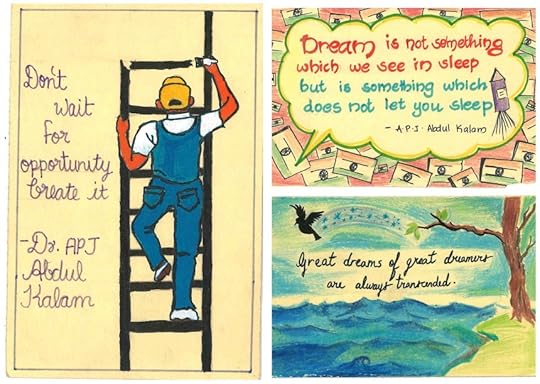
To ay the book is beautiful is an understatement. It not only appeases one’s aesthetic sense but the words on the postcards feeds the soul. Re-visting the words said by the wise and simple man from Tamil Nadu can be the medicine you may just need when your confidence is dwindling or you feel worthless. APJ’s life story is an inspiration to millions and the postcards just prove how much he had touched the very heart of India.
I am keeping the book at my work table as my go-to book for the times when I need to feed my soul, when I need reassurance that my story too can make a difference.
Do yourself a favour, please let Kalam sir’s words touch you. Let his wisdom seep into your soul and what better than pictures to imprint his words onto your mind. After all a picture is worth a hundred words. Definitely recommended.
Title: Dear Kalam Sir
Authors: Saji Mathew, Jubie John
Publisher/ Imprint: Bloomsbury India
Pages: 224
Genre/ Sub-Genre: Non-Fiction/ Tribute
Rating: 5.00 of 5.00
Reviewed for: Publisher
This review was first published on The Tales Pensieve and is reproduced here with permission.


October 15, 2016
Book Review: Love Bi The Way
Some stories need to be told, not because they are exceptional as stories or the author has exemplary narration skills but because some stories ask questions. This is one.
Bhaavna Arora‘s latest book Love Bi The Way came to me while it was at the desk of the editors at Penguin as a spiral bound manuscript and later as a chic-looking paperback. The cover page as well as the title is a sheer giveaway about the theme of this contemporary romance novel. Yes, it is bi-sexuality. And this also proves to be the point that does the book in. While on the cover – it is tantalising; it is an eye catcher and thematically a give away, which will evoke interest. But it will also make an average Indian reader, especially the ones not in tier I cities, cringe to read the book out in a public place.
Love Bi the Way is the story of two girls – gifted painter Rihana and entrepreneur Zara. They are respectively fire and ice. Rihana is passionate, Zara is calm. Rihana is experimental, Zara is conventional. Rihana has a drinking problem, Zara doesn’t touch alcohol. Rihana has a string of casual flings, Zara runs far away from relationships of any kind. And yet Rihana and Zara are housemates at Zara’s house – Cupid, with a labrador, Tiger, for company! Despite the differences the girls adore each other and are each other’s support system. Whether it is about dealing with Rihana’s rocky relationship with her parents or about Zara’s past with her husband or parents, they are there for each other.
Arora is a good observer and a bold storyteller. She has effortlessly entwined various social issues like domestic violence, child abuse, impacts of a bad marriage on children, homosexuality and the taboo around it in her story. The narration is smooth and the story moves briskly. Where the book fails is the predictability factor.
The title and the cover page leave no doubt in the reader’s mind that the story is about bi-sexuality (though it really is a very small part of the story). After reading the blurb when the reader starts reading the book, it is very predictable – two female protagonists. Housemates. The predominant thought throughout the entire book is – when is it coming? And obviously when it does, the reader has presumed for so long that it fizzles out.
If not for this factor that dominates the book, only because of its title and cover, Love Bi the Way is a story worth your time. It divulges into the quirky and dark side of human carnal desires and the lives it leaves crumpled in its wake. It has everything to make it a recommended read except that the predictability ruins the reading experience.
Title: Love Bi The Way
Author: Bhaavna Arora
Publisher/ Imprint: Penguin India
Pages: 239
Genre/ Sub-Genre: Fiction/ Romance
Rating: 3.00 of 5.00
Reviewed for: Author
This review was first published on The Tales Pensieve and is reproduced here with permission.


October 14, 2016
Book Review: Rightfully Wrong Wrongfully Right
Varsha Dixit is back with Sneha, Nandini, Aditya, Nikhil, Gayatri and a new character Viraj. While the first book in the Right Wrong series was Nandini and Aditya’s story, the second one was about Sneha and Nikhil, the third book – Rightfully Wrong, Wrongfully Right brings to the readers the story of diva and vamp from the first two books – Gayatri & Viraj. Though this time around the author has given the vamp quite a makeover.
Dixit has turned the vamp of the first two books in the series into the protagonist in this book. In a closure of sorts she rationalises why Gayatri was the way she was and why she has turned into this adorable heroine of the story we are about to read. And it makes sense. Rightfully Wrong, Wrongfully Right takes us to Mumbai where the entire story will be played out with the entire cast.
Gayatri as we know from the prequels is the rich, spoilt Diva. Fashion conscious and daddy’s credit card dependent. The author rights the wrong; she takes us into the mind of the ex-vamp and we find a woman struggling to move out of the firm clutches of her father. A woman determined to find her own identity and live her dreams. Nikhil, Gayatri’s foster brother helps her find an administrative position in a project where he, Aditya – Gayatri’s ex-fiancé and Nandini’s present husband and her father have invested heavily. Her job though arranged by the investors depends hugely on the approval and acceptance of Viraj, the chief scientist on the project or as they call him – the mad scientist. He is a genius, fitness freak, drop dead hunk in an unconventional manner and hates administrators especially fashion conscious ones. And he comes with a past.
Dixit pits her protagonists into a battle of wits and situations charged with passion and conflicts. While Viraj is only the means to keep her job for Gayatri, Viraj looks at Gayatri as someone who can help him fulfil some of his motives. Also proving efficient catalysts are the support cast of Nikhil, Sneha, Nandini and Aditya. Strained relationships especially between the three women are explored to form the inter-weaving strings in the story.
Rightfully Wrong, Wrongfully Right is at the core the story of Gayatri and Viraj. Is passion kindled, do fireworks fly between the two wrongs and do they have a happily ever after is what the book is headed towards at the climax. Expect no literary excellence but Dixit picks up from where she left in Wrong Means Right End. Written in a style and language that an average Indian english reader will understand and enjoy, Dixit nails it. While this is essentially a love story, the author divulges into that space into the protagonist’s minds where they are coming from and knowing them up close helps connect. Helps understand the wrong and they seem right.
Viraj is the new character in the series and has been etched out beautifully. He is strong, sexy and adorable while at the same time he is quirky, irritating and unapproachable. There is a certain charm about dark men; men who won’t open up fully, who will keep a part of them, with themselves, tucked away somewhere. Viraj is your quint essential sexy Indian man and you do want him to fall for the heroine and not a side character. Gayatri’s makeover, for readers who have read the first two books, comes as a shock and indigestible initially. Though over time with insights into her thought process, her good side grows on you but she only becomes convincing towards the ending chapters.
A book I enjoyed reading and recommended if you are looking for a breezy romantic read this weekend. Can be read as a standalone book, though reading the first two books helps the understanding the equations of the supporting characters better.
Title: Rightfully Wrong Wrongfully Right
Author: Varsha Dixit
Publisher/ Imprint: Rupa Publications
Pages: 275
Genre/ Sub-Genre: Fiction/ Romance
Rating: 3.75 of 5.00
Reviewed for: Publisher
This review was first published on The Tales Pensieve and is reproduced here with permission.


October 6, 2016
I Am A Drifter & No I Am Not Lost
The hardest challenge is to be yourself in a world where everyone is trying to make you be somebody else.
– E.E.Cummings
This is my story and it is anything but boring. I know years later when I narrate it, this story is going to be an interesting one, you never know, maybe the most interesting one around. This is the story of a drifter who believes she is not lost. Find out why:
Back during my school days, when I had my poems being published in the local editions of TOI and HT, I wanted to be a journalist. I didn’t know how did people become journalists but I sure wanted to be one. For me it was a profession of words. Yes, that’s what I wanted. Well, I didn’t had to research much about it; my folks were dead against it and so the idea got shelved.
Next I wanted to be an administrative professional. To do what? Heck I had no idea. I wanted to be an administrative professional but not the standard MBA types. Thanks to Employment News, MBA in Hospital Administration sounded good. It had a challenging ring to it. So that was it! But while in those 5 years at college, most people wanted to go into hospital operations, it is easier to land a job there, I ran after HR. The human aspect was interesting. HR or Finance has fewer jobs. So what do I choose? HR of course. I tell my interviewer during my campus interview hospital operations is boring, human beings are interesting. Guess what, they gave me the job
October 5, 2016
Stubbornness Is a Gender Thing?
I happend to see this lovely advertisement by Dainik Bhaskar ‘Zidd Karo, Duniya Badlo‘ which loosely translated to english means ‘Be stubborn, Change the world‘. The video mainly features children and has a lovely message about how a little girl is stubborn about studying and resists being dragged away from school by her father. Her friends help her and finally the father gives in.
The advertisement is good, it hits home, it communicates well and is 2 minutes of positivity. All that is well but maybe because the video features so many little girls this particular thought crossed my mind. The way we Indian girls are brought up, being stubborn is often equated with a term called ‘Ahamkaar‘ which means egoism. No, not when we are little girls. We are adorable then. Our zidd/ stubbornness is very adorable, too. It is when we start blossoming into young ladies in our teens and thereafter when we often hear this term being used for us if we refuse to comply to norms.
Be it speaking out our mind, not complying to the stereotypes or being steadfast on what we want in life, we are defined by that one word – Ahamkaari or the one who is egoistic.
There is this young lady, I know. She is educated, has a job that gives her financial independence, knows what she wants in life and is vocal about it, when asked. She is not just vocal about it, she also takes action to make that a reality. So, though a bit unbecoming of the Indian tradition of staying at the parents house till she is married, she bought her own place and moved out. She is aware of the kind of person she is and the kind of adjustments she can make and hence decided and conveyed long back her decision to not get married. So, this lady is hard working, independent, focused and sticks to her goals. And yes that requires a certain level of stubbornness. And guess how do most of her relatives describe her when they happen to gossip about her. They call her Ahamkaari! A woman who refused to comply to the social norm of getting married at a certain age, manages to live all by herself is egoistic and will have to pay the price now or later. That’s the social verdict as far as she is concerned.
While her younger brother too follows something similar. Runs his own company, is financially independent, stays in his own house and has no plans of getting married. And going by the social norms he too is past his marriageable age. Is he called Ahamkaari? I have not heard such a thing yet. He is called successful, talented, focused and stubborn. But I am yet to hear anyone call him egoistic and link all his life decisions to it.
Why the double standards?
Is wanting to live one’s life not complying to stereotypes ego? Is being aware of self and not hiding it ego? Is wanting happiness ego?
Every person has a different source and definition of happiness. It is only our social conditioning which has set a user manual for us that these are the things that will give us happiness. While there are many women who find happiness in creating life and nurturing it, there may be some who find happiness in imparting wisdom to children who have been abandoned by their creators. While most men may find happiness in hanging out with their buddies every weekend, there may be some who find happiness is spending that time at an animal shelter. To each his own. Or her own, maybe?
Can we allow that as a society? Can be stop labelling the stubbornness of a man and woman differently?
Why does it has to be – he is determined, he will go miles; she is egoistic, wait till she faces the consequences.


October 4, 2016
Disassembling Indian Joint Families & Breaking Marriages: Is There A Connection?
The last weekend I had travelled to Kerala to pick up mom. She had just undergone Ayurveda treatment for back ache and refused point blank to travel by air because it involves sitting for longer durations as well as changing flights. So train it is! And as is the lovely habit of Indians, especially our parent’s generation, of chit chatting a lot with the co-passangers, so was the case here. Mom being the talkative type found company easily and I was being subjected to an array of discussions ranging from Indo-Pak war strategies to the pathetic state of railway coaches to raising children to different traditions of marriages in different communities.
One such discussion I picked up was how things are in a joint family and how elders treat and train the younger boys and girls for their respective roles in life. I have had friends who come from joint families. And most of them wanted to run miles away from it. Many had a criteria for marriage that they did not want to marry into a joint family. So the general image I have about joint families is that it is a big freedom cruncher especially for girls. The very thought of having to take permission for going to a friend’s birthday party from 3 different people and being answerable to another 7 is in itself a thought that can freak me out. Add to that taking any decision considering the pleasures (and mostly displeasures) of the entire family. To someone who had lived all her life is a nuclear family, this seemed pretty taxing. Somehow, after a while the conversation jumped to the fragility of marriages today. This got me thinking.
What made the Indian institution of marriage tick so long despite two, practically, strangers marrying each other and what has changed now?
I think if you look at it, the basic fabric of families has changed and is constantly changing. The great Indian joint family has been disassembling in the past decade and continues to do so. It is practically non-existent in today’s urban India and is headed towards becoming extinct.
Did the joint family system have a role in keeping a man and woman together?
If you look closely beyond the facade of traditional, unyielding family rules, joint families were the biggest support system a couple could have which the nuclear family couple is missing and for them that void is being filled in by counsellors and psychiatrists. To start with, a man and women are not thrown in together, in isolation, in a joint family. The man still has the familiarity of his family and the woman too finds similarity in the different new relationships she finds in the new house and this is a huge booster in bolstering their relationship. The comfort of familiarity plays a much larger role in strengthening the bond between a couple than the privacy that nuclear families so proudly offer.
A rift between a man and a woman is inevitable but it scaling unprecedented proportions is what creates the first chasm in marriages. With many people around in the house itself, it becomes easier to find someone who would lend a ear. Sharing concerns or irritants becomes easy and one need no go scourging for strangers on social media to share a pain. And once it is out of the system nothing the other did or said is too big to forgive. Many tiffs in fact do not even get escalated for the fear of elders in the house.
A major bone of contention between modern couples is the child. This is where a joint family is the biggest support system a couple can get. With elders and so many others in the house raising a child becomes a cake walk. It is not an added stress that it has become for many nuclear couples but just a natural addition to the family who’s growth and development is everybody’s responsibility and everything goes by as smoothly as possible.
Most importantly, a joint family keeps a couple away from each other most of the time which in hindsight is a very good thing. Because this man-woman relationship is a very fickle thing. Over familiarity takes away the excitement from the relationship and breeds contempt. Amidst all the responsibilities and concerns that come to a couple as a part of the great Indian joint family they don’t get the time to be bored of each other, which I am told is a major relationship problem these days.
The ancestors were one heck of a smart bunch, undoubtedly. They knew much more about human psychology and its impact on intimate relationships than a whole batch of doctors today.