
Favourite Colours's Blog
September 25, 2018
In the shadows – online reviews
Some (old) reviews for
In the Shallows
From S.A. Williams (his blog)
…a collection of 18 short stories set in Norway. Truly of the modernist bent, these stories are not plot-driven (which is not to say that they don’t each have a plot of sorts), rather we see a slice of each main character’s life in the tales, which range widely in length. Just don’t expect the traditional obvious rising action – climax – resolution structure; it’s there, but more subtle as the work focuses deeply on moments, which is highly effective in the way [the author] has done it.
I received a free copy of this book, and was excited to read it because I’ve read single short stories before and have always been impressed. But he’s somehow outdone himself here. The theme of the book is apparent as the reader makes her or his way through the differing aspects of each character’s disconnect from someone or something. The range of emotions conveyed is surprisingly versatile considering what one might expect along the theme.
Of particular note amongst these tales:
‘But I wasn’t…’ which shows the annoyed perspective of an older sibling with a younger. It evokes some sadness on the part of the reader in viewing the main character’s frustration with his younger sister, but is ultimately easily related to by anyone who isn’t an only child.
‘A Candlelit Room’ is a story that chronicles a woman waiting, one assumes for her date, and the roller coaster of emotion that ensues.
‘I know that’ takes the mundane routine of a grocery story cashier and turns it on its head, providing an engaging view into the woman’s inner monologue while she considers recent events in her romantic life.
‘…and over again’ is a stunning sketch of a relationship that has become long-distance and illustrates well the importance of first feeling connected in order to feel the regular pleasures of life.
‘Gøteborg’ which, simply put, is about losing it all and beginning over again through a serendipitous occurrence.
The other 13 stories don’t disappoint either.
My only complaint about this book (and it is best ignored) is in the formatting. Call me crazy (go ahead) but I like page breaks on my e-reader between stories. (Seriously, that’s my onlycomplaint!)
Part of me wonders how this hasn’t been picked up by a major publisher yet, but then there are benefits to remaining indie.
5/5 stars
From Serena (her blog)
Throughout this book there is a wonderful sense of inclusiveness. I was able to indulge my visual senses with the authentic verbal pictures painted on every page. The author is quite diligent in his attention to detail. Although the stories are quite separate and have unique story-lines, there is a consistency in the writing style, careful and thorough, poetic and observational. The settings are features in themselves, I feel drawn to the beauty of Norway. [This book] was a delicious escape at the same time as touching on topical issues and age old emotions. The character studies make good reading. A most satisfying read for the literary hungry. From Serena (Promptqueen at wordpress)
From DakinGunby
This was one of those strange eBooks you mysteriously find yourself reading – and find yourself, moreover, very pleased that you did, the stories are deep and warm and human and tender. If you like quirky little tales that weave a pattern in spite of their diversity, and if you like a dry humour and a rich expressive descriptive narrative, I heartily recommend you pick up a copy of this fairly priced anthology. There is much to get your mind into, to challenge the tameness of plot driven tales – in a way this is a step back into time, think Katherine Mansfield meeting early John Updike and you won’t be too far off what is presented here. Why not 5 stars? Well, the title is a clue here – these are sketches, the fact isn’t hidden, but whilst sketches are fine sometimes it is the finished work of art one cries out for, and some of the stories I just wish [the author] had taken to that next level. 4/5
If you would like to review this collection, please contact favourite colours through this blog…
From S.A. Williams (his blog)
…a collection of 18 short stories set in Norway. Truly of the modernist bent, these stories are not plot-driven (which is not to say that they don’t each have a plot of sorts), rather we see a slice of each main character’s life in the tales, which range widely in length. Just don’t expect the traditional obvious rising action – climax – resolution structure; it’s there, but more subtle as the work focuses deeply on moments, which is highly effective in the way [the author] has done it.
I received a free copy of this book, and was excited to read it because I’ve read single short stories before and have always been impressed. But he’s somehow outdone himself here. The theme of the book is apparent as the reader makes her or his way through the differing aspects of each character’s disconnect from someone or something. The range of emotions conveyed is surprisingly versatile considering what one might expect along the theme.
Of particular note amongst these tales:
‘But I wasn’t…’ which shows the annoyed perspective of an older sibling with a younger. It evokes some sadness on the part of the reader in viewing the main character’s frustration with his younger sister, but is ultimately easily related to by anyone who isn’t an only child.
‘A Candlelit Room’ is a story that chronicles a woman waiting, one assumes for her date, and the roller coaster of emotion that ensues.
‘I know that’ takes the mundane routine of a grocery story cashier and turns it on its head, providing an engaging view into the woman’s inner monologue while she considers recent events in her romantic life.
‘…and over again’ is a stunning sketch of a relationship that has become long-distance and illustrates well the importance of first feeling connected in order to feel the regular pleasures of life.
‘Gøteborg’ which, simply put, is about losing it all and beginning over again through a serendipitous occurrence.
The other 13 stories don’t disappoint either.
My only complaint about this book (and it is best ignored) is in the formatting. Call me crazy (go ahead) but I like page breaks on my e-reader between stories. (Seriously, that’s my onlycomplaint!)
Part of me wonders how this hasn’t been picked up by a major publisher yet, but then there are benefits to remaining indie.
5/5 stars
From Serena (her blog)
Throughout this book there is a wonderful sense of inclusiveness. I was able to indulge my visual senses with the authentic verbal pictures painted on every page. The author is quite diligent in his attention to detail. Although the stories are quite separate and have unique story-lines, there is a consistency in the writing style, careful and thorough, poetic and observational. The settings are features in themselves, I feel drawn to the beauty of Norway. [This book] was a delicious escape at the same time as touching on topical issues and age old emotions. The character studies make good reading. A most satisfying read for the literary hungry. From Serena (Promptqueen at wordpress)
From DakinGunby
This was one of those strange eBooks you mysteriously find yourself reading – and find yourself, moreover, very pleased that you did, the stories are deep and warm and human and tender. If you like quirky little tales that weave a pattern in spite of their diversity, and if you like a dry humour and a rich expressive descriptive narrative, I heartily recommend you pick up a copy of this fairly priced anthology. There is much to get your mind into, to challenge the tameness of plot driven tales – in a way this is a step back into time, think Katherine Mansfield meeting early John Updike and you won’t be too far off what is presented here. Why not 5 stars? Well, the title is a clue here – these are sketches, the fact isn’t hidden, but whilst sketches are fine sometimes it is the finished work of art one cries out for, and some of the stories I just wish [the author] had taken to that next level. 4/5
If you would like to review this collection, please contact favourite colours through this blog…


September 20, 2018
Nightshift – by Maritta Wolff
Nightshift – by Maritta Wolff
Random House 1942
This was one of those odd hardbacks I found at a flea market in Oslo, I think it might even be a first edition – anyway, I bought a lot of books a year or so ago, just a few krone each, just based on the date and the opening paragraph. Many of these I haven’t read, but this one – its bulky 660 page mass kept shouting out to me from the shelf and, after a quick check of the author’s history on wikipedia, it sounded like a decent enough read.
From what I expected this looked like being a no-holds-barred, brutal melodrama and, maybe it didn’t quite shock now the way it may have done 70 years ago, but it was, nevertheless, high on drama. Whilst Wolff’s writing isn’t as divine as, say, Steinbeck’s or as intellectual as Mary McCarthy, she does have a knack of writing superb characterisations, the Braun family are as thoroughly interesting as they are disparate.
In spite of its length, and the domesticity of much of the novel (this is essentially a gritty working class tale) the plot keeps moving; and the flash of glamour – developed through chanteuse Petey – makes for a very enjoyable read. Yes, the dialogue often feels ripped straight from a B movie (a film version was developed through Warners, with Ida Lupino as the mouthy Petey Braun) that’s not to say that the subject matter (from poverty to mental illness to adultery, rape and, ultimately, brutal murder) is predictable or clumsily presented, Wolff pushes the boundaries of the day, if not with her literary prowess, but certainly as far as melodrama and atmosphere are concerned; the reader easily and delightfully transported to some cinematic film-noir world.
Photo Credit
Novelist’s Official Page
Random House 1942
This was one of those odd hardbacks I found at a flea market in Oslo, I think it might even be a first edition – anyway, I bought a lot of books a year or so ago, just a few krone each, just based on the date and the opening paragraph. Many of these I haven’t read, but this one – its bulky 660 page mass kept shouting out to me from the shelf and, after a quick check of the author’s history on wikipedia, it sounded like a decent enough read.
From what I expected this looked like being a no-holds-barred, brutal melodrama and, maybe it didn’t quite shock now the way it may have done 70 years ago, but it was, nevertheless, high on drama. Whilst Wolff’s writing isn’t as divine as, say, Steinbeck’s or as intellectual as Mary McCarthy, she does have a knack of writing superb characterisations, the Braun family are as thoroughly interesting as they are disparate.
In spite of its length, and the domesticity of much of the novel (this is essentially a gritty working class tale) the plot keeps moving; and the flash of glamour – developed through chanteuse Petey – makes for a very enjoyable read. Yes, the dialogue often feels ripped straight from a B movie (a film version was developed through Warners, with Ida Lupino as the mouthy Petey Braun) that’s not to say that the subject matter (from poverty to mental illness to adultery, rape and, ultimately, brutal murder) is predictable or clumsily presented, Wolff pushes the boundaries of the day, if not with her literary prowess, but certainly as far as melodrama and atmosphere are concerned; the reader easily and delightfully transported to some cinematic film-noir world.
Photo Credit
Novelist’s Official Page
September 13, 2018
Modern Man is Ultra Quick
Original synopsis for ‘Modern Man is Ultra Quick’.
(Mild spoilers included)
Modern Man is Ultra Quick is a social satire. The title of the novel is ironic: modern man lives in an ultra quick world full of emails, iphones, fast food and quick fixes, but nothing is built to last. Modern Man himself is actually rather lazy and, when it comes to relationships, not often enough the sharpest tool in the box.
So this novel is about people. Not the ones who have it all figured out, who have the perfect jobs, are in loving relationships, have all the right answers and do the smart things (do they really exist?); it is not about the completely down and out, either (who do exist). No, predominantly it is about your everyday Modern Man in his late twenties/early thirties.
In this bitter sweet, darkly humoured story about relationships, loyalty, love and hope, mistakes and failures, we meet a loosely knit group of friends who inhabit a world of local pubs and the parks and streets of England’s most multi-cultural city, Leicester. That being said, it could be any Western city with a grand past and an uncertain future.
Dennis is a lovesick bedroom poet who is struggling to get over Beth – the ‘greatest ever love affair’. We see the faded industrial city of Leicester through his eyes, as he – jobless and suffering in the rare heat of summer – eventually decides that he has to move on. With his questionable motives and wafer thin commitment, things don’t look too good until he finally meets Justine – only to discover history repeating itself.
Krystof, an Eastern European immigrant, has the luxury of occupation, working illegally on the roofs of the city, philosophising and coming to terms with his new life. As he brusquely states, he is much too old to have girlfriends – but he has one, none the less: sweet Cherie, whose only problem is that she is a paranoid basket case stuck in the 1980s.
Sean has convinced himself that he can rekindle an old romance, and pursues it at the expense of his buddies. More or less by accident he stumbles into the arms of Amelia, a displaced Australian. They are both looking for something and somehow seem to discover it in each other, despite the reservations of Sean’s interfering older brother, Joe, who would like to feel happier with his own life – if he ever dared think about it.
Steds seems to be an ok, well-balanced middle class guy who at the beginning of the novel is happily lethargic in a comfortable relationship. When his girlfriend leaves him after a dramatic breakup, he slowly reveals a different side of himself; sucked into a damaging oblivion of alcohol, one night stands, fast food and video games. However, things only reach boiling point when he falls for Sandy, a buxom, intelligent strawberry blonde who wouldn’t touch him with a barge pole. Sandy is seeing Emile – who unfortunately for them both – is more of a lover than a fighter.
The novel follows the twist and turns of the lives of these 21st Century anti-heroes and the women in their lives; as the novel draws to its fateful close, the threads and ties are drawn together for a showdown amongst the nightlife and black holes of the city.
Buy ‘Modern Man is Ultra Quick’ here
(Mild spoilers included)
Modern Man is Ultra Quick is a social satire. The title of the novel is ironic: modern man lives in an ultra quick world full of emails, iphones, fast food and quick fixes, but nothing is built to last. Modern Man himself is actually rather lazy and, when it comes to relationships, not often enough the sharpest tool in the box.
So this novel is about people. Not the ones who have it all figured out, who have the perfect jobs, are in loving relationships, have all the right answers and do the smart things (do they really exist?); it is not about the completely down and out, either (who do exist). No, predominantly it is about your everyday Modern Man in his late twenties/early thirties.
In this bitter sweet, darkly humoured story about relationships, loyalty, love and hope, mistakes and failures, we meet a loosely knit group of friends who inhabit a world of local pubs and the parks and streets of England’s most multi-cultural city, Leicester. That being said, it could be any Western city with a grand past and an uncertain future.
Dennis is a lovesick bedroom poet who is struggling to get over Beth – the ‘greatest ever love affair’. We see the faded industrial city of Leicester through his eyes, as he – jobless and suffering in the rare heat of summer – eventually decides that he has to move on. With his questionable motives and wafer thin commitment, things don’t look too good until he finally meets Justine – only to discover history repeating itself.
Krystof, an Eastern European immigrant, has the luxury of occupation, working illegally on the roofs of the city, philosophising and coming to terms with his new life. As he brusquely states, he is much too old to have girlfriends – but he has one, none the less: sweet Cherie, whose only problem is that she is a paranoid basket case stuck in the 1980s.
Sean has convinced himself that he can rekindle an old romance, and pursues it at the expense of his buddies. More or less by accident he stumbles into the arms of Amelia, a displaced Australian. They are both looking for something and somehow seem to discover it in each other, despite the reservations of Sean’s interfering older brother, Joe, who would like to feel happier with his own life – if he ever dared think about it.
Steds seems to be an ok, well-balanced middle class guy who at the beginning of the novel is happily lethargic in a comfortable relationship. When his girlfriend leaves him after a dramatic breakup, he slowly reveals a different side of himself; sucked into a damaging oblivion of alcohol, one night stands, fast food and video games. However, things only reach boiling point when he falls for Sandy, a buxom, intelligent strawberry blonde who wouldn’t touch him with a barge pole. Sandy is seeing Emile – who unfortunately for them both – is more of a lover than a fighter.
The novel follows the twist and turns of the lives of these 21st Century anti-heroes and the women in their lives; as the novel draws to its fateful close, the threads and ties are drawn together for a showdown amongst the nightlife and black holes of the city.
Buy ‘Modern Man is Ultra Quick’ here
August 25, 2018
The Joys of Exile – thoughts on being a British writer in Norway.
Blog piece commissioned by the now defunct Brit Writers Blog – October 2012
When I was invited to contribute to the Brit Writers blog, it suddenly occurred to me that I was no blogger, not even a writer with any experience in writing anything beyond the fiction that formed in the daydreams that tumbled as I walked around the streets of my adopted hometown, Oslo. What on Earth could I possibly contribute, what experiences or skills do I possess as a writer beyond those shared by anyone who has put pen to paper?
Like so many of us, there is nothing special about having suffered rejection at the hands of agents, or sat scratching one’s head blinking at a blindingly empty note pad – no one needs me to tell them about that experience.
Even my brief flirtation with success and the horror of my publisher going bankrupt on the eve of my book launch is perhaps something I should save for a time when bitterness and vitriol rule me and spite sparks from my words.
I started to think about inspiration, about what it was that made me write and what allows me to pursue that elusive brave agent prepared to take on such a writer as myself, and I found myself gazing out at the strangely exotic wooden villas across from the cafe that I had parked myself in today, suddenly it was obvious…
If I can comfort and reassure myself about one thing, one detail that I share in common with some of my literary heroes – it is the possession of inspiration gained from abandoning my home country. Whilst I look to Ibsen, Lawrence and Joyce as examples of such exile, I have chosen to differ in my approach; their pilgrimages took them to the sun of dry lands, of endless summers in the Mediterranean, America, Australia, I have taken to the north and have found my creative haven in Oslo, Norway.
In several ways, I now see the benefit of being an alien when it comes to being a writer – the ability to see at distance the culture that has smothered and suffocated me from birth; like looking at a painting, sometimes the perspective only falls true when one steps back, to remove the distraction of detail, the brush strokes of familiarity blur to a whole and the picture is clear.
When I tried to write in England, there was always a sense of being like a chef trying to make a meal from inside of the cooking pot; the people that I wanted to study were just too close, the stage sets of my fiction were heavy and exhaled down my neck – now I can sit in a town that allows my vision and my imagination the freedom to create; the removal of the too familiar sights of my youth gives me the space in my mind to create the worlds I want to pursue, the lives I want to observe.
But it is not just the streets and buildings, as much as they inspire and create permanent moods of vacation, there is more to being overseas than the environment. Naturally, it is people and relationships that make the real difference. Isolated amongst unmanageable languages and permanent curiosity, one moves to find understanding, knowing oneself becomes an essential part of adapting to an unknown world.
In this situation a drive to discover the world and habits of one’s hosts develops without control, it is a survival instinct; as too is the journey inwards, separated from the distractions of familiarity, the comfort of established relationships, landing in a life where friends and relationships must be newly formed, networks and connexions built from a base of nothing; time is abundant for the consideration of one’s own heart and mind, the secrets and essences are drawn to the surface as new acquaintances form with personalities developed from cultures different to one’s own.
So, as a writer, leaving England transformed me, it taught me about the person I was which, in turn, helped me to understand the worlds and lives of the characters in my stories, gave me the confidence and bravery to speak my mind and from my heart, it helped me to understand what formed my own character – my family and my friends and my home, my community. And with this understanding strong and alive within me, the words came easily, the ideas formed and flowed and passed to the page unhindered by the repression of not having moved beyond the intimacy and safety of the culture of my birth.
When I was invited to contribute to the Brit Writers blog, it suddenly occurred to me that I was no blogger, not even a writer with any experience in writing anything beyond the fiction that formed in the daydreams that tumbled as I walked around the streets of my adopted hometown, Oslo. What on Earth could I possibly contribute, what experiences or skills do I possess as a writer beyond those shared by anyone who has put pen to paper?
Like so many of us, there is nothing special about having suffered rejection at the hands of agents, or sat scratching one’s head blinking at a blindingly empty note pad – no one needs me to tell them about that experience.
Even my brief flirtation with success and the horror of my publisher going bankrupt on the eve of my book launch is perhaps something I should save for a time when bitterness and vitriol rule me and spite sparks from my words.
I started to think about inspiration, about what it was that made me write and what allows me to pursue that elusive brave agent prepared to take on such a writer as myself, and I found myself gazing out at the strangely exotic wooden villas across from the cafe that I had parked myself in today, suddenly it was obvious…
If I can comfort and reassure myself about one thing, one detail that I share in common with some of my literary heroes – it is the possession of inspiration gained from abandoning my home country. Whilst I look to Ibsen, Lawrence and Joyce as examples of such exile, I have chosen to differ in my approach; their pilgrimages took them to the sun of dry lands, of endless summers in the Mediterranean, America, Australia, I have taken to the north and have found my creative haven in Oslo, Norway.
In several ways, I now see the benefit of being an alien when it comes to being a writer – the ability to see at distance the culture that has smothered and suffocated me from birth; like looking at a painting, sometimes the perspective only falls true when one steps back, to remove the distraction of detail, the brush strokes of familiarity blur to a whole and the picture is clear.
When I tried to write in England, there was always a sense of being like a chef trying to make a meal from inside of the cooking pot; the people that I wanted to study were just too close, the stage sets of my fiction were heavy and exhaled down my neck – now I can sit in a town that allows my vision and my imagination the freedom to create; the removal of the too familiar sights of my youth gives me the space in my mind to create the worlds I want to pursue, the lives I want to observe.
But it is not just the streets and buildings, as much as they inspire and create permanent moods of vacation, there is more to being overseas than the environment. Naturally, it is people and relationships that make the real difference. Isolated amongst unmanageable languages and permanent curiosity, one moves to find understanding, knowing oneself becomes an essential part of adapting to an unknown world.
In this situation a drive to discover the world and habits of one’s hosts develops without control, it is a survival instinct; as too is the journey inwards, separated from the distractions of familiarity, the comfort of established relationships, landing in a life where friends and relationships must be newly formed, networks and connexions built from a base of nothing; time is abundant for the consideration of one’s own heart and mind, the secrets and essences are drawn to the surface as new acquaintances form with personalities developed from cultures different to one’s own.
So, as a writer, leaving England transformed me, it taught me about the person I was which, in turn, helped me to understand the worlds and lives of the characters in my stories, gave me the confidence and bravery to speak my mind and from my heart, it helped me to understand what formed my own character – my family and my friends and my home, my community. And with this understanding strong and alive within me, the words came easily, the ideas formed and flowed and passed to the page unhindered by the repression of not having moved beyond the intimacy and safety of the culture of my birth.
August 24, 2018
Interview with Norgesnytt…
In 2014, Favourite Colours was interviewed for a Norwegian-language newspaper, Norgesnytt – the artical is no longer available online so here is the transcript of the original (English) transcript
Q&A with Martin Kynningsrud of Norgesnytt regarding self-publishing
• Q. Why self-publish?
• A. As an english writer based in the heart of a ‘foreign language market’, there are three potential resources for book publication: 1. an english publisher 2. a Norwegian publisher or 3. self publishing – with the first option it is a difficult prospect, the market in the UK is saturated and the publishers are reluctant to invest in anything that is not likely to yield an instant return, still feeling, as they are, the downturn in the UK economy – add to this the necessity of having to go through the agency system, again there is the same problem of too many writers not enough willing and available agents. With option 2 the approach is actually much easier, yet the industry is still rather cautious; furthermore as a non-Norwegian language writer, the publishers are sometimes intimidated by the prospect of marketing an unknown overseas writer; additionally, English text is exempt from the funding scheme available to Norwegian texts. As for option 3, there are massive limitations in resources, marketing, connections – in every area of the publishing process, in fact; however, the advantage is that it allows an author to get their work in the public domain and to take it from there – at bottom, writing is all about being read – if people can actually read what one has written, that is the place it all begins from, regardless of the publishing direction.
• Q. What is the self-publishing process?
• A. Initially I used a website (smashwords) that converts documents to all the different ebook formats and then acts as a ‘publisher’, really they are more like a distributor, using their own site as a market place and having links to the major book retailers worldwide. Amazon also offer a similar service, however they only convert to the kindle format. the process is very simple, one submits a strictly formatted document of the text, plus a cover image, the document is checked for correctness and compatibility and, if approved, converted and made available.
For the paperback, the process is largely the same – however the demands on the technical preparation of the document are much more relaxed – with a book, the product appears as it does in the submitted document, with left/right pages prepared etc; the ebook formats need to be much more adaptable to user preferences, so the text has to be subject to changes in font size etc.
Ebooks are available immediately from the core company, and after an unspecifiable delay at the linked vendors. The paperback version is printed on demand, so when a purchase is made a copy of the book is generated and sent to the purchaser….
• Q. Would you recommend self-publishing to others who dream of writing a book?
• A. Naturally. Self-publishing allows a book to enter the public domain, ultimately books are meant to be read and shared – self-publishing provides a 100% potential for this to happen.
Regardless of whether one self-publishes or has a ‘real’ publisher – the book is still subject to promotion and marketing, therein lies the difference – yet in spite of a publisher’s resources and expertise, there is still no guarantee their marketing campaign will hit – most book successes are based on word-of-mouth recommendation.
What must also be remembered is that self-publishing is not entirely as the name suggests – effectively, the service provider still absorbs the majority of profit in the paper form, with ebooks, not so much, but there is still a presence.
Self-publishing also provides greater control for the author – which is both a good but also potentially dangerous thing – if someone is to follow the self-publishing route it is essential that they utilize independent readers, editors and as many sources of quality control as possible.
• Q. Do you have further books planned?
• A. I have a novel and a collection of short stories completed – my plan is to self-publish the short stories and to send the novel to UK agencies. If that does not yield any success, then I will consider offering it self-published and focus on sending my next finished novel to agents.
Having the self-publishing option helps sustain momentum until a deal comes along – the self-publishing option provides something of substance to build a readership around – without self-publishing, all an unsigned writer has is a bunch of
Q&A with Martin Kynningsrud of Norgesnytt regarding self-publishing
• Q. Why self-publish?
• A. As an english writer based in the heart of a ‘foreign language market’, there are three potential resources for book publication: 1. an english publisher 2. a Norwegian publisher or 3. self publishing – with the first option it is a difficult prospect, the market in the UK is saturated and the publishers are reluctant to invest in anything that is not likely to yield an instant return, still feeling, as they are, the downturn in the UK economy – add to this the necessity of having to go through the agency system, again there is the same problem of too many writers not enough willing and available agents. With option 2 the approach is actually much easier, yet the industry is still rather cautious; furthermore as a non-Norwegian language writer, the publishers are sometimes intimidated by the prospect of marketing an unknown overseas writer; additionally, English text is exempt from the funding scheme available to Norwegian texts. As for option 3, there are massive limitations in resources, marketing, connections – in every area of the publishing process, in fact; however, the advantage is that it allows an author to get their work in the public domain and to take it from there – at bottom, writing is all about being read – if people can actually read what one has written, that is the place it all begins from, regardless of the publishing direction.
• Q. What is the self-publishing process?
• A. Initially I used a website (smashwords) that converts documents to all the different ebook formats and then acts as a ‘publisher’, really they are more like a distributor, using their own site as a market place and having links to the major book retailers worldwide. Amazon also offer a similar service, however they only convert to the kindle format. the process is very simple, one submits a strictly formatted document of the text, plus a cover image, the document is checked for correctness and compatibility and, if approved, converted and made available.
For the paperback, the process is largely the same – however the demands on the technical preparation of the document are much more relaxed – with a book, the product appears as it does in the submitted document, with left/right pages prepared etc; the ebook formats need to be much more adaptable to user preferences, so the text has to be subject to changes in font size etc.
Ebooks are available immediately from the core company, and after an unspecifiable delay at the linked vendors. The paperback version is printed on demand, so when a purchase is made a copy of the book is generated and sent to the purchaser….
• Q. Would you recommend self-publishing to others who dream of writing a book?
• A. Naturally. Self-publishing allows a book to enter the public domain, ultimately books are meant to be read and shared – self-publishing provides a 100% potential for this to happen.
Regardless of whether one self-publishes or has a ‘real’ publisher – the book is still subject to promotion and marketing, therein lies the difference – yet in spite of a publisher’s resources and expertise, there is still no guarantee their marketing campaign will hit – most book successes are based on word-of-mouth recommendation.
What must also be remembered is that self-publishing is not entirely as the name suggests – effectively, the service provider still absorbs the majority of profit in the paper form, with ebooks, not so much, but there is still a presence.
Self-publishing also provides greater control for the author – which is both a good but also potentially dangerous thing – if someone is to follow the self-publishing route it is essential that they utilize independent readers, editors and as many sources of quality control as possible.
• Q. Do you have further books planned?
• A. I have a novel and a collection of short stories completed – my plan is to self-publish the short stories and to send the novel to UK agencies. If that does not yield any success, then I will consider offering it self-published and focus on sending my next finished novel to agents.
Having the self-publishing option helps sustain momentum until a deal comes along – the self-publishing option provides something of substance to build a readership around – without self-publishing, all an unsigned writer has is a bunch of
August 23, 2018
The winter the snow was heaviest
The winter the snow was heaviest.
To borrow again from musical jargon, this anthology was the ‘difficult second album’. It would be unfair to say it was as considered as its predecessor In The Shallows or its follow up When Now and Then is All that Remains, equally unfair would it be to suggest that it was a collection of the fragments that fell in-between the two. Although it is defined by the two sections – Winter and Summer – it is probably more definitive to highlight how many of these stories were written during travels, or about travels.
The opening story was written on a christmas vacation, to my ex-‘in laws’, in Horton, where so many of the ‘Shallows’ stories were conceived. It is traditional in Norway that christmas celebrations are focussed on the christmas eve – food, drink, presents and everything else comes together – it makes sense, there is nothing cosier than exchanging gifts by the fire, candlelight sparking off the decorated tree – the downside of this is that christmas morning ends up subdued, over hung. I woke up, I think I’d had trouble sleeping, woke up hours before anyone else and sat at the kitchen table and wrote it in one sitting. I remember snow from my youth, but it never seemed to come back the same way when I was older, Norway does snow, it was a real winter wonderland. The story is serious though, very personal and intimate, it was good to write it, to share certain emotions. The book’s cover was taken just down from the house, it is the view at the end of the story.
Snø på løkka is a sketch, just a simple idea, the same sort of pathos and lassitude that curls round the opening story, also dominates this story – of course, many of these stories are about relationships – have you ever noticed how relationships are like the weather? This story is as brittle and cold as the old snow and ice.
The weather viewed through a window is a theme repeated in The Window Dresser, the mood is also retained, the stillness and frigidity of relationships. It is also a story about isolation and communication, and about seperation and aspiration and disappointment.
After what is beginning to feel a rather cold, bleak collection Vikerfjell, a short prose-poem, warms and comforts – cabin-essence – another way of looking at a damaged relationship, surrounded awkwardly by social life and nature.
Langrenn stays in the mountains, but changes the mood. An extended sketch, a retelling of a curious incident, human behaviour at its most mundanely peculiar.
The next three stories are very much travel stories. First up is Ett brev från Vättern, a story writen on a weekend trip to Jönköping in Sweden to see the incredible Loney Dear. Vättern is a staggeringly big lake, by English standards, even by Norwegian standards it is, well, almost oceanic. That weekend it was frozen; in the wind that blew down from the north, across those miles and miles of ice is the coldest I have ever been. The story is a little historical tale that attempts to recreate that coldness in the break up of an engagement. Lufthavn is a brief series of observations, an attempt to encapsulate every horror of air travel. The first English-based story in the collection, Carole, was written on the awful little train that runs from Birmingham to Stanstead, for some of the journey the train passes through fenland, where there is nothing much to see, so it’s almost impossible not to work on one’s fellow travellers. Carole was on the train, she was probably someone’s good friend, maybe a good mother, she was a modern woman, but, well, the story kind of sums her up…
Not for the first time, the excellent musician and song writer Emil Svanängen inspired a story, Summer. Listening to his breathtaking album, Dear John, travelling by bus, home through the snow, I knew that this was a moment of life that I wanted to capture, needed to capture – it’s a very personal story, that I hope fits, atmospherically, with that album.
In the same way I tried to sketch social moments and emotions in Snø på løkka, Marita, Asbjørg and the American Boy, is a more voyeuristic study of behaviour. Camped out in, not my favourite area of Oslo, Grünerløkka, I took time to capture the surroundings and the personalities that always I felt separated from. This idea expands into Black Sequins, the same observation standpoint, but a totally different social dynamic.
Bringing the first half of the collection to a close, Obligatory Balcony Scene is the train-of-thought recollection of an incident, a perfect unexpected moment.
The Summer season of the collection begins with an older story, The Marina Motel, one of the collections more developed stories. Set in Northern California and San Francisco, it is the tale of a couple that blow off their small town life for a weekend of intimacy and glamour in The City. Things don’t pan out that way, as is so often the case in life, but tenderness, on this occasion, holds their world together.
The phrase ‘Like Jasmine‘, has been a recurring theme in various pieces of work: a poem, a song and, here, a very delicate little story, inspired in a café by the fragrance of Jasmine tea, a story that will always be special beyond the words written, for its part in a romance that changed everything.
Sometimes it’s hard to remember if events in a story were real, whether they played out as one writes them down. It seems unlikely in the case of 7-up, certainly the place and the restaurant owner existed, but perhaps not the events; and yet the subject – heatstroke and vomit – is not the sort of thing that one would easily imagine. The following three stories are very much real moments, a return to the practice of ‘sketching’. Horizon continues from 7-up – nausea, heat, baking sun – perhaps I am not a natural sun-lover. The Old Man at the Sea is real, but also imagined – it is a sketch of life but from the perspective of an imagined observer – the unspoken interaction between a group of young holidaying women and an older, disenchanted man. Shopping List is another journey into Oslo café life, and an alternative perspective of the relationship between two different generations.
Possibly the oldest fragment likely to be published, Random Photography was, many years ago, a fragment in an aborted novel, that eventually became part of Modern Man is Ultra Quick – it was more an idea than a story. Only a vague recollection of a moment in St. James’ Park accompanies this piece. The piece itself never really had any connection to anything, just a charming little moment of life.
Another couple of quick sketches – Hamburgers was a corruption of a moment of my life, without such grand gestures as proposals being involved, and Lowestoft was, like Summer, a story written listening to a song, in this case ‘Cologne‘ by Ben Folds.
The remaining three stories are all American stories. Blackies is a genuine story inspired by a ride I took with a friend, Josh Blaine, in his jeep, freezing to death in a t-shirt. There were times when I desperately wanted Costa Mesa to be my home, it wasn’t to be, but writing about it helped to ease the disappointment. Hayden, Toby & Blair is even closer to reality, the back story is a placeholder for emotions and experiences that were very real. And I still have the shorts.
Bringing the collection to a close is, What a Pretty Girl, which is easily one of my favourite stories. It was written just after I had finished a first draft of The Daughters of Youville (a novel, coming soon) and continued the adventure of writing historical fiction. It’s one of those stories that no longer retains any indication of what inspired it – perhaps a photo of an old Lüchow’s menu? – but that seems to work just right, and with characters that feel perfect for the story.
May 29, 2018
Favourite Colours at The Norwegian Festival of Literature
Favourite Colours, for the second year running is delighted to once again be associated with the largest and coolest literature festival in the Nordic Region – The Norwegian Festival of Literature – in our home town, Lillehammer. Sadly they haven’t asked FC to speak or participate, but the much easier task of translating has landed on the FC desk, along with the always fun job of hosting some of the writers.
Please visit the festival if you have the opportunity this week: https://www.litteraturfestival.no/en/
It is also perfect timing, as FC can today announce that the entire catalogue of our books can be found on Lillehammer High Street in the superb bookshop, Gravdahl. If you are a local, or visiting Lillehammer for the festival, why not pop in and take a peek…
Please visit the festival if you have the opportunity this week: https://www.litteraturfestival.no/en/
It is also perfect timing, as FC can today announce that the entire catalogue of our books can be found on Lillehammer High Street in the superb bookshop, Gravdahl. If you are a local, or visiting Lillehammer for the festival, why not pop in and take a peek…
A post shared by A Favourite Colours Book (@favourite.colours.books) on May 29, 2018 at 3:33am PDT
April 4, 2018
When now and then is all that remains
Whilst The Winter the Snow was Heaviest marked a step up from In The Shallows, our third collection When Now and Then is All that Remains takes an even more substantial leap forward, once again this is a collection that reads as a single book; that whole ‘Album’ idea of thinking, where the atmosphere and tone of the stories runs through the entire collection; themes appear and reappear.
‘Now and Then’ is predominantly about relationships, although the focus is very much on unformed or broken relationships, abut desire and longing, about sentimentality and disenchantment, about things lost and love unrequited. There is a fine boundary between love and friendship and these stories reveal how dangerous, how tempting it can be on that border.
The title story kicks of the collection with a feeling of light and optimism: a newly divorced couple, the promenade in Eastbourne, England, the eighties, but it could be earlier, it could be modern day. This is a story about perspective, about coming to terms with what life serves up for us; how sometimes what we thought we wanted is not what lies ahead for us, and how sometimes we take for granted what we most rely upon.
Pimlico, After the Rain was the original driving force for this collection, setting the tone, establishing the voice of the book. Inspired by a visit to the unmatchable Tate Britain, as much by the surrounding streets as the art itself’, it is a small family drama where (much like the earlier FC novels) strong females are juxtaposed with their inferior male counterparts; although, on this occasion, our male lead isn’t perhaps as comical as he seems. It is a story about life choices, about art and career, about aspiration and expectations, about the paths we choose in life.
One of the first of several included stories that deal with the issue of attraction between friends, The American Architect is a moody study of a single man, taken over by an enigmatic attraction towards a good friend. The nightmare situation and the near impossible task of working out how to resolve it.
In two stories, so far, it has been the male protagonists who are both guilty of longing for someone to share their lives with, in the next story the role is reversed, it is the young, successful Bettina who is searching for that special someone. Bettina is the product of young millennial Oslo – with their Mac-obsessions and their all-white apartments – but, try as she might, she can’t get herself that ultimate Frogner accessory – a wholesome hubby.
Following on, in a sense, from where The American Architect left off, The Girl who Cried at Candles is a short study of a man stuck in the void created by discovering that the relationship he dreamt of is never going to happen.
Set in the Mid-60s, in the world of our unpublished novel, The Daughters of Youville (some day! promise!), Carla & Muir is a social, situational piece inspired by the works of John O’Hara. The subject here is desire and jealousy, but also the fundamentals of attraction and social behaviour are considered as a cocktail party unravels, twists and finally breaks down.
Rereading Sentimental Journey, it feels as though it were written in a dream – how on earth did it actually come about? Almost like a stage play, this story is a winding, back and forth conversation – the two participants trying to come to terms with memories, romance, sentimentality, depression, relationships, indifference, fate….the list goes on! Amazing what we find ourselves thinking about in airport departure lounges.
Attraction and desire, random moments when one’s heart is caught by a stranger – The Seat Number Lottery is a short sketch which considers such an idea, how a physical attraction can be instantaneous and inexplicable, desire for that person takes us over; but for all its strength, physical desire is just a game, it is emotional desire that really moves us.
Le Marché aux Fleurs is the first of two European sketches, along with A Parsimonious Necessity, the two stories briefly consider two groups of middle aged men, sitting chatting – the first group debating heatedly among the delicacy of a flower market, the second group offers a juxtaposition of original thought with a bar full of ultra-modern, bandwagon jumpers.
Many of the key recurring themes of this collection appear in Nice Hat, Bro – jealousy, sentimentality, inappropriate attraction, desire, troubled relationships – yet, it reminds us that, whatever we may be stressed about, sometimes it is the little details of life that are the final straw.
The last of this series of five short sketches, Of Garlands and Gabriels, is a sad little tale of a man, lost, waiting; it is more, though, it is about the present and the past, about youth no longer existing, about change and failure.
Although there is a certain sentimentality about the next story, considerations of youth and things that have been lost, Emma, is a story quite different to the others in this collection, it is a pastiche of the American High School films we grew up with – the dork, the captain of the football team, the unobtainable beauty – only without the sugar and silliness. It is a coming of age experience with a cruel double twist at the end.
The Girl with the Hopbine returns us to Oslo and the familiar theme of a relationship lost, attraction and desire, and how such powerful emotions can be triggered by the ordinary things in our lives.
There is a very fine artist called Carl Randall (his website opens here) – some of his best work depicts, in beautiful monochrome, the profiles of Japanese faces; having visited one of his exhibitions an inspiration took hold. Naturally, what was formed by inspiration turned into something very much disconnected with these paintings – Japanese Profiles is a story of an English Consul who falls in love with a Japanese woman.
The Wind & the Moon & the Little Boy is a tiny fragment of prose that, in many ways feels almost like a poem. Just a little exchange between a small boy and his bullying big sister.
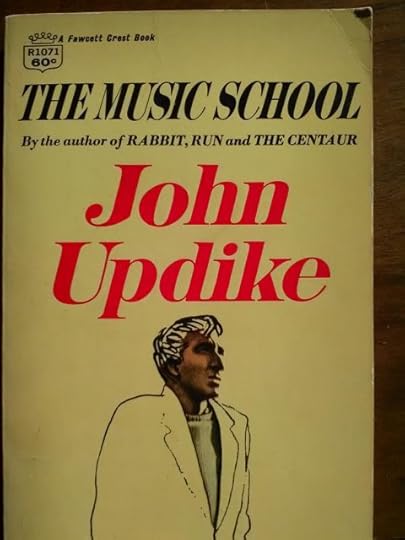
The whole concept of the name Favourite Colours is a tip of the hat to the old book publisher Fawcett Crest, and their way of titling editions, A fawcett crest book. The phrase Favourite Colours stuck after standing out in the novel, Modern Man is Ultra Quick, (even at one point being the title of that novel), to apply it to the name of our publishing house therefore fitted perfectly with the fawcett crest story, and FC was yet another tie. The story in this collection that shares the phrase A Fawcett Crest Book was written pretty much as it reads, a cold day, a flea market, a big bag of paperbacks and discovering (far too late) the writing of John Updike. The book in question was The Music School.
(continues after image…)
The collection finishes with a much older story, actually one of the earliest stories we have published, but a story that none the less fits nicely in this collection. Herr Ahlen and Kaptein Persson is a queer tale about a lonely man on Christmas morning who finds himself in the walking company of two strangers. A tale of past, present and future, of what we retain, what we lose and what we wish for.
The book is available in paperback from amazon, and also in hardback and limited monogrammed and numbered paperback from the favourite colours shop…
‘Now and Then’ is predominantly about relationships, although the focus is very much on unformed or broken relationships, abut desire and longing, about sentimentality and disenchantment, about things lost and love unrequited. There is a fine boundary between love and friendship and these stories reveal how dangerous, how tempting it can be on that border.
The title story kicks of the collection with a feeling of light and optimism: a newly divorced couple, the promenade in Eastbourne, England, the eighties, but it could be earlier, it could be modern day. This is a story about perspective, about coming to terms with what life serves up for us; how sometimes what we thought we wanted is not what lies ahead for us, and how sometimes we take for granted what we most rely upon.
Pimlico, After the Rain was the original driving force for this collection, setting the tone, establishing the voice of the book. Inspired by a visit to the unmatchable Tate Britain, as much by the surrounding streets as the art itself’, it is a small family drama where (much like the earlier FC novels) strong females are juxtaposed with their inferior male counterparts; although, on this occasion, our male lead isn’t perhaps as comical as he seems. It is a story about life choices, about art and career, about aspiration and expectations, about the paths we choose in life.
One of the first of several included stories that deal with the issue of attraction between friends, The American Architect is a moody study of a single man, taken over by an enigmatic attraction towards a good friend. The nightmare situation and the near impossible task of working out how to resolve it.
In two stories, so far, it has been the male protagonists who are both guilty of longing for someone to share their lives with, in the next story the role is reversed, it is the young, successful Bettina who is searching for that special someone. Bettina is the product of young millennial Oslo – with their Mac-obsessions and their all-white apartments – but, try as she might, she can’t get herself that ultimate Frogner accessory – a wholesome hubby.
Following on, in a sense, from where The American Architect left off, The Girl who Cried at Candles is a short study of a man stuck in the void created by discovering that the relationship he dreamt of is never going to happen.
Set in the Mid-60s, in the world of our unpublished novel, The Daughters of Youville (some day! promise!), Carla & Muir is a social, situational piece inspired by the works of John O’Hara. The subject here is desire and jealousy, but also the fundamentals of attraction and social behaviour are considered as a cocktail party unravels, twists and finally breaks down.
Rereading Sentimental Journey, it feels as though it were written in a dream – how on earth did it actually come about? Almost like a stage play, this story is a winding, back and forth conversation – the two participants trying to come to terms with memories, romance, sentimentality, depression, relationships, indifference, fate….the list goes on! Amazing what we find ourselves thinking about in airport departure lounges.
Attraction and desire, random moments when one’s heart is caught by a stranger – The Seat Number Lottery is a short sketch which considers such an idea, how a physical attraction can be instantaneous and inexplicable, desire for that person takes us over; but for all its strength, physical desire is just a game, it is emotional desire that really moves us.
Le Marché aux Fleurs is the first of two European sketches, along with A Parsimonious Necessity, the two stories briefly consider two groups of middle aged men, sitting chatting – the first group debating heatedly among the delicacy of a flower market, the second group offers a juxtaposition of original thought with a bar full of ultra-modern, bandwagon jumpers.
Many of the key recurring themes of this collection appear in Nice Hat, Bro – jealousy, sentimentality, inappropriate attraction, desire, troubled relationships – yet, it reminds us that, whatever we may be stressed about, sometimes it is the little details of life that are the final straw.
The last of this series of five short sketches, Of Garlands and Gabriels, is a sad little tale of a man, lost, waiting; it is more, though, it is about the present and the past, about youth no longer existing, about change and failure.
Although there is a certain sentimentality about the next story, considerations of youth and things that have been lost, Emma, is a story quite different to the others in this collection, it is a pastiche of the American High School films we grew up with – the dork, the captain of the football team, the unobtainable beauty – only without the sugar and silliness. It is a coming of age experience with a cruel double twist at the end.
The Girl with the Hopbine returns us to Oslo and the familiar theme of a relationship lost, attraction and desire, and how such powerful emotions can be triggered by the ordinary things in our lives.
There is a very fine artist called Carl Randall (his website opens here) – some of his best work depicts, in beautiful monochrome, the profiles of Japanese faces; having visited one of his exhibitions an inspiration took hold. Naturally, what was formed by inspiration turned into something very much disconnected with these paintings – Japanese Profiles is a story of an English Consul who falls in love with a Japanese woman.
The Wind & the Moon & the Little Boy is a tiny fragment of prose that, in many ways feels almost like a poem. Just a little exchange between a small boy and his bullying big sister.
The whole concept of the name Favourite Colours is a tip of the hat to the old book publisher Fawcett Crest, and their way of titling editions, A fawcett crest book. The phrase Favourite Colours stuck after standing out in the novel, Modern Man is Ultra Quick, (even at one point being the title of that novel), to apply it to the name of our publishing house therefore fitted perfectly with the fawcett crest story, and FC was yet another tie. The story in this collection that shares the phrase A Fawcett Crest Book was written pretty much as it reads, a cold day, a flea market, a big bag of paperbacks and discovering (far too late) the writing of John Updike. The book in question was The Music School.
(continues after image…)
The collection finishes with a much older story, actually one of the earliest stories we have published, but a story that none the less fits nicely in this collection. Herr Ahlen and Kaptein Persson is a queer tale about a lonely man on Christmas morning who finds himself in the walking company of two strangers. A tale of past, present and future, of what we retain, what we lose and what we wish for.
The book is available in paperback from amazon, and also in hardback and limited monogrammed and numbered paperback from the favourite colours shop…
March 7, 2018
In the shallows.
In the shallows was our first volume of short stories – written mainly during the summer of 2008 on a long commute from Horten, Vestfold to Sandvika. The train line runs low along the Oslo fjord for some miles; the scenery, though not as dramatic as the fjords on the west coast, to someone brought up in England, is beautiful and dramatic; the detail of the woods and fields, too, the old barns and wooden churches, in green fields, under clear blue northern skies.
Originally, the collection was titled ‘separations’ – each of the stories had an element of separation – significant separation, such as death or divorce, or more abstract separation, such as that between generation or gender.
Because of the consistency of the writing and the theme, it was intended to make the collection like an LP, specifically those early 60s records, where musicians were starting see the bigger picture, where an album was a complete thing, rather than just a collection of tracks – like Pet Sounds , Revolver or Something else by the Kinks , where there is a ‘feel’ that holds the collection together. This was the plan for In the Shallows, where, despite the stories being very different there is the sensation that, rather than being a collection, it is one single text, with a consistent tone and atmosphere.
The collection starts off with the ‘title track’ – In the Shallows – where the fjord is the star, and the separations are numerous: between male and female, old and young, the living and the dead, the past and the present, the fjord and the forest and the cabin. It is a story about how our mind processes memories, about how shadows of the past can trigger the most profound emotions.
Young Henrik did not appear in the original eBook, written two years later, but fits in seamlessly with the tone and atmosphere of the other stories. It also deals with separation, not so distinctly, focusing, again, on the past and present, but in this case on the differences between expectation and reality.
Herr Melby Makes Coffee is a period piece, indistinctly set in mid-century Norway. It is the first story to tackle the subject of separation within relationships – here with the added complication of social and class barriers.
Life and death, one’s influence in the world are the problems faced by the protagonist in A Guilty Conscience. A guilt-ridden man battles with a life choice, battles to chose which burden is the greatest – to be or not to be.
A man torn between his family and his lover is the subject of Billingstad. Whether he has made the decision, or that it has been made for him, guilt returns as a theme in this winter tale of infidelity.
Pre-dating the other stories in the collection, Randolph’s Cosmetics is none-the-less very much a part of the continuing theme of the book. Once again, we are on a train, only this time it is man and wife – yet therein lies the separation, what is it that hold this husband and wife together, and what gulfs lie between them?
The subject of married couples is continued in After Dinner Speakers – a wordless, deconstruction of an argument.
Food continues as the theme in The Date, much like the previous story, this is a deconstruction of a not very successful meal, shared between two people on a first date.
Like Cars that Pass in the Morning Night, shifts the perspective back to social differences, with jealousy and desire entering the equation, adding confusion and deeper emotion to an everyday passage of thought.
An extended train of though is the basis for I Know That – the wondering of a bored checkout girl. As the world passes her by the girl considers her life and the argument she had with her other half, earlier that morning.
Constant Companions returns to the themes of marital separation and one’s relationship to the past, as a man stares from his high window, down the side of the fjord to the sea and the islands, the familiarity harsh as he feels the loss of the departure of his wife.
Despite its short length, But I wasn’t… is a heartbreaking little tale about two young children, forced together, yet worlds apart.
Youth also plays a starring role in Konditori, only now juxtaposed with older generations – how is it that families can be so different, and similarities spring up in the least expected ways?
Rather than relationships torn apart, unsavable …And Over Again considers a relationship temporarily broken apart, the longing and desperation of being away from someone much loved and the unmatchable bliss of reacquaintance.
Beginning Norwegian, in essence, is really the starting point for all these stories – a new country and the problems of settling in, fitting in to a new world. Sometimes, it is the comfort of something familiar that gets us through difficult times, and sometimes inspiration comes in the most unexpected way.
Another period piece, A Candlelit Room, considers the themes that appear throughout the text in a more mysterious way. A woman is waiting for something, something unknown, but the effect on her is significant, and it is only fitting that we are left wondering, too.
Meredith is an atmospheric story, almost like a stage play, with a dream sequence – the story looks at the break between past and present, about something possessed and then lost. It is also about perception and the barriers and connections within society.
Based on the Loney, Dear song Saturday Waits, going by the same name, Saturday Waits is a short prose-poem, a flash of thought and emotion in response to the revelation of the death of a relationship.
Finishing the collection, titularly seemingly out of place in this very Norwegian collection, Göteborg is the story of two people who break from their lives to find new paths and new futures, just over the border in Sweden – the thing with separations, they can’t exist without togetherness.
Kind words about the stories.
Herr Melby makes coffee:
“This short story radiates power in its distinctive and understated way, and is rich in symbolism, with great attention to physical detail. The relationship between the two protagonists is handled in such an artistic and understated manner that the emotional impact of their estrangement is subtle, but highly palpable.” via Good Reads
“…a touching and amazing short story which introduces two complex and conflicted characters. Despite the short length the character development is amazing and feels complete and the plot is engaging. A great quick read!” via Smashwords
“A short story with prose that is both descriptive and restrained, “Herr Melby Makes Coffee” tells of two aging men who face the realities of their affair. Although I enjoyed the way it was written, the ending was too inconclusive for me, and I found myself wondering what exactly had just happened.” via Smashwords
“The writer has examined every detail, movement, look and feeling with microscopic vigilance in this unusual short story. Two male lovers, two agendas crossing paths on different levels. There is a sense of ending, of mourning a relationship but no tangible or verbal conclusion that explains the situation completely. The setting, as with all the stories from this author, is beuatifully presented.” via Smashwords
A Guilty Conscience:
“What a wonderful mix of descriptive, observational poetry and introspective turmoil as the focus of this brief story rolls over thoughts in a mind tormented by perpetual analysis, juggling with cause and effect, action and consequence, while still maintaining a safety net of absolute distraction in an amazing location. A well written ambiguous piece that challenges the reader’s inagination intellectually at the same time as fulfilling it aesthetically with a complete atmospheric portrait.” via Smashwords
Kind Words about the collection.
“(In the Shallows) is a collection of 18 short stories set in Norway. As the title suggests the stories follow the theme of separation on the part of the characters. Truly of the modernist bent, these stories are not plot-driven (which is not to say that they don’t each have a plot of sorts), rather we see a slice of each main character’s life in the tales, which range widely in length. Just don’t expect the traditional obvious rising action – climax – resolution structure; it’s there, but more subtle as the work focuses deeply on moments, which is highly effective.” via Smashwords
Purchase a copy here.
Originally, the collection was titled ‘separations’ – each of the stories had an element of separation – significant separation, such as death or divorce, or more abstract separation, such as that between generation or gender.
Because of the consistency of the writing and the theme, it was intended to make the collection like an LP, specifically those early 60s records, where musicians were starting see the bigger picture, where an album was a complete thing, rather than just a collection of tracks – like Pet Sounds , Revolver or Something else by the Kinks , where there is a ‘feel’ that holds the collection together. This was the plan for In the Shallows, where, despite the stories being very different there is the sensation that, rather than being a collection, it is one single text, with a consistent tone and atmosphere.
The collection starts off with the ‘title track’ – In the Shallows – where the fjord is the star, and the separations are numerous: between male and female, old and young, the living and the dead, the past and the present, the fjord and the forest and the cabin. It is a story about how our mind processes memories, about how shadows of the past can trigger the most profound emotions.
Young Henrik did not appear in the original eBook, written two years later, but fits in seamlessly with the tone and atmosphere of the other stories. It also deals with separation, not so distinctly, focusing, again, on the past and present, but in this case on the differences between expectation and reality.
Herr Melby Makes Coffee is a period piece, indistinctly set in mid-century Norway. It is the first story to tackle the subject of separation within relationships – here with the added complication of social and class barriers.
Life and death, one’s influence in the world are the problems faced by the protagonist in A Guilty Conscience. A guilt-ridden man battles with a life choice, battles to chose which burden is the greatest – to be or not to be.
A man torn between his family and his lover is the subject of Billingstad. Whether he has made the decision, or that it has been made for him, guilt returns as a theme in this winter tale of infidelity.
Pre-dating the other stories in the collection, Randolph’s Cosmetics is none-the-less very much a part of the continuing theme of the book. Once again, we are on a train, only this time it is man and wife – yet therein lies the separation, what is it that hold this husband and wife together, and what gulfs lie between them?
The subject of married couples is continued in After Dinner Speakers – a wordless, deconstruction of an argument.
Food continues as the theme in The Date, much like the previous story, this is a deconstruction of a not very successful meal, shared between two people on a first date.
Like Cars that Pass in the Morning Night, shifts the perspective back to social differences, with jealousy and desire entering the equation, adding confusion and deeper emotion to an everyday passage of thought.
An extended train of though is the basis for I Know That – the wondering of a bored checkout girl. As the world passes her by the girl considers her life and the argument she had with her other half, earlier that morning.
Constant Companions returns to the themes of marital separation and one’s relationship to the past, as a man stares from his high window, down the side of the fjord to the sea and the islands, the familiarity harsh as he feels the loss of the departure of his wife.
Despite its short length, But I wasn’t… is a heartbreaking little tale about two young children, forced together, yet worlds apart.
Youth also plays a starring role in Konditori, only now juxtaposed with older generations – how is it that families can be so different, and similarities spring up in the least expected ways?
Rather than relationships torn apart, unsavable …And Over Again considers a relationship temporarily broken apart, the longing and desperation of being away from someone much loved and the unmatchable bliss of reacquaintance.
Beginning Norwegian, in essence, is really the starting point for all these stories – a new country and the problems of settling in, fitting in to a new world. Sometimes, it is the comfort of something familiar that gets us through difficult times, and sometimes inspiration comes in the most unexpected way.
Another period piece, A Candlelit Room, considers the themes that appear throughout the text in a more mysterious way. A woman is waiting for something, something unknown, but the effect on her is significant, and it is only fitting that we are left wondering, too.
Meredith is an atmospheric story, almost like a stage play, with a dream sequence – the story looks at the break between past and present, about something possessed and then lost. It is also about perception and the barriers and connections within society.
Based on the Loney, Dear song Saturday Waits, going by the same name, Saturday Waits is a short prose-poem, a flash of thought and emotion in response to the revelation of the death of a relationship.
Finishing the collection, titularly seemingly out of place in this very Norwegian collection, Göteborg is the story of two people who break from their lives to find new paths and new futures, just over the border in Sweden – the thing with separations, they can’t exist without togetherness.
Kind words about the stories.
Herr Melby makes coffee:
“This short story radiates power in its distinctive and understated way, and is rich in symbolism, with great attention to physical detail. The relationship between the two protagonists is handled in such an artistic and understated manner that the emotional impact of their estrangement is subtle, but highly palpable.” via Good Reads
“…a touching and amazing short story which introduces two complex and conflicted characters. Despite the short length the character development is amazing and feels complete and the plot is engaging. A great quick read!” via Smashwords
“A short story with prose that is both descriptive and restrained, “Herr Melby Makes Coffee” tells of two aging men who face the realities of their affair. Although I enjoyed the way it was written, the ending was too inconclusive for me, and I found myself wondering what exactly had just happened.” via Smashwords
“The writer has examined every detail, movement, look and feeling with microscopic vigilance in this unusual short story. Two male lovers, two agendas crossing paths on different levels. There is a sense of ending, of mourning a relationship but no tangible or verbal conclusion that explains the situation completely. The setting, as with all the stories from this author, is beuatifully presented.” via Smashwords
A Guilty Conscience:
“What a wonderful mix of descriptive, observational poetry and introspective turmoil as the focus of this brief story rolls over thoughts in a mind tormented by perpetual analysis, juggling with cause and effect, action and consequence, while still maintaining a safety net of absolute distraction in an amazing location. A well written ambiguous piece that challenges the reader’s inagination intellectually at the same time as fulfilling it aesthetically with a complete atmospheric portrait.” via Smashwords
Kind Words about the collection.
“(In the Shallows) is a collection of 18 short stories set in Norway. As the title suggests the stories follow the theme of separation on the part of the characters. Truly of the modernist bent, these stories are not plot-driven (which is not to say that they don’t each have a plot of sorts), rather we see a slice of each main character’s life in the tales, which range widely in length. Just don’t expect the traditional obvious rising action – climax – resolution structure; it’s there, but more subtle as the work focuses deeply on moments, which is highly effective.” via Smashwords
Purchase a copy here.
February 5, 2018
Favourite Colours's Blog
- Favourite Colours's profile
- 8 followers
Favourite Colours isn't a Goodreads Author
(yet),
but they
do have a blog,
so here are some recent posts imported from
their feed.
