
W.S. Culpepper's Blog: Observe, Write, Revise & Repeat . . .
October 25, 2018
Khashoggi and Thomas Becket
MbS and his Saudi cronies clearly misread most of Western Lit in addition to all of Western Civ while dallying about at Oxford and Cambridge. Not only did they get blindsided by the shitstorm that has tumbled down after what was supposed to be just another jiffy hit by the Palace Removal Services, but somewhere along the way they completely missed the point of T.S. Eliot's Murder in the Cathedral.
Thomas Becket, Archbishop of Canterbury, feuded fiercely with King Henry II on a regular basis and returned to England after seven years of self-exile to martyrdom at the hands of Big Shots who were eager to curry favor with their sovereign. Eliot doesn't concern himself much with Henry's culpability in the plot; it was a given back in the Twelfth Century that whatever/whomever displeased the royals got eliminated.
"Will no one rid me of this turbulent priest?" quoth Henry, and presto!
Eliot focused on the temptations of Becket in facing his fate and martyrdom. In the first moments of the play, Becket rejects practical advice from the first of four priests:
Take a friend's advice. Leave well alone,
Or your goose may be cooked and eaten to the bone.
He knows what's in store and accepts his death as a testament to his faith. But Eliot adds a nuanced twist to the sanctimony, suggesting that Becket also understood that his death would ultimately and profoundly shift power in England, change the king's supremacy over church and state. And some of that transformation didn't take six or seven centuries to play out. The slain Becket was elevated to sainthood almost immediately by Pope Alexander III. His death helped embolden the family plot against the king, and in order to stay in power with the help of the church, Henry had to do public penance at Thomas's tomb in 1174. The shrine of St. Thomas a Becket at Canterbury Cathedral became one of the most revered in all Europe. Etc., etc.
And, being a good conflicted Christian, playwright Eliot cedes the moral high ground to Becket--almost, leaving ambiguous the fiery prelate's true motivations for walking into an execution:
Now is my way clear, now is the meaning plain:
Temptation shall not come in this kind again.
The last temptation is the greatest treason:
To do the right deed for the wrong reason.
In the same vein, one has to wonder: was Khashoggi merely a hapless naïf who waltzed into a death trap or did the former court toady have more complex, Machiavellian motivations in becoming the target of another political murder most foul? I suspect MbS is wishing about now he'd thought that one over just a trifle. Sooner or later, life imitates art. Rinse, wash, repeat.
Thomas Becket, Archbishop of Canterbury, feuded fiercely with King Henry II on a regular basis and returned to England after seven years of self-exile to martyrdom at the hands of Big Shots who were eager to curry favor with their sovereign. Eliot doesn't concern himself much with Henry's culpability in the plot; it was a given back in the Twelfth Century that whatever/whomever displeased the royals got eliminated.
"Will no one rid me of this turbulent priest?" quoth Henry, and presto!
Eliot focused on the temptations of Becket in facing his fate and martyrdom. In the first moments of the play, Becket rejects practical advice from the first of four priests:
Take a friend's advice. Leave well alone,
Or your goose may be cooked and eaten to the bone.
He knows what's in store and accepts his death as a testament to his faith. But Eliot adds a nuanced twist to the sanctimony, suggesting that Becket also understood that his death would ultimately and profoundly shift power in England, change the king's supremacy over church and state. And some of that transformation didn't take six or seven centuries to play out. The slain Becket was elevated to sainthood almost immediately by Pope Alexander III. His death helped embolden the family plot against the king, and in order to stay in power with the help of the church, Henry had to do public penance at Thomas's tomb in 1174. The shrine of St. Thomas a Becket at Canterbury Cathedral became one of the most revered in all Europe. Etc., etc.
And, being a good conflicted Christian, playwright Eliot cedes the moral high ground to Becket--almost, leaving ambiguous the fiery prelate's true motivations for walking into an execution:
Now is my way clear, now is the meaning plain:
Temptation shall not come in this kind again.
The last temptation is the greatest treason:
To do the right deed for the wrong reason.
In the same vein, one has to wonder: was Khashoggi merely a hapless naïf who waltzed into a death trap or did the former court toady have more complex, Machiavellian motivations in becoming the target of another political murder most foul? I suspect MbS is wishing about now he'd thought that one over just a trifle. Sooner or later, life imitates art. Rinse, wash, repeat.


September 30, 2018
Verge Fever: A Burning Quest to Vanquish a Public Eyesore with Spade and Paintbrush
In the beginning:
Thanks to a rainy spring, the weeds were showing and growing by late March and prospering indeed throughout April over the rough patch of land in front of our property, the space between the sidewalk and the curb that New Orleanians refer to as the city servitude or easement. Here in Louisville, our newly adopted home in the aftermath of Hurricane Katrina, this humble ground is rarely referred to at all, reduced in many neighborhoods to the status of no-man’s land, a marginal entity beneath contempt like the Untouchable Caste of India. Midwestern city ordinances classify these oft-neglected public strips as “verges.” If verge sounds more like a Hindu phallic totem, Shiva’s lingam, rather than a plot of earth, trust me: my pathetic allotment was on the verge of irremediable decline, prompting averted eyes not worship. And city regulations designated me, the adjacent homeowner, responsible for its upkeep.
One-hundred and fifty years ago Kentucky plutocrats started building monuments to house their egos and bumptious families in the cow pastures south of downtown in what is now Old Louisville. Designed as lush, verdant common space to separate paved sidewalks from the avenues in front of stately mansions and townhomes, verges fell into disrepair during hard times between the great wars of the last century along with the economic fortunes of the old-guard families who built them.
Even as Old Louisville’s Victorian architectural treasures and Olmsted parks have been rediscovered and restored by an entirely new demographic, the verges continue to suffer trenches dug and filled haphazardly by municipal utilities, indiscriminate planting and subsequent root blight of struggling trees, spotty improvements and marginal maintenance by city agencies, and most recently, regular use as trash dumps for anything passing drivers and pedestrians can’t be bothered to dispose of properly.
Like many of my fellow citizens, I had become inured or resigned to a creeping ugliness. But as the garbage piled up and the mornings grew sultry, I grew increasingly resentful of my servitude. There had to be a better way. I resolved to sail closely against the winds of public neglect and tackle my festering eyesore/wasteland/health hazard with a sweeping and transformative restoration. I decided to up my game and carve out a niche of beauty on the block.
My public-private beautification project was not entirely anomalous. Our neighborhood association funds itself by operating a highly successful blues festival each fall and supports community outreach and improvements with the profits. We recently completed a major project to restore one of the historic pedestrian entry-ways into Old Louisville know as Garvin Gate. Like my servitude, the gate is also public land and had fallen into disrepair and become a hangout for all sorts of riff-raff. Additional financial support from our city councilman and sister associations made landscape lights and music and automatic sprinkler systems possible. Without question, the upgrades have made the area cleaner, safer, and much more attractive. Thus inspired, I thought I might catch the same aesthetic spark and start another fire of civic purification and renewal. I knew that whatever was going down in front of my house would be on my time and my dime. No matter, I was seized by a fervent cause, down with a fever—nothing to do but see it through.
The layout:
On most streets in our historic district the plots between our wide sidewalks and the granite street curbs are scaled accordingly. Along my property line lay two unpaved sections, each about sixteen feet in depth and extending over a total of fifty of the sixty frontage feet, the rest filled by two perpendicular walkways connecting sidewalk and street. The smaller western section of the servitude was heavily shaded and root impacted and was not remediable without tearing out an established tree—not a battle I cared to engage for many reasons.
The eastern section that passed for workable land received more sunlight with only partial tree-canopy overhang. Therein lay my objective, my beachhead. Sand, however, it was not. Ohio Valley clay had leached into whatever meager topsoil once existed and become compressed over the centuries and spiked with discarded brick and concrete to yield a tiller’s nightmare, cursed hardpan that nearly defied my best English garden spade and exhausted all of my religion.
A modest epiphany:
Even when deemed noxious by location, I have always respected nature’s hardiest terrestrial plants. The hundred hours spent hacking, pick-axing, digging, and cursing that patch of adobe crust from which sprung a host of weeds only enhanced my admiration for them. Most days, however, I felt a surge of savage remorselessness for every bloody stem I uprooted. One morning I saw things in a somewhat different light and found a measure of tolerance, yea, verily, acceptance even, for some of the feral foliage in my plot. I decided to conserve and replant a species known as wild violets.

As the pigs in Animal Farm said, “All animals are equal, but some animals are more equal than others.” Ditto, I decided, for weeds. As you will see below, the violets fit nicely into my eclectic urban bed—pretty much right where they started.
Down to business:
After hacking and weeding through the top twelve inches of hardpan, the real work lay ahead. About three weeks into the project, I had something that resembled the surface of Mars: rocky dust barren of chlorophyll. I was throwing good punches, but lo, this Tar Baby of a project held me fast and close and tormented my fever dreams by taking on a life of its own.
I have but one maxim for anyone thinking about single-handedly undertaking remediation and renovation of a similar-sized plot of urban neglect. Your physical suffering will only be exceeded by your out-of-pocket costs. You may muse confidently, “What can a few bales of peat moss, a few cubic yards of compost, and some three-inch pots of groundcover species run me?” Ha! Discounting any trips to your local emergency room—a pitfall I managed to avoid—your good intentions may quickly run afoul of your budget if you don’t seek out the most frugal of options. I had a respectable mound of home-brewed compost, but it didn’t make a dent in the 14’ X 20’ area that needed working. Also, it had been a while since I’d priced any of those cute little pots of groundcover. Stick to the hardiest and buy in volume at your favorite discount nursery or home-improvement store; the high-end nurseries charge two-to-four times as much for the exact same commodities. Even with the violets already at hand, I purchased over 200 small pots in order to space plantings in a grid at one-foot intervals. You can do the math. I quickly blew through my initial estimates of “a few hundred dollars” for plants and materials. And remember, I didn’t pay anybody for labor other than Old Father Time.
What went in:
In addition to the wild violets harvested in situ, I used monkey (mondo) grass, and variegated ajuga (bugleweed) for color and shape variety and what I hoped would be a heat- and drought-tolerant blend of compact, low-growing mounds of vegetation. I built a raised bed with limestone borders for a center feature and planted Stella d’Oro daylilies and later added red-and-orange Echinaceas for accents. Here is what it looked like in late May 2018:
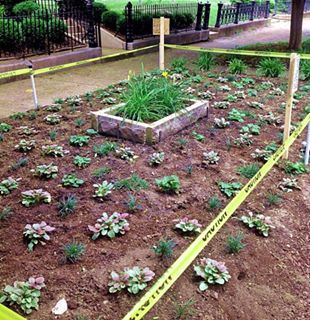
So, I’ve decided this is a good idea, but:
The police tape was just for show. I knew it wouldn’t keep out even the most casual of vandals or mean-spirited souls. Few emerged. While I labored through my fever, my neighbors paused to kibitz and observe from a safe distance. Nothing like a guy sweating and grunting in the dirt to attract spectators, chaste devotees of leisure and cleanliness, one and all.
I also entertained a recurring cast of work-averse supplicants. Some of the cagier types sauntered by just I was putting away my tools for the day to ask if there was anything they could do for a few bucks. I always thanked them with as sincere an expression as I could muster and said that I preferred to go at it solo. Undeterred, most of them shifted seamlessly to pan-handling. Two or three dollars for a hamburger was the most popular leadoff pitch. The rest of their pals didn’t waste any time with airy employment ruses, merely asked upfront for money. I wished them, one and all, Godspeed and better fortunes elsewhere. No doubt they departed a tad disappointed in me but happily unburdened by additional indebtedness to their fellow man. A few were so forgiving and large hearted as to try me again the very next day.
For the occasionally impressionable or the odd rational bloke, I posted the following two signs:

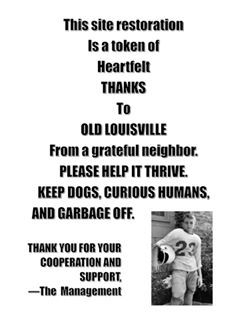
I was not at all certain whether these appeals would foster understanding or tolerance, but thus far, evidence suggests my campaign didn’t rile up too many folks even if I haven’t won over every heart and mind. One indecisive soul uprooted one of my signs but kindly abandoned it down the block. And one weekend a few drunken dervishes tore into the caution tape but spared the plantings. Mostly, things have remained secure with nothing but positive comments coming up on our online neighborhood chat board and all but three of the plants surviving the worst of the summer.
Making it more permanent:
After a couple of well-deserved weeks away from civic improvements for vacation travel with family and friends, an all-too-familiar voice interrupted my afternoon siesta.
“No rest, no slothfulness,” quoth Tar Baby.
I pretended to doze on in silence.
“Good fences make good neighbors,” he prodded.
That got my attention.
I shot back, “And the same wise man wrote, ‘Something there is that doesn’t love a wall.’”
“Not a wall, lazybones, a humble but attractive fence, a decorative garden border. Now, get back to work.”
If a boundary more durable and attractive than yellow caution tape was called for, I wanted something elegant-funky, evocative of Old Louisville, not modern and machine-stamped and straight from Amazon.com. Were I still living in New Orleans, I would have gone to Ricca’s Architectural Sales and searched through their period treasures. I had one likely source to check hereabouts; Ricca’s Midwestern cousin is called Architectural Salvage. There I found four-foot sections of Mexican wrought iron, enough to encircle the nearly seventy feet of bed. Each section featured attractive fleurs-de-lis within the designs. These ancient symbols of French royalty hold historical significance for two major American cities, New Orleans and Louisville, part of the vast Mississippi watershed that LaSalle claimed originally for King Louis XIV of France. As you can see below, my French-fried Mexican iron needed a little work.
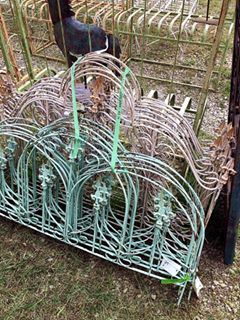
My own private stack with orders attached, straight from Tar Baby.
Below is what the project looks like today: grown in and fenced in and ready for winter and death and renewal next year.
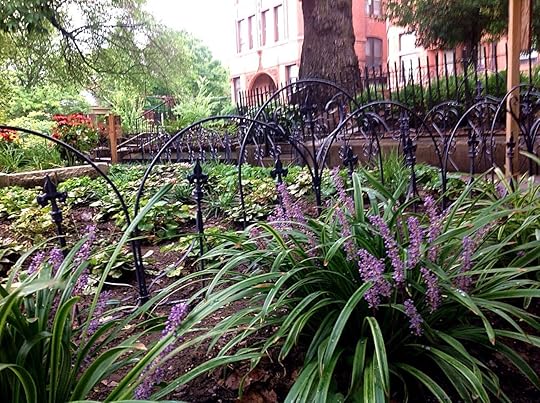
I painted the iron deep purple. PPG calls their color “Quixotic Plum.” I think it complements our variegated liriope border—and perhaps the wild violets next spring. With Squire Tar Baby at my side the project was always a trifle Quixotic, no?
Months of sweat equity finally broke the verge fever. I worked intermittently from May through August, averaging twenty hours each week. Some things take longer at age seventy. Although tired at the end of each day, I was satisfied with incremental progress. For relief during the most tedious phases, I multitasked. I mapped out plot and character elements for my third novel while weeding and working the soil and enjoyed a lot of fine music while hand-painting the wrought iron. Sometimes I gritted my teeth and endured unsolicited advice from Tar Baby, my alter-ego; I’d quickly learned to resist the urge to smack him when he was especially sassy.
After Labor Day:
I still make my trash pickups, but there’s a lot less to pick up than before. I guess you can count me among life’s optimists, yet I’m certain that one little hard-won swath of beauty will never rid the world of slobs and lowlifes or cure the mobile vulgus.
But Martha and I couldn’t be more pleased with what we now look out upon from our home, and that’s transformational enough for us.

We’re at the end of our summer and nearly to the end of my tale. Here’s hoping all those perennials and highfalutin weeds stay happy over the coming seasons. I know I am. Tar Baby not pestering me no more.
Thanks to a rainy spring, the weeds were showing and growing by late March and prospering indeed throughout April over the rough patch of land in front of our property, the space between the sidewalk and the curb that New Orleanians refer to as the city servitude or easement. Here in Louisville, our newly adopted home in the aftermath of Hurricane Katrina, this humble ground is rarely referred to at all, reduced in many neighborhoods to the status of no-man’s land, a marginal entity beneath contempt like the Untouchable Caste of India. Midwestern city ordinances classify these oft-neglected public strips as “verges.” If verge sounds more like a Hindu phallic totem, Shiva’s lingam, rather than a plot of earth, trust me: my pathetic allotment was on the verge of irremediable decline, prompting averted eyes not worship. And city regulations designated me, the adjacent homeowner, responsible for its upkeep.
One-hundred and fifty years ago Kentucky plutocrats started building monuments to house their egos and bumptious families in the cow pastures south of downtown in what is now Old Louisville. Designed as lush, verdant common space to separate paved sidewalks from the avenues in front of stately mansions and townhomes, verges fell into disrepair during hard times between the great wars of the last century along with the economic fortunes of the old-guard families who built them.
Even as Old Louisville’s Victorian architectural treasures and Olmsted parks have been rediscovered and restored by an entirely new demographic, the verges continue to suffer trenches dug and filled haphazardly by municipal utilities, indiscriminate planting and subsequent root blight of struggling trees, spotty improvements and marginal maintenance by city agencies, and most recently, regular use as trash dumps for anything passing drivers and pedestrians can’t be bothered to dispose of properly.
Like many of my fellow citizens, I had become inured or resigned to a creeping ugliness. But as the garbage piled up and the mornings grew sultry, I grew increasingly resentful of my servitude. There had to be a better way. I resolved to sail closely against the winds of public neglect and tackle my festering eyesore/wasteland/health hazard with a sweeping and transformative restoration. I decided to up my game and carve out a niche of beauty on the block.
My public-private beautification project was not entirely anomalous. Our neighborhood association funds itself by operating a highly successful blues festival each fall and supports community outreach and improvements with the profits. We recently completed a major project to restore one of the historic pedestrian entry-ways into Old Louisville know as Garvin Gate. Like my servitude, the gate is also public land and had fallen into disrepair and become a hangout for all sorts of riff-raff. Additional financial support from our city councilman and sister associations made landscape lights and music and automatic sprinkler systems possible. Without question, the upgrades have made the area cleaner, safer, and much more attractive. Thus inspired, I thought I might catch the same aesthetic spark and start another fire of civic purification and renewal. I knew that whatever was going down in front of my house would be on my time and my dime. No matter, I was seized by a fervent cause, down with a fever—nothing to do but see it through.
The layout:
On most streets in our historic district the plots between our wide sidewalks and the granite street curbs are scaled accordingly. Along my property line lay two unpaved sections, each about sixteen feet in depth and extending over a total of fifty of the sixty frontage feet, the rest filled by two perpendicular walkways connecting sidewalk and street. The smaller western section of the servitude was heavily shaded and root impacted and was not remediable without tearing out an established tree—not a battle I cared to engage for many reasons.
The eastern section that passed for workable land received more sunlight with only partial tree-canopy overhang. Therein lay my objective, my beachhead. Sand, however, it was not. Ohio Valley clay had leached into whatever meager topsoil once existed and become compressed over the centuries and spiked with discarded brick and concrete to yield a tiller’s nightmare, cursed hardpan that nearly defied my best English garden spade and exhausted all of my religion.
A modest epiphany:
Even when deemed noxious by location, I have always respected nature’s hardiest terrestrial plants. The hundred hours spent hacking, pick-axing, digging, and cursing that patch of adobe crust from which sprung a host of weeds only enhanced my admiration for them. Most days, however, I felt a surge of savage remorselessness for every bloody stem I uprooted. One morning I saw things in a somewhat different light and found a measure of tolerance, yea, verily, acceptance even, for some of the feral foliage in my plot. I decided to conserve and replant a species known as wild violets.
As the pigs in Animal Farm said, “All animals are equal, but some animals are more equal than others.” Ditto, I decided, for weeds. As you will see below, the violets fit nicely into my eclectic urban bed—pretty much right where they started.
Down to business:
After hacking and weeding through the top twelve inches of hardpan, the real work lay ahead. About three weeks into the project, I had something that resembled the surface of Mars: rocky dust barren of chlorophyll. I was throwing good punches, but lo, this Tar Baby of a project held me fast and close and tormented my fever dreams by taking on a life of its own.
I have but one maxim for anyone thinking about single-handedly undertaking remediation and renovation of a similar-sized plot of urban neglect. Your physical suffering will only be exceeded by your out-of-pocket costs. You may muse confidently, “What can a few bales of peat moss, a few cubic yards of compost, and some three-inch pots of groundcover species run me?” Ha! Discounting any trips to your local emergency room—a pitfall I managed to avoid—your good intentions may quickly run afoul of your budget if you don’t seek out the most frugal of options. I had a respectable mound of home-brewed compost, but it didn’t make a dent in the 14’ X 20’ area that needed working. Also, it had been a while since I’d priced any of those cute little pots of groundcover. Stick to the hardiest and buy in volume at your favorite discount nursery or home-improvement store; the high-end nurseries charge two-to-four times as much for the exact same commodities. Even with the violets already at hand, I purchased over 200 small pots in order to space plantings in a grid at one-foot intervals. You can do the math. I quickly blew through my initial estimates of “a few hundred dollars” for plants and materials. And remember, I didn’t pay anybody for labor other than Old Father Time.
What went in:
In addition to the wild violets harvested in situ, I used monkey (mondo) grass, and variegated ajuga (bugleweed) for color and shape variety and what I hoped would be a heat- and drought-tolerant blend of compact, low-growing mounds of vegetation. I built a raised bed with limestone borders for a center feature and planted Stella d’Oro daylilies and later added red-and-orange Echinaceas for accents. Here is what it looked like in late May 2018:
So, I’ve decided this is a good idea, but:
The police tape was just for show. I knew it wouldn’t keep out even the most casual of vandals or mean-spirited souls. Few emerged. While I labored through my fever, my neighbors paused to kibitz and observe from a safe distance. Nothing like a guy sweating and grunting in the dirt to attract spectators, chaste devotees of leisure and cleanliness, one and all.
I also entertained a recurring cast of work-averse supplicants. Some of the cagier types sauntered by just I was putting away my tools for the day to ask if there was anything they could do for a few bucks. I always thanked them with as sincere an expression as I could muster and said that I preferred to go at it solo. Undeterred, most of them shifted seamlessly to pan-handling. Two or three dollars for a hamburger was the most popular leadoff pitch. The rest of their pals didn’t waste any time with airy employment ruses, merely asked upfront for money. I wished them, one and all, Godspeed and better fortunes elsewhere. No doubt they departed a tad disappointed in me but happily unburdened by additional indebtedness to their fellow man. A few were so forgiving and large hearted as to try me again the very next day.
For the occasionally impressionable or the odd rational bloke, I posted the following two signs:
I was not at all certain whether these appeals would foster understanding or tolerance, but thus far, evidence suggests my campaign didn’t rile up too many folks even if I haven’t won over every heart and mind. One indecisive soul uprooted one of my signs but kindly abandoned it down the block. And one weekend a few drunken dervishes tore into the caution tape but spared the plantings. Mostly, things have remained secure with nothing but positive comments coming up on our online neighborhood chat board and all but three of the plants surviving the worst of the summer.
Making it more permanent:
After a couple of well-deserved weeks away from civic improvements for vacation travel with family and friends, an all-too-familiar voice interrupted my afternoon siesta.
“No rest, no slothfulness,” quoth Tar Baby.
I pretended to doze on in silence.
“Good fences make good neighbors,” he prodded.
That got my attention.
I shot back, “And the same wise man wrote, ‘Something there is that doesn’t love a wall.’”
“Not a wall, lazybones, a humble but attractive fence, a decorative garden border. Now, get back to work.”
If a boundary more durable and attractive than yellow caution tape was called for, I wanted something elegant-funky, evocative of Old Louisville, not modern and machine-stamped and straight from Amazon.com. Were I still living in New Orleans, I would have gone to Ricca’s Architectural Sales and searched through their period treasures. I had one likely source to check hereabouts; Ricca’s Midwestern cousin is called Architectural Salvage. There I found four-foot sections of Mexican wrought iron, enough to encircle the nearly seventy feet of bed. Each section featured attractive fleurs-de-lis within the designs. These ancient symbols of French royalty hold historical significance for two major American cities, New Orleans and Louisville, part of the vast Mississippi watershed that LaSalle claimed originally for King Louis XIV of France. As you can see below, my French-fried Mexican iron needed a little work.
My own private stack with orders attached, straight from Tar Baby.
Below is what the project looks like today: grown in and fenced in and ready for winter and death and renewal next year.
I painted the iron deep purple. PPG calls their color “Quixotic Plum.” I think it complements our variegated liriope border—and perhaps the wild violets next spring. With Squire Tar Baby at my side the project was always a trifle Quixotic, no?
Months of sweat equity finally broke the verge fever. I worked intermittently from May through August, averaging twenty hours each week. Some things take longer at age seventy. Although tired at the end of each day, I was satisfied with incremental progress. For relief during the most tedious phases, I multitasked. I mapped out plot and character elements for my third novel while weeding and working the soil and enjoyed a lot of fine music while hand-painting the wrought iron. Sometimes I gritted my teeth and endured unsolicited advice from Tar Baby, my alter-ego; I’d quickly learned to resist the urge to smack him when he was especially sassy.
After Labor Day:
I still make my trash pickups, but there’s a lot less to pick up than before. I guess you can count me among life’s optimists, yet I’m certain that one little hard-won swath of beauty will never rid the world of slobs and lowlifes or cure the mobile vulgus.
But Martha and I couldn’t be more pleased with what we now look out upon from our home, and that’s transformational enough for us.
We’re at the end of our summer and nearly to the end of my tale. Here’s hoping all those perennials and highfalutin weeds stay happy over the coming seasons. I know I am. Tar Baby not pestering me no more.
August 19, 2016
Poverty, Crime, and Its Myriad Victims
Los Angeles, like most large cities in the U.S., harbors numerous murky cesspools of crime, failing schools, and physical decay. You and I would never pass through any of them without a compelling reason, probably not even then. Poverty and the downward social spiral in these chaotic neighborhoods are perpetuated, in part, by crass politicians and misguided do-gooders who encourage a sense of victimization, resentment, and pernicious grievance among the denizens--most of whom are trying to resist that message and constantly struggle to better themselves and escape the killing and the madness. Some among them are content to subsist on permanent dependency status with goods and services dispensed by government agencies and non-profit organizations. The bottom-feeders merely pillage, plunder, maim and murder the weak trapped in the violence or unsuspecting souls who happen to wander too close to the shores of these filthy swamps. Easy pickings either way.
South Central L.A. is one of these festering crime pools, and one that is uniquely situated close to a handy and burgeoning source of hapless victims, the relatively affluent and naive students attending the main campus of the University of Southern California [USC.] Also, Los Angeles is one of the cities in close proximity to our southern border with Mexico, a four-thousand mile meander of land and oceanfront that has been the Golden Gateway for millions of illegal entrants to our country over the last decade. Several thousands of these undocumented visitors have come with extensive criminal resumes and continued their happy plundering "Up North" or have applied themselves assiduously to on-the-job mayhem and street training in thuggery after arrival. Although these hardened criminals comprise only a small percentage of the illegal entrants from abroad, they punch well above their relative weight. And they are not, by anyone's reckoning, all of Hispanic origin. The most dangerous of these invaders are from rabidly anti-American oases like North Yemen and Iran and the sundry "Stans" and are upstanding members of well-known terrorist and quasi-military clubs, eager to prove their mettle amidst the infidels or go sleeper and await further encoded communiques from home. Best estimates are that only about 15% of these extremely dangerous individuals are apprehended and expelled. Among the garden-variety street thugs, about 35% are spotted and "weeded out" (Homeland Security Speak for sent back home), only to have almost every one of those not thrown under the jail or killed in their land of deportation return to our Land of Opportunity within months!
Consider two recent news stories, events once thought to be freakishly rare, maybe yellow-journalism tabloid stuff, they are now too frequent and too heinous for the jaded and harried mainstream media to ignore. These case studies characterize the extreme lawlessness and lack of control in regions along the border. Many of the citizens of Texas, New Mexico, Arizona and California have experienced the invasion first hand; some are running like hell while they still can.
Case #1: Twenty-four-year-old, Xinran Ji, an engineering graduate student at USC, was walking home from a study group after midnight on July 24th when he was robbed and brutally beaten by four teenagers (three male, one female) wielding baseball bats and pipe wrenches. The victim escaped only to be run down and beaten again, then escaped again and staggered back to his dorm room. He died later the same morning from multiple trauma. Police apprehended the four suspects after they continued on their spree and attacked a couple. One of those victims was able to assist in their capture. All of the suspects have been charged with capital murder. The eldest, 19-y/o Jonathan DelCarmen, told law enforcement during his interrogation that he was in the U.S. illegally. He had been living here, having his way with victims, for SEVEN YEARS!!! City boosters and public officials have often trumpeted reports showing that violent crime stats across the city, including South Central Los Angeles, have been declining "every year for more than a decade." These data, I am certain, offered great solace to Mr. Ji's surviving family members. BTW, it took over a week for the U.S. Dept. of State to issue entrance visas so the grieving family members could travel here from China. You just can't be too careful these days.
Case #2: On August 5th, off-duty Border Patrol agent Javier Vega, Jr., was fishing with relatives in the Rio Grande Valley in Texas when two men attempted to rob them, then opened fire on Vega and his family. Vega was shot and killed and his father was shot in the hip.
The two suspects were apprehended nearby later that same day and confessed to the murder. Both are undocumented immigrants from Mexico. County officials confirmed that both Gustavo Tijerina, 30, and Ismael Hernandez, 40, are from Matamoros, Mexico, and both have been deported from the U.S. before. One of the men had been deported FOUR TIMES, while the other had been deported TWICE. One of the shooters, Tierna, is expected to be hit with additional charges tying him to a series of armed robberies and car jackings at fishing spots in Cameron County over the last six weeks. He is also believed to be connected to the drug smuggling Gulf Cartel. One of his earlier victims was another off-duty Border Patrol agent who was also out fishing when he was robbed.
Again, I am certain that the fine work of our law enforcement officials in finally bringing and bundling charges for these pigs will be a soothing balm for Agent Vega's wife and children. But in spite of her grief and frustration his widow will likely never ask why these men weren't put out of action on one of their five or six previous forays in our county. She and her late husband understood that his job was not to apprehend and secure illegals but sort and send them along upstream where most just vanish in the night.
South Central L.A. is one of these festering crime pools, and one that is uniquely situated close to a handy and burgeoning source of hapless victims, the relatively affluent and naive students attending the main campus of the University of Southern California [USC.] Also, Los Angeles is one of the cities in close proximity to our southern border with Mexico, a four-thousand mile meander of land and oceanfront that has been the Golden Gateway for millions of illegal entrants to our country over the last decade. Several thousands of these undocumented visitors have come with extensive criminal resumes and continued their happy plundering "Up North" or have applied themselves assiduously to on-the-job mayhem and street training in thuggery after arrival. Although these hardened criminals comprise only a small percentage of the illegal entrants from abroad, they punch well above their relative weight. And they are not, by anyone's reckoning, all of Hispanic origin. The most dangerous of these invaders are from rabidly anti-American oases like North Yemen and Iran and the sundry "Stans" and are upstanding members of well-known terrorist and quasi-military clubs, eager to prove their mettle amidst the infidels or go sleeper and await further encoded communiques from home. Best estimates are that only about 15% of these extremely dangerous individuals are apprehended and expelled. Among the garden-variety street thugs, about 35% are spotted and "weeded out" (Homeland Security Speak for sent back home), only to have almost every one of those not thrown under the jail or killed in their land of deportation return to our Land of Opportunity within months!
Consider two recent news stories, events once thought to be freakishly rare, maybe yellow-journalism tabloid stuff, they are now too frequent and too heinous for the jaded and harried mainstream media to ignore. These case studies characterize the extreme lawlessness and lack of control in regions along the border. Many of the citizens of Texas, New Mexico, Arizona and California have experienced the invasion first hand; some are running like hell while they still can.
Case #1: Twenty-four-year-old, Xinran Ji, an engineering graduate student at USC, was walking home from a study group after midnight on July 24th when he was robbed and brutally beaten by four teenagers (three male, one female) wielding baseball bats and pipe wrenches. The victim escaped only to be run down and beaten again, then escaped again and staggered back to his dorm room. He died later the same morning from multiple trauma. Police apprehended the four suspects after they continued on their spree and attacked a couple. One of those victims was able to assist in their capture. All of the suspects have been charged with capital murder. The eldest, 19-y/o Jonathan DelCarmen, told law enforcement during his interrogation that he was in the U.S. illegally. He had been living here, having his way with victims, for SEVEN YEARS!!! City boosters and public officials have often trumpeted reports showing that violent crime stats across the city, including South Central Los Angeles, have been declining "every year for more than a decade." These data, I am certain, offered great solace to Mr. Ji's surviving family members. BTW, it took over a week for the U.S. Dept. of State to issue entrance visas so the grieving family members could travel here from China. You just can't be too careful these days.
Case #2: On August 5th, off-duty Border Patrol agent Javier Vega, Jr., was fishing with relatives in the Rio Grande Valley in Texas when two men attempted to rob them, then opened fire on Vega and his family. Vega was shot and killed and his father was shot in the hip.
The two suspects were apprehended nearby later that same day and confessed to the murder. Both are undocumented immigrants from Mexico. County officials confirmed that both Gustavo Tijerina, 30, and Ismael Hernandez, 40, are from Matamoros, Mexico, and both have been deported from the U.S. before. One of the men had been deported FOUR TIMES, while the other had been deported TWICE. One of the shooters, Tierna, is expected to be hit with additional charges tying him to a series of armed robberies and car jackings at fishing spots in Cameron County over the last six weeks. He is also believed to be connected to the drug smuggling Gulf Cartel. One of his earlier victims was another off-duty Border Patrol agent who was also out fishing when he was robbed.
Again, I am certain that the fine work of our law enforcement officials in finally bringing and bundling charges for these pigs will be a soothing balm for Agent Vega's wife and children. But in spite of her grief and frustration his widow will likely never ask why these men weren't put out of action on one of their five or six previous forays in our county. She and her late husband understood that his job was not to apprehend and secure illegals but sort and send them along upstream where most just vanish in the night.
July 12, 2014
Innocents Abroad: 2014
Like Mark Twain and his band of pilgrims, ours was to be another “great European pleasure excursion.” Admittedly, our objectives and itinerary were more modest than those sailing aboard the Quaker City back in 1867. Martha and I and another couple had made plans to visit Paris and the Luberon. Rather than a leisurely five and one-half months, we looked forward to staying in some of our favorite places for just under three weeks. Plenty of time, still, to revisit the great City of Light and the pastoral pleasures of the South. Plenty of time, also, to get into big trouble that threatened to end the whole affair almost before it began—if not for an alert and caring stranger who saved my bacon. And if not for an improbable chain of events, even his exceptional efforts on my behalf would have been in vain.
The brisk west-to-east Atlantic crossing aboard modern aircraft nearly always leaves its passengers with one malady that those intrepid nineteenth-century sailors never had to endure: jet lag. All four of us were staggering a bit after touching down at Charles DeGaulle International that Thursday morning. For me, jet lag manifests as a fuzzy-headed hangover, one that seems to get worse and last longer with advancing age. A great lunch and a nap lifted my spirits, but I couldn’t clear the cotton wool between my ears on our first evening in Paris.
Around 8 p.m. we walked over to Francois Pasteau’s bustling bistro, L’Epi Dupin, a couple of blocks from our hotel. The streets were fairly quiet, but a crowd clustered about the entrance of the restaurant. I was jostled by others in the doorway as we made our way to the maître d’ to claim our table reservation. He finally found our party’s name on the list, but I was distracted just long enough with the search and his French to be robbed blind by a pickpocket working the crowd. Of course, I was completely unaware at the time that one of the “jostles” was a pro lifting an overstuffed billfold from my back pocket. Jet lag and momentary confusion plus failure to shift to my “overseas travel mode”—shifting wallet, cash, and bank cards to a front pants pocket—set me up as ripe for plunder.
I discovered the theft only when it was time to pay the bill. Even then I was unsure, unwilling to accept, what had happened. Had I left my wallet back in our hotel room or back where we had lunch? My frazzled mind began casting about in what would become an increasingly stressful blur of frustration, blind alleys, fruitless searches, and anger at my stupidity for not having taken proper precautions to avert what appeared to be an almost certain catastrophe as the night wore on. After turning over every inch of our hotel room, retracing our steps to and from and about the restaurant, there remained only the (very remote) possibility that the manager at our lunch spot would find my missing wallet while cleaning up. His café-bar was crammed full until after midnight, but he promised to call the hotel if anything showed up. With this wisp of hope for redemption, I trudged back upstairs and decided to wait until morning before beginning the nauseating ordeal of cancelling all of my credit cards, notifying all of my associated brokerage and bank accounts that someone may be using my Texas driver’s license and God knows what else, stealing my online identity, etc., etc., etc. . . . At least I still had my U.S. passport and could prove who I was to the Paris police when I filed a theft report—just another sucker who’d wandered into trouble in the big city.
Neither Martha nor I slept much that night. Stress breeds stress, and we both began to anticipate the worst. It wasn’t pretty: all of our credit cards were set up as accounts where I was listed as the primary card holder with a single shared number. Those would soon be voided and useless. If we could figure out a way to pay our hotel bill, we were leaving for the South in less than forty-eight hours. There we would be living in a rural hamlet so small that they didn’t even have street numbers, much less a post office. How could any replacement cards ever catch up with us? There were going to be long hours in the next several days when phone service and online connections were unavailable. We would be sitting ducks for identity theft.
Cutpurses have plagued travelers since Ulysses wandered the Mediterranean, but all they ever got was a bit of goatskin and a few shekels. The potential for modern financial havoc is far greater—if someone has your name and just the right numbers. At home I’ve always used layers of internet security and exercised caution and vigilance online and out in public spaces. This was not my first rodeo. One question tormented me as I tossed around a hard bed, plagued by recriminations and no easy answers. “How could I have been so careless?” Sometime after dawn peeked around the bedroom drapes, I finally passed out, beaten and exhausted. Martha’s voice awakened me around 12:30 the following afternoon.
I was trying to make sense out of something she kept repeating while looking at her iPhone. Our daughter had texted and tried to call us from the States while we slept after sunrise. Her messages were all about someone named Allen or Alain who was calling about some of our credit cards. Credit cards? I groaned and rolled over. I felt as though I had been thrown down a coal chute after a nasty beating, mostly about the neck and head: robbed then beaten and left to suffer the consequences. Well buster, here comes the real trouble.
“Great, so they really are stolen and the banks are calling to alert us about suspicious charges from Turkey? Morocco?”
“I don’t know. Jennifer is asking if we’re OK, if you’re OK. Somebody kept calling our home phone after midnight, but I don’t think it’s a bank. Wait. This text says his name is Alain and he’s found your driver’s license and credit cards, and he wants you to call him. Jennifer was there spending the night for some reason; she sent his cell-phone number. . .”
“WHAT?”
“Wait. There’s more, a later message. He’s bringing the stuff to the police station; he wants you to call him—same number. Alain.”
“Jesus!! I can’t believe it. How could someone just find my stuff? Who cares? Hand me your phone; I’m awake now!”
* * *
Alain Cavalie, my personal savior and world-class Good Samaritan, owns a very popular bar-brasserie named Les Oiseaux (The Birds) at 45 rue de Sevres and lives just a few doors down on the same street. As he came out of his courtyard about eight that Friday morning and surveyed the busy neighborhood, something shiny and gold caught his eye—my “Gold Card” lying with its brothers and sisters—part of last night’s debris in the gutters of Paris.
“I knew immediately what had happened,” he told me later as we walked to the local prefecture of police at Place Saint Sulpice. “I just did what I hoped someone would have done for me if the situation had been reversed.” Alain spoke flawless American English, having spent several years working in the States “after university.” He was a hang-gliding instructor in Arizona before returning to France to take care of his parents who had fallen ill. “Hang gliding, a lot like windsurfing, just without the ocean.” I knew right away this guy was special.
Special indeed. Instead of walking by my pile of glittering bank cards or merely turning the pickpockets’ chaff over to the police, Alain gathered everything up, checked around the corners and alleys for more, then went to his computer and used my driver’s license information to try to tease out any useful contact information. As careful as I think I am in “wiping my tracks” on the internet, he found out a lot. He complimented us on our lovely home (Google Earth!), and I had already figured out he’d gone to Facebook or somewhere and saw that I was an avid windsurfer. But he’d only found one telephone number, and he had no way to know that he was calling our land line at our home. Nonetheless, he spent lots of his time that morning (and expensive international calling minutes) to leave voicemail messages about finding my cards.
“For someone, anyone; quand meme, I didn’t have any other choice.”
Of course, he had plenty of other choices—including doing nothing at all or ripping us off himself—but thank God he was kind, considerate, and persistent. His messages came in between 1 and 3 a.m. Austin time. The last beep from his final message woke up our daughter who took down the recorded information and tried frantically to reach us, not knowing what our circumstances were in Paris or why this man had the contents of my wallet. By that time we were dead asleep at our hotel and didn’t respond to her calls for several more hours.
Jennifer was the third sleep-deprived victim of my stupidity that day. She works in Austin, lives on her own, but doesn’t waste her own money on cable TV. She had DVR’d some shows on our cable box and decided to catch up while we were away. If she hadn’t fallen asleep while watching, Alain’s messages would have never gotten through. Jen checks on things occasionally at our home when we travel but never checks voicemail. In fact, I’d almost canceled our land line “voice” contract before we left for Europe.
The entry hall and duty desk at the Saint Sulpice police station was thick with hapless victims from the previous evening, queued up to fill out endless forms to report what was lost or stolen. Instead of leaving me with a hearty handshake at the door, Alain helped me cut through the bureaucratic snarls and legal idioms. I, it seems, was a special case—a highly unusual case, in fact—I got to see a special officer, the one who actually returns stolen goods to rightful owners. Since Alain had turned in the items only a couple of hours before, his face was still familiar to the men on duty. In a flash I was presented with a sealed “evidence packet” after showing my passport and signing a ledger. Alain had recovered every bank card and important piece of identification that I carried. I felt giddy; I couldn’t help from laughing. There was only one card missing. The dopers who’d snatched my cash and kept my wallet for a souvenir must have been outdoorsy types. They kept my U.S. Forest Services Card. A terrific value, for a one-time payment of ten USD, this card provides for lifetime admission to any National Park or Forest in the U.S. of A.! Just then, I thought I heard distant voices of a choir raised in “Hallelujahs!”
The prefecture is located on the square and just across from the 13th-century church that are named for Sulpitious the Pious who, it is said, devoted himself to good works and study of scripture. I don’t know what miracles are attributed to him, but there I was standing at the desk and reflecting on a sudden confluence of good works and latter-day miracles. Alain, for all of his noble efforts, would have fallen short had the street sweepers, who begin their patrols through the 6th arrondissement at dawn, come across my orphaned bank cards before he had. Had I cut off our land line phone contract before leaving town or had Jennifer not decided to burn through six or seven episodes of “Dance Fever” that same night, his helpful calls would have died, stillborn or floated out into the ether and remained unheeded.
We continued our conversation on the way back, in the direction of our hotel and Alain’s business. I still felt hung over but so much more focused and alive than I had a few hours before dawn on that strange and wonderful day. I tried to press some money on him, some way of thanking him for his troubles, but he would have none of it. The late afternoon light made me squint as I tried to fix Alain’s (saintly-to-me) countenance in my memory. He reminded me again to be sure to check all of my accounts for any suspicious activity over the coming days and weeks. I promised I would remain trebly vigilant—over my accounts and my troublesome bits of plastic. I shook his hand (again!) and thanked him (again!!) for saving our vacation. Before we parted, I told him we were returning to Paris after our week in Provence. I wanted to stop by Les Oiseaux and buy him a drink, raise a glass to salute him in a proper French manner. If he was less than thrilled at the prospect of drinking at his own bar, he had the good graces to conceal his disappointment. I would have bought him dinner at a three-star restaurant, but although he appreciated fine cuisine, I didn’t think dining in prestigious places mattered greatly to this man. He dug out a business card from his wallet so we could set up a return date the following week. Reflexively, I reached for my wallet to exchange cards, then laughed when I came up empty. It was a nice feeling, then, to be able to laugh about some missing cards. And I will see that he gets one of those business cards, along with something meaningful—un petit cadeau—from me, sometime soon. Merci, Alain, milles mercis!
The brisk west-to-east Atlantic crossing aboard modern aircraft nearly always leaves its passengers with one malady that those intrepid nineteenth-century sailors never had to endure: jet lag. All four of us were staggering a bit after touching down at Charles DeGaulle International that Thursday morning. For me, jet lag manifests as a fuzzy-headed hangover, one that seems to get worse and last longer with advancing age. A great lunch and a nap lifted my spirits, but I couldn’t clear the cotton wool between my ears on our first evening in Paris.
Around 8 p.m. we walked over to Francois Pasteau’s bustling bistro, L’Epi Dupin, a couple of blocks from our hotel. The streets were fairly quiet, but a crowd clustered about the entrance of the restaurant. I was jostled by others in the doorway as we made our way to the maître d’ to claim our table reservation. He finally found our party’s name on the list, but I was distracted just long enough with the search and his French to be robbed blind by a pickpocket working the crowd. Of course, I was completely unaware at the time that one of the “jostles” was a pro lifting an overstuffed billfold from my back pocket. Jet lag and momentary confusion plus failure to shift to my “overseas travel mode”—shifting wallet, cash, and bank cards to a front pants pocket—set me up as ripe for plunder.
I discovered the theft only when it was time to pay the bill. Even then I was unsure, unwilling to accept, what had happened. Had I left my wallet back in our hotel room or back where we had lunch? My frazzled mind began casting about in what would become an increasingly stressful blur of frustration, blind alleys, fruitless searches, and anger at my stupidity for not having taken proper precautions to avert what appeared to be an almost certain catastrophe as the night wore on. After turning over every inch of our hotel room, retracing our steps to and from and about the restaurant, there remained only the (very remote) possibility that the manager at our lunch spot would find my missing wallet while cleaning up. His café-bar was crammed full until after midnight, but he promised to call the hotel if anything showed up. With this wisp of hope for redemption, I trudged back upstairs and decided to wait until morning before beginning the nauseating ordeal of cancelling all of my credit cards, notifying all of my associated brokerage and bank accounts that someone may be using my Texas driver’s license and God knows what else, stealing my online identity, etc., etc., etc. . . . At least I still had my U.S. passport and could prove who I was to the Paris police when I filed a theft report—just another sucker who’d wandered into trouble in the big city.
Neither Martha nor I slept much that night. Stress breeds stress, and we both began to anticipate the worst. It wasn’t pretty: all of our credit cards were set up as accounts where I was listed as the primary card holder with a single shared number. Those would soon be voided and useless. If we could figure out a way to pay our hotel bill, we were leaving for the South in less than forty-eight hours. There we would be living in a rural hamlet so small that they didn’t even have street numbers, much less a post office. How could any replacement cards ever catch up with us? There were going to be long hours in the next several days when phone service and online connections were unavailable. We would be sitting ducks for identity theft.
Cutpurses have plagued travelers since Ulysses wandered the Mediterranean, but all they ever got was a bit of goatskin and a few shekels. The potential for modern financial havoc is far greater—if someone has your name and just the right numbers. At home I’ve always used layers of internet security and exercised caution and vigilance online and out in public spaces. This was not my first rodeo. One question tormented me as I tossed around a hard bed, plagued by recriminations and no easy answers. “How could I have been so careless?” Sometime after dawn peeked around the bedroom drapes, I finally passed out, beaten and exhausted. Martha’s voice awakened me around 12:30 the following afternoon.
I was trying to make sense out of something she kept repeating while looking at her iPhone. Our daughter had texted and tried to call us from the States while we slept after sunrise. Her messages were all about someone named Allen or Alain who was calling about some of our credit cards. Credit cards? I groaned and rolled over. I felt as though I had been thrown down a coal chute after a nasty beating, mostly about the neck and head: robbed then beaten and left to suffer the consequences. Well buster, here comes the real trouble.
“Great, so they really are stolen and the banks are calling to alert us about suspicious charges from Turkey? Morocco?”
“I don’t know. Jennifer is asking if we’re OK, if you’re OK. Somebody kept calling our home phone after midnight, but I don’t think it’s a bank. Wait. This text says his name is Alain and he’s found your driver’s license and credit cards, and he wants you to call him. Jennifer was there spending the night for some reason; she sent his cell-phone number. . .”
“WHAT?”
“Wait. There’s more, a later message. He’s bringing the stuff to the police station; he wants you to call him—same number. Alain.”
“Jesus!! I can’t believe it. How could someone just find my stuff? Who cares? Hand me your phone; I’m awake now!”
* * *
Alain Cavalie, my personal savior and world-class Good Samaritan, owns a very popular bar-brasserie named Les Oiseaux (The Birds) at 45 rue de Sevres and lives just a few doors down on the same street. As he came out of his courtyard about eight that Friday morning and surveyed the busy neighborhood, something shiny and gold caught his eye—my “Gold Card” lying with its brothers and sisters—part of last night’s debris in the gutters of Paris.
“I knew immediately what had happened,” he told me later as we walked to the local prefecture of police at Place Saint Sulpice. “I just did what I hoped someone would have done for me if the situation had been reversed.” Alain spoke flawless American English, having spent several years working in the States “after university.” He was a hang-gliding instructor in Arizona before returning to France to take care of his parents who had fallen ill. “Hang gliding, a lot like windsurfing, just without the ocean.” I knew right away this guy was special.
Special indeed. Instead of walking by my pile of glittering bank cards or merely turning the pickpockets’ chaff over to the police, Alain gathered everything up, checked around the corners and alleys for more, then went to his computer and used my driver’s license information to try to tease out any useful contact information. As careful as I think I am in “wiping my tracks” on the internet, he found out a lot. He complimented us on our lovely home (Google Earth!), and I had already figured out he’d gone to Facebook or somewhere and saw that I was an avid windsurfer. But he’d only found one telephone number, and he had no way to know that he was calling our land line at our home. Nonetheless, he spent lots of his time that morning (and expensive international calling minutes) to leave voicemail messages about finding my cards.
“For someone, anyone; quand meme, I didn’t have any other choice.”
Of course, he had plenty of other choices—including doing nothing at all or ripping us off himself—but thank God he was kind, considerate, and persistent. His messages came in between 1 and 3 a.m. Austin time. The last beep from his final message woke up our daughter who took down the recorded information and tried frantically to reach us, not knowing what our circumstances were in Paris or why this man had the contents of my wallet. By that time we were dead asleep at our hotel and didn’t respond to her calls for several more hours.
Jennifer was the third sleep-deprived victim of my stupidity that day. She works in Austin, lives on her own, but doesn’t waste her own money on cable TV. She had DVR’d some shows on our cable box and decided to catch up while we were away. If she hadn’t fallen asleep while watching, Alain’s messages would have never gotten through. Jen checks on things occasionally at our home when we travel but never checks voicemail. In fact, I’d almost canceled our land line “voice” contract before we left for Europe.
The entry hall and duty desk at the Saint Sulpice police station was thick with hapless victims from the previous evening, queued up to fill out endless forms to report what was lost or stolen. Instead of leaving me with a hearty handshake at the door, Alain helped me cut through the bureaucratic snarls and legal idioms. I, it seems, was a special case—a highly unusual case, in fact—I got to see a special officer, the one who actually returns stolen goods to rightful owners. Since Alain had turned in the items only a couple of hours before, his face was still familiar to the men on duty. In a flash I was presented with a sealed “evidence packet” after showing my passport and signing a ledger. Alain had recovered every bank card and important piece of identification that I carried. I felt giddy; I couldn’t help from laughing. There was only one card missing. The dopers who’d snatched my cash and kept my wallet for a souvenir must have been outdoorsy types. They kept my U.S. Forest Services Card. A terrific value, for a one-time payment of ten USD, this card provides for lifetime admission to any National Park or Forest in the U.S. of A.! Just then, I thought I heard distant voices of a choir raised in “Hallelujahs!”
The prefecture is located on the square and just across from the 13th-century church that are named for Sulpitious the Pious who, it is said, devoted himself to good works and study of scripture. I don’t know what miracles are attributed to him, but there I was standing at the desk and reflecting on a sudden confluence of good works and latter-day miracles. Alain, for all of his noble efforts, would have fallen short had the street sweepers, who begin their patrols through the 6th arrondissement at dawn, come across my orphaned bank cards before he had. Had I cut off our land line phone contract before leaving town or had Jennifer not decided to burn through six or seven episodes of “Dance Fever” that same night, his helpful calls would have died, stillborn or floated out into the ether and remained unheeded.
We continued our conversation on the way back, in the direction of our hotel and Alain’s business. I still felt hung over but so much more focused and alive than I had a few hours before dawn on that strange and wonderful day. I tried to press some money on him, some way of thanking him for his troubles, but he would have none of it. The late afternoon light made me squint as I tried to fix Alain’s (saintly-to-me) countenance in my memory. He reminded me again to be sure to check all of my accounts for any suspicious activity over the coming days and weeks. I promised I would remain trebly vigilant—over my accounts and my troublesome bits of plastic. I shook his hand (again!) and thanked him (again!!) for saving our vacation. Before we parted, I told him we were returning to Paris after our week in Provence. I wanted to stop by Les Oiseaux and buy him a drink, raise a glass to salute him in a proper French manner. If he was less than thrilled at the prospect of drinking at his own bar, he had the good graces to conceal his disappointment. I would have bought him dinner at a three-star restaurant, but although he appreciated fine cuisine, I didn’t think dining in prestigious places mattered greatly to this man. He dug out a business card from his wallet so we could set up a return date the following week. Reflexively, I reached for my wallet to exchange cards, then laughed when I came up empty. It was a nice feeling, then, to be able to laugh about some missing cards. And I will see that he gets one of those business cards, along with something meaningful—un petit cadeau—from me, sometime soon. Merci, Alain, milles mercis!
December 5, 2013
A Memory and a Great Creole Recipe
My maternal grandfather Elmer appears as the father figure, Elmer McChesney, in my recent novel,
The Replacement Son.
Fortunately for me, Elmer and I spent a lot of time together when I was growing up. He was a gentle soul and a wonderful story teller who enjoyed poker, Jax beer, and a good cigar. He was the only person I’ve ever met who could transform fishing on a sweltering New Orleans summer afternoon into a grand adventure. I have never gone fishing since our last outing on Lake Borgne. In my book I tried to honor his memory by showing him in a pivotal dramatic role as a spiritual anchor for the fictional McChesney family, a man whose love sustained both of his sons through terrible times and brought them together in magical ways. Both the fictional and real-life Elmers had careers in the coffee trade.
When my grandfather first began to work as a coffee importer in New Orleans, he went to lunch at The Economy Café or any one of another two dozen bars and restaurants in the warehouse district upriver of Canal Street that served food to blue-collar workers and blue-blooded executives by the hundreds. Some menus were elaborate, but most establishments offered all-in-one meals with, perhaps, choices of one or two side dishes in order to save time and money for the eateries and for their hard-working patrons. In many bars the food came at no extra charge with the price of a beer. Sumptuous dining sometimes cost a quarter.
Of course, in post-Reconstruction New Orleans only white patrons were allowed inside most of these warehouse district establishments. Blacks were served through a side or rear service window or not at all. However, many African-American families owned and operated places where their kind of folks came to eat—especially in the 5th, 7th and 9th wards of early 20th-century New Orleans. Many of these proprietors were proud to claim Creole heritage, and like their forebears, they blended centuries-rich Caribbean and African elements with the extensive culinary traditions of the Creole Spanish & French and the Deep South. This vibrant Creole Soul Food movement had taken hold in the city generations before it achieved commercial success or was even recognized outside of New Orleans. Among the best-known Black entrepreneurs to open to the public was the Chase family who offered their culinary talents in the 5th ward Treme neighborhood. They opened the Globe Sandwich Shop on Orleans Avenue during the Great Depression. A few years later they opened Dooky Chase’s restaurant across the street.
For centuries many white New Orleans families who had been fortunate enough to have talented Black kitchen staff enjoyed elements of African Creole cooking at home—whether they knew it or not. As racial barriers began to break down throughout the city in the early 1960s, more Whites explored the great Creole/Soul Food spots in traditionally Black neighborhoods. Long before that day, Leah had joined Edgar “Dooky” Chase in the kitchen at their now-famous Creole restaurant. My Grandpa Elmer was a regular patron in his retirement.
I am happy to say that Madam Leah is still going strong and finally managed to re-open the old spot, some 3 years after Hurricane Katrina flooded her out. The following recipe is my humble approximation of what one might enjoy at her table. It is named to honor her undaunted spirit and the entire Chase family’s contributions to our wonderful Creole heritage.
Dookey Chase Blackeyed Peas and Ham: [10-12 servings]
2# shelled fresh peas or 1.5# dried peas
1-2 cups diced ham (or sausage)
Ham shank bone, if available
1 bell pepper
1 large sweet onion
3 celery stalks
1 bunch freshly chopped cilantro
3-4 bay leaves
1 Anaheim pepper or 2-3 lemon drop peppers (optional, for added heat)
1 tsp black pepper
2 tsp hot paprika
1 tsp ground coriander seeds
1 tsp Szeged chicken rub spice blend
2 tbsp Worcestershire sauce
3-4 cups chicken stock or bullion
This recipe can be made more heart-healthy by trimming as much fat from the ham as possible, omitting the ham shank and/or sausage and using a minimum splash of olive oil to brown the meat and wilt the veggies. Of course, something would be missing from the final brew, but one has to be considerate of individual needs. I shall leave it to my readers to decide whether that “something” is vital and essential and, therefore, indispensable.
Use fresh peas if at all possible. Rinse fresh peas in cool water and leave in colander until ready to add to pot. Dried peas need to be soaked overnight; change soaking water 2-3 times to help “de-gas” the legumes. Discard final water prior to cooking soaked peas.
Stir and brown the diced meat, uncovered, in a large Black Widow over medium-high heat. Remove the meat and any excess fat drippings. Medium- dice all fresh veggies except the cilantro and wilt in the covered pot (about 15 minutes over medium-to-low heat.) While wilting, stir in the dried spices. Add browned meat, peas and shank and pour in enough stock to cover everything over by about 1”. Stir in bay leaves ,cilantro and Worcestershire. Simmer briskly over low heat for 2-3 hours, partly covered. Serve over rice; have a beer. [Poker and cigars optional.]
When my grandfather first began to work as a coffee importer in New Orleans, he went to lunch at The Economy Café or any one of another two dozen bars and restaurants in the warehouse district upriver of Canal Street that served food to blue-collar workers and blue-blooded executives by the hundreds. Some menus were elaborate, but most establishments offered all-in-one meals with, perhaps, choices of one or two side dishes in order to save time and money for the eateries and for their hard-working patrons. In many bars the food came at no extra charge with the price of a beer. Sumptuous dining sometimes cost a quarter.
Of course, in post-Reconstruction New Orleans only white patrons were allowed inside most of these warehouse district establishments. Blacks were served through a side or rear service window or not at all. However, many African-American families owned and operated places where their kind of folks came to eat—especially in the 5th, 7th and 9th wards of early 20th-century New Orleans. Many of these proprietors were proud to claim Creole heritage, and like their forebears, they blended centuries-rich Caribbean and African elements with the extensive culinary traditions of the Creole Spanish & French and the Deep South. This vibrant Creole Soul Food movement had taken hold in the city generations before it achieved commercial success or was even recognized outside of New Orleans. Among the best-known Black entrepreneurs to open to the public was the Chase family who offered their culinary talents in the 5th ward Treme neighborhood. They opened the Globe Sandwich Shop on Orleans Avenue during the Great Depression. A few years later they opened Dooky Chase’s restaurant across the street.
For centuries many white New Orleans families who had been fortunate enough to have talented Black kitchen staff enjoyed elements of African Creole cooking at home—whether they knew it or not. As racial barriers began to break down throughout the city in the early 1960s, more Whites explored the great Creole/Soul Food spots in traditionally Black neighborhoods. Long before that day, Leah had joined Edgar “Dooky” Chase in the kitchen at their now-famous Creole restaurant. My Grandpa Elmer was a regular patron in his retirement.
I am happy to say that Madam Leah is still going strong and finally managed to re-open the old spot, some 3 years after Hurricane Katrina flooded her out. The following recipe is my humble approximation of what one might enjoy at her table. It is named to honor her undaunted spirit and the entire Chase family’s contributions to our wonderful Creole heritage.
Dookey Chase Blackeyed Peas and Ham: [10-12 servings]
2# shelled fresh peas or 1.5# dried peas
1-2 cups diced ham (or sausage)
Ham shank bone, if available
1 bell pepper
1 large sweet onion
3 celery stalks
1 bunch freshly chopped cilantro
3-4 bay leaves
1 Anaheim pepper or 2-3 lemon drop peppers (optional, for added heat)
1 tsp black pepper
2 tsp hot paprika
1 tsp ground coriander seeds
1 tsp Szeged chicken rub spice blend
2 tbsp Worcestershire sauce
3-4 cups chicken stock or bullion
This recipe can be made more heart-healthy by trimming as much fat from the ham as possible, omitting the ham shank and/or sausage and using a minimum splash of olive oil to brown the meat and wilt the veggies. Of course, something would be missing from the final brew, but one has to be considerate of individual needs. I shall leave it to my readers to decide whether that “something” is vital and essential and, therefore, indispensable.
Use fresh peas if at all possible. Rinse fresh peas in cool water and leave in colander until ready to add to pot. Dried peas need to be soaked overnight; change soaking water 2-3 times to help “de-gas” the legumes. Discard final water prior to cooking soaked peas.
Stir and brown the diced meat, uncovered, in a large Black Widow over medium-high heat. Remove the meat and any excess fat drippings. Medium- dice all fresh veggies except the cilantro and wilt in the covered pot (about 15 minutes over medium-to-low heat.) While wilting, stir in the dried spices. Add browned meat, peas and shank and pour in enough stock to cover everything over by about 1”. Stir in bay leaves ,cilantro and Worcestershire. Simmer briskly over low heat for 2-3 hours, partly covered. Serve over rice; have a beer. [Poker and cigars optional.]
November 23, 2013
"I knew she was going to make it . . . "
I was a lowly resident-in-training, one of the chronically sleep-deprived grunts, just learning my way around the Pediatric Intensive Care Unit at our Children’s Hospital at the University of Chicago when I overheard this mother’s hopeful update on her baby’s status.
Her comment was preceded by a long sigh of relief, exhaled a lifetime ago—so long ago, in fact, that the names of the generous donors who had helped finance that splendid teaching hospital have been taken down and replaced by plaques and portrait busts of worthies from other families with deeper pockets. Donors beware! But, my note today is not some cautionary tale of disappointments awaiting fat-cat philanthropists.
This is a tribute to a proud nation’s people, who, back then when I was feeling my way through my medical training, represented for me the very best in teaching and caring and healing. You see, the mother’s happy gush of renewed confidence was also an expression of gratitude for the wonderful care her child had received from a host of dedicated critical-care nurses who’d attended her child through a turbulent post-operative course following open-heart surgery. And the nurse who’d really stood out in this mother’s opinion, who’d delivered unfailingly vigilant, expert, and tender care for her precious baby, was named Marcella.
“I knew she was going to make it . . . finally turn the corner . . . Marcella was on duty again; Marcella was with her all through the night. Thank God for that wonderful woman! She pulled me and my baby through.”
Marcella, like many among our very best nurses, had emigrated from the Philippines. Chicago had attracted millions of European and Asian immigrants over the course of its history. The Filipino community was one of the largest and best-educated émigré groups to seek opportunities in the U.S. before and after World War II. And there was a special attraction that our Children’s Hospital had for them. Among four prestigious academic medical centers for children in the city, the one at the University of Chicago had no trouble recruiting from the cream of the Filipino nursing corps. The magnet that drew them there was named Dr. Rene Arcilla: the head of our division of pediatric cardiology, brilliant clinician and academician, author of a definitive textbook and hundreds of research publications in the field, member of nearly every prestigious investigational panel and honorary scientific society in the world, and a genuine-certified Filipino home boy.
Dr. Arcilla was born and received his early medical education in Manila. He moved to Chicago, became a naturalized U.S. citizen, and studied under some of the pioneers in pediatric physiology and pathology. With them he developed many of the early techniques for diagnosis and treatment of complex birth defects of the heart.
During my time at the University of Chicago in the 1970s, I would see Dr. Arcilla honored as a “Citizen of the Decade” by his home country and have a Children’s Research Center named after him in Manila. He was, without question, one of the most dedicated teachers and finest role models I have ever had the privilege to work with. Most remarkably, he remained throughout a thoroughly modest, soft-spoken and caring individual who shared his knowledge and insight with everyone around him.
I realize that in the harsh, egocentric haze of the 21st century, this account sounds too unblemished to be real. Dr. Arcilla is now 89 years old and has recently retired from active clinical practice but still holds emeritus teaching appointments at two medical schools in Chicago. I can say with certainty that every one of the colleagues and fellows and nurses who’ve ever worked with him remember dozens of “Dr. Arcilla moments,” his special insights or clinical pearls or generous efforts to promote us and our careers instead of himself. For the nurses, Dr. Arcilla walked on water; for the Filipino nurses, he would occasionally make jokes in Tagalog while walking on water.
There were other brilliant, dedicated professors in our day who took a sustained interest in teaching rounds and especially challenging patients and dropped in on hospitalized children and their families at any time of day, regardless of whether they were covering hospital services that week. This was no accident of nature; this was a top-down standard of medical care and continuous education that followed from the examples of our hands-on pediatric department chairman, Sam Spector. Each member of the teaching faculty had their unique clinical preferences and styles and domains: the Clinical Research Center, the Neonatal Intensive Care Unit, the Emergency Department, the Outpatient Clinics. Dr. Arcilla’s special kingdom was the Pediatric Intensive Care Unit, or PICU.
Because of Dr. Arcilla’s gentle and expert tutelage, experienced nurses in the PICU knew way more about post-operative heart patients than the average first- or second-year pediatric resident. But those same wise nurses had also learned from their hero a remarkable degree of modesty and restraint. They could even move a bleary-eyed and befuddled rookie doctor to action and teach him something along the way:
“The 3-a.m. Vignette”
or
A Learning Experience in One Act that Ends Well for All
Marcella [gently prodding a young resident who is slumped forward, dozing behind the panel of monitors at the PICU nursing station]: “Sorry to disturb you, Dr. Culpepper. But Baby Lorenzo’s latest blood gas is looking even more alkalotic. Thought you would want to know.” [M. reads out the pertinent numbers, then repeats them, just in case Dr. C. is dozing off again.]
Dr. C.[slowly sitting upright]: “Yep, roger, 10-4. But we haven’t made any changes in his ventilator settings—wait, let me see that lab printout please. The pCO2 is normal; it’s his base excess that’s sky high.” [Pause . . .]
Marcella: “Yes, Doctor, it’s a metabolic alkalosis; we’ll have trouble weaning him from ventilator support if we don’t fix that first.”
Dr. C.: “Well, what the hell is doing that? We haven’t given that kid any bicarb since the first day post-op . . .”
M.: “Yes, Doctor, but his kidneys shutdown briefly after that long pump run. He’s starting to pee a lot now, but it’s not good pee, you know.” [A hopeful pause.]
Dr. C.: “OK, got it, he’s in the diuretic phase of his renal insult. You’re right again, Marcella. So, he’s wasting all kinds of goodies now in his urine. He’s probably low on chloride—way low from the looks of this. Grab a set of electrolytes from the arterial line, and let’s double the potassium and sodium chloride concentrations in the central line fluids.”
M.: “Might need to double the rate too. He’s already put out a ton since midnight.”
Dr. C.: “I don’t know why you need me, Marcella. I’ll go ahead and write those orders—oh, yeah, touché again: you could have just as easily written them, but I at least need to sign them, huh? When are you going to start medical school, anyway?”
M.: “Oh, my goodness, Dr. Culpepper, now you’re joking. I know you’re awake now.”
—Finis—
Benediction: May the Ever-Unfathomable Lord show some mercy and be with the good people of the Philippines and grant them a respite from their recent trials and suffering. Amen.
Her comment was preceded by a long sigh of relief, exhaled a lifetime ago—so long ago, in fact, that the names of the generous donors who had helped finance that splendid teaching hospital have been taken down and replaced by plaques and portrait busts of worthies from other families with deeper pockets. Donors beware! But, my note today is not some cautionary tale of disappointments awaiting fat-cat philanthropists.
This is a tribute to a proud nation’s people, who, back then when I was feeling my way through my medical training, represented for me the very best in teaching and caring and healing. You see, the mother’s happy gush of renewed confidence was also an expression of gratitude for the wonderful care her child had received from a host of dedicated critical-care nurses who’d attended her child through a turbulent post-operative course following open-heart surgery. And the nurse who’d really stood out in this mother’s opinion, who’d delivered unfailingly vigilant, expert, and tender care for her precious baby, was named Marcella.
“I knew she was going to make it . . . finally turn the corner . . . Marcella was on duty again; Marcella was with her all through the night. Thank God for that wonderful woman! She pulled me and my baby through.”
Marcella, like many among our very best nurses, had emigrated from the Philippines. Chicago had attracted millions of European and Asian immigrants over the course of its history. The Filipino community was one of the largest and best-educated émigré groups to seek opportunities in the U.S. before and after World War II. And there was a special attraction that our Children’s Hospital had for them. Among four prestigious academic medical centers for children in the city, the one at the University of Chicago had no trouble recruiting from the cream of the Filipino nursing corps. The magnet that drew them there was named Dr. Rene Arcilla: the head of our division of pediatric cardiology, brilliant clinician and academician, author of a definitive textbook and hundreds of research publications in the field, member of nearly every prestigious investigational panel and honorary scientific society in the world, and a genuine-certified Filipino home boy.
Dr. Arcilla was born and received his early medical education in Manila. He moved to Chicago, became a naturalized U.S. citizen, and studied under some of the pioneers in pediatric physiology and pathology. With them he developed many of the early techniques for diagnosis and treatment of complex birth defects of the heart.
During my time at the University of Chicago in the 1970s, I would see Dr. Arcilla honored as a “Citizen of the Decade” by his home country and have a Children’s Research Center named after him in Manila. He was, without question, one of the most dedicated teachers and finest role models I have ever had the privilege to work with. Most remarkably, he remained throughout a thoroughly modest, soft-spoken and caring individual who shared his knowledge and insight with everyone around him.
I realize that in the harsh, egocentric haze of the 21st century, this account sounds too unblemished to be real. Dr. Arcilla is now 89 years old and has recently retired from active clinical practice but still holds emeritus teaching appointments at two medical schools in Chicago. I can say with certainty that every one of the colleagues and fellows and nurses who’ve ever worked with him remember dozens of “Dr. Arcilla moments,” his special insights or clinical pearls or generous efforts to promote us and our careers instead of himself. For the nurses, Dr. Arcilla walked on water; for the Filipino nurses, he would occasionally make jokes in Tagalog while walking on water.
There were other brilliant, dedicated professors in our day who took a sustained interest in teaching rounds and especially challenging patients and dropped in on hospitalized children and their families at any time of day, regardless of whether they were covering hospital services that week. This was no accident of nature; this was a top-down standard of medical care and continuous education that followed from the examples of our hands-on pediatric department chairman, Sam Spector. Each member of the teaching faculty had their unique clinical preferences and styles and domains: the Clinical Research Center, the Neonatal Intensive Care Unit, the Emergency Department, the Outpatient Clinics. Dr. Arcilla’s special kingdom was the Pediatric Intensive Care Unit, or PICU.
Because of Dr. Arcilla’s gentle and expert tutelage, experienced nurses in the PICU knew way more about post-operative heart patients than the average first- or second-year pediatric resident. But those same wise nurses had also learned from their hero a remarkable degree of modesty and restraint. They could even move a bleary-eyed and befuddled rookie doctor to action and teach him something along the way:
“The 3-a.m. Vignette”
or
A Learning Experience in One Act that Ends Well for All
Marcella [gently prodding a young resident who is slumped forward, dozing behind the panel of monitors at the PICU nursing station]: “Sorry to disturb you, Dr. Culpepper. But Baby Lorenzo’s latest blood gas is looking even more alkalotic. Thought you would want to know.” [M. reads out the pertinent numbers, then repeats them, just in case Dr. C. is dozing off again.]
Dr. C.[slowly sitting upright]: “Yep, roger, 10-4. But we haven’t made any changes in his ventilator settings—wait, let me see that lab printout please. The pCO2 is normal; it’s his base excess that’s sky high.” [Pause . . .]
Marcella: “Yes, Doctor, it’s a metabolic alkalosis; we’ll have trouble weaning him from ventilator support if we don’t fix that first.”
Dr. C.: “Well, what the hell is doing that? We haven’t given that kid any bicarb since the first day post-op . . .”
M.: “Yes, Doctor, but his kidneys shutdown briefly after that long pump run. He’s starting to pee a lot now, but it’s not good pee, you know.” [A hopeful pause.]
Dr. C.: “OK, got it, he’s in the diuretic phase of his renal insult. You’re right again, Marcella. So, he’s wasting all kinds of goodies now in his urine. He’s probably low on chloride—way low from the looks of this. Grab a set of electrolytes from the arterial line, and let’s double the potassium and sodium chloride concentrations in the central line fluids.”
M.: “Might need to double the rate too. He’s already put out a ton since midnight.”
Dr. C.: “I don’t know why you need me, Marcella. I’ll go ahead and write those orders—oh, yeah, touché again: you could have just as easily written them, but I at least need to sign them, huh? When are you going to start medical school, anyway?”
M.: “Oh, my goodness, Dr. Culpepper, now you’re joking. I know you’re awake now.”
—Finis—
Benediction: May the Ever-Unfathomable Lord show some mercy and be with the good people of the Philippines and grant them a respite from their recent trials and suffering. Amen.
November 4, 2013
To Show Respect
Since my novel,
The Replacement Son,
was released in June, I have traveled over 7,000 miles—most of it driving around the back roads of our wonderful country in my trusty old Honda Element. In the company of Martha, my beloved wife and longtime co-pilot, I have visited 17 states and numerous communities and independent bookstores on a journey that has included divers and unbounded pleasures: exploring new places and meeting new people and renewing old friendships.
From Hamilton, MT to Louisville, KY to Pass Christian, MS, we have delighted in many facets of elevated social intercourse, especially our extended discussions of lives fictional and real, past and present, as fondly recalled in shared memories or represented in literary fiction. Since many of these visits were linked to a promotional book tour, the discussions included particular attention to the lives of the characters in my novel. Without exception, my “Son” and I were treated to kind and gentle days with exceptionally warm and caring readers across the land.
However, as most who travel for a living will attest, not much of the joy of the journey is in the getting there any more. Yes, even the splendor of inspiring historic sites, dramatic vistas, and rugged scenery in the central and northern Rocky Mountain states that we drove through began to fade and lose some of their inspirational lift after six or seven hours behind the wheel. Home and the special comfort of one’s own bed began to exert seductive pull and induce emotional longings that built to intensely irrational levels the longer one remained among the picaresque souls. Worse yet was the cruel withdrawal suffered by those wanderers who were allowed but a brief taste of the familiar luxuries of home, only to have to sprint away again on the dreaded “quick turnaround” for another destination and another set of squeaky box springs.
Mine was not a unique ailment but a nagging discomfort that I had not experienced since my years in an earlier profession that required frequent travel . . . in another galaxy, far, far away. By last week my dual diagnoses of road fatigue and homesickness had reached levels that threatened my better judgment and good behavior. The neighbors, finally happy to be done with Halloween, perhaps wondered where the whining and spooky moans were still coming from.
You can probably guess the source of those sounds by now: there was another book festival coming up on Saturday, and I was booked! And, as much as I wanted to honor my commitment to the organizers and thank the fans of The Replacement Son for buying and reading my book, leaving home/driving there were the last things I wanted to do last Friday. But I went. And yes, Interstate 10 heading east from Austin to Baton Rouge was a series of bloody parking lots interspersed between highly dangerous intervals of high-speed vehicular antics performed by citizens who clearly needed medication adjustments. I even dodged a few escapees from the local zoos. And yes, there was no healthy or remotely appetizing food along the way. And yes, there was no way to drive and simultaneously stretch cramping muscles sufficiently.
But blessedly, after a nine-hour drive that sometimes(!) only takes seven, the accommodations at my downtown hotel were delightfully clean and comfortable. I found some good Creole food in a most unlikely spot, thanks to an advance tip from a dear friend. And most importantly, the crisp fall weather and the appreciative crowds and the “hooray books/music/food!” vibe of the 2013 Louisiana Book Festival on the grounds of the Old Capitol in Baton Rouge made the trip to and fro all worthwhile.
We met a lot of folks and thanked a lot of folks from my home state who stopped by to talk about my book and share their stories about what The Replacement Son has meant to them. Others seemed genuinely interested to learn why they needed to buy the book and find out more. There were many who bought the book and some who just wanted to stroll about and observe the action.
We gave away little bottles of Tabasco sauce just for stopping by: “Spice up your reading; spice up your life!” For buyers of the book we raffled off an old Rex doubloon: “Mint condition; makes a great gift!” Lucky winner: the Genre family of Baton Rouge. Finally, my book was selected by the executive director of the Adult Literacy Advocates of Greater Baton Rouge to be included among the Louisiana Authors’ Collection—a selection of works by local fiction writers to be auctioned off at their annual fundraiser next week, all proceeds to benefit that worthy community organization.
I arrived home late Sunday evening, never more happy to see my wife and daughter and the old homestead. The Sunday drivers were a bit less manic than Friday’s Fools, but the road was long and dangerous nonetheless. My mind and less distinguished parts were numb. It was not until this morning that I glanced at some of the newspapers from the weekend.
I have gotten to the point regarding the sad state of national affairs that I mostly loathe politics and see only the negative connotations and consequences. However, I read one article today wherein the writer commented approvingly about the (seemingly) genuine efforts by one state governor to reach out to people in his state: to listen and to try to solve problems. The theme of the article was that effective (worthy?) politics were actually more than just a good feeling and that people—at least some people—perhaps knew the difference. They appreciated the governor’s efforts even if they didn’t always agree with him. Why? Because they believed that he respected them. Why? Because he showed up—not to yap and demagogue at them—but to listen to them and their needs and try to deliver solutions. And in good times and bad, he always showed up. In short, TO SHOW UP IS TO SHOW RESPECT. To quote the governor, “If you show up and let them know you care about them, they’re willing to give you a chance.”
This message seemed to resonate with me on many levels. I will remember it the next time I have to saddle up and continue on my journey to get the word out about this book and the next one and perhaps, about the one after that. And thanks again to everyone who has listened and already decided to give my “Son” and me a chance.
From Hamilton, MT to Louisville, KY to Pass Christian, MS, we have delighted in many facets of elevated social intercourse, especially our extended discussions of lives fictional and real, past and present, as fondly recalled in shared memories or represented in literary fiction. Since many of these visits were linked to a promotional book tour, the discussions included particular attention to the lives of the characters in my novel. Without exception, my “Son” and I were treated to kind and gentle days with exceptionally warm and caring readers across the land.
However, as most who travel for a living will attest, not much of the joy of the journey is in the getting there any more. Yes, even the splendor of inspiring historic sites, dramatic vistas, and rugged scenery in the central and northern Rocky Mountain states that we drove through began to fade and lose some of their inspirational lift after six or seven hours behind the wheel. Home and the special comfort of one’s own bed began to exert seductive pull and induce emotional longings that built to intensely irrational levels the longer one remained among the picaresque souls. Worse yet was the cruel withdrawal suffered by those wanderers who were allowed but a brief taste of the familiar luxuries of home, only to have to sprint away again on the dreaded “quick turnaround” for another destination and another set of squeaky box springs.
Mine was not a unique ailment but a nagging discomfort that I had not experienced since my years in an earlier profession that required frequent travel . . . in another galaxy, far, far away. By last week my dual diagnoses of road fatigue and homesickness had reached levels that threatened my better judgment and good behavior. The neighbors, finally happy to be done with Halloween, perhaps wondered where the whining and spooky moans were still coming from.
You can probably guess the source of those sounds by now: there was another book festival coming up on Saturday, and I was booked! And, as much as I wanted to honor my commitment to the organizers and thank the fans of The Replacement Son for buying and reading my book, leaving home/driving there were the last things I wanted to do last Friday. But I went. And yes, Interstate 10 heading east from Austin to Baton Rouge was a series of bloody parking lots interspersed between highly dangerous intervals of high-speed vehicular antics performed by citizens who clearly needed medication adjustments. I even dodged a few escapees from the local zoos. And yes, there was no healthy or remotely appetizing food along the way. And yes, there was no way to drive and simultaneously stretch cramping muscles sufficiently.
But blessedly, after a nine-hour drive that sometimes(!) only takes seven, the accommodations at my downtown hotel were delightfully clean and comfortable. I found some good Creole food in a most unlikely spot, thanks to an advance tip from a dear friend. And most importantly, the crisp fall weather and the appreciative crowds and the “hooray books/music/food!” vibe of the 2013 Louisiana Book Festival on the grounds of the Old Capitol in Baton Rouge made the trip to and fro all worthwhile.
We met a lot of folks and thanked a lot of folks from my home state who stopped by to talk about my book and share their stories about what The Replacement Son has meant to them. Others seemed genuinely interested to learn why they needed to buy the book and find out more. There were many who bought the book and some who just wanted to stroll about and observe the action.
We gave away little bottles of Tabasco sauce just for stopping by: “Spice up your reading; spice up your life!” For buyers of the book we raffled off an old Rex doubloon: “Mint condition; makes a great gift!” Lucky winner: the Genre family of Baton Rouge. Finally, my book was selected by the executive director of the Adult Literacy Advocates of Greater Baton Rouge to be included among the Louisiana Authors’ Collection—a selection of works by local fiction writers to be auctioned off at their annual fundraiser next week, all proceeds to benefit that worthy community organization.
I arrived home late Sunday evening, never more happy to see my wife and daughter and the old homestead. The Sunday drivers were a bit less manic than Friday’s Fools, but the road was long and dangerous nonetheless. My mind and less distinguished parts were numb. It was not until this morning that I glanced at some of the newspapers from the weekend.
I have gotten to the point regarding the sad state of national affairs that I mostly loathe politics and see only the negative connotations and consequences. However, I read one article today wherein the writer commented approvingly about the (seemingly) genuine efforts by one state governor to reach out to people in his state: to listen and to try to solve problems. The theme of the article was that effective (worthy?) politics were actually more than just a good feeling and that people—at least some people—perhaps knew the difference. They appreciated the governor’s efforts even if they didn’t always agree with him. Why? Because they believed that he respected them. Why? Because he showed up—not to yap and demagogue at them—but to listen to them and their needs and try to deliver solutions. And in good times and bad, he always showed up. In short, TO SHOW UP IS TO SHOW RESPECT. To quote the governor, “If you show up and let them know you care about them, they’re willing to give you a chance.”
This message seemed to resonate with me on many levels. I will remember it the next time I have to saddle up and continue on my journey to get the word out about this book and the next one and perhaps, about the one after that. And thanks again to everyone who has listened and already decided to give my “Son” and me a chance.
July 2, 2013
Hearts in the Mirror: A Physician's Perspective
I’d had a bloody-painful experience during a routine medical check-up last year. As part of my lab studies, a 12-lead ECG was on order from the menu of tests—one of those a la carte “abundance of caution” selections reserved for 60-somethings like me, a hard-core competitive tennis player who’d suffered a bout of atypical chest pain a few years back. I also have a modest abundance of chest hair that last year’s gruff ECG technician had no interest in trying to work around or leave standing. Her hasty solution to my ample growth was a multilayered dermabrasion and clear-cut with one of those dreadful disposable “prep razors” that left painful scabs for weeks afterward. I had no intention of repeating that barbaric exercise this year.
About an hour before my appointment time last Friday, I stripped down to my waist, flipped up the little trimmer attachment on my wet-dry electric shaver, and stood coolly before my bathroom mirror. I was set to do a little preemptive but judicious thinning of my flourishing crop. I was master of all I surveyed and would determine exactly what got mowed in the interest of stable lead placement and what stayed, minus all the blood-letting of last summer. I was confidently casual about my assignment: I was, after all, a pediatric cardiologist with over twenty-five years clinical and teaching experience. I knew the territory!
For those who don’t know what I’m talking about, let me first say that it only takes 10 electrodes in good contact with your skin to generate 12 leads or recordings of the heart’s electrical activity from standard points of reference. Forget about what all the rhythmic squiggles might mean or how they arise; all we care about for this discussion is where the measuring do-hickeys need to be placed on your body. Four of those sensing electrodes attach to your limbs, just above the wrists and ankles, and the other six are placed over or between easily identified anatomical landmarks across the chest. Those last six electrodes are called precordial or chest leads, and those are the ones that can present problems for placement on very fat or extremely hairy blokes. Fortunately, I’m neither, nor am I the pushy, argumentative sort. I wasn’t going to be a smart-ass and debate (what I believed to be) the marginal value of this test with my cardiologist. Like most of us, I just wanted to be an affable patient, a reasonable chap with reasonably smooth terrain for the electrical mapping to come. But I also had no intention of being a martyr to those who saw the mandated procedure as physician-sanctioned blood sport.
Facing the mirror, I quickly found the landmarks for the muscular space between the second and third ribs, just to either side of my breastbone, and then counted down two more until I was at the fourth intercostal (in-between rib) space. I switched on the trimmer and gently buzzed away enough hairs to make a window about an inch in diameter for the first two electrodes, one to the right and one to the left of the sternum. All neat and painless—this was going just as planned, such an improvement over last year! As I was about to move to the next landmark, one of those new fangled miniature mosquitoes buzzed by my ear. Perhaps these beasts haven’t come to your town yet? Then count your blessings. These critters are eight to ten times faster than their big, clunky cousins, and once (easily!) inside your home, they can survive for days of endless torture and stinging harassment. This one had been at us forever, it seemed, and I wasted the next 10 or 15 minutes in fruitless pursuit around the bathroom.
By then I was more than a little frustrated and at risk of being late for my appointment, an occasional lapse I was willing to grant my overbooked physician but one that I’ve tried to avoid as a patient. I returned to the mirror and quickly plotted out and trimmed the last four spots for the chest electrode placements, brushed the trimmings off my chest into a towel on the floor, slipped my shirt and shoes back on, and headed out the door with my satchel of reading material for the waiting room.
I didn’t get far with Eudora Welty before a very pleasant clinical assistant—whom we shall call Bernice—escorted me in for the preliminary proddings and weigh-ins and interval history recitals. I was happy to learn that Bernice was also the “ECG lady” for the afternoon. She was definitely not the surly bitch of yesteryear, and I had already checked for blood under her fingernails. While getting acquainted, we traded obligatory opinions about the day’s weather (hot but nothing like last year, f’sure) and where we grew up (she: Orange, TX; me: New Orleans, LA), thus quickly establishing our bona fides for what constitutes good eatin’ as well as hot ‘n humid.
All was as cordial yet professional as one could hope for at that point. As I slipped off my shirt and onto the examination table for the ECG, I shared a short version of last year’s butchery and my preemptive chest prep for today. Although she’d just read from my chart that I was a physician, I gratuitously assured her that I knew what was up in the heart department. “Before we moved to Austin after Katrina, I practiced pediatric cardiology for over twenty years. . . . blah, blah, blah.”
Bernice and I continued to chat amiably as she secured the electrodes then stored the ECG recording in her device. I noted she’d had a little trouble with a couple of the chest leads, but she found enough skin to stick to after a little fiddling and added that I’d “made it easy” for her to do the study. It was only after she’d removed all the electrodes that I sat up on the table while she was putting away her equipment. Before slipping on my shirt, I glanced down at my chest and realized what a stupid blunder I had made and what a bumbling oaf of a heart doc I must have seemed to the unflappable and eminently tolerant Bernice.
I had trimmed the first two spots exactly where they should have been, cleared the densest forest to the right and left of my sternum at the 4th intercostal space. But, after chasing the mosquito, I’d returned to the mirror and trimmed the rest of the spots ON EXACTLY THE OPPOSITE SIDE OF MY CHEST FROM WHERE MY HEART RESIDES!! All of the remaining lead positions should have been over the left side of my chest, starting around my 5th rib, on to a spot below my nipple, and so on, with the last spot well beneath my left armpit. All to record the standard “views” of a heart in the normal anatomic location. DUH!! What an idiotic mistake; especially for someone who can recite instructions on proper ECG lead placement in his sleep!
So, what happened says a lot about how our brains work—at least how my brain apparently works—to “make sense” of the visual world we navigate daily without much actual questioning or conscious analysis. Our brains have an uncanny ability to sort and rationalize spatial images to “fit” our plastic notions of what is “correct” as opposed to what images actually fall on the retinas of our eyes. Most of you already know that the brain “corrects” for the normally inverted images of the world that the lenses of the eye bring into focus on the visual neurons packed into the retina. But, right and left orientation and interpretation is a little less constant in our daily lives and a lot trickier for the brain to process. For example, centuries ago, after only a few days of shaving my face in a mirror, I could coordinate all the hand-eye information necessary to shave in the proper direction and avoid all but the most superficial damage given some warm water, lather, and a decent razor. BUT, the fellow in the mirror is certainly NOT the same one I would see if my identical twin were standing and facing me from the same distance as my mirror-image.
Physicians have special nomenclature to refer to all of the details of surface and direction and orientation of a patient’s anatomy. This is particularly important to understand with the respect to left- and right-ward orientation. Anatomical right and anatomical left ALWAYS refer to the patient’s right and left, not the physician’s—an ancient and amazingly deferential concession, considering how little regard many of those early learned men and quacks alike held for their victims. Thus, my twin or the patient who is (standing or seated) facing me has his anatomical left hand directly opposite my right and vice versa. So ingrained is this “inverse handedness” relationship within my own physician-patient universe, that whenever I faced a patient and requested, for example, “please raise your left arm,” I would invariably demonstrate the maneuver with my right arm. They would sometimes hesitate and look puzzled at the obvious contradiction, but I?—never! Those facing me with hearts in normal, left-sided orientation (not all, to be sure) showed tell-tale signs of activity through their little chests opposite my right hand, and so on.
Sometime last Friday, between chasing that pesky mosquito and picking up my chest-hedge trimmer again, I underwent an unconscious transformation. The “I” in the mirror shifted sides. For the moment, the familiar shaving buddy no longer existed; I had become the patient! The physician approached his fellow patient with all the assurance that years of experience could possibly bestow, and I proceeded to trim away just the necessary amount of hair covering all of the remaining landmarks on the right side of my chest, precisely where they should have been—for the anatomical left of my “patient self.” A literal and figurative doppelganger stood before me and nodded approval as I completed my work.
Of course, I know now how to avoid such cerebral mysteries and confusion in the future. Best of all, I can skip the trim altogether. I simply have to request Bernice for my “ECG lady” if my cardiologist insists on documenting another normal resting ECG during my visit. And I’ll be sure and remember to bring her that crawfish etouffee recipe that we talked about. Come to think of it: I’ll probably fix up a batch and bring her the real thing. She certainly deserves it, and I know I don’t need a mirror for any of that.
About an hour before my appointment time last Friday, I stripped down to my waist, flipped up the little trimmer attachment on my wet-dry electric shaver, and stood coolly before my bathroom mirror. I was set to do a little preemptive but judicious thinning of my flourishing crop. I was master of all I surveyed and would determine exactly what got mowed in the interest of stable lead placement and what stayed, minus all the blood-letting of last summer. I was confidently casual about my assignment: I was, after all, a pediatric cardiologist with over twenty-five years clinical and teaching experience. I knew the territory!
For those who don’t know what I’m talking about, let me first say that it only takes 10 electrodes in good contact with your skin to generate 12 leads or recordings of the heart’s electrical activity from standard points of reference. Forget about what all the rhythmic squiggles might mean or how they arise; all we care about for this discussion is where the measuring do-hickeys need to be placed on your body. Four of those sensing electrodes attach to your limbs, just above the wrists and ankles, and the other six are placed over or between easily identified anatomical landmarks across the chest. Those last six electrodes are called precordial or chest leads, and those are the ones that can present problems for placement on very fat or extremely hairy blokes. Fortunately, I’m neither, nor am I the pushy, argumentative sort. I wasn’t going to be a smart-ass and debate (what I believed to be) the marginal value of this test with my cardiologist. Like most of us, I just wanted to be an affable patient, a reasonable chap with reasonably smooth terrain for the electrical mapping to come. But I also had no intention of being a martyr to those who saw the mandated procedure as physician-sanctioned blood sport.
Facing the mirror, I quickly found the landmarks for the muscular space between the second and third ribs, just to either side of my breastbone, and then counted down two more until I was at the fourth intercostal (in-between rib) space. I switched on the trimmer and gently buzzed away enough hairs to make a window about an inch in diameter for the first two electrodes, one to the right and one to the left of the sternum. All neat and painless—this was going just as planned, such an improvement over last year! As I was about to move to the next landmark, one of those new fangled miniature mosquitoes buzzed by my ear. Perhaps these beasts haven’t come to your town yet? Then count your blessings. These critters are eight to ten times faster than their big, clunky cousins, and once (easily!) inside your home, they can survive for days of endless torture and stinging harassment. This one had been at us forever, it seemed, and I wasted the next 10 or 15 minutes in fruitless pursuit around the bathroom.
By then I was more than a little frustrated and at risk of being late for my appointment, an occasional lapse I was willing to grant my overbooked physician but one that I’ve tried to avoid as a patient. I returned to the mirror and quickly plotted out and trimmed the last four spots for the chest electrode placements, brushed the trimmings off my chest into a towel on the floor, slipped my shirt and shoes back on, and headed out the door with my satchel of reading material for the waiting room.
I didn’t get far with Eudora Welty before a very pleasant clinical assistant—whom we shall call Bernice—escorted me in for the preliminary proddings and weigh-ins and interval history recitals. I was happy to learn that Bernice was also the “ECG lady” for the afternoon. She was definitely not the surly bitch of yesteryear, and I had already checked for blood under her fingernails. While getting acquainted, we traded obligatory opinions about the day’s weather (hot but nothing like last year, f’sure) and where we grew up (she: Orange, TX; me: New Orleans, LA), thus quickly establishing our bona fides for what constitutes good eatin’ as well as hot ‘n humid.
All was as cordial yet professional as one could hope for at that point. As I slipped off my shirt and onto the examination table for the ECG, I shared a short version of last year’s butchery and my preemptive chest prep for today. Although she’d just read from my chart that I was a physician, I gratuitously assured her that I knew what was up in the heart department. “Before we moved to Austin after Katrina, I practiced pediatric cardiology for over twenty years. . . . blah, blah, blah.”
Bernice and I continued to chat amiably as she secured the electrodes then stored the ECG recording in her device. I noted she’d had a little trouble with a couple of the chest leads, but she found enough skin to stick to after a little fiddling and added that I’d “made it easy” for her to do the study. It was only after she’d removed all the electrodes that I sat up on the table while she was putting away her equipment. Before slipping on my shirt, I glanced down at my chest and realized what a stupid blunder I had made and what a bumbling oaf of a heart doc I must have seemed to the unflappable and eminently tolerant Bernice.
I had trimmed the first two spots exactly where they should have been, cleared the densest forest to the right and left of my sternum at the 4th intercostal space. But, after chasing the mosquito, I’d returned to the mirror and trimmed the rest of the spots ON EXACTLY THE OPPOSITE SIDE OF MY CHEST FROM WHERE MY HEART RESIDES!! All of the remaining lead positions should have been over the left side of my chest, starting around my 5th rib, on to a spot below my nipple, and so on, with the last spot well beneath my left armpit. All to record the standard “views” of a heart in the normal anatomic location. DUH!! What an idiotic mistake; especially for someone who can recite instructions on proper ECG lead placement in his sleep!
So, what happened says a lot about how our brains work—at least how my brain apparently works—to “make sense” of the visual world we navigate daily without much actual questioning or conscious analysis. Our brains have an uncanny ability to sort and rationalize spatial images to “fit” our plastic notions of what is “correct” as opposed to what images actually fall on the retinas of our eyes. Most of you already know that the brain “corrects” for the normally inverted images of the world that the lenses of the eye bring into focus on the visual neurons packed into the retina. But, right and left orientation and interpretation is a little less constant in our daily lives and a lot trickier for the brain to process. For example, centuries ago, after only a few days of shaving my face in a mirror, I could coordinate all the hand-eye information necessary to shave in the proper direction and avoid all but the most superficial damage given some warm water, lather, and a decent razor. BUT, the fellow in the mirror is certainly NOT the same one I would see if my identical twin were standing and facing me from the same distance as my mirror-image.
Physicians have special nomenclature to refer to all of the details of surface and direction and orientation of a patient’s anatomy. This is particularly important to understand with the respect to left- and right-ward orientation. Anatomical right and anatomical left ALWAYS refer to the patient’s right and left, not the physician’s—an ancient and amazingly deferential concession, considering how little regard many of those early learned men and quacks alike held for their victims. Thus, my twin or the patient who is (standing or seated) facing me has his anatomical left hand directly opposite my right and vice versa. So ingrained is this “inverse handedness” relationship within my own physician-patient universe, that whenever I faced a patient and requested, for example, “please raise your left arm,” I would invariably demonstrate the maneuver with my right arm. They would sometimes hesitate and look puzzled at the obvious contradiction, but I?—never! Those facing me with hearts in normal, left-sided orientation (not all, to be sure) showed tell-tale signs of activity through their little chests opposite my right hand, and so on.
Sometime last Friday, between chasing that pesky mosquito and picking up my chest-hedge trimmer again, I underwent an unconscious transformation. The “I” in the mirror shifted sides. For the moment, the familiar shaving buddy no longer existed; I had become the patient! The physician approached his fellow patient with all the assurance that years of experience could possibly bestow, and I proceeded to trim away just the necessary amount of hair covering all of the remaining landmarks on the right side of my chest, precisely where they should have been—for the anatomical left of my “patient self.” A literal and figurative doppelganger stood before me and nodded approval as I completed my work.
Of course, I know now how to avoid such cerebral mysteries and confusion in the future. Best of all, I can skip the trim altogether. I simply have to request Bernice for my “ECG lady” if my cardiologist insists on documenting another normal resting ECG during my visit. And I’ll be sure and remember to bring her that crawfish etouffee recipe that we talked about. Come to think of it: I’ll probably fix up a batch and bring her the real thing. She certainly deserves it, and I know I don’t need a mirror for any of that.
June 22, 2013
A Short Word about the Front Cover
It was a family effort that started with discovery of an old photo archive, followed by generous permission for use from the subject’s surviving spouse. Even without any context, almost any observer will find this child’s picture deeply engaging and emotionally evocative. The design artists at Two Harbors Press were quick to grasp how this powerful image captured the major themes of the novel. The final front cover is what we all agreed was the best version among their several excellent treatments of the subject (See below for link to enlarged cover image.)
The young boy pictured is obviously trying to please the world around him and become the "little man" that he strives so painfully to portray. But he is not at ease. His little chin is creased from his military-stiff erect stance, his brow is furrowed with effort and concern, his hands are clasped together as servant and supplicant. The cap is meant to convey what? A symbol of a future role, something to grow into or some undertaking, currently beyond him, that he is already forced into. He is certainly not smiling. His clothes and hands and knock-knees are scrubbed clean. He has not been allowed to play and grub around, possibly he never does when he knows that he always needs to measure up, be picture-perfect. His world is scary and demanding, and he is not alone. Hovering above and below him are two pale-bright images – dusky doppelganger or guardian angels? Good or evil? Good and evil? One senses, perhaps, that the skies surrounding this boy are not likely to stay blue, graced only with wispy, gentle clouds.
The hero of the novel, Harry McChesney, must find his own identity and become the son that his dead brother never had a chance to be for the family. But Harry's family was not like others he'd known. Harry had a brother whom he'd never met and never even knew existed for many years. The lost brother who is always present in the life of our replacement son is an ambiguous force, like the ghostly companions on the front cover. Throughout Harry’s intriguing life search and heroic adventures—a story spanning the Great Depression, WWII, and Hurricane Katrina—he remains a sympathetic and immensely attractive character—brave, flawed, funny, and a little unpredictable.
The vulnerable little boy who stands before us on the front cover, tensely gazing out at the world, represents our protagonist at about the age when he first learned of his brother’s short life, agony, and death. In the few days since the novel has been released for publication it seems that many kindly disposed readers have spotted my “Son” standing—ready to please!—on the bookstore shelf or website and decided to give him a hug, clasp him to their hearts. No doubt, they felt good about themselves as they marched with The Replacement Son to the checkout or clicked the "buy now" button. Early reviews have confirmed that their initial decisions to bring him home were well worth their time and effort.

The young boy pictured is obviously trying to please the world around him and become the "little man" that he strives so painfully to portray. But he is not at ease. His little chin is creased from his military-stiff erect stance, his brow is furrowed with effort and concern, his hands are clasped together as servant and supplicant. The cap is meant to convey what? A symbol of a future role, something to grow into or some undertaking, currently beyond him, that he is already forced into. He is certainly not smiling. His clothes and hands and knock-knees are scrubbed clean. He has not been allowed to play and grub around, possibly he never does when he knows that he always needs to measure up, be picture-perfect. His world is scary and demanding, and he is not alone. Hovering above and below him are two pale-bright images – dusky doppelganger or guardian angels? Good or evil? Good and evil? One senses, perhaps, that the skies surrounding this boy are not likely to stay blue, graced only with wispy, gentle clouds.
The hero of the novel, Harry McChesney, must find his own identity and become the son that his dead brother never had a chance to be for the family. But Harry's family was not like others he'd known. Harry had a brother whom he'd never met and never even knew existed for many years. The lost brother who is always present in the life of our replacement son is an ambiguous force, like the ghostly companions on the front cover. Throughout Harry’s intriguing life search and heroic adventures—a story spanning the Great Depression, WWII, and Hurricane Katrina—he remains a sympathetic and immensely attractive character—brave, flawed, funny, and a little unpredictable.
The vulnerable little boy who stands before us on the front cover, tensely gazing out at the world, represents our protagonist at about the age when he first learned of his brother’s short life, agony, and death. In the few days since the novel has been released for publication it seems that many kindly disposed readers have spotted my “Son” standing—ready to please!—on the bookstore shelf or website and decided to give him a hug, clasp him to their hearts. No doubt, they felt good about themselves as they marched with The Replacement Son to the checkout or clicked the "buy now" button. Early reviews have confirmed that their initial decisions to bring him home were well worth their time and effort.
May 20, 2013
Empathy, Compassion, and the Ethics of Self-Pity
I have always been a super-efficient shopper, but yesterday I merely wandered the aisles of my favorite local produce supplier. Intending to spot something fresh and inspiring, I wasn’t really on my game. I had sustained a rather painful and humbling sports injury—more than just a setback, it was rather an abrupt end for this early-summer’s campaign to go deep into next week’s major regional “super senior” (!!) tennis tournament here in Texas.
As the internal bleeding and swelling from a bicep muscle tear throbbed and nagged with what would ordinarily be unconscious adjustments of my right arm or of the flimsy shopping cart my arm was partly responsible for, I was lamenting the irony in the title of the age division that I’d now “achieved” in amateur tennis. My injury and niggling pain were reminders that there was nothing “super” about the super seniors. In brief, I wasn’t really shopping but wallowing in my own private pity party.
As I winced and silently moaned to guide my cart around the next blind turn, I suddenly had to swing wide to avoid what was headed awkwardly in my direction—a young woman, late twenties at most, with rather fine facial features framed by luxuriant dark-brown hair, athletic upper body, and no voluntary control whatsoever over her paralyzed, atrophic lower extremities. Yeow!
I know my abrupt evasive maneuver hurt my arm again, but I cannot recall any personal discomfort or whimpering the rest of the afternoon. As an acute-care physician I’d seen a lot more disturbing sites, but I know my eyes bulged and my jaw dropped as I registered the severity of her disability. I then did what we all do reflexively in these situations: I averted my eyes, just enough to keep her in the corner of my sight while rearranging my expression and shutting my flap in order to appear unshaken. We made no eye contact, and I was thankful that she didn’t witness my facial charades, the full program of which she has likely seen endless times as she gamely plunges through her daily chores.
Her pretty brown eyes were intent on the dairy products in the cold case as she planted her two aluminum crutches ahead of her while tottering momentarily against the tyranny of gravity on her useless legs. She then weighted her upper body to just raise her feet off the floor and swung herself forward to another landing point of crutch tips and the balls of both feet. What at first seemed awkward was in fact a well-practiced if disarticulated mode of locomotion that spoke to excellent core strength, determination, self-sufficiency, and the chronicity of her neurologic insult. She needed a wide berth for a wide-based gait but was clearly not inclined to asking for help.
And she wasn’t just on a momentary meander, heading back to the convenience of one of those motorized shopping carts or scooters you see the afflicted elderly or morbidly obese of any age chugging about in so often these days. She didn’t have any cart of any kind. How could she? She carried two cloth shopping sacs, one looped securely over the arm pad of each of her metal poles. The carton of almond milk and a dozen eggs were never going to topple this woman, but the maneuvers required of her to bend and reach and stash these items—“simple” things most of us take for granted, radically altered by her body mechanics—triggered an impulse to rush over and “help” that I found almost irresistible. Her depth of concentration and serenity during this brief encounter, however, said, “No need, people; I have done this many times now. It’s OK for me even if you couldn’t do this in a hundred tries.”
So, I paused only as long as I needed, to be sure that her eggs were tucked safely in the left sac, and moved on with a sense of purpose and focus that could only approximate the mastery this woman demonstrated over a far more challenging physical world.
I saw her once more that afternoon through a break in the labyrinth of aisles and displays and shook my head in recognition of the contrast between the admiration I felt for her and my embarrassment with myself for the daze of self-pity she’d “caught” me indulging in.
I thought there might be a way to assuage some of my guilt, to rationalize my indulgences by finding an ethical benefit sentient beings derive from self-pity. Yes, perhaps if it sounds a warning buzzer from our conscience, “Hey, you’re heading off the road! What have you done today for others?” But isn’t this the same line of argument that the cheat or the sneak (or the serial killer?) makes when, confronted with morally superior behavior in others, he decides to get right, go straight? “The depth of my preoccupation made me realize how much I needed to reform!” If it is only a temporary fix, another self-indulgence in order to dampen the cognitive dissonance, what ethical balance is restored or whom is truly served?
If only there were no victims of self-indulgence other than the practitioner, but too much attention to our perennial favorite, the ego, always diverts the moral compass. Virtue and the greater weal are always diminished by such actions. How to leave off the pity parties going forward? I am sure the woman at the store passed through the dark woods of self-pity before she took to her rehab program. Like all of us, she must have days that make her cry and shout or maybe just whine a bit, but I suspect that she doesn’t go there too often any more. Perhaps the secrets are to keep reminding ourselves that not everyone is so fortunate as we, and almost none are undeserving of compassion. Since I certainly am and have been more blessed than most in this life, I’ll try to remember her example—based only on my conjecture and inferences from a momentary but powerful encounter—and add it to the many courageous comebacks I witnessed during my years as a physician. Fortunately for us all, empathy and compassion are renewable, and even mundane renewal in the dairy aisle can keep us open without distraction to the world’s contingencies, including our own, in order to find more occasions for practical charity as well as transfiguring insight.
As the internal bleeding and swelling from a bicep muscle tear throbbed and nagged with what would ordinarily be unconscious adjustments of my right arm or of the flimsy shopping cart my arm was partly responsible for, I was lamenting the irony in the title of the age division that I’d now “achieved” in amateur tennis. My injury and niggling pain were reminders that there was nothing “super” about the super seniors. In brief, I wasn’t really shopping but wallowing in my own private pity party.
As I winced and silently moaned to guide my cart around the next blind turn, I suddenly had to swing wide to avoid what was headed awkwardly in my direction—a young woman, late twenties at most, with rather fine facial features framed by luxuriant dark-brown hair, athletic upper body, and no voluntary control whatsoever over her paralyzed, atrophic lower extremities. Yeow!
I know my abrupt evasive maneuver hurt my arm again, but I cannot recall any personal discomfort or whimpering the rest of the afternoon. As an acute-care physician I’d seen a lot more disturbing sites, but I know my eyes bulged and my jaw dropped as I registered the severity of her disability. I then did what we all do reflexively in these situations: I averted my eyes, just enough to keep her in the corner of my sight while rearranging my expression and shutting my flap in order to appear unshaken. We made no eye contact, and I was thankful that she didn’t witness my facial charades, the full program of which she has likely seen endless times as she gamely plunges through her daily chores.
Her pretty brown eyes were intent on the dairy products in the cold case as she planted her two aluminum crutches ahead of her while tottering momentarily against the tyranny of gravity on her useless legs. She then weighted her upper body to just raise her feet off the floor and swung herself forward to another landing point of crutch tips and the balls of both feet. What at first seemed awkward was in fact a well-practiced if disarticulated mode of locomotion that spoke to excellent core strength, determination, self-sufficiency, and the chronicity of her neurologic insult. She needed a wide berth for a wide-based gait but was clearly not inclined to asking for help.
And she wasn’t just on a momentary meander, heading back to the convenience of one of those motorized shopping carts or scooters you see the afflicted elderly or morbidly obese of any age chugging about in so often these days. She didn’t have any cart of any kind. How could she? She carried two cloth shopping sacs, one looped securely over the arm pad of each of her metal poles. The carton of almond milk and a dozen eggs were never going to topple this woman, but the maneuvers required of her to bend and reach and stash these items—“simple” things most of us take for granted, radically altered by her body mechanics—triggered an impulse to rush over and “help” that I found almost irresistible. Her depth of concentration and serenity during this brief encounter, however, said, “No need, people; I have done this many times now. It’s OK for me even if you couldn’t do this in a hundred tries.”
So, I paused only as long as I needed, to be sure that her eggs were tucked safely in the left sac, and moved on with a sense of purpose and focus that could only approximate the mastery this woman demonstrated over a far more challenging physical world.
I saw her once more that afternoon through a break in the labyrinth of aisles and displays and shook my head in recognition of the contrast between the admiration I felt for her and my embarrassment with myself for the daze of self-pity she’d “caught” me indulging in.
I thought there might be a way to assuage some of my guilt, to rationalize my indulgences by finding an ethical benefit sentient beings derive from self-pity. Yes, perhaps if it sounds a warning buzzer from our conscience, “Hey, you’re heading off the road! What have you done today for others?” But isn’t this the same line of argument that the cheat or the sneak (or the serial killer?) makes when, confronted with morally superior behavior in others, he decides to get right, go straight? “The depth of my preoccupation made me realize how much I needed to reform!” If it is only a temporary fix, another self-indulgence in order to dampen the cognitive dissonance, what ethical balance is restored or whom is truly served?
If only there were no victims of self-indulgence other than the practitioner, but too much attention to our perennial favorite, the ego, always diverts the moral compass. Virtue and the greater weal are always diminished by such actions. How to leave off the pity parties going forward? I am sure the woman at the store passed through the dark woods of self-pity before she took to her rehab program. Like all of us, she must have days that make her cry and shout or maybe just whine a bit, but I suspect that she doesn’t go there too often any more. Perhaps the secrets are to keep reminding ourselves that not everyone is so fortunate as we, and almost none are undeserving of compassion. Since I certainly am and have been more blessed than most in this life, I’ll try to remember her example—based only on my conjecture and inferences from a momentary but powerful encounter—and add it to the many courageous comebacks I witnessed during my years as a physician. Fortunately for us all, empathy and compassion are renewable, and even mundane renewal in the dairy aisle can keep us open without distraction to the world’s contingencies, including our own, in order to find more occasions for practical charity as well as transfiguring insight.
Observe, Write, Revise & Repeat . . .

. . . then work like hell to edit, publish, and sell the bloody thing. One Southern writer's swim through the perilous seas of declining readership, waning attention spans and blithe disregard for wha
...more
- W.S. Culpepper's profile
- 6 followers

