
Phil Simpkin's Blog: Phil Simpkin's Goodreads Blog
August 16, 2021
Ebook underpricing dilemma
I am currently faced with the dilemma of 'what is the right price?' for my current 'The Borough Boys' series as Kindle ebooks.
For those who are subscribed to kindle unlimited, it is an easy matter to borrow / read for nothing.
For those buying as a Kindle, a competitive and fair price is a must, and as an author you always want to be fair and make the title as cheap as possible.
However, even with current royalty levels, a low sales rate means an even lower ROI, and at the moment I am seeing little evidence of the lates book in the series selling in any numbers.
Comparing similar genre, release dates, author's other works, i have decided to adjust the prices upwards, slightly, as I don't want to suggest that these are a cheap and meaningless read.
I feel it is important to those considering buying to understand why I am making such decisions.
Thanks
Phil


August 8, 2021
A taste of book four = A few silver threads...
The Lord taketh away
‘…in sure and certain hope of the resurrection into eternal life, through our Lord Jesus Christ, we commend to almighty God our sister, Gertrude, and we commit her body to the ground, earth to earth, ashes to ashes, dust to dust…’
At the same time as George Shepherd was being born, The Reverend Reginald Williams cautiously completed the final committal and saw the ever familiar poor quality parish coffin lowered into the shallow grave at the edge of the pauper site, taking frequent opportunity to inhale, discretely, from a scented handkerchief.
The pauper pit was always stomach churning to him, and he accepted that he had a very weak stomach for this side of his duties, and with fear of the foul air and risk of disease, the handkerchief gave him some reassurance.
Nobody mourned for the woman, and apart from some local ghouls passing through, who spent moments watching somebody else’s sadness whilst sheltering from a sudden squall, huddled under the older saplings around the perimeter of the cemetery, not one family member or friend was present.
This small, deep patch in a larger communal grave, in the poorest quarters of Welford Road cemetery, normally reserved for the town’s epidemics, was to be all that would be offered to this poor woman.
The recorded cause of death still caused fear, where it struck, and history had demonstrated how quickly and viciously it spread, taking many in its trail.
As soon as the priest had finished his words, the gravediggers piled quicklime over the box, and buried it deep under a thick layer of topsoil. Eight feet had been the Government’s suggestion, and back-breaking work for the labourers, but so it had to be, especially when somebody was watching.
The realisation to some of the spectators of the significance of a deep burial and added lime caused one or two to scurry off quicker than planned, just in case, ignoring the sharp raindrops stinging their faces. They had heard no talk of the disease of late, nor did they wish to.
Fear was rife in the streets around the county gaol, and this was likely to be not the first, nor the last to die in such dreadful circumstances, or so thought the general practitioner that had attended the small, soulless house on Tower Street, not two days prior, Friday the 8th of October 1852.
Neighbours had complained of a strange and putrid smell, and finding the rear door ajar, had entered to find the woman, clearly dead, slumped in a chair.
The vomit and diarrhoea surrounding the body had quickly lent Dr Elliot to determine that another localised outbreak of dysentery or, more likely Asiatic Cholera, was behind her demise, and it would be safer for all to bury her quickly and disinfect the house and burn all contents as a priority, in keeping with best practice.
He had not been unduly surprised at how well preserved she had appeared, the severe dehydration with such ailments had often left victims almost mummified, and remarkably intact. The residue of bodily fluids were the odorous and dangerous residue.
As much as science and medicine now generally suspected contaminated water as most likely common source of diarrhoea type outbreaks, some doubts still remained with many physicians, and a report to the Coroner for enquiry by the local Board of Health would (officially) be required.
Scientists and medical types had been exploring Cholera outbreaks for many years, and were pressing hard to identify what these outbreaks had in common, and which might end the speculation, once and for all.
That being said, each year, Leicester suffered outbreaks of common diarrhoea type illnesses, predominantly between April and October, which took many lives of elderly or very young, cholera and dysentery aside.
A very naive young constable, Peter Toomey, who attended the initial report, had not long been appointed. This had been his first unexpected death, and had taken his guidance directly from Dr Elliott, and was thus minded that this was a natural, if fearful, sudden death. His Sergeant had briefly attended, but not even crossed the threshold when he caught the stench and acknowledged the good doctor’s opinion, advising Toomey to get on with it.
The deceased’s name meant nothing to Toomey, whatsoever.
Nothing was touched or removed for fear of infection being spread further, and the arrival of borough workers versed in such specific risks was anticipated, promptly.
Leicester had also seen its share of acknowledged cholera outbreaks, and had done well to have very few reported deaths in those of 1831 and 1847, when the country as a whole, had lost over 100,000.
Thus, the least said about such potential deaths, the better, in Dr Elliott’s opinion.
His suggested cause would likely generate an acknowledgement from Coroner Oliver Mitchell that caution should be applied, and a quick and clinical burial in an area of the cemetery that would not be too often disturbed, authorised.
And so it came to pass, just as the good Doctor had predicted.
In light of just the handful of other recent cases in the poorer streets around the gaol, and down towards the river (no doubt a contributory cause, in Elliott’s mind) and along towards Leicester Mill, this was still localised, and the board of health could see no extra measures benefitting the community, to those already in place.
This was still seen as an illness that predominantly affected the poor, and rarely touched the better off in their more sanitary living conditions, but not exclusively, and Leicester’s two thousand wells and communal conduit in Cheapside were still a cause for concern to the whole population. The tainted wells in the slums near the river seemed likely for the small cluster Elliott thought connected, as with so many other illnesses he treated.
Thousands of pounds were currently being spent on the new fangled sewerage systems, promoted by Robert Thompson and his Leicester Chronicle, and being built by Thomas Wicksteed, including a major scheme started at the rear of the Infirmary, alongside the river through Asylum Street, across by the Castle and through All Saints, Woodgate and out towards the road to Uppingham.
Fresh water from the Corporation’s new reservoir at Thornton would reach the borough, sometime later in the year, the borough understood.
If water borne sources were identified, as being speculated, Leicester would be ahead of the country in terms of mitigating risk.
The work of the borough was already being talked of as a model in Parliament. The borough elders would prefer nothing to distract the nation from that view, hence Cholera was such a dirty and dangerous word in so many ways.
August 7, 2021
Welcome to my new author website!
Hi folks. Despite my recent efforts to market and promote my work, and especially the release of book four, 'A few silver threads' back in June 2021, I have had a poor response, in all likelihood due to cancelling my previous website which was no longer returning value for money.
I hope that this website and this blog in particular improve my visibility on the internet, and help me to promote my work more effectively and efficiently.
It is a work in progress, and I am looking to add background material supporting my work over forthcoming weeks.
Thanks
Phil

July 11, 2021
A short promotion - Book four - 'A few silver threads'
Hi folks;
For your information, I am running a promotional event on both Amazon.co.uk and Amazon.com, for the next week only.
During that time you can obtain a Kindle download of book four for the reduced price of £0.99 and $0.99 respectively.
At over 400 pages, this gives you an awful lot of pages for very little cost.
Please grab a copy whilst the promotion is running.
Thanks
Phil
February 21, 2021
More news on book four - and pricing print books
After a review of current Amazon / Kindle pricing, printing costs, etc, and their impact on value for money for my readers who prefer print books, I was quite concerned as to how the size of 'Without fear of favour' had influenced such a high print copy cost, at over 450 pages.
As a consequence, I have reviewed my draft of what will be book four in the Borough Boys series, and adapted into print book sized format, and already I am at 280 pages, with quite a bit left to fit in.I have eliminated as much superfluous material as possible to get it down to the current size, and set myself a limit of 400 pages, maximum, for my target to complete the work.I am still more than happy with the story / storyline, and the intrigue is still there, but I know it will be tough to keep with the target, as things presently stand.The good news is that I am still writing hard, and the end is definitely in sight!
February 11, 2021
2021 - an impending fourth novel, and a revamp of books 2 & 3
An interesting couple of days, exploring and developing new cover creator software.
As a result I have now completed a more desirable effect for my series, and something a little less 'stark'.
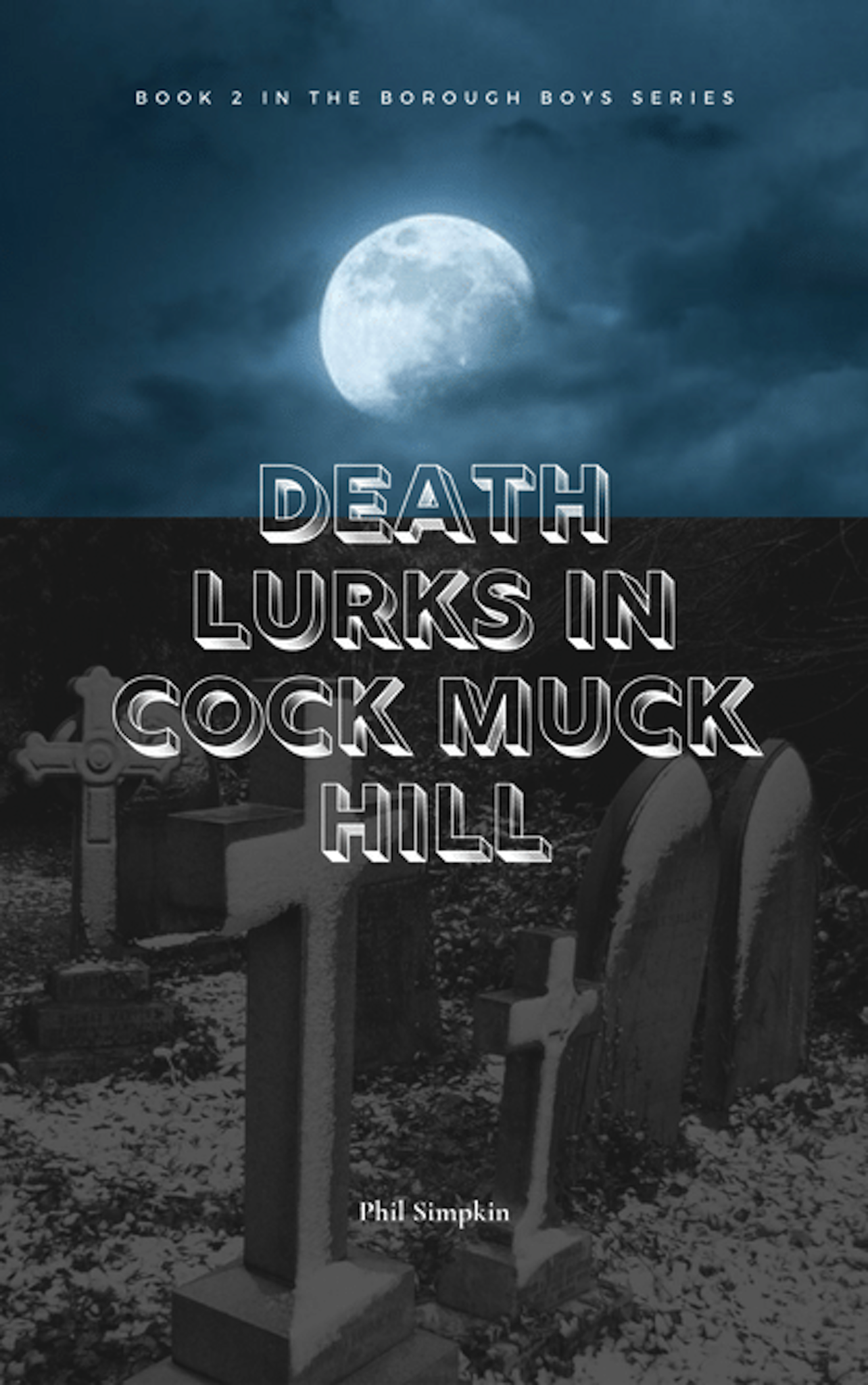
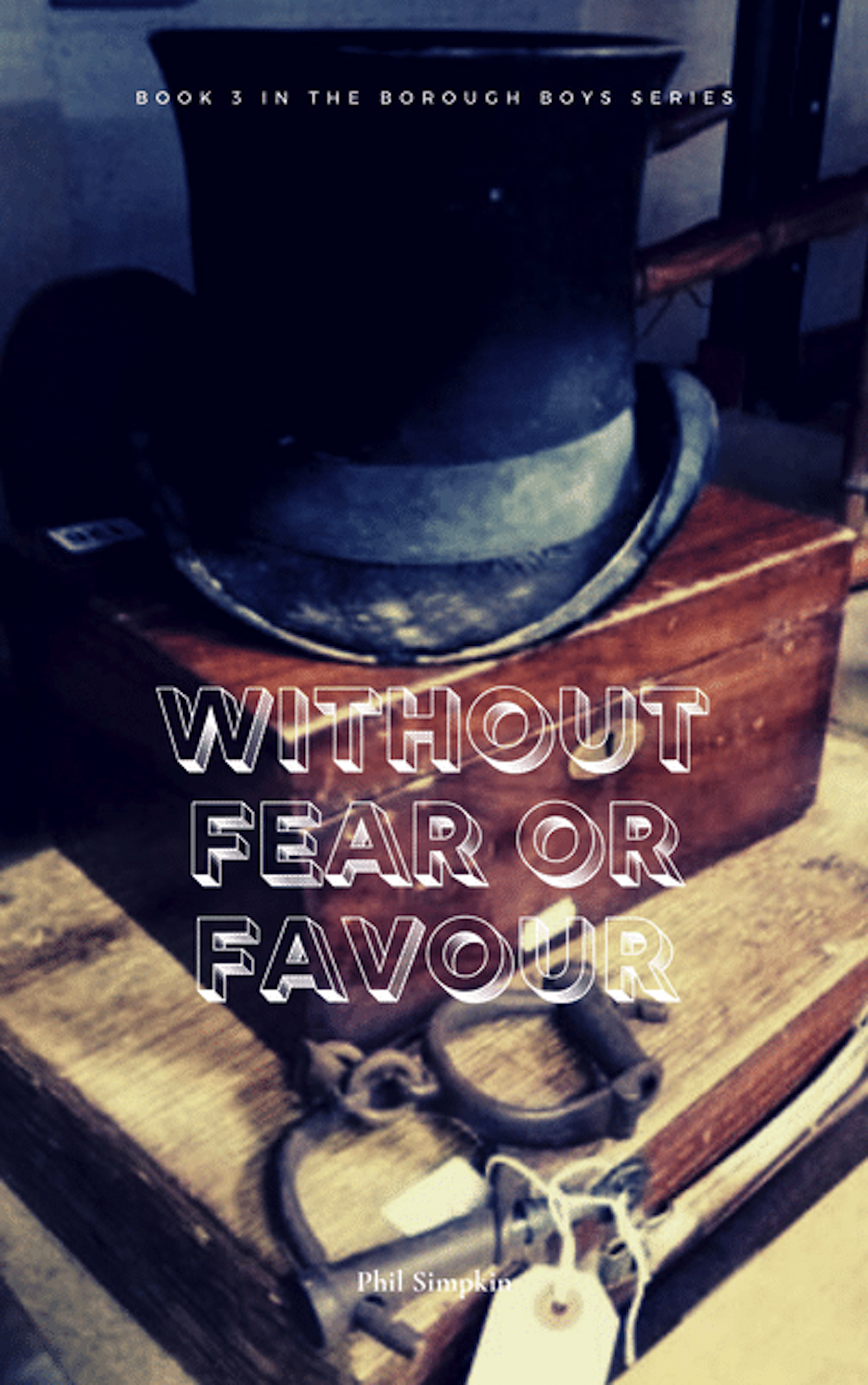
Books 2 & 3 have now redesigned covers for both Kindle books and Print books, and a design for what will be book 4 in both formats has also been completed.
A glimpse of the revamped covers on 2 & 3 below...
February 1, 2021
A recap - the Characters and Locations that my series is based upon...
Who and what are 'The Borough Boys'? Who is Samson Shepherd?
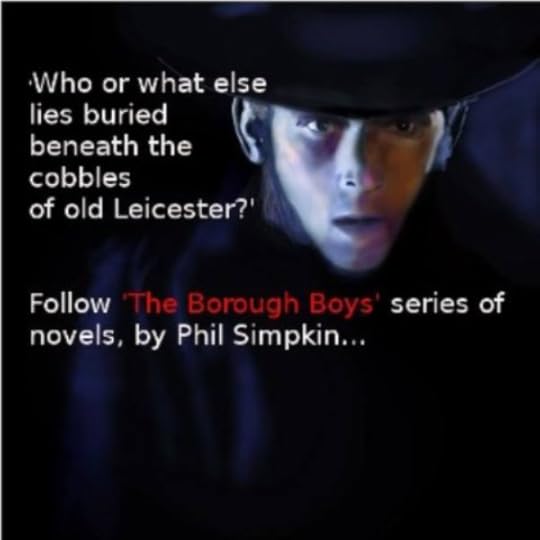
 This is the commissioned artwork by Simon Marchini that forms part of the cover for my 'Borough Boys' series of novels. This is the man I wanted, just as I wanted him to look! Copyright Simon Marchini (c) 2013
Constable Samson Shepherd will become the central character of my present series of stories, and in my first novel he makes his initial impact on Policing in the Borough of Leicester.
Samson was brought up in Sutton Bonington, just over the Leicestershire border inside Nottinghamsire, where he lived with his parents and siblings.
His father, a heavy drinking and violent agricultural labourer, has caused Samson to learn to fight, and Samson has become a seasoned pugilist, primarily to protect himself, his mother and his siblings.
A keen artist and fisherman, he moved to Leicester, to join the Borough Police. This was as a result of the death in service of his uncle George, one of the original fifty constables in the Force, during Chartist riots in 1842.
Samson is tall, red headed (don't call him ginger), strongly built, with a sharp brain, and hard hands. A twice broken nose gives him a noticeable appearance, young and soft, but with something more hardened suggested.
Keen to learn, quick to observe, and with an impressive memory, he is destined to become one of Leicester Police's finest.
Teamed up with his mentor, John Beddows , a rugged copper, previously reduced in rank for a fondness of 'the drink', they are to make a formidable pairing. Beddows is a street hardened cop with loads of experience, and knows all the ropes.
They will learn from each other and grow into a notable crime fighting team!
Also, meet the real coppers of 1850's Leicester, Robert Charters, Francis 'Tanky' Smith, 'Black Tommy' Haynes and co, who add colour to my stories.Who is John Beddows?
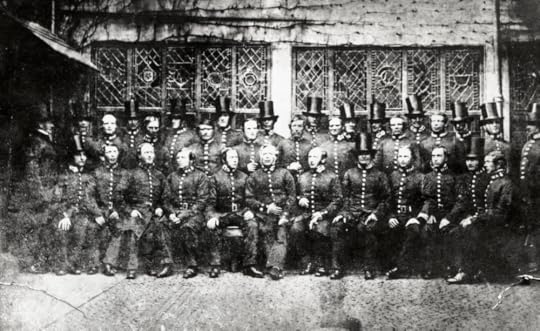
John Beddows is one of the original fifty officers employed by Leicester Borough Police in 1836.
Promoted to a Sergeant for his exemplary courage and knowledge, he was previously 'busted' to Constable second class due to his thirst for Ale, as was so common a curse in this period of Leicester's history.
Now a hard but fair detective sergeant he is Sam Shepherd's mentor, and he takes Sam under his wing, demonstrating the skills Sam would need to not only thrive, but to survive, in a pretty lawless and violent emerging Industrial Town.
Stocky, craggy, battle-scarred and hard, he is a fearsome adversary, and backs down to nobody. My real 'Crushers' - Francis 'Tanky' Smith, 'Black Tommy' Haynes & Robert Charters.
Not only was Tanky Smith Leicester's first private detective, he began his career as one of the first Police Detectives in The Borough of Leicester Police.
He and his partner in crime, Thomas 'Black Tommy' Haynes feature in my series 'The Borough Boys'.
It is thought by many that because of his mastery of disguise, to infiltrate Leicester's Victorian gangs, he was the basis for much of Conan Doyle's Sherlock Holmes.
Tanky Smith ultimately left the Borough Force and became a Private Investigator, of note, but he will feature accurately in 'The Borough Boys' series until the timeline says otherwise!
'Black Tommy' (The name sounds really sinister, but there is nothing to substantiate anything sinister at all) will feature, likewise.
Robert Charters joined The Borough Force in January 1840, on recommendation from The Metropolitan police, and served as Head Constable (The Borough's equivalent of Chief Constable), until October 1871.
From Peelers to Pandas
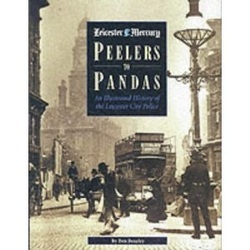 Image copyright Ben BeazleyMuch of my research would not have been possible without the help of a former colleague of mine, Ben Beazley, who sadly passed away recently.
Not only did Ben help with background information, but also with actually writing and publishing considerations.
Ben wrote a wonderful account of Leicester Borough Police, and its transition to Leicester City Police, and ultimately through its merger into Leicestershire Constabulary (what would be Leicestershire Police, as it is today).
My respect goes out to Ben for his endeavours, which have helped me tremendously, working out what these guys must have gone through, from the humble beginnings of 1836.
Ben's book can still be purchased via the link below. It is full of brilliant facts and information covering the whole timeline that 'The Borough Boys' will live through!
http://www.amazon.co.uk/Peelers-Pandas-Illustrated-History-Leicester/dp/1859832318
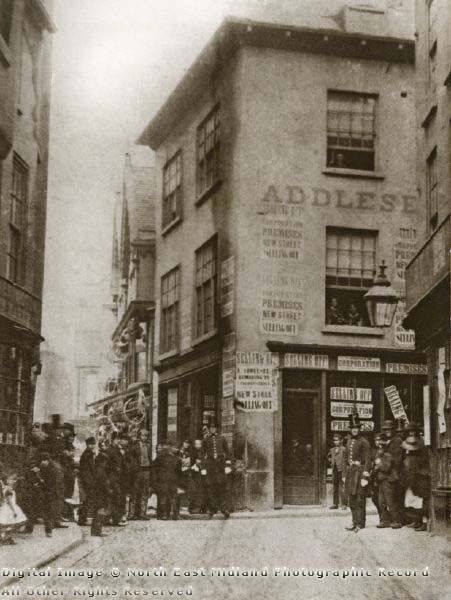
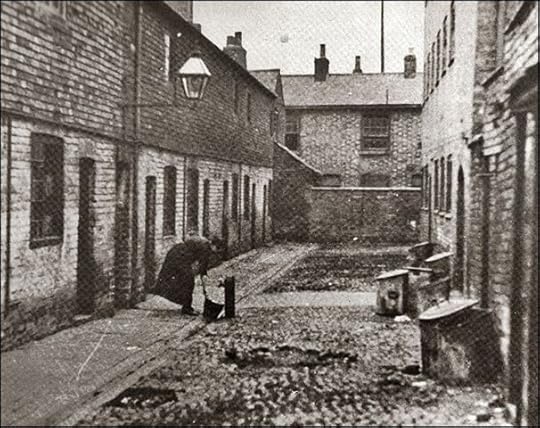 Sandacre Street - the communal water conduit ca1920A site for great images of what Victorian Leicester really looked like...
'Leicester Past & Present'
Click here
Thanks to Terry at the website for allowing me to reproduce / share images from his site, including the gallery below. [image error]
 [image error]


 [image error]
 [image error]


The Rookeries
For those of you who are unfamiliar with Leicester, the area that I am going to portray in many these stories is now long buried under the façade of a modern industrial City.
If you look at a modern street map or plan of Leicester, search for Abbey Street (See map above).
Abbey Street was in many respects, the centre of the Rookeries, and divided the Irish immigrants from the remainder of the area’s inhabitants.
Mansfield Street still exists, which runs between Churchgate and Abbey Street.
Part of Sandacre Street still exists, and that runs between Mansfield Street and what is now Gravel Street, and the location of the current St. Margaret’s Bus Station.
The original Sandacre Street dog-legged and was thus, longer than it is today, the road turning right towards Abbey Street, before meeting up again on the old Gravel Lane.
Cock Muck Hill would have stood underneath the Factory and Office blocks (Mansfield House) between Mansfield Street and Belgrave Gate, across to the end at Abbey Street. Baker Street ran parallel to Abbey Street and would have sat under what was the old Odeon Cinema site.
Bateman’s Row and Bateman’s Yard and ‘The Rats Castle’ would have stood near to the corner of what is now to the left of Sandacre Street at its junction with what is now Gravel Street, on the opposite side of Sandacre Street to the old bus depot.
Green Street and Lower Green Street, the heart of the Irish population, would have stood beneath what is now the multi-story car-park leading up to the old ‘Abbey Motor Hotel’, within the confines of Orchard Street and Garden Street, which still exist today. About 900 Irish immigrants lived in this small area in 1851!
Sadly, none of the old housing that formed The Rookeries can be seen today. Ned Newitt, in his book ‘The Slums of Leicester’, paints probably the best picture of old Leicester, and has images of some of the slums that made up these streets.
It is important to remember that these were the smallest, cheapest, poorest houses that one could imagine. Often no more than two rooms, about 6’ to 10’ square, built around tiny yards, with their privies and dirt, full of all the least able in society.
To get to the yards, the alleyways formed a network or maze, running in and out and joining each other up as a dark and foreboding route in and out of the hovels.
The airiness and space of modern Leicester hides its dark and dismal past.
January 31, 2021
An overview of the work of Phil as at January 2021
Current Books by this Author

The three books currently in circulation under 'The Borough Boys' series are;-
Jack Ketch's Puppets (2013)

Death lurks in Cock Muck Hill (2013)
Without Fear or Favour (2016)

My other publication in circulation is;-
Leicestershire Myths & Legend - in verse
2021 - A year of change
After a challenging year or two, 2021 offers a time for change, and shortly, time for a fourth book in my 'Borough Boys' series of novels.
I have also made the decision to close my 1455bookcompany website, which was becoming more of a vanity asset.
I will endeavour to make more use of my blog, and the Facebook page for 'The Borough Boys', and Twitter will be utilised for promotional purposes.
I hope this does not disappoint.
Thanks
Phil
31/1/2021
November 11, 2017
Those voices in my head...
The voices inside my head have finally started, once again.
I have been struggling with how to adapt the work I have already undertaken on book four, which was not going the way I best wanted, wandering further and further away from any chance of links to what will become book five.
Last night, Beddows and Shepherd started chatting away and provided me with a solution, and one which I had not considered, but will add perfectly to resolving my dilemma.
Funny how a little reading can get my voices talking.
Time to get book four back on track.
Phil Simpkin's Goodreads Blog

- Phil Simpkin's profile
- 16 followers


![[image error]](http://www.1455bookcompany.com/uploads/3/4/5/0/34508318/7404092_orig.jpg)
![[image error]](http://www.1455bookcompany.com/uploads/3/4/5/0/34508318/2872670_orig.jpg)
![[image error]](http://www.1455bookcompany.com/uploads/3/4/5/0/34508318/4597609_orig.jpg)
![[image error]](http://www.1455bookcompany.com/uploads/3/4/5/0/34508318/1044072_orig.jpg)