Chuck Sandy's Blog
October 2, 2021
The Bullet or the Ballot Lesson Plan

Craig Wherlock (Greece) shares a lesson plan he uses to encourage students to think critically about the civil rights movement.
The Bullet or the Ballot was the name of a political speech American civil rights activist and Muslim minister, Malcolm X delivered in 1964. In it he set out the choices he believes Black Americans had in dealing with the racism they faced in the United States. Malcolm Xs beliefs were the polar opposite of those set out by fellow minister Martin Luther King, who advocated peaceful non-violent opposition to racism.
An ambitious lesson planThis is a classroom lesson plan I have used several times over the years, and it has produced incredible results in terms of generating language use and heightened interest from English language learners I teach. It is aimed at those with a confident grasp of English, preferably B2 and above, or indeed you could use it in a social studies class. It is ambitious in its scope, but I believe if you ask a lot of your students then they can far exceed your expectations. However, with less-advanced students, the teacher is going to have to provide a lot more support in terms of helping them prepare suitable language and with explaining the social and historical context of the times and situation.
The entire lesson will require at least 2-3 meetings of 45 minutes each, and access to the Internet, either at home or in the classroom.
Lesson plan steps1 Ask students to write down or research what revolutions/rebellions have taken place in their country over the last 100 years, this can set for individual homework prior to the lesson or done via internet in groups if they have access at school. In Greece, this is a tall order considering the country’s turbulent history during most of the 20th and 21st century.
2 Students compare their information with other groups or individuals and report back to you.
3 Now ask them if drastic social change ever comes about completely peacefully. Once again, they discuss this in groups and emphasise the fact that you want concrete examples to support their ideas. Ideally, this would involve access to the Internet in class.
4 Explain to students that they are going to see a trailer for the 1988 movie, Mississippi Burning, and ask them to write down;
What kind of film is it?
Where is it set?
When is it set?
What is the basic plot?
5 Student watch the trailer and write down what would they have done if they had been born Black American in the community depicted.
6 Students discuss their answers with each other.
7 Now, explain to the students who Martin Luther King and Malcom X were. Most likely, the names will be unknown to younger students and so ask them to do a quick five-minute search on Google. Make sure they understand that both of the men were Black leaders who lived and campaigned in the same era as Mississippi Burning was set (the early 60s), yet both had very different ideas about how the Afro-American community should deal with racism.
8 Divide the class into two groups and give them links to either Malcolm Xs “The Ballot or the Bullet” (speech transcript and audio) or the “I have a dream” speech by Martin Luther King (transcript here, audio here). Both texts present a challenge to learners, due to their linguistic sophistication and the fact that it belongs to an era that may be unknown to your students. It is not necessary for them to understand everything, but rather get the general idea of the speakers. This is best done over the course of a whole lesson in which students work in groups and are allowed to help each other.
9 Alternatively, for homework, students listen to the speeches and write down what each leader thinks should be done to improve the situation of their community and why. You might need to check on students’ ideas to ensure they got the gist of the speeches.
10 Now explain to students that they are now either Martin Luther King or Malcolm X and they have to debate what is the best way to deal with the problems Black Americans face in the society shown in the Mississippi Burning trailer. Students should use the ideas in the speeches to support their ideas.
11 Organise a class debate about which speaker had the best ideas on dealing with racism. This will form the basis of a essay, which students can plan in the lesson in groups and then at home individually.
12 Answer an essay question.
“Malcolm X or Martin Luther King: who would you have followed if you had been a Black American in the 1960’s?”
The post The Bullet or the Ballot Lesson Plan appeared first on iTDi Blog.


Pick a cause and fight for it!

Margarita Kosior (Greece) shows us how the has introduced the topic of companion animal welfare into English language classrooms all over the world.
“Pick a cause and fight for it,” I once heard from a like-minded colleague, and this sentence has been my motto ever since. True, we cannot do everything, but we can all do something for at least that one cause we decide to support with all our might.
My causeThe fate of stray animals has always been close to my heart. In 2014 I adopted my cat, Cookie, and in 2016, my dog, Mocha. Since then, I have been looking for ways to make a difference and bring a change for stray animals, not only in Greece, where I am based, but all over the world. I always have dog food and cat food in my car, but I never thought this was enough. I have found homes and families for a number of stray animals, but this does not sound like the ultimate solution either. I have cried and I have worried, but issues of animal neglect, abuse and abandonment require more powerful means than despair, pity and distress.
I am an English teacher and education is my secret weapon; and that’s the weapon I decided to use to communicate my cause and my passion to teachers and learners of English all over the world.
The power of storytelling and educationI believe in the power of storytelling and the power of education to bring a big change, and an English language classroom is the right place for this change to happen. As students are working on their English and developing their 21st century skills, they are also shaping attitudes and beliefs in ways which bring hope for a better future for all living creatures on this planet. And that exactly is the purpose of the Tales of strays campaign, which I created to introduce the topic of companion animal welfare into English language classrooms all over the world. ELT professionals can support the campaign and fight for companion animals and their rights in three ways: through storytelling, materials writing and teaching.
StorytellingThe campaign started with a picture book (Toby to the rescue) — a story which I wrote and my then ten-year-old daughter Evita illustrated. It tells the story of Toby, a stray dog who lives under a tree in the park. He doesn’t have friends, and he doesn’t even have a name. When one day Toby meets Little Nick, who is taking a walk in the park with his mum, the lives of the dog and the boy change forever. Of course, Mum is always there to give precious advice about what responsibilities are involved in keeping a companion animal.
The second story, Mae to the rescue, is a more recent addition to the series and to the campaign. In this story, a girl named Lucy has some important shopping to do, so she goes to the shopping mall with her mum. Suddenly, when she loses sight of her mum in a crowd of shoppers, the little girl panics and starts crying. That’s when she meets Mae, a stray dog who offers her help. They become very good friends, but then it’s time to say goodbye …
Tales of strays, therefore, is a book series about how lives change when a child meets a stray. The books can be used either as bedtime stories, or as educational tools raising awareness and empowering the youngest people on earth. In either case, they can be accompanied by a number of free activities and resources available on my website. The stories will appeal to both very young and a bit older readers, thanks to engaging plots, dialogues written in the form of rhyming chants, and beautiful illustrations made by a child.
I have personally taken the Tales of strays picture books to storytelling sessions at preschools and schools in Greece and also abroad (e.g. Serbia, Argentina, and Kazakhstan), and have been amazed by the level of student motivation and engagement during those sessions, and also by the children’s innate capacity to empathise with animals lacking love, care and devotion they deserve.
Materials writingEvery year, Tales of strays supporters and friends celebrate World Stray Animals Day (4 April) with a publication. The first publication, The human-animal bond and what it enTALES, released in 2020, is a compilation of 11 lesson plans written by educators and materials writers from all over the world. The title of the second publication (2021) is ELT for companion animals and it contains another 11 contributions. Since the release of the two compilations, teachers in various countries have used those lesson plans in their classrooms to introduce students to the issue of companion animals and our responsibilities towards them, and have talked about the plight of stray dogs and cats. We’ve seen some amazing projects — posters, pictures, reflections, videos, poems, and more — created during and as a follow-up of those lessons.
Teachers who are willing to support the cause through materials writing can consider designing a lesson plan on an issue related to the broader topic of human relationship with companion animals (e.g. responsible dog/cat adoption, understanding dog body language, therapy dogs), teaching values such as compassion, commitment, empathy, etc. The lesson can be designed for an age group and CEFR level of the author’s choice. The author is not expected to directly speak about animal neglect and abuse. Instead, they can choose to highlight the beauty of our relationship with companion animals and nurture positive behaviors towards them, rather than directly condemn negative attitudes. I feel we can have a more powerful effect this way. Any teacher or materials writer willing to participate can send a message to talesofstrays@margaritakosior.com to express interest in contributing. Every year, compilations are uploaded to talesofstrays.com — the place which I currently use for Tales of strays related activities — and made freely available to anyone who would like to spread awareness of the problem of stray companion animals worldwide.
TeachingNo matter how creative and engaging the materials in the Tales of strays compilations are, they would not make much of a difference in the world if it were not for the inspiring teachers willing to bring the topic of companion animals, their well-being, but also their frequent neglect and abandonment into lessons.
In order to become an official Tales of strays supporter, throughout the academic year, the teacher or school needs to commit to delivering at least four lessons of their choice from the existing compilations (The human-animal bond and what it enTALEs and/or ELT for companion animals) or to suggest their own ideas or projects and work on them with their students. Since the campaign can only grow if we get the word out there, teachers try to support the cause on social media by posting samples of their students’ work and their reflections. This way, we can get more teachers and students involved, and make an even bigger impact.
Gandhi said, “The greatness of a nation and its moral progress can be judged by the way its animals are treated.” The Tales of strays campaign, based on its three pillars of storytelling, materials writing and teaching, and aiming to change our attitudes towards companion animals, can only take us forward.
More information about the campaign can be found on my website or on our Facebook page.
The post Pick a cause and fight for it! appeared first on iTDi Blog.
Storytelling for a cause

Efi Tzouri (Greece) introduces storytelling activities she has used in her teaching with the Hands Up project and with refugee children in Greece
This article is based on my experience as a volunteer with The Hands Up Project, as well as an educator working with refugee children in Greece.
Establish a safe environmentFirst and foremost, what is essential is to allow space for feeling and establishing a safe environment for teaching, by designing lessons with sensitivity and consideration. We should always give the opportunity to learners to use the language they have been learning through interaction and group work, and value learners experiences in the classroom. It is effective to design tasks that follow simple instruction, introduce one thing at a time and involve a lot of practice either through repetition (especially for the younger learners) or through role play and communicative activities. Also, it is very significant to provide help and support when it is needed, to make sure that everyone is engaged in the activities and can participate easily and naturally in communication.
Sharing experiences through storytellingStorytelling has been an integral part of communication and accompanies our daily lives. The emergence of technologies has generated a re-orientation of the ordinary, or traditional storytelling, by giving opportunities to narrators to share personal experiences by using digital and multi-modal elements, like videos and pictures, as well as music, both in a face to face or in an online environment.
Storytelling is a form of art which not only has the power to motivate learners and engage them in the language learning process, but also to provide them with opportunities to cultivate life skills like creativity, collaboration, critical thinking and problem solving. Learners are introduced to new concepts and material, they are given the chance to develop their ideas in an organized manner and discover meaningful ways to apply their knowledge. Language learning is turned into an experiential process by adding a dynamic pedagogical value to the utilization of Storytelling.
Foster self-expression and self-awarenessCreative activities based on storytelling aim at fostering self-expression and self-awareness by providing the opportunity to young learners to introduce themselves to others, to talk about their preferences and to create space for feeling and openness. Additionally, a bridge between personal and school life can be built establishing a safe environment for teaching.
One of my favourite storytelling activities is built upon personal objects that learners are asked to choose and bring to class. It is important to mention that I selected this activity as an ideal one because for me it empowers creativity and imagination, and also it develops trust and space for interaction and communication.
The activity can be divided into two parts. The first part can turn into a guessing game. In class, all objects could be put in a box and learners should be encouraged to find out which object belongs to whom. If the lesson is online learners can be instructed not to reveal their object, so that the other participants could guess what kind of item it is by asking questions about size, colour, material, or use. In the second part, students are asked to write a story about their personal objects (who gave it to them and why, or why they bought it, why it is their favourite, what makes it valuable or important to them, what it reminds them of, where it was bought, etc.). A great outcome is to encourage learners to share their stories by either reading them or acting them out.
Storytelling enhances learningStorytelling not only embeds the power to enhance learning through experience but most importantly gives an active voice to learners to share their thoughts and to express their feelings, hence to develop a dynamic personality in a classroom environment. Personal stories are reflected upon narratives, and learners are given the chance for self-representation and self-expression. Live narration holds the power to throw light on diversity and cultural identities and personal storytelling can turn a typical narration to active participation by inviting the audience to become engaged and to identify with the characters or the situation.
Storytelling gives kids wings to fly by their hearts and their minds to tell their story and celebrate their glory. It is where those kids belong now and where they want to be in the future
– Haneen Khaled The Hands Up Project
The post Storytelling for a cause appeared first on iTDi Blog.
October 1, 2021
Introducing Inclusive Practices in Education: A Letter to Colleagues

Angelos Bollas (Greece) gives us advice on teaching about inclusion, equality and diversity
It appears to me that the number of colleagues who are interested in adopting inclusive practices is on the rise. I observe several webinars, conference talks and workshops, as well as informal discussions on social media being dedicated to Equality, Diversity, and Inclusion (EDI). Even though this is a great development, it is vital that colleagues be cautious when it comes to receiving advice about such sensitive matters. Indeed, most language teachers around the world are not trained in psychology, sociology, and other sciences relevant to EDI. As such, it becomes easy to follow advice that appears to be sound without critically examining its validity. This letter aims to help colleagues develop their criticality with regards to EDI-related materials, practices, and sources.
Dear colleagues,
Although colleagues in Academia have long been interested in exploring the issue of inclusion and inclusive practices with attention to gender and sexuality in education, and in English Language Teaching (ELT) in particular, the issue has only recently received wide attention among ELT professionals. It was only a few years ago that the first relevant talk (concurrent event) at IATEFL took place and, since then, we have observed a plethora of conference presentations, publications for teachers and learners, webinars, and other modes of information/knowledge sharing addressing this topic.
Even though one should not but welcome such developments in our field, it is important to take them with a pinch of salt, as we ought to do with anything that ascends overnight from being a so-called taboo topic to becoming a trend. This short blog post addresses those teachers who are genuinely interested in being inclusive and providing their learners with lessons that allow them to be seen, recognised, and celebrated for being who they are. Its aim is not to put them off from learning more about inclusive practices; quite the contrary, it aims to encourage credible, ongoing, and multidisciplinary education on the subject.
What is ‘credible’ education?What is being challenged through these few words in this post is the concept of ‘credible’ education. Arguing that credible education is solely university-produced knowledge would make this author (or any other one for that matter) nothing but an elitist who is ignorant of the fact that the working conditions of English language teachers around the world do not allow them to access well-guarded scholarship from journal articles and academic publications. At the same time, it would be ignorant to claim that only those working in academia are capable of producing work that is worthy of attention and consideration.
So, the question should not be so much about what makes the cut to being considered ‘credible’; rather, the question should be what it is that we, practicing teachers, should be on the look-out for when consulting advice with regards to inclusive practices. Below, there is a brief list of what one should be wary of:
Sources that focus too much on the author’s personal experiences.Although it can be extremely insightful to hear or read about someone’s own experiences with (a lack of) inclusive practices as learner and/or teacher, it is not fruitful to assume that one person’s experience is generalisable and/or that it provides enough evidence to base any teaching or materials design decision on.
Sources that are not based in any form of research.As discussed earlier, accessing journal articles or academic publications can be very expensive, especially for English language teachers. However, it is not uncommon for professional publications to be based on secondary research, that is, research conducted by others. Such publications can be a very valuable tool for us because they are not based on one person’s beliefs or thoughts. Rather, they are based on research and evidence, which, in turn, allows us to reflect on the applicability of a certain task, idea, or approach to our own learning and teaching context.
Sources that provide you with ready-made lessons (and no framework to help you design your own sources).Even though ready-made lessons are very useful, especially for busy classroom practitioners, there is a danger that colleagues might end up giving the odd token lesson every now and then. Indeed, while every attempt to address inclusion, or lack of, is a significant one, it should be noted that token lessons can potentially contribute to the stigmatisation of certain identities. It is necessary to adopt a more holistic approach which extends beyond the single odd lesson. As such, it is important that we consult sources that encourage us to develop such an approach and apply it to all materials, the ones we design but also the ones that are publicly available.
Perhaps, at the heart of this post is an attempt to encourage colleagues to engage with the issue of inclusion and inclusive practices in a meaningful manner, to congratulate those who are already involved in this complicated but important mission, and to promote research and evidence-informed approaches.
Best Regards,
Angelos
The post Introducing Inclusive Practices in Education: A Letter to Colleagues appeared first on iTDi Blog.
September 4, 2021
Happiness Hacks – simple positive psychology exercises for teachers and students

Marc Helgesen (Japan) shares happiness hacks based on the science of positive psychology
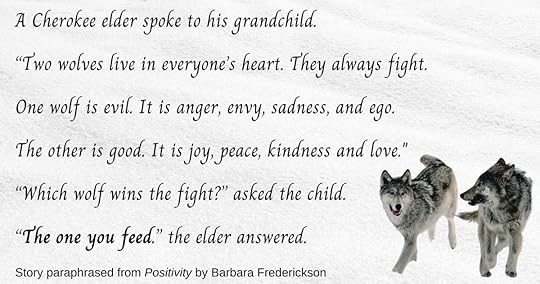
There are many short, simple activities we can do to make ourselves and others happier. Dr. Laurie Santos of Yale University and The Happiness Lab blog refers to them as “happiness hacks.” What follows are happiness hacks. Most you can do either for yourself or with your students, or both. The first are silent. Most you can do privately, even if you are in public. The second set you may want to do out loud. Many you are likely to want to share with your students. Enjoy.
LINKS: Happiness blog link: https://www.happinesslab.fm/
Happiness hacks link: https://www.youtube.com/watch?v=4gwi-rzSwlQ
Silent happiness hacks(Those with links have a variation you might want to do with students).
Time confetti (Explained at 14:45 in the linked podcast) Yale’s Laurie Santos  says we actually have more free time than we did 10 years ago. It is just broken into tiny bits. We often don’t use it. Make a list of good things you could do in those 3- to 15-minutes chunks of free time (remember you are trying to be happier, not necessarily more productive). Make your list. Then, when you have free time (10 minutes until your next ZOOM?) do one. Starter list:
Notice nature walks. Take a slow walk outside. Notice nature. Even if you are in a big city, there are probably elements of nature: the breeze rustling leaves in the trees. Leaves crunching under your feet. The sounds of birds. See how much you can notice. In the spring, try walking somewhere where you can smell flowers, etc.
 Just smile. Sit somewhere private. Close your eyes. Make a big smile on your face. The smile is likely to trigger positive neurotransmitters. Notice how the feeling builds.
Spreading and catching smiles. In some public place, smile at strangers. Many will smile back. We naturally reflect smiles. Of course, if someone doesn’t smile back right away, look at someone else. You don’t want to come off in an inappropriate way.
Breathing 6-5-4. Breathing is one of the quickest ways to work with the mind/body connection. A basic concept is to breathe out through the mouth and breathe in through the nose. This is because the mouth is bigger than the nostrils. You want to expel as much old air as possible. A good way is to breathe in for the count of six, hold your breath for the count of five, breathe out for the count of four, then hold again for the count of five. Repeat several times. The important thing is not the specific count, it is the ratio. You can raise or lower the numbers to match what feels good to you. If you aren’t used to doing yoga breathing, you might feel a bit dizzy. I teach my students this for settling their nerves before something stressful like presentations, big tests or job interviews. You can do it privately in pubic.
Walking meditation (fast) (breathing). You easily can combine Breathing 6-5-4 with a walking meditation. Go of a walk at a fairly relaxed pace. Use your breathing and steps to match you 6-5-4 pattern as in Breathing 6-5-4. Note, this is a walking meditation but your eyes are open.

Walking meditation (slow). This time your eyes are closed. You need an open space, like a gym or big hall that isn’t being used at the time. You need a lane of about 5-8 meters that doesn’t have chairs or other things to trip over. Stand and close your eyes. Breathe deeply a few times Very, very slowly, lift your right foot. Move it forward about half the length of your foot. As you do, notice the muscles in your foot and leg. Set your foot down. Shift your weight from your left. Notice every muscle move. Slowly repeat the pattern: lift, forward, step down, shift. Repeat the pattern until you have gone several meters forward. If time permits, turn around and slowly return to your starting point.
Eating with mindfulness. Get a piece of fruit or chocolate. You are going to eat it as slowly as possible, using all the senses. Start by looking at it. If it is fruit, notice what is different about this piece compared to another one. Smell it. Depending on what you are going to eat, the smell might be enough to make your mouth wet with saliva in anticipation of the treat. Bite off a small piece. Put it on your tongue but don’t start chewing. Does it trigger saliva in your mouth? Really notice the flavor. Bite into the piece. Does is make a sound? As slowly as possible, each the whole piece. Continue. Really notice what you are eating. Enjoy!
Inhaling in a supermarket. Next time you are in a large supermarket – the kind that has a bakery and a flower shop — slowly walk through the bakery as if you plan to buy something. You are really there to inhale. Notice the delightful aroma of freshly baked bread. Then go to the flower shop. Do the same thing. Notice the aroma. (Maybe buy a flower for someone who doesn’t expect it— but that’s an entirely different happiness exercise.)
 Sounds around you (Sounds surround you). Find a relatively quiet place to sit. Close your eyes. Breathe deeply. Listen closely for about a minute. How many different sounds can you hear?
For you (and maybe your students)
These are good exercises for you. And you might want to share them with your students.
 3 good things today. Each day, probably in the evening write down 3 good things that happened today and why. “Why” can either be why each happened or why it was good. To make this a speaking activity, have students make and share their lists and ask questions about the events.
3 good things a day this week. Like the task above, but do it every day for a week. To make it a speaking task, again, students share the highlights. In vetted research, people who do this are likely to have up to six months of positive results just from doing this for a week. Essentially, they get in the habit of noticing good things.
Affirmative constructive responses. When someone tells you about something good that happened to them, ask follow-up questions that let them go deeper into the positive emotion: Great! Where were you? When did this happen? What happened next? This allows the speaker to re-experience the positive feeling, and it also helps keep the conversation going.
Example Link: (Active Constructive from 4:18)
Compliments. Why do textbooks rarely include compliments? Here are some to tell yourself. You can also write them on the board and have students, in small groups, give each other true compliments. You’ve got a beautiful smile. That’s a really nice scarf. You’re really nice. Cool jacket! You’re always on time. You’re so smart. You are really creative. After giving the compliments, partners just say, “Thank you.” At the end, they try to remember the compliments, think about them and smile.
 Growth mindset responses. Most of us think of Dweck’s growth mindset responses as being for students. But they are good for use as teachers, too. When you do something well, compliment yourself. Here are some ways: Your hard work paid off! You really tried hard on that. You proved that you can do it! You should be proud of what you accomplished. You kicked butt! Of course, these work well with your students, too.
 Thank you to the world. Alone or with a partner, see how many languages you can say, “Thank you” to. Think of a reason to thank that language or culture. How many can you list? Examples: I want to say “shukran” to the Arab world. They invented math. (I don’t like math but it is important.) I want to say “gratze” to Italy for great art. And pizza.
Positive words. If doing this on your own, choose the list you want to use. If you live in a place where English is not the first language, consider translating the list(s) into the local language. Today or this week, try to use them in daily conversation or in class. How many can you use today? Tomorrow? This week?
Elementary: good, joy, nice, helpful, happy, love, smile, kind, great, fun, cool, sweet, enjoy, super, laugh.
Intermediate: wonderful, incredible, pleasant, excellent, delightful, peaceful, enjoyable, fantastic, fabulous, terrific, brilliant, amazing, awesome, marvelous, outstanding. Each evening, see how many you can remember. How did you use them? You can have students try this, too.
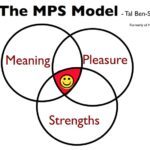 Make your job a calling. Amy Wrzesniewski (Yale School of Management) says occupations can be “a job” (you do it for the money), “a career” (money plus status, opportunities for promotion, etc. ) or “a calling” (you do it because you are contributing to a greater good). This can be any job, but maybe easier for us since we are teachers. Tal ben-Shahar says you can find the calling in your job with an MPS (Meaning/Pleasure/Strengths) model. Think about the part of your job that makes it meaningful. Perhaps helping students communicate independent of you. What in your job gives you pleasure? Seeing your students succeed? Where does that cross over with your skills. You are a teacher. You know how to help students do things. That center point in a Venn diagram is your calling. Enjoy it. Maybe it isn’t there every hour of every day but appreciate it whenever you notice it. And notice it often.
(This takes a bit longer than the others, but will give you 8 great topics to reuse.)
8 things happy people do.
Remember good things when they happen.Thank people.Do kind things.Take time for friends and family.Forgive (including yourself)Notice good things as they happen (mindfulness).Take care of your health and body.Find ways to take care of problems.Teach these, probably one at a time.
Then have groups make haiku (5-7-5 syllable poems) on posters. Share.
Artwork © clipart.com. Used under license to the author.
The post Happiness Hacks – simple positive psychology exercises for teachers and students appeared first on iTDi Blog.
Fixing your biggest work from home problems in 2021

Chris Rush (USA) provides solutions for three of the most common issues related to working from home
Now that we’re well into 2021 and working from home is more mainstream than ever before, we need to talk about self-care. This topic has been too easily overlooked (especially for teachers but for all professionals) because it’s tragically easy to assume that working from home (WFH) makes self-care easier.
Unfortunately, nothing could be further from the truth.
Let’s assume that the adjustment period is over, and you’re used to the new normal of now working from home — you’ve got your working corner set up, and your family finally understands that this isn’t vacation.
There are long-term perils of working from home, and if you’re a 1-year WFH veteran, it’s likely that you’re over the initial growing pains and now starting to come to terms with the long-term effects. Let’s talk about them and how to deal with them.
Problem one: the blurring boundaries between working time and home time.This can happen slowly and innocently. You start off by enjoying the breaks you can take during the workday, whether it’s to spend time with family, exercise, or just take a nap. You make up for the lost workday time by having your laptop on during evening TV time. Gradually, the boundaries between when you’re working and not working begin to fade. Eventually you feel like you constantly have a screen in front of you — computer, tablet, phone, and even during the time that you’re supposed to be relaxing you’re thinking about the work you “should” be doing instead. This didn’t happen before because work was in a specific geographic location that was distinct from your home, but now your work life has invaded all your personal spaces. Anxiety over tasks undone replaces the pleasure you used to feel at home.
The fix: make your “work” as location-specific as possible.Stop mixing locations. Make your office, or your desk, the only place you work from. If you have a laptop and you’re used to working from the kitchen table or couch, try confining it to one specific place, and that place will be “where work happens.” When you go there, your mind can switch into work mode. When you’re in this place, don’t engage in distraction — this location is your sacred workspace — you can check social media from any other location in your home, but save this one for work. This strategy works especially well if you have multiple devices. A “work computer” can be used only at the desk for work purposes. Don’t work from your couch on your tablet — reserve that for fun, and keep it away from your work area. You can make this boundary stronger by wearing “work clothes” in your work area — anything that makes you feel like it’s time to get down to business — and changing into something more comfortable when you’re finished for the day. Do your best to keep to a timetable — decide what time you’ll stop working that day, and when that time comes, leave everything else until tomorrow.
Problem two: your work area is not optimized.It’s likely that when you first started working from home, home office supplies were scarce. Things like external monitors and webcams were out of stock for months, so we had to make do with what was available. It’s quite possible that you got used to sub-optimal conditions for work, and then forgot about trying to improve them.
The fix: upgrade your workspace.Hunching over a laptop on a desk is a bad way to spend 8 hours a day. If you don’t have a desktop computer, get an external monitor, mouse, and keyboard, and elevate the display so that you’re not looking down at it (your neck will thank you). You could even skip the monitor and just get the mouse and keyboard and prop the laptop on a stack of books. The point is not to get nice things, but to reduce or eliminate repetitive strain injuries. It has also been said that sitting down for 8 hours a day is as negative for your long-term health as smoking. Try to find a way to alternate sitting and standing. The ideal solution might be a convertible desk, but you can also make your own creative solution. At the very least, make sure you take regular computer breaks to stand up and walk around, especially if your old job had you on your feet.
Problem three: human distractionsEven if we do everything in our power to optimize the work from home environment, one thing we can never control is the actions of others. Roommates, partners, or children share our living spaces, and getting work done doesn’t matter if it comes at the expense of harming our most important interpersonal relationships.
The fix: communication plus environmental barriersThe first thing we should do is be honest about the circumstances, and not expect others to read our minds. For cubicle workers, putting on a pair of headphones might be a perfectly acceptable way to communicate nonverbally to colleagues “don’t bother me right now,” but that message might be less effective and more hurtful to a romantic partner. Don’t be afraid to talk about your needs, and make it clear that the more efficiently you can work, the more unfettered time you’ll have to spend with the other members of your household. Once you’ve had the necessary conversations and negotiated the proper interpersonal boundaries, you’ll be able to implement physical boundaries — closing the office door if you have an office, donning the aforementioned headphones, or hanging the background sheet behind you which family will know to interpret as “shh, Mommy’s on a conference call.”
No matter what the rest of 2021 holds, working from home looks like it’s here to stay. If you’ve struggled to make it efficient, I hope these strategies can help bring you a positive outcome. If you’ve got other tips that you’ve used successfully, please share them!
The post Fixing your biggest work from home problems in 2021 appeared first on iTDi Blog.
Well-being for all in Education: A lofty goal?
Patrice Palmer (Canada) evaluates how well-being policies are being implemented in education
I recently gave a keynote speech at the TESL Atlantic conference in Canada on this topic. In the last year, I’ve noticed more ELT conferences with a well-being theme so it appears that interest in well-being in English Language Teaching is growing which is good news. Despite this trend, few schools or educational institutions are making well-being for all (teachers, students, and all school staff) a priority. For many governments across the globe, there has been an attempt to make well-being a focus, with little progress according to positive psychology expert, Boniwell (2011).
Research related to well-being is exploding but there has been an ongoing debate about a precise definition (and a definition for teacher well-being as well). The World Health Organization (2004) defines well-being as the presence of ‘a state in which the individual realizes his or her own abilities, can cope with normal stresses of life, can work productively and fruitfully and is able to make a contribution to his or her own community’. In more simple terms, well-being is about feeling positively about life, full of energy and good health (Centres for DC, 2018).
Student Well-beingSadly, mental health issues in children and youth have been increasing globally. During the pandemic, these rates have further increased. Students who are not well will struggle academically and as Vella-Broderick & Chin (2021) suggest, well-being is important in its own right and a prerequisite for learning. Furthermore, there is a positive association between learner well-being and higher academic achievement (Suldo et al., 2011). Teachers want their students to be well but often do not have the resources, support or training to do this vital work.
Teacher Well-beingThere has been significant research conducted related to stress in the teaching profession. Teacher stress is higher and well-being lower than in the general population, and stressed teachers are less effective in the classroom (Bentea, 2017; Sanetti, 2021). More attention needs to be paid to the impact of stress on teachers, their ability to function and perform well, and sustain their careers. Teacher well-being is important because without well teachers, Greenberg (2021) argues that “we will not have healthy schools and successful students.” It’s imperative that schools and learning organizations address teacher well-being and implement initiatives that encourage and support well-being.
The Well-being Connection: Students and TeachersTeacher and student well-being is closely linked. Simply put, the mental health and well-being of teachers impacts the mental health and well-being of students (Greif Green, 2021). In addition, there is interesting research from the University of British Columbia (UBC, 2016) that suggests a link between teacher burnout and student stress. The notion of stress contagion indicates that teachers can pass on stress to students. The key take-away is that learning happens best when teachers and their students are well, but as teachers flourish, relationships with students, colleagues and the larger community become more positive (Cherkowski & Walker, 2018). Therefore, there are many reasons why student and teacher well-being may be a lofty goal but a worthy one.
Why Well-being in Schools?Here are some reasons why it makes sense for schools to adopt well-being for all as a goal:
Schools are important for student well-being and happiness (UNESCO, 2016)
Promoting and sustaining flourishing in schools is integral to societies because schools…are the locations for well-being (Cherkowski & Walker, 2018)
Schools that most effectively promote good mental health and well-being adopt a whole-school approach (Weare, 2006)
Teachers can model a healthy lifestyle, mindsets and habits (Cambridge Assessment, 2021)
Can we teach well-being?The good news is yes! A recent study conducted by Yarden (2021) found that even short courses that taught evidence-based positive psychology interventions to enhance well-being improved students’ mental health. The interventions include activities like mindfulness, cultivating gratitude, savouring and self-compassion. Given the challenges of the past 16 months, learning about well-being and applying actions to improve it in students, teachers and all school staff is vital.
How do we teach well-being?One approach is using a positive education model based on the science of positive psychology or human flourishing. Positive education has grown rapidly and evidence shows an effective and meaningful impact on students and teachers within a school setting, and other individuals within the educational communities using this model (Galazka, 2020). Some of the countries using a positive education model are Australia, Bhutan, China, Hong Kong, India, Israel, Peru, Mexico, UAE, the USA, and Canada. Positive education focuses on character strengths, growth, resilience, and optimism, as well as a goal of both well-being and academic mastery (White & Kern, 2018). I have posted some resources below to get you started.
Resources:CorStone – http:// corstone.org/girls-first-bihar-india
ELT and Happiness – http://www.eltandhappiness.com/
International Positive Education Network – https://www.ipen-network.com
Positive Psychology – https://positivepsychology.com/positive-education-happy-students/
Community of Positive Psychology for English Language Teachers – https://coppelt.org/
Growing Strong Minds – https://growingstrongminds.com/
MacIntyre, D., Gregersen, T., Mercer, S. (2016). Positive Psychology in SLA. Multilingual Matters
VIA Character Strengths – https://www.viacharacter.org/
References:
Clarke, T. (2021). Education brief: Learner Well-being. Cambridge Assessment, International Education. https://www.cambridgeinternational.org/Images/612684-learner-wellbeing.pdf
Cherkowski, S. & Walker, K. (2018). Teacher wellbeing. noticing, nurturing, sustaining and flourishing in schools. Burlington, ON: Word & Deed Publishing.
Galazka, A. (2020). Positive Education and Well-being in the ELT Classroom. https://www.hltmag.co.uk/apr20/positi...
Greif Green, E. in Cardoza, K. (2021). ‘We Need To Be Nurtured, Too’: Many Teachers Say They’re Reaching A Breaking Point. https://www.npr.org/2021/04/19/988211478/we-need-to-be-nurtured-too-many-teachers-say-theyre-reaching-a-breaking-point
Suldo, S. & Thalji, A. & Ferron, J. (2011). Longitudinal academic outcomes predicted by early adolescents’ subjective well-being, psychopathology, and mental health status yielded from a dual factor model. The Journal of Positive Psychology. 6. 17-30
Weare, K. (2006). Developing the Emotionally Literate School, London: Sage
White, M. A., & Kern, M. L., (2018). Positive education: Learning and teaching for wellbeing and academic mastery. International Journal of Wellbeing, 8(1), 1-17
Yaden, D., Claydon, J., Bathgate, M., Platt, B, Santos, L. (2021) Teaching well-being at scale: An intervention study. PLoS ONE 16(4): e0249193
The post Well-being for all in Education: A lofty goal? appeared first on iTDi Blog.
July 31, 2021
Teacher self-care matters

Theodora Papapagionotou (Greece) shares nine great ideas for teacher self-care
Being a teacher is a demanding job. Preparing for your lesson, creating lesson plans, teaching your class, facing discipline problems, talking with parents… It takes all of your day.
Being a teacher during a pandemic is even more stressful; your classes are online now, your schedule has changed, you have to learn to use technology efficiently to cater for your students’ needs. You face problems controlling your students, you spend endless hours in front of a screen, sitting all the time, not able to move much and you find yourself working even more than you used to before.
This is the teacher of today.
And while you are doing the best you can to deal with a difficult situation like this, there are people who don’t appreciate your work and the fact that you have dedicated your life to making your students learn.
This is frustrating, and leaves you with a lot of problems; physical, emotional, psychological, you reach burnout even faster than before.
And that’s when you have to put yourself first and do something for your well-being. This is the definition of self-care.
I don’t really know what’s happening in other countries, but in my country, Greece, there is no policy at schools for teachers’ self-care. No matter if you work at a public or a private school or if you are freelance. You are on your own.
And that’s why you have to take things in your own hands and start doing something for yourself.
So, I have some tips for my own experience and I hope they can help you, too!
Watch your weight!What happened to me in the first lockdown was to gain a lot of weight. I was sitting all day in front of a screen and my only pleasure was food. Until one day, I could not climb the stairs without losing my breath. My clothes couldn’t fit me and I felt really bad for myself. As a result, I could not function very well. I lost my will to create material for my students and I became the boring teacher, who I hate! When I realized that, I took the big decision to watch my diet, adopting healthy eating habits and this gave me my teaching motivation back.
Move!Even for 10 minutes. Take the dog out for a walk and enjoy nature in the park. If you don’t have a dog or a park in your area, just go out for a walk and fresh air. Waking and observing what’s happening around you, can clear your head and you can get back to work with more energy.
Exercise!If you don’t like walking, you can have a workout at home. There are plenty of free videos online and you can choose what you like — yoga, dancing, even high intensity exercise! While you are exercising, powerful hormones are released and this make you feel happy, and accomplished.
Create a morning routine!Eat breakfast. Make your bed, wear clothes, do your make-up and don’t spend the day in your pajamas. Maybe you will not go out, but it will probably change your frame of mind.
Make positive affirmations.This is a step in believing in yourself. Some examples are: “Everything will go all right”, “I believe in myself”, “I am strong”, “I will make it today”. It works!
Start a journal!What are your goals for today? Write them all down, even if they are as simple as “make the bed” or “clean the room”. Of course you can also keep a teaching journal with your lesson plans and ideas and notes about what has succeeded and what needs more work in your lessons. You will definitely see an improvement as days go by.
Set your boundaries.Just because you work from home, this doesn’t mean that you are accessible all the time. Set your working time and devote time to yourself and for your relaxation. Students and co-workers can wait. Your well-being is more important.
Spend some time with friends and like-minded people.Communicate. There are people who are struggling just like you and others who can help you overcome your problems because they have gone through the same situations and succeeded. Don’t isolate yourself.
Adopt a pet!If you can, this will be a great opportunity to save a stray. You save a life and you get love in return. Caring for somebody will give you motivation to go on. And the selfless love you get is something incredible.
I am not an expert, just experimenting myself and seeing what’s working for me and what’s not. I hope I have helped some of you!
The post Teacher self-care matters appeared first on iTDi Blog.
The lockdown won’t get us down

Pravita Indriati (Indonesia) shares a lesson idea (for a pre-teen class ages 10-11) to help students share their feelings about the pandemic lockdown
It has been more than a year since the beginning of the COVID-19 outbreak that has impacted our lives, the business sectors, and education. Schools have been closed and have switched to online learning. Students have to attend school through online platforms, such as Zoom, GoogleMeet, Teams and more. They are unable to meet their friends, family and relatives. This has had a tremendous impact on our lives, not only on adults but also on children.
In the first wave of the outbreak, Indonesia experienced a total lockdown when we were unable to go places and meet people. It was quite a shock to us as adults and children. Weeks and months have passed, students’ interest in learning has decreased due to a number of reasons: zoom-fatigue, inability to travel and be social, internet connection issues and more. As a result, students skipped classes, were demotivated to participate in activities; and I saw frowning faces everywhere.
I work in an English language course in Indonesia, teaching different classes and levels for 1-1.5 hours each day for six days. In one of my classes, which had gotten worse, I quickly took the initiative to “get out” of the curriculum and give students an activity that allowed them to share their feelings about the current situation and learn from each other.
The lesson (for a pre-teen class ages 10-11) was as follows:
Step 1:I started by asking how the pandemic made them feel, then asked them to share by typing on the virtual whiteboard. Surprisingly, they came up with different but honest answers, such as: “sad, I cannot meet my friends”, “bored, I cannot play with my friends anymore”, “I cannot go anywhere”, “worried (the student explained that she avoided watching TV because the news made her feel that way)”, “I miss my teachers” and more. Then I continued by giving them some time to share more about it in words to express their feelings.
Step 2:I showed them the Ted-Ed video about How To Cure Your Boredom and started with pre-teaching some vocabulary. While watching, I asked them to check the steps to cure boredom in the video. During the discussion, some of them shared that they have already tried meditating, reading books, doing art and exercising.
Step 3:
At the end of the activity, I asked them to share with others their ways of curing their boredom and providing evidence. One student showed the paintings she made during quarantine, another student showed and recommended a book she read, and the other told us how to meditate and the benefits.
The next meeting:As a follow-up, as this is a once a week class, I checked with them at the next meeting and asked if maybe they tried out those activities their friends shared. Some mentioned taking up painting and reading a book. They shared how doing different kinds of activities has given quite an impact on them and how they no longer feel bored and feel more motivated.
It was such a good activity and sharing time that allows them to, at least, survive the quarantine period and learn from one another. I am glad that with this activity, students had a way to say how they felt, showed each other how to survive and feel better amidst the current situation. I could see a small but significant impact the activity has brought to their lives as well.
The post The lockdown won’t get us down appeared first on iTDi Blog.
Teacher self-care strategies: exploring teachers’ responses in Perú

Iván Aguilar (Perú) shares research gathered with approximately 70 teachers that includes their current and new self-care strategies
“Adaptability is the simple secret to survival” –Jessica Hagedorn
It’s been more than a year now since the pandemic hit the world and, consequently, many aspects of our lives and work. Teachers felt this shock tremendously since their styles of teaching and interacting with their students moved to the not very well-known area of online teaching.
Teachers may have perceived themselves as victims of a completely new and tense situation in which their major concern was the effectiveness of their lessons. Working from home also brought its own challenges such as not having a private space to work or dealing daily with the limitations of quarantine.
This crisis increased the amount of stress that teachers experience affecting their well-being in different areas and causing a variety of symptoms. However, adaptation is inherent to humans and the teachers’ initial view of themselves as victims turned into discovery of strategies to deal with the crisis and develop a personal and original approach to self-care. The most evident proof of this is that the educational system, with its new limitations, did not stop. The way this adaptation naturally happened at a binational center in Perú is what I will discuss in this article. I have been working at ICPNA Region Centro in Perú for many years and perceived these changes and adaptation in myself and my colleagues. This is what I will discuss in this article.
Binational center: ICPNA Región CentroICPNA Region Centro is a binational center located in the center of Perú in a city called Huancayo. There are approximately 69 teachers who are in charge of teaching English in the language program. The program consists of three main levels (basic, Intermediate, and advanced) as well as a six-month Methodology course. Teachers also come from varied educational backgrounds and have different numbers of years of experience. During the first months of the pandemic all the language program was moved to an online format and has been working this way for more than a year now.
Collecting informationDuring the first months of the pandemic, I was looking for ideas on how to take care of myself as a teacher and had the chance to read “The Teacher Self-Care Manual” by Patrice Palmer. After implementing some of the strategies described in the book, I wanted to know what my colleagues had been doing to deal with this difficult situation. This is why a short survey was prepared which included some of the most relevant concepts and strategies presented in the book. The survey explored what strategies teachers were currently using and which ones are more difficult for them to implement. The following sections present our findings.
Strategies currently usedOur first insights about self-care strategies commonly used by teachers is shown in the following graphic. It’s interesting to see that preventive healthcare and doing activities different from work are the two strategies with the highest rating.
Teachers praising themselves for the good work they do appears to be a strategy used less often. This is probably due to the fact that teachers tend to lose sight of how valuable their job is.A similar tendency is observed with the possibility for teachers to take breaks during a workday. This is understandable as teachers’ workloads have increased and probably combined with the different demands imposed by the work done at home now.Staying in contact with significant others seems to be hard for teachers.It is a more worrying situation to find that at least half of the teachers do not eat their meals at regular times. We all know the consequences of this habit, so teachers should do their best to change it.
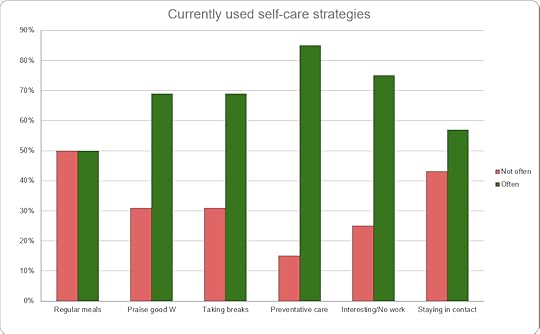
Abbreviations
Eating meals regularly=Regular mealsPraising themselves for good work=Praise good WTaking breaks during a workday=Taking breaksSeeing the doctor for preventative care=Preventative careDoing something interesting unrelated to work=Interesting/No workStaying in contact with important others=Staying in contactImplementing new strategiesWhen asked about the possibility of implementing new self-care strategies, teachers responded as follows:
Half of the teachers pointed out that doing things differently from work was the strategy they are more likely to use more often.Many spent time alone and wanted more time for connection with significant others.Exercising and walking seem to be strategies that most teachers feel are difficult to try and use. There might be several reasons for this to happen such as not having enough time, not finding a good place for physical activity, and a lack of the habit developed. These two strategies are crucial since they enable teachers to balance their physical and mental well being.Getting more spare time is also difficult for teachers. This is quite understandable since teachers, as we pointed out, have heavy workloads.
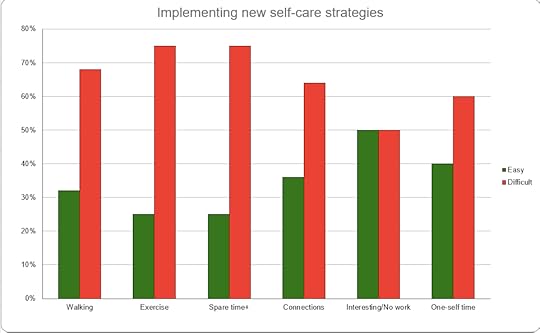
Abbreviations
Walk for relaxation=WalkingGetting more exercise=ExerciseGetting more spare time=Spare time+Getting connection with important others=ConnectionsDoing something interesting unrelated to work=Interesting/No workSpend time with one-self=One-self timeTo sum upIt has been found that doing something interesting unrelated to work is the self-care strategy teachers use most often. It is also the strategy they seem to be more likely to implement more often compared to the other strategies suggested. Then we could say that the key word to help teachers deal with the current conditions they are living at our binational center is “variety.” Additionally we can state that:
Physical activities are seen as difficult to access, so it’s necessary for the school leaders and head teachers of all organizations to develop simple but usable strategies for teachers to work on these aspects.Balanced diets would also be of great help for teachers, thus having some guidance though workshops or other media would be very interesting and useful to implement.As we have seen, teachers’ voices are not the ones of being simple victims. On the contrary, they are aware of the importance of self-care and are currently taking actions to keep themselves well. Like all teachers around the world, I’m sure they love their profession, but also understand that , as human beings, they need “variety in their lives” to express their completeness and infiniteness.
The post Teacher self-care strategies: exploring teachers’ responses in Perú appeared first on iTDi Blog.