A.M. Khalifa's Blog
April 14, 2014



February 20, 2014
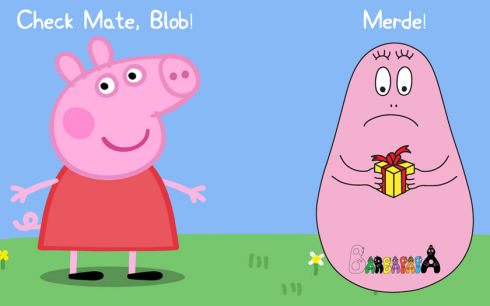
The Brave New World of Content and Copyright: How a little British Piggy Wiped the floor with a French Shapeshifter
 This is a cautionary tale. If you are a content producer of any sort, and still operating under the archaic copyright presumptions and mindset of the distant past, then you’re well on your way to becoming extinct. Much sooner than you think, I’m afraid. Listen well and heed my advice if you are a writer, a film maker, or a musician, and anything in between. This applies to all of us.
I have a four year old daughter who doesn’t watch much television because we decided against outsourcing our parenting duties to the networks. But we do allow her to watch some DVDs and a few of her favorite shows on our tablets, under our supervision.
To simplify this story, let’s assume she started off watching two shows a couple of years ago. Because it’s the comparison between these two shows that will serve as the moral of my story.
The first is a French classic called Barbapapa, which started off as a series of children’s books written in the 1970s. The main characters are the Barbapapa family, who are most notable for their ability to shapeshift at will. The books evolved into a highly successful animated show, localized and licensed across the globe, along with a healthy merchandising system.
The second show is a more contemporary British creation called Peppa Pig, which revolves around a female pig, and her family and friends. Episodes feature day-to-day living with lighthearted flare, and a bit of signature British tongue-in-cheek for good measure. Innocuous things like attending playgroup, going swimming, visiting her grandparents, going to the playground or riding bikes.
A a parent, I love both shows equally. Barbapapa has a beautifully nostalgic and vintage quality to it, but was well ahead of its time with deep messages of ecological responsibility. Peppa Pig is hugely entertaining, moderately educational, but most importantly, it does no harm. For a modern animation, that’s a huge plus.
As a content creator myself, I respect the hard work of creative artists and purchased a few original DVDs of both shows when my daughter was two and still getting in them. But in due course and as a result of changing viewing habits, we discovered episodes of both shows widely available on YouTube. So it was infinitely more convenient to watch them on our tablets, or even beam them from our mobile devices to our big screens, rather than the whole song and dance of finding the DVD, making sure it’s not scratched, wiping it clean—you get the picture.
About a year ago, every single episode of Barbapapa that was previously available on YouTube disappeared overnight. In its place was the infamous YouTube message that the “copyright holder of said content has requested that it be removed,” yadda, yadda, yadd. At roughly the same time, more high quality episodes of Peppa Pig started mushrooming, including hour-long compilations of the latest seasons. And this has continued until this day.
Being the delightful parents that we are, we purchased whatever Barbapapa DVDs we could get our hands on to appease the little one. I think you already know where this story is going.
Inevitably, my daughter lost interest in Barbapapa because it wasn’t readily available to watch on YouTube. Because mock it all you like, but the whole YouTube/mobile device marriage is really made in heaven for the modern family on the run.
And inversely proportionate to her loss of interest in Barbapapa, was her increased obsession with Peppa Pig – and the formidable merchandising empire that came with it.
Here’s the fuzzy math of this whole thing. We probably own one or two Peppa Pig DVDs, which have been sucked into some black hole around the house, never to be found again. In other words, our net contribution to the Astley Baker Davies animation studio that produces Peppa Pig is about $15 in DVD purchases. On the other hand, we’ve probably been “forced” to spend about five times as much on Barbapapa DVDs when they disappeared from YouTube.
Now this is where the story gets more cautionary. Despite our paltry spending on Peppa Pig DVDs, the amount we’ve shelled out on Peppa Pig merchandise—figures, coloring books, bags, water cups, pajamas, t-shrits, shoes, and you wouldn’t even begin to imagine what else—is probably fifty times more than what we would have spent if we had purchased the entire library of Peppa Pig DVDs. And the future library for the next five years.
And what have we spent on the Barbapapa brand name other than the DVDs? Nothing. Or practically nothing.
Peppa Pig: Game, set, match!
Two production companies targeting more or less the same age group. One operating with antiquated and aggressive philosophies to copyright as the linchpin of the financial engine of content, and the other one couldn’t care less about its content being pirated and distributed widely for free. If I was one of the makers of Peppa Pig, I’d be secretly satisfied that whoever is uploading my shows is doing my seeding for me and ensnaring generations of loyal fans and instilling in them a voracious appetite for anything and everything that can be pig-branded. And this is not just rife in the English speaking world. Peppa pig is everywhere and in every language. The next time you see a child rushing to splash in muddy puddles, you now know where that came from.
The moral of the story is this: Stop trying to fight piracy. It’s a futile, expensive, and polarizing endeavor. A lost cause, really.
Technology and our changing viewing and consumption habits are decades ahead of the narrow minds of the geriatric suits at the media corporations who are still deluding themselves that copyright is the be all and end all of generating income from the content you create.
I take my hat off to the ingenious minds at Astley Baker Davies who were on the money with their strategy not to draw the copyright infringement card and alienate their fan base, and their parents’ who hold the checkbooks.
As the music business has discovered the hard way, and the publishing industry is quickly learning, the future of the business side of producing content is going to be far less about monetizing content, and much more about cashing in on the rich layers of experiencing said content, over and over again.
Which means that the unit price of any piece of content is invariably going to shrink until its negligible or zero. Look at full-length electronic books now selling at 99 cents. Heed the lesson of software which went from thousands of dollars per license to free, or almost free aps. Consider that the most successful newspapers in the UK are distributed gratis to commuters. And of course everything about the music industry is a testament to this trend. Musicians now make most of their money on merchandising and live events, and are practically giving away music. One of the biggest players in the industry is Live Nation Entertainment – formed from the merger of an events promoter and a ticket seller. The film industry is a tougher cookie to crack, but mark my word, the rebels are at the walls of Hollywood and sooner or later will bring the whole thing down.
For far too long now the creation, production and distribution of content has been in the monopolistic hands of large corporations that have set unrealistic and extortionate prices. Now the revolution is coming to democratize the creation and pricing of content. And this doesn’t necessarily mean that absolute earnings will plummet. In fact, if the music industry numbers are anything to go by, earnings under the new paradigm eventually start heading north. The pyramid is being turned on its head. Far more people are now connected to the commercial “grid” than decades ago. Which means that rather than make a bundle of money from a few people by overcharging them, the market has expanded to a point where you can viably earn microscopic amounts from a wider audience and end up at the same point.
The lesson here for any content creator is to sprint beyond our fixation and obsession as a society with copyright. In a world where massive technological advances have lowered the bar dramatically for anyone to operate as a content generator (repeat after me: crowdsourcing), we will need to think of more creative ways to make money and be rewarded for our hard work. The singularity of the ‘content for money’ paradigm is not just shifting, it’s crumbling.
As a writer, I’m committed to making my books available at the fairest price point possible. But I am taking it a step further: I am willing to give it away for free. But only if you ask. If you tell me, “Love your work, man, and would love to read one of your books. But I honestly can’t afford to spare the $2.99 at this point of my life,” I’ll straight up give it you for free.
Because just like Peppa Pig, I’d rather draw you into my muddy puddle for the long haul, than see you shapeshift away.


January 31, 2014
Getting Hugh Howeied up the A$$
I am yet to read a single line of fiction penned by the omnipresent author of Wool, Hugh Howey. But somehow, I feel I know everything about the man. There’s hardly a discussion on the future of publishing without at least one token mention of the “Hugh Howey” effect. If you’re a writer and have no idea who he is, I will assume you are the sort of person who gets things done predominantly by fax.
Hugh Howey is the poster child of indie publishing. Every living independent writer has some sort of crush on him. He defied the laws of nature and achieved massive mainstream success on his own, without going through the traditional gatekeepers of the industry. In a manner of speaking, he’s that first lobe-finned fish that came up for air only to realize it can breathe on it’s own, then crawled to land and evolved into an amphibian.
And if there is one thing you need to know about writers, we all hate being fish and can’t wait to grow up and become proper amphibians.
Depending on who you speak to, Mr. Howey’s break-through success is either a freak anomaly – the chances of it being repeated being similar to winning the lottery twice, on the same day – or, he is the Moses of all scribes who will split the sea and lead us all to salvation.
You would expect indie writers to be deifying Mr. Howey, but what pray do mainstream publishers think of what he represents?
If Mr. Howey is the the kid who figured out that Santa is a myth, then mainstream publishers are the adults hoping he’d keep his mouth shut so he wouldn’t ruin Christmas for them and the control they yield on their kids. Fortunately, shutting up is not something that Mr. Howey seems able or intent on doing. He figured how to climb to that cookie jar, and now wants to share that knowledge with every other cookie-starved kid. How awesome does that make him? His web site, his blog, his video diaries, and most of the interviews he gives are brimful with generous, practical know-how for other writers trying to make it.
The Hugh Howey effect may very well represent the first nail in the coffin of mainstream publishing. If that’s the case, imagine the horror the mere mention of his name spreads in the hearts of the fat-cat big five publishing executives.
Who knows, maybe in their private meetings, mainstream publishers use “to be Howeied” synonymously with the less pleasurable connotation of the F word.
“Did you hear what happened to Marty?” | ”What?” | ”He got Howeied up the a** by his wife. She cleaned him out.”
Or maybe they just use it as a blanket term for everything detestable.
“I’m afraid it’s a rather advanced case of Howey of the prostate.”
“I had a terrible Howey last night. I woke up all sweaty and palpitating praying to God that Hugh Howey never existed. That it was all just a bad Howey. But it wasn’t just a bad Howey. It was real. I checked and Wool is number #4 on Hard Science Fiction on Amazon.”


January 5, 2014
My review of Elysium
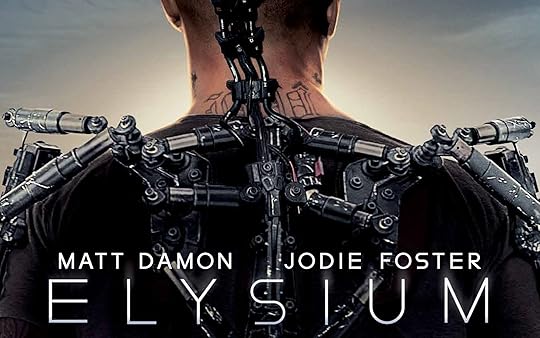
With Matt Damon and Jodie Foster, and a few positive critical reviews, Elysium seemed like a safe choice. The premise is intriguing, and the production values are high with stunning aesthetics. Many years in the future, earth is a dystopian shit hole populated by the disenfranchised, while the folks with means have evacuated their way of life to an exclusive artificial colony hovering over earth, called Elysium. I am not going to bother with unwrapping the political parables of the setting because it’s all way too obvious, even in a simplistic way.
For a variety of reasons, Matt Damon’s character needs to break into Elysium where one of the perks of living there is access to Med-Bays which reverse and eliminate all diseases and injuries. But as one would expect from an exclusive orbital colony, pirate ships trying to penetrate Elysium are repelled with brutal force under the auspices of a ruthless Secretary of Defense, played by Jodie Foster.
Before long, the whole affair falls flat on its ass with huge gaping plot holes, mediocre acting, and one too many over the top caricatures. Like the pseudo villain called Kruger who comes to the screen with a particularly annoying South African accent. Overall, Matt Damon probably gave the best performance, but the biggest disappointment was Jodie Foster. Her character didn’t even amount to one dimension, and like Kruger, she too sported a ridiculous accent. But unlike him, hers was intermittent and unidentifiable which was at best annoying, and for the most part highly distracting. Even the usually dependable William Fichtner, who’s made a career out of being the underrated actor who delivers the goods, left me with scant nothing.
As a writer, it both pains and enthuses me to see such weak stories making it to the silver screen. There were at least six major back-to-back plot inconsistencies/implausibilities. Neill Blomkamp, the South African director of this film, also wrote it, which further confirms my belief that some of the best movies tend to be based on excellent books. In other words, a good director isn’t necessarily a good writer. Unless you happen to be James Cameron.
Was Elysium the worst movie I’ve ever seen? Far from it. It was generally entertaining and watchable. But it thwarted my willing suspension of disbelief and was guilty of the worst thing any work of fiction can commit – to make the consumer feel they can do a better job.
I give it 2.75 stars out of 5 for beautiful visuals and for keeping me watching till the end despite the stated weaknesses.


December 18, 2013
Are you a nice person or a jerk?
 Imagine the world was clearly divided between nice folks and jerks. I am not talking about good versus evil, but just your general behavior in the public sphere.
Now be honest and ask yourself, are you nice or a total jerk?
Let’s find out.
When you’re in the lift and someone is rushing to get in as the door is about to shut, do you wave your hands to activate the motion detector so the doors slide back open, or do you stand like a sphinx reveling in their misery as they come close but don’t quite make it?
Talking of enclosed public spaces, do you control the urge, or do you pass wind when it’s almost impossible to determine the culprit?
At the supermarket, if you develop buyer’s remorse about the prosciutto shaved fresh for you at the deli, do you just leave it concealed in a random cold section knowing it’s likely going to be discarded, or do you buy it regardless?
And while we’re still at the supermarket, when you’ve unpacked your groceries in the car, do you return the shopping trolley back to it’s place or do you abandon it as a potential wayward hazard?
Do you sneeze and cough in a handkerchief or on your sleeve to avoid propagating your microbes, or do you let it all out not caring you could be patient zero of a deadly pandemic?
And if you were certain you weren’t going to get fined would you park in a spot designated for the disabled, or would you never do it out of principle?
Do you hold the door for others and maintain eye contact with a smile, or do you zip through, not caring if the door hits them in the face on the way back?
If you and another person reach the queue at roughly the same time, do you allow the other person to go ahead of you or do you walk faster to claim your lead?
When you bump into other people, do you automatically assume it’s your fault and apologize, or do you fire a dirty look at the other person?
Do you smile and say good morning to strangers, or do you habitually ignore the world, living behind your Beats headphones?
Do you talk candidly to your neighbors about things they do that annoy you, or do you leave passive aggressive notes?
Gents, do you put the toilet seat up in a public restroom as you hose down, or do you assume when it comes to urine on the toilet seat it’s every man for himself?
Do you praise your friends in public and criticize them in private, or do the exact opposite?
When you drive, do you always give pedestrians right of way, or are you always trying to get ahead of them?
Do you only buy stuff you plan to keep, or do you sometimes buy things to use just once only to return them during the grace period?
Are you the sort of person who breaks up with a significant other over email, text or Facebook, or do you do everything face-to-face regardless of the pain?
Have you ever faked a heart attack or other serious illness on a plane to be upgraded to the next class? Or requested the disability service to whiz through customs and immigration when you are perfectly healthy? Or is that just not your style?
Do you give false compliments to gain petty advantages, or do you only say nice things to people when you genuinely mean them?
So what are you, a kind soul or a total a** hole?
Here’s what I think. A very small minority of the folks reading this are going to swing heavily towards being either totally angelic, or totally rotten. But for most of us, we will fall somewhere in the middle of that spectrum. Nice 24/7 can be colorless and irritating. And rotten all the time is unacceptable.
The truth is, as humans, our own survival and best interest is hard-coded somewhere in our primordial blue print. Living in mega societies and adapting to a system that respects the other is in a way counter-intuitive to the basic set of animal mores that have helped our species evolve tenaciously over time.
There will be times when even if our general disposition leans towards being cordial, it’s going to be impossible not to be a jerk. Such as when we are grieving or just fuming angry. If you’ve just discovered your spouse is banging their sexy personal trainer, you aren’t going to hold the door open for the chatterbox old lady who lives on the first floor. And if you’re that personal trainer who just discovered the cute, wealthy client you’ve been sleeping with is no where near as single as they claimed to be, not only will you not care to return the shopping trolley to its bay, you may also be tempted to ram it in the closest minivan as a blanket assault on all married couples. Or in other words, when we are stressed or threatened, we revert to our basic, survival codes which prod us to be less amiable.
Sticking by the rules of public civility makes life generally more pleasant for everyone, but for most people it requires that we actively choose to play nice. One day at a time.


November 25, 2013
The Bunker, Part II
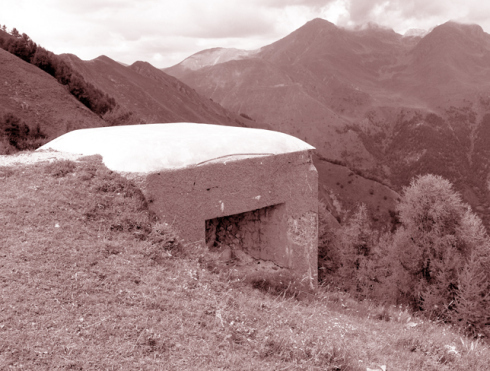
Franco Alemagne didn’t take my hand to shake it warmly, but placed it on the cold metal door which he wanted me to believe was the entry to a life-sustaining bunker in the heart of Tuscany. When my hand touched the nondescript metal surface, a small window slid open revealing a rectangular glass tablet, maybe even an LCD screen.
“It’s a secure entry system. It reads your genetic code from you skin cells. Only four other people in the world can access it.”
Although clear, the implication was chilling. My father in law had somehow procured a “part of me” and used it to configure my genetic profile as one of the five people who could access this place. I could only guess that Jessica and the kids, and Mr. Alemange himself were the four others. Getting a hair follicle or some biological sample from Jessica was feasible since she had lived with him for the first eighteen years of her life. My ears grew hot at the thought of an Alemagne operative handling my children surreptitiously to get a sample of their genetic source code.
“Who are you?” I blurted involuntarily.
He did not supply an answer, but removed my hand of the screen.
The outline of my palm was imprinted on the glass tablet and looked like the infrared rendition of a night vision device. As the system analyzed my profile, random numbers and cryptic figures blinked and danced around the screen until everything dissolved out and the word Approvato began to flash in green. The screen slid up with a high-tech hum revealing yet a third surface beneath, in brushed aluminium and two glass spheres.
“Look inside these prisms. It’s a retinal scan. A secondary protocol.”
I complied and the glass tablet materialized again announcing once more I was approved. The words Inizia test di riconoscimento vocale appeared in amber on screen for five seconds before a countdown from twenty started, accompanied by unnerving beeps.
“When it reaches zero, say something—it’s the third and final security protocol of this gate.”
Still distraught how this man got inside my head and that of my wife and children to scan our retinas, and the anger over what he did to me in New York five years ago bubbling to the surface, all I could say to satiate the voice recognition system was, “Fuck you, Signor Alemagne.”
And with these four honest words, my life changed forever.
*
We crawled through the first gate into a dark chamber. Motion detectors activated faint pilot lights almost immediately. My naive assumptions that whatever Alemagne had summoned me to see was at hand was quickly laid to rest. It would take us another ninety minutes.
From that point onward we processed ourselves through no less than seven security access points by validating my genetic profile, my retina, and my voice every single time. With each successive entry we were incrementally removed from a layer of human civilization. Eventually I lost count. We crawled on all fours through tunnels, stripped naked and were sprayed by disinfectants in a decontamination zone, changed into HAZMAT suits then back into civilian garb, took elevators that traveled us deeper inside the earth, and rode high-tech electric cars the likes of which I had never seen on the streets above.
“We have arrived” he finally announced after we emerged into an ample circular space roughly as large as a baseball field and a half.
All around us, there was foliage and vegetation. Above us an artificial sky, like an optical illusion, challenging my sense of reality. Beneath my feet the softest grass played an equally cruel cerebral hoax.
“Are we back up on the surface?”I asked, not because there was any possibility of that to be true, but because the only other thought to pass through my head was, The Truman Show.
Franco Alemagne smiled for the first time of our mutual journey through his underworld . Like an artist revealing his seminal work to a most discerning public.
“We are one thousand feet under the earths’s surface.”
I raised my head up to the “sky” and inhaled deeply the freshest but most sanitized air I had ever allowed through my lungs. My head was light, not from the purity of the oxygen, but the multiple distortions of reality battering my senses.
What kind of man has the resources to access the know how to concoct a synthetic atmosphere?
“What you are about to see represents the nectar of human civilization and scientific achievement. We broke ground thirty years ago, using technology from decades in the future. And it was only completed two months ago. There are five other facilities like this on every continent, with one single purpose.”
“And what would that be?”
“To preserve life for as long as possible while the world outside is scorched to the ground.”
Still enchanted by the realism of the virtual sky above our heads, I continued to gaze until I lost all sense of time. This wasn’t a run-of-the-mill theater or studio fake sky. This sky was moving, changing, evolving. The genius of its design meant I cold never tell how high up it was or what it was made of. It was, for all intents and purposes, a sky. Deep inside the earth’s crust.
“But…why?” I finally let out. I wasn’t expecting an answer.
“You work in networks and computers at the United Nations, isn’t that so?”
But I wasn’t expecting a question either. Like you don’t know everything about me.
“You can think of these six facilities as the backup drives of life on earth. At least that’s what they were conceptually when we started. “
“We?”
He ignored me.
“Each facility has a genetic bank containing samples of all known living species on this planet. There is a digital library of every piece of information ever generated or created by a human being. Constantly being updated, even as we speak. And that’s just the tip of the iceberg. Every facet of human life is constantly being updated in the vast learning archives of each of these facilities. Almost like a camera taking period snapshots of life outside. And it will only stop when these facilities go into service.”
“What do you mean?” A war is coming he had told me when we first met.
“The moment each of these facilities is activated, they will be entirely sealed from the outside world. Like a Faraday cage on steroids. Nothing linking them to the earth that remains. Not a single sign of life that can escape to the outside.”
And air? Before I even asked, he was ready with the answer.
“This is an entirely self-sufficient ecosystem. There is an air management matrix that not only mimics the composition of the atmosphere on land, but one that is programmed to introduce low level seasonal pathogens to maintain the evolutionary edge of the human immune system. Carbon dioxide and other unwanted gases are extracted and stored in compartments embedded even deeper underground.”
Once again he answered a question I had not asked. “There is enough oxygen to last fifty people for thirty years. But there’s not going to be fifty people here when the time comes. Just you and your family.”
“Where are we now?” I felt like a buyer asking a top-notch realtor to guide them through a prospective property.
“The entire estate is about fifteen acres. Think of this area here as your sanctuary. The only part of the complex that serves no functional purpose but to remind you of what life above ground used to be. Because other than yourselves and the occasional flu viruses injected in the air, there’s nothing else here that’s alive. No plants, no animals, and no insects. No flowing bodies of water or wind. No sun, or moon.”
I pointed to the foliage and trees around the sanctuary.
“Designed in Stockholm, assembled in Bratislava,” he said as he walked away and disappeared in the synthetic, lush green.
*
He called the estate Eden. I concede there’s not much subtly or imagination with a name like that. I suppose when your life project is to build an underground Noah’s arc to give humanity a fighting chance, being nuanced is at the very bottom of your priorities.
What I saw that day when I followed Alemagne beyond the artificial foliage of the sanctuary was implanted in my consciousness forever. And I know now that’s exactly what he wanted. He was priming me. Revealing everything he had every worked for not just to educate me, but to hand over the keys and the responsibility to shepherd what he had built.
He was right. Eden was a self-contained ecosystem. But one built to sustain four members of one single life form. The genetic bank of plant and animal life was not something we ever needed to worry about or interact with. It was there for after the apocalypse. He never told me how or why.
Eden was built not just to support our lives, but to sustain and nurture our humanity. There was no house, because there was nothing we needed to shelter ourselves from. No elements, no predators, and certainly no humans.
There were only five built structures on the estate. The genetic repository was one of them and was located at a far edge of the estate and out of our day-to-day scope of vision.
The central nerve of Eden was the Learning Zone. A marvel of human ingenuity powered by a talking, artificially intelligent being. Everything was conducted through speech and didn’t require a computer interface to operate. It wasn’t just the automated classroom designed to educate children from preschool to postgraduate levels that amazed me. Or the bountiful warehouse of learning, leisure and entertainment supplies. Let alone the infinite library of audiovisual instructional material on any human task imaginable, from how to make on origami crane to a step-by-step guide to surgically remove a kidney stone. The thing that really blew my mind away was the existence of two operational modes. The default was designed to be powered by adults. But if the system sensed that adult interaction suddenly went missing, it would automatically switch to assume the primary operators where children. Just in case something ever happened to Jessica or I, Eden would continue to guide and educate our children.
The largest built structure was the Life Zone. A spectacular automated food preparation system and warehouse of frozen, dehydrated and preserved food. Like a figment of Roald Dahl’s wildest imagination, food storage, processing, and preparation was all conducted behind closed machinery. Because of the total fire ban on Eden, cooked food was prepared by microwave and then dispensed for consumption. I guess humanity had already lost its innate instincts to forage, hunt or grow its food long ago so there was no point for Eden to account for sustaining that skill.
And there was an infirmary where we could extract teeth, or indeed perform outright surgery. Whatever we cared to train to do in the Learning Zone.
The last of the structures was the Power and Waste Management Zone at another far corner of the estate. I didn’t ask, but only assumed that whatever was inside it that could sustain our energy requirements for thirty years had to be highly nuclear. And I wasn’t intellectually curious enough about feces to inquire what happened with human bodily waste on Eden. After everything I had seen, I was certain Alemagne had figured it out. Well.
*
Six hours later, Alemagne and I once again stood on top of the hill where I had first met him waiting for our ride back to the mansion. I had forgotten about the present day version of Jessica and the kids, engrossed instead with the future edition of us living as survivors of some destructive global war in this obscenely expensive, secretive but technologically mind-boggling world my insane father in law had built.
“You wanted to kill me because I am black. Why do you want to save me now?” I fired at him.
“Is that what she told you?”
I inched closer to him. “No, that’s what the mafioso sleazeball you sent to scare me said after he struck me in the gut.” My own fist was clenched tight now, the vow I had taken to repay the Alemagne debt once again overpowering me.
“He said those exact words?”
Lava bubbled in my belly as I strode even closer to him. “When I asked him why you wanted to kill me, he said ‘look at you, isn’t it entirely obvious?’ What else could he have meant?”
“And of all your attributes, why did you assume it was the color of your skin he was referring to?”
The question stopped me in my tracks. “Because of your political beliefs. The neo-fascist party you formed. I just assumed.”
Alemagne smiled for only the second time since we met.
“Jessica is a smart girl, which means she’s also… convincing. But—”
“But what?”
“Don’t get me wrong. I had every intention of killing you.”
“That’s a relief.”
“But I didn’t want to kill you because you were black and sleeping with my daughter. I wanted to kill you because I had my doubts you would stay with her and be a husband and father to that child. If you were just fucking around, you would have been an obstacle to her making a family. Eden was designed to sustain a family. Not a single mother.”
He left me with a version of the truth and started trekking down the hill when he saw the black Range Rover approaching.
“Wait!” I yelled at him. “Are you saying Jessica knows about this place? That she was in on it?”
He marched on, silently ignoring me.
“Yours is one fucked up family, Alemagne. You can take your doomsday bullshit and shove it up your ass. I am taking my kids and we’re flying back tonight.”
He stopped in his tracks but didn’t turn to face me.
“2:03 p.m., Friday, April 13, 2018,” he said.
“What’s that?”
“At that precise moment every living cell on this planet outside the sealed bunkers will be vaporized. The war will start a month before that. Then the first wave of attacks will strike down on April 7th. Massive devastation on April 11th. And finally total annihilation on April 13.”
I shook my head and rolled my eyes.
“Put yourself in my position. Do you have any idea how idiotic you sound? How deranged you come across? There’s absolutely no way an intelligent man like you can seriously expect me to believe this. Because unless you can travel through time or foretell the future, typically, the way wars work, the way they’ve always started in history, is that they just fucking happen.”
“History rarely happens, son. It’s mostly agreed upon in advance. There is a third way for a person to be able to know in advance of an impending war.” He turned to face me.
“Yeah? Like what?”
“If you are the one who is going to start it. Thirty years ago I was involved in a series of terrible events beyond my control. Events I wish with every part of my being I could overturn. Events that will ultimately lead to the destruction of this planet.”
“What events?”
“Don’t wait until the war starts to get here. Social structures, telecommunication, services, transportation, governments and law enforcement will crash and fail a few months before the destruction. Save yourself. Save your family. I’ve shown you a glimpse of the future. It’s up to you to plan for it.”
*
We are on the plane flying back to New York. Jessica and I have only exchanged distrustful looks but we never spoke about what I knew, or what she was hiding. I had no desire to censure her, or to try to probe her. We have five years to thrash it all out. I observe Zoe and Marcus both fast asleep now in the comfort of a flat beds in the sky. If and when this war comes, they will be ten and seven. And Eden will be the only life they will ever know after that. Do I believe Alemagne? That’s an impossible question to answer. Everything he told me sounds like the overstretched science fiction imagination of a stunted teen. But the technology and the resources I witnessed inside Eden point to a different sort of man. A villain perhaps. But one with a code of honor. The sort of villain who kept his word.
*
It’s been three weeks since I saw Eden and met Alemagne in Tuscany. I can’t get either out of my mind. A question has been bugging me since. One upon which my trust of this man and the vision of the future he is desperate to sell me could be contingent on. It was an inconsistency in his story. When I first met him, he told me when the war will come, he will have been long gone. Yet Eden was accessible to five people, my family and I, and another person, who I assumed was him. But why would he retain permanent access privileges even though he seemed certain he was departing well before the war? There was a trace of dishonesty I needed to verify.
*
I am fully inebriated as I saunter out of a bar on Fifth Avenue where my work colleagues and I usually gather on Friday night. I am trying to hail a yellow cab, but I am not doing it with much assertiveness of conviction. Then a black Range Rover drives by and I think of Franco Alemagne. I dial his cell number, not giving a fuck about the time difference.
“Pronto?” He’s unexpectedly civil.
“You lied to me.”
Silence.
“You said you would be dead when the war comes, but yet you’re one of the five people who can access Eden.”
“Then why did we use your hand, retina and voice every single time to access the various check points?”
Even through my slurred thoughts, stunted logic, and a judgement clouded by volatile rage, I picked up on the soundness of his reasoning.
“Then who’s the fifth person with access to Eden?”
“A scientist. Part of a team of six. You can think of them as humanity’s litmus test. A group of people who have agreed to survive the war in smaller, bare-essentials bunkers near each of the six complexes, for five years after the war. Then to emerge and see if they can survive for another five years in the aftermath of the destruction. No one knows how long after the annihilation earth will remain inhospitable. We’ve stretched the Eden complexes to support life up to thirty years because of the limitations of the supply of oxygen and the nuclear reactors. But it’s a conservative guess. If at the ten year anniversary each of these six individuals are still around with no adverse reactions on their bodies, they will come to liberate the citizens of the six Edens around the world. Who wants to live underground forever?”
“Why are they in separate bunkers? Why not join us and then leave after five years?
There was a lump of silence at the other end of the phone.
“Alemagne?”
“Because once you are inside Eden, you can only leave every ten years. It’s a one way valve that opens for twenty-four hours once every decade.”
To be continued. Maybe.


November 18, 2013
The Bunker
My father-in-law wanted to execute me, but I beat him to it by getting his daughter pregnant. My first child saved my life. Now how many men do you know can make that assertion?
This may sound like conjecture on my part: every father-in-law hates the man sleeping with his princess on some level, right? But trust me, this is not hyperbole. He told me so himself. Not directly. But through his agents. The men he sent to “warn” me, five years ago.
I had just started working at the United Nations in Manhattan. I was walking back home through Central Park in broad daylight when three men of impressive build jumped me. They covered my head with a cloth bag that stunk of freshly excreted urine. Then stuffed me in a van parked on the ninety-seventh street transverse, just like a terrible mob movie. Only it wasn’t. Far from it. We drove for about two hours, with my heart thumping through my throat, my mouth parched like the Sahara, and the only image floating in my mind was how my live-in girlfriend Jessica would react to the cops when they tell her my dead body was found floating in the Hudson.
When we got to the final destination, they removed the bag. I didn’t find myself tied to a skeletal chair in some godforsaken warehouse in Jersey. Instead, I was in the living room of a spectacular mansion overlooking what must have been a national park of sorts, with a purple sun plunging in a meadow where free-roaming deer sauntered like they were the star attraction in a high definition National Geographic program. The smell of opulence was mildly reassuring. Rich people don’t kill on their grounds, I reminded myself.
I glanced around. Snow white carpets and minimalist leather furniture, the sort you look at but can’t touch at museums of contemporary art and design. Pretentious brand-name graffiti paintings strung relentlessly on all walls. And there he was, the centerpiece of this grand display of wealth, an impeccably dressed man who couldn’t have been older than fifty. Sitting right across from me smoking an electric cigarette. Hardly an extra from the set of the Sopranos as I was certain I would find, based on our Central Park introduction. He came across as a sophisticated Eurozone politician. The likes of whom I work with every day at the UN.
After staring me down for a few minutes while puffing out intimidating, but odorless smoke, he finally said, “Do you know why you are here?” His was a distinguished northern Italian accent that gave further credence to his sophistication.
I shook my head, not being entirely genuine. After everything Jessica had told me about her estranged father, I was all but certain this was his shit show.
“Mr. Alemagne has asked me to send you a message.”
Bingo.
“From this day forward, consider yourself a dead-man walking. The only reason he’s allowing you to live— for now—is for the sake of that child you’ve planted inside his daughter’s womb. That girl will need a father.”
How did he know the gender of our unborn child? I didn’t.
“Even if it’s someone like you…a father is a father.”
My head dropped and I stared at my feet. There was nothing I could think of to say. But one thought pummeled through my head: what the hell did I get myself into.
“Within a week you will marry Jessica. And if you ever let her down or fail to take care of her and your future daughter, you will lose this immunity. Mark my word, sir, your head will come off. And it’s never attractive when that happens.”
As he cut me loose, he punched me with all his might in the center of my gut.
“Why?” I managed to extrude as I wrapped my hands tight around my belly and gasped for air on the soft carpet.
“Why?” he roared back my questions in my face, like I was an imbecile student asking a redundant question in a class of gifted children.
I nodded, shuttering my mouth and biting hard on my lower lip to tamper the urge to puke on his shiny leather shoes. It was a question to which I was almost certain of the answer. But I had to be sure.
He shrugged, again like a mentoring teacher who had lost all faith in his student’s aptitude. “Look at you. Isn’t it entirely obvious?”
I saw the reflection of my face in his shoes and it all made sense.
They dropped me back where they picked me, and I never once mentioned to Jessica what happened that day.
*
I am driving from Rome to the heart of Tuscany to finally meet the man who sentenced me to death because of who I am. With me in the car is my wife Jessica who hadn’t seen her father since she escaped his tyranny ten years ago. He’d been watching us all along. Keeping an eye on me to make sure I held up my end of the bargain with Jessica. And our two children, Zoe and Marcus in the back seat. Oblivious to the very notion of grandparents, let alone they were about to meet their very own.
If he was ill or dying, Jessica wasn’t given any details by the very same Alemagne executive who had assaulted me five years ago. He had shown up at our doorstop one Sunday morning, wearing an equally impeccable suit and smoking the same electric cigarette. And once again he came with a message, but this time for Jessica, from her old man summoning the four of us to Italy for a matter of “extreme urgency.” She seemed to know this sharply dressed messenger, and wasn’t in the least bit surprised he had found us. Her eyes and her voice suggested she was fond of him, like one wold be of an uncle or a trusted relative.
If Jessica had any inkling why her old man was desperate to see us, she wasn’t telling me. I was adamant against it at first, given what he had done to me. But I sensed she was insistent we complied. The fact she was willing to make this trip with the three of us by her side was all the convincing I needed. I considered coming clean to hear about the manner by which her father had “reached out to me” five years ago, but somehow I knew this would be inconsequential to her decision. And deep down, I had my own selfish reasons to meet her father. I owed Mr. Alemagne something. Decrepit old man or not, the fuck-face was going to get it straight in the gut. Even if it had to be in front of Jessica and the kids.
*
Jessica had only spoken of her family once, and she made it clear that after this one time we would never broach the subject again. She had run away from home and left the country when she was only eighteen. Life at the Alemagne estate was soaked in tears and drenched in pain under the iron-clad oppression of a detestable, megalomaniac father and a spineless mother. Mr. Alemagne was an immensely wealthy industrialist, and a founding member of an ultra-right secessionist party. The kind of man who operated by micro-managing and terrorizing every molecule in his universe . Jessica believed the party he had formed was a thinly veiled vehicle for a blatantly racist paradigm that blamed everything wrong with Italy on immigrants and the “lazy, unproductive” portion of the country south of Tuscany. Jessica was a wild child who had the constituency to challenge him, from the moment she possessed the intellectual faculties to do so. But her younger sister wasn’t quite as tenacious. Or thick-skinned. She found salvation by sucking on her father’s Beretta subcompact and taking her life in his study. Two days after the funeral, Jessica made her escape.
*
Accessing the Alemagne estate was like going through a maximum security military complex. Multiple fortified gates. Aggressive barbed wire wrapped around everything. Sniper towers and cameras everywhere. The residence itself was perched on a majestic, gently sloping hillside. We were sandwiched and escorted by two military-grade vehicles as we drove up to the house. The security shenanigans almost robbed me of the breathtaking view of the estate, and the stunning first impression of the Tuscan mansion where my wife grew up.
Every member of Jessica’s extended family was there on the lawn forming a loud and gregarious welcoming committee. Except her father. A few of the men my age or younger approached me and made me feel vaguely welcome, while the women formed a thick circle around Jessica and our kids. When all the tears had been cried, and my Zoe and Marcus had been smothered with enough hugs and kisses, it was time to eat. As we walked to a banquet table laid out by a large lake, once again the same man who had punched me in the gut emerged out of nowhere, still in a spiffy outfit.
“Mr. Alemagne would like to see you,” he said as he grabbed my arm a little tighter than was hospitable. I could tell he had personal dislike for me.
It was the second time I got into a car with this man, fortunately this time round without the suffocating urine-infused cloth bag. We drove away from the estate in Range Rover heading south, I could tell from the position of the sun. About five minutes later, he parked at the foot of a small hill.
There he was. A towering figure of a man with snow-white shoulder-length hair flapping in the wind. He stood motionless on top of the hill gazing in the opposite direction, like he was meditating or speaking to God. Quietly ignoring us as we trekked on foot towards him.
When I was finally standing across from Jessica’s father, the vow to to punch him in the stomach in front of his goon was deliciously tempting. But as quickly as it had surfaced, it started to fizzle. All I could muster was to extend my hand to him in peace. Because in his eyes, his lips, and his finer features, I saw the genetic ghost of the woman I loved and the children we made together. He was her father and their grandpa. Whatever animosity I held in my heart wasn’t nearly as strong as the inexplicable empathy I was quickly developing for him.
The Alemagne patriarch didn’t shake my hand, but turned to his centurion and dismissed him with a flick of a finger and a subtle nod. Still without acknowledging me, he marched away in some random direction. He provided no verbal or body instructions to suggest he wanted me to follow him. But I did all the same.
Never once looking behind to see if I was trailing, he descended from the other side of the hill and walked between geometrically perfect olive groves. Above us the lilac sky was spotted with tufts of cottony clouds moving at an incredibly lazy pace. Like walking into a dynamic Raphaelian painting.
Right here between the trees, he and I were alone. Possibly with only God as our witness. Far from civilization, I was now beholden to a man who had made it clear in the past my life was worth little. Nothing could stop him from pulling out the very gun his daughter had used to commit suicide and extend me the same fate.
Somehow though, murder didn’t seem to be on the menu. The way he carried himself suggested, perhaps counterintuitively, that he was a man who adhered to a code of honor. The sort of villain who kept his word.
*
“What is this place?” I finally spoke as he and I stood facing a grey metallic structure built into the face of yet another small hill about three miles west of the olive grove. It looked like a door of some sort but without handles or knobs to operate it.
My father in law looked up to the sky with a fatalistic sigh escaping his lips. As if he was observing something only his eyes could visualize. An ominous premonition. It could have been five, ten, or even thirty minutes with nothing happening.
Finally he whispered, “There is a war coming,” in unexpected neutral English. A battle-worn voice of a man closer to death than life.
I said nothing.
“When it’s time, I will be long gone. But you will know of this place and will bring my daughter and her children here. Whatever hell will have broken out on the outside, what lies behind this door will be the only safe haven to support your lives for many years. Thirty to be precise.”
“Is this why you called us here?”
For the first time since we had met, he finally looked me straight in the eyes, and extended his arm, now willing to take my dark, African hand in his.
“Come, we don’t have much time.”
Click here for Part II.


October 31, 2013
Once beautiful
He glanced at her once-beautiful face, and then turned the opposite direction to avoid her eyes. There was no sense in hurting her feelings even if he knew how this blind date was going to end for her. Not well.
She was etched with the passing of time. Not that she had lied about her age on her profile. But man was she the oldest looking forty-two year old he had ever set eyes on. It wasn’t the ageing process that had distorted her appearance. If anything, her wrinkles added an interesting dimension to her. The sun had done most of the irreparable damage. And the burning smoke of tobacco exiting her lips and bathing her face, day-in day-out, must have taken care of the rest.
Hers was a skin tone of lifeless grey. Just like the walls of his old prison cell. Blurred facial features contorted asymmetrically and drooped when they should have been elastic. As if her multiplying cells had decided to finally punish her for many years of disregard for the well being of her body. Despite that, he mentally peeled off layers imparted by time, the elements and her own recklessness and could see with great clarity how she looked once upon a time when she really was fetching. To do that was his special talent. Or what singled him out as a freak. And ever since he was released on parole and started baiting women online only to butcher them at the end of the night, he had never once backed out for failing to see beauty in a victim.
Everyone is beautiful, somehow.
Except him. He was born hideous. Not necessarily on the outside, but on the inside. The bastard child of the devil and everything wretched in this world. Killing beautiful, or even once-beautiful women was the only way he knew to heal and feel cleansed on the inside. Even if just for a few fleeting hours in the dead of the night, lying naked in their pool of blood.
“Very beautiful,” he whispered now turned to look her straight in the eye.
She smiled, but seemed taken aback. Not by the odd tone of his voice or the unnatural, nonhuman pitch. Or the iciness of his deadened eyes. But as if it had been a long time since she heard these words from a man who really meant them.



October 20, 2013
Putting the “gent” back in agent: The complete writers’ guide to Literary Agents
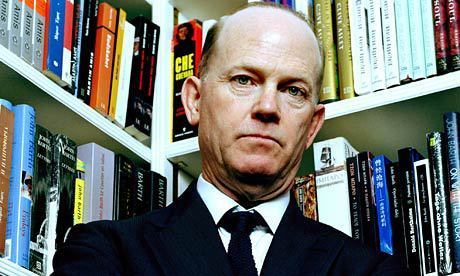
Andrew Wylie (born 1947), also known as The Jackal, is one of the world’s leading literary agents.
Perhaps no one in the publishing industry is vilified and revered with equal vigor as much as the literary agent.
I just came back from the Frankfurt Bookfair where for the first time since starting to frequent this seminal book event in 1999, I attended as a writer. While I saw almost every aspect of the book world from a different prism, my perception of literary agents remains the same. I am a firm believer that unless you know what you are doing, writers should not go to book fairs chasing agents. Let alone publishers. It’s a recipe for disaster, disillusionment, and potential humiliation. The best way to engage an agent remains the good old fashioned submission process.
Yet I am still amazed how despite all the great advice out there that tries to demystify agents and to lay a clear and effective pathway on how to approach and work with them, most writers still don’t get it and keep erring repeatedly.
In this post, I would like to throw my own pebble into the pond of enlightenment for writers when it comes to the all mighty LitAgs.
It’s a business, like any other
Literary agents have the misfortune of being the gatekeepers that filter literary talent for mainstream publishers to pick and choose from. Writers not only perceive them as “middle” men and women, which in itself carries numerous negative connotations, but many aspiring scribes have a largely inaccurate perception of agents as being inherently nasty. That there sole aim in life is to crush the hopes and dreams of ingenious writers, and instead choose to support lesser authors who they may have direct personal contacts with. Or some variation of these negative stereotypes and conspiracy theories. I’ve heard it all.
I would argue that nothing is further from the truth. Literary agency is a business like any other. No agent in their right mind would ever come across unquestionable literary talent that can translate into commercial gain and turn it down simply because they are on a power trip or because they would prefer to help their writer buddies.
The brutal reality is this: Writing is a hugely saturated and cut-throat business. Underline business. Literary agents behave in a way that reflects the needs of the market at any given time. These days, it’s not enough to be a great writer with a great story. There are thousands upon thousands who are just as good or better than you. Agents are not just looking for outstanding writers any more, that’s a given. If you haven’t perfected your craft yet, don’t even bother with agents. It’s a waste of your time and theirs. Agents are looking for the next great thing. Something unique and different they can take to their publisher clients with a convincing pitch.
The bottom line is this: If you want a mainstream publishing deal, your writing project has to be fresh, unique and it has to stand out on every level other than phenomenal writing skills. Agents and by extension publishers already have enough clients who write well and earn them handsome amounts to keep them in business for a very long time. They are not looking for more of the same. If your genre is horror, it’s not enough to be just as good as Stephen King. You have to bring something new, ground-breaking and exciting to the mix.
Now does that mean that literary agents are infallible angels who always play it straight like an arrow? Of course not. They are just as human as you and I. Will they make a few exceptions to push up their personal contacts a little faster up the ladder of submissions? Perhaps. But that doesn’t make them any worse than the doctor who gives priority appointments to friends and family, or the shop owner who offers slightly better discounts to their inner circle. Human beings are social animals and we get by through life by sticking to our groups and taking care of one another.
I would even go as far as postulating that knowing a literary agent would at best save you some time of getting the exact same answer you would have gotten if you didn’t know them. A “no” is still a “no”, even if you get it sooner. Agents have professional reputations to uphold and would never knowingly try to sell inferior material just to do their buddy a solid.
And as it happens, the vast majority of literary agents are down-to-earth, hard-working, decent folks who get all doe-eyed and excited about books and writing, just like you. They would love nothing more than to discover a diamond in the rough. To believe that you the writer could be the next Umberto Eco, Haruki Murakami, Khaled Hosseini, Alaa El Aswany, Frederick Forsyth, J.K. Rowling, or Vince Flynn.
Be Upfront and Professional
Agents repeat themselves, over and over again. It’s always the same message. Consistently the same basic principles. Which are: The number of things a writer can do to improve their chances with an agent, other than having a solid pitch, is exactly zero. No amount of jokes or “quirky” style in your query letter will endear you to them any more than a basic, well-written, courteous communique would. There is veritably nothing you can bribe an agent with that would convince them to like your pitch any more than what it deserves. There is no amount of “creativity” in how you submit your package that could enhance your chances—don’t waste your money on expensive manuscript boxes or fancy paper. And meeting you in person when you show up at their offices uninvited, or if you ambush them during their lunch break will only get your ego bruised, your face slapped or yourself arrested depending on how “spirited” your attempt is.
The truth is, I have never come across an agent’s submission guideline that was in any way vague or left anything open to interpretation. In a nutshell, here’s what agents expect from writers trying to do business with them:
1. Do your research. Find the most suitable agents and only submit to them. Don’t try to engage with an agent who specializes in mysteries and thrillers, if you happen to write cookery books or military history. How difficult is that?
2. Stick to the submission guidelines. Stick to the submission guidelines. Stick to the submission guidelines. If an agent asks for a complete synopsis that describes all the main events, don’t hold-off the final twist or ending because “you don’t want to deprive them of the thrill factor.” If you can’t follow simple instructions, agents can make all sorts of deductions about your intelligence and therefore their desire to work with you long term.
3. Be respectful and only speak when you are spoken to. Unless an agent specifically encourages you touch base after a certain period of time after your submission to prod them, the first time you contact an agent should be the last time until they engage you in a discussion. Indignant follow up letters or calls that contain phrases like “perplexed” won’t win you any favors. Most important of all, if an agent does pass on you, under no circumstance should you write back to complain or to plead for them to reconsider. If you do feel the need to write back, the best you can do is a gracious thank you note. In some circumstances if an agent’s rejection is vague or you require clarification for your own education, it may be okay to inquire about that, but only in the politest terms.
4. Never, ever burn bridges. Acting in a publishing capacity, a writer I rejected recently for a small piece of fiction first tried to make me change my mind through a series of aggressive emails. When none of my polite emails reflected a change in my position, she wrote back saying “ You are extremely unprofessional. I wouldn’t work with you on any project in the future. And I would advise anyone I know to not work with you.” Many agents I know tell me they’ve received even worse feedback from disgruntled, rejected writers. Sometimes even outright threats.
When writers behave like that upon rejection, they disclose their true nature. Good manners go a long way in this business. An agent who rejects you may, without you knowing, pass your proposal on to another agency who may find you more up their alley. But they certainly won’t be doing anything other than trashing your submission if you decide to be anything other than cordial, sane, and civilized.
It’s a free market, like any other
Perhaps one of the biggest mistake most aspiring writers commit when hunting for an agent is getting myopic and obsessive about the agents they will submit to. A lot of writers tend to send out limited submissions to either the top agencies, or just a few ones on a trial basis. And when the rejections start rolling in, they see that as a blanket condemnation of their writing skills and withdraw into a shell of self-doubt.
The savvy writer recognizes that literary agency is a free market. There are enough agencies and independent agents out there to support you sending a submission a day for a few years. And big doesn’t always mean better. In many cases, finding new or smaller agencies may work to your advantage. They may have more time and be less jaded. They could pay more attention or see unique selling points in you or your story which you may have failed to articulate, and which an A-List agent may not have the time or patience to infer on your behalf. The best approach to finding an agent is to see it as an ongoing agricultural project. Plant as many seeds as you can and keep planting, rather than sowing just a few seeds then waiting idly by their side hoping to see them sprout. Or to use another farm-inspired expression, don’t put all your eggs in one basket.
Think outside your geographic box
Another common mistake many writers commit is to think within their narrow geographic zone. It would serve them tremendously if they looked laterally and broadened their geographic focus. Instead of submitting only to agents in your country, why not cast a wider net and research literary agencies in other geographic locales? And I don’t just mean other English-speaking countries like Canada, Australia, and New Zealand. Even further afield in other vibrant literary markets like Germany, Japan and Italy, or in emerging markets like Russia, Brazil, India, and China. If your genre is over-saturated in your home country, maybe there is a market for a writer like you and a story like yours in the most unexpected place. It is erroneous to think that important publishing opportunities exist only within the confines of London or New York. The world is really your oyster.
Beware of the faux agent and the con artists
Much of the advice regarding agents focuses on what to do and not to do when dealing with legitimate literary agents. But with the advent of self-publishing, the industry is in the throes of a major overhaul. And like any industry in transformation, there are bound to be opportunistic leeches who try to profiteer in less than ethical ways.
I have noticed of late a growing species of faux agents and con artists whose business model is to prey on inexperienced first-time authors who are hungry for a break. In the spirit of vanity publishing houses which have thankfully now been fully exposed for what they are, fake agents recognize that while most writers have figured out they can produce a quality book on their own, the next step of getting it picked up by a mainstream publisher is still incredibly hard.
The most common type of fraudulent agent is the type who charge for their services. Reputable literary agents only get paid when you do. They get a commission from your earnings as a writer, through the deals they broker for you. Any one suggesting they can provide their services for a fee, are categorically taking you or a ride. Run a thousand miles in the opposite direction.
Slightly more refined, another genus of scamming literary agents will speak of co-sharing costs. They will spin you a yarn about how competitive the market has become, and that to gain an edge you need to invest in your writing career by teaming up with the agent in question (or even a publishing outfit they own or operate) to jump start your career. They will often use the editorial and production stages of self-publishing as an analogy and justification as to why you also need to invest in finding a publisher, or to “market” your self-published book. The key trigger words that should concern you are things like “partnership”, “joint venture”, “co-publishing”, “invest in your writing career”, and “the changing face of the publishing world.”
Between the thieving fake agents who want to charge you a fee for their services or those scoundrels who want you to “partner” with them, there is a whole ecosystem of agent impersonators who will want to con you out of your hard-earned cash through a myriad of ways. Like the microbial life forms of false agents who will indirectly solicit any number of favors (social, sexual, monetary) and lavish spending from you. I’ve heard of “agents” who expect to be taken out for expensive lunches to “discuss” your project. It is highly irregular for an agent assessing your work to want to dine with you. And in the rare occasion they do ask you out for a business meal, if it’s not their treat, at the very least split the bill. Even if you are a man and the conniving agent is a member of the opposite sex, resist the temptation to be a gentleman this one time because in all likelihood, you are the victim of a literary scam rather than a legitimate business relationship.
Be safe boys and girls, but open your hearts. There’s never been a better time to write and create.


October 13, 2013
The Future of Publishing: Dispatch from the Frankfurt Bookfair 2013

British writer Matt Haig recently said, “Authors shouldn’t go to book fairs any more than chickens should go to Nando’s.”
Presumably he meant writers seeking to get published. And I agree with him to some degree. Writers, listen up: Don’t go to book fairs looking to hook up with a publisher or an agent to get published. Especially if you are new at this game. You’ll get your heart plucked out of your chest and shredded. But do go to book fairs to educate yourself about this industry you so desperately want to belong to.
Many authors who want to take control of their careers spend far too much time complaining about the publishing industry, and very little time applying themselves to understand it, and therefore be able to navigate it better.
I just spent five days attending the single-most important annual event for the literary and publishing worlds: The Frankfurt Book fair. An intensive, full immersion in the essence of anything and everything to do with the book world. A crash course of where this industry is, and more importantly where it’s heading. I’ve been attending this event since 1999, but for my day job. It’s my first time as a writer, and I saw it with a new set of eyes.
Publishers, printers, digital chain suppliers, agents (yes, those agents!), and logistics companies convene every year in Frankfurt to flex their muscles and show off, as well as make the big deals. Everyone’s there in droves. Except writers. Which is counterintuitive because this whole show is based on the products that writers (and illustrators) create. But that’s a point of another discussion.
What I want to do here is give you my take on the pulse of the publishing world based on my Frankfurt experience.
Books are going to be around for a long time
The most reassuring impression I had is that reading is alive and well. Concerns about the interest in books declining as a result of diminishing attention spans are by-and-large exaggerated.
The fair is initially limited to trade visitors, but once it opened up to the public I felt a deep hunger and intense interest in books and authors. Granted the event is held in Germany, and Germans are known to be voracious readers. But this is a truly international party, and I’ve seen and heard attendants from all over the world with an equally passionate interest in the written word. The handful of rockstar authors who showed up were hounded just like movie stars.
This is good news if you happen to be a writer. Your craft is still highly in demand. Keep writing, even if the route between you and your future readers seems obstructed by the business side of the industry. On the other end, when you finally make it there, you’ll find an ocean of readers waiting eagerly to hear what you have to say, and interested and intrigued by this profession.
A book revolution is coming. But it’s not yet around the corner
The revolution we’re all expecting to rock the publishing world is coming. Mark my word. But not just yet. And it may take quite a while. The publishing industry feels ominously similar to the music world exactly ten years ago. The big players at the Frankfurt Bookfair seemed only tentatively nervous of what is about to come. But it is jittery. Gone is the resolute hubris of say, five years ago. Because there are intruders at the gates. Not posing any huge danger for now. But catapulting tiny fire balls at the fortress, patiently making small but effective dents. Microscopic gains that will one day add up.
Advances in technology have resulted in the explosion of electronic books and high-quality print on demand solutions, as well as somewhat reliable, wide distribution networks. This has lowered the entry bar dramatically. Producing a professional book and making it available for sale is no longer a difficult or prohibitively expensive pursuit. Anybody can do it. And I really mean anybody.
But herein lies an inherent contradiction of self-publishing that is both comforting and worrying for mainstream publishers.
Because anybody can do it, the emphasis on quality has never been higher. That’s the good news for traditional publishers because they can play up how their infrastructure filters out all the duds, and makes sure readers get only the quality material.
The ‘bad’ news however is that even though there is a whole bunch of crap being churned up every second by anyone who fancies themselves a scribe, truly amazing works can also slip through the cracks. And once enough excellent writers establish themselves outside the realm of traditional publishing, mainstream readers will start paying attention and look with a more serious intent at indie authors to discover the next great read.
The main juggernaut of the business has now been cornered to the last remaining strong-holds of the big publishers: Sales and marketing. As most self-published writers know all too well, even if you’ve just written the most ground-breaking novel of all time, if you can’t get it reviewed, and if you can’t get on the airwaves to promote it, and if you can’t get it stocked in all the brick-and-mortar book stores, and if you can’t flood the market with huge print runs, then you might as well wipe your *** with it. And that’s what the big publishers are holding on to for dear life: Access to the public and the ability to shape their tastes and needs using unlimited resources.
And writers know that. Even the ones who start off as indies and break through to the mainstream. They invariably jump ship and sign up with the big guys as the first order of business.
So where will the revolution come from, one might ask? From a third-party.
Just like Amazon and Lightning Source democratized the production process for printed books, sooner or later some smart entrepreneur will figure out a business model to provide effective sales and marketing services to small or self publishers. Not the con artists who currently prey on inexperienced authors like vanity publishers or self-proclaimed literary consultants. But legitimate players. Of course if mainstream publishers can heed the cautionary tales of the music industry, they would be rushing as we speak to plan for the future and make sure they’re providing these services ahead of the competition. But who am I to dole out such advice?
In the future, instead of the big five, there will be thousands, even millions of smaller publishing cells, being serviced by professional and effective enabling vendors. Not just on the production side, but before that at the editorial level, and after that at the sales, marketing and distribution points. Social media will be a part of that menu, but not nearly as a main course or even as a side dish as the prognosticators would like us to think. But more like a condiment.
Will the printed book really die? That would be, like, so

Video didn’t kill the radio star, and YouTube did not kill television. Which by extension means that electronic publishing will not bury the printed book any time soon.
The feeling I got at the Frankfurt Bookfair was that ebooks are now widely accepted not as a killer of print, but an alternative reading tool. Just like we use our phones, tablets, and computers to watch television content, while still keeping our televisions.
After five days at the Frankfurt Bookfair, here’s what I think will happen: Print will not die. What will change however is how books are printed and it will be a factor of how physical books are sold in the future.
In today’s book market, three main players deliver printed books to the end consumer:
Online vendors like Amazon: infinite availability + delayed gratification + highly discounted prices.
Large brick-and-mortar chains like Barnes and Noble: immediate availability + not as wide of a selection as online vendors + at full price.
Small independently owned bookstores that neither provide a wide spectrum of availability nor competitive prices, but fill an entirely different need: They serve as emotional hubs in the community for people who are passionate about books.
There are of course varying degrees of intersection amongst these three categories, like the medium-sized chain, the small book store that does lots of business online. And so on and so forth.
It’s not a huge secret that many folks go to their local Barnes and Noble to browse for books and to get the book store experience. But when it comes to buying books, they do it online on Amazon where they stand to save a lot of money. Unless of course they want instant gratification and are willing to pay full price. Which means the large bookstore chains are doomed. It’s just a matter of time. Not simply because online vendors are delivering books even faster, but because the number of books in print is increasing exponentially, and no store will ever be big enough for the inventory of the future.
But if the online book seller kills the mega brick-and-mortar chain, who will step in to fill the void? Not the indie book stores. Not at all. Namely because they were never competing with either Amazon or Barnes and Noble to start. And they would be stupid if they ever thought they were.
Consumers will still crave the bookstore and instant gratification experience: Walking in, walking out with a book in hand ready to be consumed. And this is where print-on-demand will come to the rescue.
Imagine this: You walk into a massive Barnes and Noble-like store of the future where there are no physical books on display for you to buy. Just electronic pods as far as the eye can see where you and other customers can browse for books. Maybe there are no pods. You can use your own mobile device to browse in store. Sometime even before you get to the store. That’s not important.
When you’ve finally decided which book you want to buy, you simply click on some screen or speak to a sales associate to place an order. Five minutes later after you’ve had a coffee or a bite to eat, the book or books you’ve ordered are ready: Printed, trimmed, laminated, packaged and ready to go back home with you. At highly discounted prices. Even a lil’ hot off the press. Just like a fresh baguette.
I am talking any book you can dream of. In any language. In your choice of font size. You even get to choose the stock. Want to save a little money? Then print the cover in gray-scale rather than color.
Behind the scenes, highly automated, advanced print-on-demand futuristic robots do all the work. And the price of each book is based on complicated formulas that calculate royalty, your choice of physical specs, and how much stock and ink are used.
Still not convinced the printed book will last long enough for any corporation to invest heavily in the POD super store model I describe above?
Then let’s dream further and braver into the future.
Why do people love printed books? Mostly because they love flipping pages, and seeing each printed leaf visible in the same dimension, rather than a virtual one as in the case of eBooks.
They love the artwork, and to hold a book in public and silently tell the world what they are reading. Readers also love to gauge how much they’ve read and how much they have left. It gives them an incentive to continue reading. And the progress bar of eBooks just doesn’t cut it.
Imagine if in addition to our ebook readers, a new class of book “vehicle” is invented? It would look and almost feel like a printed book, but it isn’t quite so. It’s a hybrid print and electronic book device. With a fancy name like the “Pelectronic Book.” Or something pretentious like that.
It’s an advanced book shell made of an indestructible paper-like membrane with tiny electronic vascular circuits. Every time you want to read a specific book from your collection, you load it on your Pelectronic device through a USB like port on the back. Maybe even wirelessly. Within milliseconds the 400–500 blank pages of your device get populated with electronic ink that’s virtually indistinguishable from real ink. Probably much better.
And what if you have a particularly long tome like War and Peace that will not fit in your standard 400 leaf Pelectronic book Frankenstein? Fear not. You can buy page expansions in modules of 50-page units. Install them for the duration of your long read, then remove them when you are back to standard length books to avoid lugging around a heavy device.
The future of book production is coming. And it will be in far more shades of excitement than what the proponents of eBook vs. print would like us to think. We just have to be open and ready for it.
Tune in next time when I give you the lowdown on literary agents! Everything you need to know to avoid getting burned.