Antonio Manuel Chavira's Blog
August 13, 2020
Trauma-Informed America
 The Fantasy vs. the Trauma-Informed USA
Imagine you’re asked to just hold on financially for a month. No income, just expenses. Could you hold on for two? Or five? For a year? We ask people to do that very often, especially if you have a disability or a history of mental illness.
Does the thought seem scary? Would doing this cause anxiety daily? This may be because there is no rock bottom in America to hit — there’s no real commitment to keeping you from being homeless, no real commitment to ensuring you receive community support, no real commitment to make sure you don’t drown in debt. Nothing that says you shouldn’t starve, and die, with your family on the streets.
When we advocate for affordable housing and homeless support, harm reduction and trauma-informed care, it’s only because we refuse to turn away from these truths. This country isn’t a magical fantasy land, people are suffering and in very real fear of this constantly.
The USA is not a society that understands when you are sick, or impaired, or have one terrible-out-of-your-control life event… or months of them. We are not a country with compassion for people that are hurt, and bottom-out. Instead, we are a country so okay with mass death that the toll grows every day and our representatives can decide to take the rest of the month off. Businesses struggle and shutter, families are kicked out by their landlords, and that is literally it for them.
When are we going to stop worrying about this horrible lack of support in our very worst moments? When are we going to look around us and think, “When I’m in a dire place, I’d like someone to help when I ask.”
This is one of those strange situations where being altruistic is also selfish: helping to ensure there is helps for those in need guarantees that there will be space for you too when you’re in need. And if you’ve never in need across your life, you are both lucky and privileged.
One bad day and it may all come utterly crashing down. How far down? That’s something we need to think about more now than ever.
— -
One final point, there is a fantasy “hero” narrative in our society that involves “overcoming adversity,” even in the face of painful traumas, and then “toughening up” to tackle future traumas with more capability.
But it is a fantasy, a pure fantasy: trauma does not create resilience. Soldiers will tell you that. So will rape survivors.
Trauma does not create resilience.
Again: Trauma. Does Not. Create. Resilience. Trauma is only horrible and debilitating.
And past trauma stresses do not create resilience to future traumas. Anyone who says so is being disingenuous at best, perpetuating and normalizing trauma at worst. This has been shown in many studies. Trauma only sensitizes you even more to future stress, debilitating people further.
American society does not want to understand this, but our current times are so stressful that they are debilitating us. Trauma is built into this country — someone has always been forced to endure terrible trauma while others ignored that pain. This is why we need more support now. This is why we’ll always need more support.


October 24, 2019
To Hope in a Time of Uncertainty
 Photo by JOHN TOWNER
It’s hard sometimes to face that feeling of never quite being completely certain — that no matter how much effort you put into what you’re doing, there will always be a question somewhere in the back of your mind about whether you’re on the right path, doing the right thing the right way, if it’ll lead you to where you want to go, and if, in the end, it’ll make you feel happy and fulfilled.
And maybe some of my friends out there are at a stage in life where you’re pushing very hard in hope it’ll lead to the lifestyle you want. It may not be here yet, but it’s coming. “God says BE,” the Koran says, “and (somehow) it is.”
And maybe others are already on their path and attempting to trust themselves, and the universe, hoping they’re making the right decisions each day, and trying to let go of outcomes. “By letting go,” as the Tao Te Ching says, “it all gets done.”
And maybe I have friends out there that are completely lost for what to do in life, and how to find happiness, the concept is so far away at the moment, and maybe hope feels gone. I know that this is a particularly hard place to sit in life, but being here is okay too. If you let the people that matter to you know how this feels they will surely understand as well, and in the meantime you can sit at these crossroads until you’re ready to select a way onward. I know you deserve the time it takes to decide, as much as you need. “Awakening self-compassion,” says Tara Brach, “is often the greatest challenge people face on the spiritual path.”
I’m writing this post to create a little extra space today, and say that it’s alright when things are uncertain like this. I know the world looks chaotic and tense and so far out of control. But it’s okay if the path forward isn’t clear. I know our government and economy and social order are hard to understand right now. But it’s okay not to know what to do next. You are safe to take this moment, this one right now, and feel lost and worried and unsure that things will work out the way you hope.
And it’s also going to be okay if they don’t work out the way you hope, you’ll be okay. You are safe to do a bad job sometimes. You are safe to fail too. Everyone does, and everyone has, at least once before. Bad luck is safe as well, everyone catches it like a cold at some point.
You also deserve the same right to be wrong sometimes. You also deserve the right to screw up and be forgiven. You also deserve the right to be scared about the future. You don’t have to be brave. Even in a relationship you can both be the weak one at the same time, there doesn’t have to be a strong one, it’s okay to be that weak.
It’s okay to hope without knowing what will happen next. It isn’t foolish, it isn’t naive… everyone hopes their lives will work out for the better and everyone is scared it won’t happen. Everyone is worried about the future, and everyone hopes it will hold wondrous outcomes.
I think it’s great. Let’s hope together today, all of us.
If you’re reading this, know you and I are hoping together right now.

October 10, 2019
A Short Reflection on Ellen Degeneres, Kindness and Fair Boundaries
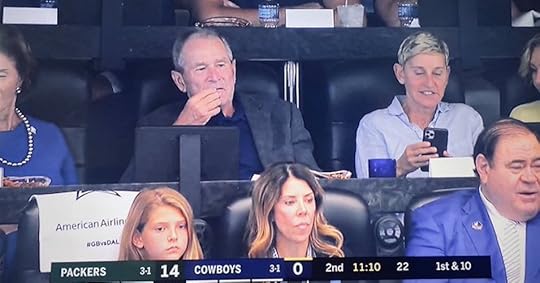
This Ellen-Degeneres-hanging-out-with-George-Bush thing is really interesting to me. In response to the above picture, Ellen said:
“In fact, I’m friends with a lot of people who don’t share the same beliefs that I have. We’re all different, and I think we’ve forgotten that that’s OK, that we’re all different.”
And in response her audience applauded.
Personally, I very much appreciate that Ellen spreads this message of total, unconditional acceptance.
But Ellen wasn’t made homeless by the 2008 financial collapse. And her family weren’t one of millions killed in the falsely justified Iraq war. Or in Afghanistan. Her wealth exempts her from attacks on planned parenthood and minority and LGBT rights.
People are upset because we need to construct natural boundaries in society to exclude and hold responsible people like George W Bush who used their power to wreck havoc on us on a global and personal scale and then walk away with impunity.
We need cultural leaders to be willing to defend the so so many people globally who still suffer the ramifications of abusive political policy. George W Bush walks around without worry, but many of us were trapped and desperate for years in the wake of his presidency.
I hope very much that Ellen can see more deeply, past feeling that she has to defend herself personally against outrage, and instead notice the disappointment her viewers clearly feel that someone they love is defending her friendship with a man who hurt a large amount of her audience.
It’s always more “kind” to help those who suffer than align with those who abuse power.

July 27, 2019
Holy Lands: On the View of Mauna Kea
 Photo by Steve Halama
I am intensely for discovery, for scientific understanding, and interested in the universe. For this reason the Protect Mauna Kea protest, over the construction of a massive telescope at the summit of a holy volcano, is so captivating to me.
On one side, several world governments, independently wealthy financiers and Caltech want to build what will essentially be one of the most powerful telescopes in the world atop an ancient sacred site for Hawaiians.
On the other, Hawaiians have viewed Mauna Kea, a gargantuan god of a volcano that begins deep at the base of the ocean, as central and deeply holy in their beliefs since… well, forever.
The National Guard was, interestingly enough, called in to protect construction from the native people. You’d think the National Guard would protect the locals before any pet project, high tech or not. How must these soldiers feel telling a non-violent neighborhood to keep away while outside contractors desecrate the site behind them. What that must do to the young soldier’s soul.
Some dry and serious-minded person out there may think, “Be serious Tony, we can’t let every holy indigenous site stop the progress of science! This is the best location and the best technology!”
And to this I’d respond, “You’d protest too if a consortium of groups you have no voice among suddenly desecrated your sacred place, whatever the reason… a church, a park, or beach, or graveyard where a family member is buried.”
But, “That’s different,” this person might reply. “Are we supposed to constantly check and see if literally EVERY place is important before we do anything?”
And to that I’d say, “Yes. Absolutely. Now you get it.”
But then this person could say, “That’s absurd Tony! You could say that ANYWHERE is a holy site we can’t use for any reason and block progress!”
And to that I’d ask: how would you treat this planet if everywhere WAS a holy site? Every inch of the planet, including where you’re sitting right now? Every cube — even the air around you, all of it. Would you still build oil and gas pipelines, test nuclear weapons and pesticides, frack and dynamite, or spew plastics and toxins into the land or water or air if you knew absolutely that this place, all of it, was Holy? Pause for a moment, seriously, look around you right now and think about it. Whether you’re an atheist or spiritual, think about the atoms you’re breathing in, and shedding off… that you’re part of this porous holy land, and that polluting or desecrating it also means polluting or desecrating yourself.
What if the first thing God says to you when you die is, “Surprise: The land you came from and returned to is Holy. You were given a Garden of Eden to share, but you personally elected to exploit it while suppressing or dismissing those who fought to defend it. And so, you’ll be judged accordingly.”
Anyway, reverence seems to be in critically short supply in this case (which seems to involve groups you’d think are progressive and/or enlightened). Consider a small donation to maybe increase the amount of reverence in the world? http://kahea.org/donate/mauna-kea-legal-defense-fund
And thanks for the sacred attention, friends.

A Family Trauma From the 1920s Border
 Photo by
Daan Huttinga
Photo by
Daan Huttinga
Late in my grandmother Lucia’s life, she told me about growing up in the 1920s along the border between El Paso and Ciudad Juarez. Back then there was little in the way of an actual border between the cities, and my family (and many others) kind of lived on both sides, did trade on both sides, had friends on both sides… it was often a very casual affair. In this way, my cousins and I are especially “Mexican American.”
Anyway, one day in the early aught years I was watching the news with her or something and there was a story of a poor black man who was hanged from a tree. I said aloud something about how tragic that was, and how traumatizing it must consistently be for the black community.
Then she told me in a sharp anguished tone (the sort of stress that begs you to take their pain more gravely than another’s) that one of her early memories was going near the US/Mexico border one morning on the El Paso side to see Mexican (and very likely Mexican-American) men and women strung up in a row, hanged from trees and poles in a line between the countries.
Now if you knew her, she always resented being called “guera” as a child, which essential means “white girl,” as she was pretty fair. But in this time hearing this from her childhood peers was especially piercing because she identified more as Mexican, and associated White Americans with terrorism along the border. She was furious and disgusted by the association between her tone and the brutality she saw, and was very ashamed of her skin color, which she projected onto her sons. This is especially interesting in my family since her husband, my Mexican-born grandfather, identified strongly as American.
This is what Americans used to do at the border: murder brown people and line their dead bodies up the way Vlad the Impaler did. The outcome in my family was that my grandmother, like many American citizens today, became ashamed for just being who she was and disgusted by American culture, which she never fully trusted. And yet counterintuitively my grandfather, like many Mexican citizens today, believed strongly in the dream of America in spite of this terror and was intensely optimistic and grateful toward this country to his last day.
These were not isolated incidents, and not even really about citizenship or border security or even xenophobia (that word is such a dismissively meaningless euphemism to call violent hatred to me). Lynching these people was about terror, cruelty, an endless quest to dominate indigenous lands, and to annihilate indigenous people who were never given the basic right to determine where their own borders might be drawn. And America reenacts this first trauma, the crushing of indigenous people, constantly — it’s as core to our national identity as the Declaration of Independence.
I love you Grandpa, I still do, I have your name. Yes, America is about your dream, which became true for you. America can do this for people. We all believe this.
America also legalized the murder, trafficking and sexual exploitation of people, and children if it chooses. It calls people it wants to oppress criminals, sells its cruelty as “tough on crime,” and then uses this classification to terrorize legal citizens within our borders every day, like my grandmother. America also does nothing to those who sign these cruelties into law, even once they’re exposed. Oil and plastic executives that ruin our environment, gambling bankers that have pushed people into abject poverty, politicians who institute the terms of mass incarceration, and executives and investors that profit from these legitimate abuses are not arrested, or even stopped, despite ruining more lives than any criminal in jail now ever could, all from the comfort of a corner office. A systemic spiderweb of rich, nondescript mass murderers with expansive investments, several large homes and cars, vacations planned for later this year, golf this weekend with their friends, “very serious” idiocy on how poor people should get over poverty they spout over one another while being served drinks by someone making less than minimum wage they’ll tip 20% and feel great about… all abusers who will never, ever face public justice.
What is the message we send when America murders people indiscriminately? That we are strong? That America is a sacred place? That America is a great place to be? That Americans are good?
My grandmother and her siblings were natural-born citizens who learned early on that America can be hellish. And jailing children in internment camps proves this is true. This is not strong, not sacred, and not good. It is sick.
My grandmothers saw it. And it was always sick.

July 3, 2019
Politically Correct Speech, Free Speech, and Listening
 Photo by Joshua Ness
I have no idea where the term “Politically Correct” came from, or what people imagine it means these days. But “Free Speech” advocates seem to hate it.
When I was younger I sensed that being “Politically Correct” just meant that you’d instead say something nice, or else not say anything at all. Instead, I suppose the meaning’s been changed to, “Some people/liberals are trying to control Free Speech and so that/they must be stopped at all cost.” In short, being “Politically Correct” also meant being oppressive, and trying to crush completely uninhibited conversation and expression.
Though there are plenty of rules in place that limit actual free speech, like not screaming bomb on a plane (unless there’s a bomb on the plane, obviously), for the most part everything you can say is already allowed. If you want to say racist, or sexist, homophobic or cruel or outright sickening things, even in public forums, by all means do it. It’s legal, and if that’s the way you want to exercise your Free Speech rights, go for it.
Will there will be repercussions? Not legal ones, but certainly your family, friends or society as a whole can opt to ostracize you. Stretching too far in one direction likely means a hard snap back, rubber band style. Likewise, if you’re in a place where speech is confined, and little can be said without severe repercussions (like a bad relationship), things feel much easier when you’re finally free to say what’s on your mind.
I sort of view this in a Buddhist way, that beyond these poles of “free or confined speech” there’s a kind of “Right Speech,” where a degree of mindfulness and concentration can help you and I say things aloud in the world that help others feel understood and included, while also expressing our needs and particular points of view.
“But Political Correctness limits that, Tony!” Free Speech advocates might say. “If someone is trying to restrain Free Speech, then they’re PUTTING rules in place for what you can say at all, and that’s wrong!”
In response I’d say that everyone is constantly putting rules in place for how they want to communicate with others. If you’ve ever looked up at another person, noticed that they wanted to engage you in some way, then quickly averted your eyes, you’ve put in rule in place: don’t talk to me. I’ve done this plenty of times with people asking me to sign petitions on the street.
That said, what’s more important here from an interpersonal perspective, putting these communication boundaries in place to live the life you want or dissolving all communication boundaries and just letting any person get up in our face about anything at any time?
“I don’t care if my speech triggers snowflakes, Tony!” one may respond. And to that I’d say, fair… though you should also anticipate not being invited places because you are clearly not interested in respecting others’ boundaries. And why would you go out of your way to deal with people you’d consider snowflakes anyway? Seems like a waste of your precious time, man.
I and others I think enjoy tact — that is, I enjoy when I’m savvy enough to think before I speak, and adapt a bit of my language so that the other person better understands me… and feels better understood in the process. Yes, of course I’ll slip up, but you sort of earn credit by even trying and setting that intention, so that a mistake here or there is easily forgivable. This is much better than being known as the guy who tries to trigger snowflakes all day… when you finally want credit from others, what reason would they have to give it to you?
This makes me feel like covering cruel language in the blanket of “Free Speech” actually traps the Free Speaker between a rock and a hard place: saying mean things ostracizes the Free Speaker (i.e. people don’t want to hang out with them anymore), which will lead to less socializing and less clarity about how to listen to others, leading to more mean things said without being checked or even noticed, then less capacity to reflect and listen to others, then more casually nasty speech, then less clarity from social cues, back and forth, downward and downward. Internet forums focused on “Free Speech” are often pretty far down this spiral, and more often convey, “I want to write hateful things and laugh at it” than “I’m interested in listening to or engaging with you.” And it shows: many of them look like planet-scale trashstorm firescapes of bile-inducing crapspeak. Pardon the language, of course.
I think the term “Politically Correct” is the first maybe ham-fisted attempt to ask that I listen and consider the other person a bit before I talk. Which seems pretty sensible on the whole, I don’t think there’s anything particular “Political” about it. Emily Post would likely approve.
Though I personally think we can go a step further to a kind of listening Thich Nhat Hanh calls “Deep Listening,” or Quakers call “Listening in Silence.” This level of listening asks us to listen to another person and wonder what they really need from us in that moment. Do they need help? To be understood? Advice? Just to feel close to another person? Then, finally, when we respond we do so from a place of honesty, generosity and self-clarity. Nothing about this “correct” speech is at its essence political at all since it’s not trying to control us. Instead, this kind of speech is about helping and even supporting the way we speak to one another.
For example: “Free Speech” advocates clearly want a lot of acceptance. They very likely did not receive much as children, and to some degree are starving for it. Now they want to be assured that they can say even the most vile, repulsive, offensive things to and about others and still feel deep down that society will accept, defend and even support them.
Likewise, when boundaries are put around their speech in any way (like, how no one dates Incels, Free Speakers are asked to leave college campuses, or Nazi speakers punched ala Richard Spencer), they are deeply and very personally hurt, as this response very clearly re-triggers an early-in-life rejection of who they are. Most likely, a caregiver used cruel language to make them feel small, and silence them. And now they do the same to others, both to finally feel large and finally have a voice. Until they resolve that core pain of rejection that has nothing to do with anyone but themselves, no amount of listening will motivate them to speak more compassionately.
So for your own sake/sanity, best leave them be. If someone says mean things to you, build a safe boundary and leave, or ask them to leave if it’s your space. Yes, they have “Free Speech,” but that doesn’t mean you must accept anything they say. Let me assure you: reject them, go ahead, as hard as that sounds, as painfully as they may take it, it’s okay. Considering others, speaking openly, then hearing Right Speech in return grows us and our own ability to bring greater understanding into the future. They also makes it clear to others that in order to be friends, they must, you know, be friendly with you.
So be Politically Correct or don’t. Advocate your Free Speech anyway you like. And feel safe that you don’t have to include mean people in your life. Or assured that the worse your language becomes, the less likely you’ll feel accepted, or even cared for, by others.

May 6, 2019
Return To A Time of Wonder
 Photo by James Pond
Today I’m going to ask that you do something you like, but that you’d otherwise restrain because you are “grown.”
Eat a pint or three of ice cream, a whole bag of chips, or a dish that surges with memories of feeling young again. Play hours of video games, or board games, or role playing games, or imagination games with your own rules. Play with toys, break them if you feel like it, you can always get more. Go to the park and play on the swings, or the jungle gym… roll down a hill or jump off a ledge. Bring out your bike, or scooter, or unicycle, or just run in the streets, race your friends, or your kids (just, you know, safely). Make a mess in the kitchen, or your workshop… blow something up, spill it all over the place, then laugh at the mess. Read comics, watch cartoons, or “trashy”/amazing TV. Listen to music you loved at 12, or 6, but are currently so embarrassed to admit you enjoy. It’s fine, you were a kid!
Try remembering what life was like when there were fewer consequences, maybe none at all. Remember how the world can feel like fun.
I’m not advocating falling into self-destructive behaviors, of course. If you’re struggling with an addiction, where acting out might mean doing something against what’s in the best interest of your health, then please do what’s best for you. A younger person inside of you, the child inside you remember being, deserves always to feel safe first.
What I’m asking instead is to remember a moment from your childhood, even if it was brief, where you felt like you could just let go, and enjoy yourself. How free it felt then, how reckless, unbridled, excited… wonder-filled. How open to the experience of life you were able to be.
This feeling isn’t nostalgia — it’s inside of you now, right now, waiting to be let out. As you read my post you probably even remembered exactly what you enjoyed, and maybe thinking about it now makes you smile at how unconditional (and meaningful!) just having fun can be.
Find the time this week to remind yourself how much young joy can still exist in your adult life. “ Adventure isn’t something you do,” Melody Beattie writes. “The adventure is your life.”
So take a break from being serious. We all know it’s not worth it anyway. Return to your self again, back to your imagination… remember who you are when you’re free again, adventurous, expansive and wild.

April 24, 2019
Voting With Your Feelings This Primary
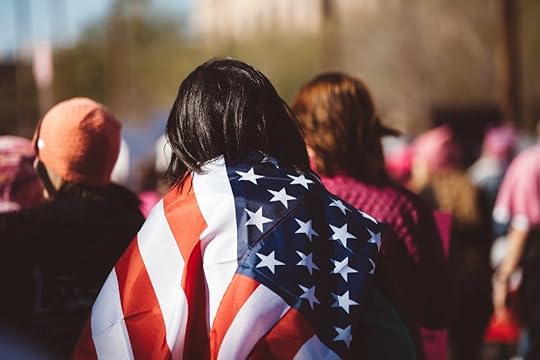 Photo by Josh Johnson
Is it just me or does this election cycle already feel very tiresome?
Part of this may have to do with the dramatic years we’re spending in chaos. Trump is such an whirlwind agent of instability that I sense most of us have found our equilibrium with him, which of course is terrible given that we don’t deserve a leader who is so shame-based, so self-involved, and so uninterested in bettering our quality of life, day to day. It leaves one feeling only despair and devalued, as though this is what we deserve as a nation, and that no democratic candidate can stand up against the tumult we’re plainly used to at this point.
This is made harder by reading articles about the Democratic party candidates that also convey inconsistent thinking and paradoxical perspectives. Candidates cannot be pro-big technology and anti-investment banking, given that these are sectors are now exactly the same. They cannot be pro-unions and anti-boycotts. They cannot care about social justice while also remaining proponents of severe incarceration. They cannot support an “even playing field” if they still expect us to compete against the rich and their vast stores of monopolized resources.
They can’t be pro-education and at the same time just fine with charter schools or the cost of university. They can’t be pro-healthcare and at the same time just fine with HMO’s current restrictions and finance models. They can’t be pro-basic income if they expect anyone but the 1% to cover the cost of that… the money will certain pass back up to companies owned by billionaires anyway, at least it can first be in the wallets of those who need it most.
I, personally, am not asking for ideological purity… I’m not even sure who coined this term except people looking for an excuse to dismiss a candidate who’s sincerely attempting any actual ideological purity. After all, Trump’s not ideologically pure in any sense of the term and Republicans were all about him. I’m just asking for consistency.
What’s crazy to write is that Trump’s lying, flip-flopping childishness is its own consistency in the “better the devil you know” sense, and this makes me sigh with the idea that he will win in 2020. Like beaten spouses, I can only imagine a candidate rising through the Democrat’s ranks only to lose because we, as a nation, are too frightened and fearful to change. “Scared animals return home,” Bessel van der Kolk wrote, “regardless of whether home is safe or frightening.” This, I sense, will be well-reflected in this upcoming election.
I’ve mentioned this before, but I don’t really think we’ve reckoned as a nation with the traumas we’ve experienced in just this one generation: 9–11, multiple wars at once, the economic crash, early global warming signs, school and public area shootings, the rise of racist nationalists, the capturing, caging and torture of immigrants and their children… this is a lot to settle on, and maybe an impossible amount to work through in one lifetime. Why wouldn’t we return to loud, pushy, strong-looking leaders who’d promise to make our fears and anxieties go away? If the opiod epidemic shows us anything, it’s that peace of mind/heart is needed so desperately we’ll even destroy ourselves for it.
And look: that’s okay. We cope any way we can, and we’ll get through it, and learn in the process about ourselves and what we’re capable of surviving as a nation. What it will take, though, is settling on how hard things really are out there, and how important consistency is to us: people who do what they say, stick to their words.
Trump is tremendously insincere… a lot of people know that about him, and even expect him to be this way, since it reinforces their existing expectations that politicians are insincere generally. “At least we know he’s an asshole,” I’ve heard from many, many people. “We can’t charge him with any sort of collusion if he’s too bumbling to have gotten away with any of his attempts to do it,” the Muller Report basically said, confirming to us that this behavior is okay. That it is okay to abuse our society this way, if he is bad at it. That as long as he’s a terrible person in the plain light of day, that is alright.
Personally, I find this perspective completely fear-based. It presumes that really, deep-down good people aren’t able to effect change the way jerks are… and that unless we hire jerks, we’ll get taken advantage of.
No, my friends. Being a good person also means having powerful boundaries that allow you to say, “No, that’s wrong and I refuse to stand for it.” Being good also means being nice to people the vast majority of your time, looking out for them, tending to them and defending them when they need the support. The Buddha’s Noble Eightfold Path: right view, right aspiration, right speech, right action, right livelihood, right effort, right mindfulness, right concentration. In short, being 100% clear about your noble intentions, and also acting nobly! What a concept.
Being scared means putting a jerk in charge and begging, even praying, that things will be okay. That only loud assholes are strong. That someone mean and big-mouthed will finally be your defender, instead of your abuser. That you are small in comparison to their screaming largeness. That is clearly not the case though. “Your thoughts and my thoughts will determine the kind of lives we will have in the future,” the Minister Joyce Meyers wrote… imagine a future where we think we deserve so much exhausting bullying.
Back to my original point, I’m already tired because several well-considered democratic candidates seem unclear about how consistent they’ll be, and since no one is ideologically pure anyway, I can imagine many voters going back to Trump praying that his mad-capped antics are, at least, reliable enough.
More to the point, I think it’s pretty clear that Trump’s strategy on the whole is to blame the screaming canary to keep us from noticing what’s happening in the coal mine. This is why the homeless, and migrants, and vulnerable minorities, and drug users, and prisoners, and abandoned veterans, and the poor and helpless and meek are shamed as inferior instead of seen more righteously, or Biblically, as the inheritors of the Earth.
I will of course not vote for Trump, as every Democratic candidate (even the most eye-rolling ones) are still 1,000% more consistent and sincere than he is. Still, it would be nice, for once, to be able to vote for someone I can put a little more faith in, who’s interested in showing us how much better things can be when we redefine ourselves as a country that wants to work together, wants to help, and wants to care about the well-being of ourselves, and the most vulnerable.
“We must not allow other people’s limited perceptions to define us,” my hero Virginia Satir wrote. I think we do that by being brave enough to be bold, not worry about who others think is or isn’t electable this time around, and follow our hearts a bit more than usual. Many people did that when they voted for Trump, wherever their hearts were at the time.
Trust in yourself this time around. Follow your gut. Not every step forward has to be part of a greater strategy — to think 10 steps ahead or plan some grand future for the party — those often don’t work out as planned anyway. I’m telling you to literally vote any way you like. Chat it out, research as you like, and vote for the kind of future you feel like seeing. Don’t think further ahead when what your heart asks.
Support whoever feels best for you. It’s okay to act on feeling. I promise: it is.

March 29, 2019
Goodnight - A Poem
 Photo by Benjamin Voros
Goodnight stars. Goodnight moon.
Goodnight Jupiter and Neptune.
Goodnight land and goodnight sea.
Goodnight those who disagree.
Goodnight you and I right now.
Goodnight us from years ago.
Goodnight Tuesday. Goodnight year.
Goodnight anger. Goodnight fear.
Goodnight birth and goodnight death.
Goodnight in and exhaling breath.
Goodnight love. Goodnight pain.
Goodnight again, and again, and again.

March 20, 2019
The Wealthy, The Dark Triad, and The Light We All Bend Toward
 Photo by Joshua Earle
“Privileged individuals are… less likely to follow rules and instructions given they believe the rules are unjust. Because they feel deserving of more than their fair share, they are willing to violate norms of appropriate and socially agreed upon conduct.”
This is a quote from University of Michigan Professor David S. Mayer’s thoughtful article, “Why Rich Parents Are More Likely To Be Unethical.” It’s very much worth reading.
It’s interesting to me that the scandal involving wealthy people bribing their way into elite colleges was exposed during the Trump administration, since it’s never been so clear that rich people in our society can generally do whatever they please, even (in this case) completely bypass, hard work, grit and fairness. So calling these people out in particular and arresting them feels to me like a first wave, of sorts.
I think it’s also cool that Professor Mayer was even able to study rich people and the specifically warped views they seem to have about what they deserve and how they expect to get around in the world, since it’s a common and often untested American belief that, “being rich means you’re doing things the right way.”
And it’s so obviously untrue.
In fact, the very wealthy seem to be acting in the world as though they have a very peculiar mental illness. Behavioral indicators amass in this article like a list outlined by the DSM:
“Rationalize unethical actions that serve their self-interest”
“Motivated by self-interest to ensure their children’s achievement”
Develop “comparisons that help them morally disengage with their actions”
“Less likely to follow rules and instructions given they believe the rules are unjust”
“Feel deserving of more than their fair share,”
“Willing to violate norms of appropriate and socially agreed upon conduct”
“More competitive, selfish and aggressive when they sense a threat”
“Lie, steal and cheat more to get what they desire”
“Less generous.”
“More likely to break the law when driving, give less help to strangers in need, and generally give others less attention.”
“Selfish, expressing a need for admiration, and a lack of empathy.”
“Less likely to believe they are vulnerable to the detrimental consequences of unethical behavior”
As written, these behaviors and cognitions align pretty clearly to the traits of the Paulhus and Williams’ Dark Triad of “narcissism (entitled self-importance), Machiavellianism (strategic exploitation and deceit), and psychopathy (callousness and cynicism).” Maybe too well.
And much like a personality disorder, this list reads as an interconnected group of trait features we as the public need to be very aware of and protect ourselves from.
The DSM-5 describes a Personality Disorder as, “an enduring pattern of inner experience and behavior that deviates markedly from the expectations of the individual’s culture, is pervasive and inflexible, has an onset in adolescence or early adulthood, is stable over time, and leads to distress or impairment.” Could it be that the wealthy, as studied, endure a Personality Disorder specific to being wealthy?
Regardless, I’m glad we’re in a society that’s now starting to see that they actively stack the deck against us… that these traits even can describe a specific personality type at all.
This personality type seems to expect that everyone can take on debt, or personal sacrifice, to pay for things that they can pay for handily and easily afford… like healthcare and higher education and comfortable housing, medication and police protection and city services like better roads and utilities. And yet given all the advantages afforded to these personality types, they still expect to break our social rules in their favor, so that they may reap benefits they don’t earn in any sense of the word.
In contrast to this type, Scott Barry Kaufman’s article, “The Light Triad vs. Dark Triad of Personality,” gives a me faith that even if some wealthy players align with the Dark Triad, society itself is does not…
“Socially aversive people certainly exist, but what about everyday saints? […] The person who isn’t constantly strategic about their giving, but who emits unconditional love naturally and spontaneously because that’s just who they are. […]
“[I]t is clear that the light triad is not merely the opposite of the dark triad. While the two are negatively related to each other, the relationship is only moderate in size (a correlation of about .50), supporting the idea that there is at least a little bit of light and dark in each of us” […]
“To our surprise (we hadn’t expected there to necessarily be three factors), three distinct factors emerged from our studies, which we labeled: Kantianism (treating people as ends unto themselves, not mere means), Humanism (valuing the dignity and worth of each individual), and Faith in Humanity (believing in the fundamental goodness of humans)” […]
“We calculated a light triad vs. dark triad balance score for each participant by subtracting each person’s score on the dark triad from their score on the light triad. The average balance score of the entire sample was 1.3, suggesting that the average person is tipped more toward the light.”
I think that a mentally healthy public, one tipped toward the light, intuitively understands that it’s hard for hundreds of millions of people to push themselves to the limit to pay mortgage or rent while +/- 200 families horde the whole other half of our nation’s wealth.
That sounds like system-wide issues that needs correction, the way an engineer would see a flaw in how a program works and then release a patch to correct it.
To me, holding the wealthy extremely accountable for how they exploit our society — the same society they benefit from every day — sounds like great, humanity-wide self-care the rest of us really need right now.
I also think that this means that however flat-out “Dark” certain people may have become, deep down they still have an inclination toward positive change (however hard they may resist).
I know that my own inclination toward the Light intuits that this is true. In cases like this, I take the word of the philosopher Lin Yutang, a relatively indulgent (though clever) character in this own right:
“When small men begin to cast big shadows, it means that the sun is about to set.”
And in response to this I smile, aware that never before has this felt more true.