
Jarrett Dapier's Blog
October 10, 2014
Book of Revelations: Barefoot Gen by Keiji Nakagawa
 Recently, my “Literacy, Reading, and Readers” (LIS527) professor showed us Raina Telgemeier’s moving webcomic account, “Beginnings,” about her experience reading Keiji Nakazawa’s Barefoot Gen when she was young. Telgemeier, whose graphic novels Smile, Drama, and Sisters have hooked my daughter something wonderful (she’s spent close to 20 hours reading and re-reading these books in the last few weeks and is a picture of reading immersion, a child “lost” in a book, when she’s poring over them), clearly values Nakazawa’s book as a seminal influence, the kind of touchstone text that changed her life. After seeking out Barefoot Gen to read for myself, I can see why.
There have only been a handful of experiences in my reading life in which I felt shaken to my heart-core upon finishing a book. Barefoot Gen was one of those experiences. Set in 1945 in Hiroshima during the months preceding the American dropping of the atom bomb, it follows young Gen who is something like 6 or 7 years old, an impetuous, hot-headed but morally centered young boy. Gen is a boy who so often “does the right thing” – for his family, for those in desperate need – and holds tight to an irrepressible optimism that saves him from paralyzing trauma again and again. The series is understood to be based on Nakazawa’s own experiences growing up in Hiroshima and surviving the bomb.
Barefoot Gen is constructed beautifully (as Telgemeier points out) so that 90% of the book is not “about the bomb” but focused on Gen’s family and their struggles in what was a small village, (with a population equal to Evanston, IL, my hometown, today: 70,000), during WWII. This allows the reader to become both emotionally invested in Gen, his little brother, and his parents, but also immersed in the cruelty of life for common Japanese villagers during WWII, especially those Japanese, like Gen’s father, who opposed the war and saw it as monstrous, inhuman and dishonorable on all sides. The longer I read, I became involved in the hardships faced by Gen’s family as they are isolated, framed, stigmatized and attacked for their anti-war convictions in the face of jingoistic neighbors and peers. Along the way, I grew to feel something like love for them, but I didn’t realize it until they were incinerated.
In this way, the entire book is “about the bomb:” it clearly depicts the everyday, human struggles of human beings in a human family trying to provide for each other while powerful humans in far-off places plot their destruction and local humans punish them for having the audacity to think for themselves.
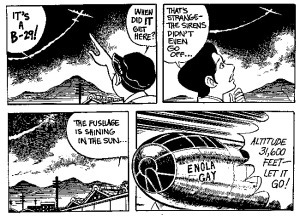
Image borrowed from “Keiji Nakazawa Interview,” The Comics Journal, October 2003.
I have never read a book that conveyed what it was like to survive Hiroshima, the horrifying suffering that occurred directly after the detonation, and the traumatic/nightmarish/instantaneous transformation of this small town from bustling community into toxic dystopian hell. To see this horror through the eyes of a child is to be reminded that, for as often as we are told that the bomb was “necessary,” the suffering of the people in Hiroshima is almost impossible to imagine or understand. The end of this book left me shaking with sobs even though I knew what was coming.
It also left me wondering how we can “justify” the bomb. Given the instantaneous elimination of 150,000+ people in Hiroshima and Nagasaki and the unfathomable suffering of those who survived, I don’t see how arguments of “who did what to whom” even apply. This gets at the core of violence itself. Can we ever know the truth of its cause enough to justify it?
In “Beginnings,” Telgemeier observes, “There’s no such thing as ‘just a comic.'” It’s a line that kept returning to me, boomeranging through my brain for days after I finished Nakagawa’s inspired book. Before Barefoot Gen I never thought that a comic book could affect me on such a deep emotional level. There have been comic books that I found quite moving – Blankets by Craig Thompson is an example; Maus, too – but nothing like this. Not only was this a profound read for me, but it also shifted my view about what a comic can and cannot “be.” Clearly, a comic book can be great literature. Barefoot Gen is certainly that. In fact, it puts any ideas of debate about comic books and their potential sophistication to rest for me. It’s not debatable. Does the form matter if the art in a book can touch a person as deeply as this one touched me?
Barefoot Gen, volume 2, set in the 4 days following the bomb blast when Gen is foraging through rubble, incinerated humans and unidentifiable body parts for a small bit of rice, is nearly unreadable. What saves it – and somehow makes it more universal as Scott McCloud suggests in Understanding Comics – is its “cartoon” style. The book is full of cartoon drawings of monsters (who are actually melted people) trudging around the city, their skin hanging off their bodies. But, somehow, the cartoon style made me able to imagine even more vividly Gen’s quest through this world of horror.
(I had to make sure to keep these books high up on a shelf lest my comic-loving daughter find them. She’s 8 and, no, she is absolutely not ready for this. I was shocked Telgemeier read it at 9 years old. I’m not ready to tell my daughter about what humans are capable of on this sort of level and I don’t think her heart is ready. But, then I don’t think anyone’s heart can be “ready” for this book fully).
I saw Barefoot Gen on the shelf for 5 years in the Teen Loft where I worked at the Evanston Public Library, but I never picked it up, didn’t know what it was about. In a way, this feels like a loss. I know so many teens who would have thought this book was incredibly powerful, so many teens to whom I would have loved to give this one, who would have wanted to know about this incredible work of history, imagination and humanity. It’s akin to how it would have felt if I had spent 5 years working with teens not knowing about The Book Thief, another profound WWII novel that can change a person’s view of violence and the world. But, I have my future work with teens and I will most certainly make Barefoot Gen a part of that work.


June 3, 2013
My Stage Adaptation of Willa Cather’s My Àntonia
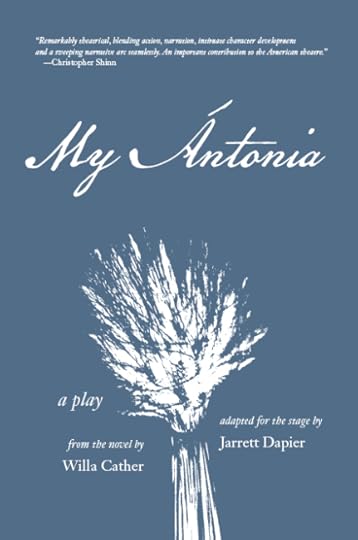
Cover design and photo by Barbara S. Evans
It is with great excitement that I announce the publication today of my stage adaptation of Willa Cather’s exquisite novel, My Àntonia. The play is published by Agatite Press and is now available in a beautiful paperback edition exclusively from Amazon.com.
The world premiere of My Àntonia was produced by the Celebration Company at the historic Station Theatre in Urbana, IL (where I am a long-time Company member) on December 1, 2011. It was directed by Gary Ambler and Joi Hoffsommer, two old friends and genuine theater artists, and featured a youthful cast of 11 performers who gave honest, heartfelt performances that brought the characters of this classic American story to beautiful life. During its nearly sold-out run, My Àntonia received strong critical praise. It also struck a personal chord for many audience members: I received several letters from local theatergoers, Cather devotees and native Nebraskans praising the script and production.
Now I’m thrilled to share the work with a wider audience. The book was designed and composed by Barbara S. Evans, a longtime staff member at University of Illinois Press, (publisher of the stunning recent book The Beautiful Music All Around Us by banjoist and music researcher Stephen Wade who, incidentally, advised me on music history of the late-nineteenth century plains while I was writing the script). Barb’s cover – which couldn’t possibly make me happier – is pictured above.
My Àntonia is available exclusively through Amazon.com now. I hope you’ll pick up a copy.
“Remarkably theatrical, blending action, narration, intimate character development and a sweeping narrative arc seamlessly. An important contribution to the American theatre… Dapier has done that rare thing, entered so deeply the psyche of the novelist that it feels like we are watching the play (Cather) would have written, not a version of the play created by a sympathetic outsider. Profoundly moving.”
-Christopher Shinn, Pulitzer Prize-finalist author of Teddy Ferrara, Dying City, Where Do We Live, and Four
“Dapier’s adaptation is faithful and true, lyrical and haunting. He has distilled this great novel into clear, essential dialogue that is as hard, poetic and vibrant as the American soil on which the story takes place.”
-Andrew White, Artistic Director, Lookingglass Theatre Company, Recipient of the 2011 Regional Theatre Tony Award.
December 19, 2012
Protecting the Gift: Crucial Post-Sandy Hook Reading
 “Schools, churches, your mama’s house, cars, THOSE ARE SAFE ZONES.” -Ameena Matthews, The Interrupters.
We are in shock over the 27 deaths of children and adults at Sandy Hook Elementary School last Friday. With each new day, the horror grows, our souls are more baffled and grief-stricken. Parents of small children the world over feel a particular kind of pain: we imagine. At morning drop-off, we imagine it happening at our child’s school. When a siren sounds across town, we imagine our own precious child in a room in chaos. At pick-up, we cry when our child runs smiling – safe – into our arms. We imagine – but fail to know – the agony of the Newtown parents who won’t hold their children again. We hurt, we pray, we imagine some more.
Sandy Hook confirms for us what we know in our heart of hearts: We live in a traumatizing, violent culture (the organization Cure Violence would call it violence-infected, a friend of mine calls it violence-addicted) and children are often the helpless victims of that violence. What can parents do to keep their children safe?
Gavin De Becker’s Protecting the Gift is a must-read for parents beset with concerns for their child’s safety. De Becker is a security expert who is unabashed about the violent potential of humans and argues convincingly about the power of unconscious denial to enable that violence. In Protecting the Gift he guides the reader through common sense practices, habits of thinking and means of analyzing situations that will help parents keep their children safe in an increasingly chaotic culture. Drawing on concepts he first introduced in The Gift of Fear, (also excellent), De Becker explains that we are all endowed with a survival impulse, one that activates to alert us when threats are approaching or at hand. Learning how to listen to that impulse is crucial to survival. In chapters covering everything from gun violence to sexual predators, he guides parents through common, real-life scenarios in which children’s safety is threatened (scenarios exponentially more common than a mass shooting like Sandy Hook) and shows us how to teach kids to recognize these situations so they are avoided.
Some of the suggestions will feel uncomfortable, even counter-intuitive: His suggestion for what to tell a child should she become lost is, choose a stranger your gut tells you will help you before a stranger chooses you. But De Becker’s clear, authoritative and empathic writing style, not to mention his keen instincts and experience, make this a how-to book of the most crucial kind.
A warning: It can be a terrifying read. Like the details of Sandy Hook, some of the scenarios he writes about are harrowing and disturbing to imagine happening to your child. But to face down the monsters he describes ultimately empowers the reader to be a more effective, confident protector of children and stems unwieldy, useless anxieties.
In the moving penultimate chapter, “Protecting the Village,” De Becker writes that we must shake off denial to be more conscious, thoughtful and vigilant about keeping children safe. His is a voice we must now heed. It is our job to do so.
Jesus said, “Let the little children come to me, and do not hinder them, for the kingdom of heaven belongs to such as these.” Matthew 19:14.
October 29, 2012
Back to School in the Bronx: An Interview with Jonathan Kozol
 Jonathan Kozol has spent a career insisting on the validity of children’s voices. In bestselling books like Rachel and Her Children, Amazing Grace and Ordinary Resurrections, Kozol has drawn on the insights of America’s poorest children to expose the ravages of their volatile living conditions, unequal schools, and violent inner-city neighborhoods.
“None of these children can be held accountable for choosing where they had been born or where they led their childhood,” he writes in his latest book, Fire in the Ashes.
At 76, he is a staunch defender of teachers, unapologetic advocate of school desegregation, and unrelenting critic of standardized testing. In 2007 he waged a hunger strike to protest the re-authorization of No Child Left Behind. His 1990 book, Savage Inequalities – which remains widely read and a staple of teacher education curricula – and its 2005 followup, The Shame of the Nation, are about the gaping rift between our nation’s poorest inner-city schools and the predominantly white, wealthy schools often situated only a few miles away.
In Fire in the Ashes, Kozol returns to the Mott Haven section of the South Bronx – “the poorest congressional district in the nation” – where many of his previous books are set. Populated with the stories of children, parents and educators first introduced to readers in Amazing Grace and other works, Fire is a kind of ‘where are they now?’ shot through with Kozol’s characteristic passion, fondness for his subjects, and moral outrage.
“I’ve never invested so much of myself in a book before Fire in the Ashes,” Kozol told me when I reached him by phone at his office in Boston last August as he prepared to embark on a nationwide book tour. “It was tremendously moving to meet these kids again now that they’re young adults. But it was also harder than any of the other books to write because some of the kids had had tragic lives. The great joy for me, the part that enlivens me and gives me hope again, is the large number of kids who have shown an indomitable power to overcome everything.”
We spoke for over an hour. We discussed the limits of charity, the current siege against teachers, and his ongoing friendship with a resilient child – now a young woman – he calls Pineapple.
The interview – “Back to School in the Bronx” – appears in the November, 2012 issue of Chicago’s In These Times magazine. Give it a read.
September 29, 2012
Statement to the District 65 School Board In Support of Consistent Fine Arts Scheduling
Last summer, the District 65 school board, which serves 10 elementary schools, three middle schools, two K-8 magnets, and other teaching sites throughout the Evanston/Skokie, IL area, considered enacting drastic cuts to funding that would have reduced the number of fine arts teachers in schools across the district. The cuts would have also cut classroom prep time by adding a 7th class to the workload of remaining fine arts teachers and stretched more of those teachers across multiple school sites throughout the week, (some teachers of drama already travel between 2-3 schools each week). I was asked by the District 65 teachers union to speak at the August 20, 2012 school board meeting about the importance of fine arts curricula and in support of a consistent fine arts teaching schedule. I was given 3 minutes. My comments to the board are below.
_____________________________________________________________________
Jarrett Dapier
Statement to the Evanston/Skokie District 65 School Board on Arts Education
August 20, 2012
Hello, my name is Jarrett Dapier and I am the father of a student currently enrolled in a District 65 school. I am also a musician, a writer, and a staff member working in teen services at Evanston Public Library where I offer drama and music programming for Evanston students in middle school and high school.
In Harper Lee’s classic novel, To Kill A Mockingbird, the main character, a girl named Scout, says “Until I feared I would lose it, I didn’t love to read. One does not love breathing.” This is how I feel about arts education.
A quality fine arts education teaches kids empathy, how to trust and explore the complexities in life, and the power of abstract thought. It teaches kids to make connections between seemingly disparate ideas and themes. It teaches how to work cooperatively within a group, while also encouraging independent self-expression and point of view. A quality fine arts education deepens the lessons of social studies, language arts, even math, and it does all this by meeting children in the place where they naturally reside: at play in the imagination.
In my work at the library and as a parent at home, I have noticed that children and teens are just as observant, perceptive, and intuitive about the world as the rest of us. But they tend to lack the abilities to consciously understand all of what they’ve seen and heard. Creative expression gives children this ability, it gives them an outlet, a chance to make mistakes, and boldly work through all sorts of thoughts and feelings. When their souls are well-tended in these ways, children remain curious, open, and eager to learn more about the world.
But there’s a catch. A quality fine arts education is one that offers fine arts classes on a consistent, daily basis. I have seen first-hand in programs I run at the library and while raising my daughter at home that children thrive when offered consistency. It gives their world order and makes them feel safe. To offer fine arts classes only sometimes would confuse and disorient them. And to offer these classes only sometimes would obstruct the efforts of our talented fine arts teachers to build upon previous exercises and activities and cause them to waste class time reviewing and re-introducing what they’ve already taught before.
Just as breathing is essential to the functioning of complex systems inside us, the fine arts are essential to sharp, creative and empathic thinking, the kind exhibited by the very best learners and thinkers throughout our history. Please preserve a consistent fine arts schedule for the students of District 65. Thank you.
Jarrett Dapier's Blog

- Jarrett Dapier's profile
- 45 followers

