
K.M. Alexander's Blog
November 6, 2025
Read My New Short Story – REM State: fieldwork.
For a recent scary story night, I decided to explore a setting that had been rattling around in my head for a while. REM State is unrelated to The Bell Forging Cycle, but it shares a similar DNA. I like massive cities and weird creatures, what can I say? I don’t write short stories all that often, but instead of filing this one away and forgetting about it, I figured it’d be fun to release it. Who knows, maybe I’ll do more of this in the future.
You can read REM State: fieldwork. below for free, or, if you prefer, listen to me reading it. I’ve even listed an e-book copy on Amazon, if you’d like to throw a buck my way and support my writing. Whatever you decide, I hope you enjoy, and let me know what you think!
REM STATE: fieldwork.by K. M. Alexander
 LISTEN NOW
 or, buy it on Amazon.
The doctor was not supposed to be here. No human was. No human had truly been. Not completely, at least. Not physically. Not until now. To those here, he was an interloper, an invader, a virus that had crept its way past the immune response and now found himself drifting through this place. They would kill him for that. Oh yes, they would kill him, but only if they could find him.
The steady drumbeat emanating from a neon-soaked club provided a muted bass line to his hurried rush down the boulevard. The box on his right wrist hummed. Drops of bright red blood trickled from beneath where it had bitten. The sharp pain that had carried him here was gone. It had been replaced with a manageable ache.
In a few hours, the device would be ready for the trip back. Not much time, considering. Putting it out of his mind, he jammed his hands into his coat pockets and moved on.
Night had fallen, or so he presumed, for he did not know if day and night existed here, and it was colder than he had expected. The sky above was ink black, with no stars in the firmament, no moon to give off a cheery glow. The only light here emanated from the city itself. Its street lamps, glowing windows, and the signs advertising a million things in as many languages, none of which he could comprehend.
He pulled his jacket’s collar up to protect against an ever-present wind that howled down the thoroughfares bearing scents of warm spices, sour rot, cooking meats, piss, perfumes, and the spiky scent of fresh snow. He tried to make a mental recording of the city and wished he had time to take detailed notes. But time would come later. Safety first. Observe. Remember. Keep moving.
People—or what he in his head thought of as people—moved around him, ignoring or not noticing the rushing human in their midst. None looked alike; each came assembled in all manner of configurations. Some appeared human, others only nearly so. Some deviated into horrors the doctor could only describe as unfathomable—and between them all, ignored by everyone, were the transients.
Ghostly human forms would drift in and out, like eye floaters or visual echoes. They passed through people, surfaces, and walls. The locals ignored these intruders the way one would ignore steam or sunlight. There was a possibility they couldn’t even see them. He made a another mental note—something to explore later.
Had he been a religious man, the doctor would probably think of these as souls. Instead, he preferred to call them—mixing his Latin and Greek—as animus sine somatic or “will without body.” A temporal state. A transitory period that arrived before one reached a full paradoxical sleep state. It was, as he theorized, an uncoupling. For what purpose, he had no idea. But for a moment, a brief fraction of time, the mind was free of its body. Detached and adrift.
As such, the animus’ brief foray to this place was at most seconds in length. Once in a complete paradoxical state, the animus drifted apart, passing from one reality to the next. It was strange to realize one’s mind as empty even for the briefest of moments. Up until now, it had only been conjecture. Learning to harness the transition and interrupt the transit was what allowed him to travel here. All thanks to the humming device on his wrist, and unlike the billions of unconscious minds drifting into and out of this world, he managed to stay.
He passed a person with a head that resembled an iron anvil, wearing a flamboyant business suit and carrying a briefcase; behind them, on a leash, came a pet with three legs and a head shaped like a sphere, floating above where a neck should have been. It let out little sing-song sounds, like a child’s nursery rhyme heard from several rooms away. While staring, he nearly collided with someone who looked like a two-dimensional drawing by Picasso or Braque come to life, each line that made up its form shifted as it moved and wriggled into jagged lines as it swore in a silent, unknown language. The doctor stepped back, hands raised, accidentally bumping into what looked like a dodo with a human body and six arms. It squawked in protest.
“Sorry. Sorry. S-so sorry. I didn’t—I mean—apologies,” he mumbled in English.
It was impossible to tell if either understood. Both stared at him with expressions he found unreadable, using faces he barely recognized as sentient. He was drawing too much attention. His heart fluttered in panic, and he stepped out of the flow of traffic and onto a dingy, dimly lit stoop. The two creatures watched for a moment, the dodo head tilting slowly. He kept his hands raised and didn’t make any more eye contact. After a moment, each moved on, leaving him somewhat alone, catching his breath, and trying in vain to settle his wits.
The transition had been faster than he expected—nearly accidental. His camera has not come with him, and he felt a great pity at that, despite the undercurrent of fear. He’d figure out a way to bring it here next time. Sew it into the lining of his coat, perhaps.
“Calm down. Look where you are,” he said to himself. “Don’t dwell on ‘what-ifs.’”
Taking his own advice, he did, and it overwhelmed him. Oh, what a place! What a discovery! A city—a whole civilization—existing in the space between dreams! He wanted to leap for joy. He was right! Conjecture had been proven as fact! He brayed a laugh that attracted the attention of a tall woman with large, folded, feathered wings where her arms should have been. He quickly stifled himself, mumbled another apology, and watched as she moved on.
This place itself felt like a dream. It was unbelievable. It was incredible. The things he’d already seen sounded fantastical, something lifted from comic books, not an actual scientific discovery. Who would believe him? Who could? They’d pass him off as a loon. But he was no charlatan. He was the first! To be the first in a new land deserved recognition, didn’t it? His name would be mentioned alongside the likes of Magellan, Drake, and Cook.
A strange vehicle that reminded him of an enormous transparent hamster ball clattered past. The creature inside was more liquid than solid; it slopped up against the interior, pushing the ball down the street, its features shifting and tearing as its body was jostled by its momentum.
It was all so amazing. He could feel his grin, couldn’t stop himself.
Proof. That was it. He needed proof! Get proof this place existed. Get proof that it was so much more than just a half-cocked theory. Get evidence and get out. That would do. It’s all it would take! Then those condescending pricks at the institute would have to acknowledge the truth.
The thought warmed him despite the chill. He laughed again. But more quietly and to himself. What would it take to convince them? A newspaper could be easily faked by someone with a computer, desktop publishing software, and time. Photographs could be brushed aside as AI-generated nonsense. A collection of notes easily dismissed as fiction or the product of a diseased mind. Santoso was a skeptical bastard; it’s what made him a good theoretician. Rajan was pragmatic and not prone to the abstract. Convincing them would take hard proof, not ephemera. It needed to be something physical—but what?
When the doctor had settled his wits and was sure he wasn’t followed, he stepped off the stoop and back into the flow of traffic. Sliding quietly behind a pair of pale, identical twins dressed in all white jumpers and tall red thigh-high boots. They were bald, and had two stacks of eyes, one right above the other, plain faces, and thin pressed mouths. Like most here, they paid him no mind.
Around the doctor, the city swelled. It was dark and shadowed, sure, but it stretched upward and glowed in ways that reminded him of Bangkok or Phnom Penh. The familiarity eased him. Looking upward rooted him in a mundane performance any tourist conducts in a new city. But unlike home, unlike earth, there was always a sky above, and stars beyond that. Here, there was nothing, just that unnerving, endless void. That nothingness soured his sentimentality.
Cowering beneath that indifferent face, the doctor moved on. An interplay of ancient architecture intermixed with modern. Gas lamps hissed in one doorway, buzzing neon in another, and silent and cold LEDs glowed in a third. They layer on top of each other in ways that shouldn’t be possible.
A thought came, perhaps building materials would be proof enough. No. No, that wouldn’t work. It wasn’t the materials that were unique. Here, it was still brick, wood, glass, cement, and steel, like back home. Snapping off an ornamental from a wrought iron fence wouldn’t be the proof he needed. It was how the material was used that made it so utterly alien. How it interplayed with its neighbor. That wasn’t something he could capture.
Glancing over his shoulder, the doctors quit his draft of the twins and headed down a side street that was a little less traveled than the main boulevard. He had a vague notion of this city’s layout, drawn from a thousand interviews with people who claimed to remember their brief forays here. His research indicated that it should be a city of concentricity emanating from a core and rippling outward. If he was correct, he was now outward bound. How far out this city stretched, he didn’t know, and what lay beyond it, he didn’t want to think about. But outward was the right direction. Away from the core. Away from the eyes that he presumed lingered there.
A feral cat ran across his path, yowling in complaint at his heavy footsteps. At least the creature looked normal. Four legs. A tail. That elegant, cat-like grace as it ran. The moment felt ordinary until the thing turned to look at him, its face packed with glowing green eyes.
He stepped back in shock, surprise, and slight revulsion. The cat continued to gaze at him, somehow still passing the same feline judgment with a face full of eyes that cats back home did with only two. Would this creature be his proof? He stepped toward it, the idea churning in his head. The cat continued to watch the doctor, hesitant to get close. Its body tense. Could it sense he was an outsider?
He glanced around. Nervous to make the grab. Traffic was lighter here. Residential dwellings, apartments really, gathered along the narrow street. Some looked like the classic brownstone found in American cities and pop ular in Western movies. Others looked more like the composite buildings of Hong Kong. But many more were bizarre, outlandish constructions he struggled to comprehend. Some were made of enormous hives, others strange globules, still more of bizarre jagged chunks of glistening material. Figures leaned out of openings and leered down toward him with eyes that weren’t eyes. Lines of laundry crisscrossed the space above, connecting the mishmash together, united around the desire for a clean shirt. At least some things were universal, even here.
The cat bounded away before the doctor could muster the nerve to grab at it. It wasn’t the right sort of proof anyway. It looked too much like the cat’s back at home. It could be easily dismissed as an aberration, like a two-headed calf or a deer with six legs, the sort of mutations one found in an oddities exhibition. What he needed was something stranger.
Even as traffic thinned, it was hard to dismiss the persistent feeling of being watched. Everywhere he would look, he’d see the people of this place in all their shapes and forms turning away as if caught in the act of observation. One stood smoking beneath an awning. Another worked at chores behind windows. A third was reading a book in a rocking chair. He never caught them watching. But how could one be sure? Did they know he was an intruder? Could they read it in him somehow?
The buildings here sheltered him from the wind until he came to another broad boulevard. Much of this boulevard looked the same as before, with shops and businesses peddling their wares, and restaurants preparing meals. Cart vendors shouted at passersby. Buskers played outlandish tunes on perplexing instruments. It had the vibrance and energy of a street market.
A single enormous building occupied one corner of the crossroads. Figures moved around its base along the sidewalk. It was square and appeared to be carved from a massive chunk of basalt. It rose from the street, its facade unmarred, until it disappeared into the murk of the void above. One line of tall, tapered windows was cut into the face, extending from either side of a pair of large, wooden doors that looked better suited for a cathedral. There were no other markings. No symbols or signs. Nothing to indicate what it was or what purpose it served. Something about its presence unnerved him. Even the animus avoided the place. No ghostly figures drifted near. Maybe it was the absence of detail? The way it swallowed the light? Perhaps it was the tall figures in the broad black hats and long coats that lingered near its doors? Those had also come up in his interviews. Those were the ones he fretted over.
Hurrying his pace, the doctor continued, head down, hands in pockets, collar still up. He crossed the boulevard, giving the black building a wide berth.
How long he watched his oxfords slap the pavement, he didn’t know. When he looked up, the street returned to its idyllic residential nature. Neighbors chatted. Children played. Laundry flapped. The menacing building was behind him, out of sight. He was safe again.
He released a breath he didn’t realize he had been holding. He considered turning around, but the thought of seeing that building again made his stomach flip. Instead, he sat on a bench, catching his breath, and watched a group of children play a game in the street.
There were six of them. Five boys and a girl—someone’s kid sister, he suspected. Two of the boys looked human. Another had a thin coat of long fur covering his entire body. The tallest of the group had elongated arms and legs; when fully grown, the doctor estimated he’d reach three meters, perhaps more. The last two were clearly related. They had human bodies topped by the heads of rodents, a beaver perhaps? He wasn’t sure. Biology was never his strong suit. Animals never interested him.
The game they played was similar to baseball, but played lengthwise down the street, rather than on a diamond. After watching a few rounds, he began to understand the rules. The batter hit the ball and ran the length of the bases before turning about and heading home. The further you hit, the longer the chance you had to run, but the closer you could be to getting tagged out by the fielders. The more bases touched, the more points one scored. A charming little aberration.
The children wore the same sort of dress one expects to see on children in any city. Ratty trousers. Dirty shirts. Shoes in various states of disrepair. Hand-me-down coats with scuffs on the sleeves. They ran among the ghostly animus that passed through their makeshift field. Catching. Hitting. Fielding. Not really keeping score, but enjoying the challenge of each play.
As he watched the children, a thought—a rather rancid one—had begun to form in his mind: why not snatch one of these little ones? The tall boy with the odd-proportioned limbs was the first he considered, but one of the rodent-headed children was the better choice. They were littler than the others and something so strange and alien that it couldn’t be dismissed out of hand by his colleagues.
As the game progressed, he became fixated on the idea. The girl—the smallest of the group and often ignored—would be perfect. She couldn’t weigh more than twenty kilograms. If he timed it right, he could pluck her from the street and trigger the slip, pulling them back to his reality. What would the doubters at the institute say then?
After a few hours, as one child peeled away and then another, the game broke up. The doctor was grateful. He had grown bored and cold sitting on this bench. He had tried to play it casual, just a man enjoying a bench watching the game, the birds—were there birds here? He swore he had seen some, but now, looking about, nothing. Huh.
It wasn’t the time to dwell on the absence of birds.
He had the nervous idea that one of the adults lingering about might have pegged him as some creep or pedophile. But did it matter if they did? He would be gone from this place, and while he had full intention to return to his discovery, he doubted he’d be down this specific street ever again.
The rodent-headed siblings left with the hairy boy. The doctor watched them go for a time, then got up and quietly followed. His palms were sweaty, and he felt giddy with nervous excitement. He kept back, not wanting to spook the children or draw extra attention to himself.
The three turned down one street, and then another. The doctor followed with a quiet elegance. His focus totally on the children. The hairy boy stopped before an apartment building and bid the two siblings farewell. Taking the ball and bat with him. Then his quarry and her brother continued on their way. If they noticed him, neither let on.
His heart thumped in his chest, and his hands were quivering with excitement. His mind whirled. What awards would he receive? He imagined a whole wing of the university named after him. When was the last time someone discovered something of this magnitude? It’d change the course of history! He’d be praised! Lauded! His name would be in every journal. They’d write books about him. Though none would sell quite so well as his own autobiography. Students would study his theories and discoveries for a thousand years. Perhaps he’d get a Nobel, wouldn’t that be novel?
But first, he needed to gather his evidence. They were now on a commercial street lined with small, four or five-story shop-tops. The businesses here were closed for the day, the street narrow, and the crowds thin. Often, it was just the children and the doctor. He’d muster his nerve, step forward, ready to make his move, then someone would step into the street and he’d back off careful not to draw attention. His adrenaline surging with each failed attempt.
He’d have to be fast. Her brother might put up a fight or call for help. Ignore any distraction. Make the grab. Duck down an alley. Hit the trigger. Transition back to earth. They’d wake up in his chair in his office back home. He could do this. They could do this.
When it finally happened, he was convinced it was kismet. The brother slowed and then lingered in front of a closed sweets shop, his black little eyes lit by the glow of the confections within. The sister continued on, oblivious. The boy hadn’t even given him a second glance as he passed, so wrapped up in the storefront, he missed the large human intent on his sister.
The snatch was quick. Left hand around her muzzle, holding it shut. Right arm around her waist, lifting even as the left hand squeezed. She was lighter than he expected. The lift easier. The girl jerked and squirmed, tried to open her muzzle to scream or shout, and kicked with all her might and pummeled his chest and body with her tiny fist, though it did little good. His adrenaline was up. He barely felt a thing. Up and under the doctor’s arm she went. Then, with his evidence secure, he dipped into the shadows of a dirty alley.
They were alone. Just them and the ghosts of animus moving through the city. The device on his wrist hummed its rhythmic buzz. The in and out swell not unlike deep breathing of desynchronized sleep—so close now. No shouts of alarm followed him. No cries of panic. Had he done it? Had he really snatched his needed evidence so smoothly that no one noticed? He wanted to shout.
So close now!
The blood beneath the device had dried. It flaked off in the cold wind as he looked down at his left wrist. He’d have to release the girl’s muzzle to trigger it; there was no other way. He was sure she would scream. But did it matter? They’d be gone in moments.
“I’m going to release your muzzle,” he explained. “If you cry out, I’ll… I’ll—” What would he do? Kill her? He was no murderer. He was a scientist, a pioneer, and an explorer! She his evidence. He wished her no ill will. If anything, he celebrated her existence. She was going to be famous. She was going to make him famous! They’d be rich. So rich.
His threat unmade, the doctor released the girl’s muzzle. Then he slapped the trigger on the box. Felt its rhythm change and fluctuate. Only a few moments. The sharp bite would come. Then the blood. Then the shift. They would fade like the animus around them. He was going to be—
He heard the sounds before he felt the pain.
A wet squelch of flesh parting. A rustle of fabric. A tearing sound. The rasp of bone on bone.
Agony flared across his right arm and the side of his chest. It hurt to breathe. Any sound in his throat was cut off in a gagging choke.
He stumbled. Instinctively, he tried to release the girl, but he realized he couldn’t move his arm. Even his hand felt afire. He looked down, seeing what had happened, and understanding came all at once.
Jagged bony protrusions had grown from the little girl’s body, ripped through her clothes, and skewered his flesh. They were long and narrow and now gored with his blood.
Quills.
These were quills.
Hundreds of quills had stabbed through his arm and deep into his right side. Some so deep that they passed through his arm, so it looked like he was the one growing quills and not the girl.
He wanted to scream, needed to bellow out his pain. But it would only draw attention. He bit his cheeks, swallowing hard, his eyes welling with tears. Oh, how it hurt. How it hurt!
Feeling lightheaded, he slumped against one of the brick walls. He coughed. Spat. Saw blood. Some of the spines had punctured his lung. The girl, still slung up under his armpit, stared at him with her black little eyes. The expression on her rodent face was unreadable. Her nose twitched. She didn’t scream, didn’t make a sound; instead, she gave a little wriggle. Driving the quills deeper, tearing the holes in his body even wider.
Blood soaked his shirt, coat, and ran down into his pants. It dripped onto the ground with a wet pat, pat, pat. Each drop steamed in the frigid air. He tried to pull his arm away again, but found it immobile. Roles had been reversed. Now he was the one being held. How could he have known? What a fool he had been.
His legs gave out. He collapsed back against the brick, ass on the cold, wet cement, the girl still locked in their painful embrace. There was so much blood. Too much. This was death, death by a hundred punctures.
The box on his wrist began to vibrate more. Each vibration was agony.
Finally, the girl tore free, crawling away, and widening the damage her quills had already done. Blood flowed freely now. He did nothing to stop her. There was nothing he could have done if he had wished. Too weak to go after her, he watched her go.
She stood and turned to face him. Black eyes staring, nose twitching, quills now slick with his blood, slowly receding into clothes stained red. The ghosts passed between and around them even as the edges of his vision dimmed. Animus sine somatic. Will without body. They faded. Then he too, was gone.
Copyright © 2025 by K. M. Alexander, All Rights Reserved
Want to stay in touch with me? Sign up for Dead Drop, my rare and elusive newsletter. Subscribers get news, previews, and notices on my books before anyone else delivered directly to their inbox. I work hard to ensure it’s not spammy and contains interesting and relevant information. Sign Up Today →


October 19, 2025
An Anti-Imperialist
“And so I am an anti-imperialist. I am opposed to having the American eagle put its talons on any other land.”
Mark Twain
September 25, 2025
Uly Pupdate: Summer 2025
He’s now a year and a half old, and we’ve had a significant summer! Uly got fixed in June, and as is common in large breeds, he also underwent a gastropexy to prevent GDV. As a result, the beginning of the summer was a bit slow. We did get him a little suit to keep him from picking at his sutures, and as a benefit, it made him look like a little man from the turn of the century, about to go for a swim and an egg cream at the beach. Just needed a little straw hat.
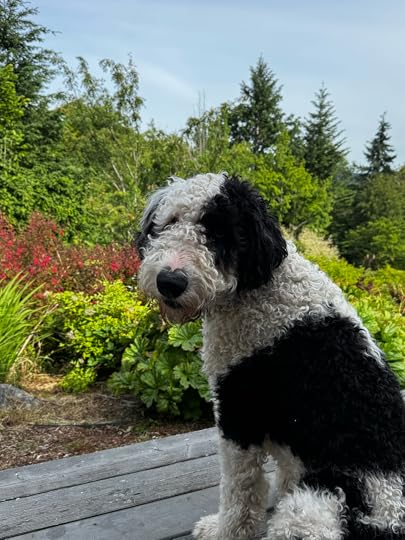
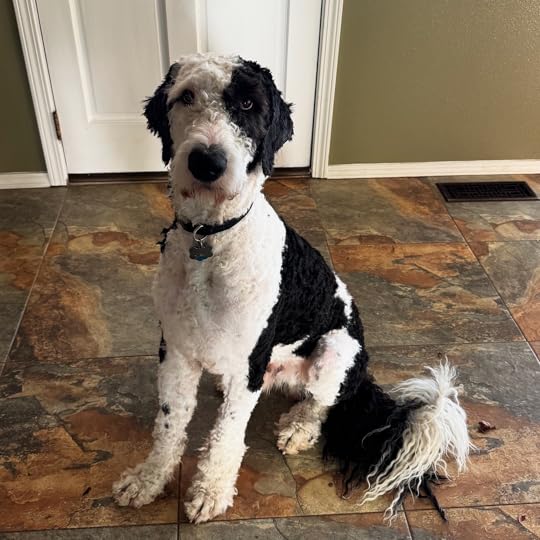
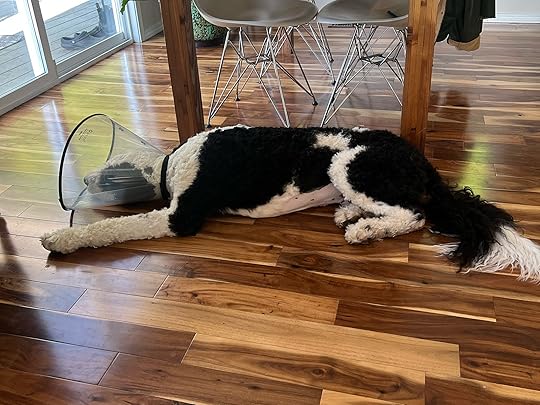
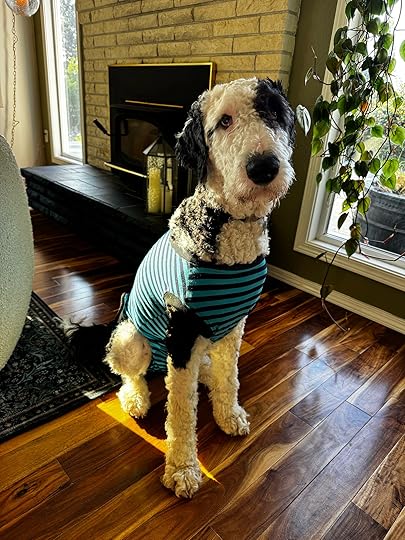
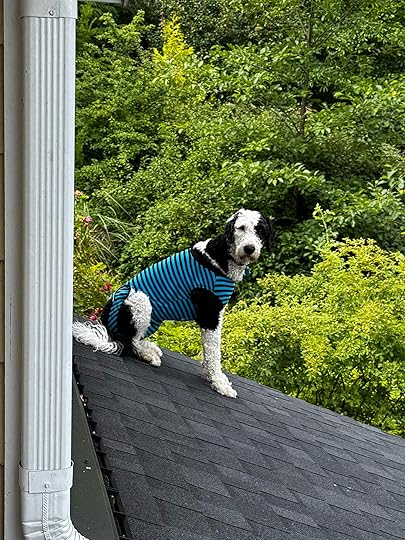
Why yes, that is the little beachgoer out on the roof. How did he get there? He decided to leap through an open window. What was he doing up there? Just chilling. That part of the roof is a single story, but I’ve seen him jump down from a twelve-foot-tall bulkhead, and we didn’t need that happening when he was still in recovery. He eventually came inside and abandoned his roof inspection after being promised treats.
After an extensive recovery (nearly six weeks!), things returned to normal fairly quickly. Walks with buddies. Playtime in the property. He enjoys fetch for a time, but his favorite game is a toss-up between tug-of-war and chase. While his energy has remained boundless, he’s now slowly starting to figure out the nap thing—as long as he gets his walk in.
Greeting friends in the woods behind our house.A collection of Uly sillies.Your typical Uly Day is as follows: wake up slowly, this can be anywhere from fifteen to thirty minutes. Harass the people until they give you breakfast. Eat breakfast. Go outside to pee. (Yeah, he waits until after breakfast.) Hang out outside for a bit. Harass the people until you get a walk. Take a lovely walk, maybe see friends, or go to the beach, or the forest, or a rare combo of all three. Return home for frozen bone time. Yay! Enjoy bone. Nap and poke around until dinner, maybe demand a play session or two. Dinner time. Yay! Okay, now it’s time for TV. That’s not a joke; he loves to gnaw on bones and watch whatever we’re watching. Otherwise, he pouts about it or harasses us. Finally, bedtime. Dream of doing it all again tomorrow.
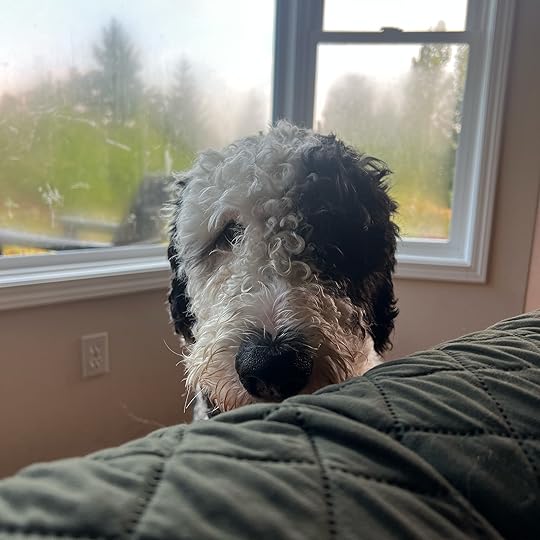
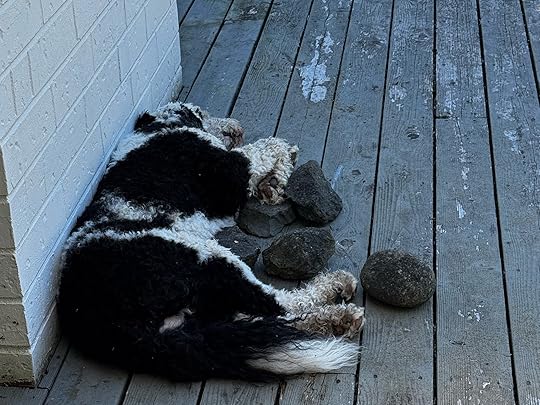
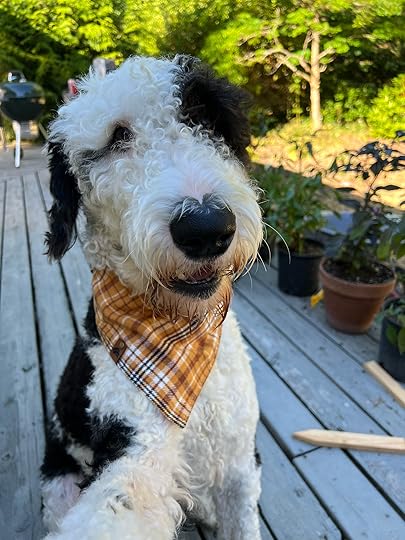
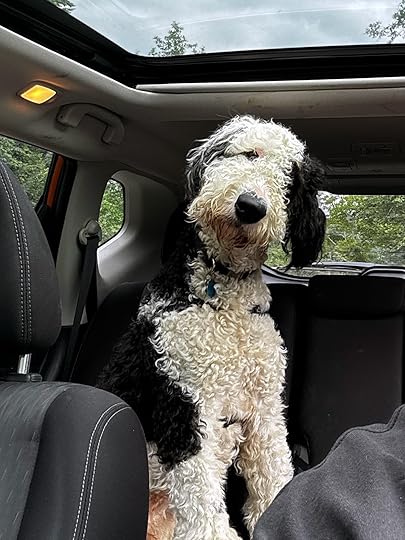
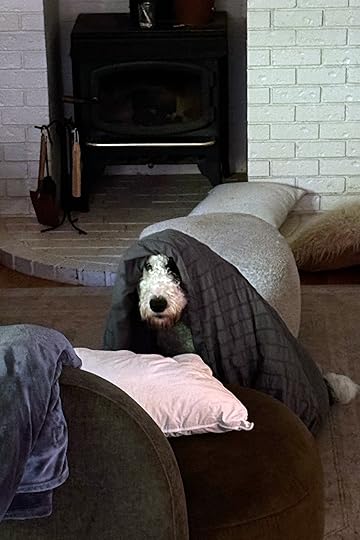
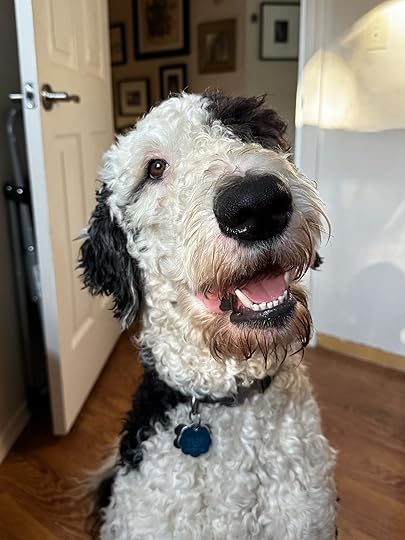
This summer, my little sister moved in with us. She has been helping train Uly, and he has been making really good progress. He’s just so happy and is so food motivated, he’s eager to listen and please. He’s due for another haircut, and it’ll be interesting to see how he approaches the rainy season when sleeping outside isn’t as desirable as it is in the summer. Maybe he’ll finally learn to curl up in front of the fireplace. Guess we’ll find out.
This has been your Summer 2025 Pupdate.
August 20, 2025
The Smoker Paddock
Every day, I have someone emailing asking where I’ve been for the last month or so. (That’s not true, but it’s a good way to start my first post in nearly a month.) Well, I have been busy! For a while now, Kari-Lise and I have spent any free time hard at work building out a patio/gazebo/outdoor cooking space/chef’s garden that I am calling our Smoker Paddock.
For years, when we lived in Seattle, I struggled along as a halfassed pitmaster with a cheap offset Char-Griller. I ran that thing into the ground and eventually said goodbye when we moved to the island. Since then, I have been sans smoker for the first time in almost a decade, which has made me sad. But this spring, I finally bit the bullet and ordered the offset smoker of my dreams, but I needed a place to store it, and I wanted that place to be a space I could use year-round, even during the rainy PNW winters. Hence, the smoker paddock.
Check out our build progress below and get a small glimpse at how “helpful” Uly was during the entire process.
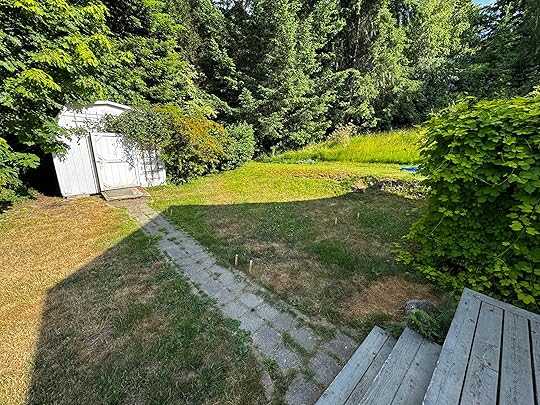
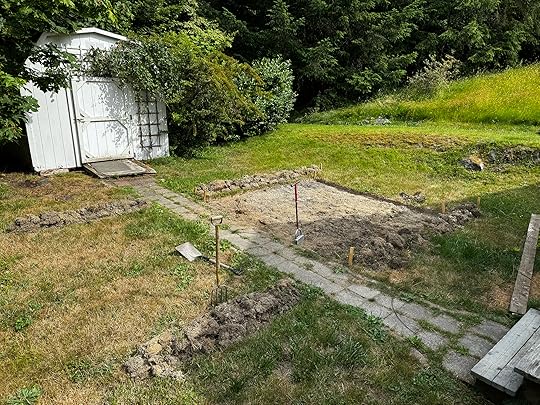
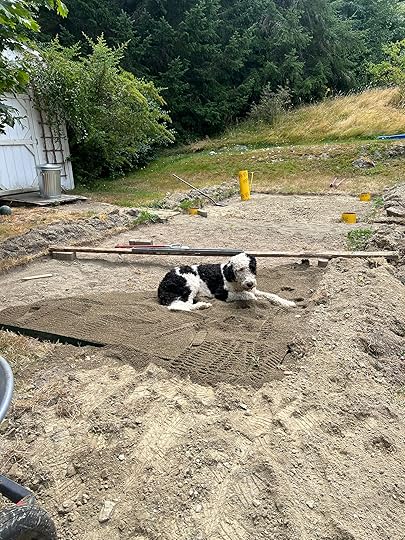
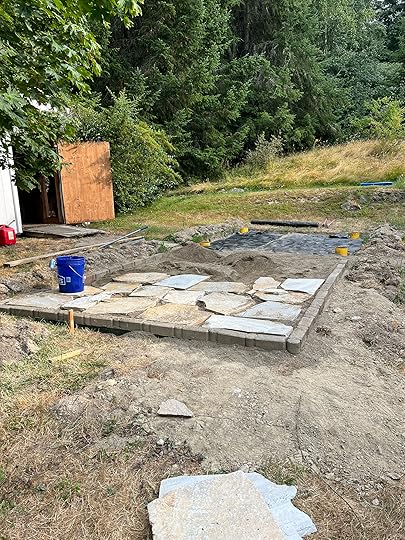
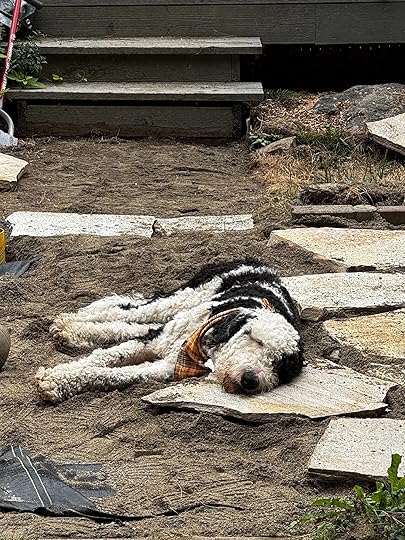
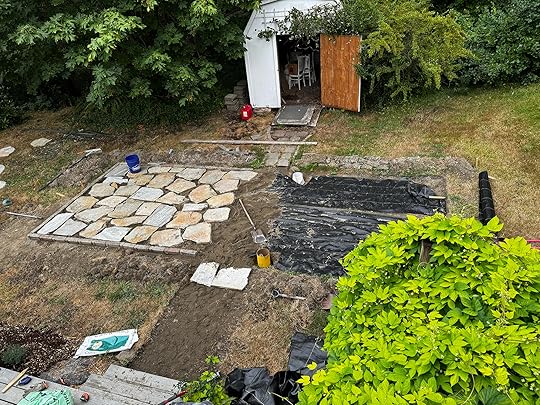

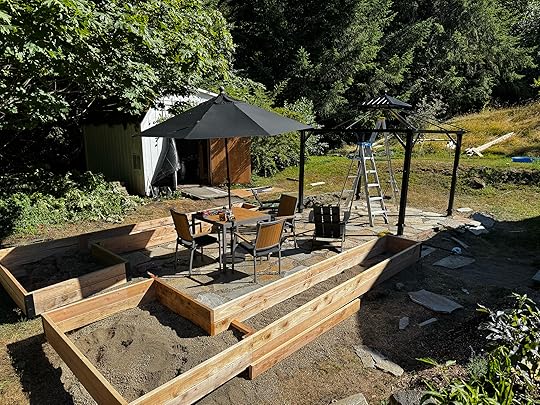
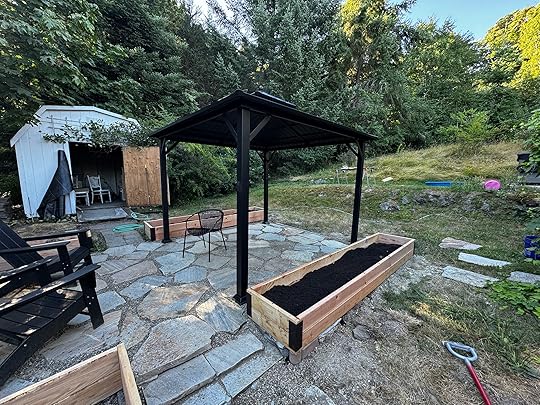
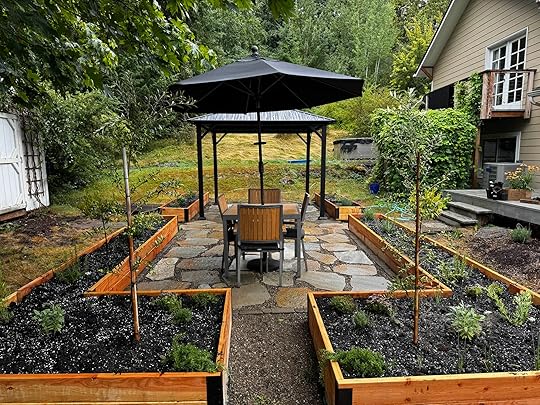
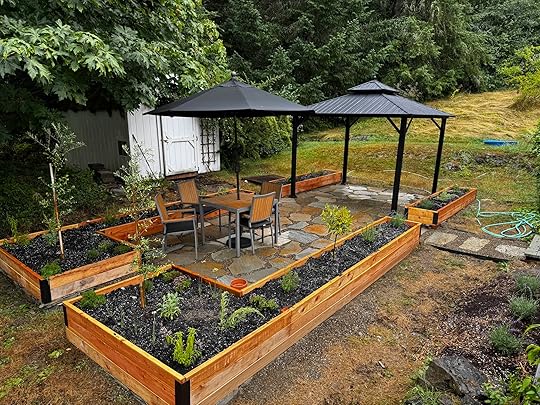
The idea was to build a covered area to keep the rain off my head and smoker, while also allowing for an outdoor dining space in warmer months. We took it to the next level by surrounding it with a chef’s garden, and Kari-Lise promptly filled it with plenty of fresh herbs. (Details below for those who are interested.) The paddock is only a few steps from the kitchen, so picking what I need on a whim will be easy. Everything in there is perennial, so it should be nice and green year-round.
We’re really excited to be on the other side. This project ended up being a lot more work than we had initially anticipated. But the flagstone creates a nice through line, as we used up all the leftover flagstone from our garden path project we completed this winter/early spring. Smoker ships this weekend, and I’m excited to get to work. I have so many ideas percolating.
Much more on that to come.
Plants in the chef’s garden: arbequina olive, bay, dot wells french thyme, lemon creeping thyme, tuscan blue rosemary, grapefruit mint, woodcote sage, medow sage, garlic chive, french tarragon, sweet marjoram, Greek oregano—I do want to get some Mexican oregano going, since I end up using that often. That’s the one big piece that is missing.
June 17, 2025
Creativity Within Stillness
When we moved to the island, Uly was still a young puppy. So, when I began taking him for walks around the area, I usually found myself going without earbuds or headphones. Initially, I did this so I could listen for approaching vehicles, other dogs, mountain bikers, or general hazards a big, silly puppy might be oblivious to. However, as time passed, I found myself increasingly relishing those moments of mental stillness.
In 2023 and part of 2024, while we were living in Seattle, I began walking frequently. Four or five-mile stretches a day, sometimes more. I lost a lot of weight doing it, and it was also a good way to supplement my reading. Earbuds went in and out the door I went. My earbuds became as ubiquitous as any piece of gear I wore. I’m not alone. Be it on public transit or in the grocery store, many of us are living in our own personal audio bubble.
In a world of content, it’s easy to find plenty to consume; all manner of thoughts and ideas can be piped into our ears when we work, play, commute, walk the dog, and so on. As technology has progressed, on-demand entertainment has continued to improve; it’s genuinely one of the wonders of modern technology, with billions upon billions of hours available at any time, nearly anywhere, covering anything. It’s pretty magical, really.
Uly is now older. He’s more aware of his surroundings than he was as a puppy, and I could easily go back to slipping in the earbuds when I take him for a walk. But I haven’t. I’m not sure I’m ever going to. Over the past year, I’ve found myself enjoying those “quiet” times alone with my thoughts; those moments of stillness. I’ve even discovered that same desire spilling over into other activities. When I’m running into town, I’ve found myself forgetting to plug in my phone or turn on the radio. I’ve often caught myself doing garden work or house chores without my earbuds. Like those walks, the trip, the project, and the chore become a contemplative experience where I mull over whatever my mind chooses to process.
Recently, author and photographer Craig Mod wrote a fascinating article for Lit Hub on the creative power of walking. The entire piece is worth reading, but there was a particular paragraph that resonated with me:
“When I’m not talking, just walking (which is most of the time), I try to cultivate the most bored state of mind imaginable. A total void of stimulation beyond the immediate environment. My rules: No news, no social media, no podcasts, no music. No “teleporting,” you could say. The phone, the great teleportation device, the great murderer of boredom. And yet, boredom: the great engine of creativity. I now believe with all my heart that it’s only in the crushing silences of boredom — without all that black-mirror dopamine — that you can access your deepest creative wells. And for so many people these days, they’ve never so much as attempted to dip in a ladle, let alone dive down into those uncomfortable waters made accessible through boredom.”
I’m not sure I’d call my own experience “boredom,” not precisely. If someone asked me if I was bored during those moments, I’d tell them no. But, to many people, the idea of spending time with only their thoughts is boredom incarnate. We’re so used to always being eternally entertained that the stillness itself seems ominous.
Terminology aside, Mod’s experience has echoed my own. Not giving my brain time to process, always filling all my quieter moments with someone else’s thoughts and ideas, had made it more complicated for me to think creatively. For a long time, sitting down to write felt like I was trying to plant something in an overgrown garden. Those crowded, cluttered thoughts I hadn’t processed choked out the space where creativity grew.
While I’m sure there are other outside factors at play, I’ve found that those moments when I carve out time to process the tangle of my mind have been creatively transformative. After those silent walks in the forest with just me, my dog, and my thoughts, my mental “brush” has been cleared. The garden hasn’t changed in size, only in upkeep. The bed of creativity has always been there, rich and full. I just couldn’t reach it because of the thicket in the way.
Lately, I’m writing more than I have in a long time. I’m feeling creatively rejuvenated, and it’s hard not to see a correlation. Creativity flowers again, not because something new appeared, but because I finally made space for what was always there.
June 5, 2025
Some Progress!
All is not quiet in the world of The Bell Forging Cycle, and I’m not talking about any recent Old Haunts or Quiet Corners. Although I haven’t been posting about my series all that much, I am still chugging along. I’ve been steadily making progress on the first draft of Book V. Eagle-eyed readers who follow the tracker in the sidebar (on desktop, it’ll be at the bottom on mobile) will note that it has jumped significantly in the last few days and now sits at over seventy thousand words. After the chaos and turmoil of last year, it’s nice to be back to work and on the road with Wal once again. I think you’ll like this one.
May 27, 2025
A Flower Post
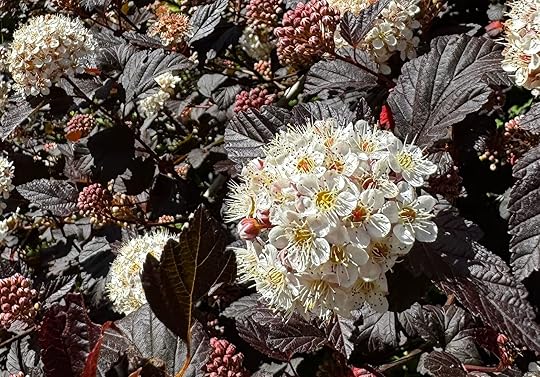
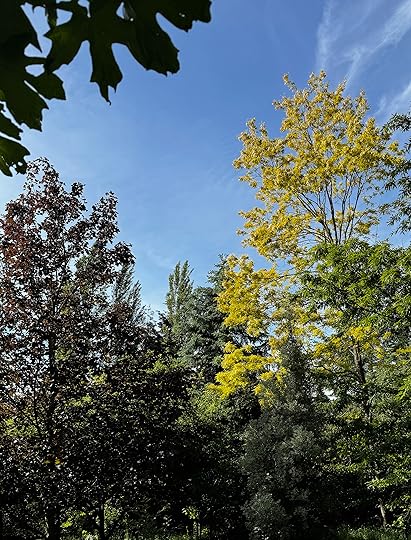
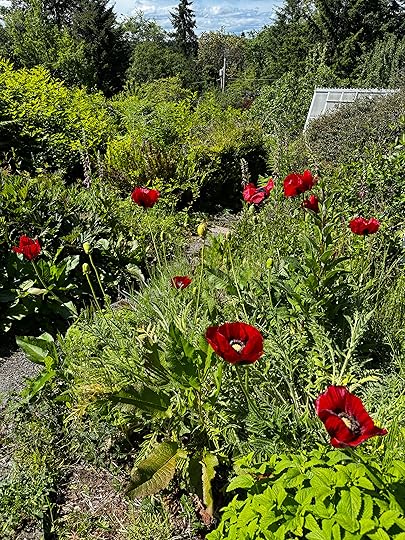
Spring is in full swing here in the PNW, and the flowers of our garden are popping off! So I figured I’d share some photos of the blooms around the place. Many of these had died back by the time we moved into the place, so it’s been lovely to experience them in person. Most of these came with the property; only the cosmos and the pink rose have been planted by us, but they’re just the start. There’s much more to come over the next few years.






May 15, 2025
Uly Pupdate: Gotcha Day!
Today is the 1st Anniversary of the day Uly came into our lives—and it’s been all the better for it. It’s been a shift moving from toy-sized dogs to a full-sized 70lb ball of endless energy, but I can’t imagine any other dog spending time with us here on the island. Here are some pics to celebrate the handsome boy’s Gotcha Day!


May 9, 2025
Old Haunts: Close Your Eyes
 West Lovat
 Level Three
 Night
Night SPOILER WARNING, KINDA
“There was no victory. There was only disaster.”
—Waldo Bell, Gleam Upon the Waves
Credits:
“Close Your Eyes” by Al Bowlly, Ray Noble & His Orchestra (1933)
Other audio and video from original, licensed, and public domain sources.
 This is just one of many.
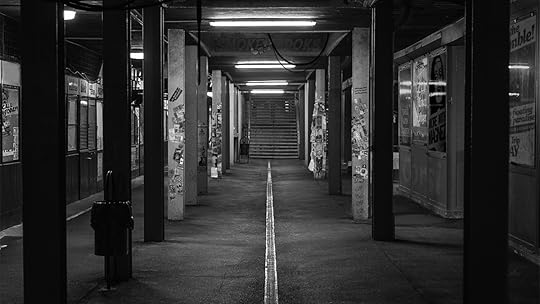
You never know what you’ll discover in the twisted streets, quiet alleys, and busy warrens of Lovat. Enjoy these “Old Haunts”, a series of vignettes and visions presented in Glorious Monochrome® by Waite Radio Pictures, Inc.
Want to stay in touch with me? Sign up for Dead Drop, my rare and elusive newsletter. Subscribers get news, previews, and notices on my books before anyone else delivered directly to their inbox. I work hard to ensure it’s not spammy and contains interesting and relevant information. Sign Up Today →
April 16, 2025
Müller: A Free 18th Century Cartography Brush Set for Fantasy Maps
In the early 18th century, Holy Roman Emperor Charles VI charged Johann Christoph Müller to produce an “authentic and complete” map of the kingdom of Bohemia. Being no slouch, Müller’s end result was a massive work, done at a 1:132,000 scale and eventually engraved on twenty-five sheets by Michael Kauffer and Jan Daniel Herz, most likely in Berlin. It is from that map that we get today’s set, and what a phenomenal set it is—and, uh… it’s much bigger than I planned.
All my Map Tools will always be free. Want to help support this work?
Click here to learn how.
 Some of the flora, symbols, and lakes within the set.
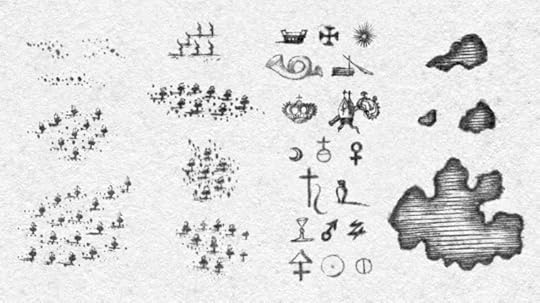
The level of detail in this work is impressive. It reminds me somewhat of the Vischer set, especially in how elements of flora are incorporated into the landforms. The flora itself is rendered with restraint in either groups of tiny rendered trees, or a stippled scrub brush, which I labeled “wilds.” They play well off each other and work together to fill out the map. It’s easy to quickly create sprawling forests or empty plains. Within the Emperor’s request, there was a goal to map “relevant military information.” To that end, Müller mapped industrial points of interest, highlighting the locations of raw materials, ranging from metals to mineral water, and the workshops and mills that processed them. He also provided details for travel, marking the locations of warm baths, inns, mail stops, and river ferries.
 A sample of the settlements you’ll find in Müller
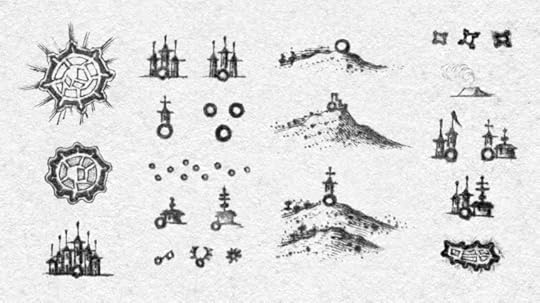
If you’ve used my sets before, you’ll be familiar with many of the imagery choices depicting the various sizes of towns, though again Müller adds his own unique spin. Manor Houses reprise the role of the Schlosser from the Vischer set. Only Müller significantly simplifies these, and they serve as a catchall, representing anything from “castles, lordly palaces, and knights’ residences.”
 The key to the original map in Latin (left) and German (right).
The extended villages were another unique approach I haven’t seen on a map from this era before. Obviously, a town or village isn’t always contained in a small bubble, especially on a map rendered at 1:132,000—one mile is 0.48 inches (or for those not beholden to the king, one kilometer here is 7.58 millimeters). To solve for this, Müller approaches communities two-fold: one is the single dot for “solitary villages,” the second adds more dots around named settlements that represent scattered or extended “rustic” settlements. Think of an extended settlement as a small town with the lone parish church and lots of farms in the area surrounding it, or similarly a village running along the length of a stream or small river. That’s what he was going for here.
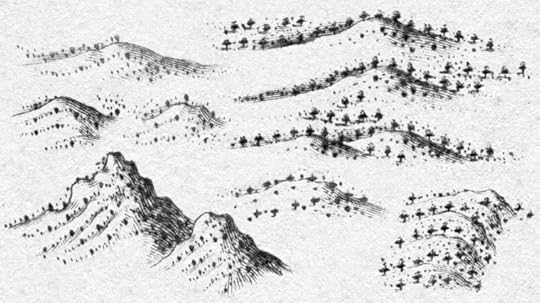 Some of the landforms found in Müller
This was a really fun set to build, and there was so much to explore on each of the separate sheets. It’s no wonder this was the definitive map of Bohemia for nearly forty years. (Eventually superseded by the Josephinian Survey.) Funny enough, this is now my second biggest set, surpassing Moronobu Gansai by over four hundred brushes*. Within the might of Müller, you’ll find over 1500 brushes, including:
100 Walled Cities25 Cities without Walls100 Market Towns50 Villages with Churches50 Villages w/o Churches50 Extended Villages50 Manor Houses25 Churches30 Monasteries30 Inns/Taverns13 Hunting Lodges40 Mills10 Ruins34 Elevated Settlements31 Unique Settlements200 Wilds200 Forests200 Individual Hills100 Groups of Hills50 Lakes20 Miracle Markers5 Archaeological Sites20 Vineyards12 Silver Symbols2 Cinnabar Symbols5 Lead Symbols10 Copper Symbols10 Acidic Water Symbols10 Glassworks Symbols20 Iron Symbols15 Tin Symbols3 Sulfur Symbols7 Gold Symbols2 Salt Symbols2 Sulfuric Acid Symbols2 Aluminum Symbols12 Bathhouse Symbols20 Ferry Symbols30 Mail Horns20 Crowns3 Bishopric Symbols*Look, they aren’t all going to be this big. Making sets this big is an enormous time investment in production and distribution. The tale just grew in the telling, I guess. Enjoy it. :)
The button below links to a ZIP file that contains an 27 MB Photoshop ABR brush set (it’ll also work with GIMP, Affinity Photo, and I’m told Procreate now). I also release the set as a pack of individual PNGs organized by folder, similar to how I organize the ABR file. This should make using these with tools like Wonderdraft much easier. No more extracting symbols from an enormous PNG.
Like this set? Click here to learn how you can support this project.
DOWNLOAD MüllerDownload the Müller PNG Pack
(42.2 MB)
As with all of my previous brush sets, Müller is free for any use. I distribute my sets with a Creative Commons, No Rights Reserved License (CC0), which means you can freely use this and any of my brushes in personal or commercial work and distribute adaptations. No attribution is required. Easy peasy!
Enjoy Müller? Feel free to show me what you created by emailing me. I love seeing how these brushes get used, and I’d be happy to share your work with my readers. Let me see what you make!
But wait, there’s more…Kauffer Hand: A Free 18th Ct. Type FamilyAlongside the launch of Müller, I’m excited to announce the launch of my second totally free typeface: Kauffer Hand. This font is extracted from the same map as the Müller brush set and is named after one of the engravers who published the map in 1726.

This typeface is a bit cleaner than Myer Scratch, but it could still use some softening to help it feel as realistic as possible. When pulling from these historical documents, not every glyph is accounted for—J, Q, and q in the base Hand style, X and Y in Italics style, and the Q in the Title style, were reconstructed from other documents labeled with a similar style to fill out the alphabet and maintain a consistent tone with the typeface. (If you want an even more polished version in a similar style, check out Three Isle Press’s Geographica family.)
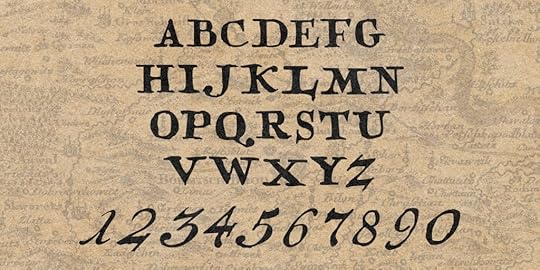 The Kauffer Hand’s Character Set.
The three variant styles can be used in multiple ways to label your projects. Müller used Italics for smaller settlements and Hand for larger ones. You can see how I even do an all-caps Hand for the titles of the largest settlements in my example map below. Title was used for bigger labels or for the map’s title. Lots of options with this one, experiment and find a way to make it your own.
 Kauffer Hand has three variants: Hand, Italic, and Title.
The button below links to a ZIP file that contains the Kauffer Hand family’s OFT files. Just install the font the way you would any other. Like my brush sets, Kauffer Hand is free and distributed with a Creative Commons, No Rights Reserved License (CC0), which means you can freely use it in personal or commercial work and distribute adaptations. No attribution is required.
DOWNLOAD Kauffer HandMüller in UseWant to see how I’ve used this set? There are three versions: a colored example, a black-and-white rendition, and a decorated sample. Click on any of the images below to view them larger. Perhaps this will inspire you as you get started on your projects!
 4000×5000 (11.4 MB)
 4000×5000 (8 MB)
 1080×1350 (2 MB)
Sample Details: I hand-drew the rivers and some of the lakes in Photoshop. Roads and trails were done in Illustrator. The font is Kauffer Hand, which can be downloaded above. All the names come from locations and surnames from the enclave of Lesotho. (A fascinating place that has been in the news recently. It’s worth checking them out.) The paper texture is from True Grit Texture Supply’s Infinite Pulp, and they’re also where I got Atomica, which gives me ink-like effects for the text, colors, the roads, and trails. The title frame comes from my Fancy Frames set, which can be downloaded from the Decorative Assets page.
Support this WorkBrushes and tools released through the #NoBadMaps project will always be free and released under a public domain CC0 license. If you’d like to support the project and help me cover the cost of hosting, research, and tool-set development, I’ve put together three ways you can help, and all are detailed below.
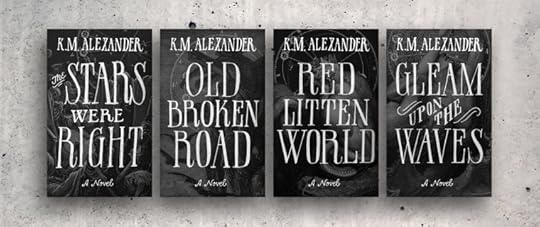 Buy My Books→
I’m not just a map enthusiast. I’m also a novelist! The easiest way to support me (and get something in return) is by purchasing one of my cosmic horror urban fantasy novels.
❦
 Buy Me a Coffee→
A simple and quick way to support the #NoBadMaps project is through a one-time donation of any amount via ko-fi. Your support helps keep this project going and is appreciated.
❦
 Join my Patreon→
If you want to continually support the #NoBadMaps project through a reoccurring monthly contribution, consider joining my Patreon and get sneak peeks into what’s coming.
❦
More Map BrushesThis is just one of many brush sets and map tools I’ve released. You can find it and other free brushes covering a wide variety of historical styles on my Fantasy Map Brushes page. Every set is free, distributed under a CC0 license, and open for personal or commercial use. I’m sure you’ll be able to find something that works for your project. Click the button below to check them out!
view more Fantasy Map BrushesWant to stay in touch with me? Sign up for Dead Drop, my rare and elusive newsletter. Subscribers get news, previews, and notices on my books before anyone else delivered directly to their inbox. I work hard to ensure it’s not spammy and contains interesting and relevant information. Sign Up Today →


