
Gabriel Wyner's Blog
April 24, 2021
This is a test content post
The post This is a test content post first appeared on Fluent Forever.


May 13, 2018
For the Single Language Lifetime Perk, do I only get to learn one language or can I switch to another after I’m done?
If you’re interested in supporting the Fluent Forever App on Indiegogo, or you’re already a backer and you’re thinking of upgrading to the “Single Language Lifetime Perk”, but you want to learn more about the “Single Language Lifetime Perk”, then this post will help you.
Want to get the Fluent Forever App? You can still help Fluent Forever create the first app that can bring you all the way to fluency — find Fluent Forever on Indiegogo.
Ok! Here’s the current plan:
Single Language lifetime is just that. No switching.
Multi language accounts allow you to switch all you like, and will also give you the ability to actively maintain more than one language. So you can learn Spanish for 6 months, then switch to French, and while you’re learning French, it will actively suggest that you make a card or two for Spanish each day and review your old Spanish cards (at a reduced rate) so that you can learn French without losing your Spanish. These accounts also allow for 2 users (and you can add additional users at $5/user/month – your backer % discount)
Single Language monthly WILL allow switching, so you can learn Spanish for 6 months and then finish and move to French. But it won’t allow you to make any new cards in Spanish once you switch, so you’re going to want to basically be done with Spanish. Yes, you’ll still be able to access your old flashcards for Spanish but without any new cards, those reviews are going to get suuuuuper boring. So if you want active maintenance then the multi language accounts are way better suited for that.
The post For the Single Language Lifetime Perk, do I only get to learn one language or can I switch to another after I’m done? appeared first on Fluent Forever.
April 23, 2018
I heard you have an app in development, but I just bought your other materials. What do I do?
Want to get the Fluent Forever App? You can still help Fluent Forever create the first app that can bring you all the way to fluency — find Fluent Forever on Indiegogo.
The post I heard you have an app in development, but I just bought your other materials. What do I do? appeared first on Fluent Forever.
February 11, 2018
Romance and Language Learning: Advice when learning a language for love
Valentine’s Day is fast approaching in many parts of the world, and as such, it seems like a good time to discuss the interaction of language, relationships and love. Love, after all, is one of the classic motivations for picking up a new language: Boy goes to Costa Rica, boy crushes hard on Spanish speaker (who doesn’t speak English), boy learns Spanish, boy and boy’s crush move in together. It’s cliché enough that there’s a name for Boy’s Crush: A “pillow dictionary.”
For my part, I’ve never been in a relationship with someone who couldn’t speak English, so I can’t speak directly to that experience. But I have done some stuff that’s relevant to this discussion. My first wife was an opera singer, and she attended many of the immersion programs that I did. We spent a lot of time forbidden from speaking English, and we spent a lot of time in places where most other people weren’t speaking English. Last year, I got married again. My wife is a first generation Mexican American, who grew up speaking Spanish at home and English at school. For our wedding, I stopped learning Japanese and spent 6 months learning Spanish, so that I could speak with my in-laws.
I’ve learned a few things along the way:
Romance isn’t easy.
Language learning isn’t all that easy. (It’s doable, it’s worth it, but it’s still a challenge)
When you stick romance and language learning together, both of them get harder…and more rewarding.
So today, let’s talk about rewards, challenges and advice when learning a language for love.
Rewards when learning a language for love
I want to start by saying that there’s a huge difference between learning the native language of your S.O. (Significant Other), and learning a new language together with your S.O. We’ll start with the latter:
Learning together leads to a stronger bond together
 When you learn a new language with your S.O., it’s a bonding experience. You go through a difficult challenge together, and as a result, you bond over it. This concept – of overcoming challenges together – is present whether you’re learning languages, mountain climbing, having a child, or deciding that you’re both going to become gym rats. Oddly enough, this particular form of bonding appears to revolve around shared pain. If it’s painless, it’s not particularly bonding. This is why people don’t develop lifelong friendships by sharing stories about, say, brushing your teeth. It’s the hard stuff that you can trade war stories about, and language learning falls squarely into that category.
What’s more, language learning encourages you to develop more of something known as idiosyncratic communication – “insider” language that only exists within the couple, and serves to strengthen the relationship. There are studies showing .
In most relationships, idiosyncratic communication develops in the form of pet names for each other and insider jokes. But when you learn a language together with your partner, this form of language-based bonding grows dramatically. It can get kind of nuts, actually; my first wife and I are English native speakers, but as a couple, we spoke a mixture of German and English. We found that we could express ourselves better in that combination of languages than we could in just one, and that shared language was an immensely powerful bonding force. Not infinitely powerful, naturally – as mentioned above, relationships are hard – but that sort of shared couple’s language is something I truly miss. It’s why my wife and I will likely pick up a language together (Japanese or perhaps Esperanto) at some point down the road.
Learning your partner’s native language leads to greater understanding
In learning Spanish last year, I discovered that learning a language together as a couple is completely different from learning your partner’s native language.
With Spanish, there wasn’t an experience of shared pain; my wife already spoke Spanish. The only pain she had to deal with was listening to me butchering one of her native languages with my Italian-isms. So no bonus bonding there.
We developed a bit more idiosyncratic communication, but very little. One of the challenging things in this situation is that I may never know Spanish as well as my wife. She’s a Spanish native speaker, I have a lot of language goals, and I likely won’t ever spend enough time on my Spanish to approximate her level. We communicate better in English, we haven’t spent months living in Spanish together, and so we default to English. We’ll use Spanish here and there, but it’s not a big part of our couple’s language.
So…did our relationship gain anything from this?
Fortunately, it did. I got to understand my wife a lot better. There are parts of her background and personality that only make sense in Spanish. There are family members and memories of hers that are intensely important to her, and exist entirely in Spanish. Around half of my wife’s brain lives in that language, and it’s a part of her that I haven’t had access to until this year.
The Gottman Institute has done some of the best research on the ingredients leading to healthy, happy relationships. One of their conclusions is that truly understanding your partner on a deep level – their history, their hopes and dreams, their internal monologues – allows you and your partner to better overcome adversity together. You become a stronger, more resilient couple. Learning Spanish allowed me to understand my wife better. What’s more, it was the only way for me to understand certain parts of her. You simply can’t translate someone’s whole childhood and family experiences.

Having a Secret Language is Kind of Awesome
Whether you’re learning a new language as a couple, or learning your partner’s native language, you’re going to pick up an ability to communicate in a secret code that most other people can’t understand. It feels a teensy bit like telepathy, and it’s a very fun ability to add to your partnership.
Naturally, this works better with rarer languages, but even with something as common as Spanish, you can pull this off. You just need to be a little more observant about who’s in the room and whether they perk their ears up or not as soon as you switch to Spanish.
Challenges when learning a language for love…and some advice on how to overcome them
Challenge: Your romantic partner is not your teacher
If your romantic partner speaks your target language well, you may be tempted to ask them to be your primary teacher.
As mentioned earlier, I’ve never been in a relationship where my partner couldn’t speak English. I suspect that if neither of you speak a word of each other’s languages, then teaching each other your languages – at a rudimentary level – might be a fun couple’s activity. But beyond the basics, if you’re looking to reach an intermediate or advanced level, you will probably want a teacher.
Enlisting your partner for that role is probably a bad idea. Teaching is hard work. It takes a special kind of patience to talk to someone who is having trouble expressing themselves, figure out what they want to say, and then let them know all the language mistakes they made. It also takes a kind of distance: to make good, well-timed corrections, a teacher needs to take a superficial interest in the content of a student’s sentences, and a much stronger interest in the form of those sentences. If a teacher focuses too much on what a student is actually trying to say, and takes a real interest in that, then they’re going to want to converse, rather than correct. Holding yourself back from that urge to freely converse is sometimes necessary and part of the hard work of teaching.
Assuming your romantic partner really cares about what you want to say, they’re in a really bad position to give you the constant corrections you’ll likely need. Sure, if they speak your target language well, they can help you create a few sentences, but if you’re looking for a tutor, I suggest you look elsewhere. Let your partner be your partner; don’t put them to work.
Advice: If you want a tutor, hire one. They’re relatively low cost online.
Challenge: Your romantic partner may not be the best choice for your regular practice partner, either.
In the event that you and your romantic partner speak at a similar level, then you may be tempted to enlist them as your main practice partner. This is possible, but it’s often really hard. Romance is often a matter of listening to your partner and feeling heard. When you both suck at a language, you’re bad at listening, your partner is bad at listening, you’re rambly and unclear, and so is your partner. It’s very, very difficult to get through a lot of conversations like these when you’re at an intermediate level or below. Things get much easier when at least one person in the conversation is able to speak the language at a high level
My first wife and I tried to force ourselves to chat in Italian when we were studying in Italy (after 3 summers of immersion programs in German, separately and together), and we totally failed at it. We had all sorts of conversations with Italians, but not with each other.
We did chat during our immersion program experiences, but those programs are special; there’s a huge social pressure to stay in your target language that can help support you both through the difficulty. Perhaps more importantly, there are tons of other conversation partners available, everywhere you look. This reduces the pressure placed on the conversations with your partner: you don’t need your partner to achieve your language goals, because there are so many other people to practice with.
Advice: If you’re both learning a language together, get other conversation partners. It’ll reduce the pressure you place on your conversations together and make them much more enjoyable and productive. You can find conversation partners through local meetups or online.
Challenge: You may feel stupid in your target language.
When you are at a beginning or intermediate level in a language, you often feel dumb, childish or powerless. This can be particularly stressful in the context of a relationship, because relationships are often built on top of power structures. On average, your relationship may be egalitarian, but that may not be the case in every context: Perhaps one of you takes charge in the kitchen, or becomes the leader when the car breaks down, or runs the show in social interactions.
Language learning – particularly in the beginning and intermediate levels – can take away much of your intellectual power. It’s hard to step forward and become the leader when you can only say things like “The dog is brown!” and “I am hungry!” As such, practicing your new language – particularly if you’re trying to maintain an immersion environment, where you’re speaking that language all the time – is extra challenging in the context of a relationship, as it messes with your existing power structures.
Advice: Make sure that both of you are aware that this is going to happen. Awareness doesn’t make challenges like these disappear, but it does take some of the sting out of those challenges.
Challenge: Language immersion screws up your communication skills
One more note about trying to do language immersion within a relationship: When two people try and force themselves to speak in a non-native language, their communication abilities drop dramatically. This can be frustrating when you’re doing this with friends or colleagues; it’s spectacularly difficult to do this with your romantic partner. Relationships require clear communication to thrive, and when one of you is feeling bad and all you can say is “THIS?? NO GOOD!”, you’re probably going to have a hard time.
Advice: Schedule regular time to speak openly in your native language. If you know that there’s going to be a time to really discuss things, then you’re not going to feel like your emotions are all bottled up without a pressure release.
So…is it worth it?
Short answer? Yeah. I think that learning a language for love is one of the most rewarding things you can do. It’s hard to find activities that so directly improve your relationship, in terms of building trust, connection, and the ability to communicate and understand each other.
Yes, the road there is challenging – potentially more challenging than doing it on your own. But that’s what a good relationship is: it’s you and your partner, overcoming challenges together. The nice thing about this challenge is that at the end of it, you get to speak a new language for the rest of your life.
-Gabe
Have some experiences with romance and language learning? I’d love to hear about them in the comments!
Also, if you’d like an extra hand in learning a language, we’re doing a Valentine’s Day sale until 2/20!


SaveSave
SaveSaveSaveSave
SaveSave
SaveSaveSaveSave
SaveSave
SaveSave
The post Romance and Language Learning: Advice when learning a language for love appeared first on Fluent Forever.
January 25, 2018
Are the Fluent Forever Pronunciation Trainers the Same as the Fluent Forever App?
Nope, they’re different!
The Fluent Forever Pronunciation Trainers are a set of videos and audio-visual flashcards. To use them, you watch some videos on YouTube, then you download a flashcard app called Anki, load our pronunciation trainer flashcards into Anki, and start studying. After 2-3 weeks, you’ll have a solid foundation in the sound system of your target language, both in terms of ear training and in terms of the spelling system. After that, you can go create flashcards on your own within Anki, as described within the Fluent Forever book. We began creating these trainers in 2013, and finished in late 2017.
The Fluent Forever App is a much bigger project that we’re currently working on. Many of our users have had trouble learning how to use Anki, or have found that parts of the flashcard creation process were overly tedious. Instead of spending all of their time exploring their new language, they were getting stuck, spending their time struggling with flashcard creation.
In response, we decided to make our own mobile app that could automate the entire Fluent Forever method, so that a student could focus all of their time on exploring their target language, while the app created flashcards automatically, based upon that student’s choices. While the Fluent Forever App DOES teach pronunciation in the first few weeks, that’s only a small part of what it can do. It’s designed to take you all the way to fluency, teaching you vocabulary and grammar from 1,875 sentences we’re making, and letting every user of the app share their original content with every other user of the app. Within the next year or two, this will become the largest database of easily learnable sentences in the world. We began this project in late 2017, and we should have a final version ready by August of 2018. If you’d like to get early, discounted access, join our Indiegogo campaign: http://indiegogo.fluent-forever.com
The post Are the Fluent Forever Pronunciation Trainers the Same as the Fluent Forever App? appeared first on Fluent Forever.
October 6, 2017
The End of Kickstarter 1: Lessons learned from my first Kickstarter campaign
I launched my first Kickstarter on December 3, 2013, and funded it on January 2nd, 2014. As I write this, it is October 3rd, 2017. I’m 15 days into my second Kickstarter campaign (which has gone quite well so far), and the very last of the products I promised are getting sent out to backers this week. Every day of the last three years and 10 months has been dedicated to this project, and “surreal” is not even scratching the surface of what it’s like to be done with it. That said, I’m kind of burying that “more-than-surreal” feeling with the insane workload and intensity of a second Kickstarter campaign, so…I guess I’ll let you know after the 2nd Kickstarter what it really feels like when there’s a break in between.
I thought it might be interesting to write a bit about the lessons I’ve learned over the last few years. All in all, I’d consider this project a success. That’s not to say it’s been perfect; I’m more than three years late in delivering everything, some people have been (legitimately) pretty upset with me, and that feels pretty crappy. But I’ve created 65 really excellent products, people seem really happy with them and folks have been really forgiving with how long it’s taken. I have way, way more people using those products than the original 1858 Kickstarter backers, and now, my whole life revolves around this language learning business thing, which continues to bring in new users at a steady rate and later on, produce fluent speakers. It’s turned out pretty well so far.
I’ll break these lessons up into two categories:
Lessons learned about running a successful crowdfunding campaign, and
Lessons learned about running a business
Let’s get to it. And fair warning: this turned out to be a long blog entry, so buckle up, (or read it in chunks).
P.S. If you ordered a word list and/or pronunciation trainer and haven’t received it yet, please check your spam folder. For some reason they like to end up there. If you still can’t find it after checking, please send us an email at gwyner (at) fluent-forever (dot) com.
Lessons learned about running a successful crowdfunding campaign
The standard advice you see when running a Kickstarter is:
Make an awesome video
Design your pledges well
Have a base of people who are already interested in your stuff
Leverage that base
Use your successes to pitch to the media
Those are all true.
Make an awesome video
The “awesome video” part has some really specific ingredients to it. I learned most of these from Jesse Genet, who used to do Kickstarter consulting over at Popexpert.com when that site still functioned:
Make it personal. People are giving money to YOU. Include the emotional components about why this is a project you care about.
Make it concrete, with a clear beginning and end date. Everyone should be able to get together at the end and say “We did it!”
Make it urgent, and make backers necessary. If this doesn’t get backed NOW, it’s not going to happen. Time must be running out for this to happen.
Make the first 30-40 seconds count. It should be clear what backers get within that time. Then keep the total video to 2-3 minutes, ideally. Here are some targets. It’s hard to nail all of them, but it’s something to aspire to:First 5 seconds: What’s it called? What is it?
Next 10 seconds: What does it do?
Next 10 seconds: What are you going to get?
Next 5 seconds: Why do we need money?
Next chunk: Why must this happen NOW?
Here’s my first Kickstarter video. I did a decent job of covering the topics I needed to cover first, though I took a bit longer than ideal to get there:
It’s 4.5 minutes (a little longer than ideal), and I hit most of the marks I need to hit in the first 1.5 minutes. Ideal would be half that time:
0:00-0:25: This is ME, and here’s my problem (need to learn languages, traditional methods didn’t work) [Makes personal]
0:25-0:45: I found a solution to learning languages and wrote a book [Starts introducing product idea]
0:45-1:05: I discovered how to make a pronunciation app, I have limited time, and I need help [What it is (concrete), why it’s urgent, why help is needed]
1:05-1:20: Here’s what you get
1:20-1:30: Here’s why I’m passionate about this
1:30+ : Now, actually present ideas in detail.
Design your pledges well
Make a cheap pledge level. $1-5 max. Give people the ability to contribute and be a part of the project without spending much money. It’ll increase the number of backers you have, which increases your visibility on the Kickstarter homepage.
The next pledge level is on the order of $25-50. If people believe in this thing and want to have it, then generally, they’re willing to pay around that much for it if they’re on Kickstarter. So yes, definitely give them good value for their money, but don’t make it easy to just spend $10-15 to support and receive awesome stuff. If you do, people will back at that $10-15 level, and you’re going to have a much harder time reaching your funding goals, your project might fail, and then both you and your backers are going to be sad.
Theoretically, it’s good to design your pledges with a target in mind, but be aware that you might miss the mark on this entirely. In the case of my first Kickstarter, I wanted people to see really good value in my $30 pledge level and go for that. As it turns out, I totally misjudged that; TWICE as many people ended up going for the 4-language polyglot pack. Surprise, people want to learn multiple languages! With my new Kickstarter, the folks I’m surveying are grabbing the $40 level half of the time, and the rest are split pretty evenly across the higher levels. But…I’m surveying existing customers, and I’m incentivizing existing customers heavily in the direction of the $40 pledge by offering bonus months at that level. I really don’t know what new backers will do.
Last, be careful about adding a time-consuming personal touch to higher pledge levels. There’s nothing wrong with it, but if your Kickstarter exceeds your funding goals, you may find that you need to spend a lot of time doing personal pledge stuff instead of working on delivering products that reach all of your backers. I didn’t get hit with this TOO much in my first Kickstarter. Mostly, I had ~7 people who got 4 hours of private Skype lessons. I did learn that 4 hours of Skype lessons is a bit overkill; generally, we found that we ran out of stuff to talk about after 1-2 hours. Anyways…if you added a bunch of personal touches to your pledges and your Kickstarter does well, you may have committed to hours and hours and hours of work, recording voicemail messages for backers, or writing letters, or what-have-you, and not working on your products. For the new Kickstarter, I have some personalized books I’ll be signing. It’ll take some time but not forever. Initially, I added in 2 hours of private Skype lessons for the highest pledge levels, but then I started getting responses back from backer surveys showing that the $800 level is going to be substantially more popular than I was initially expecting. So…I adjusted it down to 1 hour (which is still plenty of time to cover each person’s individual needs) and replaced that second hour with a gift subscription, so backers can give a friend or family member the ability to try out the app for 6 months.
Have a base of people who are already interested in your stuff
I started my Kickstarter with a mailing list of 500 people who explicitly asked me to let them know when my book was coming out. In many ways, this Kickstarter was for two things: my pronunciation trainers AND early access to the content of my book. So I KNEW these people would be interested in this thing. If I didn’t have those 500 people, I’d have been pretty screwed. Kickstarters are an audience multiplier. I began with a 500 person mailing list and ended up with 1853 backers. It multiplied my existing audience by 3-4X. If I began with a zero-person mailing list, I don’t think I’d have made my minimum of $10k, let alone the $96k I ended up raising.
Facebook is NOT your audience. I mean, you’ll find a starter audience there of friends who want to support you, but that’s likely going to be around 10-50 people. You’re looking for a group of people who are already interested in what you have to offer, and have willingly given you their contact info. Not an easy prospect, and not something that happens overnight. I got my 500 people as a result of writing a Lifehacker article. It got a million views. I got around 30k people going to my website each month after that article. After a year, 500 people signed up for my mailing list. Given the amount of traffic I was getting from Lifehacker, that 500 number is pretty low. It’s HARD to get people to sign up for stuff like that.
That said, I could have done a way better job of getting email addresses. It wasn’t obvious how to sign up for my mailing list on my website. And I didn’t incentivize it. Since then, I’ve added some resources on my website that people seem to like (a free version of my 625 word list in story order and the first chapter of my book), and I’ve turned them into “lead magnets” – basically, if you want to download the cool thing, you get it in exchange for your email address. That produced around 19k mailing list subscribers in the past year. If I was going to do everything over again, I’d have prepared a cool lead magnet (an expanded version of the Lifehacker article, perhaps), put it on a landing page for anyone entering from Lifehacker.com, and then collected WAY more than the 500 email addresses I did.
Leverage that base
In my first Kickstarter, I contacted my mailing list three times: once, when the Kickstarter started. Once halfway. And once two days before the end. Each mailing produced an immediate (large) spike in pledges.
This time around, I’m contacting folks more. I’m treating folks like backers before the campaign starts. I want people involved in helping me make decisions about the kind of product we’re going to create together. I want people involved in helping make decisions about the sorts of pledge levels they want me to offer. And above all, I want them psyched. Even if we only raise the minimum here, we’re about to run the most successful app Kickstarter ever. This is big. So I want to treat it as such.
I’ve been working with a Kickstarter consultant and he mentioned that almost everything you do before the campaign starts has to do with ramping up your Day 1 pledges. Apparently, if you can hit ~$100,000 pledged on the very first day, it means you’re going to rocket onto the front of the Kickstarter homepage and very likely break $1 million by the end of the month. So I’m doing what I can on that front, giving folks bonuses for pledging on the first day (an extra month on their subscriptions), giving them useful or interesting updates, running a raffle, etc. And I’m trying to be as up front and honest about all of this as possible. I’ve listed everything I want this app to do in the future, and it’s way more than we’re going to be able to do with this Kickstarter. So we have almost unlimited ground to cover when it comes to potential stretch goals, and folks are excited about those stretch goals, and I’m making sure that people know what it’s going to take to achieve as many of those goals as possible (pledge on day 1, tell your friends, tell your friends more).
Pitch to the Media
When my first Kickstarter first launched, I spent a few hours every day, pitching it to tech bloggers. I found Kickstarters for tech/app projects, then I found the folks writing about those Kickstarters, and I researched their contact info (which is usually not very simple to find), and then started emailing them. Personal emails are better than mass emails, naturally, but you DO need to contact a LOT of journalists before you find any that will have any interest. Pitch to media once you have some success, or some evidence for future success. “Success” means “attaining funding goals” or “getting someone to write about you” or “coming up with a decent reason for someone to write about you.” So it’s a bit iterative: with my first Kickstarter, I funded in just over 2 days. So I emailed a ton of journalists: “Funded in 2 days: Fluent Forever!”, followed by a very short intro to what I’m making. One of them wrote an article. “Funded in 2 days, passing 450% funding: Fluent Forever,” with an intro explaining how we’re ALREADY getting media coverage. That led to 1-2 more articles. “Funded in 2 days, passing 500% funding: Fluent Forever,” with an intro explaining how a bunch of media outlets are talking about us, and Zach Weinersmith is tweeting about us, and holycrap this is getting exciting.” Business Insider writes an article with an amazing title, “This could be the best language learning app we’ve ever seen”. Write to everyone “BUSINESS INSIDER: This could be the best language learning app we’ve ever seen!” Rinse and repeat. Try new journalists at the same tech blogs every few days, and keep researching, looking for more writers.
With this new Kickstarter, I have a bit more clout coming into this, in that I’ve already done a successful Kickstarter, I already have some journalists that wrote about it, and I have a really nice PR angle (soon to be the most funded Kickstarter app ever). So I’m starting early, before the campaign. We’ll see if that results in articles on day 1 or not. If not, I’ll try again once we have results to show (“$100k raised on day 1!” “$330k passed; it’s now the most funded app ever!” etc.), then repeat the process discussed above.
If all goes well, by the end you’ll have raised a bunch of funds. Now you need to spend them.
Lessons learned about how to run a business after a Kickstarter campaign
Treat Your Backers Well
First off, you need to remember to treat your backers well. They’ve decided to trust you with their money. They deserve a lot of appreciation and quality treatment for that.
Give them updates. Regular, honest and dependable. From now on, Kickstarter is your blog. Tell your backers about your ups and downs. They paid to be a part of the action, so let them see what’s going on inside.
Involve them. Let them control how the project goes, vote, etc.
Treat your backers like backers, not customers. Refer to pledges as “rewards,” rather than “orders.” This isn’t just a psychological trick or something. Kickstarter is not a store, and these aren’t customers placing pre-orders. It’s much more emotional than that; all of us are creating a new, awesome thing together. Backers are a part of the creation process. Being a backer is exciting and special and new. Treat your backers like the royalty they are; they’re the ones who are going to be putting up with your stumbling over the next few months/years.
Make quality products for them. You may find that you need to decide between giving your backers something really great that’s really late past your deadline, or giving them something that’s good enough, but closer to your deadline. Some folks might disagree with me here, but I think the right choice is to give them something really great. That doesn’t mean you need to be a perfectionist, but I feel like it’s more likely for a backer (or later, a customer) to be happy in the long run when you give them something awesome, even if it comes late. And if they’re happy, they’ll chat with friends about your stuff. I prefer “Man, those guys really messed up with their deadlines, but I friggin LOVE these headphones, so I think it turned out okay” to “Headphones? Oh yeah, I bought those a year ago but they weren’t that great so I’m using my standard iPhone ones instead.”
And on the topic of missing deadlines…
Deadlines and the realities of running a business
Then you need to realize some realities about running a business:
Everything takes way longer than you think,
Everything involves more work than you’d guess, and
It’s really hard to find good workers.
Here’s what all of that looks like:
Yay! Your Kickstarter got funded! Time to get started!!! Right?
Nope. You have 300 emails in your inbox from backers with questions about your Kickstarter. You have 100 people asking if they can join after the fact. Kickstarter isn’t going to send you any money until three weeks have passed. Oh wait, here come 50 more emails, and 25 of them are asking if they can send in more money and change their orders.
So…you hire some help using your trusty credit card. You need a virtual assistant to help you sort through the piles of email and also to start building a database with all of your customer information, to record their after-the-Kickstarter payments and their order changes and all that jazz. You need someone good and you don’t have time to look through resumes, so you pay a little more and hire through an agency. Success?
Nope. Hiring help turns out to be a full time job, and it’s a really hard job. I went through SIX assistants in my first year. Some of them couldn’t write quality emails to backers and customers, making backers angry. Some of them riddled our customer database with mistakes, or managed to completely randomize everyone’s orders, forcing me to redo the whole thing myself. By my sixth assistant, I finally found some quality help, but man…it was not an easy road, and that process repeated itself for every position within my company.
At this point, I’m of the opinion that you should always hire 2-3 people for each job you want filled. I find most of my people on Upwork.com. Put out a detailed job posting, and at the end of it, put something like “Please include the word ‘PIXIE’ in your reply to this job offer.” Ignore ALL offers that don’t include “PIXIE.” (As it turns out, 80% won’t read your job offer in that kind of detail). Out of the offers you DO get, give them all a simple job to do. The same one. Pay three times for one job. See how they did. If all of them succeeded, do it again for a more complex job. Use these jobs to weed out the folks that aren’t going to be a good fit. If it makes sense, hire TWO people and have them split the work. That way, if one of them suddenly quits (happened to me ~4 times), you don’t need to start all over, and you have someone on staff who can train the next person.
Things will get smoother as you move on, but I don’t feel like I had a handle on things until the 1 year mark. By then, I was already ~3 months late with delivering all the products for the Kickstarter, and I had spent so much time managing that I had barely been able to make much progress at all in actually delivering things. And even after then, when I had a pretty solid staff and things were going alright, management is a huge time sink. I had planned to jump into this, make some recordings, design some flashcard decks, and send out products, and I discovered that 80% of my time would be spent making hiring decisions, cleaning up people’s mistakes, answering customer technical support emails, and generally doing stuff that had little to do with product development.
The lessons learned here aren’t very practical or fun. In part, you should generously pad your time estimates for when you think you can deliver a new product, but you’re probably still going to be late if this is your first time running a company, because it’s so hard to fathom just how much time it takes to learn how to run a business. You can decide to choose insanely long time estimates, but that’s not super effective either, because it’s discouraging for your backers. They want to see something cool, soon.
For my second Kickstarter, I’m trying to do things a bit differently in the following ways:
I’m not doing the work. I’m hiring a design house, and I’m only looking at design houses that are established and known for delivering quality products under deadline. I’ve gotten MULTIPLE time estimates, and then padded the averages of those estimates. So if I am completely unable to work on this, and am buried under emails, it’s still going to get done, and get done well.
I already have good staff, and we’re hiring more staff in advance to handle the influx of emails that’s about to start. Once this thing gets going, I’ll bring on another 2-3 workers just to handle the database work of keeping customer data records and verifying that it’s all correct. I may even get a super expensive monthly service like Intercom to manage my customer support, so that there’s always a simple way for any backer or customer to contact the right person. This is basically throwing tons of money at a problem until it goes away, but it’s the appropriate solution here, because I KNOW how intense the email flood was with my first Kickstarter, and this one is going to be 10x larger.
I’m going to do my best to get VERY clear with backers about how deadlines change when a $400k Kickstarter becomes a $1 million Kickstarter. This is something I really screwed up with my first one, in large part because I had no idea what I was doing. I began that Kickstarter with a campaign promise to produce 12 pronunciation trainers. No videos, no word lists, no English trainers. Even then, I was over-promising when it came to deadlines, because I didn’t know about the running-a-business stuff. But as the Kickstarter became more and more successful, we went from twelve products to fifteen to thirty to sixty-five(!). You can’t say you’re going to make 12 products in 9 months, and then add 53 more products and still finish everything in 9 months. Yet, it’s not possible to change your time estimates in the Kickstarter pledges once the campaign has started.This is something that doesn’t have a good solution, other than a lot of open communication with your backers. With this new Kickstarter, I think an August 2018 deadline is pretty achievable if we raise $400k. But it’s no longer achievable if we raise $550k and add four more languages. Even less so if we raise $700k and add Japanese and Mandarin. Not even kind of feasible if we raise $850k and add support for ANY language. (These numbers are guesses at the moment, but are probably close to what we need.) We even have a stretch goal that extends the beta test length by 2 months, giving our backers bonus time with the app, but delaying the final version of each language by 2 months.So as this Kickstarter goes on, and before the end of it, I’m going to have to send out updated deadline information to my backers, and those deadlines are going to be rough guestimates, and I’m going to pad them hard. And hopefully, that’s going to be enough to give people realistic expectations for when their language will be done. If they’re learning Spanish, it’ll be close to the original August 2018 date (though if we extend the beta by 2 months, then even that will shift). But if they’re learning Klingon, they’re going to have to wait longer, and I don’t want that to be a surprise to anyone. It’s exciting launching a project like this, and it feels really good to think about this magical time, ~1 year down the road, when everything is done, and everyone is happy, and it’s really, really easy to be optimistic about that. And that’s the moment when a backer will email and ask “OMG I’m so excited to start learning!!! When is Welsh going to be ready?!?!” and you’re going to want to open your mouth and say “Man, if everything goes well, I think we can knock that out in a couple of months! Isn’t that awesome?!” and what you should do is close your mouth, think of the worst timeline possible, and then pad it. Then wait 24 hours, look at that email, think of an even worse timeline and pad that. Come to peace with the idea that your super excited backer is going to be disappointed with you, and it’s going to feel awful. Then send the email.I’ll be honest, I suck at dealing with disappointment. When I was responding to every customer email myself, a disappointed one would knock me out for 24hours of trying to figure out how to write an email that will make that person like me again. Aside from being nearly impossible, I realized that if I lost 24 hours for each disappointed email, I was going to get a lot more disappointed emails since I was never going to get this stuff done. As such, one of the most important jobs of my main assistant is to insulate me from folks who are really angry at me, treat them well, and summarize their emails for me, once a week, on a giant spreadsheet with words like “X was upset about Y. I’ve refunded them.” Then I could focus on getting work done instead of trying to make people like me. If you’re also someone who sucks at dealing with disappointment, I can highly recommend having someone do the same job for you if you’re starting up your own business.
That’s it! If you have questions or comments, let me know below!
The post The End of Kickstarter 1: Lessons learned from my first Kickstarter campaign appeared first on Fluent Forever.
September 1, 2017
Announcing the Fluent Forever Knowledge Base
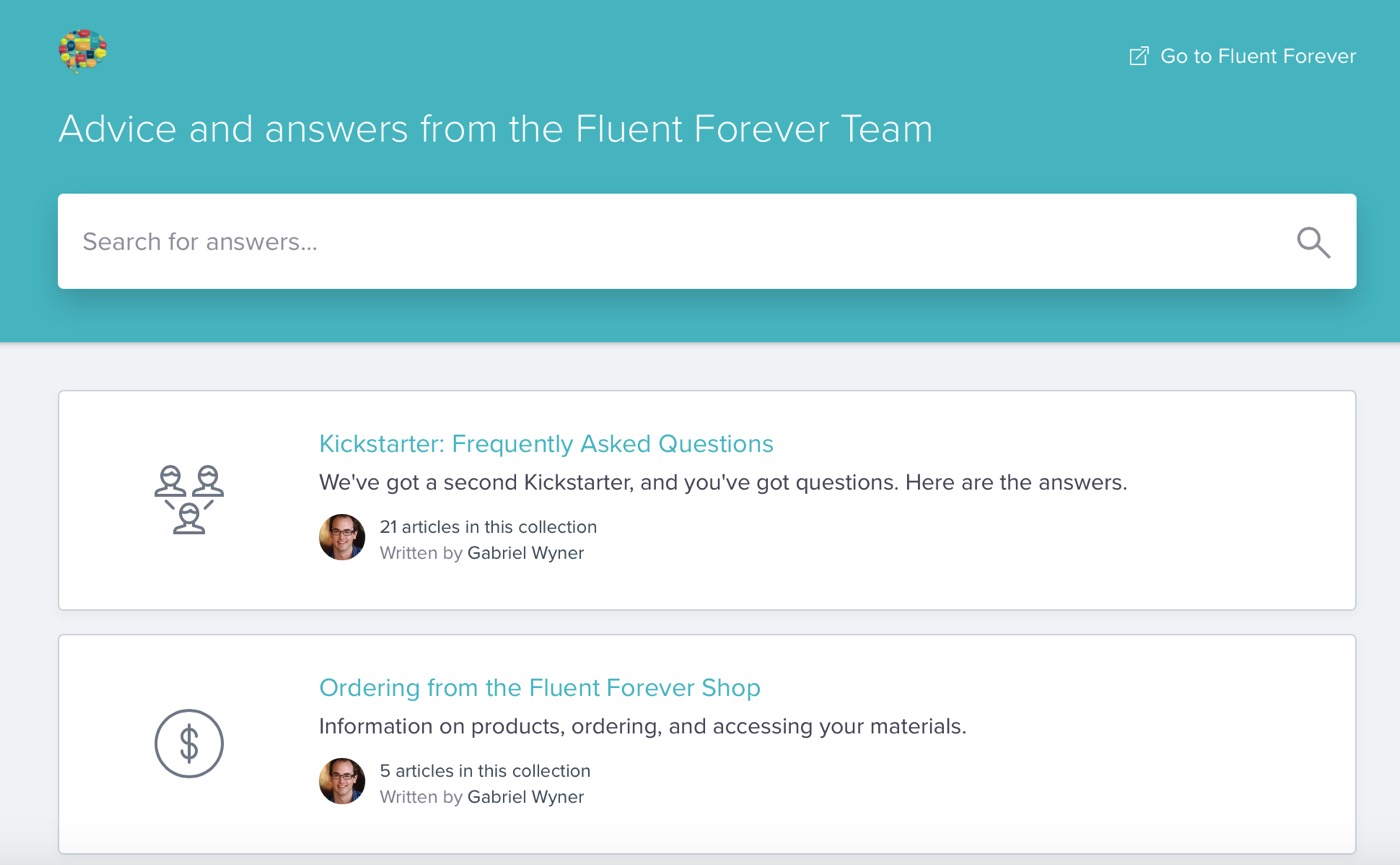
Fluent Forever has come a long way over the past four years. Once upon a time, there was just a book and an IPA trainer. Now there are 67 products, countless blog posts about updates and developments to the method, and a whole new Kickstarter that’s on its way. There have been a LOT of questions that I’ve answered over the years, and many of them have been asked more than once.
But there hasn’t been a way for new users to get THEIR questions answered, other than by emailing us and asking…until now.
Announcing the Fluent Forever Knowledge Base: a giant, organized and searchable database with answers to your frequently asked questions. We’ll be expanding it as time goes on, but it already has a bunch of content (and a lot of exciting stuff about the new Kickstarter), so check it out at: http://help.fluent-forever.com
The post Announcing the Fluent Forever Knowledge Base appeared first on Fluent Forever.
August 23, 2017
A Private Sneak Peek of the Next Kickstarter
Today, I’m releasing a private sneak peek of our upcoming Kickstarter for the Fluent Forever App. If you’re on our mailing list, check your email; you’ll find the link there. If you’re not on our mailing list, then click the button below and we’ll get you to the sneak peek!

August 16, 2017
What Makes Fluent Forever Different? (and why I’m making a new app)
Recently, a tech journalist asked me whether Fluent Forever was any different from existing products like Duolingo or Rosetta, and I realized that I didn’t have a short answer to that question. So I decided to make a short video on the topic, both to explain some of the key differences between Fluent Forever and other tools out there and to talk about some of my goals with the upcoming Kickstarter. Enjoy!
Want to be informed as soon as the Kickstarter comes out? Click here to sign up.
PS: Have you used Fluent Forever to learn a new language (or multiple) over the last few years? We could use your help for our upcoming Kickstarter video! Contact us at hello@fluent-forever.com
The post What Makes Fluent Forever Different? (and why I’m making a new app) appeared first on Fluent Forever.
What Makes Fluent Forever Special? (and why I’m making a new app)
Recently, a tech journalist asked me whether Fluent Forever was any different from existing products like Duolingo or Rosetta, and I realized that I didn’t have a short answer to that question. So I decided to make a short video on the topic, both to explain some of the key differences between Fluent Forever and other tools out there, and to talk about some of my goals with the upcoming Kickstarter. Enjoy!
Want to be informed as soon as the Kickstarter comes out? Click here to sign up.
PS: Have you used Fluent Forever to learn a new language (or multiple) over the last few years? We could use your help for our upcoming Kickstarter video! Contact us at hello@fluent-forever.com
The post What Makes Fluent Forever Special? (and why I’m making a new app) appeared first on Fluent Forever.
Gabriel Wyner's Blog

- Gabriel Wyner's profile
- 181 followers

