Stephen Moore's Blog
April 3, 2019
Pigs really can fly!
I’ve always liked the idea of flying pigs. Long ago, when I wrote my first book, SPILLING THE MAGIC, I created a unique world for flying pigs to live in. A world made up of ninety-seven multi-coloured mountains floating in the air. For me, in essence, that is the true magic of writing books. You get to go anywhere you want, real or imaginary, and you get to do anything you want when you get there. How fantastic is that? My journey as a writer has been great fun and a wonderful adventure. However, I have no plans to write more... With any luck my books will always be around in some form, for those of you who wish to find them. To leave my fingerprints upon these pages I thought it might be interesting to preserve my blogs, particularly those which help describe the creation of my work. So, please continue to enjoy them... To the many readers who have appreciated my books over the years I give my heartfelt thanks. Ours was always a partnership (because a book without a reader is no book at all). I count myself blessed. And please don't forget, pigs really can fly…


March 2, 2017
It’s World Book Day! Read something for Fun!
Read something for fun? Of course! Reading IS fun! And today is World Book Day so you don’t need an excuse. Pick something up and give it a read – just for fun. You like novels? Read one of them. You like comics? Read one of them. It doesn’t matter what. The choice is yours. Fiction, faction, dictionaries or bus tickets! Poetry, recipes, maps or timetables! Magazines, tittle-tattle, love-letters or shopping lists! Short stories, long stories, history books or haikus! As far as I’m concerned, anything goes.
What am I reading for fun? I’m reading John Grundy’s HISTORY OF NEWCASTLE. (That’s the city in the North of England.) It’s a quick wiz through time: all the way from Roman Britain to the present day. Where’s the fun in that? Well, my favourite fact so far concerns the guy who built the very first castle in Newcastle (giving the place its modern name). The year was 1080 AD. The man in question was one, Robert Curthose. What’s in a name? I’ll tell you. Curt means short, and hose means stockings. The founder of Newcastle was nicknamed Shortstockings! His father – a certain William the Conqueror – used to make fun of his son because he wasn’t very tall... It made me smile.
Happy World Book Day! Have some fun of your own...

What am I reading for fun? I’m reading John Grundy’s HISTORY OF NEWCASTLE. (That’s the city in the North of England.) It’s a quick wiz through time: all the way from Roman Britain to the present day. Where’s the fun in that? Well, my favourite fact so far concerns the guy who built the very first castle in Newcastle (giving the place its modern name). The year was 1080 AD. The man in question was one, Robert Curthose. What’s in a name? I’ll tell you. Curt means short, and hose means stockings. The founder of Newcastle was nicknamed Shortstockings! His father – a certain William the Conqueror – used to make fun of his son because he wasn’t very tall... It made me smile.
Happy World Book Day! Have some fun of your own...
September 13, 2016
Today is the Centenary of the birth of the author Roald Dahl
One hundred years ago today the author Roald Dahl was born in Cardiff, South Wales. A man I consider to be the greatest children’s storyteller of his generation. Encouraged by C S Forester, who he met on active service during World War II, he began by writing short stories for grown-ups – I remember as a youngster being glued to the TV watching, Roald Dahl’s Tales of the Unexpected. I still own a copy of his complete short stories. Dahl also wrote successful novels and even co-wrote the screenplay for Chitty Chitty Bang Bang. However, there's no doubting, his children's books are his enduring legacy.
The secret of his success...? In truth, there was no secret. Quite simply, he wrote children’s books for children. He had a uniquely inventive child’s eye, and created his stories in a language that was only ever meant for them! (A talent you either have or don't have.) Who has read Charlie and the Chocolate Factory, The BFG, Matilda (my own personal favourite), The Twits or Fantastic Mr Fox and not been thoroughly delighted? And if you have not, perhaps it is time for you to look inside yourself and find your own child-within.
Happy Birthday Roald Dahl. And many whizzpopping returns.


The secret of his success...? In truth, there was no secret. Quite simply, he wrote children’s books for children. He had a uniquely inventive child’s eye, and created his stories in a language that was only ever meant for them! (A talent you either have or don't have.) Who has read Charlie and the Chocolate Factory, The BFG, Matilda (my own personal favourite), The Twits or Fantastic Mr Fox and not been thoroughly delighted? And if you have not, perhaps it is time for you to look inside yourself and find your own child-within.
Happy Birthday Roald Dahl. And many whizzpopping returns.
July 28, 2016
In Search of the ‘Voice’ of a Book
The ‘voice’ of a book...? Call it voice, call it style. Call it meter or rhythm. Every book has its own shape, uses its own literary palette; a language specific to the author or work in question. It’s part of what makes a book unique.
Mind you, finding your own ‘voice’ is not an easy matter for an author. So, once it’s found most writers do tend to stick to that singular delivery. If it works, use it. Though, of course, there are many ways to deliver a story, and I’d like to use my own work as an example.
When I’m working on a book that requires me to tell the story from the point of view of someone watching the action - in other words when I’m writing in third-person - the style and delivery I use is my own, personal storytellers ‘voice’. I’ve written three books in this manner, among which THE BRUGAN is a good example. It’s a humorous fantasy adventure for older children, but with a particularly sad underlying theme... that of personal loss. In the early planning I did consider allowing the central character to narrate her own story, but decided that, to help soften the emotional blows, I should tell the story on her behalf, in third-person. Here’s how THE BRUGAN begins:
So, there we have me, the author, telling a tale in my natural storyteller's ‘voice’. However, when I’m writing a book in which I want a narrator to tell their own story – in other words when I’m writing in first-person, from the point of view of the narrator – my approach and delivery changes. I create and allow the narrator to write in a voice and manner that is unique to them and their own particular set of circumstances. So, the delivery of the story is quite different each time; in written language, in rhythm, and in literary palette. I’ll give you two examples:
My very first book, SPILLING THE MAGIC, was written for older children, and is told ‘first person’, from the point of view of a bright, imaginative but largely uneducated young lad from the North of England (where the beginning of the book is set). I wanted him to speak in his local everyday language; to bring a sense of immediacy to the tale. His descriptions are inventive, if he’s not too concerned about his grammar... The book begins:
Many years later, when I came to write GRAYNELORE - a fantasy novel for grown-ups - I once more found myself wanting to use a narrator to tell the tale. But, in contrast to the young lad of SPILLING THE MAGIC, this time around the narrator is a grown man and a very different proposition. He’s a killer, a thief, a liar and, as we come to discover as the story unfolds, he’s also fey... a faerie. More than that, his world is the imaginary fantasy world that is Graynelore. The rhythm of the narrator’s speech, his rich, sometimes complex use of language, and the other-worldliness of his descriptive tone are all deliberately used to reflect this. Here’s how GRAYNELORE begins:
There you have it then. As I strive to give each of my books their own identity, the search for the right ‘voice’ is an essential part of my creative process. The rhythm of the words, the vocabulary, the very punctuation, are not simply perfunctory tools used to carry the tale but are always an integral part of the telling of the story.
Books referred to in this blog:


Mind you, finding your own ‘voice’ is not an easy matter for an author. So, once it’s found most writers do tend to stick to that singular delivery. If it works, use it. Though, of course, there are many ways to deliver a story, and I’d like to use my own work as an example.
When I’m working on a book that requires me to tell the story from the point of view of someone watching the action - in other words when I’m writing in third-person - the style and delivery I use is my own, personal storytellers ‘voice’. I’ve written three books in this manner, among which THE BRUGAN is a good example. It’s a humorous fantasy adventure for older children, but with a particularly sad underlying theme... that of personal loss. In the early planning I did consider allowing the central character to narrate her own story, but decided that, to help soften the emotional blows, I should tell the story on her behalf, in third-person. Here’s how THE BRUGAN begins:
Sarah Lemming? What is there to say about Sarah Lemming? Her name gives nothing much away.
Sarah Lemming is as thin as string, with granny knots for knees. Her face is as pale and lumpy as a plate of yesterday’s cold rice pudding. She’s got this wild frizz of bright red hair that’s about as easy to comb as a roll of barbed wire fencing – it makes her look as if she’s in a permanent state of shock. And you should see her on the move; it’s like watching a mistimed explosion of fireworks. She’s all gangly arms and legs, jerky fits and starts and streaks of red hair. About as graceful as a broken stick thrown for a dog!
No, Sarah Lemming is not a pretty sight. The gawky stage, her mother calls it. Plain ugly, say the boys at her school.
She’s the kind of girl who gets left standing on her own in the school yard at break times. You’ll know the sort. Twelve years old and as dizzy as a teapot lid. The original loopy-loo who should never be listened to! Or, at least, that’s what everyone’s always telling her – even the grown-ups.
Why? Take your pick.
It’s on account of her being mad. It’s on account of her having just far too vivid an imagination. It’s on account of her seeing things she should not see. You know. Things that nobody else can see. Things that don’t exist. Things that aren’t really there.
Like what?
Well, like the Brugan.
The Brugan?
Ah yes, the Brugan. The Brugan was a . . . The Brugan is a . . . The Brugan . . . (Forgive the hesitation. It’s just that it’s not always easy to explain the seemingly impossible.)
Put it this way. When was the last time you met a creature so flighty he could stop the whole world from turning, stop it dead, and for no better reason than he felt like it? A creature so wild, so dangerous, he could switch off the sun – click! Who could take your school (for example) and turn it into a medieval castle, change his mind and turn it into a supermarket, change his mind again and turn it into an overgrown tropical rain forest. And do it all in a single draw of breath!
And this is no joke. This is serious stuff. For real, and meant. Every word of it.
Of course, even Sarah Lemming didn’t really know who or what the Brugan was the first time she met him, or understand his truly awesome power. If only she had done—!
Ah, but wait. There’s no point in us getting carried away with the Brugan . . . not just yet.
This will not be making a lot of sense to you, not be sounding at all likely, perhaps? And maybe you’re already thinking, Sarah Lemming must have made the whole Brugan thing up, just to make fools of everyone? Either that, or else she really is as mad as they all say. Yes, well . . . that’s not her fault. And you’d do well to give her the benefit of the doubt, to take what you’re told the best way you can.
First off, her story does not begin with the Brugan. You might almost wish for her sake that it did. But no. Sarah Lemming’s story begins, sadly, with a death . . .
So, there we have me, the author, telling a tale in my natural storyteller's ‘voice’. However, when I’m writing a book in which I want a narrator to tell their own story – in other words when I’m writing in first-person, from the point of view of the narrator – my approach and delivery changes. I create and allow the narrator to write in a voice and manner that is unique to them and their own particular set of circumstances. So, the delivery of the story is quite different each time; in written language, in rhythm, and in literary palette. I’ll give you two examples:
My very first book, SPILLING THE MAGIC, was written for older children, and is told ‘first person’, from the point of view of a bright, imaginative but largely uneducated young lad from the North of England (where the beginning of the book is set). I wanted him to speak in his local everyday language; to bring a sense of immediacy to the tale. His descriptions are inventive, if he’s not too concerned about his grammar... The book begins:
Want to know a secret, a big’un? Well, do you? I was never much good at keeping secrets. Not whoppers like this.
What can I possibly know worth telling, I can almost see you thinking? Well, I know . . . I know that pigs can fly. I know that real dragons are vegetarians. I know that lots of things aren’t what they seem to be, and that proper magic works. And, I know that you can help save a whole world from being snuffed out to nothing, without even knowing that you’re doing it.
Yeah, go on – laugh. Daft fairytale stuff. Well, do you know something? I couldn’t care less whether you believe me or not. And if you’re still interested you’re just going to have to get on with it. Start right at the beginning. The summer before last, the day I was sent with my sister, Mary to stay with The Stringers.
You see, if we hadn’t been sent to stay with the Stringers, there would have been nothing to tell . . .
*
It was a stinking hot morning. The kind that sends buckets of sweat dribbling down the inside of your shirt. And the air was too thick to breathe. I had to chop it up into little bits and suck it between my teeth just to swallow it. Well, nearly.
The rotten bus had dropped us off at the bottom of Lemington Hill. We – Mary and me – we wanted to be at the top of the hill. Some holiday this was going to be.
‘I still don’t see why they couldn’t have taken us with them,’ Mary said. She was sulking. She had been sulking ever since leaving home. I swear, if I hadn’t picked up my suitcase and walked away, I would have thumped her.
‘I don’t want to hear it again, Mary,’ I said, and attacked the hill with giant steps. Row after row of tiny red-brick houses and grubby little corner shops crammed the hillside. Windows and doors were slung open all over the place – it was so hot even the buildings were panting for breath.
Dad had said their holiday was a sort of second honeymoon – for Mam. ‘You know Billy, after her bother and the hospital and that.’ He had given me one of his knowing looks that was meant to explain everything, but didn’t. ‘The Stringers are canny enough. And you won’t mind not going with us just this once – will you?’ Another knowing look, and a touch of his nose with a finger. I ignored his fib about the Stringers, pretended to understand, shook my head and touched my nose. Grown-up stuff.
Many years later, when I came to write GRAYNELORE - a fantasy novel for grown-ups - I once more found myself wanting to use a narrator to tell the tale. But, in contrast to the young lad of SPILLING THE MAGIC, this time around the narrator is a grown man and a very different proposition. He’s a killer, a thief, a liar and, as we come to discover as the story unfolds, he’s also fey... a faerie. More than that, his world is the imaginary fantasy world that is Graynelore. The rhythm of the narrator’s speech, his rich, sometimes complex use of language, and the other-worldliness of his descriptive tone are all deliberately used to reflect this. Here’s how GRAYNELORE begins:
I am Rogrig, Rogrig Wishard by grayne. Though, I was always Rogrig Stone Heart by desire. This is my memoir and my testimony. What can I tell you about myself that will be believed? Not much, I fear. I am a poor fell-stockman and a worse farmer (that much is true). I am a fighting-man. I am a killer, a soldier-thief, and a blood-soaked reiver. I am a sometime liar and a coward. I have a cruel tongue, a foul temper, not to be crossed. And, I am – reliably informed – a pitiful dagger’s arse when blathering drunk.
You can see, my friend, I am not well blessed.
For all that, I am just an ordinary man of Graynelore. No different to any other man of my breed. (Ah, now we come to the nub of it. I must temper my words.)
Rogrig is mostly an ordinary man. The emphasis is important. For if a tale really can hang, then it is from this single thread mine is suspended.
Even now I hesitate, and fear my words will forever run in rings around the truth. Why? Put simply, I would have preferred it otherwise.
Let me explain. I have told you that I am a Wishard. It is my family name... it is also something rather more. I say it again, Wish-ard, and not wizard. I do not craft spells. I do not brew potions or anything of the like. No. My talent, such as it is, is more obscure. You see, a Wishard’s skill is inherent, it belongs to the man. You either possess it or you do not. (Most men, most Wishards do not.) It cannot be taught. As best as can be described, I have a knack. Rather, I influence things. I make wishes, of a kind.
Aye, wishes... (There, at last, it is said.)
Forgive me, my friend. I will admit, I find it difficult, if not tortuous, to speak of such fanciful whimsy. Make what you will of my reticence; measure Rogrig by it, if you must. I will say only this much more (it is a caution): by necessity, my testimony must begin with my childhood. But be warned: if I tell you that this is a faerie tale – and it is a faerie tale – it is not a children’s story.
Please, humour me. Suffer Rogrig Wishard to lead you down the winding path and see where it takes you. There is purpose to it. Else I would not trouble you.
There you have it then. As I strive to give each of my books their own identity, the search for the right ‘voice’ is an essential part of my creative process. The rhythm of the words, the vocabulary, the very punctuation, are not simply perfunctory tools used to carry the tale but are always an integral part of the telling of the story.
Books referred to in this blog:
June 27, 2016
In search of an, Other-World?
How do we get to an Other-World? We chase a white rabbit down a hole. We climb through a looking-glass. We step inside a wardrobe. We receive a letter enrolling us into wizard’s school. We sprinkle faerie-dust. We fall asleep and dream. Or perhaps, just perhaps, we turn the first pages of a book and find ourselves already there.
And does this Other-World have a name? It seems it has so very many names. Is it Wonderland, or Narnia? Is it, Middle Earth or Hogwarts? Is it Earthsea or Gormanghast? In my own GRAYNELORE, the narrator – one, Rogrig Wishard - becomes enamoured of the fey and finds himself in search of the Faerie Isle; an Other-World within an Other-World...!
Whatever we choose to call our favourite Other-World, so many of us – authors and readers alike – are fascinated by the very idea: of that space, that secret place, that Other-World that surely exists, must exist, just out of sight, just on the other side of our imagination, where adventure is to be found, truth spoken and all our questions answered... if only we can find a way to get there.
It’s safe to say that the use of an Other-World is a staple tool for most fantasy writers; it is certainly one of mine. Look upon my written canvas, listen to my song, turn the pages of my books, read on... beguiled by the Other-Worlds created for you there. Let me show you things that cannot be seen in any other way. Reach beyond the far corners of the universe. Let me attempt to explain the unexplainable, answer the unanswered question. Let me help you to make sense of it all... when we live in a world that so very often makes such little sense. Let me show you the inside, the other side, the makings of my mind. Let me draw you my emotions. Let me help you to escape, or to find your way home again...
Some of the Other-Worlds referred to in this blog:


And does this Other-World have a name? It seems it has so very many names. Is it Wonderland, or Narnia? Is it, Middle Earth or Hogwarts? Is it Earthsea or Gormanghast? In my own GRAYNELORE, the narrator – one, Rogrig Wishard - becomes enamoured of the fey and finds himself in search of the Faerie Isle; an Other-World within an Other-World...!
Whatever we choose to call our favourite Other-World, so many of us – authors and readers alike – are fascinated by the very idea: of that space, that secret place, that Other-World that surely exists, must exist, just out of sight, just on the other side of our imagination, where adventure is to be found, truth spoken and all our questions answered... if only we can find a way to get there.
It’s safe to say that the use of an Other-World is a staple tool for most fantasy writers; it is certainly one of mine. Look upon my written canvas, listen to my song, turn the pages of my books, read on... beguiled by the Other-Worlds created for you there. Let me show you things that cannot be seen in any other way. Reach beyond the far corners of the universe. Let me attempt to explain the unexplainable, answer the unanswered question. Let me help you to make sense of it all... when we live in a world that so very often makes such little sense. Let me show you the inside, the other side, the makings of my mind. Let me draw you my emotions. Let me help you to escape, or to find your way home again...
Some of the Other-Worlds referred to in this blog:
May 20, 2016
When real life imitates fiction
Way back in 2006, in my book FAY, I wrote about a Town Council sending in bulldozers to clear a village’s garden allotments; with the intention of building on them, and in the process ending a traditional, cultural way of life that had spanned centuries. This was a fictional tale, but over the years I’d become increasingly aware of the continual urban development that had seen my home city gobbling up mile upon mile of green field sites as it relentlessly expanded. I had seen farmland, and livelihoods, disappear and former rural villages literally swallowed up by the urban sprawl, losing their historical identity and individual way of life. It’s a long, slow process, but it is relentless and continues to this day. Indeed, very close to where I live no less than three thousand houses are due to be built over the course of the next decade or so... on what is now green field and green belt sites.
To be fair, my home city is not the only villain here. It’s a story that is being played out in almost every developing town and city in the country, if not the world. And, of course, we do need more housing and more places of work for an ever, expanding population... It is how this can be achieved sensibly, which is the point in question. There’s always more than one solution to a problem. Better use of brown field sites for example. And what about the estimated one million properties that currently stand empty in the UK... unused, unloved, often forgotten by their absentee owners?
Let me get back to FAY. What follows is a short extract. We see the scene through the eyes of a young lad called Thomas Dobson, as he comes upon the destruction of his own beloved garden allotments:
And where, you may ask, does real life imitate fiction? Let me tell you. My home city has an historical Town Moor; land set aside, and in the guardianship of the Freemen of the city, that has very strict rules to its use and development. It is a sanctuary of green fields among the chaos of iron, steel, brick and concrete that is the modern city. Anyway, on one small part of the Town Moor there is a particular garden allotment (garden plots that have been there since the 'Dig for Victory’ campaign of World War Two) and whenever I take a bus into the city, I pass them... What did I see only a few weeks ago? Bulldozers and diggers among the allotments raising them to the ground, exactly as Thomas Dodson described the Oldburn allotments in FAY. You might imagine; my heart sank. I could not let the moment pass.
I did a little bit of digging around (forgive my pun) into the allotment demolition, and fortunately, on this occasion, I can give a little sigh of relief. Among other reasons, the City Council has explained that the demolition is taking place because of possible toxic wastes, notably asbestos, thought to be present in some of the temporary structures plot holders historically built on the site. The allotments will be fully re-established and improved upon for the use of the local community. And for that, I shout hoorah! If I shall also keep a very wary-eye...
Our world around us is always in a constant state of change. But let the changes we make be the right changes, and for the right reasons.
Genre: Fantasy/magic realism
Suggested readership: Older Children/Young Adult
To be fair, my home city is not the only villain here. It’s a story that is being played out in almost every developing town and city in the country, if not the world. And, of course, we do need more housing and more places of work for an ever, expanding population... It is how this can be achieved sensibly, which is the point in question. There’s always more than one solution to a problem. Better use of brown field sites for example. And what about the estimated one million properties that currently stand empty in the UK... unused, unloved, often forgotten by their absentee owners?
Let me get back to FAY. What follows is a short extract. We see the scene through the eyes of a young lad called Thomas Dobson, as he comes upon the destruction of his own beloved garden allotments:
I’ll tell you, the allotments were ruined. I could have cried. They had always been such a magical place for us kids, a world of makeshift wooden hovels you could explore forever. Greenhouses built out of old front doors; some of them still with their number and knockers on them. Rooftops made out of corrugated iron, some out of carpet, or pieces of kitchen linoleum. Cack-handed brick chimney stacks, with tin funnels held in place with rusting coils of chicken wire, so the gardeners could light themselves fires and have brew-ups on freezing cold winter days. And each plot was quite different from their neighbour, so that together they looked to me like a giant’s patchwork quilt. Some, a blaze of colour as the summer flowers came into bloom. Some planted out with neat rows of green vegetables. Others were nothing more than patches of grey soil, where the earth had been turned over in preparation. A couple, knee-high with wind-driven weeds, where the gardeners had been too long absent.
Mind you, that didn’t matter now. Now, all the allotments looked exactly the same. All of them, smashed, ruined, obliterated. Bulldozed into mountainous heaps ready to be burned or carted away to the rubbish tips. There was a huge great brute of a machine, with caterpillar tracks and a massive shovel front, standing just where the first line of greenhouses should have been. There were deep furrows behind its tracks where it had cut heavily into the ground. Everything the machine had crossed was crushed beyond recognition and churned into mush.
And where, you may ask, does real life imitate fiction? Let me tell you. My home city has an historical Town Moor; land set aside, and in the guardianship of the Freemen of the city, that has very strict rules to its use and development. It is a sanctuary of green fields among the chaos of iron, steel, brick and concrete that is the modern city. Anyway, on one small part of the Town Moor there is a particular garden allotment (garden plots that have been there since the 'Dig for Victory’ campaign of World War Two) and whenever I take a bus into the city, I pass them... What did I see only a few weeks ago? Bulldozers and diggers among the allotments raising them to the ground, exactly as Thomas Dodson described the Oldburn allotments in FAY. You might imagine; my heart sank. I could not let the moment pass.
I did a little bit of digging around (forgive my pun) into the allotment demolition, and fortunately, on this occasion, I can give a little sigh of relief. Among other reasons, the City Council has explained that the demolition is taking place because of possible toxic wastes, notably asbestos, thought to be present in some of the temporary structures plot holders historically built on the site. The allotments will be fully re-established and improved upon for the use of the local community. And for that, I shout hoorah! If I shall also keep a very wary-eye...
Our world around us is always in a constant state of change. But let the changes we make be the right changes, and for the right reasons.
Genre: Fantasy/magic realism
Suggested readership: Older Children/Young Adult
April 14, 2016
Taking tea with the author, Eva Ibbotson
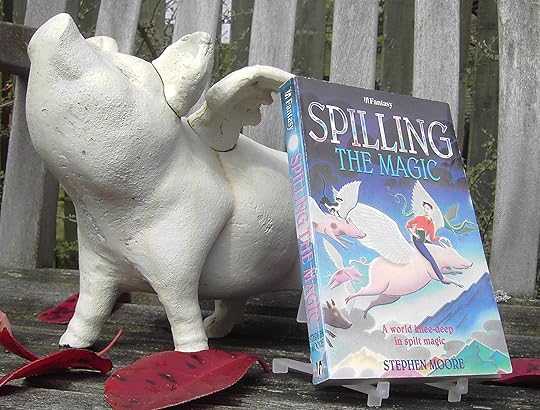 April 2016, marks the 20th anniversary of the publication of my very first book, SPILLING THE MAGIC. A fantasy adventure for older children I’m still rather fond of, full of flying pigs and floating mountains and, of course, spilt magic...
I’m lucky. Being an author has given me many happy memories. This particular anniversary brings to mind one of my favourites and concerns an author friend of mine. (I’m certain, Eva Ibbotson, would not mind me repeating it.) The year was 1996. SPILLING THE MAGIC was just about to be published, and the now late, great Eva Ibbotson graciously agreed to endorse it. I was overwhelmed, and so proud. I still am.
What’s more, as we both lived in the North of England, she agreed to meet me. So, one fine autumn afternoon, we met for tea, in the old cafe of the Tyneside Cinema in Newcastle upon Tyne. I remember, as we had never met before, we each agreed to arrive carrying a copy of our latest book so that we might recognise each other... I can still see her: a small, refined, slightly built old lady, with fine grey hair, and sharp, inquisitive, not to say mischievous, eyes. She seemed to relish our meeting, and thought it was great fun to meet up with a – comparatively – young stranger! She spoke with great warmth and kindness, and together we happily shared our thoughts about our writing, and about our hopes and future aspirations. Though she was, of course, by far the more senior talent!
At that time Eva Ibbotson was already a successful author, writing both for children and adults, and there was much more to come from her. I recall, she confided in me - most modestly - that she still had one great unfulfilled wish, and that was to write a book that might be considered a timeless classic, perhaps in the way of, THE SECRET GARDEN. Well, we drank our tea, signed and exchanged our books, wished each other well and went our separate ways. Over the next few months we wrote to each other occasionally and met up again briefly when she attended a bookshop event for SPILLING THE MAGIC.
It was in 2001 that Eva’s children’s book, JOURNEY TO THE RIVER SEA was published. From the moment I picked it up off the bookshelf and began to read I was enthralled and knew I was reading something special. I remembered back to our conversation over tea, and I realised... Eva’s wish had at last been granted: she had written her classic children’s novel. (Indeed, it was not to be her last.) I wrote to her and I told her so, and received a gracious and typically modest reply.
JOURNEY TO THE RIVER SEA went on to be a huge success, and an award-winning children’s book. Today, rightly acknowledged by many as a modern classic.
Sadly, Eva Ibbotson is no longer with us, but her books live on. If you do not know them, you must go and take a look. As for SPILLING THE MAGIC, I’m pleased to say, in its own quiet way, twenty years on, it too is still around...

February 25, 2016
“Graynelore” Paperback Publication Day! (Stephen Moore gives a reading)
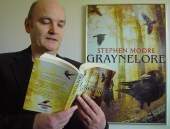 I’m so very pleased to announce that today my fantasy novel GRAYNELORE is published in paperback! (HarperVoyager Publisher). I’ve been a children’s author for many years. Finally, here is my debut novel for all you grown-ups... in paperback!
As you may well know, the ebook of GRAYNELORE has been out for quite a while now, but I must admit, there’s nothing quite like holding a brand new paperback...
To celebrate the event I’ve recorded my first public reading from the novel, which you can enjoy by simply following this link: https://www.goodreads.com/videos/9896...
How might I best describe GRAYNELORE?
GRAYNELORE is a brutal, lawless world, where a man’s only loyalty is to his grayne (his family). Murder, blackmail, theft and blood-feud are all part of daily life. Faerie tales are myths, strictly for the children. Why then does Rogrig Wishard – a hardened fighting-man – suddenly start hearing voices and seeing faeries for real? What makes him embark upon a seemingly ridiculous quest to restore a Faerie Isle to the world? Is he mad or simply faerie-touched...?
It’s a story of divided loyalty. It’s an epic fantasy, a blood-soaked mystery, a grown-up faerie tale. And, in its own twisted way, a kind of love story…
GRAYNELORE (HarperVoyager Publishers) Paperback and e-book
Suggested Readership: Grown-ups
February 5, 2016
15 of the best new Sci-Fi and Fantasy authors from HarperVoyager
In late 2012 the UK publisher HarperVoyager – an imprint of HarperCollins - put out a call for submissions of un-agented fantasy/Sci-Fi novels. An ambitious project, it was the first time they’d done this in almost a decade. In only two weeks they received almost 5000 manuscripts, out of which the works of just 15 authors were eventually accepted for publication, including my own novel GRAYNELORE.
Looking back from 2016 (was it really that long ago?) I realise that I and my fellow authors have travelled a very long, sometimes rocky, road together.
In a kind of celebration, I want to introduce you to the brilliant books created by that group of authors who made up the original 15. Among which, there’s a dazzling array of talent. Writers of Epic Fantasy, Comic Fantasy, Science Fiction, Urban Fantasy, Space Opera, Speculative Fiction and Oh... the list goes on! And with so many ingenious genre-twisters between them, I’ve always found their creative company inspiring (if just a little manic, and sometimes plain bonkers!) I’ve listed our books alphabetically by title:
 AMONG WOLVES by Nancy L Wallace. This is the beginning of a truly engaging Fantasy series, set in a world of bards and ancient libraries. A subtle blend of political intrigue with just the right amount of gruesome dark deeds. How would the author describe it? “Wolves and assassins, bards and betrayal, and one scholar’s search for truth in a world on the verge of revolution!”
 DETECTIVE STRONGOAK AND THE CASE OF THE DEAD ELF by Terry Newman. Apart from having the longest title of any of our books, this is certainly the funniest. A hugely entertaining genre-bending Comic Fantasy, written with a refreshing knowing wit. How would the author describe it? “In the multiracial steam-powered world of the Citadel, where the goblins carry shooters and elves go surfing, dwarf Master Detective Nicely Strongoak investigates his toughest case, which takes him into the murky world of Citadel politics...!”
 BELT THREE by John Ayliff. This wonderful dystopian piece of Science Fiction had me hooked from the start. What with space pirates, machines big enough to eat planets, and an unusual tale of stolen identity... How would the author describe it? "Three hundred years after the Earth is destroyed by alien Worldbreakers, a grieving identity thief is kidnapped by a pirate and must choose between escaping, seeking revenge, or joining her on her crusade against the Worldbreakers."
 DARKHAVEN by A F E Smith. There’s an appealing warmth and a subtle sense of intelligence at work in the writing of A F E Smith. This is the classic Fantasy tale of a ruling family at loggerheads. With a throne up for grabs but unwanted, murder, deceit, betrayal and a perpetrator to uncover. A satisfyingly complex story, told with clarity and aplomb. (And I haven’t even mentioned the shapeshifters...)
GRAYNELORE by Stephen Moore. (Ah, that’s me, of course) and my unusual Fantasy tale of a reiving man. A killer, a thief, a liar, who is not at all impressed to discover he’s carrying faerie blood. How might I describe it? “It’s a story of divided loyalty, an epic fantasy, a grown-up faerie tale, a blood-soaked mystery; and, in its own twisted way, a kind of love story…”
 GREY by Christi J Whitney. This young-adult Urban Fantasy is written with such flare and panache I could not help but smile as I read it. Perfect for a gypsy-dance of a tale! (In fact, it actually made me sing! And not many books can claim that!) How would the author describe it? “A secretive clan of Outcast Gypsies pull Sebastian Grey into a world of secrets, shadowy figures, and a destiny he cannot escape. A fast paced and intriguing mystery with a twist.”
 HERO BORN by Andy Livingstone. This deeply satisfying and epic Historical Fantasy is a tale to lose yourself in... (in a good way, I assure you). How would the author describe it? “The world knows it needs a hero. Fate knows the hero is a boy, dragged from sheltered village life to misery, peril and captivity. All the boy wants to know is if he'll still be alive at the end of each day.”
 THE KARMA BOOTH by Jeff Pearce. This is a taut, thought-provoking, deftly written Sci-Fi thriller. From the outset I thought the premise was simply perfect. How would the author describe it? “They say that executing a murderer won't bring your loved one back --- but now it can.” Just imagine that... But is it a miracle or a curse?
 IGNITE THE SHADOWS by Ingrid Seymour. This young-adult Sci-Fi/Fantasy is a breathless, slick – sometimes disturbing - urban thriller. I love the way that Ingrid Seymour gets right under the skin of her young heroine making it all so hugely believable. How would the author describe it? “Sentient parasites taking over the Earth's population, infecting the human brain and morphing their bodies into monsters while an infected girl fights to defeat their evil and stay in control of herself. Action packed and ‘full of thrills and chills!’”
 STEALING INTO WINTER by Graeme Keith Talboys. This is a finely written action Future Fantasy. Whether it’s dust or blood or fear in the air you can smell it! And the emotion is real. How would the author describe it? “The last thing Jeniche wanted once she had escaped into the war-torn city was to help a group of nuns and monks escape and guide them through the desert and into the mountains so they could get home. Of course, the last thing you want is often the first thing you get.” You’d better believe it!
 SUPERVISION by Alison Stine. This wonderful young-adult Supernatural Fantasy is written with such simple eloquence. But don’t let the apparent simplicity beguile you! Is this a ghost story? Or is it a murder mystery? Or is it the story of a young girl trying to find her way home? Certainly, it’s a conundrum waiting to be resolved, and a finely balanced tale that unravels subtly in its own good time.
 THE ARK by Laura Liddell Nolen. This young-adult Sci-Fi is hugely enjoyable. Fresh and vivid, and written with a knowing eye, it’s a space adventure to eat up! How would the author describe it? “The Ark: A young convict plots to escape from prison and stow away on the last spaceship leaving earth during Armageddon.”
 THE MACHINERY by Gerrard Cowan. This is a truly captivating Epic Fantasy that - trust me - will make you think. A book to take your time over and explore... How would the author describe it? “The Machinery has chosen the leaders of the Overland for 10,000 years, bringing great success to the country. But now the Machinery is broken, and Ruin is coming.” Indeed...
 THE RULE by Jack Colman. This is an intriguing Historical Fantasy with a great premise. In Helvik there is only one rule that governs its people. It’s an unbreakable rule. And, without giving anything away, thereby lies the problem... How would the author describe it? “Gunnarr has long used the one rule of Helvik to deal retribution on behalf of others. What will he do when that same rule would deny him his vengeance on the one occasion he wants it for himself?”
 UNEXPECTED RAIN by Jason LaPier. This is a hugely creative and entertaining Sci-Fi. I found the author’s descriptions of his futuristic off-earth world a true joy, and totally believable. How would the author describe it? “The story of a fugitive on the run from corruption in the law, UNEXPECTED RAIN is a star-hopping trek that mixes noir with space opera; gritty, bloody, and at times darkly humorous.”
So, there you have it, a brief introduction to my fellow HarperVoyager authors... Perhaps you’ll find a new favourite among them? To those authors I would simply like to say, it has been my privilege to travel in your company.
Looking back from 2016 (was it really that long ago?) I realise that I and my fellow authors have travelled a very long, sometimes rocky, road together.
In a kind of celebration, I want to introduce you to the brilliant books created by that group of authors who made up the original 15. Among which, there’s a dazzling array of talent. Writers of Epic Fantasy, Comic Fantasy, Science Fiction, Urban Fantasy, Space Opera, Speculative Fiction and Oh... the list goes on! And with so many ingenious genre-twisters between them, I’ve always found their creative company inspiring (if just a little manic, and sometimes plain bonkers!) I’ve listed our books alphabetically by title:
AMONG WOLVES by Nancy L Wallace. This is the beginning of a truly engaging Fantasy series, set in a world of bards and ancient libraries. A subtle blend of political intrigue with just the right amount of gruesome dark deeds. How would the author describe it? “Wolves and assassins, bards and betrayal, and one scholar’s search for truth in a world on the verge of revolution!”
DETECTIVE STRONGOAK AND THE CASE OF THE DEAD ELF by Terry Newman. Apart from having the longest title of any of our books, this is certainly the funniest. A hugely entertaining genre-bending Comic Fantasy, written with a refreshing knowing wit. How would the author describe it? “In the multiracial steam-powered world of the Citadel, where the goblins carry shooters and elves go surfing, dwarf Master Detective Nicely Strongoak investigates his toughest case, which takes him into the murky world of Citadel politics...!”
BELT THREE by John Ayliff. This wonderful dystopian piece of Science Fiction had me hooked from the start. What with space pirates, machines big enough to eat planets, and an unusual tale of stolen identity... How would the author describe it? "Three hundred years after the Earth is destroyed by alien Worldbreakers, a grieving identity thief is kidnapped by a pirate and must choose between escaping, seeking revenge, or joining her on her crusade against the Worldbreakers."
DARKHAVEN by A F E Smith. There’s an appealing warmth and a subtle sense of intelligence at work in the writing of A F E Smith. This is the classic Fantasy tale of a ruling family at loggerheads. With a throne up for grabs but unwanted, murder, deceit, betrayal and a perpetrator to uncover. A satisfyingly complex story, told with clarity and aplomb. (And I haven’t even mentioned the shapeshifters...)
GRAYNELORE by Stephen Moore. (Ah, that’s me, of course) and my unusual Fantasy tale of a reiving man. A killer, a thief, a liar, who is not at all impressed to discover he’s carrying faerie blood. How might I describe it? “It’s a story of divided loyalty, an epic fantasy, a grown-up faerie tale, a blood-soaked mystery; and, in its own twisted way, a kind of love story…”
GREY by Christi J Whitney. This young-adult Urban Fantasy is written with such flare and panache I could not help but smile as I read it. Perfect for a gypsy-dance of a tale! (In fact, it actually made me sing! And not many books can claim that!) How would the author describe it? “A secretive clan of Outcast Gypsies pull Sebastian Grey into a world of secrets, shadowy figures, and a destiny he cannot escape. A fast paced and intriguing mystery with a twist.”
HERO BORN by Andy Livingstone. This deeply satisfying and epic Historical Fantasy is a tale to lose yourself in... (in a good way, I assure you). How would the author describe it? “The world knows it needs a hero. Fate knows the hero is a boy, dragged from sheltered village life to misery, peril and captivity. All the boy wants to know is if he'll still be alive at the end of each day.”
THE KARMA BOOTH by Jeff Pearce. This is a taut, thought-provoking, deftly written Sci-Fi thriller. From the outset I thought the premise was simply perfect. How would the author describe it? “They say that executing a murderer won't bring your loved one back --- but now it can.” Just imagine that... But is it a miracle or a curse?
IGNITE THE SHADOWS by Ingrid Seymour. This young-adult Sci-Fi/Fantasy is a breathless, slick – sometimes disturbing - urban thriller. I love the way that Ingrid Seymour gets right under the skin of her young heroine making it all so hugely believable. How would the author describe it? “Sentient parasites taking over the Earth's population, infecting the human brain and morphing their bodies into monsters while an infected girl fights to defeat their evil and stay in control of herself. Action packed and ‘full of thrills and chills!’”
STEALING INTO WINTER by Graeme Keith Talboys. This is a finely written action Future Fantasy. Whether it’s dust or blood or fear in the air you can smell it! And the emotion is real. How would the author describe it? “The last thing Jeniche wanted once she had escaped into the war-torn city was to help a group of nuns and monks escape and guide them through the desert and into the mountains so they could get home. Of course, the last thing you want is often the first thing you get.” You’d better believe it!
SUPERVISION by Alison Stine. This wonderful young-adult Supernatural Fantasy is written with such simple eloquence. But don’t let the apparent simplicity beguile you! Is this a ghost story? Or is it a murder mystery? Or is it the story of a young girl trying to find her way home? Certainly, it’s a conundrum waiting to be resolved, and a finely balanced tale that unravels subtly in its own good time.
THE ARK by Laura Liddell Nolen. This young-adult Sci-Fi is hugely enjoyable. Fresh and vivid, and written with a knowing eye, it’s a space adventure to eat up! How would the author describe it? “The Ark: A young convict plots to escape from prison and stow away on the last spaceship leaving earth during Armageddon.”
THE MACHINERY by Gerrard Cowan. This is a truly captivating Epic Fantasy that - trust me - will make you think. A book to take your time over and explore... How would the author describe it? “The Machinery has chosen the leaders of the Overland for 10,000 years, bringing great success to the country. But now the Machinery is broken, and Ruin is coming.” Indeed...
THE RULE by Jack Colman. This is an intriguing Historical Fantasy with a great premise. In Helvik there is only one rule that governs its people. It’s an unbreakable rule. And, without giving anything away, thereby lies the problem... How would the author describe it? “Gunnarr has long used the one rule of Helvik to deal retribution on behalf of others. What will he do when that same rule would deny him his vengeance on the one occasion he wants it for himself?”
UNEXPECTED RAIN by Jason LaPier. This is a hugely creative and entertaining Sci-Fi. I found the author’s descriptions of his futuristic off-earth world a true joy, and totally believable. How would the author describe it? “The story of a fugitive on the run from corruption in the law, UNEXPECTED RAIN is a star-hopping trek that mixes noir with space opera; gritty, bloody, and at times darkly humorous.”So, there you have it, a brief introduction to my fellow HarperVoyager authors... Perhaps you’ll find a new favourite among them? To those authors I would simply like to say, it has been my privilege to travel in your company.
January 22, 2016
It’s the time of year to de-clutter the bookshelves
January is traditionally a time for new beginnings. We all make our resolutions. We turn over a new leaf. We plan that trip to the gym. We tidy up our lives. At least we try. And in that spirit of renewal I thought it was time for me to de-clutter my bookshelves (or at least to take a second look). I am, after all, an author. I write some of those books we keep on our shelves. I am also an avid reader and collector! But there comes a moment when you must take stock, and for me, this is it!
All around the house, the shelves are groaning under the weight of books. Books lie piled in the corners of rooms. The cupboards are bursting. The spare room is full. The attic is full. Books lie abandoned on bedside cabinets, under the bed, on coffee tables, even in the kitchen...
What can I say? I’ve always found adding books to my collection very, very easy. I love books. Their design, their texture, their smell! I love the very experience of turning over pages. And I love getting lost within the written word, as the storytelling lures me down the winding path that leads to adventure, discovery, enlightenment and new worlds...
And of course, like all readers, I have my favourite authors and favourite books. If I look up from my keyboard and turn my head towards my “favourites” bookshelf I can read names like, Tolkien, Dickens, Philip Pullman, Robert Westall, Robert Louis Stephenson, Douglas Adams, Terry Pratchett, Ursula Le Guin, C S Lewis, George Orwell, Laurie Lee, and oh, so many more. Then there is my second “favourite” bookshelf in my office (only there because my first “favourite” bookshelf is full up.)
Well, I think you get the picture. (And I haven’t even mentioned my “invisible” books - my e-books - or my antiquarian collection.)
There are lots of reasons collections get out of hand, because there are lots of reasons, we keep books. There are books I love so much I simply must have them around me. And not in only one edition either! For example, I have at least four editions of Treasure Island, and three editions of A Christmas Carol! There are the books I constantly return to. The books I will never get tired of re-reading. There are the books I wrote myself (oh yes, they too are on my bookshelves) and the treasured books given to me by my fellow authors. There are the books I grew up with, old and worn, and there are the brand-new books by authors I’ve only just discovered (always a delight). There are books both fiction and non-fiction. There are dictionaries, there are biographies, histories, art books, graphic novels, comic books, poetry...
But enough procrastination! It’s now time to do something about it.
How will I go about my de-clutter? Where will I start? Well, what about those books which are merely trophies? You know... the books we all keep on our bookshelves to impress, or simply because we think they should be there? Am I truly ever going to read that ancient copy of “--- --- -----”? And what about the books I’ve bought on a whim, always meaning to read, but just never quite getting around to them? Or the books that were given to me as gifts because friends and family were certain I would like them, yet they remain forever unread. Then there are the books I have inherited, the books I’ve been given for free, the books I keep simply because, well, because I collect books.
As I begin my task, I shall ask myself only one question. “Do I need this book?” Wish me luck. Or try it yourself.
Here are some of my favourite books that will be staying on my shelves...


All around the house, the shelves are groaning under the weight of books. Books lie piled in the corners of rooms. The cupboards are bursting. The spare room is full. The attic is full. Books lie abandoned on bedside cabinets, under the bed, on coffee tables, even in the kitchen...
What can I say? I’ve always found adding books to my collection very, very easy. I love books. Their design, their texture, their smell! I love the very experience of turning over pages. And I love getting lost within the written word, as the storytelling lures me down the winding path that leads to adventure, discovery, enlightenment and new worlds...
And of course, like all readers, I have my favourite authors and favourite books. If I look up from my keyboard and turn my head towards my “favourites” bookshelf I can read names like, Tolkien, Dickens, Philip Pullman, Robert Westall, Robert Louis Stephenson, Douglas Adams, Terry Pratchett, Ursula Le Guin, C S Lewis, George Orwell, Laurie Lee, and oh, so many more. Then there is my second “favourite” bookshelf in my office (only there because my first “favourite” bookshelf is full up.)
Well, I think you get the picture. (And I haven’t even mentioned my “invisible” books - my e-books - or my antiquarian collection.)
There are lots of reasons collections get out of hand, because there are lots of reasons, we keep books. There are books I love so much I simply must have them around me. And not in only one edition either! For example, I have at least four editions of Treasure Island, and three editions of A Christmas Carol! There are the books I constantly return to. The books I will never get tired of re-reading. There are the books I wrote myself (oh yes, they too are on my bookshelves) and the treasured books given to me by my fellow authors. There are the books I grew up with, old and worn, and there are the brand-new books by authors I’ve only just discovered (always a delight). There are books both fiction and non-fiction. There are dictionaries, there are biographies, histories, art books, graphic novels, comic books, poetry...
But enough procrastination! It’s now time to do something about it.
How will I go about my de-clutter? Where will I start? Well, what about those books which are merely trophies? You know... the books we all keep on our bookshelves to impress, or simply because we think they should be there? Am I truly ever going to read that ancient copy of “--- --- -----”? And what about the books I’ve bought on a whim, always meaning to read, but just never quite getting around to them? Or the books that were given to me as gifts because friends and family were certain I would like them, yet they remain forever unread. Then there are the books I have inherited, the books I’ve been given for free, the books I keep simply because, well, because I collect books.
As I begin my task, I shall ask myself only one question. “Do I need this book?” Wish me luck. Or try it yourself.
Here are some of my favourite books that will be staying on my shelves...