R.J. Casta's Blog
October 7, 2026
A little more about Calandis…
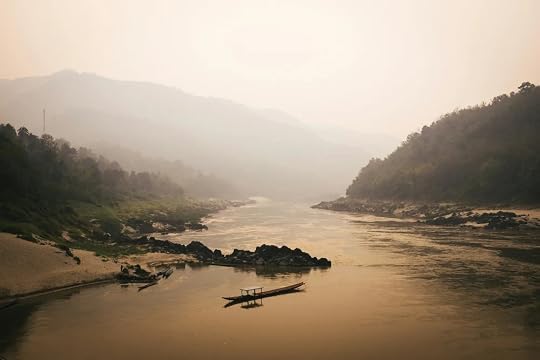
While I will have a proper map made of Calandis, I wanted to detail the wonderful world I’ve created in writing to you all. Perhaps it’s just your cozy cup of tea.
Calandis, the world in which Wick and the Wandering Barge is set, is a weapons-free world. You may see some billysticks/truncheons/bully clubs, but there will be no guns, no canons, no swords, no flinging fireballs, no cloak and daggers. This is a world that is fundamentally at peace.
Life in Calandis is all about the four cardinal rivers (The River Ought, River Brey, River Keen, and River Opal) that run from an endlessly churning set of waterfalls from a central mountain, the location of Oubliette (the Capital City).
I know it’s geographically impossible for a single set of inland waterfalls to fuel four massive rivers… but… magic.
Life flows around these rivers, and a series of hundreds upon hundreds of canals, some well-traveled and others nearly forgotten.
The north of Calandis and the River Keen are cold, but not overly so. Think… Canada. At the very end of the river is Glace-on-Sea, a town built into the crater of a shallow, dormant volcano.
To the west on the River Brey, you have wide-open farm country, and the city of Kingstep-on-Brey, an industrial town and heart of trade with other countries.
To the east, you have Wick’s hometown of Damplight, along with shallow rivers and swampy land.
To the south, you have Opal-Reach, until the River Opal turns wild and untravelled, with the very southern mouth of the river being the location of “Lighthouse at the End.”
These are just some of the locations featured in Wick and the Wandering Barge.
If I were to compare the cities and the culture to any other work of fiction, the closest I would suggest is the wonderful world created by Diana Wynne Jones and her Howl’s Moving Castle, from which I have derived great enjoyment and great inspiration. To me, she is the grandmother of cozy fantasy. Without her wonderful stories, our little niche would be considerably less cozy.
I took some time to define how Calandis would operate and decided against a monarchy, instead opting for a bureaucratic state that largely maintains the status quo, with a fair amount of pomp and ineptitude. The true spirit of what keeps Calandis running is a series of government-like guilds, master/apprentice transfer of knowledge, and a heavy, heavy emphasis on the importance of contracts.
If this seems like a world you would like reading, please stick around. There’s plenty more to come :-D


October 6, 2026
Wick And the Wandering Barge Audiobook is Live!
Hey, friends!
I have some unexpected but delightful news: ACX moved much faster than planned, and the audiobook edition of Wick and the Wandering Barge is officially live on Amazon and Audible today, a full nine days before our October 15th ebook launch!
If you love settling in with a warm drink and a cozy listen, you don't have to wait until launch day to start Wick's story.
https://www.amazon.com/dp/B0HM269T6H
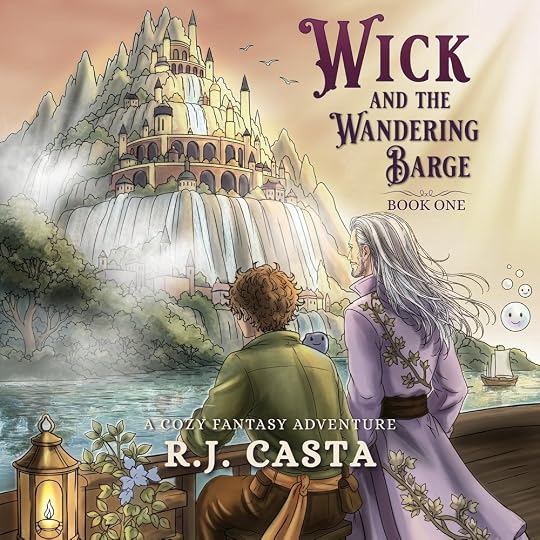
For everyone waiting on the ebook and print editions, the pre-order countdown is still ticking down to October 15th, and everything is right on track.
Thank you so much for being part of this release journey! If you do listen to the audio early, dropping a rating or a quick review on Audible makes a world of difference in helping other cozy fantasy lovers discover the series.
And thanks to my wonderful narrator, Zach Caspian, for making this happen!
October 5, 2026
The In-Between Spaces (My Style of Writing)
Not too long ago, I was introduced to the concept of “In-Between Places,” not to be confused with the books by several authors who detail the progress one’s life can take.
I’m talking about places that exist between reality and spirit. Personally, I’m not a profoundly spiritual person. I don’t follow any organized religion, but I have, in my time, assigned that label to places that transcend the normal and mundane and spark the imagination.
My first experience of this in my writing journey was in writing “The Jonathan of Bracken Manor,” my short story in Scout Media’s “A Haunting of Words” anthology. I was inspired to write the piece after my husband surprised me with a Valentine’s Dinner at Vanderbilt Grace, a luxury hotel in Newport, RI. The moment struck me when I was trying to find the bathroom of all places, and stumbled into the basement swimming pool/spa. “This would be a great place for a story about a boy who haunts a mansion.” And so… I made the story.

The next? We were on a trip to Edinburgh. I got as sick as a dog but still managed to drag my husband to see the Real Mary King’s Close, an underground street buried beneath the city’s Royal Mile. The story struck me, and the setting, characters, and villains for “Steamtown Chronicles 1: The Dark Market” took shape.
On that very same trip, I was inspired to scope out the story, “Beyond the Fairy Pools,” on a trip to the Isle of Skye.
During our engagement trip to Maui, I was compelled to write a story that culminated in a fateful conflict atop Haleakalā.
I’m not suggesting everyone must travel broadly and see more of the world to be a better writer. It helps, absolutely, but physical location doesn’t limit one’s imagination, so I set out to find these “In-Between Places” a bit closer to home.
I struggled for a while to do this. It’s hard to incite one’s imagination with the routine and, often, mundane. But slowly and surely, I was able to stumble into these places — a walk over a steam-crossing bridge, looking up through tree branches on a sunny day in my driveway, finding a food I’ve never seen before at the supermarket, hiding in an unoccupied corner of my public library.
Stories are everywhere, and it’s our job as writers to pull them out of the air and put them on paper.
So I got to thinking. I’m anchored at home by two small kids, and the prospect of air travel to parts unknown with them in tow freaks me out. I set out to create my own “In-Between Place” out of my home office.
I’m writing this now with an inexpensive projector shining stars and the moon on the ceiling, sitting at a desk that can also be raised to a standing one, with an old, beat-up leather couch behind me and art on the wall that genuinely speaks to me.
I can have the sun shine in, or not. I can make the room warm, or not. I can play all sorts of music, or not. I can light a scented candle, or not.
I feel like I have finally hit my groove now, where I have turned my own little corner of my house into an “In-Between Place” where I can close my eyes and, after thoughtful meditation, pull stories out of the air that feel right.
Anyhow, thanks for reading my little Sunday night rambling. Until next time :-)
-RJ
October 4, 2026
Cozy review of “The Spellshop” by Sarah Beth Durst
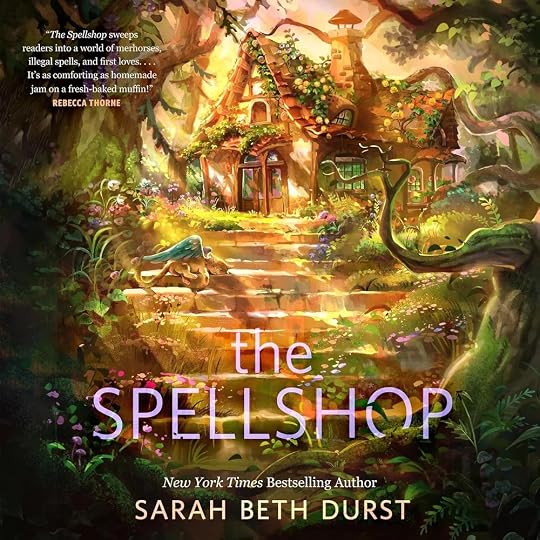

When it comes to cozy atmospheres, Sarah Beth Durst takes the cake. What could be wrong with a delightful cliffside cottage, a seascape, and a small hamlet on a remote island complete with spirit bears, talking plants, and the ability of a main character to cast simple spells to make trees and shrubs grow?
The premise is simple: A librarian flees her library with spellbooks during a particularly
bloody revolution. She brings with her several boxes of spellbooks and her talking plant companion. Only problem? Casting spells when not an official sorcerer is crazy illegal. This is the overall arc of the story, as well as a light romance and several other obstacles the main character faces.
I did, however, struggle with this one. The pacing in the beginning half of the book was quite slow, and the overall arc gets lost a little bit. I found myself asking “what is the story actually about?” The threat of the empire seemed very far away, and the coloring of the story, up to and including the varying races of peoples and creatures within, get lost in the details. One problem was the internalizations of the main character mid-conversation. She went on forever and I found myself asking, “Are the other characters just standing there while she’s in crisis?”
I will be picking up book two, though. If you like cozy, this is a must read.
What does cozy fantasy mean to me?
When I started out writing my stories in 2016, I landed on Fantasy LitRPG. Finishing the Fjorgyn series taught me a lot. In particular, I wasn’t overly fond of writing stories where the characters weren’t narratively safe. Any of them could, and did, die at any time. Michael Semione, the main character, fit “the chosen one” trope to the letter, and was also a bit of a begrudging hero, and the stakes were high. If he failed, everyone he came to love would die, and the world of Fjorgyn would be conquered by forces so malevolent and evil that it would never be the same.
In 2025, I accidentally found myself reading several cozy fantasy novels. First, TJ Klune’s “The House in the Cerulean Sea,” then Travis Baldree’s “Legends & Lattes,” then S.L. Rowland’s “Cursed Cocktails.”
And I thought to myself… I’m not that fond of high-stakes fiction or dark fantasy. I’m very comfortable and very good at writing simple stories. So I made myself a promise, and one that I extend to you, my dear readers:
My upcoming stories (“Wick and the Wandering Barge,” “Wick and the Whispering Woods,” and “Wick and the Whispering Woods”, as well as “Reed and the Ruby Loom,” “Lark and the Lady’s Locket,” “Silt and the Sunset Market,” and “Fern and the Golden Flower”) will take place in a world that is vast and diverse and safe and wonderful.
There will be no wars. There will be no evil dictators. There will be no high-stakes, “world-ending” conflicts.
The characters will face meaningful personal challenges. They might experience something dangerous, like riding a large, magical river barge down river rapids, or escaping from unarmed pirates who want to steal their stockpile of delectable fruit preserves, or escaping from a government office that wants to recruit them into menial labor, but they will be safe. Their successes and failures will define them, but they are not world-shattering.
I want to be able to read my stories to my children, most notably my son, who seems to have developed a fondness for novels at the delightful (and sometimes annoying) age of five. As such, there will be no sex or fast-burn romance.
While the “Wick” trilogy features a boat of three men and one silent, old lady who happens to be a Smudge (more on Smudges later), the other series will feature female protagonists who will have conversations with other female characters that have nothing to do with men. I find it sad that fantasy fiction often features female characters as supporting characters to male heroes.
The world of Calandis is very queer-friendly. I have been, to date, an author of gay fiction, after all. Some characters will be queer-coded. Others will be outright LGBTQ+ as a fact of their biographies rather than as a central driver of the stories. LGBTQ+ people have adventures too, after all.
I will strive in all my stories to make certain my characters and my readers feel safe with me. To lift a quote historically attributed to John Lennon (and often, as well, to a Brazilian writer, Fernando Sabino), “Everything will be okay in the end. If it’s not okay, it’s not the end.”
My covers will not use generative AI. My storytelling will not use generative AI. I will credit any cover artists, illustrators, or editors I use.
To date, my progress on “The Wandering Hearth Chronicles” is all over the place. The first three books are written. I’m waiting on the final files for book one’s audiobook, and am going through my final pass on book two before turning it over to my narrator. Book three is with my lovely editor, Niki Fixtion, and all is set for a rapid release of all three books (October 15th, December 1st, January 15th).
My current pace is 20k words per week on first draft content, and I am going to get started on either book four of the world of Calandis, or start a new series, “The Primrose Scribe.”
Wish me luck :-D
October 1, 2026
On Art, Story and Calandis
For the last two weeks, I have been in the throes of rebranding… everything. It is a happy and sad time, as I say farewell to LitRPG/Gamelit under RJ Castiglione, and start my new adventure publishing as RJ Casta, dedicating myself to “The Wandering Hearth Chronicles.”
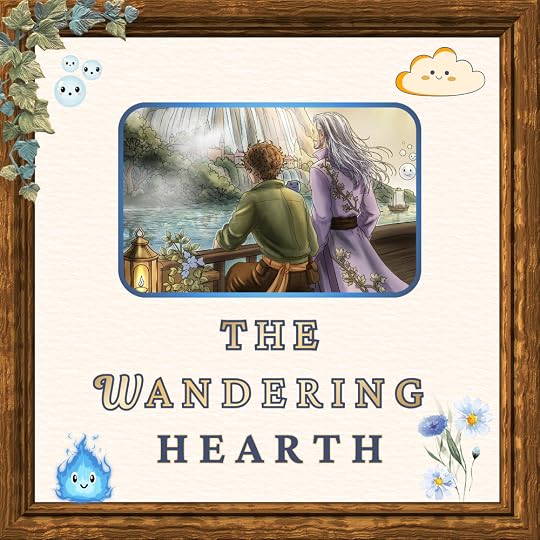
I created this world because I yearned for a peaceful world in which to write my stories, one driven by soft magic, despite a population wholly oblivious to its existence. In this world, there are no advanced weapons. There are no warring nations. There is no extreme poverty. People find that through simple work, they can build lives worth living.
This is not to say that Calandis is a perfect world. It is one where adults pay no mind to child labor, exploitative worker contracts, and lines upon lines upon lines of red tape any time they wish to interact with their government.
The government? It is simple. With no standing armies, charge of the whole of Calandis is bisected: Decision-making power is given to the High Council of Oubliette, a body of ten elected officials, three from Oubliette and the remaining seven from the key cities scattered along the Cardinal Rivers (Kingstep-on-Brey, Madder-Fen, Opal-Reach, Bathgate-Upon-Ought, Glace-on-Sea, Castle Clovelly, and Ought-Knott). The executive power falls to the central government in Oubliette, while each city/town/village has its own form of governance with a lesser council and a mayor. Each city has a constabulary that sees to its city and the surrounding areas.
Calandis also has four remote areas seldom traveled, as they’re not profoundly accessible by water: The Northern Wilds (northwest), The Wastes (northeast), The Needle Mountains (southeast), and The Moss-Mire (southwest). The only power center within one of these four is Madder-Fen in The Moss-Mire, a swampy forest navigable by shallow boats.
Clubs and blades are the most advanced weapons we will ever see in Calandis. As such, we will rarely, if ever, see life-or-death stakes. The most profoundly impactful consequence for actions will be imprisonment vs freedom.
As such, I have scoped out the following initial stories:
Wick and the Wandering Barge
Wick and the Copper Kettle
Wick and the Whispering Woods
Reed and the Ruby Loom
Silt and the Sunset Market
Lark and the Lady’s Locket
Fern and the Golden Flour
Gully’s Grand Adventure (novella)
The Captain’s Heart (novella)
Elana’s Sorrow (novella)
A Guildmaster’s Path (placeholder title)
A plethora of ~3k-word short stories.
That’s not to say this journey will be limited to just what’s above. That’s just what I have outlines for. I can imagine an entire novel told by Lady Clovelly, a character introduced in Wick and the Copper Kettle, or an origin story for Ma and Pa Scurry (brother and sister, and fruit-preserve-loving river pirates with hearts of gold, or even each of Wick’s sisters getting trilogies of their own.
How does this fit with what I have written in the past? Am I still an author of gay fiction? Absolutely. I’m just more subtle about it. Though there will never, ever, ever be romance between Wick and the Captain, both are queer characters. This is hinted at in Wick and the Wandering Barge in a sweet, organic way. Wick shall be, eventually, well on his way to meeting a husband. It just hasn’t been written yet, for Wick is still quite young (twenty-four at the story’s onset).
We shall likely also see an expansion of this world beyond Calandis when the muses strike, but for now, we have a country roughly the size of the United Kingdom and Ireland combined. That is plenty of geography for stories to breathe.
Now you may also find yourself asking… What’s with the cute and cuddly creatures in the image above? Those are Smudges. They are the core of my soft magic system. Without Smudges, Calandis has no magic, for it all is derived from them. The Board of Works, a heartless bureaucracy, uses Smudges to keep Calandis running. There are, however, a few special individuals who are called to protect Smudges. I’ve called them Hearths. Wick is one such character, owing to his unique ability to see the world not for how he wants it to be, but for how it is.
I’ll leave it at that for now. I hope you enjoy the world I’ve created. It means a great deal to me, and has taken years of creative patience to dream up. Good day :-)
September 30, 2026
Cozy review of S.L Rowland’s “The Halfling’s Harvest.”
I finished listening to this a few days ago and have to say, S.L. Rowland’s “The Halfling’s Harvest” tickled all the bellies.
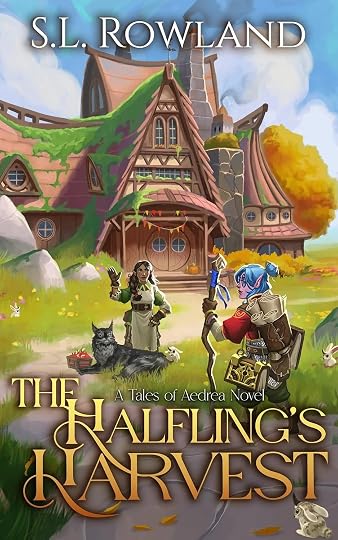
The story follows halfling and vineyard owner, Marigold Bramblefoot, a blue-haired visiting gnome named Poppy, and Marigold’s ever-present, often aggressive competition with a neighboring vineyard for the top spot in the annual Harvest Festival Wine Tasting competition.
In this story, you get loads of heart, Marigold’s nostalgia for the way her father ran things, and great characterizations from her tough-skinned, elven farm helper, her gruff Dwarven cook, a visiting wizard that feels just like Gandalf, were Gandalf to travel with a self-piloted carriage coach. There are pies and pumpkins and apple picking, healing priests, gnomish inventions, and a vibrant small-town feel that made me think I was either in the Shire or perhaps Nantucket Town (minus the beaches and ocean).
The narrators are wonderful. SL Rowland has captured the lived-in, family-centered, slice-of-life story in shop-based cozy fantasy without losing sight of the fact that stories need stakes and plots. I may listen to it again.
Whatever it is, the way you tell your story online can make all the difference.
My rating: 5/5 for the story. 5/5 for the audiobook. Available on Amazon.
May 13, 2026
Cozy Review: You Yeong-Gwang’s The Rainfall Market
I picked this up on Audible, and couldn’t stop listening to it from start to finish (when I was in my car, at least). It’s no wonder it was picked up by a Penguin Random House imprint, and the reviews on it, to me, don’t do it justice.
If you’ve ever stood under an awning at a bus stop during a torrential downpour and felt a strange, melancholy peace, then you understand the tone set by You Yeong-Gwang. The Rainfall Market belongs in a nice space in cozy fantasy I call “healing fiction,” and reflects a growing movement in Korean literature toward simple prose and positive stories.
The story follows Serin, who stumbles into a hidden world called “The Rainfall Market” that operates on a bittersweet logic: visitors trade their darkest memories or deepest regrets for currency that allows them to purchase magical orbs from creatures called Dokkaebi.
Why do I consider it a cozy story? Because the scenarios perfectly match that. At a hair salon, she is required to get a haircut. In a bookstore, she might help the book vendor find a missing book. In an apothecary, she helps the alchemist fix a broken potion. After doing the bidding of the Dokkaebi in question, they allow her to purchase the orb.
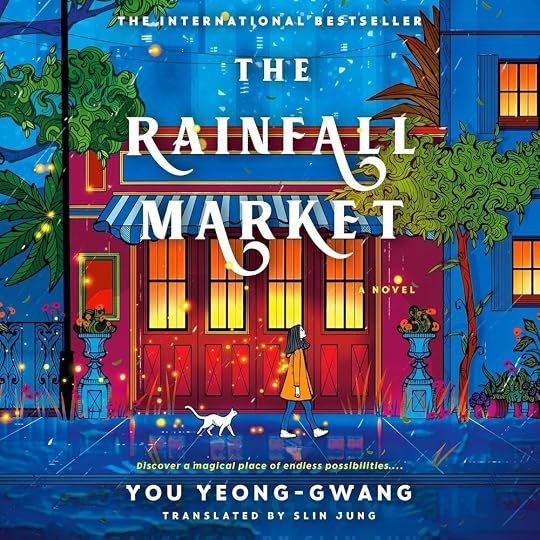
The catch? The orbs aren’t quite what she might imagine, and thanks to her traveling feline companion, she is able to see glimpses of the life she might leave the market with, both the pros and cons.
The world-building is whimsical. The emotional stakes are grounded. Each Dokkaaebi that Serin encounters reflects a different aspect of modern life.
The stakes? If she choses wrong, she gets a life she might regret. If she fails to chose, she gets nothing. And if she doesn’t get out before the end of the rainy season? Well… I’ll let you find out.
This story is a masterclass in magical realism. It doesn’t over-explain its magic. The magic just happens.
Read this if you enjoyed The Midnight Library by Matt Haig or Welcome to the Hyunam-dong Bookshop by Hwang Bo-reum.
MY RATINGS: 5/5
The Culture of Calandis
In creating Calandis, I wanted to create a realistic escape for myself and my readers. I wanted it to remain familiar, but the best parts of familiarity. As such, I’ve created a world that is softer in ways beyond what Western civilization offers in 2026.
Here are some of the highlights:
Calandis is a river- and canal-centered world. Every settlement, be it a large city or a small village, is located within a reasonable walking distance of a traversable canal or on one of the Cardinal Rivers (the Rivers Ought, Keen, Opal, and Brey). Any area beyond traversable waters is considered “the Wilds” and remains largely intact and unspoiled.
Calandis is a weapons-free world. There is no war. There are no standing armies. Guards are armed with batons or billy clubs. You will not see a sword, dagger, or gun in any of my stories. The people of Calandis simply do not consider weapons of murder, or murder at all, to be an option.
Gender roles are present but entirely optional. In marriage, a dowry can be paid by either party. In the case of the main character, Wick Barrow, his father took his mother’s name. His sister was also contractually married at the age of 22 to the Avery family. She kept her name as Barrow. No one thinks about gender. Women can be mechanics or healers. Men can be nannies or bakers. Men can dance with women. Women can dance with women. Men can dance with men. Onlookers might get jealous, but no one thinks it odd.
Great status and wealth are largely earned, and a person’s perceived value centers on their work. The most valued members of society are those belonging to a variety of guilds. This is the darker side of Calandis, and is prone to abuses by masters of their apprentices, who are often bound to the masters for a fixed term under a standard employment contract (which can always be bought out). It is rare to see someone succeed who has not worked through an apprenticeship, though not so rare that it’s shunned.
The age of adulthood is twenty-five. This is called a person’s “Standing Day,” when they are expected to stand on their own without parental support. Anytime prior to someone’s 25th birthday, they can be entered into contracts by their parents (either to marriage or to an apprenticeship).
Formal schooling is the privilege of the well-to-do. Illiteracy is common, but those who cannot read and write are not shunned or ridiculed. Their value is based on the quality of their work.
Every settlement on Calandis is market-driven, with life centered on a single market plaza. The currency is copper/silver/gold, called bits (copper), ribs (silver), and tines (gold), and follows a standard 1:100 ratio.
The festivities are based on seasonal festivals. While there is a 12-month year, each month is 34 days long, and the year is 408 days. The seasons and months are named differently from ours.
The technology is currently at an Edwardian level. Ships operate on gas or coal. There are electric lights, but they are rare.
The goal of most people in Calandis is to earn their fortune, but there is a healthy and appropriate emphasis on leisure and fun.
The government is run by an elected high council, which has jurisdiction over a heavily bureaucratic public service operation broken into various boards. Wick’s story centers on the “Board of Works,” which operates largely in secret to ensure the effective operation of the cities, rivers, and canals through the creative use (or abuse) of Smudges. Most people do not know that Smudges exist, and those who have heard of them consider them to be mostly the stuff of nursery rhymes and bedtime stories.
The economy of Calandis is market-driven, but not capitalist. There is some central planning, as the government oversees commerce in all areas. One cannot operate a storefront without a permit, and those permits are expensive and require monthly fees, often in exchange for the shop space + housing. Roads, rivers, and canals are maintained. Ferrys provide low-cost public transportation throughout the realm. Heat in big cities is centralized, as is water/gas/other utilities. The tax system is progressive and property-driven. This does create a wealth disparity, and there are some unfortunate areas where poverty is common (the Low-Drip neighborhood in Kingstep-on-Brey).
The lowest sort of job one can take in Calandis is, surprisingly, being a barger. Why? Because bargers are very visible. To work on a barge is to be unmarried and without an apprenticeship. They aren’t outright disrespected, but some, especially the wealthy, will consider it a poor choice in profession. Folks who make a barge their life are often seen as unserious.
While there is religion, it is seen as deeply personal AND private. People do not discuss it. No one attempts to convert anyone. No one forces their beliefs onto others.
That’s what I’ve written so far. As I plan to finish the main trilogy (“Wick and the Wandering Barge,” “Wick and the Copper Kettle,” and “Wick and the Whispering Woods,” prior to releasing anything, I expect this world to get much more vibrant, adding details to all three stories to make Calandis a living, breathing realm.
Why? Because of one of my greatest regrets with the world I created in Fjorgyn was that I wanted there to be things in book four that I couldn’t include, as they weren’t always present in the story from the very beginning. Now that I am much more experienced in storytelling, I want to take my time in creating wonderful worlds that can be felt from page one :-)
Have a good week.
-RJ
May 12, 2026
AI Art is Theft.
Before the rise of ChatGPT, Gemini, and so, so many more generative-AI tools, Indie Publishing had a glaring problem that many empathized with: Fledgling writers wanted to get their work out there, but artists, cover designers, and editors were beyond their reach.
Reader expectations, though, were understandably high. Readers, myself included, want polished stories and are attracted by authentic, high-quality covers and clean, concise blurbs.
In came AI. The first models weren’t very good at creating images, struggling to be passable. These companies first started training on licensed images and images free in the public domain. But, like most companies, they wanted more money.
They decided, “To heck with it,” and designed tools to scrape everything and anything off the internet. Licensing didn’t matter. They wanted more money, so they decided to take IP they had no rights to and “transform it.”
The only problem? It’s not a transformative use. They are training their tools to generate like-kind images to compete with the very artists they’re stealing from. Kind of like this:
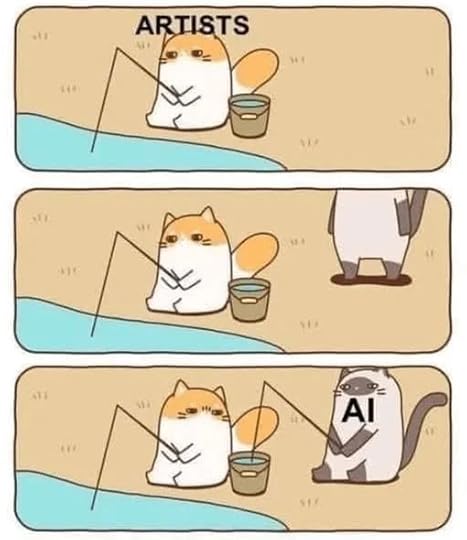
Since making this decision, artists, editors, and even authors have been made obsolete. The internet is already being flooded with AI-generated content, and it’s all… terrible. Actual, authentic art is being buried.
We have AI-generated news, videos, music, books, art, ads, homework, academic essays, scams and games. And so on, and so on.
Buzzfeed recently announced it will use AI for content creation. They cut their workforce by 12% (mostly writers), and their stock price went up 200%.
For us independent authors, multiple e-book and print book distributors have changed processes after a surge in AI-generated book publications (50% daily increase in new titles since ChatGPT). The quality of these books is currently relatively poor. That won’t be the case when these companies decide to steal our content to further train their models. In the future, these companies may choose to end their indie publishing services. And these AI companies do not care. They want more money.
Online communities where authors collaborate are drowning in arguments between the pro-AI and anti-AI crowd. The pro-AI crowd primarily consists of new writers. They do not yet see the harm in their use of generative AI. They need to be made to.
I’m personally committing to all my readers that I will never use generative AI in my work. This industry matters. Artists, editors, authors, and readers all matter. These AI companies can go suck an egg.