John Culbert's Blog
December 7, 2025
Under Heavy Skies
Clouds float; they’re lighter than air. But we live under heavy skies, because of “the cloud.”
The “cloud,” we now understand, is not a collective thought bubble in the heavens. Instead, it resembles something like this:
“Racks of multimillion-dollar microprocessors in black steel cages roared like jet engines inside a windowless industrial shed in Santa Clara. The 120-decibel din made it almost impossible to hear Digital Realty’s chief technology officer showing off his ‘screamers.’
To hear it is to feel in your skull the brute force involved in the development of AI technology. Five minutes’ exposure left ears ringing for hours. It is the noise of air coolers chilling sensitive supercomputers rented out to AI companies to train their models and answer billions of daily prompts — from how to bake a brownie to how to target lethal military drones.”
Robert Booth’s recent article in The Guardian provides an inestimable public service. With the journalist’s descriptions in mind, the “scream” of air coolers can now accompany our every idle query and random online noodling, allowing you to “feel in your skull” the fearsome costs of the AI revolution. Among those costs: the plunder of water from underground sources and public reservoirs (AI is extremely thirsty) and the channelling of dirty energy, often from fossil fuels, into its gigantic, immaculate circuitry (AI is hugely power hungry). Fuel into smoke; ice into clouds; all we love vaporized, made cheap, omnipresent, eternal.
 René Magritte, The Castle of the Pyrenées (1959)
After the Wall Street crash of 2008, and in the long shadow of the monstrous second Bush regime, I published a story with a similar premise as Robert Booth’s. The parallels are uncanny. Booth’s reference to the creepily-named Digital Realty evokes the opening gambit of my story, “Nebulae,” which takes the post-2008 real estate meltdown as the premise for a Silicon Valley entrepreneur’s unlikely project: an art installation including “shrieking jet engines” in an “industrial hangar” in Santa Clara’s neighboring San Jose, which provokes in the visitor a state of “near-hysteria under the effect of the deafening noise.”
Is it time to return to “Nebulae”? The past months have seen a number of warnings about the trillions of dollars at risk from a likely “AI bubble,” and just this week the FDIC overturned a key Wall Street reform of the Obama era by loosening rules against high-risk lending.1
“Nebulae” is the fifth entry in a series of book descriptions from the improbable catalogue of the “Purgatory Press” — the original impetus of this blog, which celebrates, if that’s the word, it’s 13th year this very month. I cite the story in full:
Sanjay R. Patel, Nebulae, vol. 1.
Released on the eve of the global recession, Sanjay Patel’s Nebulae seems in retrospect a strangely prescient document. This catalogue of cloud maps may be the perfect coffee table book for the economic times that followed the real estate meltdown, when profits and properties dissolved into thin air.
The author of Nebulae retired at 32 from his Silicon Valley company to take on a series of projects at the intersection of cosmology, art and technology. The first of these works he launched with the help of former members of the San Francisco-based art group Survival Research Labs. Two years in the making, Patel’s project was a massive installation in an industrial hangar in San Jose that simulated the speed of the Earth’s rotation and orbit around the sun. As such, and despite its elaborate nature and extensive cost, the project aimed to do no more than make manifest the actual velocity of a person standing on the ground.
Buckminster Fuller claimed he could feel the world’s motion in a peaceful state of cosmic meditation. In contrast, Patel’s work physically assaulted his visitors, provoking a sense of panic that bordered on psychosis. Three shrieking jet engines blew wind at the speed of 1,000 miles per hour, approximating the velocity of the Earth’s rotation. Meanwhile, to evoke the planet’s orbit around the sun at 67,000 miles per hour, lights brightened and dimmed to simulate the short length of a day at that corresponding velocity. One visitor described the lighting’s strobe-effect with a quote from H. G. Wells’ The Time Machine: “Night followed day like the flapping of a black wing.” Harnessed to ropes and clothed in protective gear, visitors crawled like desperate hurricane victims to the sides of the hangar, where, in small protected alcoves, windows like portholes provided a view of the outdoors. E. Clare Agare, a reviewer from Wired magazine, describes his state of near-hysteria under the effect of the deafening noise, blasting wind and flashing lights. “Out the window were a chain-link fence and dry weeds standing idle in a sunny expanse of asphalt. I looked on this vision of peace on Earth with almost physical pangs of nostalgia.” Unfortunately, due to insurance concerns the installation was closed within a week and soon dismantled. Patel for his part was not disappointed, as he had grown frustrated at being unable to factor into his equations the velocity of our galaxy, itself moving so fast as to be unrepresentable.
The artist turned next to the curious project portrayed in Nebulae. The book makes use of the most advanced satellite and computer-imaging technology to provide topographic portraits of unprecedented detail and complexity. Color plates, black-and-white elevations and cross-sections capture the size, scale, depth and relief of cloud features, lending their transient forms the durable likeness of habitable territory. And like the pioneer of an undiscovered realm, the author covers his clouds with place names as if anticipating their future settlement.
The reader will be struck by the seeming futility of this project. Each “map,” after all, is the image of a space in motion, and the features named on them can have existed only momentarily. A ridge running in a curve at the end of a wide plain, the pocked hollows of a valley, peaks dissipating in mist, these are evanescent traits. And yet each has its accompanying place name, either indicated on the map or specified in an index, and every map is located not only by its spatial position but by its place in time: Mount St. Helena, CA, 20/07/04, 14:37.24 PST, for instance, for the map on page 12. It is perhaps the naming of features that will most surprise the reader of Nebulae, since it attests not only to a seemingly infinite power of invention but a painstaking labor that verges on mania. The author’s brief introduction makes the case for this naming.
Here on Earth there is scarcely a hump on the ground that is not graced with a place name, if only by the kids who play there. Even the features of our moon and neighboring planets are named. No one lives in a place called “Northern rill of chaparral escarpment,” and there is no such thing as a typical strato-cumulus. So each cloud deserves more than the language of meteorology, which grants them only abstract terms and categories (3).
When the technocrats at JPL put their mark on Martian territory, the result was a landscape littered with the trivia of the moment: names from TV series, cartoon characters, office in-jokes, household pets. Patel’s work of nomination seems a labor of love. The map on page 31, for instance, draws its names from the Bhagavad Gita and the landscape of the battlefield at Kurukshetra. The reference is strikingly apt for Patel’s project. Like Arjuna the hesitant warrior, Patel stops the passage of time to contemplate the extent of his physical and immaterial domains. The map on page 68 draws on Herodotus’ account of Xerxes’ invasion of Greece, following cloud features that echo the lay of the land at the straits of the Dardanelles. As related by the chronicles, Xerxes lost precious time building a second bridge to replace the failed one he built across the Hellespont. Patel, however, supplies Xerxes another means of crossing into Europe; with a dam closing the Bosphorus and an isthmus stretching across the straits, new links join the Eastern and Western worlds. It is not clear whether these details are dictated by Patel’s data alone, or whether his cloud maps instead propose a reinvention of the chronicles of history, as suggested by his frequent invocation of lost causes, such as that of Metacomet, chief of the Wampanoag, in his failed uprising against the colonists of Massachusetts (57-59).
Given the number of maps he has made and continues to accumulate (31,000 and counting), one may wonder how Patel’s work of naming can keep up with his mountains of data. Anyone else in Patel’s position would likely draw names from the phone book rather than consult classical histories. His response to an interviewer on this point was laconic: “I make maps during the day and name them at night.”
Castles in the sky? There are worse insults. In taking on his work of bold uselessness, Patel seems to have turned his back on the entrepreneurial culture of his more mercenary Silicon Valley peers. Rather than turn a profit on the virtual realm, the author provides lasting documents of uninhabitable, unprofitable and transitory beauty.
The Purgatory Press is available (irony noted) at Amazon.
_______________________________________________________
Alexander Saeedy and Dylan Tokar, “Regulators Relax Rules on High-Risk Lending for Banks,” The Wall Street Journal, December 5, 2025. ︎
︎


November 16, 2025
On Belatedness in Historic Times
Compared to other media, academic publishing is dilatory. My new book, Proximities: Literature, Mobility, and the Politics of Displacement, has a publication date of April 2025, but I sent the final manuscript to the press in January, a few days before the American presidential inauguration. Given the warning signs, I knew Proximities would see the day in a world transformed. The book was written with the future in mind, and its index reads like snippets of talk captured by the informant next door. There are entries for DEI, deportations, and transgender. It covers detention camps, McCarthyism, and neo-fascism. I hazard some forecasts about the lack of future pandemic preparedness. The last footnote deals with states of exception. And as our tech overlords scrape through our every word and eye twitch, they may note the book’s special interest in the Gaza solidarity encampments and the well-being of our students.
American higher education is in crisis. As teachers and scholars, how do we respond to the challenges of the day, even as we try to continue our work? How can scholarship meet the rush of historic events when publication, especially book publication, is inevitably slow and belated?
In his landmark study The University in Ruins, Bill Readings illustrates this predicament with the story of a book published on the cusp of the great student revolts of 1968: Jacques Barzun’s The American University: How It Runs, Where It Is Going. Barzun was a professor of history at Columbia University, where protests broke out in April of that year, triggering similar actions in the US and beyond. The American University includes a preface from January 1968, to which Barzun added a postscript dated May where he avows seeing “no reason” to revise his findings in light of the student uprising.[i] For Readings, this historical irony is only confirmed by the book’s enduring success. Seemingly impervious to circumstance, The American University was reprinted in the 1990s – a full generation later, by which time neoliberalism had privatized universities and, in Readings’ assessment, “ruined” their pedagogical mission.
The secret to the endurance of Barzun’s book is that it is addressed neither to students nor professors – and certainly not to the intellectual inheritors of ’68 – but instead to future administrators. Readings notes that the subsequent rise of these university “apparatchiks” (8) was accompanied by the ascendance of the term “excellence” – an empty placeholder for previous standards of value and a symptom of the commodification of knowledge-work. We might say that it is precisely this vacuous culture of supposed “excellence” that has brought American universities within reach of authoritarian state capture in the year 2025. And here again, in a striking echo of history, Columbia stands out as the forerunner, not only of radical student action, but of a right-wing counter-revolt against education.
Columbia University students were the first to raise encampments in spring 2024 to protest Israel’s genocide in Gaza. The school’s administration responded with brutish police action and harsh disciplinary measures. In spite of this heavy-handed approach to the protests, Columbia’s Minouche Shafik was among a group of university presidents hauled before a far-right congressional hearing that demanded stricter policing of pro-Palestinian speech. Shockingly, when faced with crude partisan invective against her own students and faculty, Shafik hardly demurred. A year later, the Trump administration began to detain and deport student activists, starting with former Columbia student and pro-Palestinian activist Mahmoud Khalil.
One can hardly imagine a greater moral failure than the criminalization of anti-genocide protests. Moreover, Columbia’s example shows that cooperation with the Trump administration is no survival strategy. Threatened with federal funding cuts – political “extortion,” as some put it – Columbia recently agreed to impose additional security measures against campus protesters and to subject a number of academic programs to external monitoring.[ii] The precedent is ominous. The Trump administration’s intent, Brian Rosenberg notes, is to “destroy” American higher education as we know it.[iii] But even as we defend ourselves against what Timothy Snyder calls incipient “state terror,” we must recognize our academic institutions’ complicity in their own undoing.[iv] History may well view our administrators’ suppression of the 2024 student protests as a decisive prelude to democratic collapse.
As if following the script of Barzun’s American University,Columbia’s president was recently supplanted by a non-academic trustee.[v] This self-destructive fate of the university of “excellence” was neatly summed up when Trump’s incoming Secretary of Education announced a “final mission” before the Department of Education’s complete dismantling, namely to promote “excellent education.”[vi] From today’s perspective, however, it is perhaps the word “efficient” that rings most ominously in Barzun’s technocratic evocation of the future university, whose administrators, he says, can best “render efficient the workings of the great machine.”[vii] The phrase brings to mind Conrad’s chilling evocation, in Heart of Darkness, of the colonizing mission: “What saves us is efficiency – the devotion to efficiency,” Marlow says, before his homage lurches toward a more menacing aim: “something you can set up, and bow down before, and offer a sacrifice to.”[viii] The key notion of efficiency appears soon after when Marlow meets victims of this unholy sacrifice: dying African conscripts who “sickened, became inefficient, and were then allowed to crawl away and rest” (23).
But why invoke a hoary narrative from the age of empire? It is in the name of “efficiency” that American civic institutions are currently being dismantled, and this will have effects far and wide. In an unmistakably symbolic act, a first casualty of the purge of Washington was USAID, whose humanitarian work once reached into the world’s most deprived places. That minimum of care is now withdrawn. Malice and incivility are the order of the day. The Department of Government Efficiency’s stated premise of hunting down “waste” may be a hoax, but “efficiency” – in Conrad’s sense – does seem to be the motive.
In Proximities, I argue that we cannot separate local freedoms from impeded travel and forced displacements elsewhere.This has yielded a quite different analysis than Jacques Barzun’s of the university in a time of crisis. Proximities firmly centers the Gaza solidarity encampments and argues that our students provide a vital decolonial optic for a radical reform of higher education. In the coming months we may see what resistance remains amidst the ruins.
(Essay originally published at Liverpool University Press on May 2, 2025)
[i] Bill Readings, The University in Ruins (Cambridge, MA: Harvard University Press, 1996), 7.
[ii] Christopher Newfield, “Liner Note 20: After Columbia’s Betrayal,” Remaking II: Long Revolution, March 22, 2025, https://utotherescue.blogspot.com/2025/03/liner-note-20-after-columbias-betrayal.html.
[iii] Brian Rosenberg, “Columbia Capitulated — But So Did the Rest of Higher Education,” The Chronicle of Higher Education, March 24, 2025.
[iv] See Timothy Snyder, “State Terror,” Thinking About…, Substack, April 15, 2025, https://snyder.substack.com/p/state-terror.
[v] See Arjun Appadurai and Sheldon Pollock, “Who Actually Runs Columbia University?” The Guardian, April 1, 2025.
[vi] Linda McMahon, “Our Department’s Final Mission,” US Department of Education, March 3, 2025, https://www.ed.gov/about/news/speech/secretary-mcmahon-our-departments-final-mission.
[vii] Barzun, The American University,cited in Readings, 8.
[viii] Joseph Conrad, Heart of Darkness, Pericles Lewis, ed. (New York: W.W. Norton & Company, 2022), 8.
February 1, 2025
In Harm’s Way
At the close of the nightmarish month of January 2025, amid a virtual hurricane of calamitous events and political outrages, the crash of American Eagle flight 5342 in Washington, DC, briefly dominated the airwaves. The US president compounded the disaster by making the malicious suggestion at a press briefing that diversity, equity and inclusion programs (DEI) were responsible for the accident. In so doing, the head of state provided a kind of political rebus of the moment and a summative, if obscure, hieroglyph of recent American history.

Every major catastrophe in recent decades has prompted the vilification and racial profiling of people of color. Trump’s attacks went further, however, in implicitly targeting women, LGBTQ, and disabled people along with racial minorities. Moreover, in framing the disaster as a personnel issue, one that fatally compromised the functioning of an entire organization, the president echoed Elon Musk’s vicious swipe at the Black mayor of Los Angeles during January’s Southern California firestorms. Newly entrusted to head a supposed agency for government “efficiency,” Musk summed up the president’s sexist, white supremacist discourse in declaring that “DEI means people DIE.”
The heartless obscenity of Trump’s response to the American Eagle crash reflects an amoral, bureaucratic, business-friendly intention to purge all Washington agencies and institutions, including the Federal Aviation Administration. Here at the Purgatory Press, these events brought to mind Bill Readings and his influential book The University in Ruins. Readings’ academic career was cut short 30 years ago in another American Eagle crash; in October 1994 Readings was on American Eagle flight 4184 from Indianapolis to Chicago when the plane went down in bad weather, killing all aboard. But what, aside from that coincidence, would have prompted us take Readings’ 1996 book down from the shelf and to consult it for answers to our calamitous present?
In spite of the white nationalist tenor of the MAGA republicans, the remaking of Washington is a corporate takeover of government, not a revival of national culture. Its demographic is not the citizen but the customer. In this way, the FAA, like all other government agencies, reflects the same process that has undermined higher education.
“The economics of globalization,” Readings argued, “mean that the university is no longer called upon to train citizen subjects, while the politics of the end of the Cold War mean that the University is no longer called upon to uphold national prestige by producing and legitimating national culture. The university is thus analogous to a number of other institutions — such as national airline carriers — that face massive reductions in foreseeable funding from increasingly weakened states, which are no longer the privileged sites of investment of popular will.”1
In the years since Readings’ book was published, neoliberalism and deregulation have engineered the wholesale privatization of the commons. The story of American Eagle’s 1994 crash is itself a tale of deregulation, which, having eroded living conditions and fragmented society, has allowed business and corporate interests to capture the state. Enter the oligarchs: with the wind of public ire at their backs, the privatizers claim a mandate to destroy what little remains of welfare, consumer protections and public service. The assault on DEI is a final step in this process. And while the MAGA electorate may imagine that there are job openings for them on the horizon, Trump’s dog-whistle signalling about the need for “psychologically superior” people, people of the “highest aptitude” and the “highest intellect” is not so much a promise of white male employment as it is an amoral discursive speech act characteristic of business-speak. His reference to “naturally talented geniuses” and people of “superior intelligence” is thus equivalent to the norm-destroying contentless qualifier that has remade the university as a corporate entity. That word is the battering-ram vocable “excellence.”
“Excellence undermines linguistic reference,” Readings observes. “As an integrating principle,” he argues, “excellence has the singular advantage of being entirely meaningless, or to put it more precisely, non-referential” (22). The meaninglessness of “excellence” is useful to administrators whose task it is to manage an education system adrift in the amoral marketplace; the word supplies an empty stand-in for all standards of value. In itself “excellence” is not a criterion of judgment; as Readings pertinently observes, “an excellent boat is not excellent by the same criteria as an excellent plane” (24).
The short-term danger of the second Trump presidency is the unleashing of racist hatred and misogyny. The longer-term danger is what will be enabled by this deliberately-provoked culture of violence: a thorough dismantling of all civic values and its replacement by market logistics. When Bill Readings focussed his singular intelligence on the glum, thankless task of deciphering bureaucratic academese, he was undertaking an eminently pedagogical project. He left the “more general point” (24) up to us to develop as best as we could while our educational institutions collapsed around us. Today that point seems very clear. “The general compliance of universities with the logic of accounting” was the harbinger of the public’s coming compliance with the state capture of all public institutions.
Bill Readings, The University in Ruins (Cambridge: Harvard University Press, 1996), 14.︎
January 19, 2025
The And of an Era
In November 2024, a few days after the shock result of the US presidential election, there was a literary reading in Vancouver, British Columbia. The Iranian-American author Poupeh Missaghi was in town to launch her new novel, and since local bookstores were unable, or unwilling, to host the author, the gathering took place in a private apartment, like an illicit conclave.
Rather than read from the novel herself, the author proposed that the audience take turns reading selected passages from the text. Most were game, but some refused and passed the book to their neighbor. These silent auditors were not shy, or modest, and they did not express any other socially-sanctioned emotive response. No; they had well-founded visceral reasons to recoil from absolute horror.

Missaghi’s Sound Museum is the fictional account of a proud advocate of totalitarian state torture. It is related in the voice of the torturer herself. The author’s premise of a direct address to an assembled audience – a group of journalists invited to visit the “Sound Museum” – absorbs the reader in the torturer’s suffocating monologue, even as the cruelties she evokes touch on the most intimate and disturbing forms of violence. Importantly, the novel does not indulge in graphic descriptions, and indeed the torturer’s speech is a marvel of bureaucratic abstraction and impersonality. She enthuses upon the delicacy and precision of her methods of extracting vocal evidence from her victims and recording them for her Sound Museum, envisioned as a proud monument to torture as well as a place of learning and research. The torturer is careful to specify that the value of the Sound Museum’s impalpable artifacts may not lie in whatever data or information they convey; improbably enough, she speaks of vocal evidence reduced or elevated to the level of “pure sounds.” It will gradually dawn on the reader of Sound Museum that the torturer’s speech is perhaps itself a form of torture; for a reader expecting narrative drama, the plot is lean, even skeletal, as if purposely starved. Her encomium to cruelty constantly delays the actual visit to the Museum, which, for reader and visitor alike, ultimately never occurs.
“By withholding language-based audio that contain information,” the torturer says, “such as who the prisoner is or why they are imprisoned, and who we are and what we do, we could create a deeper, more embodied relationship between the listener and the sound. They wouldn’t listen for semantic meaning in the voice of the interrogator and torturer on the one hand and the prisoner on the other; they would only have the pure sounds.”1
The claim almost resembles the ambitious program of a radical aesthete. Interestingly, a similar evocation of “pure sounds, free of all meaning,” is found in Samuel Beckett’s postwar novel Molloy.2 Like Sound Museum, moreover, Molloy confronts the reader as a long monologue without paragraph breaks. The parallel is unsettling. It strikes close to home, and it should perhaps strike moral terror into any aesthete working in a corporatized, globalized university.
Missaghi’s novel is an ironic portrayal of managerial, technocratic morality and a firm indictment, in particular, of Iranian state terror. The torturer’s moral corruption illustrates a blinkered monstrosity that, the author strongly suggests, is at home in the corporate, conservative vocabulary of feminist uplift and the marketing discourse of edutainment. However, if we read Sound Museum in the light of theories of susceptibility, affect, and early subject formation, we might be able to provide a different, perhaps more encompassing account of the mentality of torture and a different grounding for the critique of institutional cruelty. From this perspective, the torturer’s self-serving, arrogant monologue in Sound Museum could be described as the toxic metastasis of disavowed susceptibility. To borrow Jean Laplanche’s insight into the psychic wellsprings of persecution and torture, Sound Museum’s “intrusive intimacies” illuminate the subjective violence at the heart of all bureaucratic formations.3 Its fictional scenario of direct address resonates with the accusatory aspects of some of Beckett’s late radio plays and teleplays, and Missaghi cannily activated this paranoia-inducing effect on her auditors: by requesting that they read her novel aloud, she underscored the way Sound Museum implicates all in its normalized monstrosities.
*
After the book reading, the audience stayed to mingle. Many things appear harbingers in dangerous times. Out the window, across the water, a string of lights threaded its way northward across the high steel armature of Granville Bridge, as if to safety, as if to “cities … imagined as real,” to quote Percival Everett’s new novel, James. “Oh, to be in Canada,” the narrator longingly says.4 Everett’s tale of desperate escape is unforgiving of American racial terror and illusions of national identity, but it voices, in all seeming innocence, a fantasy of asylum that is now coming undone. Canada is currently rushing to implement stricter border controls to appease the coming neo-fascist American government. Sound Museum is a reminder, since some of us need reminding, that wherever we may be, we are all implicated in the violence that makes people run for safety, the cruelty that traps them in migrant camps, the silence that condemns them to “administrative detention.”
Sound Museum opens with a epigraph from Roberto Bolaño’s Amulet, a marvelous, mournful paean to revolution, and an obsessive reference at the Purgatory Press. In spite of its suffocating premise of confinement and terror, Amulet’s sustained monologue leads the reader on an entertaining romp through the literary underworld. In contrast, Sound Museum gives us no respite from the officious, would-be intellectual pablum of the torturer. But rather than being a deficit, the lack of narrative drama underscores an important message.
The key theme of Sound Museum is complicity; the novel compels us to recognize the personal role we play in today’s unfolding horrors. And on the cusp of a new age of state-sanctioned monstrosities, it suggests that we too may be lacking in narrative, because poor in humanity.
How will you tell it, Sound Museum asks us, how will you compose the story of the part you played in the rise of fascist nationalism, of mass deportations, of “torture camps” subsidized by your tax dollars? What was your role, we asked in these pages, in bringing about “a justice system that will demand our fear and obedience, but require no credence or respect“? Your story, in all likelihood, will look like the torturer’s: a compendium of petty tasks and bureaucratic cruelties, of debts shoved onto others, of endless shirked responsibilities, of menial episodes and shameless joys conveyed in the antechamber to a new world of horrors.
Vancouver, January 19, 2025
Poupeh Missaghi, Sound Museum: A Theory Fiction (Minneapolis: Coffee House Press, 2024), 4, 15.︎“Yes,” Molloy says, “the words I heard, and heard distinctly, having quite a sensitive ear, were heard a first time, then a second, and often even a third, as pure sounds, free of all meaning. … And the words I uttered myself, and which must nearly always have gone with an effort of the intelligence, were often to me as the buzzing of an insect.” Samuel Beckett, Molloy, in Molloy, Malone Dies, The Unnamable (Paris: The Olympia Press, 1959), 63. ︎John Fletcher, “Introduction: Psychoanalysis and the Question of the Other,” in Jean Laplanche, Essays on Otherness, John Fletcher, ed. (New York: Routledge, 1999), 31. ︎Percival Everett, James (New York: Doubleday, 2024), 296. ︎
April 15, 2024
Entering the frame
In 1987, during the First Palestinian Intifada, I was working in Paris with the news periodical Israel and Palestine. My stay at the journal was brief, but my name appears on the I&P masthead for a few issues, below the editor, a socialist Israeli dissident, together with a number of leftist and progressive reporters, and two communist Chileans in exile. Israel & Palestine was exceptional for its strong advocacy for Palestinian rights and a two-state solution. Especially valuable was the paper’s regular, detailed reporting on conditions in the Occupied Territories, from gross political abuses to the quotidian humiliations of life under military rule.
Given the paper’s strong focus on life under occupation, in December of that year, at the start of the protests, I asked a senior staff member whether they planned on covering the Intifada first hand so as to observe the events up close. My question may have been naïve, but the dismissive answer amazed me. They were categorical: the uprising was a minor event, the protests would end soon. (They would last four years, of course — and eventually bring the occupiers to the bargaining table.) It was my first close encounter with journalistic myopia, and it was instructive. I was left with questions that have stayed with me ever since.
*
A photographer, David Wojnarowicz, is driving in the desert. A military air station comes into view. He is in the American southwest, but he could be like Rehab Nazzal, driving in Palestine. “What do these eyes have to do with surveillance cameras?” he asks himself. Is it possible, he wonders, to “short-circuit” the programming that makes a person conform to the social vision of things, to comfortably inhabit the “erector set” of violent infrastructure? The artist suggests that to do so is to deeply estrange oneself, to become a kind of alien surveyor of the given, to look “past the windshield into the pre-invented world.”1
The photographers Rehab Nazzal and David Wojarowicz illuminate a general truth. To live in a military or imperial culture is to be saturated by the logistics of power. It is to be exposed at all times to words and images that justify domination. Such justifications establish a regime of truth, a version of things that is self-serving, self-corroborating, and commonly passes as self-evident. Journalists play an important role in framing these ‘self-evident’ truths, the “pre-invented” groundwork of occupation, inequality and dispossession — what a notorious land-grabber once called “facts on the ground.”2 In such a context, even seemingly ordinary, innocuous statements can be loaded with violence. It is important to note this offhand discursive violence, to oppose it, to remember it — and to never forget. The opening of a Time magazine story, for instance, 20 years ago, during a terrible episode of the Second Intifada (I cite from memory: “Bethlehem has never been a peaceful place.”3 At the top of the hour, on NPR News, introducing the story of an American-style mass shooting in Tel Aviv (I quote from memory (it’s burned there, like a wound (insults, too, are wounds)): “Israel is not a very violent place”). Disavowal and repetition establish an ever-familiar reality: even the ‘new’ is made redundant.
 Old City, occupied East Jerusalem, Sept. 28, 2023 (J. Culbert)
This discourse has its visual analogues. The Palestinians have been habitually viewed through a distancing framework, as if through a telephoto lens or the scope of lethal overwatch. Social media challenges the corporate monopoly on reporting, but one wonders to what extent the current war in Gaza is still framed by distancing protocols. After months of reporting and political advocacy, the photographer Motaz Azaiza, ever dignified, generous and positive, could not help launching a bitter remark to his Instagram followers: “You like to watch.” Azaiza says he would rather be known for his photographic practice — how he sees the world — instead of his war documentation — the pictures imposed by violence. The photographer, victim of the “pre-invented.” What Azaiza compels us to notice is that even occurrences seen close up can be persistently framed so as to render them remote from the public. “Sensitive content” warnings become superfluous; they protect the already desensitized. The viewer’s numbness sustains a paradoxical distance: the remoteness of the ever-familiar. This framing has long given cover to the Israeli occupation. It normalized violence and prepared the discursive and visual regime of the current unfolding genocide.
*
I was in Palestine in October last year, and I left the West Bank just two days before the war. As events in Gaza escalated, I wanted to contribute something by writing up an account of my visit to Palestine. I had photos to share, as well. A friend put me in contact with a local left-leaning newspaper and I heard back from the editor that I would need to make some changes to make my piece publishable. I was chided that my portrayal of Israelis was too negative. And — journalistic myopia again — I was told I had to mention the October 7 attacks. The strong implication was that I would need to “condemn” them. But was it not obvious — since it was, indeed, obvious as of the first day, and within the very first hours of the war — obvious that the demand was coercive, and to obey was to condone a genocide? Also obvious, if you were ever paying attention: the coming effort to crush any lingering prospect of a two-state solution. (‘Obvious,’ here, means something quite different than the violent, consecrated truth of the discursively ‘self-evident.’ “Obvious,” derived from the latin ob – viam, means “in the way,” like evidence that bars your approach, brings you up short, stops you in your tracks — like a “flying checkpoint” or the “apartheid wall.”) I chose instead to publish it here, on my blog. I haven’t changed a word.

I am a documentary photographer. My pictures are anchored in visible evidence. This photo was taken on October 7, 2023, the day the war began, looking westward across the Dead Sea, with the contrails of military jets in the sky over Gaza. The image is a factual document, then, a truthful record from an unfolding history. At times, though, one has to intervene in the subject — to enter the frame. Before taking the picture, I pressed a button next to the pool to stop the water jets that were troubling the surface. Only then, with the waves somewhat stilled, was I able to truly capture what I saw. The blue-eyed Dead Sea: sluggish, uncaring, going on unperturbed. The pool in the foreground: a vision of calm and solitude under the pitiless sky. A private oasis, like the palace of some petty colonial Nero. It was an illusion of distance with the evidence of proximity. It stands in your way. It’s an image, maybe, of your October 7.
David Wojnarowicz, “We Are Born Into a Pre-Invented Existence,” Aperture, Fall 1994 (link).︎“Everybody has to move; run and grab as many hilltops as they can to enlarge the settlements, because everything we take now will stay ours.” Wikiquote. ︎My memory, it turns out, was only slightly faulty. The story reads: “The Church of the Nativity, one of the world’s oldest working churches, has never been an especially peaceful place.” See “The Saga of the Siege,” Time, May 20, 2002. Looking back now at this middle-brow account, a purported “inside story” of the Israeli siege of the church in 2002, one notes all-too familiar elements of the current genocide. The apparatus of control: “surveillance cameras,” “an aerial photo,” and Israeli snipers (“the best marksmen” (professional, discriminating) who “pick off the gunmen one by one”); sly, deceptive “‘peace activists’” (the words in scare quotes, as if held by tweezers); “bickering” holy men and religious scholars (implies eternal, irrational cycles of violence); entrapped, besieged Palestinians threatened with starvation (their own fault); treachery of the resistance fighters who “believed this was one place the Israelis would not dare to strike” (implying honorable restraint of the occupying force); a “violent clan” of Palestinians (primitivism, inherent vice); and, of course, “the machinery of Palestinian terror.” I wonder today whether the reporter, Matt Rees, has ever had the occasion to regret putting this in words: a Palestinian fighter “disgusted” by his comrades’ behavior, quoted as saying “I wish the Israelis would come in here and slaughter every one of us.” ︎
October 28, 2023
The View from Dar al-Kalima
Four weeks ago, on October 1st, there was an inter-faith gathering on the Mount of Olives. It was morning, and the month was young. The event took place on the grounds of Dominus Flevit church, where a long terrace stands directly opposite the walls of Jerusalem’s Old City. From this spot you are facing, at eye level, the high golden Dome of the Rock, with the clustered rooftops of the town spread out behind. We were a diverse, even motley group of students, scholars, artists, church leaders and political organizers — people of various faiths, as well as agnostics and atheists. The three sermons that morning were equally diverse and made the case, in different ways, for a vision of Jerusalem and Palestine as places of tolerance and diversity.
These were no pat homilies about being good neighbors. A common thread in the sermons was the legacy of empire and the enduring reality of colonization. The American minister Otis Moss III invoked a long and continuing tradition of anti-war activism and progressive church movements in solidarity with anti-colonial struggles. Our Palestinian reverend, the theologian Mitri Raheb, sketched the complex multicultural history of the city and its many different faiths, a history that zealots and demagogues simplify for their convenience. And Muslim Rami Nashashibi, whose family line hails from East Jerusalem, made a spirited case for a “black Jerusalem,” a vision of the city that, in embracing its African and mixed racial heritage, could heal ethnic rivalries and defeat the supremacist imaginary of settler-colonialism.
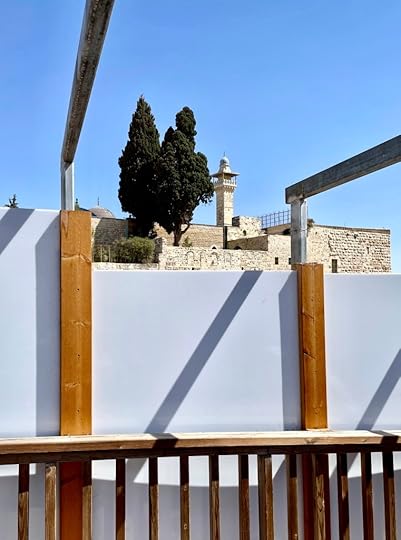 Al-Aqsa, Jerusalem
This was the first day of an academic conference like no other, hosted by Dar al-Kalima University in nearby Bethlehem, Jerusalem’s sister city in the occupied West Bank. It would be a week of many highs, with stellar academic panels by a roster of international scholars and researchers invited to address the guiding themes of “Land, People, and Culture,” with a focus on Palestine. There were banquet meals over four days, dance and musical performances in the evenings; one afternoon was devoted to cultural tours of religious and historical sites. Between panels, we would gather over coffee in the central courtyard of the newly-built campus. Dar al-Kalima’s elegant limestone-clad buildings are set atop Bethlehem’s Mureir Mountain. A circular cafeteria with 360-degree views is planned, funds permitting. The structure is nearly complete, but its top floor terminates in a bare disk of concrete. Four weeks ago that unfinished tower was an image of hope. Now, with Bethlehem in lockdown and nearby Gaza under assault, it seems the portend of a future deferred.
War broke out less than three days after the conference’s closing ceremony, and many of the foreign participants found themselves trapped by lockdowns, border closures and cancelled flights. It was a heartbreaking, disorderly end to an event that had been overwhelmingly positive and joyful. When Dar al-Kalima released a collective statement on the Israel-Hamas War on October 22nd, they referred to the “inconceivable” violence being inflicted on Gaza’s captive civilian population.[i] The word can be taken literally. In a colonial situation, many things appear utterly inexplicable and beyond belief, but only because they are rooted in arbitrary, unjustified violence. In occupied Palestine, that violence has long been a structural condition, the perpetual reality of ongoing dispossession: flying checkpoints, random raids, land theft, administrative detention, and the ordinary, grinding indignities of living under military rule.
The conference provided ample testimony to this history and its everyday lived reality. One conference participant — a resident of Jerusalem’s Old City and a legal expert, no less — was wholly confounded by the recent announcement that a sizeable chunk of her historic neighborhood in the Armenian Quarter had been sold off to a foreign Jewish investor. It was, in a word, “inconceivable.” (For its part, the BBC lamely described the affair as “murky” and “mysterious”[ii]). The scholar’s personal appeal to the highest authority in the church gave her no clear idea of her own home’s fate. That very morning, she related to me, her husband was hailed by a Jewish neighbor, who cheerfully called out to him to “start packing your bags.” We heard many stories of this kind; it was only the most recent.
Today, dispossession is seeing a dramatic increase. While media attention is trained on the US-supported Israeli genocide in Gaza, the largest land grab in over fifty years is underway in the occupied West Bank.[iii] The UN’s Office for the Coordination of Humanitarian Affairs reports that nearly 100 Palestinians have been killed in the West Bank since the start of the recent hostilities, while a total of 607 people from 82 Palestinian Bedouin households have been displaced by settler violence.[iv] Nightly raids occur in East Jerusalem and across the territory. Our hosts and the local participants at Dar al-Kalima are at risk; on October 22nd, journalist Mariam Barghouti reported that raids and roundups were focussing on people from the education sector. On the 25th, Al Jazeera reported that university students and a prominent political analyst were arrested in Hebron, south of Bethlehem.
Scholars of genocide have been tracking the use of dehumanizing language against Palestinians.[v] It may be no surprise to hear such language coming from the Israeli military, but the discourse, unfortunately, is endemic. Here, the “inconceivable” is part of the arsenal of war; to invoke the figure of “human animals” is to cast the enemy as irrational, inexplicable — and beyond ‘humanitarian’ concern.[vi] For this reason, as the Israeli smear campaign against the UN Secretary-General has shown, the merest invocation of history and context is cause for retribution; even the word “understanding” is vilified.[vii] But in addition to the courage to understand and bear witness, there are many ways to puncture the hollow discourse of dehumanization. These include empathy, care, imagination, and the steadfastness of Palestinian sumud.
A poet and scholar of Palestinian heritage recently related how someone once openly confessed to her, in unclouded, sovereign ignorance, yet with the kindest intent, that until hearing her poems they “had never thought of Palestinians as human beings.” It is a thankless task to win back the bare minimum of recognition from dehumanizing discourse, and it’s work the Palestinians should not have to do alone. But the Palestinians do not need others to speak for them. They need us to transform whatever in our home institutions is complicit in their murder. For those of us in academia, particularly those working in hostile environments of the Global North, a primary task is to unlearn: to decolonize our frames of knowledge so as to provide spaces where they can be heard and that allow real understanding to happen.
On the Mount of Olives, Drea D’Nur gave us a deeply moving rendition of Bob Marley’s “Redemption Song.” Later, in the hush of the campus auditorium at Dar al-Kalima, she paused between songs and made a simple, pregnant comment. “We won’t be here again,” she said. She didn’t elaborate. It was a remark about the uniqueness of the moment we were sharing, no doubt, but it was fateful, too. At another panel, a student from Ramallah spoke from the audience and said she felt that “something is slipping from our hands.”
I was scheduled to be the penultimate speaker at the final panel of the conference, and as the hour approached I was preoccupied with the sense of time slipping away. My own paper was no longer of much concern to me — it seemed paltry compared to what I had heard from other speakers. When I was given the microphone, I wanted to say some words about the feeling I was having. We were near the end of the conference, I wanted to say, and I was torn about using my allotted time. I wanted to say that if I didn’t speak, maybe the panel wouldn’t conclude, and maybe the conference wouldn’t come to an end, either. (I may have been thinking of a pause or a lull. On that day, October 4, the words hadn’t been turned to poison.)[viii] We had spent days of joy together, I wanted to say, but time was raging, time was a storm that wanted to scatter us and carry us off. I couldn’t keep my composure. I hewed to my text instead, hands gripping the pages, the wind in my ears.
 Bethabara, Jordan (all photos John Culbert)
[i] Statement by Dar al-Kalima University, October 22, 2023. https://www.daralkalima.edu.ps/en/news/1698126829
[ii] “Controversial land sale puts Jerusalem Armenians on edge,” BBC News, June 20, 2023. https://www.bbc.com/news/world-middle-east-65876162
[iii] Emma Graham Harrison and Quique Kierszenbaum, “‘The most successful land-grab strategy since 1967’ as settlers push Bedouins off West Bank territory,” The Guardian, Oct. 21, 2023. Religious nationalist settlers seem to have been emboldened by the Israel-Hamas war, but as The Guardian emphasizes, it is the general thrust of dispossession that lies at the root of the hostilities: “Netanyahu, boosting the standing of Hamas in Gaza, sliced up the West Bank with settlements and gave radical settlers free rein to prey on the Palestinian inhabitants. It is this project that has led Israel to its current security crisis. Finding a way out of it would involve a complete change of direction.” Julian Borger, “‘It will be slow, very hard’: Can Israel achieve its aims in Gaza invasion?” The Guardian, October 27, 2023.
[iv] https://ochaopt.org/content/hostilities-gaza-strip-and-israel-flash-update-17.
[v] See, for instance, “Palestinian Lives Matter Too: Jewish Scholar Judith Butler Condemns Israel’s ‘Genocide’ in Gaza,” Democracy Now! October 26, 2023.
[vi] Sanjana Karanth, “Israeli Defense Minister announces siege on Gaza to fight ‘human animals,’” Huffpost, Oct. 9, 2023.
[vii] As Israel’s representative to the UN put it, in reference to Secretary-General Guterres, “His statement that ‘the attacks by Hamas did not happen in a vacuum’ expressed an understanding for terrorism and murder.” David Gritten, “Israel Demands UN Chief Resign,” October 25, 2023. https://www.bbc.com/news/world-middle-east-67215620
[viii] Resisting UN calls for a ceasefire in Gaza, on October 24 Anthony Blinken said that the US would only support a “humanitarian lull.” See Tom Watling, “Israel vows to ‘teach UN a lesson’ by banning staff,” The Independent, Oct. 25, 2023.
July 4, 2023
All Tomorrow’s Partings
A few years ago, I joined a faculty dinner for a visiting scholar. I remember looking forward to a good steak, but like a budget airline menu, the choice was chicken or fish. It was only the first disappointment. As we took our seats at the restaurant, I promptly confessed that I hadn’t been able to attend the scholar’s lecture myself, as I’d been involved in a protest that afternoon. It so happened that climate activist Greta Thunberg was in town to headline a rally and march downtown, an event that capped a month of well-publicized protests, including the youth-led global Climate Strike that saw as many as 100,000 people take to the streets in Vancouver in September. It was now late October 2019, and pandemic restrictions on public assembly were soon to bring such gatherings to a halt. My memories of the faculty dinner are colored by that impending end to an era of mass action for the climate. But if unforeseen circumstances cast a pall over the climate movement in the years to come, political obstacles were already fully evident at the dinner itself.
Weather feeds small talk, but climate can fuel idiocy. Energized by the subject I had raised, a colleague was quick to repeat some of the malicious talking points of right-wing denialists circulating in the media at the time, including the slur that Thunberg’s father was supposedly writing her speeches – the implication being that larger forces were using the girl for their own dark purposes. Meanwhile, and no doubt leaning on the authority of social-media memes, he cited Thunberg’s intemperate speech to the UN as an indicator of mental illness. Another colleague scoffed openly at divesting from fossil fuels and asserted that she was counting on the performance of her pension and investments “for her daughter.” The Canadian tar sands were invoked, and the impossibility of closing them. Finally, as the conversation tapered off, a colleague from my own department leaned in to my ear to share the observation that climate has been known to change many times in Earth’s history – a statement perfectly true, but hopelessly irrelevant to the crisis we’re facing. Maybe he thought that the glaciers would start growing again next year? It was a virtual hurricane of academic disinformation.
The scene was unusual, perhaps, only in the unguarded frankness with which people voiced their attachment to business as usual. On the whole, the vested interests of corporate universities make them incompatible with the kind of radical mitigation programs the climate crisis requires. And yet, because years of market liberalization have undermined the labor conditions of the professoriat, there is reason to hope that a critical mass of knowledge-workers can help sever the ties between the production of knowledge and market ‘outcomes’ tied to the priorities of fossil capital. Precarity of employment can provide a strong basis for dis-identification with the exploitative structures of higher education, and this positionality within the institution informs my own teaching practice. Climate change, as I understand it, is the general context for humanistic study in the academy. As the overarching signifier of modernity’s ‘negative externalities,’ climate imposes a critical optic on research, as its unevenly-shared damage always illuminates the intersections of race, power, capital, and coloniality with natural ecosystems. I have been publishing in critical ecology for a decade, and every class I have taught in the past seven years has included readings in environmentalism and climate justice.
 Extinction Rebellion tag, Vancouver, BC, March 2020 (photo John Culbert)
I can’t claim, though, to have gained a good grasp of the subject of climate change by research, reading, personal initiative or political enlightenment. I owe my awareness of the climate crisis to the experience of a mass mortality event, one of the first of its kind in the Global North. If that experience left me with an enduring sense of its gravity, it’s been an ironic lesson. For one, it’s a paltry thing to credit first-hand knowledge when scientific findings have long been readily available. More importantly, the palpable evidence of climate change is a sobering indicator that the process is well underway, that increments of data now bear down on us with unstoppable momentum. Most ominous among those slow-moving forces is the warming and expanding oceans, whose massive heat stores promise an ongoing “delayed response” to cumulative heat.[i] In this context, the much-vaunted authority of first-hand experience is self-negating, and even modest claims of testimony become dubious. To feel the change is to know that it has already occurred, and on a scale that can’t be reversed. This is the general irony of our present situation, in which millions indoctrinated by denialism are now personally experiencing genuine hazards unknown in their lifetimes. As I write these lines, the US National Oceanic and Atmospheric Administration announced that July 3, 2023 was the hottest day recorded on the planet, while weather news so far this summer has been full of striking anomalies.[ii] Major U.S. cities from Chicago to Washington, DC have been repeatedly blanketed by smoke from over 500 Canadian wildfires currently burning and largely out of control – the worst fire season yet in that country’s history.
*
Today’s climate crises have been foreseeable for decades. One milestone in this unfolding calamity is the European heat wave of 2003, which marks its 20th anniversary this summer. A persistent high-pressure system settled on much of the continent in August that year, bringing record temperatures that claimed upwards of 70,000 lives. Paris, where I was spending a summer research leave, was especially hard hit. Of the 15,000 deaths in France, most were in the capital and vicinity; among the dead, the majority were seniors aged 75 and over. Even by August standards, when many residents typically leave for the country, the French capital was strangely quiet. Even birds had abandoned the city. No sparrows echoing in the courtyard, no swifts shrieking in the playground sky. People emerged after dark hoping for a breath of fresh air, lounging by parks, the river and the canal, though the air was static and temperatures stayed elevated well into the night. Mars, in an exceptionally close orbit to the Earth that summer, hung in the implacably clear night sky, a red, swollen beacon. Day after day, the sun also rose, unwelcome; early mornings were soon sweltering. The city morgues filled to capacity; in a gruesome turn of events, the wholesale food market on the outskirts of Paris was commandeered for the storage of bodies, many of which remained unclaimed after the crisis.
Such at least was the news in the aftermath. As is often the case in disasters, those caught in the event had only scraps of news to exchange: They say it’s hotter here than Cairo; It topped one hundred again today. Scenes on the street were full of meanings we could only read as comic or absurd: a delivery van on the street, its stock of cheap electric fans raided by an anxious crowd. Others came back as significant only after the fact: sudden random outbursts of anger in public; immigrant children tossing pétards at people’s feet during the July 14 fireworks. To paraphrase Céline on the confusion of war, the canicule was a rout of comprehension. We had been at the center of an epic event, in the eye of the storm, unaware that neighbors were choking in their garrets. For weeks and even months afterwards, we tried to piece together the blank sequence of days we had lived in a stupor, splayed on the floor for hours on end, lights out, the TV and laptops left dark for fear of their radiant heat. No attention span for the internet or even the radio. Strangely fitting, then, that after that warp in time the first hard news we got came as a handbill on a newspaper box, it might as well have been a sandwichman in top hat ambling by, declaring the month’s shocking toll.
How could this have happened in a rich modern metropolis? Why did things go so badly wrong? One reason was a general lack of air conditioning: Paris was unprepared, never expecting such temperatures. Or rather, the governing classes opted to put the public in harm’s way, neither preparing for danger nor taking action to prevent its cause. An infernal day early in the crisis, dreaming of peace, quiet, and modern amenities, I braved the subway and a walk across a concrete cityscape to the unlovely new Bibliothèque Nationale, but after the sweaty trek the tepid air inside gave no relief. This was ironic, given that unlike its venerable predecessor, the building’s four glass towers commit the library in perpetuity to an unholy expense of energy to maintain a stable temperature. I abandoned study and in the days that followed my work ground to a complete halt. I had come to Paris to develop a research project: a study of the long-disappeared and mostly forgotten Gibet de Montfaucon, an enormous gallows that once served as a potent symbol of the King’s justice. Countless people had been executed there over centuries, strung up and left exposed to the elements on an imposing prominence by a main road into the city. The sheer ghastliness of it gripped your mind: the bodies of the executed were hung on chains, often several at a time, and after the crows had done with them the remains would eventually fall into a pit below, scrambled unremembered in unconsecrated ground, unless their family was bold or influential enough to rescue them from that ultimate defilement. Michel Foucault’s Discipline and Punish opens by evoking a similarly cruel punishment, the execution of a would-be regicide, in order to bring home the historical gap between then and now. His more important point is that bodily discipline in our time, while not as spectacular, is all-pervading and the more insidious for being so apparently benign. My own project sought to explore the gibet’s influence on spatial politics – the resonance of obliterated memory in the surrounding cityscape.I would recognize the irony only some time later: preoccupied with what Foucault called the éclat of torture, I was unaware of the unspectacular casualties surrounding me, victims of impersonal forces and fatal neglect.
In the canicule’s aftermath, debate erupted over political accountability. President Chirac’s first statement on the disaster laid blame for the deaths on a lack of neighborliness, family responsibility and poor social “solidarity.”[iii] As he pointed out, many of the victims of the heat wave died alone in their homes. A scapegoat emerged in the media: that of the well-to-do summer vacationer enjoying the sea breeze while their elderly parent suffocated in the city. Ironically, Chirac himself was on vacation during the crisis, but on his return he played the populist by attending the burial of some of the unclaimed bodies.
“Solidarity” has a different ring on the left, and Chirac’s use of the term seemed designed to preempt socialist values and to disavow the right wing’s role in promoting business and developer-friendly policies that for decades had frayed the French social fabric. Unsurprisingly, Chirac’s public statement was countered by articles and editorials that emphasized instead the failures of social and medical care during the heat wave – symptoms of a larger neoliberal attack on social services. This rightward lurch is the subject of Louis Chevalier’s bracing study The Assassination of Paris, which targets the 1970’s demolition of the marvelous central marketplace, Les Halles, as the definitive assault on Paris’ social and cultural character. Notably, the market was moved far outside the city to suburban Rungis, and it was here the heatwave’s victims were stored. As mayor of Paris, Chirac played no small role in this strange turn of events, as his signature act of urban vandalism was to oversee the late stages of construction on the site of Les Halles and to personally choose the risible design of the mediocre new Forum – a glossy palace of consumerism to replace Zola’s vibrant “belly of Paris.”
In retrospect, then, the grotesque use of the Rungis market seems like an uncanny belated symptom of the violence inflicted on the city decades earlier. Indeed, the canicule of August 2003 might itself be seen less as a natural force than as a particularly cruel agent of eviction, a delegated power of highly diffuse disciplinary order. In his introduction to Chevalier’s book, John Merriman relates a scene he witnessed in the late 1970s when two elderly sisters, obstacles to a developer’s gentrifying ambitions, were evicted from their apartment in the prized central area of the city during what he calls “that very sneaky month” of August.[iv] Merriman’s anecdote strongly implies that solidarity is difficult or even impossible when most of the populace is away. And if August vacation has always exposed class division in Paris, climate change seems primed to put the poor and vulnerable no longer simply at risk of summer’s ennui, loneliness, and even dislocation, but instead of permanent eviction. Before ‘Paris’ became the keyword for toothless climate ‘aspirations’, the city staged a moral drama of vicious governance and social divisions that portends a general future of heatwaves and forced displacement.
 Monsieur Gérard, Paris, July 2003 (photo John Culbert)
I was left with notebooks full of scrawlings, copies of ancient maps of the city, photos I had taken in and around the site of the gibet. On one of those rolls of film I had snapped photos of a homeless man living in a tidy box on wheels in the city center, just two blocks from the site of Le Halles. Monsieur Gérard survived the calamity because he lived at street level, rather than an airless attic, and because he was visited regularly by neighbors and even a café waitress, who brought him a daily coffee. He was articulate and cheerful, but as he frankly informed me the first time we spoke, his memory was failing; he wouldn’t remember me, he said, if he saw me again.
*
When the heat wave broke, I went south to visit friends in Switzerland. We took a car trip up into the Valais, following a road that led to a high village in a deep valley cleft. It was a fairly leisurely hike to the balmy but pleasant alpine meadows above the treeline. We stopped for a snack at a rocky outcrop and my friends’ kid amused himself by pulling the legs off some luckless bug. The husband noticed my disapproval of the boy’s environmental education and he said, by way of explanation, “you have to pick your battles.”
Half the group stayed behind as the husband and I walked the knife-edge moraine up to the glacier. As we got closer I realized that we had actually stopped and snacked in full view of the glacier’s head, but didn’t know it, so gray and diminished it was. When the full length of the thing came into view, it seemed to lie shrunken at the bottom of an enormous dirty bath tub. I took a photo of my friend with the glacier spread in a diagonal slash behind him. He pointed the camera at my head and captured mostly sky. I suggested that the glacier’s sorry state must be caused by the changing climate. To which comment my academic friend – a professor of economics at a pricey liberal-arts college – thought it reasonable to suggest (since glaciers have, as everyone knows, grown and shrunk over time) that the one dying at our feet was likely to grow back again for his son to enjoy in the future.
[i] https://www.cbc.ca/news/science/ocean-temperatures-1.4970696
[ii] Gloria Dickie, “World registers hottest day ever recorded on July 3,” Reuters, July 4, 2023. https://www.reuters.com/world/world-registers-hottest-day-ever-recorded-july-3-2023-07-04/
[iii] In Chirac’s relatively short statement, where he congratulates social services for their work, while promising an investigation into their failings, the president places strong emphasis on the notion of “solidarity” – a word repeated six times. Combined with his speculation that a lack of family and neighborly support contributed to the deaths of many, the appeal to “solidarity” seemed to many commentators to amount to an exculpation of the government and its agencies. “Déclaration de M. Jacques Chirac, Président de la République, sur la révision du système de prévention, de vigilance et d’alerte sanitaire à la suite des conséquences de la canicule et sur la solidarité et le respect à l’égard des personnes agées ou handicapées, Paris le 21 août 2003.” http://discours.vie-publique.fr/notices/037000283.html
[iv] John Merriman, “Foreword,” in Louis Chevalier, The Assassination of Paris, David P. Jordan, trans. (Chicago: University of Chicago Press, 1994),xix.
January 31, 2022
“Not Just” [sic]
During the Covid-19 pandemic a rhetorical idiom gained popular currency and soon became widespread. It was heard in media reports and ordinary conversations, it was seen in high-end scholarly writing and online comment threads alike. Like all newly-popular locutions it seemed infectious, and as it spread it took on a compulsive quality. Worse, it appeared to shape people’s thoughts like an imperative command. And so, adding stupor to misery, the pandemic coincided with a generalized debility of language.
In pre-Covid times, a speaker might have used a simple “X and Y” phrase structure to distinguish between two different things; now they would reach for the more unwieldy “not only X but also Y.” The grammarians at the online Cambridge Dictionary aver that not only X but Y is used in “formal contexts,” but the construct has manifestly spread to all speakers and circumstances. Even the most ordinary statements seem to require this wordier, fancier, Shakespearean flourish; “I was hungry and tired” becomes, needlessly, “I was not only hungry but also tired.”1
Not only X but Y is a correlative conjunction. It differs from simpler “X and Y” constructs by allowing a speaker to make a meaningful contrast between things rather than merely enumerate them. In a well-turned phrase, to join Y to X is to add something of a different order of magnitude, an increase or excess on top of what is already of significant size, scale or extent. Sometimes that difference is implicit in the nature of things: not only here but everywhere; not only today but forever; not only you and me but everyone we know. At other times it calls for a weighing of values, like their relative awfulness, which, in a time of manifold emergencies, has led to a vast, ongoing rhetorical triage of horrors.
“Social distancing is slowing not only Covid-19, but other diseases too,” proclaimed a hopeful Quartz headline early in the pandemic. Another article, less optimistic, informed us that climate disruptions of the past “brought not only drought and famine, but also war.” Later, as a “worst-case scenario” unfolded in the American West, scientists said that the latest megadrought was “dry not only from the context of recent memory but in the context of the last millennium.” And in a report on the effects of radiation from a meltdown at Ukraine’s Chernobyl nuclear plant, Andrew Cockburn evoked “the millions of people exposed not only to the invisible cloud, but to its residue in the landscape from which they drew their food” – a residue that, he pointedly notes, “had global reach.”
This last example illuminates how an infectious turn of phrase can, like a symptom, indicate a broader historical ailment. Not only X but Y may be the rhetorical signature of our time; it adds and accentuates, but especially to subtract and diminish; it tends ineluctably toward the worse yet, the least most, the latest worst. As such, the phrase replaces “it’s bad enough that X,” which now goes without saying: to add Y to X is to heap misery on misery. Indeed, Cockburn’s rhetorical inflation of industrial horror to a cosmic scale seems purpose-built to illustrate the dialectic of enlightenment, inverting what one sunny humanist, at the rosy dawn of our age of calamities, called man’s destiny “to be envied not only by brutes but even by the stars and by minds beyond this world.”
An alternate phrasing replaces “only” with “just.” One recent book reviewer saw lessons for the future in American disaster novels and said “natural forces governed not just their quotidian lives, but all of human civilization.”2 Unfortunately, this second usage leads to various malapropisms due to the word just’s legal connotations. At a civic-minded exhibition at the National Portrait Gallery an informative text begins, inauspiciously, “The American Revolution was not just,” a phrase so clumsy that we’re brought up short and stumble our way into the rest of the sentence: “…a political event, but a revolution in consciousness.” In the same locale we’re informed by a no doubt well-meaning curator that “slavery was not just immoral but unconstitutional” – but why belittle morality, we wonder, as if higher justice were only second best to (Caucasian) law? One is tempted to think that this mounting chorus of “not just” expresses a stammering awareness of unspoken, ubiquitous injustice on the part of some still inchoate political constituency. On the other hand, since the word has become nearly phatic in common parlance (“I just wanted to say,” “I just feel,” “I just think,” “I just assume” (as in “I just assume stay”; “I just assume go”), etc.), we may be witnessing a hollowing-out of meaning precisely at a time when “not just” is pertinent to nearly everything under the sun.
In the meantime, language is badly mismatched to our political actuality. In her national address on December 6, 2022, the first anniversary of the neo-fascist insurrection on the US Capitol, Vice President Kamala Harris scored a new land speed record for would-be lofty rhetoric. Early in the speech she dropped a leaden phrase evoking “dates that occupy not only a place on our calendars but a place in our collective memory,” and she went on to employ the “not only X but Y” phrase structure a total of five times in just over ninety seconds.
In Harris’ speech, as in general current usage, these turns of phrase are mostly superfluous and often wholly inept. What results is verbiage rather than a well-crafted distinction. Besides, there are almost innumerable other ways to express a significant contrast – a non-optional feature of passable mental activity. To delegate that cognitive activity to a reflex pattern of sounds might be considered an abdication of civic responsibility. Moreover, when contrasting two things understatement often works best. Which is worse, “cruel” or “unusual”? What, exactly, is the connection between “rich” and “stupid”? To its credit, “X and Y” doesn’t necessarily say.
Maybe the most insidious aspect of this overuse of “not only X but Y” is that such phrases open with an apparent negation without in fact articulating a significant opposition. In this way the phrase allows every speaker to mime critical language even as they sideline dialectics. But even the sentences of otherwise articulate speakers are warped by the seeming obligation to use the expression. “The subaltern cannot only not speak but her words must be banished,” asserted a scholar in the terrible year 2021. Cannot only not?
Roland Barthes once observed that authoritarian states are defined less by what they forbid than what they oblige us to speak. The compulsive usage of “not only X but Y” might be seen, then, as an internalized prescription and, as such, the symptom of a failure of autonomous discourse at a time of unravelling democracy. Tellingly, the phrase structure holds fast even in the midst of sheer political incoherence; a fanatical Canadian captured the lock-step of idiocy and linguistic conformism in declaring “Your people are standing firm not just against mandates, not just against tyranny, not just against the loss of liberty and freedom, but against the evil that has swept across the land.”
In a recent grim prognosis on the collapse of civilization, Giorgio Agamben reminds us that “the transformation of language is the condition of all other transformations of society,” and he argues that only by confronting the present degradation of language – and restoring its ethical, poetic and philosophical qualities – will we be able “to understand how the political and legal transformations we have before our eyes could have taken place.”
*
This predicament is illustrated by media coverage of current environmental politics. On May 26, 2021, shareholder rebellions at Exxon and Chevron forced those companies to adopt policies in line with progressive calls for a sustainable, decarbonized future. Environmentally-minded directors were elected to Exxon’s governing board, while a majority of Chevron’s shareholders endorsed plans to cut the company’s carbon emissions. This seeming “paradigm shift” at two major U.S. polluters coincided with a Dutch court ruling against Royal Dutch Shell that ordered the company to immediately cut its C02 emissions and to reduce them by 45% by the end of 2030 – a decision one excitable lawyer called “a turning point in history.”
In her account of the “boardroom coups” at Exxon and Chevron, Guardian columnist Jillian Ambrose informs us that the climate-conscious hedge fund Engine No. 1 that spearheaded Exxon’s reforms was not acting primarily with the environment in mind. “Engine No. 1 puts profits first,” she points out. While this is eminently clear – and unsurprising –, the columnist inadvertently muddies the picture for us by adding, “ultimately, the aim is to create wealth.” Profit, accordingly, is not only the investors’ primary aim, it’s also their ultimate aim. It comes both first and last. Could it be that the writer is not aware that ultimate means “final”? The lapse is more than a failure of diction. It points to an inability to adequately frame the stakes of politics where finality is genuinely concerned.
Marxist theorist and cultural critic Fredric Jameson famously said that it is easier to imagine the end of the world than the end of capitalism. This fateful condition seems to be enacted in the Guardian columnist’s lapse, which conveys business imperatives as the be-all and end-all of existence, even in a story of apparent environmentalist victory, and when the fate of a livable planet is at stake. Perhaps more telling than this, however, is her employ of the viral phrasal structure “not only X but Y.” In her account of Big Oil’s “Black Wednesday,” Ambrose asserts that “the world’s biggest investors are finally aligned with climate campaigners” – surely an overstatement, but one that might be forgiven in a time of desperate hope. Worse, however, is the inversion that follows: the columnist asserts that the investors in question have joined with environmentalists “in accepting that sustainability is not only essential for the survival of the planet, but for the future of major companies too.”
In another context this inversion of emphasis might be a comical way to illustrate warped priorities, but ironizing heedless profit does not seem to be the columnist’s purpose. In any case, invoking purpose seems a fruitless task, given that the viral turn of phrase appears designed to void intention and even mental awareness. Still, it provides a helpful glimpse of what must be pictured and imagined, even in the midst of disaster and degraded language: “to imagine capitalism,” as Jameson says, “by way of imagining the end of the world.”
“He being thus lorded / Not only with what my revenue yielded, / But what my power might else exact” (Shakespeare, The Tempest, 1.2: 97-99).Matthew Sherrill, “Forbidding Planet: George R. Stewart’s Novels of Natural Disaster,” Harper’s Magazine, November 2021, 76.“Not Only” [sic]
During the Covid-19 pandemic a rhetorical idiom gained popular currency and soon became widespread. It was heard in media reports and ordinary conversations, it was seen in high-end scholarly writing and online comment threads alike. Like all newly-popular locutions it seemed infectious, and as it spread it took on a compulsive quality. Worse, it appeared to shape people’s thoughts like an imperative command. And so, adding stupor to misery, the pandemic coincided with a generalized debility of language.
In pre-Covid times, a speaker might have used a simple “X and Y” phrase structure to distinguish between two different things; now they would reach for the more unwieldy “not only X but also Y.” The grammarians at the online Cambridge Dictionary aver that not only X but Y is used in “formal contexts,” but the construct has manifestly spread to all speakers and circumstances. Even the most ordinary statements seem to require this wordier, fancier, Shakespearean flourish; “I was hungry and tired” becomes, needlessly, “I was not only hungry but also tired.”1
Not only X but Y is a correlative conjunction. Sentences using this turn of phrase differ from the more basic “X and Y” construct by creating emphasis: the first thing mentioned is minimized to highlight the second. This allows a speaker to make a meaningful contrast between things rather than merely enumerate them. Sometimes that contrast is implicit in the nature of things, like their relative size, scale or extent: not only here but everywhere; not only today but forever. At other times it requires a weighing of values, like their relative awfulness, which, in a time of manifold emergencies, has led to a vast, ongoing rhetorical triage of horrors.
“Social distancing is slowing not only Covid-19, but other diseases too,” proclaimed a hopeful Quartz headline early in the pandemic. Another article, less optimistic, informed us that climate disruptions of the past “brought not only drought and famine, but also war.” In a report on the effects of radiation from a nuclear meltdown, Andrew Cockburn evoked “the millions of people exposed not only to the invisible cloud, but to its residue in the landscape from which they drew their food” – a residue that, he pointedly notes, “had global reach.” This last example illuminates how an infectious turn of phrase can, like a symptom, indicate a broader historical ailment. Indeed, the rhetorical inflation of industrial horror to a cosmic scale seems purpose-built to illustrate the dialectic of enlightenment, inverting what one sunny humanist, at the rosy dawn of our age of calamities, called man’s destiny “to be envied not only by brutes but even by the stars and by minds beyond this world.”
An alternate phrasing replaces “only” with “just.” One recent book reviewer saw lessons for the future in American disaster novels and said “natural forces governed not just their quotidian lives, but all of human civilization.”2 Unfortunately, this second usage leads to all kinds of malapropisms due to the legal connotations of the word just. At a civic-minded exhibition at the National Portrait Gallery an informative text begins, inauspiciously, “The American Revolution was not just,” a phrase so clumsy that we’re brought up short and stumble our way into the rest of the sentence: “…a political event, but a revolution in consciousness.” In the same locale we’re informed by a no doubt well-meaning curator that “slavery was not just immoral but unconstitutional” – but why belittle morality, we wonder, as if higher justice were only second best to (Caucasian) law? One is tempted to think that this mounting chorus of “not just” expresses a stammering awareness of unspoken, ubiquitous injustice on the part of some still inchoate political constituency. On the other hand, since the word has become nearly phatic in common parlance (“I just wanted to say,” “I just feel,” “I just think,” “I just assume,” etc.), we may be witnessing a hollowing-out of meaning precisely at a time when “not just” is pertinent to nearly everything under the sun.
In the meantime, language is badly mismatched to our political actuality. In her national address on December 6, 2022, the first anniversary of the Capitol insurrection, Vice President Kamala Harris scored a new land record for would-be lofty rhetoric. A mere twenty seconds into the speech she dropped a leaden phrase evoking “dates that occupy not only a place on our calendars but a place in our collective memory,” and she went on to employ the “not only X but Y” phrase structure a total of five times in just over one and a half minutes. In Harris’ speech, as in general current usage, these turns of phrase are mostly superfluous and often wholly inept. What results is verbiage rather than a well-crafted distinction. There are, in any case, almost innumerable other ways to express a significant contrast – a non-optional feature of passable mental activity. To delegate that cognitive activity to a reflex pattern of sounds might be considered a betrayal of civic responsibility. Moreover, when contrasting two things understatement often works best. Which is worse, “cruel” or “unusual”? What, exactly, is the connection between “rich” and “stupid”? To its credit, “X and Y” doesn’t necessarily say.
Maybe the most insidious aspect of this overuse of “not only X but Y” is that such phrases open with an apparent negation without in fact articulating a significant opposition. In this way the phrase allows every speaker to mime critical language even as they sideline dialectics. But even the sentences of otherwise articulate speakers are warped by the seeming obligation to use the expression. “The subaltern cannot only not speak but her words must be banished,” asserted a scholar in the terrible year 2021. Cannot only not?
Roland Barthes once observed that authoritarian states are defined less by what they forbid than what they oblige us to speak. The compulsive usage of “not only X but Y” might be seen, then, as an internalized prescription and, as such, the symptom of a failure of autonomous discourse at a time of unravelling democracy. In a recent grim prognosis on the collapse of civilization, Giorgio Agamben reminds us that “the transformation of language is the condition of all other transformations of society,” and he argues that only by confronting the present degradation of language – and restoring its ethical, poetic and philosophical qualities – will we be able “to understand how the political and legal transformations we have before our eyes could have taken place.”
*
This predicament is illustrated by media coverage of current environmental politics. On May 26, 2021, shareholder rebellions at Exxon and Chevron forced those companies to adopt policies in line with progressive calls for a sustainable, decarbonized future. Environmentally-minded directors were elected to Exxon’s governing board, while a majority of Chevron’s shareholders endorsed plans to cut the company’s carbon emissions. This seeming “paradigm shift” at two major U.S. polluters coincided with a Dutch court ruling against Royal Dutch Shell that ordered the company to immediately cut its C02 emissions and to reduce them by 45% by the end of 2030 – a decision one excitable lawyer called “a turning point in history.”
In her account of the “boardroom coups” at Exxon and Chevron, Guardian columnist Jillian Ambrose informs us that the climate-conscious hedge fund Engine No. 1 that spearheaded Exxon’s reforms was not acting primarily with the environment in mind. “Engine No. 1 puts profits first,” she points out. While this is eminently clear – and unsurprising –, the columnist inadvertently muddies the picture for us by adding, “ultimately, the aim is to create wealth.” Profit, accordingly, is not only the investors’ primary aim, it’s also their ultimate aim. It comes both first and last. Could it be that the writer is not aware that ultimate means “final”? The lapse is more than a failure of diction. It points to an inability to adequately frame the stakes of politics where finality is genuinely concerned.
Marxist theorist and cultural critic Fredric Jameson famously said that it is easier to imagine the end of the world than the end of capitalism. This fateful condition seems to be enacted in the Guardian columnist’s lapse, which conveys business imperatives as the be-all and end-all of existence, even in a story of apparent environmentalist victory, and when the fate of a livable planet is at stake. Perhaps more telling than this, however, is her employ of the viral phrasal structure “not only X but Y.” In her account of Big Oil’s “Black Wednesday,” Ambrose asserts that “the world’s biggest investors are finally aligned with climate campaigners” – surely an overstatement, but one that might be forgiven in a time of desperate hope. Worse, however, is the inversion that follows: the columnist asserts that the investors in question have joined with environmentalists “in accepting that sustainability is not only essential for the survival of the planet, but for the future of major companies too.”
In another context this inversion of emphasis might be a comical way to illustrate warped priorities, but ironizing the logic of heedless profit does not seem to be the columnist’s purpose. In any case, the question of purpose is no doubt beside the point; the viral turn of phrase seems designed to void intention and even mental awareness. Still, it provides a helpful glimpse of what must be pictured and imagined, even in the midst of disaster and degraded language: “to imagine capitalism,” as Jameson says, “by way of imagining the end of the world.”
“He being thus lorded / Not only with what my revenue yielded, / But what my power might else exact” (Shakespeare, The Tempest, 1.2: 97-99).Matthew Sherrill, “Forbidding Planet: George R. Stewart’s Novels of Natural Disaster,” Harper’s Magazine, November 2021, 76.October 9, 2021
Domesticating the Beast
In a recent essay on the fate of social welfare under globalization, Caleb Crain describes government regulation of business as a means to “house-break capitalism.”1 Pankaj Mishra’s version of this metaphor is more graphic: to “defang capitalism,” asserts Mishra, is the main purpose of social welfare.2 Both turns of phrase evoke the capture and containment of an unruly animal, perhaps a wild predator once free to “prowl the globe.”3 The image also implies, inadvertently perhaps, that the house-broken pet becomes thereby fit to be loved — the conventional role, after all, of a domesticated animal. In this scenario, the creature’s aggressiveness gives way to affection, even as one’s own controlling violence is tempered into love of a kind. But this latter could be itself seen as a kind of submission.
The metaphor’s implications are suggestive. While it is common enough to extend the image of the house to the broader economic sphere – the words “economy” and “domestic” both originally refer to households – it is less usual to think of the home as a place where capital and its uncivilized ways are moderated and pacified, trained to behave. Out there, capital is sure to be cruel and messy, antinomic to civilized life, but here in the home it has been tamed and declawed. The image invites us to imagine the private home less as a refuge from a dangerous, exploitative world than as a kind of processing center where, by making capital amenable to our family, we help make it acceptable to all. We will not have changed the nature of the beast, but here, at least, we can make it heel. In this view of things, the home is the private extension of economic logic, capital’s intimate alibi.
 Oriol Tuca, Acció de Joseph Beuys
 A poem of Baudelaire’s evokes the bewitching charm of such a peaceable domestic kingdom. “L’invitation au voyage” describes an ideal interior of luxe, calme et volupté in a faraway exotic locale. The poet specifies that in this perfect setting one’s slightest desires are satisfied by goods that themselves come from “the ends of the earth.” With its haunting repetitions, the poem creates a mounting suspicion in the reader that these satisfactions are not only distant but perpetually out of reach; indeed, the poem suggests a structure of permanent regress, whereby any desirable “here” requires a supplementary “there,” an ambiguity condensed in the single duplicitous adverb “là” (here/there). This spatial dynamic of discontentment also has a temporal aspect, as Baudelaire’s romantic tone of nostalgia makes every desirable good a thing of bygone days.
Regressive attachments are a hallmark of political conservatism. However, as Alastair Bonnett argues in Left in the Past, nostalgia is an overlooked characteristic of radicalism, too. Bonnett shows that among conservatives and leftists alike the contemporary domestic interior provides a kind of safe space for nostalgia’s backward-looking wordview. “While in the public realm nostalgia is rebuked, within the personal realm it tends to be tacitly indulged,” Bonnett observes. “We do not expect the treasured object, the valued images, that we use to personalize our homes and ‘work stations’ to be sneered at. Indeed, modern etiquette demands that these tokens of attachment are beyond criticism.”4
We might then consider Baudelaire’s lyrical raptures over his lovely household objects “polished by the years” as expressing the more prosaic desires of a greedy consumer. This may in turn illuminate the voracious role of the woman in the poem who, like Crain’s image of capital-as-dangerous-pet, may secretly be “quaerens quem devoret,” or seeking whom to devour, as the poet once scrawled on a sketch of his mistress. Bruce Robbins cites Baudelaire’s poem to illustrate how domestic wares, as global products of capital, should prompt the consumer to extend their sense of affiliation and responsibility accordingly: if the comforts we enjoy here are thanks to faraway laborers, we owe it to them to be mindful of their living and working conditions. Home, understood as a place traversed by capital, can hardly be restricted to one’s neighborhood, town or state, as doing so would be to deny the proximity of remote suffering: local “goods” are the concrete materialization of distant ills. Robbins is dubious, however, of supposedly “ethical” consumer choices that aim to rid the home of tainted products, as such gestures of apparent responsibility, he shows, can amount to self-protective exculpation. A green household or a so-called ‘passive’ home all too easily expresses “the tyranny of the close over the distant.”5 Inverting Baudelaire’s nostalgic structure of longing, Robbins suggests that the blissful interior should instead become a lived awareness of the shadow side of one’s privilege, and he cites one critic who sketches the unlikely scenario of a host telling the dinner guests that “her lovely home doubles as a sweatshop during the day.” Pressing the point, Robbins suggests that “seeing your home as a sweatshop” might be an appropriate political avowal of one’s tainted dependence on the work of others (105).
While Robbins’ argument helpfully counters the often smug hypocrisy of consumer agency, his picture of the inevitably tainted home may slide too easily into passive accommodation. Roberto Bolaño’s By Night in Chile provides a devastating portrait of such accommodation by giving Robbins’ imagined scenario of domestic complicity a nightmarish twist. Bolaño’s writing is nowhere stronger than in this novella, whose slim narrative exposes Chilean fascism’s soul-destroying corruption through the eyes of a monstrous collaborationist priest. At the end of the narrative the reader learns a horrifying truth about the fancy literary soireés at María Canales’ house: unbeknownst to the dinner guests, they had been sitting atop a dungeon where political tortures were occurring. Here, “house-breaking” capitalism shades darkly into breaking capital’s recalcitrant subjects. Indeed, with his characteristic political acumen, Bolanõ is careful to intimate that “more than one bone had been broken” in a torture victim’s shackled body, while for reasons pertaining to his ineffable genius, Bolaño makes mention of Baudelaire too in this gruesome passage.4 Further, in a detail that might give Robbins pause, the author pointedly specifies that the torture chambers are discovered by a literary theorist who takes a wrong turn in the bowels of the house – and who keeps the sinister knowledge to himself.
A graphic indictment of the Pinochet regime, Bolaño’s morbid anecdote has a wider political relevance. The house of the culture-loving Chilean collaboratrice might be considered an apt metaphor of the privileged home under the present global economic order. Indeed, the horror-house is in a very real sense the general model of the first-world consumer’s dream home: fascist Chile under Pinochet was, significantly enough, the first country to adopt the American policies of radical market deregulation known as neoliberalism. Indeed, Chile still remains the ideal of this economic model: as Colin Crouch observes, it is the only place on Earth where neoliberalism in its “pure form” was ever brought about.7
 Joseph Beuys, I Like America and America Likes Me (1974). Photo: Caroline Tisdall
In the year after Pinochet’s coup, Joseph Beuys travelled to the United States to stage a three-day performance in which he was locked into a room with a coyote. The performance ended when the coyote, having gradually become habituated to Beuys’s presence, allowed the artist to embrace it. Beuys’s shamanistic performance remains a potent anti-capitalist statement about the human relationship with the wider environment. But it also might be seen as a cautionary vision of domestication, whereby capitalism delegates the all-conquering logic of privatization to the individual house-breaker.
Until recently, to “house-break capitalism,” as Crain put it, was the standard practice of the western industrialized welfare state; cognizant of its electors’ grievances, yet bending to business logic, the state enforced regulations that protected citizens and workers from some of the sorriest exploitative and polluting excesses. Neoliberalism’s guiding principle has been to free capital from those meddlesome constraints. Unlike in Bolaño’s Chile, however, the market’s worst victims tend to be far from the homelands of contemporary western democracies as capital prowls unmolested in the deathscapes of distant labor.
Climate change seems to exacerbate this violent scission between home and away; as is often pointed out, the poorest and least ‘developed’ countries stand to lose the most in an overheated world. And yet, as climate disasters wreak increasing damage in some of the most prosperous and developed places in the Global North – heatwaves in Canada, floods in Germany, wildfires in Australia – climate change has the potential to foster global awareness of the collective costs of a rapacious market system. Unless the citizens of wealthy enclaves simply continue to boost the air-conditioning for their families — and pets.
1. Caleb Crain, “Merchants of Doom,” The New Yorker, May 14, 2018, 91.
2. Pankaj Mishra, “The West’s Self-proclaimed Custodians of Democracy Failed to Notice it Rotting Away,” The Guardian, September 20, 2019.
3. Andreas Malm, Fossil Capital (New York: Verso, 2016), 335.
4. Alastair Bonnett, Left in the Past: Radicalism and the Politics of Nostalgia (Bloomsbury, 2010), 6.
5. Bruce Robbins, Perpetual War (Durham: Duke University Press, 2012), 97.
6. Roberto Bolaño, By Night in Chile, Chris Andrews, trans. (London: The Harvill Press, 2003), 121.
7. Colin Crouch, The Strange Non-Death of Neoliberalism (Cambridge: Polity, 2011), 21.