Julia George's Blog
October 4, 2025
Why We Wrote Love and Redemption.
A Son’s Struggle to Redeem the Memory and Character of His Family. By George Kovach – Stepson of Celia Klein/Kovacova and Son of Ivan Kovach.
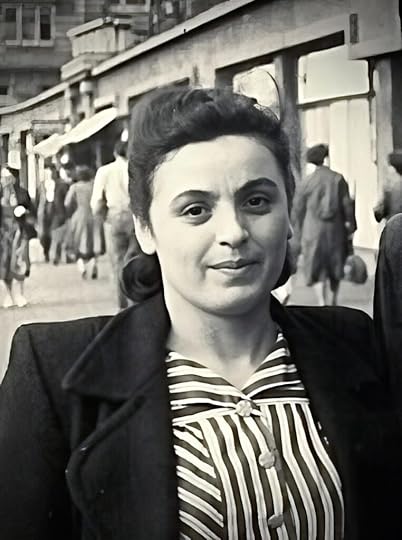
There is a reason for this novel that goes far beyond the desire to tell a remarkable story. Love and Redemption was born out of love, grief, and a sense of duty to redeem the character and tarnished memory of my stepmother, Celia Klein/Kovacova, after she was misrepresented in two global bestsellers that claimed to be “based on a true story.”
My stepmother’s character, called Cilka in The Tattooist of Auschwitz and Cilka’s Journey by Heather Morris, was a fabrication, cobbled together from rumors, selective recollections, and an author’s lurid imagination. The result was deeply offensive to my stepmother’s memory, and to those of us who knew the real Celia.
A Surprise Visit – April 2019In April of 2019, Heather Morris emailed me and asked if we could meet. She told me she was writing a novel called Cilka’s Journey which was about my stepmother, and it also included my father. I was not familiar with Ms. Morris’s work since I had not read or heard of The Tattooist of Auschwitz, her only book at that time.
It seemed that Ms. Morris was making a special stop in Oakland, California on her way to Australia, just to see me. I was puzzled. Why hadn’t she contacted me earlier? As the only living relative of both her heroine and hero, I could have provided important facts and crucial context. Heather never did explain why she hadn’t reached out before her manuscript was nearly finished.
Out of courtesy, my wife, Julia, and I invited her to dinner at our home.
A Congenial DinnerOur dinner with Heather was pleasant. Julia broiled chicken to have with salad and vegetables. We had a wine tasting of good California wines, and the three of us discussed the relative merits of California and Australian wines. After much typical small talk, I waited for Heather to ask me questions about my stepmother and my father.
Instead, when we got to dessert, Heather began revealing news about all the advances she was getting for Cilka’s Journey. In a dramatic whisper, she announced, “Over two million dollars for just the North American rights.” Then, she confessed, “Today, we got 90,000 euros for the Polish rights!” I replied, “Who would have thought? Poland!” I felt all this was an attempt to impress me for some reason. But why?
The Moment of TruthFinally, Heather got to the point. She wanted any photos I had of Celia and my father. And she wanted me to write an afterword, since I was the stepson of her heroine and the son of her romantic hero. (This was previously done by the son of Lale Sokolov for The Tattooist of Auschwitz. Lale was the hero of that novel.) If I did this for her, she implied, I would be given X number of dollars or euros.
A long pause ensued.
I thanked Heather but said that before I put my “family seal of approval” on Cilka’s Journey, I wanted to know more about the novel. Heather replied that it was all very top secret, and she could not allow me to read the manuscript. Instead, she said she would read excerpts to me.
We invited her to dinner again the next night.
From an Author’s HeartSince my wife and I are writers, I wish every author well. Writing and then selling your work is an almost impossible task. Often, years are spent desperately trying to secure an agent who will then try to interest a publisher in your work. In spite of a few miraculous success stories, most are not. Heather’s amazing luck with Tattooist was one of the few.
I later found out that Heather had spent over a decade working on Tattooist. First, in years of interviewing Lale Sokolov, then attempting to sell the story as a screenplay, and finally working with an agent to make it into a book. Her dedication, patience, and persistence is an inspiration to all authors.
An Unsettling DiscoveryThat night, I bought and read The Tattooist of Auschwitz and discovered the character, Cilka, that Heather had created.
Cilka (Celia) was just a supporting character in Tattooist. But what a character! She was the most gorgeous woman in Auschwitz. She was the mistress/sex slave of the SS Camp Commander. She supposedly saved Lale Sokolov’s life. He called her the bravest woman he had ever met. Consequently, after readers finished reading Tattooist they wanted to know, “What happened to Cilka?”
Of course, with the amazing success of Tattooist, Heather and her publishers lusted after a sequel. Cilka was the obvious choice.
New RevelationsHeather returned to our apartment the next night for more home cooking and California wine, after which she made good on her promise to read excerpts from Cilka’s Journey.
From the bits and pieces of Cilka’s Journey that Heather read to us, it was obvious that she had no real facts regarding my stepmother. How could she? She had never met my stepmother. My stepmother was dead.
Also disturbing was her completely inaccurate portrait of my father, who she also never met. She portrayed him as a kind of grifter and petty thief who was indifferent to the fate of his wife and child (me). As I had just read Tattooist, I immediately recognized my father’s character as a pale shadow of Lale Sokolov.
Heather had already presented the character of Cilka as the mistress/sex slave of a high-ranking SS camp commander in Tattooist. What would she do to Celia, and my father, in Cilka’s Journey?
In addition, in the parts Heather read to me, there was no development of my father’s and stepmother’s relationship. No discovery of each other’s past, character, or personality. The meeting and relationship of my father and Celia was supposed to be the romantic end to Cilka’s Journey. The moment where, after all she’s suffered, she finds hope for the future in a relationship with a man she can admire and love. The man who becomes the safe harbor where she can finally rest from the storms of her ruined life.
I knew I could not contribute to a book that presented characters that had nothing in common with the people that I knew and loved, namely, my stepmother and my father, no matter how much money I was offered.
I told Heather I needed to think about what she had asked of me. She was disappointed not to have the “family seal of approval” she had come so far to obtain, but we parted amicably.
I then got my hands on an advance copy of the complete novel of Cilka’s Journey and read it.
The Shocking Abuse of My Stepmother’s CharacterReading Cilka’s Journey was painful. Heather’s portrait of my stepmother had nothing to do with the Celia I knew, or her history as my stepmother had recounted it to me.
Cilka’s Journey takes place in the Soviet Gulag, but it has lengthy flashbacks to Cilka’s experiences in Auschwitz. Here are three of the most egregious errors I found.
(First) In Cilka’s Journey, my stepmother is presented as being the mistress of not one but two high-ranking SS commanders. In Tattooist, Cilka (supposedly my stepmother) was the mistress of only one SS commander, SS-Obersturmfurer Johann Schwartzhuber. This is not only false in my stepmother’s case, but patently absurd.
Ms. Morris and her publishers, it seems, chose to ignore the concept of rassenschande (race defilement) and what Herr Himmler did to SS men caught breaking that commandment. The punishments varied from imprisonment, to hard labor, or being sent to a concentration camp. If their sexual relation with a Jewish woman was long-standing, as Cilka’s is in Tattooist and Cilka’s Journey, the punishment for the SS officer could be death.
I doubt SS-Obersturmfurer Johann Schwartzhuber would have jeopardized his career, and possibly his life, over lust for some Jewish girl.
(Second) In Tattooist, Cilka is presented as a great beauty, but my stepmother was just a girl of average attractiveness when she was young. It’s interesting that in Cilka’s Journey Heather completely drops the idea of Cilka being a great beauty. The extraordinary beauty that was central to her character in Tattooist wasn’t useful in the gulag of Cilka’s Journey.
(Third) In Cilka’s Journey, Ms. Morris has my stepmother steal drugs from the Vorkuta camp hospital. This gulag hospital had very few drugs for its prisoner patients. If this had been true, can you imagine the suffering and deaths that would have been on Cilka’s conscience? My stepmother, who later worked as a senior government accountant in Slovakia, had a reputation for incorruptibility and honesty. The idea that she would steal drugs from desperate patients would have devasted her.
Ignorance of Facts of My Stepmother’s HistoryBased on documents in my possession, and my conversations over many years with Celia and my father, it was apparent that Heather got many basic facts wrong about my stepmother’s history. Here are a few.
(1) Celia was not liberated by the Russians from Auschwitz. The Germans destroyed Auschwitz before the Russians arrived. My stepmother was moved to Ravensbruck concentration camp for women in January of 1945 on the infamous death march. She was liberated by the Americans in May of 1945.
(2) Celia was not arrested by the Soviets and sent directly to Vorkuta, Siberia from Auschwitz. After liberation by the Americans, she returned home to Bardejov, Slovakia and was arrested there later.
I remember taking a trip to Bardejov with Celia and my father when I visited them in 1967. We were walking in the town and my father said to Celia, “Your house is just two streets over, do you want to go by?” There was a profound silence from my stepmother, and then she shook her head, “No.”
Later, my father told me what had happened to my stepmother when she returned home after liberation. She found that her home had been seized and occupied by the family of one of the men who had worked in her father’s business. Her home, like the homes of so many Slovakian Jews, had been turned over to the authorities and given to non-Jewish citizens.
(3) Celia was not accused of sleeping with the enemy by the Soviets. She was accused of being a spy because she spoke German and had been liberated by the Americans.
(4) In Cilka’s Journey, Heather mentions the use of penicillin. The Soviet Union was isolated from Western medicines and antibiotic therapies during and after World War II. Remote and poorly funded hospitals in the Siberian Gulag would never have had access to penicillin. If they were lucky, they may have had someone experienced in phage therapy which had been developed in Soviet Georgia.
My Profound Sorrow and Moral Outrage.The Celia Klein/Kovacova that Heather had created was nothing like my stepmother. When I finished reading Cilka’s Journey, I felt a profound sorrow over the distorted image of my stepmother presented in not one but two global bestsellers. I was outraged on behalf of the courageous, kind, and long-suffering woman I knew and loved as my stepmother.
I suppose I understand how Ms. Morris, having never met my stepmother or my father and knowing nothing except the bare facts of Celia’s biography, would naturally reach for the lurid and titillating. However, Celia was my stepmother. She was dead and could not protect herself. Nor could her husband, my father, who was also dead. It was up to me to set the record straight.
The Struggle Begins.Through my attorney, I let Ms. Morris and her publishers know that I would sue if I felt she had defamed by stepmother or father. I made it clear that I wanted no money from them. I wanted to save the reputations of my stepmother and my father.
Why did Heather and her publisher not want to do that? Because a story is much more powerful for the reader if they know the real person behind the character. The connection is more emotional and personal. Sara Nelson, the then VP of Harper Collins, said, “There’s a real interest in fiction that is based on history and real people.” What the reader wants is almost a memoir. So, Heather had to find a real person for her fictional character of Cilka, as she had with Lale Sokolov in The Tattooist of Auschwitz. And that’s where she ran into trouble.
Freedom of Speech, or Carte Blanche in Writing Fiction?Also important for me is the larger issue of how a writer handles information about a private person in writing a book that is based on a true story.
Can the author tie the name of a character to a real private citizen (living or dead), also reveal that person’s real name, and then make that character do and say things that cannot be proved and are detrimental to that person’s reputation and memory?
Freedom of speech has conferred a kind of carte blanche on those engaged in the arts. This is where the respect of the rights or reputation of others becomes important. Because of the protections bestowed by freedom of speech, the decisions of how to present a real person in a novel based on a true story are left up to the author. Therefore, the author must always consider very carefully what she/he makes that person do.
The author, as I see it, is the guardian of that real person’s reputation and memory. Expecially if that person was not a public figure. Especially if there are people still alive who knew that person. Especially if that person was a victim of the Holocaust or the Gulag.
Untimately, Heather and her publishers, under the law, had to acknowledge my right of privacy for my father because he was a blood relative. In her afterword to Cilka’s Journey, Heather explains why she doesn’t name my father: “I have not included the name of the man she (Cilka) met in Vorkuta and married, in order to protect the privacy of his descendants.” (This is false. The reason she did not include him was because I threatened to sue.)
Because of my threat, Heather replaced my father with a vague character called Alexandr, who exchanges only a few sentences with Cilka through the whole novel. His main occupation seems to be wandering around a Soviet labor camp, smoking and gazing up at the sky. This vague man is the major romantic interest of her novel.
But No Deliverance for My Stepmother.Unfortunately, under the law, the right of privacy was not extended to my stepmother, Celia Klein/Kovacova, because she was not my blood relative. Therefore, Heather and St. Martin’s Press were free to run roughshod over Celia’s character without anyone being able to defend her. Thus, they were able to exploit and defame the character of a survivor of the Holocaust and the Gulag for profit.
Moral obligation in Fiction Based on A True Story.Celia Klein/Kovacova was not a public figure. She was not a celebrity. There are people still alive who knew my stepmother personally and worked with her in Slovakia. They all would be shocked to read these things about her in both Tattooist and Cilka’s Journey. I was shocked. Some might be led to believe these things to be true because the cover of Cilka’s Journey says, “Based on the powerful TRUE story.” (My capitalization.)
I contacted Heather and her publishers and expressed, once again, my objections to the portrayal of Celia. I made it clear, again, that I did not want any money, nor would I accept any money coming from this misbegotten project. But I told them that they did have an obligation to make amends to the spirit of Celia for abusing her in the pursuit of profit.
I proposed to them that if they contributed 10% of all revenues from Cilka’s Journey to the Solzhenitsyn Fund or Memorial (the Russian Gulag organization) I would not sue or publicize my objections to the book. These are non-profit organizations. Heather and her publishers would be able to deduct their charitable contributions and take all the good works credit for themselves. Then, maybe, the spirit of Celia would indeed rest in peace.
Their response was to stonewall and slow-walk their decision. “We will get back to you in due course,” they responded. They never did.
I Went Public and the Controversy Went Global.I wrote a letter to Daniel Bloom at Times of Israel and told him my story. he published it in his blog (October 2, 2019: Veracity of Holocaust ‘novel’ Questioned by Stepson of main character.) This post is no longer available.
It was picked up in The Guardian by Alison Flood (October 3, 2019: Sequel to The Tattooist of Auschwitz branded ‘lurid and titillating’ by survivor’s stepson.”
The Daily Mail was not far behind with an article by Mahnaz Angury (October 5, 2019: Bestselling Australian author is accused of dragging Holocaust survivor through the mud after portraying her as a ‘drug pusher and a sex slave’ in new book.)
The Australian also published an article by Fiona Harari. (October 5, 2019. Holocaust survivor dragged through new hell: stepson.)
One Last Attempt to Get Justice.Love and Redemption, the novel my wife and I wrote under our pen name, Julia George, was born out of frustration at the injustice done to my stepmother by Heather Morris and her publishers. It is based on conversations I had with Celia and my father over a number of years. The parts of the novel that include my father, Ivan, are taken directly from his written memoirs.
After we completed Love and Redemption, I once again contacted Heather. I sent her the manuscript and asked her to read it. I hoped she might finally see the many errors in her treatment of my stepmother and acknowledge the fact that she was not the woman she called Cilka in both her novels. It would also have been gracious on her part to make some author comment for our publication of the novel. Even if it was only that it was interesting for her to hear Cilka’s story from the family who actually knew her and loved her. All she offered was to repeat what she had said so many times before, that this is a story that needs to be told.
The post Why We Wrote Love and Redemption. appeared first on Julia George.


August 12, 2025
When a Charming Victorian Cottage in Napa Valley Became a Crime Scene.
By Julia George (Pen name of husband and wife writing together.)
 The Past is a treasure trove of ideas. Memories live again in your novels.
This is a Facts Behind the Fiction story about Blood into Wine, our detective novel set in California wine country. It’s about an idyllic three months living and working in America’s Eden, as Napa Valley later came to be known. It is also a glimpse into the way the people and places I came to know became part of that novel.
At the time, I was an actress (George a theater director). Neither of us thought we would one day be writers. But theater people draw on a myriad of impressions, emotions, and experiences, to create a character or bring a play to life. A writer does the same. Everything we experienced that summer in Napa Valley was deeply etched in our memories.
Decades later, those memories blossomed into scene after scene in Blood into Wine. The heat, the dust, the smell of grapes in the sun, the passionate people devoted to wine, the politics of a land coveted by rival groups, the deep sensuality of that magical Eden. Blood into Wine is both an intriguing detective story and a love letter to Napa Valley.
Flashback 1978, Napa Valley. Julia’s Story.
It wasn’t as if I hadn’t been to Napa Valley before. It was 45 minutes away from Oakland, an easy drive with amazing views. Still, I’d only gone a few times, for an afternoon of wine tasting and soaking up the country atmosphere. Then, in the summer of 1978 I found myself living and working in the Valley for three months. I was no longer a tourist. I was in with the in-crowd.
To my delight, the Berkeley Repertory Theater, where I was a resident actress, chose that year to do a summer season of three plays in an old, brick building in the Vintage 1870 complex in Yountville. I was cast as Rosalind in Shakespeare’s As You Like It. All of us actors were to be housed with families who lived and worked in the Valley, an exciting prospect for everyone.
A Journey Into the Past.
I rolled up the driveway of Lila and Bill Jaeger’s estate in Rutherford. The large Victorian house they had lovingly restored was surrounded by beautiful gardens. I felt like I’d travelled back in time to another era. Lila appeared on the porch and motioned me to continue on to the right, past the crystal blue swimming pool. I killed the engine on my little blue VW Bug and hopped out into the intense Napa Valley heat. It wrapped me in a soul igniting warmth.
My Cute Victorian Cottage Home for the Summer.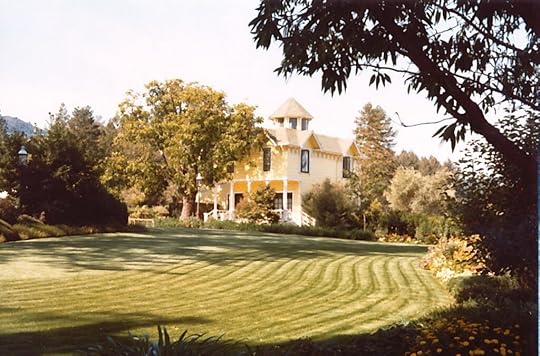
I looked across a wide green lawn at the cutest cottage I’d ever seen. A smaller version of the main house. Around the porch, jasmine and gardenia bushes filled the air with an intoxicating fragrance. Did Lila mean for me to live in this dream cottage for the entire summer?
“Are you sure you don’t mind my staying here?” I asked, as Lila joined me. “I mean, what if you have guests? Three months in the height of tourist season is a lot for me to take over your guest house.”
Lila put her arm around me and gave me a squeeze. “You don’t know how much fun it is for me to have the actress playing Rosalind living in my little cottage. I’ve got five dinners already planned for friends who want to meet you. Guests can come by any time of the year. You are a special treat.”
It was a sweet and flattering response. I was touched.
“Thank you so much,” I responded, and hugged her back. “I’m looking forward to becoming part of the Valley and meeting as many people as I can.”
Exploring the Past in the Present.So, I carried my suitcases into Lila’s sunny yellow cottage, dropped them on the floor, and immediately set out to explore my home-away-from-home for the summer.
There are Victorian houses in Napa Valley that date all the way back to the 1800s. It was easy to imagine the spirits of the past still wandering their former haunts. If this little cottage had one or two spirits, I was sure they were friendly. Perhaps it was just an actor’s imagination. Imagining you live in the past is a technique actors use to get into character for plays set in other centuries.
I marveled at the little details that gave authenticity to this house. Years later, many of those details came back to me when writing Blood into Wine.
Discovering the Inside Story of America’s Eden.That night I joined the family and a couple of their friends for dinner at the big house.
Lila and Bill Jaeger were gracious hosts and dinners at their house were accompanied by music and laughter along with great food and fine wines. Those dinners over that summer were also an intimate look into the workings and politics of the Valley that I would never have learned about in any other way.
At that time, the Jaegers owned two wineries, Rutherford Hill and Freemark Abbey. They were members of the Napa Valley wine elite. The conversations around the table covered everything from wine making, to vineyard cultivation, to feuds over cutting down trees for new vine planting, to who was going to buy what property next, to in-crowd gossip about Napa Valley “characters” of which there were plenty for an actor to be curious about.
When, many years later, I had left the theater and taken up writing novels, I drew on those incredible evenings and all I’d learned to create an authentic backdrop for Blood into Wine.
Places an Author has Lived or Visited Add Color and Authenticity to a Novel.“Renzo felt like he’d stepped into the playhouse version of a classic San Francisco Victorian, perfect in every detail except the scale . . . To one side, on an antique hall bench with an oval mirror and brass coat hooks, sat an old straw hat decorated with dried flowers . . . sliding doors with etched glass panels closed off the dining room . . . an exquisite little parlor whose central focus was a wood fireplace carved with a grape and vine motif.” (From Blood into Wine.)
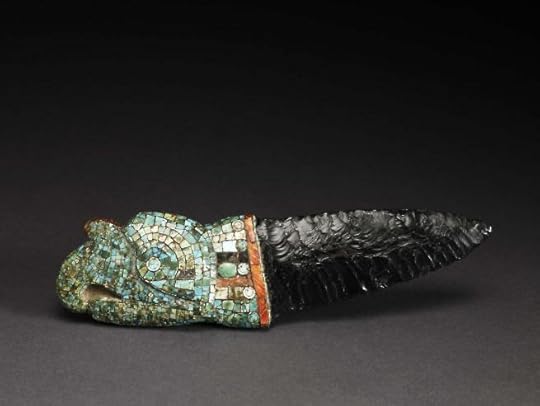
In Blood into Wine, Lila’s cottage is transformed into a tiny, yellow and white Victorian cottage surrounded by vines where one of the suspects has been living. Renzo, Jackie, and the Saint Helena police search the house. What they discover in the stuffy attic is bizarre enough to fit with the murder. The antique dagger is damning evidence, but is it the actual murder weapon?
 Characters Have to Eat. Those Moments Can Reveal Plot or Personality.
Napa Valley is a land of food contrasts. From the ultra-expensive French Laundry to the vineyard worker’s quick bite, there were lots of cool places for Inspector Dante and the Saint Helena cops to catch a bite. Not that the French Laundry was on their budgets. That was for the elite of the story.
Here are three places I know well, that not only reveal our detectives’ taste in food, but also insights into their attitudes, personalities and pasts.
Oakville Grocery. Saint Helena Highway, Oakville, CA.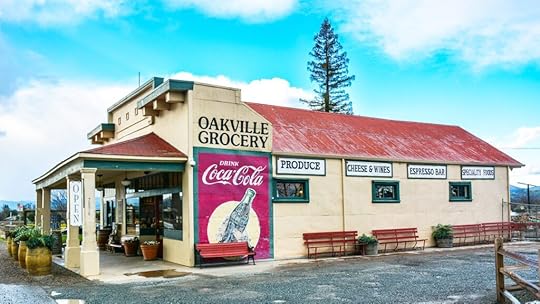 Founded in 1881, Oakville Grocery is the oldest continually operating grocery store in the state of California.
“The human mind, Renzo reflected, was the optimum time machine. He stepped into Oakville Grocery and instantly, without warp drives or worm holes, time shifted and the present dissolved into the past. Suddenly, he was eight years old again, taking refuge from the dusty heat in the dark coolness of the little country store . . . Thirty years spanned in a nanosecond. A simpler Oakville Grocery. An uncomplicated time. A different Renzo.” (From Blood into Wine.)
This is a short chapter packed with Napa Valley atmosphere. The tamales are first rate. The clientele ranges from tourists with Oakville Grocery on their bucket list, to local wine growers popping in for a tasty pick-me-up, to the super rich elite who know where the best lunch can be found without fuss. The cars in the parking lot range from pick-up trucks to Mercedes and Ferraris. Inspector Wong (Renzo’s partner) is super impressed.
If you’re interested, here’s a link to a really good article about Oakville Grocery.
La Luna Market and Taqueria. 1153 Rutherford Road, Rutherford, CA.
“Renzo turned down Rutherford Road, and pulled to a stop in front of a funky old market with rusty shopping carts lined up under a low roof supported by wood posts . . . It appeared not only Mexican workers hung out at La Luna Market. Chief Larsen and Sergeant Ferrell stood in line talking to Renzo. Jackie wasn’t exactly thrilled to see them, but at least the presence of the local police meant the food was probably tasty, generous, and cheap. He steeled himself for an interrogation and joined Renzo.” (From Blood into Wine.)
La Luna Market serves here to foster a reconciliation between the detectives from San Francisco (Renzo and Jackie) with the local cops (Larsen and Ferrell) in the Valley, who aren’t happy with the intrusion of out-of-town detectives into their territory.
Taylor’s Refresher, 933 Main Street, Saint Helena, CA.
“Renzo pulled into the parking lot of Taylor’s Refresher in Saint Helena and stopped the car. Smoke poured from the chimney of the classic nineteen-fifties drive-in restaurant, and the heavenly smell of mesquite wood and burgers wafted through the late afternoon air.” (From Blood into Wine.)
Not only has Taylor’s Refresher been going since 1949, but it has been voted as making one of the best burgers in America.
Here’s a fun story link about Taylor’s Refresher. A peek into a Napa Valley feud.
Places That Inspire Dramatic Moments.Saint Helena Catholic Church. Founded 1866. Dedicated to Saint Helena of Constantinople.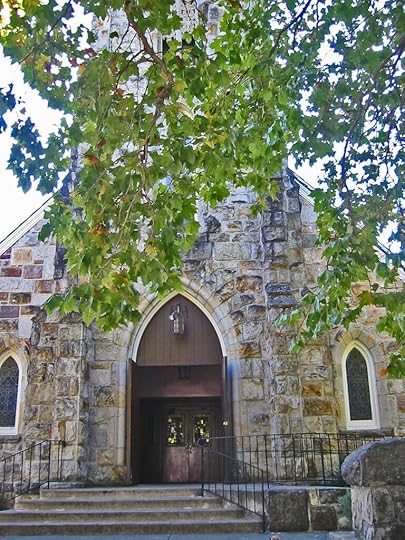
“Renzo’s eyes swept over the faces of the congregation. The murderer could be sitting in this very room, simulating grief, making a mockery of mourning . . . But if the murderer was here, it was a wonder the blood itself didn’t shriek and give away his presence.” (From Blood into Wine.)
The Saint Helena Catholic Church is the location of the funeral service for Augusto Venturi, the renowned wine maker of Napa Valley, who was murdered in a most vicious and bizarre way at the beginning of the novel.
Holy Cross Catholic Cemetery, Saint Helena, CA.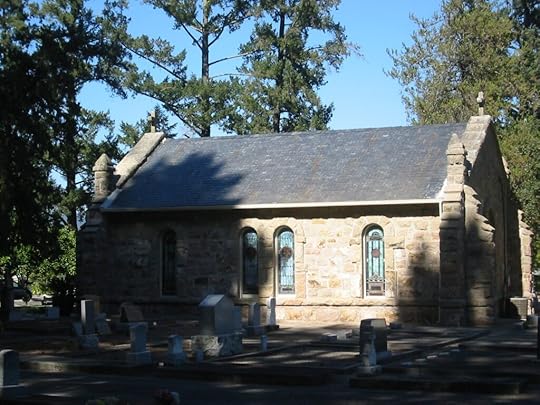
Later in the novel, the scene shifts to Holy Cross Cemetery where Renzo meets with Maria, who is being pursued by the murderer. She desperately wants Renzo to take her five-year-old son to safety. This building is where Maria is hiding.
Wine, Grapes, and Barrels.Of course, an investigation into the murder of a renowned winemaker of Napa Valley will put wine and everything involved in its cultivation, preparation, vintage, and sale under a microscope. Wine is the life blood of any great wine growing region. It runs in the veins of families that have cultivated the vine for centuries. And so it is with the families involved with the murder of Augusto Venturi.
Because of that fact, Renzo and Jackie spend a lot of time interviewing the major members of the Venturi Vineyards family. They learn about how grapes are grown, how wine is made, and how it is marketed, all in an attempt to understand who might have wanted Augusto Venturi dead.
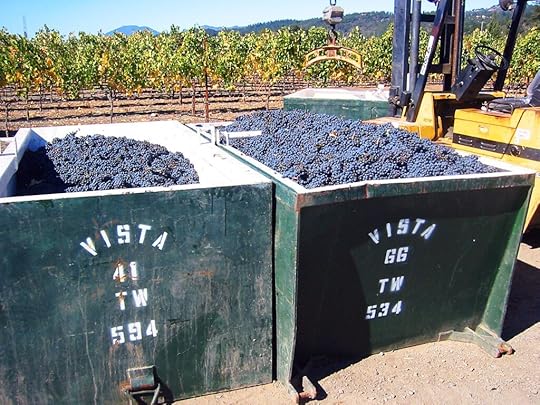
Bins of Cabernet Grapes, Fresh from the Fields and Headed for the Crusher.In a spot like this, Jackie learns that wasps love grapes and don’t like intruders.
 A Cave With Barrels of Aging Wine.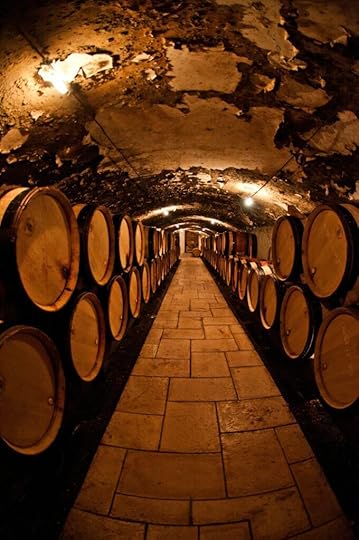
The scene of Renzo’s interrogation of Cesare Brovelli about his relationship with Augusto Venturi, and the passions that swirl around the pursuit of high-end cabernet.
The Vast Vineyards of Napa Valley.
Where grape pickers, legal and illegal, gather for the care and harvesting of some of the finest grapes in the world. Where Renzo and Jackie watch Cesare Brovelli work side by side with his workers and ponder just what this man of the land, and known wine expert, can tell them about the murder.
A Map is Always Helpful in a Novel with Multiple Settings.I drew this map to help the reader not only understand the Valley but also be able to follow Renzo and Jackie from place to place.
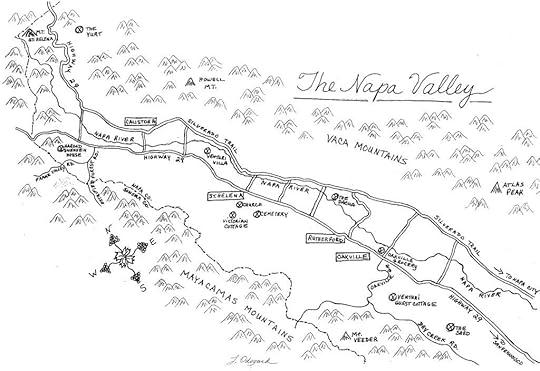
Napa Valley is 30 miles in length and 5 miles wide. On the east side, the Vaca Mountains protect it from the intense heat of the Central Valley. On the west side, the Mayacamas Mountains protect it from the cooler influence of the Pacific Ocean which is only a one-hour drive away.
Highway 29, running down the center of the Valley, is nearly always crowded with tourists and frustratingly slow. The Silverado Trail on the other side of the Valley, which isn’t used as much by tourists, is an escape route for Renzo and Jackie to avoid traffic.
Renzo and Jackie’s investigation has them travelling from one end of the valley to another, up narrow mountain roads, along tourist-clogged highways, from wineries to private homes, in searing heat and clouds of dust.
A Love Letter to Napa Valley.I loved living in Napa Valley in the summer of 1978, and I also loved writing Blood into Wine. What I’ve described here is only a glimpse into the memories and details of that summer that went into the novel. I confess to a great deal of descriptive prose, in a book I now call my love letter to Napa Valley.
I hope you enjoyed this post. I also hope you will read Blood into Wine. Let it take you on a Napa Valley vacation with the added zest of a murder investigation.
And the Wine is Bottled Poetry.
Sincerely, Julia George https://juliageorgeauthor.com/
The post When a Charming Victorian Cottage in Napa Valley Became a Crime Scene. appeared first on Julia George.
May 6, 2025
Family – A Treasure Trove for Authors.
By Julia George
I’ve been thinking about my last blog post – My Family’s Desperate Flight Through the Twentieth Century. https://juliageorgeauthor.com/my-familys-desperate-flight-through-the-twentieth-century/ The family in that post is my husband George’s family (George being the other half of Julia George, our pen name).
When George and I got together, his grandmother, mother, father, aunts, uncles, cousins, etc. became mine as well. His dramatic family stories have been a treasure trove of plots and characters for our novels.
The Gudym-Lefkovich Family – 1910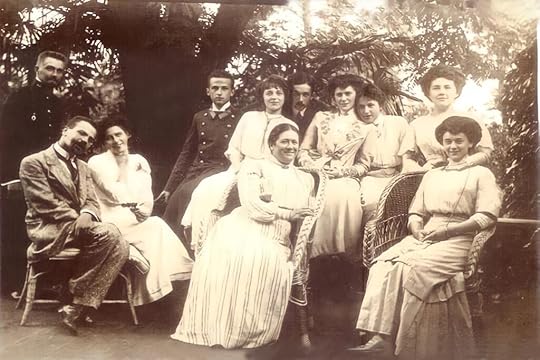
From Imperial Russia to the Revolution to Exile to fighting and fleeing both Nazis and Communists, George’s family is a treasure trove of plots and characters.
The Odegard Family – 1909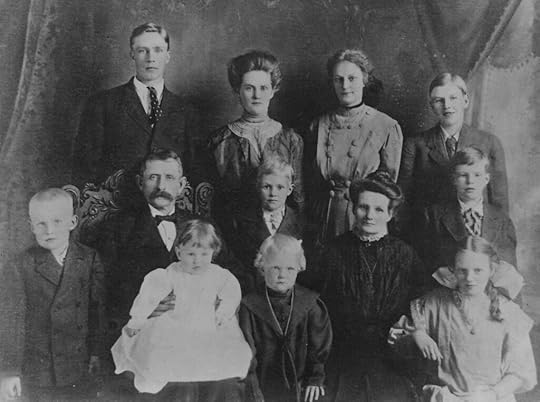
My family also, though not quite as filled with high-stakes adventure, has a story to tell.
From failing farms in Norway to a romance on the way to America to building a sod house in North Dakota to running a boarding house in Montana and finally settling in Washington State with a family of 7 strapping boys and 3 clever girls, my family’s saga is an Immigrant success story.
Advice to My Fellow Authors. Talk to Your Relatives!Your relatives have a wealth of stories that you might not be aware of. When we are growing up, we’re so focused on our own problems, adventures and dreams that we often are, as the Simon and Garfunkel song goes, hearing without listening.
No matter what your age now, it’s never too late to mine the rich family stories lying in wait for you.
If you are lucky enough to have a grandmother or grandfather still living, reach out to them. Believe me, they will be thrilled to know their grandchild is interested in their life history.
There are surprises in store for you. Adventures you never realized that kindly old person ever had. Characters they knew long before you were born will come to life through their telling.
Go time travelling with them, and your next novel might be waiting for you.
Your Parents Have Adventures to Tell Also.Your parents are next. Believe it or not, they had a life before you came on the scene. They had separate lives even before they met each other. Find out about their dreams and schemes when they were young.
Some of their adventures will be recognizable to you, and some will seem from a different world. Here’s where you’ll find new characters, new struggles, new perspectives of life and love.
And don’t forget your aunts, uncles, cousins.
Minimalists Beware.It’s amazing to me how the narrative today is often focused on decluttering your life by throwing away things that do not serve your immediate needs or interests. What a waste!
How many articles do I see telling older people to get rid of as much as they can to “spare” their children the supposedly tedious task of throwing those old, “useless” things away when they die.
The artifacts of your family history is never “useless.”
Why Can’t I Just Keep Photos?Taking photos of everything for a phone archive is not the same as holding the item in your hand, feeling the softness of the fabric of an old dress or blanket, hugging the floppy stuffed bunny you were given as a child, wearing that bit of costume jewelry your mother wore to her high school prom, using your father’s old hammer and remembering the time he taught you how to hammer in a nail.
Old things are treasure chests of memories. Memories are treasure chests for a writer to inspire plots, characters, emotions, and scenes.
Look in the Attic!Does anyone in your family have an attic? That dark, dusty, mysterious space is waiting for you to go on a treasure hunt. What might you see?
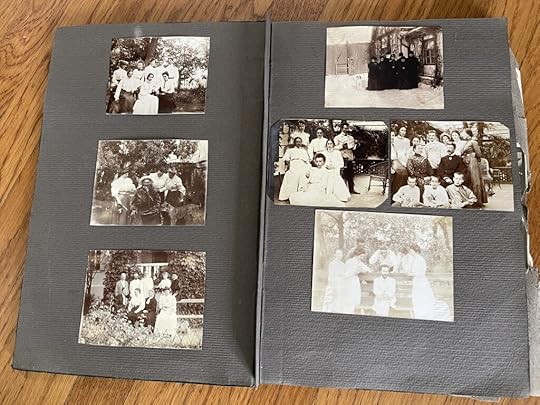
A pile of old photo albums perhaps, their brittle pages witnesses to family stories you’ve forgotten, or never knew. If you’re lucky, some of them will be very old indeed.
Out of the Past Photo Album.My husband’s grandmother managed to bring this old album out of Russia when she escaped the Bolsheviks in 1920. Its cover is black velvet with a small circular watercolor painting.
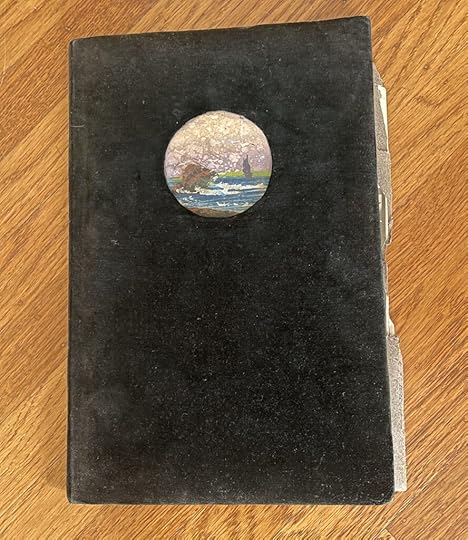
In it are photos that go back more than a hundred-fifty years. Some have names, some have not, but all of them evoke a time long past and have been the inspiration for a new novel we’re writing now.
 The Cup of Sorrows.
So much tragedy is associated with this enameled cup that it might very well be haunted.
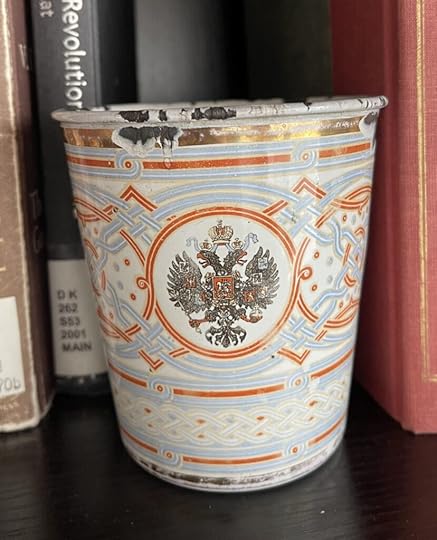
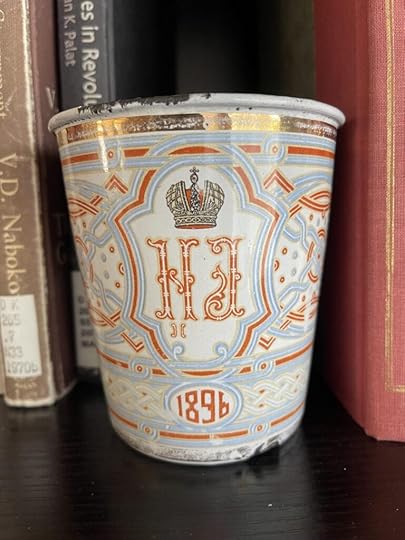
On the day Nicholas II of Imperial Russia was crowned Tsar, cups like this, filled with little treats, were distributed as gifts to the thousands who came to Khodynka Field to celebrate. The field was treacherous, with pits and trenches, as it was often used as a military training ground. A rumor went round that a gold coin would be inside the cup.
Half a million people stampeded toward the tables to get the gifts. Some fell into the pits, others were trampled underfoot. Over 1300 were killed!
Tsar Nicholas II tried desperately to compensate the victims of that terrible coronation day, but it was believed to be an omen for the rest of his reign.
Twenty-one years later, he and all his family were murdered by the Bolsheviks. You can see the Romanov eagle on one side and the initials of the Tsar and Tsarina on the other.
What Does this Old Cup Inspire You to Write?This cup was brought out of Russia during the Revolution by my husband’s great grandmother who was there on that fateful day.
I envision a time travel novel in which someone finds this cup and is transported back to that terrible day. Will he/she be able to warn the Tsar of what is to come and prevent the tragedy?
Or perhaps this cup will inspire a paranormal mystery about a haunted cup of sorrows.
If you are interested, here is a link to a post about the Khodynka Tragedy.
https://todayinhistory.blog/tag/khodynka-field/
The Binoculars on the Bookshelf.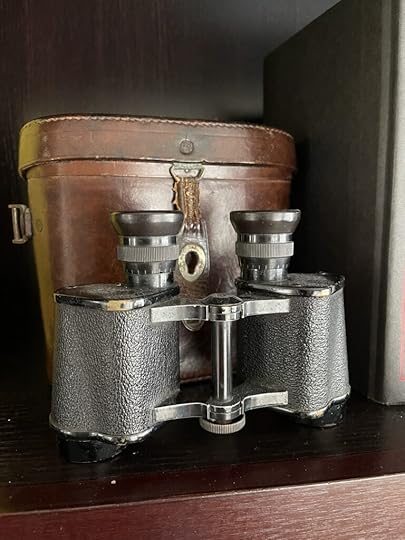
Here is an old pair of binoculars. They date back to the end of the Nineteenth Century and are still good. They belonged to Jura Tarakanov, and had been handed down to him by his father who was a Russian general in the First World War.
Here is General Tarakanov on his beautiful horse.
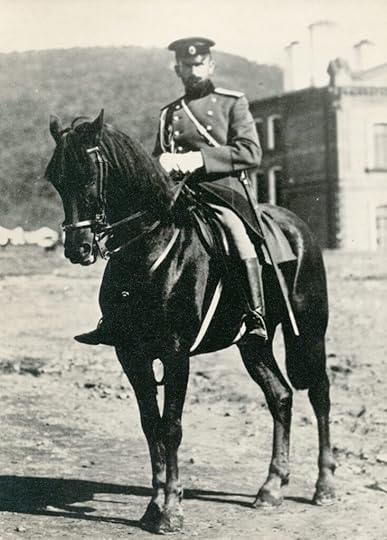
General Tarakanov’s son, Jura, was my mother-in-law’s first love when she was eighteen. Alas, he married her best friend who was a couple years older.
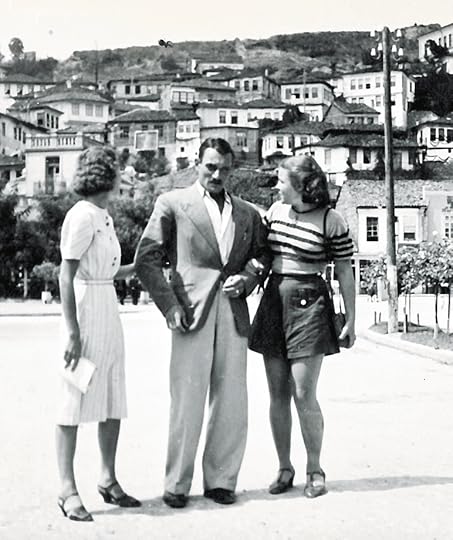 Galya (on the right) and her friend, Vera, walking with handsome Jura.
Like my mother-in-law and her friend, Jura had also escaped the Bolsheviks and was a fellow exile in Yugoslavia between the wars.
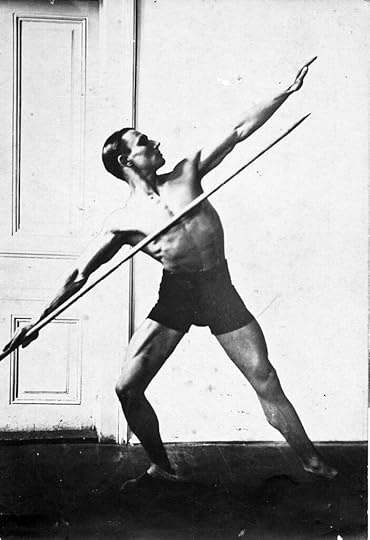 Jura Tarakanov in a gymnast pose in the 1930s.
After a career as a gymnast and a troubadour in European cafes, Jura ended up in Brazil where he worked as a cartographer, hiking all over the countryside with these binoculars, studying the land for his maps.
There is a story here. A story of war and exile, of love lost and found. For, after his wife died, he finally married my mother-in-law. They were both well into their sixties. Love triumphs over time.
A Time Travelling Microscope.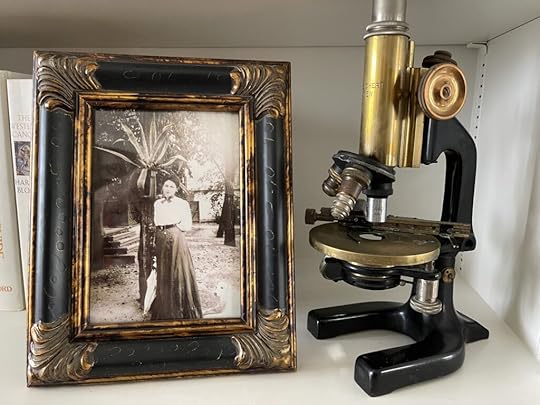
Speaking of time, this microscope has travelled through time for over a hundred years. At the beginning of the Twentieth Century, it helped my husband’s grandmother, Julia Gudym/Lefkovich, to study and fulfill her dream of becoming a doctor.
She used it to help diagnose and heal the women in her village in Ukraine.
Somehow, through her courage and determination, Julia carried it through the Russian Revolution into exile in Yugoslavia where she continued to help those she could.
It came with her to the United States when she emigrated here in the nineteen-fifties. When she died, it sat in the attic of her daughter’s house (my mother-in-law) until that house was sold and it came to us.
My husband and I had it cleaned, and our son used it for science classes when we homeschooled him.
Now it sits on a shelf in our library next to a photo of the woman who cherished it. When we write Love and Revolution, the novel about her life, it will again play a part. It is a family treasure.
A Sentimental Maximalist.I confess. I am a shameless sentimentalist. The rooms in my house are small galleries. Framed photos of family adventures grace the walls.
Treasures from the past nestle between books, arranged to have some connection with the books themselves.
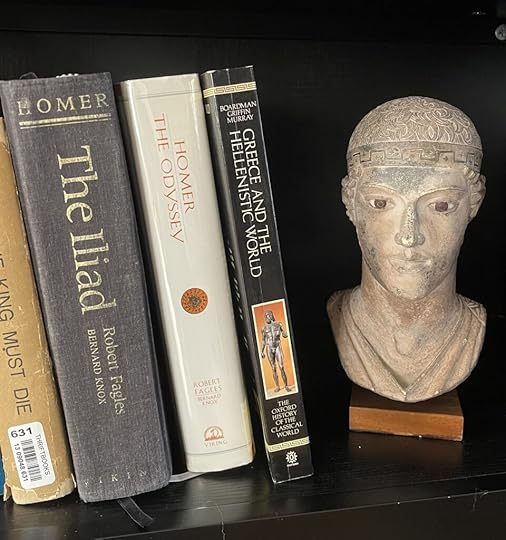
You know. A clay head of The Charioteer next to books on Ancient Greece.
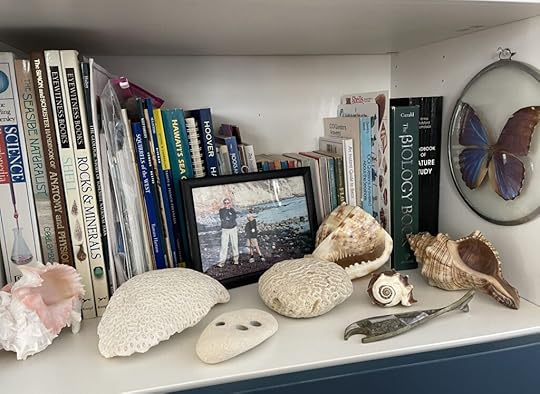
Seashells and rocks, gathered from the beaches of California, lined a shelf with nature study books.
Old swords and daggers, handed down or brought home from foreign travels, hang around on walls and above doorways.
Toys from my son’s childhood lounge in the attic in and around a wooden toy chest my own father built for me.
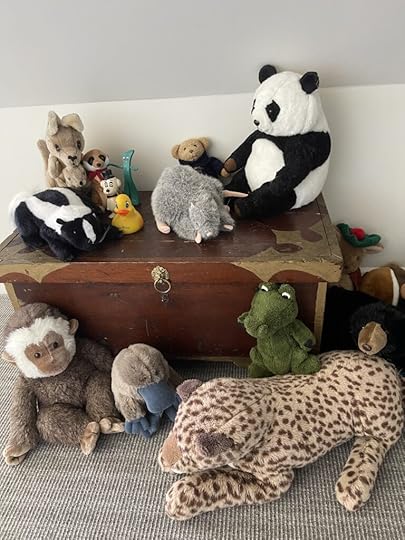
I do go up and visit them from time to time. Just to remind them they are still loved.
Even my car is 25 years old. I can’t give him up. He’s an old friend who’s journeyed from Carmel to Yosemite, LA to Seattle.

Not to mention the fact that he’s a classic Chrysler 300M. Rare now, since they only made them for a few seasons.
Is my house a cluttered mess? No. Each sentimental item has its own pride of place. They find their ways into plot and character ideas. They are my inspiration.
But most important of all, they remind me of the people I love and who have, and do, love me.
They are my Family Treasure Trove.
P.S.If you’re curious to know more secrets from the life and writings of Julia George, I’d love to have you visit our website and stroll around. https://juliageorgeauthor.com/
The post Family – A Treasure Trove for Authors. appeared first on Julia George.
March 13, 2025
My Family’s Desperate Flight through the Twentieth Century.
By George Kovach (with Julia Odegard)
“If you want to make an omelet, you have to be willing to break a few eggs.” V.I. Lenin
“Comrade, I see broken eggs everywhere. But where, oh where, is the omelet?” A Bolshevik worker.
Broken Lives. A True Story of Revolution and Exile.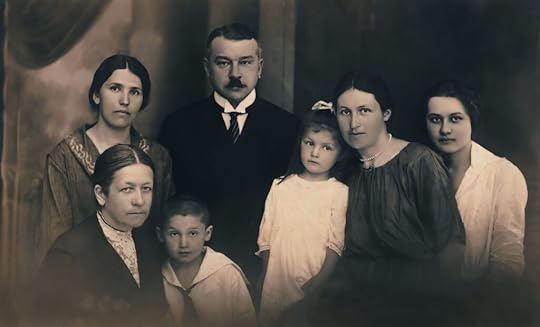 My family in exile after the Russian Revolution.
Pictured here is my family in 1920, exiled from their homeland which was near Kiev in the Ukraine. This is the story of their flight from war and revolution into exile.
Imperial Russia looked forward to a hopeful future.At the beginning of the Twentieth Century, Europe and Russia looked forward to a hopeful future. A new age of technology. Railways, electricity, cinema, photography, aircraft, and new discoveries in science and medicine promised to change the world for the better. Russia stood to reap the benefits of the new age, helped by her long association with Europe.
1895 – Life at the Sunset of the Nineteenth Century.Children born at the sunset of the Nineteenth Century were to be a new generation for a brilliant new Twentieth Century in Russia. My grandmother often told me how excited and optimistic everyone was about the coming century and what the future would bring.
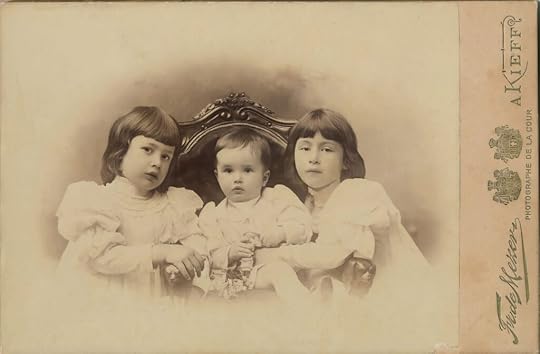 Julia Gudym/Lefkovich with her sister and baby brother at the end of the Nineteenth Century.
Julia, her sister, Kyra, and their baby brother Anatole grew up in a rural setting in the Ukraine. Surrounded by forests and fields of grain, they roamed the countryside with friends from the local families, learning about life on a farm, picking mushrooms and fruit from the orchards. Julia, Kyra and Anatole expected a life of peace, progress, and adventure. The future looked bright ahead.
Unfortunately, the great expectations of this family, and so many others, never came to pass.
1912 – Julia Gudym-Lefkovich – The Brains of the Family.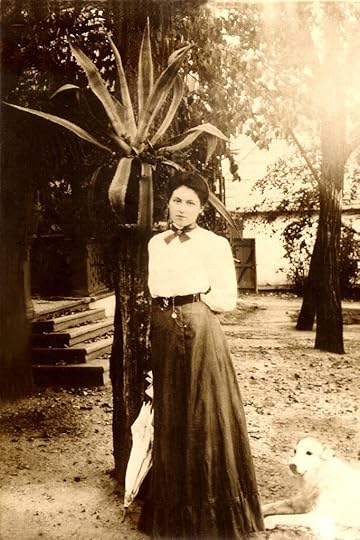 My grandmother, Julia Gudym-Lefkovich in 1912 on her farm in the Ukraine.
My maternal grandmother Julia was the brains of the family, with a burning desire to become a doctor. However, her mother refused to let her attend the University of Saint Petersburg, where long-haired revolutionaries might expose her to radical ideas. She also argued that proper young ladies married a respected neighbor. So Julia waited until she was of legal age to decide her future for herself. Meanwhile, she taught herself Latin, Greek, and higher math, devouring books on all the subjects she needed for admission to university. Subjects she had not learned in finishing school. As soon as she turned 21, she left home and moved to St. Petersburg to live with her uncle.
Mother was right.Just as her mother predicted, she did encounter young revolutionaries at the university. Nevertheless, Julia’s mother need not have worried. Radical young idealists had no influence on my grandmother. Rather, their ignorance of the true nature of the Russian people, outside of the rarified world of academia, amazed her. They seemed to know nothing about the people of the countryside. For them, the Russian peasants existed only as symbols of imperialist oppression or useful tools in their fight to transform Russia.
Surprisingly, after graduating in Biology, Julia did marry that neighbor, a man with a charming sense of humor and love of the rural life she preferred.
Even after her marriage, my grandmother continued to study medicine in preparation for final exams to become a doctor. In the meantime, she put her medical skills to work helping the local people at a free clinic she set up near their farm. Women, especially, came to her for medical advice and help.
During the Revolution, her knowledge of English saved her family’s life when they were on the run from the Bolsheviks. When they were driven into exile, she put the many languages she had learned to good use giving French, German and English lessons to help her make a living.
1913 – Europe’s Last Glorious Summer.“The tenacity of the bourgeoisie is colossal. We are forced to tear off this class and chop it away.” Leon Trotsky
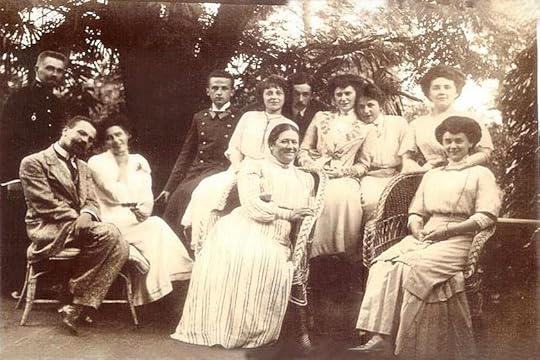 The Gudym-Lefkovich family on the eve of the Great War.
This is a picture of my grandmother’s family on the eve of the Great War. Everyone was optimistic about the new century. The scientific and technological miracles of the 19th century held promise of even greater things to come. It seemed that human knowledge was accelerating at extraordinary speed. The future of humanity could only get better and better.
Russia, after the 1905 revolution, could visualize finally becoming fully European. At this time, Russia’s economy grew faster than any other economy in Europe. Russia finally established a limited parliament called the Duma, also freedom of the press, and an independent judiciary. Much work remained, but Russians saw evidence of real progress.
And yet, just four years after this happy summer, their world had vanished. Many died fighting to save the Russia they knew and loved. Others, branded as class enemies, died at the hands of idealistic revolutionaries. Those who survived faced either a miserable life of hunger and fear in the new Soviet Russia, or lived out their lives in exile, never to return to their homeland.
Looking back, it’s highly doubtful that the Russian Empire could have survived. Ethnic minorities comprised too large a segment of the population. However, a peaceful break-up of the Empire, like the later peaceful break-up of the Soviet Union, still could have happened. A gradual transition of the Russian heartland to a constitutional monarchy, a republic, or a social democracy was possible. The totally unnecessary Great War brought an end to any peaceful resolution of the problems of the Russian Empire.
1913 – New Hope for Russia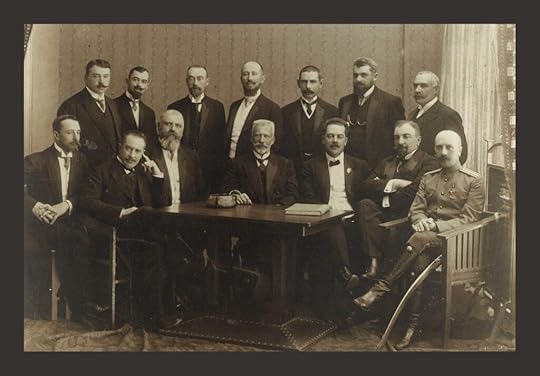 A provincial zemstvo in the Ukraine in 1913.
A picture of a provincial zemstvo. My maternal grandfather, George von Gersdorff, stands on the far left.
Zemstvos, a form of local self-government, like our county or state governments, functioned on the district and provincial level. They were elected on a limited franchise. Zemstvos had powers of taxation, dealt with local education, medical relief, road maintenance, sanitation, etc. These elective bodies came into being during the Great Reforms of Alexander II in the 1860’s. Through them, many believed that Russia’s problems could be peacefully resolved.
My grandfather, a liberal constitutionalist, became governor of his province during the short provisional government after the February Revolution. The zemstvos then became full-fledged institutions of state and municipal self-government. Any citizen could be elected to them.
The Bolsheviks abolished the zemstvos after the coup d’etat of October 1917, and gave orders for any elected official of these institutions to be shot as a “class enemy.” Unfortunately, my grandfather was an officer, not only in the Great War but also during the Civil War, which put him on the Bolshevik’s list of enemies. During that time, he lived a rather precarious life running and hiding from the Bolsheviks who had orders to shoot him on site. It is a miracle, and a testament to the loyalty of his friends and family, that he survived at all.
1913 – A Marriage in the Autumn of the Empire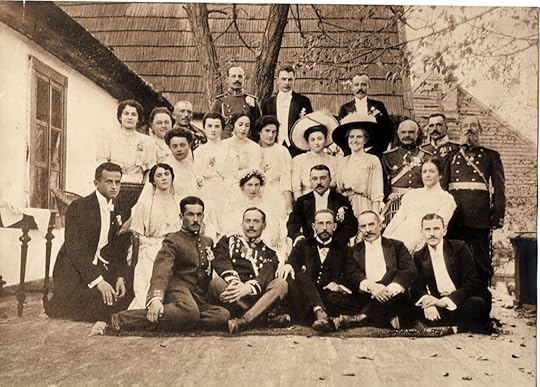 Wedding of my grandmother and grandfather in 1913 near Kiev.
My grandmother and grandfather married in October of 1913. Family and friends gathered in the country to wish the couple health and happiness.
Their honeymoon granted my grandmother’s dearest wish – to see Italy. For one blissful month they travelled that charming country, marvelling at ancient ruins, enchanted by glorious works of art, and inspired by the myriad of churches.
Only a few short months after their return, war was declared in Europe. The Great War. The war to end all wars. The war that destroyed the promise of the Nineteenth Century and left an entire generation of young men dead or maimed in body and mind. It was also the war that insured the demise of Imperial Russia.
1916 – A Loyal Soldier – A Class Enemy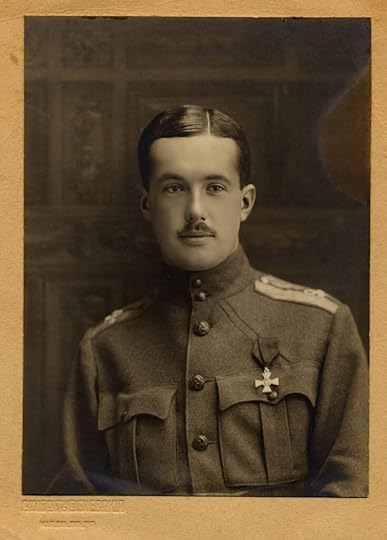 My great uncle, Anatole, wearing the Saint George Cross for bravery.
This is my great uncle Anatole, my grandmother’s brother, the baby boy you saw in the earlier photo. My uncle took a keen interest in the arts, and reputedly had a lovely singing voice. In 1914 he joined the army to fight on the side of Russia in the Great War. For his courage in World War One, he was awarded the Saint George Cross, Russia’s highest medal for bravery.
After the Revolution, he fought with the White Army and died in battle fighting the Bolsheviks to save the Russia he knew. His final burial site is unknown.
1914 – 1918 – Humanitarian Service will not save you.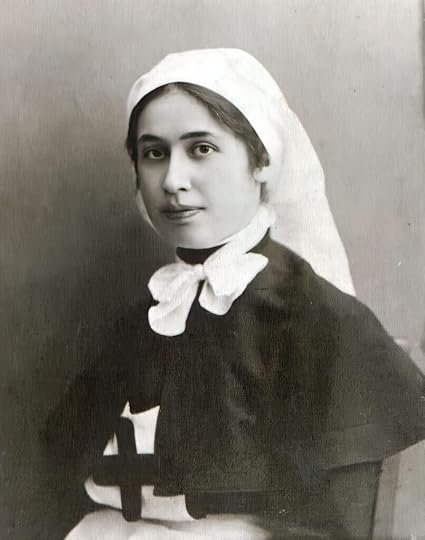 My great aunt, Kyra, a nurse during the Great War.
Kyra Gudym-Lefkovich, my grandmother’s sister. Like her brother Anatole, Kyra left her home in the countryside to help the war effort. For four years she tended the wounded and dying at the front. She was one of the few nurses awarded the Saint George Cross for bravery under fire.
However, the Bolsheviks saw no worth in the self-sacrifice of a courageous humanitarian. Kyra belonged to the wrong class and was of no use to them. Forced to go into hiding, she barely escaped the new People’s Utopia with her life. She died young in exile from the complications of typhus acquired during the war.
1920 – A Journey into Exile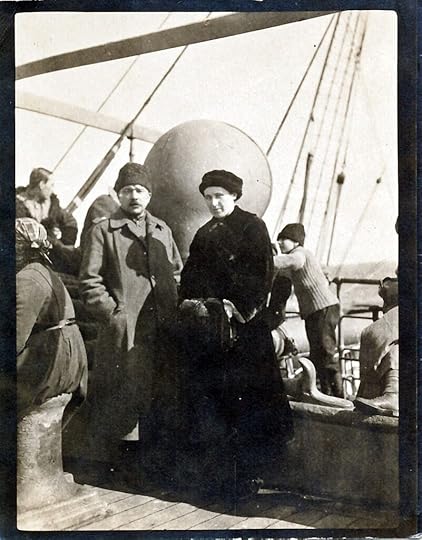 My grandfather and grandmother leaving Russia for the last time.
My grandfather and grandmother barely made it out of Russia alive. Pictures of them had been posted in the towns they stayed in on their flight. The message on the photos was to capture them or shoot them, whichever was most expedient to the captor. Through the bravery and extreme kindness of friends and strangers alike, they made it to the last steamship out of Odessa in January of 1920.
Even there, their future was unsure. When they arrived at the port, the officer told them the ship could take no more passengers. My grandmother held up my one-year-old mother – little Galya. “You see this child?” my grandmother said in her perfect English. “If you do not let us on your ship, she will die at the hands of the Bolsheviks. They have no use for her.” It was at that moment that my one-year-old mother reached out her little hand and grasped the gold button on the officer’s uniform. He looked down. She looked up at him and smiled. That smile saved their lives. The officer smiled back and let them board.
When the Red Army captured Odessa, they murdered thousands of refugees and sent the rest to concentation camps where most died of disease.
A Poignant FarewellImagine what it is like to stand onboard that ship and watch the country of your birth, the country you love, recede slowly into the distance, never to be seen by you again. To leave friends and family behind, brothers who are doomed to die in battle trying to save their country, relatives who have either been murdered or sent to concentration camps to be worked to death. To realize your future will be nothing like your past. That you face poverty, hunger, bitter hardships, unfamiliar customs, and people strange to you, who speak a language you do not know. To wonder how you will be able to keep safe those you love. The torture of the soul known as exile.
1921 – A New Generation Faces a Precarious Future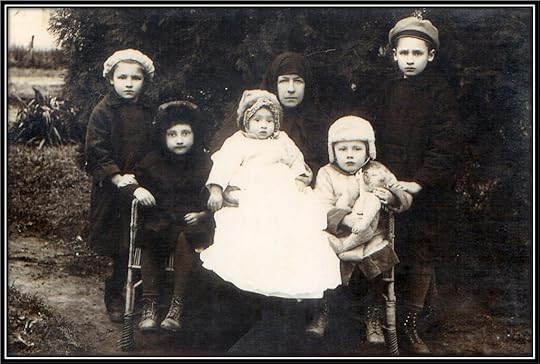 My great-grandmother and her grandchildren in exile in Yugoslavia, 1921.
My great-grandmother, Varvara, is pictured here with her grandchildren. They have all barely escaped the Bolsheviks and have found sanctuary in Yugoslavia. That my great-grandmother is in this picture at all is a miracle. During the Revolution she too was hunted by the Bolsheviks.
At one point, in desperation, she took refuge in an insane asylum. Another time she was captured and put in a prison. When she was asked to recite the nature of her crime she looked the Bolshevik guard in the eye and said, “I was arrested because twenty years go Captain Dragomirov married my sister.” Clearly, her family associations were toxic.
From this point on, Varvara only wore black in mourning for her son, Anatole, who died in battle fighting the Bolsheviks. Her grandchildren would grow up in a foreign land. They would make friends, go to school, have hopes and dreams.
And yet, in a little over a decade they would face a new political upheaval and an entirely new world war.
The post My Family’s Desperate Flight through the Twentieth Century. appeared first on Julia George.
October 13, 2023
Help! I’m in love. With the hero of my novel!
Confessions of Julia George – Author.
I fell in love with him right from the start. I couldn’t help myself. He was so . . . I don’t know . . . wonderful! I’m referring to the hero of my award-winning cozy mystery novel, Galya Popoff and the Dead Souls. That was the venue that brought us together.
Alas! I’m the victim of a hopeless passion. Because he doesn’t even know I exist. And yet, he should know, because I created him. And, in a way, I am him. At least a part of him. His thoughts are my thoughts. His dreams, my dreams.
Here he is. My hero.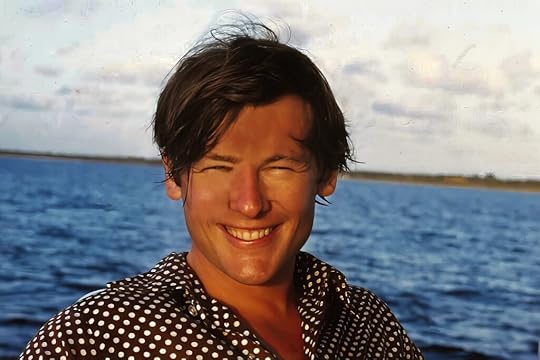 This guy looks like he’s getting away with something.
Tanned by the California sun and looking like he’s getting away with something. Which he usually is.
His name is Lance Steel. That was his idea. His real name is Pavel Popoff, but he wanted a name that wasn’t ridiculous. He’s an actor, you see, so it’s important. I suggested he use the name of the hunky, romantic ski instructor he played in that ever-so-popular TV show, Aspen! But he said he would rather forget that show because it was cancelled. And now he’s out of work. Or, as they say in Hollywood, between engagements.
Besides, Lance said, the name Brick Mason wasn’t as dashing as Lance Steel.
I agreed. I always agree with him. What a pushover!
It seems I just can’t resist those soulful hazel eyes with a mesmerizing ability to shift from golden brown to shady green on a whim of emotion. And don’t get me started on that rogue lock of chestnut hair that persists in flopping over his forehead and makes you long to smooth it back in place just to feel it run through your fingers. Sigh.
Is he tall, you ask? Oh yes. But not the towering-over-you kind of tall. The just right kind where you have to look up a bit to catch his eyes but not so much to feel small and insignificant.
Muscular without being bulky. Agile without being rangy.
And when he smiles . . . well . . . I’m not the only one charmed by that boyish grin.
No. I am not delusional.You have to understand my obsession. I spent an entire year with Lance. I went everywhere with him. Every thought he had, I had. Every frustration he suffered, I suffered with him. Every dangerous situation he found himself in, I rescued him. And that included some very creepy nightmares where he almost . . . but that would be revealing too much. Suffice it to say, he needed me!
And then there was his overbearing, demanding mother, Professor Galya Popoff.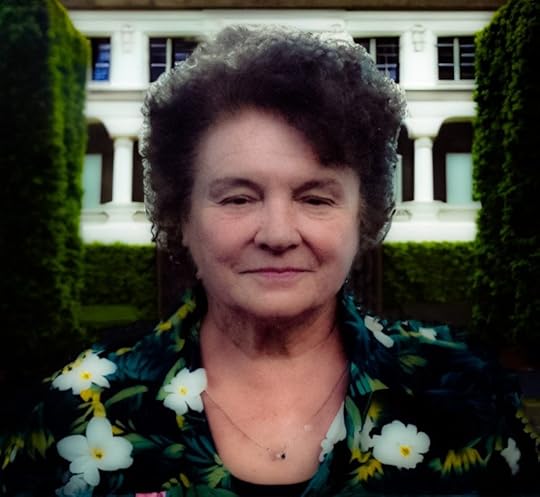 Professor Galya Popoff on campus.
I got him out of trouble with his mother so many times I felt like a crisis intervention worker. Professor Galya Popoff teaches Russian Language and Literature at Lobo del Mar College. A charming little town on the California Coast. Let me tell you, Galya is a formidable woman. Stubborn, bossy, determined, but a soft touch underneath. Some of her students call her Mama Popoff. Others are terrified of her.
Well, Professor Popoff cast herself in the role of detective after witnessing the suspicious death of a fellow professor who fell, or was pushed, off the the-hundred-foot-high campanile on campus. The fact that he was free-climbing it in the dead of night – illegally, I might add – was irrelevant to Galya.
Also irrelevant was the fact that her son, Lance, did not want to play Watson to her Sherlock. He was badgered into it. Which nearly got him killed. Several times!
Women were another problem I had to deal with.I had a harder time getting Lance out of trouble with women. You see, he can’t resist a pretty face or a sexy figure, and he’s so easily manipulated by tears and pouts and, well, just about anything a woman throws at him. Does he learn from his mistakes? Frankly, no, but he is aware that he’s making those mistakes at the time. It’s just that . . . well . . . he’s Lance.
There was Tanya, and Roxanne, and the sexy secretary at Argus Investments, and . . . Wait! I was the one who introduced him to all those women. To my credit, I also got him out of some pretty sticky situations with them. A couple of them were downright dangerous. Especially that time when he ended up naked by the pool.
Is he grateful? Like I said, he doesn’t even know I exist.
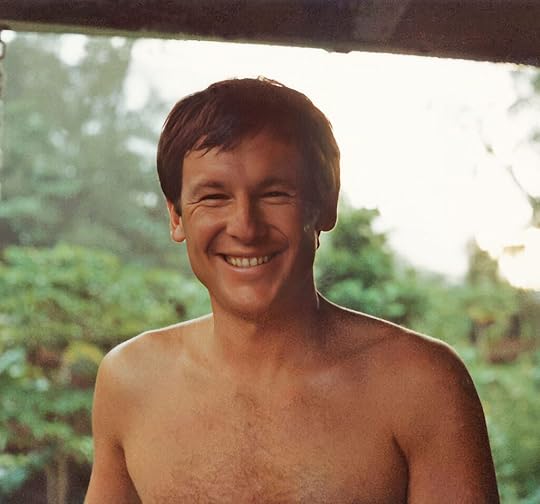 Lance without his clothes and grinning.
Whoops! I didn’t mean to add this photo. But here he is wearing nothing but a silly grin when the shotgun was pointed straight at him. Never let it be said that my hero lacks nerve.
I’ve done everything for him.C’mon! I made him the charming, hapless star of a farcical, off-the-wall detective adventure. “Wacky but wonderful,” fans called it. And that led to him being cast in another successful TV series. So, he’s no longer between engagements.
I took him to some of the most beautiful and fun places along the California coast.
 Impressive California coastline.
I gave him his favorite car. A red Corvette. Just so he could look cool.
 Red Corvette sports car parked near the Pacific Ocean in California.
And I was with him on those hair-raising hairpin turns as we swept along Highway One looking for clues and following suspects.
 Winding road on California Coastal Highway One.
Like when we ended up at that posh wellness resort with the trendy little yurts where Galya got in trouble.
 The yurt at the wellness resort where Professor Galya Popoff found one of the suspects in the murder case she was investigating.
Lance had to save his mother from being carted off as a murder suspect. And don’t tell me I was the one who set her up. I may be the author, but I never would have made her do what she did in that yurt. It was purely a case of the character getting totally out of control.
 The yurt in Galya Popoff and the Dead Souls where Professor Galya Popoff found one of the suspects in the murder she was investigating.Devoted. That’s what I am.
I even gave Lance a cute and clever little dog to help him solve the murder of the free-climbing professor. It wasn’t my fault that Kroshka stole the scene most of the time. Or that he was smarter than Lance when it came to nosing out clues. And I know Lance appreciated him because he took him everywhere and called him Brother Breadcrumb.
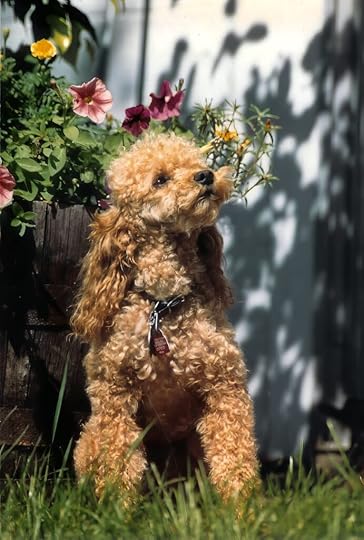 Kroshka, the toast colored poodle with his nose raised to sniff for clues.Do you think I should see someone about this obsession?
If not, you may be on the way to being in love with Lance yourself. If you are, you may want to spend more time with him. Check out the cozy comic mystery he’s starring in. Hope you enjoy it. And Lance, being an actor, knows how important reviews are. He would love for you to leave one.
Just click here to find him on Amazon – Galya Popoff and the Dead Souls.
Lance sends his thanks.
And if you’re interested in me – the author – you can find out all my secrets and more on my website.
The post Help! I’m in love. With the hero of my novel! appeared first on Julia George.
February 22, 2023
Teamwork! Or How We Write Fiction Together
Yes! It can be done.
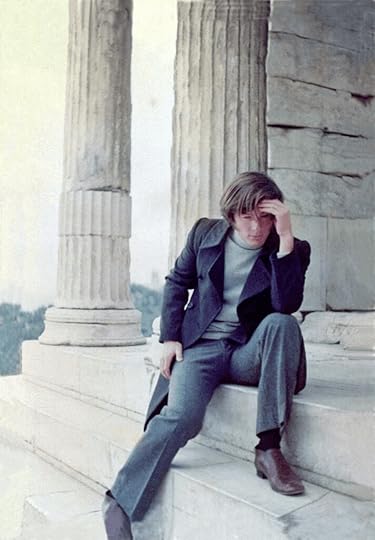
They say writing is a lonely profession.
Do you find that to be true?
Are you isolated from the bustling world outside your window?
A prisoner of your own imagination?
(Follow the link in the photo for a little Greek travel nostalgia on the Acropolis.
Do you wonder what happened to your carefree life when you actually had time for people who weren’t imaginary?
I mean, do you find yourself talking to your cat or dog more than to your friends?
Worse!
Do you talk more to yourself than your cat or dog?
(Follow the link in the photo for some lonely Hungarian gypsy music.)
We have the solution to your problem.
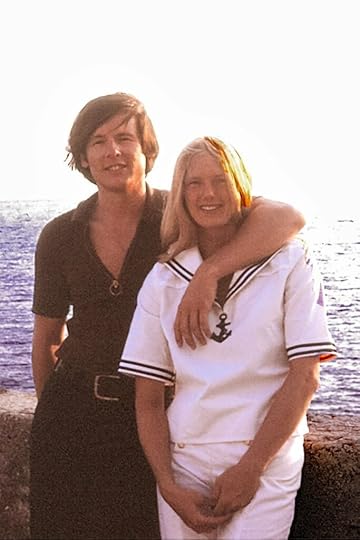 Write as a Team!
You see?
They found each other.
And the future looks brighter already.
Whether it’s a husband and wife team, like ours.
Or best friends with a passion for telling stories.
Or mothers and sons.
Brothers and sisters.
Even simply soulmates who see eye-to-eye.
Writing together is a winning combination.
Think about it.No more long hours in a silent room, staring at an empty computer screen.
No more sleepless nights wondering where to take your plot next.
No more boring your friends with the joys and sorrows of your creative journey.
Keep it in the family.
And I use the term loosely. Because, when you write together, you quickly become so interconnected it’s as though you were born twins.
 Wait, you say!
I see a divorce on the horizon.
I can’t even agree on what to have for dinner.
No way could I expose my most cherished creative ideas to the critical eye of someone else.
However close our relationship.
I’m not sure I even trust my cat to be supportive.
How in the world do you do it?
Julia and George are here to reveal their secret.
We’ve been working together ever since we met in college, fell for each other in a big way, and started living together.
Back then our passion was theater. No matter where we were, we constantly tossed ideas back and forth about what plays we were going to produce when we started our own theater.
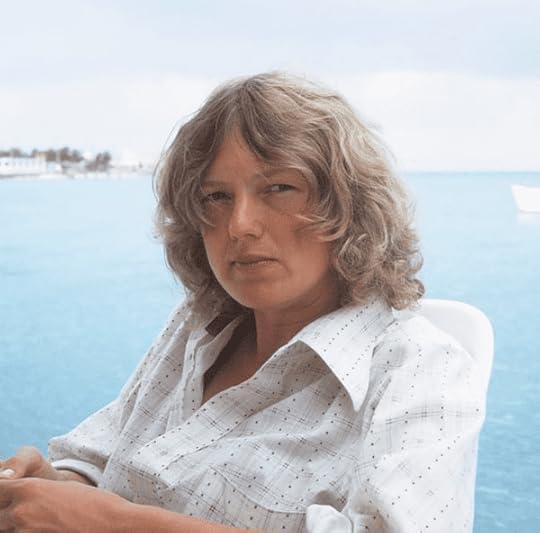
George had some pretty big ideas.
If I look a bit skeptical, it’s probably because I’m wondering where we’re going to get the money for this fabulous project.
We worked part-time jobs and spent anything extra on whatever production we were doing.
Needless to say, we didn’t have a savings account.
The usual plight of those crazy young people who want to be in “The Arts!”
But we didn’t care because we were doing it together.
Did I say working as a team meant talking stuff over?
Boy! Did we talk stuff over. A lot!
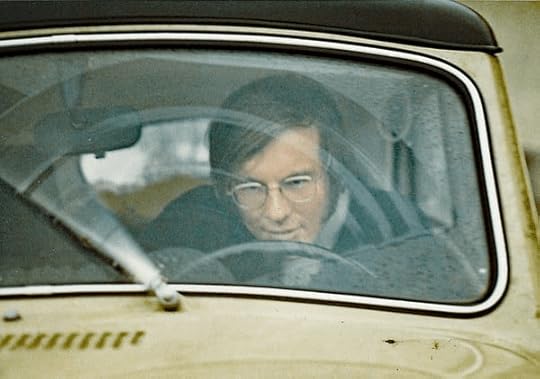 We talked while driving in the car.
No matter what the weather.
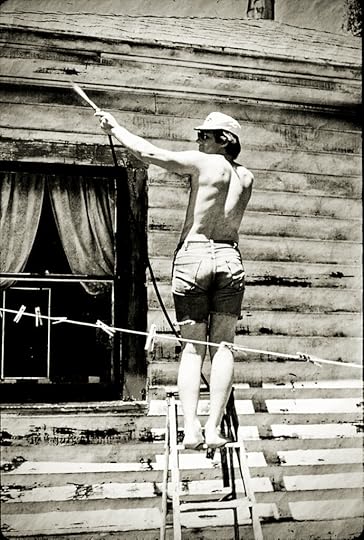 Working at those part time jobs.
No matter how precarious.
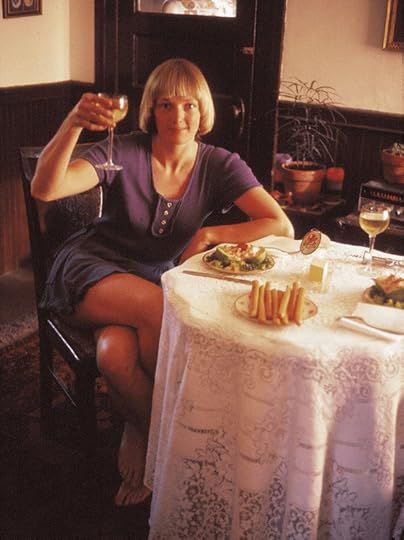 At dinner.
This was a dinner to celebrate finding a free venue for our first production.
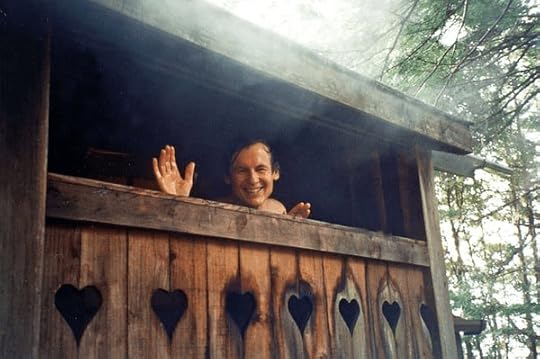 Even in the shower.
That was a really fun shower
So, when we decided years later to write fiction, we just naturally did it together! The family that works together stays together!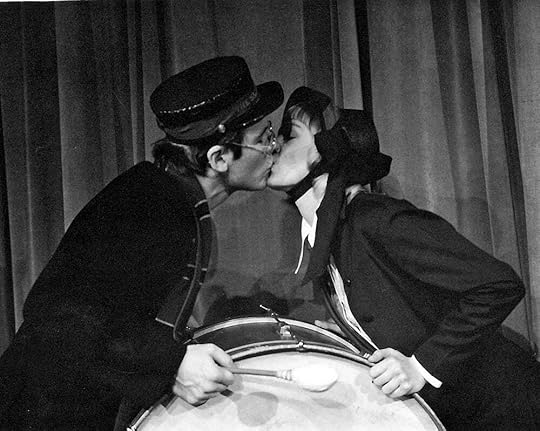 George
For us, writing is 24/7. You read about how a lot of writers sit down and write for a set period of time.
We find that ideas come to us at all times. It’s not something you can turn off. Until the book is done, of course.
Maybe not even then.
I keep a pad and paper next to the bed because my best ideas come to me in the middle of the night.
Or just before I got to sleep. Or just before I wake up.
At times, it gets annoying because I can’t even get a good night’s sleep.
I’m being pursued by characters, plots, red herrings . . .
Talk about nightmares!
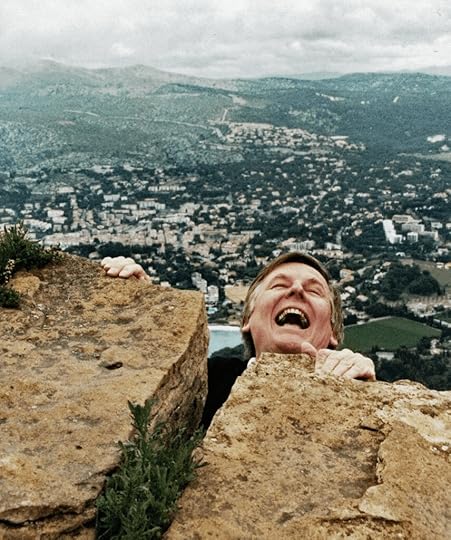 Julia
Julia
George is the plot man. His head is overflowing with so many plots it’s sometimes hard to choose which one to focus on.
And when we finally do settle on a basic plot, he starts in with the twists and turns and intricate devices.
It’s really crazy at times. But such fun!
Do you have someone whose imagination overflows with plots?
Cherish that person if you do.
Their imagination will inspire yours.
 George
Julia is the one who brings our characters to life.
She sits at the computer, staring at the blank screen for hours.
Until our characters begin to speak and move.
Sometimes she walks around the house talking like them.
A little weird.
But it works.
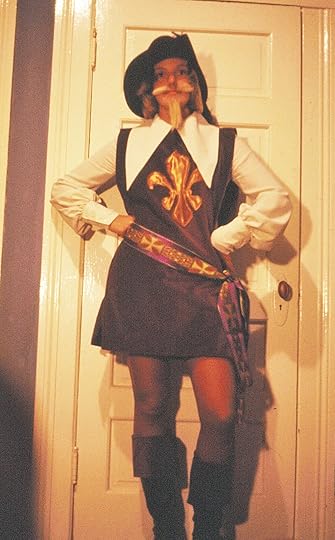 Julia
Julia
After we’ve outlined the novel, we work chapter by chapter.
Because we’ve never gotten the theater out of our blood, we look at chapters as scenes.
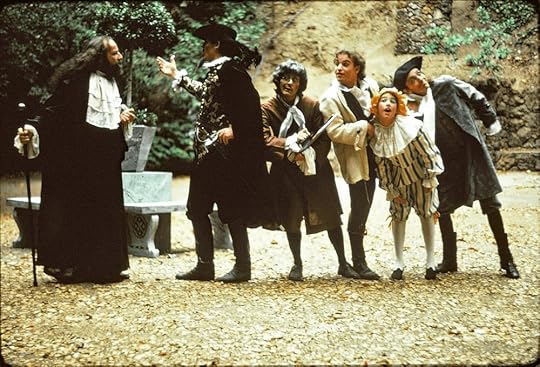
To paraphrase Shakespeare – our characters make their entrances and exits, and two authors, in their time, play many parts.
This, of course, is an actor’s dream come true.
Finally! We get to play
ALL THE PARTS!
 George
After Julia has a first draft of a chapter, we start working together on the re-writing.
And discussing.
And re-writing.
And discussing.
Well, you get the picture.
And this process goes on for each chapter.
Why wait to have a first draft of the entire book when you can drive yourself crazy chapter by chapter?
 Julia
Julia
When all the chapters have been gone over until our eyes have crossed, we start the marathon of editing the entire book.
George edits a chapter.
Then I edit the same chapter.
Then we do it all over again.
And again.
Until we’re happy with it.
In the end, we look on our finished manuscript as a 250 (or so) page play.
We hope we’ve created an intriguing stage for our actor/characters to perform their parts.
We strive to keep the pace of each chapter, and the entire novel, moving in time with the movement of the plot.
And also give our actor/characters room to express themselves.
And rein them in
when they start to
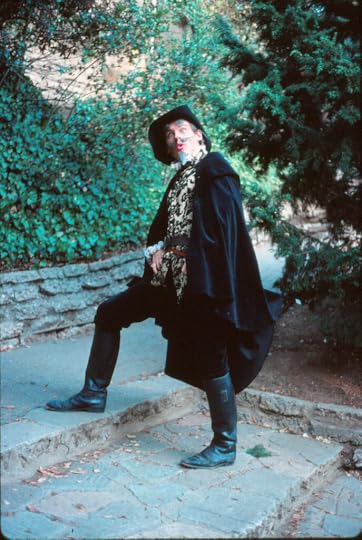
Ham it Up!
Trust me.
It happens!
In novels
just like in the theater.
 Now wait just a minute!
I hear you say.
This whole thing sounds like a fairytale.
A walk down the primrose path.
No two people can work that closely together on something so personal as a novel and never disagree.
You’re right, of course.
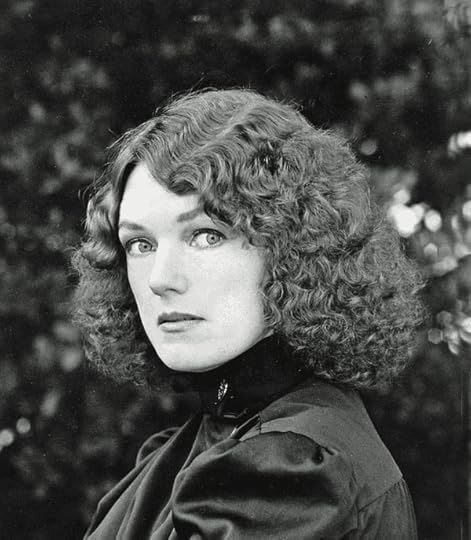
To be perfectly honest, We don’t always see eye-to-eye on everything.
Julia: He would never say that!
George: No. He’d say something much more cynical.
Julia: Actually, I don’t think he should say anything at all. Just smile.
George: Smile!? There’s a dead body at his feet.
Julia: Yes. Smile. Cynically, of course.
 Cross Swords on
Character Actions.
Maybe not literally cross swords
Although . . .
We did take fencing once.
 Battle over
Plot Changes
Hmm!
We always seem to make a joke out of everything.
Don’t we?
In the end
We always make peace
And harmony reigns.
Are we still together?
You bet we are!
Such a fun time
As This?
The post Teamwork! Or How We Write Fiction Together appeared first on Julia George.
January 24, 2023
Who is the Real Galya Popoff?
Let her son, George, tell you about the larger than life woman who inspired the wacky cozy detective in Galya Popoff and the Dead Souls?
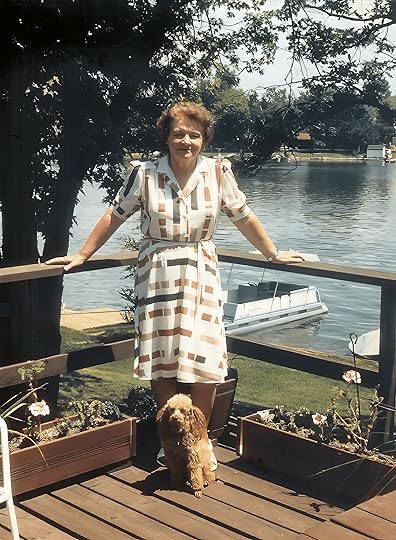
The inspiration for Professor Galya Popoff was the amazing, bold-spirited woman to whom the book is dedicated. My mother. Helen Kovach/Tarakanov.
Here she is with her beloved poodle, Kroshka.
Like Galya Popoff in the novel, my mother (Galya to her friends) was brave, loyal, stubborn, funny, feisty, bossy, outspoken, and compassionate.
Those who knew her will never forget her.
She was loved, and she is missed.
Here are some of my mother’s adventures that inspired her character.
Real Life Adventures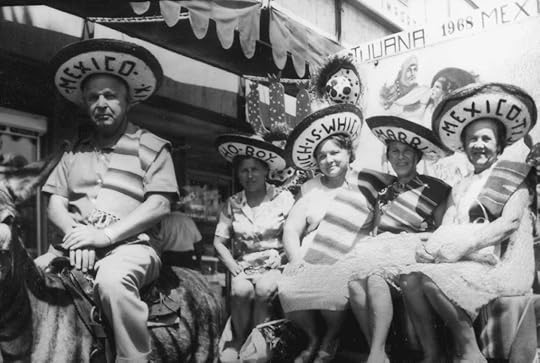
Once, she took a trip to Mexico with a group of professors. In this photo, Galya, my mother, is in the center, wearing a coy smile. The disgruntled man on the donkey was the only male professor on the trip. It was Galya’s suggestion he be photographed on the donkey. As you can see, he wasn’t happy about that. However, when Galya insists you play the gentleman and “escort” the ladies, you do it. Or suffer a long lecture on chivalry.
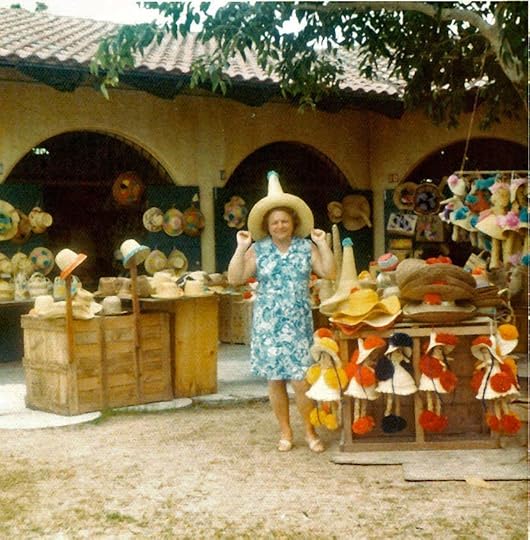
My mother loved to shop for souvenirs wherever she went. I know Galya Popoff would have been as formidable as my mother at bargaining with shop owners. Most tourists are too timid. Not Galya! Because she loved to bargain, the shop owners loved her.
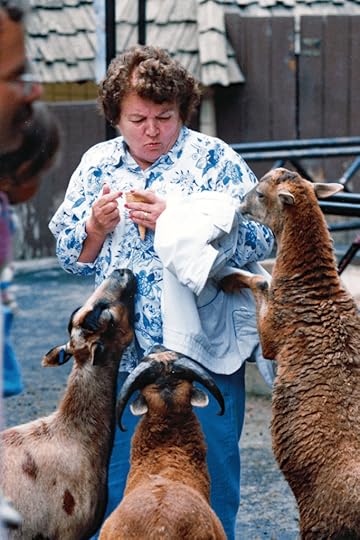
Galya Popoff always demands good behavior from everyone. We won’t talk about some of her antics while trying to solve the case. My mother, the real Galya, even demanded good behavior from animals. Kroshka didn’t always obey her, of course. As you can see, neither did these goats.
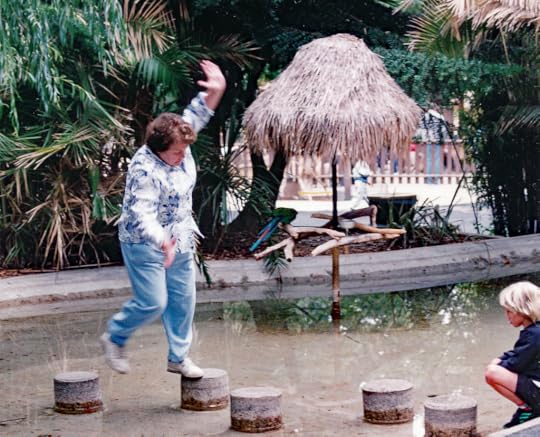
“I can do it!” was my mother’s mantra. Here she is, amazing her grandson with her balancing skills. He was so sure she would fall into the pond. Of course, she didn’t.
In the novel, Galya Popoff does a perfect racing dive into the swimming pool to save her beloved poodle, Kroshka. Go Galya!
A Dramatic PastMy mother’s life was a long adventure that intersected with most of the twentieth century’s more sensational moments. Much of the time, she was running from the forces of evil, doing her best to save as many of her family and friends as she could. Even so, she still managed to find a bit of happiness in the midst of chaos.
Her story inspired many aspects of Galya Popoff’s character and attitudes in the novel.
Helen (Galya) was born in Russia at midnight on December 28, 1917, at the beginning of the Revolution. Her family was landed gentry with an estate near Kiev in the Ukraine. At the time of Galya’s birth, they were already on the run from the Bolsheviks. So, little Galya was a refugee even before she was born. When we were writing the novel, my wife and I imagined Galya Popoff would have had the same dramatic start in life.
Escape from Tyrrany.In 1920, my grandmother and her family made their way to Odessa on the Black Sea in the desperate hope of escaping the Bolsheviks. The captain of the last British ship in port told them, sadly but firmly, that there was no room left onboard. Fortunately, my grandmother spoke perfect English, with a British accent (she’d had a British governess).
She approached the captain, carrying little Galya, (my mother was two years old) in her arms. With tears in her eyes, she held her up in front of the British captain. “If we do not get on your ship,” Grandmother said, “this child will die. It is certain.”
Little Galya (my mother), curious and bold even then, reached out and began to play with the brass buttons of the captain’s uniform. When he looked down at her little face and sparkling eyes, she looked up at him and smiled. That smile saved their lives, because the captain melted and let them onboard. Galya Popoff would say she saved her family. Her is a photo of her parents leaving Russia into exile.
My mother and her brother, George, lived as Russian exiles in Yugoslavia. The Russian emigre community held a “Cutest Refugee” contest and Mama and Uncle George won. Look at little Galya’s expression. She already has definite ideas about the photographer!
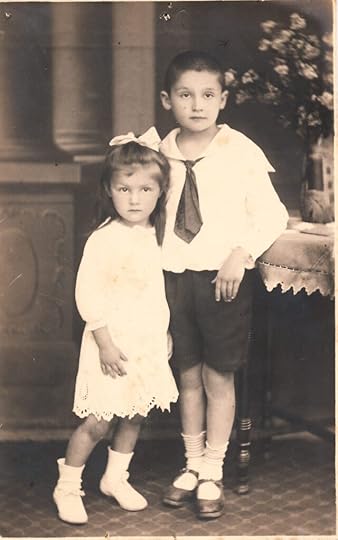 A Willful Child with a Fearless Stubborn Streak
Like Galya Popoff, the fictional character, my mother had a strong will and a fearless stubborn streak. When she was twelve, family finances were at a low ebb and her father told her she must change from her Russian language school to a local Yugoslav school to save money. She was furious at being forced to be separated from her friends. Knowing her father loved her long chestnut hair, she took her revenge on him by cutting it all off. Here she is with her newly chopped off bob. Look at that stubborn expression!
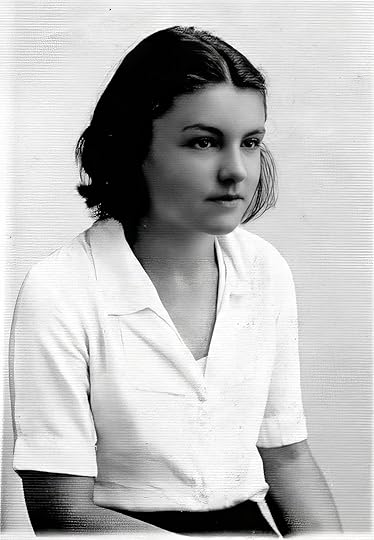
However, just like Galya Popoff, she quickly made a host of new friends. In her new school, her love of gossip and stories gained her the reputation of being “The Newspaper” and “The Telephone.” If you wanted to know the latest, you went to Galya!
Young People Should Have Fun! Galya’s Mantra.In 1937, the storm clouds were gathering in Germany and the Great Depression was raging around the world. But, when you are nineteen and out of school for the summer it all seems very far away. Another catastrophic war in Europe seemed impossible. My mother and her friends were poor but resourceful. They pooled what meager funds they had and took off on a trip to Dubrovnik, Yugoslavia on the Adriatic Sea. They slept on the roofs of family and friend’s homes, ate tomatoes and bread, and had loads of fun. Galya Popoff remembers that romantic summer in the novel.
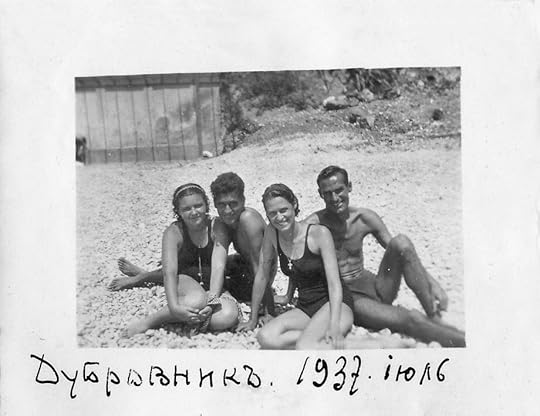
The spirit of this young girl never left my mother, no matter what hardships and heartbreaks she suffer in life. Inside she was always nineteen at heart. Ready for fun and laughter. Like Galya Popoff when she chatters and gossips with Tanya, who is at least 40 years younger. Here she is on that long-ago summer holiday. And with her best friend, Vera. (Galya is on the right).
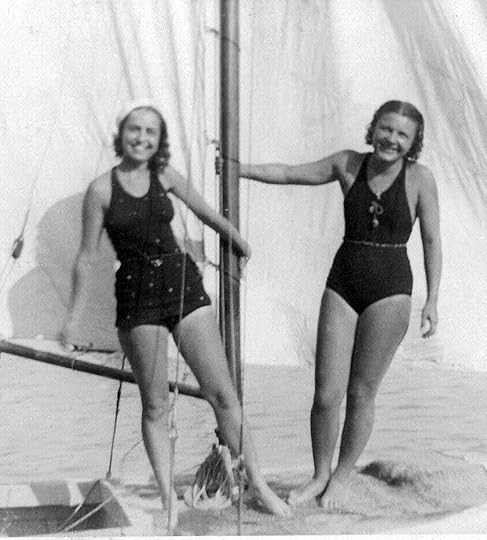 An Unrequited Love for a Dashing Cavalier.
My mother fell in love that summer. With a dashing, slightly older young man called Jura Tarakanov. The character of Mr. Montecoucouli in Galya Popoff and the Dead Souls is based on her first love. The fact that he was a well-toned gymnast certainly added to his allure.
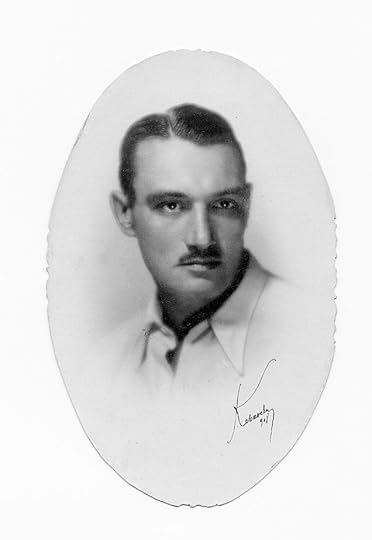
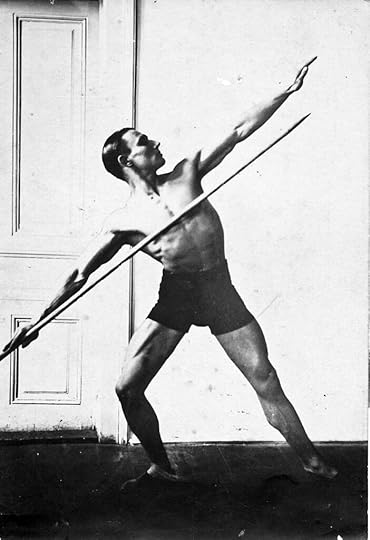
But alas! Like Mr. Montecoucouli, he was just out of reach. he married her best friend, Vera. Vera was a couple years older than Galya. Here they are, best friends in love with the same handsome, sophisticated man. My mother is on Jura’s right.
However, there is a happy ending to the story for Galya. Many, many years later her best friend Vera died. My mother rushed to Brazil, where Jura and Vera had been living, to attend the funeral and comfort her old friend, Jura. They both missed Vera. They reminisced about the past. Jura played the guitar and sang the songs they’d loved so long ago. At 60, he was still so romantic.
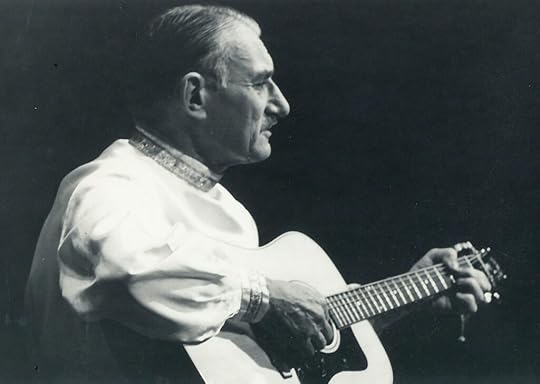
Galya told Jura that she had been in love with him way back in Yugoslavia during that summer of 1937. “Why did you never say anything?” Jura asked. “I knew Vera was in love with you too,” my mother said. “And a woman does not steal the cavalier of her best friend.” However, she was not about to lose him a second time. “Marry me, Jura,” she said. And he did. Like Galya Popoff, my mother was very persuasive.
A Charming and Vivacious Young Russian Girl.Galya the Boyarina. Russian emigre girls loved to have their photos taken in traditional Russian costume. The poses were always vivacious or coy. In Galya Popoff and the Dead Souls, Galya often embodies both.
As her son, Lance, says in the novel, “She should have been an actress.”
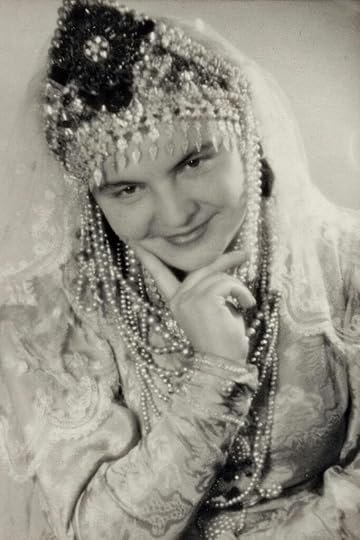
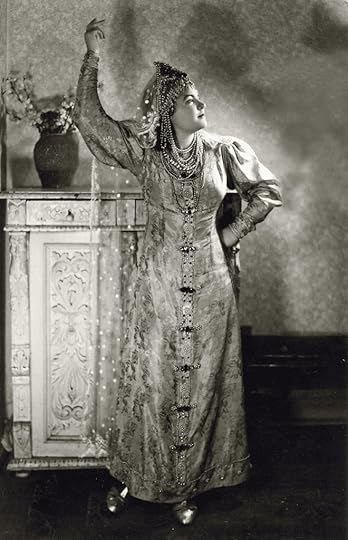
1940. The war raged in Europe, but Galya’s spirits never flagged. Like all young women, she loved to laugh, dress up, and dance. The tango was her favorite.
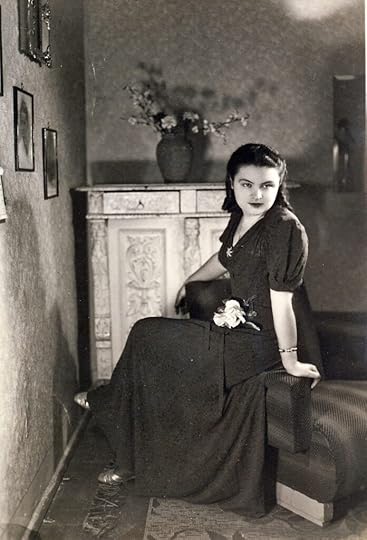
The Hungarians were offering university scholarships to Eastern European students and my mother signed on to go to law school in Budapest, even though she didn’t speak a word of Hungarian, one of the most difficult languages to learn.
But she quickly charmed a fellow law student – Ivan Kovach (my father). Ivan helped her learn Hungarian and get her degree in law. They married in Czechoslovakia in 1943.
My father secured a job as head of the Red Cross in Prague. And in 1945, I came along to liven things up.
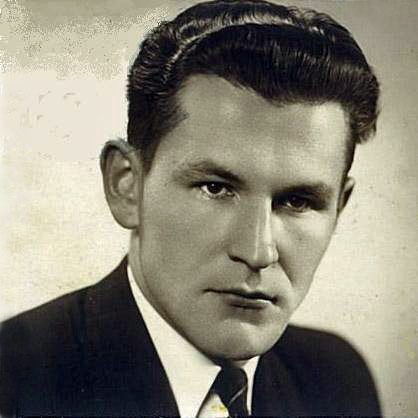
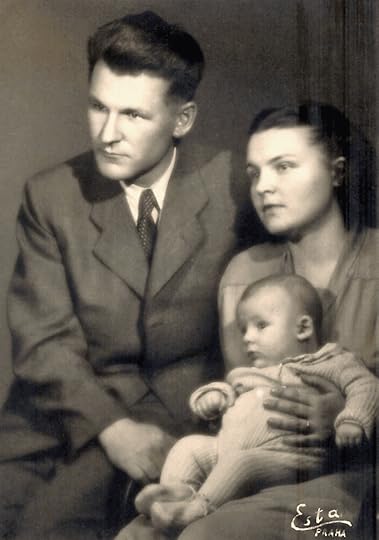
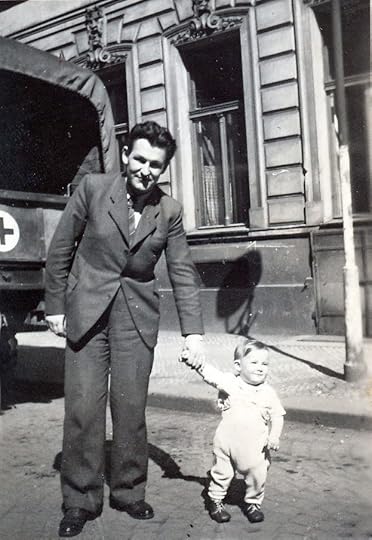 A Communist Totalitarian Nightmare Brings Tragedy.
1945. The war ended but peace was denied us. My father, a young, idealistic lawyer, began working for the Czech parliament. As in Galya Popoff and the Dead Souls, my mother told him that Czechoslovakia would fall to the communists. She argued that all the countries around Czechoslovakia were falling like nine pins. If Czechoslovakia went communist, she said, he would surely be arrested.
As in our novel, he refused to believe it. My mother begged him to leave.
The communists took over Czechoslovakia, making it clear that anyone who was not loyal to the party was suspect. My father, a member of the Czech parliament, and an advocate of democracy, was arrested. I was three-and-a-half years old. They threw him into prison. His crime? Believing Czechoslovakia should be a democratic country with laws and a constitution. he was sent to a Siberian concentration camp for being – you guessed it – an Enemy of the People.
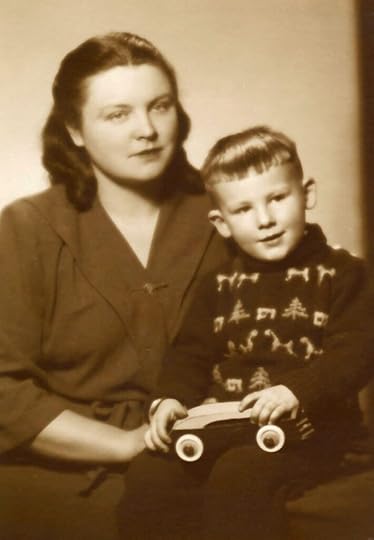
My mother had this photo taken to give to my father in prison before he was sent to the Gulag, so he could remember us. You can see she’s been crying. My mother bought the little truck for me to keep me from crying. One of my earliest memories is sitting on a bench in the hallway of the prison, waiting for my mother.
During her visit, my father told my mother that if she didn’t take me and get out of Czechoslovakia she would surely be arrested as well, and I would be sent to a Soviet orphanage. Lance points this out in the novel. My father also ordered her to divorce him immediately,which would delay her arrest by the Soviets. She argued against it, but she knew he was right, and she did it.
A Desperate Mother’s Flight to Freedom.Escaping from Czechoslovakia with a four-year-old child took courage, determination, and resourcefulness. As Galya Popoff would have done under those circumstances, my mother contacted a truck driver whose route went along the border of Czechoslovakia and Germany. She offered to pay him to take us along on one of these trips, but he refused to take a child. How my mother convinced him, I can only guess, but he finally agreed.
Mama and I his under the seat in the driver’s cab. However, the border guards had gotten wind of our escape and were in pursuit. If they caught us, we would all be dead. The driver stopped the truck next to a field. Mama and I scrambled out, and the truck took off. My mother tied my arm to hers, and the two of us started running across the field toward a forest, and freedom.
I remember that field vividly. We ran with the guards shooting at us. But I guess they figured a woman and child were less important than the truck driver, and they took off after him instead. My mother never knew what happened to our savior.
Galya Popoff is courageous and fearless in the novel. Lance, her son, realizes he owed her his life many times over. As I owe my mother. Both Lance and I understand how amazing and brave our mothers were.
The Long Road to A Peaceful Life.1950. We found ourselves adrift in a Germany ravaged by the war. This is a picture of us in bombed out Bremen. We knew no one. We had nothing except my mother’s iron will and stubborn determination that we should survive. Eventually, the authorities put us in a DP Displaced Persons) camp.
At age four, I found the camp fun. While my mother worked, I spent time with some local cows. My poor mother was terrified they would trample me. But I loved them. They were my special friends.
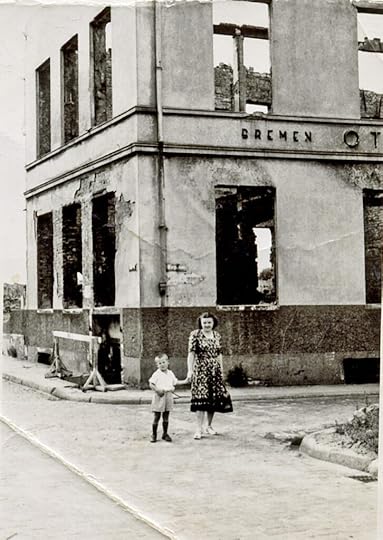
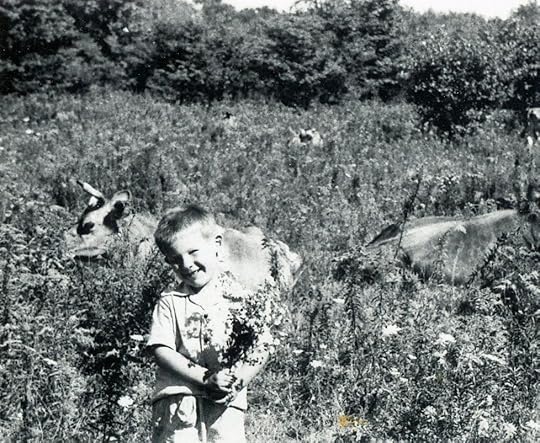
Eventually, we secured a passage to Canada, sponsored by Grand Duchess Olga Romanoff, the sister of Czar Nicholas II. Her husband had been in the same regiment as my grandfather.
Here we are on a Liberty Ship crossing the Atlantic to the New World.
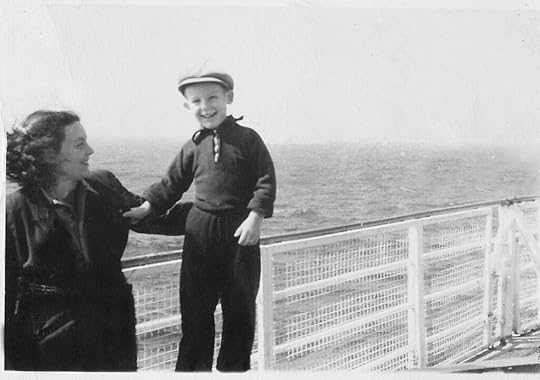
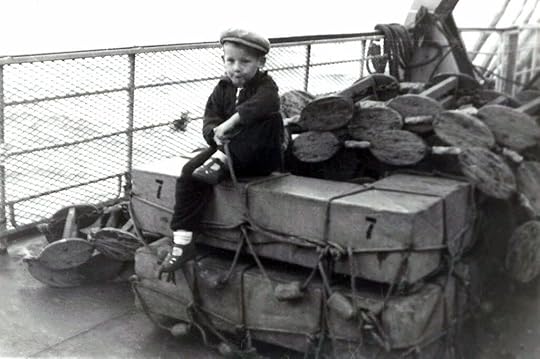
My mother never gave up. She had a degree in law, but was forced by circumstances to work at menial labor for years until we gained permission to come to the United States. As a result, it took many years for her to learn English. Even thought she spoke seven languages when she came. Unfortunately, English wasn’t one of them.
However, she succeeded so well that eventually she became a professor of Russian Language and Literature at a new college in Michigan.
And The Real Life Inspiration for Galya Popoff!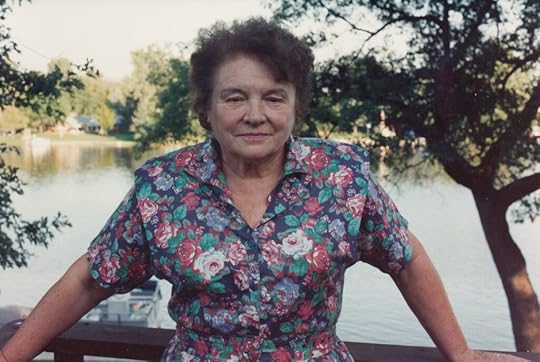
Galya/Helen Kovach/Tarakanov would have loved Galya Popoff and the Dead Souls.Her affectionate review would have been – “Such a nonsense!”
The post Who is the Real Galya Popoff? appeared first on Julia George.