Katherine Collins's Blog
May 21, 2017
Sunday Best – May 21, 2017
I just happen to think that in life we need to be a little like the farmer, who puts back into the soil what he takes out.
– Paul Newman
I was planting a little peach tree the other day, and noticed that the soil was teeming with life, full of the nematodes, bacteria, and fungi that make life possible. Truth be told, it was a little overwhelming, all that squirming and wriggling. At one point I was wishing for a simple scoop of potting soil, fluffy and clean and worm-free.
In many ways potting soil is easier, more controlled and consistent. But of course the tough truth is something we all suspect: easier does not mean better. When it’s in full health, soil is messy, full of creepy crawlies – and it’s all that burrowing and processing that makes life possible.
Remove the mess, and you remove the miracle.
This has me wondering, in my life, what have I over-sanitized? What has been lost in the process? How can I leave room for a few creepy crawlies, for the messy discomfort that encourages new life to emerge?
With so much that we want to grow, there’s only one motto that makes sense.
Bring on the worms.
*****
…speaking of new life, stay tuned for our fancy new Honeybee website, coming next week!


May 14, 2017
Sunday Best – May 14, 2017
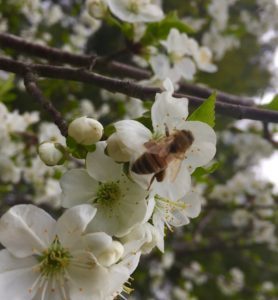
For to the bee, a flower is the fountain of life;
And to the flower, a bee is the messenger of love.
– Kahlil Gibran, The Prophet
Would you rather be the flower or the bee?
We live in a transactional world, where exchange often comes loaded with caution and suspicion. Who is taking advantage of whom? Is the flower a fool? Is the bee a sucker?*
Stop.
Look how exchange happens in the real world: most of the time, there is mutual benefit, or benefit on one side without harm on the other. We do not live in a zero sum, winner-take-all world.
Pollination is far more common than predation.
So would you rather be the flower or the bee? A better question might be,
How will you pollinate?
* Okay, the bee is literally a sucker, taking up all that nectar. But she’s no fool!
May 7, 2017
Sunday Best – May 7, 2017
 This week I’ve had the great joy of , which has brought with it the chance to shake off leftover cynicism, to become Rilke’s springtime person. In a time of transition, it’s so tempting to “armor up,” as Brené Brown would say, getting ready for whatever challenges might come our way.
Truth be told, I did wear my lucky shoes.
But when it comes to that tougher armor, the kind that is built up from the bruises of time and experience, I’m trying hard to leave it at home. I’m trying to dare to say that second sentence, the one that usually remains unsaid. The one that is a little less technically polished and a little more vulnerable, a little more true.
Dear honeybees, as the earth shakes off last season’s toughness to send up new shoots, let’s do the same.
Let’s dare to be springtime people.
We must become springtime people in order to find the summer, whose greatness we must herald.
– Rainer Maria Rilke
April 30, 2017
Sunday Best – April 30, 2017
Tenderness is not weakness. It is fortitude.
– His Holiness Pope Francis
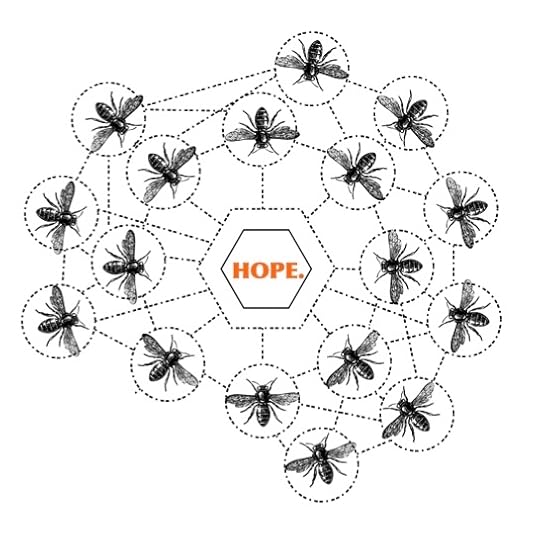
We have so much to do, and we must do it together. Each and every one of us can become a bright candle, a reminder that light will overcome darkness. For Christians, the future does have a name, and its name is Hope.
Feeling hopeful does not mean to be optimistically naive… Hope is the virtue of a heart that doesn’t lock itself into the darkness, that doesn’t dwell in the past, that does not simply get by in the present but is able to see a tomorrow.
Hope is the door that opens into the future. Hope is a humble hidden seed of life that, with time, will develop into a large tree. And it can do so much, because a tiny flicker of life that feeds on hope is enough to shatter the shield of darkness.
A single individual is enough for hope to exist, and that individual can be you. And then there will be another You, and another You, and it becomes an Us.
And so, does hope begin when we have an Us? No, hope begins with one You. When there is an Us, there begins a revolution.
The future is in the hands of those people who recognize the other as a You, and themselves as part of an Us.
I was blessed to hear these words from Pope Francis at the TED conference this past week, and you can already see the full address on their site. Just after His Holiness spoke, dear friend Raj Panjabi, founder of Last Mile Health, accepted the 2017 TED Prize. Last Mile Health is a perfect example of what the Pope is talking about – Science plus Love in action – and it is wonderful to see an even broader community join to form an Us in support of this hopeful, courageous mission.
Dear Honeybees, it is hard to be tender in this tough, tough world. But it’s the only real strength there is.
April 23, 2017
Sunday Best – April 23, 2017
On Framing
I was in Santa Fe this week, for meetings at the terrific and provocative Santa Fe Institute, and I popped into the Georgia O’Keeffe Museum for the umpteenth time. One luxury that comes with repetition is the chance to catch an element that you’ve overlooked before, and this time, thanks to the curators, I came to focus on O’Keeffe’s concept of framing.
The artist had a famous ambivalence about Lake George, where she spent a number of years with Alfred Stieglitz. In letters she often noted the oppressive beauty of all that green in upstate New York, longing for western wind and skies. In fact, her pelvis series originated when she took a “barrel of bones” back east from the desert:
The first year I was out here I began picking up bones because there were no flowers. I wanted to take something home, something to work on … When it was time to go home I felt as if I hadn’t even started on the country and I wondered what I could take home that I could continue what I felt about the country and I couldn’t think of anything to take home but a barrel of bones.
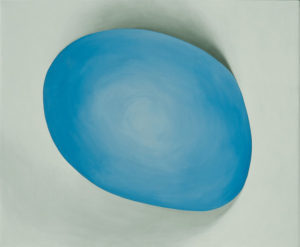
What I had not noticed before is the framing function of these bones, how in many of her paintings they slice through the endless landscape, not floating in the vastness, but rather giving it shape and focus. O’Keeffe notes:
…when I started painting the pelvis bones I was most interested in the holes in the bones – what I saw through them – particularly the blue from holding them up in the sun against the sky as one is apt to do when one seems to have more sky than earth in one’s world … They were most wonderful against the Blue – that Blue that will always be there as it is now after all man’s destruction is finished.
This has me thinking, what is the opening through which I see the endless sky? It’s sometimes a fine line between focus and blindness.
What if I shift that opening, just a bit?
What if I look again, when the light has changed?
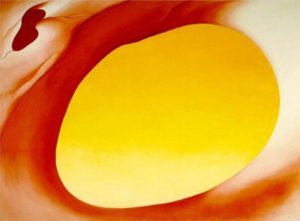
* O’Keeffe’s Pelvis Series, 1947 and 1945, via Georgia O’Keeffe Museum. More in her own words can be read in this essay published at Momus.
April 21, 2017
Friday Feature – April 21, 2017
Hello Honeybees, and happy Friday!
By the end of the work week sometimes your brain’s a little tired, right? Ready for a different sort of engagement. Ready to add a little art to the science of your week. Ready for wonder.
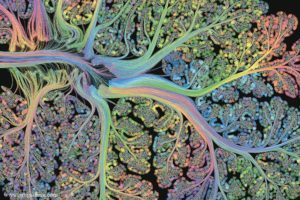
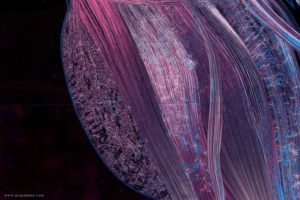
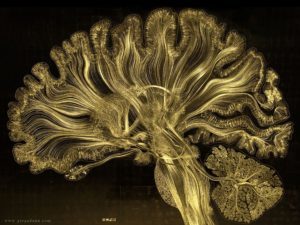
Well, look no further. These wonder-ful images were created by Dr. Greg Dunn and Dr. Brian Edwards, in a project called Self-Reflected. Dunn is a neuroscientist, Edwards is an applied physicist, and both are artists.
Even more mesmerizing than the still images is the video animation, which shows an amazing noggin’ in action. You can read more about the painstaking and multi-disciplinary process of creating these views on their site, or you can just marvel at the beautiful results.
And for the cherry on top, the original series is shown at the Franklin Institute in Philadelphia, site of one of my all-time favorite field trips. If you have not walked through a giant heart, complete with dark twists and turns and thunderous Poe-like beating, you have not yet lived.
* With thanks to UpWorthy, where my terrific sister first spotted this story.
* Please note that this is the final week to support our work at Honeybee! For full explanation of our exciting transition, plus our latest “State of the Field” report, please read more here.
April 16, 2017
Sunday Best – April 16, 2017
Sometimes the right poem appears at the right time. This past week I referenced the inspiration of the Heron Foundation, which got me thinking about the avian kind of herons, and at the same time I was pondering the weirdness of spring, how is it light and emergent and yet full of heavy and seemingly impossible things…. change is good! change is hard! To top it all off, my family is celebrating Easter this weekend, a most joyful and most incredible holiday.
…and then in comes Mary Oliver, right on cue.
Heron Rises from the Dark, Summer Pond
So heavy
is the long-necked, long-bodied heron,
always it is a surprise
when her smoke-colored wings
open
and she turns
from the thick water,
from the black sticks
of the summer pond,
and slowly
rises into the air
and is gone.
Then, not for the first or the last time,
I take the deep breath
of happiness, and I think
how unlikely it is
that death is a hole in the ground,
how improbable
that ascension is not possible,
though everything seems so inert, so nailed
back into itself–
the muskrat and his lumpy lodge,
the turtle,
the fallen gate.
And especially it is wonderful
that the summers are long
and the ponds so dark and so many,
and therefore it isn’t a miracle
but the common thing,
this decision,
this trailing of the long legs in the water,
this opening up of the heavy body
into a new life: see how the sudden
gray-blue sheets of her wings
strive toward the wind; see how the clasp of nothing
takes her in.
Dear Honeybees, as we take in this new season with all its impossibilities, may all of your miracles be common things.
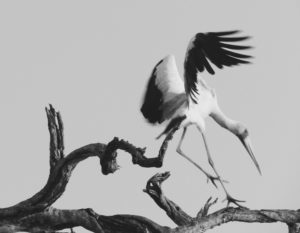
* You are right, this photo is not a heron, it’s a stork! But I like the taking-off-impossibly image. From Sabi Sands, South Africa, 2016.
** You can (and should) read this poem in full context in the volume What Do We Know? — and a terrific interview between Mary Oliver and Krista Tippett can be found at OnBeing.
*** Have you seen our big news?! Honeybee is continuing, but there is just a little time left if you would like to support our work.
April 14, 2017
Friday Feature – April 14, 2017
$1 billion!
The Ford Foundation recently announced that they will invest $1 billion of their $12 b endowment in mission-related investments. This is a Big Deal. It’s the largest commitment of its kind from a private foundation, and the shift builds upon Ford’s sharpened mission in recent years, as they focus on combating inequality.
Why is this such a big deal? Well, first, it’s a billion dollars, which is pretty great. And second, once one “mega” does something, it is a lot easier for their mega-peers to do something too.
Most of all it means that we are marking the beginning of an era that gets beyond the “5% rule,” where foundations give away 5% of their assets each year. This rule is supposed to be a floor, a minimum requirement set by the IRS, but many large foundations plan their work around giving that 5% annually, and not more. This move shows what’s possible when we unlock the potential of the other 95% of assets…. which currently totals somewhere around $700 billion dollars in the US.
And why now? Quotes from foundation President Darren Walker:
On risk and reward: “There is growing evidence that it is possible to find impact investing opportunities that deliver financial and social, double bottom-line returns.”
On purpose: “My conviction is that this moment offers us an opportunity to be accelerators of justice.”
While we are celebrating this important move, let’s not forget to offer giant props to other pioneers like the Heron Foundation, which has paved the way for other philanthropic organizations by already going “all in” and investing its endowment 100% in alignment with mission.
100%. Now that’s a nice round number.
You can read more in this Forbes article, and this insightful NY Times piece, which examines the board-level discussions at Ford in more detail, came online just as we were hitting “publish” on this post.
P.S. Did you miss our big news?! Change is in the air!
April 9, 2017
Sunday Best – April 9, 2017
[image error]
The tighter you squeeze, the less you have. – Thomas Merton
What’s Your Jello?
I revisited one of my favorite talks recently: the New Grand Strategy by Capt. Wayne Porter and Col. Mark Mykleby. I first heard of their work at the PopTech Conference a few years ago, then read their initial paper on the Wilson Center site, then finally the book that most recently emerged from the same set of ideas.
This time through, the line that really hit home was one about squeezing Jello. One central shift that Porter and Mykleby cite is the need to move from a mindset of command-and-control to response-and-resilience. Easy to understand, but oh so hard to do.
Their advice applies at all levels, from micro to macro. Last month my challenge was my own health, in battle with the flu. Other times, it’s been a looming deadline, or not-quite-thriving relationship, or a policy decision with big governance consequences.
When something is amiss, almost always, my first inclination is to try harder, to squeeze tighter. And sometimes, when the issue is solid and tangible, that kind of focus and determination pays off. The book gets finished, the presentation gets done, the decision gets made.
But other times, the challenge is more like Jello, squishy and squirmy, and all of that focused squeezing leaves me with a mess on the floor and a handful of nothing. Turns out you cannot schedule the flu, or create a heartfelt shared vision through brute force.
Dear Honeybees, where are you holding most tightly?
Is it helping?
Jello is, of course, a branded product made by Kraft – and technically, yes, it is spelled Jell-O.
*****
P.S. Did you see our big news from last week?
April 7, 2017
Friday Feature – April 7, 2017
I will freely admit, the mechanics of Washington are mysterious to me. A friend who is a devoted public servant once told me that the way I feel about Washington is the way she feels about Wall Street: from the outside, it is opaque and easy to caricature, but it’s really just like another country where you need to learn the language and customs and then it all makes sense.
I don’t speak the language of Washington. But this puzzles me: our current budget proposal includes eliminating OPIC, the Overseas Private Investment Corporation. True, if you just read the name, you might want to eliminate it too. But here is the reality:
OPIC has returned a profit to the US government every year for 39 years – $239 million in total.
Small and medium US businesses are the main constituency – 77% of OPIC transactions are with these non-mega-corps.
Since 1974, an estimated 275k US jobs and $75b in US exports have been generated through OPIC projects.
And it adds to prosperity and peace in the regions where those US businesses connect, all over the world.
Hmmm. No matter what the local dialect, this would be on my list of things to grow, not to cut.
Dear Honeybees, what are you cutting out in your own endeavors? And why?
This terrific piece by Willy Foote of Root Capital and an accompanying Forbes article have more detail & context on OPIC, including the data points noted above.
*********
For those who missed our big news from last week, please see the details here!
On a related note, this week marks a small shift, from Finance Friday to Friday Features. While some of our commentary might still relate to business or economic issues, we’ll be broadening out our Friday posts to include more wisdom from books, media, and natural creatures as we go forward.