Jason M. Steffens's Blog
January 2, 2023
Top 5 Novels of All Time
as objectively determined by me
The Chronicles of Narnia by C.S. Lewis. (Yes, I am treating the seven books as one.) Bonus points for how re-readable these are. The Count of Monte Cristo by Alexandre Dumas. Known as a story of revenge for a horrible wrong, it is so much more. Read the unabridged version. Winter’s Tale by Mark Helprin. This novel will make you realize that there are things that can be done with both language and plot that you did not realize were possible. A Tale of Two Cities by Charles Dickens. I am limiting myself to one book per author on this short list, even though Dickens can fill such lists by himself. I wouldn’t blame you if, under such constraint, you chose David Copperfield in this spot. I go with A Tale of Two Cities for the opening line, the gravity of the story, and for Sydney Carton. Ishmael (and its sequel Self-Raised ) by E.D.E.N. Southworth. (Yes, I am treating the two books as one.) Most of you will not have heard of this one. Emma Dorothy Eliza Nevitte (“E.D.E.N.”) was a popular nineteenth century novelist. There has never been a better fictional character than the Ishmael she created. You may obtain beautiful hardcover editions of these books from Lamplighter Publishing.[image error]Top 5 Novels of All Time was originally published in Compendium Miscellanea on Medium, where people are continuing the conversation by highlighting and responding to this story.


July 30, 2020
Identifying the Experts
I have certain credentials concerning the study and practice of law. But you should not pay attention to me if I speak on intellectual property law because that was never my field of expertise. If you want to know about IP law, you should seek the words and counsel of lawyers who have studied and practiced in that area. There are countless other areas of law that despite my being a lawyer I know almost nothing about. Similarly, on the topic of infectious diseases, we should not deem statements from medical doctors who are not infectious disease experts as equivalent to those from medical doctors who spend their time studying the prevention, diagnosis, and treatment of infectious diseases.
Experts can be wrong — in fact, they often are, simply because of human fallibility, incomplete information, and other non-nefarious reasons. And when they are wrong, as usually discovered from their own study and the work of their peers, they change their positions if they are intellectually honest. But an appeal to the authority of a credential — in law, medicine, engineering, or whatever — without regard to differences in fields of study and practice within those broad topics is not adequate proof that the actual experts are wrong.
We have all faced having someone speak on a topic about which we know a lot and they know almost nothing, but they talk as if they are an expert. We recognize their foolishness. Our problem is when the subject is one in which we know almost nothing. It is a hard thing to overcome our predispositions to believe the person who says what we want to hear and to disbelieve the person who says what we don’t want to hear. We must learn to identify the true experts. They are usually the ones who have spent years studying the matter and continue to study it, ask more questions than they answer, seek out those smarter than them, contribute in the field, teach others, and admit these things: they have been wrong before, some information is unknown or unknowable, and others are the experts in other fields.

Identifying the Experts was originally published in Compendium Miscellanea on Medium, where people are continuing the conversation by highlighting and responding to this story.
January 15, 2017
On Being a Cubs Fan from the ’80s
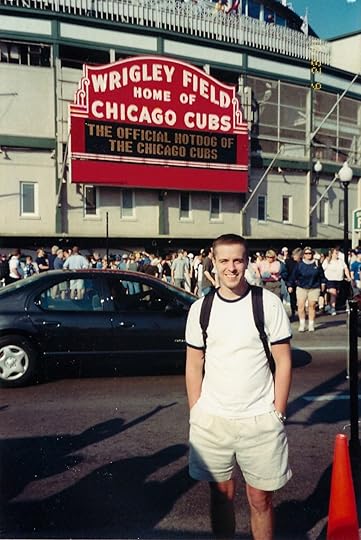 For a brief shining moment in June 2001, I was the official hotdog of the Chicago CubsHere is our history in brief yearly rundowns of the Cubs teams we saw, until we saw the best of all.
There are two types of Chicago Cubs fans among children of the eighties:
those who, as children, thought the 1984 team was the best team of all time; andthose who, as children, thought the 1989 team was the best team of all time.It comes down to which year you were born. That is, were you old enough in 1984 to understand what was happening, or was 1989 the first Cubs winner you really saw? Either way, Ryne Sandberg was — in our small minds — the greatest player who ever lived.
I was born late in 1977. It wasn’t until I was a 7-year-old in the summer of ’85 that I started revolving my schedule around watching Harry Caray and Steve Stone call Cubs games on WGN. Thus, I have no memory of 1984 and its fateful NLCS. But 1985 was long enough ago. In fact, when it is the beginning of your baseball memory, it is a lifetime ago. Here is our history, based on my warped memory:
The Dallas Green — Jim Frey — Don Zimmer Era1985: Throwing out basically the same team as the previous year, but adding in a 40-year-old Davey Lopes, who no one could throw out stealing, the Cubs had the best record in the National League after play on June 11. Then came a 13-game losing streak, mostly against NL East rivals the St. Louis Cardinals and the New York Mets, that destroyed hopes of a repeat division championship. Still, 1985 Thad Bosley is the best pinch hitter we’ll ever see.
1986: Wait. Putting the 1984 team out there doesn’t work anymore? Maybe just replace Jim Frey with Gene Michael? No?
1987: It’s possible that there has never been a more popular player in a single season than Andre Dawson was to Wrigley Field patrons in 1987, elevated by his showing up as a free agent to the Cubs’ spring training facility and offering to sign a contract for whatever amount the Cubs filled in, and by a .688 slugging percentage at his home park. Also, Bill Murray filled in for Harry Caray to broadcast a game against the Montreal Expos and it was awesome:
https://medium.com/media/db754e6655fca94833da04015c754bc8/hrefOther than that, tough year, especially from the pitching staff. I’m not sure how long that 24-year-old Jamie Moyer will last. Nice knowing you, Mr. Michael.
1988: In his second full season, at age 22, Greg Maddux became Greg Maddux, future Hall of Famer.
1989: The Boys of Zimmer. Sandberg-Grace-Dawson. Jerome Walton and Dwight Smith finished one-two in the Rookie of the Year voting. Everything worked, even — somehow, for one year at least — trading Rafeal Palmeiro for Mitch Williams. This was the best team ever, so we thought until Will Clark destroyed all our dreams.
1990: Ryne Sandberg went bonkers with the home runs, Harry Caray got to try to say Héctor Villanueva’s name backward, Doug Dascenzo — using a glove as big as he was — played in his third season without making an error, and Wrigley Field hosted the All-Star Game. So those were the good things.
1991: Year One of the Gary Scott destroys Spring Training pitching, gets destroyed once the season starts phenomenon. Dave Smith, after a nice career closing games for the Houston Astros, came to the Cubs and became the worst closer in baseball. And Ty Griffin (’88 Olympian; 9th pick in ’89 draft) really isn’t going to make it out of double-A, is he?
The Larry Times Era1992: Gary Scott spends a second season teaching us that we must stop paying attention to spring training stats. This was the year that convinced Greg Maddux he had to get out of Chicago if he ever wanted to win.
1993: Why would we worry about the loss of Greg Maddux? General Manager Larry Himes went out and got us Juan Guzman, Greg Hibbard, and Randy Myers! Ryne Sandberg stopped being the team’s best position player.
1994: Two of the most shocking things happened in 1994. First Tuffy Rhodes hit 3 home runs on opening day, against Dwight Gooden no less (Gooden seemingly always beat the Cubs — of course, he did on this day, too):
https://medium.com/media/226d2edd3c968033d8e2be307c5bd382/hrefSecond, Ryne Sandberg, with the second highest salary in the game, abruptly retired midseason. After those two things, the players’ strike that ended the season and resulted in no World Series wasn’t nearly as surprising.
The Ed Lynch Era1995: Baseball is back and Greg Maddux won a World Series with the wrong team!
1996: Ryne Sandberg is back! He seems … older. And now instead of Randy Myers we have Rodney Myers. But, seriously, I played some of the computer version of Strat-O-Matic with this team and the bullpen was pretty good, what with Turk Wendell, Terry Adams, Kent Bottenfield, and Bob Patterson. Yeah, I don’t know how that happened either. The starting pitching — outside of Steve Trachsel having one of his every-other-year good years — was atrocious, though.
1997: There is no hope for the Cubs. Ryne Sandberg decided to retire again.
1998: There is hope for the Cubs! Joyous ridiculousness abounds! The Great Home Run Chase revives baseball from the adverse effects of the 1994 strike. Sammy Sosa went from a nice player to having one of the most absurdly great 5-year stretches. In his 5th big league start, Kerry Wood pitched the most dominant game in big league history against the league’s best offense. Steve Trachsel took a no-hitter into the 7th inning of Game 163 to break the Wild Card tie with the San Francisco Giants. Glenallen Hill was picked up off waivers from the Mariners and hit 351/414/573 in the 2nd half. Lacking a third baseman, Gary Gaetti (a/k/a “The Rat”) was signed in mid-August after the Cardinals released him, and he promptly slashed 320/397/594 down the stretch. (A few downsides to this season: (1) Brant Brown, who had a really nice year, dropped a flyball in leftfield late in the season, losing a game and causing Ron Santo to explode in “Oh Nooooo!”; (2) Jeff Blauser had a career 1.053 OPS against the Cubs in 78 games (under 770 against everyone else), the Cubs signed him to play for them so that he couldn’t do that to them anymore, and he posted a 639 OPS; and (3) the Cubs scored 4 runs in 3 games off Smoltz, Glavine, and Maddux en route to being swept in the playoffs.)
1999: This team was so old. Combine this year with 1997 and it’s even clearer how ridiculous 1998 was.
2000: Glenallen Hill did the most ridiculous thing to a pitched baseball we’ve ever seen: he hit it beyond the left field wall, out of the stadium, past the adjoining street, onto the roof of the next door apartment building:
https://medium.com/media/65c5f215265ccd54ef21800ccf3fbd79/hrefSomehow that didn’t save Ed Lynch his General Manager’s job.
The Jim Hendry Era2001: For many of us Cubs’ fans from the 80s, Mark Grace’s 13-year run as first baseman of the Chicago Cubs, from 1988–2000, was the most consistent thing we’ve seen in sports, so consistently good and durable that it was hardly discussed. I was never happier for an ex-Cub than I was for Mark Grace when he signed as a free agent with the Arizona Diamondbacks before the 2001 season, played well for them, and helped them win a World Series, including a leadoff single in the bottom of the 9th of Game 7 of the World Series. I wish it had been with the Cubs, but he was out of time with the Cubs.
2002: The 2001 team had a winning record and this team finished with just 67 wins, but there was serious cause for optimism in the pitching staff. Kerry Wood, still just 25, got through a whole season; 27-year-old Matt Clement, acquired from Florida, figured out his control problems; Mark Prior, 21, made his debut after being the 2nd pick in the 2001 amateur draft, and Carlos Zambrano, also just 21, put up a 111 ERA+ in 108.1 innings. The Jim Hendry era began mid-season; now it was just time to find a manager.
2003: The Dusty Baker era began with a bang, despite lots of consternation over his preference for veterans over the young guys. In retrospect, the mid-season acquisition of Aramis Ramirez had great long-term benefits. But it was the young starting rotation that drove this team, and at a time before we had heard about towel drills, Mark Prior was the most confident pitcher, and we were the most confident fans when he was on the mound. Until Game 6 of the of NLCS. Kerry Wood’s homer in Game 7 brought renewed euphoria, but it didn’t last long.
2004: Chicago had a three decade string of megastars, one in each of the major sports — Walter Payton, Michael Jordan, and Sammy Sosa. This is the year that ended the streak, and in such a way that we all act like the more recent of those stars never happened. Before the inglorious end of this season, though, the trade deadline deal for Nomar Garciaparra (giving up nothing of significance in return) was the most exciting transaction ever. Unfortunately, the Red Sox were prescient (or lucky) in seeing that Nomar’s days as a healthy and elite player were over. This was the most disappointing team of my lifetime. It was nice having Greg Maddux back in the twilight of his career, though.
2005: In Dusty we no longer trusty. Wood and Prior broke. Garciaparra was injured, which means saw a lot of Neifi Perez, inexplicably batting first or second in the order in more than half the games. The Corey Patterson dream died. Derrek Lee, at least, did something Fred McGriff, Eric Karros, and Hee Seop-Choi couldn’t quite do: make us no longer miss Mark Grace at first base.
2006: The Dusty era was over at the end of 2004. It took a 66–96 record in 2006 for the right people to realize it. This was the year the Cubs threw out every young starting pitcher they had to see what stuck. The most entertaining batter may have been Carlos Zambrano (6 homers in 73 at-bats).
2007: Out with one old-school manager, in with another in Lou Piniella. The first year of the Alfonso Soriano free agent deal turned out well, thanks in part to a down year in the NL Central, which gave the Cubs the division with 85 wins. Félix Pié made his debut. I saw him play a game in A ball in 2003 as an 18-year-old. He looked the part of a future star (and his minor league stats were impressive). There seemed no way he would fail in the way Corey Patterson had. It’s so easy to be wrong about prospects. Did you know he’ll still only be 32 in 2017? (Though after a nice season in Korea in 2014, he seems to be done with baseball.) Anyway, the Cubs went all 1998 and got swept in the division series, though it was impressive watching Geovany Soto steal the catcher’s job in September (1.206 OPS in 16 games in that final month) and finding himself as the starting catcher in the playoffs, leading into his Rookie of the Year campaign in 2008.
2008: This team was really good, despite the fact that 2007’s breakout starting pitcher, Rich Hill, lost his control early in the season and basically disappeared for seven-and-a-half seasons. The only real star season came from Ryan Dempster, who somehow went from a not very good closer in 2007 to finishing 3rd in the league in ERA+ in more than 200 innings. (The amount of value the Cubs got out of Dempster in his eight-and-a-half years with the team was really remarkable, considering how he fell apart in Cincinnati before joining the Cubs and how the Cubs were able to trade him to Texas at the end of his tenure in 2012 for Kyle Hendricks.) Kosuke Fukudome came over from Japan with performance that didn’t match expectations, but just about everyone else was good to really good. That included Ryan Theriot, notwithstanding that the Theriot inspired TOOTBLAN stat was invented. Kerry Wood found new life as a closer. Carlos Marmol excelled in the setup role. The result was a legitimate 97-win season. Alas, for the second straight year, the Cubs were swept in the division series (this time by the Dodgers), and Lou Piniella’s Cubs never threatened again.
2009: Just about everyone who played so well in 2008 played worse or was less healthy in 2009, other than Derrek Lee, Aramis Ramirez, and Kosuke Fukudome. Super Sam Fuld started his career of making super catches in the outfield. Reed Johnson was on the team as well, and it seems possible to me that the Cubs could have been the first team to play with just two outfielders if it had been those two, as each of them could dive from one half of the outfield to the other.
2010: Lou Piniella managed some good teams in his career. This was not one of them, and it was his last managerial season. Carlos Marmol reached the height of his effective wildness, striking out 138 batters in 77.2 innings. Starlin Castro made his debut as the 20-year-old starting shortstop of the present and future.
2011: The team wasn’t good, it wasn’t young, it was paying a lot of money to free agent signees that weren’t working out, and there didn’t appear to be a plan to get better. Nine years after it began, the Jim Hendry era ended. It had its moments.
The Plan2012: After the 2011 season, Theo Epstein and Jed Hoyer were hired and The Plan was implemented. The most visible early part was trading for Anthony Rizzo and installing him as first baseman. Kerry Wood made his final appearance and it was everything it should have been, as he entered the game in relief, struck out one last batter on three pitches, and walked off to a standing ovation and a hug from his son. His career 10.3 K/9 mark remains the second best in baseball history, behind Randy Johnson.
2013: The Plan makes for some bad baseball and an odd collection of players, most of whom are just filling gaps until The Plan bears fruit. It’s easy to not watch. Kris Bryant was taken as the 2nd pick in the draft.
2014: The young guys started coming up and/or taking on bigger roles, among them Hendricks, Rondon, Grimm, Baez, and Soler. After 2 years and 2 months of The Plan producing bad big league baseball, the Cubs spent the last 4 months of 2014 as a 500 team, even after trading away Jeff Samardzija’s hair for Addison Russell. (Oh, how much The Plan was aided by Samardzija figuring out how to control his pitches.)
2015: The Plan hit overdrive. Jon Lester signed. Joe Maddon hired. Kris Bryant at third. We thought we had confidence with Mark Prior on the hill in 2003. We hadn’t yet seen Jake Arrieta in 2015 (and we’ll never see anything like his second half again). 97 wins. It was all so amazing and wonderful until running into the hardest throwing starting rotation in baseball history in the NLCS, just when we all were beginning to think that Back to the Future Part II really had predicted, in 1989, a 2015 Cubs World Series.
2016: If I write anything about this greatest of all seasons, I’ll reveal that I care more about this than I should. Perhaps I’ve already done that.

On Being a Cubs Fan from the ’80s was originally published in Compendium Miscellanea on Medium, where people are continuing the conversation by highlighting and responding to this story.
December 20, 2016
My Writing
I wrote and self-published a novel in September 2013 titled Never on Sundays. You can buy it in paperbook or for Kindle, Nook, or iBooks. It has a Goodreads profile. Read how I came to write the novel. Read an excerpt. Here is the description:
A star baseball player decides that attending church is more important than the game he grew up loving and that will earn him millions. While his team works to keep him playing everyday, his wife must deal with the life she has come to expect turned upside down. At the same time, a Baptist pastor is faced with the loss of his church’s property for his decision to lead the church out of an association. A lawyer’s encounter with the athlete and the pastor causes him to see as never before how his own life has become defined by his job. Never on Sundays examines the division — and the hope — created by choosing the best path.Sermons
I have on occasion preached and taught at Twin Pines Baptist Church, and have adapted some of those messages in a Medium publication titled Antioch Road.
BloggingI post miscellaneous things in a Medium publication called Compendium Miscellanea.
Puppet SkitI wrote a 3-part puppet skit called Bobzil for Vacation Bible School at Twin Pines Baptist Church in the summer of 2013. Each part is designed to last 5 to 7 minutes. I put it in the public domain, so it is free to use, copy, distribute, or modify as you see fit for your own needs, with or without attribution.
Legal WritingWhile in law school, in 2002, the Iowa Law Review published my student note titled The “Peculiar” Being: The Rights of an Unborn Child in Iowa. It is available for purchase on LexisNexis. (I don’t receive any of the proceeds.)

December 4, 2016
It is so fashionable today to criticize email as a productivity drain, that it is fascinating when…
It is so fashionable today to criticize email as a productivity drain, that it is fascinating when someone exalts its benefits as a productivity booster. And it does have its benefits. Mark Cuban unashamedly stating his love of it reminded me of Dave Girouard’s 2013 column “In Defense of Email.” There are ways to do email better, yes (not replying with just a “thank you” is one), but many of us would be much less productive in our jobs without it.

It is so fashionable today to criticize email as a productivity drain, that it is fascinating when… was originally published in Compendium Miscellanea on Medium, where people are continuing the conversation by highlighting and responding to this story.
October 13, 2016
Supporting Donald Trump Damages Our Christian Witness
I am a Christian, and an independent Baptist. There may be no more reliable anti-Democratic Party voting bloc in America than independent Baptists. The reasons are numerous, and include that party’s antipathy toward preborn children, marriage properly defined, religious liberty, parental rights, and support for Israel. (At the same time, Democratic Party governmental leaders are on our prayers lists, and most of us even mean our prayers for them.)
But there is now not just opposition to the progressive agenda, there is a fear among us, and her name is Hillary Clinton. That fear manifests itself in supporting Not Hillary Clinton, and his name is Donald Trump. It’s not called by the name of fear, but rather an appeal to not “wasting” our vote, an appeal to supporting someone with a chance to win on the chance that he will not be so bad as Hillary Clinton. But it looks and sounds and smells like fear, and not the one fear — that of God — that the Bible allows and commands.
Have we, as some say, arrived in the mess our nation is in because for too long we as Christians have not been engaged in the political arena? So that we need more “legislative rallies” and “capitol connections?” Or is the opposite true — that Christians have been so focused on the political arena that we have paid less attention to, as Jesus put it, our “first love?” I do not know. It may be that this is simply the way the world is headed and we have nothing to do but play the part to which God called us in the world as it exists. But to do this, we must recognize that our witness for Christ is compromised by our witness for Trump.
We are not to put our trust in princes, but what else do we call support for someone who says that he alone can solve our problems?
We say all human life has inherent worth deserving of protection from conception, but what does it say to support someone who has lived his life being “pro-choice in every respect” and who defends Planned Parenthood?
We say we believe in sexual purity, but what does it say to support someone who has bragged about his infidelities, engaged in voyeurism, and objectified women?
We say we cherish the institution of marriage, but what does it say to support someone who has not cherished his own and who has sought to break up others’?
We say we love the nation of Israel, but what does it say to support someone who praises possibly Israel’s greatest threat, Putin’s Russia?
We say we value truth and honesty, but what does it say then to ignore the lies, the shortchanging of contractors, and the stiffing of creditors, and further to excuse the fraud that was “Trump University.”
In other words, a support for Trump is a sacrifice of virtues we hold most dear. And armed with these conflicting positions, how can we expect anyone to accept our testimony that Christ is preeminent, that our hope is in Him alone, that to die is gain, that we are His ambassadors?
“But the Supreme Court!” No, that is not sufficient.
“But Dole, Bush, McCain, and Romney weren’t perfect!” No, they were not, but I will not engage in your moral equivalency between them and Trump.
“But Hillary Clinton!” I am not afraid.
Trump could offer me the whole world, but I would deny the offer all the same.
To say that you will at least be holding your nose while voting for Trump does not help. We are not voting for a platform and we are not voting for a vice president. We are voting for a person to fulfill a public office. Our vote for a person — and our admonition that others do so as well — is our support, and when that support is given to one like Trump, it makes our declarations of support for a host of Biblical virtues appear less genuine, less important than worldly position and comfort.
I’d like to convince people that the parade of horribles they see resulting from a Hillary Clinton presidency are not so inevitable. The office of the presidency, including its power to nominate Supreme Court justices, is not so powerful so as to be able to destroy our constitutional order or who we are as a people.
But, ultimately, so what. If Hillary Clinton and her Supreme Court nominees take away our churches’ tax exemptions, push us further toward European-style socialism, and even take away our guns, so what. None of that compares to whether we maintain a consistent, faithful witness for Christ.
Christians should not support Donald Trump. Our calling is greater and higher than political victory. Our trust and faith in God is sure. Let us demonstrate it.
Further reading: Matthew Anderson : “Should Evangelicals vote for Clinton or Trump? No.” Erick Erickson : “An Open Letter to the Religious Right”Liberty University Students: “Liberty United Against Trump”Todd Friel: “What Christians Can Learn from the Cesspool of Donald Trump’s Mind”
Supporting Donald Trump Damages Our Christian Witness was originally published in Compendium Miscellanea on Medium, where people are continuing the conversation by highlighting and responding to this story.
October 10, 2016
Our Duty
“Let us raise a standard to which the wise and honest can repair; the rest is in the hands of God.”— George Washington, Speech to the Constitutional Convention (1787)
“Let us hear the conclusion of the whole matter: Fear God, and keep his commandments: for this is the whole duty of man.”— Ecclesiastes 12:13
Our duty is clear. It only becomes complicated when we adopt the moral relativism of the world’s philosophies, for it is then that we must put everything to the test of a false balance. On this false balance, it becomes a moral imperative to excuse all manner of evil for the chance of avoiding what is ostensibly some greater evil. But as we take our eyes off our calling, as we fear that which is not to be feared, our judgment is weakened and our witness is compromised. If you have been told that it is your duty to save any man-made institution or government by accepting Evil A to avoid Evil B, you have been told a lie.

Our Duty was originally published in Compendium Miscellanea on Medium, where people are continuing the conversation by highlighting and responding to this story.
"Our Duty" in Compendium Miscellanea
“Let us raise a standard to which the wise and honest can repair; the rest is in the hands of God.”— George Washington, Speech to the Constitutional Convention (1787)
“Let us hear the conclusion of the whole matter: Fear God, and keep his commandments: for this is the whole duty of man.”— Ecclesiastes 12:13
Our duty is clear. It only becomes complicated when we adopt the moral relativism of the world’s philosophies, for it is then that we must put everything to the test of a false balance. On this false balance, it becomes a moral imperative to excuse all manner of evil for the chance of avoiding what is ostensibly some greater evil. But as we take our eyes off our calling, as we fear that which is not to be feared, our judgment is weakened and our witness is compromised. If you have been told that it is your duty to save any man-made institution or government by accepting Evil A to avoid Evil B, you have been told a lie.
Our Duty was originally published in Compendium Miscellanea on Medium, where people are continuing the conversation by highlighting and responding to this story.
September 24, 2016
Senator Cruz: Nothing has changed about the character of Donald Trump or the attacks he made…
Senator Cruz: Nothing has changed about the character of Donald Trump or the attacks he made against your wife and your father. What has changed is that (1) it has become clear that Trump has a chance to win, giving him the ability to continue to shape the GOP in his own image; and (2) RNC chaiman Reince Priebus has threatened consequences in future elections against those who refused to endorse Trump. It is not enough to say that Trump may be better than Hillary Clinton in a few areas without addressing his own significant flaws. I will be voting against them both, and voting for someone (Evan McMullin) who is decent and competent, and understands the role of the presidency. We should not let a fear of Clinton blind us to the evil that is Trump, or the hope that lies in Christ alone.

August 6, 2016
“Vote as if your ballot determines nothing whatsoever — except the shape of your own character.
“Vote as if your ballot determines nothing whatsoever — except the shape of your own character. Vote as if the public consequences of your action weigh nothing next to the private consequences. The country will go whither it will go, when all the votes are counted. What should matter the most to you is whither you will go, on and after this November’s election day.”
Those running for election are not entitled to my vote. They earn it, or they do not. On election day, the ballot box does not record me holding my nose; it simply records my support. Some candidates whose names are on the ballot are not worth it, and in some elections none are. If I were to support their lack of decency and fitness, my own character will have been adversely affected.

“Vote as if your ballot determines nothing whatsoever — except the shape of your own character. was originally published in Compendium Miscellanea on Medium, where people are continuing the conversation by highlighting and responding to this story.