Sally Morgan's Blog: Down the Rabbit Hole
June 3, 2015
Rocking Camden
 Lime green leather biker jackets, red rubber platforms, Nepalese paper light shades, 1950s prom dresses, antique books, a £46 million house: you can get anything in Camden. Since Dickens immortalised its oldest, dingiest places in his stories this labyrinth of decaying, workhorse Victoriana has layered itself in paint and legend. And, once a year, it throws back its head and roars to its very own rock festival.
 Ch-ch-ch-ch-changes
Camden hasn’t changed much since I first came here in 1989. I’m sure Bowie and other now-greats, who played here when the bars were more famous than they were, would all recognise it too.
Despite the inevitable property price hike and designer brand creep – a multi-storey All Saints now glares snootily at Dingwalls across the lock, for instance – Camden remains truly schizophrenic.
Market sellers brazenly pitch stalls practically in the doorways of emporia; and emporia is really the only word that does these art installation / wild frontier trading posts any justice. The merchandise is a beguiling stream of dichotomies; lacy dresses and nose rings, tattoos and tattoo removal, tutus and novelty sweatshirts, ball gowns and bovver boots. It’s a mix that shouldn’t work but does, attracting 100,000 perusers on a normal weekend. On Camden Rocks weekend, you can easily add another 80,000 on top.
While I’m still searching my over-stimulated mind for the perfect description for this place I almost, quite literally, trip over it: a street entertainer dressed as Tim Burton’s Mad Hatter, complete with tea party and man-sized white rabbit.
Of course.
Camden is Wonderland.
On Snakebite and Black.
Amy Winehouse lived here, wrote her heart-wrenching songs here, drank in a local pub like she wasn’t famous, fell in love with a bad boy, whose name she tattooed across her heart, and she died here – at the rock-tragedy age of 27. It doesn’t get much more Camden than that.
Awesome Bands, No Wellies
The best thing about going to a rock festival in the middle of London is that there is no mud and no camping. We found a great canalside apartment on AirBnB, that cost us less than staying at a Travelodge. The next best thing after that was a toss up between a gazillion food choices, loos with brick walls that can’t be pushed over, decent alcohol and – at around £35 each – pretty cheap tickets.

Kerri Watt
The line-up this year was extensive but I’d never heard of most of them. First act we stumbled upon was soulful, country rock singer, Kerri Watt, in the emerald green basement of BrewDog. It must take proper guts to get up on stage with just your guitar and sing your own stuff to a room of tiddly strangers – and she did it beautifully.

Lips
Next up was Dingwalls, named after a bloke called Mr Dingwall, whose name has stayed painted on the wall for about 150 years. Girl fronted rock dub ska band, Lips, were on in the upstairs bar. Very cool cross-genre stuff. Singer, Natalie, practically rattled the windows with a voice that seemed far too big for such a small body to produce.

Under The Influence
A stroll up Chalk Farm road took us to Barfly for Under The Influence. Heavy rock mixed with rap lyrics and soulful, banging choruses, a bit like a young Rage Against the Machine. They tarnished their angsty vibe a tad by flogging CDs for a fiver out of a sports bag at the end of their set, but we loved them anyway.
Worst band award goes to: And You Will Know Us By the Trail of Dead. We caught them at Electric Ballroom. Ridiculously long name aside, I lasted for about five minutes before their noise forced the will to live out of my body. I followed it back onto the street shortly afterwards.
Skindred was the band my man really wanted to see. We got to The Underworld very, very early to secure our place in the pit. It was so hot and dark and oppressive down there that we couldn’t handle it and went for a burger at Haché instead. Imbibing nothing but beer and vodka all day with no food is clearly a practise handled better at 23 than 43. Something else that the years have changed: a crap venue means a crap experience, regardless of who you want to see play.
The Main Event
The queue to get back into Underworld was four-deep. It wobbled all the way around the building and half way back to BrewDog. First non-booze-induced hiccup in our day; it didn’t take a sober genius to realise we were very unlikely to get in. Even if we did, it was going to be hell in there.
Our burgers blotted the alcohol pickling our brains just enough for us to formulate a plan. My man and I left our mate hedging the Skindred queue while we checked out the other venues: seeing any band now was preferable to spending the 9pm slot on the street.
The queues to every major venue were as bad as the one we’d left behind. Back at Dingwalls, however, the rock Gods were on our side. For the 500 capacity downstairs venue there was absolutely no queue. It was un-claustrophobic, had great visibility with the floor sloping down towards the stage and room at the bar. A quick call and an unsteady sprint for our mate later and we were all in. They shut the door behind us. It was a rock ‘n’ roll miracle.

Us. And Modestep.
So circumstances decided that our main event would be Modestep – I even knew who they were. Bonus. They sound like all the best bits of hard core house and hard core rock, and they definitely metalled it up a bit for this set.
The drummer is insanely good and the singer infected us all with the same dark electricity that binds the band together. We went mental from the moment the guitarist sauntered on ten minutes late swigging from a bottle of rum, til the masked synth man finally pulled the plug.
After Party Anticlimax
It wasn’t possible to top Modestep but we had tickets for The Underworld after party, so we went. This time it was empty but still oppressive. I got glared at by an archetypal rock chick in black fishnets, blacker hair and blackest eyeliner; my noncommittal jeans, boots and shirt clearly offended her. When a very shouty trashy thrash band came on we left.

At Camden Rocks 2015
We ended the night in a cheesy cocktail bar drinking espresso martinis and talking shite with people I will never meet again.
Cheers Camden, you twisted nutter. We’ll be back.




November 3, 2014
Sweet little lies

We all lie. It’s a fact of life. We use white lies to mask painful truths, make others feel comfortable and protect our fragile egos. We might say we prefer nasty truths to nice lies but even that’s a lie: how many fat people like being told they’re fat? Lying is normal. And it’s OK. It’s completely different from knowing you’re doing something wrong and doing it anyway.
“Lying is bad!” Say all parents to their children, followed by something like: “Santa doesn’t bring presents to liars.” Ah yes, parenting 101. Using the most popular fiction in history (after the virgin birth) to inspire not truth, but fear, through hypocrisy, not honesty.
Kids are born excruciatingly honest. They don’t need to learn not to lie, they need to learn how and when to lie. Who hasn’t lived through the shame of moments such as, “Mummy, that ugly old lady has a beard,” booming from your toddler in an inescapable checkout queue?

Tell me lies, tell me sweet little lies …
Artifice or art?
As adults we know there are some true things we shouldn’t say and some false things we should. We learn how to paint over our own ugly truths with more than words: make-up, hair dye, Botox, corsets, stacked heels and depilation. We see Facebook full of filtered selfies, learn about the fickle frame of justice, the flattering fibs of fashion and grow to love the flamboyant fictions of movies, books, songs and TV.
Truth and lies are learned social behaviours. A far better measure of integrity is our understanding of right and wrong. Scruples. Telling a lie to save someone’s feelings from a pointless painful truth is right. Telling a lie to hurt, inspire hatred or gain personally at the expense of another’s happiness is wrong. Somewhere in the middle lie most of us.
I say most. Some people take dishonesty to a whole new realm; consciously manipulating others through destructive deceit with nothing in their sights but their own purpose. Their lies are blackened with hot, sweaty guilt that set their pants on fire. Why pants? To remind them that they’re being arseholes. Wrong, wrong, wrong.
Hot pants and dirty business
 Living with a burning behind can be a lucrative game. If you can handle the guilt it’s easy to manipulate certain legalities – making you technically right, even if you’re still a wrong ‘un.
UK Limited Liability law protects honest business owners from personal loss in the event of dissolution. It also means dishonest directors with Limited Liability can’t be sued for losses and debts incurred by their businesses.
The Law was passed in 1855. While the entrepreneurial advantages to the scrupulous business owner were obvious, so too was the potential for abuse by arseholes. Contemporary lawyer and legal writer, Edward William Cox, said:
” … he who shares the profits of an enterprise ought also to be subject to its losses; that there is a moral obligation, which it is the duty of the laws of a civilised nation to enforce, to pay debts, perform contracts and make reparation for wrongs. Limited liability is founded on the opposite principle and permits a man to avail himself of acts if advantageous to him, and not to be responsible for them if they should be disadvantageous; to speculate for profits without being liable for losses; to make contracts, incur debts, and commit wrongs, the law depriving the creditor, the contractor, and the injured of a remedy against the property or person of the wrongdoer, beyond the limit, however small, at which it may please him to determine his own liability.”
And it burns, burns, burns …
Abuse of this law is called ‘phoenixing’ – something I experienced personally in 2009. I bought a shower I never received from Dial Group International. I tried to serve them with a court summons but the business had been dissolved with zero liability. The same directors formed another, almost identical business within days (probably with assets stripped from the original) but I could do nothing to approach them.
The debt they owed me had died with the dissolved business. The new business that arose from its ashes was owned by the same people. Trading standards knew it was the same people, indeed, they knew this wasn’t their first phoenix enterprise. Yet there was nothing I could do. They were protected and I was not.
This business has since been featured on BBC’s Watchdog along with many others. It is obvious, when faced with a camera crew, that the arseholes behind them know what they’re doing is wrong. Because they look as guilty as a puppy caught shitting on a new rug.
These are the burning bottomed people who get permanently struck off Santa’s list.
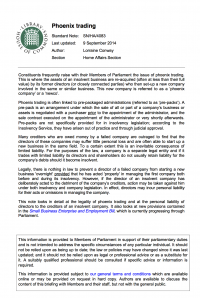
Click for full report
On September 9th 2014, a briefing was submitted to Parliament. It details what is and what is not considered phoenix fraud and looks at changes to the Small Business and Employment Bill currently being proposed. The purpose of these changes is to make fraud more difficult. Unfortunately, it’s also very clear in this document why the unscrupulous get away with what they do: the rules around the phoenix process are far too easy to manipulate, making it possible to bring fraudulent activities within the law by a gnat’s whisker. Changes to business law have been suggested before and have come to nothing, so let’s hope this time, something is actually done.
The Fraud Advisory Panel works to bring these arseholes to justice, as detailed in this 2012 report. Some businesses do, honestly, hit hard times and dissolve. But if you think you’ve been ripped a new one by a phoenix scammer, report it to Action Fraud.
If you are involved in such a scam, shame on you. Think for a second about what you’re doing. Your grubby theft masquerading as business is wrecking lives, causing honest people bankruptcy and perhaps even breaking up marriages through financial stress. Plenty of people earn great money without causing such damage. Become one of those instead.
The difference between truth and fact
Facts happen. Our actions are facts.
The things we say and think are individual truths; the product of our interpretation of facts. And the words we use to express our reasons are subjective. They are open to perception, translation and miscarriages of context.
Facts don’t change.
If you rip someone off, you can try to paint over the ‘why’ with self-aggrandising legalese. It won’t change the fact that you ripped someone off or that it’s wrong.
I love Maya Angelou but I don’t agree with this quote of hers: “People will forget what you said and did but they will never forget the way you made them feel.”
We are creatures of mnemonic narrative, for whom stories stick in our minds more than isolated moments. It is why we all think we have a novel in us, why we identify with favourite movies or use fictitious characters to illustrate a factual point. It’s also why we always remember how people make us feel, and we always remember why.
 Let’s not teach our kids falsehoods about how good people don’t lie. Let’s instead teach them the importance of scruples, kindness, right and wrong.
Because an arsehole is still an arsehole, whichever way you paint it.
Fact.


September 14, 2014
Breaking bad and fixing better
 Frattura de polso means ‘broken wrist’ in Italian. I learned this in Edolo hospital. I didn’t get as far as learning ‘pain’, before the morphine kicked in.
What I did learn was that Tramodol goes down exceptionally well with brandy, broken stuff can end up stronger and Italian mountain dwellers love a bit of the impossible.
Best laid plans and all that

Passo Tonale. If you look closely, you might see the hole my arm left in the snow
I knew I’d broken my wrist as soon as I hit the snow. Classic snowboarder’s injury, apparently: a simple ‘hand down’ at the wrong angle splinters several bones. Five, in my case.
It was exactly half way through our holiday. Sunshine blasted out of the kingfisher blue sky turning the powdery runs into glittering icing. Such a contrast from the day before when we’d tackled our first black run in a blinding blizzard. Having said that, if I had been fully aware of the cliff-face I was taking on I probably would have bottled it and stayed on the chair lift. Maybe it was a case of pride before a fall; I was pretty bloody pleased with myself on the Tuesday evening.
Delighted with the clarity of Wednesday morning, we steamed up to Passo Tonale and practically drop-kicked the kids into their ski lesson. Barely an hour later I was skidooed off the mountain, every glittering, sunny bump sledgehammering through my smashed arm.
Lying on my stretcher on the floor of the tiny, white-tiled first aid hut nestled between ski schools and restaurants, wincing at savage flashbacks of bone shattering, it dawned on me that arm pain was the tip of this iceberg. This injury was going to be a full body kick in the crutch. A right-handed writer with a broken right wrist: fabulous. What the hell was I going to do about the stack of work waiting for me at home? I had websites and eBooks to write, a demo video to produce. I would be letting clients down and I wouldn’t be getting paid. Holy crap! What about school runs, cooking, laundry?
Snap
It’s pretty easy to feel sorry for yourself in such a situation. It is also, however, easy to snap out of it when faced with another person in a worse state than you. Enter a most unfortunate woman, stretchered into the hut, making noises I’ve only ever heard in a maternity ward. Her foot was dangling back to front. I can live with a broken wrist, was my first, selfish thought.
Next stage of injury: feeling stupid. With all my OCD planning and packing I had not foreseen this. Or perhaps I had. I always like to learn a few words of the language spoken in whichever country I’m about to visit, you know, ‘just in case’. My predictable stroll through basic Italian had taken me to a train station, a pizzeria, various social events and a museum. While useful for a weekend in Rome, not so much when taking three under twelves skiing.
Pericolo: danger, Aiuto: help and Ho torto mio ginocchio: I’ve twisted my knee, were quickly added to my skeletal Italian lexicon. Frattura de polso. Could have kicked myself for not learning that one. Which is something the poor cow next to me wouldn’t be doing for a while.
Breaking worse
 First injury in 32 years of skiing, I thought, as we descended to Edolo in the ambulance, trying not to look at the bulbous deformity of my hand. Still flat on my back, ears popping, I remembered the first time I’d skied. Ten years old, on a school trip to Aprica, a town only about 30 ks from where I’d just tried to punch a hole in a mountain. I’d been blown away by the theatricality of the views on that first trip; the steepness of the mountainsides, the deepness of the valleys into which they plunged, defiant houses and trees clinging to sheer rocks, flicking their teeth to impossibility. I’d been equally stunned this time. Shame I couldn’t see them now on this glorious day.

Ponte di Legno’s 17th Century church
I was worried about the boys. They must be hungry. I hoped they would find a shop selling fruit and snacks like the one in Ponte di Legno, the 17th century town we were staying in. Blood oranges the size of grapefruits, grapefruits the size of cantaloupes. Ten different kinds of mozzarella, braseola, fresh bread. We’d pondered, incredulous, how it could be possible to find food of such quality at 1258 m, precariously teetering on Europe’s snowy roof, accessible only by roller-coaster roads, in the middle of winter. It beat seven bells out of my local, vertically unchallenged, Sainsbury’s.
At the hospital they cut the arm off my top. I felt drunk with pain. They gave me morphine. It still hurt but I didn’t care any more. X-rays came next. Everyone was so kind to me that I didn’t see the final bit coming.
A reduction. Such a harmless sounding word for such a barbaric act. Four people and one bone doctor. A bowl of plaster. Two yanking the hand, two holding the elbow, bone doctor slapping on plaster while the zig-zag wrist is pulled straight. Worse than child birth. And that’s enough about that.
Breaking good
The right-angle of heavy plaster encasing my arm from shoulder to finger nails was now the centre around which the whole family had to orbit. A sympathetic pharmacist mercifully furnished me some particularly creative pain relief. Tramadol drops in brandy: they work.
Back at home all my worries about tackling the every day came true, starting with resetting all deadlines to accommodate two weeks of rest. A million little movements, until now taken for granted, were rendered either laughably impossible or eye-wateringly agonising.

Barbie called. She wants her arm back
The good news came two weeks later when the ten pound monster cast was replaced with funky pink fibre glass, and more X-rays revealed I wouldn’t need surgery. The abject torture of the reduction had worked. Turns out, if you’re going to break a bone, best place to do it is on a ski-field. The bone doctors there get quite a lot of re-setting practice. I hope the poor girl with the broken leg had similar good news.
Stronger than before
When my arm emerged six weeks after I left the mountains, it was hairy, smelly, flakey with no visible muscles or even veins. It was a waxwork of an arm, frozen and stiff. I couldn’t twist it, clench a fist, bend my wrist or lift anything. It was shocking all over again to understand that healing the bones within was just the start of getting better.
My son waxed the hairs off for me. He enjoyed that much more than waxing his own leg, which his curiosity insisted he try. Silly boy. The rest was up to me. The success of physiotherapy like life, I learned, depends on how much effort you are willing to make: you only get out what you put in. I was willing to make a lot.
We are so much stronger than we think we are. Our bodies are incredible healing machines all by themselves. Add spirit and mindset to the mix and our potential is immense.
 My break was bad – an intra-articular displaced distal radius Colles fracture, plus fracture of the ulna and three carpals. People go through far worse. My physio said it was highly unlikely my arm would ever be properly better again. I refused to accept that and launched into full-on rehab mode. It hurt a lot but it’s better now. To the outside world, my wrist was never broken.
I think about snowboarding that mountain again now and this time, not breaking my wrist. I think too about those little Italian houses and trees, clinging to an almost vertical rock face and the wonderful food we found in the most unpredictable places. I join them all in flicking my teeth to the impossible.


January 15, 2014
2014 resolutions? Make them respect-olutions and they might just stick
 The echoes of new year resolutions are still ringing around the streets, even as the first ‘dry-athalon’ casualties slink back to the pub. True story: A friend of mine, one January years ago, joined a gym to get fit. He only ever went there on his way to McDonalds to buy fags from the bar.
What start out as the best new year intentions for self improvement largely crash and burn. Why? Maybe we’ve got this whole thing wrong …
It’s not news that resolutions made in December rarely last until February. So why do we make them, over and over again, knowing they are probably doomed?

Rolling Stone, Keith Richards. Alive thanks to never having given up anything for new year. He couldn’t survive the shock of a detox (unconfirmed)
The timing doesn’t help. January is depressing. Yet it is now, precisely when we need all our vices to remain sane in the long, dark hour of the year, that we impose upon ourselves the sort of extreme, active detox that may well be the only thing capable of killing Keith Richards. Humans are predisposed to resist change with every cell. We’re already struggling with a new date and turning a year older, surely it’s too much to introduce a new, miserable, restrictive regime on top of all that?
I fully support everyone who’s decided to overhaul their pizza/lunges ratio. Giving up smoking is always going to get my thumbs up and I’m a huge fan of drinking pulverised fruit and veg so juicing aficionados, I get you. Same with fledgling yoga fans, mint tea drinkers and vegans. It’s refreshing and inspiring to see people being brutally honest about their lifestyles and taking action to turn muffin tops into abs. Much better than listening to people whine about their thigh-rub as they shove in another doughnut.
But we are followers of narrative. Abstract concepts such as ‘lose weight’ or ‘eat less’ don’t mean very much unless they are incorporated into a bigger story. What we do know is that being greedy in life is what leads to making resolutions. Because, as we all know, greed is bad. It causes banks to collapse, people to borrow too much money for houses that bankrupt them and is fuelling the obesity epidemic.
Unhappiness leads to greed and greed makes us unhappy. So it’s the unhappiness that needs addressing in order to sort out the greed. An unhappy soul is just as unhappy in a thin body as a fat one; ask any anorexic. As someone wise once said, “Happiness lies not in having everything you want, but in wanting what you have.” That means taking stock, being grateful, thanking your lucky stars.
Surely we all know this? Yet looking down the list of the 50 most common new years resolutions (The Mirror), it seems we think addressing the consequences of greed with more greed is the answer. We want cosmetic surgery, a body like Beyonce, to spend less and earn more, to join expensive gyms, to get married and have a baby. We claim to hate change, yet seem unbelievably greedy for it. No wonder most resolutions get kicked to the curb before January is out. The stress of figuring out that little paradox makes me want to skip the psyllium husks and tear into the nearest block of cheddar.
Resolutions need a new name. They need to be part of our living narratives and more about respect for ourselves and others, being generous, giving and grateful. They need to be respect-olutions.
Choose a respect-olution that benefits the wider community and you’re already more likely to succeed in your endeavours – run a marathon for charity instead of ‘start running’. Plus, it will make you feel even better about yourself than going for a month without a drink.
Start with gratitude, follow up with generosity and see how much you end up giving – and getting back.
Saying ‘thank you’ and feeling true gratitude for all the good things in our lives is the singular most uplifting thing we can do.
Try it.
Out loud.
(Somewhere quiet, so the men in white coats don’t hear.)

Passive aggression: The act of making lots of people uncomfortable through indirect, angry behaviour rather than dealing with whatever it is that’s bothering you
Compound this thanks with generosity of spirit – it doesn’t have to be a big thing – and see how different your day feels, how much happier you are. Ignore passive aggressive barbs on Facebook, or if you’re a poster of such things, try NOT posting. Leave a nice comment for someone instead; be happy for them, rejoice in your friends small successes and they’ll rejoice in yours.
The grand vista of life is what actually matters. Stubbornness and point scoring sprout from the same place as greed. Don’t think you’re a greedy person? How many times have you refused to talk a problem through with someone? That’s greed for control. By your actions, you’re saying your personal drama is more important than anything or anyone else. Where’s this lack of generosity got you? Is your problem resolved? Are you happy now, or reaching for the biscuits?
The best bit ever …
Talking is the singular best stress reliever, and we need to do more of it. Switch a little bit of social media for actual socialising, resolve to be happy, realise you want for nothing and greed should leave you alone. Imagine a world where staying at home is less healthy than going to the pub. Some researchers believe that time is already upon us with the benefits of socialising far outweighing any negative effects of moderate drinking. So go enjoy the company of friends, talk it out, announce your great intentions and be generous with your support of theirs.
Keep resolutions where they belong; at the end of arguments. And this year, give more, thank more, respect more and next year, you might find you don’t need to make any resolutions at all.



December 11, 2013
Next stop: Christmas
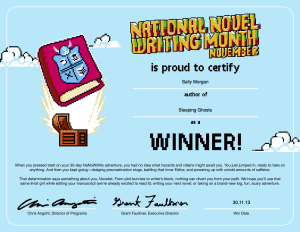
It’s done. 50,139 words and my NaNoWriMo writing challenge is complete. It’s a good start, I’m happy with the words I’ve written but there’s still a very long way to go until this book is finished.
For now though, I’m catching up with work and indulging in ‘chewing gum for the eyes’ TV. Phew. Novembers are never going to be the same again.


November 9, 2013
NaNoWriMo – the trick is packing it all in

In 1997 I went to Asia with a friend. We were obsessed with travelling light and bought tiny rucksacks, easy to haul on and off of buses and trains and use as pillows to help prevent them being stolen.
Great plan, you might think. Apart from the proportions of our packs not matching at all the volume of things we might require or want for a supposed year-long trip. Of course, only once we were well into our overland crawl from Nepal to Goa, did we realise quite how ridiculously ambitious our light-living ideals had been. Thus, we always had more stuff to carry than our bags could hold.
There had only ever been space for necessities; our packs were bulging before we left England with malaria pills, toiletries, first aid equipment and clothes suitable to take us from a Sikh temple to the beach. But as I travelled, I wanted to buy mementos too. I was pretty certain this was a one-time trip – and I haven’t been back yet. Sarongs and small ornaments quickly joined the ‘necessities’ list. More space had to be found.

I would wake up in the night, my dreams of how to fit more into my pack seared onto the backs of my eyelids. I would have to test my idea there and then, by torch or candlelight, gleefully wasting precious resources we needed for one of the frequent power cuts. Every time I thought I’d found the optimum packing format, I’d see something else I wanted to buy, and each time my desire to own something new took over, I would somehow find a way to fit it into my poor, obese pack.
And that’s what it’s like taking part in NaNoWriMo.
At the end of the week 1, I’ve written 12,000 words of Sleeping Ghosts and I’m not entirely sure how I’ve managed it. All I know is somehow it’s happened, with about 6,000 words of ‘extra stuff’ that doesn’t count towards the final tally stuffed in there on top.
Not drinking alcohol has undoubtedly helped stretch my days. Removing red wine from my life has also been surprisingly easy. I thought I was genetically part merlot. Seems not.
Yet even with the clear head and energy for early morning workouts not drinking has given me, it’s still been a challenge fitting all the extra writing around my paid work. Various time organisation experiments have revealed it really doesn’t matter which order I do things in.
The trick is wanting to fit it all in. If I want to do it, somehow, it gets done.
I have limited pockets of time, just as I had a finite amount of space in my pack. Compartmentalisation is crucial; I break the day into morning and afternoon slots – the morning being longer as I have to navigate school runs, homework, clubs and dinner after 3pm.
But deciding which slot best suits my work or novel writing is only part of it. This challenge is about producing 50,000 words of the actual story. Part of reaching that goal for me, of writing words I can actually work with later, means also researching as I go, or playing with little bits of character exploration here and there, or offloading into the odd blog post about progress and process.
I need to write 50,000 words to succeed in this challenge. I want them to be good words which means I have to write more to make them good.
Wants and needs are funny things – and so entwined. Sometimes you can’t separate them. You just have to find space for both and it’s amazing what you can stuff into a day if you really want to.
So my first profound lesson learned from NaNoWriMo is this:
It’s not about how much space you think you don’t have, but what you do with it that counts.


November 1, 2013
I can’t grow a moustache, so I’m doing this in November instead
Ever wanted to write a novel? Most of us have at some point thought, Man! This would make a good book.
We might get really enthusiastic about our idea, might even get as far as writing a few notes on a phone, laptop, or – in a fit of romantic literary cliche – a napkin.
Then life, the great dampener of creativity, invades our spirit and the writing spark fizzles out. Or we start over-complicating what it is we want to write.
What’s this story about, anyway? Do I really have time to do this? Who would read it, who would actually care?
Answer: If you care enough to write it, then you should. And as to the time thing, what about you try to write as much as you can but only for a short time – say a month?
I’ve just signed up to NaNoWriMo – short for National Novel Writing Month – along with over 200,000 other writers. You’re allowed to plan your novel in advance but not a single word, dot or colon must be written of the actual story until November 1st. TODAY!!
It’s really quite nice to be part of some big challenge. It’s never occurred to me to run a marathon. Or swim the channel. Kilimanjaro remains unconquered by me and the poles are all together too white and freezing to invite a visit from someone part human, part lizard, when there’s no promise of boarding to entice me to the snow.
Thinking on a more modest scale, I’ve never been able to grow a moustache – ruling out any success for me during Movember – and I didn’t quite get around to giving up alcohol in Stoptober. So doing something I love – writing – and combining it with something I should do more of – not drinking – means NaNoWriMo sounds like my Goldilocks activity: just right.
Actually it’s more that one relies on the other if it’s to work at all. Churning out 2000 odd words a day means that while I’m getting out that novel (or at least a large chunk of it) by default I won’t be drinking. Two birds, one stone. It’s all good.
My taking part in NaNoWriMo is good for me, of course, but it’s also helping support thousands of young writers find their literary voices. People can be so nervous about how others will rate their stories. I hope that these young writers find their nerve and write, no matter what. Because it’s the writing that matters. No single book has been loved universally. If just one reader engages with what you’ve written, you’ve succeeded. You’re a writer.
 If it all goes according to my plan, and I use that word loosely, my second novel, Sleeping Ghosts, will be more than 50,000 words into its first draft by the time silly season hits.
Next year, if I manage to write something I like this time, I’ll look into sponsoring my efforts so that other souls can benefit from my sober, Novel-ember too.
Here’s hoping my first drink of December is a celebratory one.
With bubbles. Or perhaps an olive.


August 26, 2013
Making mistakes that count means living like there’s no delete key
 I’m pretty sure plenty of people would agree I’ve fallen flat on my face – physically as well as metaphorically – quite spectacularly many, many times. But apart from a few obvious ones like smoking cigarettes and drinking too much wine, I’ve tried hard to never make the same mistake twice.
Mistakes are important – they teach us what works and what doesn’t and sometimes, lead us to create something that works extremely well. So my new aim is not to stop making mistakes, but to only make good ones. If I’m going to fail, I want to fail big. From now on, I want all my mistakes to matter.
Each failure is a stepping stone to success
Living through failures makes eventual success so sweet. I recently baked birthday cupcakes for a party but they had to be sugar, dairy and gluten-free to allow everyone there to eat them. I finally got to something that could be consumed without me wincing, swallowing a gallon of water or that could double as a ship anchor on about batch 12. But I did it. And nobody died when they ate them. Success. Each crappy batch I made took time but it was time well spent because I got there in the end.
I’m writing this post having spent the past few days at Hubspot’s Inbound Marketing Conference 2013, in Boston, USA, and the idea of creating something new from making mistakes has been a common theme. As a mistake-making expert, I’m delighted to agree with Arianna Huffington, Seth Godin and lots of the other inspirational speakers that being someone who falls over a lot is not necessarily a bad thing. Mistakes and failures mean you’re not afraid to take risks, to experiment. They mean you’re more concerned with cutting your own path than following a well-mapped road of someone else’s design.
Arianna also spoke about how important it is to sleep and recharge in order to be at your best. She gave a recent must-watched TED talk expounding the virtues of sleeping your way to the top. Without downtime, our uptime diminishes in value. But what if our restful nights are spent sweating and cringing about a million little things we’ve cocked up during the day? No amount of Zen-filled, Feng Shui planned, gadget-free bedroom space can prevent the demons we create for ourselves invading the dark hours when we should be swimming in our happy dreamy place. Small mistakes can accumulate and become big, pointless ones by default.
Sweating the small stuff can rob us of making the one big mistake that could change everything.
Make the mistakes that count
So the thing I’ve taken away with me from Inbound is how I want to apply quality control to my mistakes. I want to live my life as if there’s no delete key.
What would I do differently if I couldn’t rub it out?
Mistakes are going to happen to us, regardless of how hard we try to avoid them. By being just a tad more careful, more considered, less slap-dash, I think I can side step many of the little ones. Imagine: no f%#€ ups means no messes to mop up = far more time to fail dramatically. The biggest, most powerful messes can’t be mopped up. They have to be lived through, grown around, learned from.
Once I thought of this, it changed my outlook immediately. If I take away the safety net of the delete key I have to think more clearly about everything I do. I simply have to make sure I don’t make silly little errors – so I tried it and this is what I discovered:
If I write without being able to delete anything, I have to think ahead to the next sentence before I write it, think about the final line of my post before I write the first. And instead of feeling nervous because I can no longer make little mistakes, it makes me more efficient. Not filling up my day with little mistakes leaves me more time to fall over on a scale I’ve not even thought of yet. Because I haven’t had the time.
The final word goes to Nate Silver and his quote from Piet Hein:
The road to wisdom? Well it’s plain and simple to express: Err and err and err again but less and less and less.



August 12, 2013
Summer swimming lessons and the art of letting go
 Portugal. Summer holidays. The kids are exhausting themselves with fun. I sip beer in sunlight dappled by a woven thatch umbrella, beneath which I’m lounging like a sybaritic lizard.
I watch a terrified child in her arm bands, clinging like a barnacle to the edge of the pool. Her father bobs nearby, his outstretched hands insistent but goading. A battle rages between them; his conviction of her safety versus her fear of sinking beneath the twinkling water that looks so inviting from The Edge. Go on, I find myself saying under my breath to the girl, You’ll love it! But you have to let go of the side …
How easy it is to see a dilemma from a distance and know exactly what needs to happen to make it better. I must have been that little girl at some point, before I learned to swim. I can’t remember the first time I pushed away from The Edge and doggy paddled into the Wild Blue Yonder but I can think of countless metaphorical parallels since.
What stops us from letting go? Why bother getting into the pool at all if we never intend to swim?
Nobody surely likes the idea of sinking. What if that little girl’s arm bands do fail her? She might be justified in never trusting a swimming pool/her father/life-jackets again. Or maybe she will bypass several stages of learning by accidentally graduating straight to Survivor level by conquering Sink or Swim on day one: she’ll never know, if she doesn’t let go.
The paralysis of analysis
Whatever happens to the little girl in the next few minutes, it’s clear from my point of view that she’s not in any real danger. Her father is standing in water only waist-deep. Even if she sank like an anchor, he’d have her out of there in a flash. It’s nothing more than her own perception of worst case scenarios that’s gluing her to the side. She wants to do it – she wants to swim – but her tangled fears have tied her in knots. She’s trapped in a web of her own making. If only she can push away into the water just once, she’ll soon see the only thing she’s really fearing is fear itself.
She needs to do, not think. Her decision to get into the water has already been made.
At least I’m witnessing real potential danger here. That little girl, without her arm bands and daddy, could actually drown in front of me right here. How many times do grown-ups stop themselves from jumping into exciting new things because real danger is holding them back? Not many. Perceived danger, then? Nope. Is it about not wanting to be seen to be sinking, rather than actually hitting the bottom?
That little girl doesn’t even know I exist. If she was older, she’d be more conscious of onlookers. Perhaps she’d worry I’d laugh at her first clumsy strokes from behind my sunglasses; despite only being able to see her own tense reflection in my lenses.
What’s more important: the thoughts of a lazy lady who happens by chance to be watching, or concentrating on achieving what we set out to do?
What a waste of precious time it is, to fret over what other people might be thinking about us.
Two wrongs can make a right?
I can’t deny, I’m gripped by the drama in the pool. I can’t wait to see the delight on the little girl’s face as she crosses her first narrow slice of open water. Once she achieves this, there’ll be no stopping her. The last thing I want to see is her losing her nerve before she’s had a chance to experience the freedom and lightness of swimming.
Perhaps she’s scared of making a mistake. She’s too young to know that without mistakes we wouldn’t have rubber, Coca Cola or radioactivity.
“Good judgment comes from experience, and experience comes from bad judgment.” So said Fred Brooks, IBM computer scientist and software engineer. I couldn’t agree more. I can’t count how many lessons I’ve learned from the life equivalents of belly-flopping, misjudging depth or a poorly-timed intake of breath.
The art of letting go
In an eye-blink, the little girl makes up her mind to let go. It isn’t perfect, there’s a lot of splashing and face-scrunching but she’s off. She squeals with the delight of her achievement and now there’s no stopping her. In minutes, she’s pushing away from The Edge over and over again, crossing wider stretches of water each time. The last twenty minutes of terror have been washed away completely by this new thrill.
By the time I order my second beer she’s taking running jumps into her dad’s arms. The Edge she’d clung to so fearfully is a launch pad for her now.


May 3, 2013
Why has TV advertising gone down the toilet?

EDF: WTF?
Can someone at EDF please tell me what a small, brownish blob has to do with electricity? I have questions: none of them about switching my power supplier. What is this blob? Why is it sitting in a bird bath and riding a dog? It looks like … it can’t be … is it a poo?
It’s all over their website too. No explanation, just the dog with whatever-it’s-rolled-in taking root on its back. There’s another picture below, of ‘Mr Hanky’ inviting us to ‘play’. I don’t think so. My children squeal hysterically every time it comes on TV, “It even has the pointy end, mum!”
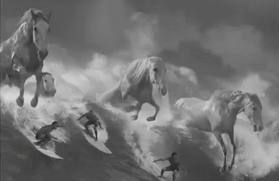 Without wanting to sound like an old fart, I remember when certain companies were as famous for their entertaining ads as their products. Guinness: tick follows tock … Neptune’s horses thundering behind old-man surfers, who’ve patiently waited for the perfect wave. Hints of Melville, Joyce and Thomas in the poem, set to Leftfield beats. Great Big Themes: Art. And all to demonstrate that good things – like the slow-pouring black velvet they’re selling – come to those who wait. “Here’s to waiting.” Bloody brilliant. Or, to quote an even older Guinness ad: “Pure Genius.”
Levis ads were equally awesome. Unknown recording artists scrambled to offer their music as backdrop, because these sassy little mini-movies sold as many records as they did trousers. Street cred and career could be launched simultaneously with a fast-[sound]track to number one, courtesy of the oldest jeans in the world. Musicians went from ‘please let me in Mr Bouncer,’ to ‘sure I’ll accept free membership to your hip club,’ in one smooth, denim-clad strut.
For those products unmatched to art or in-your-face youth culture, there was always cracking humour: Levis (again) Carling Black Label, Hamlet Cigars, Castlemaine XXXX. Long story short, ad breaks were actually quite fun. If a good ad came on, it could drag me back to the telly, my half-made cuppa abandoned in the kitchen. Take note, EDF: THAT is power.
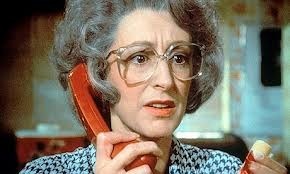
Beattie on her BT phone
Sure, TV has changed and TV ads had to evolve. But simply chucking a bit of social media in does not a progression make. Following in the illustrious steps of Oxo (stock cubes – family grows up around a casserole dish) and Gold Blend (coffee – subtly roasted porn), BT attempted to get their ad audience to ‘join in’, with a reality TV meets soap opera style ‘series’. Even though the faces were famous, nobody cared whether they got together or had a baby and whether they spoke via BT lines, on Skype or by carrier pigeon. We all preferred Maureen Lipman’s 1980s exclamation of, ‘he’s got an -ology!’ when she phoned her grandson to congratulate him on his underwhelming GCSE results. Now that was clever. And her character was called Beattie. (BT, geddit?)

The Go Compare ad
We have never been further from those heady hey days of TV ads. In our presumably enlightened 2013, rather than entice customers with sheer imagination, dramatic thrills or a good, old-fashioned chortle, marketers have turned to the spoiltest of brats for inspiration and decided to annoy us into buying their wares. The most played ad of the last year has been voted so eyebrow-tuggingly irritating, that the chap playing the lead character (a Welshman called Wynne Evans) had to go into hiding. The company was forced to create a counter-campaign where said refugee, an opera singer, was bumped off in ever more ‘hilarious’ ways, or risk alienating its customer base. Of course, it was for Go Compare: the ad equivalent of a child tantrumming next to you at the supermarket checkout on a particularly busy Christmas Eve.
What the F…igaro does opera have to do with a price comparison website? Gimmicks are fine, we all get the point of a hook that makes the product/service/whatever being sold more memorable than its competition. But there was a time when gimmicks bore at least a tenuous link to the marketable item. A bank would give away piggie banks, for example.
How the hell did we reach this level of madness: an opera singer selling a website, a turd selling electricity?
TV ads are now quite literally shit. I only watch shows I’ve Sky+d so that I never have to subject myself to the agony of watching the bollocky, pappy ads. Half the time, I don’t even know what they’re trying to sell me. And even if I did, I’d be so irritated by ten seconds in, I’d be looking for something to hurt myself with, just to take my mind of the screen.
Ad dudes: are you duping us? I’ve seen sites suggesting how people can knit little EDF poop toys for their children (it’s called, ‘Zingy’, by the way, the arse nugget). If you’re all splitting your sides with mirth at how you’ve convinced kids to play with a cuddly dump, then shame on you. If not, and this is a serious campaign, shame on you with bells on. Joke’s not funny. Sort this shit out.