Angela Padron's Blog
March 18, 2016
Why is There a Lack of Diversity in Publishing? Here's One Reason Why.
Many people today talk about the need for diversity in children's books. The argument is that there are not only enough books with characters of color, or with disabilities, or who are LGBT, etc., there are also not enough diverse writers and illustrators either. However, the problem really starts behind the scenes where diversity is lacking the most - the industry itself.
 Lee & Low is a publishing company whose mantra is diversity. They are the largest multicultural publisher in the United States. On their About Us page, one sentence written in bold says, "we pledged to make a special effort to work with unpublished authors and illustrators of color." Not only are the founders of the company diverse, all of their imprints revolve around diversity. From bilingual books to books focusing around Asian or Latino culture, you can always count on Lee & Low to make sure diverse books are getting into the hands of children around the world.
Recently, Lee & Low posted a baseline surveythat took a year to complete. The evidence from this survey, as well as researchconducted by the Cooperative Children's Book Center, shows the breakdown of diversity in different areas of the publishing world. And the results should come as no surprise - "the number of diverse books published each year over the past twenty years has been stuck in neutral, never exceeding, on average, 10 percent."
In every category of the survey - from the industry overall, to the executives, the editorial and sales departments, the marketing and publicity departments, and the book reviewers - 77% or more of the people are caucasian/non-minority, 88% or more have no-disability, and 86% or more are straight/non-LGBT.
In one part of the survey, it says, "While all racial/ethnic minorities are underrepresented when compared to the general US population, the numbers show that some groups, such as Black/African Americans, are more severely underrepresented. This mirrors trends among children’s book authors. In 2014, just 2 percent of the books tracked by the Cooperative Children’s Book Center were by black authors. Latinos were similarly underrepresented in both places."
So what can be done to change this lack of diversity in publishing?
Looks like it would help to start at the top, to encourage and hire more people of diverse backgrounds in more decision-making positions. In addition, more people of color and diversity need to write and illustrate. And authors and illustrators all around need to include more diverse characters in their books.
If people can start making these kinds of changes, perhaps one day the publishing world will reflect more of the real world around us.
 Lee & Low is a publishing company whose mantra is diversity. They are the largest multicultural publisher in the United States. On their About Us page, one sentence written in bold says, "we pledged to make a special effort to work with unpublished authors and illustrators of color." Not only are the founders of the company diverse, all of their imprints revolve around diversity. From bilingual books to books focusing around Asian or Latino culture, you can always count on Lee & Low to make sure diverse books are getting into the hands of children around the world.
Recently, Lee & Low posted a baseline surveythat took a year to complete. The evidence from this survey, as well as researchconducted by the Cooperative Children's Book Center, shows the breakdown of diversity in different areas of the publishing world. And the results should come as no surprise - "the number of diverse books published each year over the past twenty years has been stuck in neutral, never exceeding, on average, 10 percent."
In every category of the survey - from the industry overall, to the executives, the editorial and sales departments, the marketing and publicity departments, and the book reviewers - 77% or more of the people are caucasian/non-minority, 88% or more have no-disability, and 86% or more are straight/non-LGBT.
In one part of the survey, it says, "While all racial/ethnic minorities are underrepresented when compared to the general US population, the numbers show that some groups, such as Black/African Americans, are more severely underrepresented. This mirrors trends among children’s book authors. In 2014, just 2 percent of the books tracked by the Cooperative Children’s Book Center were by black authors. Latinos were similarly underrepresented in both places."
So what can be done to change this lack of diversity in publishing?
Looks like it would help to start at the top, to encourage and hire more people of diverse backgrounds in more decision-making positions. In addition, more people of color and diversity need to write and illustrate. And authors and illustrators all around need to include more diverse characters in their books.
If people can start making these kinds of changes, perhaps one day the publishing world will reflect more of the real world around us.


Why is There a Lack of Diversity in Publishing? Here's why...
Many people today talk about the need for diversity in children's books. The argument is that there are not only enough books with characters of color, or with disabilities, or who are LGBT, etc., there are also not enough diverse writers and illustrators either. However, the problem really starts behind the scenes where diversity is lacking the most - the industry itself.
Lee & Low is a publishing companies whose mantra is diversity. They are the largest multicultural publisher in the United States. On their About Us page, one sentence written in bold says, "we pledged to make a special effort to work with unpublished authors and illustrators of color." Not only are the founders of the company diverse, all of their imprints revolve around diversity. From bilingual books to books focusing around Asian or Latino culture, you can always count on Lee & Low to make sure diverse books are getting into the hands of children around the world.
Recently, Lee & Low posted a baseline surveythat took a year to complete. The evidence from this survey, as well as researchconducted by the Cooperative Children's Book Center, shows the breakdown of diversity in different areas of the publishing world. And the results should come as no surprise - "the number of diverse books published each year over the past twenty years has been stuck in neutral, never exceeding, on average, 10 percent."
In every category of the survey - from the industry overall, to the executives, the editorial and sales departments, the marketing and publicity departments, and the book reviewers - 77% or more of the people are caucasian/non-minority, 88% or more have no-disability, and 86% or more are straight/non-LGBT.
In one part of the survey, it says, "While all racial/ethnic minorities are underrepresented when compared to the general US population, the numbers show that some groups, such as Black/African Americans, are more severely underrepresented. This mirrors trends among children’s book authors. In 2014, just 2 percent of the books tracked by the Cooperative Children’s Book Center were by black authors. Latinos were similarly underrepresented in both places."
So what can be done to change this lack of diversity in publishing?
Looks like it would help to start at the top, to encourage and hire more people of diverse backgrounds in more decision-making positions. In addition, more people of color and diversity need to write and illustrate. And authors and illustrators all around need to include more diverse characters in their books.
If people can start making these kinds of changes, perhaps one day the publishing world will reflect more of the real world around us.
Lee & Low is a publishing companies whose mantra is diversity. They are the largest multicultural publisher in the United States. On their About Us page, one sentence written in bold says, "we pledged to make a special effort to work with unpublished authors and illustrators of color." Not only are the founders of the company diverse, all of their imprints revolve around diversity. From bilingual books to books focusing around Asian or Latino culture, you can always count on Lee & Low to make sure diverse books are getting into the hands of children around the world.Recently, Lee & Low posted a baseline surveythat took a year to complete. The evidence from this survey, as well as researchconducted by the Cooperative Children's Book Center, shows the breakdown of diversity in different areas of the publishing world. And the results should come as no surprise - "the number of diverse books published each year over the past twenty years has been stuck in neutral, never exceeding, on average, 10 percent."
In every category of the survey - from the industry overall, to the executives, the editorial and sales departments, the marketing and publicity departments, and the book reviewers - 77% or more of the people are caucasian/non-minority, 88% or more have no-disability, and 86% or more are straight/non-LGBT.
In one part of the survey, it says, "While all racial/ethnic minorities are underrepresented when compared to the general US population, the numbers show that some groups, such as Black/African Americans, are more severely underrepresented. This mirrors trends among children’s book authors. In 2014, just 2 percent of the books tracked by the Cooperative Children’s Book Center were by black authors. Latinos were similarly underrepresented in both places."
So what can be done to change this lack of diversity in publishing?
Looks like it would help to start at the top, to encourage and hire more people of diverse backgrounds in more decision-making positions. In addition, more people of color and diversity need to write and illustrate. And authors and illustrators all around need to include more diverse characters in their books.
If people can start making these kinds of changes, perhaps one day the publishing world will reflect more of the real world around us.
February 13, 2016
Crayon Batik - A Near Disaster
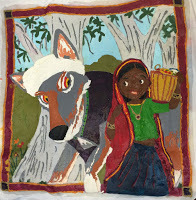
In my last post about diversity, I spoke about the illustration I made of Little Red Riding Hood from India, including how I came up with the idea and all the research and drawing I did to make the illustration come to life. What I didn't talk about is my coloring process - or the disaster that this particular illustration almost became...
A few months ago, I explained in a blog post called "Playing With Crayons" how I use crayon batik to create some of my latest illustrations. It's an interesting process because you really don't know what results you're going to get - once the fabric is placed in the dye bath you get that "crackle" effect that is unique to batik. And no crackling happens the same way twice. However, getting the wax out of the fabric can also have interesting - and scary - results.
So here's how I made Little Red, or Little Dupatta as I'm calling her:
First, I blew up the final sketch to about 22" x 22" and transferred it onto white muslin fabric using a light box.
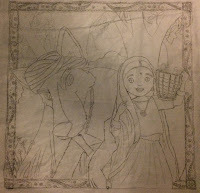
Then I began a color study by coloring in my sketch, just to make sure that the colors I was envisioning would work together.
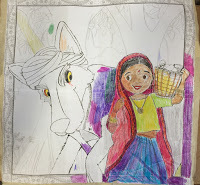 Next I peeled lots of Crayola crayons, broke them up and placed the pieces into a wax melter. Last time I had melted the crayons in jars and placed them in a hot skillet with water. Either way works fine except the melter melts the crayons faster and keeps them hotter longer, which is important because you need the wax to be hot enough to blend into the fabric.
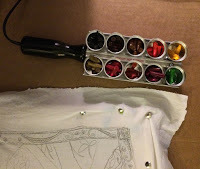 They're both messy ways to work and a pain in the neck to clean so either way you'll be getting your hands and brushes dirty.
At this point it's about five hours until the Tomie dePaola Award submission deadline for this illustration. But I stopped working to take my son to the doctor due to pain in his foot that he had been experiencing for two days. Turns out that he had a hairline fracture, from jumping incorrectly on the sidewalk. That's my boy!
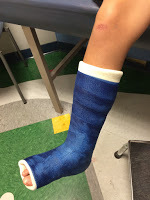
After the doctor's appointment, I began to "paint" with the melted crayons to completely cover the batik in color.
Then I put the batik in a dye bath of Imperial Purple. I thought that color sounded very distinguished.
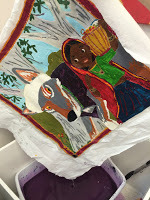
This is what it looked like after the dye bath. Can't see much crackle yet. But just you wait...
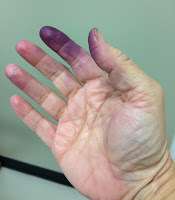
This is what happens when the gloves you're using have a hole in them. It stays like this for a couple of days, while the dye is seeping into your skin and running through your bloodstream. No big deal.
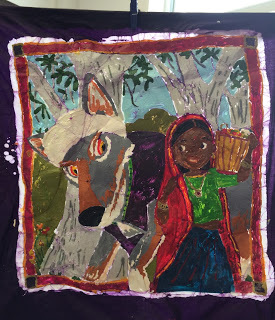
After the batik was dry, I placed it between sheets of newsprint to iron out the wax. And then I nearly pulled my hair out - all the wax was bleeding WAAAAYYY too much and covering up the entire batik.

At this point it was either throw the entire thing away or just keep ironing until all the way was lifted off.
Luckily, I was able to salvage it even though the colors had bled way more than expected.
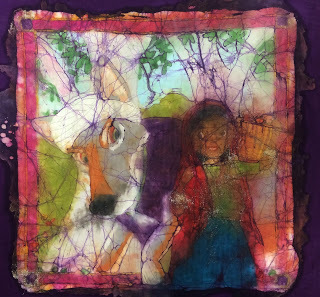
And then came the finishing touches. I'm going to channel my inner Stevie Wonder here and for all of you who use digital applications to either enhance or fix your work, sing along with me:
"Keep smiling, keep shining. Knowing you can always count on me. For sure. That's what Photoshop is for..."
So I scanned the batik and worked a bit on cleaning up the color in some areas as well as changed some of the coloring on the wolf's clothing. Here's the finished piece again...
In the end, I'm happy with the result but am learning that I need to get better at not putting on the melted crayon so thick. This way the colors won't bleed as much. Also I need to leave space where my line drawing goes so that the dye can seep into the openings to naturally outline the piece. Then I wouldn't have to overlay my sketch in Photoshop. I also need to keep searching for the best way to melt the crayons to keep them as hot as possible while painting with them.
It's all still a learning process, a fun - and at times scary - one. Nevertheless, I'm determined to perfect this style. I have another sketch in the works so check back next month to see how that batik turns out.
A few months ago, I explained in a blog post called "Playing With Crayons" how I use crayon batik to create some of my latest illustrations. It's an interesting process because you really don't know what results you're going to get - once the fabric is placed in the dye bath you get that "crackle" effect that is unique to batik. And no crackling happens the same way twice. However, getting the wax out of the fabric can also have interesting - and scary - results.
So here's how I made Little Red, or Little Dupatta as I'm calling her:
First, I blew up the final sketch to about 22" x 22" and transferred it onto white muslin fabric using a light box.
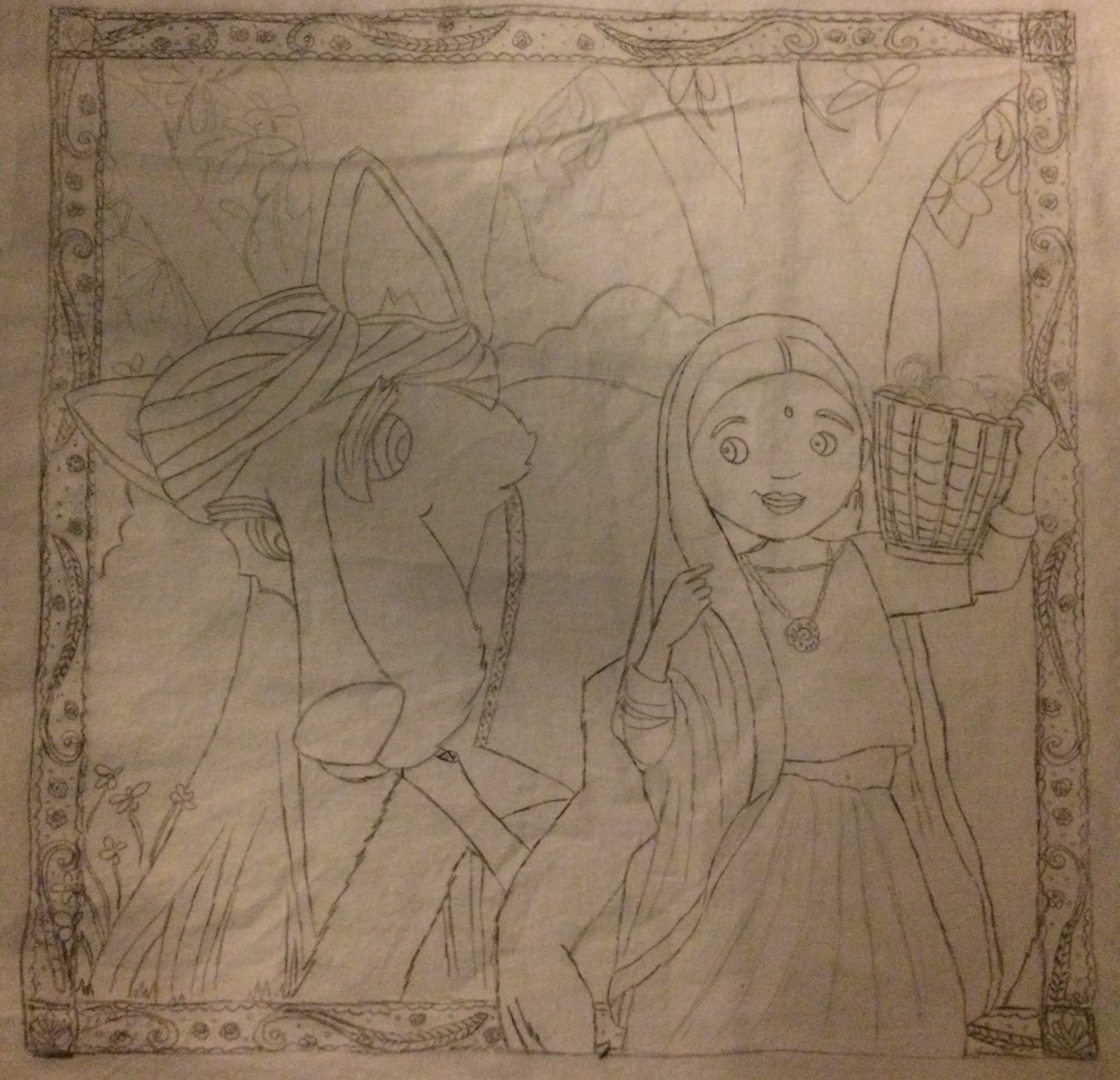
Then I began a color study by coloring in my sketch, just to make sure that the colors I was envisioning would work together.
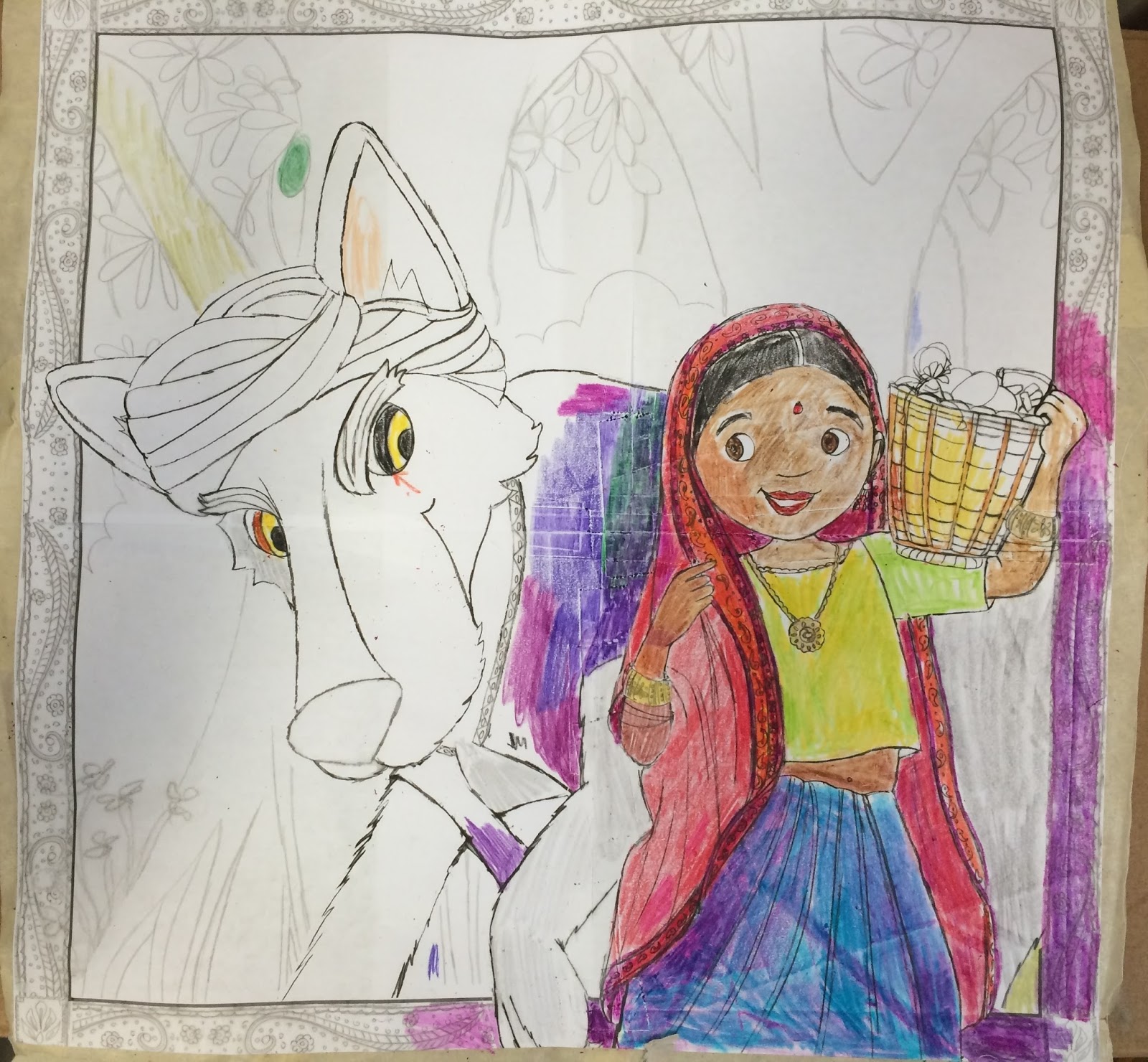 Next I peeled lots of Crayola crayons, broke them up and placed the pieces into a wax melter. Last time I had melted the crayons in jars and placed them in a hot skillet with water. Either way works fine except the melter melts the crayons faster and keeps them hotter longer, which is important because you need the wax to be hot enough to blend into the fabric.
 They're both messy ways to work and a pain in the neck to clean so either way you'll be getting your hands and brushes dirty.
At this point it's about five hours until the Tomie dePaola Award submission deadline for this illustration. But I stopped working to take my son to the doctor due to pain in his foot that he had been experiencing for two days. Turns out that he had a hairline fracture, from jumping incorrectly on the sidewalk. That's my boy!
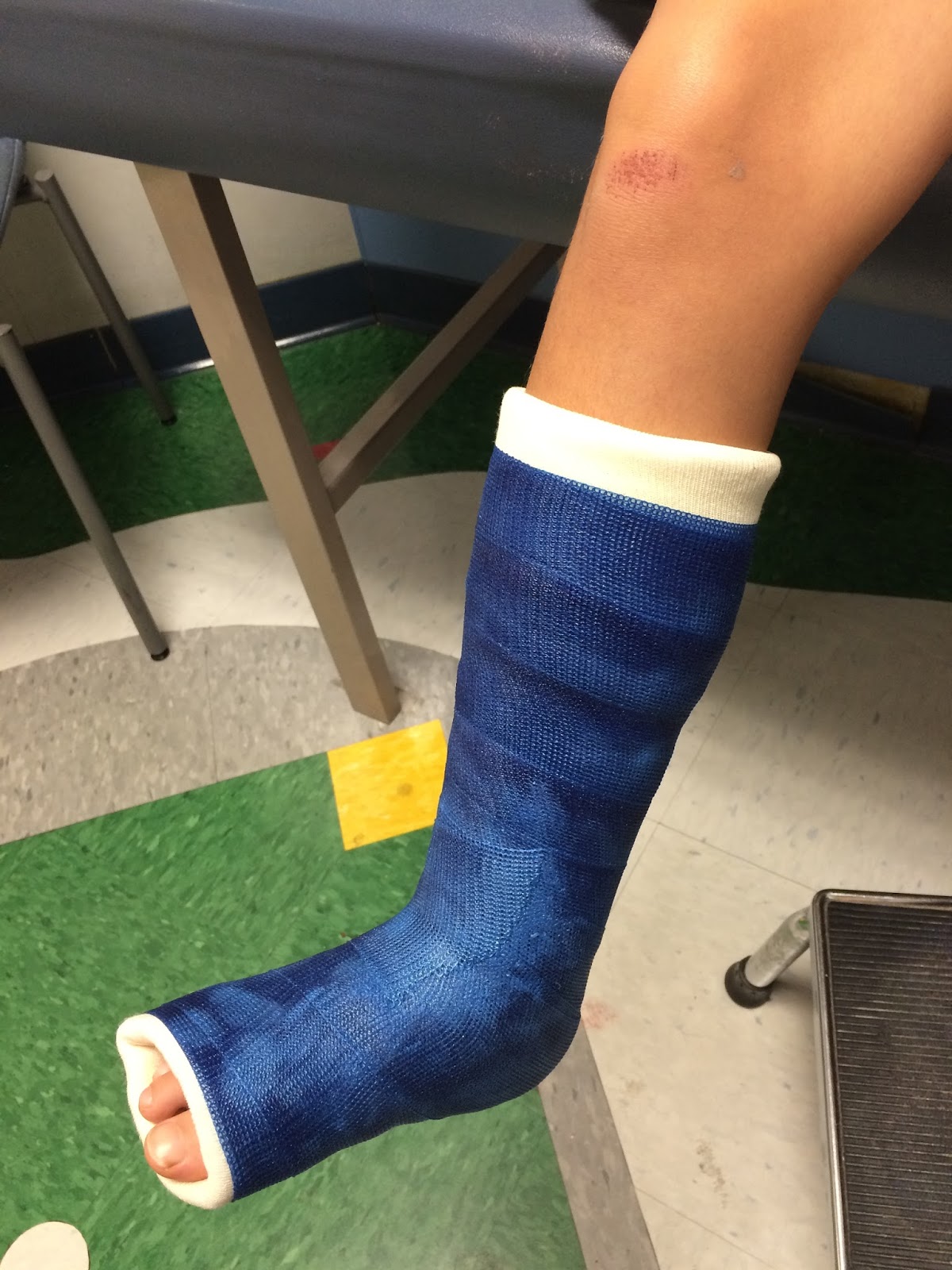
After the doctor's appointment, I began to "paint" with the melted crayons to completely cover the batik in color.
Then I put the batik in a dye bath of Imperial Purple. I thought that color sounded very distinguished.
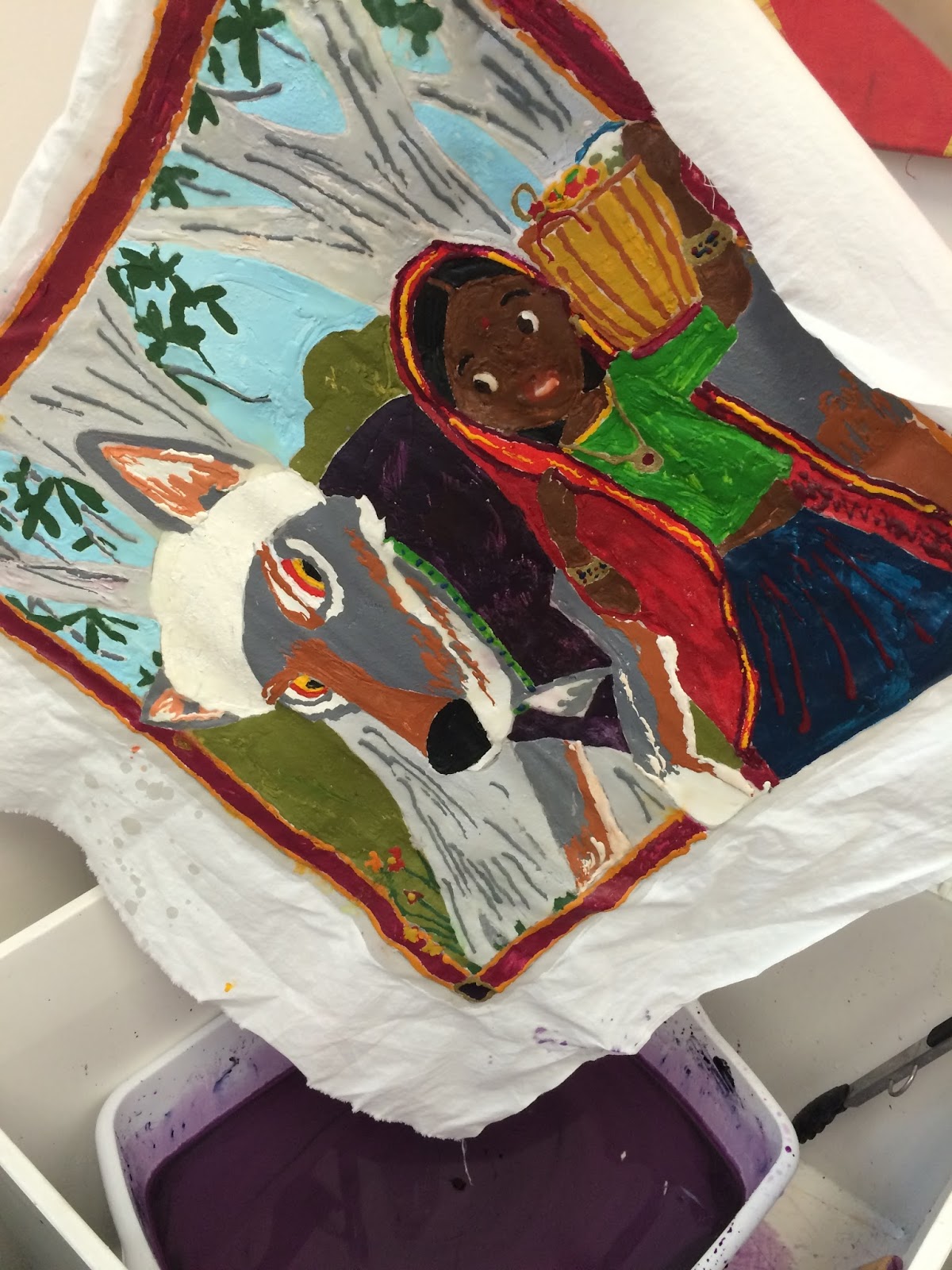
This is what it looked like after the dye bath. Can't see much crackle yet. But just you wait...
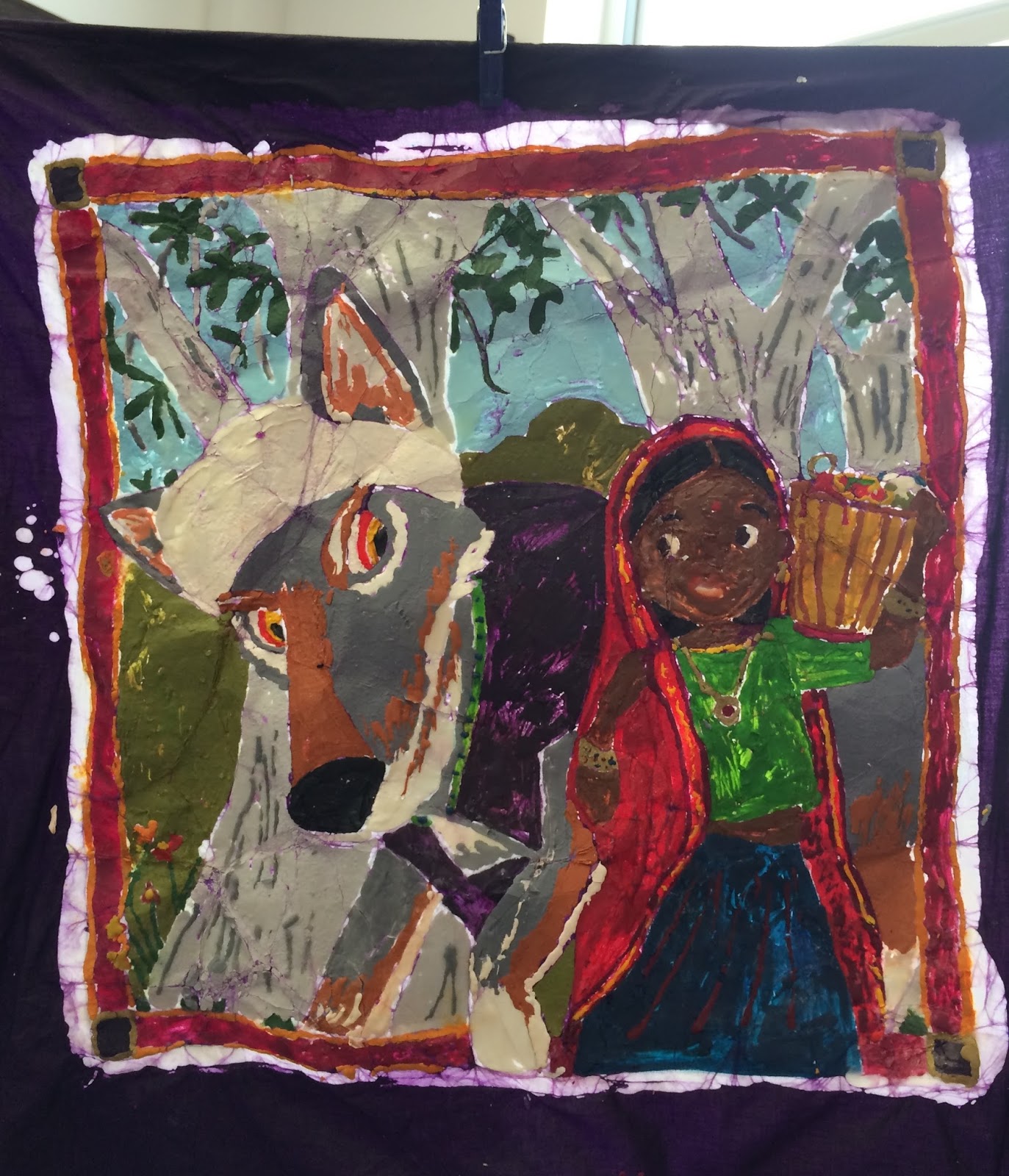
This is what happens when the gloves you're using have a hole in them. It stays like this for a couple of days, while the dye is seeping into your skin and running through your bloodstream. No big deal.
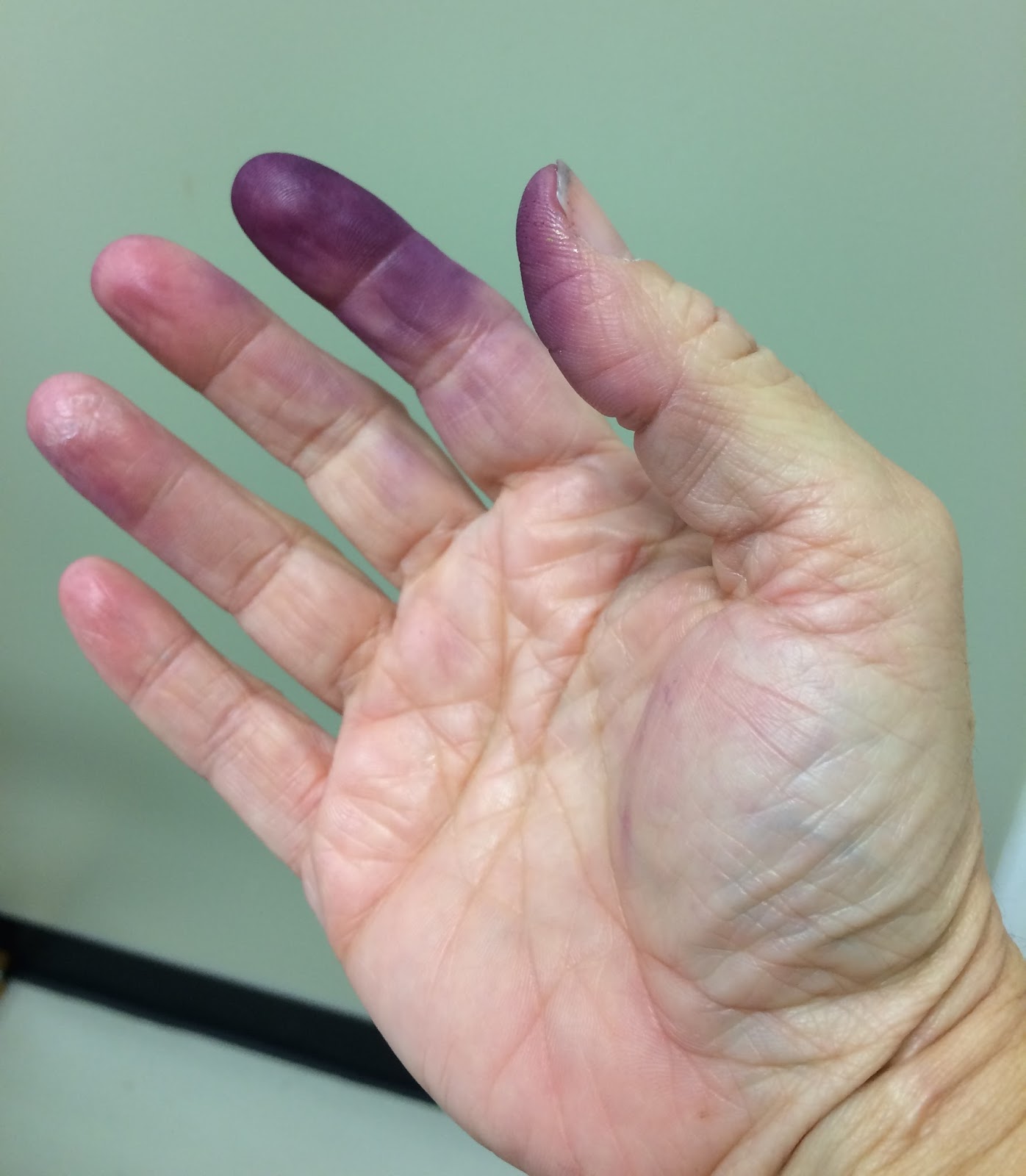
After the batik was dry, I placed it between sheets of newsprint to iron out the wax. And then I nearly pulled my hair out - all the wax was bleeding WAAAAYYY too much and covering up the entire batik.
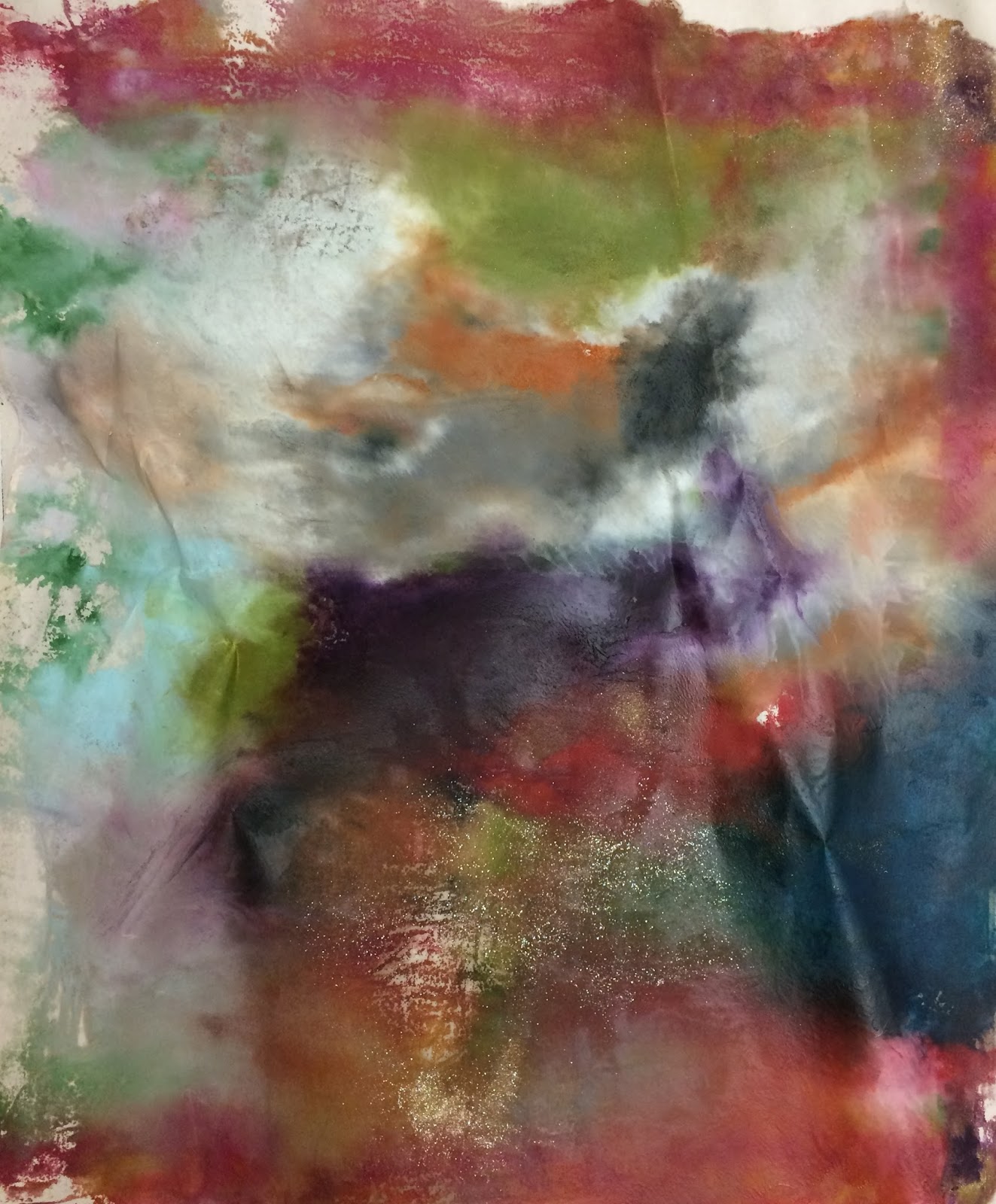

At this point it was either throw the entire thing away or just keep ironing until all the way was lifted off.
Luckily, I was able to salvage it even though the colors had bled way more than expected.
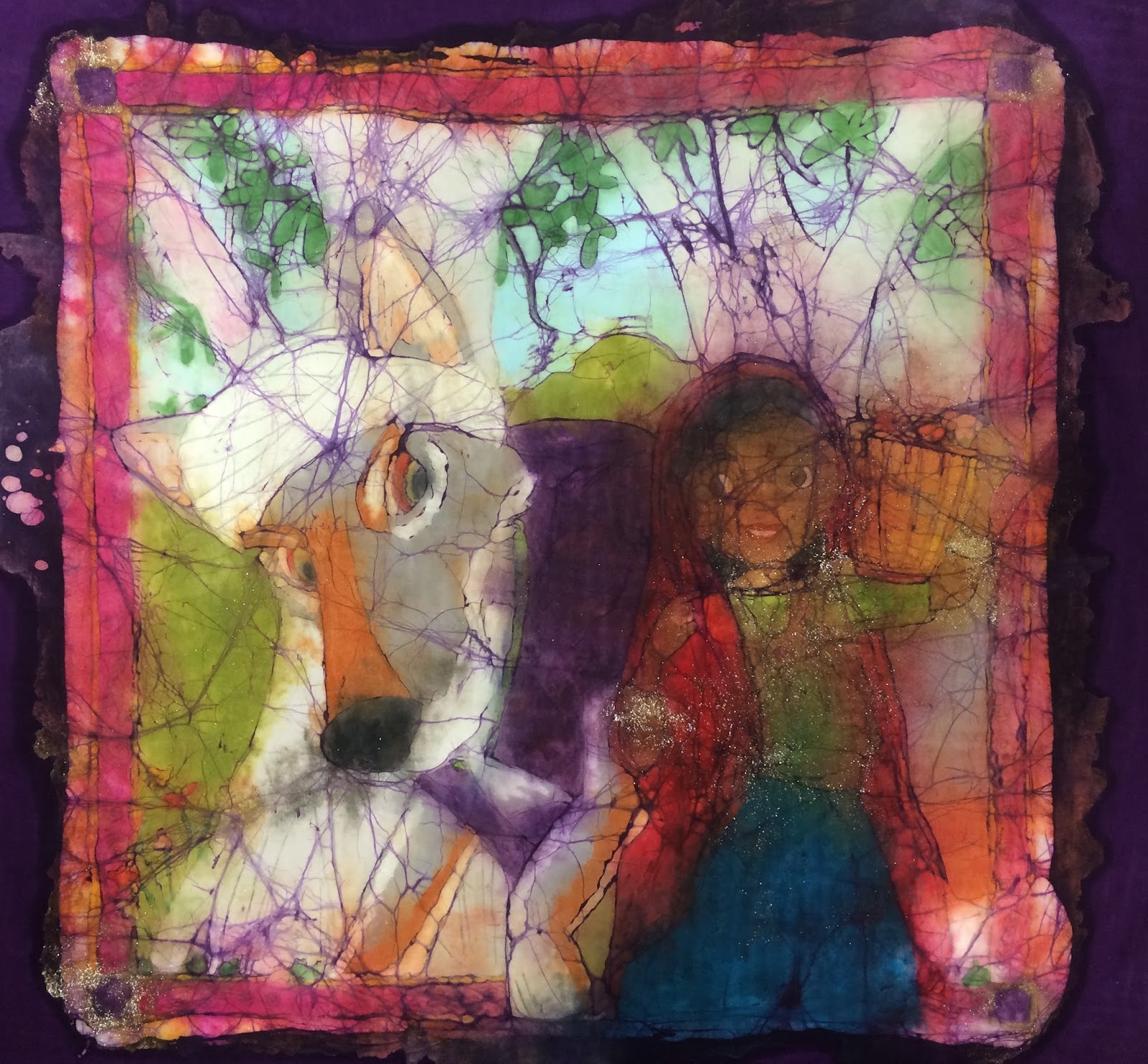
And then came the finishing touches. I'm going to channel my inner Stevie Wonder here and for all of you who use digital applications to either enhance or fix your work, sing along with me:
"Keep smiling, keep shining. Knowing you can always count on me. For sure. That's what Photoshop is for..."
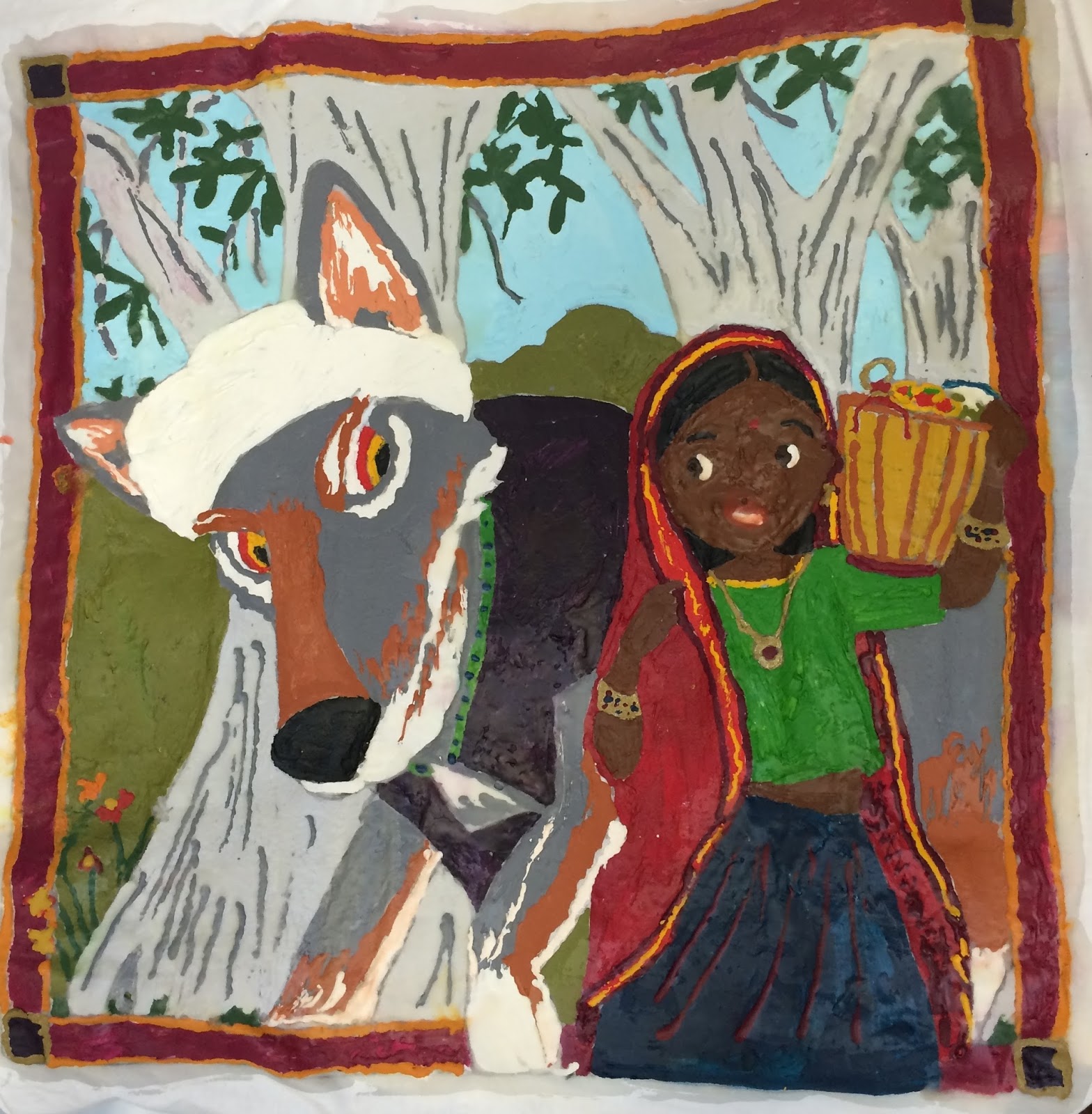
So I scanned the batik and worked a bit on cleaning up the color in some areas as well as changed some of the coloring on the wolf's clothing. Here's the finished piece again...
In the end, I'm happy with the result but am learning that I need to get better at not putting on the melted crayon so thick. This way the colors won't bleed as much. Also I need to leave space where my line drawing goes so that the dye can seep into the openings to naturally outline the piece. Then I wouldn't have to overlay my sketch in Photoshop. I also need to keep searching for the best way to melt the crayons to keep them as hot as possible while painting with them.
It's all still a learning process, a fun - and at times scary - one. Nevertheless, I'm determined to perfect this style. I have another sketch in the works so check back next month to see how that batik turns out.
January 16, 2016
Thinking About Diversity - All the Time
Whenever I'm starting a new story or illustration, my first thought is: Who will the characters be? An animal? A creature? A person? And my second thought is: Where do the characters come from? What do they look like? Then I have a list of personality traits in my head that I check off, such as:
skin colorhair color hair type (straight, curly, long, short, tied up, let down, covered with a hat or wrap, etc.)heightweightclothingetc.No matter what characteristic I am thinking of, however, I'm always keeping diversity in mind.
Why? Because diversity is all around us. It’s the world we live in.
At least it's the world I've always lived in.
As mentioned in previous posts, I grew up in New Jersey is a suburban area that had a mix of races. I was two hours away from New York, the diversity capital of the world. I've taught in urban and suburban areas and have seen children from all different backgrounds, ethnicities and races learn and play together. So in my mind, I always think of ways to make my stories and illustrations diverse. Because that's what I see - that's what most kids nowadays see every day. And the literature they read should reflect such diversity.
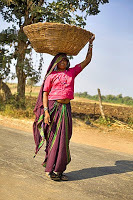 Recently, I entered the SCBWI Tomie dePaola Award illustration contest where the task was to illustrate an excerpt from "Little Red Riding Hood." Tomie was looking for "something different," for us to "think outside the box" and not to make the characters look too typical. The idea that popped into my mind was to make Red from India. I don't know why but I just felt like setting the story in a different place than I had seen before.
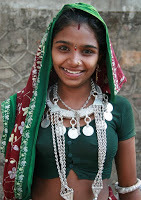 I wanted to be sure to portray Red in the correct clothing and scene, though. So I turned to a friend of mine who is from India. She asked me great questions, starting with “Where do you want Red to come from, the city or the village?”
Why? Because girls wear different clothing or garb, depending on where they live in India.
We decided most likely Red would live in the village, especially if she were coming from her home and traveling through the woods. So I researched photo references of girls who might live in an Indian village, as well as the different types of trees (banyan) that might exist in a wood near a village.
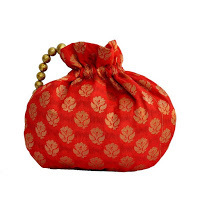 An example of a potliAnd “What will Red be carrying to Grandma’s (I mean, “Dadima’s) home?” my friend asked. Even though the original Brothers Grimm story had Red carrying a bottle of wine, my friend said this wouldn't happen in India. No problem - I didn't want a little girl being the reason for Granny getting tipsy!
My friend explained to me what a typical village girl might have in such a basket (a jar of pickles, and a potli bag for example). She provided me with so much information, I felt like I was not only creating a new piece but learning about a culture.
Here is the finished piece!
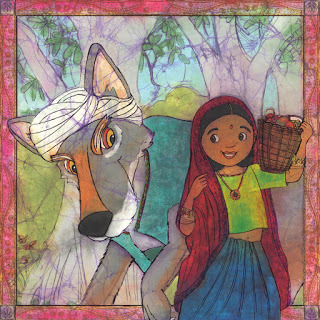
Although I didn’t win the contest, I was very happy with the finished piece. I feel like it fits in with the rest of my diverse portfolio of characters and illustrations. It also allowed me to continue experimenting with my new crayon batik/Photoshop style, which provides a lot of textures and interesting patterns in the finished piece. And of course, it allows me to add another diverse piece to my portfolio.
So whether you are writing a story, developing a new character, or illustrating a spread, try to keep diversity in mind. You never know what you might learn!
My next blog post will show the process of making the Little Red batik. Stay tuned!
Whenever I am starting a new story or illustration, my first thought is: Who will the characters be? An animal? A creature? A person? And my second thought is: Where do the characters come from? What do they look like? Then I have a list of personality traits in my head that I check off, such as:
skin colorhair colorhair type (straight, curly, long, short, tied up, let down, covered with a hat or wrap, etc.)heightclothing (generic or cultural?)No matter what characteristic I am thinking of, however, I'm always keeping diversity in mind.
Why? Because diversity is all around us. It's the world we live in.
At least it's the world I've always lived in.
As mentioned in previous posts, I grew up in New Jersey in a suburban area that had a mix of races. I was two hours away from New York, the diversity capital of the world. I've taught in urban and suburban areas and have seen children from all different backgrounds, ethnicities and races learn and play together. So in my mind, I always think of ways to make my stories and illustrations diverse because that's what I see - that's what most kids nowadays see every day. And the literature they read should reflect such diversity. - See more at: http://www.childrensbookacademy.com/b... I am starting a new story or illustration, my first thought is: Who will the characters be? An animal? A creature? A person? And my second thought is: Where do the characters come from? What do they look like? Then I have a list of personality traits in my head that I check off, such as:
skin colorhair colorhair type (straight, curly, long, short, tied up, let down, covered with a hat or wrap, etc.)heightclothing (generic or cultural?)No matter what characteristic I am thinking of, however, I'm always keeping diversity in mind.
Why? Because diversity is all around us. It's the world we live in.
At least it's the world I've always lived in.
As mentioned in previous posts, I grew up in New Jersey in a suburban area that had a mix of races. I was two hours away from New York, the diversity capital of the world. I've taught in urban and suburban areas and have seen children from all different backgrounds, ethnicities and races learn and play together. So in my mind, I always think of ways to make my stories and illustrations diverse because that's what I see - that's what most kids nowadays see every day. And the literature they read should reflect such diversity. - See more at: http://www.childrensbookacademy.com/b... I am starting a new story or illustration, my first thought is: Who will the characters be? An animal? A creature? A person? And my second thought is: Where do the characters come from? What do they look like? Then I have a list of personality traits in my head that I check off, such as:
skin colorhair colorhair type (straight, curly, long, short, tied up, let down, covered with a hat or wrap, etc.)heightclothing (generic or cultural?)No matter what characteristic I am thinking of, however, I'm always keeping diversity in mind.
Why? Because diversity is all around us. It's the world we live in.
At least it's the world I've always lived in.
As mentioned in previous posts, I grew up in New Jersey in a suburban area that had a mix of races. I was two hours away from New York, the diversity capital of the world. I've taught in urban and suburban areas and have seen children from all different backgrounds, ethnicities and races learn and play together. So in my mind, I always think of ways to make my stories and illustrations diverse because that's what I see - that's what most kids nowadays see every day. And the literature they read should reflect such diversity. - See more at: http://www.childrensbookacademy.com/b... I am starting a new story or illustration, my first thought is: Who will the characters be? An animal? A creature? A person? And my second thought is: Where do the characters come from? What do they look like? Then I have a list of personality traits in my head that I check off, such as:
skin colorhair colorhair type (straight, curly, long, short, tied up, let down, covered with a hat or wrap, etc.)heightclothing (generic or cultural?)No matter what characteristic I am thinking of, however, I'm always keeping diversity in mind.
Why? Because diversity is all around us. It's the world we live in.
At least it's the world I've always lived in.
As mentioned in previous posts, I grew up in New Jersey in a suburban area that had a mix of races. I was two hours away from New York, the diversity capital of the world. I've taught in urban and suburban areas and have seen children from all different backgrounds, ethnicities and races learn and play together. So in my mind, I always think of ways to make my stories and illustrations diverse because that's what I see - that's what most kids nowadays see every day. And the literature they read should reflect such diversity.
Recently I entered the SCBWI Tomie de Paola illustration contest where the task was to illustrate an except from "Little Red Riding Hood." Tomie was looking for "something different", for us to "think outside the box" and not to make the characters look too typical. The idea that popped into my mind was to make Red from India. I don't know why but I just felt like setting the story in a different place than I had seen with this story before.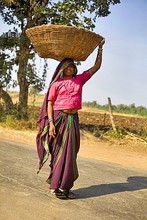
I wanted to be sure to portray Red in the correct clothing and scene, though. So I turned to a friend of mine who is from India. She asked me great questions, starting with "Where do you want Red to come from, the city or the village?"
Why? Because girls wear different clothing or garb, depending on where they live in India.
We decided most likely Red would live in the village, especially if she were coming from her home and traveling through the woods. So I researched photo references of girls who might live in an Indian village, as well as the different types of trees (banyan) that might exist in a wood near a village.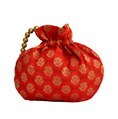
And "What will Red be carrying to Grandma's (I mean, "Dadima's) home?" she asked. My friend explained to me what a typical village girl might have in such a basket (a jar of pickles, and a potli bag for example). She provided me with so much information, I felt like I was not only creating a new piece but learning about a culture.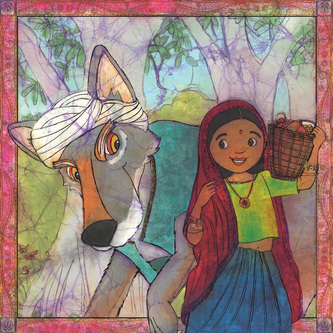
Although I didn't win the contest, I was very happy with the finished piece. I feel like it fits in with the rest of my diverse portfolio of characters and illustrations. It also allowed me to continue experimenting with my new crayon batik/Photoshop style, which provides a lot of textures and interesting patterns in the finished piece. And of course, it allows me to add another diverse piece to my portfolio.
So whether you are writing a story, developing a new character, or illustrating a spread, try to keep diversity in mind. You never know what you might learn!- See more at: http://www.childrensbookacademy.com/b...
skin colorhair color hair type (straight, curly, long, short, tied up, let down, covered with a hat or wrap, etc.)heightweightclothingetc.No matter what characteristic I am thinking of, however, I'm always keeping diversity in mind.
Why? Because diversity is all around us. It’s the world we live in.
At least it's the world I've always lived in.
As mentioned in previous posts, I grew up in New Jersey is a suburban area that had a mix of races. I was two hours away from New York, the diversity capital of the world. I've taught in urban and suburban areas and have seen children from all different backgrounds, ethnicities and races learn and play together. So in my mind, I always think of ways to make my stories and illustrations diverse. Because that's what I see - that's what most kids nowadays see every day. And the literature they read should reflect such diversity.
 Recently, I entered the SCBWI Tomie dePaola Award illustration contest where the task was to illustrate an excerpt from "Little Red Riding Hood." Tomie was looking for "something different," for us to "think outside the box" and not to make the characters look too typical. The idea that popped into my mind was to make Red from India. I don't know why but I just felt like setting the story in a different place than I had seen before.
  I wanted to be sure to portray Red in the correct clothing and scene, though. So I turned to a friend of mine who is from India. She asked me great questions, starting with “Where do you want Red to come from, the city or the village?”
Why? Because girls wear different clothing or garb, depending on where they live in India.
We decided most likely Red would live in the village, especially if she were coming from her home and traveling through the woods. So I researched photo references of girls who might live in an Indian village, as well as the different types of trees (banyan) that might exist in a wood near a village.
 An example of a potliAnd “What will Red be carrying to Grandma’s (I mean, “Dadima’s) home?” my friend asked. Even though the original Brothers Grimm story had Red carrying a bottle of wine, my friend said this wouldn't happen in India. No problem - I didn't want a little girl being the reason for Granny getting tipsy!
My friend explained to me what a typical village girl might have in such a basket (a jar of pickles, and a potli bag for example). She provided me with so much information, I felt like I was not only creating a new piece but learning about a culture.
Here is the finished piece!

Although I didn’t win the contest, I was very happy with the finished piece. I feel like it fits in with the rest of my diverse portfolio of characters and illustrations. It also allowed me to continue experimenting with my new crayon batik/Photoshop style, which provides a lot of textures and interesting patterns in the finished piece. And of course, it allows me to add another diverse piece to my portfolio.
So whether you are writing a story, developing a new character, or illustrating a spread, try to keep diversity in mind. You never know what you might learn!
My next blog post will show the process of making the Little Red batik. Stay tuned!
Whenever I am starting a new story or illustration, my first thought is: Who will the characters be? An animal? A creature? A person? And my second thought is: Where do the characters come from? What do they look like? Then I have a list of personality traits in my head that I check off, such as:
skin colorhair colorhair type (straight, curly, long, short, tied up, let down, covered with a hat or wrap, etc.)heightclothing (generic or cultural?)No matter what characteristic I am thinking of, however, I'm always keeping diversity in mind.
Why? Because diversity is all around us. It's the world we live in.
At least it's the world I've always lived in.
As mentioned in previous posts, I grew up in New Jersey in a suburban area that had a mix of races. I was two hours away from New York, the diversity capital of the world. I've taught in urban and suburban areas and have seen children from all different backgrounds, ethnicities and races learn and play together. So in my mind, I always think of ways to make my stories and illustrations diverse because that's what I see - that's what most kids nowadays see every day. And the literature they read should reflect such diversity. - See more at: http://www.childrensbookacademy.com/b... I am starting a new story or illustration, my first thought is: Who will the characters be? An animal? A creature? A person? And my second thought is: Where do the characters come from? What do they look like? Then I have a list of personality traits in my head that I check off, such as:
skin colorhair colorhair type (straight, curly, long, short, tied up, let down, covered with a hat or wrap, etc.)heightclothing (generic or cultural?)No matter what characteristic I am thinking of, however, I'm always keeping diversity in mind.
Why? Because diversity is all around us. It's the world we live in.
At least it's the world I've always lived in.
As mentioned in previous posts, I grew up in New Jersey in a suburban area that had a mix of races. I was two hours away from New York, the diversity capital of the world. I've taught in urban and suburban areas and have seen children from all different backgrounds, ethnicities and races learn and play together. So in my mind, I always think of ways to make my stories and illustrations diverse because that's what I see - that's what most kids nowadays see every day. And the literature they read should reflect such diversity. - See more at: http://www.childrensbookacademy.com/b... I am starting a new story or illustration, my first thought is: Who will the characters be? An animal? A creature? A person? And my second thought is: Where do the characters come from? What do they look like? Then I have a list of personality traits in my head that I check off, such as:
skin colorhair colorhair type (straight, curly, long, short, tied up, let down, covered with a hat or wrap, etc.)heightclothing (generic or cultural?)No matter what characteristic I am thinking of, however, I'm always keeping diversity in mind.
Why? Because diversity is all around us. It's the world we live in.
At least it's the world I've always lived in.
As mentioned in previous posts, I grew up in New Jersey in a suburban area that had a mix of races. I was two hours away from New York, the diversity capital of the world. I've taught in urban and suburban areas and have seen children from all different backgrounds, ethnicities and races learn and play together. So in my mind, I always think of ways to make my stories and illustrations diverse because that's what I see - that's what most kids nowadays see every day. And the literature they read should reflect such diversity. - See more at: http://www.childrensbookacademy.com/b... I am starting a new story or illustration, my first thought is: Who will the characters be? An animal? A creature? A person? And my second thought is: Where do the characters come from? What do they look like? Then I have a list of personality traits in my head that I check off, such as:
skin colorhair colorhair type (straight, curly, long, short, tied up, let down, covered with a hat or wrap, etc.)heightclothing (generic or cultural?)No matter what characteristic I am thinking of, however, I'm always keeping diversity in mind.
Why? Because diversity is all around us. It's the world we live in.
At least it's the world I've always lived in.
As mentioned in previous posts, I grew up in New Jersey in a suburban area that had a mix of races. I was two hours away from New York, the diversity capital of the world. I've taught in urban and suburban areas and have seen children from all different backgrounds, ethnicities and races learn and play together. So in my mind, I always think of ways to make my stories and illustrations diverse because that's what I see - that's what most kids nowadays see every day. And the literature they read should reflect such diversity.
Recently I entered the SCBWI Tomie de Paola illustration contest where the task was to illustrate an except from "Little Red Riding Hood." Tomie was looking for "something different", for us to "think outside the box" and not to make the characters look too typical. The idea that popped into my mind was to make Red from India. I don't know why but I just felt like setting the story in a different place than I had seen with this story before.
I wanted to be sure to portray Red in the correct clothing and scene, though. So I turned to a friend of mine who is from India. She asked me great questions, starting with "Where do you want Red to come from, the city or the village?"
Why? Because girls wear different clothing or garb, depending on where they live in India.
We decided most likely Red would live in the village, especially if she were coming from her home and traveling through the woods. So I researched photo references of girls who might live in an Indian village, as well as the different types of trees (banyan) that might exist in a wood near a village.
And "What will Red be carrying to Grandma's (I mean, "Dadima's) home?" she asked. My friend explained to me what a typical village girl might have in such a basket (a jar of pickles, and a potli bag for example). She provided me with so much information, I felt like I was not only creating a new piece but learning about a culture.
Although I didn't win the contest, I was very happy with the finished piece. I feel like it fits in with the rest of my diverse portfolio of characters and illustrations. It also allowed me to continue experimenting with my new crayon batik/Photoshop style, which provides a lot of textures and interesting patterns in the finished piece. And of course, it allows me to add another diverse piece to my portfolio.
So whether you are writing a story, developing a new character, or illustrating a spread, try to keep diversity in mind. You never know what you might learn!- See more at: http://www.childrensbookacademy.com/b...
December 28, 2015
The Blog Awakens
Sometimes life requires you to do things you hadn't planned. For me, I hadn't planned on ever going back to working as a classroom teacher - I decided that about 12 years ago after experiencing burnout. But, this year I needed a full-time job and a position happened to open up in my son's school. It was a tough ride at first, getting back into the swing of grading papers, conferences, meetings, paperwork, standards assessments, etc. Although I'm doing better now, I still find I have little time for doing anything I want or need to do, like exercise, read, write, draw, or even spend quality time with my family.
I had forgotten how much free time teaching absorbs - no, actually, devours - which prevents you from having a life. The life that is forcing you to take the job in the first place.
Vicious cycle, isn't it?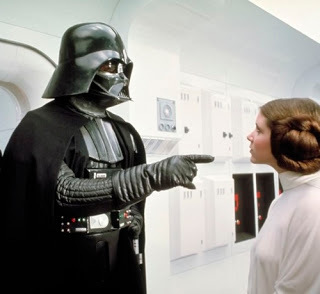 I told you not to take that job! Now that I'm on winter break, I'm getting caught up on a lot of things I've been meaning to do. My brain has finally had some time to think through some stories that I've been stuck on. I also decided to peek at my blog again. I was shocked when I saw that the last time I posted anything on the blog was July. JULY? Five months ago! How in the world could I have let five months pass without creating a single post? Where in the world did the time go?
And then I could sense it... the awakening...
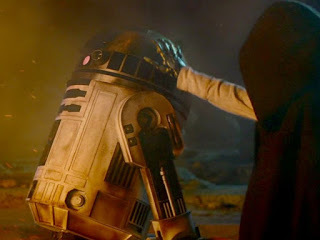
After watching "Star Wars: The Force Awakens" two times this past weekend, I got inspired. I thought the movie was excellent - the story plot, the characters old and new, the mysteries and the unanswered questions that left me wanting more, the beginning of some interesting character arcs... everything about it reminded me why I've loved Star Wars since it first appeared on screen in the 70's. It reminded me that good storytelling can leave an audience in a state of emotional withdrawal.

And it made me want to start writing and creating again.
So as busy as teaching makes me, as much as it consumes my mind and time, I cannot let it overpower me. I cannot let it lead me to a "dark side" of non-creativity as teaching has done in the past.
 You have failed, Dark Side. I am a Jedi - of the Creative Side of the Force, that is. I shall make time to blog and write stories and work on illustrations on a more regular basis from now on.
The blog has awakened...
and so have I.
I had forgotten how much free time teaching absorbs - no, actually, devours - which prevents you from having a life. The life that is forcing you to take the job in the first place.
Vicious cycle, isn't it?
 I told you not to take that job! Now that I'm on winter break, I'm getting caught up on a lot of things I've been meaning to do. My brain has finally had some time to think through some stories that I've been stuck on. I also decided to peek at my blog again. I was shocked when I saw that the last time I posted anything on the blog was July. JULY? Five months ago! How in the world could I have let five months pass without creating a single post? Where in the world did the time go?
And then I could sense it... the awakening...

After watching "Star Wars: The Force Awakens" two times this past weekend, I got inspired. I thought the movie was excellent - the story plot, the characters old and new, the mysteries and the unanswered questions that left me wanting more, the beginning of some interesting character arcs... everything about it reminded me why I've loved Star Wars since it first appeared on screen in the 70's. It reminded me that good storytelling can leave an audience in a state of emotional withdrawal.

And it made me want to start writing and creating again.
So as busy as teaching makes me, as much as it consumes my mind and time, I cannot let it overpower me. I cannot let it lead me to a "dark side" of non-creativity as teaching has done in the past.
 You have failed, Dark Side. I am a Jedi - of the Creative Side of the Force, that is. I shall make time to blog and write stories and work on illustrations on a more regular basis from now on.
The blog has awakened...
and so have I.
July 27, 2015
You Can't Get Bored with Board Books
Between working many many hours for the Miami Book Fair International this summer and getting ready to go back to teaching in less than a month, I haven't been very discipline about writing new blog posts. But this is one that I've been meaning to write about for a while.
In June, I attended the New Jersey SCBWI conference for the second year in a row. Once again, it was a fabulous opportunity to mingle with fellow writers and illustrators, network with editors and art directors, and get inspired to work on my stories and illustrations.
At the conference, I was fortunate to take the illustrator intensive with Patti Ann Harris, Executive Art Director at Scholastic. She works with novelty books, picture books, and board books for the preschool market. The main focus of the intensive circled around board books, so our homework for the workshop was to illustrate a spread from one of the given board book texts (which came from actual published board books).
I chose the text given from Richard Scarry's "I Am a Bunny" and illustrated the following spreads (we only had to do one - I felt ambitious and motivated to do more).
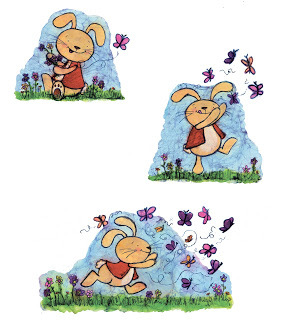
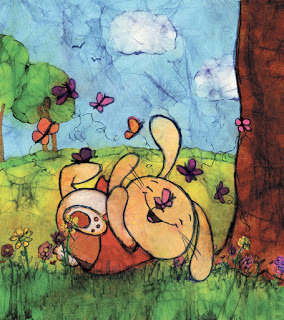
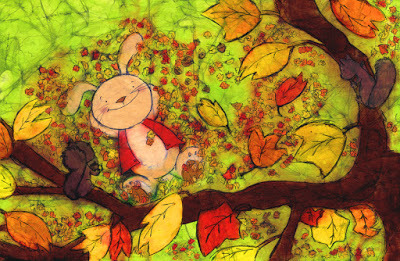
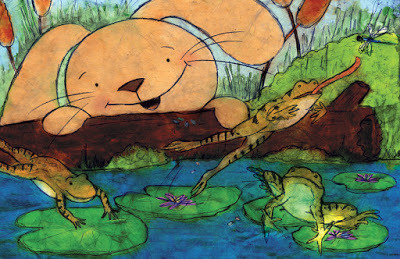
(For more insight into my batik technique, see my last blog post here.)
Besides seeing some fabulous work from all the other illustrators and how they interpreted the texts, we learned a lot about board books by looking at examples that Patti Ann has worked on or that Scholastic has published.
Board books are geared toward the very young, mostly for ages 0-3. They are usually printed on heavy board or sometimes fabric so that they can withstand young children tossing them around or even eating them! This is the age when children are being exposed to the concept of print and reading, as well as basic concepts such as counting, colors, numbers, animals, among other topics. They learn the proper directionality of reading, how to relate the pictures to the text, inflection and fluency by hearing others read to them, and so on. Children at this age can not only develop an interest in reading but they can learn more about the world around them as well as how to use their imagination.
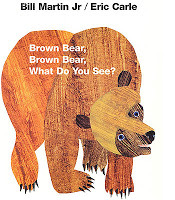 Every day from the time our son came home from the hospital, I read some book out loud to him. Then one day, around 15 months old, he pointed across the room and said "Brown bear, brown bear." He was pointing to"Brown Bear, Brown Bear, What Do You See?" After learning to navigate that book, he would say some of the words on the pages of his "Hop on Pop" board book, then came "I Can Teach My Dog a 100 Words", and "Don't Let the Pigeon Drive the Bus", among other concept board books teaching letters, numbers, colors, etc. His interest and skills just kept building year after year and now at seven years old he reads well beyond his age level.
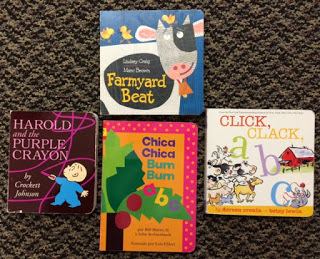
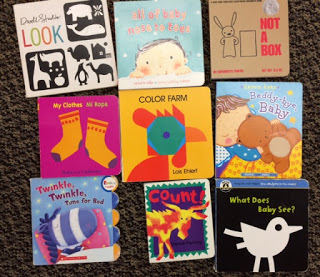
Some board books are written as stand-alones while others are created from picture books that have already been printed. Here are some examples of books that I saw at the library:
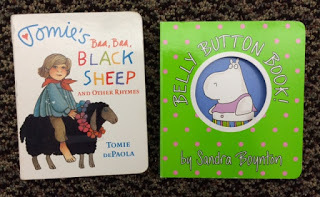
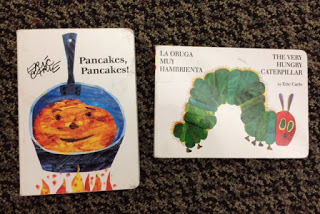

One of my favorite board book author/illustrators is Leslie Patricelli. She is super talented and knows what topics work best with this age group. Her ability to use short, simple text and simple, colorful illustrations is like no one out there today, in my opinion. Here are a few of her books:
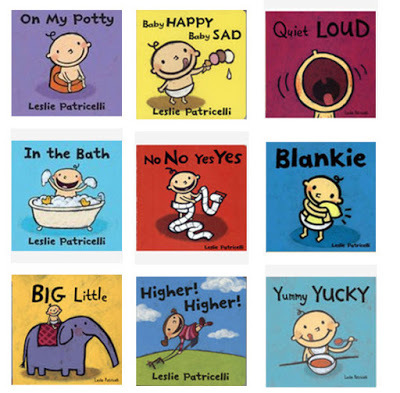
Board books are such an important part of publishing. I believe the younger children read, the less literacy problems they'll face in the future - and the sooner they can develop a life-long love for reading. I'm hoping my new illustration style and some new story ideas can break into the board book world someday. I would love my books to be responsible for some child out in the world learning how to read - and learning to love to read!
In June, I attended the New Jersey SCBWI conference for the second year in a row. Once again, it was a fabulous opportunity to mingle with fellow writers and illustrators, network with editors and art directors, and get inspired to work on my stories and illustrations.
At the conference, I was fortunate to take the illustrator intensive with Patti Ann Harris, Executive Art Director at Scholastic. She works with novelty books, picture books, and board books for the preschool market. The main focus of the intensive circled around board books, so our homework for the workshop was to illustrate a spread from one of the given board book texts (which came from actual published board books).
I chose the text given from Richard Scarry's "I Am a Bunny" and illustrated the following spreads (we only had to do one - I felt ambitious and motivated to do more).


(For more insight into my batik technique, see my last blog post here.)
Besides seeing some fabulous work from all the other illustrators and how they interpreted the texts, we learned a lot about board books by looking at examples that Patti Ann has worked on or that Scholastic has published.
Board books are geared toward the very young, mostly for ages 0-3. They are usually printed on heavy board or sometimes fabric so that they can withstand young children tossing them around or even eating them! This is the age when children are being exposed to the concept of print and reading, as well as basic concepts such as counting, colors, numbers, animals, among other topics. They learn the proper directionality of reading, how to relate the pictures to the text, inflection and fluency by hearing others read to them, and so on. Children at this age can not only develop an interest in reading but they can learn more about the world around them as well as how to use their imagination.
 Every day from the time our son came home from the hospital, I read some book out loud to him. Then one day, around 15 months old, he pointed across the room and said "Brown bear, brown bear." He was pointing to"Brown Bear, Brown Bear, What Do You See?" After learning to navigate that book, he would say some of the words on the pages of his "Hop on Pop" board book, then came "I Can Teach My Dog a 100 Words", and "Don't Let the Pigeon Drive the Bus", among other concept board books teaching letters, numbers, colors, etc. His interest and skills just kept building year after year and now at seven years old he reads well beyond his age level.
Some board books are written as stand-alones while others are created from picture books that have already been printed. Here are some examples of books that I saw at the library:

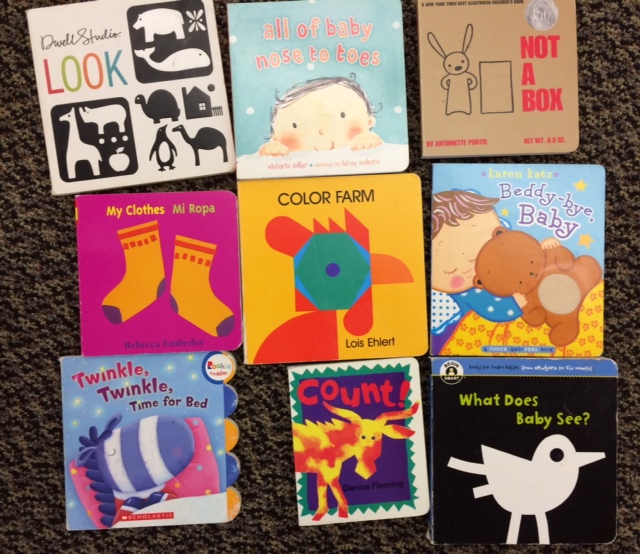


One of my favorite board book author/illustrators is Leslie Patricelli. She is super talented and knows what topics work best with this age group. Her ability to use short, simple text and simple, colorful illustrations is like no one out there today, in my opinion. Here are a few of her books:

Board books are such an important part of publishing. I believe the younger children read, the less literacy problems they'll face in the future - and the sooner they can develop a life-long love for reading. I'm hoping my new illustration style and some new story ideas can break into the board book world someday. I would love my books to be responsible for some child out in the world learning how to read - and learning to love to read!
June 23, 2015
Playing With Crayons
For the last four weeks, I have been busy preparing by stories and portfolio for the New Jersey SCBWI conference. Part of that preparation included experimenting with one of my favorite art mediums, batiks, for my illustrations.
Batik is the art of wax resist and dye on fabric or paper. Batiks can be traced back to the Middle East, Africa, Indonesia, Malaysia, China, Thailand, Philippines, and India. They are usually created on cloth by applying wax to the material and then dyeing it. Cracks in the wax often occur as the batik is folded or pushed into dying tubs. The “crackling” effect occurs when the dye seeps into any cracked parts of the wax.
The first batik I ever created was of a dolphin jumping out of the water. I was in fifth grade and painted melted crayons on fabric, then ironed out the wax. I wish I had taken a picture of it.
In college I learned the tub dye method to create these three batiks.
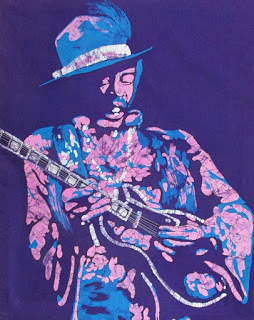
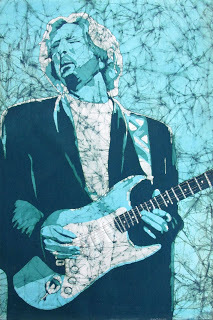
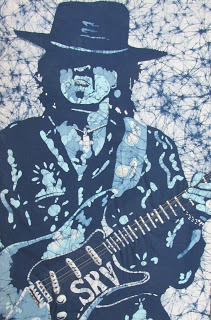
First I drew my picture on white muslin. Then I melted a mix of paraffin and beeswax and painted it on the areas to keep white. The wax has to be hot enough to go on clear so as to not allow any dye to get onto those areas. Next the fabric is placed into a dye bath of the lightest color. Wherever the wax was applied, that area would stay white. After the fabric is hung to dry, wax is applied to the areas that will stay the light color. The process is repeated until the last color (the darkest) is applied.
I've since created other batiks the same way, such as these.
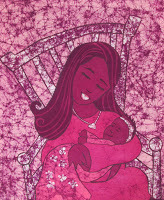
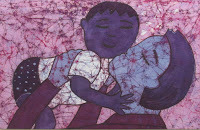
However, when using the tub dye method, all the colors need to stay in the same analogous or monochromatic color family in order to prevent colors from mixing incorrectly. The palettes then become limited. So I started using Photoshop to colorize them.
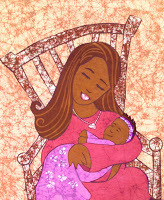
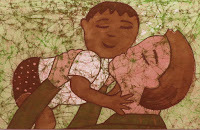 With some convincing and encouragement from friends, I started to examine the idea of using this technique for illustrations. Using melted crayons seemed to give me the best option with regard to using lots of different colors while keeping the crackling the same color.
First I draw out a sketch and then transfer it onto white muslin with a pencil and light box.
Then I melt some crayons and use brushes to paint the melted crayon wax onto the fabric.
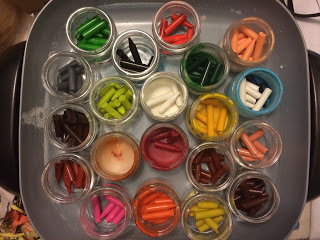
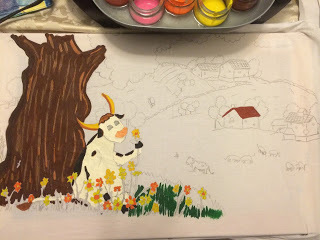
After the whole picture has been painted, I prepare a dye bath, then crumple the fabric and place it in the dye bath for about 20-30 minutes.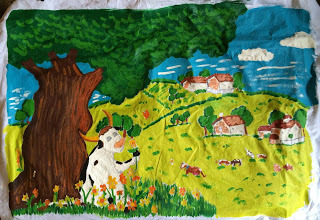
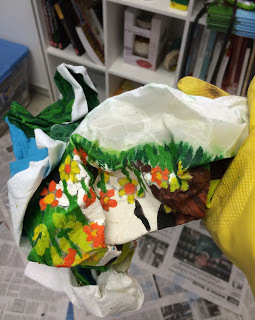
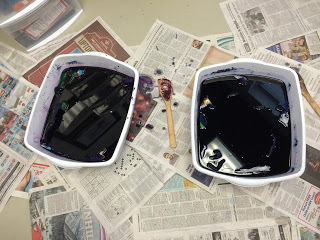 Then I hang it to dry. Once it's dry, I iron out the wax between sheets of newsprint.
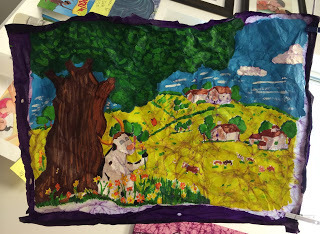 The crayon color did run and bleed quite a bit so I had to touch it up in Photoshop. Plus some of the colors came out darker than I wanted. So I made it look like this.
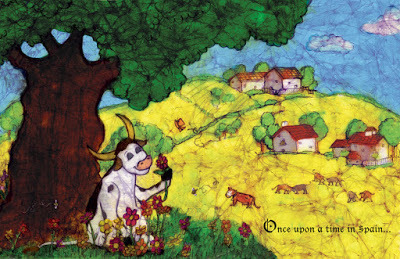
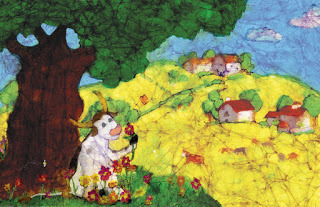 Here it is with my original sketch and text placed on top in Photoshop. (Please note: text and idea comes from "The Story of Ferdinand" by Munro Leaf)
Next time the crayon wax has to be thinner and hotter - I'll be using aluminum cups to melt the wax instead of glass jars in water inside a hot skillet in the future.
Here are some other recent crayon batiks done the same way.
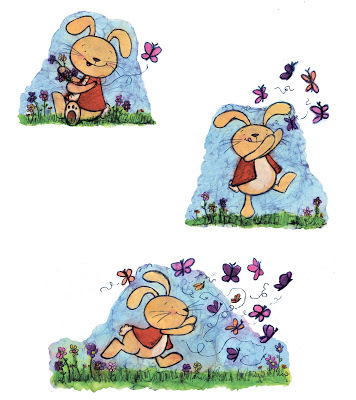
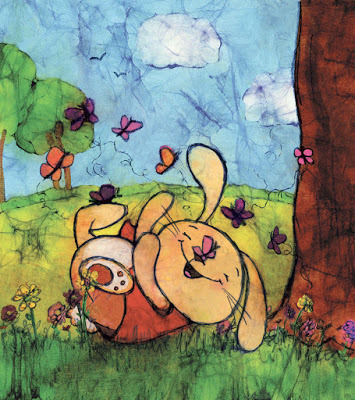
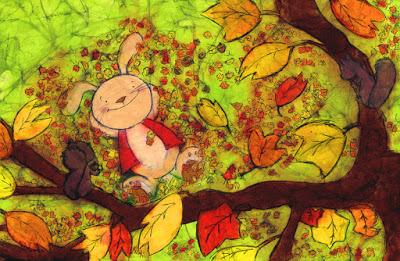
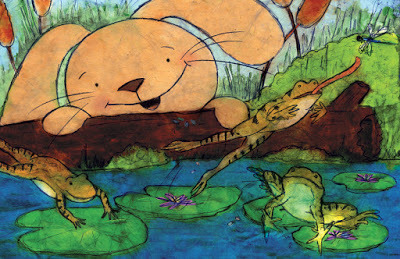
Come back next month when I hope to have more of these illustrations to show!!!
Batik is the art of wax resist and dye on fabric or paper. Batiks can be traced back to the Middle East, Africa, Indonesia, Malaysia, China, Thailand, Philippines, and India. They are usually created on cloth by applying wax to the material and then dyeing it. Cracks in the wax often occur as the batik is folded or pushed into dying tubs. The “crackling” effect occurs when the dye seeps into any cracked parts of the wax.
The first batik I ever created was of a dolphin jumping out of the water. I was in fifth grade and painted melted crayons on fabric, then ironed out the wax. I wish I had taken a picture of it.
In college I learned the tub dye method to create these three batiks.


First I drew my picture on white muslin. Then I melted a mix of paraffin and beeswax and painted it on the areas to keep white. The wax has to be hot enough to go on clear so as to not allow any dye to get onto those areas. Next the fabric is placed into a dye bath of the lightest color. Wherever the wax was applied, that area would stay white. After the fabric is hung to dry, wax is applied to the areas that will stay the light color. The process is repeated until the last color (the darkest) is applied.
I've since created other batiks the same way, such as these.

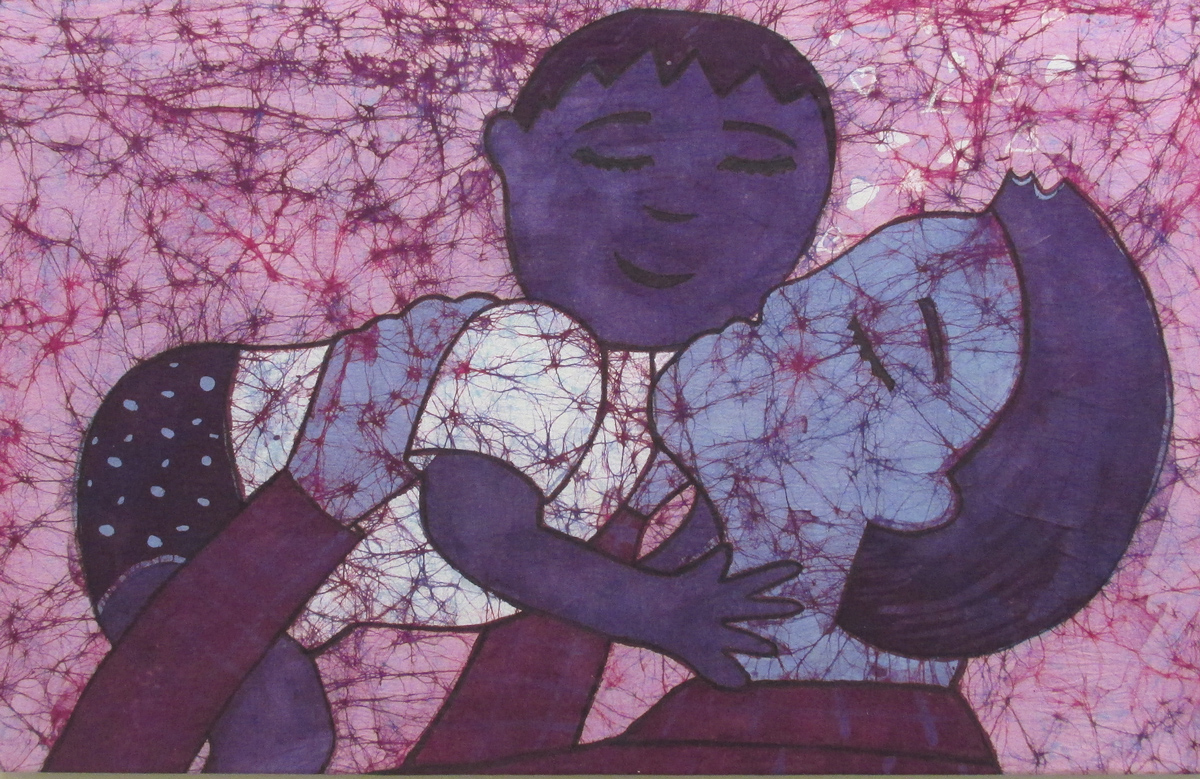
However, when using the tub dye method, all the colors need to stay in the same analogous or monochromatic color family in order to prevent colors from mixing incorrectly. The palettes then become limited. So I started using Photoshop to colorize them.

 With some convincing and encouragement from friends, I started to examine the idea of using this technique for illustrations. Using melted crayons seemed to give me the best option with regard to using lots of different colors while keeping the crackling the same color.
 First I draw out a sketch and then transfer it onto white muslin with a pencil and light box.
Then I melt some crayons and use brushes to paint the melted crayon wax onto the fabric.


After the whole picture has been painted, I prepare a dye bath, then crumple the fabric and place it in the dye bath for about 20-30 minutes.


 Then I hang it to dry. Once it's dry, I iron out the wax between sheets of newsprint.
  The crayon color did run and bleed quite a bit so I had to touch it up in Photoshop. Plus some of the colors came out darker than I wanted. So I made it look like this.
  Here it is with my original sketch and text placed on top in Photoshop. (Please note: text and idea comes from "The Story of Ferdinand" by Munro Leaf)
Next time the crayon wax has to be thinner and hotter - I'll be using aluminum cups to melt the wax instead of glass jars in water inside a hot skillet in the future.
Here are some other recent crayon batiks done the same way.


Come back next month when I hope to have more of these illustrations to show!!!
May 12, 2015
Magic Tree House Books - Truly Magical!
As a kid, I didn't have a tree house but I always thought it would be cool to play in one. There's even a show out now called "Tree House Masters" on Animal Planet - what a way to make a living!
 But imagine one day walking through the woods and discovering a tree house high up in a tree. You climb up the rope ladder to find the tree house filled with books of all kinds. When you point to a picture and wish to go there, the wind starts to blow...
The tree house stars to spin.
It spins faster and faster.
Then everything is still.
Absolutely still.
And you are transported to another time and place.
Well thanks to Mary Pope Osborne, you can journey in that magical tree house, too.
I've always enjoyed reading "Magic Tree House" books with my students and stepsons over the years. I introduced the books to my son Alonzo last year when he was in Kindergarten and we read up through book 19 (and have since skipped around to other books in the series). I'm starting to reread many of the MTH books now to get inspired as I write my own chapter book series - no details to share yet.
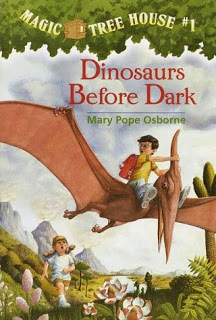
The MTH series began in 1992 and is still going strong. There are currently 51 "Magic Tree House" books in the series. In addition, there are 28 Fact Trackers which are nonfiction companions to the fiction titles. You can read "Magic Tree House" books in print form, as ebooks, and as audio books narrated by Mary Pope Osborne herself. There are also the "Merlin Missions", which is a series of MTH books with longer text and higher reading level geared toward older readers.
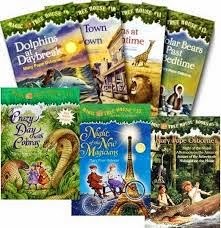
"Magic Tree House" is THE number one chapter book series out there, in my opinion, for many reasons:
First, the characters - Jack and Annie - are very age appropriate for the target readers. The series is perfect for children who are on the tail end of reading picture books but not quite ready for middle grade novels. My son was six years old when he started. Although Amazon has them listed for ages 8-12 (grades 3-7) I feel kids as young as 6 or 7 could start reading these books, if not alone then with an adult.
Second, the sentence structure is simple yet complex enough to be challenging. The text and dialogue flow from page to page and make each book an engaging fast read. Most of the books in the series have 10-12 short chapters and are around 100 pages. And each chapter ends with some type of cliff hanger or interesting sentence to make you want to turn the page.
Also, while every book tells its own story, each book connects to the others in some way. For example, every 3-4 books will connect to a larger story, such as Jack and Annie having to find multiple items or clues to break a spell. There are prologues in each book explaining what happened in previous books to remind the readers where they left off. And Jack and Annie will often reference previous stories to further remind readers about their adventures and how the current story relates or connects. (i.e. They're riding on a helicopter over an earthquake stricken town in China and say "Remember when we rode on the helicopter to Antarctica?"). This is so important when writing a series.
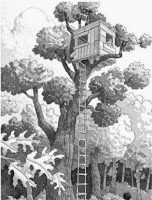 Third, the illustrations are placed throughout the books to help readers visualize the text. They also help to break up the text to ease that transition from picture books to novels.
And last but not least, each book deals with some type of historical event or topic that takes readers to another time and place. It's done in such a creative way to not only delight readers but teach them something about history, culture, and geography, among other topics.
Oh, and did I mention there is a magic librarian named Morgan le Fey who asks Jack and Annie to help her break magic spells, solve mysteries and riddles, and save ancient stories from being lost forever?
How cool is that??
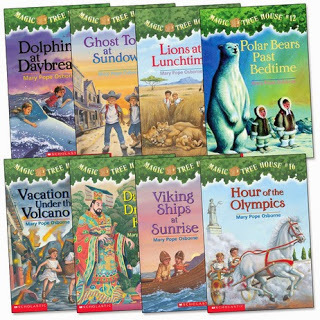
I'm glad that my son is only seven years old now and still has plenty of Magic Tree House books left to read with me - and to me. Then again, I'm 43 and am still reading the books. I don't think Magic Tree House books will ever get old - or will ever lose their magic!
 But imagine one day walking through the woods and discovering a tree house high up in a tree. You climb up the rope ladder to find the tree house filled with books of all kinds. When you point to a picture and wish to go there, the wind starts to blow...
The tree house stars to spin.
It spins faster and faster.
Then everything is still.
Absolutely still.
And you are transported to another time and place.
Well thanks to Mary Pope Osborne, you can journey in that magical tree house, too.
I've always enjoyed reading "Magic Tree House" books with my students and stepsons over the years. I introduced the books to my son Alonzo last year when he was in Kindergarten and we read up through book 19 (and have since skipped around to other books in the series). I'm starting to reread many of the MTH books now to get inspired as I write my own chapter book series - no details to share yet.

The MTH series began in 1992 and is still going strong. There are currently 51 "Magic Tree House" books in the series. In addition, there are 28 Fact Trackers which are nonfiction companions to the fiction titles. You can read "Magic Tree House" books in print form, as ebooks, and as audio books narrated by Mary Pope Osborne herself. There are also the "Merlin Missions", which is a series of MTH books with longer text and higher reading level geared toward older readers.
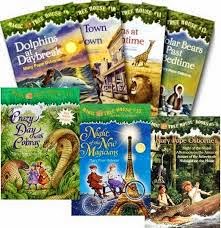
"Magic Tree House" is THE number one chapter book series out there, in my opinion, for many reasons:
First, the characters - Jack and Annie - are very age appropriate for the target readers. The series is perfect for children who are on the tail end of reading picture books but not quite ready for middle grade novels. My son was six years old when he started. Although Amazon has them listed for ages 8-12 (grades 3-7) I feel kids as young as 6 or 7 could start reading these books, if not alone then with an adult.
Second, the sentence structure is simple yet complex enough to be challenging. The text and dialogue flow from page to page and make each book an engaging fast read. Most of the books in the series have 10-12 short chapters and are around 100 pages. And each chapter ends with some type of cliff hanger or interesting sentence to make you want to turn the page.
Also, while every book tells its own story, each book connects to the others in some way. For example, every 3-4 books will connect to a larger story, such as Jack and Annie having to find multiple items or clues to break a spell. There are prologues in each book explaining what happened in previous books to remind the readers where they left off. And Jack and Annie will often reference previous stories to further remind readers about their adventures and how the current story relates or connects. (i.e. They're riding on a helicopter over an earthquake stricken town in China and say "Remember when we rode on the helicopter to Antarctica?"). This is so important when writing a series.
 Third, the illustrations are placed throughout the books to help readers visualize the text. They also help to break up the text to ease that transition from picture books to novels.
And last but not least, each book deals with some type of historical event or topic that takes readers to another time and place. It's done in such a creative way to not only delight readers but teach them something about history, culture, and geography, among other topics.
Oh, and did I mention there is a magic librarian named Morgan le Fey who asks Jack and Annie to help her break magic spells, solve mysteries and riddles, and save ancient stories from being lost forever?
How cool is that??

I'm glad that my son is only seven years old now and still has plenty of Magic Tree House books left to read with me - and to me. Then again, I'm 43 and am still reading the books. I don't think Magic Tree House books will ever get old - or will ever lose their magic!
April 28, 2015
How Do Dinosaurs Say We Love Jane Yolen?
 Zo's official logoMy seven-year-old son Alonzo is so into dinosaurs. He started getting the dino itch about a year ago and hasn't stopped loving them since! He even has his own website called www.alonzosdinos.com where he shows off his 112 dino drawings and gives some facts for people to learn about the different prehistoric species.
 When I was a kid, I was into dinosaurs, too. But I remember learning about only 5-6 species of dinos. Today there are over 500 different named dinosaurs - and my son probably knows most of them!
So for this blog post, in honor of National Poetry month AND my junior paleontologist son Alonzo, I'm going to focus on Jane Yolen and her dinosaur picture books.
 Ah! A T-Rex!When Alonzo discovered Jane Yolen's dinosaur picture books, he was immediately hooked. And so was I. What's fabulous about Jane Yolen's books is that they are simple, eye-catching, and involve topics that are relevant to children. Not to mention she has a fabulous illustrator in Mark Teague who's been able to teach children about different dinosaurs while showing what dinosaurs would be like if they acted like children. And if you're an illustrator, you'll want to study Mark Teague's illustrations - he is one of THE best children's book illustrators out there. You can learn so much about composition, movement, expression, color, etc. from his work.
Each of the books begins with a question in the title and the first few spreads also ask the reader questions - what would a dinosaur do in a given situation? Would they spit out half-chewed broccoli when they ate their food? Would they stick beans up their nose? Would they be a playground bully if they went to school? Would they stomp and throw a tantrum to hear one more book before bedtime? Then about 2/3 of the way in, Yolen flips the script, and says no, dinosaurs are good, just like you little readers. She then, in her simple rhyming format, tells the readers what good dinosaurs would do in those situations - eat all their food, kiss their mom and dad goodnight, treat others nicely at school.
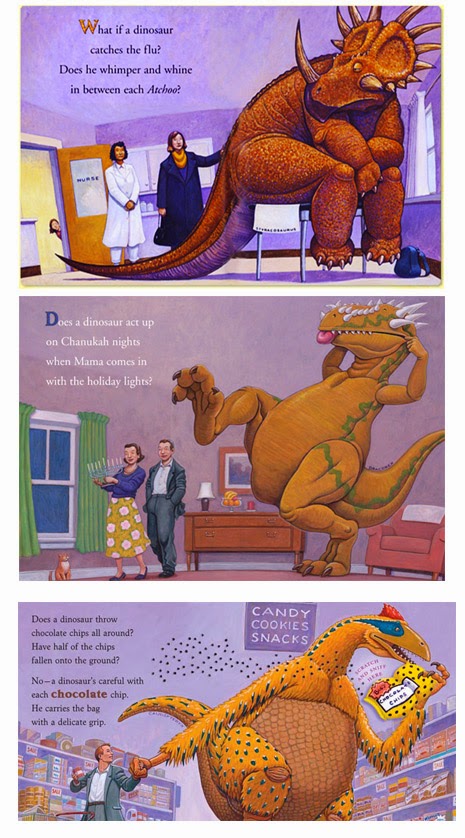 Here are some of the great titles in the dinosaur book series: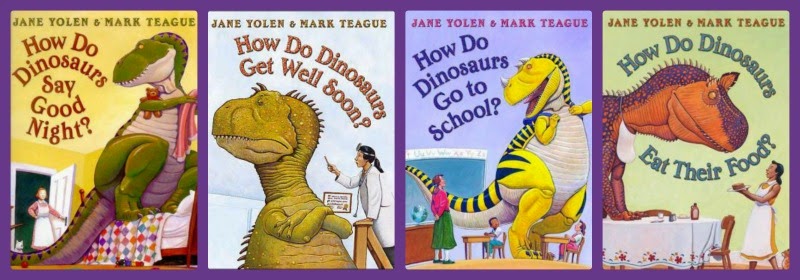

So for all your little dinosaur lovers out there, like my son Alonzo, I highly recommend you introduce them to Jane Yolen's books. They'll not only read some wonderful books in verse, but they can learn to act like good little dinosaurs do.
April 19, 2015
Celebrating Poetry Month with Shel Silverstein
The Academy of American Poets started National Poetry Month in 1996. It's held every April and is celebrated with schools, publishers, libraries, booksellers, and poets all over the world. I was not an avid reader as a child, but one thing I did love to read and write was poetry. And still do to this day.
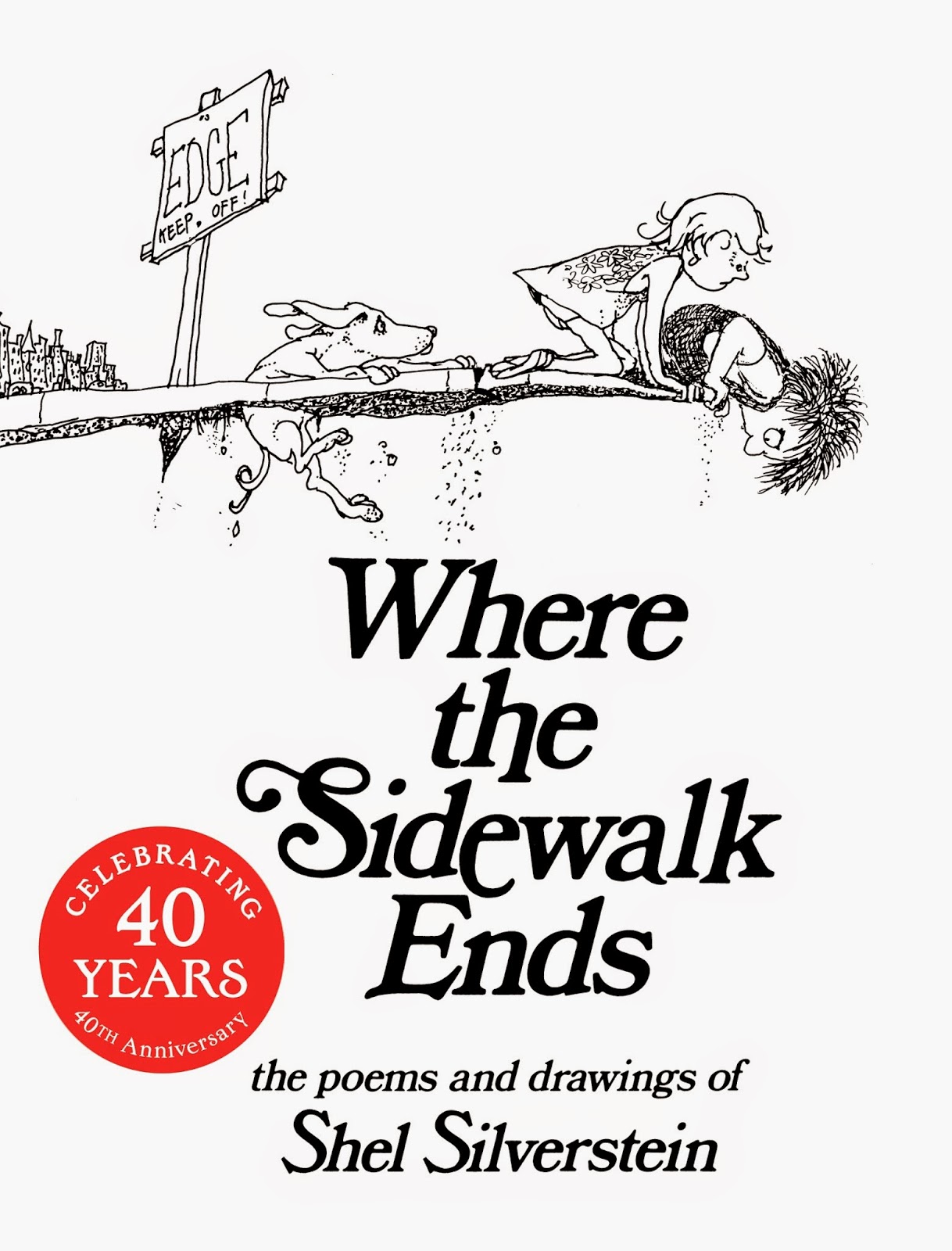 One of my favorite children's book writers of poetry is Shel Silverstein. I remember reading so many of his books when I was a kid. Probably my favorite collection of his work is "Where the Sidewalk Ends", published in 1974. It opens with this great poem:
 If you are a dreamer, come in,For someone who didn't really like to read as a child, Silverstein's words felt welcoming, comforting as if he was saying, "It's okay. You can trust me. You'll like my poems. You'll want to read more. I won't let you down."
If you are a dreamer, a wisher, a liar,
A hope-er, a pray-er, a magic bean buyer . . .
If you’re a pretender, come sit by my fire
For we have some flax-golden tales to spin.
Come in!
Come in!
Who can forget these incredible works of word and art, too.
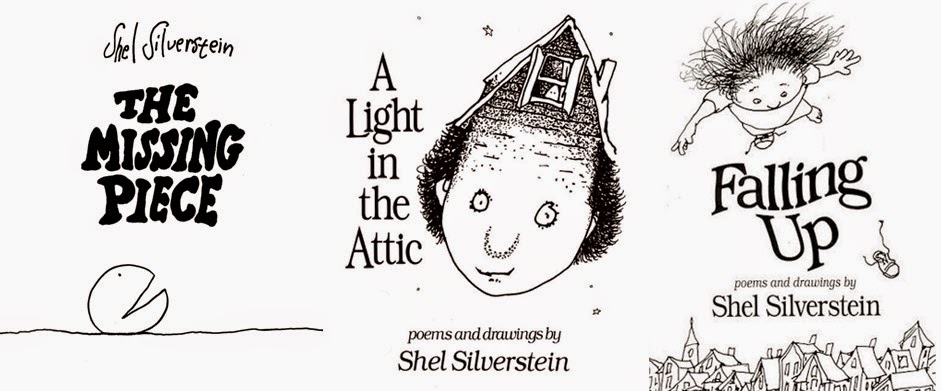
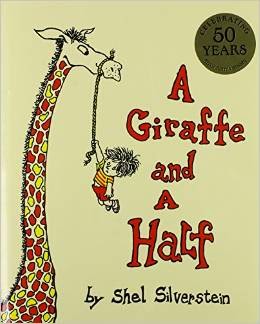
In every book, I really felt like Silverstein was inviting me into his world of imagination. I felt like every time I opened one of his books I would find something new to read or see. His poems were every kind - silly, fun, weird, strange, touching and most of all inspiring. His illustrations were so simple and funny. They added a great deal to each poem. I'm usually drawn to colors in paintings, books, and just about everything. But there's something about Silverstein's books being in just black and white that are eye-catching, special and unique.
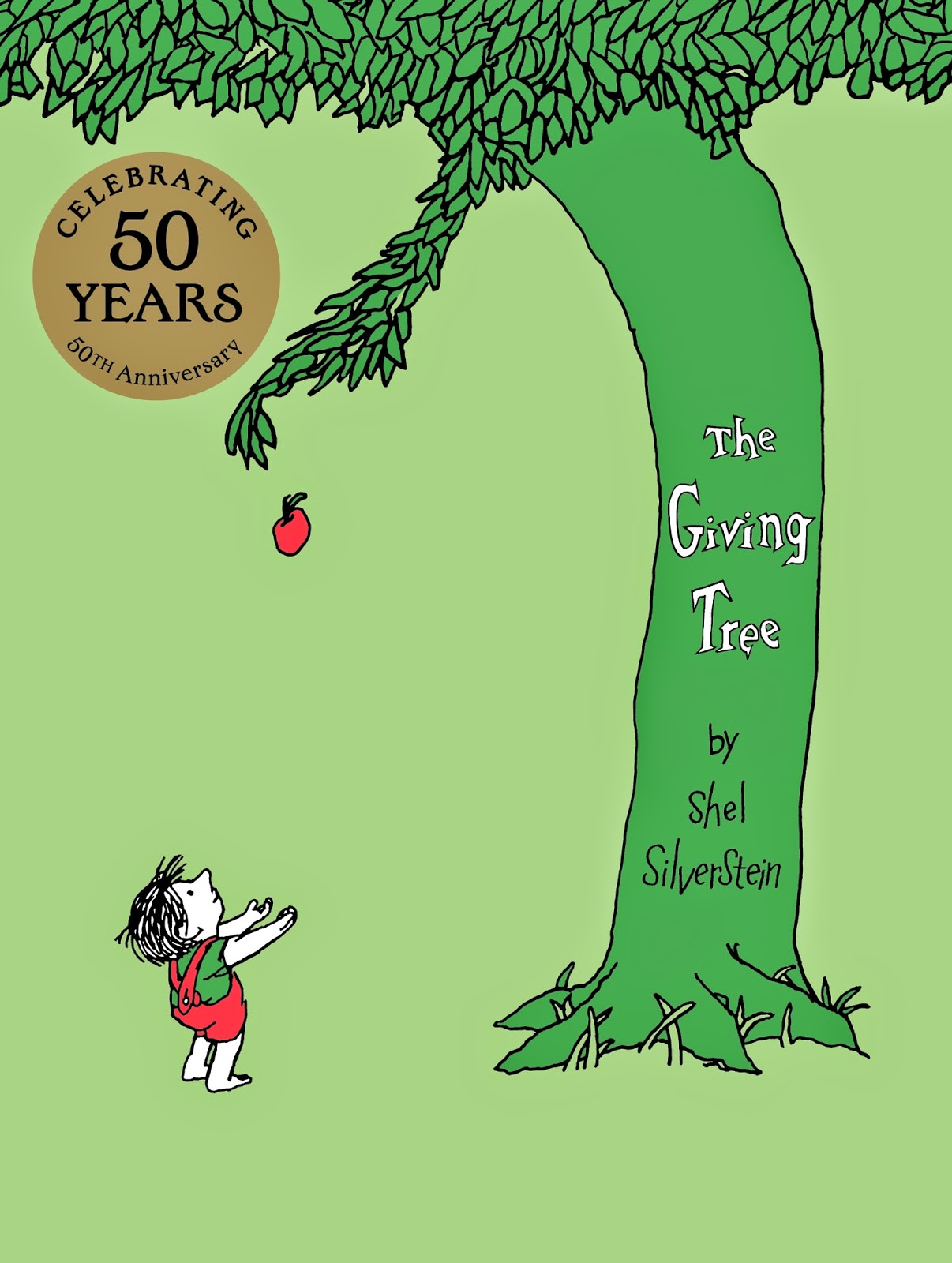
Out of all Silverstein's books, though, by far the one that caught my heart the most is "The Giving Tree." I tear up each time I read it. It's a masterpiece that you need to pick up every so often to be reminded how important it is to give to others and to evaluate your capacity to love.
So this April, I encourage you to take a look at Shel Silverstein's work. Browse his website where there are lots of resources for teachers and parents to share his poetry, specifically for National Poetry month and beyond. As for me, I'll be going to the library and checking out all of Silverstein's books, starting with a special edition of "Falling Up" that has a few never before released poems - like this one called "The Poet Tree"
Underneath the poet treeCome and rest awhile with meAnd watch the way the word web weavesBetween the shady story leaves.
The branches of the poet treeReach from the mountains to the sea.So come and sit...and dream...and climb--Just don't get hit by falling rhymes.
Thanks for the invite, Shel. I plan on reading your books with my son, hoping that he'll grow up to love you as much as I do.