Hannah Anderson's Blog
January 3, 2017
On Writing (More)
“If God gives you something that you can do, why in God’s name wouldn’t you do it?” –Stephen King, On Writing: A Memoir of the Craft
 Illustrator: C. Coles Phillips, 1920
Last week, I started dreaming about a new writing project. This would be THE project. The One that would challenge and push me. The One that would require an honesty and determination that I’m not sure I possess. The One that captures everything I love in life. But when I began to share it with my husband, he raised both hands to stop me.
“I don’t want to hear about it.”
“Wha—“
“You heard me. I don’t want to hear about it. I want you to write it. You write it and then I’ll read it.”
It’s not that my husband is unsupportive of my writing; he’s so supportive, in fact, that he refuses to listen to me talk about writing. With every conversation, he knows that the likelihood I will actually write decreases exponentially . I know this too, and so last week, I also made my 12-year-old daughter swear that she would not let me share ideas with her, either. She has my full permission to instruct me to SHUT YOUR MOUTH, MOTHER when I sidle up to her to tell her about my latest, greatest project.
And so in the spirit of the New Year, I’m publicly resolving to talk less and write more.
It’s not about producing more content so much as taking writing seriously. Over the last five years, I’ve watched (often incredulously) as writing has morphed from hobby to part-time work to vocation. I’ve known for a while that I needed to shift my approach to writing—to act as if it were truly vocation—but I’ve found plenty of excuses not to, counting on the off chance that if I didn’t own it as vocation then I wouldn’t be responsible for it.
But to riff off Miss O’Connor, our callings don’t change according to our ability to stomach them. If God has given me something to do, then I’d better get doing it.
No Comment
The first step I’m taking toward talking less and writing more is to remove the comment section from the blog. Common wisdom says that a comment section helps build platform because it drives traffic and forms community. Not-so-common wisdom says that the comment section inhibits my writing because I feel responsible to respond to praise, questions, and critique. This is not a statement about the quality or quantity of comments at SAL, but the very likely possibility that I could write a 700 word essay only to expend 1500 words in the comment section.
By removing the comment section, I’m also clarifying what’s happening here. Instead of seeing this blog as a common meeting space, I see it as a workspace –a space where I craft ideas to send out into other spaces. My goal is not for you to discuss ideas here but for you to discuss them with the people you actually live, work, and worship with—your pastor, your wife, your friend.
I don’t want to build a community around my writing; I want my writing to help you build your community.
Having said this, I believe there is value in online community. I have benefited from new ideas and the comfort of knowing that I am not alone in my concerns and joys. But online interaction can very quickly become a closed circuit, especially when the writing begins to support the community that has grown up around… the writing… which now must support the community… which has grown…
I don’t want this for my writing and I don’t want it for my readers. Instead, I want my writing to support the work that’s happening in our real lives, not draw you (or me) further away from it. There may be a day when the comment section won’t draw me away, but I’m not there yet.
Social Media Dis-engagement
In order to write more, I’m also taking steps to limit my social media engagement. This too flies of the face of current wisdom about How to Become Successful Online (in Ninety Days or Your Money Back).
The problem with social media is that it is primarily about being… social. It rewards extroverts and those who know how to work a room. It rewards public presence and being personally accessible—or worse, for crafting an image of accessibility, for giving readers the impression that you’re personally invested in them. In short, social media rewards you for inviting more and more people into your private life.
Which is the exact opposite of what it takes to write well.
Writers serve readers best, not by hanging out in the public square, but by hiding themselves away to actually… write. For some of us, this hiding away is no sacrifice; for others, it is a discipline, an act of self-control rooted in faith and obedience. Writing well requires space for reflection in a “room of one’s own.” But in our digital world, that room is often packed with hundreds, if not thousands, of friends and followers.
Beyond simply being a distraction, I’ve also found that social media can actually undermine my motivation to write. For me, writing has always been about working through ideas. Questions pop into my head (yes, they really do *pop* in–most of the time uninvited) and I use the process of writing to resolve them. But as I write, I’m also cutting a path for readers to follow so that they can work through the ideas themselves. Social media allows me to resolve a question without actually having to write about it—or at least write in a way that readers can follow.
Here’s what happens: I’ll read an interesting article or someone will pose a question. My brain immediately starts turning so I respond with a comment or tweet. Someone else engages. We dialogue and 700 words later, the question is resolved; unfortunately, my need to write about it is also resolved. Because the answer is obvious now (to me at least), I don’t feel the need to develop it any further or guide others along the same mental process. And so I don’t write.
Sometimes I wonder if we’ve lost more books to Facebook threads and Twitter rants than the Alexandrians lost to fire.
Five years ago, I started this blog as a way to keep myself accountable to write. Today I’m returning to it for the same reason. I understand that being a writer in the digital age means having a social media presence; I also understand that shaping ideas requires community. But I don’t believe God has called me to be a social media magnate. He has called me to write.
And often the work of writing is simply that: work. Work that happens word by word, line by line in quiet consistency. It’s no more glamorous than laying brick or filing medical charts. Or at least, it shouldn’t be. But like laying brick and filing medical charts, writing is good, steady, faith-filled work. And when God has given you the opportunity and ability to do good work, what possible justification could you have for not doing it?
The post On Writing (More) appeared first on Sometimes a Light.



December 22, 2016
On the Making of Lists
[image error]
Mma Ramotswe liked to make lists, and, like all people who make lists, she was inclined to take an optimistic view of their contents. So lists of things achieved–cases closed, and so on–tended to include matters that were almost, but not quite finished, and lists of things to be done by noon embraced tasks that might well not be performed until four o’clock in the afternoon or possibly even noon the following day. This did not involve self-deception… well, perhaps it did, but how can anyone manage to negotiate their way through life’s complexities without at least a smidgen of self-deception here and there?
Some of these lists were written down on scraps of paper and on a whiteboard on the kitchen wall in Zebra Drive. The whiteboard… hosted lists for other members of the family, the idea being that everybody should look at it in the morning to see what they had to do later that day. So there might be a note reminding Mr. J.L.B. Matekoni to telephone the Botswana Eagle Insurance Company to renew the household insurance; or a reminder to Motholeli to take ten pula to school for her new mathematics textbook; or one to Puso to put his football socks in the wash. Sometimes there where lists for hersels–of household supplies running low (washing-up liquid, butter, the hot Mozambique peri-peri sauce that Mr. J.L.B. Matekoni liked to put on his roast chicken); or lists of people she had to telephone (her aunt in Mahalapye, Mr. J.L.B. Matekoni’s cousin in Muan–the one who needed the cataract operation–Mma Potokwane about meeting for tea when she next came to town). Lists, she thought, are the stories of our lives; they give a picture of who we are and what we do every day.
–From Precious and Grace by Alexander McCall Smith (New York: Pantheon Books, 2016)
On this week’s episode of Persuasion, my co-host Erin Straza and I talk about the lists that tell the stories of our lives. With 2017 right around the corner, the impulse to plan and sort and list is nigh irrepressible. But which lists and how? Which system will be “the one” to revolutionize your coming year? We tackle everything from personalized planners to the popular bullet journaling technique to my tendency to menu “plan” after the fact.
Listen in here:
 Episode 80: What Your 2017 Calendar Says About You
The post On the Making of Lists appeared first on Sometimes a Light.

November 17, 2016
Further Thoughts on the Shape of Women’s Ministry
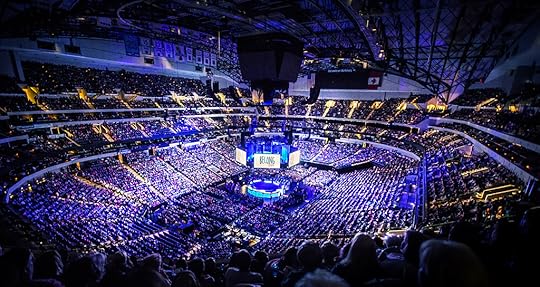 Arena shot of Belong Tour, a traveling women’s ministry event
This week, Kate Shellnutt of Christianity Today published a piece that examines the shape of women’s ministry in the white evangelical church. The article comes in the wake of the controversy surrounding popular speaker and author Jen Hatmaker’s public support of gay marriage. In response to her new position, LifeWay will no longer sell Hatmaker’s books and products.
While I don’t agree with Hatmaker’s position, I also don’t think folks are necessarily seeing the big picture. Hatmaker is not one individual who suddenly and unexpectedly went rogue. She represents the larger shape of evangelical women’s ministry that is very often detached from the established Church. Erin Straza and I tackled this question in a recent Persuasion podcast in which we argue that much of women’s spiritual formation has been outsourced to the marketplace. We shouldn’t be surprised when it’s shaped by influences other than the Church.
Kate’s article at CT taps several leaders in ministry and tries to set the larger frame for what’s happening, particularly among white evangelical women. For example, while most pa stors have probably never heard of Hatmaker, she has a FB following larger than John Piper, Tim Keller, or Gary Chapman. Kate reached out to me for her article and I asked her if I could publish more of our email exchange here:
_________________________________________________________
Kate: What do you see as some of the pros and cons of having so much momentum around women’s ministry at a national level?
Hannah: Positively, I think we need to recognize that the Spirit of God is at work. Because the digital age has changed how ideas spread, women (who have historically existed in the margins of theological conversation) have an opportunity to add to the conversation without ever leaving their desks. In the past, a lack of infrastructure would have held them back; but today, women who are gifted to teach, lead, or encourage have opportunity to actualize these gifts in a public way.
The advantage, of course, is that the Church at large can benefit from these gifted women. They become a channel of the Holy Spirit’s power and blessing as they fulfill their calling for the good of the Church and the glory of God. One practical affect is that new topics come up for discussion and application—topics that male leaders simply wouldn’t know to address or can’t address. Female leaders are also uniquely positioned to apply the teachings of the Church to the needs of half her members.
On the other hand, because so many female spiritual leaders are operating in parachurch contexts, their ministries have the potential to lose the doctrinal and structural accountability that the established Church provides. The digital age may free women from the gendered constraints of traditional ministry, but this means that they also have the potential to become free agents.
Consider how few female evangelical leaders are visibly attached to an institution such as a church, seminary, or non-profit that did not grow up around their personality. Name a male leader like Rick Warren and you immediately think of Saddleback Church. Say Beth Moore or Ann Voskamp or Jen Hatmaker and most of us will draw a blank about which local church these women affiliate with. This is not to say that they aren’t connected, but their local church isn’t a visible or central a component to their public ministry.
Being distanced from ecclesiastical institutions also means women’s ministry inadvertently becomes shaped by market forces. Nationally known female spiritual leaders are by-and-large entrepreneurs and most often, out of necessity. Because women struggle to find space in the established Church, they end up creating their own institutions, whether as collectives or around themselves. The latter is both fed by and feeds evangelical celebrity culture.
This entrepreneurial dynamic also affects the shape and philosophy of women’s ministry, even if only inadvertently. When a woman has to create her own position and then maintain that position apart from the contribution (both financial and spiritual) of a larger institution, her target demographic can disproportionately affect the shape of her ministry. This is true of many entrepreneurial endeavors, not simply women’s ministry; but if the majority of female leaders are operating in the marketplace (as opposed to the institutional Church), women’s ministry as a whole can reach a point of critical mass where an audience-centric philosophy creates wider expectations about style, topics, and content.
Practically speaking, this broader culture locks both leaders and followers into a matrix built on audience consumption of the personal spirituality of the celebrity. The “product” is not robust spiritual formation so much as spirituality mediated through the experience and passions of the tribal leader. Of course, not all nationally known female leaders and ministries operate this way, but building “tribe” is a significant emphasis for many.
Kate: Also, the tweet from you that stood out most to me was about how female leaders don’t need to “show their work” theologically. Could you expand on that? What is the role you see theology playing? And why shouldn’t we be tempted to write off these women as overly inspirational or shallow?
Hannah: I believe that market forces are unduly shaping women’s ministry. And part of what the market wants is simple, practical spirituality. In a robust learning environment, a teacher works to create a curriculum and syllabus that suits the needs (not the wants) of the learner. But teachers operating in the marketplace must always consider what the market can bear. They themselves aren’t necessarily a-theological (although some may be), but they may feel a tension to craft their teaching in a way that minimizes theological book work in favor of inspiration, lifestyle advice, or practical mission.
The problem is that if lay women don’t see their teachers modeling theological investigation or healthy engagement with the Scripture, they won’t be able to develop these abilities themselves. They won’t even know they need to develop them. It’s like learning to cook from a recipe that calls for pre-packaged ingredients like “cake mix” vs. a recipe that calls for flour, sugar, dry milk, baking soda, and salt. The shortcuts may seem helpful at the moment, but have we really learned to cook? Have we grown in our spiritual understanding?
I do not believe that all female leaders must have an M.Div. or theology degree to teach or lead. I don’t have one myself. But we do need to raise the expectation for what passes for spiritual formation. In an article in the Washington Post last year, Karen E. Yates reflects on the last two decades of women’s involvement in Christian publishing and notes that “women today are publishing at an incredible rate without the title of pastor, without a seminary degree and without a traditional pulpit.”
If nothing else, this should get our attention. Not because women aren’t capable of the higher thinking associated with formal teaching ministry, but because of the very real possibility that half the Church is being trained in mission by people with a limited number of tools in their toolkits. As a woman, this also concerns me because a haphazard approach to theology could reinforce prejudices against women teachers. In some ways, we have to be better and more faithful than our male counterparts in order to overcome entrenched biases.
This doesn’t mean we should write off women leaders as uneducated, un-theological, or shallow. You do not gain the following necessary to be a nationally known leader without a great deal of gifting, self-education, and hard work. What women leaders often are, however, is isolated. Isolated from the very Church they are seeking to build. If Paul is correct that the Church is “the pillar and ground of truth,” the way forward is not to shame female leaders for using their gifts without theological credentials. The way forward is for the Church to identify and support gifted women, partnering with them via theological training and commissioned ministry positions.
If you don’t want women breaking down the doors, simply open them for them.
The post Further Thoughts on the Shape of Women’s Ministry appeared first on Sometimes a Light.

October 6, 2016
When God Surprises You
This Tuesday, my book Humble Roots finally released. Several weeks ago, I’d made a plea for help in spreading the word; this plea was met with overwhelming enthusiasm and support from around the country and around the world. And yesterday, one day after release, Humble Roots, with its message of finding rest through humility, topped Amazon’s Inspiration & Spirituality category
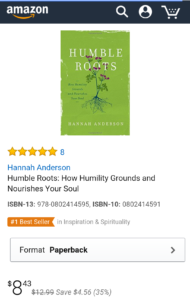
I found myself needing to sit down a lot yesterday.
But this experience also reminded me of a section in Humble Roots. In chapter 9, I tell the story of a handful of green beans carelessly tossed into a pile of dirt late one summer. A month earlier, my husband had tried to cultivate these same green beans in our garden but to no avail. He planted, he tended, he watered, he staked. But after several weeks, all he had to show for his efforts was a lush vine with no fruit. A couple of weeks later, however, my son found the bag of leftover beans and “planted” them in the dirt next to our recently constructed patio. The beans sprouted, blossomed, and produced more fruit than my husband’s carefully tended ones did.
Part of humility means trusting God with our plans and submitting to the possibility that they will not be fulfilled… But part of humility means trusting God with our plans and submitting to the possibility that they will be fulfilled in ways that we cannot imagine. Because we can’t know the future, we also don’t know when He will choose to bless us with abundance…
The fact that success can come without our efforts is testimony, yet again, to God’s surpassing power and goodness. God delights to use small, out-of-the-way, unexpected means to showcase His glory… So, what if God can grow beans in a pile of unattended dirt? What if God can bring about good things without us? What if grace is true?
I never expected Humble Roots to rank so well one day after release. But I’m learning that God often does the unexpected. And sometimes the unexpected means calling us to places of leadership and influence that we did not seek. But even here, humility guides us because humility reminds us that this–all of this–was never about us in the first place.
I’ve often seen women struggle when their influence grows–whether it’s in a church, community, or even in the home. Sociologists tell us that women often lack the confidence to assume leadership; and so when they’re put in places of influence, they can doubt their own abilities, withdraw, and self-sabotage. (On the other hand, men–as a general category–do not seem to struggle with confidence in their own abilities.) I know this lack of confidence to be true in my own life. When I’m put in front of people or receive public praise, all I want to do is close up shop and hide, preferring abdication over the need to meet expectations about future growth. But as much as humility reminds us that God is the one who makes our work flourish, humility also frees us to flourish in the midst of that work. Humility frees us to become men and women of influence.
A few weeks ago, I had the opportunity to write a short post for womensministry.net, a site devoted to supporting and encouraging women who are called to serve in position of influence in the church. I wrote about how humility is the very thing that makes our leadership effective. Instead of leading us away from growing influence, humility frees us to step into God’s call on our lives by freeing us from preoccupation with ourselves. Specifically,
1. Humility rescues us from the need to make a name for ourselves.
2. Humility frees us from the paralysis of criticism.
3. Humility gives us the confidence to obey God’s call.
You can read the whole article there, but ironically enough, this was the very article that I needed to (re)read yesterday. In the midst of all the excitement and busyness of Launch Week, I’m learning to take my own medicine and remember that this isn’t about me.
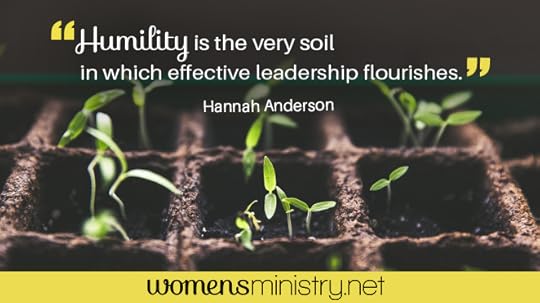
Praise Jesus and thank heavens, none of this is about me.
The post When God Surprises You appeared first on Sometimes a Light.

August 23, 2016
Humble Roots
Hello, my name is Hannah and I need help.
There I said it.
The woman who happily assumes responsibility after responsibility. The woman who loves doing it all. The woman who stays up late and gets up early worrying about how she’s going to get it all done. The woman who so prided herself in her usefulness that God decided she needed to write a book about humility.
This woman has finally reached a place where she can ask for help.
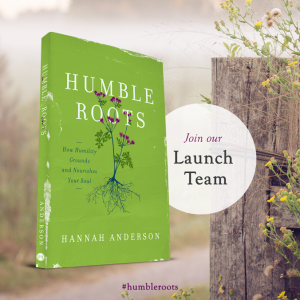
On October 4th, my second book Humble Roots will release to the general public. But between now and then, I need a group of folks who are willing to read it and tell others about it. I need a group of folks who can help amplify the message of finding peace through humility.
If you’re anything like me, you’re probably up to your neck in good work–family, church, community service. But if you’re anything like me, you’re also probably exhausted. Worn thin by the sheer weight of trying to do more and be more than God intends for you.
In Matthew 11, Jesus invites people like us to find rest in Him. “Come to me, all you who are weary and burdened” He calls, “and I will give you rest.”
But this rest doesn’t come by throwing off good things, having tighter schedules, or simply learning to say “No.” This rest comes through humility. It comes by learning limitation and dependence.
“Take my yoke upon you and learn from me,” Jesus continues, “for I am gentle and humble in heart. And you will find rest for your souls.”
Too often, the desire to do good work can mask a deeper pride. We busy ourselves with good things, not simply to fill the need, but because we need to be needed. We need to know that we are important, to know that our lives matter. And so to quiet our fears and stroke our egos, we try to save everyone and everybody from everything.
But we are not God. And when we try to be, we end up stretched, worn thin. While we’re busy saving the world, we’re losing our own souls.
So let me say it once again: I need your help.
In the past, I might have tried to launch a book on my own. To do enough work behind the scenes to make up the difference of having to humble myself and ask for help. But today, I know better.
If you’d be willing to receive an advance copy of Humble Roots, read it, and commit to to sharing it over the next few weeks, please go to this form. There, you will find more details about how you can help. More than anything though, I want you to join me on this journey to rest, to walking the path of humility.
I want you to come with me, through field and forest, to discover how the natural world declares the glory of God and reminds us of our limitations. I want you to learn how honey and blackberries and wild grapes teach us dependence. I want you to believe that the One who cares for the lilies of the field will care for you too. I want you to know the peace of wild things.
So will you come? Will you join me?
The post Humble Roots appeared first on Sometimes a Light.

August 2, 2016
Beauty Will Save the World
In hard times, beauty is among the first things we abandon; in hard times, beauty is among the things we need most.
 “Nature Morte, Vase aux Marguerites et Coquelicots” (Vincent Van Gogh, 1890)
In a recent op-ed in the New York Times, David Brooks recounts how Frederick Douglass, a former slave and abolitionist, used photography to change the nation’s view of slavery. Renowned as a statesman and activist, Douglass was also something of an artist, carefully selecting his posture, dress, and demeanor to communicate his intrinsic humanity. Near the end of the piece, Brooks confesses
I don’t understand why artists want to get involved in partisanship and legislation. The real power lies in the ability to recode the mental maps people project into the world.
Brooks may not understand the temptation, but I do.
When the world is falling to pieces around you, beauty can seem trivial. When the world is falling to pieces around you, it’s so much easier to embrace utilitarianism. Why arrange flowers to set on the table underneath the window where the sunbeam falls when all flesh is grass and the grass withers and the flower fades?
In the span of seven months, this year has brought us terror and death and anger and division and violence. These may not be the worst of times, but they are, by no measure, the best. And in times like these, it’s tempting to bypass beauty and settle for whatever gets the job done. Go directly to the punch. Take the shortest route. Cut to the chase. And then, once your work is done, Cinderella, you can think about going to the ball. Once your work is done, Cinderella, you can sit down to read a novel. Once your work is done, Cinderella, you can write a song.
But what if the work is never done? What if the work can never be done without beauty?
A few weeks ago, I listened to a 2015 interview with Sonia Manzano, best known to millions of children and their parents as “Maria” from Sesame Street. Sonia assumed her alter ego in 1971 and spent the next 44 years showing us a community who lived and loved together, who fought and forgave each other. But that world was not the world Sonia knew as a child. Growing up, Sonia’s world was plagued by domestic violence and poverty.
And in those dark times, beauty became a refuge.
“I found a lot of comfort on television when I was a kid,” Manzano writes. “So I think it’s interesting that I ended up on a show that offered a bit of comfort to children who lived in the inner city… Here was a moment, an hour, where there’s order, where there’s humor, where there’s love in a place that looks like your home.”
Award-winning children’s illustrator Jerry Pinkney, echoes a similar thought:
Our work is to create books that act as wide-open doors—books that allow all children to walk through and feel safe enough to stay.
But beauty is not simply about creating an escape from present difficulties. The work of beauty is to create a vision of the world as it was meant to be. It is a way to see past the present darkness to a future beyond. To the tired, beauty promises rest. To the oppressed, it offers freedom. To the fearful, it whispers “Hope.”
“Poets, prophets and reformers are all picture makers,” Frederick Douglass writes, “and this ability is the secret of their power and of their achievements.”
What poets and prophets and reformers offer us is a vision of the world set right. This is why beauty is so powerful and why human beings have always made art, in even the most difficult times and most hardscrabble places. The Appalachian mamaw, fingers bent and eyes straining, thrusts her needle through bits of scrap, quilting together utility and beauty. The island child, malnourished and broken by disease, still gathers bits and bobs to fashion a toy.
This is human heart searching for its home. Searching for safety. Searching for the world as it should be. For in the beginning, it was good; and in the end, it will be good again.
I write this as an act of confession. A confession of what I know to be true; a confession what I fail to do. In the turmoil of 2016, I find myself abandoning beauty in favor of the utilitarian. I find myself focusing on the immediate, preferring argumentation to persuasion. They say talk is cheap and I believe them because talk is easy. It’s easy to pontificate. It’s easy to argue. It’s easy to analyze.
It’s so much harder to hope.
It’s so much harder to believe.
It’s so much harder to keep faith.
It’s so much harder to create.
So hard, in fact, that pursuit of beauty requires Divine intervention. To live beautifully, to live full of love and joy and peace and longsuffering and gentleness and meekness, means being filled with God himself.
And so, as with every other Divine filling, beauty begins with humility. Beauty begins when we repent of our failure to see the world beyond this present darkness. Beauty begins when repent of our failure to see the Power who is greater than evil. Beauty begins when we repent of our lack of faith, and yes, even our lack of imagination.
St. Augustine, that confessing saint, once wrote of God: “Late have I loved you, beauty so old and so new.”
One measure of faith, it seems, is whether we can recognize the Beauty around us. One measure of faith, it seems, is whether we work to create beauty around us. One measure of faith, it seems, is whether we offer hope to those who themselves struggle to believe. Because this is what every artist knows: Show. Don’t tell.
Do not simply tell us what is wrong; show us what is right. Do not simply tell us what we must understand; show us how to understand it at a level deeper than words. Do not simply tell us what the world is; show us what it should be.
Show us beauty
Show us kindness
Show us courage
Show us faith
Show us conviction
Show us love
In these hard times, we must not abandon the work of beauty. We must take up our cross and discipline ourselves to celebrate it—the quiet moments, the simple pleasures, the secret joys–even as the world falls to pieces around us. But we must do more than this. In these hard times, we must take up our cross and discipline ourselves to create beauty. We must discipline ourselves to rebuild the world even as it falls to pieces around us.
So go. Set the table with the good dishes. Pick the wildflowers that will tomorrow die. Compose a song you already know by heart. Write that novel and build that better mousetrap. And in so doing, remind us all of what the world can and must and one day will be.
The post Beauty Will Save the World appeared first on Sometimes a Light.

July 22, 2016
Misplaced Fear
Yesterday, James Dobson, a conservative Christian leader and founder of Focus on the Family, endorsed Donald J. Trump for president of the United States. Dobson had previously supported Senator Ted Cruz, a man whose family life and conservatism aligned nicely with Dobson’s own. Because of this, Dobson’s endorsement could surprise some; it’s more than ironic that a man who has devoted his life to restoring the American family would endorse a man who has contributed so significantly to its destruction, on both a personal and professional level.
Because of this, some see Dobson’s endorsement as hypocritical. But I think this answer is too easy. Dobson explains his motivation for endorsing Trump:
All I can tell you is that we have only two choices, Hillary or Donald. Hillary scares me to death. And, if Christians stay home because he isn’t a better candidate, Hillary will run the world for perhaps eight years. The very thought of that haunts my nights and days.
No, Dobson is not a hypocrite; he is a man who has misplaced his fear.
We often talk about misplaced trust—what happens when someone’s abused your loyalty or let you down–but we rarely talk about misplaced fear or what happens when we fear the wrong things. But even if we don’t talk about it, the Scripture does. In fact, the entire book of Proverbs is built on the question of who and what we should fear. “The fear of the Lord is the beginning of knowledge,” Proverbs opens in chapter one; it then proceeds to build the rest of the book—whether it relates to relationships, money, work, or citizenship –on this fundamental question: Who are you going to fear? Are you going to fear the LORD or are you going to fear man?
The reason we must fear the right things is because when we fear someone we give them power over us. When we fear someone, we attribute to them the power to destroy us. So that when we fear a particular candidate, we give to them the shaking-in-our-boots kind of awe that should only be attributed to the LORD. When we fear a particular candidate, we place them far above their status as creatures who are made from the same dust that we are. And ultimately when we fear a particular candidate, we will end up placing our trust in whoever promises to rescue us from them.
This is why the fear of another person is often accompanied by adulation of the opposing candidate or party. Our fear of the one can effectively blind us to the faults the other. To the extent we vilify one, we will deify the other. And in both cases, we attribute too much power to mere mortals.
This is not to downplay the significance of leadership. Proverbs has a lot to say about that, too. But ultimately we must not place our fear (or trust) in another human being. “Do not fear those who can kill the body but cannot kill the soul,” Jesus reminds us “Rather fear him who can destroy both body and soul.”
So how do we reorient our fear? How do we make sure it is not misplaced? How can we make decisions from “fear of the LORD” and not from the fear of man?
First, we reorient our fear by remembering the truth about Who is in charge. The truth about Who raises up leaders and Who sets them down. The truth about Who alone gives life and health and peace. The truth about Who we are ultimately responsible to.
Just as a scout uses the North Star to find his way, we must be guided by the fear of the LORD. We must orient ourselves to fear him who alone is to be feared. And by doing this, by directing our awe upward, we’re actually able to make better decisions about the things of earth. When we fear the LORD instead of fearing other human beings, our minds clear up and we can engage the complexity of the world from a place of faith and wisdom.
In other words, reorienting our fear dials back our emotions so we can get our head on straight for a moment.
When we are driven by fear of other people, we end up acting like a trapped animal, responding out of instinct to the threat immediately in front of us. We either fight or flee. In the case of politics, we either come out swinging, demonizing the opposing candidate and anyone who would question our position. Or we flee. We remove ourselves from conflict entirely, refusing to engage the conversation. We hole away and are of no good to anyone.
In both cases, the fear of man makes us less than God has made us to be.
But the fear of the LORD restores us. It makes us wise. It makes us strong. It makes us loving. When we fear the LORD, we have the courage to stand our ground because we find our security in Him, not in a political candidate or the approval of others. We neither attack nor flee. We stand quietly and speak confidently. And we can listen. When we fear the LORD, we can hear the concerns and objections of others. We can learn.
“The fear of the LORD is the beginning of knowledge,” Proverbs 1:7 promises, “but fools despise wisdom and instruction.”
This is why people who are motivated by the fear of man shut down conversations; they cannot risk learning something about their candidate that would undermine their confidence in him. People who fear the LORD, however, can listen to other points of view because they are not threatened by new information or a new way of looking at a problem. They know that their trust does not reside in a particular candidate but in the LORD himself.
So I’m wondering: How would this election cycle change for us if we were motivated by “the fear of the LORD” instead “the fear of Hillary Clinton” or “the fear of Donald Trump”? What would change if we were kept awake at night by our concern to properly reverence the LORD and not our fear of a certain candidate? How would our interaction with political opponents change if we feared the LORD who made them in his own image?
A lot of things would change, I think, and the first would be our own hearts.
The post Misplaced Fear appeared first on Sometimes a Light.

July 20, 2016
Hillbilly Elegy

Many of you know that I live in the mountains of western Virginia. We’re hardworking bunch, knit together by family, shared sense of community, and a particular love for this region. Here, my kids go to local schools, and my husband pastors a small church at a bend of a long country road. A graveyard sits on the right and a cow pasture on the left. A small stream runs through the pasture and is home to minnows, tadpoles, lizards, and crawdads.
But not everything is idyllic. Like many other communities, we’re increasingly affected by income disparity, drug use, & the breakdown of the nuclear family, Travel just a bit farther west and you’ll hit the coal fields of southern WV and eastern KY. The challenges these folks face make ours seem like child’s play. It’s hard to understand the challenges of rural life because outsiders tend to idealize it (Mayberry) or mock it (Beverly Hillbillies). What we don’t do is take a careful look at the complexities of it.
In the recently released, Hillbilly Elegy, author J.D. Vance chronicles the story of “his people”–from growing up an Ohio factory town to returning to his ancestral home in the hills of eastern Kentucky. Vance’s childhood was marked by family chaos and underachievement. It was a childhood and family that he loves deeply nonetheless. But Vance doesn’t mince words: he honors the humanity of these self-described “hillbillies” at the same time he calls them to own their potential.
One of the most enlightening aspects of the book is Vance’s take on how religion plays out in working class communities. There’s often a deep-seated sense of faith or belief in God, but for the most part, the rural poor are detached from local churches. Vance wonders out loud how much this is their own fault and how much it is the fault of church. I’ve wondered the same thing myself. Many times.
Are our church’s even accessible to folks outside a certain demographic? And if they aren’t, how can we change that?
Here’s my longer review of the book and a podcast in which I argue that it will be among the most influential books of 2016.
The post Hillbilly Elegy appeared first on Sometimes a Light.

June 22, 2016
Persausion Podcast: Diffusing Our Fear of Math with Wendy Alsup

For over a year now, I’ve been co-hosting Persuasion, a weekly podcast with Erin Straza. The goal of this podcast is to create space for women to contribute to the broader conversation without getting trapped into talking about “women’s issues.” In fact, we believe that when you’re a woman, every issue is a “woman’s issue.” Our tag line, “Fine Ladies, Rational Minds, and the Best Kind of Company,” comes from a mash up of two Jane Austen quotes:
“I hate to hear you talk about all women as if they were fine ladies instead of rational creatures. None of us want to be in calm waters all our lives.”
and
“My idea of good company…is the company of clever, well-informed people, who have a great deal of conversation; that is what I call good company.’
‘You are mistaken,’ said he gently, ‘that is not good company, that is the best.”
This week the “best kind of company” joins us to tackle the issue of math anxiety . Wendy Alsup, a math educator, helps us explore why so many of us seize up when we’re surrounded by numbers. You may know Wendy from her theology books or blog, but Wendy’s more than just a pretty online face. She’s also a veteran math teacher who currently teaches adults at the community college level. In this episode, Wendy helps us understand why so many people think they’re “bad” at math, how to create a math-positive culture, and why math is the “language with which God has written the universe.”
Come join our conversation here.
The post Persausion Podcast: Diffusing Our Fear of Math with Wendy Alsup appeared first on Sometimes a Light.

December 17, 2015
When “The Truth” Isn’t True
Despite the fact that the US Presidential election is almost a year away, I’m ready for the campaigning to be over. In the last few months, we’ve seen our share of drama, name-calling, schism, and scandal. Same old, same old, right? Unfortunately, no. If anything, the Republican primary has already been full of unsettling surprises, not the least of which is the disturbing popularity of a man who is anything but conservative. And it’s left many folks—conservative, moderate, and liberal alike—scratching their heads wondering, “Why is Donald Trump so popular?”
In this recent New York Times piece, Justin Wolfers argues that Trump’s popularity stems from his rhetorical style rather than what he’s actually advocating. Trump’s willingness to speak the unspeakable signals to many folks that he’s “authentic”—despite the fact that unspeakable things are often best left unsaid. In this respect, people are not gravitating toward Trump’s specific positions so much as his willingness to speak flamboyantly and promote positions that are so obviously apolitically correct. They think he’s not like other politicians so he’s trustworthy. The problem, of course, is that Trump is being entirely political. He’s hit on a winning, albeit risky, strategy, and there’s no reason for him to stop.
But as manipulative as Trump may be, the larger concern is that so many people are foolishness enough to be manipulated. The real problem is that people generally have a hard time differentiating between what “sounds true” and what is true. And the result is that some folks, like Trump, get away with speaking falsehood because of it.
Dietrich Bonhoeffer writes this of “truth-tellers” like Trump:
It is only the cynic who claims “to speak the truth” at all times and in all places to all men in the same way, but who, in fact, displays nothing but a lifeless image of the truth. . . . He dons the halo of the fanatical devotee of truth who can make no allowance for human weaknesses; but, in fact, he is destroying the living truth between men. He wounds shame, desecrates mystery, breaks confidence, betrays the community in which he lives, and laughs arrogantly at the devastation he has wrought and at the human weakness which “cannot bear the truth.
Bonhoeffer’s observation is even more striking when you remember the political and social milieu in which he existed: Nazi Germany. Bonhoeffer watched as political leaders leveraged violence, fear, and divine right in order to gain power. Today, we look back at the atrocities of WWII and wonder how it is possible that an entire populace could participate in them.
The simplest answer is that they were convinced they heard “truth” in the Nazi message.
The potential that we could believe something to be true simply because of it “sounds true” is particularly significant for those of us who worship a Savior who identifies himself as “the way, the truth, and the life.” As Christians, it is essential that we learn the difference between what is true and what “sounds true.” If nothing else, we need to learn the difference so we can protect our own churches from pastors, teachers, and yes, political leaders, who would manipulate us to gain power. We must learn to spot the difference between a person who is actually living out the truth and one who is simply using “truth” for his own ends. We need discernment.
But not that kind of faux discernment that relies on feelings and false instinct. This approach to “discernment” is exactly what men like Trump are manipulating. They’re counting on your suspicion of the establishment. They’re counting on your search for a “truer” explanation of reality. They’re counting on your emotional response to their words rather than your analyzing the content of them. So in order to be discerning in the face of such “truth-tellers,” we must learn to evaluate the effect of their words. According to Bonhoeffer, we must answer these questions:
Do the truth-teller’s words set him up as an exclusive source of “truth”?
Do the truth-teller’s words mock the poor and weak?
Do the truth-teller’s words break trust?
Do the truth-teller’s words shame?
Do the truth-teller’s words make light of private mysteries and sacred spaces? Does he boldly go where angels fear to tread?
Do the truth-teller’s words destroy the bonds of community?
Does the truth-teller mock those who disagree with him? Is it their fault for being unable to receive “truth”?
A person who speaks this way–whether he is in your circle of friends, in politics, or in the church–is not telling you the truth. He may use the language of “truth,” but he is manipulative, self-assured, and dishonest. He many not be the “smooth-talker” that we generally associate with falsehood, but he is speaking falsehood nonetheless. And you must not be deceived by it.
The post When “The Truth” Isn’t True appeared first on Sometimes a Light.