Rob Prince's Blog
October 12, 2026
Canada Needs Jesus. The Church of the Nazarene needs Canada
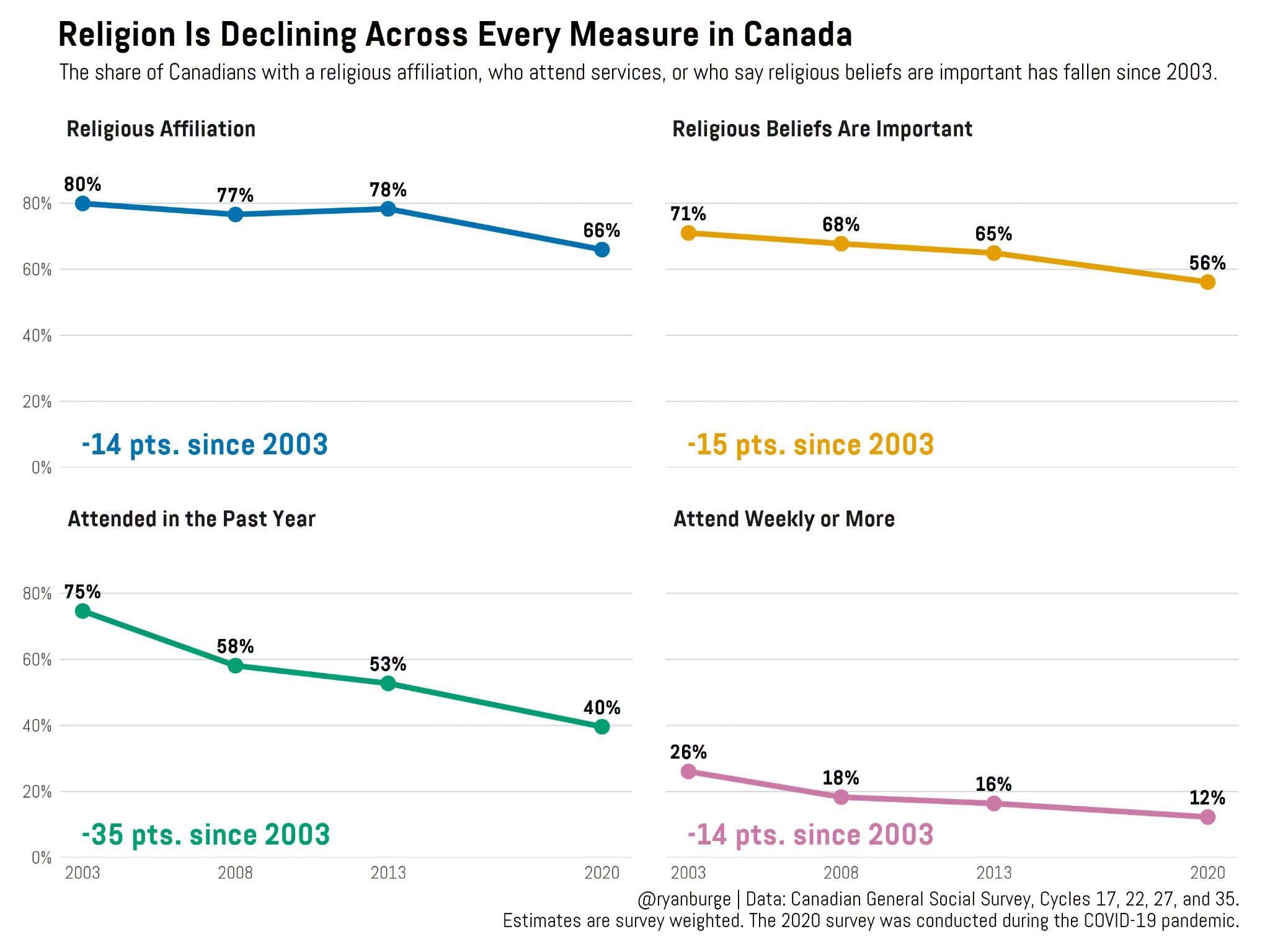
Ryan Burge recently released a series of graphs examining religious life in Canada (see graphs). Although the data only extends through 2020, the trends are troubling. They point to a decline in religious affiliation and practice. Logically, it seems those numbers have worsened rather than improved by 2026.
The Church of the Nazarene groups Canada and the United States together in the USA/Canada Region. Yet any geography buff knows that Canada is an enormous country, spanning a vast landmass and home to approximately 41.8 million people. The Church of the Nazarene divides this expansive nation into five districts. Under the leadership of Canada National Director Mark Collins, the denomination has 365 licensed and ordained ministers, 148 churches, and 12,215 members across the country.
The Church of the Nazarene has a long and meaningful history in Canada. The first Nazarene church in the country, located in Oxford, Nova Scotia, predates the formal establishment of the Church of the Nazarene denomination, having begun in 1902. Remarkably, it continues to meet in its original building.
Canada is also home to Ambrose University in Calgary, the denomination’s affiliated educational institution. Over the years, Canada has produced many outstanding leaders. Perhaps the most notable is Edward Lawlor, who served as a general superintendent from 1968 to 1976. Raised in Canada, Lawlor also served as district superintendent in both Alberta and Canada West. More recently, Stan Reeder, a Canadian native, served as the USA/Canada regional director.
Like New England in the United States—where Vermont and New Hampshire rank among the least religious states—Canada presents significant challenges for those seeking to make Christlike disciples. The work is difficult, but it is not impossible. The spiritual challenges facing Canada should not lead us to despair; rather, they should deepen our commitment to prayer, mission, and faithful witness.
What Can We Do? We can pray.
Pray for Mark Collins as he provides leadership and direction for the Church of the Nazarene in Canada.Pray for the five district superintendents: David Skidmore, Steven Ottley, Gordan McCann, Randy Barrington, and Rose Brower-Young.Pray for workers to enter the harvest fields, remembering Jesus’ words in Luke 10:2: “The harvest is plentiful, but the workers are few.” Pray that God will open doors for the gospel, strengthen local churches, and raise up new leaders.Pray for a spiritual awakening across Canada—a revival that renews the Church, draws people to Christ, and inspires a new generation of disciples.Pray that the Nazarene Bible College and Shepherds Circle (shameless plug) might assist encourage and equip pastors for the days ahead!The USA/Canada Region is vast, diverse, and filled with both challenges and opportunities. Canada must not be overlooked, and its spiritual future must not be written off. The mission field is too important, the gospel is too powerful, and the call of Christ is too compelling for us to surrender hope.
Canada is not beyond the reach of the gospel. Let us pray, work, give and believe God for a revival. This land must not be lost to the Kingdom of God or to the mission of the Church of the Nazarene.


October 5, 2026
Sell the Building. Save the mission.
When does a church make the hard decision to sell its aging, neglected, and increasingly expensive building? From my observation, usually about five years after they should have reached that conclusion.
Here are the facts: Many congregations sacrifice Christ’smission for the sake of an aging building. Time, energy, and money are poured into patching a leaking roof, maintaining an ancient heating and cooling system, and figuring out how to heat a building that is three times the size needed for the shrinking number of people who attend.
There is sentimental value. A church building can hold decades of wonderful memories—salvations, baptisms, Spirit-filled revivals, weddings, funerals, answered prayers, and transformed lives. People can point to a particular spot at the altar and remember where they decided to follow Jesus or where their marriage was restored.
Those memories are real. They matter. That’s what makes the decision so hard.
Selling the property can feel like admitting defeat—as though the church is losing the battle. But in many cases, if the church is going to preserve its mission, the building may have to be sacrificed. The church exists for people, not for a building.
When Jesus told Peter, “I will build my church,” He wasn’t talking about brick and mortar. He was talking about a people—a community of disciples called to carry His message into the world.
That mission has never depended on a building. In fact, a congregation’s mission can sometimes be hindered when people begin to believe the building is the reason the church exists. It isn’t. The church exists to bring people into fellowship with Christ. It exists to make disciples, baptize them, and teach them the ways of Jesus. If the constant drain of money, time, and energy required to maintain a building is hindering that mission, perhaps it’s time to put a “For Sale” sign in the front yard.
But where would the congregation meet? That’s where creativity and faith come in.
Depending on the size of the remaining congregation, they could meet in homes, schools, township halls, community centers, or even reach an agreement with another church to share space. It would require change. It would require humility. Undoubtedly it will require faith.
But what if selling an aging building wasn’t the end of the church? What if it was the beginning of a new vision?
Imagine a congregation freed from the burden of maintaining a building it no longer needs. Imagine redirecting those resources toward people—toward evangelism, discipleship, missions, children, families, the poor, and the community. Imagine a church rediscovering that its mission is not a building.
The mission is people.
Times have changed, but Jesus hasn’t changed. The world still needs Jesus. That mission has never required a building. The early Christians understood this. They carried the gospel into homes, marketplaces, prisons, and even the catacombs. They didn’t wait for the perfect facility before they fulfilled the mission Jesus had given them.
The question should not be, “How do we maintain our building?” The better question is:
“How can we fulfill the mission Jesus us called us to accomplish? Do we need to let go of our building to see it happen?”
October 1, 2026
An A-to-Z Guide for Pastor Appreciation Month
Appreciate your pastor even when it’s not October.
Be in Church this Sunday
Complain about the temperature in the sanctuary (just kidding, bring a sweater)
Devote yourself to holiness
Equip others to serve with you.
Forgive when he/she makes a mistake or forgets a prayer request (pastors are human too)
Give to missions
Have your pastor’s back when nay-sayers are around
Invite a neighbor to church
Jump in and help
Keep your pastor in your daily prayers
Love your pastors’ family
Make your church a joy-filled place
Never Gossip
Or put up with those who are gossiping.
Place something in the offering (a tithe is even better)
Question every decision (OK. Joking again. Trust the pastor’s leadership).
Remember to apply the sermon during the week.
Say an “Amen” when during the sermon.
Text your pastor good news (and say, “no need to text back”)
Uplift your pastor whenever possible
Volunteer in the areas that no one wants to volunteer.
X-hibit the qualities of Christ.
Your example matters. Let others see you appreciate your pastor.
Zealously, cheerlead on your church’s behalf.
P.S. Giving a gift card to a nice restaurant is good too!
September 28, 2026
“For the time will come” has come
Not everything that grows is healthy.
Cancer grows.
Weeds grow.
Bacteria and mold grow.
Rust grows.
The U.S. national debt has grown to roughly $40 trillion. That’s not good.
In an era when many sound churches are shrinking, just because a church is growing does not necessarily mean it is healthy or faithful. Butts in the seats and dollars in the coffers do not automatically equal godliness or goodness. I’ve learned from talking to pastors of the “majority of churches” (churches under 100 in attendance) that there are many, many faithful, wonderful churches that haven’t shown significant numerical growth.
Of course, growth that comes through a Holy Spirit–infused movement is good. Every follower of Jesus longs for revival. We celebrate people coming to Jesus, lives being transformed, communities being renewed by the gospel and the resulting spiritual growth.
But we should also remember that numerical growth is not the same thing as spiritual health. Paul warned Timothy: “For the time will come when people will not put up with sound doctrine. Instead, to suit their own desires, they will gather around them a great number of teachers to say what their itching ears want to hear. They will turn their ears away from the truth and turn aside to myths.” —2 Timothy 4:3–4
“For the time will come” has come. Churches can grow by telling people what they want to hear rather than calling them to Christlikeness.
Churches can grow by…
teaching people to hate their neighbors rather than love them.building allegiance to a political ideology, personality, or institution rather than allegiance to Jesus.performing trendy music without spiritual depth. (Emphasis on: “performing” not “worshipping”)being located in a growing community and producing fans of Jesus not disciples.preaching a prosperity gospel rather than Jesus’ words: “What good is it for someone to gain the whole world, yet forfeit their soul?” (Mark 8:36)building on fears rather than proclaiming the “perfect loves that drives out fear.” (1 John 4:18)The bullet points above are not the gospel of Jesus Christ.
False teaching can infiltrate even the best denominations. Yes, even the Church of the Nazarene. Do not assume that a denomination’s history, reputation or past victories makes it immune to ruin.
Do not be deceived. Church growth can be a beautiful thing. But growth is never the ultimate measure of faithfulness. The question is not merely, “Is a church growing?”
Ask instead:
Does this church look like Jesus?
Does its teaching sound like Jesus?
Does the membership exhibit the fruit of the Spirit?
Does it call people toward holiness, truth, grace, humility, justice, mercy, and love?
Not everything that grows is healthy. Examine the fruit. If the messenger/institution/church does not look and sound like Jesus, have the courage to walk away and find one that does.
September 22, 2026
What I Loved About the Kansas District Pastors’ Retreat
There was so much to love about the Kansas District Pastors’ Retreat. Here are five things that especially stood out to me:
It was affordable.
And by “affordable,” I mean free! The cost of the retreat came out of the district budget—not the local church’s budget or the pastor’s personal wallet. The district valued the importance of the entire team being together and removed one of the biggest barriers that can keep pastors from attending.
It was bi-vocational friendly.
The retreat ran from Thursday evening through Sunday morning, meaning those who work another job typically only had to miss one day of work. Some pastors came directly after work on Friday and missed the first 24 hours, but they were still able to participate meaningfully. The format made room for them.
It was diverse.
In part because of the first two points, there were pastors both young and old, from different backgrounds and experiences. The district also provided a translator and translation equipment, allowing several Hispanic pastors to participate fully. There was a beautiful sense of unity throughout our time together. It felt like a little piece of heaven.
Everyone was together.
While we had plenty of free time to rest and recharge, there were also wonderful opportunities to connect. Conversations around the meal tables were rich, the worship was meaningful (thanks to MNU’s PR group!), and there were plenty of moments of laughter and fun. A rousing game of bingo and some talented—and not-so-talented—karaoke singers made for two unforgettable nights!
The Lord met with us.
As I spoke, the participants and I quickly connected, and the Lord met with us in a beautiful way. Each session was special. There was a sense that God was doing something among us that went beyond simply gathering pastors together.
I’m so very thankful that District Superintendent Kendall and Denise Franklin invited Karla and me to be part of this gathering. We loved being with this great DS and his pastors and spouses. It is an experience we will not soon forget.
What a gift to spend time with pastors, worship together, laugh together, and most importantly, experience the presence of God together.
September 8, 2026
Shepherds Circle’s FIVE Hs of Pastoral Wellbeing
Pastors spend their lives caring for others. But who cares for the shepherd?
Shepherds Circle believes pastoral wellbeing begins with caring for the whole person. A healthy shepherd pays attention to five interconnected areas of life: Heart, Health, Home, Head, and Hands.
These five stakes hold the shepherd’s life in balance. When one is neglected, the others are eventually affected. When all five are intentionally nurtured, pastors are better equipped to flourish personally, love deeply, lead wisely, and serve faithfully.
HEART:The Soul of the Shepherd
Every pastor needs fresh fire—a continually renewed, Spirit-filled life with God. The Heart is the inner life of the shepherd: faith, spiritual vitality, emotional awareness, identity, character, and communion with God.
Ministry can become outwardly fruitful while the soul quietly grows tired. Shepherds need space to be renewed, restored, and reminded that their identity is rooted in Christ, not in their ministry performance.
Key Questions
How is your soul?Is your relationship with God vibrant and life-giving?Where are you experiencing spiritual dryness, weariness, or renewal?Are you receiving from God, or are you primarily giving to others?Foundational Scripture: “Keep your heart with all vigilance, for from it flow the springs of life.” Proverbs 4:23
The Aim: A renewed heart that thrives in God’s presence rather than merely working for God.
HEALTH: The Body and Wellbeing of the Shepherd
Healthy shepherds are better equipped to shepherd well. Physical, emotional, and mental wellbeing are not luxuries; they are essential to a sustainable life and ministry.
Pastors often care for the wellbeing of everyone around them while neglecting their own. Caring for the body, mind, emotions, rest, and rhythms of life is part of faithful stewardship.
Key Questions
Are you caring for the body God gave you?How well are you caring for your physical, emotional, and mental wellbeing?Are you getting adequate rest and recovery?What rhythms are helping—or harming—your health?Foundational Scripture: “Beloved, I pray that all may go well with you and that you may be in good health, as it goes well with your soul.” 3 John 1:2
The Aim: A healthy shepherd has the strength and resilience to serve for the long haul.
HOME: The Relationships of the Shepherd
For pastors, home can be both sanctuary and storm. Navigating marriage, parenting, family, friendship, and the unique pressures of ministry is not always easy.
When the pastoral home is in turmoil, it becomes difficult to lead and minister with freedom. Healthy relationships provide a place where pastors can be known, loved, challenged, encouraged, and cared for—not simply because they are pastors, but because they are people.
Key Questions
Who knows the real you—and who has your back?How healthy and connected are your closest relationships?Does your family experience the best of you or what is left of you?Do you have friendships where you don’t have to be the pastor?Are the boundaries between ministry and home healthy?Foundational Scripture: “I have no greater joy than to hear that my children are walking in the truth.” 3 John 1:4
The Aim: A healthy home where the shepherd is known, loved, and supported.
HEAD: The Mind and Perspective of the Shepherd
Pastoring requires right thinking, sound theology, wise perspective, and continual learning. What we believe about God, ourselves, the church, ministry, and the world profoundly shapes how we lead.
The Head is about more than knowledge. It is about cultivating a healthy mind and a biblical perspective—learning to think clearly, lead wisely, and resist the distorted thinking that can accompany stress, isolation, or ministry pressure.
Key Questions
What is shaping your mind and your leadership?Is your thinking grounded in Scripture, wisdom, and truth?Are you continuing to learn and grow?How are stress, disappointment, or success affecting your perspective?Are you leading from wisdom or simply reacting to demands?Foundational Scripture: “As someone thinks within himself, so he is.” Proverbs 23:7
The Aim: A clear mind that enables the shepherd to lead with truth, wisdom, and grace.
HANDS: The Calling and Work of the Shepherd
The Great Commission has not been rescinded. The world still needs Jesus, and the shepherd is still called to roll up his or her sleeves and enter places of need with the good news of God’s grace.
The Hands represent our work, ministry, leadership, service, and calling. But faithful service is not the same as endless activity. The goal is not simply to do more; it is to serve faithfully, fruitfully, and sustainably.
Key Questions
Is the way you are serving sustainable and faithful?Are you living from calling or driven by pressure?Is your ministry producing lasting fruit?Are you making space for others to serve and lead?Are your hands doing what God has actually called you to do?Foundational Scripture: “Declare his marvelous deeds among all the peoples.” 1 Chronicles 16:24
The Aim: Faithful hands that serve God’s purposes with passion, wisdom, and sustainability.
THE FIVE ARE A CIRCLE, NOT A CHECKLIST
The Five Hs are deeply interconnected.
Heart affects Head.
Head affects Hands.
Hands affect Health.
Health affects Home.
Home affects Heart.
If one area is neglected, the others eventually feel the strain. If one area is strengthened, it can bring renewal to the whole.
A pastor may have healthy Hands but an exhausted Heart.
A strong Head but a struggling Home.
A thriving ministry but a neglected Health.
The goal isn’t perfection in every area.
The goal is awareness, intentionality, and wholeness.
Shepherds Circle exists to help pastors identify where they are flourishing, where they are vulnerable, and where they need care. Because the shepherd matters too.
August 31, 2026
What I Heard from Pastors/DSs in the Shepherds Circle Listening Groups
Two weeks ago, Shepherds Circle convened pastors from the majority of churches in the Church of the Nazarene (those churches with fewer than 100 people in attendance). Last week, I sat with pastors from the other end of the spectrum: those serving in the 5% of our churches with more than 250 in attendance, including nine pastors from the top 0.7% with attendance above 750. Then, a group of district superintendents came to the Nazarene Global Ministry Center.
Different churches.
Different responsibilities.
Different challenges.
But I walked away with one overwhelming realization: Every shepherd carries a heavy load.
The stressors may not be the same, but I’m not sure our hearts, minds, or bodies know the difference. Stress is stress. Pressure is pressure. And ministry can be tough at any size.
A church of 50 may be struggling to pay the electric bill. A church of 1,000 may be laying off staff because the mortgage has become too much. A district superintendent may be trying to find a pastor for a small, faithful congregation that simply cannot afford to pay a pastor a living wage. Different problems. Same weight.
It hurts when a long-time family leaves a church of 75 for a mega church down the road. It hurts when a long-time member of a larger church takes to social media to criticize the music, the pastor, or the perceived political bent of someone in leadership. And it hurts when long-time church leaders gossip concerning the district superintendent’s leadership style.
It’s lonely when a pastor in a church of 50 feels like there is no one to talk to. It can be just as lonely in a church of 1,000 when a pastor has no one trusted enough to have an honest conversation. And it’s lonely for a district superintendent who spends more time putting out troubling fires rather than experiencing Pentecostal fires in the district churches.
Besides those stressors (and so many other burdens in ministry), life happens to all of us. Troubles at home, health trials, extended family responsibilities will take a toll on anyone. Those circumstances aren’t church matters, but they affect the ability to minister well.
Here’s the bottom line:
Pastoring a smaller church is tough.
Pastoring a larger church is tough.
Being a district superintendent is tough.
All of these are callings. All are important. All are needed. Each pastor/district superintendent I met with is serving well and joyfully. But being called doesn’t mean being immune to stress, disappointment, criticism, loneliness, or exhaustion.
And that is why Shepherds Circle is being created.
Pastors need help. They need encouragement. They need someone who understands. They need someone they can trust. They need people who will listen without judgment, pray with them, walk alongside them, and remind them that they don’t have to carry the weight alone. They need to connect with someone who will hear them.
Pastors of small churches need that.
Pastors of large churches need that.
District superintendents need that.
Creating healthier pastors creates healthier churches which creates healthier districts—and ultimately strengthens the mission God has given us. No matter the size of the church, no matter the title, no matter the challenge: Shepherds need shepherding, too. Every shepherd needs a circle of people who are genuinely on their side. That’s what Shepherds Circle is all about.
.
August 24, 2026
Let’s Celebrate the Vast Majority of Nazarene Churches

Last week, Shepherds Circle gathered a group of pastors whose churches average fewer than 100 in worship attendance. Originally, we called this group “small church pastors.” But during last week’s conversation, it became clear that “small church” may not be the best way to describe this group.
According to the latest data from Nazarene research, the breakdown of worship attendance across Nazarene churches in the USA/Canada is the following:
Worship AttendanceChurches%Zero3838.1%1–492,28948.4%50–991,17224.8%100–24964013.5%250–7492104.4%750 330.7%Total4,727100.0%Of the 4,727 Nazarene churches in the USA/Canada, 3,844 have fewer than 100 people in worship attendance. That represents 81% of all churches. Moreover, 57% have fewer than 50 people in attendance.
“Small” may technically describe these churches, but maybe it is not the most helpful term. “Average,” “normal,” “majority church,” or simply “the majority” might be a more accurate descriptor. In fact, “the vast majority” may be the best narrative of the group representing more than 80% of our churches. Which raises an important question: If the vast majority of our churches have fewer than 100 people in worship, shouldn’t our strategies for moving forward reflect the realities, strengths, and challenges of the vast majority?
The vast majority of churches don’t necessarily need to know how the 0.7% of churches with 750 in attendance operate. That is a different ball game. The vast majority need strategies for the realities they face every day: navigating difficult parishioner dynamics (like the pastor who last week described a member threatening to leave over the church’s lighting); addressing deferred maintenance in aging facilities with limited resources; and discovering creative revenue streams to help fund the mission.
Does what’s reported on the Annual Pastor’s Report (APR) show the health of a vast majority of the Nazarene churches? Maybe not. Does an improvement in worship attendance from 75 to 80—or a five-person decline—really tell us much about the faithfulness of a congregation? What matters is what that body of believers is doing in its community. Are they loving people beyond the walls of the church? Are they praying? Do they have a broken heart for those who are far from Jesus? How many members are engaged in mission and service? Are they supporting their pastor? Are they forming disciples who are learning to live holy lives in a post-Christian America?
These questions may tell us far more about the health of a church than an attendance number. That leads to an even larger question: If the metrics we often use to measure success or failure—the numbers reported on the APR—do not fully reflect what is happening in the vast majority of our churches, do we need to consider new metrics?
Maybe success should not be defined simply by how many people fill a pew, but how many people serve after they leave their seats. Success should not be determined by how much money is placed in an offering plate, but how much love is offered to a neighbor. Perhaps we should be asking not only how many people attended last Sunday, but how many people were discipled, served, prayed for, welcomed, encouraged, or introduced to Jesus during the week.
Those kinds of kingdom activities are much harder to capture in a report filled with numbers. The APR gives statisticians a picture of certain realities, but it does not capture all the ways the kingdom of God is advancing through a local congregation.
The vast majority of our churches are doing the work of the kingdom. Much of that work simply isn’t recorded on the APR. Let’s find better ways to articulate, recognize, and celebrate what is happening.
Facts:
1. The vast majority of our churches are faithfully serving Jesus in their local contexts.
2. The vast majority of our pastors are faithfully leading, loving, praying, serving, and persevering. Their churches may not be large, but their faithfulness is significant.
Conclusion:
1. Maybe it’s time to stop calling them “small churches” and start recognizing them for what they really are: the vast majority of the Church of the Nazarene.
2. And maybe it’s time to celebrate them—not because they have achieved impressive numbers, but because they are faithfully doing the work God has called them to do.
.
August 17, 2026
Are Itinerant Evangelists Needed in the 21st Century?
Paul writes in his letter to the Ephesians that God calls some people to be evangelists. Along with other ministers, evangelists are “to equip God’s people and to build up the church” (Ephesians 4:11–12). Paul clearly understood the evangelist to be a necessary ministry within the church.
Is that still the case?
Recently, I spoke with one of the few remaining tenured evangelists in the Church of the Nazarene. There are fewer than a dozen active tenured evangelists in the denomination. Even more striking, in the past ten years, only one person has been elevated to the status of tenured evangelist.
One tenured evangelist. In ten years. For an entire denomination.
It seems that itinerant evangelists are becoming a dying breed.
Consider a few basic facts:
The church still needs to be equipped and built up.According to Paul, equipping and building up the church is part of the evangelist’s calling.The Church of the Nazarene considers this calling important enough to maintain an extensive process for organizing, recognizing, and categorizing various levels of evangelistic ministry. See the Manual for the details.Yet very few people appear to be responding to that call.These facts raise some difficult questions. Is God still calling evangelists? Has the evangelist become a relic of the past—a ministry that was once useful but is no longer relevant? Do we still need itinerant evangelists in the 21st century?
For generations, the evangelist’s role was preaching in a week of revival meetings—sometimes two weeks. It was an annual staple of most Nazarene churches—sometimes twice a year. But that practice has become increasingly uncommon.
At the same time, as many churches are experiencing declining attendance, diminished finances, and increasing challenges in reaching their communities, one could argue that the church needs to be equipped and built up more than ever. In other words, perhaps the problem isn’t that we need fewer evangelists. Maybe we need more—just a different kind.
The 21st-century evangelist’s job description may look less like the one we inherited from recent generations and more like the ministry of Philip, “the evangelist,” in the Book of Acts. Philip was one of the seven chosen to help distribute food in Acts 6. In Acts 8, he preached to crowds, but he also shared the gospel one-on-one with the Ethiopian eunuch. Then, in Acts 21, we find Philip in Caesarea, where Paul and Luke were recipients of his hospitality. Philip preached—but he did much more.
Perhaps we should envision an evangelist who is not simply a pulpiteer, but also an equipper, encourager, consultant, trainer, and partner in ministry. Someone who can help a church evaluate its effectiveness, identify opportunities, and develop practical steps for reaching its community.
Imagine an evangelist who comes alongside the local pastor—not to replace the pastor’s leadership, but to strengthen it. An evangelist who trains, equips, and empowers pastors and congregations to reach their communities with the gospel and to pursue holiness. Maybe the 21st-century itinerant evangelist will spend less time behind the pulpit and more time in classrooms, coffee shops, living rooms, and one-on-one conversations.
Is this where the future of the evangelist lies—not in abandoning the historic calling, but in rediscovering it? An additional voice alongside the local pastor can still be powerful. The church still needs to be equipped and built up. People still need to hear the gospel. Believers still need to be challenged toward holiness. Churches still need encouragement, renewal, and empowerment. The evangelist’s job is not done.
What may need to change is not whether we have evangelists, but how we use them. We need a new breed of evangelist—men and women who are called, trained, and released to build and equip the church in ways that make sense for the world in which we now minister.
The fields are still white unto harvest.
The church still needs evangelists to equip and build it up to reach our world.
It just might look different than it did in the past.
Could God be calling you to a new and essential ministry of evangelism?
Shameless Plug Alert: Nazarene Bible College can help evangelists-in-training develop the theological, practical, and ministry tools they need to fulfill that calling in the 21st century.
August 10, 2026
A Pastor’s Eulogy: “He was Full of it”
Maybe because I’m inching closer to the finish line than the starting gates of life, but lately I’ve found myself thinking—morbidly, perhaps—about the perfect pastor’s eulogy. What will be said or written about me when I’m gone?
What would I want someone to say?
Would I care about the number of sermons preached? The number of people in the pews? The dollars collected? The programs started? In my final Annual Pastor’s Report, what would I want said? What would I really want included in the summary of my life and ministry?
Luke gives us a pretty remarkable answer in Acts 6.
Luke, the careful historian, writing Stephen’s obituary tells how he performed great wonders and signs among the people, but Luke doesn’t give us the details. We don’t know exactly what Stephen did or didn’t do. There is nothing in Stephen’s obituary that sounds like an entry on an Annual Pastor’s Report. No attendance figures. No financial totals. No list of accomplishments. Yet in two phrases, containing thirteen words, Luke basically says, Stephen was full of it.
A drug addicted, thief once said that about me after I advised his dad not to give the man any more money. He was not pleased with me at all. But I don’t think he and Luke meant the same thing. Being “full of it” in the conversation with the thieving son was not a compliment.
But in describing Stephen, Luke said, Stephen was “full of faith and the Holy Spirit” (Acts 6:5) and “full of God’s grace and power” (Acts 6:8).
Stephen was full of “it.” The “it” being faith, the Holy Spirit, grace, and power. I want to be full of that too. Being full of it meant there was no room for Stephen to be full of pride, greed, significance, or self.
But being full of “it” didn’t mean Stephen was spared hardship.
He was the first Christian martyr.
Being full of “it” didn’t mean he avoided pain or suffering.
He was dragged outside the city and stoned to death.
And yet, being full of “it,” his next to last words were, “Look! I see heaven open and the Son of Man standing at the right hand of God” (Acts 7:56).
Then, like Jesus, Stephen entrusted himself to God and prayed that the Lord would forgive those who were killing him.
It’s quite a eulogy from Luke. Stephen’s life was quite a life.
So, Pastor, maybe your Annual Pastor’s Report doesn’t contain numbers that would wow anyone at the Global Ministry Center. Maybe it isn’t filled with impressive attendance figures or record-breaking dollars. Maybe the statistics don’t tell the story you wish they did.
That’s not the goal.
The goal is to be full of it.
Full of faith.
Full of the Holy Spirit.
Full of God’s grace.
Full of God’s power.
When the final report is written, those are the things I hope can be said about me.
I hope they can be said about you, too.