
Daniel Klock's Blog
April 1, 2015



April 24, 2014
Featuring indie author D.Z.C
Today I have the pleasure to feature indie author D.Z.C. for a special blog post:
Looking O'er TroyWho is your favourite literary character? Newspapers and websites regularly run polls on the subject, and the same names come up over and over again... Mr. Darcy, Jane Eyre, Sherlock Holmes...
My heart, however, belongs to Caroline Graham's DS Gavin Troy, from the Midsomer Murders books.
It's possibly an odd choice. Detectives' sidekicks rarely feature on the favourite character lists, for the very good reason that they tend to be agreeably bland. Watson, Lewis, Hastings... The template recurs sufficiently often to have become a trope. The subordinate - affable, respectful, possibly a little slow - acts as a foil, a sounding-board and even occasionally as comic relief from the high-flown, irrascible criminal genius of the great detective. Even the writers of the tv version of Midsomer Murders reverted to type, making the DS Troy character naive, subservient and painfully nice.
In the books (which, if you haven't read yet, you really should), Troy is a brilliant creation, subverting the clichés in every possible way. For a start, it is Inspector Barnaby, the Great Detective, who tends to be the nice guy, and his sidekick who usually finds himself playing the bad cop. It's not just the role reversal that is remarkable, though.
Caroline Graham's characterisation is always outstanding: the inhabitants of Midsomer are all instantly recogniseable, but never stereotypes. Created with a few economical lines, they are complex, human and infinitely believable. It is a mark of the care and brilliance devoted to the creation of DS Troy that even among such solidly real creations he stands out: both ordinary and exceptional. What's more, Graham follows the cardinal rule in developing her characters: she shows, rather than telling.
Take the example of Written in Blood (my favourite book in the series, since you ask). The first couple of pages introducing the detectives tell us everything we need to know:
Barnaby lifted his hand in acknowledgement and made for his office. He was crossing the enclosed walkway that linked the CID block to the station proper when he observed his bag carrier striding smartly towards him. Gavin Troy wore a long, tightly belted black leather coat which flapped and slapped against his boots. A dark cap covered his cropped red hair and he had, in readiness, put on the steel-rimmed glasses he wore when driving. He looked like a storm trooper.
Knowing the pleasure such a comparison would afford, Barnaby immediately put it from his mind.
One paragraph and one sentence, and we already have the main dynamic of the book established. Inspector Barnaby can afford to be placid and equitable, because he has someone else to be nasty on his behalf, violent even, on occasion (later in the book we find Troy ramming a local villain's face into a hotplate when breaking up a fight in a restaurant). What's more, Barnaby makes sure that he remains ignorant of his subordinate's more outré behaviour - preserving his own innocence. At the same time, however, here's a hint of something else on Troy's part. Trying too hard, perhaps? Read on:
'What's the matter with you this morning?'
'I'm alright, sir.'
The matter was Troy's cousin, Colin. His mother's sister's boy. Colin had been a thorn in Troy's flesh for years. Sailing through exams that Troy had to sweat blood even to scrape a pass in. Silver-tongued, sarcastic, Colin was always laughing at the things his cousin held most dear. He seemed to regard Troy's whole lifestyle as some sort of comedic entertainment, referring to the sergeant more than once as a clockwork Rambo. Last night he had turned up at his Aunty Betty's when troy was also present, and for the same reason - to deliver a birthday gift. Winking at his cousin, Colin had taken off his filthy battered sheepskin jacket to flash the message on his T-shirt: 'When The Going Gets Tough The Smart Bugger Off'. He had just left university and, to Troy's deep satisfaction, had so far been unable to find a job.
For the next few chapters we see the crime scene and the witnesses more through Troy's eyes than Barnaby's: his sarcastic asides:
If we knew that ducky, Troy muttered in his head, we wouldn't be asking, would we?
His nicotine habit and his family:
The sergeant was a deeply frustrated man. He couldn't smoke in the office. He couldn't smoke in the car. He couldn't smoke on the job. (Not his day job anyway.) And, now that the dangers of passive smoking had been provably demonstrated, he had to be bloody careful when and where he smoked at home. For Talisa Leanne, his heart's delight and the best reason for living a man could ever hope to come across, was only two, and two year-old lungs were obviously extremely vulnerable.
His obsession over neatness:
Troy, trying on the Rolex, turning his wrist this way and that in front of the bathroom mirror, removed it in a hurry and smeared his crisp shirt cuff with grey powder. He cursed silently, knowing it would irritate him for the rest of the day. He wondered how odd it would look if he pushed the cuff out of sight up his coat sleeve. Of course then he'd have to do the same with the other. Snorting with annoyance he joined his boss.
His lack of education:
'And you didn't go out again?' She stared at him as if he were mad. 'Or return to Plover's Rest for any reason?'
Pluvvers is it? noted Troy, who had been rhyming it with Rover's, as in Return.
And his awkwardness about it:
A gentleman. Troy kicked savagely at the gravel as they made their way back to the rusty gate. Of course, we all know what that means. The upper crust on life's farm-house. He lit a cigarette. A member of the club. Right tie. Right accent. Right attitude. Right sort of money. Right wing. (Troy himself was extremely right wing, but from quite a different jumping-off point, and for quite different reasons.)
We begin to settle down: there might be a few differences from the traditional template, but it seems, for the moment, as though we're dealing with a more or less standard detective's sidekick. Barnaby provides the brainwork, and Troy drives the car. And then everything changes: suddenly the pair are faced with a witness unlikely to give way to tea and sympathy, and a bad cop is required.
'In other words, you did not go out at all?'
'No.' After a lengthy pause Brian picked up his cup, put it down again. Coughed. Blew his nose and peered into his hanky before putting it back into his pocket.
'Mrs. Clapton, on the other hand,' said Sergeant Troy quietly (almost as if musing to himself), 'seemed to have had a lot of trouble dropping off. She was still awake in the small hours. Heard Max Jennings drive away.'
'Really.'
'Yes. Really.'
There was an even longer pause during which the two policeman exchanged confident, almost amused glances not missed (and not meant to be missed) by the interviewee. They were both enjoying his predicament but Troy more so for he had, by nature, an unkind heart.
Later on, left alone with the suspect, we suddenly see Troy in a different light:
There was something concealed behind his blank expression that hinted at great determination. He looked like a rigorously discipined monk. Or enthusiastic inquisitor. Brian could, with no trouble at all, see him applying some troublemaker's face to a hotplate.
For all his lack of formal education, his insecurities and his self-deception, when freed from Barnaby's gaze he shows a perceptive, devious and accurate intelligence that it is impossible to imagine coming from, say, Doctor Watson or Captain Hastings.
The switch has taken place, and now we've got him fixed in our heads as both the gormless sidekick and the bad cop, odd though this may seem... But there's another reversal still to come. When we meet Brian's wife, an abused and downtrodden amateur artist, it is - contrary to everything we've been led to expect - Troy rather than Barnaby who gives her the first glimmer of light that will end with her leaving her obnoxious husband once and for all, when he asks to buy one of her paintings for his daughter. It is the bad cop and not the good cop who provides redemption.
So it is that Graham builds up a character that is endlessly contradictory: savvy and ignorant, nervous and abrasive, bigoted and sympathetic... And despite all this, we are quite clearly standing in front of a real, solid, self-contained person, in whom we can recognise our own inconsistencies. Summing it up, Graham tells us: "The sergeant had no time for neurotic women. To be fair he had no time for neurotic men either. Troy liked people to be simple and uncomplicated, which was how he saw himself."

People Like Us (The Keszthelyi Chronicles)
By Zichao Deng

Xanadu (The Keszthelyi Chronicles)
By Zichao Deng
April 8, 2014
Being quiet...
well, I have been quiet here lately. But I have been busy: in just a litle over three months I have rough finished the translation of "Fraud at Snowfields" into German. Pretty good, eh? Now I am sure I will manage to publish it in time for next Christmas.
March 20, 2014
Even more...
The book has now 25 Reviews on Amazon, 24 of them with 5 Stars. Seems to be quite a good reading...
February 2, 2014
Amazon reviews...
... getting more and more really excellent book reviews on Amazon!
January 2, 2014
Indie and Proud started...
The first Indie and Proud event started. See it here: http://writeongrandi.com/
December 31, 2013
Indie and Proud...
The Indie and Proud year long compain is about to start. The websites are up, the facebook page already has over a hundred likes after just one day and the first event is about to take place on January 2nd.
And the second event will be about me: author DZC will feature me in his blog.
December 21, 2013
Meeting somebody...
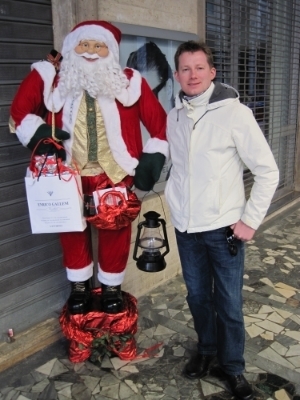
Perhaps you will meet the real one in the book?
December 10, 2013
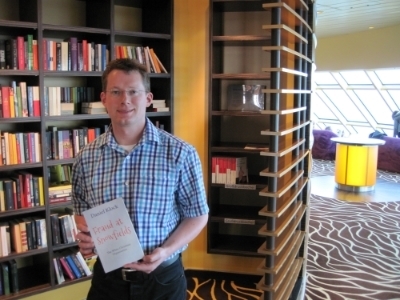
Now on cruise...
"Fraud at Snowfields" - my book now in the library of a cruise liner - AIDAmar.
November 28, 2013
Reading at a grammar school...
here is a major article in a German newspaper of my reading at a grammar school: Newspaper Article


