Eileen Chadnick's Blog
December 14, 2025
Vision 2026: 12 Questions to Help You Get Ready for the Year Ahead
A version of this has been published in the Globe and Mail.
We made it! In the final stretch to the year’s finish line. How did it go? Good year? Meh? Terrible? This year marks the fourteenth year of presenting a list of twelve questions to complete the year and to start anew. These prompts will help you mine for the good, learn from the tough, and take a good look ahead with clarity and vision.

Image courtesy of Pixabay/ Animal Planet Earth
The Year Past: #1: What went well?What went well – this is always the first reflection in my annual list of twelve questions. This question starts us off with a more open, positive lens. Life is always a mixed bag of good and not so good. But the tough stuff tends to highjack our brain’s attention and the good gets lost. Noticing the positive stuff is what builds resilience, optimism, better thinking, health, and more. So whether your year was great, terrible, or something in between, find those good bits to bring more light to the year past.
#2 What can you be grateful for from the year past?Now flex your gratitude muscle. What lifted you up, sparked some joy, peace, and positive energy? Remember, even micro moments can have a substantive impact. Perhaps you are grateful for some beauty and nature in your surroundings? For your early morning coffee/tea rituals? Opportunities that helped you grow; for the relationships and meaningful connections you have with others? Tuning into authentic gratitude can provide a greater sense of abundance and ‘‘enough-ness” instead of lacking.
#3 Who showed up for you this past year and how about yourself?Who was there for you this past year? What small or larger gestures had a positive impact? And how did you show up for yourself? Were you resourceful and able make stuff happen? Kind and compassionate to yourself when your inner critic was getting loud and disruptive? We often overlook ourselves as a refuge for comfort and support. So as you express gratitude to others, don’t grinch out on yourself. You deserve thanks as well.
#4 How did your personal resilience help you navigate the tough stuff this past year?Let’s face it. There was a lot of tough stuff this past year. You are more resilient than you likely realize. It’s what gets you through the hard stuff and helps you bounce back. What did you do to help yourself stay afloat in the excessively busy and/or difficult days? What helped you recover from setbacks, disappointments, and challenges? Consider your actions and, just as important (or more!) –your mindset. Bring all these beautiful gems to your treasure chest of strengths and know that you can count on yourself for the year ahead.
#5 What habits served you well? What bad habits need to be ditched?We all have habits. Some are intentional and others less so. Reflect on those habits (big or small) that supported you this past year. Maybe you developed habits that helped you be more organized and helped manage the chaos of increasingly heavy loads? Or you learned when and how to say ‘no’ to avoid burnout? Perhaps you made sleep and regular breaks a priority which helped keep you well even amidst the frenetic pace of work and life? What else?
Now think about the habits that did not serve you well. Too much time glued to your devices? Or killing time with excess scrolling? Skipping lunch to get more stuff done? Procrastinating and adding more pressure to your already stressful load?
Ready to ditch a bad habit for a good one? Remember, Good habits do not need to be herculean in size or ambition. They need commitment and consistency.
#6 Give the year past a name or theme to honour it. 2025 was the year of_________. The Year Ahead:#7 Picture yourself a year from now. What’s that ‘thing’ you could do or change that your ‘future you’ would be so pleased that you did it’?
In addition to tangible outcomes that might be related to some of your goals (e.g. get promoted, learn a new skill, move forward with a relationship), you might also reflect on areas that call for your internal personal growth. For instance, step into more courage to speak up for yourself and/or be more vocal in meetings; Invest in yourself to become a better leader, or join a gym or hire a trainer to become a healthier you. The next question takes this further.
#8 What would you need to learn and/or do differently to help catalyze that desired change? Who might support you?Change and transformation often means stepping into unfamiliar territory. You may need to learn new skills and develop different parts of yourself — for instance, to start speaking up more in meetings, or apply for that new role. One doesn’t need to fake their way through. Often humility is what’s needed. Perhaps asking for help in a mentor, a coach, a boss, or friend? What do you think you need to do and learn to create the shifts you desire and who might you tap into for support?
#9 How might a slower and softer approach in the year ahead serve you well; maybe even help you grow?It’s great to be ambitious but too much constant striving can can wear one down. In the frenetic chaotic pace of work and life, more people are embracing slow as an alternate path to their growth. Even with heavy demands on you, where can you give yourself permission to rest, replenish, and recover? Where can you rein in your automatic habit of doing more and instead slow down enough to discern if more is needed or might less be better in this moment?
Outside of work do you always try to push faster, harder, further? Instead of always climbing the biggest mountain, where might you enjoy a slower and different kind of adventure?
#10 Where can you find meaning and connection even in the seemingly mundane?Not every day or feels great Sometimes we have stuff to do that might even be boring and tedious. Work and life can sometimes feel a bit meh and tiresome. But even these mundane moments can offer up micro moments of beauty, awe, goodness. You must stay awake to notice those moments, like I did recently on a cold fall day, just doing some grocery shopping.
#11 What will success mean for you in the year ahead and how will you measure your success?Next year this time, how will you look back and assess how your year went? Will you rely mostly on hard metrics of outcomes and what others decide about your success?
Reflect on how you might take a more expansive view of success and discern what is meaningful, good, and satisfying to you? Beyond the performance ratings and measurable achievements, what else needs to be acknowledged? How might you also assign due value on the relationships you built; the contributions you made to a positive workplace culture; the confidence and leadership presence you developed? And other significant accomplishments that have high value but are sometimes harder to quantify?
#12 Give your year ahead a personal theme or mantra. 2026 will be the year of ________.I hope you can use this year’s reflection to help you cast a wider lens for what it means to have a meaningful year filled with purposeful growth, authentic fulfillment, and lots to call the next year a personal success.
—
Eileen Chadnick, PCC, of Big Cheese Coaching, is an ICF credentialed, two-time ICF (International Coaching Federation) Prism award winner , who works with leaders (emerging to experienced), and organizations, on navigating, leading and flourishing in times of flux, opportunity and challenge. She is the author of Ease: Manage Overwhelm in Times of Crazy Busy .


November 20, 2025
Finding Awe and Connection Even in the Mundane
Last weekend I went out to get groceries at my local Metro store. It was cold and grey out. Felt a little ‘meh’ – you know, it was a mundane chore on a greyish day. But then something changed.
I looked up. Not metaphorically. Literally, I looked up to the Metro store sign to note at what letter I parked in front of. This helps me find my car after the groceries. How many times have any of us mindlessly gotten out of our car but forget where exactly we parked (guilty!). The sign let’s me know (in front of the M or the T or…).
As I looked up, something caught my attention. I noticed a beautiful white pigeon amongst a plethora of other “regular” coloured pigeons. It looked like a dove. Well actually it was a dove as all pigeons are! So as I stared at this lovely bird for a bit, I then looked over at those other ‘regular’ coloured birds and saw that they weren’t regular at all! They were beautiful! And there were so many of them. As they preened you could see all kinds of gorgeous colours and markings unfold. I saw beautiful tones of teal with white and red markings. And more. It was quite a fashion show of sorts! Suddenly my mundane morning wasn’t so mundane anymore.
I was struck with awe, standing in the Metro parking lot looking up at this beautiful array of birds.

(Photo courtesy of Pixabay. My photos — scroll down further — did not do justice to the beauty in the moment)
We get a lot of pigeons here in Toronto. Most often, I and many others tend to ignore them or think of them as a nuisance (they can make a mess). But if we could only slow down a bit in our hectic, busy ways — well, look what happened. Beauty emerged out of a seemingly ordinary moment.
I took a photo and put it in my BAG. Not a literal bag. Rather my journal and of digital photo album of micro moments of Beauty, Awe, Goodness.
What’s the deal with BAG?
I coined the word “BAG” (and wrote about it in another post some time ago) to capture micro moments of Beauty, Awe, Goodness that come my way. I try to do this daily but don’t necessarily go looking for them. Rather, I stay open to noticing them if/when they appear. It is so easy to NOT notice those little moments that can inspire us because there is often so much tough stuff that takes up space in our minds. Here’s what I wrote in an earlier post that explains the intention of this BAG practice.
“This is about bringing more intention into what I pay attention to. It is not about ignoring the realities of the day. But rather, making space for noticing and appreciating the good. Without this intention and proactive noticing it is far too easy for the tough stuff to take up space — ALL the space — in our mind and attention. That’s not a healthy thing for anyone.”
Some people may refer to these micro moments as ‘glimmers’. What’s cool is you can find them anywhere. Even in the most mundane activities — like walking across a parking lot on a cold, grey day.
Remember, it’s not just the THING (i.e beautiful bird, a sunset, or other) that is so important but rather what it sparks for you — in your internal state. Your reaction. I truly was inspired as I love nature and animals. But this dove sighting may not spark for everyone. So keep an eye out for the things that do resonate for you. It could be kindness, something funny, or simply a moment of connection — even with a stranger. Well guess what. In that same parking lot and grocery store, I got some of that too.
The parking lot and grocery store that keeps giving.

(This was my photo – hard to capture the beauty of the pigeons but at least it gives me a snapshot that sparks a memory of that moment. That’s worthy in itself!
After my dove sightings, I grabbed a cart and made my way into the store. But I heard a lady calling out to me. I had dropped my bags (my literal bags this time. In Toronto, we bring our own bags to the stores). That was sweet of her. Then she went to get a cart but there were none available there. So given her kindness of alerting me to my dropped bags, I gave her my cart and went to find another one a little further away.
A nice micro moment. But then ‘coincidentally’ I kept bumping into her throughout the store. She couldn’t find a good lettuce, I pointed out one that I saw. And so on.
While not a huge BAG moment, it was still a nice little micro moment of connection with a kind stranger. Those count too.
What is in your BAG?Eileen Chadnick, PCC, of Big Cheese Coaching, is an ICF credentialed, two-time ICF (International Coaching Federation) Prism award winner , who works with leaders (emerging to experienced), and organizations, on navigating, leading and flourishing in times of flux, opportunity and challenge. She is the author of Ease: Manage Overwhelm in Times of Crazy Busy . She is also a long-time, regular contributor at the Globe and Mail Work-Life section.
September 17, 2025
Growth 2.0: Do Less, Slow Down, Grow More
Hello to a new season! I love the autumn. The coolness (but not too cool yet), the foliage, the soups, maybe apple pie – and other harvest yummies. And let’s not forget: the feeling of a fresh start! Many people liken September to the ‘real new year’ (even more so than January for some). It feels like a bigger reset after a lengthy and more relaxed pace of summer. The busy season begins! But does it have to?
So now that we are diving back into a shiny new — and likely busy — season, I can’t help but ask:
How Will You Grow from Here as You Navigate the Return Back to the Busy Season?
It’s a good question to consider at the beginning of something new or at a completion (a year, opportunity, challenge, milestone, birthday). Questions like this can open the door to more thoughtful and purposeful ways to lean into our life with intention. Growth mindsets help us self actualize, stay fresh, relevant, and engaged in our work and lives. That’s the spirit of my annual year-end 12 Questions — which can be asked at any time of the year.
But what will growth mean for you this season (or year)? Back to the hustle bustle or what if you did less? Can less actually be more?
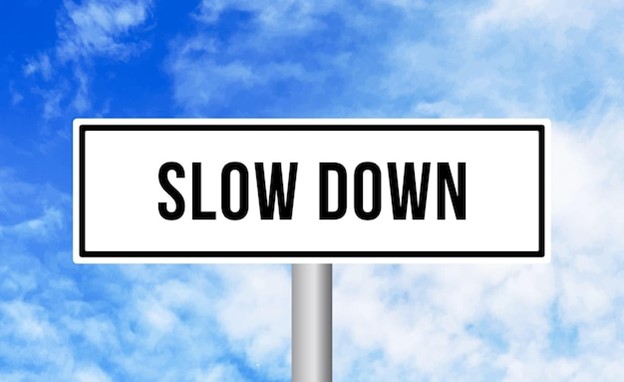
As we pursue personal and professional growth, many of us (self included) can become so busy we sometimes lose sight of what is already right in front of us that is good. We are always striving for more. I’m thinking of a conversation I had with “Sal”. He was feeling so much frustration because he didn’t see a next step immediately ahead of him within the organization he worked. There was lots of good in his current role, including opportunities to grow and learn, but the obsession with climbing the ladder as fast as he can highjacked his view of the good in the now.
Don’t get me wrong. There are many good reasons we want to grow. This focus and growth energy helps us flourish and do great things in the world — not just for ourselves but for others too.
This is a good thing. But not always.
The go, go, striving for more pace (faster, higher, more) of our hustle and ever-changing work culture can be hard to sustain and can sometimes deplete us rather than energize. Look around (or inward) to notice how many of us are wearing down. And this rushing, striving pace does not always satisfy our need for meaning in our work and lives.
Many people these days struggle with finding the balance. But rest and recover is essential. Maybe we are looking at this the wrong way. Often the pursuit of balance involves taking time off for rest and recovery (which is good!) and the rest of our time is still insanely busy (often untenable), focused on more, faster, higher. Are we really doing this right?
A Better Way to Grow? Can Less Really Be More?Does growth always have to mean work harder, faster, do more? What if our growth can come from the lens of slower, doing a little less, and being softer with our relentless drive? If we were to change the ‘recipe’ for growth and put more attention on the often overlooked dimensions of what leads to flourishing – we may grow even deeper parts of ourselves and our efficacy in our work and lives. Maybe find more meaning; maybe even be more creative and productive.
Increasingly there’s more attention on the merits of slow and doing less. In his book, “Slow Productivity” Cal Newport makes a case for slowing down, going deeper, and kicking the tires on old patterns of excess busy as a path to productivity. And in recent video, Dan Pink, cites “Do Less” as one of best practices for getting more done and with better quality.
This go slower movement is not being championed by lazy laggards. Quite the opposite. Many highly accomplished people are pushing back and checking out the rewards offered in the slower lane. They are not giving up their personality, nor their quest for career and life success. They are just recalibrating and finding better ways to honour what our bodies, minds, and souls need to flourish. And it turns out this can often net out into better ways to contribute to work work and the world.
A Linkedin Post and article by Pam Mclean reflected this perfectly. As Founder and Chief Knowledge Institute of Hudson Institute of Coaching, Mclean has been a profound and accomplished change maker in the world of human potential, performance and development. On the threshold of a significant milestone birthday she reflects on what she calls her “Private Rebellion”. She asks, “What if our most courageous act at this stage of life isn’t about striving to do more, but deliberately choosing to do less? Mclean calls out the misguided belief that doing nothing wastes precious time. “ want to learn how to waste time and get nearly nothing done and feel good about a day of meandering….instead of fighting the discomfort of unproductivity, I practice more stillness.”
Consider this in your own life. What would be possible if you took a closer look at your constant do-do-do busyness — and found ways to carve out ways to do a little less, go a little slower, and maybe learn how to press the pause button a little more often and try some stillness?
I know this sounds unrealistic or even unpalatable for some people. Especially if you are used to the go-go energy of fast paced work and life — not to mention the demands (oh yes, all those demands, how will they get done!?). And many of us are not yet in a stage of life that affords us to cut back too much without consequences. But I think it is a worthy exploration and pursuit to consider. Personally, I’m living into these questions myself. It’s not easy but it’s necessary.
If you are not yet at the life stage or have the circumstances to slow down as much as you might like, that’s okay. We can still find little pockets of slow.So many of us are in that camp. But we don’t have to wait for life to slow down for us. We can find and practice more micro-moments and tiny opportunities to practice this right now. Here are just a few thoughts and reflection questions to get you started and more aware of your habits.
Do you feel guilty taking a break? Do you feel you need to earn it by working excessively? Do you feel uncomfortable with some white space (not busy ‘doing’?)? Instead, can you challenge yourself to try on a new perspective? Perhaps reframe quality and strategic breaks as a tool for excellence and not a sign of lazyness or weakness.Do you constantly multi-task? Even at lunch, are you also reading/doing something else? Can you give yourself permission to focus on one thing – perhaps eat, enjoy, let your mind rest and wander for a bit. And then see where it goes.Do you feel you need to fill up all your ‘down time’ with stimulus. On the bus or subway do you find yourself scrolling, or always listening to podcasts or books? The latter can be wonderful (not knocking them) but what if you were to experiment with occasionally being still and silent – even for just a bit. See what happens. You may be very surprised and see your brain rest and wander and start to make new connections. The best ideas come when we stop our focused thinking and let our minds wander (there’s actually a lot of science around this).Is your list overflowing with too many impossible to accomplish items where everything looks like a priority? Can you chunk it down to ‘today’s essential priorities; things to keep an eye on for later (this week, month, etc.)?Are you addicted to the “Yes Habit” which only adds to your impossible to do list? Can you slow down your automatic ‘yes’ to discern if maybe this is not the right time to add something else to your load? Do you know how to say ‘no’ or ‘no, not now’. Check out some tips in this article.Can you walk your dog more often (even if you don’t have one:) to give your brain a rest? And again, if you enjoy listening to podcasts and books while you walk (not a bad thing), per tip above, try one day not adding that distraction into the walk. Notice what you notice. Notice what you feel after the walk.Confession: I have always struggled with doing less as my ‘striver, passionate’ side of me always wants to do more stuff. But for me it is now essential. So I am learning to find merit in the slow and less where I can. And invite you to consider this as a possibility for yourself too.
There are better ways to get stuff done, live a good life, and live and work with more meaning. Speaking of which as I quietly share this (if you got this far in this article). I am working on a “Better Way Academy” that will speak to these and other related “Better Ways” to live and work in these crazy busy demanding times. But no promises how fast I’ll launch. Because I am walking my talk and working slowly on this.
Here’s to more with less; growth with slow!
Eileen Chadnick, PCC, of Big Cheese Coaching, is an ICF credentialed, two-time ICF (International Coaching Federation) Prism award winner , who works with leaders (emerging to experienced), and organizations, on navigating, leading and flourishing in times of flux, opportunity and challenge. She is the author of Ease: Manage Overwhelm in Times of Crazy Busy . She is also a long-time, regular contributor at the Globe and Mail Work-Life section.
July 7, 2025
Summer Slowdown? Take Your Breaks Even When Too Busy.
Do you hear that quiet? Traffic is a little lighter. Emails (maybe) a bit fewer. The pace of work slowing down – even if just a smidgeon. It’s summer! Where the living is (supposedly) easier.
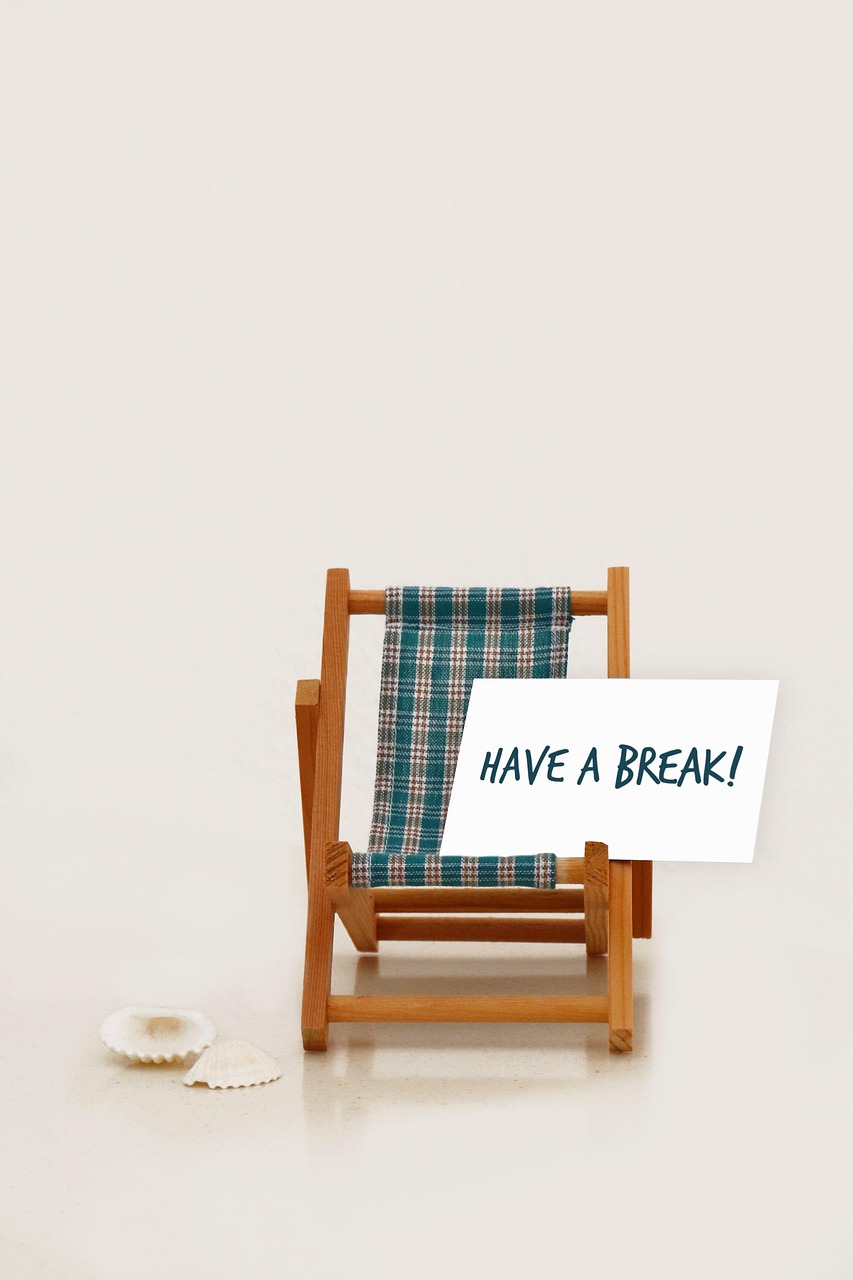
Photo courtesy of Pixabay/Bellahue123
Summer is one of those few times in the year when many of us get a built-in break or at least a reprieve from the relentless pace of work and life. Granted, for those grinding it out during summer, hopefully there are at least some opportunities for summer recharge – perhaps a long weekend here and there; and with longer daylight, some more enjoyment after hours?
I’m having a quieter summer than usual and I’m taking advantage of it. Unplugging from work a little more. Rest is crucial to clear the brain, recharge our nervous systems, have some fun, and simply rejuvenate. I can use all that. How about you?
Saving up for rest and recharge just for vacations just doesn’t cut it. The lead up to a break and the stress of the return to work after can often add more stress. A week or two (or more) is lovely but doesn’t take care of all the weeks in between. It’s kind of like trying to eat all your veggies in one singular day and meal. Imagine eating tons of broccoli just on Sunday and no vegetables the rest of the week. Doesn’t quite work that way. Same for rest and recovery. We need micro-doses along the way.
But rest we must. Our brains, minds, and bodies were not built to withstand the never-ending hustle bustle cycle of work and stress. Even Olympians take time to rest. In fact, it’s been said that those who make it to the podium achieve their medal by taking their rest and recovery as serious as their training days.
Many of us have lost the skill of taking meaningful breaks to recharge. There’s always more to do. The never-ending task list. As work has become faster, heavier and more demanding our seasons of work and rest have blended with boundaries blurred. Same for that line between home and work, especially with hybrid work still in play for many.
There’s just got to be a better way. Enjoy your summer break. But knowing the bookends of getting ready and coming back can draining, reflect on how you can bring meaningful rest and refresh to your life – during those breaks and in between them throughout the year.
A few thoughts:
Take it when you can – even if it isn’t perfect. Many people forego taking time off because they feel they are too busy at work, or they don’t have anything special to do. So it feels like wasted time so they might as well work. Saving up your time for the ‘perfect time’ or the ‘perfect way to use your time’ won’t do your brain or body good. It will catch up to you and when the real busy seasons come, will you be as ready and refreshed as you need to be?
Make a list. If you don’t have a super exciting big holiday planned, no worries. Make a list of things you might enjoy if only you had even a bit of time. “If I had the time, I’d like to do more of __”. It doesn’t have to be a trip around the world. Be a tourist in your own city. Read that book you always wanted to. Clean out that old shed, or closet. Catch up with an old friend.
Small is good! Don’t fall into the limiting belief that your hard-earned break must be big and impressive. Let go of that striving and driving mentality to ‘perform well’ even in your breaks. You don’t need to be impressive. You don’t need to achieve. You just need to learn to shift gears. Maybe slow down. Or rev the pace up – but with something different that engages your mind, soul, spirit – outside of work. Even tiny breaks can be expansive if we get out of our same old routine and habitual frame of mind. Think and act tiny and notice the big difference it can make.
Shhh. Practise a bit of quiet. Life is so loud and busy and chaotic. As human beings we are always thinking, thinking. Can you turn that off for just a bit. Engage in anything that gets your mind of the cycle of work and life worries. Stillness may not be easy for everyone, but when we do get quiet, it’s amazing what we can start to hear as fresh, and more helpful thinking can emerge. In quiet, you can come home back to your self. Your real (and whole) self, not just your working self.
Reflect purposefully. As we give those chatty inner critics their own vacation and quiet our busy thoughts, reflect on some more intentional, purposeful questions. Perhaps, revisit the 12 reflection questions from the early new year. Add new ones like: “How can I rest and refresh even in this shorter space of time? What does my body and mind need right now? What would be fun, different, nourishing to do with my time this weekend, afternoon, evening (whenever).
Block it off and pay yourself first. In the workdays, consider paying some time to yourself first (like the financial planners recommend with money) to recharge and catch your breath. Some of my clients told me they leave their entire calendars open and then all their time gets booked by others with no time left for themselves. They learned that even 20 minutes to pause and reflect or go for a short walk can make a big difference to one’s energy in those crazy busy days.
Eileen Chadnick, PCC, of Big Cheese Coaching, is an ICF credentialed, two-time ICF (International Coaching Federation) Prism award winner . She works with leaders (emerging to experienced), and organizations, on how to create better ways to navigate times of flux, opportunity and challenge. She is the author of Ease: Manage Overwhelm in Times of Crazy Busy .
May 21, 2025
Need a little luck sent your way? Four ways to generate more luck.
A version of this article will also be published in my column at the Globe and Mail.
“Luck is what happens when preparation meets opportunity.”
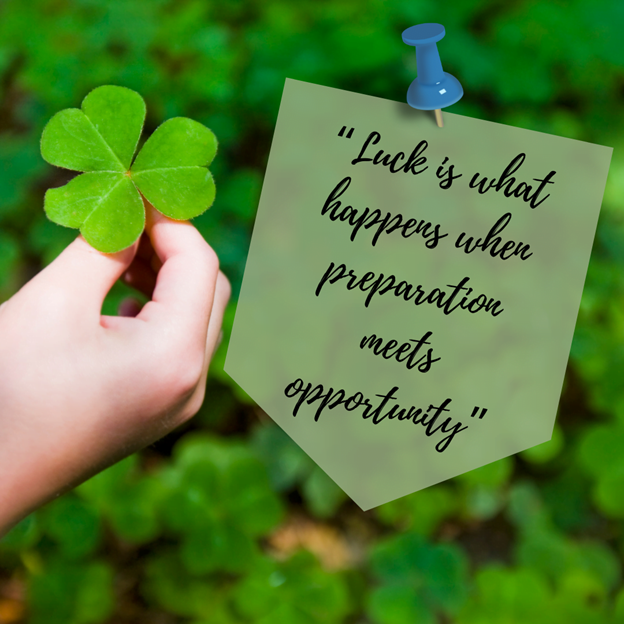
I love this quote. It’s become one of my mantras. There’s some debate as to who to attribute this to. Some say the Roman philosopher, Socrates, was first to coin this expression. Others say Elmer Letterman. And in more modern days, Oprah Winfrey has frequently been attributed to sharing this wisdom too. I don’t know who was first, but I love it!
I first heard this quote well before I ever even knew of Oprah. I was in my 20’s and trying to figure out my career path. I was at a crossroads (who hasn’t been there, eh? The first of many!). I lived in Montreal and our local newspaper would post daily quotes that were sponsored by advertisers. This little gem jumped out at me. It was love at first sight and I’ve held it closely as a mantra from then on.
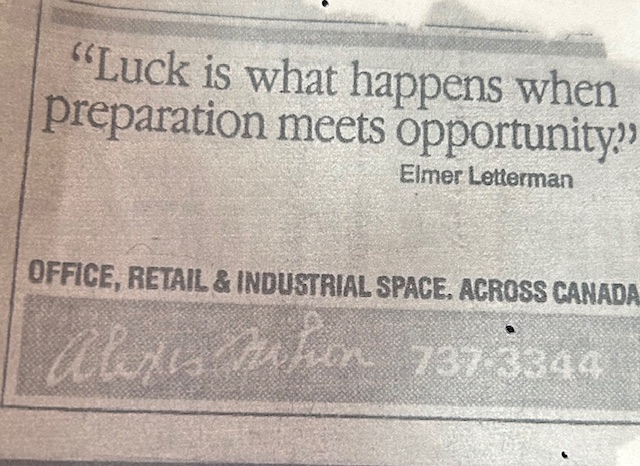
Photo: a cut-out from when I first clipped this quote from our daily newspaper in Montreal (decades ago!)
I was feeling lost at the time and unsure what career direction to pursue. I was always leaning into something and in many ways “preparing” but sometimes I did not know exactly what I was preparing for. This doubt and unease happens in times of career uncertainty and confusion.
This quote buoyed my spirits and even my sense of hope, which I now refer to as my “Hope Index.” It said to me that it was okay to not yet know. That is is still possible to take steps to prepare and when the opportunity strikes, you will see it and be ready to go for it. You create your own luck by being ‘awake’ with eyes wide open and preparing however you can.
Some people may think the notion of luck is malarky. Isn’t it random and happenstance – they may argue. And how can you prepare and create luck if you don’t even know what opportunity you are aiming for? What if you don’t yet know what job you want? What career path to pursue?
Isn’t preparing in advance like shooting darts to – nowhere?
Not quite.
I’ve had many, many ‘lucky breaks’ throughout my career. My first one was getting a really huge opportunity to work in a world class PR firm having just moved to Toronto to begin my career in communications. I was competing with candidates with way more related experience. You see, I had a degree in fitness (yes, fitness) and a marketing diploma. I needed all the luck I could get to break into this new path. And I did get lucky but truth be told, this luck ‘landed’ in great part because I networked like crazy, worked up the most compelling narrative I could with my then-limited experience, and kept at it until finally, something clicked.
Years later, I took a leap of faith to venture out as a solopreneur (still in PR and Exec Communications back then). I got some huge big “lucky” breaks and managed to get accounts with large companies both in Canada and in the U.S. Well, if I am really honest, the ‘luck’ did not just arrive out of the blue. I worked hard to find new business, including scouring the newspaper (back then in print) to seek out prospect potential. There was a 3 line mention that a large U.S. banking company (affinity cards) was coming to Canada. I worked tireless to find the ‘person in charge’ — lots of follow-ups . Finally, I got a conversation. They were impressed with my perseverance (and experience) and I earned the account. As a solopreneur I beat all the larger PR firms to the punch. Lucky eh?
Later on when I got into coaching, I also had some lucky moments. I recall bumping into an old colleague who had his own large firm. I casually mentioned “By the way, guess what I’m doing these days….yada, yada, coaching. Let me know if you or anyone you know might be interested in exploring…yada, yada.). Luckily – the timing was right and guess what happened. Got some new business. Lucky that I spotted those 3 lines in the paper eh? And that I put in all that effort to connect with them…yada, yada luck!
We create our luck more far more often than we realize.There is a lot of uncertainty in our economy right now and many people are feeling anxious about not knowing what is coming next. There are many ways to be ready and prepared to ‘attract’ (or seize) a lucky break.
Consider these scenarios:
Zahra is ready for a change and sees a job ad with a company she has long admired. There are likely hundreds of applicants. But “lucky” for her she has been actively networking – just to keep current and connected, even before she was looking for a new role. Turns out one of her new acquaintances works at that company and was able to help Zahra get her resume seen. And with a good word put in, Zahra got the interview, nailed it and landed the job. What luck (that she’s been networking and found someone to help!).
Layla’s current job doesn’t call for AI skills yet. But she knows it is coming so she takes a couple courses to start to skill up. Not long after, her employer restructures and shifts focus to – you guessed it – more AI in the mix. Layla gets to stay while others in her team were unfortunately let go. Lucky Layla (good thing she had the foresight and curiosity to learn some new AI skills!).
Giorge gets a random call from a recruiter for a leadership role that he hadn’t applied for but sounded interesting enough to explore further. It’s been ages since he’s interviewed. He kind of wings it. The offer goes to another candidate, Francois. Indeed, Francois was also caught off guard with the recruiter call but he’s been keeping his resume updated and regularly reflects on his accomplishments and strengths because – you just never know when you will need to speak about them. He aces the interviews and gets the job. Lucky break that the recruiter called — but more so that he was ready!
Four ways to prepare for those yet unseen “lucky breaks” that either come your way – or that you create.Of course there’s no guarantee that one’s preparation will garner the ‘win’ or bring luck. The point is that even when there is uncertainty you may have more influence over your destiny than you think. Here are a few ideas.
#1) Foster the boy/girl scout mindset of ‘always being prepared’. Reflect on what this means for you in your career. Be it resume updates, new skills, networking, and more. Don’t wait for the opportunity to present itself and then prepare. Prepare now and always. Funny how opportunities show up once you start to kick up some dust. Coincidence? Maybe. Maybe not.
#2) Learn, grow, be curious – and awake: Don’t get too comfy in your current role/sector. Be someone who reads, stays up to date, and is always curious beyond their current task/job description. Even if not looking for a job, stay awake to where the job market is headed – and stay alert for luck that may come your way, even if disguised as a challenge.
#3) Connect, connect, connect: No matter how skilled you are or impressive your resume is, you must nurture connections with others . If uncomfortable with ‘networking’, reframe it as connection. Remember, it’s often people who can introduce you to hidden opportunities beyond those listed. And do remember to reciprocate and offer help to others as well.
#3) Stay in possibility. Lean in and take actions to do what you can – even in uncertain and ambiguous times. This will elevate your own sense of trust and confidence. I have a colleague who often says, “Do something, and something will happen.”. I love that. It gives me hope that I can generate some of my own luck. How about you?
So what do you say? Ready to attract some luck your way?
Eileen Chadnick, PCC, of Big Cheese Coaching, is an ICF credentialed, two-time ICF (International Coaching Federation) Prism award winner , who works with leaders (emerging to experienced), and organizations, on navigating, leading and flourishing in times of flux, opportunity and challenge. She is the author of Ease: Manage Overwhelm in Times of Crazy Busy . She is also a long-time, regular contributor at the Globe and Mail Work-Life section.
April 11, 2025
Navigating Career Insecurity in Times of Uncertainty
A version of this article has also been published in my column at the Globe and Mail. See here for more.
Are you worried about your job security? In the past few months there has been a severely amplified threat of disruption. The trade war prompted by President Trump has sparked an unprecedented level of uncertainty, confusion, and chaos. Governments, business, and so many of us are on alert.
In this backdrop, I’m hearing from clients who are nervous about their career wellbeing. What can they do to stay safe? What if they lose their job? The chorus of concerns gets louder as the weeks go by. While there sadly will (and already have been) job losses as industries grapple with the impact of sudden tariff increases, those still employed are feeling anxious with all the uncertainty.
In this article, I offer just a few starting thoughts to help navigate these turbulent times. For starters, don’t panic. But do prepare.

Photo: Geralt on Pixabay
Don’t panic. But do prepare: It is always a good idea to stay on your career-ready toes even when all is well. This is even more important when there is turmoil and uncertainty that may (or may not) impact you. Rather than waiting, there are things you can start to do right now. Some of the points I’m about to share cover just the basic essentials. Equally important, are some crucial mindsets and behaviours. Make sure you read to the end for those as well.
Starting with the essentials:
Ensure your resume and LinkedIn profile are up to date. This sounds obvious but it is so easy to let dust accumulate on your profiles while you are busy working and happily employed. But don’t do that. Make sure your profile is fresh and current. This means more than just your job history. Include your strengths, accomplishments, and the value you bring (see next point). Resume writing takes time, thought, and remembering who you are and your many accomplishments, large and small. Don’t wait until this is a scramble. Take time to update now. See the next points to help you do this.
Take stock of your skills, abilities, and accomplishments. Knowing your skills, strengths and accomplishments is not only for your resume (interviews, etc.) it is imperative that you know your own value. This process will reconnect you to all that you’ve done and what you are capable of as you look ahead. It’s a confidence booster which is helpful in these uncertain times, especially if you need to pivot to new terrain. If this is difficult, keep reading as I outline a helpful exercise to remember through stories (see the CARS activity)
Don’t forget transferable strengths: Chances are there will be a lot of pivoting ahead. Do not limit your skills only to your current role and context. Make sure to highlight transferable skills so that you can be seen able to flex and pivot to other opportunities. For instance, negotiating with suppliers; managing projects; and developing relationships – all these abilities can be transferable to other roles and sectors.
Remember through stories: I’ve coached many people who got stumped when asked to describe their strengths and accomplishments. We tend to be so focused on getting stuff done, we pay less attention to who we are. If this feels difficult for you, try to remember through your stories. There are various ways to do this. One that I work with is a variation of a common exercise often referred to as CAR. I call my version CARS. The “S” is very important – read on:
Try the CARS Exercise to help you remember: The CARS exercise prompts you to reflect in a way that boosts your own self awareness of your accomplishments and strengths. You can decide what to bring from this exercise into your profiles (resume, Linkedin), letters and interviews.
CARS: Stands for Circumstances; Actions; Results; and ‘So What’.
Circumstance: Identify a situation or circumstance. It could be a challenge, opportunity, tasks — large or small. E.g. I had to find way to improve a process and reduce costs under tight deadline and get support from variety of stakeholders.
Actions: What did you do? Reflect on all the activities, behaviours you did. Start with action verbs (e.g. consulted with __; Generated options __; Executed __, etc.)
Results: What happened because of what you did? Consider both concrete results but also the less tangible yet equally important outcomes such as deepening relationships.
So what does this mean? This last part should not be under-estimated or ignored. It prompts you think about why this story matters and what it says about you.
“So what this means is –___.” Here’s where you convey what this reflects about you and your abilities. Why does this example matter? What does this little story highlight about you and what you can bring to a role? Connect to this and you’ll be better at telling your story to others.
E.g. “So what this says about me is you can count on me to find solutions to even the most difficult of challenges; to be collaborative and respectful and…..(fill in the blank”.
Mindset MattersDuring times of disruption it may be easy to default to defensive behaviour (when we are frightened, our brians default to a protective stance). Some people may feel like hard work is futile and that control is out of their hands.
Your mindset, attitude, and ultimately behaviour may make a significant difference in how you navigate these tricky times.
For this article, I’m focusing only on situations where you are still employed but may be operating under the cloud of uncertainty. In my experience, I’ve seen situations where companies were forced to lay off staff. But some still got to stay. I had a client recently ask me:
“How do I make sure I have the best chance of being in the group that gets to stay?”
Management decisions who to cut and who to stay are not always clear cut. Here are a few thoughts on how to give yourself better chance of surviving the ‘cuts’.
Adopt a flexible mindset:
This is no time to be ardently defending the way things used to be done. Rather, this is a time to show you can flex, pivot, and adapt to changes – as often as you need. Survival of the fittest is always about adaptation. In today’s context, companies are grappling with how to respond to the current climate. You may find things shifting frequently. Roll with it as best you can and do not be the vocal naysayer that complains about all the changes. Be the person that portrays an attitude of “I’m ready to be of service and can pivot to what is needed.”
Be a person who is good to work with: You do need skills, but character should not be overlooked. If you find yourself in a situation where your employer must make some cuts, but will keep some people onboard, what can you do to increase your chances that you will get to stay?
While skills, abilities and roles will play into the equation — what about when there is parity in those kinds of skills (i.e. yours are the same as others)? If you are someone who tends to be perceived as difficult to work with, you may not have as many chips in your favour in comparison to others who may seen as consistently good to work with.
Check in with yourself and ask, are you seen as a collaborator? A good person to work with? Make sure you are. It won’t guarantee your job but it sure can’t hurt.
Looking ahead, we will all need to strengthen our tolerance of uncertainty and adapt to change for at least for at least a good while. There’s lots more on this topic but for now if you are still employed but feeling the weight of uncertainty, at least give yourself a little peace of mind by doing what you can do right now as a start.
Wishing you resilience and lots of positive energy (we can all use large doses of that!).
Eileen Chadnick, PCC, of Big Cheese Coaching, is an ICF credentialed, two-time ICF (International Coaching Federation) Prism award winner , who works with leaders (emerging to experienced), and organizations, on navigating, leading and flourishing in times of flux, opportunity and challenge. She is the author of Ease: Manage Overwhelm in Times of Crazy Busy .
March 17, 2025
Amidst the Chaos, a Grounding Moment
No question this is a time of a lot of chaos. No matter where you live, the world now is going through tough stuff. Lots of uncertainty (tariff trade wars, economic uncertainty, political strife, and so much more). It is times like these that I most appreciate those moments of grounding and joy. So here’s one I’d like to share that just populated my BAG (capturing moments of Beauty, Awe, Goodness). It happened at 3am ET on March 14th.
—
Did you happen to see the Lunar eclipse on March 14th? I did. Admittedly, it was at a time that I’d normally be sleeping (3am ET). I did not set my alarm but I thought if I happen to awaken, as I often do in the middle of the night, I would check it out.
Well, right on time, I rolled over and and it was just before 3am, so I thought, ‘what the heck’ and I went outside.

(from my back balcony)
It was quite spectacular. The night was clear enough to see the moon in all its orange-reddish glory. I did not stay out too long, but long enough for a moment of awe. My photos don’t do it justice but for me they are wonderful reminders of that lovely magical moment.

I’m particularly a fan of these big cosmic moments. It reminds me as the world swirls, that the sun, the moon, the earth still know what to do and they show up in a dependable time (lol). And the magnificence of this cosmic even always brings perspective of the bigness of the world.
It was interesting to talk to others who lived far away in other provinces and they too saw the moon. In that way it was a reminder that we are all connected, no matter how far away we may live from one another. See the same moon. Same sun.
A similar experience of awe happened last summer with the solar eclipse. I did a little video on that experience too if interested in seeing that.
Both of these moments go into my BAG of Beauty, Awe, Goodness.
WHAT ABOUT YOU? What are your moments of awe? How do you stay present to noticing or creating moments of grounding?
Eileen Chadnick, PCC, of Big Cheese Coaching, is an ICF credentialed coach, a two-time ICF (International Coaching Federation) Prism award winner, who works with leaders (emerging to experienced), and organizations, on navigating, leading and flourishing in times of flux, opportunity and challenge. She is the author of Ease: Manage Overwhelm in Times of Crazy Busy .
March 2, 2025
How to Handle a Bully at Work
A version of this article will be published at the Globe and Mail (link to follow).
There’s a lot of complexity in our world, one of which is happening on the political front right now. I’m not a political columnist nor expert by any means but as I read the news the word ‘bully’ keeps surfacing. As we all try to make sense of what seems nonsensical behaviour from U.S President Trump, the details and motives keep shifting. But bullying is a theme that endures. This prompted me to address bullying in the workplace — in a recent article for my Globe and Mail column.
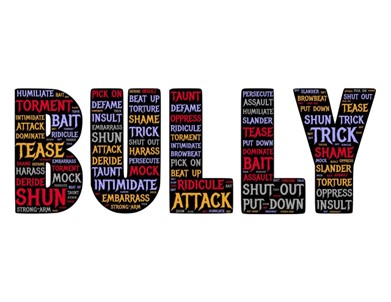
Bullying on the grand political stage is a big deal. But it is also a big deal in any other context – such as the workplace. If you have ever experienced bullying behaviour from someone at work, you know it can be tough to navigate. It can be stressful, confusing, unsettling – and take a toll on your personal and professional wellbeing. I know from personal experience (many, many years ago). If only I knew then what I know now.
Why do people bully?
We often assume we know the reason for the bullying behaviour based on the person’s actions. But often the surface behaviour may not make any sense. Looking at the current political threat of a trade war, is it really about tariffs? Or is it about the 1 per cent fentanyl issue? Or is it about allowing US banks to operate in Canada? Or about making Canada the 51st state? Or wait, maybe it’s about our maple syrup – yes, that must it! They want our trees so they can make Canadian maple syrup!
Of course, it may be about none of the above. Reasons for bullying behaviour in any context can often be vastly different from what we see and think we understand.
Sometimes it is just for show – for others to see. To signal who has the greater power. To establish oneself as the alpha boss. Or perhaps there are other reasons that we can’t see because the bullied are merely pawns in a bigger strategic chess game (in the bully’s mind) that goes beyond the issue of the day.
This holds true for bullying on any stage be it political or within our own lives – workplaces included.
SO WHAT TO DO?These thoughts are for workplace bullying. I am not offering advice for the political arena which is far more complex.

Photo courtesy of Helio42 at Pixabay
Get Curious: Slow down the assumptions and spend time wondering a little more what is beneath your bully’s behaviour. Don’t fall into the trap of thinking it is just one issue and once fixed the bullying will stop.
If you respond to their first act of bullying, they know they have you. Don’t be surprised when another seemingly weird reason for more bullying may surface.
Think of the kid who bullies another kid for their lunch. It’s not about the lunch sandwich. They want something else. Power? Status? Influence?
From playground or workplace, the bully wants something, and you are the target to help them get it. You might be the direct threat. Or just a pawn in their purpose.
Consider your work bully. Do they feel threatened by you in some way. Maybe they see you as an obstacle to their career goals. Were they the rising star and then you came along? Maybe they feel insecure and don’t even understand their own why? Or maybe, it has nothing at all to do with you. You are simply being used for their greater purpose.
Confront/Approach Privately: Appeasing a bully’s constant threats may not work. Instead confront the bully directly. But do it privately. Shaming a bully publicly may not go well. It may fuel their egotistic fire. They are all about image, saving face, and looking good.
But showing your strength quietly (and privately) may at least send the message that you won’t passively allow unacceptable behaviour.
Ask Questions: Rather than threatening them, seek to understand by asking them genuine questions about what it is they want or are unhappy about. Ask how you can work together – maybe as allies rather than fierce competitors? The bully might expect force from you so coming at them with a gentler, collaborative approach might surprise and disarm them. You might discover what is behind their behavior. Or you might not. A bully might still hold their cards close to their chess.
The situation may not necessarily change immediately. You may need to lean in a few times before the bully gets the message that you are not playing into their chess game. And indeed, you may need to speak more directly to them in a way that signals you aren’t backing down. Bullies feed on perceived weakness but strength can be subtle and shown with grace.
There is no guarantee this will work. Every situation is unique. The point is not to waste all your energy (or play all your cards) trying to fix something that may not be the real issue. Sometimes the bullying behaviour simply ends, and they go on to bully someone else. If indeed you were merely a pawn in their chess game, the bullying may dissipate, and you can go back to your work – your real work.
Of course, if bullying in the workplace happens over time without repercussions to the bully, then there is a problem with the workplace culture. Core values on the corporate wall and website are merely words unless the workplace walks the talk and there are consequences. But that’s another issue perhaps for another article sometime.
For now, I don’t profess to know all the answers to bullying challenges – especially on the political front! But doing nothing or doing the wrong thing can only exasperate the issue. Try strength but from a different vantage point. See what happens.
Eileen Chadnick, PCC, of Big Cheese Coaching, is an ICF credentialed, two-time ICF (International Coaching Federation) Prism award winner , who works with leaders (emerging to experienced), and organizations, on navigating, leading and flourishing in times of flux, opportunity and challenge. She is the author of Ease: Manage Overwhelm in Times of Crazy Busy .
January 27, 2025
Set Intentions to Stick With Your Goals
Note: a version of this article has also been published at the Globe and Mail.
I love fresh starts. There’s often lots of hope associated with new beginnings. That’s why birthdays and a new year can often inspire one to create something new in their life (and/or work). Perhaps you have named some goals or aspirations or even a mantra or theme for this fresh new year at hand?
But it can be hard work to stick with goals. Busy work and life can be fierce competitors for our attention, time, and focus. This is why many people have become disheartened with setting new year goals (or worse, resolutions). Year after year they name them but have trouble sticking to them as other priorities win the day.
Can you relate? Wondering what the key is to sticking to goals?
(Pixabay)
Before you toss the towel in on those lovely aspirations, consider that perhaps you just might need a recalibration of sorts to get your focus back and into some purposeful action. Goals are good for you! Or rather, the right kind of goals can be good for you. They help us self actualize, learn, grow, and create more meaning in our lives.
As we head into February (some refer to it as the month of blahs), take heart (also a good theme for February – aka Valentines), take another look at your goals and see if you can get back on track. Here are some thoughts.
Firstly, don’t get bogged down in the language and ‘rules’ of goals. But do embrace the power of intentions! The Language of Goals:“Goals” mean different things to different people. Some people have a fairly formal take on goals. E.g. perhaps they think of them as needing to be specific and well-defined, measurable, actionable, and time-sensitive (often referred to as ‘SMART’ goals). They may be oriented to detailed planning. For others, goals are just another way of saying, “I want something different, and I plan to make it happen.” They may take a less fulsome approach to planning and maybe just get started and see what happens from there.
Context matters. Indeed, some goals are meant for more concrete planning and measurement, and others less so. For instance, work related goals may require more rigour and detailed plans. For instance, increase sales by x% by year-end. Earn a promotion; expand network, etc. Or on the personal side, run a marathon!
But other goals can be less tangibly visible or measurable yet very heartfelt, experiential and very meaningful. For instance, a goal oriented to one’s ‘inner world’ (of feelings and experience) such as, feeling less stressed; being more engaged at work (and life); becoming more confident, or happier, etc.
All worthy and each might warrant a different path to making it happen. While there is lots of science and discipline around goal setting and achievement — for now I want to invite you to NOT get overly bogged down by doing it ‘perfectly right’. There are many right ways to pursue change and make good things happen in your life.
I’d like to invite you to think more about the power of settings intentions.

What is often missing from people’s goal setting is getting really clear on what they truly want and are willing to do to make it happen. Intentions can make a difference. This requires reflection and commitment: What will I do? What will I focus on? What can I count on myself for? And more.
Intentions cultivate a roadmap of focus, purposeful action and mindsets that empower. For instance, if your goal is to earn a promotion, then drill down and ask yourself what within your sphere of influence do you need to take responsibility for; and what will you commit to?
Perhaps this may involve learning new skills; having career conversations with your boss; developing yourself in different ways.
The careerist seeking a promotion might set intentions to learn more about something related to their desired goal; to take a course to advance their skills and knowledge; or to take more leadership on a project that has potential for visibility, impact, and a chance to showcase their potential.
In addition to actions, intentions can also be attitudinal and oriented to mindset. For instance, a young professional wanting to progress in their career but who lacks confidence and tends to be overly silent in meetings, might set intentions such as:
“Today my intention is to be courageous (even if I feel scared) to speak up at least once in the meeting.” Or “today I will remind myself to be more aware of my strengths, abilities and potential instead of self judgment and overly focusing on what I cannot yet do.”
An individual feeling distraught from all the woes in the world and the stresses in their life, may have a goal to be heartier and happier despite the tough stuff. They might set an intention to ‘notice the good in the day’ no matter how much tough stuff happens.
Create the Habit of Setting Intentions.Don’t start your day without setting intentions: For greatest impact, it is important to be consistent and stay in the focus. You may also set intentions for the week, month, year or other timeframes.Include both actionable and mindset-oriented intentions: Don’t underestimate how powerful mindsets are for fueling purposeful action.Don’t be afraid to go small: Tiny goals and intentions can add up over time. Many big goals are made up of many parts. E.g. Today I will reach out to just one person to expand my network.Check in regularly with yourself. Hold yourself accountable and stay in touch with how you are honouring your intentions. When things don’t go well, be curious, open and patient with yourself and see what you can learn or modify.Ready to dust off those goals and aspirations and give this another try? The rewards await.
Eileen Chadnick, PCC, of Big Cheese Coaching, is an ICF credentialed, two-time ICF (International Coaching Federation) Prism award winner , who works with leaders (emerging to experienced), and organizations, on navigating, leading and flourishing in times of flux, opportunity and challenge. She is the author of Ease: Manage Overwhelm in Times of Crazy Busy .
Setting Intentions Helps You Stick With Goals
I love fresh starts. There’s often lots of hope associated with new beginnings. That’s why birthdays and a new year can often inspire one to create something new in their life (and/or work). Perhaps you have named some goals or aspirations or even a mantra or theme for this fresh new year at hand?
But it can be hard work to stick with goals. As we close down the first month of the shiny new year, the glitter may have faded out a bit from your attention and energy. Busy work and life can be fierce competitors for our attention, time, and focus. This is why many people have become disheartened with setting new year goals (or worse, resolutions). Year after year they name them but have trouble sticking to them as other priorities win the day.
Can you relate? Wondering what the key is to sticking to goals?
(Pixabay)
Before you toss the towel in on those lovely aspirations, consider that perhaps you just might need a recalibration of sorts to get your focus back and into some purposeful action. Goals are good for you! Or rather, the right kind of goals can be good for you. They help us self actualize, learn, grow, and create more meaning in our lives.
As we head into February (some refer to it as the month of blahs), take heart (also a good theme for February – aka Valentines), take another look at your goals and see if you can get back on track. Here are some thoughts.
Firstly, don’t get bogged down in the language and ‘rules’ of goals. But do embrace the power of intentions! The Language of Goals:“Goals” mean different things to different people. Some people have a fairly formal take on goals. E.g. perhaps they think of them as needing to be specific and well-defined, measurable, actionable, and time-sensitive (often referred to as ‘SMART’ goals). They may be oriented to detailed planning. For others, goals are just another way of saying, “I want something different, and I plan to make it happen.” They may take a less fulsome approach to planning and maybe just get started and see what happens from there.
Context matters. Indeed, some goals are meant for more concrete planning and measurement, and others less so. For instance, work related goals may require more rigour and detailed plans. For instance, increase sales by x% by year-end. Earn a promotion; expand network, etc. Or on the personal side, run a marathon!
But other goals can be less tangibly visible or measurable yet very heartfelt, experiential and very meaningful. For instance, a goal oriented to one’s ‘inner world’ (of feelings and experience) such as, feeling less stressed; being more engaged at work (and life); becoming more confident, or happier, etc.
All worthy and each might warrant a different path to making it happen. While there is lots of science and discipline around goal setting and achievement — for now I want to invite you to NOT get overly bogged down by doing it ‘perfectly right’. There are many right ways to pursue change and make good things happen in your life.
I’d like to invite you to think more about the power of settings intentions.
What is often missing from people’s goal setting is getting really clear on what they truly want and are willing to do to make it happen. Intentions can make a difference. This requires reflection and commitment: What will I do? What will I focus on? What can I count on myself for? And more.
Intentions cultivate a roadmap of focus, purposeful action and mindsets that empower. For instance, if your goal is to earn a promotion, then drill down and ask yourself what within your sphere of influence do you need to take responsibility for; and what will you commit to?
Perhaps this may involve learning new skills; having career conversations with your boss; developing yourself in different ways.
The careerist seeking a promotion might set intentions to learn more about something related to their desired goal; to take a course to advance their skills and knowledge; or to take more leadership on a project that has potential for visibility, impact, and a chance to showcase their potential.
In addition to actions, intentions can also be attitudinal and oriented to mindset. For instance, a young professional wanting to progress in their career but who lacks confidence and tends to be overly silent in meetings, might set intentions such as:
“Today my intention is to be courageous (even if I feel scared) to speak up at least once in the meeting.” Or “today I will remind myself to be more aware of my strengths, abilities and potential instead of self judgment and overly focusing on what I cannot yet do.”
An individual feeling distraught from all the woes in the world and the stresses in their life, may have a goal to be heartier and happier despite the tough stuff. They might set an intention to ‘notice the good in the day’ no matter how much tough stuff happens.
Create the Habit of Setting Intentions.Don’t start your day without setting intentions: For greatest impact, it is important to be consistent and stay in the focus. You may also set intentions for the week, month, year or other timeframes.Include both actionable and mindset-oriented intentions: Don’t underestimate how powerful mindsets are for fueling purposeful action.Don’t be afraid to go small: Tiny goals and intentions can add up over time. Many big goals are made up of many parts. E.g. Today I will reach out to just one person to expand my network.Check in regularly with yourself. Hold yourself accountable and stay in touch with how you are honouring your intentions. When things don’t go well, be curious, open and patient with yourself and see what you can learn or modify.Ready to dust off those goals and aspirations and give this another try? The rewards await.
Eileen Chadnick, PCC, of Big Cheese Coaching, is an ICF credentialed, two-time ICF (International Coaching Federation) Prism award winner , who works with leaders (emerging to experienced), and organizations, on navigating, leading and flourishing in times of flux, opportunity and challenge. She is the author of Ease: Manage Overwhelm in Times of Crazy Busy .