Eric Chandler's Blog
July 31, 2026
This Is Not A Map

“I’ve always been fascinated by maps and cartography. A map tells you where you’ve been, where you are, and where you’re going – in a sense it’s three tenses in one. It’s also an amazing ideogram of information that is very useful and, perhaps most pertinently, also not at all useful.”
— Peter Greenaway, British film director
I held two pieces of paper in my hand. Satellite photos with red pointers in the center. No coordinates, no legend, no scale, no label. Just the brown sand and darker patches of earth. The red pointer on each photo marked the spot.
I slid them into the pocket of a folder and closed it up. I put the folder on top of a stack of papers, the bureaucratic remnants of twenty years in uniform. I gathered the pile under my left arm and walked out of the operations building for the last time.
To the east, over the tired green of the September poplars, you could sense Lake Superior ready to spawn a fog monster, like she does in the fall. Ready to send ghostly tendrils up to threaten the airport runway on the other side of the parking lot to the west.
My red Dodge was like a horse that knows the way to the barn. I was almost a passenger as the truck followed the road out of the gate. Past the F-16 on a stick to zig-zag through town to my house. My whole career in my rearview mirror, from basic training in 1985 to retirement in 2013. After almost three decades, the very last thing I did was make maps of two places in Afghanistan. Those two pieces of paper closed a circuit in my head. A big deep breath and an exhale.
I didn’t just want those maps. I needed them in a way so deep and visceral that I have trouble fully expressing it. I want to know why.
BEFORE
The character of a map changes over time. A map is a planning device beforehand. It’s aspirational, something that helps you imagine. During, it’s a tool that helps you orient yourself. Afterward, it’s a relic. A record. Maybe, if I look at the role maps have had in my life, I canunderstand my need. The metamorphosis of maps from before, during, and after their use might give me an explanation.
My dad was in the US Forest Service, which made me a Forest Service brat. As mobile as a military brat, but with more trees. In each new town, my parents specifically picked houses within walking distance of the library. In Cadillac, Michigan, I rode my Schwinn Varsity ten- speed to the library and looked through the shelves. One book sprawled open, its binding split and surrendered. Massive rectangular pages in a landscape layout. Text on the left page and maps on the right. Maps with three colors. Black lines with red and blue shapes in opposition. The West Point Atlas of American Wars. I was in 8th grade. I drooled over that atlas, page after page.
A map is a way for people to orient themselves. I was always the new kid. Maps made me feel rooted, if only temporarily. They made order out of chaos. Maps gave me the “right answer” the same way that math did. The West Point Atlas said, This is the Battle of the Bulge. This is what happened.
 My copy of the West Point Atlas with my grandfather’s letter explaining where he was on this map of the Battle of the Bulge.
Then, dad told us we were moving again. This time to Plymouth, New Hampshire. I barely remembered the state where I was born. We were headed back to the White Mountain National Forest where he started his career. All I knew was the flat Midwest. I looked at my dad’s well-worn Appalachian Mountain Club (AMC) White Mountain Guide. Inside the back cover, a manila pocket held several maps of the White Mountains. I imagined my future using those maps. Like the West Point Atlas, they had only three colors. Black for the trails and roads. Blue for water in the ponds and streams. Brown for the contour lines.
During my four years of high school, my dad and I wore out those maps. The AMC manages the Four Thousand Footer Club. It’s a list of people who’ve climbed all 48 peaks over 4000 feet in the White Mountains. My dad and I started “peakbagging” in 1981. The maps were part of a cycle. We planned a hike and imagined the terrain. Then we climbed Hancock or Tom or Madison or Wildcat. We looked from that summit and saw Bond or Willey or Moosilauke or Passaconaway. All the mountains from the maps, laid out like a rolling, green quilt. Then, curiosity drove me to look at the maps again and plan the next hike. My notes tell me I climbed all but ten of those peaks with my dad. We turned brown contour lines into memories.
My dad and I climbed South Hancock in June 1982. We went straight up the fall line through evergreens on a trail the AMC guide calls “unrelievedly steep.” I said something that day that was the culmination of plastic models and math and maps and mountains. I told my dad, “I want to build airplanes.” Then we bagged the peak below tree line. Ironic to choose a career path toward the sky on a peak with no views. I saw airplanes as an extension of summiting a peak. A way to approximate the God’s-eye view of maps.
 My dad’s copy of the AMC guide showing our peakbagging record
I got into the US Air Force Academy to chase an aeronautical engineering degree. Just before basic training in 1985, my great-aunt Boo died. Boo was a social worker and a poet. Her husband was a historian at Bradford College who died decades earlier. The family gathered at her house in Haverhill, Massachusetts. It was a hot day as we piled out of the car. We walked into the dim interior. Narrow paths crossed the rooms between endless stacks of their books, magazines, and newspapers. My parents told me I could take any books I wanted. I sullenly picked through the dusty piles wondering when we could leave. And then I saw them: Both volumes of the West Point Atlas of American Wars. The same maps I pored over in the Cadillac public library. In perfect condition and still encased in a protective sleeve. The whole set felt as heavy as a cinderblock. The broad, black hardcover swung open like a door hinged on undamaged gray cloth bindings. I turned the broad, smooth pages, cool in contrast with the stuffy heat of the room. I walked out with those two volumes like Moses with stone tablets. They sit on my bookshelf today.
After I finished Air Force Undergraduate Pilot Training (UPT) in 1990, I went back to New Hampshire to bag the last five peaks on my list. I have the AMC guide that I used that day. I summited Middle Carter, South Carter, Carter Dome, Wildcat, and Wildcat E in one 14-mile walk in a steady drizzle. No views. That map is still wrinkled from the rain. I don’t remember what airport I flew into or where I stayed. But I remember the hike itself and the map.
After UPT and F-16 school, I went to another specialized course. I learned to fly at night with the cleverly named LANTIRN system (Low Altitude Navigation and Targeting Infrared for Night). A pod looked forward using infra-red sensors and repeated that image in your heads-up display. The second, probably more important, part of the pod was the Terrain Following Radar (TFR). This helped you fly at at low-level. You were a high-speed blind man and the TFR was the white cane, tapping at the ground in front of you. We planned in even more detail for these nighttime low-levels. We built a simplified map of each leg of the route that we called a “stick chart.” The black line of the route was centered in each chart, the direction of travel from the bottom of the page to the top.
Making the stick chart was my favorite part of mission planning. You took the white chart and placed it over the leg location on a topographic map. Then you put both of those on a light table, a broad surface of glass lit from underneath. The contour lines showed up through the map and the chart. I traced the contour lines of the mountain peaks onto the blank white paper. I was like Gollum, muttering “my precious” as I obsessively traced the higher contours of the threatening hills. Not the whole mountain, just the top. Like the summits were islands. A rough shape would’ve been good enough, but I took my time tracing the lines. It makes me happy that contour lines are a through line from my mountainous childhood to aviation.
I recently learned that my AMC maps were hand-drawn. Louis F. Cutter surveyed and drew maps of the Presidential Range of the White Mountains starting in 1885. The AMC used his painstakingly crafted maps in their first guide in 1907 until 1998 when they went digital. I pulled out the maps from my 1987 edition and compared them to the 1917 edition I found online, the first to use the three-color scheme. They looked almost identical, 70 years apart. Finely crafted, but with human imperfections in the lines and lettering. I drew mountains by hand on my LANTIRN stick charts, just like the hand-drawn mountains on my hiking maps. Whether it was for climbing a mountain or for flying around one, I unfolded my maps beforehand and tried to imagine.
 The old school hand-drawn maps in my 1987 AMC guide
DURING
Then maps change from day-dreaming devices into practical tools. Since we first used a stick to scratch a map in the dirt, we’ve wanted more detail in our maps. One way is to increase the scale of the map. Comedian Steven Wright had a doozy: “I have a map of the United States… actual size. It says, ‘Scale: 1 mile = 1 mile.’ I spent last summer folding it.” Jorge Luis Borges’s story “On Exactitude of Science” depicts a fictional kingdom where maps are enlarged and perfected, but there’s a downside:
…the Cartographers Guilds struck a Map of the Empire whose size was that of the Empire, and which coincided point for point with it. The following Generations, who were not so fond of the Study of Cartography as their Forebears had been, saw that that vast Map was Useless,…
It’s strange to think that a perfect map would be no help. A map so good that it would show your coffee cup on the table. But, if you put the coffee cup in the sink, the accurate map would be instantly obsolete. This is an example of Bonini’s Paradox. When you try to simulate something or make a model of it, the more precise the model is, the less usable it is. You get a map too big to carry that goes out of date immediately.
The map-territory relation is an example of this paradox. Alfred Korzybski wrote this in Science and Sanity, published in 1933: “A map is not the territory it represents, but, if correct, it has a similar structure to the territory, which accounts for its usefulness.” The best example of this is the map of the London Underground. In 1933, Henry Beck created the Way Finder for that subway system. The simple colored lines don’t show precise geography. But if you want to know the next stop or where to transfer to a different train, it’s very useful. More helpful because it’s simple.
Cartographers can’t depict everything. Peter Turchi, author of the book Maps of the Imagination, put it this way in an interview. “People think about inclusion all the time but it’s a little less common for people to think about omission,” says Turchi. “What you want to convey to any reader or user is often defined by what you leave out.” You won’t see mountains on a subway map.
I made LANTIRN stick charts, route maps, and maps of the target area throughout my life as a pilot. I went on three deployments to Iraq and one to Afghanistan. I flew Close Air Support (CAS) on every single sortie. CAS means you work in close proximity to ground troops. This demands careful coordination so that friendly troops are not put in danger by your actions in the air. You talk on the radio to a Joint Terminal Air Controller (JTAC; “jay-tack”) on the ground and give his troops the support they need. We typically did non-lethal tasks, but we had weapons, just in case. We spent our time in the briefing studying the maps where we planned to work.
When friendly forces took effective fire from the enemy, we called it Troops In Contact (TIC). A TIC was the highest priority, superseding any of the planned missions we had. We left the planned mission, got grid coordinates, a radio callsign for a JTAC. Then my wingman and I raced across Afghanistan toward the location with the help of GPS. On the way to the fight, I shoved the pre-planned maps for the other superseded missions under my leg. We showed up overhead the TIC for the ultimate pick-up game. You built situational awareness as quickly as you could to help the troops on the ground. The TIC never happened on a piece of dirt that we already studied. We started from scratch every single time. It was like waking up from a coma in the huddle at the Superbowl: “What down is it? Are we winning?”
Sometimes we went from one TIC to another, bouncing around the country like a ping- pong ball. You might get a chance to choke down a Red Bull and an energy bar. Piss into a piddle-pack on the way back from the tanker. Then we’d be off to another TIC. I climbed out of the cockpit four, sometimes six, hours later, hollow from repeated doses of adrenaline. I saw the unused maps from the lower priority missions all wrinkled and sweaty on the ejection seat. I thought, Oh yeah. Forgot about you.
Let’s say you’re at a truck stop and there’s a big map on the wall next to the fridge full of energy drinks. You’ll see the human desire: Where am I? There’ll be a big, greasy mark on the map from all the fingers that point and touch. You’ll know where you are. Rushing over the mountains of Afghanistan to a TIC, I wanted a grease spot or a big red arrow in the sky pointing to a valley saying, “You are here.” I never had the tool of a map when it mattered most.
One day, I arrived at a TIC and the JTAC passed the coordinates of the enemy position to me over the radio. He calmly used a standard format called a “9-line.” Nine pieces of information that helped me figure out where the enemy was. The JTAC was on a ridge and his unit was taking fire. I could hear gunfire and shouting in the background. He described where he was on a ridge, a beige east-west spine. They were on the western tip. Around a hundred meters to their west, enemy troops were firing at them from a creek bed in the valley. I made a dry run to make sure I was pointed in the right place and not at friendlies. Then the JTAC cleared me to use my 20mm cannon. I made three passes and used all 500 rounds of my ammunition. The friendlies were able to safely withdraw. I don’t know if I hit anybody that day.
I didn’t have time during that fight to draw a map so I could understand my place in the world. I wasn’t able to depict friendlies here, enemies there. The world was the map, the valley itself. My eyeballs were the pen that drew the contours, the rivers, the ridge line. Maybe, on the day I retired, I made my two maps to complete unfinished business. To make the maps that I was too busy to draw at the time. Two maps for the two lives I took in two other valleys.
AFTER
I live in Duluth, Minnesota. July is supposedly the only month when it’s never snowed. We leave the winter gear in reach. Each member of my family has a plastic bin filled with stuff like hats, gloves, mittens, and head lamps. Recently, I was rooting around in my bin for a hat and found two maps. One was a poster-sized topo map of the Presidential Range of the White Mountains. The last time I climbed a Four Thousand Footer was 30 years ago. The other map was the Wind River Range in Wyoming. I climbed Fremont Peak there 24 years ago. For some reason, those maps are in my hat bin right now. The maps went from planning charts to useful tools to relics.
 I wrote this story 6 years ago. This is a picture of those two maps in my hat bin today in 2026. Wind River Mountain Range and White Mountains. Go figure.
A giant map of Alaska hangs on the wall behind our laundry room. A memento of my three-year Air Force assignment there. I found more maps jammed behind Alaska. Yet another White Mountain National Forest map. Topo maps of the Uinta Mountains where I climbed King’s Peak in Utah just a month before 9/11. A laminated area map of the Great Salt Lake Desert that I used while at Hill Air Force Base. I admit it. I’m a map hoarder. I’m like a squirrel storing so many nuts that I lose track of where they are.
Maybe the two maps I made the day I retired are just more of the same life-long compulsion. Maybe I hoard maps as topographical proof of life. If it’s not on a map, did it happen? James Salter was a fighter pilot in the Korean War. He said something about writing that seems true for maps:
Call it a delusion if you like, but within me was an insistence that whatever we did, the things that were said, the dawns, the cities, the lives, all of it had to be drawn together, made into pages, or it was in danger of not existing, of never having been. There comes a time when you realize that everything is a dream, and only those things preserved in writing have any possibility of being real.
Many of the books on my shelves are about the wars in Iraq and Afghanistan. I read to build context for my combat experiences. Several combat veterans mention maps in their stories. In the story “Soldier’s Home,” Ernest Hemingway describes a WWI veteran named Krebs and his return to civilian life after the war. Krebs wants to know how his experience fits into the big picture:
He sat there on the porch reading a book on the war. It was a history and he was reading about all the engagements he had been in. It was the most interesting reading he had ever done. He wished there were more maps. He looked forward with a good feeling to reading all the really good histories when they would come out with good detail maps. Now he was really learning about the war. He had been a good soldier. That made a difference.
Kevin Powers writes about maps and the passage of time in his novel The Yellow Birds.
He highlights some of the map-territory issue with a map of Iraq:
That map, like every other, would soon be out of date, if it was not already. What it had been indexed to was only an idea of a place, an abstraction formed from memories too brief and passing to account for the small effects of time: wind scouring and lifting the dust of the plains of Nineveh in immeasurable increments, the tuck of a river farther into its bend, hour by hour, year by year; the map would become less and less a picture of a fact and more a poor translation of memory in two dimensions.
In notes at the end of the book, Powers talked about his motivations for writing it. He said he was trying to illuminate “the cartography of one man’s consciousness.”
Benjamin Busch writes about maps in a story called “Into the Land of Dogs.” The character in this short story is the only survivor of a helicopter crew that crashes in Afghanistan. The description of maps in the air versus maps on the ground makes my spinal cord ring like a tuning fork:
He was learning just how different maps and land were, his simple acceptance of symbols wearing away as he travelled. He had lost trust in depiction. No, that wasn’t it. Representation. There had been such certainty in the air, all the hills, forests, dunes, and towns clearly identified and named.
Both Powers and Busch portray maps as untrustworthy because of the passage of time and changing perspectives. They’re right. For example, I thought I was done with the Four Thousand Footers. Not so fast. I reviewed the hike when I crossed Wildcat E in the rain, the last peak on my list. In 1998, when the AMC maps went digital, they found that Wildcat D was the taller summit and kicked Wildcat E off the list. The 1987 list and maps I own are obsolete. The hiking project I started with my dad in 1981 isn’t complete. On the bright side, I have a reason to go back to New Hampshire’s high country for one more hike.
I never set foot in Afghanistan except inside the wire at Kandahar Air Base. But I saw almost all of it from the air. At the time, I couldn’t name the places I saw. I did a “show of force” over a city once, flying 500 knots over the buildings at 500 feet above the ground. To deter anyone who wanted to threaten a US convoy that was hauling ass back to its compound. I tore across that urban sprawl and thought, Wow. Big town.
Sometimes, I drink beer and zoom into the maps on Google, almost like drunk texting. I try to make sense of where I was, where I might’ve been. One night, I scrolled the computer mouse across big striated cliffs next to a river as it spilled out next to that big town. It took me years, but I finally thought, Huh, so that was Jalalabad.
I showed up over some coordinates and talked to a dude on the radio. I looked out the window at an anonymous scene with mountains by some river. I looked at the brown. The black and blue. Made my own contour lines. Friendlies here, enemies there. My mental map.
Now, like Krebs. I want detailed maps after it’s all over. Sometimes, I think I made my two maps to fill in a gap. Like Krebs, I want maps to help me really learn about the war.
#
The day after Michael Herr died in 2016, Esquire republished his August 1968 piece “Hell Sucks.” I felt a surge when I read this line: “When the battle for Hué was all over, they entered it into the records, gauged its terrible cost and battlegrammed it, so that it took on the dry, tactical stamp of the West Point Atlas of American Wars.” When he mentioned my atlas, it was like he completed a circle between my combat deployments and my 8th grade self. In both the magazine article and his book Dispatches, Herr opens with a passage about a map:
There is a map of Vietnam on the wall of my apartment in Saigon, and some nights, coming back late to the city, I’ll lie out on my bed and look at it, too tired to do anything more than just get my boots off. The map is a marvel, especially absorbing because it is not real.
Later, in the magazine piece, Herr describes how an unnamed officer stops by for a cocktail and is also drawn to the map. The following passage about the map of Vietnam doesn’t appear in the book:
The General is drawn to it too, and whenever he stops by for a drink he’ll regard it silently, undoubtedly noting inaccuracies which the maps available to him have corrected. The waters that wash around my Indochine are a placid, Disney blue, unlike the intense, metallic blues of the General’s maps. But all of that aside, we both agree to the obsolescence of my map, to the final unreality of it.
Salter and Hemingway wrote about how we desire stories and maps. How we want the stories to create reality and the maps to give us meaning. But writers from Vietnam and later tell us that maps will fail us. Busch wrote about “losing trust in depiction.” Powers said a map was a “poor translation.” Herr wants you to agree on the “final unreality” of a war map. Turchi says it best in his book: “The first lie of a map—also the first lie of fiction—is that it is the truth.” If simplicity gives a map utility, than my two minimalist maps are the most useful lies ever told.
The map—before, during, and after the event—lives between our ears. What Powers called the “cartography of one man’s consciousness.” I thought that if I brought my two maps into being, I could somehow get answers. All my life, maps helped me up mountains on foot and around mountains in airplanes. Maybe my two maps could help me now. But Turchi says that my mapmaking has probably been in vain: “We compile mental maps that are wildly skewed, a mental atlas so large and complex that we can never fully convey it to anyone else. Then we live in the world those maps create.”
Surrealist René Magritte painted a work called “The Treachery of Images,” a depiction of a pipe for smoking tobacco. Under that image he painted this phrase in French: “This is not a pipe.” The statement is true. It’s not a pipe. It’s the image of a pipe. The red pointer on my first map is just an image. It isn’t the man hiding in the rocks waiting for my two bombs to impact. The red pointer on my second map is not the second man disappearing while his motorcycle cartwheels away from the explosion. The two maps are not the two men.
I don’t put much faith in those pieces of paper anymore. Which is good, because I can’t find them. We moved into a different house. My papers are in boxes that went from one attic to the other. I’ve looked. Those two maps were the last thing I made in uniform and they’re missing.
Even without them, I still see the snowy peaks of the Hindu Kush stretching off to the horizon north of Jalalabad. The nameless folds of the earth there preserved in the folds of my brain. My memories conspire with the terrain itself to become a map. One that is perfect, filled with meaning, and imaginary.
 Looking at a modern AMC map in 2023 before going to do Shmo’s Big Stupid that year.
***
This story was first published in Consequence (Vol. 13), Fall 2021.


January 29, 2026
Shmo’s 2025 Writing Review
 Boundary Waters Canoe Area Wilderness, July 2025.
2025 Writing Goals:
Find an agent/publisher for memoir.Start new book project.Support and promote writing by others.Read at least 2 books a monthRapidly turn short-term ideas into articles/essaysThere were a lot of distractions in 2025. But I am thrilled to share that I met my number one goal for the year. Tracy Crow Literary Agency offered me representation for my memoir this year. I first met Tracy Crow at a writing conference at the US Air Force Academy in 2018. She is a Marine and an accomplished writer herself. I am thrilled that she is representing me and my work.
Regardless of what happens next, I am grateful to her for making my work better. She made three inputs to my manuscript which I took to heart. One of them was easy. The other two were hard, so it took me all summer to rework my project. I finished that up in September, so now we are actively trying to find a home for my book. I’m excited for people to read it someday.
As far as starting a new book project, I wrote last year that I was trying to decide between two projects. Well, the only real progress I made toward this goal was deciding which one to pursue. My idea is to explore the way Duluth has prioritized outdoor recreation and to examine whether that commitment is a success. I’m hopeful that a detailed look at a very local situation might illuminate some lessons that are applicable to a wide audience.
I did the worst job on goal number three. In 2024, I started making video reviews of books, usually by people I know. I didn’t do any in 2025. Maybe I wrote a sentence or two on a Goodreads review. I did some social media sharing of other people’s work, but I always do that. That’s a little too easy. I need to pump up these efforts this year. Reviews and sharing the work that your writer friends do is the coin of the realm. I try to be a professional about writing, so I need to do more work helping out my fellow writers. Taking a close read of other writers’ work and then explaining it to others makes me better as a writer. Please try to remember that it’s all about me, all the time. I’m a narcissist-coated narcissist with narcissist filling.
I didn’t read 24 books this year. I made it through 19, but I got bogged down on some books about conservation, since I treat them like school books. I’m dog-earing pages and making notes. They tend to go slower than novels. But then again, I’ve only met this goal once (last year) in the past 15 years. So, I’ll remind myself what Stephen King says, “If you want to be a writer, you must do two things above all others: read a lot and write a lot. There’s no way around these two things that I’m aware of, no shortcut.”

Speaking of writing a lot, the last goal was about getting ideas onto the page and out into the world quickly. Now, I spent most of this year on my highest priority topic which was rewriting my memoir. But meanwhile, since the election in the fall of 2024, I’ve been writing a Substack called Angry Shmo. I’ve been trying to address conservation and veterans issues there, rapidly venting my spleen on the page. I wrote 27 posts in 14 months, so I feel like I met this goal. Most importantly, I’ve been trying to turn my anger into action. I explain this in the first post there. I reread it recently. That motivated me to keep writing it, since I’ve come to believe that even the smallest action to preserve our nation’s ideals is worth it. I try to make a Call to Action in every post, but I’m sure that I’m barely moving the needle. I’m doing it for free. Mostly, I’m doing it to remind myself that my values haven’t changed. Edmund Chandler got here in 1630 or so. My family’s genealogy crew calls him Edmund the Immigrant, which I find interesting. It would be nice to make it to the 400 year milestone since Chandlers arrived on the continent before I get put in a reeducation camp.
Outside the memoir and the Substack, I haven’t put a whole lot into the world, but here are some links if you want to play catch-up.
No guarantee USA keeps metals from mines near BWCA
I track the time I spend working as a writer on an excel spreadsheet. It also acts as a bullet journal so I can see which writing projects I’m chewing on. I get paid by the hour as an airline pilot and most years I work around 500 hours. There’s a lot more time associated with commuting and hanging around in hotels. But the pay comes from the actual hours from push back until I hit the gate again.
E. Annie Proulx says, “How we spend our days is, of course, how we spend our lives.” Outside of work, I logged 195 hours last year as a writer, which is within a half hour of the previous year. I logged 352 hours of exercise this year. In 40+ years of recordkeeping, that wins the bronze medal for me.
500 hours of work, 352 hours of fitness, and 195 hours of writing. I’m pretty happy with this. I will say that my screen time is too high in general. It’s not a writing goal, per se, more of a life goal, but I’m trying to aggressively limit my screen time this year. That extra time should channel into my family, my fitness, and my writing. Maybe I’ll see a change in the fitness and writing numbers as a result at the end of the year.
I made progress with last year’s goals, so I’m essentially going to cut and paste with some tweaks for goals 1 and 2 for the coming year.
2026 Writing Goals:
Help agent sell memoir.Start shaping theme, doing research, and conducting interviews for new book project.Support and promote writing by others.Read at least 2 books a month.Rapidly turn short-term ideas into articles/essays.Keep writing, people!
September 21, 2025
Pattern of Life
 Leo. Somewhere along the Superior Hiking Trail. 2014.
It’s empty where you were.
Just a big gaping hole.
-from “Bloodshot Eyes” by Trampled by Turtles
The vet depressed the plunger on one syringe, the sedative. She gave him the second syringe and then listened to his heart with a stethoscope. Leo was lying down in what we called his “food pose.” He was lying on his stomach, straight ahead with his forelegs on either side of his head, with his chin on the ground. This is the alert way he used to lie down when he was waiting for somebody to drop a piece of food.
Shelley wept and held his head. I cried as I stroked his back. The vet stopped listening with the stethoscope, I looked her in the eyes, and she gave a slight nod. It happened quietly. But it was terrifyingly fast. He was with us for almost 15 years. A couple tablespoons of a drug. In less than a minute, he was gone. I put my fingers on his closed eyes.
We are so fragile.
I don’t want to make too much of this. Shelley’s mother passed away recently. I can rapidly use all the fingers on my hands counting the people who recently lost their spouses and siblings and parents to cancer and old age. We are hardly the first people to put down their dog. But Leo was with us for a long time. My kids grew up with him since they were 11 and 8. We aren’t unique. But it still hurts.
 My dad with Fred
And the hurting seems to be part the deal. My dad got his Labrador named Fred while he was still in college, before marriage, before kids. I was about ten when I hugged a very sick Fred around the neck before my dad took him to the vet to put him to sleep. Later, my dad and I hunted over a German shorthair named Jack. Many years after I left home, he was riddled with tumors and in pain, so my dad put him down. My dad called me while I was in Air Force pilot training in Arizona and gave me the news. I went straight to the liquor store. I drank a bottle of whiskey to stop my pain while watching the orange thunderheads building in the sunset over the mountains around Phoenix. The whiskey didn’t help.
 Jack and me on the summit of Whiteface in New Hampshire. 1982.
I called my parents to tell them about Leo. I told them it hurts. My dad said that he knew since he’d been through it three times. “Three?” I asked. I knew his first dog was named Rummy, but I didn’t know he was euthanized like Jack and Fred. He told me the story and shared the part about anguish.
“I wrapped him up in some canvas,” he said. “I dug a hole and buried him. I couldn’t see. Rummy and I were the same age.”
Yeah, I’m having a hard time seeing through my bloodshot eyes two days later.
I’m writing this because, well, I write. Leo was alive for most of the time I’ve been publishing my work. Since my first years in writing were about the outdoors, Leo is a character in many of those articles about our family outdoor adventures. Writing is how I make sense of things. I’m trying to pay tribute to Leo. I once wrote that I wanted to write something worthy enough for Leo. For all dogs. This will have to do.
Also, some people outside of our family have come to know Leo through my writing. I initially saw social media as a good thing. I shared my stories, including those about Leo, using those “platforms.” I’ve come to believe that social media was a mistake. But maybe the part where readers learned about Leo redeems things just a little. So, I’m scribbling about the death of my dog because some of you may actually care. Maybe some of you will even be able to find this story after elbowing your way past the algorithm that will try to point you away from Leo and toward some authoritarian hate.
Leo was with us outdoors all the time. I used to say that he was “as normal as he got” when he was outside. He was a little standoffish. We think he was a Lab/Border Collie mix. The Lab part wanted to make friends but the Border Collie part didn’t like to be touched.
He just wanted your food. He was honest about that. When the food was put away after supper, he simply left. He was uninterested in contact. Shelley would say, “He’s not very loving.” He was no Golden Retriever.
At the house, when he met a stranger, he was too rammy, like a puppy, even as he got old. When he was younger and met someone new, he’d uncontrollably pee everywhere, usually on the person’s shoes. Hence, “Leo the Pee-o.”
But outside, he was fine. We ran, hiked, skijored, and even stand-up paddleboarded with him. We took him salmon fishing in North Shore streams. I even took him grouse hunting a few times, even though neither of us were any good at it. He helped spot the kids from the boat while they learned to waterski. He was mellow, almost friendly outside. He listened better and had good recall. He was just another member of the family, though still a little detached.
In the old Chariots of Fire movie, one of the athletes who was religious said this about God, “When I run, I feel His pleasure.” Leo ran beside me during all of the biggest things I’ve ever done outdoors in my life. In 2014, he ran all 310 miles of the Superior Hiking Trail with me in 41 sections over a five month period. In 2018, he spent five days with me as we hiked the remote Kekekabic Trail through the Boundary Waters Canoe Area Wilderness. In 2020, he was my only companion again on a six-day backpacking trip across the Border Route Trail. He was with me for every single one of those 415 continuous miles of the North Country Trail through the Arrowhead of Minnesota. The Kek, the BRT, and the SHT. I joke that he’s the first dog to run them all. Probably not, but hey, sue me. If I ran and hiked 415 miles, he ran over a thousand. As I watched him run, like a black missile, I imagined him happy.
 He only stopped running because I found food. Superior Hiking Trail, 2014.
We got him from the Animal Allies shelter in 2011. I was preparing to deploy to Afghanistan in 2012. This meant, four the fourth time since 9/11, Shelley would be running the farm alone for a while. We had a stretch where some teenagers were playing “ding-dong ditch” with our doorbell. It was just kids playing pranks. Irritating, but I didn’t think it was too threatening. But this spurred Shelley’s desire for a dog around the house.
I said, “Do you want a toddler for the next 15 years?”
She was adamant and I kept pushing back.
Then, one night, when I was reading Grace some stories before bed, the invasive “ding-dong ditch” incidents rose up in my daughter’s mind. She asked me, “Am I going to get abducted?”
We went to get the dog.
He was originally named Frye at the shelter. He was a four-month old refugee from Iowa. The kids changed his name to Leo and brought him home. Over the years, he earned his keep. He loved us by accomplishing the mission, not by putting his chin in your lap. For years, until he started to go deaf, he had a zero false alarm rate. He could tell whether a car door slamming was in our driveway or next door. If he barked, but I heard nothing, I learned to trust that he knew something I didn’t. He had the loudest bark of any dog I’ve ever known. It was like a sonic weapon. When he barked, it watered your eyes. The metal chairs in the kitchen rang like bells after each ahWOO.
Shelley was right. Leo was a good guard dog. He barked at me when I hugged her. Don’t be touching Mama, he thought. “Good boy,” I said.
Shelley does all the heavy lifting in our home. Mama walked Leo. Mama fed him. Mama gave him a mid-day snack. Mama brushed his coat. Mama let him out to pee.
We live in town, so we picked up his piles in our yard after he did his business. We had a metal garbage can that we lined with plastic bags to collect Leo’s poop. It is, of course, horrifying. Our kids have a knack for naming things. The kids were reading a lot of Harry Potter books at the time. In that style, they named the can of poop, the “Chamber of Sorrows.”
Filling that can and emptying that can are part of the rhythm in our home. Leo was part of that rhythm. Part of the “pattern-of-life.” On my first and only deployment to Afghanistan, the reason we got Leo, I was flying to a FOB (forward operating base) when they said they had a mortar POO (point of origin) for some incoming fire they were getting. I have chased POOs dozens of times on deployments and never seen anything. (Weren’t we just talking about Leo’s poo?) Yet again, I looked through my targeting pod at some coordinates, expecting nothing. My adrenaline spiked when I saw a three man team on a mountain top who looked like they were carrying something.
“I’ve got ‘em!” I said. For the first, and only, time of my life I actually found somebody at some POO coordinates.
The guy on the ground could see what I was seeing. “Nah,” he said. “Those guys are picking pine nuts. Pattern-of-life.”
But I digress. Leo was part of our pattern-of-life. He slept on a pillow/blanket combo in our bedroom. In the middle of the night, I would hear him gently not-quite-snore as he exchanged the air. Often, he let out a cartoon-like fart. In the morning, he followed an ironclad pattern. It felt extraordinarily loud in the silence of the dawn. He woke up and smacked his lips. When you think about how much longer a dog’s lips are than ours, it’s pretty amazing. We used to call the smacking “lip management.” He stood up, his nails clicking on the hard floor. He walked to the bathroom door, shoved it open with his nose, even though we weren’t in there. The spot on the door where he did this turned black. Somewhere along the line, he would sneeze, which we called “snart” for “snot art,” and also shake his body, whapping his ears. He walked to Shelley’s side of the bed and stuck his head up to sniff her face while his wagging tail repeatedly whacked against her dresser and back against the bed. Most of the time, he walked by the end of the bed to go out to the rest of the house, skipping me. (The only guarantee he would come to me by the bed was if there was a thunderstorm. I felt his cold nose in my armpit and I woke up aware that it must be raining. I put my hand on his back and tried to calm his frightened shivering.)
The pattern of life every morning sounded like:
Smack-smack-smack-clickety-clickety-clickety-SNART-clickety-clickety-WHAPPA-WHAPPA-WHAPPA-clickety-(shove)-clickety-clickety-thumpWHACKthumpWHACKthumpWHACK-clickety-clickety-clickety…(doppler effect of toenails getting further away)
He would snarfle-snurfle and groan with joy as he squirmed around on his back exactly thirty minutes after he ate. Somewhere around that time, in the kitchen, he sometimes reluctantly allowed a brief affectionate interaction. I squatted down on my heels, butt almost to the ground, and held up my hands and made a scratching motion. He would walk up to me, nose-to-nose, and I continued the scratching motion with my hands at the base of his neck. He always looked at Shelley wherever she was in the kitchen while I scratched. I narrated this, pretending I was Leo, “Rub my neck while I look at Mama. Yes, that’s it.” If I stopped and he wanted more, he punched me with a forefoot, and went back to looking at Mama. But usually, after about 30 seconds, he left. I guess this is what passed for love from a dog who was somewhere “on the spectrum.”
He let out a big sigh like he had to pay taxes when he rolled to his side from laying on his stomach. I quoted a Doc Holliday line from the movie Tombstone when he did this, “I’m afraid the strain was more than he could bear.”
Anytime Shelley prepared food and worked her knife, he stood by her, ready to catch a carrot peel or maybe take care of the end of that cucumber she wasn’t going to use. She called him “The Composter.”
Leo was part of our pattern-of-life, day after day for fourteen years. The daily acts were more important than the big adventures.
Leo’s crisis on Friday was not a surprise. Back in July, he had gastro-intestinal problems for about three weeks. We thought maybe he had some kind of stomach bug. Instead, we learned there was a mass growing on his spleen. They offered surgery to remove his spleen that afternoon. We pulled the reins, since surgery would be pretty invasive, especially since he was over 100 in dog years. The vet suggested we gave him some Chinese herbal medicine called yunnan baiyao, a coagulant. His stomach thing cleared up almost before he started taking the medicine. Maybe related to the medicine. Maybe not.
We met with a vet oncologist. She did a detailed ultrasound and said the mass looked pretty homogenous, so she thought she could do a needle biopsy. It wasn’t cancer. Usually you could bet that it was either 60% likely to be a hemangiosarcoma (cancerous growth) or 40% chance it was a hemgangioma (non-cancerous growth) on his spleen. It was neither, really. The results of the biopsy showed hyperplasia, the spleen going into a kind of overdrive. Either way, the only way to be sure would be to cut the growth out and see. We still didn’t want to put Leo through a surgery and months of recovery. They might not even be able to do the surgery if they saw metastasized cancer during a screening of his lungs. The oncologist said the growth might have been there all along and maybe the gastro problem was just some coincidence. We learned that the spleen is a bloody organ and ultimately, the growth on the spleen could tear and hemorrhage. It was still a threat, cancer or not.
In the meantime, we stopped giving him the Chinese medicine. After that, he seemed healthier than ever. People saw him and said he couldn’t possibly be 14. Even seeing the x-rays, the doctor said, “Jeez, look at his spine. Looks like a young dog.” We joked that he was Benjamin Button, aging in reverse. I often think that his eternal youth was partly due to a healthy, active outdoor lifestyle. Was my family active because of him? Was he active because of us? In any case, we stowed the threat in the back of our minds.
Lilly is the daughter of our close friends who live a few doors down. She helped take care of Leo this summer while we left home on adventures without him. This way, Leo could sleep in his own bed instead of being sent to a kennel. We paddled in the BWCA. We went to Maine and hiked in New Hampshire. We flew to Juneau, Alaska. Got all four of us in the Chandler band back together where Grace was working for the summer and hiked the coastal mountains. Leo liked Lilly in our absence.
After about six weeks of running in and out of the house, we got back into the rhythm at home, both kids gone back to their schooling. Just me and Mama and Leo. Clickety-clickety, etc. On the last sunny day before a stretch of rain, we walked Leo down to Lake Superior and he jumped in, like usual.
The next couple days, he didn’t eat his breakfast, which was extremely unusual. Friday night at around 8 pm, Shelley and I watched the British Baking Show. Leo was there, as always. He got up and stood by the back door. This was his silent cue that he needed to go out. He was good that way. He left a pile in the yard and came back in. We turned the TV show back on but he just stood there and started to dry heave. Then he lay down on his side and we could see that his stomach was bloated and rib cage looked larger. His stomach was hard and he was repeatedly contracting it. I was around a dog that had bloat and died a couple summers back. I thought that was happening to Leo. He wouldn’t stand up. I tried to pick him up and he barked at me in pain. This got him on his feet, though, and we managed to coax him up his “old man” ramp into the back seat of the truck under his own power. We drove to the emergency vet.
They took Leo to the back, and we waited. We told them we were worried about his distended gut and also told them about his spleen. They took us to a room. The vet came in later without Leo and said the mass on his spleen had grown since July. And that the growth on his spleen was bleeding. His body cavity was filling with blood and he was in pain. This was the inevitable crisis we hoped wouldn’t happen.
She described three options. First, surgery. Second, palliative care to prolong his life. This would somehow clear out the blood and reduce his pain. Frankly, I was unable to listen anymore during the description of number two. Third, euthanasia. They left us alone to talk it over.
I had a hard time believing he would heal. He was definitely in pain when I tried to carry him. I tried to imagine what the next several months would be like for him. Dogs take pain differently than we do. I once saw Leo roll around on a Lake Superior beach. Half an hour later, I was close to his face and could see that he had about a teaspoon of sand in each of his eyes. Didn’t even phase him. I think he thought, “Well, I guess this is the way my eyes are now.” He would suffer and not complain.
I didn’t want Leo to feel any more pain. Simple as that. I saw a future of pain. Followed by another crisis just like the one Leo was in right then. A future crisis where Shelley was alone and I was away at work. Or worse, a future crisis where Lilly was burdened with Leo in a terrible situation because Shelley and I were out of town for something. My dad has repeatedly told me he let Fred suffer for too long. I didn’t want Leo to suffer.
While we deliberated, they brought Leo into our room. He wagged his tail and then lay on the floor, quivering like he did during thundershowers. I looked down at his swollen rib cage and stomach. We called the kids to say what we were thinking. We asked if they wanted to see him via video. Neither of them wanted to see Leo in that condition. We made our decision.
I was glad we were both there. I was glad he was having a normal day up until two hours earlier. Earlier that afternoon, he rolled around with joy after his last supper.
They came in to put a catheter into his foreleg. He wasn’t able to stand up to leave the room. They had to carry him out. This kind of foreshadowed how I imagined the rest of his life. Sick. In pain. Unable to move.
They brought him back in and spread out a soft blanket where he could lie down. You know the rest.
I feel ruined. But that’s the price of admission. Leo reminded me that we are all fragile and precious. We knew this day would come. Since July, mortality has been closer, which made pretending he was fine a more conscious act.
I have spent a lot of time with a book by Martha Nussbaum called The Fragility of Goodness. She is a contemporary philosopher with a view of humanity that I believe is true. In an interview with Bill Moyers she said:
“To be a good human being is to have a kind of openness to the world, an ability to trust uncertain things beyond your own control, that can lead you to be shattered in very extreme circumstances for which you were not to blame. That says something very important about the condition of the ethical life: that it is based on a trust in the uncertain and on a willingness to be exposed; it’s based on being more like a plant than like a jewel, something rather fragile, but whose very particular beauty is inseparable from that fragility.”
Leo’s beauty was inseparable from his fragility. We ignored that since July. But, to be honest, we ignore it all the time about everything and everybody that we love. It’s all fragile. It’s all vulnerable.
Yesterday, Shelley and I woke up without Leo. No farting dog in his bed. No clickety-clickety-SNART. No joyful rolling around on his back after breakfast. No neck to rub while he looks at Mama. No heavy sigh. No sonic boom when he barks because the mailman is here. This first day without Leo was already brimming with absence. The pattern of our life is now silent and filled with gaps.
Yesterday, Shelley and I took the same path where we took Leo for his last walk on the last sunny day of his life. This was less than 24 hours after he died. We noted the places where he always stopped to sniff and pee. We used to say he was “checking his pee-mails.” The one spot where he always pooped next to the railroad tracks. How he always ate the first piece of grass he saw after exiting the tunnel under the highway. Leo’s pattern of life, now gone. We walked to the Endion Ledges, a name that is a version of the Ojibwe word “endaayaan” which means “home.” The wind was out of the east, so Lake Superior sent big waves to crash on the ledges where Leo swam two days earlier.
We walked home past the liquor store and bought a bottle of wine so we could raise a glass to Leo. When we got back to the house, Shelley took the wine inside. I took the shovel and went to the back yard to pick up Leo’s last shit, the one he took right before he started to bleed. I dumped it in the garbage can and put the lid back on the Chamber of Sorrows for the last time.
 Leo spoils a self-timed pic on Mt. Oberg. 2013.
December 31, 2024
Shmo’s 2024 Writing Review

2024 Writing Goals:
Find an agent/publisher for memoir.Support and promote writing by others.Read at least 2 books a monthRapidly turn short-term ideas into articles/essays.At the end of 2023, I gave my memoir manuscript to a professional editor. She worked on it for a couple of months. Then, I worked on it pretty hard for the first ten months of 2024. I soothed myself by saying, “I only have to take her advice if I agree with it.” The problem was that I agreed with 99% of what she said, so the rewrite was more work than I thought it would be. As far as goal #1, I sent my manuscript off to a literary agent at the beginning of November. I’m waiting to hear back. So, strictly speaking, I didn’t accomplish the first priority this year. But I am “finding” an agent, so I’m hopeful that I’m on that long path to publication. My #1 goal for 2025 will still be to find an agent and a publisher.
I accomplished #2. The fact is that it’s pretty easy to click and like and share and subscribe on social media to support my friends who write. That is most useful when it’s a magazine article or blog post that they write. But I try to do more than that when it comes to my friends who write books. That’s where goal #3 and goal #2 start to get intertwined. I accomplished #3 for the first time ever this year, reading 25 books. Frankly, I don’t know how people read as many books as they do. It might help if I stop looking at my phone. Anyway, when I read a book by someone I know, I make an effort to review it, even if it’s just a paragraph long. In this world of algorithms and Goodreads and billionaire book sites, it’s a way we can help each other as writers.
Even just a passing, positive, personal comment from someone about something I’ve written is something I remember for years. Hell, forever. I think of the reviews as “paying forward” a thank you for all the help I’ve been given by other writers over the years. Plus, I learn a lot by thinking about what I got from somebody’s writing. Sharing what I learned and what I liked helps me when it comes to my own writing. So, I’m still selfish, I guess. I’ve also tried out short video book reviews on social media that I call “Shmo and Tell.” Kind of an experiment that serves as a rough draft for what I end up writing out in a book review. The fact is, ain’t nobody I know getting rich selling books. For me, the reviews I write aren’t going to boost book sales so the writer enters a new tax bracket. But the reviews help me feel like I’m not the only one sitting in a chair by myself trying to get the words in the right order. They help me feel connected. Which I think we need. I need.
But anyway, here are the 25 books I read this year. I’ll put links to the reviews I wrote and maybe a link to one of those Shmo and Tell things, just so you can laugh at how I look like I’m melting as I age.

The Wild Delight of Wild Things
Shmo and Tell on A Winter’s Rime
I’ll call goal #4 a success, too. I focused on my book the entire year, so I didn’t write many articles. I published four articles and one poem this year, which is fewer than normal. Considering that I was focused on my memoir, I’m okay with it. Because I did manage to crank out each piece quickly. And since the election, I started a Substack called Angry Shmo where I’ve written a piece pretty much every week. In that free Substack I try to compartmentalize the piss and vinegar running through my veins regarding current events. So, I’m getting practice at having an idea and quickly getting it off my chest. This will be a valuable skill since I’m going to start another book project this year. Magazine articles will have to fit into the small time gaps. Since it’s a short list, here are the pieces I got published this year. In a nice bonus, the story I wrote about Watson was in the Top 5 most read Saturday Essays published this year at our local Duluth website Perfect Duluth Day.
Duluth Duo Powers The Adventure Running Company
Laughing Twice (poem in Loud Coffee Press, Issue 17)
MAGA special interests want your public lands
I’ve tracked my writing time since 2020 in an Excel spreadsheet that also serves as kind of a bullet journal. Anytime I do work that I consider part of my writing “job,” I log the time. During the pandemic, for two years, I worked as a writer for an hour a day. When I went back to my flying job and upgraded to captain, that time dropped to 120 hours in 2022. But it’s been trending back up to around 200 hours this year. The trend is good since I think it shows I’m getting more disciplined and figuring out how to manage my time better. I do about 600 hours of work per year at the airline and I do about 360 hours of exercise per year. So, 200 hours of writing for the year slots in about right. Feeling good about the use of my time.
So, next year’s goals will look last year’s but with a new #2 goal of starting a new book project. I’ve got two ideas I have to choose between. One is more time critical, which would make it seem first, but it’s more difficult. The other is not time critical, but much easier in terms of access to the research. Life is full of choices, as my dad says.
2025 Writing Goals:
Find an agent/publisher for memoir.Start new book project.Support and promote writing by others.Read at least 2 books a monthRapidly turn short-term ideas into articles/essaysHappy New Year, people. Keep writing!
March 30, 2024
Shmo’s 2023 Writing Review
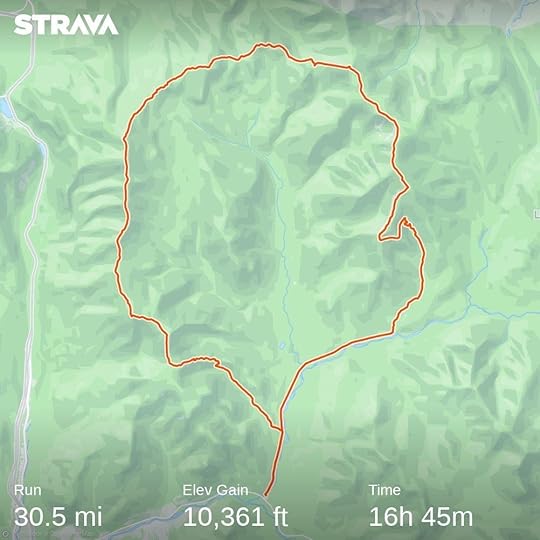
 On Franconia Ridge, about 20 miles into my 31-mile, 17-hour jaunt around the Pemi Loop in the White Mountains of NH. 10,000′ of climbing that day. Uff Da. August 2023.
It’s fitting that I’m posting my annual writing review three months into the following year and three years since the last one. Since I’m allegedly “goal-oriented,” I created some goals for 2022, which will have to suffice for this 2023 review.
2022 Writing Goals:
Finish draft of memoir.Write curiosity essay and “reader” essay.Support and promote writing by others.Read at least 2 books a monthI managed to finish a draft of my memoir. Finally accomplished item #1. I sent it off to the Veterans Writing Award contest that’s administered by Syracuse University in New York. I worked pretty hard on it the previous 3 years and submitted it to them in March of 2023. After I did that, I had what I’d call a writing hangover. I had never written a whole book-length project before. It kind of drained me. I turned my attention to the outdoors and stepped away from the keyboard. At the end of the post, I’ll talk about my big year on the trails. After I scratched my trailrunning/hiking itch, I followed up with the writing contest people and learned that my manuscript “did not advance.” That’s a nice way to put it. At the end of 2023, I sent my manuscript to a professional editor for them to chew on. I got it back before Christmas 2023 with their inputs. I have more work to do on it, which I’m doing now. Daunting to have to keep working on something you thought was done. In some ways this book reminds me of an ultramarathon:You just have to keep moving forward. Stubbornness is an important ingredient in writing and running.
I never got around to #2. I barely remember what I meant by those two essays, but I do indeed remember. I’ll get to them eventually. But the short term ideas that are not WHOLE FRIGGING BOOKS, will have to wait until I’m done with my memoir. I only published two magazine articles last year, largely because I was preoccupied with my book or with my post-submission hangover recovery.
Regarding #3, I enjoy promoting and supporting writing by others. I don’t engage as fully as some people, but I like to share writing by people I know. And even by people I don’t know, especially if the writing resonates with me somehow. I’m hardly a reliable curator, but I do read a lot and pretty intentionally. So, when I find something I enjoyed, I like to tell people about it. Liking and sharing posts on the internet and making book reviews is kind of the coin of the realm for writers. You can genuinely help writers by doing that (hint hint). I try not to be transactional about it. (e.g. I wrote a review for them, they better write one for me) In some ways, when I try to articulate why a book meant something to me, I think it makes me a better thinker, which should, in turn, make me a better writer. It’s a lot like being an instructor pilot. Teaching other people to fly or explaining how to fly to someone else invariably makes the instructor a better pilot.
I didn’t accomplish #4. But I am pretty much at my limit with two books a month and struggle to meet that goal. I do have a day job, after all. But I am just astounded at how well-read other authors and writers are. It’s essentially a time-management question. I love reading. Can’t be a writer without reading. One thing that helps me is that I’ve finally learned how to read two books at one time. I used to only be able to read one book after another. Lately, I find that if I split my reading into Research and Pleasure, I make more progress. I’m filling my head with reading about conservation and public land topics lately, with an eye to a next book. So, I take the Research reading and try to make it something I do after supper for a while, with a pencil in hand, writing notes in the margins and underlining passages. Treating it like homework. Then, I read whatever I want the rest of the time. This usually means a few pages before I throw the book on my bedside table before I pass out. So, I’ve started to take books on the road with me at work. I usually try to travel light, so a book doesn’t meet that goal. But this new habit of bringing a book for fun on the road helps keep me from scrolling on my phone. Worth the extra weight. Maybe this year I’ll hit two books a month.
So, here we go for 2024.
2024 Writing Goals:
Find an agent/publisher for memoir.Support and promote writing by others.Read at least 2 books a monthRapidly turn short-term ideas into articles/essays.This is the year to put the memoir into the end zone. I’ll keep doing #2 and #3. I’ve come up with a new thing on Instagram called “Shmo and Tell” where I do a short video review of a book that I like. Not every book that I read, but ones that I want to share something about. I’ve been having a little fun with it. #4 is new. I get plenty of ideas all the time. When I’m not working on my memoir, I can have a little “treat” and hammer out whatever other story ideas are on my mind. I need to be less worried about where they’re going to end up and more worried about getting my words out of my head. My friend Felicia Schneiderhan is a writer and she said this to me once: “Write whatever you want. Nobody reads anything anyway.” Maybe a little glib, but I find it motivational. Write whatever you damn well please.
Another reason I added #4 is because of the loss of Shawn Perich in 2023. He died too young. He had a lot more writing about the outdoors in him that needed to come out. I’m barely a fisherman, but the steelhead are starting to run in north shore streams pretty soon, and it makes me think of Shawn. And then I feel the gap where he used to be. I wrote a tribute to him here, along with a lot of other people. He was a huge part of my growth as an outdoor writer. I miss him.
 Shawn Perich. (Photo Credit: Steve Kuchera)
Books I read:

I reviewed several of these books. You can check out the links below.
Another Nice Thing:
My book of poetry Kekekabic, earned an Honorable Mention in the 2023 Northeastern Minnesota Book Awards for Poetry! That was way cool. You can get a copy at the top right of the front page of this post.

Writing Hangover Cure:
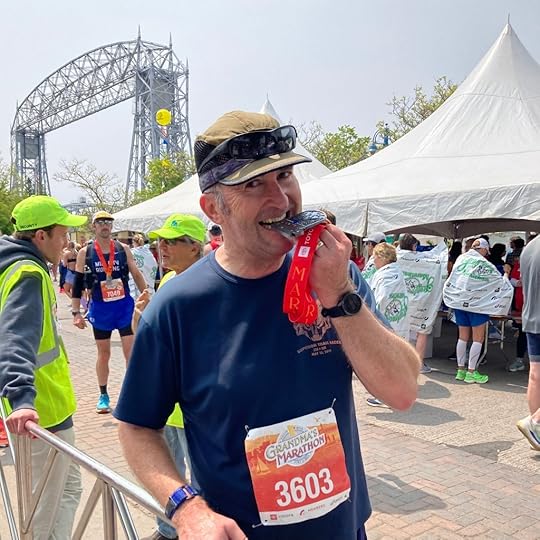
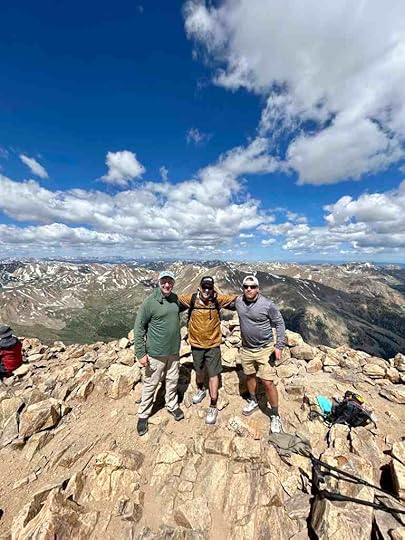
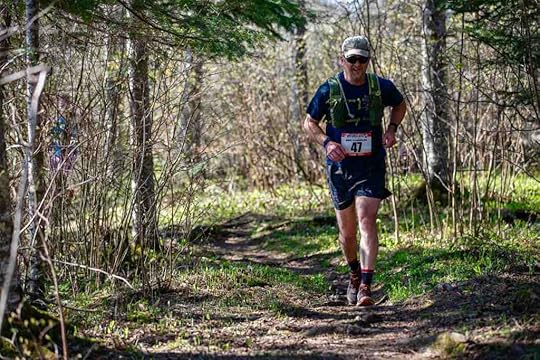
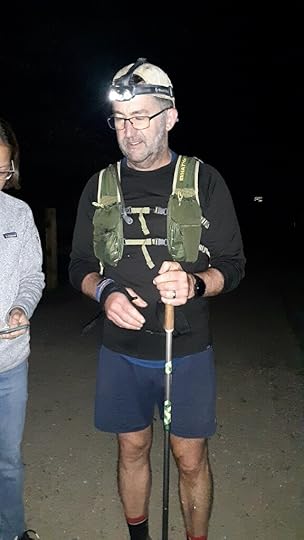
Like I said, I “finished” my book in March 2023 and felt wrung out. So, I ran a trail ultramarathon in May (Superior Spring Trail Race 50k), Grandma’s Marathon (my 15th time), climbed a Fourteener in July in Colorado with Luke and TJ (Mt. Elbert, Colorado high point), and ran my first 50-miler in 13 hours at the end of July (the Voyageur). All of that was to get ready for what I called Shmo’s Big Stupid. I went around the Pemi Loop, 31 miles, 10000′ of climbing in the White Mountains of New Hampshire. It took me 16 hours and 45 minutes. Started in the dark. Finished in the dark. Broke a trekking pole two hours into it. It was the hardest thing I’ve ever done. And like writing a book, the main things were sticking to the plan and being stubborn. And also like writing a book, by the end, I was hallucinating voices in the creek bottoms and from the rushing Pemigewasset River. If I ever get my book published, because of finishing the Pemi Loop, I’ll know just how good it feels to be done.
October 20, 2023
Memory Loop
What’s your earliest memory? I’ll share mine and, in so doing, you will get to experience the terrifying rollercoaster that I experience between my ears every single day.
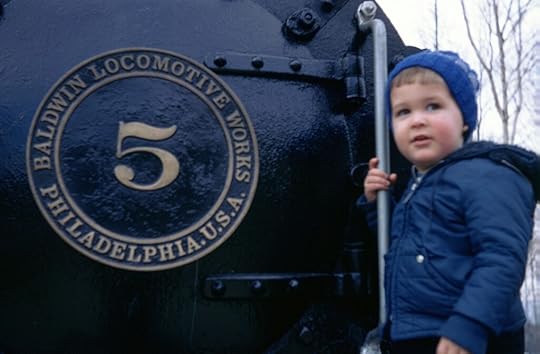
The earliest thing I can remember is being told to stand up at the front of a train for a picture. When I grabbed onto a piece of the train with my bare hand, I remember thinking, “Goddamn, that thing is cold.” Probably not in those exact words.
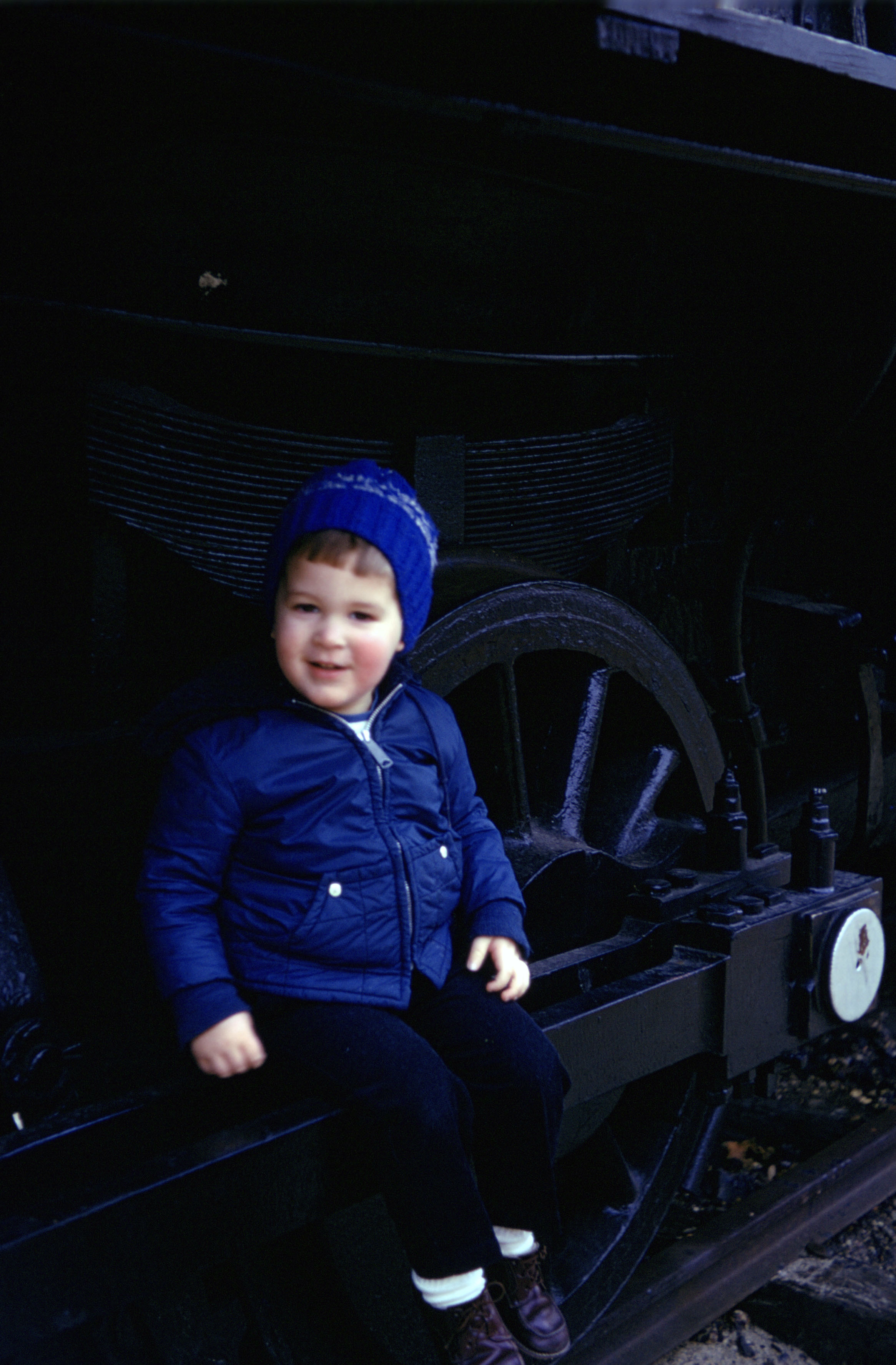
About ten years ago, my mom digitized a bunch of family photos of my sister and me. One of those photos is the exact moment of me on that train. Another photo shows me sitting by one of the drive wheels. Based on the chronological order of all the photos my mom shared, I’d guess I was probably 2 or 3 years old. I was surprised to see that the photo aligned with my memory.
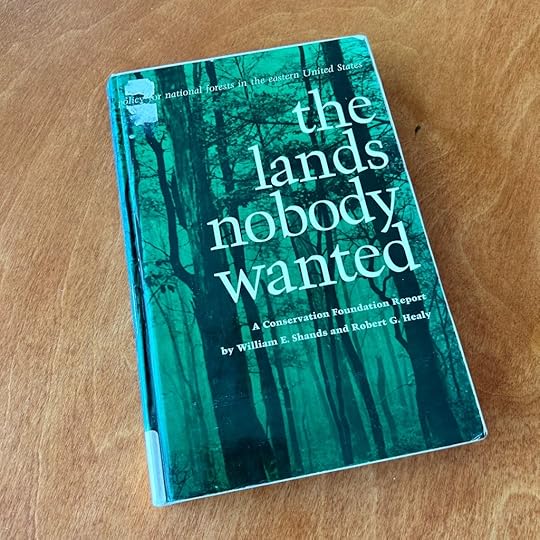
Fast forward to a week ago. I was reading a book written in the 1970’s about land policy suggestions for eastern national forests, as one does. I stumbled onto a picture in the book that showed a man standing in the snow in front of a train. The man is Sherman Adams, a former governor of the state of New Hampshire. He was also White House Chief of Staff under Eisenhower. He started a ski area called Loon Mountain. The train behind him in the picture was a static display at the base of Loon Mountain. The train looked familiar to me.
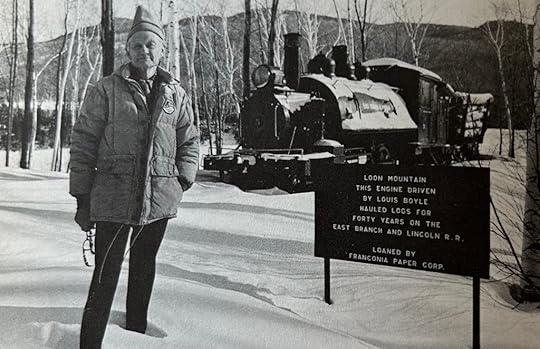
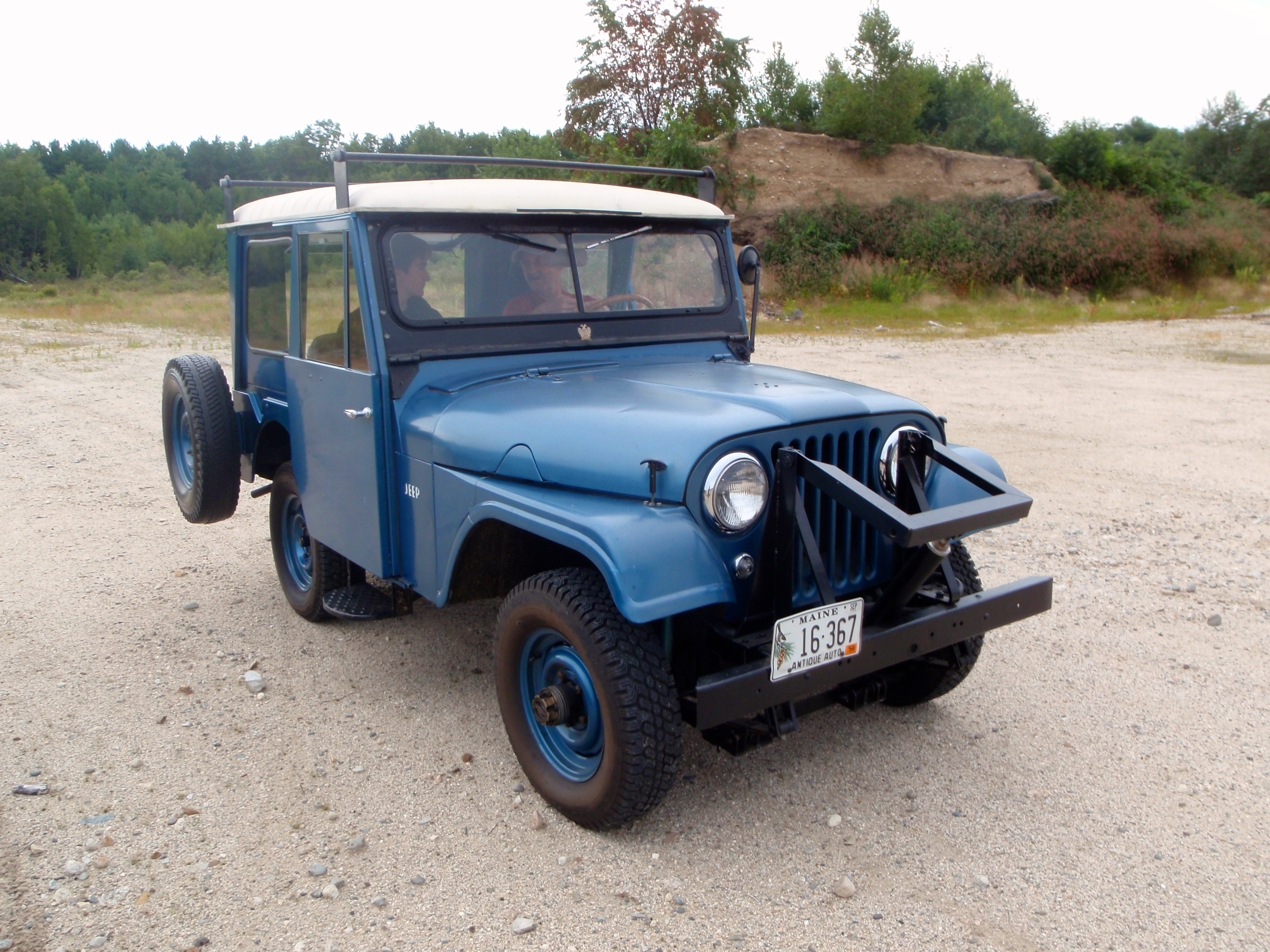
Now, to use a train metaphor, my brain veers onto a siding for a second. Hang on. My dad bought a 1958 Willys Jeep from one of his University of Maine fraternity brothers. He still has it. The brother’s uncle used to go fishing with Sherman Adams in that Jeep. In the 1980’s, when my sister and I went to high school in Plymouth, New Hampshire, my dad was the US Forest Service District Ranger for the Pemigewasset Ranger District of the White Mountain National Forest. My dad had some oversight of Loon Mountain since it was on forest service land in his district. Because of that, he had a lot of chances to see Sherm Adams. My dad recently told me that every time Adams would see him, he’d ask my dad to sell the Jeep to him. My dad would say no. But anyway, here’s my dad teaching Sam how to drive that Jeep in a Chandler Brothers gravel pit in Maine. Sam can say he drove a jeep that Eisenhower’s Chief of Staff used to ride.
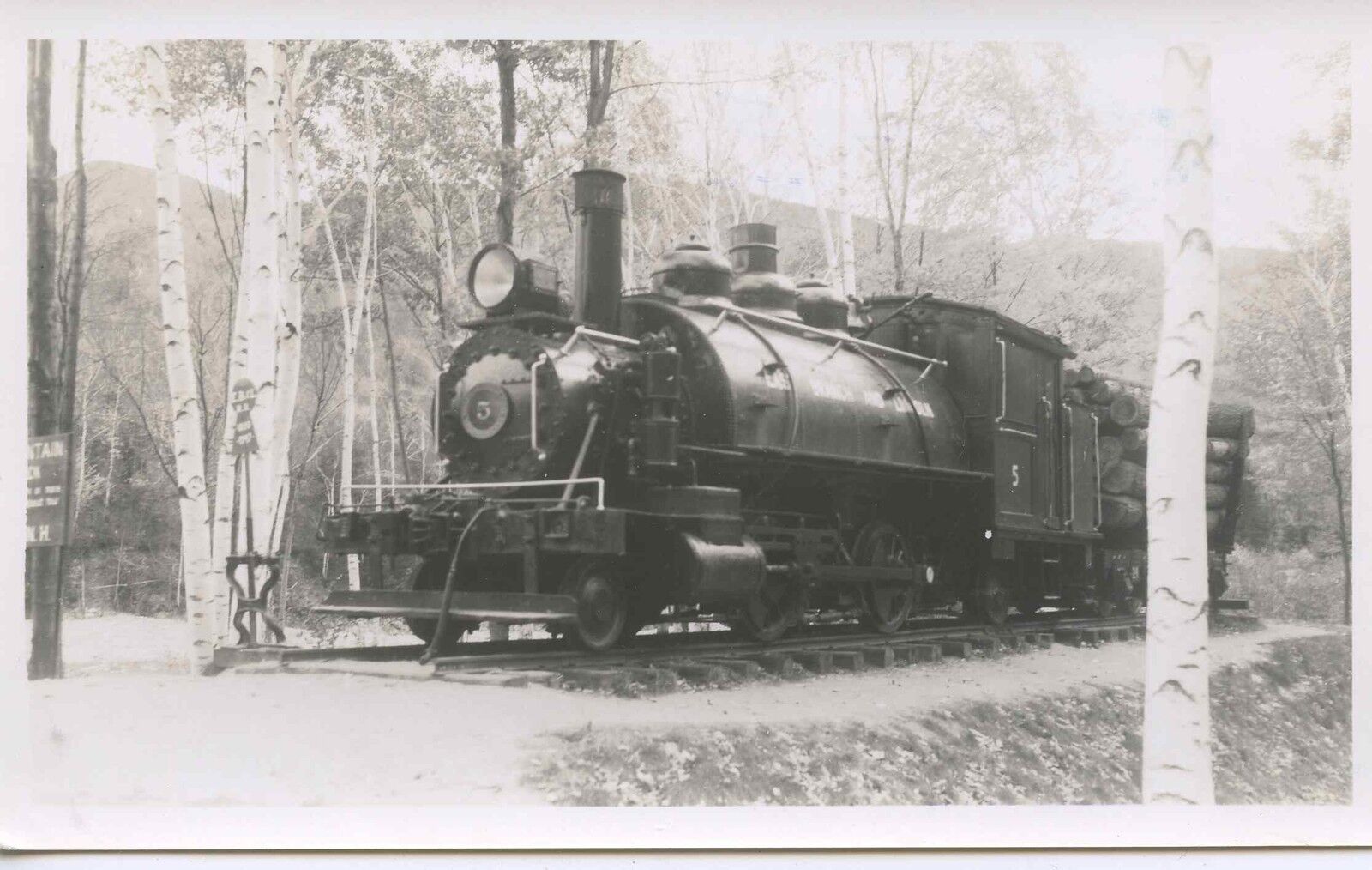
Back to the train. It looked familiar, so I compared it to the one in the photo with me. It looked the same. My parents confirmed they took a picture of me at the foot of Loon Mountain. I dug around the internet to see what I could find about the train. It’s a Baldwin 2-4-2T Locomotive #5, built in Philly in 1906. The 2-4-2 means the wheel arrangement, with the 4 drive wheels in the middle. It was bought new by the J.E. Henry Lumber Company and drove around in the East Branch and Lincoln Railroad system from 1906 to 1946. Then it ran in the rail yard as a switcher until 1969. I found a photo on eBay of the train newly arrived at its static display, right around the time I climbed up front for a picture. It was probably a “new” thing to my folks as we were out on a Sunday drive in 1969 or so.
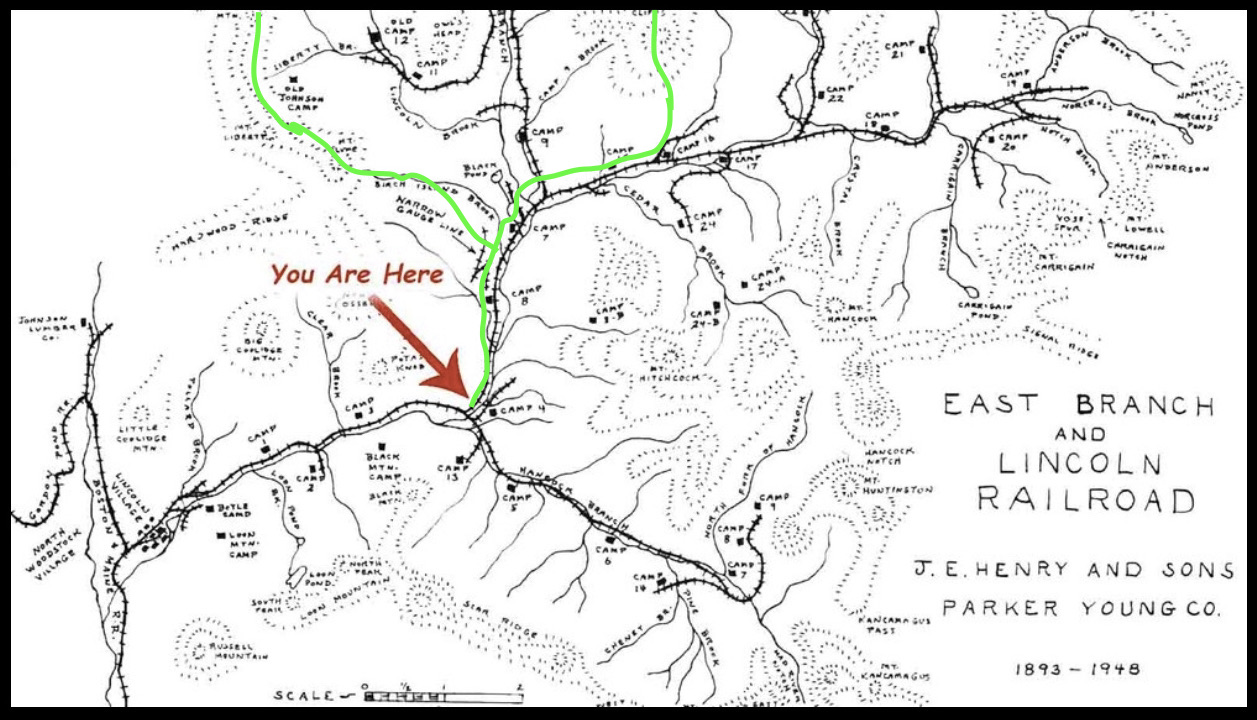
I poked around to see where the train might’ve been on the East Branch and Lincoln Railroad. “East Branch” being the East Branch of the Pemigewasset River. In August of this year, I hiked a 31-mile circuit around this area called the Pemi Loop (short for Pemigewasset). The Lincoln Woods Trail was where I started in the dark and finished my loop in the dark 17 hours later. The trail right by the river is clearly a railroad bed with ties still embedded in the dirt. The map shows the EB & L Railroad was all over the Pemi, including places that are now designated wilderness areas. So, it’s very likely that old Locomotive #5 was working railroad that I ran up a century later. (As yet another aside, my dad just told me that Sherman Adams worked in those logging camps as a young man. So, Sherm, Loco #5, and I all rooted around in the same places.) The green line on the map shows where I went up to the right and came back down on the left. The modern trailhead is the “you are here” arrow.
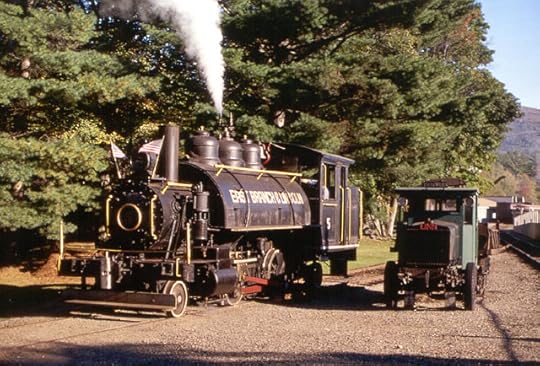
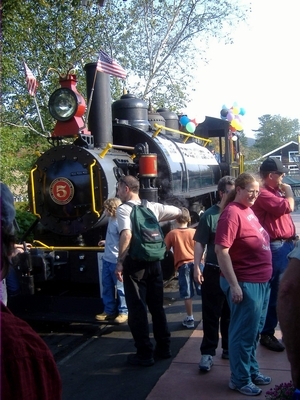
ADHD is a hell of a thing combined with the internet, so I kept digging. It turns out that Clark’s Trading Post just down the road got Locomotive #5 from Loon in 1999 and got it running again as part of their railroad museum. In 2006, they spruced it up even more to celebrate the 100th birthday of the train. After that, I lost the thread about how long it kept running, but it appears to be sitting as a static display again at Clark’s Trading Post. I think these pictures are roughly from 1999, 2006, and the present. Cool to see the train with a head of steam after it sat for 30 years at Loon Mountain so kids like me could have pictures. I even found a video on YouTube of the train running along some track from about 2010.

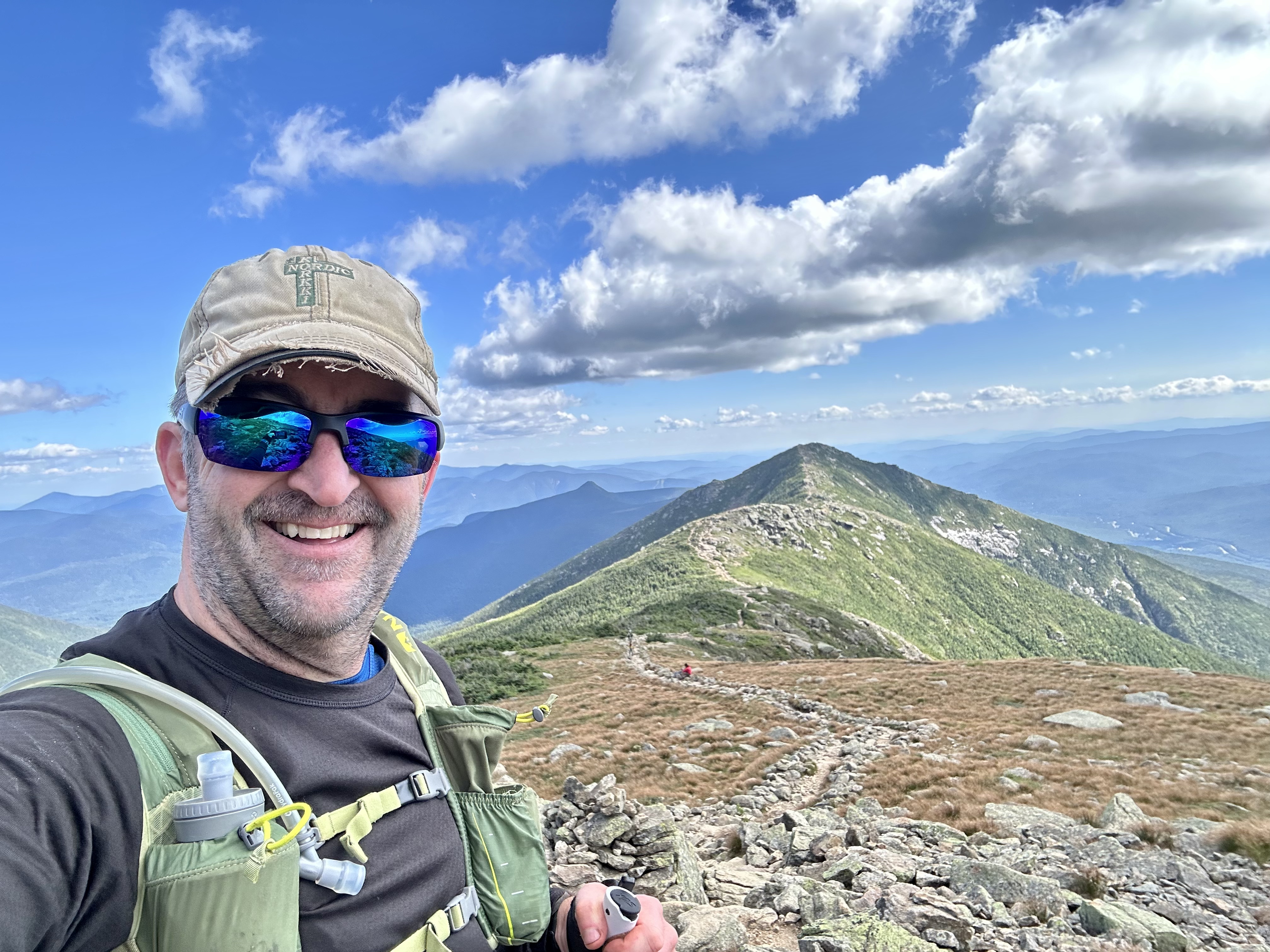
Remember, I only dug into this train about a week ago. Months after I was in New Hampshire climbing 10000′ over 31 miles during a 17 hour hike. I went down the rabbit hole and found out where the train is. I was initially excited because I thought the train was still running. I thought it would be cool that both the train and I had run up the East Branch of the Pemi…and were still running. But the train is static. Even worse, now that I know where the train is, I realize I missed an opportunity. For my hike in August, we stayed exactly one mile away from that train. I could’ve gone and taken a picture reenacting the photo from 54 years ago. Maybe another time. But when the hell will that be?
All because I went back to the state of my birth to hike the Pemi Loop in one day. I got the book, with the photo of Sherm with the train, because I decided to do that hike. This is all just a way for me to remind myself that curiosity is a good thing. And that sometimes, the threads that you follow to their end only announce themselves as whispers. I barely discovered some of these things. If I paid a little less attention or was a little less curious, I wouldn’t have found all these connections. I wouldn’t have my earliest memory with a train looping back five decades later when I ran in that same train’s tracks.
All the connections, all the memories, looping back around on themselves, overlapping each other. Run loops in one place long enough, and you start to realize that the land, the people, and the memories are all connected, separated only by time. The memories loop them all together. Maybe we could all use a little more awareness that we’re all in this together as the time loops back around, over and over.
June 25, 2023
First Lap of the Sun
Short Version
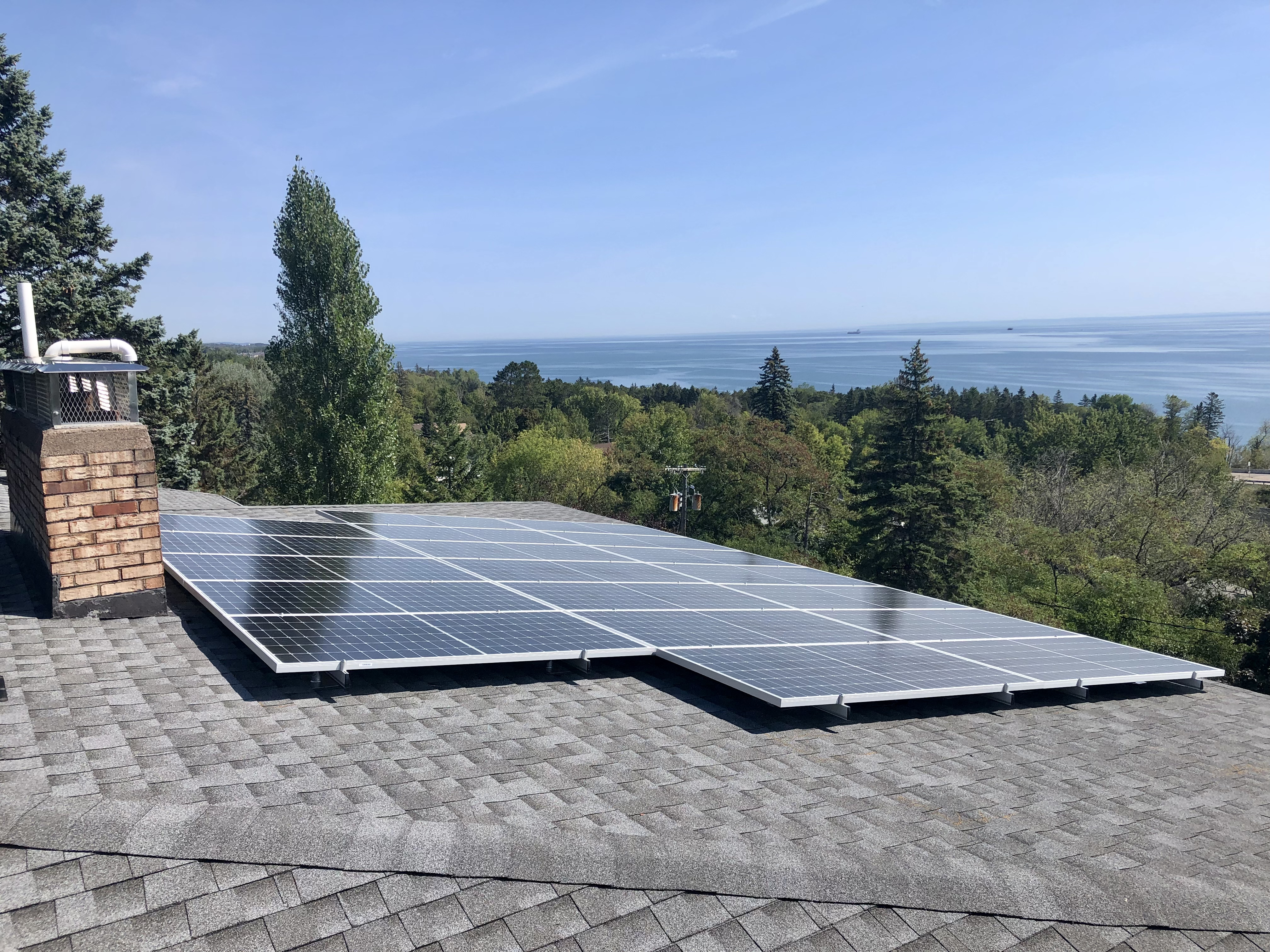
We put solar panels on our house in September, 2021. I just did some math on their first trip around our local star. In the 12 months after installation, we spent $84 dollars on electricity, and that was just from fees. We generated more electricity than we used. During the previous, non-solar year, it cost $1000 for a year of electricity. During this first 12 months, we generated 5.4 MWh (megawatt-hours) of solar energy while using 4.9 MWh. We are in a grid-tied system, so we sold the electricity we generated back to Minnesota Power for the same price that we paid for it. Each month, the extra power we generated was credited to us and then we used those credits as it got darker in the winter.
The website that displays our solar panel performance says that, since installation, we’ve generated a total of 11.7 MWh of electricity. This is supposedly the same as 8.3 tons of CO2 or 140 trees or enough to charge over a million phones. And we’re not even at two full years yet.
I quickly learned there’s nothing quite as fun as sitting with a cup of coffee and watching the meter run backwards when the panels are cooking.
Longer Version
A few years ago, I wrote a magazine article about how the Salmela family down the street installed solar panels on their house. While writing that, I learned two things. First, that there was a federal tax credit for buying solar panels that was due to “sunset” (see what I did there?) in a few years. Stepping down from a 30% credit down to zero over several years. The second thing I learned was that there was a website to calculate your Duluth rooftop’s potential for generating solar energy. We had just moved into our current house in 2018. Using that calculator, I saw that our unobstructed, south-facing roof was pretty ideal for generating power. All this was rattling around in my head. Then some money shook loose in 2021 and we pulled the trigger. I’d like to say the 7kW system we installed was an intelligent choice that corresponded to exactly a year of usage. But we really installed that 19 panel system of that size because it was what we had available to spend. Obviously, there’s a lot of upfront cost and it’s daunting.
So, pretty late in the game in 2021, we joined the Duluth and Arrowhead Solar Coop. This outfit pools its resources and puts out a request for bids from local solar installers. In theory this increases your leverage and you get a better deal due to being part of a large purchase. Better than you could do by yourself. Because we got into that year’s cycle really late, we were too late to get into the rebates that were available that year through Minnesota Power. Wolf Track Energy won the installation bids that year and they installed our system in September, 2021. The whole process with them went really well. They communicate really well and, miracle of miracles, they did what they said they would do and showed up when they said they would. The city had to inspect their work and found a couple small things that needed to be fixed. Wolf Track Energy immediately fixed them. (I mean, I got a Wolf Track baseball cap and coffee cup; I must like them a lot.) Minnesota Power also came to install a meter that allowed the solar power to get metered in and calculated.
Things That Surprised Me
Snow collecting on the panels wasn’t as bad a problem as I thought. My roof has a shallow pitch where the panels are. The application that shows how much electricity the panels are making showed panels as “broken” after it snowed. In reality, they were just the panels that were snow covered. Since we have a cold roof and the panels are raised from that cold roof, the snow collected, but didn’t really adhere. After a snow event, the wind would eventually clean them off without my intervention. Which is good, since the roof is not that easy to get up to. And besides, in the winter, we’re barely creating solar energy, so the snow wasn’t really preventing a whole lot when it was on the panels. I mostly went with avoiding the roof because I’m lazy but also because…
It’s impossible to see our panels from anywhere standing on the ground around our house. So it made it hard to assess what was happening up there.
We made more electricity than we used. My original estimates were that we’d cover about 10 months of electricity with the panels. It was a surprise to see that we had a surplus. But it makes more sense when two things are considered. First, the solar year was just 3 of us in the house, and only two of us for about 3 months of that. We used 4.9 MWh. The previous non-solar year was pandemic time with all four of us in the house for the whole year and we used 7.8 MWh. With a full house of people, generating 5.4 MWh of solar would’ve only covered about 8 months. So, my solar is great this year, as empty-nesters, but probably wouldn’t carry all the freight with a full-house.
The time for the panels to “pay for themselves” is longer than we originally thought. Payback wasn’t necessarily my goal, but after looking at the savings ($916 saved vs. the previous year of non-solar) our costs would take over 16 years to pay for themselves. When we first installed our system, the estimate was around 12 years.
The Inflation Reduction Act boosted the Federal Tax Credit for solar panels back up to 30%. So, if you were inclined to get some solar panels, now’s as good a time as it has been with regard to getting some reimbursement.
I learned that electricity price per kWh has gone up dramatically recently. My sample non-solar year was about $0.068/kWh. The solar year was $0.103/kWh. I don’t know why the costs increased. Even though I used 38% less electricity in the solar year, if we didn’t have panels, the annual price still would’ve been close to $1000.
While digging around I learned that Minnesota is making big strides as a state with renewable energy. 29% of Minnesota’s in-state electricity is generated by renewable resources. I was also surprised to learn that the two nuclear power plants in Minnesota generate a lot of our electricity. I had forgotten they even existed.
Things I Still Don’t Understand
I filled out my 2021 taxes correctly to get a 26% tax credit for the $20k I spent on panels. The IRS said I did it wrong. I got them to agree with me that I did it right. But now they say, they don’t believe me and I have to send them receipts. Which I did. So I wait for a $5000+ refund from the IRS over a year after I filed. Government, amirite?
My system plateaus in real-time at 5.5kW. I have a 7kW system. I once read a reasonable explanation for why my 7kW system tops out at 5.5kW on a sunny day, but I haven’t been able to find it again.
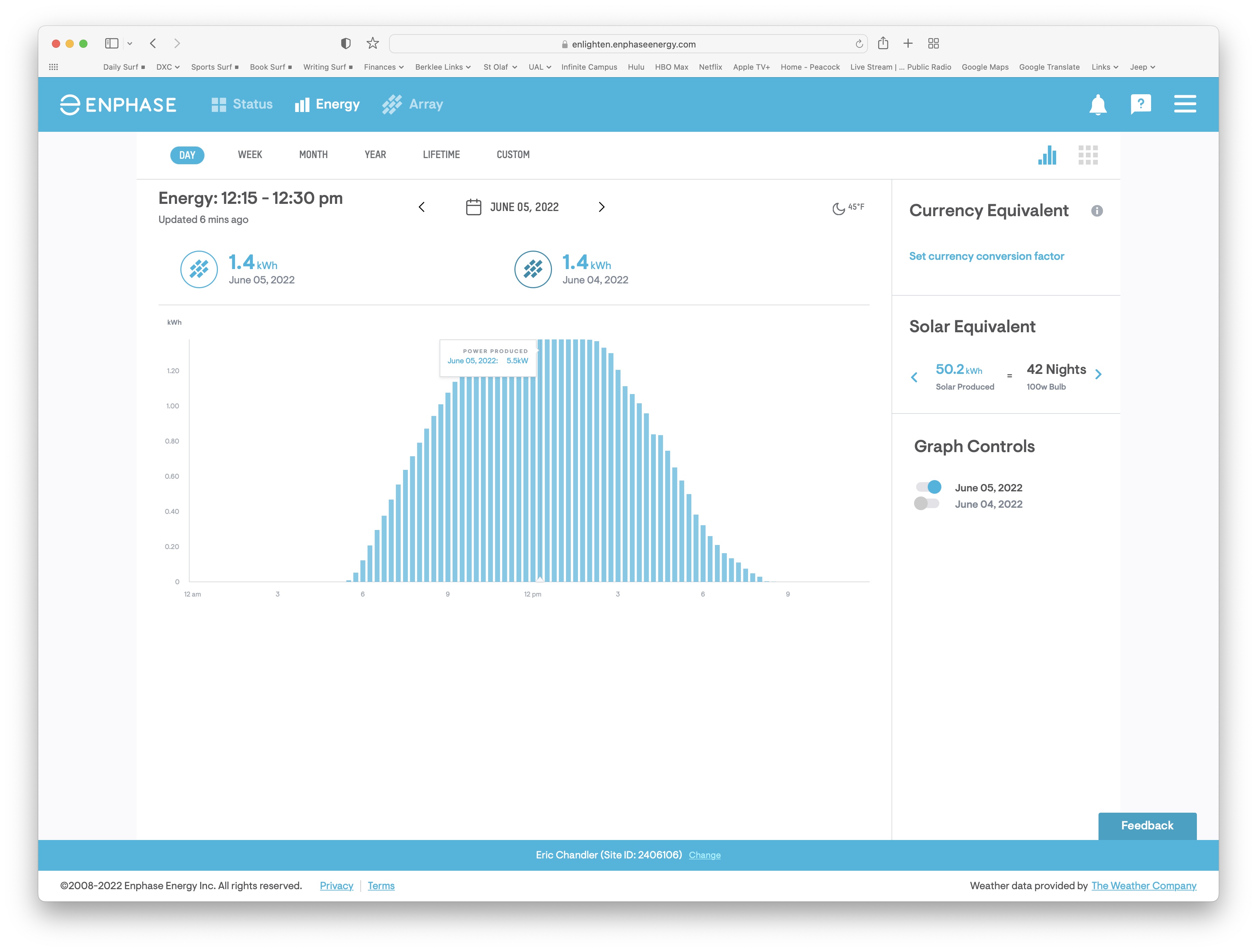 My system plateaus at 5.5kW on a sunny day when it’s a 7.7kW system. Who knew?
I heard a rumor that I can’t get more credit for electricity than I use in a 12-month period. But I did. (Don’t tell anybody.) I’ve never been able to find that in writing. I don’t really want to ask anybody, since I apparently got away with it once. My folks in Maine signed paperwork for their solar system that makes that explicit; they won’t be able to make more than they use in a year. But me? I guess I’m a solar outlaw.
The Upshot
This whole solar panel experience has an unexpected outcome. I tend toward the pessimistic and cynical. But at a certain point, adopting the “everybody is stupid and everything sucks” attitude all the time is a copout. This solar panel purchase has changed my attitude. Just because I can’t do everything, doesn’t mean I have to do nothing.
I mean, I’ve been burning dinosaurs for a living since 1989. I burned tens of thousands of pounds of gas just today. It’s going to be impossible for me to “catch up.” But that’s still not a reason to do nothing. I just bought an electric lawnmower to use some of my solar surplus. It’s lighter and quieter. I’m thinking about a heat pump instead of a natural gas boiler. I joined Protect Our Winters. This attitude change has even bled over into other things. I came up with my Big Stupid charity run for two non-profits because I figured I could do something instead of nothing.
I mean, I’m still a grouch. But I’d rather be a grouch that goes down swinging instead of one who just sits on a barstool and complains.
May 2, 2023
Shmo’s Big Stupid
In August, I’m going to attempt the Pemi Loop in the White Mountain National Forest in New Hampshire. It’s a 31-mile trail with over 9000′ of climbing and I plan to do it in one (long!) day.
I’m dedicating this attempt to two non-profits that support military veterans. Please consider a donation to one or both of the organizations listed here:
Minnesota Assistance Council for Veterans. Their mission is to end veteran homelessness in Minnesota. Donate by clicking HERE.
Veterans On The 48. Their mission is getting more veterans outside and onto the trails to promote healthy lifestyles both physically and mentally. Donate by clicking HERE.
Your money goes directly to the non-profit. I can see what money goes to MACV because of the way the donation page is set up. I can’t see what happens for Veterans On The 48. So, I’d ask a favor. If you donate to the Veterans On The 48, please email me (ShmoF16@msn.com) how much you gave them so I can keep track of what impact you are making there.
Thank you for your support!
If you’re a glutton for punishment, I’ve got a bunch of words below the map about why I’m calling this project Shmo’s Big Stupid and a bunch of other thoughts.
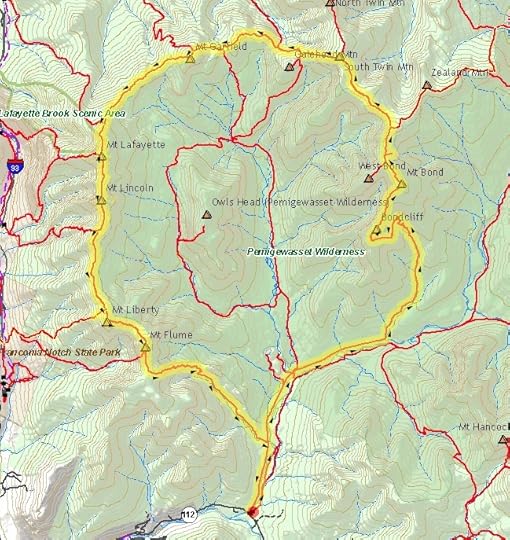
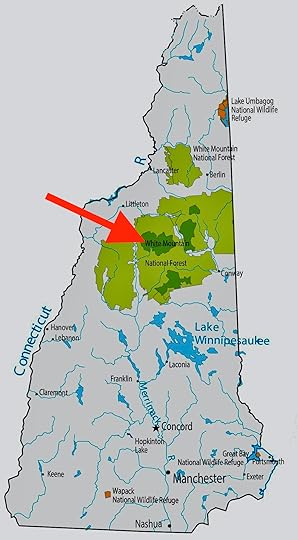
“Why these non-profits?“
Well, in a nutshell, I want to “Get veterans indoors and get veterans outdoors.”
As far as “getting veterans indoors,” I see homeless people everywhere I go as an airline pilot. But you don’t have to leave Duluth to see people who are unhoused. Pretty much every summer, if you run along the Superior Hiking Trail in the Point of Rocks, you’ll pass through a whole community of people sleeping outside. Now, there’s a lot of bad news in the world. Sometimes it’s overwhelming and just paralyzes me. I can’t fix all of it, so I do nothing. At a certain point, I realized I can’t do everything but maybe I can do something. In January 2020 there were an estimated 37,252 homeless veterans, according to the U.S. Department of Housing and Urban Development. Minnesota does better than most states with around 280 homeless veterans here. I know some guys that work for MACV and they are within striking distance of getting that number to zero. I don’t think people who served their country should have to live in a tent. So, I decided to point some money toward them.
As far as “getting veterans outdoors,” I believe that healthy, outdoor activities are good for you no matter who you are. But there is some research that shows it’s specifically good for veterans. I was born in Littleton, NH, just northwest of the White Mountains. When I was in high school as a kid, my dad and I hiked most of the 48 Four Thousand Footers in the White Mountains together. I finished the Four Thousand Footer list in 1990. A few years ago, I heard about the new Veterans On The 48 organization and their group hikes for veterans. I grew up in those peaks and think that this non-profit has a great purpose in one of my favorite places in the world.
“Why are you doing this, Shmo, you big dummy?”
Three reasons. First, this is the continuation of several years of big outdoor adventures that I started during the pandemic.
They canceled Grandma’s Marathon in June of 2020 and I was kind of cut adrift. I always do the Birkie ski marathon every year and Grandma’s every June. Now one of my annual milestones was gone. I need a goal out in front of me every four months or so. Not because I’m especially into the event itself. Because knowing that event is out there gets me out the door for hundreds of days beforehand. The process that is spurred by some kind of event is what I actually get out of the event. The process is what ends up being important.
So, in 2020 with no public events allowed, I decided to backpack the 65-mile Border Route Trail solo with Leo my dog. That went well so I decided to run 53k because it was my 53rd birthday. I trained all summer, including the backpacking trip, and ran two 16.5 mile loops starting and finishing in my driveway. In 2021, I started sniffing around for a 54k run for my 54th birthday. I got a brainstorm from going down internet rabbit holes. I would run from the Minnesota Low Point (Lake Superior) to the Minnesota High Point (Eagle Mountain)! I thought it was possible I’d be the first guy to do it. I scoped out an 18.2 mile route. Then I went to a website for Fastest Known Times and learned that a guy had done this very thing about 3 months before I came up with it. Dammit. But hey, 18 miles wasn’t going to be enough to get me 54k for my 54th birthday. But what if I ran up and back? That would be over 54k and I bet there wouldn’t be anybody dumb enough to do that. I went 37 miles in just under 10 hours. And now, I hold the FKT for the Low/High/Low variation in Minnesota. I did the Eagle Mountain part with Shelley and Grace. I can tell you, that was one of the coolest days I’ve ever spent outside. Now, my FKT is simply because I was dumb enough to do it first. I ain’t fast. But hey, I created a project, trained for months and it worked. And it was a blast.
So I came out of that year with ideas. Around that time, I read Jessie Diggins book Brave Enough. In it, she describes something she does each year: The Big Stupid. She says it’s “an adventure that really isn’t the smartest from a training perspective for my sport, but is very necessary in order to feed my soul and sense of adventure.” Without realizing it, I was coming up with my own Big Stupid ideas for several years. Big dumb ideas that spurred me into a months-long process outdoors to prep for some big adventure outside. Not very sophisticated, but it works for me. I get into a really fun headspace when I think about what to do next. Even more fun between the ears when I settle on an idea and start figuring out how to get ready. So, that’s why I’m calling this project Shmo’s Big Stupid. Thanks, Jessie.
My second reason for doing the Pemi Loop is the process that goes into it beforehand. Even if I never did this project, my summer is looking pretty monstrous to get ready. I’m running a trail ultramarathon: the Superior Spring Trail Race 50k on May 20 on the Superior Hiking Trail. Then I’m running Grandma’s Marathon in June. Then in July, I’m going to tackle a big one: the Voyageur. A 50-mile trail ultra. I’ve done the Eugene Curnow three times, which is the 25-mile version from the zoo to Carlton. So I’m familiar with the trail. I figured, Hey, I can run 37 miles, why not try 50 miles? If I can come out of this summer healthy, I figure I can go do the 50k Pemi Loop with a fair amount of confidence.
My third reason, is because I can. Someday, I would kill to be able to do something this stupid.
“How’d you get this idea?”
A few years ago, I wrote an essay about maps. In it, I looked into the history of the Appalachian Mountain Club maps that guided me up those 48 Four Thousand Footers. I learned that my 1987 list of peaks was now obsolete. In 1998, the AMC went from the manual maps to an all digital map process. During that switch, they learned that Wildcat E was shorter than they thought. So, Wildcat E got demoted and Wildcat D got promoted. So, the list I completed in 1990 was retroactively incomplete! My OCD took over. I came up with an idea to go back east and climb Wildcat D to make sure I’m actually complete with the current list of 48 mountains. This is something I may try to do while I’m back east doing the Pemi Loop, hopefully with the whole family.
While I was scouring the internet about Wildcat D and the Four Thousand Footers, I ran into something called a White Mountains Direttisima: 240-mile direct route that’s the shortest way to climb all 48 in one shot. I got super excited about this. The main stumbling block was finding enough time to do it. I figured I’d need 45 days (driving from MN to bring my gear). I’d have to beg for time off from work, even more than the vacation I already burned. I’d split the 240 miles into three ten-day chunks with a couple days resupplying at my parents’ house in Maine in between. With a few days of family vacation in Maine beforehand. But ultimately, I’d be 30 days in the hills by myself. I was recently eating dinner in a restaurant in Boston and sat next to my dad. I explained this Big Stupid idea. He said, “That’s really dumb.” Like, not in a cool way. I took a step back and reevaluated this 6-week long project and agreed. Too big. Too dumb. Too much time alone instead of with family. So, I scaled back to a one-day suffer-fest on the Pemi Loop. I think that’ll be plenty.
Anyway…
I’m excited to go back to the land of Live Free or Die. My dad started his Forest Service career on the White Mountain National Forest. I was born right there in Littleton. We hiked all over there. My dad was the District Ranger on the Pemigewasset Ranger District of the WMNF. So, I’ll be running a loop around the Pemi Wilderness, the largest wilderness area east of the Mississippi, which used to be in his district. It’ll be kind of like going home. If you’re really bored, you can read this thing I wrote several years ago called “Good Views” about Owl’s Head, which is in the center of that loop. Kind of gets at how the mountains mean a lot to me there. I’ll be sharing my process and the Pemi Loop itself on social media. You can find those links at my About page. Please consider a donation to the two non-profits at the top of the post.
I’ll close with a picture of me on Mt. Garfield around 1983. My dad’s taking the picture looking over me to Owl’s Head on the left and Flume in the distance. I’ll be running past this spot in a few months, 40 years after the picture was taken. Kind of cool.

September 6, 2022
Take a Whiff: A Review of The Chicago East India Company by Christopher Lyke
Take a Whiff:
A Review of The Chicago East India Company by Christopher Lyke

When you finish reading The Chicago East India Company by Christopher Lyke, you’ll know something about the author: “He’d worked with his back, and fought,…” Then you’ll know that people who go to war split in two. One part physically returns home and tries to rejoin daily American life. The other part is lodged in their brain and bleeds over into every thought and action. Halloween in the neighborhood with the kids contains echoes of a time in Afghanistan. In less than a hundred pages, Lyke creates a lyrical drumbeat to help you learn—help you feel—what that post-war headspace is like. The last chapter is masterful and replicates the rhythm of the whole project in miniature. If you aren’t changed when you close this book filled with concentrated, seething energy, I feel sorry for you.
 Christopher Lyke
Ford Madox Ford, famous English novelist and World War I veteran, came up with a term for this mental split. In his book It Was the Nightingale, Ford called this species of man homo duplex: “A poor fellow whose body is tied in one place, but whose mind and personality brood eternally over another distant locality.” Lyke drags you from one end of that spectrum to the other. From teaching school in Chicago to a night patrol in the mountains of Afghanistan. But he really sings to me when he describes life at home in the United States when it’s interwoven with the memory of something overseas. While he’s getting chewed out by a school administrator in Chicago, Lyke writes:
He stared at me for a while without looking away. It was another silly game he must have learned at a management seminar. A year before, people had been trying to kill me. These tricks meant nothing.
Here, Lyke nails something I think all the time. In my civilian life, some potential bad thing might seem possible, but then I would think to myself: What’re they going to do? Something worse than shaving my head and sending me to Afghanistan? Been there, done that.
Lyke dramatically captures how one place lives in your brain while your body lives in another. And in those moments, his writing shows how combat throws a different light on every aspect of your civilian life in the aftermath. Sometimes big, sometimes small, but ever-present.
Many of the chapters are short and entirely about life in the US, but there’s that one-line nugget that demonstrates what people carry with them after war. Sometimes, Lyke shares a dark mood or a sense of exhaustion that isn’t explicitly a result of deploying, but could be. This mimics the genuine uncertainty I sometimes have about what’s a result of combat time and what might just be part of growing older. In this way, this book should be relatable to readers who “soldier on” in their civilian jobs, even though they’ve never been overseas.
There’s a lot of discussion for many years now about the growing “civil-military gap.” The widening chasm between those who serve and civilians who don’t. Storytelling is a way to bridge that gap, and to me, it seems natural that the onus is on the military veterans to tell those stories. But it also requires readers who are willing to be made uncomfortable. It’s kind of a hard sell: Read my book because it’ll make you squirm. Still, it’s why I recommend Lyke’s book. It’s powerful, somewhat angry, but short enough to digest. The parts about life in the big city in a job that you need, but don’t necessarily want, should hook anybody. The way the chapters alternate between the US and the war are spaced out in a rhythm that brings the reader along. That rhythm comes to a crescendo in the last chapter and, dear reader, you’re going to get agitated. And that’s the point.
In Sebastian Junger’s book, Tribe, he proposes a way for communities to welcome home veterans. Lyke’s work is a concentrated version of this idea for a reader who is willing to commit:
…if contemporary America doesn’t develop ways to publicly confront the emotional consequences of war those consequences will continue to burn a hole through the vets themselves… …Offer veterans all over the country the use of their town hall every Veteran’s Day to speak freely about their experience at war… A community ceremony like that would finally return the experience of war to our entire nation, rather than just leaving it to the people who fought.
I don’t know how much of Lyke’s book is autobiographical. Some chapters refer to the main character in the third person, while other stories are told in first person. I suppose I could make some guesses about what’s nonfiction and what might be fictional based on the point of view. I’m reminded of the line from Tim O’Brien’s The Things They Carried that’s almost like a Zen koan: “You can tell a true war story by the questions you ask. Somebody tells a story, let’s say, and afterward you ask, “Is it true?” and if the answer matters, you’ve got your answer.”
For the longest time, the answer did matter to me, and still does. I believe a war story should be true. But now, I have my own litmus test for truth and it’s one I learned from Jerad W. Alexander in a piece he wrote called “On Telling War Stories”:
The subject has a tendency to spray a social gathering with what seems to be an ultrafine shit-mist,…
Lyke’s stories read like the truth to me because I can smell that mist. Even though I was overhead the battlefield instead of on the ground. Even though I’ve never been a big city schoolteacher. I want to shove a copy of The Chicago East India Company into a reader’s hands and say, “Take a whiff.”
***
Eric Chandler is the author of Kekekabic (Finishing Line Press, 2022) and Hugging This Rock (Middle West Press, 2017)
April 8, 2022
Seeing the Elephant

A Review of So Frag & So Bold: Short Poems, Aphorisms & Other Wartime Fun (Middle West Press, 2021) by Randy Brown
Reviewed by Eric Chandler
Randy Brown’s latest chapbook, So Frag & So Bold: Short Poems, Aphorisms & Other Wartime Fun (Middle West Press, 2021), is small and explosive. That’s why the cover image of a combination heart/grenade is so apt. Grenades are also small and explosive.
The “Wartime Fun” comment in the title might seem odd, but humor is the sugar that makes the medicine go down. It’s hard to look directly at war. But if a poem is funny, you might be able to hang on long enough to hear what the poet is trying to say. The title also says these are short poems. True, but the words gained power for me surrounded by white space.
I read somewhere that laughter happens when your brain gets surprised. When I read “Morning Prayer” I laughed because, my goodness, my wife and I love a cup of joe:
Coffee?
Thank God.
A short poem, for sure. There’s even a poem that ponders just how short a poem can be. Another questions what poetry is. The chapbook title comes from Brown’s parody of a William Carlos Williams poem called “This Is Just to Say.” Williams’ plums in the ice box become grenades in Brown’s poem. These poems might be a little “inside baseball,” requiring some familiarity with writing and poetry, but they still made me smirk.
Still, this is mostly a collection that ponders war. Brown is self-aware when it comes to revisiting one’s experiences in the military. Some pieces are almost meta-poetry. Writing about war writing. In one piece called “a poem” he writes:
You don’t have to make everything
a poem, she said.
Or about
being a Veteran.
And in his “The New Sherpatudes,” his personal list of aphorisms and nuggets of wisdom, he ends with this one-liner: Nostalgia is a disease, suffered by old soldiers. I think it’s too strong to say that reminiscing about wartime experiences is a disease. We tell stories, after all. It’s intensely human to share our stories.
We tell those stories in different ways, which Brown covers nicely in a piece titled “blind men & veterans.” Seeing combat has been called “seeing the elephant.” He deftly combines that phrase with the old fable about several blind men describing an elephant differently based on which part of the animal they were each touching. Brown got me nodding when I read this piece:
we each describe
seeing the elephant
differently
As for me, I feel guilty sometimes about continuing to dwell on wartime events in my life. My disease of nostalgia. Brown dropped a truth grenade on me in a piece called “on war poetry.” Not funny, but explosive. It made me realize it’s okay to revisit some of the most important moments of my past:
we write the war /
the war writes us
even the ones
who got away clean
One time, I was dangling my toes off a dock into a Minnesota lake when a bald eagle swooped down and snagged a fish out of the calm water ten feet in front of me. The surprise of such an improbable occurrence hit my brain and I let out an explosive “HA!” like a grenade. Brown lobs many surprises that powerful, so go get yourself this chapbook. It really is So Frag & So Bold.