Iain Ballantyne's Blog
October 4, 2021
A ship for the ages: new expanded paperback edition of ‘HMS London’
Delighted to share for the first time the cover of the forthcoming paperback edition of my book ‘H.M.S. London’, published by Pen and Sword Books, which has revised and fresh words, plus new and upgraded imagery.
It was originally published in 2003, but a lot has happened since then, yielding developments in the ship’s past narrative while a decision to build a new HMS London means the story stretches into the future.
The action-packed tale of warships named London in the Royal Navy spans centur...


July 18, 2020
U-Boats versus escorts in the Battle of the Atlantic
‘The Deadly Trade’ takes readers on an epic voyage through submarine warfare, including how U-boats in two world wars tried to achieve victory, first for the Kaiser and 20 years later for Adolf Hitler.
The action-packed narrative includes bitterly contested Battle of the Atlantic convoy fights of WW2. ‘The Deadly Trade’ tells the stories of Britain’s formidable submarine-killing escort group leaders, including Frederic ‘Johnny’ Walker, Donald Macintyre...
June 5, 2020
D-Day Navies Pt3: Desperate bid to sink a hated battleship
RoIf conventional U-boats could not get right in among the invasion armada then a do-or-die naval commando unit of the Kriegsmarine might and a top target was the 35,000 tons British battleship HMS Rodney.
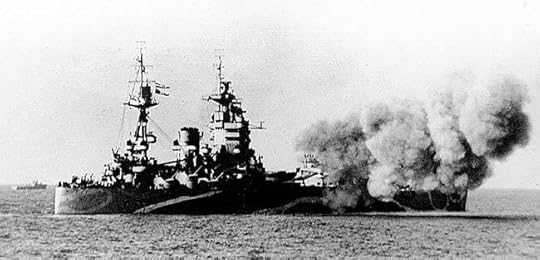
HMS Rodney bombards enemy units in Normandy, June 1944, delivering what the British Army hailed a ‘Victory Salvo’. Photo: Strathdee Collection.
She was often to be found at anchor off the beaches during June and July 1944. German panzer divisions ashore in Normandy especially hated Rodney, for...
Part three: Struggle at sea off Normandy
If conventional U-boats could not get right in among the invasion armada then a do-or-die naval commando unit of the Kriegsmarine might and a top target was the 35,000 tons British battleship HMS Rodney.
HMS Rodney bombards enemy units in Normandy, June 1944, delivering what the British Army hailed a ‘Victory Salvo’. Photo: Strathdee Collection.
She was often to be found at anchor off the beaches during June and July 1944. German panzer divisions ashore...
D-Day Navies Pt2: HMS Rodney’s accidental bombardment
Fulfilling her role of heavyweight bombardment reserve, the battleship HMS Rodney trailed behind the first wave of invasion shipping. She was to hang back during D-Day and conduct a bombardment only if called in by assault force commanders. The way things turned out, however, her mighty 16-inch guns did roar after all, though not quite in the fashion anticipated.
The Germans had laid extensive minefields off the Normandy coast and channels had been swept clear at both the eastern and western end...
Part two: Struggle at sea off Normandy
Fulfilling her role of heavyweight bombardment reserve, the battleship HMS Rodney trailed behind the first wave of invasion shipping. She was to hang back during D-Day and conduct a bombardment only if called in by assault force commanders. The way things turned out, however, her mighty 16-inch guns did roar after all, though not quite in the fashion anticipated.
The Germans had laid extensive minefields off the Normandy coast and channels had been swept...
D-Day Navies Pt1: Blasting the Atlantic Wall
The tendency among some accounts of the fighting that followed the D-Day invasion itself is to regard the struggle offshore as won after the troops got beyond the beaches. It does not reflect the fact that hundreds of vessels were engaged in providing a wide variety of support and in combat for some time afterwards.
They delivered supplies such as food and fuel, plus more troops and equipment while a variety of warships carried out bombardments of enemy formations inland and battered German coas...
Part one: Struggle at sea off Normandy
The tendency among some accounts of the fighting that followed the D-Day invasion itself is to regard the struggle offshore as won after the troops got beyond the beaches. It does not reflect the fact that hundreds of vessels were engaged in providing a wide variety of support -and engaged in combat for some time afterwards.
They delivered supplies such as food and fuel, plus more troops and equipment while a variety of warships carried out bomb...
May 26, 2020
‘Bismarck was being mercilessly pounded’
As the sun peeped over the eastern horizon on 27 May 1941, to reveal a storm-tossed seascape, from his upper deck position aboard HMS Cossack, teenage rating Ken Robinson scanned his surroundings.
Aboard Ken’s ship and other destroyers in the 4th Flotilla, tired, red-rimmed eyes studied the horizon, trying to sight the enemy, who must be nearby but was not yet visible. This was most likely, so the destroyer men thought, because Bismarck was lurking in a squall and preparing to blow them out of w...
‘Bismarck had to be stopped’
As the Swordfish torpedo-bombers headed back to the carrier HMS Ark Royal on the afternoon of 26 May 1941 they came across some other warships, which might well be the enemy.
The attention of formation leader, Lieutenant Commander James Stewart-Moore, was drawn to one of his own aircraft, which was equipped with air search radar. Via semaphore flags, a young officer in its crew indicated to his leader that a contact had been picked up, around ten miles away.
Destroyers came into view below, whi...