Jourdan Cameron's Blog
November 30, 2015
Introducing: Nausicaa 100 Pages at a Time
It’s no secret that I’m a huge fan of Nausicaä of the Valley of the Wind– I’m a big fan of the movie, and the manga is my all-time favorite piece of science fiction. For a bit of background, Hayao Miyazaki, author of the manga and director of its film adaptation, began work on the manga in 1982 after he tried (and failed) to create a film adaptation of Richard Corben’s Rowlf. Originally serialized in the magazine Animage, Miyazaki wasn’t initially planning to have the manga adapted for film, but the manga proved successful and the talent behind the film adaptation eventually led to the formation of the legendary Studio Ghibli, the animation house responsible for some of the greatest movies of all time. The video embedded below perfectly encapsulates why Miyazaki’s films have captivated and inspired millions, it’s well worth a watch.
If you’d like to watch Miyazaki’s films, a great collection is now available on Amazon if you’re looking to jump right in– today, however, will not be so much a celebration of Mr. Miyazaki’s filmography; rather, it’s the first of many examinations of his manga masterpiece, Nausicaä of the Valley of the Wind. Seeing as it’s the end of #RRSciFiMonth, it’s the perfect time to debut this ongoing series, Nausicaä 100 Pages at a Time. I’ll be examining the story, themes, characters and other elements of the manga one hundred pages at a time.
Mind you, many wonderful stories have influenced Miyazaki’s Nausicaä of the Valley of the Wind including Tolkien’s Lord of the Rings, Homer’s Odyssey and The Lady Who Loved Insects (also known as The Princess Who Loved Insects) from a 12th century collection of stories from Heian era Japan. While I’ll try to tie in the influences as best I can, I may have to produce a second edition of these essays at some point in the future with more examination of the influences. For now, however, it’s time to examine the first hundred pages of Nausicaä. I’m going to say it now- everything’s going to be spoiled. If you don’t own the manga, I recommend you buy it and read along with me. If you’ve read it before but don’t remember very much, I’ll provide a synopsis- if you’re reading along, you can skip reading my synopsis and jump down to the Examination section.
Pages 1-100: The Beginning After the End
Synopsis: The manga opens with an explanation of what occurred long ago- that industrial civilization had peaked and abruptly fallen by fire, but in spite of it, mankind lived on- but the “sophisticated technological superstructure” had been lost- a fantastic way of prefacing that this is a piece of postapocalyptic fiction; a bit more exposition reveals that the world has been horribly polluted, toxic bacteria have a foothold in the forests and that the little kingdom of five hundred- the Valley of the Wind- is largely spared from the world’s poisons by a stiff ocean breeze.

Image courtesy of Team Ghibliink: http://www.nausicaa.net/miyazaki/manga/nausicaasamples.html
The titular protagonist, Nausicaä, is introduced as she’s exploring the toxic jungle- having discovered a freshly molted ohmu shell, she recognizes its value and, for a while, relaxes upon it- the peace of the moment is broken by the distressed cries of giant insects, whose voices only our protagonist can hear. She discovers that a whole swarm of them- including a massive, raging ohmu- is pursuing somebody. Using harmless strobe grenades, she pacifies the insects and sends them back to the forest. It’s soon revealed that the person in trouble was her beloved teacher, Master Yupa Miralda, expert swordsman and adventurer, that the Valley of the Wind is on the brink of war, and that Nausicaä’s father, King Jhil, is too sick to fight due to poisoning from the toxic jungle.
It’s later revealed that Nausicaä had ten siblings who didn’t survive childhood, and that King Jhil regrets not having a son as an heir- but also that he believes that Nausicaä would make a fine chieftain.
Nausicaä then goes on a trip with her uncle Mito in the gunship- it’s revealed that this flying vessel was built over a hundred years ago, and that nobody has the technology- or knowledge- to build them anew. Nausicaä once again hears the cries of distressed insects in her mind and finds that they’re attacking a flying barge- and to her horror, she discovers that a refugee ship it’s filled with women and children. In spite of her best efforts to stave off the insects, the ship crashed, killing everybody on board. Running into the wreckage, Nausicaä discovers Rastel (named Lastelle in the English dub of the film adaptation), a dying princess of Pejitei, who reveals that their allies from Torumekia were the ones who attacked. Before she dies, she gives Nausicaä what appears to be some sort of royal bauble meant to be given to her brother.
The Torumekians eventually arrive at the crash site, and upon discovering that Rastel had been given a burial by somebody from the Valley of the Wind, the Torumekians head there- disregarding proper procedure on landing and nearly inciting a war. The sluglike creatures owned by the worm handlers smell the royal plot device on Nausicaä- what ensues is a brief duel between her and the Torumekian soldiers that is broken up by Master Yupa, who reminds everybody of the fragility of the alliance between the Valley of the Wind and Torumekia, thus convincing the Torumekians to retreat.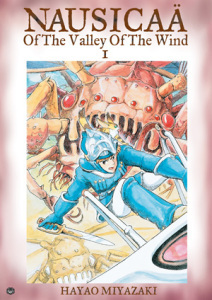
It’s then revealed that the Torumekian forces are in possession of a god warrior, but they’re short a control stone- the royal bauble that’s kept in the Valley of the Wind- meanwhile in the valley, Yupa discovers that Nausicaä has been growing the supposedly poisonous plants and fungi from the jungle in secret, and that, given clean water, they don’t produce toxins.
Afterwards, Nausicaä departed to join a fleet of airships from the surrounding tiny nations in battle- some time after joining up with the fleet, a rogue gunship attacks its barges- it’s Rastel’s brother, who shoots and quite badly damages the Torumekian barge carrying Kushana, the general who led the foolhardy excursion to the Valley of the wind- her assistant takes the helm of the ship, and with that, we’re one hundred pages into Nausicaä of the Valley of the Wind.
Examination
The first thing worth talking about in any discussion of Nausicaä is how the characters are handled. The first hundred pages have not only been a great introduction to the world, cultures and conflicts but most importantly, the characters of Nausicaä including the titular princess. The way that Nausicaä herself is introduced to the story is relevant to all the other aspects of the story; the story opens with Nausicaä on her iconic white glider on an expedition into the jungle. Within the space of ten pages, her inner dialogue and actions reveal her character’s love of nature, offer clues into the sort of world she inhabits and the cultures that she’s part of. Her scavenging of a shed ohmu shell is a window into her dependence on the natural world; she is a character who is so in touch with nature and the environment around her that she as good as is as a part of it.
Nausicaä is an environmentalist, the very embodiment of her creator’s ideals- without her, the story in this manga would still be interesting, but the setting would be little more than a postapocalyptic backdrop- the themes in the story, such as the importance of caring for the environment and the value inherent in living in harmony with the natural world would not have shone through if not for the character of Nausicaä.
Being an environmentalist entails more than just an appreciation of the environment, however- Nausicaä is quite clearly a scientist, as evidenced by her experiments with the plants from the toxic jungle. Though she is a part of the world around her, she isn’t so arrogant as to believe that she has no more to learn about it.

Nausicaä’s the star of the story, but she’s not the only fascinating character- Kushana, daughter of the Vai emperor and rival to the protagonist is, to Nausicaä, a proper foil- where Nausicaä is a nature loving pacifist concerned with the well-being of others, Kushana is a warrior would sooner see the jungle destroyed. That’s not to say she’s a villain; something I appreciate about many of Miyazaki’s works is that they tend not to have characters who are pure evil, and Kushana is no exception. Even though she has qualities that make her seem initially repugnant as a character, she turns out to be one of the most fascinating and relatable characters in the manga on account of her having empathy, concerns, worries- she’s a fantastically fleshed out character.
Initially, however, Kushana is incredibly antagonistic. From the way that she lands in the Valley of the Wind as though she’s invading to the way that she destroys Nausicaä’s sword, she’s set up in opposition to the protagonist, both politically and ideologically.
Master Yupa’s role in the story is that of a loving mentor to the protagonist; he’s an important supporting character who doesn’t help the protagonist find herself so much as a character who’s there to remind Nausicaä of who she is and of the importance of remaining true to herself. Take, for example, the scene in which Nausicaä is fighting Kushana’s men and Yupa dashes right into the conflict, being stabbed in the arm by his pupil, who comes to realize that she’s been infuriated to the point of violence, which has only led to harm.
Where Kushana serves as Nausicaä’s foil, Yupa is a mirror into her heart.
A discerning reader may note that a fair amount of exposition occurs within these hundred pages- and yet, I hold it up as a prime example of good storytelling. Why? Because even though it’s clear that the characters are speaking about aspects of the world for the benefit of the audience, it doesn’t come across as exposition- it all makes sense as conversation for the characters.

There’s more to the characters that will be explored in future instalments of Nausicaä 100 Pages At a Time, for the time being, I invite your commentary; what do you think of my examination thus far? Mind you, this is essentially the “pilot” essay- I have much more to say about Nausicaä’s themes, characters, world, style and worldbuilding- I’d love to talk about how Nausicaä is a strong female character who doesn’t go galavanting boldly about proclaiming that she’s a strong female character (something that certain more recent works could stand to benefit from), and I can’t wait to talk about how environmentalism and the ethics of biological warfare are themes that stay out the forefront of Nausicaä that remain accessible without being shoved down the throats of readers but before I advance, I’d like some feedback on what I can improve in my own writing, and what you’d like to see out of my examinations. Please leave me your feedback below or hit me up on Twitter @Jourdan_Cameron.
By the way, it might not be immediately obvious, but one of the works that inspired Nausicaä is Asimov’s Nightfall, which you can listen to for free over here. It’ll be clearer later in the story how Asimov’s apocalyptic tale of darkness influenced Miyazaki’s environmentally oriented epic.



August 18, 2015
Paper Towns, Adaptation and Creative Control
I recently had the pleasure of seeing the film adaptation of Paper Towns in theaters- I rather enjoyed it, but some changes had to be made from its source material in order for the movie to work- embedded below is a video I created about what changes were made and which I believe work best.
I still do wonder how much creative control an author should have when it comes to adaptations of their work. A while back, I got to ask John Green, the author of Paper Towns, what he thought about creative control. What he told me, essentially, is that he thinks that authors shouldn’t have veto control- that while they should be consulted regarding their work, but ultimately creative control belongs in the hands of the people who are adapting the work to the new medium.
This is much like what Mr. Gaiman told me a while back on the Diane Rehm show (if you have a chance, give the show a listen, it’s fantastic).
Essentially, it seems that if you’d like to see your work adapted- faithfully- to the screen, it’s necessary to find directors who will maintain your themes and concepts and such. But what happens when somebody manages to get their hands on your work and utterly ruins it? This happens- the example I think of is what happened with the Sci-Fi Channel adaptation of Earthsea– Ursula K. Le Guin’s famous fantasy was butchered and whitewashed for television. What happened with Earthsea, I think, is a warning to anybody who’s considering having their work adapted for another medium. Essentially, it’s important to work with people who you’re sure won’t ruin your work- maybe people whose work you’re familiar with and appreciate.
–
So, I’ve been hard at work writing and such- I’ll be honest, I’ve not made a whole lot of progress on the Me Squared spinoff. Yes, it’s still in progress, it’s just going… Slow. But it’ll be written, rest assured! I’ve been very busy running a weekly game news show, interviewing cool game developers, and working hard on some other stuff. Did I mention? My show runs on television! That’s right folks, the Blackman ‘N Robin Game News Update is on TV every week on 9 Bit, a VOD channel in Atlanta, Georgia that runs on Comcast. If you happen to live out there, check it out.


April 9, 2015
Becoming an Author – My Talk at the Clark Memorial Library
So, a couple of weeks ago at Clark Memorial Library in Bethany, CT, I held a talk on becoming an author. I talked about my personal path as a writer, writing literature for the young, and being an author in general. I have the footage from the event embedded below for your viewing pleasure; enjoy!
So, as of late I’ve been busy with a lot of things- there’s my weekly game news show, there are those fifty-two short stories that I’m trying to write this year that I’ve fallen a little bit behind on (very behind on). There are also the books I’m working on, such as the Me Squared spinoff and a new sci-fi novelette that I just started work on. That last item, hopefully, I can finish and unveil soon (if I can figure out a satisfying middle).

Photo by Deirdre Cameron
Otherwise, however, things are going well for me as a writer.


January 22, 2015
It’s time for the #D10Challenge!
In case you’ve not heard, one of my goals for 2015 is to write 52 short stories- one for every week of the year. Thus far I’m on schedule (hopefully I can say the same thing in July!) and at some point a few days ago, I wasn’t quite sure what to write. I had come up with a few ideas during the week, but I wanted flesh them out in my head a bit more before putting them to paper.

Thus, I came up with the D10 Challenge. In case you’ve not heard of it, D10 dice are 10-sided and typically used for roleplaying games- the old fashioned kind that require a paper, pen, and imagination.
In order to participate in the D10 Challenge (or the #D10Challenge to easily find it across various social networks), all you need is, no surprise, a D10, which you can get for cheap on Amazon or at your local comic book store, a book (the longer the better), and some way to write the whole lot down. Some folks may prefer paper and pen, others type, still other will wind up using an old-fashioned printing press. Whatever floats your boat!
Once you have all your supplies assembled, roll the die three times, and write these numbers down. Let’s say you wind up with “174”, you’ll crack open your book to page 174. If your book only has 74 pages, just go to page 74; on the other hand, if your book is over 1,000 pages, roll four times. If your book is over 10,000 pages, remember to lift with your knees.
Once you’ve opened your book to the page you need, roll the die eleven times and write down the numbers. The first number is the line number- the next ten are the word numbers. If you roll a zero during the first of your eleven rolls, you can pick the line you start with. Now, starting on your line, use the first number to determine which word you take- continue this process with the last nine numbers and boom, these are the ten words that will inspire your story.
Also, any of your last ten numbers are zero, you can pick any word you want- moving forward, of course.
How you go about writing the story is completely up to you- but you need to involve those ten words in some way or another. I’m not saying that they need to be included- but adding them does add a nice extra layer of challenge.
When I took the D10 Challenge myself, I used my copy of The Unabridged Edgar Allan Poe and wound up in the second chapter of The Journal of Julius Rodman. For your reading pleasure, I’ve included the story below.
If you take the #D10Challenge, be sure to let me know! Either tweet me @Jourdan_Cameron or leave a comment.
–
Pierre
by Jourdan Cameron
“So what did you do with it?”
“Sold it. I had-”
“And?”
“That,” I replied, nodding towards the simple wooden chair that sat beside the fireplace. “I had the peltries, too, but nobody would take them.”
“Are you just going to toss them out?”
I shrugged. “Is there a place in your apartment for massive fake furs?”
“Sure there is! Besides, I’m sure to save a bundle on heating.”
“You mean in the next six months,” I chuckled.
“They don’t call me Practical Pierre for nothing,” he said, pointing a thumb at himself.
“I’m the only one who calls you that.”
“Well, I’m sure a few of the fans-“
“Pierre, there are only a few fans.”
“Well, I’m sure they call me that!”
As we left the cabin, I decided to put my camera on one last time. I slipped the Omnopticam onto my head- it was the latest version- or, at least, what was the latest version when we departed into the woods- it looked and felt just like an ordinary black knit cap; I’m pretty sure there aren’t any other knit caps that require access to Multipurpose Atomic Batteries, unless there have been some real innovations in the last twelve months.
“And so, Pierre the Practical left the sanctuary in the woods, trailing behind him our unsold pelts. Pierre, tell the good folks at home what you plan to do with these?”
“Well, I suppose I can save myself some money on my heating bills. They lock in heat! Besides,” he said holding
“That is in spite of the fact that they’re fake. Very nice, Pierre.” I looked back at the cabin; it had begun to vanish behind the trees.
“You shouldn’t let that thing drag through the leaves,” I said, my narrator voice gone. “Do you really want to go through the trouble of cleaning dead leaves and twigs out of your pelt? You’ll get bugs in your apartment.”
We walked awhile through the woods, and were heading down a slope- the village was growing near. “So how many fans do you think we really have?”
Pierre shrugged. “Does it really matter? The guys at Quickbooter liked our pitch, funded it, and put it up for people to see. How many people were watching isn’t really relevant- we’re going home to money.”
“I guess you’re right.” I smirked. “I bet we’ll go home and our only fans will have been the five people who paid for this.”
“Maybe they’ll want our auto-” Pierre paused. “Did you hear something?”
I shook my head. “The village is just ahead, maybe it was-” Pierre suddenly tumbled down the slope.
I rushed to meet him at the foot of the hill where he lay still on his back atop the fake fur, eyes wide.
“Pierre, are you alright?” I crouched beside him; he didn’t answer. Instead, he stared just past me at the hill. A masked figure in dark clothing was walking down the hill, bearing a long rifle in both hands.
Heart racing, I looked back down at Pierre, whose wide eyes would see nothing more.
I took off running for the village- a bullet struck the trunk of a tree as I passed it, spraying bark and wood in a plume. I caught sight of the village and hoped that the trees had swallowed the sight of my back from the sniper’s view.
A village woman grinned as she caught sight of me.
“Kim! You’re in a rush, where’s Pierre? Oh, he’s back at the cabin getting the chair for Bill, I’ll bet.”
“Mrs. Rodman, somebody’s trying to kill me- he got Pierre!”
The old woman’s smile vanished. “Get to the Sync Center, we need the police.”
We hurried past the quaint village buildings to the Sync Center- the only building in the whole resort with any connection to the outside world. Once a week, Pierre and I would come here to upload footage to the editors at the distribution company.
We reached the tiny building at the other end of the village- the Sync Center is little more than a well-insulated shed with a large screen on one wall.
“Hello,” spoke an irritatingly calm voice as I entered the Sync Center. “Would you like to access the Internet?” The screen on the wall glowed a pensive shade of blue.
“User Kim, emergency police!” I shouted.
“I’m sorry, I didn’t quite catch that,” said the voice. Mrs. Rodman harrumphed disapprovingly- I inhaled sharply and tried again. “User Kim,” I said more slowly, “emergency, police.”
“Thank you. Connecting… Connecting… Connecting… Connect-” the voice vanished, and the screen went dark.
A cold knot formed in my stomach. “Stay here,” I said to the visibly shaken Mrs. Rodman.
Jaw clenched, I slowly opened the Sync Center door- the village was quiet as always. I looked right, and looked left- no sign of anybody.
“Congratulations, Kim.” The voice that was neither distinctly male nor female had returned to the shed, though the screen remained dark. “If you’re hearing this, it means that your most recent upload has been receieved and viewed over ten thousand times.” The screen flickered to life, and it had begun to play the footage of Pierre rolling down the hill- I’d completely forgotten that I left Omnopticam running.
“Once again, we congratulate you! Expect to be contacted shortly by your personal Quickbooter representative regarding bonus payments. Would you like information regarding future sponsorship agreements?”
“No,” answered Mrs. Rodman.
“Your personal Quickbooter representative will happily inform you of your rights regarding sponsorship agreements. Thank you for working with Quickbooter!”
“You need to get out of here. They’ve sent the sniper for you,” Mrs. Rodman said gravely.
“How do you know that?”
“Because they told me,” she said bitterly. “You need to run.”
I gritted my teeth. The sweet old lady I had come to trust was a traitor. I was ready to hurl her into the river- but I didn’t have the time to drag along a hostage.
“Hurry now,” she said with a smirk. “The world is watching.”
–
Just a quick heads-up, I’m giving away a copy of Elegy for a Dead World- in case you’ve not heard of it, it’s a video game for people who write- or would at least like to give it a shot. It’s inspired by the works of Keats, Shelley and Byron, and it’s worth checking out.


December 3, 2014
What Shall I Write Next?
In case you haven’t heard, I’m working on a few different projects- there’s my top-secret fantasy novel that I wrote a long time ago and need to get to work editing- there’s my slightly less secret adaptation of a classic fairy tail that my illustrator’s hard at work editing, and there’s the “next” book in the Me Squared series that takes place from another character’s perspective.
That said, I’m planning on working on something that I can (hopefully) publish early in 2015. I have quite a few short stories under my belt already, and some of them have the potential to be turned into books. It’s not unusual for writers to turn stories into books- after all, Ender’s Game started life as a short story, and look at how well that turned out.

I’ve done some thinking, and I’ve decided to consider two stories for proper book adaptations: White Bat, and The Winds from Above the Portal. The first story, White Bat, was written for Pocket Sized Yarns, and is very short (under 540 words!). If you’d like to read it, click here to get yourself a copy of Pocket Sized Yarns for free. I can’t say too much about the story due to spoilers, so you’ll have to read it- but I can say that it’s a story of a family in a war- I can say no more. Just read the story- it’s super short. Also, I’d like to thank Redditor /u/sonofableebblob for his fantastic illustration of the opening sentence of White Bat.

The second story is The Winds from Above the Portal- it’s the story of a girl and her father who take a spaceship ride to Jupiter in order to explore an anomaly that’s broken out above the planet. Nobody’s really sure what it is- but it seems to emit some sort of wonderful beauty that people can’t resist. This story draws some inspiration from the Space Odyssey series as well as Sagan’s Contact which, for great shame, I’ve not yet read- I’ve only seen the film. You can read Winds here- I’ve made it available for free. It’s a novelette already- expanding it would be significantly easier than White Bat, which would probably go from short story to novelette (as opposed to from novelette to novella).
White Bat, however, seems to have the potential to be turned into a short series of novelettes- while I think Winds is better suited to being a one-shot. So, what’s a writer to do? Right now, I’m plotting out what the expanded stories of White Bat and Winds would look like- and I’d like your feedback. What would you prefer to see out first? Sound off in the comments, comment on Instagram, tweet at me, say something on my Facebook page- whatever you prefer, just let me know! I’m considering everybody’s opinions.


November 7, 2014
What Makes Good Science Fiction
In case you’ve not heard the news, November is #NaNoWriMo, or National Novel Writing Month- and in case you’re wondering, I’m totally working on a couple of books, though I doubt they’ll be done before November’s end. It’s also worth noting that November is Sci-Fi Month (A.K.A. #RRSciFiMonth), a month dedicated to, surprise, science fiction. Hosted by @RinnReads, it’s a celebration of all things science fiction- as a sci-fi author, I’m proud to participate!
Today, I’ll be talking about what makes for good science fiction.

To start with, how do we define sci-fi? Well, according to Wikipedia, science fiction is “a genre of fiction dealing with imaginative content such as futuristic settings, futuristic science and technology, space travel, time travel, faster than light travel, parallel universes, and extraterrestrial life.”
A rather cold definition, but hey, that’s Wikipedia for you.
In case you’re not familiar with the idea of genre fiction it is, simply put, fiction that focuses on plot (over characters) and fits into a specific genre by fulfilling certain requirements- to be science fiction, some fictional science needs to be involved. Regrettably, science fiction doesn’t always get the treatment it deserves- thanks, in part, to the Curse of Genre Fiction. This has caused some sci-fi authors to reject the notion that their works fall into the category of sci-fi.
The trouble with genre fiction is that a work may fill in all the little checkboxes to categorize itself in its genre- lasers? Check. Aliens? Check. An adventure we’ve read a thousand times before? Check. Alright guys, it’s a sci-fi story, fire up the presses and push it out with the rest of the pulp novels- that’s essentially what happened with plenty of sci-fi before, and shall continue to happen into the future. It’s the Curse of Genre Fiction.

This, however, doesn’t mean that all science fiction is bland, formulaic and boring! Far from it- my favorite work of literature is the science fiction manga Nausicaa of the Valley of the Wind. Nausicaa follows its titular protagonist, Princess Nausicaa, as she deals with a war that threatens to destroy her people and their entire way of life- along with the environment, and the mutated creatures that inhabit the planet. It’s a long story that was published serially over the course of twelve years, and covers some very heavy themes, such as man’s place in the world and the ethics of biological warfare- while at the same time developing interesting characters, building an incredible world and telling a great story.
Overall, it’s an amazing piece of fiction- but what sets it apart as good science fiction? Indeed, what makes for good science fiction to begin with?
As mentioned earlier, science fiction calls for fictional science- time travel, imaginary technology, insane scientific advances- but what makes a work of science fiction good is what said work does with these things. For instance, a story involving time travel could just feature a man going back in time, watching the pyramids rise in Egypt and going home, and it’d technically be science fiction- but would it particularly special? Without strong execution, compelling characters or an interesting plot, no.
What if the time traveler had to face consequences for traveling back to ancient times? What if he accidentally erased somebody from history and had to go home to a future forever changed because of what he’d done? That’d be a good piece of science fiction because it not only involves an element of fictional science, but explores the implications- it looks at the “what if” and the “now what?” and it’s made all the more interesting for it.
That’s not to condemn a work of sci-fi that doesn’t explore the implications of an imaginary technology- plenty of science fiction is really just meant to be fun, and that’s just fine by me. But for a work to fully take advantage of being a piece of science fiction, I believe that it should explore what imagined concepts and technologies can do.
For what it’s worth, this is something that I think Doctorow’s For the Win does quite well. It’s a book about kids playing video games to change the world.

Speaking seriously, For the Win is an exploration of virtual economies- what happens when things are being sold in cyberspace? How does this affect labor, what sorts relationships are created between people and corporations? While I thought the book was a little preachy at times, it’s a good example of what science fiction can explore.
In my own book, I wanted to explore human cloning. What happens when we can make copies of human beings? In Me Squared, Hildan Hegennerry, the protagonist, discovers that his parents cloned him because they thought he’d be sick and, down the road, would need spare parts. In my book, Hildan’s parents had to revisit the painful ethical questions they were asking themselves when they first had their son cloned. To keep the book open to a young audience, I tried not to dwell too long on the idea that George, Hildan’s clone, would’ve likely been killed as a toddler in order to keep Hildan alive- but I was unafraid to touch on the subject.
Hildan has to figure out what his relationship is to George- is he a copy? A strange friend of sorts that looks like him? Is George his brother, or does the fact that he’s a clone make him something more- does it mean that they need to have a deeper and more complex relationship than most siblings?
I was able to explore the ethics of cloning, some of the philosophical implications and consider what human cloning might be used for- all in the space of a novella that I aimed at kids. Not to blow a trumpet ahead of myself, but Me Squared is good fiction- and good science fiction. It has an interesting plot and characters (adults seem to love the book just as much as kids!), it avoids being formulaic and bland, hence being good fiction- but by encouraging audiences to consider the implications of the fictional science, it asking the questions of tomorrow in the space of today.
—-
So, what science fiction do I recommend? Well, there’s a lot that I enjoy- if you’ve been looking for good sci-fi, good news- it’s #RRSciFiMonth! If I can make the time (I’m working extra hard on my books for #NaNoWriMo), I’ll write a couple of articles on films, books, etc., and why I love them. For now, check out the list below of some works of science fiction that I really love.
1. Nausicaa of the Valley of the Wind
I mentioned this one in the above article- and I drag it into just about everything because it’s so very good. If you’re not ready to read a thousand pages of postapocalyptic brilliance quite yet, at least check out the movie, which is a fantastic introduction to the stunning world of Nausicaa, and covers the early part of the manga.
There are several reasons to love Nausicaa besides those I already mentioned; the titular protagonist is a great example of a strong, well-written female character. Too often in science fiction, female characters exist simply to give the buff, manly protagonists a love interest, and don’t seem to exist outside of the heads of the male characters. This is not the case in Nausicaa. I’ve never read anything else quite like it.
2. Fahrenheit 451
If you’re not familiar with the works of Ray Bradbury, Fahrenheit 451 is a good starting point. In F451, firemen set fires, working hard to destroy books. You might’ve read this book at a blistering pace as part of your school curriculum- and thus, there’s the chance you didn’t get the opportunity to give the book the relaxed reading it deserves. If the book disappointed you many years ago in high school, give it another go today.
See Also: Brave New World and 1984
3. The Foundation Series
I confess, I’ve only read Foundation and Foundation and Empire, the first two books in Isaac Asimov’s groundbreaking series (I’ll get around to Second Foundation some time in 2015). Nonetheless, it’s a series I can wholeheartedly recommend. These books are set deep in the future- humanity has taken to the stars, and they’ve spread across the stars- there’s a strong and wonderful Empire that rules. Like all good things, however, the Empire must come to an end. Hari Seldon is the man who sees it coming, and makes predictions with history, psychology and mathematics, and warns of an impending dark age. In order to shorten its length, he convinces people to start working on an encyclopedia to preserve humanity’s knowledge.
I’m not going to start spoiling the books for you, but I will say that I’d consider this series as a must-read. It’s thought provoking, exciting, and is very definitely science fiction done right.
4. The Girl Who Leapt Through Time

Time travel is a classic science fiction element, and in The Girl Who Leapt Through Time, it’s combined with a classic sort of story, namely, a coming-of-age tale. In the film, a girl discovers that she can, quite literally, leap through time- the movie explores what this fantastical ability does to her relationships. It’s a comedy and a drama, and it’s absolutely worth checking out.
Part of the reason I’ve included it in this list is because most of the science fiction I’ve included is so very… Serious. Empires and the environment and censorship- it’s all interesting subject material, but it’s also quite heavy. So can science fiction that explores concepts be lighthearted and cheerful? I certainly think The Girl Who Leapt Through Time does a good job at proving that it can.
See Also: The Hitchhiker’s Guide to the Galaxy
5. To The Moon
Good science fiction isn’t restrained to a medium or two- while I’ve mostly written about science fiction in literature and film, there are also video games that I’d consider to be good works of science fiction- if you don’t believe me, take a look at To the Moon. To the Moon is a video game about fulfilling a dying man’s wish by traversing his memories and changing the course of his life- or, at least, the life he remembers.
To quote my own review: This may be one of the greatest stories ever told in a video game. While the premise is certainly interesting, the execution is, if you’ll excuse the pun, out of this world. This game positively drips with wit, charm, humor, and emotion. The whole thing is saturated with feeling, and the story is no exception. The characters don’t feel like cheap caricatures- they feel like real people, cut out of the fabric of life itself. The game’s dialogue is simply engrossing, which is a good thing because there’s plenty of it.
See also: A Bird Story, in the same series.
The above are just a few of my favorite bits of a big, beautiful genre. Hopefully I can make the time to write more during #RRSciFiMonth! If you’ve not explored science fiction, now’s a fantastic time to do so. If you’re already a fan, you should check out the Hugo Award winners from this year- I confess, I’m guilty of not having read their stuff quite yet (Ancillary Justice is high on my to-read list), but I’ll get around to it eventually.


October 28, 2014
Out Now: Pocket-Sized Yarns
Good news everybody: one of my short stories, White Bat, has been published for your reading pleasure, in a short story collection known as Pocket-Sized Yarns: An Indie Micro Story Collection. The collection boasts stories from thirteen different writers in a variety of genres with their own distinct styles. If you’re looking to discover new authors, find new stories to love, or if you just need a quick indie fix, you’ll need to check out Pocket-Sized Yarns. The book is available for free on Smashwords- you can’t go wrong picking it up.
 So, have you been curious as to what else I’ve been working on lately? Well, I’ll tell you; as of late, I’ve been hard at work on my book, which is an adaptation of a classic (and woefully underrated) fairytale. I can’t say much else, but I’ve set the whole thing to rhyme and I’m currently working with my illustrator to get the thing out soon. That’s not the only book I’ve been working on, however- I’ve also been busy writing the Me Squared spinoff from another character’s perspective. This one’s going to take a while to finish- the main character’s voice is rather different from Hildan’s- and this book’s aimed at a somewhat older audience than Me Squared. That’s not to say that fans of the first book won’t enjoy this one, but I am saying that this book has a more serious tone.
 Also, I got to go to the 2014 New York Comic Con, which was pretty awesome- I took a ton of photos, most of which I’ve posted here. I also wrote about the massive #GamerGate controversy and how I feel about it, as well as a review of one of my favorite adventure games this year, Ether One. So, what’ve you been up to? Sound off below.


August 20, 2014
My Interview with Daphne Clarke-Hudson!
So, some while ago I was interviewed by a certain Daphne Clarke-Hudson- she’s the host of A New Day, and somehow I managed to forget to post the wonderful conversation we had a while back to my own blog; today, I remedy that situation. Below, I’ve embedded our interview- in it, I talk about Me Squared, what inspired the book, and what drove me to be a writer. Enjoy!
In case you’re wondering, I’ve been very very hard at work on my next few books. I’m working as hard as I can to have it ready by November of 2014- that being said, if I run a little overtime, it’s because I’m still working on it, and because I’m unwilling to release an unfinished book. Soon, I’ll be releasing more details about it- once more of it is finished and I’m certain I won’t have to run back through the pages and rewrite sections of the story due to embarrassing plot holes. Stay tuned, and be sure to follow me on Twitter!


July 1, 2014
Rain
Rain
by Jourdan Cameron
As a little girl, helping my mother to prepare dinner was part of my routine. I admit, I was a handful; at seven years old, who isn’t?
I remember, quite vividly, rubbing the rough green surface of a bundle of kale beneath the chilly water running from the kitchen tap. I was hardly tall enough to see above the edge of the sink, but it didn’t matter- Mom saw to it that I was doing somethinghelpful.
After she had me toss the kale into the pot, she asked me to help her clean the rice. I wasn’t very helpful in this regard- I just let the stuff run through my fingers. She didn’t really care at this point, I think she was just looking to keep me occupied. I didn’t really care much about helping, and she didn’t really need me, so I just enjoyed the sensation of thousands of tiny grains running through my fingers.
I began thinking things that were rather unusual for seven year olds- I wondered if each grain was an individual, with its own little life as a bit of rice, wondering where it was going as it fell through my hands. Sometimes I would try and keep an eye on one as it shifted with my tiny fingers- was that one the special individual? Sometimes I’d spot a grain that was a little browner than the others, shorter or longer or with a funny indentation- and yet in the crowd, it felt the same as the others. I wound up tossing a bunch to the floor as I asked my mother where rice came from.
Stiffly and awkwardly, she signed back that she wasn’t totally sure. Though she began to learn sign language from the day she knew I wasn’t hearing, she never really seemed comfortable doing it- my dad, on the other hand, signed as though he had been raised in a deaf family, that is to say, quite well.
I never forgot that evening- mostly because Mom burned the kale, and the whole house stank for a week- but also because, as I stood there with the rice in my hands, I began thinking about the lives of others. The rice, running through my fingers told me that people would come- they’d be with me, for some time- and they’d go. Where they went didn’t matter much to me- they’d be gone.
In that moment, I had grown up a little.
A thousand moments, just like those grains of rice running through my hands, came and went. They were all individuals, they all touched me in different ways at different times in different places- and in these moments that I became a woman. I had the good fortune to grow up around other people who understood me; my parents were Jehovah’s Witnesses. After they learned I was deaf, they moved away to the city, to a congregation where there were other deaf people- men, women, children- it was there that I made friends, learned about people, and had many of those moments in which I grew up a little at a time.
It was here that I met my husband, Robert; it was during my moments of growing up that we became friends- out of the hundred or so people in my congregation, all of whom I loved as family, he always felt different to me. Unlike a funnily colored bit of rice, which feels and tastes the same as all the others, whenever I spoke to Robert, I noticed something about him that made him stand out from all the others. Once I had grown up, I realized that we shared many special feelings for one another; it was only a matter of time before we married.
My years with Robert were filled with many beautiful moments. As Jehovah’s Witnesses, we had both grown up reading the Bible- it contains warning for those who marry. It says that those who choose to tie the knot will have ‘tribulation in the flesh’, as it were. This proved true for Robert and I- we’ve had our disagreements through the years, bitter as the kale my mother burned so many years ago. Unlike the kale, however, the stench of an argument has never stuck with us for very long.
Then, too, have been the countless joys in our marriage- among them our son, Peter. He was born hearing- like any other little boy, he loved us both, and we loved him back- he taught us to love in new ways- we are forever in his debt, because we can’t pay him back for the education he’s given us.
What surprised Robert and I the most was how accepting Peter was of our deafness. Besides a few funny incidents as a toddler, it never really upset him. Had I not known better, I’d have said that Peter didn’t care that we were both deaf. One day, however, he showed me and Robert pictures of some sort of device in a magazine. He explained, with hasty and excited signs, that there was a device that would allow the deaf to become hearing- cochlear implants, they were called.
Robert was less than enthused by the idea- he didn’t want an implant.
“I’ll just let God fix my ears.”
“But Dad, don’t people wear glasses and ride wheelchairs?”
I watched as Robert’s chest swelled and, a moment later, was deflated by Peter’s razor-sharp wit. If Athena was born wearing full armor, our son was surely born with a head full of wisdom, or at least the ability to pick up on it quickly. We promised him that we’d look into the technology- and look we did. While Robert still had no interest in an implant of his own, he promised me that he’d stand behind me if I wanted one. In part to please Peter, and driven a little by a growing curiosity to know what sound was, I decided to get one.
Most of the moments between my decision to get the implant and the moment I began to use are, in my memory, blurred and indefinite. I certainly can recall Peter’s excitement- it was as loud as my husband’s indifference was quiet. For the most part, though, those moments ran past me like the grains of rice through my fingers. After my surgery, the doctor asked me to feel the space just above my ear- the implant felt a bit larger than I imagined it. It was a device made of a few parts that resided outside my ear- it took up the space above my ear, and a large, round part of it sat further back on my head.
With a few carefully measured signs, my doctor said “Alright, we’re going to turn it on now.” She reached around my head and turned on the device. I gasped, and laughed, and gasped again, because I had never heard myself laugh before. The sensation of hearing was so foreign; it’s a bit akin to running from the sun baked concrete around a pool into the chilly waters- even when you step out, the hot, rough concrete will feel different to your now-wrinkled soles.
So many things were changed, not in themselves, but in my mind.
“What’s it like hearing, Mom?”
For the first time, I heard Peter speaking to me- I’d not known his voice until that day. When he spoke, I stopped noticing all the strange new sounds, and simply stared at him. Robert stood in the corner, grinning.
“Mom?” Since I could read lips, I knew what my son was saying, and signed back to him.
“It’s… Different. I didn’t think that the word ‘mom’ sounded like that!”
When we left the doctor’s office, the noise of noon traffic struck me harshly as the sun’s glare- people were shouting, cars were honking and it was all new to me. I wasn’t quite so overwhelmed as awestruck to imagine that this is what the world went through- daily. I had hardly been able to imagine hearing, and yet, here I was, doing it. It was new, strange, delightful, wonderful, terrible- it was different.
As time went on, however, I grew disappointed with my implant- not everything was as good as I imagined it could be, in particular, music. I especially disliked violins.
Most disappointed by this, though was Peter, who had been hoping to share so many songs with me. After I reluctantly heard a few, he quit trying. After a while, I not to keep the device on all the time. To my surprise, Peter wasn’t really upset by this- that, or he did a good job not showing it. Robert managed to remain indifferent, but supportive.
I decided to let my curiosities about the world’s noises, for the most part, remain curiosities. Occasionally I’d give in and flip on my implant, but for the most part, I couldn’t really enjoy music, or birds- the sound of the ocean was a disappointment.
Life went on.
Peter grew up and found his special rice grain, a nice girl named Martha with a penchant for cooking- of all things- kale.
As the world turned, it became clearer and clearer that the Bible’s prophecies were coming true. The days that followed were not without difficulty; the trials we saw could fill their own volumes. Today, of course, things are better. After the end- The End- the world grew beautiful again.
A few times, I turned on my cochlear implant. The things I experienced were better, though not quite perfect.
One day, however, I woke up and the device was lying on my pillow between me and Robert. Having it gone from my head felt oddly freeing- I didn’t think much of the thing. In the dim early morning light- which was a bit dimmer than usual- I got out of bed and went to our living room. It’s a lovely and well-lit space; the massive window at the far end of the room lets in the sunrise every day. This morning, however, there were thick, dark clouds overhead. Rain was coming.
I stood and watched as they imposed themselves portentously above- and I heard the tiniest noise. It was different, without my implant. It was, in a way, full, in spite of its smallness. It was whole, complete- and I wasn’t overwhelmed.
It was soon followed by another, and another and another and yet another and soon tens, hundred, thousands- they were like the grains of rice that ran through my hand, each one a world to itself. I wondered about them, as I wondered about the rice. Were they individuals? They were, of course, individuals, but to what extent? To me, they were a mass, formless and beautiful.
I was unfrightened by them. There was no disappointment here- though I was startled by the sound of something bigger- a flash of lightning, followed by a noise that seemed great, infinite and terrible- I knew it to be the thunder that occasionally the air during storms. I’d always felt it, but never quite like this.
As I struggled to catch my breath, a pair of arms enveloped me from behind.
I looked up to see Robert grinning down at me. We stood by and watched the storm that morning.
In the ominous silence following a particularly boisterous boom of thunder, he spoke a single word to me.
“Rain.”
—-
I wrote this story in response to a prompt- I’m pleasantly surprised by how well it came out, considering I’m not deaf. I had to guess a little at non-hearing people experience the world. I did draw a bit on my own personal beliefs, however- I am one of Jehovah’s Witnesses- if you’d like to learn about that, please be sure to take a look at JW.org, as there’s plenty of wonderful information there.


May 21, 2014
What I’ve Learned So Far
Hard as it is for me to believe, in a couple of days from my having written this, I’ll be twenty years old. It’s funny to recollect things- a steady trickle of decade old memories from my ninth year flow into my consciousness, gently invading my waking hours with thoughts. You’ll be twenty soon. I remember twenty being “that age” for me when I was young- it was the age when I’d start living as an adult. My nine-year-old self was absolutely certain that by twenty, I’d be an airplane pilot driving a Chevrolet Corvette on my way to my job at the Massachusetts Institute of Technology every morning in order to make advances in the field of robotics.
That’s not what happened to me, but I can’t say that I’m unhappy with the way my life turned out. I live a happy life with my family in Connecticut. I’m an author and I occasionally build flying things in Kerbal Space Program- it’s the closest I’ll get to being a pilot. In the past couple decades, I’ve learned a lot of important lessons about a lot of important things. In particular, I’ve learned plenty about writing thanks to my parents, librarians, and my favorite authors- here are a few things that I feel everybody should know about writing.
1. Don’t Write Anything You Wouldn’t Want to Read
Simple and stupid as this sounds, it’s one of my most important rules to abide by. If I wouldn’t want to read something my own work, why would anybody else care to? Since I write for young people, this is particularly important to stick to; I feel that far too many books aimed at kids are boring because they’re “written down”- people assume that kids won’t understand or care about higher concepts, so they’re skipped out on- the same goes for vocabulary, relationships and style, the end result being genericism and writing that, while not necessarily “bad”, doesn’t take its readers anywhere worth going.
This isn’t to say that all juvenile literature needs to be filled to the brim with complex ideas and ruminations on high concepts- from my childhood, I fondly remember a sci-fi comedy series about a boy whose consciousness was placed into different bodies for… Frankly, I don’t remember why it was done, I just remember that he swapped bodies with the President of the United States, his best friends, and on at least on occasion a space alien. It was a fun series that I don’t remember for being serious- but reading it, I didn’t feel as though somebody were “writing down” to me.
In short, if you have an interesting idea for a book, don’t be afraid to take said idea to whatever conclusion you reach. While there are a few things that you have to be considerate of when writing for young people, remember that they are first and foremost people, and that you ought not write anything for them that you yourself wouldn’t care to read.
2. Show, Don’t Tell
If you spend any length of time searching for advice for writers, you’re bound to come across “show, don’t tell” sooner than later. If you’ve heard the term but are unfamiliar with what it means, it’s basically the idea that when you’re writing something- anything- it’s better to write a description of the thing rather than to outright say it. For instance:
Maria, my girlfriend, really tall.
Compare that to this:
During a barbecue last summer, I had to make special accommodations for Maria. Since she’s a full foot taller than my entire family, we had to have a few modifications made to our doorframes so she could come in and out without having to duck. Of course, she still needs to bend over to hug my mother, but I don’t think it’ll be as big a problem once we’re married and move out to Oregon.
Of course, in the latter example I got a little carried away with the story, but that’s the idea. Don’t just say “Maria is tall”- show us with descriptive language that Maria is tall. Show us what her being tall has to do with anything else, and make us want to keep reading. Of course, it’s possible to take this concept too far. Don’t overdo show, don’t tell, because your story could get so wrapped up in details that it stops being interesting. The only time it’s “acceptable” to do this is when it’s for a good reason, such as halfway through Oscar Wilde’s A Picture of Dorian Gray. One of the chapters was a dreadfully boring exhibition of all the things that the titular character had collected and was interested in. It seemed like a distraction from the rest of the story, but by the end of the chapter, I realized that the reason for it was to show that Dorian was trying to distract himself.
While I don’t recommend throwing away five percent of your writing in order to bore your readers intentionally, I do recommend telling when it’s necessary to write succinctly, and you feel no need to draw any attention to a thing for more than a fleeting moment.
3. Break the Rules
This is something I learned early- well before I had any interest in writing. Remember what I mentioned earlier about that painful chapter in The Picture of Dorian Gray? That was an example of rules being broken. Admittedly, it’s probably not the best example, but it’s certainly a memorable one. When you violate the rules of a medium, it leads to interesting results.
Take, for instance, Jabberwocky, by Lewis Carroll.
‘Twas brillig, and the slithy toves
Did gyre and gimble in the wabe;
All mimsy were the borogoves,
And the mome raths outgrabe.
“Beware the Jabberwock, my son!
The jaws that bite, the claws that catch!
Beware the Jubjub bird, and shun
The frumious Bandersnatch!”
He took his vorpal sword in hand:
Long time the manxome foe he sought–
So rested he by the Tumtum tree,
And stood awhile in thought.
That’s but a bit of the poem, but look at how this piece of poetry breaks rules; it’s full of words that Carroll made up. Besides the names of the fantastical creatures, which are within the “rules”, there are the adjectives- is it ever really brillig outside? When’s the last time somebody you know was frumious?
And yet, the poem tells a story, and the “nonsense” words actually mean something.
Break the rules if you have something to say.
If Carroll hadn’t anything to say in his poem, it wouldn’t be remembered. It’d just be a collection of strange amalgamations of familiar words in somebody’s attic, gathering dust, a curiosity and nothing more. What do we learn here? That there’s nothing wrong with breaking the “rules” of writing- it can be a good way to make things stand out. That said, don’t depend upon broken rules to fix a boring story.
The story told in Jabberwocky would still be rather interesting if it abided by the rules; perhaps it mightn’t have been as memorable or unique, but it would still have been a worthwhile thing.
You can break the rules if you have something to say.