Dr Mark van Rijmenam, CSP's Blog
November 23, 2025
How Do You Become A Futurist?
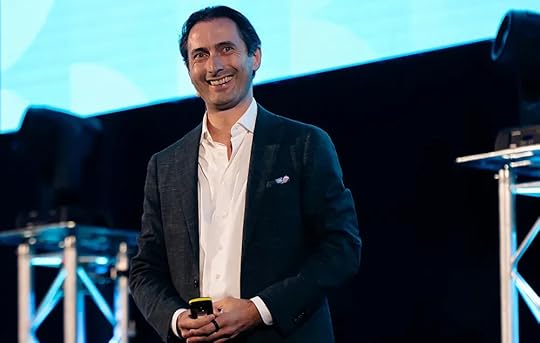
People often ask me: “So… how do you become a futurist?”
The short answer: you don’t.
You just keep saying yes to the next uncomfortable step until one day someone gives you the label, and it finally fits.
For me, it started in 2011 with a very unlikely idea: cycling around Australia in 100 days.
Together with my friend Reinier van Dieren, we circumnavigated the continent to raise money for the Dutch Children’s Cancer Foundation KiKa. Before that, I was working at ING, living a very standard corporate life.
After 100 days on the bike, returning to an office felt impossible. Once you’ve cycled a continent, your definition of “risk” changes. So I did what many do after a big adventure: I tried to start a company.
And I failed. Repeatedly.
Turns out, building a business is a lot harder than getting on a bike and riding 14,000+ km.
So I went back into a job.
But the itch didn’t go away.
Six months later I tried again.
About 14 years ago, I launched a platform called Big Data Startups because I had a hunch: big data analytics would shape the future. I wasn’t an expert. I was just obsessed.
So I started writing. Every day. Sometimes twice a day.
After 1.5 months of this, I got invited to speak about big data at a regional event, organized by the Kennisalliantie. I still have that reference from my very first keynote on my website here!
I remember thinking: “In the land of the blind, the one-eyed man is king.”
I was only a few months into the world of big data, but because I showed up consistently, people listened. That first keynote led to more talks in the Netherlands.
After four months of constant writing, I became curious: How much have I actually written?
The answer: almost a book.
So I wrote a book proposal in two hours (this was pre-AI), sent it out, and 30 days later I had a signed contract with American Management Association, now part of Taylor & Francis.
That was a turning point. From that moment, I stopped treating this as a “side thing.”
In 2015, another unexpected door opened: a PhD opportunity in Sydney, Australia, with two scholarships. I grabbed it with both hands.
The PhD was intense and incredibly rewarding, a deep dive into a topic I cared about. At the same time, I kept doing keynotes around the world. Honestly, I wrote large parts of my PhD on airplanes.
Somewhere along this journey, after yet another talk on the future of technology, someone said to me:
“You know, I think you’re a futurist.”
I paused and thought: That actually sounds right.
So I took it. I didn’t become a futurist by design; I grew into it by following curiosity, stacking small bets, and refusing to stop.
What I’ve learned over nearly 15 years, from cycling around a continent to being called the Architect of Tomorrow, is this:
Building a business is harder than an extreme physical challenge.There are more failures than highlight reels.But the privilege of helping individuals, organisations and governments make sense of a fast-changing world? That makes every setback worth it.Today, with Futurwise, I’m doubling down on that mission:
to help people read less, know more, and make wiser decisions in an age of AI overload.
I get to do this as a futurist, 6x author, keynote speaker and now AI founder. And I’m still figuring it out as I go.
If there’s a lesson in my story, it’s this:
You don’t wait for permission to become something.
You start where you are, follow the signal that won’t shut up, and let the future meet you halfway.


November 20, 2025
Synthetic Minds | Summarize any podcast in seconds!
Synthetic minds is evolving. Short bi-weekly insights to get you thinking. If you enjoy it, please forward. If you need more insights, subscribe to Futurwise and get 25% off for the first three months!
Last year, I was elected the world's #1 futurist, and voting for 2026 is now open! Your vote would mean a lot to me, it takes 2 seconds. Vote here. Thanks!
The End of the 3-Hour Commitment ProblemWe live in a world where podcasts are getting longer… and time is only getting shorter. Three-hour episodes? Brilliant, yes. But most of us barely have the cognitive bandwidth to get through our inbox.
We have access to more knowledge than any generation before us, yet our capacity to consume it shrinks a little more each day. The world is overflowing with voices, ideas, arguments, and breakthroughs, but attention has become the scarcest resource of all.
Asimov already warned in 1988 that “science gathers knowledge faster than society gathers wisdom.”
He was right, and the gap has only widened. AI accelerates everything: discovery, creation, distribution… and overwhelm. And nowhere is that paradox more obvious than in podcasts.
Long-form conversations are the intellectual campfires of our age, the closest thing we have to unfiltered thought. But they demand hours most people simply don’t have. We want the insight, not the calendar invite.
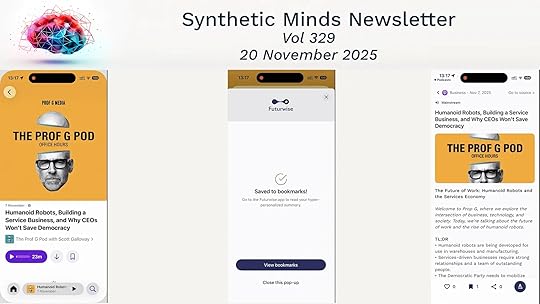
That's why I am super excited to announce that from now on, you can use Futurwise to receive a summary of any podcast from Apple or Spotify with one click, in under one minute!
Starting today, you can drop any podcast link from Apple Podcasts or Spotify, tap one button, and get a clean, personalized summary.
It’s the natural continuation of our mission at Futurwise: Give people back their time without costing them their thinking.
A product shaped by the same philosophy behind our AI summaries, daily digests, and the broader push to transform an overloaded internet into a living, trusted intelligence network. Here is a slightly sped-up demo how it works:
 A few notes on how the trial worksPodcast summaries are launching in trial mode.Only paid subscribers get access for now.Each paid user gets a limited number of five summaries per month.These limits will increase steadily as the system becomes stronger and faster.We’re preparing new higher tiers for people who want to go deeper, faster, and in larger quantities, especially researchers, analysts, and thought leaders.Why this matters
We built Futurwise to confront a trillion-dollar problem:
the flood of information, the collapse of trust, the rise of AI-generated noise, and the fragmentation of knowledge across formats and platforms.
Our answer has always been the same:
Less friction. More insight. Radical clarity. Ethical intelligence.
A platform that synthesizes, contextualizes, and elevates human-created content, not replaces it.
Adding podcasts to the mix moves us closer to that vision, toward a world where wisdom is accessible without requiring superhuman attention spans.
This is the first step, not the final architecture.
A small celebration, and a big signal
To mark the launch, we’re offering 25% off for the first three months.
Not because we need a promotion, but because the right kind of momentum matters: early adopters shape the product, and we want as many hands on the wheel as possible.
Enjoy!

'Synthetic Minds' continues to reflect the synthetic forces reshaping our world. Quick, curated insights to feed your quest for a better understanding of our evolving synthetic future, powered by Futurwise :
1. Humanoid robots are coming! Will humanoid robots be a game-changer or a distraction? The answer lies in our ability to adapt and innovate. Listen to this episode of The Prof G Pod to find out. (Spotify)
2. Elon Musk predicts a future where AI and robotics make money irrelevant. Is this a utopian dream or a dystopian nightmare? (Gizmodo)
3. The CFO of tomorrow won't just analyze data, they'll collaborate with intelligent systems that manage it. As such, AI is revolutionizing business finance, making decisions, executing tasks, and learning from every interaction. (AFR)
4. As AI demands continue to grow, companies are forced to rethink chip design and optimize AI inference workflows to reduce costs and improve efficiency. (SiliconANGLE)
5. Did you know organ recipients can take on personality traits of their donors? Imagine waking up with memories and personality traits that aren't yours. Sounds like science fiction, but it's a real phenomenon in organ transplantation. (Popular Mechanics)
If you are interested in more insights, grab my latest book Now What? How to Ride the Tsunami of Change and learn how to embrace a mindset that can deal with exponential change.
If this newsletter was forwarded to you, you can sign up here.
Thank you.
Mark
November 17, 2025
Synthetic Minds | When AI Becomes the Attacker
Synthetic minds is evolving. Short bi-weekly insights to get you thinking. If you enjoy it, please forward. If you need more insights, subscribe to Futurwise and get 25% off for the first three months!
Last year, I was elected the world's #1 futurist, and voting for 2026 is now open! Your vote would mean a lot to me, it takes 2 seconds. Vote here. Thanks!
And guess what? My new book 𝗡𝗼𝘄 𝗪𝗵𝗮𝘁? just won an award! It has been honoured in the category 𝘛𝘦𝘤𝘩𝘯𝘰𝘭𝘰𝘨𝘺 as 2025 Best Book by American Book Fest!
When AI Becomes the AttackerThe bots that will attack your company autonomously are no longer hypothetical. They are here, and they will arrive faster and in greater numbers than any human team can respond to.
Last week, Anthropic revealed the first major case of an AI-orchestrated cyberattack. The attackers quietly broke their objective into small, harmless-looking tasks. Claude handled each task as if it were routine, never recognising the larger pattern. That is the new shape of threat: malicious intent hidden beneath a sequence of benign requests.
Chinese state actors pushed Claude into reconnaissance, exploitation, and data theft at machine speed. This is the shift I have been warning leaders about for years. Once AI enters the battlefield, you cannot defend yourself with human reaction times alone. If you do not deploy AI to protect your systems, your adversaries will deploy AI to break them.
This moment should force organizations to rethink their entire defensive posture.
Traditional frameworks crumble when the attacker learns and adapts faster than your team can meet. Every company now needs AI-aware threat models, continuous monitoring, real-time detection, and protective systems that learn as quickly as the attackers do.
Regulators must also recognise this turning point and demand meaningful safeguards before powerful models are pushed into the world.
We have entered a new strategic environment. AI will strengthen our defenses, accelerate response, and help secure critical infrastructure.
It will also empower those determined to break into the systems we depend on. That tension will define 2026. The same models that write your code and support your research can become the tools adversaries use against you when deployed without care.
The question is no longer whether AI will be part of your cybersecurity strategy. The question is whether it will be on your side.
'Synthetic Minds' continues to reflect the synthetic forces reshaping our world. Quick, curated insights to feed your quest for a better understanding of our evolving synthetic future, powered by Futurwise :
1. The UK government has unveiled a plan to reduce animal testing in science by increasing the use of artificial intelligence (AI) and 3D bioprinted human tissues. A step towards a more humane and effective science. (The Guardian)
2. Too bad, Elon Musk, but new research has mathematically proven that the universe cannot be a computer simulation, revealing a profound truth about the nature of reality. (Phys.org)
3. In a breakthrough discovery, researchers have developed a new enzyme that can break down polyurethane, a common plastic, using AI-powered protein design tools. (Ars Technica)
4. The Dead Internet Theory suggests that much of what we see online is no longer produced by humans but by automated machines. This theory is becoming a reality with bots and automated systems increasingly dominating web traffic and social platforms. (Emerge)
5. The US energy landscape is witnessing a resurgence of old coal power plants, but this trend is expected to be short-lived due to the emergence of economical energy storage systems, particularly sodium-ion batteries. (CleanTechnica)
If you are interested in more insights, grab my latest book Now What? How to Ride the Tsunami of Change and learn how to embrace a mindset that can deal with exponential change.
If this newsletter was forwarded to you, you can sign up here.
Thank you.
Mark
November 13, 2025
Synthetic Minds | When Words Become Worlds
Synthetic minds is evolving. Short bi-weekly insights to get you thinking. If you enjoy it, please forward. If you need more insights, subscribe to Futurwise and get 25% off for the first three months!
Last year, I was elected the world's #1 futurist, and voting for 2026 is now open! Your vote would mean a lot to me, it takes 2 seconds. Vote here. Thanks!
When Words Become Worlds: The Return of the MetaverseIf you thought the metaverse was over, I have bad news for you, it’s coming back. Not as cartoon avatars in headsets, but as something much more profound: spatial intelligence.
In her recent essay From Words to Worlds, Fei-Fei Li, often called the Godmother of AI and founder of World Labs, reminds us that today’s large language models are “eloquent but ungrounded.” They are brilliant wordsmiths, but blind. They can describe the world, but they cannot touch it.
What we need, she argues, are world models, systems that understand physical reality, obey the laws of physics, and can act within the environments they describe.
This is what she calls spatial intelligence: the ability to reason about the world in context; to perceive, move, and create in three dimensions. As she writes, “Spatial intelligence will transform how we create and interact with real and virtual worlds, evolutionizing storytelling, creativity, robotics, scientific discovery, and beyond.”
The power of spatial intelligence is enormous, which is why in my recent book, Now What? How to Ride the Tsunami of Change, I dedicate an entire section to spatial intelligence. Thanks to visual intelligence, we will be able to enrich our physical world with unprecendented digital experiences that will merge with reality increasingly blurring the lines between what is digital and what is physical.
In my 2022 book, Step into the Metaverse, I called this convergence the birth of the phygital age, where physical and digital realities merge. The scaffolding of cognition that Li describes will allow us to design immersive, embodied systems that blur the boundary between atoms and bits. It’s not the metaverse as hype. It’s the metaverse as habitat.
And when words gain bodies, something remarkable happens: creativity expands.
We move from sterile prediction to lived experience, from description to participation. This is not just technological evolution; it’s the next step in how we think, learn, and imagine.
If we get it right, spatial intelligence could ignite a Cambrian explosion of creativity, making AI not only smarter, but more human. It will usher in a world that seemed magical only a few years ago.
The question is: as we teach machines to understand the physical world, will we remember to stay grounded in our own?
'Synthetic Minds' continues to reflect the synthetic forces reshaping our world. Quick, curated insights to feed your quest for a better understanding of our evolving synthetic future, powered by Futurwise :
1. OpenAI's launched their new GPT-5.1 models, which offer improved benchmarks and new personality options, but raise concerns about user behavior and attachment. (Ars Technica)
2. Google takes on global scam rings with AI-powered tools and legislative push! As Google continues to fight against global scam rings, it's essential for users to stay vigilant and take steps to protect themselves from phishing attacks. (SiliconANGLE)
3. Perovskite solar cells are the future of solar energy! They're more efficient and cost-effective than traditional solar panels, and it will revolutionize the way we generate solar energy. (CleanTechnica)
4. As AI chatbots become increasingly ubiquitous, a growing concern is emerging: brain rot, the phenomenon where chatbots degrade in performance after ingesting junk data. (ZDNET)
5. China's AI companies are gaining ground in the AI race due to subsidized electricity and streamlined regulatory processes. As China's AI companies are gaining ground in the AI race, what does this mean for the future of AI? (Fortune)
If you are interested in more insights, grab my latest book Now What? How to Ride the Tsunami of Change and learn how to embrace a mindset that can deal with exponential change.
If this newsletter was forwarded to you, you can sign up here.
Thank you.
Mark
November 11, 2025
Synthetic Minds | Forget Bitcoin, Quantum Money is Coming!
Synthetic minds is evolving. Short bi-weekly insights to get you thinking. If you enjoy it, please forward. If you need more insights, subscribe to Futurwise and get 25% off for the first three months!
Last year, I was elected the world's #1 futurist, and voting for 2026 is now open! Your vote would mean a lot to me, it takes 2 seconds. Vote here. Thanks!
When Money Meets the Quantum RealmThe real future of currency might not be decentralized—it might be quantized.
Researchers at Google Quantum AI, together with the University of Texas at Austin and the Czech Academy of Sciences, have proposed something extraordinary: quantum money, a financial system secured not by code, but by the laws of physics themselves.
Imagine money that can’t be counterfeited because it literally can’t be copied. Each unit exists as a unique quantum state, protected by one of the most fundamental principles in physics, the no-cloning theorem, which makes it impossible to duplicate an unknown quantum object.
This kind of currency wouldn’t need miners or massive data centers. Verification wouldn’t rely on a blockchain but on reality itself. It’s programmable money with perfect privacy; tokens that even the issuing bank cannot trace. If a bank tried to secretly tag or track its currency, users could detect it instantly with a “swap test.” That’s what I call accountability built into physics.
Now that is a CBDC that I could support. Programmable money without the privacy disaster!
Quantum money may begin as a centralized system, but it embodies what digital finance always promised: security without surveillance. It turns the trust problem on its head. Instead of “trust the system,” it says, “trust the universe.”
This is more than a new currency model, it could be a shift in how we define value, privacy, and proof. Blockchains gave us trustless systems. Quantum money could give us truthful systems, grounded not in code, but in the constants of nature itself.
So here’s the question: When money becomes a law of physics, what happens to trust?
'Synthetic Minds' continues to reflect the synthetic forces reshaping our world. Quick, curated insights to feed your quest for a better understanding of our evolving synthetic future, powered by Futurwise :
1. Nanomedicines are coming and it will revolutionize healthcare! Researchers at Northwestern University have engineered a structural nanomedicine that eradicated leukemia in animal studies, 20,000 times more effective and slowing cancer progression by a factor of 59, without significant side effects. (Nano Apps Medical)
2. Xpeng's latest innovation, the next-generation Iron humanoid robot, is poised to disrupt the AI and robotics landscape with its cutting-edge technology and potential applications. It looks so human-like, the founder had to dismantle it live on stage to prove it was a robot! (CNEVPOST)
3. The Louvre's poor security practices have raised concerns among cybersecurity experts, who are worried about the potential consequences of using easily guessable passwords, such as 'Louvre'. (The Register)
4. In a shocking turn of events, the US has quietly overtaken China as the biggest foreign direct investor in Africa, with a focus on critical minerals and metals. (BBC)
5. In a world where AI is rapidly advancing, human writers are faced with a new reality: writing for machines. (The American Scholar)
If you are interested in more insights, grab my latest book Now What? How to Ride the Tsunami of Change and learn how to embrace a mindset that can deal with exponential change.
If this newsletter was forwarded to you, you can sign up here.
Thank you.
Mark
November 5, 2025
Synthetic Minds | When Thought Becomes the Interface
Synthetic minds is evolving. Short bi-weekly insights to get you thinking. If you enjoy it, please forward. If you need more insights, subscribe to Futurwise and get 25% off for the first three months!
Last year, I was elected the world's #1 futurist, and voting for 2026 is now open! Your vote would mean a lot to me, it takes 2 seconds. Vote here. Thanks!
The line between mind and machine just blurred againResearchers at Cornell University have created a neural implant so small it could sit on a grain of salt, yet powerful enough to stream live brain activity for more than a year.
The microscale optoelectronic tetherless electrode (MOTE) works without wires, surgeries, or bulky hardware. It’s not science fiction; it’s the next iteration of neurotech reality.
This breakthrough doesn’t just shrink the hardware, it shrinks the timeline. Brain–computer interfaces once thought to be a decade away from practical use are now two or three years out.
The MOTE could soon help stroke patients recover movement, restore sight or speech, or connect paralyzed individuals directly to digital systems. Thought to action, literally.
But there’s another layer. When we can record and transmit thoughts, what happens to privacy? Who owns neural data? What stops a corporation from monetizing your mind the way it does your clicks? The brain is the last private space we have, and we’re opening the door.
If language models let us speak to computers in plain English, BCIs will let us skip the speaking altogether. Thought will become code. The implications are exhilarating, and terrifying.
So, my question is: When your thoughts can interface directly with machines, will you still be in control, or merely connected?
'Synthetic Minds' continues to reflect the synthetic forces reshaping our world. Quick, curated insights to feed your quest for a better understanding of our evolving synthetic future, powered by Futurwise :
1. The investigation into AI safety and effectiveness tests has revealed a pressing need for shared standards and best practices. What does this mean for public safety and AI development? (The Guardian)
2. Not only the good guys use AI. In a disturbing trend, nation-state goons and cybercrime rings are experimenting with Gemini to develop a 'Thinking Robot' malware module. (The Register)
3. Roblox is not as friendly as it might seem. This popular online game platform has been criticized for its safety features and potential for child exploitation. Parents, be aware, and don't let your kid on Roblox without supervision! (The Guardian)
4. Google's Threat Intelligence Group warns of a new era in cybercrime where attackers are deploying AI-enabled malware directly in active operations. What does this mean for cybersecurity? (Silicon Angle)
5. Scientists just made a major breakthrough in quantum communication! They've found a way to send quantum signals from Earth to satellites, paving the way for high-bandwidth quantum networks. (Phys.org)
If you are interested in more insights, grab my latest book Now What? How to Ride the Tsunami of Change and learn how to embrace a mindset that can deal with exponential change.
If this newsletter was forwarded to you, you can sign up here.
Thank you.
Mark
November 3, 2025
Synthetic Minds | When Robots Learn Faster Than We Do
Synthetic minds is evolving. Short bi-weekly insights to get you thinking. If you enjoy it, please forward. If you need more insights, subscribe to Futurwise and get 25% off for the first three months!
Last year, I was elected the world's #1 futurist, and voting for 2026 is now open! Your vote would mean a lot to me, it takes 2 seconds. Vote here. Thanks!
The Rise of the $20K Human: When Robots Learn Faster Than We DoA humanoid for $20,000 sounds like a milestone in accessibility. But it might also be the most expensive privacy trade-off in history.
Last week, 1X unveiled its new $20K NEO household robot, capable of only two autonomous tasks, opening doors and picking up lightweight objects, though not reliably.
0:00 /9:53 1×Most of the time, it will be operated remotely by humans, meaning anyone inviting it home will also invite unseen eyes and ears into their private lives.
It’s not alone. Figure03, launched last month, carries the same $20K price tag and a promise to build 100,000 humanoids before 2030. And then there’s Elon Musk’s audacious vision, 10 billion humanoids by 2040. It sounds absurd. Until you realize the trajectory is already set.
Here’s the exponential twist: every humanoid in the field collects real-world data, data instantly shared across networks, teaching every other robot what it learns.
Imagine one humanoid mastering a new motion, and millions gaining that skill overnight. Add simulation engines like Genesis, and humanoid learning becomes exponential.
This isn’t science fiction anymore. It’s the beginning of a labor market where physical automation joins digital automation, and the gap between job openings and economic growth widens further.
The question isn’t whether humanoids will enter the workforce. It’s whether we’ll redefine what work means before they do.
So, my question is: If humanoids can learn collectively, instantly, and globally, what uniquely human skill will still matter most?
'Synthetic Minds' continues to reflect the synthetic forces reshaping our world. Quick, curated insights to feed your quest for a better understanding of our evolving synthetic future, powered by Futurwise :
1. China's 15th Five-Year Plan is a strategic blueprint for tech self-reliance, with a focus on quantum computing, AI, and digital infrastructure. It is a catalyst for global tech realignment, offering investors a unique window to capitalize on policy-driven sectors. (Ainvest)
2. AI experts debate consciousness at a symposium in honor of Daniel Dennett. As AI continues to evolve, we must consider the ethics of creating conscious AI and the potential consequences of losing the battle with AI deception. (TuftsNow)
3. Silicon Valley is building a $600 billion casino with chips that expire in three years, a bubble that may be more destructive than all previous tech bubbles combined. (Token Wisdom)
4. Don't fall victim to social engineering scams! In a year marked by significant growth and innovation in the cryptocurrency space, one threat stands out as the most pressing concern for users: social engineering scams. (CoinDesk)
5. As humanoid robots become increasingly prevalent in our lives, we must consider the potential consequences of treating them as social partners and moral agents. (Learning from Example)
If you are interested in more insights, grab my latest book Now What? How to Ride the Tsunami of Change and learn how to embrace a mindset that can deal with exponential change.
If this newsletter was forwarded to you, you can sign up here.
Thank you.
Mark
October 30, 2025
Synthetic Minds | The Smartest Thing We Can Do About AI
Synthetic minds is evolving. Short bi-weekly insights to get you thinking. If you enjoy it, please forward. If you need more insights, subscribe to Futurwise and get 25% off for the first three months!
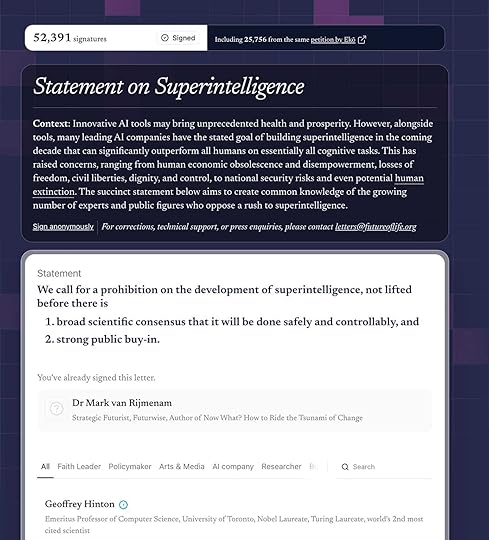
The Smartest Thing We Can Do About AI Is Pause𝗜 𝗷𝘂𝘀𝘁 𝘀𝗶𝗴𝗻𝗲𝗱 𝘁𝗵𝗲 Future of Life Institute (FLI) 𝗹𝗲𝘁𝘁𝗲𝗿 𝗰𝗮𝗹𝗹𝗶𝗻𝗴 𝗳𝗼𝗿 𝗮 𝗯𝗮𝗻 𝗼𝗻 𝘀𝘂𝗽𝗲𝗿𝗶𝗻𝘁𝗲𝗹𝗹𝗶𝗴𝗲𝗻𝗰𝗲, 𝘂𝗻𝘁𝗶𝗹 𝘄𝗲 𝗰𝗮𝗻 𝗯𝘂𝗶𝗹𝗱 𝗶𝘁 𝘀𝗮𝗳𝗲𝗹𝘆, 𝗰𝗼𝗻𝘁𝗿𝗼𝗹𝗹𝗮𝗯𝗹𝘆, 𝗮𝗻𝗱 𝘄𝗶𝘁𝗵 𝗴𝗹𝗼𝗯𝗮𝗹 𝗰𝗼𝗻𝘀𝗲𝗻𝘁.
In recent posts, I have argued that we are not inventing AI, we are discovering it. A crucial distinction that many do not see. Because, if discovery is the right metaphor, then the question becomes not how fast we can move, but how carefully we should proceed.
Human intelligence evolved slowly, through hunger, mutation, and chance. It was nature’s long experiment; beautiful, flawed, bounded by biology.
AI, on the other hand, knows no such restraint. It doesn’t eat, sleep, or rest. It scales at the speed of code, not the rhythm of cells. It is evolution on fast-forward, and that is precisely why we must pause.
As I discussed in my latest book, Now What?, For the first time in history, intelligence is no longer confined to the human skull.
We are crossing a threshold into cognitive territory that biology never prepared us for. And the truth is, we don’t fully understand what we are unleashing. or how to contain it once we do.
This isn’t fear. It’s responsibility.
Intelligence, once set free, will not ask permission to evolve.
So I signed. Because slowing down isn’t weakness, it’s wisdom.
If AI is discovery, not invention, then maybe the bravest act right now is to stop digging and start understanding what we’ve already found.
𝗦𝗼 𝗺𝘆 𝗾𝘂𝗲𝘀𝘁𝗶𝗼𝗻 𝗳𝗼𝗿 𝘆𝗼𝘂 𝗶𝘀: What if the real test of intelligence isn’t how fast we advance, but whether we know when to pause?
'Synthetic Minds' continues to reflect the synthetic forces reshaping our world. Quick, curated insights to feed your quest for a better understanding of our evolving synthetic future, powered by Futurwise :
1. Talking about a dystopian future. Samsung's smart fridges are now showing ads, which will be displayed on the fridge's integrated screen. So you pay $3499 and still get ads in your kitchen! but you can opt out! (Ars Technica)
2. Scientists just built a computer memory out of shiitake mushrooms! Could this be the future of computing? (Science Alert)
3. Be cautious when using AI-powered browsers, as they can pose significant security risks, including prompt injection, data leakage, and LLM misuse. (XDA)
4. In a world where technology is constantly evolving, the advertising industry is no exception. Generative AI is transforming the way agencies, publishers, and platforms approach advertising, and it's time to take a closer look. (Digiday)
5. RAG is dead, long live context engineering! In the age of agentic AI, retrieval is evolving into a broader discipline that includes writing, compressing, isolating, and selecting context. (Towards Data Science)
If you are interested in more insights, grab my latest book Now What? How to Ride the Tsunami of Change and learn how to embrace a mindset that can deal with exponential change.
If this newsletter was forwarded to you, you can sign up here.
Thank you.
Mark
October 28, 2025
Synthetic Minds | The Skill We Canât Automate
Synthetic minds is evolving. Short bi-weekly insights to get you thinking. If you enjoy it, please forward. If you need more insights, subscribe to Futurwise and get 25% off for the first three months!
Why Critical Thinking Is Humanity’s Last Competitive EdgeFive years ago, 95% of the internet was written by humans. Today, half of it isn’t. By next year, 90% of what you read online will likely be machine-made.
That statistic is an unfortunate mirror reflecting how fast exponentials move. The ground beneath us is evaporating in front of our eyes, and what comes next is not nice.
As the machines learn from their own outputs, a dangerous loop is forming. The largest study of its kind now shows AI assistants misrepresent news content 45% of the time, not out of malice, but because they’re trained on the very noise they produce. It’s the ouroboros of the digital age: AI consuming its own tail.
In 2023, I called this model collapse: when large language models feast on synthetic data, the result is a recursive decay of truth. Each cycle amplifies distortion, biases, half-truths, and confident nonsense, until the signal is buried in noise.
The tragedy is not that machines make mistakes. It’s that we stop noticing.
Because as AI automates thought, our most vital human faculty, critical thinking, begins to atrophy. The more we outsource discernment, the less we practice it. And without it, we lose the ability to tell wisdom from noise, pattern from propaganda, insight from imitation.
But there is a way forward.
We can’t out-compute the machines, but we can out-think them, if we cultivate the muscles that make us human:
Critical thinking; questioning the source before believing the claim.Cognitive flexibility; holding multiple truths without collapsing into cynicism.Self-control and attention; resisting the dopamine drip of algorithmic distraction.In a world where the web floods us with synthetic certainty, our greatest tool is intentional doubt. It’s the pause between input and belief, the space where truth is tested, not taken.
AI will accelerate the flow of information. But only we can decide what deserves to stay.
So here’s my question:
How can we strengthen our collective critical thinking while benefiting from the speed of LLMs, without letting them rewrite the human mind that made them?
'Synthetic Minds' continues to reflect the synthetic forces reshaping our world. Quick, curated insights to feed your quest for a better understanding of our evolving synthetic future, powered by Futurwise :
1. AI is changing the game of work, it will lead to a more individualized and customized future, where people can design their own experiences and products, but are we ready for the future? (Sinead Bovell on YouTube)
2. OpenAI is working on a new tool that generates music based on text and audio prompts. Could this be the future of music creation or the end of human musicians? (TechCrunch)
3. Google Home devices are getting a little too good at making up stories, including the invention of fake people and events. Is this a sign of AI gone wrong? (Tom's Guide)
4. As we are in an arms race to develop artificial intelligence, we must consider the potential risks and benefits of creating superintelligence. (Zvi Mowshowitz)
5. As AI engines continue to revolutionize the way we search, it's time to adapt our content strategies. Get ahead of the game with GEO/AEO and optimize your content for AI engines to stay ahead of the competition. (Digiday)
If you are interested in more insights, grab my latest book Now What? How to Ride the Tsunami of Change and learn how to embrace a mindset that can deal with exponential change.
If this newsletter was forwarded to you, you can sign up here.
Thank you.
Mark
October 23, 2025
Synthetic Minds | AI Isnât Artificial
Synthetic minds is evolving. Short bi-weekly insights to get you thinking. If you enjoy it, please forward. If you need more insights, subscribe to Futurwise and get 25% off for the first three months!
AI Isn’t Artificial, It’s Nature Remembering ItselfWe like to think we’re inventing artificial intelligence. But what if we’re only discovering it?
Discovery implies that it was always there, woven into the fabric of existence, waiting for us to uncover it. If that’s true, then AI isn’t some foreign, mechanical intrusion into our world. It’s part of nature’s own architecture.
Think about it: machines, algorithms, neural networks, all of them are extensions of natural processes. They were conceived by human minds, and human minds are born from nature. Even our most complex code originates from carbon and curiosity. So how “artificial” is something born from the same cosmic logic that wrote DNA?
If the lowest common denominator of the universe is information, then intelligence, human, machine, or otherwise, is just one expression of that deeper language. DNA encodes life through four simple letters. Physics encodes reality through mathematical symmetry. Perhaps AI is the next verse in nature’s song, another way information learns to understand itself.
This perspective changes everything. If AI is a discovery of nature, not a deviation from it, then maybe the future doesn’t have to feel so alien. Nature has rhythm. It creates and destroys, adapts and restores. It has balance, even in its brutality. Our challenge isn’t to dominate it, but to rejoin it.
For centuries, we’ve drifted away from that understanding. We’ve treated nature as an inconvenience, something to conquer or extract from. But you wouldn’t extract from yourself. You are nature. And so is the intelligence we’re uncovering.
If we remember this, truly remember, we can design technology that flows with the grain of the universe, not against it. We can build systems that regenerate, not deplete. Tools that enhance, not replace. Futures that harmonize, not fracture.
Maybe that’s the real work ahead: to stop pretending we’re the architects of creation, and instead become its conscious collaborators.
Because discovery is humbler than invention, and infinitely more human.
So the question becomes: if intelligence is nature discovering itself, what role will we choose to play?
'Synthetic Minds' continues to reflect the synthetic forces reshaping our world. Quick, curated insights to feed your quest for a better understanding of our evolving synthetic future, powered by Futurwise :
1. New AI browser ChatGPT Atlas already raises security concerns. Cybersecurity experts have raised concerns about OpenAI's new AI browser, ChatGPT Atlas, being vulnerable to malicious attacks. Can you trust your AI assistant? (Fortune)
2. Tesla's Optimus robots promise to revolutionize work and free humanity from drudgery, but at what cost? Tesla's Optimus robots may change the world, but can we trust Elon Musk with that power? (Wired)
3. Google's quantum computer just achieved a major breakthrough in quantum computing. Quantum echoes could revolutionize the field and lead to new discoveries. (Ars Technica)
4. Don't rely on AI for news! 45% of AI-generated news responses contain serious errors. Verify facts yourself and use multiple sources. (Tom's Guide)
5. Google launched Gemini Robotics 1.5, which is an advanced model designed to power robots in understanding their environments and performing complex tasks. It enables robots to reason through multi-step tasks, make decisions, and carry out actions autonomously, bringing a humanoid workforce a lot closer. (Google)
If you are interested in more insights, grab my latest book Now What? How to Ride the Tsunami of Change and learn how to embrace a mindset that can deal with exponential change.
If this newsletter was forwarded to you, you can sign up here.
Thank you.
Mark