Victoria Thompson's Blog
June 17, 2026
Book Giveaway! Enter the Hot Summer Mystery Sweepstakes

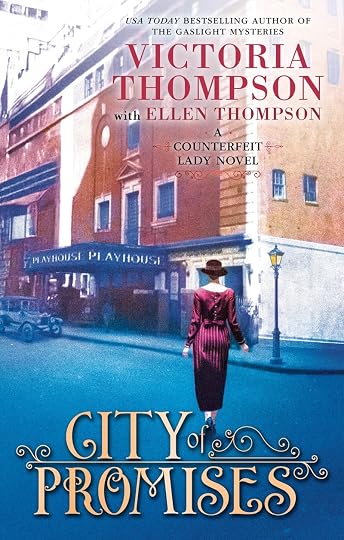
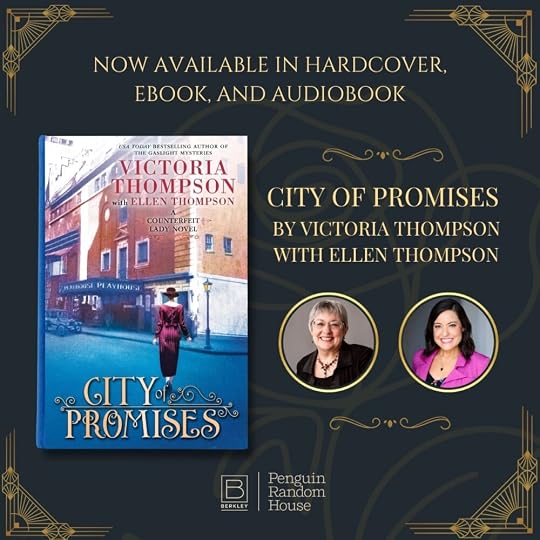
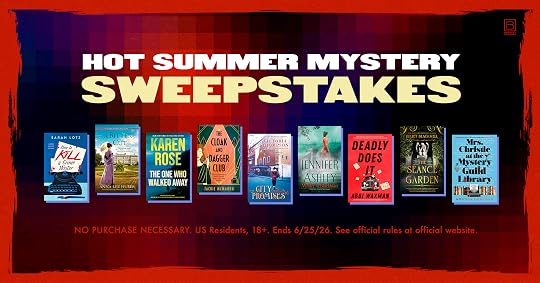
Berkley is giving away a bundle of nine mystery novels, including City of Promises by Victoria Thompson with Ellen Thompson.
>>Click here to enter the sweepstakes<<
Enter by June 25, 2026. US Residents, 18+. See official rules for full details.
Prize Includes:


Published on June 17, 2026 19:07
•
Tags:
counterfeit-lady, counterfeit-lady-novels, cozy-historical, giveaway, historical-fiction, publisher-giveaway, victoria-thompson
May 24, 2026
Goodreads Giveaway! Enter to Win a Copy of City of Promises!
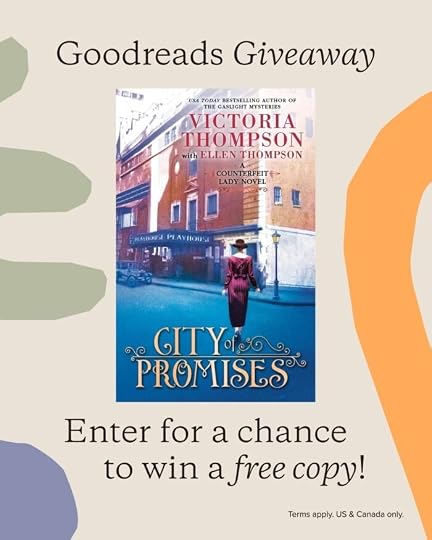
Berkley is giving away ten hardcover copies of City of Promises! Enter by June 23, 2026
-Click here to enter-
Published on May 24, 2026 21:01
•
Tags:
counterfeit-lady, counterfeit-lady-novels, cozy-historical, giveaway, goodreads-giveaway, historical-fiction, victoria-thompson
May 12, 2020
Drawing on my own history for Murder on Pleasant Avenue
Writing Murder on Pleasant Avenue was a joy on several levels. It is the 23rd book in the Gaslight Mystery Series, so every book in that series is kind of a miracle because I never expected the series to last beyond six books! So that’s exciting.
The second reason I enjoyed writing this book is because it features my favorite ethnic group, the Italians. My paternal grandparents emigrated from Italy as teenagers over 100 years ago, but my grandmother died young, so I never knew her, and I didn’t know my grandfather well. Most of what I know about them is second hand, but even that is fascinating. From the census records, we know that my teen-aged grandfather lived in a boarding house and my grandmother’s father lived in a boarding house next door. My great-grandfather had four daughters, and he brought them over one at a time and then finally brought his wife to America. Two of his daughters married the sons of the family he was boarding with and my grandmother married the boy who lived next door. Arranged marriages? Most likely! But I know my grandfather dearly loved his wife from the touching inscription on her headstone.
The third reason I loved writing this book is because it features Maeve and Gino, who are usually secondary characters in the series. A few years ago, they actually got their own book, Murder on St. Nicholas Avenue, and it was fun to give them a slightly larger role in this story, too. In this book, Gino is falsely accused of murder, and his friends must find the real killer to save him. Fans have been nagging me for a while now to get the Maeve and Gino together, so this was a great opportunity for them to grow a bit closer as a couple. Will they or won’t they? Since I started my career writing romance, you can rest assured that they will eventually get a happy ending. I just won’t promise how soon that will happen!
The final reason I enjoyed writing this book is because I got to dispel some myths about the mafia in it. Murder on Pleasant Avenue features The Black Hand, an early criminal group that preceded the mafia but was not actually connected to it. The Black Hand terrorized people by kidnapping women and children and selling protection. The mafia, who came along later, started out by counterfeiting, loan sharking and running a lottery (i.e. the numbers racket). The Black Hand eventually faded into history while the mafia grew more powerful. What most people don’t realize is that both groups got their start by preying mostly on other Italian immigrants.
In Murder on Pleasant Avenue, I got to show some Italian family life and enjoy vicariously what I missed because I never knew my grandmother. Did you have any relatives who are immigrants to America? Do you have some happy family memories you’d like to share?
The second reason I enjoyed writing this book is because it features my favorite ethnic group, the Italians. My paternal grandparents emigrated from Italy as teenagers over 100 years ago, but my grandmother died young, so I never knew her, and I didn’t know my grandfather well. Most of what I know about them is second hand, but even that is fascinating. From the census records, we know that my teen-aged grandfather lived in a boarding house and my grandmother’s father lived in a boarding house next door. My great-grandfather had four daughters, and he brought them over one at a time and then finally brought his wife to America. Two of his daughters married the sons of the family he was boarding with and my grandmother married the boy who lived next door. Arranged marriages? Most likely! But I know my grandfather dearly loved his wife from the touching inscription on her headstone.
The third reason I loved writing this book is because it features Maeve and Gino, who are usually secondary characters in the series. A few years ago, they actually got their own book, Murder on St. Nicholas Avenue, and it was fun to give them a slightly larger role in this story, too. In this book, Gino is falsely accused of murder, and his friends must find the real killer to save him. Fans have been nagging me for a while now to get the Maeve and Gino together, so this was a great opportunity for them to grow a bit closer as a couple. Will they or won’t they? Since I started my career writing romance, you can rest assured that they will eventually get a happy ending. I just won’t promise how soon that will happen!
The final reason I enjoyed writing this book is because I got to dispel some myths about the mafia in it. Murder on Pleasant Avenue features The Black Hand, an early criminal group that preceded the mafia but was not actually connected to it. The Black Hand terrorized people by kidnapping women and children and selling protection. The mafia, who came along later, started out by counterfeiting, loan sharking and running a lottery (i.e. the numbers racket). The Black Hand eventually faded into history while the mafia grew more powerful. What most people don’t realize is that both groups got their start by preying mostly on other Italian immigrants.
In Murder on Pleasant Avenue, I got to show some Italian family life and enjoy vicariously what I missed because I never knew my grandmother. Did you have any relatives who are immigrants to America? Do you have some happy family memories you’d like to share?
Published on May 12, 2020 08:15
May 21, 2019
Got Milk?
Party like it’s 1899!
So I was working on ideas for Murder on Trinity Place, the 22rd book in the Gaslight Mystery Series. The series started in 1896, and after 21 books, we were approaching the end of 1899, so I thought it would be fun to show the turn of that century. Were people as excited about it as we were in 1999? It turns out they weren’t (which is a different blog post). Where do I go from there?
Got Milk?
By this time, I had an idea for how to start Murder on Trinity Place, even if it wasn’t as interesting as I had hoped. The murder would happen on New Year’s Eve, and I decided the victim would be a man whose legitimate business might be a cover for some sort of illegal activity. I consulted a few of my writer friends (I knew they would help because it’s always easier to come up with ideas for other people’s books). My good friend, Susanna Calkins, suggested that milk wagons could be used for all sorts of nefarious purposes when not actually hauling milk. What a perfect idea! (such a perfect idea, as you will see, that I ended up dedicating the book to her.)
And then the magic happened.
I started researching what milk delivery was like around the turn of the last century, and I discovered all sorts of things about milk that I’d never dreamed of. Did you know that at one point in time in New York City, they had “milk wars”? Did you know that in mid-Nineteenth Century New York City, half of the children died before the age of five? Half of them! And why? Mostly from drinking contaminated milk. Yikes. This was serious stuff. This is why writers love doing research. Truth is often much more interesting than anything you could make up yourself.
“Never cry over spilt milk, because it may have been poisoned.” –W.C. Fields
When the owner of a dairy is found murdered, Frank and Sarah Malloy are asked to solve the case by their very superstitious neighbor, Mrs. Ellsworth, because the victim is the father of her new daughter-in-law. (Can we all take a moment here to lament the fact that the English language has no easy way to describe your relationship to your child’s in-laws? “My daughter-in-law’s parents” is so unwieldy. But I digress.) Since Mrs. Ellsworth once saved Sarah’s very life, they cannot refuse, and they begin an investigation that leads them to some very surprising places.
Milk has long been a staple of the American diet. What are your memories of drinking it as a child? Do you remember home delivery? Do you like milk? Hate it? Are you allergic? Are you surprised to learn that at one point it time drinking it could actually be dangerous?
So I was working on ideas for Murder on Trinity Place, the 22rd book in the Gaslight Mystery Series. The series started in 1896, and after 21 books, we were approaching the end of 1899, so I thought it would be fun to show the turn of that century. Were people as excited about it as we were in 1999? It turns out they weren’t (which is a different blog post). Where do I go from there?
Got Milk?
By this time, I had an idea for how to start Murder on Trinity Place, even if it wasn’t as interesting as I had hoped. The murder would happen on New Year’s Eve, and I decided the victim would be a man whose legitimate business might be a cover for some sort of illegal activity. I consulted a few of my writer friends (I knew they would help because it’s always easier to come up with ideas for other people’s books). My good friend, Susanna Calkins, suggested that milk wagons could be used for all sorts of nefarious purposes when not actually hauling milk. What a perfect idea! (such a perfect idea, as you will see, that I ended up dedicating the book to her.)
And then the magic happened.
I started researching what milk delivery was like around the turn of the last century, and I discovered all sorts of things about milk that I’d never dreamed of. Did you know that at one point in time in New York City, they had “milk wars”? Did you know that in mid-Nineteenth Century New York City, half of the children died before the age of five? Half of them! And why? Mostly from drinking contaminated milk. Yikes. This was serious stuff. This is why writers love doing research. Truth is often much more interesting than anything you could make up yourself.
“Never cry over spilt milk, because it may have been poisoned.” –W.C. Fields
When the owner of a dairy is found murdered, Frank and Sarah Malloy are asked to solve the case by their very superstitious neighbor, Mrs. Ellsworth, because the victim is the father of her new daughter-in-law. (Can we all take a moment here to lament the fact that the English language has no easy way to describe your relationship to your child’s in-laws? “My daughter-in-law’s parents” is so unwieldy. But I digress.) Since Mrs. Ellsworth once saved Sarah’s very life, they cannot refuse, and they begin an investigation that leads them to some very surprising places.
Milk has long been a staple of the American diet. What are your memories of drinking it as a child? Do you remember home delivery? Do you like milk? Hate it? Are you allergic? Are you surprised to learn that at one point it time drinking it could actually be dangerous?
April 1, 2019
Party like it's 1899!
Victoria Thompson’s latest Gaslight Mystery, Murder on Trinity Place, releases on April 30.
Party like it’s 1899!
The first book of the Gaslight Mystery series was set in 1896, and after 22 books, we were approaching the end of 1899, so I thought it would be fun to show the turn of that century. Remember all the hoopla surrounding the most recent “turn of the century” in 1999? Y2K had many of us in a panic with predictions that computers would somehow cease working when the date rolled over to the year 2000. Planes would fall from the sky. Elevators would plunge to the basement. Life as we know it would end. Then the date rolled over and nothing happened! Except for lots of parties and celebrations for the beginning of a new century.
Y19HUN?
What, I wondered, was going on in anticipation of 1899 becoming 1900? Surely, people were excited and perhaps a bit apprehensive about something in those days, even though they didn’t have any computers back then to malfunction.
So I researched it and guess what? In 1899, people had decided that the new century didn’t really start in 1900. They felt that 1900 was actually the last year of the Nineteenth Century! They did celebrate New Year’s Eve that year, but no differently then they had all the other 99 New Year’s Eves of that century. The big celebration for the beginning of the new century was held on New Year’s Eve 1900. What a disappointment! But…
Human Beings will always be contrary.
Human nature being what it is, not everyone agreed about this, and some people still thought 1900 was the first year of the Twentieth Century. Would those people try to convince everyone else they were right? Of course they would! And would they be annoying when then did so? Yes, indeed. Perhaps even so annoying someone would want to murder them! Which is how Murder on Trinity Place begins. A man who has been trying to convince people they are wrong about the start of the new century is found dead on New Year’s morning. Was someone so annoyed with his arguments that they murdered him? Or was something else going on?
Frank and Sarah are on the case.
Frank and Sarah Malloy are asked to solve the case by their very superstitious neighbor, Mrs. Ellsworth, because the victim is the father of her new daughter-in-law. (Can we all take a moment here to lament the fact that the English language has no easy way to describe your relationship to your child’s in-laws? “My daughter-in-law’s parents” is so unwieldy. But I digress.) Since Mrs. Ellsworth once saved Sarah’s very life, they cannot refuse, and they begin an investigation that leads them to some very surprising places.
Did you believe all the hype about Y2K? Did you stay up to make sure your computer would still function after midnight? Or did you think it was all a big hoax?
**********
Murder on Trinity Place
The devil's in the details when a respected man is found murdered near historic Trinity Church, in the exciting new novel from the national bestselling Gaslight Mystery series...
As 1899 draws to a close, Frank and Sarah Malloy are ready to celebrate the New Year--and century--at Trinity Church when they notice Mr. Pritchard, a neighbor’s relative, behaving oddly and annoying the other revelers. When Frank tries to intervene and convince Pritchard to return home with them, he refuses and Frank loses him in the crowd. The next morning Sarah and Frank are horrified to learn Pritchard was murdered sometime in the night, his body left on Trinity Place, mere steps from the incident. Frank and Sarah must search Pritchard's past for a link between the new crimes…and old sins.
**********
Victoria Thompson is the bestselling author of the Edgar ® and Agatha Award nominated Gaslight Mystery Series and the Sue Grafton Memorial Award nominated Counterfeit Lady Series. Her latest books are Murder on Trinity Place and City of Secrets, both from Berkley. She currently teaches in the Master’s Degree program for writing popular fiction at Seton Hill University. She lives in Illinois with her husband and a very spoiled little dog.
Party like it’s 1899!
The first book of the Gaslight Mystery series was set in 1896, and after 22 books, we were approaching the end of 1899, so I thought it would be fun to show the turn of that century. Remember all the hoopla surrounding the most recent “turn of the century” in 1999? Y2K had many of us in a panic with predictions that computers would somehow cease working when the date rolled over to the year 2000. Planes would fall from the sky. Elevators would plunge to the basement. Life as we know it would end. Then the date rolled over and nothing happened! Except for lots of parties and celebrations for the beginning of a new century.
Y19HUN?
What, I wondered, was going on in anticipation of 1899 becoming 1900? Surely, people were excited and perhaps a bit apprehensive about something in those days, even though they didn’t have any computers back then to malfunction.
So I researched it and guess what? In 1899, people had decided that the new century didn’t really start in 1900. They felt that 1900 was actually the last year of the Nineteenth Century! They did celebrate New Year’s Eve that year, but no differently then they had all the other 99 New Year’s Eves of that century. The big celebration for the beginning of the new century was held on New Year’s Eve 1900. What a disappointment! But…
Human Beings will always be contrary.
Human nature being what it is, not everyone agreed about this, and some people still thought 1900 was the first year of the Twentieth Century. Would those people try to convince everyone else they were right? Of course they would! And would they be annoying when then did so? Yes, indeed. Perhaps even so annoying someone would want to murder them! Which is how Murder on Trinity Place begins. A man who has been trying to convince people they are wrong about the start of the new century is found dead on New Year’s morning. Was someone so annoyed with his arguments that they murdered him? Or was something else going on?
Frank and Sarah are on the case.
Frank and Sarah Malloy are asked to solve the case by their very superstitious neighbor, Mrs. Ellsworth, because the victim is the father of her new daughter-in-law. (Can we all take a moment here to lament the fact that the English language has no easy way to describe your relationship to your child’s in-laws? “My daughter-in-law’s parents” is so unwieldy. But I digress.) Since Mrs. Ellsworth once saved Sarah’s very life, they cannot refuse, and they begin an investigation that leads them to some very surprising places.
Did you believe all the hype about Y2K? Did you stay up to make sure your computer would still function after midnight? Or did you think it was all a big hoax?
**********
Murder on Trinity Place
The devil's in the details when a respected man is found murdered near historic Trinity Church, in the exciting new novel from the national bestselling Gaslight Mystery series...
As 1899 draws to a close, Frank and Sarah Malloy are ready to celebrate the New Year--and century--at Trinity Church when they notice Mr. Pritchard, a neighbor’s relative, behaving oddly and annoying the other revelers. When Frank tries to intervene and convince Pritchard to return home with them, he refuses and Frank loses him in the crowd. The next morning Sarah and Frank are horrified to learn Pritchard was murdered sometime in the night, his body left on Trinity Place, mere steps from the incident. Frank and Sarah must search Pritchard's past for a link between the new crimes…and old sins.
**********
Victoria Thompson is the bestselling author of the Edgar ® and Agatha Award nominated Gaslight Mystery Series and the Sue Grafton Memorial Award nominated Counterfeit Lady Series. Her latest books are Murder on Trinity Place and City of Secrets, both from Berkley. She currently teaches in the Master’s Degree program for writing popular fiction at Seton Hill University. She lives in Illinois with her husband and a very spoiled little dog.
Published on April 01, 2019 10:21
•
Tags:
historical, murder-on-trinity-place, mystery, new-york-city
February 27, 2019
Victorian Fetishes and How to Avoid Them
Victoria Thompson’s latest book, City of Secrets, is the second in her new Counterfeit Lady Series, which released on November 13, 2018. She’s thrilled to tell you all about the new series.
Blackmail.
What does that make you think of? Probably shady doings and scandalous photographs and demands for money that never end. When I was trying to come up with an idea for the second Counterfeit Lady novel, City of Secrets, my wonderful editor suggest blackmail as a topic. I couldn’t remember the last time I read a book about blackmail, so I was intrigued.
How could I use that crime to motivate my Counterfeit Lady, Elizabeth Miles, to arrange another con when she’s promised her beloved Gideon that she’ll reform? The answer, of course, is blackmail. When Elizabeth’s new friend is suddenly widowed, she discovers that her late husband has left her penniless because he’d used all his money paying a blackmailer. Elizabeth, naturally, wants to help, and of course she does.
But what, you may ask, had this respectable gentleman done that he wanted so desperately to hide? That, of course, was important information for the story, so I had to come up with something good—or rather something very bad. It had to be something he would give anything to conceal. It also had to be historically accurate. But most importantly, it had to be something that wouldn’t make readers go, “Ewwww!” and stop reading the book (which would be a very bad thing in itself!).
This was a quandary! I naively decided it should be some kind of sexually deviant behavior, but what kind? Something shocking but not disgusting or offensive to readers. What could that be? So I did some research and things only got worse.
If you search for “Victorian fetishes” (and I definitely don’t recommend it!), you will discover that most Victorian fetishes actually sound funny to modern folks. Being tickled with feathers. Watching a woman walk around in boots. Seriously. Everything I found would either make readers laugh or go, “Ewwww!” and close the book. Definitely, a quandary.
So how did I solve it? I think I did so very cleverly, although I’ll rely on my readers to give me their opinions. Please let me know how I did!
Blackmail.
What does that make you think of? Probably shady doings and scandalous photographs and demands for money that never end. When I was trying to come up with an idea for the second Counterfeit Lady novel, City of Secrets, my wonderful editor suggest blackmail as a topic. I couldn’t remember the last time I read a book about blackmail, so I was intrigued.
How could I use that crime to motivate my Counterfeit Lady, Elizabeth Miles, to arrange another con when she’s promised her beloved Gideon that she’ll reform? The answer, of course, is blackmail. When Elizabeth’s new friend is suddenly widowed, she discovers that her late husband has left her penniless because he’d used all his money paying a blackmailer. Elizabeth, naturally, wants to help, and of course she does.
But what, you may ask, had this respectable gentleman done that he wanted so desperately to hide? That, of course, was important information for the story, so I had to come up with something good—or rather something very bad. It had to be something he would give anything to conceal. It also had to be historically accurate. But most importantly, it had to be something that wouldn’t make readers go, “Ewwww!” and stop reading the book (which would be a very bad thing in itself!).
This was a quandary! I naively decided it should be some kind of sexually deviant behavior, but what kind? Something shocking but not disgusting or offensive to readers. What could that be? So I did some research and things only got worse.
If you search for “Victorian fetishes” (and I definitely don’t recommend it!), you will discover that most Victorian fetishes actually sound funny to modern folks. Being tickled with feathers. Watching a woman walk around in boots. Seriously. Everything I found would either make readers laugh or go, “Ewwww!” and close the book. Definitely, a quandary.
So how did I solve it? I think I did so very cleverly, although I’ll rely on my readers to give me their opinions. Please let me know how I did!
Published on February 27, 2019 10:03
•
Tags:
blackmail, city-of-secrets, new-york
November 1, 2017
New Series!
The first book in my Counterfeit Lady Series, CITY OF LIES, comes on on Nov. 7!
Have you ever hidden your real self in order to get along or get ahead? What if your life depended on it?
My heroine, Elizabeth Miles, has made her living pretending to be someone else. As a con artist, she cheats wealthy but greedy men, but this time she got caught, and Oscar Thornton is determined to get his revenge.
This was the original premise of City of Lies, but I needed more. I needed an interesting way for Elizabeth to escape Thornton when she runs out of a hotel and down a city street. Where could she go and who would protect her?
Because writers do a lot of research for their books, they often learn things they can’t use in a particular book, so they store it away for possible use later. I’d read a lot about the early 20th Century, and I knew that in 1917, women had demonstrated outside the White House every day (every day!) for Women’s Suffrage. By November, President Wilson was pretty annoyed. He started having them arrested in an effort to scare them off, but it wasn’t working. He just made them mad, so more women than ever were demonstrating.
What if Elizabeth joined a group of women demonstrating for Women’s Suffrage to escape Thornton, but she chose the wrong day to do it? Instead of sending them to jail overnight this time, the judge sentences them to three months in a workhouse. Elizabeth must continue to be a counterfeit lady, enduring abuse and a hunger strike while pretending to believe in their cause.
Then a funny thing happens. She begins to like and respect the other women, and they begin to like and respect her, too. She can imagine a new kind of life, except that Oscar Thornton still wants to kill her and he knows exactly where she is. How can she save herself without revealing her true identity to her new friends and losing everything she has gained? Even worse, how can she trick her new, very honest friends into helping her run a con on Thornton that will finally save her life?
Like women of every age, Elizabeth wears a mask to help her safely navigate her world.
Every woman understands the need to pretend in order to get by and get ahead. When this story takes place, society was changing and women were fighting to be taken seriously, to be valued, and to have a seat at the table. A hundred years later, women are still fighting for the very same things. Elizabeth lived in exciting times, and so do we. I’m looking forward to exploring her adventures in a time that eerily mirrors our own.
Have you ever hidden your real self in order to get along or get ahead? What if your life depended on it?
My heroine, Elizabeth Miles, has made her living pretending to be someone else. As a con artist, she cheats wealthy but greedy men, but this time she got caught, and Oscar Thornton is determined to get his revenge.
This was the original premise of City of Lies, but I needed more. I needed an interesting way for Elizabeth to escape Thornton when she runs out of a hotel and down a city street. Where could she go and who would protect her?
Because writers do a lot of research for their books, they often learn things they can’t use in a particular book, so they store it away for possible use later. I’d read a lot about the early 20th Century, and I knew that in 1917, women had demonstrated outside the White House every day (every day!) for Women’s Suffrage. By November, President Wilson was pretty annoyed. He started having them arrested in an effort to scare them off, but it wasn’t working. He just made them mad, so more women than ever were demonstrating.
What if Elizabeth joined a group of women demonstrating for Women’s Suffrage to escape Thornton, but she chose the wrong day to do it? Instead of sending them to jail overnight this time, the judge sentences them to three months in a workhouse. Elizabeth must continue to be a counterfeit lady, enduring abuse and a hunger strike while pretending to believe in their cause.
Then a funny thing happens. She begins to like and respect the other women, and they begin to like and respect her, too. She can imagine a new kind of life, except that Oscar Thornton still wants to kill her and he knows exactly where she is. How can she save herself without revealing her true identity to her new friends and losing everything she has gained? Even worse, how can she trick her new, very honest friends into helping her run a con on Thornton that will finally save her life?
Like women of every age, Elizabeth wears a mask to help her safely navigate her world.
Every woman understands the need to pretend in order to get by and get ahead. When this story takes place, society was changing and women were fighting to be taken seriously, to be valued, and to have a seat at the table. A hundred years later, women are still fighting for the very same things. Elizabeth lived in exciting times, and so do we. I’m looking forward to exploring her adventures in a time that eerily mirrors our own.
Published on November 01, 2017 07:37
•
Tags:
victoria-thompson
April 21, 2017
Newsies Make the News!
Newsboys were everywhere in turn of the century New York City. More than a dozen newspapers covered the City’s happenings, and ragged children—mostly boys but a few girls, too—stood on street corners morning and night in all weathers to sell them for a penny or two. Most of these children were homeless orphans or had simply been abandoned by families unable to care for them any longer, so their home was on the street.
Eventually, charities stepped in to help these children by opening Newsboys’ Lodging Houses. In these houses, the “Newsies”, as they were called, could find a hot meal and a bed for the night for a nickel each, although the boys preferred to “carry the banner,” which was their slang for sleeping on the street. The Newsies didn’t care for charity, and they certainly didn’t appreciate being cheated, so when two of the biggest newspapers raised the price of the papers for the boys without raising the customer’s price, they went on strike. Could a bunch of rag-tag children beat Joseph Pulitzer and William Randolph Hearst at their own game?
That’s only one question Private Investigator Frank Malloy and his new bride, Sarah Brandt, must answer in Murder in the Bowery when the search for a missing newsboy leads them to an innocent debutant, a ruthless gangster, and a Bowery “guide” who takes rich men on “slumming” tours of the neighborhood. But none of these people is who or what they seem, and Frank and Sarah have to find the truth before a killer strikes again.
************
Former police sergeant turned private detective Frank Malloy and his wife Sarah are caught up in the strange world of a society woman who enjoyed flirting with danger but found death instead…
Frank Malloy’s latest client is well-dressed Will Bert. He’s searching for his brother, a newsboy named Freddie so he can share his new financial good fortune. Frank makes quick work of the case and locates Freddie but a happy reunion between brothers is not in the cards.
When Will’s name is mentioned, Freddie runs off—only to be found dead a short time later. A suspicious Frank tracks down Will who spins a tale of lust and deceit involving a young society woman Estelle Longacre. Estelle’s risky behavior took a fatal toll but Frank can’t be sure if the company she kept is to blame or if her own ruthless family had a hand in her death.
Frank will need Sarah’s help to unearth the dark secrets of the Longacres and to discover if there is a connection between Estelle and Freddie’s death. Together they must navigate an underground web of treachery to find answers.
About the author: Edgar® and Agatha Nominated author Victoria Thompson writes the Gaslight Mystery Series, set in turn-of-the-century New York City and featuring midwife Sarah Brandt. Her latest, Murder in the Bowery, is a May 2017 release from Berkley Prime Crime. She also contributed to the award winning writing textbook Many Genres/One Craft. Victoria teaches in the Seton Hill University master’s program in writing popular fiction. She lives in Illinois with her husband and a very spoiled little dog. Find out more at www.victoriathompson.com. Follow her on Facebook at Victoria.Thompson.Author and on Twitter @gaslightvt.
Eventually, charities stepped in to help these children by opening Newsboys’ Lodging Houses. In these houses, the “Newsies”, as they were called, could find a hot meal and a bed for the night for a nickel each, although the boys preferred to “carry the banner,” which was their slang for sleeping on the street. The Newsies didn’t care for charity, and they certainly didn’t appreciate being cheated, so when two of the biggest newspapers raised the price of the papers for the boys without raising the customer’s price, they went on strike. Could a bunch of rag-tag children beat Joseph Pulitzer and William Randolph Hearst at their own game?
That’s only one question Private Investigator Frank Malloy and his new bride, Sarah Brandt, must answer in Murder in the Bowery when the search for a missing newsboy leads them to an innocent debutant, a ruthless gangster, and a Bowery “guide” who takes rich men on “slumming” tours of the neighborhood. But none of these people is who or what they seem, and Frank and Sarah have to find the truth before a killer strikes again.
************
Former police sergeant turned private detective Frank Malloy and his wife Sarah are caught up in the strange world of a society woman who enjoyed flirting with danger but found death instead…
Frank Malloy’s latest client is well-dressed Will Bert. He’s searching for his brother, a newsboy named Freddie so he can share his new financial good fortune. Frank makes quick work of the case and locates Freddie but a happy reunion between brothers is not in the cards.
When Will’s name is mentioned, Freddie runs off—only to be found dead a short time later. A suspicious Frank tracks down Will who spins a tale of lust and deceit involving a young society woman Estelle Longacre. Estelle’s risky behavior took a fatal toll but Frank can’t be sure if the company she kept is to blame or if her own ruthless family had a hand in her death.
Frank will need Sarah’s help to unearth the dark secrets of the Longacres and to discover if there is a connection between Estelle and Freddie’s death. Together they must navigate an underground web of treachery to find answers.
About the author: Edgar® and Agatha Nominated author Victoria Thompson writes the Gaslight Mystery Series, set in turn-of-the-century New York City and featuring midwife Sarah Brandt. Her latest, Murder in the Bowery, is a May 2017 release from Berkley Prime Crime. She also contributed to the award winning writing textbook Many Genres/One Craft. Victoria teaches in the Seton Hill University master’s program in writing popular fiction. She lives in Illinois with her husband and a very spoiled little dog. Find out more at www.victoriathompson.com. Follow her on Facebook at Victoria.Thompson.Author and on Twitter @gaslightvt.
Published on April 21, 2017 15:31
Newsies Make the News!
Newsboys were everywhere in turn of the century New York City. More than a dozen newspapers covered the City’s happenings, and ragged children—mostly boys but a few girls, too—stood on street corners morning and night in all weathers to sell them for a penny or two. Most of these children were homeless orphans or had simply been abandoned by families unable to care for them any longer, so their home was on the street.
Eventually, charities stepped in to help these children by opening Newsboys’ Lodging Houses. In these houses, the “Newsies”, as they were called, could find a hot meal and a bed for the night for a nickel each, although the boys preferred to “carry the banner,” which was their slang for sleeping on the street. The Newsies didn’t care for charity, and they certainly didn’t appreciate being cheated, so when two of the biggest newspapers raised the price of the papers for the boys without raising the customer’s price, they went on strike. Could a bunch of rag-tag children beat Joseph Pulitzer and William Randolph Hearst at their own game?
That’s only one question Private Investigator Frank Malloy and his new bride, Sarah Brandt, must answer in Murder in the Bowery when the search for a missing newsboy leads them to an innocent debutant, a ruthless gangster, and a Bowery “guide” who takes rich men on “slumming” tours of the neighborhood. But none of these people is who or what they seem, and Frank and Sarah have to find the truth before a killer strikes again.
Eventually, charities stepped in to help these children by opening Newsboys’ Lodging Houses. In these houses, the “Newsies”, as they were called, could find a hot meal and a bed for the night for a nickel each, although the boys preferred to “carry the banner,” which was their slang for sleeping on the street. The Newsies didn’t care for charity, and they certainly didn’t appreciate being cheated, so when two of the biggest newspapers raised the price of the papers for the boys without raising the customer’s price, they went on strike. Could a bunch of rag-tag children beat Joseph Pulitzer and William Randolph Hearst at their own game?
That’s only one question Private Investigator Frank Malloy and his new bride, Sarah Brandt, must answer in Murder in the Bowery when the search for a missing newsboy leads them to an innocent debutant, a ruthless gangster, and a Bowery “guide” who takes rich men on “slumming” tours of the neighborhood. But none of these people is who or what they seem, and Frank and Sarah have to find the truth before a killer strikes again.
Published on April 21, 2017 15:28
May 5, 2016
What's a Boston Marriage?
Have you ever heard of a Boston Marriage? In Nineteenth Century America, unmarried professional women (teachers, social workers) often shared living quarters. Part of this was an economic necessity because, just like today, women were paid less than men. The other part of it was social. Women developed close friendships with their peers and enjoyed each other’s company. The author Henry James (you probably studied him in high school) wrote about one of these relationships in his classic novel The Bostonians. Although the phrase “Boston Marriage” never appears in his novel, people started calling these relationships between professional women who lived together Boston Marriages, no matter what city they lived in. This is the part I love most about writing historical—learning all this trivia!
In MURDER IN MORNINGSIDE HEIGHTS, my protagonists Frank and Sarah Malloy have just opened a private detective agency. They are hired to find out who killed a young woman who taught at a women’s college and lived with two of the female professors who had a Boston Marriage. They learn all kinds of fascinating things about life in a women’s college. They also learn some dangerous secrets, one of which got an unfortunate young woman murdered.
My fans have been thrilled that Frank and Sarah are finally married (after 18 books!), although one fan expressed concern that starting a detective agency would mean Sarah couldn’t participate in solving the crimes anymore. Don’t worry about that! Sarah is thoroughly involved in this investigation, along with Gino and even Maeve. And, as always, you’ll learn things you didn’t know about Old New York.
You can find Victoria at www.victoriathompson.com. Follow her on Facebook at Victoria Thompson.Author or on Twitter @gaslightvt.
Bio:
Edgar® and Agatha Nominated author Victoria Thompson writes the Gaslight Mystery Series, set in turn-of-the-century New York City and featuring midwife Sarah Brandt. Her latest, MURDER IN MORNINGSIDE HEIGHTS, is a May 2016 release from Berkley Prime Crime. She also contributed to the award winning writing textbook MANY GENRES/ONE CRAFT. Victoria teaches in the Seton Hill University master's program in writing popular fiction. She lives in Indiana with her husband and a very spoiled little dog.
In MURDER IN MORNINGSIDE HEIGHTS, my protagonists Frank and Sarah Malloy have just opened a private detective agency. They are hired to find out who killed a young woman who taught at a women’s college and lived with two of the female professors who had a Boston Marriage. They learn all kinds of fascinating things about life in a women’s college. They also learn some dangerous secrets, one of which got an unfortunate young woman murdered.
My fans have been thrilled that Frank and Sarah are finally married (after 18 books!), although one fan expressed concern that starting a detective agency would mean Sarah couldn’t participate in solving the crimes anymore. Don’t worry about that! Sarah is thoroughly involved in this investigation, along with Gino and even Maeve. And, as always, you’ll learn things you didn’t know about Old New York.
You can find Victoria at www.victoriathompson.com. Follow her on Facebook at Victoria Thompson.Author or on Twitter @gaslightvt.
Bio:
Edgar® and Agatha Nominated author Victoria Thompson writes the Gaslight Mystery Series, set in turn-of-the-century New York City and featuring midwife Sarah Brandt. Her latest, MURDER IN MORNINGSIDE HEIGHTS, is a May 2016 release from Berkley Prime Crime. She also contributed to the award winning writing textbook MANY GENRES/ONE CRAFT. Victoria teaches in the Seton Hill University master's program in writing popular fiction. She lives in Indiana with her husband and a very spoiled little dog.
Published on May 05, 2016 11:18