Justin Alexander's Blog
November 30, 2025
Random GM Tip – Character Sheet Logistics

What do you do with your character sheets between game sessions?
If you’re using an online service for your character sheets that everyone in the group can access, this will largely take care of itself. But if not, then this is one of those little technical flourishes that you probably never think about, but which can nevertheless have an impact on your game. (And particularly so with some RPGs.)
Broadly speaking, there are three competing interests when it comes to the disposition of your group’s character sheets.
First, and most importantly, the players need to have their sheets during the game. (Obviously.) So if they forget to bring them or, worse yet, lose them entirely, that can derail an entire session.
Second, between sessions, the GM may want to reference the PCs’ sheets while prepping adventures. (Is anyone proficient in a particular skill? What spells do they have prepared today? Who’s carrying the Eye of Miebalung? And so forth.)
Third, and this is where it gets tricky, the players may want to have access to their sheets between sessions. This will be particularly true if they need to advance their characters between sessions or if there’s any form of intersession play. (For example, some groups might run domain play or downtime actions on their Discord server.)
Laying out all of these competing interests like this, it’s easy to see the points of tension. In fact, if we assume there’s just one copy of each sheet, it would seem impossible to satisfy everyone’s needs, although whether or not this will effect a particular group will depend on their personal tastes and predilections.
(For example, I mostly prep my scenarios while thinking about the “logic of the world,” so I rarely, if ever, design with the PCs’ characters sheets in mind. In other words, I set up problems and let the players worry about how their characters will solve them. Although there are exceptions, like how the GUMSHOE system spreads its Investigation Abilities between the PCs, and it can be useful to do some spot-checking to make sure everyone is getting access to the spotlight.)
MY SOLUTIONS
In my dedicated tables, my players usually keep their sheets, taking them home with them between sessions. (Many of my players are copious note-takers, and they’ll often have a fistful of handouts they’ve collected over the course of the campaign. So they’ll just keep all that stuff together, sometimes even reviewing it between sessions.)
However, I do make a point of periodically making a copy of their sheets. (This usually just means taking pictures of them with my phone, although if the players are using a digital sheet – e.g., form-fillable PDFs – I’ll just have them e-mail me copies.) I generally don’t do this after every session (too much hassle), but instead aim for the moments where the sheets have been significantly updated. In D&D, for example, I try to remember to do this each time the characters level up. In my Night’s Black Agents campaign, on the other hand, I’ll do it after each major operation (which is, again, when character advancement is happening).
This works well because my copy is generally up to date enough to be an effective reference for adventure prep when I need it. If a player forgets their sheet for a session, it’s also “good enough” (or, at least, close enough) that I can print temp copies for them.
For my open tables, on the other hand, I’ve defaulted to keeping all of the character sheets. I’ve discovered that the more casual nature of the game and/or the long breaks between sessions for some players meant that it was much more likely for character sheets to vanish into the ether if they left the table. For open tables I’m also usually running RPGs with streamlined character creation systems, so players also don’t need as much time to advance their characters and are unlikely to be doing it between sessions.
OTHER SOLUTIONS
This is a good example of how the specific needs of your group may shift from one campaign and game to the next. So what you want to do is keep the general principles in mind, while thinking about how they can be fulfilled and the tensions between them resolved in each specific case.
For example, if the game is being hosted at the apartment of one of the players, it may make sense for that specific player – rather than the GM – to keep all of the primary character sheets. (If they never leave the gaming room, they can never be forgotten.)
As another example, the GUMSHOE roleplaying games all include worksheets that GMs can use to specifically track the Investigative Abilities of the group. By capturing the essential information the GM is most likely to need while prepping adventures between sessions, a tool like this may reduce the GM’s need to make duplicates of the PCs’ sheets.
Similarly, the digital tools I mentioned earlier can almost automatically resolve these issues by making access to the character sheets ubiquitous and the number of copies functionally infinite. But this can create tradeoffs for players who would prefer to play with paper-and-pencil (how often are they required to update their digital sheets? how can printing off up-to-date copies for each session be facilitated?) and potentially raise other questions. (For example, what will you do if an online service goes offline? Do you want to archive older versions of the sheets? If so, how often should you do it?)
There are undoubtedly solutions and creative approaches to this stuff that haven’t even been discovered yet. So keep experimenting!


November 29, 2025
Review: Mothership Adventure Sphere – Part 5: Airlock Series
Airlock is a series of systemless SF horror adventures created by James Floyd Kelly. I grabbed the first four in the series with an eye towards using them in my Mothership campaign.
All of the adventures in the series are two-page trifolds. The presentation is fairly standardized and they’re all designed with white text on a black, star-speckled background. The result is evocative, but not very friendly on the printer ink. (I actually jumped through some hoops to invert the files before printing them.)
(You may notice that the Mothership logo appears on the cover images for these adventures on DriveThruRPG, but they are definitely systemless and do not use Mothership’s mechanics.)
AIRLOCK #1: THE SIGNAL
The PCs are sent to pick up two data technicians from an isolated, long-term data vault being run by the Kars-Sundar corporation. When they arrive, however, they find one of the techs dead and the android survivor acting erratically. If the PCs investigate, they’ll likely discover that Abbi, the android, was corrupted by a distress call received by the station.
The concept is straightforward enough that you should be able to hack a playable experience out of this one, but The Signal is near-fatally flawed by it continuity being all over the place:
Kars-Sundar is shutting down the long-term data vault… except then it isn’t any more.When the PCs find Abbi alive and Steven missing, Abbi tells them her fake story of what happened… unless it’s a significantly different fake story that’s only implied elsewhere in the adventure?As the crew arrives, a radiation storm will knock out the comms and prevent Abbi from exposing them to the Signal… but also she plays it for them when she first meets them.Is Abbi’s goal to reach the origin point of the Signal or is it just being randomly destructive and murder-y?This adventure is supposed to have a direct connection to Airlock #2: Distress Call (which ostensibly takes place at the location where the Signal originated), but it turns out this just creates even more weird continuity glitches.
I’d like to say that all of this makes The Signal a kind of grab bag that a GM could pick elements from build their own version of the adventure. But it’s really just a vague, barely usable mess that becomes more confusing the more time you spend trying to unravel it.
What I want from an adventure – whether one I buy or one I prep myself – is rock solid continuity. I want to know exactly what the situation is, so that we can then inject the PCs into that situation and play to find out the result. So this one misses the mark pretty wide for me.
GRADE: D
AIRLOCK #2: DISTRESS CALL
Following some dubious experiments, the AI core of the Fractal Dream has taken over the ship and killed the crew. Unfortunately, this leaves the AI stuck in space, so it sends out a distress signal to lure in some suckers (i.e., the PCs). Now Katie, the AI, needs to take over the PCs’ ship so that it can escape.
…which would make sense if the crew of the Fractal Dream had managed to disable the ship’s engines before Katie took over. But they didn’t. Instead, shutting down the engine is something the PCs are expected to do.
Maybe the intention here is that Katie is just pretending to be stranded to lure in the unwary? But this would seem to contradict other sections of the text and it’s all very vague. In fact, the biggest problem here is that a lot of Distress Call is just waving generally in the direction of an adventure.
This also means that there’s a lot of blather on the page. For example, there’s four different paragraphs scattered around this two-page trifold, each explaining how Katie has broken free of her programming, is no longer bound by her safety restrictions, and so forth.
But because so much space is wasted on blather, it also means what should be the actual meat of the adventure is short-shrifted. For example, there’s a bit where Kelly writes, “Katie has plenty of offensive weapons – shocks via metal surfaces, electrical overloads, temperature control, and many more.” The adventure would be considerably better if a lot of its blather was placed with actually giving Kelly a concrete, fully realized toolset of fun, dynamic actions the GM could deploy in response to the players.
What’s here isn’t really a firm foundation that you could use to build a playable version of the adventure. It’s more like a quick sketch of what a blueprint of that foundation might look like.
Expect to put a lot of work into this one.
GRADE: D-
AIRLOCK #3: CRYO – SWEET SCREAMS
Cryo: Sweet Screams is a really frustrating adventure to use. (Or, at least, try to use.)
First, the scenario is incorrectly sequenced. There’s a section called “Running the Scenario” which is positioned, on the page, to seemingly be read last, but which has essential information necessary to understand large swaths of the rest of the adventure. But, upon closer inspection, it turns out that reading this section first won’t work, either: There’s no correct reading order here. It’s just a big jumble.
The scenario also promises the GM certain tools, only to fail to deliver on them. Take the “Cast of Characters,” for example. It would be super useful to have this authoritative reference for each character in the adventure, but it turns out that every single character write-up lacks the essential information for the character (e.g., “she’s the bad guy”).
Once I untangled the adventure, though, what I discovered was something that seemed hopelessly overwrought:
The PCs are sent to intercept and redirect a medical intervention ship whose comms array has been damaged.
But that’s not all! The corporation is also reprogramming the ship’s android to get up to mischief, and that obviously goes awry and causes the android to start acting erratic (as androids are wont to do).
But that’s not all! The android isn’t the real bad guy. The real bad guy is the human member of the crew, who has ALSO been infected with a (biological) virus that makes her a psychopath.
Even if you want to roll with this “it’s viruses rewriting personalities all the way down” premise, though, Cryo: Sweet Screams has deeper issues.
The crux of the adventure is, “Durden will slowly exhibit strange behavior once he wakes.” But what is this strange behavior? No idea.
Later, if the PCs watch the news and learn that the vaccination program at the ship’s last stop was botched, “this news will trigger actions in Durden and Talisha.” What are these actions? No idea.
Furthermore, the medical ship’s shuttle “will have some issues that need to be addressed by the crew.” This is, in fact, stated no less than three times across the six panels of the adventure, and the idea is that this will give the PCs something to do while the unspecified “strange behaviors” are happening.
But what are these tasks the PCs are supposed to do?
No idea.
GRADE: F
AIRLOCK #4: DEAD WEIGHT
I’ve concluded, after reviewing dozens of these adventures, that the trifold format is a tricky one. Creators really don’t seem to understand how to organize their information. The front page is often used as if it’s back cover text (which is kind of waste of space in a format where space is quite limited), and then, once you flip open the trifold, it’s a complete crapshoot which order you’re supposed to read the other five panels in.
Some creators seem to have decided to just wave the white flag and simply not include any sort of orientation for the GM. For example, no matter where you begin reading Dead Weight, the text will always just blithely assume that you know what a GH3 is.
If you, too, are wondering what they are, after trawling the text and reassembling the scattered bits of information thrown around with wild abandon, I’m fairly certain the answer basically boils down, “A large tribble with legs and teeth.” The GH3s breed incredibly rapidly, and will quickly overwhelm any station or ship they find themselves on, rending every bit of flesh they can find along the way.
As another example of the white flag being waved, take the NPC named Mitchell. In one section he’s been placed in cryosleep. In another, there’s an offhand comment to him “having his own programming.” From this, I assume you’re supposed to conclude that he’s an android, but the adventure never actually says that. There’s a lot of this kind of stuff scattered around the text, creating countless booby traps and lacunae.
Taking a step back, the scenario hook for Dead Weight is that the PCs detect an intermittent signal coming from an abandoned space station which has drifted into deep space. When they board the station to claim the salvage rights, they awaken the GH3s, which have survived in a state of advanced hibernation.
The core premise seems to be that the PCs will conclude that it’s impossible to kill the GH3s faster than the GH3s reproduce! They’ll have no choice but to flee and/or blow up the station!
… except the reality is that the GH3s double their numbers every 8 hours. That’s quite aggressive for a biosphere, but rather less terrifying to a PC with a flamethrower. (In contrast, an ochre jelly in D&D is terrifying because it can split multiple times per round. If it, like the GH3s, split once every 8 hours, it would be considerably less intimidating.)
In fact, this is another example where it’s difficult to understand how the time scale of this adventure is supposed to work at the table: What are the PC supposedly doing during the hours and hours of time the GH3s need to become a meaningful threat? This is something you might be able to solve by prepping some time-consuming guidelines for how long it takes to effectively salvage the station – e.g., repairing thrusters takes 4 hours, etc. – but you’re really swimming uphill at this point to force this adventure into a satisfying experience at the table.
GRADE: D
Note: This adventure should not be confused with Dead Weight, an unrelated Mothership adventure written by Norgad, which I previously reviewed.
CONCLUDING THOUGHTS
There are a lot of problems with these Airlock adventures, and they’re pretty consistent throughout the series. The impression I’m mostly left with is that all of them are more like the concept of an adventure, each remaining, sadly, undeveloped in any meaningful way while the poorly organized trifold format is instead filled with vague, often directionless and repetitive blather.
I was really hoping that these were going to be great. I was very excited when I found the series, which has almost a dozen installments. I thought I’d found something that would keep my Mothership open table supplied with adventures for potentially months.
Unfortunately, I found these first four installments to be essentially unusable and I’ve given up on the series.

Ptolus: Running the Campaign – Undead for Effect
DISCUSSING
In the Shadow of the Spire – Session 48C: Entering the Tomb
Passing down a short flight of open stairs and through an antechamber of sorts, they entered another large chamber, this one with a wide pit in the center of it.
Carefully approaching the edge of the pit, Tee looked down to find it tightly packed with two dozen or more ancient zombies – their grey and desiccated flesh stretched cross across browned bones. When they became aware of their presence, the undead things began to claw wildly at the walls, although they found no purchase and there seemed little risk of their escape.
“Desiccated?” Agnarr said. “That sounds flammable.”
As the PCs reach what we now think of as Tier 2, you have the opportunity to start using certain monsters for effect rather than threat.
When they were 1st level, the PCs nervously peered in every direction, ready to leap into action at even the slightest hint of movement. They really had no choice: Even a rabid house cat might prematurely end their adventuring careers with a couple of unlucky dice rolls.
As you drift into higher levels, however, some of those early foes become so trivial that they no longer pose any meaningful threat, even in great numbers. Take, for example, the pit of zombies in this session. Even if one of the PCs had been thrown headlong into this shambling horde, they’d almost certainly have been okay: If they hadn’t torched them, Nasira could’ve turned them en masse. And if she hadn’t, then Agnarr could have easily cleaved his way through them.
As a GM, it’s easy to respond to this trivialization of challenge by simply eliminating such encounters. And, of course, to some extent, that exactly what you should do.
But what this ignores is that encounters can be – and should be! – about more than just combat challenges. If you’ve been conditioned to think of D&D as simply a string of combat encounters connected with a thin patina of exposition, this may seem strange. But encounters should also be serving the needs of mood, theme, logic, and world-building.
This particular pit is helping to set tone and show the history of the Tomb (the upper levels have been abandoned for a long, long time). It also reinforces theme and just generally creeps the players out. (It could have also been significant as a bargaining chip when the PCs went down to the second level of the dungeon, but (a) as we can see here, that never happened and (b) I no longer recall if that was intentional on my part when designing the dungeon or if it was just one of those happy accidents.)
Facing encounters that would have once been daunting but have instead become trivial also communicates something about the PCs’ changing place in the world. It’s also important to remember that, even though such encounters might pose little or no risk to the PCs, they can still be deadly dangers to their PCs’ allies and other NPCs in the dungeon (and showing that to the players can also be a great way of reinforcing everything they’ve gained through their hard work).
For example, maybe the PCs can cut a swath through the goblins on the top level of the dungeon with ease, but the presence of those goblins may nevertheless explain why the lizardfolk have been trapped down on the second level of the dungeon.
Undead, in particular, can have a lot of this worldbuilding potential. They can last a long time and continue communicating a lot about a dungeon’s original purpose and its history, either through their presence, their actions, or even just their clothing. And, in terms of challenge, there’s something deeply satisfying about watching foes that once intimidated you go scurrying away in terror after the cleric turns them.
You can take a lesson from that when running non-undead foes, too: You don’t need a divine gift for a mob of goblins to go scurrying for their hidey-holes after seeing the barbarian slice-and-dice their comrades by the dozen.
It feels great for the players, but can also present a fun twist where the trivial mooks raise the alarm and bring much dangerous foes into the fray.
Campaign Journal: Session 48D – Running the Campaign: Art Handouts
In the Shadow of the Spire: Index

In the Shadow of the Spire – Session 48C: Entering the Tomb
 IN THE SHADOW OF THE SPIRE
SESSION 48C: ENTERING THE TOMB
January 9th, 2010
The 26th Day of Kadal in the 790th Year of the Seyrunian Dynasty

After perhaps fifty or sixty feet, Tee emerged into a small chamber of unadorned stone. The shadows seemed even deeper here, stubbornly clinging to the corner of the room.
There was a single door of iron. As Tee took her first cautious step off the stairs towards it, Elestra – following behind her – gasped to see the shadows literally dart out from the walls. Catching Tee unaware and from behind, the first shadow clawed its incorporeal hand through her shoulder while the other plunged its own straight through her heart and chest.
Tee gasped, fumbling for a potion to fight off the cloying cold gripping at her limbs. As she stumbled away from the stairs, the supernatural shadows pursued.
Agnarr raced down the stairs. Tor, who had been watching the party’s rear, pushed his way past Ranthir and the others still on the stairs, but couldn’t get past Agnarr without exposing his own back to the shadows.
Elestra, cut off by both of the fighters, instead turned into a bird, flew through a gap in the stone balustrades of the stair, and alighted by Tee’s side. With soothing hands, she helped her shaking friend.
Nasira grasped her holy symbol and raised it high. The nearest shadow fled from her faith, passing through the iron door. This allowed Agnarr to safely back away from the base of the stairs, giving room for both Tor and Nasira to descend.
As Nasira came, she called aloud the name of her goddess – “SAYL!” – and in a burst of holy light the remaining shadow was blasted back into the floor of the chamber. There it remained for a long moment – like a shadow imprinted without an owner – before it faded away into nothingness. The palling darkness of the chamber seemed to lift at its passing.
HAUNTED HALLS
Beyond the iron door was a long hall of dark grey stone that seemed to serve as a crossroads of sorts between four narrow arches. Web-encrusted skeletons lay slouched in a dozen shallow niches that lined the walls of the hall. Tee was taking no chances and stabbed the nearest of the skeletons through its exposed sternum. As she did so, the skeleton in the next niche lurched suddenly to its feet… and then stumbled and collapsed into a broken heap.
Tor and Agnarr did a quick sweep around the circumference of the hall, bashing each skeleton in turn (although they evoked no response from any of the others). Ranthir, inspecting the remnants of their bone-bashing, noted that the skeletons had been covered in small, detailed runes – arcane in nature, but drawn in an archaic style. Some of the runes appeared necromantic, but not all of them, and Ranthir was puzzled as to what their purpose had been.
Passing through one of the arches leading out of the hall, Tee found herself in a huge chamber. Dozens of chains dangled from the ceiling, each tipped with a vicious, serrated hook. On two or three of the hooks she could see skeletal remains hanging limply.
… and many of the chains were drifting slowly in the breeze of a room in which the air was perfectly still.
The effect was unnerving, and after quickly confirming that the room was otherwise empty they went through the arch on the opposite side of the hall. Passing down a short flight of open stairs and through an antechamber of sorts, they entered another large chamber, this one with a wide pit in the center of it.
Carefully approaching the edge of the pit, Tee looked down to find it tightly packed with two dozen or more ancient zombies – their grey and desiccated flesh stretched cross across browned bones. When they became aware of their presence, the undead things began to claw wildly at the walls, although they found no purchase and there seemed little risk of their escape.
“Desiccated?” Agnarr said. “That sounds flammable.”
Tee sprayed some oil into the pit and lit ‘em up. The party backed out of the chamber as it started to fill with thick, black smoke carrying the stench of burning flesh.
Running the Campaign: Undead for Effect – Campaign Journal: Session 48D
In the Shadow of the Spire: Index

November 28, 2025
Review: Mothership Adventure Sphere – Part 4

TURN BACK THE CLOCK
Turn Back the Clock by Kyle Tam is a thinly disguised roman a clef of Arthur C. Clarke’s and Stanley Kubrick’s 2001. The PCs receive a distress call sent from a ship thought lost for centuries: Mankind’s first expedition to Jupiter. It’s been knocked loose in time by the presence of the Star Child Flux Child. The original crew is experiencing Annihilation-like transformations, and if the PCs aren’t careful, they’ll similarly become lost in space and time.
Conceptually this seems really interesting. Unfortunately, it’s the execution that kills this one.
First, imagine adapting 2001: A Space Odyssey, but you aren’t really sure how to do that, so the structure of your adventure is just punching the Flux Child in the head until it’s “felled,” freeing you from the ship. But, also, that’s basically impossible because the Flux Child does 5d100 damage, 20 maximum Wounds, and you forgot to include a Health score.
Second, I frequently found the text confusing. For example, “the crew is not technically in danger,” but they were currently fusing with the furniture and/or have pieces of their bodies falling off, plus they will shortly cease to be sentient. Hmm. I feel like I have a radically definition of “danger” than the author here.
Finally, there are more fundamental design problems here. For example, a core structure of the adventure is, “The longer you spend onboard the Charon, the more of yourself you lose. Each day, make a Sanity save or else roll on the [Distortion Table].” But the adventure is keyed as a pointcrawl with three briefly described areas.
This is a problem I frequently see in published adventures. I’ve discuss a similar problem in Running Background Adventures. There’s simply not enough narrative material to fill the time necessary to trigger this structure.
“Clarke’s Star Child does body horror” is a cool concept. But, sadly, there’s nothing on the page in Turn Back the Clock that I would actually use in bringing that concept to the table. This is a disappointing miss for me.
GRADE: F
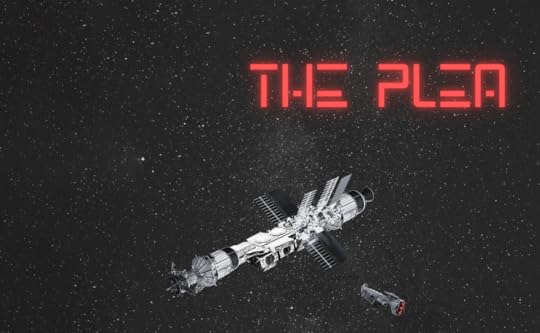
The PCs are hired to pick up a secretive shipment from an automated shuttle. The only problem? An experimental combat drone – the Synthetic Predator 1st Design, 3rd Revision (or SP-1D3R) – has stowed away on the shuttle to escape the facility where it was being tested. Desperate for energy, it begins draining the power systems on the PCs’ ship.
This is another good concept with shaky execution.
Designer Nikolaj Gedionsen describes the adventure as “a claustrophobic game of cat-and-mouse aboard a failing ship where an intelligent machine predator turns the crew’s familiar home against them.” Which sounds great, but immediately runs face-first into a ship map that’s entirely linear. It’s hard to play cat-and-mouse on a balance beam.
The Plea also frequently relies on overriding or ignoring the core rules of Mothership. In my experience, this sort of thing doesn’t work because the players get frustrated at the bullshit “threat” that’s arbitrarily being thrust upon them.
The adventure includes its own mechanical superstructure in the form of a Power Drain system (modeling and tracking the SP-1D3R taking over and depleting the ship’s systems), but I have a difficult time believing it was ever playtested. The core of the system boils down to:
Start with 12 Power.-1 Power when the drone connects to a system.If the PCs power down a section, it can’t be Power Drained and also save 1 Power per turn.The math just fundamentally doesn’t math here. Nonetheless, I’ve done several dry runs of the system using various interpretations of what it might have meant (did you mean -1 Power per turn? can the drone be attached to multiple systems simultaneously?) and it just doesn’t work.
All of these issues, I think, explains why a significant chunk of this adventure is a section called “The Vibe.” Ultimately, that’s a pretty good summary of The Plea: It’s a concept running almost entirely on vibes.
GRADE: D
TESSERACT
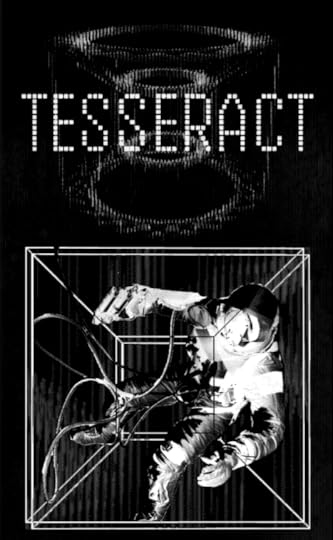
Pyry Qvick’s Tesseract initially threw me for a loop because (a) it’s called Tesseract (a cube extended into fourth-dimensional space in the same that a square is extended to become a cube in three-dimensional space) and (b) it features a bunch of non-Euclidean cube-shaped rooms. So my brain kept trying to make the adventure work as an actual tesseract… but it isn’t.
 Which is OK. I mention this only in the hope it might help you avoid the same pitfall and get straight to appreciating just how cool this adventure is.
Things kick off in Tesseract like this:
Your ship passes a massive metallic cube. After a moment, your ship passes by a massive metallic cube. Again and again. Your navigation shows no progress made.
On the cube’s surface, a hatch opens.
Crawling inside the cube, you discover a dozen of the aforementioned cube-shaped rooms, all arranged on a map that makes it easy for you to run as the GM, but devilishly complex for the players to unravel. (If they ever do.)
The rooms themselves are consistently themed, but each one is varied and intriguing. In addition to the navigational puzzle of the non-Euclidean map, exploring the cube is also deeply satisfying because the rooms present an interconnected mystery that allows the players to slowly piece together what’s happening here (and, hopefully, undo it). This is very much the adventure that Turn Black the Clock wanted to be, but dropped the ball on.
Season to taste with the creepy cube-droids which infest the place.
The net result is a creepy, well-designed adventure I am sure will leave your players disoriented, paranoid, and thrilled.
GRADE: B-
Rather than the trifold modules we’ve been reviewing, Dead Weight by Norgad is a twelve-page micro-adventure.
The PCs are crewing a cargo ship when an alien artifact in one of the ship’s holds activates, causing all dead bodies in the area to rapidly accelerate towards. It starts with all the meat in the ship’s galley, which rips through the crew currently eating dinner. The dead bodies of the crew, of course, are added to the mass of meat and bone, which rip through the hull of the ship, causing lockdown and atmospheric pressure doors to trigger throughout the ship.
As the investigation and emergency repairs begin, a crew member mortally injured in the initial incident dies, inflicting more damage… and that’s when corpses start arriving from outside the ship. Can the PCs figure out what’s going on and jettison the artifact before the asteroid the artifact was taken from arrives and annihilates the ship?
The concept of Dead Weight is elegant in its horrific simplicity. The execution is simply beautiful.
Just look at this map:
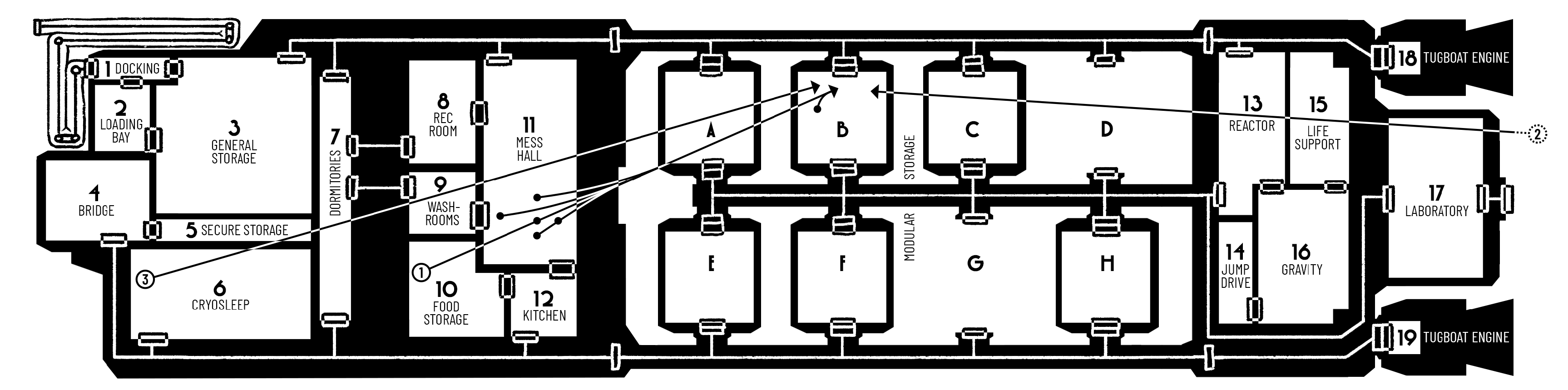
Each of the vectors here show the trajectory of damage from the scripted meat projectiles, and you can see how simple it would be to draw your own vectors and immediately understand the resulting damage as events play out at the table. This map is simply fantastic as both a reference and a structure of play, and Norgad has also included player handouts (without the GM-only info) that you can print out for the players.
The ship key itself is equally polished: Nested descriptions make it easy to master the adventure, while creating satisfying layers of investigation for the PCs. Clearly delineated post-incident shifts in the room descriptions make it a breeze to keep the potentially complicated continuity and dynamic environments of the adventure crystal clear in play.
I have only one quibble with the whole package: It’s not immediately apparent why the adventure track ends with the asteroid 98-Gobstopper crashing into the ships. Careful reading suggests that the asteroid – composed of “banded layers of oxygen, hydrogen, nitrogen, carbon, calcium, and phosphorus, with some other trace elements” – is actually the compacted remains of the countless dead attracted by the artifact at the asteroid’s core. But it would have been friendlier to the GM to just spell that out.
This quibble, of course, scarcely detracts from the whole package. Dead Weight went straight into my open table rotation. I adore it.
GRADE: B+

Ex-RPGNet Review: The Mortality of Green
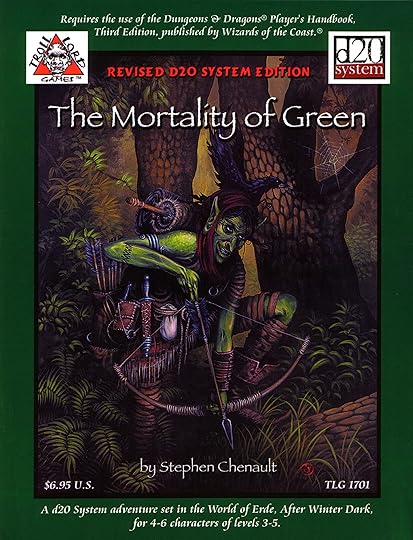
An excellent overland adventure, organized to make the GM’s task simple and the player’s experience memorable.
Original Review Posted May 21st, 2001
Before WotC’s OGL and D20 trademark license came along and allowed them to release products like A Lion in the Ropes and The Malady of Kings, Troll Lord Games was producing generic fantasy adventures. As with many products of their kind, the production values on these generic modules were weak. But in the case of Troll Lord, the modules were cheap enough to match those production values ($5), and the content itself was highly memorable (if sometimes in need of some fix-up work). These modules are now being updated to D20 (check out their website), and are – I think – worthy of your attention.
PLOT
Warning: This review will contain spoilers for The Mortality of Green. Players who may find themselves playing in this adventure should not read beyond this point.
One of these modules was (and is) The Mortality of Green by Stephen Chenault. Set within the Darkenfold Forest, The Mortality of Green focuses upon the Druidic Council’s efforts to recover the forest from the evil which has long possessed it. Although the task will be long and arduous, the Council is attempting to offer the denizens of Darkenfold hope by having Cornelius the White carry a sapling of the Great Tree to the woodsmen of Rangers Knot, who will plant it in a secret grove whose ground shall be sanctified. In turn, the grove (and sapling) will begin to heal the Darkenfold.
Unfortunately, deep within the forest lives a sentient tree named Gristlebones. Gristlebones is twisted, old, and corrupt. He sends one of his allies – Quagmire the Troll – to intercept Cornelius and steal the sapling. Which Quagmire does.
Enter the PCs, who stumble across the dying Cornelius – who attempts to extract an oath to recover the sapling and fulfill his failed mission. The PCs’ attempt to fulfill this oath will lead them throughout the Darkenfold as they seek to catch Quagmire before he can deliver the sapling to Gristlebones, who will corrupt its powerful magic for his own purposes.
STRENGTHS
When I was first being exposed to the adventures being produced by Troll Lord Games, I was immediately struck by the extremely memorable environments in which they were being set. All of them take place within the After Winter Dark campaign setting (which I have reviewed elsewhere on RPGNet). Despite this, however, their unique – and compelling – elements are still presented in a fashion which allows them to be inserted seamlessly into any sufficiently generic campaign world.
The Mortality of the Green, of course, is no exception to this. Stephen Chenault is very careful to present the Darkenfold in such a way that it is not simply rendered into the meaningless background noise of the stereotypical “evil forest”. The Darkenfold is given a specific character, history, and geography – playing upon familiar fantasy themes, but establishing itself as something memorable unto itself.
With his setting established, Chenault then proceeds to develop upon it an excellent overland adventure. As a general rule, I find that overland adventures generally have problems. Unlike a standard dungeon, the players are not tightly confined to a set of stone rooms – and, as a result, it’s all too easy for the PCs to simply start missing things. On the other hand, unlike scene-act structure, the overland adventure has a certain assumption of self-direction. The Mortality of the Green is also a chase adventure – in which the PCs are expected to track someone down. This provided yet another opportunity for the adventure to fall flat, because its all too easy to fall into the trap of designing such an adventure so that the entire thing will derail in the DM’s hands if a single tracking die roll (for example) is missed.
Fortunately, Chenault avoids the pitfalls – and the result renders the DM’s task simple, and the player’s experience memorable: The necessary possibilities are covered, the adventure responds with changing dynamics to the actions of the PCs, and the entirety is kept simple enough to be easily played.
Style: 3
Substance: 4
Author: Stephen Chenault
Publisher: Troll Lord Games
Line: D20
Price: $5.00
ISBN: 0-9702397-1-8
Product Code: TLG1101
Pages: 22
For an explanation of where these reviews came from and why you can no longer find them at RPGNet, click here.

November 25, 2025
Thought of the Day: Why D&D?
In the past few days I’ve been asked several times why I still play Dungeons & Dragons.
After all, I’ve criticized the rules, the adventures, the design, and even the company. So why am I still running and playing this game?
There are a bunch of answers to this question. In fact, part of the answer to the question is that there ARE so many answers to the question.
The most basic answer is the Arneson & Gygax designed one hell of a game, and with the exception of the most mangled edition of the game, D&D has never drifted so far that its core gameplay has become unrecognizable. There was a time, back in the ’90s, when, so frustrated that my house rules for AD&D had become longer than the core rulebooks themselves, I did give up on D&D for a while, wandering off in pursuit of the One True Way of Gaming. I’ve since learned that there is no One True Way of Gaming, which makes it easier to appreciate D&D for what it is instead of dwelling on everything it isn’t.
Another answer is, in the words of Ryan Dancey, network externality: There are a lot more people who want to play D&D than there are people who want to play any other RPG you’d care to name. It’s just easier to recruit players for D&D and, if I’m looking for a group to play in, I’m statistically more likely to find a group playing D&D. This matters less to me than it used to: After years of running open tables, I’ve recruited a large network of players I can tap into regardless of what system I’m running. (For example, I’ve had little or no difficulty getting players for my new Mothership-based open table.) But you can never completely escape D&D’s gravity well: I’m currently setting up a Heroes of the Borderlands table for my daughter and some of her friends who are desperately interested in playing D&D for the first time. I could try to run something else for them, but I’m not going to tell a bunch of kids to NOT be excited about the game they’re already excited about.
My own familiarity with D&D and its milieu has its advantages. Not only do I like D&D-esque fantasy in general, but my immense experience prepping and running D&D adventures means that I have a very large “bag of stuff” (as Robert Conley puts it) that makes it a lot easier for me to create and improvise stuff while playing D&D.
(This can actually be a double-edged sword if you’re not careful: Yes, I have a finely honed sense of what D&D-eseque fantasy means to me. But that can also be a creative rut that makes it difficult to break out of those tropes. Even with conscious effort, it can be easy to fall back into that rut, specifically because of the comfort and confidence it affords.)
This, of course, would apply to any of the many D&D-adjacent RPGs that are out there. But as a professional RPG designer, it’s also frequently important for me to stay tuned into the industry leader. I’ve had people ask me, for example, why So You Want to Be a Game Master assumes that the reader is most likely interested in running D&D and only pivots to discussing other systems in earnest after the newbie has gotten their feet under them. And the answer, of course, is that this is just the reality of things. D&D remains not only the primary gateway to the RPG hobby, but can still be relied on as a universal touchstone. (To the degree that, when I discuss other RPGs or RPGs in general in my writing or my videos, I not infrequently get comments from people confused because they think D&D is the only RPG in existence.)
(This need to stay in-tune with the current edition of D&D can be another double-edged sword for me. I’d probably have enjoyed several of the D&D 5th Edition games I’ve run over the years more if I’d house rules them more aggressively.)
D&D’s dominance, particularly in the 3E/5E OGL era, also means that D&D is blessed with bountiful source material. For example, when I was working on The Vladaam Affair last week and needed stat blocks for the archmages of the Red Company of Magi, all I needed to do was hit up Volo’s Guide to Monsters. I’ve talked in the past about looting bestiaries and trawling published modules when doing adventure and campaign prep. It’s something that very few other games even come close to achieving.
(This is something that I wish more RPGs would try to provide in a targeted fashion. Not only do I think published adventures are essential for an RPG, but modular components designed to be plugged into prep are vital. For example, Eclipse Phase produced a supplement called NPC File 1 which was just a collection of supporting cast stat blocks. It was literally a game changer for running Eclipse Phase games, because it was so effective at speeding up prep and enabling improvisation when the players jagged off in an unexpected direction. But, unfortunately, they never released a sequel and have never updated the NPC File for 2nd Edition.)
To make a long story short (too late), I really don’t see a time in my future when D&D won’t be part of my life.
Recently, though, I have been giving some long, hard thought to my relationship as a consumer (and reviewer) of Wizard of the Coast’s official D&D books. During the November meeting of 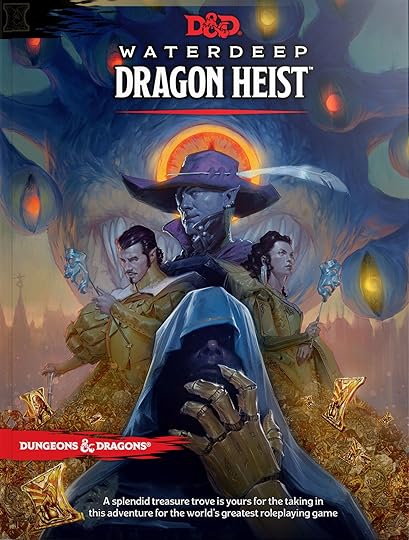 the Alexandrian Hangout Club, I was asked if I would be reviewing Forgotten Realms: Adventures in Faerun. This was a particularly interesting release because it included 50+ one-page adventures, which definitely sounds like more jam. The only problem? I flipped through the book at my local game store and saw that, like other recent releases, many of the dungeon maps aren’t properly keyed. And that was only the most obvious failure in basic adventure design. (For a deeper dive, take a peek at Questing Beast’s recent video.)
Although I came somewhat late to D&D 5th Edition (finally getting sucked in by the intriguing promise of Dragon Heist), a combination of reasonably paced releases, financial security, and professional interest made it the first time that I lived out my childhood dream of buying every official D&D book as it came out. But I think that time is coming to an end. I may still be playing and running D&D 2024, but I think this revised edition is also a great jumping off point for me.
Will I be back some day? Probably. Last time I jumped off official D&D as a consumer was back in 2008, and I was gone for a decade. I have high hopes I’ll be back sooner this time. There’s new leadership at Wizards of the Coast, and perhaps we’ll see them right the ship over there.
Or perhaps not.
But either way: Good gaming!

November 24, 2025
Ptolus: Running the Campaign – Laying Groundwork
DISCUSSING
In the Shadow of the Spire – Session 48B: The Fall of Tepal
The biggest story of the morning hours had been a mysterious fire in the Guildsmans’ District – an apartment building on Storm Street had burned to the ground in flames that witnesses reported to be a bright, phosphorescent blue (leading authorities to suspect magical arsonry).
But that news was being rapidly forgotten by the larger story sweeping across the city: An army had marched out of the Southern Desert, taken the city-state of Tepal by surprise, and sacked it.
Nasira was taken aback by the news. Learning that the news had arrived in Ptolus on three refugee ships she headed towards the docks. Speaking with passengers from the ships, however, she could discover little in the way of detail: The ships had sailed free just as the city was falling, and they could tell her nothing about the fate of her temple or the city itself once it had been taken.
At the beginning of this session, the PCs were visited by Talia and Marcus Hunter, delvers interested in exploring a section of Ghul’s Labyrinth which the PCs had previously discovered earlier in the campaign.
The Hunters are from Dark Tidings, an adventure by Monte Cook that was published back in 2009. In the original module, the PCs are hired by friends of the Hunters who want the PCs to save the Hunter expedition, which has gone missing in the Dungeons beneath Ptolus. If the PCs take the job, they’re given a full briefing on the back story, a map of the Dungeon area where the Hunters disappeared, and a list of the members of the Hunter expedition.
It’s a fun adventure and I wanted to incorporate it into the In the Shadow of the Spire campaign. One option, obviously, would be to run the scenario hook as written: The Hunter’s friends show up out of the blue and want to hire the PCs.
Instead, what I’m doing in this session is laying groundwork for the future adventure.
First, I’ve performed a campaign stitch: The Hunters aren’t going to disappear in some random section of the Dungeon. Instead, their explorations will be directly connected to the actions of the PCs. This means that I can also use Dark Tidings to answer the lingering question of what lies beyond one of the bluesteel doors in the Laboratory of the Beast. Plus, it lets me develop the Delver’s Guild and its inner workings a bit (with the delving contract), while also packaging up a unique, flavorful reward for the PCs (in the form of earning a percentage of the Hunter’s delving haul). All of which is also, conveniently, a great way to get the players invested in the fate of the Hunter party.
Second, of course, I’m setting up a reason for the PCs to be hired to save the Hunters when they go missing later in the campaign: It’s a section of Ghul’s Labyrinth they’re already familiar with, making them uniquely qualified for the job. There’s nothing wrong with random patrons popping up out of the blue to offer the PCs jobs on the basis of nothing but their reputation, but I’ve generally found it more effective when you can make things a little more personal. Not only does this make the campaign feel cohesive, it also means that the player’s choices have weight. (We tried to save the missing child at Greyson House, which led us to explore Ghul’s Labyrinth. We cleverly discovered a password which allowed us to discover the Laboratory of the Beast. We tried to sell the rare treasures we discovered there, which led to the deaths of the researchers from House Erthuo and, much later, the Hunters approaching us.)
Sometimes this sort of stuff will just organically happen during play. Sometimes, though, you need to look ahead and set things up. This doesn’t necessarily mean you need to have everything prepped ahead of time: You just need a general idea of what an upcoming scenario might look like. In this case, I’m setting up a published scenario, but we could just as easily imagine an original scenario where the only thing I really know is that (a) an adventuring party will approach the PCs and (b) will later go missing in order motivate further exploration of Ghul’s Labyrinth.
Published adventures, unfortunately, often overlook this type of groundwork. Since the author doesn’t know the particular details of your campaign, it’s easiest to have everything about the scenario arise from a tabula rasa. I think this is a mistake, though, and in my own work, as well as my work as an RPG Producer at Modiphius and Atlas Games, I emphasized the importance of including Groundwork tools that GMs could use to set up published scenarios in their own campaigns. (See Design Notes: Scenario Tools for more details on this.)
Regardless of what published adventures may do, however, as GMs I think we should always be looking fore these opportunities in our own campaigns.
In the case of the Hunters, the payoff for this groundwork would come eight sessions later., and the PCs wouldn’t actually go after the Hunters until Session 62, a full year and a half later in real time.
Sometimes you need to plant those seeds deep.
In fact, this sessions also features groundwork for a completely different adventure, with the Fall of Tepal being connected to multiple future scenarios.
Campaign Journal: Session 48C – Running the Campaign: Undead for Effect
In the Shadow of the Spire: Index

In the Shadow of the Spire – Session 48B: The Fall of Tepal
IN THE SHADOW OF THE SPIRESESSION 48B: THE FALL OF TEPAL
January 9th, 2010
The 26th Day of Kadal in the 790th Year of the Seyrunian Dynasty
With the negotiations finished at long last – and satisfied that they had made a good deal (while doing their best to protect the Hunters from the horrors of the Labyrinth and vice versa) – they headed downstairs and grabbed some newssheets.
The news was actually in the middle of a sharp shift: The biggest story of the morning hours had been a mysterious fire in the Guildsmans’ District – an apartment building on Storm Street had burned to the ground in flames that witnesses reported to be a bright, phosphorescent blue (leading authorities to suspect magical arsonry).
But that news was being rapidly forgotten by the larger story sweeping across the city: An army had marched out of the Southern Desert, taken the city-state of Tepal by surprise, and sacked it.
Nasira was taken aback by the news. Learning that the news had arrived in Ptolus on three refugee ships she headed towards the docks. Speaking with passengers from the ships, however, she could discover little in the way of detail: The ships had sailed free just as the city was falling, and they could tell her nothing about the fate of her temple or the city itself once it had been taken. Worse yet, the descriptions of the army made it clear that it was the Atapi who were responsible.
In confusion, Nasira retired to her room at the Ghostly Minstrel to meditate and pray, finding nothing in her thoughts to reconcile the sudden war-like change in the Atapi.
THE TALE OF GISSZAGGAT
Tee and Agnarr, meanwhile, were taking the crates from Mahdoth’s to the disposal site in the Temple District. Then they dumped the drakken’s body and fenced the loot they had collected from Mahdoth’s and the would-be assassins.
Ranthir, of course, spent the day studying (as was his wont).
Tor took Blue down to the Wings Falls. Riding down the long, mossy slant of Blue Street he quickly learned where it had gotten the name: The thick, watery mist cast up by the raging falls filled the air and turned it blue – in fact, blue rainbows were cast prismatically through the air.
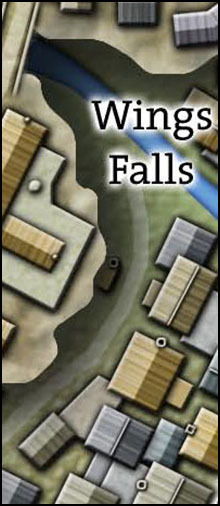 Wings Falls itself proved to be a six-tiered step falls where the King’s Gorge narrowed into the ravine which carried the river between Midtown and the Temple District. The water sped up through the narrow pass and almost leapt over the steps of the falls. The falls took their name particularly from the uppermost step, where the water divided itself around an obelisk of harder, uneroded stone – leaping up and around it the water arched to form two “wings” that seemed to beat and dance through the air as if they would lift the entire river in flight.
While Tor frolicked in the mists, Elestra was trying to find some hint of the Haven of Gisszaggat. Following the Voice of the City she was guided to a small, worn-down shrine tucked into a nook of the Temple District.
Within the shrine she found an elderly, robed priest sitting in cross-legged prayer before a meditation flame. When she asked him of Gisszaggat, his eyes widened. “The tale of the demon Gisszaggat has been long forgotten save in a single tome.”
He told her the story: More than 700 years ago, in the days before the city had descended down from the cliffs of Oldtown, the demon Gisszaggat had risen from the caverns beneath the city. It had plagued the city and single-handedly laid siege to it. “It was written that Gisszaggat had never truly been defeated, but in pain and suffering he retreated back into the caverns beneath the Plain of Ptolus.”
“The Plain of Ptolus?”
“The vast expanse of grassland between the cliffs of the old city and the Docks by the sea.”
In other words, the area now inhabited by the Midtown and the markets and the Temple District.
Elestra thanked him, tipped him a gold, and then returned to her room. There, putting Gisszaggat far from her mind, she set herself to the task of studying an anti-poison spell from the Masks of Death that she hoped would prove effective against the corpse flowers or other deadly vegetation to be found in Alchestrin’s Tomb.
ENTERING THE TOMB OF ALCHESTRIN
They met outside the gates of the Necropolis about an hour before sunset. They were met with some suspicion by the Keepers of the Veil, but eventually allowed entry. (Although they were sternly cautioned that no one would be allowed to leave the Necropolis after sunset.)
They reached Darklock Hill and Alchestrin’s Tomb without difficulty, but as the sun set spectral howls echoed from the northern end of the Necropolis. These grew closer and more frequent as they worked, and shortly after the second moon rose they saw a torchlit procession some distance away to the west.
The plug itself turned relatively easily, but leveraging it out proved quite time-consuming. It took them the better part of half an hour to finally breach the Tomb. A twisting stair of stone curled its way down through the iron shaft into which the plug had been set.
They followed Tee down into the stygian gloom, which seemed to encroach unnaturally upon their lights.
Running the Campaign: Laying Groundwork – Campaign Journal: Session 48C
In the Shadow of the Spire: Index

November 22, 2025
Ex-RPGNet Review: After Winter Dark – A Fantasy Campaign Setting
This is a product you shouldn’t ignore. Read the review. No, really: Read the review. I’m not kidding.
Review Originally Posted February 12th, 2001
After Winter Dark, I’m afraid, is one of those products which – if you saw it on the shelf at your game store – you would promptly ignore. I mean, it’s got three strikes against it:
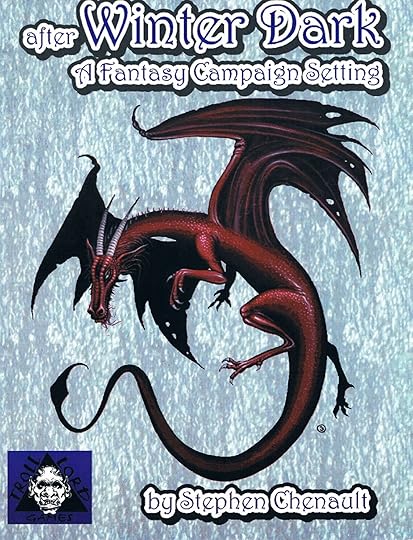
It’s from a company you’ve never heard of before.The cover, while having a very nice picture of a dragon on it, still comes across as very amateurish in its overall composition and structure.It’s a generic fantasy campaign.Whoa! Hold on there! Don’t hit the “back” button on me quite yet! Keep reading!
After Winter Dark is, thus, one of those products which is truly fun to review, because you know that you have the chance to let people know about an outstanding product which they might otherwise miss.
So give me – and After Winter Dark — a chance to change your mind.
WEAK POINTS
Let’s get these out of the way first: Yes, the cover has a certain taint of amateurism. The interior art is reproduced too darkly. And the two maps (one of the geographical forms and the other for the sociopolitical boundaries – a nice touch, by the way) are organized numerically, while the text is organized alphabetically (making it difficult to cross-reference between them).
After Winter Dark is also only 24 pages long – which isn’t so much a fault in the grand scheme of things (because, at $5, that makes it a far better deal than the comparable product on the market, the D&D Gazetteer), as it is a fault because I want more.
Okay, those are the downers. It’s all uphill from here.
HISTORY
The After Winter Dark campaign setting is placed upon the world of Erde. The story of its creation is fairly typical in all but the details: The All Father brought the world into existence, and during the Days Before Days all creatures knew his mind – even the Great Dragon Frafnog who, today, is the only being which remembers this ancient time. Given eternity, however, the All Father grew weary of his creation and allowed the dwarves to enter it – and the dwarves did not know his mind, and their empire grew great. Some of the dwarves settled far from their brethren and lived wholly above ground, eventually becoming the thirteen tribes of man. And the Great Trees still wandered wild, and the Dragons made their nests across the world, and for three hundred centuries Erde thrived beneath the light of the sun.
Then the Goblins came – from whence, no one knows (although there are whispers of dwarves forever twisted and corrupted by the dark and evil of the deep). The terrible sorcery of the goblins made war upon the dwarfs, and the Goblin-Dwarf Wars stretched across four millennia – smashing the world of the Days Before Days into chaos. In the final days of the wars, the goblin sorcerer Ondluche worked powerful magic in an attempt to undo the dwarves – but the magic went awry, and the mind of the All Father was broken, opening gates into all of his imaginings. Thus the multiverse was born, and a host of new creatures sprang into the world. From the All Father’s purest thoughts came the Faerie, but there were also darker things – demons and orcs and, worst of all, the All Father’s Nightmare: Unklar.
The Age of Dwarves came to an end, with the great societies of both dwarf and orc smashed back into a primitive state by their self-destructive war. And thus the Age of Man began. From their “shallow roots in the distant north, the thirteen tribes of men grew.” The tribes became kingdoms, and the greatest of the kingdoms became the Empire of Aenoch. Then the Empire decayed, and the Middle Kingdoms arose in its place. This was the Age of Heroes – when “men, elves, and dwarves battled the evil remnants of the Old Empire, and heroes, like Aristobolus the White, Luther the Gallant, Daladon Half-Elven, and the monk Jaren ruled the day”.
But the Age of Heroes was doomed to end in tragedy: Sebastien Oliver I, “last of the House of Aenoch”, summoned forth the “last breath of the Days Before Days”. Using vile sorcery he summoned forth Unklar from the Paths of Umbra, and Unklar slew Sebastien and for forty years made war upon the land – bringing all the world beneath his heel: “In the last only the Kingdom of Kayomar stood alone against him and his vile folk. But in the Catalyst Wars, they too were thrown down and their last King, Robert Luther, slain, and with him, Jaren the monk. Only the Great Tree avoided Unklar’s touch for it hid in the deeps of the Eldwood, on the edge of the world. There, servants of the Oak under the ranger lord Daladon struggled on through the long years of the millennial darkness. Jaren, taken to Aufstrag, languished there for a millennium.”
Thus came about the Age of the Winter Dark – when Unklar ruled with an iron fist, and a shroud of mist obscured the sun and brought eternal winter upon the land. Then, “in the 1019th year of Unklar’s reign the Winter Dark Wars began”. Unklar’s power had waned, and his opponents gathered about the Great Tree – Aristobolus returned from the Land of Shade and Chaos, Luther from the Sea of Dreams. Jaren was freed, Dalodon half-elven and Dolgon (the last dwarven king of Grundliche Hohle) came as well. “In the 1030th year of Unklar’s reign they stole into his throne room and cast him from the plane.”
That was sixty years ago.
This, then, is the world of After Winter Dark: There is just the faintest scent of Elric here, as the Young Kingdoms begin to build anew beneath a lingering shadow upon the remnants of an ancient past.
THE WORLD TODAY
It was the history of the After Winter Dark campaign which first caught my attention. You know that something is being done right if you are immediately enraptured with era after era of a world’s history: I can easily see myself setting entire campaigns in the time of the Goblin-Dwarf Wars, the Empire of Aenoch, the Age of Heroes, the Age of Winter Dark, or the Winter Dark Wars – not to mention the Young Kingdoms which are actually detailed in this pamphlet.
After Winter Dark takes the familiar, twists it just enough to make it its own, and then adds that ineffable quality of the epic which can take the ordinary and make it exceptional. In short, I was excited — and that’s worth $5 right there.
Erde’s cosmos and calendar are described, then its people and languages, followed by the gods and divine orders, and then the guilds and other organizations of the world. Finally, the individual lands are given brief descriptions (including their Lord, Capital, History, and Modern Classification). Finally, the major geographical and terrain features of the world of Erde are described.
The actual detail of the world, although sparse (as the format would suggest), is no less exciting than the history. A few examples.
Aufstrag. “Fell Unklar, brooding in fear, roused himself and fortified his Keep. Rending the earth with his great axe he cleaved huge rifts about the Imperial castle of Old Aenoch, and with sorceries created great pools of water and pestilence to cover the rent lands. And all of Aenoch between the rivers Udunilay and Uphrates was made a swamp of fell death.” Aufstrag was once the mighty stone citadel of Unklar’s rule – “in time of years the place became a cesspool of all things vile; tunnels, great and small, fanned out beneath the halls into the rock of the world, towers and buttresses rose into the sky, and the city sprawled out over hills”. The halls of Aufstrag have fallen into decay now, but Coburg the Undying – one of Unklar’s unvanquished lieutenants – is rumored to lurk within its massive halls, plotting for the day that he will reclaim his power.
(In my opinion, Aufstrag is simply a wonderful excuse for an elaborate dungeon. And I really hope that the Troll Lords return here some day with a product which will explore its dark depths in detail.)
Grundliche Hohle. The Deep Halls, as it is known in the tongues of men, is the oldest of the dwarven realms. Unklar opened it to the darkness and slew or enslaved Angrod’s people. Eventually, though, Dolgan – the last king of Grundliche Hohle – rose up from the slave pits and helped defeat Unklar. Now the dwarves have returned here, to reclaim their ancient land.
The Shelves of Mist. “These gently rolling, forested hills, north of the Darkenfold, are home to all manner of fantastic creatures. The many creeks and small lakes lend to the banks of mist which seem to forever hang over the shelves. ‘Tis said that these hills harbor the gates of Vakhund, doorways to other worlds.”
The Detmold. “An old and dark forest. Its short thick trees grow close together and crowd the northern road. It is said that Queen Ephremere of Aachen became one with the Unicorn here.”
Even in the brief span of 24 pages, it becomes clear that what truly helps After Winer Dark excel is the attention to detail: Specifically, Stephen Chenault has crafted a world in which every detail has been dipped in the fantastic and awe-inspiring. The mountains of Erde have a history; the hills echo with the ring of magic; the rivers flow from springs of time immemorial; and the entire world seems harmonized to an ancient, evocative song. If you can take nothing else from this product, you can take the rich elements from which it has been built and use them to spice your own campaigns.
This is a world of fantasy, above all, which deserves a much more detailed presentation. But, until that happens, we will have to content ourselves with After Winter Dark.
COMMERCIAL DETAILS
A full color poster map (21” x 32”) of the world of Erde is sold separately, also for $5. It is well done for the price, and I honestly can’t imagine using After Winter Dark without owning a copy. Check it out.
After Winter Dark and the After Winter Dark Fantasy Campaign Setting 21” x 32” Map can be ordered directly from Troll Lord Games or from Wizard’s Attic. Both of these have also been packaged with the CD-ROM editions of The Fantastic Adventure, Mortality of the Green, and A Lion in the Ropes for the low price of $10. I have reviewed The Fantastic Adventure, and will be reviewing The Mortality of Green and A Lion in the Ropes in the near future.
Style: 3
Substance: 4
Grade: B+
Authors: Stephen Chenault
Company: Troll Lord Games
Line: Sword & Sorcery
Price: $5.00
ISBN: 0-9702397-0-X
Production Code: TLG 1001
Pages: 24
This campaign setting has been vastly expanded and released as After Winter Dark: The Codex of Aihrde , but there is something still incredibly appealing about the slim, 24-page version I first read 20+ years ago.
This review nearly went astray. It somehow slipped through my original archiving of these reviews and, although I recalled reading After Winter Dark, I had actually remembered NOT reviewing it. (I think because I wrote half of a never-finished review of a later Troll Lord Games campaign supplement.) It was only because a review that will be reprinted next month mentioned that I had written a review of After Winter Dark “that could be found elsewhere on this site,” that I realized something was amiss.
Thankfully, I was still able to track down a copy of the review. And here it is!
For an explanation of where these reviews came from and why you can no longer find them at RPGNet, click here.