Arley L. Dial's Blog
July 11, 2016
At what cost progress?
Those who have read my novels might have noticed the recurring theme of recognizing the price that has been paid for progress. While I have been accused of being a luddite in my time, I certainly think that any price we have paid is well worth it. The ability to refrigerate food alone is probably worth any damage (real or perceived) that it has done to society.
That being said, I shall now begin my weekly ridiculous diatribe. If you are one of the half-dozen or so people who read this blog last week, you saw me praise Edgar Rice Burroughs's John Carter of Mars novels and specifically mention the strong female characters. While I appreciate a strong female lead like Thuvia, and love the fact that we see them more and more in today's media, I have to wonder what happened to the John Carter type?
Many people scoff or roll their eyes when I say that my favorite literary character is Howard's Conan of Cimmeria. A second favorite of mine is Flemming's James Bond. Both characters are often disregarded as one dimensional brutes who solve every problem with physical violence. Folks who take this view might have a point, but I ask you: Is that so bad? We have progressed as a society to the point where sensitivity and critical thinking are lauded (as they should be) but let us not forget that many of the major problems throughout history have been solved by men of action.
I am not advocating cracking fools over the head with a sword, but I fear the day that direct action has been driven so far from our collective consciousness that we become as soft as the people in Robert Howard's poem A song of the Naked Land:
"But our brothers still dwell in the sun-seared wasteAnd their sons are hard and lank;They will hunt the wolf-pack that we chased,And drink the water we drank.
They will know the hungers we once had,While the stream of centuries runs,Till they burst from the desert, hunger-mad,To slaughter our slothful sons."
Robert E. Howard
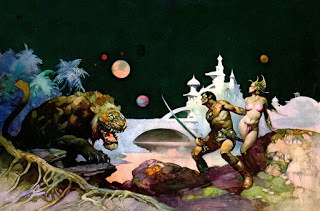
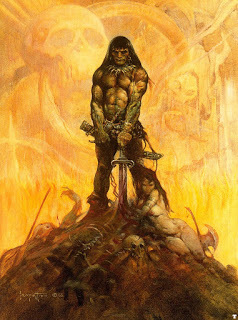 as always, quotes and images used without permission. Come and get me coppers! But seriously, art by the late great Frank Frazetta, natch!
ad
That being said, I shall now begin my weekly ridiculous diatribe. If you are one of the half-dozen or so people who read this blog last week, you saw me praise Edgar Rice Burroughs's John Carter of Mars novels and specifically mention the strong female characters. While I appreciate a strong female lead like Thuvia, and love the fact that we see them more and more in today's media, I have to wonder what happened to the John Carter type?
Many people scoff or roll their eyes when I say that my favorite literary character is Howard's Conan of Cimmeria. A second favorite of mine is Flemming's James Bond. Both characters are often disregarded as one dimensional brutes who solve every problem with physical violence. Folks who take this view might have a point, but I ask you: Is that so bad? We have progressed as a society to the point where sensitivity and critical thinking are lauded (as they should be) but let us not forget that many of the major problems throughout history have been solved by men of action.
I am not advocating cracking fools over the head with a sword, but I fear the day that direct action has been driven so far from our collective consciousness that we become as soft as the people in Robert Howard's poem A song of the Naked Land:
"But our brothers still dwell in the sun-seared wasteAnd their sons are hard and lank;They will hunt the wolf-pack that we chased,And drink the water we drank.
They will know the hungers we once had,While the stream of centuries runs,Till they burst from the desert, hunger-mad,To slaughter our slothful sons."
Robert E. Howard
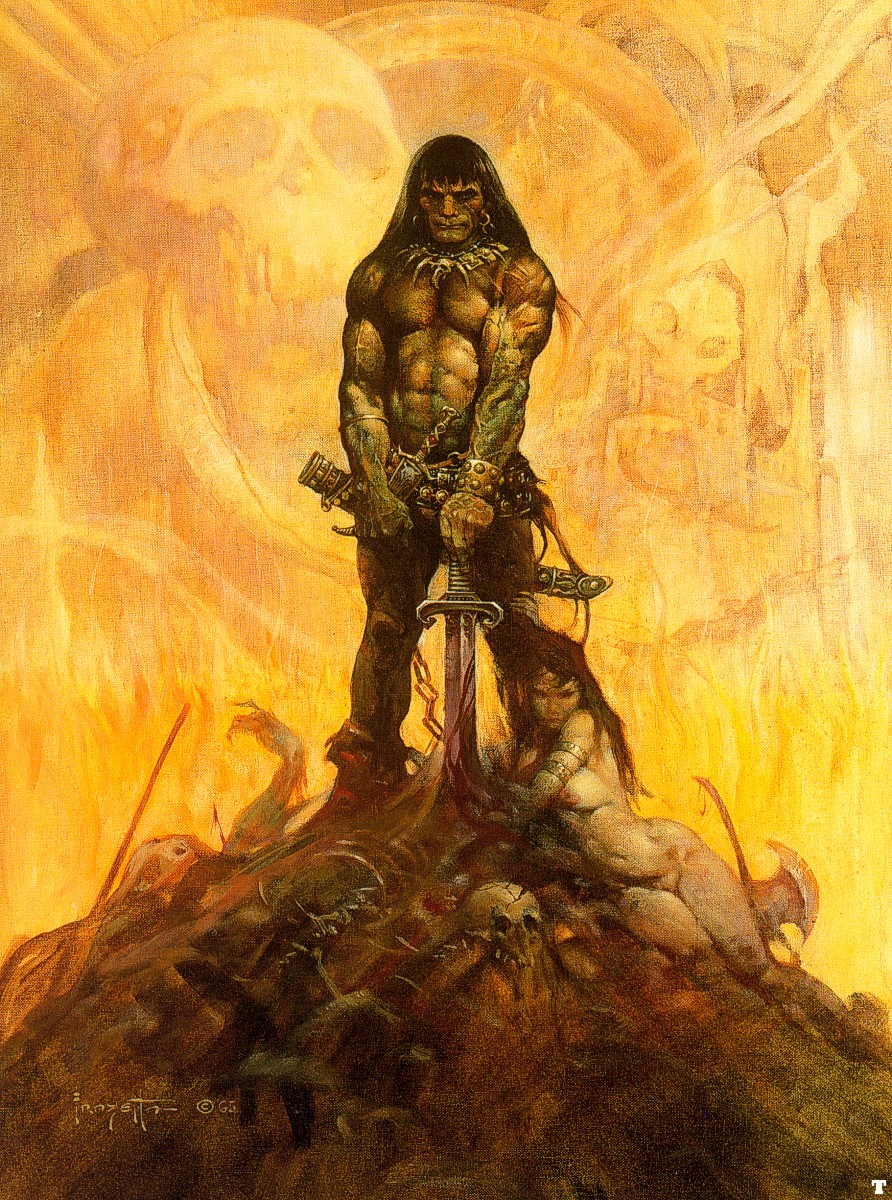 as always, quotes and images used without permission. Come and get me coppers! But seriously, art by the late great Frank Frazetta, natch!
ad


July 3, 2016
The oldies are goodies
I have enjoyed many books written before I was born. Some are well-known classics (Lord of the Rings, etc.) and some have been less widely read (Romer's Fu Manchu series.) The men and women who wrote close to a century ago did so with a tone and sense of romance that is difficult to find in contemporary works. The haunting dread of Lovecraft, the relentless action of Howard, and the sere wit of Twain are hard to find. Every time a find a new body of work that is written in such an elevated style, and untainted by our twenty-first century social norms, I feel blessed. Edgar Rice Burroughs's John Carter of Mars series is the most recent such blessing.
With the lofty elegance of tone mentioned above, Burroughs recounts the tale of one John Carter of Virginia as he is transported to the planet Barsoom (Mars) and has various adventures. The first three novels in the series are told from the first person perspective, and though the story sometimes strains under the weight of such a restricted point of view, I found it easy to envision Barsoom through the eyes of a confederate veteran of the American civil war. I hesitate to give any more information lest I ruin the story for those like me who have gone their entire lives without reading this fantasy classic.
John Carter is a man who is unapologetically drawn in heroic proportions. Deja Thoris, the female love interest displays all of the qualities of a strong female character, which is somewhat surprising considering the time in which the stories were written. I have read books published in the 1960's which depicted females with far less depth than Burroughs did fifty years before (I'm looking at you, Ian Flemming.) Descriptions of the differing races populating the Martian surface show none of the racism which often salts older works of fiction (Sax Romer, I see you trying to slink out the back). Instead, Burroughs offers us a look at strange races which have their own identities and a truly alien perspective. The fantastic locations and impressively developed world always leaves me guessing as to what will happen next. Say what you will about the stories, formulaic they are not.
As you can see, I give the John Carter of Mars series two thumbs up. I only wish I was a Thark so I could make it four! If I were to work diligently for the next fifty years. I despair that my own stories will ever be half so good. Until next time, Kaor!
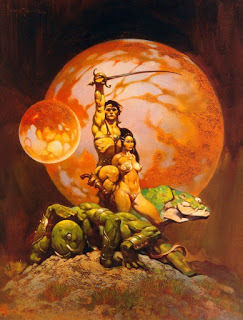
With the lofty elegance of tone mentioned above, Burroughs recounts the tale of one John Carter of Virginia as he is transported to the planet Barsoom (Mars) and has various adventures. The first three novels in the series are told from the first person perspective, and though the story sometimes strains under the weight of such a restricted point of view, I found it easy to envision Barsoom through the eyes of a confederate veteran of the American civil war. I hesitate to give any more information lest I ruin the story for those like me who have gone their entire lives without reading this fantasy classic.
John Carter is a man who is unapologetically drawn in heroic proportions. Deja Thoris, the female love interest displays all of the qualities of a strong female character, which is somewhat surprising considering the time in which the stories were written. I have read books published in the 1960's which depicted females with far less depth than Burroughs did fifty years before (I'm looking at you, Ian Flemming.) Descriptions of the differing races populating the Martian surface show none of the racism which often salts older works of fiction (Sax Romer, I see you trying to slink out the back). Instead, Burroughs offers us a look at strange races which have their own identities and a truly alien perspective. The fantastic locations and impressively developed world always leaves me guessing as to what will happen next. Say what you will about the stories, formulaic they are not.
As you can see, I give the John Carter of Mars series two thumbs up. I only wish I was a Thark so I could make it four! If I were to work diligently for the next fifty years. I despair that my own stories will ever be half so good. Until next time, Kaor!

June 26, 2016
Why am I here?
"Writing a novel is a lot like crossing the Atlantic in a bathtub: There's a lot of room for self doubt."
-Stephen King-
Many times (usually about forty thousand words into writing a book) I get the feeling that whatever I am writing is the worst thing that was ever vomited out on a page, and represents the low point in English literature.
When I reach the doldrums, I begin to wonder why I write novels. Why am I spending all of my free time grinding out thousands of words worth of nonsense when I could be fishing? This happens so consistently that I have developed a defense against the blues, and I thought I would share it today with the three people who actually read this blog.
Books have been one of the subtle blessings in my life. No novel will fill the pantry or the gas tank. There has never been a story that was so good that it cured some horrifying disease. But the major crises of life have their own solutions. What sometimes lacks treatment are the tiny stresses and disappointments that snowball over the course of the day or the week.
It was these tiny stresses that books relieved when I was a young man. When the American luxury problems piled up, and I began to feel overwhelmed, I could pick up a book and go somewhere else for awhile. Finding a date for prom doesn't matter when Gus is riding out to save Lorena. Trying to pass a test that I haven't the time to study for is irrelevant when James Bond has been taken captive by Dr. No. The family problems which shall not be named could be put off till after Gotrek Gurnisson has stemmed the tide of beastmen swarming over Altdorf.
Considering how great this blessing has been for me, I like to think that my work can offer some small bit of relief to those who enjoy my novels. I have derived so much comfort from the authors that I love, I am proud to do the same for others. So as you struggle against the current of life this week, take the time once in a while to step back and open a book. As for me, I had better go and check on Thuvia The Maid of Mars, she was in a pretty tough spot when I left her.
-Stephen King-
Many times (usually about forty thousand words into writing a book) I get the feeling that whatever I am writing is the worst thing that was ever vomited out on a page, and represents the low point in English literature.
When I reach the doldrums, I begin to wonder why I write novels. Why am I spending all of my free time grinding out thousands of words worth of nonsense when I could be fishing? This happens so consistently that I have developed a defense against the blues, and I thought I would share it today with the three people who actually read this blog.
Books have been one of the subtle blessings in my life. No novel will fill the pantry or the gas tank. There has never been a story that was so good that it cured some horrifying disease. But the major crises of life have their own solutions. What sometimes lacks treatment are the tiny stresses and disappointments that snowball over the course of the day or the week.
It was these tiny stresses that books relieved when I was a young man. When the American luxury problems piled up, and I began to feel overwhelmed, I could pick up a book and go somewhere else for awhile. Finding a date for prom doesn't matter when Gus is riding out to save Lorena. Trying to pass a test that I haven't the time to study for is irrelevant when James Bond has been taken captive by Dr. No. The family problems which shall not be named could be put off till after Gotrek Gurnisson has stemmed the tide of beastmen swarming over Altdorf.
Considering how great this blessing has been for me, I like to think that my work can offer some small bit of relief to those who enjoy my novels. I have derived so much comfort from the authors that I love, I am proud to do the same for others. So as you struggle against the current of life this week, take the time once in a while to step back and open a book. As for me, I had better go and check on Thuvia The Maid of Mars, she was in a pretty tough spot when I left her.

June 18, 2016
Shifting Gears
After the recent release of Mexican Silver, I decided it was time for a change. I have enjoyed working on westerns and historical fiction, and in the process learned more than I ever have before about the history of the west. However with five books of that genre under my belt, I thought I might try something new.
New to my writing career, but not new to me however. At the tender age of ten or eleven, my mother bought me a book of stories about King Arthur and the Knights of the Round Table. That was the start of a lifelong love of the fantasy genre. After King Arthur, came the The Hobbit, the TSR books, and literally hundreds of other fantasy and scifi novels that I consumed voraciously. Even now, I am working my way through the John Carter of Mars series, and loving every minute of it.
It might seem like a major shift to switch from the western to fantasy genres, but I argue that the two are quite similar. The larger than life heroes, wielding weapons of awesome power, terrible struggles against the elements and deadly creatures, and fantastic settings populated by exotic peoples are elements that both genres have in common. In my own work, the careful reader might find parallels between certain characters in Plews and classic characters from fantasy novels (Fenelon, I'm looking at you.) Thomas Ammondale, the unseen villain in A Warrior's Elegy, was even named after the wizard Thoth Amon as an homage to the great Robert Howard.
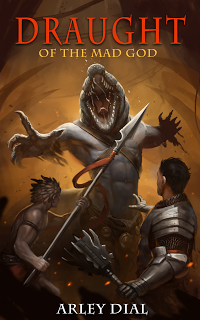
With the explanation for the switch out of the way, I would like to give some insight into my plan going forward. The first fantasy novel I released, Draught of the Mad God, was patterned after the pulp fantasies that struck my fancy as a young man (and still do today!) My second work, which is in progress now, will be a more in depth and complicated story along the lines of an epic fantasy. Both pieces take place on the same world, though on different continents. Each book will be the beginning of a series, and I hope to release books from each series alternately.
I hope that you will all enjoy this journey half as much as I think I will. I will (hopefully) be blogging about my process on a weekly basis, and I would love to hear any feedback or questions you might have. As always you can find me on Facebook, Twitter, and Goodreads. Just put my name into the search engine, the world isn't big enough for more than one Arley Dial. Until then, may you all dream of Conan asking a Pictish raider "Are you going to draw that steel, or stand there and whistle Dixie?"
New to my writing career, but not new to me however. At the tender age of ten or eleven, my mother bought me a book of stories about King Arthur and the Knights of the Round Table. That was the start of a lifelong love of the fantasy genre. After King Arthur, came the The Hobbit, the TSR books, and literally hundreds of other fantasy and scifi novels that I consumed voraciously. Even now, I am working my way through the John Carter of Mars series, and loving every minute of it.
It might seem like a major shift to switch from the western to fantasy genres, but I argue that the two are quite similar. The larger than life heroes, wielding weapons of awesome power, terrible struggles against the elements and deadly creatures, and fantastic settings populated by exotic peoples are elements that both genres have in common. In my own work, the careful reader might find parallels between certain characters in Plews and classic characters from fantasy novels (Fenelon, I'm looking at you.) Thomas Ammondale, the unseen villain in A Warrior's Elegy, was even named after the wizard Thoth Amon as an homage to the great Robert Howard.
With the explanation for the switch out of the way, I would like to give some insight into my plan going forward. The first fantasy novel I released, Draught of the Mad God, was patterned after the pulp fantasies that struck my fancy as a young man (and still do today!) My second work, which is in progress now, will be a more in depth and complicated story along the lines of an epic fantasy. Both pieces take place on the same world, though on different continents. Each book will be the beginning of a series, and I hope to release books from each series alternately.
I hope that you will all enjoy this journey half as much as I think I will. I will (hopefully) be blogging about my process on a weekly basis, and I would love to hear any feedback or questions you might have. As always you can find me on Facebook, Twitter, and Goodreads. Just put my name into the search engine, the world isn't big enough for more than one Arley Dial. Until then, may you all dream of Conan asking a Pictish raider "Are you going to draw that steel, or stand there and whistle Dixie?"

September 7, 2015
Man, I feel like a woman.
His horse was fleet, and gained on the cow quickly. The dappled white flanks heaved and strained beneath him, and his pony's neck was stretched forward, pointing toward their prey as straight as any arrow.The selection above is from my book Plews. It is one of my favorite scenes in the entire book, even though it has little impact on the rest of the story. In this scene a Blackfoot man named Sleeping-Badger goes on a buffalo hunt. It sounds simple enough, but when I really started thinking about it, the whole idea became amazing. I imagined myself waking up long before the sun rose, leaving my warm buffalo robes and stepping outside my lodge. I imagined my moccasins crunching in the new snow as I went to catch my favorite horse. I imagined riding a long way through the darkness to reach the herd. I felt the horse heaving beneath me as I loped toward the herd. I listened to the sound of thousands of hooves thundering over the hard packed earth. I watched my arrow fly. I felt the fear when I realized that if I failed my family would suffer great want.I think the section came out well because I imagined that I was Sleeping-Badger. The sights, the smells, and the thoughts that came to him were mine. This part of the writing process has become one of my favorites over time. I'm sure that I still have no idea what it was actually like to be a First Nations man during the 1820's, but I had fun imagining it.It has been pointed out to me recently that the women in my stories lack depth. The word 'cardboard' has been mentioned. Granted the subject matter of my books leaves little room for women to appear at all, but the few who do seem flat even to me. This is a concern not only because I want all of my characters to have depth and meaning, but also because the two projects I am currently working on have women playing a major role. I wracked my brain for some time wondering what I could do to make my female characters more real, until I realized that thinking of them as characters was the problem.With Sleeping-Badger (and others) I imagined that I was the character, but I had never done that with a female character. The idea is daunting, not only because I shy away at the thought of imagining myself as a woman, but because of the difficulty presented by the exercise. It was hard enough to imagine myself as a fur trapper in the early part of the nineteenth century. How much harder will it be to imagine being a Mexican woman who owns a gambling hall in Santa Fe circa 1836? Will I be able to do it, or will I stretch my imagination to the breaking point?I guess we're about to find out.ad

August 10, 2015
My heroes have always been cowboys
The Western genre has always contained peculiar elements. Whether it be in film, literature, or art, images of horses, guns, and broad brimmed hats are often what identifies the western as such. There are other elements though, which are more fundamental than the set dressing, which make a story great no matter the genre.
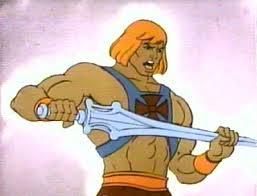
The hero is a recurring element in stories which have charged our imagination since time immemorial. One might argue that every story has a hero, but when I use the word I don't simply mean the protagonist of a particular tale, but an actual hero. They don't always look alike, or act alike, but the hero has been turning up in stories since man first put pen to paper. That they don't often look the same is probably why Joseph Campbell called his book 'The Hero with a Thousand Faces'.
When I think of a hero, I think of characters like Conan, James Bond, Josey Wales, and Jack Reacher. While I recognize that there are real heroes in our world, (support our troops) I am a book lover and I have the tendency to gravitate to those heroes which only exits within the pages of the novels I read.
What makes me (us) love our heroes so much? In my case I think it might be that I never let go of the child I once was. The adolescent male world of muscles guns and machinery has never completely lost it's glitter, though the dullness of the adult world has done its best to tarnish the gleam.
It seems that the concept of an ultimate hero is one that I forget at my peril. As I write my latest novel, I might delve too deep into the historical aspect of the project. In my quest to deliver realism in my work, I am in danger of making the hero just a little too believable, and thus quenching the fires of romance. So, as I try to stay rooted in the historical accuracy of my time period, I will remind myself to cut loose once in awhile and have my hero open up a fresh can of whoop ass.
ad
Aug 10, 2015
The hero is a recurring element in stories which have charged our imagination since time immemorial. One might argue that every story has a hero, but when I use the word I don't simply mean the protagonist of a particular tale, but an actual hero. They don't always look alike, or act alike, but the hero has been turning up in stories since man first put pen to paper. That they don't often look the same is probably why Joseph Campbell called his book 'The Hero with a Thousand Faces'.
When I think of a hero, I think of characters like Conan, James Bond, Josey Wales, and Jack Reacher. While I recognize that there are real heroes in our world, (support our troops) I am a book lover and I have the tendency to gravitate to those heroes which only exits within the pages of the novels I read.
What makes me (us) love our heroes so much? In my case I think it might be that I never let go of the child I once was. The adolescent male world of muscles guns and machinery has never completely lost it's glitter, though the dullness of the adult world has done its best to tarnish the gleam.
It seems that the concept of an ultimate hero is one that I forget at my peril. As I write my latest novel, I might delve too deep into the historical aspect of the project. In my quest to deliver realism in my work, I am in danger of making the hero just a little too believable, and thus quenching the fires of romance. So, as I try to stay rooted in the historical accuracy of my time period, I will remind myself to cut loose once in awhile and have my hero open up a fresh can of whoop ass.
ad
Aug 10, 2015
August 3, 2015
Elevation

I reached a milestone today, and I hope you will celebrate a little with me. I have just finished the first draft of my (as yet untitled) fourth novel!
I call it a milestone as opposed to an accomplishment because there are still weeks of work to be done editing, and polishing, before the work is ready to face the world. Nevertheless, I feel some sense of accomplishment getting the draft finished.
The process of writing a novel is a long and lonely one. I think Stephen King said it best when he likened it to crossing the Atlantic in a bathtub saying: 'There is a lot of room for self-doubt'. Over the course of months of writing, I often find myself despairing over whatever story I'm working on. There is a certain point in every story (usually toward the end of act II) when I think that what I've written is garbage. If left unchecked, the 'stinkin thinkin' snowballs into the thought that I have wasted several years of my life working on nonsense that no one should have to read.
Regardless of how strong this feeling grows however, I find myself getting up every day and typing my quota of words. There is something inside that drives me on that is stronger than my doubts. What this thing is, I have no idea. It could be my faith in Jesus. It could be my often noted mulishness, or it could be something as simple as momentum. I simply do not know what drives me in those dark moments.
A similar thing on a much smaller scale happened to me today after I had finished my draft. By way of celebration, I took a bike ride up a long winding country road (yeah, I'm that guy). When I say 'up' I mean this literally. The road climbs steadily for two miles. To say that I struggled would be putting it mildly. My recent move (see my post two weeks ago) included a gain of approximately 6,000 feet in elevation, making the air feel rather thin to my tobacco ravaged lungs. Several times during the ride, I felt the desire to turn back. I was alone, so I didn't have to convince anyone that it was time to turn around, and there was no one around to fault me for throwing in the towel.
Yet I endured.
That nameless thing within me reared it's head and I struggled on, until I reached the end of the road and the top of the hill. I won't bore you with a description of the dazzling view because no matter how beautiful, the view would not have been worth the pain I endured to get there. The only thing that made the ride worth it was the sense that I had done it. With no encouragement nor promise of accolades, I had climbed the hill.
That is the same feeling that I have when I think about my newly completed draft. It is not my longest work, and only time will tell if it is my best, but I have finished. I will sleep well tonight knowing that I overcame the high hurdle of my own self doubt, and accomplished my goal.
See you next week,
ad
Aug. 3, 2015
July 27, 2015
Best Intentions
 Two posts and nine months ago, I posted a blog titled 'We need a new twenty'. If you don't want to go back and read my ravings, I suggested we take Andrew Jackson off of the U.S. twenty dollar bill because of his (integral) part in enacting the 'Indian Removal Act' of 1830. It recently occurred to me that, as dastardly as that act was, President Jackson must have believed he was doing the right thing.
Without going into what 'Old Hickory' might have been thinking, we must realize that everyone who does anything has affirmative reasons for what they do. I can think of few instances where someone did something out of pure meanness, or committed and evil act simply for the sake of evil. The Red Stick Creek Indians who perpetrated the massacre at Fort Mims, Alabama thought they were doing the right thing by their people. The settlers who pushed the Creeks to the point of violent reaction thought they were doing what was right by their families. Andrew Jackson similarly must have thought he was was in the right by driving the Creeks out of the deep south.
This doesn't just apply to the Creek war, but every conflict that has ever taken place. The British thought they were in the right to attempt to quell the colonial rebellion. The confederate gentry thought they were right to defend their rights as slave owners. The Japanese must have thought that it was their own version of 'Manifest Destiny' to conquer the Pacific. I could (and probably just did) site examples ad nauseam of people, or groups, who had perfectly affirmative reasons for doing what they did, even though we now consider their actions or ethos repugnant.
In my most recent novel 'Nagodzaa' I tried to tell the story of two men who both had good reasons for their actions, but were brought into conflict nevertheless. Lt. Willard Riley of the U.S. Tenth Cavalry and Ka'edine of the San Carlos Apache, both fought bravely for what they thought was right, but their differing viewpoints made them enemies. It doesn't go well for either of my protagonists.
At this point the reader (if there are any) might think that I am taking a stand for moral relativism. This is not the case. Regardless of what Andrew Jackson, or Joseph Stalin, or Jefferson Davis might have thought, they were in the wrong. Evil exits, regardless of anyone's viewpoint or best intentions.
But it does beg the question: What are we doing now, that will be viewed as evil by future generations? What are we doing as a country that will make the U.S . a byword one hundred years from now? What am I doing as an individual that will horrify and shame me when I stand before the judgement seat?
I have no answers to these questions. This is not that kind of blog. I do hope however, that I have offered up some food for thought in the maelstrom of information that we have in the twenty-first century.
So until next week, find me on Facebook, Twitter, Instagram, or Goodreads, and as always: Watch your topknot!
Arley L. Dial
7/27/2015

July 20, 2015
Coming home, or, What I did on my summer vacation.
 Howdy everyone!
It's good to be back after such a long hiatus.
I recently (last week) moved from north Florida back to my native state of New Mexico, and I couldn't be happier to be home. The trip was fun, and to avoid this blog turning into a travel log, I will only tell you that Natchez and Vicksburg Mississippi are definitely worth a visit. The highlight of the trip was seeing an American Bison at the Wichita Mountains Wildlife Refuge outside Lawton Ok.
The thing that struck me most was the sense of relief I felt growing as we traveled west. In Oklahoma, when the last shreds of kudzu had been left behind us, and the land began to open up, it felt as if I let out a breath I had been holding for two years. Simply being able to see more than a few yards in one direction was like a weight had been taken off my shoulders. When we stopped for gas and an ice cream in the Texas panhandle, the dry air was like a balm to my heart. I breathed deep like a nineteenth century consumptive following doctor's orders to go west for a drier climate.
Don't get me wrong. It's not as if I don't like Florida, or the Deep South, but it is just not home. Folks raised in the more heavily populated and greener climes of the east would feel the same way I did after living on the naked plains of the west for a couple of years.
I am grateful to be back in my place in the world, and glad to have the opportunity to make my passion my work. I will continue to combine my passion for literature with my passion for the American West. I will pour out my love of these things, and use the talents that God has given me to produce novels which hopefully bless and inspire those who read them.
I thank you for bearing with me on this rather personal edition of Westerlinglore. I assure you that next week I will return to the fun and interesting facts about life in the Old West that I discover during my research and travels. I would love to hear about what others find, as the West seems to have an unlimited supply of interesting stories. Find me on Facebook, Twitter or Instagram (it's not hard, there are very few Arley Dials in the word) and lets share our experience and love of home.
Adios for now,
Arley L. Dial, July 20, 2015
 P.S. If you find yourself looking for a good read, have a look at one of my novels on Amazon. Once again, just put my name into the search engine, you'll find me.
October 20, 2014
We need a new twenty
 We need a new $20 bill
While researching my novels, I learn quite a bit about historical figures, and that has changed my perspective on many of them. One of them in particular has been weighing heavily on my mind lately, and that is Andrew Jackson, sometimes called 'Old Hickory' but most often referred to by my contemporaries as 'The guy on the twenty dollar bill'. Being a frequent visitor to social media sites, I watch with amusement (and sometimes boredom) while my Democrat friends vilify George W. Bush, and my Republican friends do the same to Barrack Obama. Neither of these men, as controversial as their presidencies sometimes are, comes anywhere near committing the moral outrages of Andrew Jackson. I am not talking about his habit of dismissing all of the government officials who opposed his campaign and replacing them with his supporters. Every president since Jackson has done the same thing. I am also not talking about the personal scandals that one of his cabinet members (John Eaton) became involved in. Bill Clinton's infidelity blew poor Eaton out of the water. I am talking about a particular bill, which was a platform of the Jackson campaign, and was passed into law on May 28, 1830. That law was known as the 'Indian Removal Act' and represents one of the most shameful periods in our nation's history. For those of you who are not familiar with the act, it nullified treaties with what were then known as 'The Five Civilized Tribes' and made it a law that those people be forcibly removed to what is now Oklahoma. 'The Five Civilized tribes were, the Cherokee, Chickasaw, Choctaw, Creek and Seminole peoples living in what we now consider the southeastern United States. The people of these first nations were not referred to as 'civilized' for no reason. They were farmers, stock raisers, traders and artisans who lived a relatively peaceful existence with the whites for generations. I say 'relatively peaceful' as opposed to the nomadic tribes of the far west who seem to have maintained raiding as one of the pillars of their economy. The Americans in those southern states did not call for the native's removal to protect their settlements or their lives, but mainly because gold had been discovered in Georgia. 'Old Hickory' answered that call. After the enactment of the Indian Removal act, many terrible atrocities were committed (by both sides) in the conflict between the First Nations and the Americans of European and African descent. I don't mean to say in any way that the act was the ultimate 'low point' in relations between the two groups. It does however, signify the start of years of institutionalized oppression by the U.S. government. In my job as a cashier, I am struck by the irony that if a customer hands me a picture of
Andrew Jackson, I will give him a T-shirt featuring a representation of Osceola (I live near Florida State University). Most people that I have spoken with do not think about (or often even know) who Andrew Jackson was, and what he represented. So perhaps we should keep 'Old Hickory' on the twenty, lest we forget, and risk repeating a deplorable chapter in the history of our great nation.
ad10/20/2014
 p.s. My vote for the new model would probably be Cochise, but since I know of no extant picture of him, here is Sitting Bull for your enjoyment.