
Dom Conlon's Blog: Inkology blots
October 24, 2014
Why writing for children makes everything clear
So last week I was guiding a poetry writing session at Nelson & Colne College. I searched my mind, found snippets of memories of me writing awful, intractable poetry about the struggle of life, and decided I could act as a warning sign to all other writers. A bit like William McGonagall might do if he were alive today.
My insight was to show how writing for children might well help to introduce clarity and accessibility, no matter what subject was being written about. The remarkable thing about children’s literature is that it can tackle any subject. Children are routinely asked to deal with issues which the adult world labels as ‘difficult’. Sexuality, divorce, death, disability, fairness, justice - there is no topic you can think of which does not end up affecting a child. We might pretend to shield them from the worst horrors of this world but for the most part these attempts only serve to introduce ignorance, misunderstanding and prejudice.
Simply put, kids are smart.
They phrase things in a childish way which reveals rather than obscures issues. When my son asked me whether a man can love another man, the question came so directly, so perfectly judged, the answer could only be ‘yes’. How, when we teach love as the most desirable of human achievements, could it be anything else?
I wanted the students to choose a difficult topic and write a poem which related it to a child. The results were varied and extraordinary. I saw the light of language put to illuminating rather than creating shadows, and I watched as these young, energetic writers reforged the links of their own not to distant childhoods.
Of course, there will be times when literature needs to be more complex, and run deeper. There will be times when it employs language which is beyond children, but, my argument ran, the starting point should be a clear and accessible truth.
--
You can see my books here.
My insight was to show how writing for children might well help to introduce clarity and accessibility, no matter what subject was being written about. The remarkable thing about children’s literature is that it can tackle any subject. Children are routinely asked to deal with issues which the adult world labels as ‘difficult’. Sexuality, divorce, death, disability, fairness, justice - there is no topic you can think of which does not end up affecting a child. We might pretend to shield them from the worst horrors of this world but for the most part these attempts only serve to introduce ignorance, misunderstanding and prejudice.
Simply put, kids are smart.
They phrase things in a childish way which reveals rather than obscures issues. When my son asked me whether a man can love another man, the question came so directly, so perfectly judged, the answer could only be ‘yes’. How, when we teach love as the most desirable of human achievements, could it be anything else?
I wanted the students to choose a difficult topic and write a poem which related it to a child. The results were varied and extraordinary. I saw the light of language put to illuminating rather than creating shadows, and I watched as these young, energetic writers reforged the links of their own not to distant childhoods.
Of course, there will be times when literature needs to be more complex, and run deeper. There will be times when it employs language which is beyond children, but, my argument ran, the starting point should be a clear and accessible truth.
--
You can see my books here.


April 22, 2014
Writing about everything
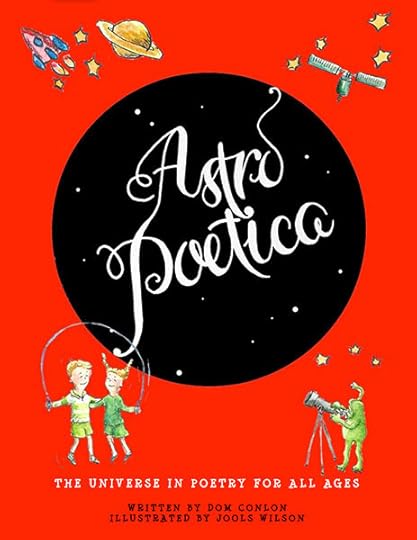 So this is an easy enough task: sum up the entire universe, from the Big Bang through all the planets of the Solar System to asteroids and nebula and black holes.
And then do that in a way that children as well as adults can understand and appreciate.
OK, maybe it isn't that easy.
But that is where Astro Poetica began. And it is, thankfully, exactly where it seems to have ended in a collection of poetry written by me and illustrated by Jools Wilson.
Astro Poetica began as I sat back in my seat at the Planetarium in Liverpool's World Museum, listening to the accessible and inclusive narrative of John Moran, poetry began to form inside me. Looking up with the entire universe above me, I found the words shouting at me. I saw Saturn as a potter's wheel, I saw Mercury as a hot tempered child, I saw Jupiter as a giant beach ball.
It was an almost overwhelming experience. John's elegant and easy manner told me that I had to write some poems about Space and that I had to do it in a way children and adults alike could enjoy.
Whenever I discuss poetry, specifically the poetry I love, with friends, I hear the same thing: "I don't understand poetry, I don't know where to begin." Poetry, for many, has become something to decipher, something you have to "get". I tend to point people at e e cummings and tell them to just enjoy the language. Enjoy the feel of words as you say them. Watch out for images and phrases. Take it easy, take it slow. Find your own way.
Whilst I was writing Astro Poetica, all of this was in my mind. I knew that in addition to the poems, I wanted to write about how to read poetry. I wanted to give people a way in, an angle (my angle) about the things I was thinking as I wrote. I'd stress that this was just my view and that I was always open to learning how other people read.
Astro Poetica includes the poems, illustrations, a chapter which starts a discussion about reading, and a chapter about how to write your own poems.
It's been a huge undertaking but I think I've managed it. I'm proud of the writing and I think I have achieved a balance of accessible, thoughtful, funny and poignant.
Dom Conlon
March 5, 2014
Eating the Moon
Tiny the Giant means an awful lot to me. On a personal level he represents a very special bond my son and I share and on a professional level he is the first book I ever published.
So to share the very first page of the next book in the series is a joy. A real, genuine, knock-me-off-my-feet joy.
I've uploaded the page and written a few things about the story over on the Inkology site and I hope you can find your way there: http://www.inkology.co.uk/one-tiny-page/
So to share the very first page of the next book in the series is a joy. A real, genuine, knock-me-off-my-feet joy.
I've uploaded the page and written a few things about the story over on the Inkology site and I hope you can find your way there: http://www.inkology.co.uk/one-tiny-page/
January 15, 2014
Picture the past
 Hello adults. Please send those children out of the room.
Gone?
Good.
OK, so regardless of what we tell our children, we can talk freely now.
Do you remember the times when you crept out of bed, sneaked downstairs, ate sweets before mealtimes, went further away from home than you were allowed to, of doing something innocently naughty and running away...? The sense of danger, the thrill of getting away with something - these are wonderful, valuable parts of childhood. They kickstart the ability to explore and aid in our ability to deal with situations. In an increasingly sanitised and controlled world, this sense of free-play is more valuable than ever.
Maurice Sendak knew that "children are tough". They can be trusted a lot more than we give them credit for. I like this. I feel this. I enjoy sharing cautionary tales with my son and try to talk to him in an open and honest way.
Children really are tough.
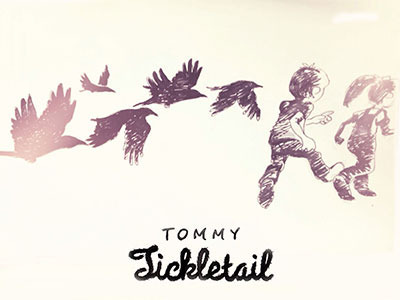
This was going through my mind when I had the idea for my own cautionary tale, Tommy Tickletail. I wanted to build up a sense of suspense, of danger which would excite children. I trusted them to know they were safe, and to thrill to this sense of danger as they wondered what the children in my story were afraid of waking.
But the words were only half the story. And less than half the atmosphere.
Illustrator, Carl Pugh, was delighted when he read the first draft. A long time fan of horror, he laid claim to illustration duties before I could even suggest someone who would bring it to life.
And I'm glad that he did.
It was his decision to paint each page with watercolours, lending the book a sense of place and a solidity which children can really grasp. The movement of colours across the page, the spills of watery blacks pooling into depths, the hints of outlines and shapes beneath tables - these are things which need to be seen, to be felt. These are things which Carl has let drip from his brushes and take their own, new forms.
The results surprised me. They delighted me of course, but they did surprise me. They taught me not just the value of trusting an illustrator's judgement (a lesson I'd learned on I AM A GIANT and one I'll write about some other time) but about needing an illustrator's judgement.
Because a writer really does need an illustrator's judgement. There comes a point, earlier on than I realised on this book, when that judgement can add so much more. We got there in the end with Tommy Tickletail but it would have been quicker if I'd stopped finessing my words so much and just passed over the outline to him. The way he saw Tommy would have helped me reach the proper words and the final edit in a more elegant way. And by that I am actually being kind to myself. I slowed everything down by trying to force Carl into thinking a certain way. And by writing ideas which were much better served by his illustrations. And because he is kind and giving, he let me do it.
Next time I've told him to shout at me.
Tommy Tickletail was written by Dom Conlon
Buy it on iBooks
Buy it on Kindle UK
Buy it on Kindle US
January 8, 2014
Tiny details – publishing a book for children
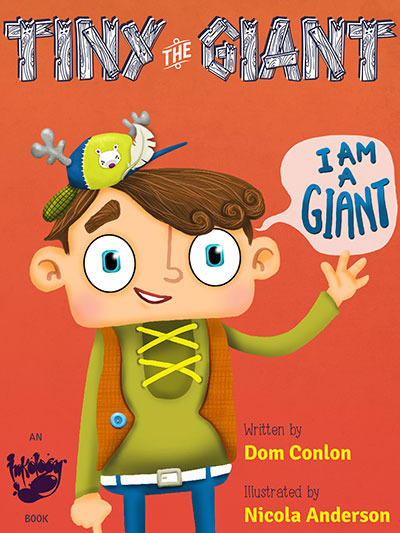
The first book in the Tiny The Giant series was published late last year, to (I'm happy to say) critical acclaim.
It’s a picture book about a little boy who decides (quite reasonably, I think you’ll agree) that he must be a giant because he can’t reach the end of his shadow.
In some ways I think it was also about the process of the writer in me breaking out to tell the world that, at last, he has written a book.
The entire process of writing, illustrating, designing and publishing a children’s book has been a long journey and I've had to climb mountains, fight through forests and hear all kinds of whispers. My journey was filled with places where I thought I could stop and say "I've made it".
For example, what read reasonably well across a few pages of A4 didn’t, once divided into a 32 page picture book, work well at all. So I couldn't stop there. I had to keep walking.
Then I found that the illustrated text which looked beautiful on its own, didn’t work too well with the illustrations. So I couldn't stop there. Onwards I walked.
And there were many more false ends to come. From realising I was writing TOO much (leaving little space for the illustrator to tell her story) to understanding how digital files display on different devices.
But each step further I walked has helped produce a book which I believe is as lovingly produced as any you’d find lining the best bookshelves of bookstores. It’s so lovely, in fact, that I was keen to share it around with colleagues.
And by gum, I’m glad I did.
Everybody here at Inkology had read I AM A GIANT before. It’s one of the stories you can read (with our blessing) for FREE here on the Inkology website. We’re ok with that. The book contains the same text but the value lies in seeing it as a complete book rather than just the words.
So I expected people to pat me on the head and say “well done, you've reached the end of your journey”.
I didn’t expect a little girl to point out quite a major mistake right at the end of the book. But by gum, I’m glad she did.
Listening to it as a bedtime story, she took in all the words and all the pictures. She followed my journey all the way. Then, right at the end, she asked why Tiny was facing the wrong way. She had been told he was looking at the Mountains and Trees and he just wasn’t.
She was right.
That led me to take a closer look and remember why. And in doing so I realised that many months ago, I’d taken a wrong turn. But that little girl knew the right path and with her help I managed to change the art which then showed me I needed to take steps to make a major change to the text on one page. The result is a much more solid and satisfying story.
But the journey was worth it. And now I know it's still far from over.
Tiny details make the difference.
As I ought to have learned from the story itself.
I AM A GIANT was written by Dom Conlon
FOR KINDLE. CLICK HERE.
FOR iBOOKS. CLICK HERE.
Inkology blots

Writing about writing for children in a digital world. Contains thoughts about the next generation of storytellers. Around a campfire, on a sofa - where next for stories?
- Dom Conlon's profile
- 16 followers
