Michael Barrett Miller's Blog
January 27, 2024
Dogs in the middle ages: what medieval writing tells us about our ancestors’ pets
The Conversation – 26 January 2024
“In the middle ages, most dogs had jobs. In his book De Canibus, the 16th-century English physician and scholar John Caius described a hierarchy of dogs, which he classified first and foremost according to their function in human society.
At its apex were specialised hunting dogs, including greyhounds, known for their “incredible swiftnesse” and bloodhounds, whose powerful sense of smell drove them “through long lanes, crooked reaches, and weary ways” in pursuit of their prey.
But even the “mungrells” that occupied the bottom rungs of the canine social ladder were characterised in terms of their labour or status. For example as street performers, or turnspits in kitchens – running on wheels that turned roasting meat.
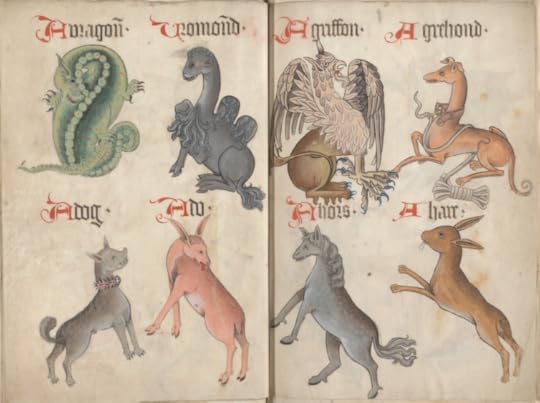 A dog with a spiked collar and a greyhound with a long leash from the Helmingham Herbal and Bestiary (c. 1500). Yale Centre for British Art, Paul Mellon Collection, CC BY-SA
The place of dogs in society changed when hunting became an aristocratic pastime, rather than a necessity. Simultaneously, dogs were welcomed inside noble homes – especially by women. In both cases, dogs were signifiers of elite social rank.
 A nun holding her lapdog, in Stowe MS 17, f. 100r . British Library
Indeed, in his ranking, Caius positions the “delicate, neate, and pretty” indoor dogs below hunting dogs but above the base mongrels, because of their association with the noble classes. As for puppies: “the smaller they be, the more pleasure they provoke”.
Although the church formally disapproved of pets, clerics themselves often owned dogs. Like women, clerics’ dogs were generally lapdogs, ideally suited to their indoor pursuits.
In praise of dogsNot everyone had such affection for dogs. Concerned about potential violence, urban authorities in England regulated the keeping of guard dogs, as well as violent popular entertainments, such as boar, bear and bull-baiting.
In the Bible, dogs are often characterised as filthy scavengers. Proverbs 26:11 famously describes how they return to their own vomit.
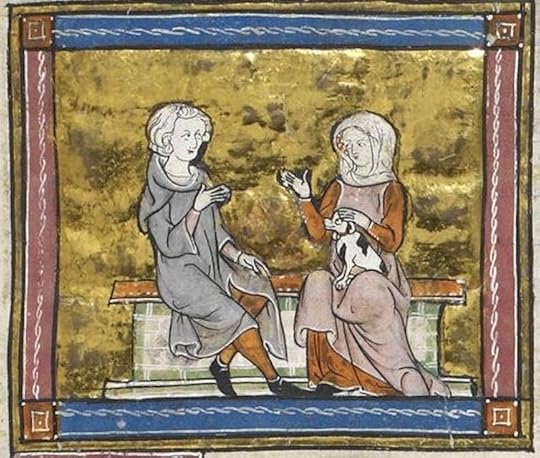 A miniature of Sir Lancelot, in conversation with a lady holding a small dog (c. 1315-1325). British Library
On the other hand, the story of St Roch in The Golden Legend, a popular 13th century collection of saints’ lives, tells of a dog who carried bread to a starving saint, then healed his wounds by licking them. One of Roch’s saintly attributes, a motif by which viewers can recognise him, is a devoted dog.
The trope of dogs defending their owners or lamenting dead ones can be traced back to the classical period, to texts like Pliny the Elder’s Natural History.
This theme is repeated in the medieval bestiary tradition, a moralising compendium of knowledge about animals both real and mythical. One common story tells of the legendary King Garamantes who, when captured by his enemies, is tracked down and rescued by his faithful dogs. Another tells of a dog who publicly identifies his master’s murderer and attacks him.
The tale of one greyhound, Guinefort, even inspired an unofficial saint’s cult. Writing in the 13th century, Dominican inquisitor and preacher Stephen of Bourbon described a noble family who, falsely believing the dog to have killed their infant, killed Guinefort in retribution.
 Detail of a miniature of King Garamantes, being rescued by his dogs, from the Rochester Bestiary ( c.1230). British Library
Upon discovering the child unharmed (the dog had really saved it from a venomous snake), they honoured the “martyred” canine with a proper burial, which led to its veneration and alleged healing miracles. Although Stephen’s story intended to reveal the sin and folly of superstition, it nonetheless underlines what medieval people perceived as the special qualities that distinguished dogs from other animals.
According to the Aberdeen Bestiary (c. 1200): “No creature is more intelligent than the dog, for dogs have more understanding than other animals; they alone recognise their names and love their masters.”
The association between dogs and loyalty is also expressed in the art of the period, including in relation to marriage. In tomb monuments, depictions of dogs indicate fidelity of a wife to the husband who lies beside her.
 This effigy of a dog is part of Archbishop William Courtenay’s tomb in Trinity Chapel, Canterbury Cathedral. Author provided (no reuse)
In the case of clerical tombs, however, they may suggest the faith of the deceased, such as Archbishop William Courtenay (d. 1396), buried in Trinity Chapel, Canterbury Cathedral. Courtenay’s alabaster effigy reposes atop a tomb chest on the south side of the chapel. The archbishop wears the robes and mitre of his office, and two angels support his cushioned head. A long-eared dog wearing a belled collar lies obediently at his feet.
Although it’s tempting to wonder whether the dog depicted on Courtenay’s tomb may represent an actual pet owned by the archbishop, the belled collar was a popular convention of contemporary iconography, especially for lapdogs.
Pampered pooches Allegory of Vanity by Hans Memling (c. 1490). Museum of Fine Arts of Strasbourg
Like their modern counterparts, medieval dog owners with means kitted out their companions with a variety of accessories, including leashes, coats and cushions made from fine materials.
Such material investment was central to the aristocratic culture of vivre noblement (the art of living nobly), where the deliberate consumption of luxury commodities publicly demonstrated one’s status.
Popular perceptions of dog owning and accessorising also fed gendered stereotypes. Whereas men were more likely to own active dogs for the protection of their life and property, women preferred lapdogs they could cradle and pamper. Toy dogs, then, could also be associated with female idleness and vice, as seen in Hans Memling’s painting Allegory of Vanity (c. 1485).
But even working dogs needed meticulous care and attention if they were to perform at their best. A miniature in a lavish 15th-century copy of Gaston Phébus’s influential book Livre de la Chasse (Book of Hunting) shows kennel attendants examining dogs’ teeth, eyes, and ears – while another bathes the paws of a very good boy.”


January 26, 2024
Are U.S. Republicans Selling Out Ukraine?
In 1994, an agreement was concluded to assure Ukraine of US protection against Russia if they gave up their nuclear weapons.
In 2014, when the Russians rolled into Ukraine, people jumped up and quoted the Budapest Memorandum. The Russians yawned and said that the agreement only covered the previous Ukrainian government, not the illegitimate Ukrainian government.
Everyone sat down and grumbled until the Russians did a full invasion two years ago.
America will sink into the sea in the eyes of most countries if it sells out its friends in Ukraine.
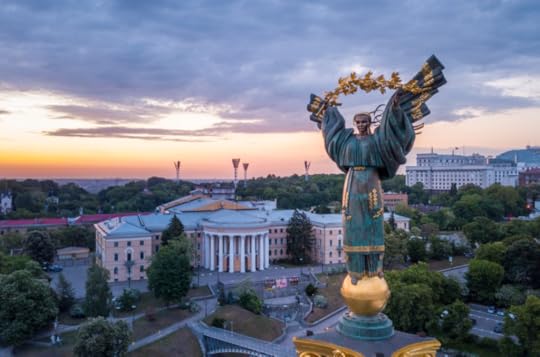
The following is a significant part of the agreement. Below this section is a link to the entire document.
North Korea, and probably Iran, will never give up their weapons, as when they do, they may end up like Kadaffi, who gave up nukes, or, of course, Ukraine.
1994 Budapest Memorandum on Security Assurances
To solidify security commitments to Ukraine, the United States, Russia, and the United Kingdom signed the Budapest Memorandum on Security Assurances on December 5, 1994. A political agreement in accordance with the principles of the Helsinki Accords, the memorandum included security assurances against the threat or use of force against Ukraine’s territory or political independence. The countries promised to respect the sovereignty and existing borders of Ukraine. Parallel memorandums were signed for Belarus and Kazakhstan as well. In response, Ukraine officially acceded to the NPT as a non-nuclear weapon state on December 5, 1994. That move met the final condition for ratification of START, and on the same day, the five START states-parties exchanged instruments of ratification, bringing the treaty into force.
2009 Joint Declaration by Russia and the United States
Russia and the United States released a joint statement in 2009 confirming that the security assurances made in the 1994 Budapest Memorandum would still be valid after START expired in 2009.
2014 Russian Annexation of Crimea
Following months of political unrest and the abrupt departure of Ukrainian President Viktor Yanukovych, Russian troops entered the Crimean peninsula of Ukraine in March 2014. On March 18, over the protests of the acting government in Kiev, the UN Security Council, and Western governments, Russia declared the annexation of Crimea. The United States, the United Kingdom, and Ukraine called the action a blatant violation of the security assurances in the 1994 Budapest Memorandum. However, according to the Russian Foreign Ministry, “the security assurances were given to the legitimate government of Ukraine but not to the forces that came to power following the coup d’etat.”
January 24, 2024
New Book – New Reviews
“Blue Jasper” has recently joined the thousands of books available to readers all over the world.
I am pleased that many are enjoying these stories.
If you subscribe to Kindle Unlimited all my books are free to download.
See Amazon to order your copy.
“Thanks for the copy.
I was hoping you would share more of the tales of the team as they dodged in and out of the shadows. Wonderful stories.
I’ve been to Kyiv. The story of visiting Babyn Yar was very moving. I visited the memorial some years after the team. I honored those who had died while at the newer monument.
Oh, Bela. What a story-”
Jean M.
“Assassination, chicanery, espionage, deception, fantastic characters, beautiful stories, intriguing locations, and Holy Moly – nonstop action.” James Freeman
“Thanks for the advanced copy.
I read all four of your “Life in the Shadows” books. I loved them, wishing for more.
This collection of short stories, vignettes, is a perfect companion and further look into the characters and their exploits. Well done.” Ralph Cooper
“Some may disagree, but I like how you’ve let the covers convey the mood—no clutter – just Picasso’s Shepard and Smith’s painting of the Red House.
Ok. I loved the stories. I felt like I was walking with Mick, Jack, Walking Bear, and Mahaney.
Oh. After reading “Taipan,” I have determined to never be in the bush in the Cape York Peninsula. My oh my!”
J.B.R.
“I loved each story. I laughed at some antics and then cried when I read Emma’s letter.
Nitara was unforgettable.
Terrific.”
Magdela I.
Walk with the team, Jack, Mick, Walking Bear, and Mahaney, along with support from various agencies, as they confront multiple challenges in this collection of adventures.
Visit Babyn Yar in Kyiv.
Meet Maximón, a Mayan God, as the men take out a troublesome Russian agent.
Meet Glances Twice as she fires an arrow into Walking Bear’s heart.
Nitara, Emma, and Bela are special memories that readers will hold in their hearts.
Reviewed by JV
5.0 out of 5 stars on Amazon – 22 January
Unexpected setting in Guatemala
Reviewed in the United States on January 22, 2024
“Good book for fans of espionage and intricate plot lines. I was pleasantly surprised by the unexpected setting in Guatemala, which added an intriguing layer to the narrative. The author’s attention to operational details and espionage tactics is impressively thorough, making the story both authentic and captivating. It’s a book that keeps you on the edge of your seat, with its well-crafted characters and masterful storytelling.”
January 19, 2024
Oh, My. Shocking conditions in Gaza. Video of Dr. Seema Jilani M.D. reporting on conditions.
Pediatric Consultant Medical Oversight
Fulbright Scholar,freelance journalist and Texas Children’s Hospital physician. Seema did her post-doctoral training in pediatrics at Baylor College of Medicine.
Seema was selected by the US Department of State as a 2016 Fulbright Scholar to Istanbul where she taught medical students including Syrian refugees how to engage in media advocacy as a physician.She was a flight physician for medical evacuation flights for Texas Children’s and has concentrated on working in areas of conflict.She has done humanitarian aid work in Afghanistan,Iraq,Pakistan,Egypt,Lebanon,the Gaza Strip, the West Bank,Sudan,Bosnia and Nepal. Her media work has been published in The New York Times,BBC News,The Washington Post and other media outlets. She has written about health care challenges for children in the USA,immigrant healthcare and was selected as a Truman National Security Fellow in Washington,DC. She speaks at least 4 languages. The team are indebted to Seema and her family who continue to help guide us in the region, despite the bombing in Beirut last year, which led to Seema and family returning to the US. Her skill as a humanitarian, mother, doctor and healer was tested and as ever she shines. We are indebted to her always.
January 18, 2024
Meta documents show 100,000 children sexually harassed daily on its platforms
Employees fretted over company’s ‘negligible’ response to child grooming, according to internal documents made public in lawsuit
Meta estimates about 100,000 children using Facebook and Instagramreceive online sexual harassment each day, including “pictures of adult genitalia”, according to internal company documents made public late Wednesday.
The unsealed legal filing includes several allegations against the company based on information the New Mexico attorney general’s office received from presentations by Meta employees and communications between staff. The documents describe an incident in 2020 when the 12-year-old daughter of an executive at Apple was solicited via IG Direct, Instagram’s messaging product.
“This is the kind of thing that pisses Apple off to the extent of threatening to remove us from the App Store,” a Meta employee fretted, according to the documents. A senior Meta employee described how his own daughter had been solicited via Instagram in testimony to the US Congress late last year. His efforts to fix the problem were ignored, he said.
The filing is the latest in a lawsuit initiated by the New Mexico attorney general’s office on 5 December, which alleges Meta’s social networks have become marketplaces for child predators. Raúl Torrez, the state’s attorney general, has accused Meta of enabling adults to find, message and groom children. The company has denied the suit’s claims, saying it “mischaracterizes our work using selective quotes and cherry-picked documents”.
Meta issued a statement in response to Wednesday’s filing: “We want teens to have safe, age-appropriate experiences online, and we have over 30 tools to support them and their parents. We’ve spent a decade working on these issues and hiring people who have dedicated their careers to keeping young people safe and supported online.”
A 2021 internal presentation on child safety was also referenced in the lawsuit. According to the suit, one slide stated that Meta is “underinvested in minor sexualization on IG, notable on sexualized comments on content posted by minors. Not only is this a terrible experience for creators and bystanders, it’s also a vector for bad actors to identify and connect with one another.”
The complaint also highlights Meta employees’ concerns over child safety. In a July 2020 internal Meta chat, one employee asked: “What specifically are we doing for child grooming (something I just heard about that is happening a lot on TikTok)?” According to the complaint, he received a response: “Somewhere between zero and negligible.”
Meta’s statement also says the company has taken “significant steps to prevent teens from experiencing unwanted contact, especially from adults”.
The New Mexico lawsuit follows a Guardian investigation in April that uncovered how Meta is failing to report or detect the use of its platforms for child trafficking. The investigation also revealed how Messenger, Facebook’s private messaging service, is used as a platform for traffickers to communicate to buy and sell children.
Meta employees discussed the use of Messenger “to coordinate trafficking activities” and facilitate “every human exploitation stage (recruitment, coordination, exploitation) is represented on our platform”, according to documents included in the suit.
Yet, an internal 2017 email describes executive opposition to scanning Facebook Messenger for “harmful content” because it would place the service “at a competitive disadvantage vs other apps who might offer more privacy”, the lawsuit states.
In December, Meta received widespread criticism for rolling out end-to-end encryption for messages sent on Facebook and via Messenger. Encryption hides the contents of a message from anyone but the sender and the intended recipient by converting text and images into unreadable cyphers that are unscrambled on receipt. Child safety experts, policymakers and law enforcement have argued encryption obstructs efforts to rescue child sex-trafficking victims and the prosecution of predators. Privacy advocates praised the decision for shielding users from surveillance by governments and law enforcement.
January 17, 2024
What happens when a school bans smartphones? A complete transformation
Teachers say mobile phones make their lives a living hell – so one Massachusetts school barred them.
The Mirror
“When the weather is nice, the Buxton boarding school moves lunch outside. Students, faculty and guests grab their food from the kitchen, and eat together under a white tent that overlooks western Massachusetts’ Berkshire mountains.
As the close of the school year neared last June, talk turned to final assignments (the English class was finishing Moby-Dick) and end-of-year fun (there was a trip planned to a local lake). It was, in most ways, a typical teenage afternoon – except that no one was on their phones.
Buxton was wrapping up the first year of a simple yet novel experiment: banning cellphones on campus. Or, rather, smartphones.
Instead, the school gave everyone on campus – including staff – a Light Phone, that is, a “dumb” phone with limited functionality. The devices can make calls, send texts (slowly) and can’t load modern applications; instead coming with deliberately cumbersome versions of music and mapping apps. They are about the size of a deck of cards, with black and white screens.
As one student put it: “It’s like the demon baby of an iPad and a Kindle.”
Most everyone agrees, however, that the school is better off with these hell devices. (And yes, that includes students.) There are fewer interruptions during class, more meaningful interactions around campus, and less time spent on screens.
“It’s a problem we’ve found a pretty good way to address,” Scott Hunter, who teaches English and music, said of smartphones. Bea Sas, a senior at Buxton, added: “I think people are a lot more social.”
 A student decorates a piece during a ceramics class, while other students interact during an art block at Buxton school.
For many teachers, their students’ phone use is exasperating. “It’s every class, every period,” said Mark McLaughlin, a math teacher at Neah-Kah-Nie high school in Oregon. “The worst part of my job is being the cellphone police.”
Educators across the country report waging a near-constant battle against phones. A survey of a school district in Virginia found that about a third of teachers were telling students to put away their cellphones five to 10 times a class, and 14.7% did so more than 20 times a class.
When a middle school in Canada surveyed staff, 75% of respondents thought that cellphones were negatively affecting their students’ physical and mental health. Nearly two-thirds believed the devices were adversely affecting academic performances as well.
“It’s a big issue,” said Arnold Glass, a professor of psychology at Rutgers University who has researched the impact of cellphones on student performance. “They lose anywhere between a half and whole letter grade if they are allowed to consult their phones in class.”
Ian Tomombulak, a guidance counselor at Lamoille Union high school in northern Vermont, is also facing a flood of cellphones at his school. “I have kids who during the day get a Snapchat or text and it ruins their entire day,” he said. Another issue he’s seeing is that students use cellphones to coordinate mass trips to the bathroom so they can hang out during class. “It feels like it distracts from the learning that happens on the academic level.”
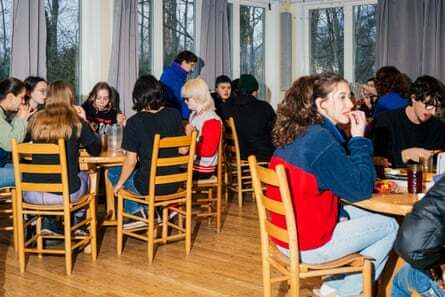 Lunchtime at Buxton school.
When I mentioned the Buxton experiment to Trombulak, he was intrigued. One thing it could address, he noted, was the argument from students that they need phones to communicate with their parents. And, he said, teenagers often adapt to new parameters relatively quickly. He remembers a field trip with his students where, at the last minute, everyone learned that cellphones wouldn’t be allowed. At first, the news was apocalyptic.
“They were so upset. They didn’t know how to handle themselves. I was really nervous,” said Trombulak, reliving the drama. But part way through the trip, the kids largely forgot about their phones and, at one point, they self-policed a girl who tried to sneak a phone on to the rope source.
“At the end of the first day, sitting around the campfire, they said, ‘We didn’t think about our phones all day,’” said Tombulak. “That was really cool.”
To an extent, Buxton saw a similar progression through the stages of panic, grief and ultimately some level of acceptance. “When it was announced I practically had a breakdown,” said then senior Max Weeks. And while he’s still not a fan of what he says was a “unilateral” decision to switch to the Light Phone, he said, overall, the experience “hasn’t been as bad as I expected”.
It’s an open secret that students still sneak phones into their rooms on campus, with some testing the limits more than others. “People get pretty ballsy,” said Yamailla Marks, also a Buxton senior, and get caught. Generally, though, it’s hard to spot a smartphone on campus.
That includes staff. The head of the school, Peter Beck, says he gave up his iPhone for a Light Phone and installed an old GPS system in his car for when he needs to go out into the world. He’s thrilled with how the first year has gone.
It’s difficult to tell how the new phone policy is affecting academic performance because Buxton uses a narrative evaluation system. But culturally, Beck says, the move has been transformative, often in small but cumulatively meaningful ways.
“People are engaging in the lounges. They are lingering after class to chat,” said Beck, who estimates that he’s now having more conversations than ever at the school. “All these face-to-face interactions, the frequency has gone through the roof.”
Another effect has been a surge of students signing up for the school’s photography class, which uses film cameras. Enrollment nearly tripled. While a popular new teacher may have been a factor, Light Phones also don’t have cameras.
“It’s much more of a process to get photos now than with the phone,” said Marks, but she’s fallen “in love” with photography. Still, when she goes home for breaks it’s back to her smartphone. Then she has to give it up again when she comes back to school. “It’s really funny how you adjust very quickly. Like subconsciously.”
Buxton isn’t alone in trying to curb the use of smartphones in schools. As of 2020, the National Center for Education Statistics reported more than three-quarters of schools in the US had moved to restrict the non-academic use of the devices. France banned smartphone use in schools in 2018. But whether the private schools’ Light Phone approach could – or should – be applied to public schools wrestling with how to handle cellphones is up for debate.
As a parent, Mark’s mother, Nina Marks, has been thrilled by the Buxton experiment. The school picked, and largely won, a fight that she hadn’t been able to with her daughter. But as a teacher, she’s hesitant.
“Children and adolescents have supercomputers in their pockets … It’s a constant battle to deal with,” she said, agreeing with other educators. But, she adds, having to police cellphones has created friction with her students in the past and can single out students in ways that can be problematic. She likes her current school’s policy, which is to let each teacher decide how to handle phones in their classrooms.
Marks isn’t alone in being skeptical of outright bans. A staff survey at a school district in Illinois found that 70% of the 295 respondents thought students should be allowed to have their phones at school. “We aren’t teaching them accountability and responsibility by storing it for the day,” wrote one anonymous commenter.
Trombulak also sees phones as a potential teaching moment for students. “They’re struggling with the phone, but they didn’t invent the phone. They didn’t buy the phone,” he said. “If school is a place you’re supposed to learn how to do things, then safe technology use needs to become more part of the curriculum.”
Providing dumb phones could be part of the way forward, Nina Marks admits, but she wonders if funds at already strapped public schools could be put to better use. “If you think of people as addicts, you have to replace that with something else,” she said. “If there was extra money to go around, rather than buying every kid another device, I would give every kid a journal and some really nice paint markers.”
 A student flips through a book in the arts studio at Buxton school.
Nonetheless, Light Phone has seen interest from other private schools and school groups, intrigued by the Buxton model, as well as organizations such as churches.
The company bills itself as an antidote to smartphone overuse – a non-alcoholic beer of phones. “We’re actually pretty into tech – we built a phone. We’re just not into extractive tech that manipulates your emotional state,” said Joe Hollier, one of the founders. “So many people got a smartphone and didn’t intend to wake up and check their email before they brush their teeth. But that’s what started happening.”
Light Phone is also working on potential tweaks to the design. While Hollier says that Light Phones are intentionally small and slow, so that people use them less, students report that they also break easily and the batteries die quickly, which wasn’t in the plan. They are also debating whether to add the option for a camera, or other features. But, Hollier doesn’t want the broader message to disappear in the details.
“It’s about trying to find a balance that’s appropriate for you, whether that’s a Light Phone, a simplified iPhone or whatever it is,” he advised. “[The goal] is to hopefully remind people that we have the agency to decide how we use these things.”
 Student artwork of a flip phone hangs on a wall, and film hangs to dry in a photography class at Buxton school.
Hollier was among the diners as lunch wound down at Buxton. When the chatter waned, staff and students started making daily announcements. Seniors should meet in the library to go over their graduation speeches. A reminder that prom was just a few days away, followed by a reprimand for whoever stole sparklers from the chemistry lab and a note that the biology class was changing locations.
Then, over the speakers, Can I Call You Rose? by Thee Sacred Souls started to croon. And, on a walkway replete with flowers, a proposal to prom unfurled – they said yes. “The best promposal ever,” cheered one member of the crowd. Another added: “That was soooo good.”
No one caught the moment on camera.”
‘I will pretend not to be me’: Russia cracks down on LGBTQ+ community
Wouldn’t you think the Russians and others would worry about more significant issues than who people choose to be with?
“Less than 48 hours after ‘global LGBTQ+ movement’ banned for being extremist, LGBTQ+-friendly bars were raided“
The Guardian – 17 January
he ink was barely dry on Russia’s decision to outlaw what it called the “international LGBT public movement” as extremist when masked police raided a bar in central Moscow where Vasili gathered with his friends on Friday nights for an LGBTQ+ party.
“It was a regular Friday evening until suddenly we saw the police storming in,” Vasili, who asked for his name to be changed because of safety concerns, recalled.
Vasili described how, along with about 100 others, he was ordered to face a wall while police searched visitors for drugs and photographed their passports.
“The police claimed it was a drug raid, but everyone understood they raided the club because it was a queer night,” he said. “Standing against that wall, you realise how little rights you have as a gay person in this country.”
At least two other LGBTQ+-friendly venues in the Russian capital were raided on the same evening of 1 December, less than 48 hours after the country’s top court, in a landmark ruling, banned what it called the “global LGBTQ+ movement” as an extremist organisation.
While sexual minorities have faced a long history of social exclusion and prejudices in both the Soviet Union and its Russian successor, the Kremlin first opened its legal attack on Russia’s LGBTQ+ community in 2013, when Vladimir Putin signed the notorious law that banned “propaganda of nontraditional sexual relations” among minors.
But in big cities such as Moscow and St Petersburg, gay Russians and their allies still found ways to express themselves despite existing laws, with a vibrant LGBTQ+ party scene blossoming, one to which authorities largely closed their eyes.
“Before the [Ukraine] war, there was an understanding that inside one’s home or at a queer party you could still be yourself,” said Karen Shainyan, a prominent Russian gay rights advocate and journalist.
“We actually thought that attitudes towards sexual minorities were improving as more people were talking openly about queer topics,” Shainyan, who launched a popular LGBTQ+-themed YouTube channel in 2019, added.
Opinion polls also indicated that positive attitudes towards the queer community were gradually improving over the past five years, progress that Shainyan fears risks being undone.
“The war in Ukraine changed everything,” he said.
Ever since Putin’s full-scale invasion of Ukraine in 2022, the Russian leader launched a fresh effort to promote what he called “traditional values”, making anti-gay rhetoric one of the cornerstones of his political agenda.
The Kremlin is directly linking the crackdown on LGBTQ+ expression with its justification for the war, said Shainyan, telling its citizens that Russia was not only fighting Ukraine, but was involved in a broader, existential battle against western liberal values it often describes as “satanic”.
Last year, Putin signed a law that banned “LGBT propaganda” among adults, a bill that criminalised any act regarded as an attempt to promote what Russia calls “non-traditional sexual relations” – in film, online, in advertising or in public. In the aftermath of that law, bookstores and cinemas withdrew all content containing LGBTQ+ themes.
The on-the-ground consequences of the “extremist” label imposed on the “international LGBT public movement” at the end of November are yet to be fully felt.
In the past, the authorities have used the extremist label to prosecute human rights groups, religious groups and political opposition, including allies of the Kremlin critic Alexei Navalny and members of the Jehovah’s Witnesses, some of whom have received lengthy prison sentences.
Human rights activists said the wording in the ruling – targeting the “international LGBT public movement,” which is not an entity but rather a broad and vague umbrella term – allows Russian authorities to persecute any individual or organisation it considers to be part of the “movement”.
There will be less visible consequences as well, activists said, with institutional oppression harming the mental health of the queer community.
“It is hard to comprehend the speed at which the crackdown is happening,” said the Russian queer performance artist Gena Marvin.
Before the war in Ukraine, Marvin challenged the gender norms of the Putin regime and the Russian state’s homophobic attitude through a series of daring public performances, which have been recorded in the critically acclaimed documentary Queendom.
In her last performance in Russia shortly after the start of the war, she walked down the streets of Moscow wrapped in barbed wire in a powerful statement against the war.
“We are now in a dark new era in which some Russians are outlawed the day they are born,” Marvin said.
Both Marvin and Shanian left the country after the start of the war and are residing elsewhere in Europe. On the day of the 30 November extremism ruling, Shanian co-founded a LGBTQ+-focused media outlet called I Just Got Lucky to “unite Russian queers and provide them a platform of support”.
Many others from the queer community are also looking for a way out of the country, said Evelina Chaika, who heads the NGO Equal Post, which helps queer Russians relocate.
Chaika said her group registered a sixfold increase in requests for relocations since the supreme court’s “extremist” ruling.
“We now receive an average of 12 requests on how to leave Russia an hour. More than 100 a day,” she said.
Those deciding to leave for the west often face an uncertain and difficult journey. “The asylum process for Russian LGBTQ+ members in Europe is very challenging and can easily take over a year,” said Harlem, who heads LGBTQ Asylum Support, an organisation specialised in helping queer people navigate the asylum system in the Netherlands.
Harlem, who changed his name after his arrival in the Netherlands because of safety concerns, was speaking to the Guardian at the funeral in Amsterdam of Mikhail Zubchenko, a 24-year-old queer Russian who killed himself while waiting for his asylum application in a Dutch refugee camp.
Zubchenko was the fourth Russian LGBTQ+ asylum seeker to kill themselves in the Netherlands last year, which Harlem said points to the particularly precarious situation of sexual minorities in refugee camps.
“LGBTQ+ refugees are extremely vulnerable, many had to flee the country in a rush out of safety reasons, leaving everything behind,” said Harlem, a gay man who himself left Russia seven years ago.
“We see that many in the community are in great mental distress because of the lengthy asylum process, the harsh living conditions and the growingly oppressive situation back home”
Moscow’s latest extremism ruling will add further stress to those awaiting a decision from the host country.
“You realise just how crucial these interviews are,” said Dzam, who left a Muslim-majority region in Russia where he said he faced threats to his life. “If you fail the asylum process, you can’t just return home. There is no life there for you,” he said.
The majority of Russia’s LGBTQ+ community, however, are unable or unwilling to leave their homes.
“This is my country. I don’t know where else to go,” said Vasili, who was still recovering emotionally from the police raid.
Vasili decided he would stop going to queer events and would only discuss his sexuality with his closest friends.
“Many in this country don’t support the war in Ukraine but decide to stay quiet so they don’t get into trouble,” he said. “It will be the same for my sexuality. I will just pretend not to be me.”
January 15, 2024
Adventure is a click away!!!!
Start your adventure with “The Bridge.” It tells you how it all began.
RJT
5.0 out of 5 stars – Posted on Amazon
A Great Novel
Reviewed in the United States
“If you enjoy espionage and action, you will love this great novel. Set in the cold way era, the author skillfully brings the reader into the never-ending cat and mouse game of spies and how they risk everything to do their jobs. This is a well written novel with plenty of suspense, action, and unexpected twists. The characters are well developed and relatable. The storyline moves along at a fast pace and will draw you in. I especially enjoyed the descriptions of everyday life for the average citizen of the USSR and the foreigners who were employed in the country. I’m looking forward to the next book in this terrific series.”
January 13, 2024
The Zone of Interest – Film on Rudolf Höss, the Kommandant of Auschwitz.
The New Yorker – Richard Brody
“With movies that are based on books, there’s no inherent merit in either fidelity or infidelity. What matters is the sense of freedom, of using a book to one’s own purposes. That’s the best thing about “The Zone of Interest,” the writer and director Jonathan Glazer’s adaptation of Martin Amis’s 2014 novel of the same title. Glazer transforms it drastically and makes it feel almost entirely like his own creation. The novel is narrated by way of the characters’ monologues, and they’re mostly schtick-laden, performative voices—Amis’s novel plays largely like a variation on “Portnoy’s Complaint” with its prime complainants being fictionalized Nazis who run Auschwitz. I’m not a fan of the book, which strikes me as a near-parody of the Holocaust, with torrentially erotic eruptions of lust, jealousy, and absurdity applied to the sordid private lives of fictitious Nazi officials and mass murderers. (It also prominently features one Jewish character, Szmul, the leader of the Sonderkommando—Jewish inmates under orders to do much of the physical labor involved in mass murder, such as shaving hair, guiding captives to gas chambers, and shovelling out the ashes. Szmul’s voice, though written briefly and thinly, is lent a moving earnestness, but his destiny is the stuff of pulp fiction.)
Glazer’s film distills and transforms the novel’s premise into an altogether different story and tone. It’s a sort of narrowly bordered bio-pic, centered on the real-life Höss family: Rudolf Höss (Christian Friedel), a longtime Nazi and S.S. member who was one of the commandants of Auschwitz; his wife, Hedwig (Sandra Hüller), nicknamed Hedy; and their three daughters and two sons, ranging from an adolescent to an infant. They live in a gracefully appointed house just outside the walls of the death camp; the property abuts the walls, which, with their curved barbed-wire stanchions, are instantly recognizable. They live a largely ordinary family life: they picnic by the river, Hedy tends her garden, the children go to school; there are birthday celebrations and social gatherings. But some details stand out. Hedy does her “shopping” for clothing, cosmetics, and jewelry from among items confiscated from deportees. (One friend found a diamond in a confiscated tube of toothpaste, declaring, “They are very clever.”) On a river swim, Rudolf finds something in the water that makes him rush his children home and scrub them and himself thoroughly. The ambient soundtrack of daily life is the barking of dogs, the shouts of officers, the screams of captive victims, gunshots, and the roar and smoke of crematoria. (As Rudolf and one of his sons ride on horseback through nearby fields, amid yelling as prisoners are driven through the area, the son calls attention to the sound: “Do you hear that? . . . A bittern. A heron. A Eurasian gray heron.”)
The movie’s prime drama is the conflict between professional life and family happiness. Höss, considered a good manager, is promoted to a higher position and sent to the German town of Oranienburg (the site of the Sachsenhausen concentration camp). But Hedwig, who is happy in the Auschwitz house and in its surrounding rural landscape, pressures Rudolf to beg his superiors to let her and the children continue to live there in his absence. The unhappy Höss bids farewell to his horse (yes, to his horse: “I love you; I love you, my beauty”) and to Hedwig. He heads to Germany, alone, where he’s part of the beau monde but takes no pleasure in it, reporting to Hedy by phone that he hardly noticed all the aristocrats and notables at a fancy-dress ball because he was too busy imagining the trouble he’d have gassing everyone in the high-ceilinged room.
If this sounds borderline hilarious, it should, because the movie is an extreme form of Holokitsch; it’s this year’s “Jojo Rabbit.” Glazer’s movie is a presentation of nearly unfathomable horrors by way of bathos, alluding to enormities in the form of minor daily inconveniences. There’s conceptual audacity in the effort, yet Glazer doesn’t display the courage or the intellectual rigor to pull it off successfully; if he did, he’d have centered the movie strictly on Hedy’s and the children’s experiences and points of view, noting the hints and traces of the death camp in and near the house and amid the landscape. The movie would have shown Rudolf and his activities solely through their eyes, thus making their surmises and their doubts, or their willful indifferences, all the more conspicuous—the movie wouldn’t have noted any more details of the horrors than they did.
Instead, much of the movie follows Rudolf, not just in his family life but also in his daily business—but only so far. Rudolf sees and knows everything that goes on in Auschwitz and in the death camps over all, but Glazer shows him only involved in bureaucratic activities. He reviews plans for a circular crematorium that can operate continuously. He attends a meeting of concentration-camp directors who are exhorted to furnish workers for German factories, while also being prepared to receive—and, for the most part, exterminate—the many Hungarian Jews who are about to be deported from their homeland (as actually happened, in 1944). Rudolf is an eyewitness to the atrocities relentlessly perpetrated under his command within the walls of Auschwitz, but Glazer dispenses with the problem of dramatizing or representing—or even describing—them. In the process, he shrinks from portraying the horrors of the real-life Höss’s character, too, and, as a result, he trivializes them.
Glazer’s diminution of the perpetrators themselves is a cinematic reinforcement of Hannah Arendt’s notion of the banality of evil: of deportation and extermination as the product of the numbingly mindless routine of the bureaucratic mind. But just as Adolf Eichmann is now understood to have been no mere paper-pusher but a rabid antisemite who took to his death-dealing duties with enthusiasm, Höss wasn’t just a skillful technocrat—he was a longtime Nazi true believer, going back to the nineteen-twenties with decades of blood on his hands. (Amis at least gets that straight, albeit cloaking it in antic language.) There’s no room for rabidness in the movie, however, no ideological talk or overt hatred. There’s also no room for the victims: prisoners, serving as forced laborers, appear around the house throughout the film, but silently. They’re given neither any voice nor any point of view.
Still, Glazer wants to stress that the banalities in question are no mere banalities; they’re grim and grave. Unlike pretty much any other movie that opens with a family picnic in a charming riverside landscape, the movie begins with more than two minutes of a black screen, accompanied by music (by Mica Levi) so bleak that it makes Mahler’s Ninth sound like Carl Stalling. In other words, before the first dramatic image, Glazer has essentially proclaimed the movie’s deep seriousness, and his own. Lest any viewer get too lost in the bright-green weeds of the Höss family’s daily routines, Glazer punctuates the movie with hallucinatory sequences, with eerily expressionistic black-and-white, night-vision thermal images, featuring music like sepulchral belches from the Earth’s depths. In these scenes, a girl goes on solitary and secretive routines of gathering (seemingly where bodies are buried) and of depositing (of apples beside shovels where inmates likely do forced labor). At one point, an image of smoke whites out the screen; at another, closeups of flowers, accompanied on the soundtrack by horrible yelling and screaming, fade to an all-blood-red screen.
By gussying up such sequences as cinematic emergencies rather than as regular rounds like those of the rest of the film, Glazer again and again emphasizes that the film’s apparent ordinariness is faux—that these daily lives are indeed extraordinary and horrific, elements of a historic tragedy. Yet his blatant exertion to get that point across suggests a lack of confidence that viewers will get the point from the drama alone—and a fear that his dramatic choices indeed risk diminishing those horrors. The filmmaker appears to want it both ways—to make subtle allusions that are given meaning by vehement jolts, to avoid specifics while pounding out generalized emotions.
There are moments that suggest an earnest and substantial inspiration that, however, remains largely undeveloped. A girl appears to have found a folded-up sheet of lyrics, titled “Sunbeams,” by the real-life Auschwitz inmate and survivor Joseph Wulf; she plays the piano, as if inwardly setting it to her music, as its words appear onscreen in subtitles. (Did she scavenge the poem in her black-and-white, night-vision wanderings? The physical practicality behind such a moment is exactly the sort of exalted ordinariness that virtually cries out for a straightforward, dramatically direct and detailed approach.) There’s a character who casually opens an abyss of a backstory: Hedwig’s mother, Linna Hensel (Imogen Kogge), while walking with Hedwig in the family garden beside the death camp’s wall, wonders out loud, “Maybe Esther Silberman is over there . . . the one I used to clean for.” (But then Glazer lays it on thick, with Linna’s complaint that she was “outbid” for Esther’s curtains.)
Glazer’s purely external depiction of Auschwitz—its outer walls only—is of a piece with his reconstruction of life in its vicinity: he keeps his hands clean. He models his vision of the Höss family circle, and of the Holocaust, on his own formidable artistic dignity. The movie ends, pardon my spoiler, at the current-day museum that is Auschwitz. Glazer films employees cleaning inside a former gas chamber and in the halls and corridors where piles of shoes, crutches and other medical devices, and uniforms of inmates are on display. He seems to suggest that there’s such a thing as the banality of good, too, yet it remains similarly muted and abstract. He doesn’t deign to hear what the workers have to say. 
An earlier version of this article misidentified a female character in two scenes of the film.
With movies that are based on books, there’s no inherent merit in either fidelity or infidelity. What matters is the sense of freedom, of using a book to one’s own purposes. That’s the best thing about “The Zone of Interest,” the writer and director Jonathan Glazer’s adaptation of Martin Amis’s 2014 novel of the same title. Glazer transforms it drastically and makes it feel almost entirely like his own creation. The novel is narrated by way of the characters’ monologues, and they’re mostly schtick-laden, performative voices—Amis’s novel plays largely like a variation on “Portnoy’s Complaint” with its prime complainants being fictionalized Nazis who run Auschwitz. I’m not a fan of the book, which strikes me as a near-parody of the Holocaust, with torrentially erotic eruptions of lust, jealousy, and absurdity applied to the sordid private lives of fictitious Nazi officials and mass murderers. (It also prominently features one Jewish character, Szmul, the leader of the Sonderkommando—Jewish inmates under orders to do much of the physical labor involved in mass murder, such as shaving hair, guiding captives to gas chambers, and shovelling out the ashes. Szmul’s voice, though written briefly and thinly, is lent a moving earnestness, but his destiny is the stuff of pulp fiction.)
Glazer’s film distills and transforms the novel’s premise into an altogether different story and tone. It’s a sort of narrowly bordered bio-pic, centered on the real-life Höss family: Rudolf Höss (Christian Friedel), a longtime Nazi and S.S. member who was one of the commandants of Auschwitz; his wife, Hedwig (Sandra Hüller), nicknamed Hedy; and their three daughters and two sons, ranging from an adolescent to an infant. They live in a gracefully appointed house just outside the walls of the death camp; the property abuts the walls, which, with their curved barbed-wire stanchions, are instantly recognizable. They live a largely ordinary family life: they picnic by the river, Hedy tends her garden, the children go to school; there are birthday celebrations and social gatherings. But some details stand out. Hedy does her “shopping” for clothing, cosmetics, and jewelry from among items confiscated from deportees. (One friend found a diamond in a confiscated tube of toothpaste, declaring, “They are very clever.”) On a river swim, Rudolf finds something in the water that makes him rush his children home and scrub them and himself thoroughly. The ambient soundtrack of daily life is the barking of dogs, the shouts of officers, the screams of captive victims, gunshots, and the roar and smoke of crematoria. (As Rudolf and one of his sons ride on horseback through nearby fields, amid yelling as prisoners are driven through the area, the son calls attention to the sound: “Do you hear that? . . . A bittern. A heron. A Eurasian gray heron.”)
The movie’s prime drama is the conflict between professional life and family happiness. Höss, considered a good manager, is promoted to a higher position and sent to the German town of Oranienburg (the site of the Sachsenhausen concentration camp). But Hedwig, who is happy in the Auschwitz house and in its surrounding rural landscape, pressures Rudolf to beg his superiors to let her and the children continue to live there in his absence. The unhappy Höss bids farewell to his horse (yes, to his horse: “I love you; I love you, my beauty”) and to Hedwig. He heads to Germany, alone, where he’s part of the beau monde but takes no pleasure in it, reporting to Hedy by phone that he hardly noticed all the aristocrats and notables at a fancy-dress ball because he was too busy imagining the trouble he’d have gassing everyone in the high-ceilinged room.
If this sounds borderline hilarious, it should, because the movie is an extreme form of Holokitsch; it’s this year’s “Jojo Rabbit.” Glazer’s movie is a presentation of nearly unfathomable horrors by way of bathos, alluding to enormities in the form of minor daily inconveniences. There’s conceptual audacity in the effort, yet Glazer doesn’t display the courage or the intellectual rigor to pull it off successfully; if he did, he’d have centered the movie strictly on Hedy’s and the children’s experiences and points of view, noting the hints and traces of the death camp in and near the house and amid the landscape. The movie would have shown Rudolf and his activities solely through their eyes, thus making their surmises and their doubts, or their willful indifferences, all the more conspicuous—the movie wouldn’t have noted any more details of the horrors than they did.
Instead, much of the movie follows Rudolf, not just in his family life but also in his daily business—but only so far. Rudolf sees and knows everything that goes on in Auschwitz and in the death camps over all, but Glazer shows him only involved in bureaucratic activities. He reviews plans for a circular crematorium that can operate continuously. He attends a meeting of concentration-camp directors who are exhorted to furnish workers for German factories, while also being prepared to receive—and, for the most part, exterminate—the many Hungarian Jews who are about to be deported from their homeland (as actually happened, in 1944). Rudolf is an eyewitness to the atrocities relentlessly perpetrated under his command within the walls of Auschwitz, but Glazer dispenses with the problem of dramatizing or representing—or even describing—them. In the process, he shrinks from portraying the horrors of the real-life Höss’s character, too, and, as a result, he trivializes them.
Glazer’s diminution of the perpetrators themselves is a cinematic reinforcement of Hannah Arendt’s notion of the banality of evil: of deportation and extermination as the product of the numbingly mindless routine of the bureaucratic mind. But just as Adolf Eichmann is now understood to have been no mere paper-pusher but a rabid antisemite who took to his death-dealing duties with enthusiasm, Höss wasn’t just a skillful technocrat—he was a longtime Nazi true believer, going back to the nineteen-twenties with decades of blood on his hands. (Amis at least gets that straight, albeit cloaking it in antic language.) There’s no room for rabidness in the movie, however, no ideological talk or overt hatred. There’s also no room for the victims: prisoners, serving as forced laborers, appear around the house throughout the film, but silently. They’re given neither any voice nor any point of view.
Still, Glazer wants to stress that the banalities in question are no mere banalities; they’re grim and grave. Unlike pretty much any other movie that opens with a family picnic in a charming riverside landscape, the movie begins with more than two minutes of a black screen, accompanied by music (by Mica Levi) so bleak that it makes Mahler’s Ninth sound like Carl Stalling. In other words, before the first dramatic image, Glazer has essentially proclaimed the movie’s deep seriousness, and his own. Lest any viewer get too lost in the bright-green weeds of the Höss family’s daily routines, Glazer punctuates the movie with hallucinatory sequences, with eerily expressionistic black-and-white, night-vision thermal images, featuring music like sepulchral belches from the Earth’s depths. In these scenes, a girl goes on solitary and secretive routines of gathering (seemingly where bodies are buried) and of depositing (of apples beside shovels where inmates likely do forced labor). At one point, an image of smoke whites out the screen; at another, closeups of flowers, accompanied on the soundtrack by horrible yelling and screaming, fade to an all-blood-red screen.
By gussying up such sequences as cinematic emergencies rather than as regular rounds like those of the rest of the film, Glazer again and again emphasizes that the film’s apparent ordinariness is faux—that these daily lives are indeed extraordinary and horrific, elements of a historic tragedy. Yet his blatant exertion to get that point across suggests a lack of confidence that viewers will get the point from the drama alone—and a fear that his dramatic choices indeed risk diminishing those horrors. The filmmaker appears to want it both ways—to make subtle allusions that are given meaning by vehement jolts, to avoid specifics while pounding out generalized emotions.
There are moments that suggest an earnest and substantial inspiration that, however, remains largely undeveloped. A girl appears to have found a folded-up sheet of lyrics, titled “Sunbeams,” by the real-life Auschwitz inmate and survivor Joseph Wulf; she plays the piano, as if inwardly setting it to her music, as its words appear onscreen in subtitles. (Did she scavenge the poem in her black-and-white, night-vision wanderings? The physical practicality behind such a moment is exactly the sort of exalted ordinariness that virtually cries out for a straightforward, dramatically direct and detailed approach.) There’s a character who casually opens an abyss of a backstory: Hedwig’s mother, Linna Hensel (Imogen Kogge), while walking with Hedwig in the family garden beside the death camp’s wall, wonders out loud, “Maybe Esther Silberman is over there . . . the one I used to clean for.” (But then Glazer lays it on thick, with Linna’s complaint that she was “outbid” for Esther’s curtains.)
Glazer’s purely external depiction of Auschwitz—its outer walls only—is of a piece with his reconstruction of life in its vicinity: he keeps his hands clean. He models his vision of the Höss family circle, and of the Holocaust, on his own formidable artistic dignity. The movie ends, pardon my spoiler, at the current-day museum that is Auschwitz. Glazer films employees cleaning inside a former gas chamber and in the halls and corridors where piles of shoes, crutches and other medical devices, and uniforms of inmates are on display. He seems to suggest that there’s such a thing as the banality of good, too, yet it remains similarly muted and abstract. He doesn’t deign to hear what the workers have to say.
An earlier version of this article misidentified a female character in two scenes of the film.
The following appeared in the Seattle Times some years ago.
Thomas Harding – Seattle Times
“Brigitte Höss lives quietly on a leafy side street in Northern Virginia. She is retired, having worked in a Washington fashion salon for more than 30 years. She recently was diagnosed with cancer and spends much of her days dealing with the medical consequences.
She also has a secret not even her grandchildren know: Her father was Rudolf Höss, the Kommandant of Auschwitz.
It was Rudolf Höss who designed and built Auschwitz, turning an old army barracks in Poland into a killing machine capable of murdering 2,000 people an hour. By the end of the war, 1.1 million Jews had been killed in the camp, along with 20,000 gypsies and tens of thousands of Polish and Russian political prisoners. As such, Brigitte Höss’ father was one of the biggest mass murderers in history.
For nearly 40 years, she has kept her past out of public view, unexamined, not even sharing her story with her closest family members.
I discovered where she lived while doing research for “Hanns and Rudolf,” a book on how Höss was captured after the war by my great-uncle, Hanns Alexander, a German Jew who had fled Berlin in the 1930s.
It took three years to find her. She would be interviewed only on the condition that neither her married name be revealed nor any details that would disclose her identity.
“There are crazy people out there. They might burn my house down or shoot somebody,” she says in a thick German accent.
If the subject of the Holocaust comes up, she steers the conversation in another direction. “If somebody asks about my dad,” she says, “I tell them that he died in the war.”
But she has just turned 80 and wonders if it’s time to tell her grandchildren her story. She was a young girl caught in epic historic forces she could little understand, much less be responsible for. Does she pass on the fear of discovery that she has lived with all her life? Or does she take her story to her grave?
“It was a long time ago,” she says. “I didn’t do what was done. I never talk about it — it is something within me. It stays with me.”
According to SS personnel records — held in the National Archives in College Park, Md., — Inge-Brigitt Höss, the third of five children, was born Aug. 18, 1933, on a farm near the Baltic Sea. Her father, Rudolf, and mother, Hedwig, met on this farm, a haven for German youths obsessed with ideas of racial purity and rural utopia.
Brigitte had an extraordinary childhood, moving from the farm to one concentration camp after another as her father scaled the ranks of the SS: Dachau from ages 1 through 5; Sachsenhausen from 5 to 7; and from 7 to 11, in perhaps the most notorious death camp, Auschwitz.
From 1940 to 1944, the Höss family lived in a two-story gray stucco villa on the edge of Auschwitz — so close you could see the prisoner blocks and old crematorium from the upstairs window.
Brigitte’s mother described the place as “paradise.” They had cooks, nannies, gardeners, chauffeurs, seamstresses, haircutters and cleaners, some of whom were prisoners.
The family decorated their home with furniture and artwork stolen from prisoners as they were selected for the gas chambers.
The children were aware their father ran a prison camp. Men with black-and-white striped uniforms worked in their garden.
In April 1945, as the end of the war appeared in sight, Rudolf Höss and his family fled north. His wife took the children and found refuge above an old sugar factory in a village near the coast. Höss took on the identity of a laborer and hid on a farm four miles from the Danish border. The Höss family waited for the right moment to escape to South America.
We sit in a small, dark den in her house. Brigitte Höss lies on an old couch, complaining that her feet hurt. I sit on a plump love seat next to a Christmas tree, upon which hangs a star knitted by her mother.
I start by asking about the time she spent living next to Auschwitz. “It is best not to remember all those things,” she says.
She is more willing to talk about when the British captured her father. One cold evening in March 1946, Hanns Alexander, my great-uncle — a German-born Jew but by then a British captain — banged on the family’s door.
“I remember when they came to our house to ask questions,” she says, her voice tight. “I was sitting on the table with my sister. I was about 13 years old. The British soldiers were screaming: ‘Where is your father? Where is your father?’ over and over again. I got a very bad headache. I went outside and cried under a tree. I made myself calm down. I made myself stop crying, and my headache went away. But I have had migraines for years after that. These migraines stopped a few years ago, but since I received your letter, they have started again.”
The story continues. “My older brother Klaus was taken with my mother. He was beaten badly by the British. My mother heard him scream in pain from the room next door. Just like any mother, she wanted to protect her son, so she told them where my father was.”
Rudolf Höss was awakened and arrested in the barn.
He was handed over to the Americans, who made him testify at Nuremberg. Höss was passed to the Poles, who prosecuted him, then hanged him on a gallows next to the Auschwitz crematorium.
Hedwig and the children scraped by. They stole coal from a train to heat their home. Shoeless, they tied rags around their feet. As a family connected to the Nazi regime, they were shunned. It was only when Klaus found a job in Stuttgart that the family’s fortunes improved.
In the 1950s, Brigitte Höss managed to leave Germany and make a new life in Spain. She worked as a model for three years with the up-and-coming Balenciaga fashion house. And she met an Irish-American engineer working in Madrid.
The couple married in 1961. They had a daughter and a son.
The engineer says his wife told him about her father and her life in Auschwitz while they were dating. “I was at first a little bit shocked,” he says. “But then as I discussed more and more with her, I realized that she was as much a victim as anybody else. She was just a child while this all happened. She went from having everything to having nothing.”
Brigitte Höss’ life is now full of doctors, hospitals and pills. She and her husband divorced in 1983. He lives in Florida.
Her son lives with her. He knows about his grandfather but has not expressed much interest in family history. Her daughter has died. Her grandchildren often visit her.
Once a year she goes to Florida to spend time with her sister Annegret, who flies in from Germany. Klaus died in the 1980s in Australia. Her other brother, Hans Jürgen, and elder sister, Heidetraud, both live in Germany.
None of the siblings talks about their childhood. It’s as if their history started in 1947, after Rudolf Höss was executed.
Harding is the author of “Hanns and Rudolf: The True Story of the German Jew Who Tracked Down and Caught the Kommandant of Auschwitz” (Simon & Schuster Hardcover; September 2013).
January 5, 2024
The Largest Mass Execution in United States History
On the morning of December 26th, 1862, 38 Dakota men were hung in Mankato, Minnesota, under the orders of President Abraham Lincoln. They were hung from a scaffold specifically designed for the execution and killed in front of an estimated 4,000 people who lined the streets of Mankato to watch the hanging. Historical accounts document that the men held each other’s hands and sang a Dakota song in the moments leading up to their death.
The mass execution, the largest in United States history, resulted from the Dakota War of 1862. The war began over broken treaties by the U.S. government and settlers. The Dakota people had the vast majority of their homelands taken and were confined to an area that could no longer sustain them. Treaties promised annuity payments in exchange for ceding land, but by the summer of 1862, annuity payments had not been made and people began to starve. Conditions became dire as traders refused to sell credit to the Dakota. Trader Andre Myrick is famously quoted for saying, “So far as I am concerned, if they are hungry, let them eat grass or their own dung.
On August 17th, 1862, four young Dakota warriors, who were desperate to feed their people and angry at the horrific living conditions and deception they had been subjected to, went in search of food and killed 5 white settlers, igniting the war. Over 500 settlers died; the number of Dakota killed was never counted. The actual war lasted only 37 days but would carry profound consequences that would forever alter the lives of generations of Dakota people.
The AftermathDakota leaders surrendered to Colonel Henry Sibley on September 26th, 1862, under the promise that only those who attacked settlers would be punished. Over 2,000 Dakota men were taken into custody, more than double the number that is estimated to have participated in the war.
Sibley promptly assembled a commission of military officers to begin trying Dakota men accused of participating in the war. The commission sentenced 303 Dakota to death and 16 to prison terms. The trials were fraught with injustices, conducted in a foreign language to the Dakota, and moved at a rapid pace, some lasting no more than five minutes.
President Lincoln had the ultimate say in the fate of the 303 men sentenced to death. Lincoln reviewed the trail transcripts approved 39 executions, though one was later suspended. Two Dakota leaders, Medicine Bottle and Shakopee, were later found and captured near the Canadian border. They were brought to Fort Snelling and hung there on November 11th, 1865.
Over 1,700 Dakota people, mostly women and children, who were not sentenced to death or prison were rounded up at the Lower Sioux Agency and forcibly marched to an internment camp at Fort Snelling. Along the way, Dakota people were attacked by mobs of violent Minnesotans, who threw stones and beat elders, women, and small children. The surviving Dakota spent the winter at Fort Snelling, where they suffered from exposure, disease, and brutal living conditions. An estimated 300 died while in the camp.
ExileIn the spring of 1863, Minnesota voided treaties with the Dakota and passed the Dakota Expulsion Act, a federal law that makes it illegal for Dakota to live in Minnesota. Although it is no longer enforced, the Dakota Expulsion Act has never been repealed.
The remaining Dakota men who has been convicted of war crimes were taken to Davenport Iowa, where they were imprisoned for three years before being exiled. Those who were interned at Fort Snelling were put on to steamboats and sent to a reservation in Crow Creek, South Dakota. The vast majority of Dakota still live in exile today, in places such as Nebraska and South Dakota. Many Dakota also fled and sought refuge in Canada.
The Lasting Impacts of 1862My father, Melvin Lee Houston, lives in Nebraska, on the Santee Sioux Reservation. He and countless other Dakota people are still paying the price for the events of 1862 and continue to be impacted by the trauma inflicted upon our ancestors.
“When we were removed from Minnesota, our lives changed forever. Our ways of life, language, foods, and culture, all of that is place based and rooted in Minnesota. The trauma we experienced, and our exile continues to impact our lives – physically, mentally and spiritually to this day.”
Beginning in 1492, Native peoples have been subjected to extreme trauma, colonization, violence, and oppression that carry lasting impacts across generations. The cumulative emotional trauma that has been passed from one generation to the next is what researchers call “historical trauma.”
Dr. Maria Yellow Horse Brave Heart (Hunkpapa/Oglala Lakota), describes historical trauma as, “collective and compounding emotional and psychiatric wounding over time, both over the life span and across generations.”
Mass execution, forcible relocation, and imprisonment in internment camps coupled with cultural genocide constitutes massive group trauma for the Dakota. This trauma is still playing out in the physical, mental, and emotional health of Dakota people today.
Dr. Nicole Redvers, ND, MPH, is a member of the Deninu K’ue First Nation and Assistant Professor at the University of North Dakota where she helped co-develop the first Indigenous Health PhD degree program in North America. According to Dr. Redvers, “the scientific literature tells us that trauma has deep effects on our bodies. Notably, an experience of trauma has the potential to alter how are genes are expressed and therefore can affect our disease risk patterns. This alteration in our gene expression has the potential to then be passed down through generations. This means that the trauma experienced by our ancestors still has the potential to affect the expression of our genes today.”
In order to examine the health needs of Dakota peoples, it is essential to understand how historical trauma from events such as the 1862 hanging and Dakota removal, along with U.S. government policies such as extermination, relocation, and boarding schools continue to impact health outcomes.
“Historical trauma in Indigenous communities is a complex state that demands more serious attention within the United States,” said Dr. Redvers. “In my opinion, historical trauma manifests in both direct outcomes as well as indirect outcomes. If we consider epigenetic effects, then there is the potential for seeing physiological changes that can have direct health outcomes. Additionally, we see indirect effects of historical trauma on health such as through substance use disorder, internalized oppression, and a breakdown of traditional ways of life. All of these indirect elements can then have stark impacts on health outcomes for our communities.”
Bringing Our Relatives HomeMany Dakota people are still actively involved in searching for the bodies of the 38+2 and repatriating culturally significant items that were stolen by settlers during the war. After the hanging, the bodies of the Dakota warriors hung from the scaffold on display before they were cut down and dumped in a shallow mass grave near the Minnesota River. By the next morning, almost all of the bodies had been dug up and stolen, mostly by doctors for use as medical cadavers and experimentation.
In 1998, the skull of Marpiya te najin (He Who Stands in the Clouds) also known as Cut Nose, one of the 38 hung, was returned to the Dakota by the Mayo Clinic. William Mayo, founder of the Mayo Clinic, took Cut Nose’s body from the mass grave and used it to study and teach his children anatomy.
“That skull sat on display for over 100 years -it was used as a trophy of war. We also tracked down some of Cut Nose’s skin that was located in Michigan and that was returned,” said Melvin Lee. “We are still missing most of our relatives’ bodies. We believe that Shakopee is in Pennsylvania and Medicine Bottle was last seen in Saint Paul at an auction facility.”
The Mayo Clinic has since issued a formal apology and taken steps towards reparations and healing, but for many the trauma lives on. Franky Jackson, (Sisseton Wahpeton Oyate), works for the Prairie Island Indian Community as Compliance Officer for the tribe’s Tribal Historic Preservation Program. Franky has been directly involved in the in the repatriation of items and body parts from 1862.
“When we’re dealing with repatriating items such as physical body parts or sacred items, it can be retraumatizing and take a physical toll on you,” said Franky. “The trauma from 1862 is ongoing and it lives on in our people today. There are many items out there from that time that still need to be brought home, from trophies of war such as the nooses used in the hanging, to bodies, and cultural items stolen. These need to be returned to our communities and dealt with appropriately,” he said.
Healing from Intergenerational TraumaDakota Nations are reclaiming community health and working to address the cycle of intergenerational trauma through cultural revitalization and culturally based health interventions. It is time for health care institutions to also do their part to appropriately recognize and address historical trauma. “Healthcare institutions are positioned well to ensure they are not complicit in the perpetuation of the intergenerational trauma of Indigenous Peoples,” said Dr. Redvers. “The first step healthcare institutions can take is to recognize and directly acknowledge the history of colonization, genocide, and trauma of Indigenous Peoples in this country. From smallpox blankets, to forced sterilization, to unethical medical research in the living as well as on the remains of our relatives, to structural racism and explicit and implicit bias, healthcare institutions can only begin to bridge trust and reconciliation efforts when truth is acknowledged.”
Blue Cross and Blue Shield of Minnesota has declared racism a public health crisis and continues an ongoing commitment to partner with communities across the state to address the root causes of racial and health inequities. There is no end point to this work, and it requires building trust, deep humility, and a lasting commitment to listen to communities most impacted by racism and historical trauma.
As Dakota people, we find strength in our identity, culture, and ancestors. “I’m proud to be a Dakota exile. Our ancestors fought and made sacrifices so that we could be here today. Their strength is still with us, and we carry that too, not just the pain and trauma,” said Melvin Lee. In order to achieve health equity, we need allies and institutions to recognize both the strength and self-determination of Indigenous peoples, along with the trauma we have endured that continues to be perpetuated today.