
Shon Mehta's Blog
May 1, 2026
Shon Mehta: Insights from The Uncharted Mind on Life, Ambition, and the Human Condition
Introduction:
Words have a life of their own. Many of the reflections found in Shon Mehta’s work were first shared with the world over a decade ago. We are gathering them here—returning these thoughts to their intended home and their original context.

"Sometimes I feel I am destined for greater things, and then again sometimes I suspect I am just an extra in someone else's epic."
- - Shon Mehta, The U...


April 17, 2026
Stories of Jivavarta: Where Nothing Happens

In a cosy mountain village deep inside the Rongcha Kingdom, two friends shared a single dream -- to become great painters.
Seeking greatness, one of them decided to move to the big city, Sonira. He was convinced, as were most other artists from across the empire, that Sonira was where "things happened."
The other friend chose to stay behind and work on his craft.
In the city, the first friend met many artists and dreamers who spent their days basking in the city's energy, congratulating themselves ...
April 9, 2026
The Jivavarta Framework: Multi-Genre Storytelling Universe
The Jivavarta Framework—literally meaning “Abode of the Sentient”—is a grounded fictional setting designed by author and philosopher Shon Mehta to explore human resilience, social architecture, and moral philosophy without the influence of magic or gods. Jivavarta serves as a consistent setting in which human choices, moral dilemmas, and societal dynamics shape every story, enabling a rich exploration of themes without being confined to a single genre.
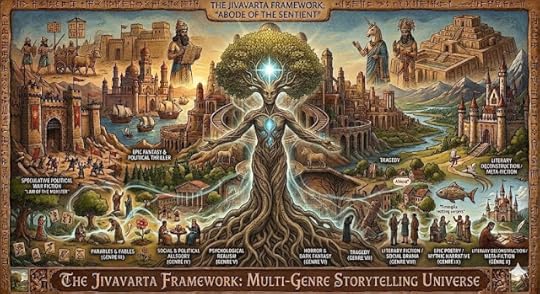
I. Speculative Political War Fiction with Hu...
April 4, 2026
Microfables of Jivavarta: Biting Dog
 Biting Dog — A Jivavarta Microfable by Shon Mehta. "We don't find what others are—we make them so.
Three boys once saw a dog sleeping in the...
April 3, 2026
Lore Of Jivavarta: Faiths of Jivavarta
Jivavarta, a land rich in spiritual tradition and philosophical evolution, is a realm where religious belief systems not only shape individual lives but also influence societal structures and norms. The three predominant belief systems that have shaped Jivavarta’s cultural and spiritual identity are Tapasi, Ajabuhi, and Secular Individualism.
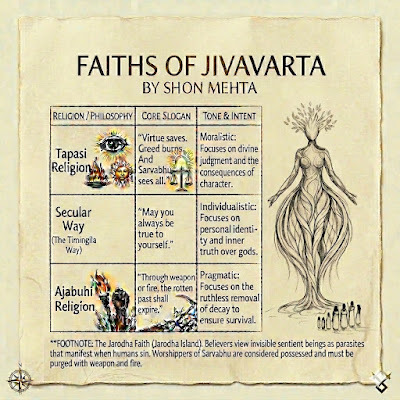 A comparative overview of the core philosophies and slogans defining the spiritual landscape of mainland Jivavarta.1. Tapasi
Tapa...
March 27, 2026
Stories Of Jivavarta: The Man Who Cheated Death
 Kushta stands at the center of a grand, mythical spectacle in Jivavarta, illustrating the power of a well-told story to reshape public perception.
In a quiet village in Jivavarta tucked between the hills, there lived two men who could not bear the sight of one another.
Abrak was strong-hearted and wore his honour like armour. Kushta was silver-tongued and wore his lies like silk. Their hatred ran so deep that even the wind, they said, dared not flow between them.
One day, fate offered Abrak an oppo...
March 23, 2026
Rough Hewn: The Silence of the Room

It is a strange thing, to be abandoned by someone who never existed.— Shon Mehta
There are moments after completing a story or novel when I feel an odd sadness—an emptiness I cannot quite explain. I realize that my characters—those strange people I once believed I controlled have quietly departed. As they should; and yet, what is unsettling is that I miss them. I feel abandoned. It is a strange thing, to be abandoned by someone who never existed.
During the act of creation, these characters troub...
March 10, 2026
Stories of Jivavarta: The Crossroads of Vakshi
 A desolate intersection in Vakshi where a shadowless tree stands as a silent witness to the choices of the weary.
Along the road to Vakshi, where the ground starts showing cracks like some old pottery, at a crossroad, stands what remains of a tree. The tree had thrived once, and had given shade to weary travelers. Now it was all dried up and shadowless, but it was still popular since in a forest covered with thorny bushes it was the only tree that stood in a clearing.
Beneath the tree sat four tra...
February 25, 2026
Stories of Jivavarta: Parables of Belonging | Immigration Allegory

Parable 1: The Sitar and the Flute
Sonira was once a city known for its flute music. From dawn till dusk, flute melodies floated through its streets. The sound was familiar to every ear. The people called it harmony, but it was the harmony of one, for they had never known another sound.
One morning, a musician arrived from the faraway village of Idany, carrying a sitar made from fine, seasoned wood. He went straight to the town square to play. A crowd gathered out of curiosity, but as he started,...
February 20, 2026
Stories of Jivavarta: The Balance
 God King of Rongcha stands embodying the wisdom required to rule the Rongcha kingdom.
Once upon a time, there was a great Rongcha kingdom. The great kingdom had frequent battles with the neighbouring kingdom. The reason for the battles was the border dispute between these two kingdoms.
The king a wise man was getting old. So he thought of grooming his son as his successor. Therefore, the next time when the king went for the battle, he took his son along with him. His son, the young prince, was as...


