
Kathy Parry's Blog
October 7, 2024
Hello world!
Welcome to WordPress. This is your first post. Edit or delete it, then start writing!
The post Hello world! appeared first on Kathy Parry | Corporate Energy Expert.


January 25, 2021
Are You Surge Protected?
Recently I was working on my laptop when a huge clap of thunder and a flash of lightening hit. Poof! My computer went down. All I could think was, “Did I just blow up my computer with that surge?” I was not plugged in with a surge protector and immediate panic set in. That dread in your stomach that, “This could be bad.” Luckily, my computer was fine. Many of today’s versions have some built in protection. But remember when all computers needed a surge protector?
Do you still have a surge protector? Most would answer with an emphatic, “YES”. Because if the thought of a surge of outside energy burning up your computer terrifies you like it does me, then you want to make sure your information is protected.
Do you do the same for your day? Do you protect your day against surges of energy?
Let me explain. We all have a finite amount of energy to devote to our day. Part of it goes to family, a bunch of it goes to work and then we usually squeeze in a bit of energy for ourselves. That may be a workout, reading a book or a little Netflix at night. But during our day, someone or something can catch you off guard and arrive with their needs.
These disruptions in the flow of your productivity or your team’s can cause a shut down. Your work gets interrupted by an outside force.
How do you deal with these events? These surges often happen during crisis and it becomes necessary to re-route your energy. But what if the outside force interrupting your productivity isn’t an emergency or crisis. It is just raining, no huge thunder or lightening.
You are going to have to guard your energy. Put up your protector and let these interruptions, whether a person, project or distraction know that you are not going to be deterred. Being productive, owning your energy and not shutting down for someone else’s issue are key to staying powered up.
A few tips to make that happen in your day:
Schedule your day before you start it – the night before works great for thisLeave space each day to help others. That way when you are interrupted you can give them a time that you have available to help them.If you have tasks that needs to be in a No Interruption Zone, let team members know you won’t be available.Schedule breaks in your day for communication. Return calls and emails then.For more ways to protect your day from energy drains, power up and stay resilient sign up for resources or visit www.KathyParry.com
The post Are You Surge Protected? appeared first on Kathy Parry - Corporate Energy Expert.
September 21, 2020
The Big Meltdown that Helped Me Re-Frame My Disruption
I drove a big YukonXL for 13 years. When you have four children in 7 years you haul a lot; kids, sports equipment, carpool kids, rummage sale finds. You get the picture. I needed a workhorse of a vehicle.
At one point this vehicle also became the place that provided the space for a turning point in my life. My youngest daughter was predicted to live only two years due to a degenerative disease. Because I was always busy hauling my other children around in the “truck” I rarely had time to wallow in my daughter’s prognosis. But one day after dropping off the last of her older siblings at various activities, I had a full breakdown. Right there in the big SUV. Bawling. I had to pull over.
I didn’t get it. I had been tough through these first two years of my daughter’s life. Managing the other three children’s activities, taking my youngest to lots of appointments, learning the ins and outs of metabolic syndromes. But on this day – BOOM. I was a mental mess.
I pulled the truck off the road and into a parking lot. I sobbed. Then I started to ask why? “Why are you losing it?”
Maybe through this pandemic crisis you’ve held it together great. But I’m guessing at some point you may have lost it. Your event may not have been a big, ugly cry. But if you had feelings of doubt, overwhelm or disbelief you probably were affected by the same thing driving my reaction: FEAR.
Fear is a good thing, meant to save our lives. But living in fear holds us back from moving through a disruption or crisis.
But how do you talk yourself down when fear overwhelms? You get really honest with yourself. Going deep into why you are afraid isn’t easy. All that vulnerability looks weak. People will talk. Be tough. Don’t let it show. WRONG.
Asking myself the hard question, I wiped my tears, “What are you so afraid of?” It wasn’t actually my daughter’s diagnosis I realized. Her prognosis had been with me for two year and I had made peace. I was afraid of “sad eyes”. When I used to greet friends, they were upbeat and fun. Now everyone looked at me with sad eyes. Empathy is great and we should display it. But sad eyes all the time were bringing me down.
This situation needed re-framing – quick – or sad eyes may surround me forever.
I let people know I was okay. I presented myself with more confidence and humor. Acknowledging my fears and going deep into what I was feeling was not an easy step. (Remember I had a full melt down before I did it!) But to move through a crisis our fears must be confronted, explored and worked through.
If you are fearful you may not want to work through your fears alone. And that is okay. Get a friend, a therapist or colleague and ask for the help you need to get through the fear. Vulnerability is the friend needed to move through a disruption. Introduce yourself to her today, acknowledge the fear and start to move through it. You’ve got this.
If you are in a state of fear that is leading you to feel overwhelmed, please reach out to a professional. I did.
The post The Big Meltdown that Helped Me Re-Frame My Disruption appeared first on Kathy Parry - Corporate Energy Expert.
August 31, 2020
Do You Have a Warped Frame on this Disruption?
Over the years I have framed a lot of pictures. Back in eighties I was really into botanical prints. I would search antique stores for yellow-edged pictures of iron weed or day lilies and customize mats and frames for each unique print. It was a cool little hobby and I gave away a lot of botanical prints for gifts.
Recently, I wished I would have taken the time to properly frame a print. It is a large replica blueprint of a patent drawing of a boat propeller. It was hanging in the basement of our lake cottage and as things tend to do at a lake, it was exposed to humidity. Because I framed it in plastic – hey, it was cheap, and I was doing three prints – the frame warped. I’m going to have to Re-Frame it.
When we are stretched by a disruption, it can feel like everything surrounding us is buckling. Bending from the pressure of an outside source. I bet you’ve felt it recently. The way you frame your work is bent. The frame around your family is stretched. And most definitely you’ve had days that were entirely framed in some cheap plastic that warped the moment you woke up.
It is time to Re-Frame!
Re-Framing is the second section on my Rubber Band Resilience Curve. (see below) This period of re-framing is not all gilded and museum-quality, there is hard work to be done. To turn a disruption into an opportunity it must be re-framed.
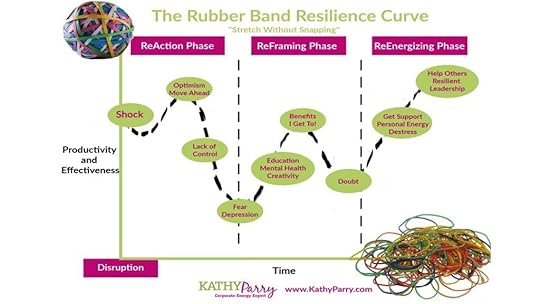
Where do you start?
The first step is the language you use. Start switching all your, “I have tos” to “I get to”. This simple shift in perspective makes all the difference in mindset. Imagine if you walked into your staff meeting (weather remote or in person) and stated, “We get to serve our clients today!” Not the old, warped language that may go something like, “What client issue do we have to work on today?” You get to! If you are lucky enough to have clients, residents, or customers then you are lucky enough “to get to” serve them.
What other language examples could you change? Look below this post for a few examples of re-framing language. Print this out. Post it. And make sure to fill in that last spot the next time you say, “have to” or you find negative language sneaking into the framework of your day.
Reframing disruption is a process. It doesn’t happen overnight, especially when the disruption is as big as a global pandemic. But awareness of the broken frame is a first step. And the desire to put a more beautiful or stronger frame around the crisis is what leaders do. Start to imagine your new frame today. Then use the right language to set the opportunities in motion.
The post Do You Have a Warped Frame on this Disruption? appeared first on Kathy Parry - Corporate Energy Expert.
August 17, 2020
Be Someone Smart and Build Your Resilience
I love smart people. Really. Think about it. If you’re like me, some days you wake up and think you know nothing. You have a problem to solve, a project to finish or just in a quandary for next steps. What do you do?
If you’re like most successful professionals, you try to figure it out yourself. But that is hard. The answers don’t automatically flow. That’s when smart people come in.
Now, you can go to YouTube U. You will find a lot of smart people there making lots of brilliant videos. I have learned how to defrost a freezer tube, put together a shelving unit and make homemade carpet cleaner all from YouTube. But these video lessons only offer one perspective.
To really grow in your resilient behaviors, at some point you will need to seek the advice of others. And to be the type of leader that develops resilient behaviors in her team, you will have to share knowledge. This huge disruption has helped many of us become more collaborative in our approach to problem solving. A big part of the reason is NO ONE HAS ALL THE ANSWERS. If you read my post from last week, you’ll know that most of us are suffering from some form of COVID Brain.
How do you go about being a smart person? And how do you know if people need to know what you know? ASK. No one wants a know-it-all around, but people do need help finding answers. Be that person.
ASK: If you see someone struggling reach out. Ask. “Would you like to know how we did that on our team?” Many people do not ask for the help they need. Whether it is embarrassment, lack of confidence or just plain old, I-can-do-it-myself attitude, we don’t like to ask for help. So, to be a resilient leader you may need to be the one to ask HOW you can help.
You may be asking people you don’t normally talk to. Are you an assisted living executive director? Could you reach out to other directors, even not within your state or city and just ASK how they are doing? You will be shocked at how many people want to talk to someone who understands what they are experiencing. Are you an HR director who just successfully virtually on-boarded new associates? Could you share in a group that you would be happy to tell the group how you did it? ASK.
Many of us are not in the habit of giving out our knowledge as often as we should. But if you know something, be like the woman who taught me how to properly fold a tamale on YouTube. Share your successes with others who may need the information for their success. Being someone smart for others is one way for both parties to rise on the resilience curve and work through the disruption.
The post Be Someone Smart and Build Your Resilience appeared first on Kathy Parry - Corporate Energy Expert.
August 10, 2020
COVID Brain – It isn’t just your imagination
Have you recently walked in a room and forgotten why? Were you SURE that you completed a task, only to find out you really didn’t? Does your work sometimes seem confusing?
Guess what? You may be experiencing COVID19 brain. It is a thing. In an article in INC Magazine, the concept of COVID brain is explored. Neuro scientists Hilke Plassmann and Benjamin Kessler explain how the combination of trauma, sleep deprivation, stress and uncertainty collide in our brains to create a perfect storm of fog and confusion.
Did I fill out the requisition request or was that last week? Did I feed the dog dinner?
It all gets mashed up in the pre-frontal cortex of our brains. This area handles analytical thinking, memory, and complex planning but it is in a state of overwhelm. Our brains process and make decisions based on past experiences. BUT we don’t have anything stored away to compare to this disruption. Most of us have never worked from home and home-schooled children. Or worried about becoming ill while still trying to figure out if we can meet our financial responsibilities. Our brains are not currently hardwired for all the scenarios.
So, what do we do to combat COVID brain and all its foggy consequences? How do we stay resilient and energized when our brains are not functioning the way we are used to?
A few tools to that help:
Pause – When that foggy feeling creeps up. Stop and acknowledge that you feel off. Your thoughts aren’t clear and the only way to stop that thick-brain feeling is to stop what you’re doing. Breathe. Reset your current intention. The world, your kids, your boss can generally wait five minutes for you to gain some clarity.
Make a plan – I use an amazing planner that helps me work through the day. Or you can also use my Resilience Daily Planner that you can find here. Planning your day helps you stay focused. And focus is the enemy of the COVID brain. We are meant to concentrate on tasks for about 90 minutes. After that, even without brain fog, we begin to lose our ability to concentrate. Find your sweet spot. How long can you focus on a task without distraction? Hey, if it is only ten minutes, then break your day down into 10-minute increments.
Go to what you know – Find a task that you know you can do. What is something that you are good at and you do without question? If you are in a work situation, reset to a basic task that you have done many times before. A spreadsheet, a team call, a report. Pick something with a familiar flow that you can work on for your next designated chunk of time. If you are in a personal situation, do the same. Reset to a stack of laundry, a grocery list or walking the dog.
Get a drink of water – Many of us reach for the caffeine when we feel brain fog. But what our bodies actually crave is hydration. Your brain is 73% water. Studies out to the University of Connecticut show that even a 1% decrease in brain hydration can cause cognitive decline.
Many of us feel overwhelmed in the age of COVID. But being intentional to care for your energy levels and resilience is one way to better manage this huge disruption. For more resources please visit this link.
The post COVID Brain – It isn’t just your imagination appeared first on Kathy Parry - Corporate Energy Expert.
August 3, 2020
How Do You Handle an OVERreactor
It is 3:00 am. Here we go again.
“woof, woof, WOOOFFF!”
“Phil be quiet, it’s the air conditioner!”
Phil is my 9-month-old Bernadoodle puppy. And lately Phil has been waking up in the middle of the night. And barking. And barking. It can be the AC cycling on, the dishwasher cycling off, a tree branch moving or one of the kids shifting in their beds, random noises are causing him to react.
We all react when we are startled or disrupted. And most of us have been majorly disrupted the last few months. Phil the puppy must think his incessant barking at a trashcan lid blowing off is an appropriate reaction. But how do we, in a professional setting determine appropriate reactions to our disruptions?
The COVID19 pandemic has caused many of our reactions to be more emotional. We are afraid, confused, and angry. Many of us are grieving. We are grieving for people we have lost. We are grieving for people and family we can’t see. We are grieving a lack of normalcy. While we try to be “professional” in our reactions at work, this is also a time to be human with our reactions. Understanding of those reactions.
If you have a team member having a particularly emotional reaction to a situation, be gentle. We don’t know what threats they have faced to create their larger reaction. Ask the team member to remove themselves from the situation. And be gentle in your approach. Put on your empathy cape. “How can I help?” “What can we do for you?” or “Do you need ten minutes to yourself?” Can all go a long way to build team members up.
Reactions are hard to hide when we are emotionally charged. Help your teams understand we are human and have a space or policy in place for team members to regroup and regain some composure. I recently spoke to a director in a long-term care facility who set aside a space in an activity room just for team members to take a moment. Caregivers are taxed and emotions from residents and families can all create situations that cause reactions to be big.
A few tips on to help your team manage reactions:
Acknowledge that we are all having reactions to this disruption
Understand that not all reactions are the same
Put a plan in place for your team members to gather support when big reactions happen (more on this in a resource later this week!)
We can not go through our days without reacting. But building a culture where we understand each other, support each other and find solutions together will help mitigate those huge barking moments in the middle of our days.
For more resources visit www.KathyParry.com
And to get a free tool kit for caregivers visit: https://mailchi.mp/kathyparry/resourc...
The post How Do You Handle an OVERreactor appeared first on Kathy Parry - Corporate Energy Expert.
July 29, 2020
How do you care for a care giver?
She does not wear a cape. He is not able to leap tall building in a single bound. And she certainly does not shoot spider webs from her wrists. But caregivers need to be elevated to heroes regardless.
And they should be. Anyone who has been a caregiver, either professionally or for a family member knows exactly the toll it takes. But most caregivers do not want or need the label of hero to do what they do.
Most caregivers do it because of love. Love for another human being. It is that simple.
There is lot of discourse in this country. A lack of love for other human beings. But caregivers live in a space of humanity. They can look in a hurting person’s eyes and see themselves. Empathy is the cape caregivers wear.
During the pandemic, I witnessed caregivers whose capes of empathy were stretched, ragged and torn. They had used so much of their own heart caring for those who needed them, they suffered. They are worn out, stressed out and burned out.
If you are not a caregiver, your time is now. It is time for all of us to rally. To care for our caregivers.
How do you do it? Where do you start, especially if you don’t know a caregiver? Being someone smart is one of the tactics I teach when helping professionals become more resilient. It means sharing your gift with someone who may need it during a disruption. When we share our knowledge, we build resilience for others and ourselves.
Are you a financial planner? Reach out to an assisted living facility and offer to have a virtual Q & A for their caregivers.
Do you have the gift of technology? Create an online portal for a patients to express gratitude to their caregivers.
How do you find out what to give? Ask. Call up a few people you know who are caregivers or who serve caregivers. Just start asking. Have a conversation. Even it is just a friend caring for an elderly parent or special needs child.
Go get you cape of humanity out. Put it on. Care for the caregivers.
Are you a professional care giver or manage a team of caregivers? You can download a post-pandemic resilience TOOL KIT here
The post How do you care for a care giver? appeared first on Kathy Parry - Corporate Energy Expert.
May 5, 2017
Another Sample Blog Post
This is the second greatest blog post of all time, with the first sample one being the greatest.
The post Another Sample Blog Post appeared first on Kathy Parry - Corporate Energy Expert.
Sample Blog Post 1
Even though it is just a sample, this is the greatest blog post of all time.
The post Sample Blog Post 1 appeared first on Kathy Parry - Corporate Energy Expert.
Kathy Parry's Blog

- Kathy Parry's profile
- 4 followers

