Tricia Barr's Blog
May 11, 2014
WYNDE Wins Gold Medal in Independent Publisher Awards
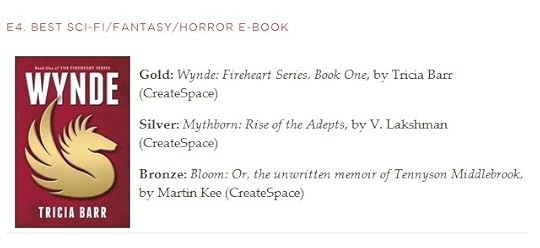
The Independent Publisher Book Awards is the world's largest international and regional book awards competition. Its goal is to recognize "excellence in independent publishing." Thirty-eight medalists were chosen from nearly 600 entries in the e-book category.
For more information on Wynde hop over to TriciaBarr.com.
For updates on all things FANgirl follow @FANgirlcantina on Twitter or like FANgirl Zone on Facebook. At times she tries the Tumblr.


April 28, 2014
Scum and Villainy Radio Appearance
Join Alex Rybak and Cody Eichel this week for their best episode yet! Mark Pircirilli (creator of Yodas News) joins us to discuss the New York Toy Fair. We play the new "Lost Missions" trailer as well. Our first special guest this week was Tricia Barr, creator of fangirlblog.com and author of Wynde. She discussed her role in the Star Wars community and her mission as a 'Fan Girl.' Our second guest this week was Greg Weisman, Executive Producer of Star Wars Rebels. He discussed his career on shows such as 'Gargoyles', his new novel 'Rain of the Ghosts,' and Star Wars Rebels. We will be giving away a copy of Greg's new book and he was kind enough to autograph it for us! Just tweet or email us the word 'Rain' to be entered. This was an amazing show and one you don't wanna miss!
Wynde
Rain of the Ghosts
Tricia Barr took her understanding of brand management and marketing, mixed it with a love of genre storytelling, and added a dash of social media flare to create FANgirl Blog, where she discusses Star Wars, fandom, and strong female characters. She also writes about Star Wars for Random House’s science fiction and fantasy blog Suvudu.com and Star Wars Insider magazine and is a contributor for Her Universe’s Year of the Fangirl. Her FANgirl opinions can be heard on the podcasts Assembly of Geeks and RebelForce Radio Presents Fangirls Going Rogue.
Tricia has completed her first novel, Wynde - a military science fiction with a fantastical twist that features heroines Vespa and Gemini. For excerpts and tales of her adventures in creating a fictional universe, hop over to TriciaBarr.com.
For updates on all things FANgirl follow @FANgirlcantina on Twitter or like FANgirl Zone on Facebook. At times she tries the Tumblr.
February 22, 2014
WYNDE Around the Web: February 22, 2014
I’ve previously discussed how the friendship and teamwork of Vespa and Gemini are an important part of the storytelling in the novel. A long-time friend, aurrasingrules from the TFN Fanfic forums, just completed Wynde and noted:
[Vespa] and Gemini were the true power couple of this book!
The fun part about this short story is it will shake up some preconceptions from the novel. Writing from tight POV allows me the ability to convince readers one thing is happening when maybe it’s not…
Melissa, known on Twitter as @JediLibrarian42, had fun tweeting as she read the book, including tweeting right at one of the character's Twitter account. A couple of my favorites are below:


The “tall, dark and handsome” line obviously refers to the classic Disney prince. Over the course of the book, I had a lot of fun playing around with the fairy tale trope. In a particular scene that takes its inspiration from Cinderella, the chimes of a clock signal the end of Gemini’s time at a party. Gemini is not at the party to meet her true love, but rather to support her best friend Vespa. The stroke of midnight doesn’t take her back to a miserable existence, but rather her life as a warrior, a job that she is passionate about. Turning expectations on their heads was probably one of the most enjoyable parts of writing the book. It makes the story familiar, but modern and fresh. Or at least I hope that is how it comes off to the reader!
Melissa wrote a nice review over at The Ramblings of a Jedi Librarian. Here’s what she says about my characters:
The characters are well rounded, and I found myself really liking some of them. Vespa is a young woman with spirit, who in the face of imminent danger, doesn’t give in to fear. Instead she stands up and fights. She repeatedly cares more about saving those she loves than the danger to her own life. She’s a strong young woman fangirls of all ages can stand behind and cheer for. Gemini Reed, Vespa’s best friend, is another great character. I petite blonde (Yeah! We need more of those) who proves that big things come in small packages. She enlists in an elite military special forces group, Gemini takes part in the battle at the end of the novel, proving herself to be a formidable ally and opponent. She is a well rounded character, and like Vespa, a strong female character for fangirls to love. The male characters where equally great. Zephyr, Vespa’s childhood friend who cares for her a lot more than she realizes, I found myself rooting for him and hoping Vespa would give him a chance. Even Daemyn, Vespa’s overprotective father who is afraid of losing his daughter and expects a bit too much from his children, reminded me a bit of my own dad with his over protectiveness and I could totally relate to Vespa’s frustration with him (yet another plus when you can relate to a character or two). The most unique character was the AI Wisper, who has her own personality and role to play in the story.
Just a reminder: My book Wynde is out now and here are all the things you can do to support it.
For updates on all things FANgirl follow @FANgirlcantina on Twitter or like FANgirl Zone on Facebook. At times she tries the Tumblr.
February 1, 2014
Flaunting My Diversity
When Kai posted her piece Publishers, Flaunt Your Diversity, it hit on a topic that is near and dear to my heart as a storyteller. I have talked about diversity in storytelling over at my blog FANgirl for several years now. While my main focus for FANgirl is to promote equality for women in fiction and as storytellers, diversity means balance in portrayal of race, religious beliefs, and sexual orientation too. People are unique and different. If stories are supposed to reflect our reality, and more importantly if science fiction projects potential futures, then diversity is something that cannot be ignored.
At the turn of the new year I published my novel Wynde . As I wrote, I took time with each character to make sure I wasn’t just drawing from my baseline comfort zone. I was raised in a heteronormative white Catholic family. My father worked, my mom stayed at home with my sister and I. As a writer, I am very aware that I grew up in a family environment that is considered normal in storytelling. That doesn’t mean I haven’t known people or families who were different than mine, though. A good friend growing up was half-Japanese, half-Filipino; her mother was a doctor, her father stayed at home to raise the kids. I have been lucky enough to travel the world and experience many cultures, meet people of all types, and embrace their individuality. I’ve also seen horribly oppressive mindsets. As a woman I have experienced harassment and biases against my gender. For me, the two most important things a writer can keep in mind are a self-awareness of her own biases and a recognition of how other people’s biases are formed and affect their world view. From there, storytelling can open up infinite possibilities when creating characters and the stories that involve them.
In my epic space opera Wynde, the fictional world of Prime has parallels to Earth in a similar way that Panem in The Hunger Games can be easily related to the United States. With that said, Prime and Earth are not the same place; for where I wanted to take the story, I needed to create a fictional setting. That meant I couldn’t portray racial diversity by referring to a character as Asian, Indian, or African or by mentioning a country of origin; I had to consider other ways to identify characters as diverse. One method is to mention skin tones. In Wynde many different people of color work side by side as equals. I wanted to show this because that’s what I would like our future to aspire to. Still, diversity issues are real and relatable, and I wanted to address that in my story. I created four unique cultures on Prime based on affinities for different gods. For example, people living near volcanoes revere Aladare, the god associated with fire, farming societies worship Tarah, the goddess of the land, and so on. Like national and racial diversity in the real world, Prime’s cultural differences breed specific biases. Through the course of the story, the Primeans must overcome these differences to stop an alien invasion. The world government on Prime is united, led by a Prime Minister. In his cabinet, one minister is tasked with diplomacy between cultures. My heroine’s mother, Utara Fireheart, holds that position. Her last name hints at Utara’s cultural affinity – fire. I never discuss her race in the first book of the Fireheart Series, though, for storytelling reasons that will be revealed in later books. Through Utara’s point of view we see many people of color working in the upper echelons of government.
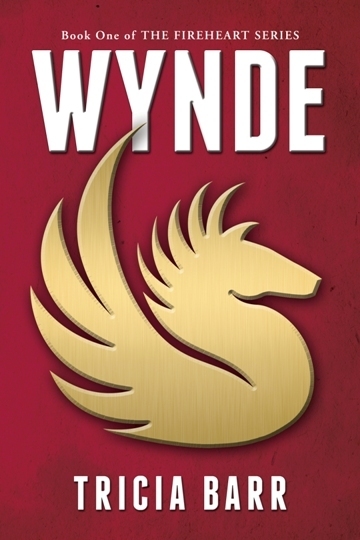
For my childhood friend, her Japanese and Filipino heritage combined with her life as an American immigrant to certainly affect her life experiences, sometimes making them broader, other times hindering her. This was a dynamic I very much wanted to portray in Wynde. In fact, it helped form an image of my heroine’s father, Daemyn Wynde. His last name indicates he comes from a different culture than his wife Utara; he is a Faytan, who worships the goddess of air. He is also, in my mind’s eye, a character who would be played by an actor of Asian descent. So not only are the main family’s children blended culturally, they are blended racially. The cultural differences reveal themselves more so in the prose, but I have always envisioned my fictional universe as a transmedia story. In the coming months, I will be working with an artist to showcase the characters’ diversity in a visual medium. After all, a picture is worth a thousand words. I am excited for readers to see the diverse cast as well as read about them.
Diversity isn’t just something on the outside; it can come from within too. While I was writing about what is considered a traditional family historically, I didn’t let that limit how other characters were portrayed. Vespa is Wynde’s lead protagonist. Her best friend Gemini serves as my secondary female protagonist. In a heroine’s journey, the central character needs to grow. In my experience, good friends help that process. From that mindset, Gemini became the heroic rock of the story. She is unwavering and kind and heroic in ways most can’t possibly be. Through this foundational character, I present an alternative look at family; she is the daughter of two doting fathers. Additionally, I had an opportunity with two heroines to show not only that searching for happiness within a romantic relationship is possible, but also that the alternative, going it alone, is also a healthy and respectable choice for a young woman to make. Which character makes what choice, I will leave for you to discover.
One of my top goals for Wynde was to make it accessible to anyone, to create a world where many different types of people could find themselves. If you’re looking for a diverse tale, check the book out and let me know what you think.
A bold flying maneuver won Vespa’s team the Airspar Championships during her first year at Kedu Academy. Two years later some, like her father, still say her choice was rash and reckless.
While Vespa is vacationing on the Kavil moon to celebrate her graduation, alien terrorists attack. Her impulsive decision to fight back helps thwart the initial Orkan assault, but also strains the previously deep bond with her father. Vespa must bear the consequences of her actions while the government of her home planet, Prime, struggles to comprehend the implications of the strike. Relations with their longtime trade partners are further challenged by the arrival of a military task force from the Protectorate—human colonists who had left Prime centuries ago and who bring a far different perspective on the Orkan’s intentions.
Vespa enlists into an elite military unit training spaceblade pilots to defend her planet. But she can’t do it alone—success will take teamwork. With the lives of her family and friends at stake, she must sort allies from enemies and repair her relationship with her father before it is too late. When outright war erupts on the Kavil moon, another fateful choice may be inevitable.
Wynde combines contemporary themes, military science fiction, fantasy, and romance into a sweeping space epic that launches the adventures of the next great heroine.
Tricia Barr took her understanding of brand management and marketing, mixed it with a love of genre storytelling, and added a dash of social media flare to create FANgirl Blog, where she discusses Star Wars, fandom, and strong female characters. She also writes about Star Wars for Random House’s science fiction and fantasy blog Suvudu.com and Star Wars Insider magazine. For excerpts and tales of her adventures in creating a fictional universe, hop over to TriciaBarr.com.
Follow Tricia at @FANgirlcantina on Twitter or like FANgirl Zone on Facebook.
January 14, 2014
Writers Toolbox: Teaser Trailers
 A while back I posted my second teaser trailer for my novel Wynde. I thought I would share how I learned to use the teaser trailer as a tool in creating the novel.
The trailer is essentially a screenplay for a trailer you might see at the movie theater or on television. Trailers are meant to give you a sense of what the movie is about, and that’s how I approach my prose fiction trailers, too. A short blurb, like you’d find on a back cover or dust jacket flap, can’t provide a real sense of the scope of the universe I’ve created for my story or the breadth of emotions the reader might experience. Over the years I’ve been lucky to have many readers of my fanfiction, and consistently I’m told my writing is very vivid and emotionally gripping. I’ve been told on more than one occasion that scenes play out like movies in the reader’s mind, and that they feel like they are experiencing the story alongside the point-of-view characters. When I write that’s basically how the story plays out in my imagination, so it’s nice to get feedback that I’m able to transfer the experience in my mind effectively onto the page.
First, though, where did the idea to create these teaser trailers come from? Back in the early iterations of fanfiction message boards self-promotion became taboo, mostly out of necessity. Stories would get spammed to stay on top of the board for readers to find. Writers had a few ways to gain exposure, such as using links in signature lines, which provided an incentive to participate in the community by reading other writers’ stories, responding to comments on your own story, and entering into social and topical discussions about the fandom. Interestingly, that’s now the model published novelists are being forced to utilize – they have to participate in social media or as bloggers in order to be noticed amid the overwhelming volume of entertainment options available to fans. The fan-community awards process was another way fanfiction writers gained recognition. Telling good stories garnered nominations and wins, which resulted in more exposure to a broad segment of the readership. Sometimes limited venues for self-promotion were created, such as a community thread where writers were allowed a single, one-time post to announce a new story. Here, too, the key was creating an announcement that stood out. Writing a good teaser trailer helped convinced readers to give the story a try, just like an exciting movie trailer can intrigue people who otherwise might not have planned to see the film. BJ, my editor, wrote an awesome teaser trailer for one of our co-authored fics, and that really helped us bring the story concept into a cohesive idea and earned us a great readership, too. I’ve been using teaser trailers as a tool ever since.
Original concept notes for Teaser Trailer #1:
Selfish/Selfless, Choices, Heroine, Family, Love
For the first Wynde teaser trailer, which BJ and I co-wrote almost two years ago, I primarily wanted to give a sense of the main character, Vespa. The opening of the trailer includes a few scenes that I was deliberating about their inclusion in the manuscript. Ultimately, I opted to open the novel with an immediate action sequence that puts the stakes on the table from the very start. In the first trailer I also wanted to give a sense that the novel is a war story with touches of romance. Providing a glimpse of the worldbuilding was important, too. Scenes reveal various landscapes on Prime and on the Kavil moon, which can vary from beautiful vast valleys to barren harsh wastelands; I even teased an early look at the underwater kingdom of the Orkans, the meraliens who serve as the antagonist. A few other scenes from the first trailer were altered or did not make it into the book. For example, one scene showed Gemini, Vespa’s friend, leading a squad of soldiers, but when I approached that part of the story I realized it was more important for Gemini to enter the battle alone. Her capability as a leader will come in later stories. I also cut a scene with Vespa and her brother Terraq working together in favor of a different combination of characters accomplishing the same objective, and the scenes that replaced it have been noted by the betas as some of their favorites.
In Agent of My Own Destiny I discussed how storytelling can be a complicated process. Early in their development, stories need to have a beginning and an end, and a general idea of the plot between those two points. Yet accomplished storytellers warn against characters becoming enslaved to the plot, which results in characters doing things “out of character” and they start to lose agency. My theory on characters is this: a character is who she is, part nature, part nurture, and those two facets of her life often create a conflict of self within the character. Frequently this internal conflict is the character’s blindspot. For that reason, I tend to use external point of view to identify for the reader what the conflict is. At times, the main character will show glimpses of understanding her own internal conflict, but it won’t be until the external objective is reached during the climax that the character resolves her internal struggle. In the end, the character isn’t so much changed, but rather ends self-aware of the conflict that exists within her and is able to resolve the personal crisis it created.
Over the past ten years as I have written novellas and novels, I’ve learned that the best way to avoid the power of the plot overriding characterization is to approach my story design in a three step process. The teaser trailer is a necessary step in that process. The first step is to detail the objective goal of the story. For Wynde it boils down to: a terrorist attack (the beginning) leads to war which ends with a victory for either the good guy or the bad guy (the end). The second step is to lay out the main character’s internal conflict and line it up with the short list of plot points that must be shown to achieve the story’s objective goal. At this stage I’ll also keep handy a chart of the dramatic action I want to follow, which include such things as rising action, falling action, climax, and denouement. Depending on the story I’m telling, these may vary. A tragedy wouldn’t play out in the same way a romance would.
This is the point when the teaser trailer begins to help shape the story. If you peruse the scenes of the first teaser trailer, it gives glimpses of the world and specific moments in the story. Almost all of the scenes in the first teaser trailer capture moments of the plot’s dramatic action, when the story and also its characters are moving toward their external and internal objectives. The scene below sets the context for one of the most pivotal events in the book. Early on I had distinct visuals of how and where Vespa would face her internal conflict, and I knew then it would be an action-driven sequence. I didn’t want a moment filled with a personal awakening to occur in the confines of a cockpit, but I did want the weightlessness of space to figure into the physicality of moment. So I envisioned a zero-g sparring chamber, where pilots learned space combat skills without their spacecraft.
INT. MILITARY TRAINING ROOM
The middle of the room is dominated by a large translucent sphere of shimmering energy. Within the sphere, two individuals in military training fatigues prepare to engage one another in zero-gravity hand-to-hand combat.
This was one of the earliest plot points set. It occurs at the beginning of the section where tension starts to ramp up, and I had always been excited to write it. Unlike many writers, I rarely write out of order. It would be like eating all my favorite morsels on a plate first. So when I finally got to expand on this trailer scene, it served as a reward for getting through some of the steps that are less exciting to me as a writer. When it was actually written, the zero-g sparring sequence turned out even better than I had originally imagined, because I had laid all the groundwork with the characters before I wrote it. Interestingly, this scene was removed from the second teaser trailer, which was written after Wynde was finished, because it didn’t serve the goals of that trailer.
Narration text from Teaser Trailer #1:
In a world suddenly plunged into war, familiar alliances cannot be trusted and old rivals may be the only hope for survival. Friendships will be tested, families torn apart, and new love formed. A heroine’s heart will be forged in the fires of destiny.
The narration text in the first teaser trailer sets out clearly what the book would be about. While all three sentences apply to my primary heroine’s journey, the first two sentences apply to many secondary and tertiary characters, as well. Even the world of Prime experiences, within the context of the book, an arc that plays on these themes. Over the course of writing the novel I kept returning to this summary to make sure my characters and their actions were meeting this objective.
The narration text also became critical to the third step of story design, which is figuring out how all the puzzle pieces – the plot moments, the characterization, and the worldbuilding – all work in tandem.
Often when storytellers lose their characters to the power of the plot, it is due to having too strict of an outline for the story. Outlines are handy, but they need to be flexible. The first idea a writer has, the one created during the outlining process, isn’t always the best one for the character. Outlines also often lack the most crucial piece of characterization: motivation. Plots don’t motivate characters, but plot points do contribute to the nature or nurture of a character. Outlines teach the writer to focus on what the characters will do, not why they do them. In the course of writing Wynde, keeping my focus on character motivations rather than plot points led me to some revisions to my original outline that really made the novel stronger, in both characterization and plot.
Another trap authors often fall into is creating a story in which only one character’s motivations drive the tale. Functionally this is how most stories of old often unfolded. Over the past thirty or so years, though, a shift in storytelling has been occurring – now the adventure isn’t just about Dorothy Gale or Peter Parker, but also their allies and enemies. Books like Wicked and Catching Fire, and television shows like Fringe, Lost, and Buffy the Vampire Slayer reveal that the antagonist, loved ones, fellow plane-crash survivors, and friends like the Scooby Gang can go on journeys, as well. Movies have been slower to reflect this shift in storytelling, in large part due to the nature of the medium, which constricts the storyteller to a tight two-hour format. With that said, The Avengers and Pacific Rim are examples of this change occurring in films, too. Imagine the protagonist as a planetary body hurtling through space. She will affect other objects with her gravity as she passes nearby. These other objects are the secondary and tertiary characters, who each have their own gravity as well and will affect the main protagonist in turn. I designed Vespa’s story in very much this way, with the actions and motivations of other characters impacting Vespa’s progression, and vice versa.
Including a large cast of characters who all play off each other in this way can result in story bloat, which creates a different set of problems of its own. I learned this the hard way back in the fanfiction days. In the process, I developed my own system to help tackle this problem. One common way to prevent story bloat is to use first-person point of view, which necessarily limits the scope of the story being told. This worked well for the first two Hunger Games books, but in Mockingjay, Katniss’ sole point of view limited giving the readers a true understanding of the epic revolution unfolding. From the start on Wynde, though, I understood that my character arcs and worldbuilding would suffer from this same problem if I stuck to a single character’s observations. I needed to take the reader to other planets and locations than where my heroine went. I also rather enjoy the advantages of not always being inside my protagonist’s head. To keep the story from losing focus or growing too large, I put a qualifier on every scene: it must, in some fashion, directly tie into the emotional themeline of Vespa’s journey. If the scene couldn’t pass that test, it was extraneous. Here again, I utilized the first teaser trailer’s narration as a gauge.
Now that I’ve shared some of the tools in my toolbox and the intentions behind my teaser trailers, perhaps it’s time to remind you that the second trailer is up. It was written after the manuscript was completed, so it has some different imagery than previously. And the narration has a little bit of a different goal, too. Maybe later I’ll talk about that…
Related posts:
Teaser Trailer #1
Teaser Trailer #2
Agent of My Own Destiny
Tricia Barr took her understanding of brand management and marketing, mixed it with a love of genre storytelling, and added a dash of social media flare to create FANgirl Blog, where she discusses Star Wars, fandom, and strong female characters. She also writes about Star Wars for Random House’s science fiction and fantasy blog Suvudu.com and Star Wars Insider magazine and is a contributor for Her Universe's Year of the Fangirl.
For excerpts and tales of her adventures in creating a fictional universe, hop over to TriciaBarr.com.
For updates on Tricia Barr follow @FANgirlcantina on Twitter or like FANgirl Zone on Facebook. At times she tries the Tumblr.