Angus Browne's Blog
October 13, 2014
Has Alexander the Great's tomb been discovered?
Right now, one of the most exciting discoveries in archaeology is currently underway in the Greek town of Amphipolis. A tomb has been discovered and so far it looks like it's completely intact.
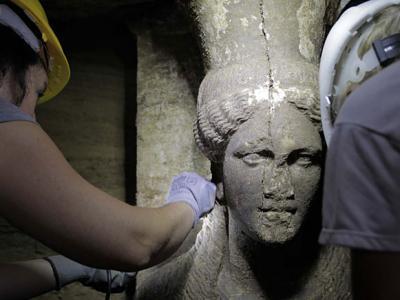
What we know about the tomb so far is that the it's massive, it dates to the period of Alexander the Great, it's in ancient Macedonia and everyone's excited.
There's a lot of conjecture that it may be the tomb of Alexander the Great. If so, there's no doubt that this will be one of the greatest archaeological discoveries of all time.
It would put Tutankhamun's tomb discovery in the shade.
So, the obvious question, is it Alexander's tomb?
Sadly, I would suggest not.
Although it would be great if it was, all the evidence that we have about Alexander's tomb is that he was buried in Alexandria in Egypt and not in ancient Macedonia.
If you've read Archie and the Lost Tomb then you may already know most of the following, but for those who haven't yet, it's worth a brief synopsis.
Alexander died in Babylon of something that remains unclear. Considering how many battles he was in, it's amazing that he actually died of a disease rather than a battle field injury. After his death, it took two years of in-fighting amongst his generals to secure his body before it was finally decided that the body would be transferred to Macedonia.
It was while the body was being transported that the funeral cortege was hijacked in the Syrian desert outside Damascus by forces loyal to Ptolemy who had secured control of Egypt. Ptolemy wanted the body of his oldest friend to secure some legitimacy for his own still tenuous rule in Egypt and he successfully captured it and took it back with him.
After moving around a bit, the body was finally laid to rest in a grand tomb in Alexandria which was referred to as the Soma (which means body in ancient Greek.)
The crucial question at this point is just how secure is the knowledge that he was actually in Alexandria?
There are at least three historical references to the tomb and to those who visited it from Strabo, Plutarch and Pausanias amongst many others. When these three all independently mention it being in Alexandria, then it seems a safe bet that it was there. There is even evidence that Cleopatra looted gold from the tomb in order to fund some of her own military campaigns.
The 4th Century AD was a time of great turmoil in Alexandria - a time of rioting, war, earthquakes and possibly even a tsunami. It was during this period that the location of the tomb was lost. And remains lost to this day.
So, with the weight of this much historical record, it seems more than likely that Alexander was buried in Alexandria and not in Macedonia. If this is the case, then just who is buried at Amphipolis?
It looks like we will know, hopefully, in the next few months but there a number of possibilities, including that it is of Alexander's mother, Olympias, which may make the most sense.
Anyway, it's going to be fascinating one way or another and is still one of the greatest archaeological discoveries of our age!
What we know about the tomb so far is that the it's massive, it dates to the period of Alexander the Great, it's in ancient Macedonia and everyone's excited.
There's a lot of conjecture that it may be the tomb of Alexander the Great. If so, there's no doubt that this will be one of the greatest archaeological discoveries of all time.
It would put Tutankhamun's tomb discovery in the shade.
So, the obvious question, is it Alexander's tomb?
Sadly, I would suggest not.
Although it would be great if it was, all the evidence that we have about Alexander's tomb is that he was buried in Alexandria in Egypt and not in ancient Macedonia.
If you've read Archie and the Lost Tomb then you may already know most of the following, but for those who haven't yet, it's worth a brief synopsis.
Alexander died in Babylon of something that remains unclear. Considering how many battles he was in, it's amazing that he actually died of a disease rather than a battle field injury. After his death, it took two years of in-fighting amongst his generals to secure his body before it was finally decided that the body would be transferred to Macedonia.
It was while the body was being transported that the funeral cortege was hijacked in the Syrian desert outside Damascus by forces loyal to Ptolemy who had secured control of Egypt. Ptolemy wanted the body of his oldest friend to secure some legitimacy for his own still tenuous rule in Egypt and he successfully captured it and took it back with him.
After moving around a bit, the body was finally laid to rest in a grand tomb in Alexandria which was referred to as the Soma (which means body in ancient Greek.)
The crucial question at this point is just how secure is the knowledge that he was actually in Alexandria?
There are at least three historical references to the tomb and to those who visited it from Strabo, Plutarch and Pausanias amongst many others. When these three all independently mention it being in Alexandria, then it seems a safe bet that it was there. There is even evidence that Cleopatra looted gold from the tomb in order to fund some of her own military campaigns.
The 4th Century AD was a time of great turmoil in Alexandria - a time of rioting, war, earthquakes and possibly even a tsunami. It was during this period that the location of the tomb was lost. And remains lost to this day.
So, with the weight of this much historical record, it seems more than likely that Alexander was buried in Alexandria and not in Macedonia. If this is the case, then just who is buried at Amphipolis?
It looks like we will know, hopefully, in the next few months but there a number of possibilities, including that it is of Alexander's mother, Olympias, which may make the most sense.
Anyway, it's going to be fascinating one way or another and is still one of the greatest archaeological discoveries of our age!