
Eileen Chong's Blog
June 18, 2020
Racism, and Black Lives Matter
I’ve just had a short essay published on Meanjin in the ‘What I’m Reading’ series. I wrote it in May, and feel like events have overtaken me since.
A video of me reading two new poems from my book to come, A Thousand Crimson Blooms, is up on Panacea Poets run by the Queensland Poetry Festival.
The poems making their debut here are ‘Teacher’ and ‘Cycle’. ‘Teacher’ is about Singlish, racism, my mother, and what teaching and learning really mean. ‘Cycle’, a crown of sonnets, is a recursive poem that moves through a series of intertwined interior and exterior landscapes.
I hope you will enjoy the essay, and also the reading.
I am also part of a collaborative project, Thinking About Immortality and Kindness, which responds to the escalation in racism Asian-Australians have faced since the start of the pandemic. It was partially funded through donations, and I thank all those who donated to our project so it could go ahead.
On the topic of racism: Black Lives Matter.
I have experienced racism, and continue to experience racism in ways large and small, through structural racism, personally-directed racism, and everything in between.
The racism experienced by Black, Indigenous, and people of colour (BIPOC) in America, Australia, and all over the world is unacceptable.
Educate yourself on racism. Don’t make BIPOC bear the dual burden of simultaneously experiencing and having to explain their pain.
Here are links to articles you should read:
Rebecca Solnit on the true violence around the George Floyd protests
Derrick Johnson in the Guardian on Black deaths in America
An excerpt from Reni Eddo-Lodge’s Why I’m No Longer Talking to White People About Race
Ijeoma Oluo on the need to centre BIPOC in discussions about race
Amnesty International’s resource on how to be a genuine ally to Indigenous communities
A study of Indigenous deaths in custody by the Australian Human Rights Commission
And if you can, please donate to Indigenous causes in Australia.


June 16, 2020
New book to come: A Thousand Crimson Blooms
Some news and links:
My next collection of poetry, A Thousand Crimson Blooms, will be published by the University of Queensland Press in April 2021. Here is the official announcement.
I have an interview up at correspondences, showcasing my involvement with Silent Dialogue, a collection of essays from Asian-Australian creators, forthcoming in October 2020.
Other recent writings include:
A recording of a poem, ‘Witness’, for Well-Known Corners, part of the University of Canberra’s Poetry On The Move 2020,
An essay, ‘Climbing the Hill’, at Sydney Review of Books,
A poem, ‘The Hymen Diaries’, at Overland Journal, and
A poem, ‘After’, in Cordite Poetry.
I have also received a Create NSW grant towards a new work, and it is interesting to see how our changed world is affecting my new poems.
Much of my work teaching in schools was cancelled as a result of the pandemic. I have been able to teach several sessions over Zoom, and I am grateful for teachers who have taken the trouble to organise these sessions. Teaching is a vital part of what makes poetry meaningful for me. If you are an educator who would like me to speak to your students over Zoom or other platforms, please know that I am set up for it and ready for any sessions. You can contact me through the website, or at my email address, eileen AT eileenchong.com.au
Stay safe, everyone.
February 22, 2019
Beginnings
I’ve always been good at starting things. I find it a little harder to end things, even when it’s time to.
Late last year, I left all social media, rather abruptly. So if you’ve been looking for me online, that’s what’s happened–I haven’t blocked you or anything!
Leading up to it, I’d been thinking about spending less time on social media, but did not see how I could easily taper off my use of it. When you are a writer, and you work from home, alone, social media can be a good way to stay connected with readers, other writers, and help you keep up to date with work and publishing opportunities.
 I had been struggling with boundaries–I am a very open person by nature, and my social media content reflected that openness. It also left me open and vulnerable in ways I did not expect, but should probably have predicted. I’m glad I made the decision to stop using it, although I do sometimes miss the people I connected with online. I hope they continue to keep in touch with me via more old-fashioned methods!
The most exciting thing that has happened to me since then is that I edited my first ever poetry journal–Issue 26: Belonging of Rabbit Poetry Journal, with huge thanks to Jessica Wilkinson.
I selected 35 poems from a pool of 1500 submissions from all over the world, which was no easy task. I’m proud of each and every one of the poems in the issue, and am very grateful for the opportunity to undertake such an enjoyable and rewarding task.
Issue 26 was launched in Sydney and Melbourne in December 2018, and continues to be on sale through the Rabbit website. There are incredible poets in this issue, some of whom I had never read before, some whose work I was familiar with.
Meanwhile, it’s life as usual over here. I’m still writing, still submitting, and working on a manuscript for my next collection of poems (my fifth!! full length collection, my ninth!! book). Since October 2018 (the date of my last post on this website), I have had several poems published in various places:
‘Running’ and ‘Eating Plums’ in The Shanghai Literary Review (print only)
‘Sewing Daisies’ in Voice and Verse Poetry Magazine (print only)
‘Walking with Bella’ in Verity La
‘Running’ is a poem about friendship and simpler times, set in my memory of the track and field of my junior college in Singapore.
‘Eating Plums’ is a response to William Carlos William’s ‘To A Poor Old Woman’, and I hope it strikes the right note.
‘Sewing Daisies’ is a poem that continues a narrative that began in my own ‘Mary: A Fiction’, which was published in Peony (Pitt Street Poetry, 2014). It is written in the voice of Mary Shelley, and was a response to a prompt from the editor of Voice and Verse, which sought work that responded to the work of Percy Shelley or Mary Shelley.
‘Walking with Bella’ recollects a time where the poet Bella Li and I shared a rainy afternoon wandering Brisbane when we were both at the Queensland Poetry Festival 2017.
It’s always a pleasure and an honour to be included in anthologies. The latest I’ve had poems in are Heroines (The Neo Perennial Press, 2018), with my poem ‘Magnolia’, and On First Looking (Puncher and Wattmann, 2018), with my poems ‘Dog Meals’ and ‘Green Grief’.
I also have several poems and other writing forthcoming in various journals over the few months, including in Overland, Island, Cha Journal, Djed Press, The Lifted Brow, Rabbit, Sijo, and Verity La. My deep appreciation to the editors who continue to believe in my work.
 Quitting social media has also led me to think hard about where it is I’d like to put my energies to try to make a difference in this world. I trained as a teacher, and I have run poetry workshops in schools and organisations since I became a poet.
This year, and onwards, I’d like to focus my efforts on spreading the love and passion for poetry in schools. I believe that readers can be grown, and I believe in the transformative power of poetry to change lives. At the top is a recent photograph of me with some of my lovely students at Santa Sabina College! (Photo taken from Twitter @SSCommunicate).
I have already visited four schools so far this year, and there are more on the horizon. Each group of students brings its own challenges and rewards. I undertake each session with great joy and responsibility. It is a privilege to be back in the classroom and to have access to young minds, and to speak about the art form that brings me so much richness and nuance.
I’m looking forward to the rest of 2019. I hope it brings more good poems into the world, and peace and joy to all.
October 9, 2018
Taking stock

It is now October, and it is always the month in which I take stock of the year. I try to plan my work life 3 to 6 months ahead, and so in my mind, I am already done with 2018. It has been a very busy 16 months or so. I feel like I haven’t stopped. 2018 has been a huge year for me.
Mostly, I am grateful for the work I have been given the opportunity to do over 2017-2018. I am not an academic, and I don’t often write prose, or criticism. I have worried that I take from the poetry community, without being able to give back in meaningful ways.
But over the past year, I have judged several poetry competitions on a national and international level, and I have also concluded editing for Issue 26 of Rabbit poetry journal, my first ever poetry editorial. It was immensely rewarding for me to be entrusted with such a task, and I am looking forward to seeing all the fine poems in print soon.
On the publishing front, I have had a chapbook of poems, Dark Matter, of 20 new poems, published in September by Recent Work Press. It was launched alongside several other chapbooks, by Moira Egan, Keijiro Suga, Oz Hardwick, and Sholeh Wolpe at the University of Canberra’s International Poetry Studies Institute’s Poetry on the Move Festival 2018.
This brings my book family count to eight. Eight beautiful books, from Pitt Street Poetry, George Braziller, Recent Work Press, and for Map-Making, Potts Point Press.
I have tried hard, despite my judging and editing commitments, to keep at writing and publishing new poems. It is my life’s work. Some journals I have published in this year include:
‘Dog Meals’: Voice and Verse Poetry Magazine, Issue 41 (print only)
‘Windows, Singapore’: Cha Journal, Writing Singapore Issue
‘Guts’ and ‘Coins’: Ricepaper Magazine
‘Rainbow’: The Margins, by Asian American Writers’ Workshop
‘Woman, Crying’ and ‘My Mother, Painting’: The Lifted Brow, Issue 38
‘Compass’, Australian Book Review, Peter Porter Poetry Prize 2018 shortlist
‘Paper Boats’: Stilts, Issue 2
‘A Thousand Blooms’ and ‘Seeking Heaven’: Peril, Edition 33
‘Measure’, Verity La
‘My Mother Talks in Numbers’: Meanjin, Spring 2018

That’s my mum in the photo, checking my sums in my poem about her with her trusty calculator…
Something I am particularly grateful for was the opportunity to engage in a poetic dialogue with Zeina Hashem Beck at The Lifted Brow in Issue 38. It is something I will always treasure.
Also, one of the best things to happen to me this year was getting Painting Red Orchids and Rainforest reviewed by Boey Kim Cheng in the Sydney Review of Books. Kim Cheng is a mentor and friend of mine, and he has reviewed all of my full-length collections to date. His latest review of my work is expansive, generous, and incisive, and a real object lesson in the fine art of reviewing.
2019 is the first year that my book Burning Rice will be studied as part of the New South Wales’ Higher School Certificate syllabus for English (Advanced). I am looking forward to school visits to read and discuss my work with students over the next few years. Teaching will always be my first love, and I am so happy I get to interact with bright young minds, with poetry as the vehicle.
(If you are a teacher who is interested in having me at your school, please get in touch! I love school visits! I trained as a high school teacher, so I know what I’m doing in the classroom.)
I have several new poems forthcoming in various journals and magazines soon. To keep up to date with my work, you can follow me on my author Facebook page, or my Twitter account. My Instagram account is full of food photos, so if you prefer that, I will see you there!
May 26, 2018
Map-Making

Singapore, 1998. We are in a classroom. There is no air-conditioning. The air is warm and humid, and it is in the slow afternoon, in the final period before the end of the school day. The hour is long; the sun slants across the desks. Two 18-year-old schoolgirls are sitting at the table at the back of the room.
One girl is copying out the lines to T.S. Eliot’s ‘The Love Song of J. Alfred Prufrock’ into a notebook; the other girl is covering blank pages with fantastical curlicues and tessellations.
The girls will grow up. They will move away from Singapore. They will each endure separate, unspeakable trials in their lives. But they will stay friends.
Map-Making is the physical embodiment of a promise two friends made to each other twenty years ago, in that classroom. The promise that one day, they would create something together, something that was borne of their friendship, and of their individual creative pursuits. The 18 year-old girls did not know who they were going to be. We’d like to think the 38 year-old women know a little better.


Map-Making is a 100-page book of photographs and poems about Singapore, a collaborative effort between the photographer Charlene Winfred and myself. It is published by the micropress I founded in 2016, Potts Point Press, and is issued in a limited edition of 100 signed and numbered hardcover books.
The title of the book is taken from a poem I wrote for Charlene years ago–a memory of us in Geography class. The poem was published in my second book, Peony, in 2014, and it is the final poem in Map-Making.
Map-making
for Charlene Winfred
Under the flicker of fluorescent lights
we pored over creased maps of places
we’d never heard of. You tore me a sheet
of graph paper and we set out measuring
the perimeters of plateaus, plotting out
the cross-sections of lonely knolls.
I much preferred it the other way around:
transposing latitudes and angles into clusters
of karst, tracing carefully in blue the meanderings
of some old river, shading in the isolation
of ox-bow lakes, far from the weighted delta,
near the blissful meeting of estuary and ocean.
You were always better at it than I was,
your skill evident in the delicate green
of mangroves, the dappled grey of salt flats.
At the end, we would sign our names like artists
in the corners then lay down our pencils,
the day’s journey mapped out and complete.
From Peony, 2014, Pitt Street Poetry
I am so proud to have worked on this with Charlene. We have not lived in the same place since 1999, and so this project is an accomplishment in itself, conceived of and worked on remotely, kept going by the determination, faith, and trust between two friends.
Friendship is a precious gift I know to treasure. Map-Making is our blood, sweat, tears, our hard-earned money, dreams, and hopes encapsulated in a book. We are moved beyond words to have made this, to be able to share this with you.
I head to Singapore in a few weeks to launch my new book of poems, Rainforest, on 15 June at 7pm, at BooksActually in Tiong Bahru. I hope to see you there. If you would like to have a copy of Map-Making, please contact me. Copies are very limited.

I am looking forward to returning to the land of my birth, to see my grandmother again, and to once again eat the food I was nourished by from childhood. I will speak the language of my people again, breathe the heavy air, and step into my old self, like I’d never left.
I’ll be seeing you.

All images in this post copyright (C) Charlene Winfred Photography.
May 22, 2018
Nearly halfway through 2018
 It hasn’t seemed that long between updates, but here we are, in the final week of May 2018. I’m proud to say that Rainforest from Pitt Street Poetry was published this month and launched in Sydney by the poet, editor and critic Dr Felicity Plunkett, as well as Canberra by poet Melinda Smith (both part of the Pitt Street Poetry family).
I feel like this is my strongest book to date, and possibly my most structured: I have 52 poems in four sections: East, South, West, and North, which are the cardinal directions in the Chinese order. I’m very proud of this book, and think it makes a wonderful addition to my body of work.
Here are some photos from the book launches: at Stanley Street Gallery in Sydney, and at Smith’s Alternative in Canberra. In Sydney, I catered Malaysia food from Albee’s Kitchen in Campsie; we had curry puffs, fried wonton, and various Malaysian kuih kuih.


I also read with my poetry teacher, Judith Beveridge in Canberra. Rainforest is dedicated to Judith, and I have nothing but the highest respect and love for her. Believe me when I tell you she is an angel sent to earth and that we don’t deserve her. Judith has a new and selected poems out from Giramondo in June; it’s called Sun Music. We were hoping to have a double launch in Canberra, but the stars didn’t align.


I am headed to Singapore in June to launch Rainforest to friends and family there at BooksActually, and to speak at an event at SingLit Station. It feels like I am running a very long race here…
In other poetry and publication news:
I was interviewed in January for Liminal Magazine by poet and critic Robert Wood, and photographed by Leah Jing-McIntosh. I’m so pleased to be part of this very exciting magazine that explores what it means to be Asian-Australian.
I had five of my poems translated into Chinese by the writer Isabelle Li as part of a translation workshop I participated in at Melbourne University in 2017; they have been published in Cordite.
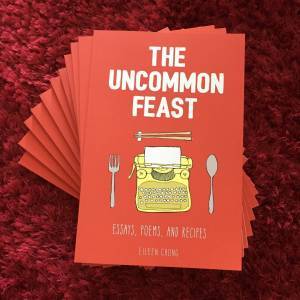
In February, the wonderful Shane Strange at Recent Work Press published The Uncommon Feast: Essays, Poems, and Recipes, which collects my essays and poems about food, as well as recipes from my mother’s kitchen and my own, alongside hand-drawn illustrations by my husband, Colin Cassidy. Food is complex for me; it represents survival, love, joy, and alchemy. There is a foreword from Judith Beveridge in the book, and I am so glad for the book’s existence.
We celebrated the book at a Lunar New Year event at Ashfield Town Hall in February with the support of Ashfield Library and the Inner West Council, with Sheila Ngoc Pham as co-organiser, featuring Lachlan Brown, Isabelle Li, and Wai Chim as readers. Over 150 people attended and we had such a warm, inclusive, and fruitful evening together. We are hoping to do an event like this every year.


In March, I wrote two poems for Edition 33 of Peril Magazine, in response to the artwork of Vipoo Srivilasa and Sofi Basseghi, in collaboration with the Hyphenated exhibition at the Substation in Melbourne, which showcased the work of Asian-Australian artists. The poems were beautifully typeset and exhibited at the show alongside the artwork.
My poem ‘Compass’ shortlisted for the Peter Porter Poetry Prize, run by the Australian Book Review. A meditation on water in seven parts, ‘Compass’ is in Rainforest, along with several other recently published poems, such as ‘Black Sun’, published in Island Issue 152, and ‘Measure’, published in Verity La.
In April, Verity La hosted me on their poetry podcast, where I talked to Michele Seminara and Alice Allan about Li-Young Lee, Rainforest, and what it means to be an Asian-Australian writer. I’m so very proud and happy to have had the chance to work with others in poetry; community is everything to me.
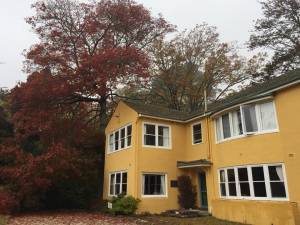
I also ran a workshop on food in poetry at Varuna, the Writers’ House, in Katoomba, as part of this year’s Sydney Writers’ Festival. It was just beautiful in autumn, with the beech tree crimson with foliage.
Here is my beautiful book family as of now. I am adding a couple more projects to this very soon! Stay tuned for the announcements.
 I am also judging the University of Canberra’s Vice-Chancellor’s International Poetry Prize 2018, alongside head judge Wendy Cope, and co-judges Moira Egan and Oz Hardwick. The top prize is $15,000, and second prize is $5000. Entries close 30 June 2018, so enter away.
I will also be appearing at this year’s Poetry On The Move: Inhabiting Language poetry festival in Canberra from 13 to 16 September, alongside international and Australian poets Moira Egan, Sholeh Wolpé, Lisa Brockwell, and many other poets. I will be running a workshop on call and response in poetry. Tickets are limited, so book soon. The program will also be announced at a later date.
Don’t forget to follow me on Facebook, Twitter and/or Instagram for updates that are a bit more frequent than the website–especially when it comes to readings, workshops, and appearances. Travel well, until we meet again.
December 8, 2017
Loose ends
[image error]And here, the mandatory 2017 recap:
![[image error]](http://www.eileenchong.com.au/wp-content/uploads/2017/05/Eileen_Chong-Painting_Red_Orchids-2.jpg)
It has been a big year for me, beginning with Painting Red Orchids shortlisting for the Victorian Premier’s Literary Awards 2017 and ending with it shortlisting for the Prime Minister’s Literary Awards 2017.
In between, I have judged the Newcastle Poetry Prize 2017 with Kevin Brophy, and am in the process of judging the NSW Premier’s Literary Awards 2018 with Jen Webb and Peter Minter.
I launched Lachlan Brown’s second collection, Lunar Inheritance, at Ashfield Library. You can read a version of the launch speech here at the Sydney Review of Books. I also published an essay, ‘The Common Table’, in Meanjin, reflecting on my experience as a writer of colour shortlisted in the PM Literary Awards 2017.
 I had poems published in numerous journals this year — I am especially proud of my publications with Peril Magazine, including a poem I wrote in support of Ellen van Neerven, ‘Common Words’, following the attack on her from high school students after her poem, ‘Mango’, was used in the Higher School Certificate exam. Other notable publications this year include ‘The Task’ in Overland, ‘Warhol: Notebooks’ in Meanjin, several poems in ‘Westerly’, and ‘Pulau Ujong’ in Glass Poetry, complete with reflection and a recording of me reading the poem.
I wrote a response to Dorothea MacKellar’s iconic Australian poem, ‘My Country’, as part of Toby Fitch’s wonderful series with Australian Poetry, ‘Transforming My Country’. The poem was performed at the Sydney Writers’ Festival, and published in the Australian Poetry Journal 7.1, along with many other complex responses to the MacKellar poem. I also had a great time at the Queensland Poetry Festival in Brisbane, where I met the most incredible people, like Mindy Gill, Eleanor Jackson, Chloe Callistemon, among others, and ran a poetry workshop while sharing dumplings with my workshop participants.
I’m proud to have a poem, ‘Butterfly Lovers’, in Metamorphic: 21st century poets respond to Ovid, published by Recent Work Press. But most of all, I’m thrilled that my American book, Another Language, is finally out in the world, from George Braziller in New York, with a stunning and thoughtful foreword by the poet and editor Paul Kane, who edits the Braziller Series of Australian Poets.
 The micropress I run, Potts Point Press, which produces letterpressed broadsides of Australian poems, released ‘Yachts’ by Judith Beveridge in a limited edition of 50, signed and numbered. (They are AUD45 each, plus shipping. I have a few copies left. If you are keen on owning a copy, email me.)
I’m also over the moon to be able to announce that my next collection of poems, titled Rainforest, will be released in May 2018 with my supportive and wonderful Australian publishers, Pitt Street Poetry. 2019 will see my first collection, Burning Rice, studied on the New South Wales Higher School Certificate syllabus for English (Advanced).
This past week, my beloved grandmother, Yeap Ah Choo, turned 85 in Singapore. I was unable to be there with her and with my family, but I am with them always in spirit. My biggest joy of the year, and for all the ones to come? Being with family, and being part of family.
As always, follow me on Facebook, Twitter and/or Instagram for updates that are a bit more frequent than the website, although I can be contacted through the contact form here, always.
Here’s to 2018 — whatever the new year might bring, let it be light, bright, and full of positivity.

September 7, 2017
On Not Really Being Chinese
 While I am ethnically Chinese, I was born in Singapore. My father was born in a small town called Muar, in Malaysia, and my mother was born in Singapore. My father’s parents were both Hakka, from Guangdong in China, they travelled south independently before the age of 20, and met, married, started and raised a family in Malaysia. My mother’s father was from Fujian, Anxi, having journeyed to Singapore at the age of 7 with his family in the belly of a junk; my mother’s mother had been born in Singapore to a Hokkien father and a Peranakan mother. The Peranakans, or Straits Chinese, are a distinct cultural group in Singapore, Malaysia and Indonesia, with a mix of Chinese and Malay cultures due to intermarriage, dating as far back as the 15th century.
I grew up and went to school in Singapore, my first job was in Singapore. I left Singapore to come to Sydney, Australia, as an adult migrant with my then-partner (who is Australian). Before I met him, I would never have thought of moving to Australia. I hadn’t even thought of leaving Singapore for good. I did think of possibly working for a few years in a place that was larger and more connected with the rest of the world — the cities of London, New York, Tokyo, Hong Kong or Beijing.
The primary language of education, commerce, and law in Singapore is English. I sat the Cambridge Ordinary Levels at 16, and the Cambridge Advanced Levels at 18, before attending university in Singapore, studying Linguistics and Literature. In Singapore, all subjects, except that of other languages, are taught in English. I did have to study Chinese language in school up till the age of 17, but we rarely studied Chinese literature. I certainly didn’t study the classics, because my Chinese reading ability was never proficient enough. I visited China in 1993, as a child, for two weeks. I have never been back. I don’t know where my families’ villages and ancestral homes are in China, or if they even still exist. By that measure, I am not really Chinese.
When I came to Australia to live, I didn’t realise I would never be going back to Singapore to set up home again. I didn’t realise it would be nearly impossible to have your heart in two places. A few years after I arrived in Australia, I became an Australian citizen, which meant giving up my Singapore citizenship. I wanted to participate in the democracy of the country I live in. I don’t regret doing this, but it is hard to not process this as both as a loss and a gain.
Over the past few months, I have thought a lot about what it means to be Asian, or Asian-Australian. I am not an academic or an activist, and have never consciously thought about identity politics, though of course it affects me and my work. I’ve always maintained that I would like to viewed as an Australian writer first and foremost, who, as a migrant from Singapore, has Chinese roots. Singapore, China and their related themes arise in my work, because these are themes that arise in my life, too. Yet these themes do not limit or define me, or my work. How does one become Australian, without losing one’s Asianness? How does one embrace universality and globalism without having to shed one’s cultural specificities and regionalisms?
Some time ago, my third book, Painting Red Orchids, was reviewed on Cordite by a Melbourne writer, Ling Toong. I thought it was a good review — most of the time, writers are pleased to have their books reviewed at all. The author’s reading of several of my food poems — that they were ‘clumsy and superficial treatment of multiculturalism’, in my ‘depiction of exoticised cuisine and food rituals as sensual cross-cultural exchanges’, was surprising to me. Anna Kerdjik Nicholson, in her launch speech for my book, understood the reflexive function of one of my poems, ‘Xiao Long Bao’ (full text in previous link), and said that ‘[t]he exactness of the method of making the dumplings is a nice metaphor for the making of the poem.’.
I would go further to say that as a cultural statement, the poem insists that the reader traverse the precise processes of dumpling-making before being allowed to achieve the ‘[s]udden understanding’ of all the hype about dumplings, which, of course, isn’t sudden at all, (or just about dumplings), but can seem sudden, in the way abrupt clarity can happen. Extrapolate this to cultural understandings: you need to walk a mile in someone’s shoes before you can even begin to understand what it might mean to be that person.
Cultural identity is very rarely straightforward, especially with diasporic peoples such as myself. There is no one Asian-Australian identity. No two Asian-Australian experiences are completely alike. We are as diverse as all peoples in Australia — be they First Nations people from different parts of Australian country, be they white migrants of Anglo-Celtic heritage, or of Greek, Turkish, Lebanese, South American, be they refugees who were forced to leave their homes behind.
I can’t speak for anyone other than myself. But it is my hope that in telling my stories, in sharing my experiences, other people feel empowered to speak their own stories. It is important in art, literature, and in life that people see others who look like them, who sound like them, who come from places and experiences like theirs, who are telling stories they know to be true. No one wants to be the outsider who is unheard, who feels like their culture and their concerns are unimportant. That the only way to fit in to be like all the others. There are many ways to be Australian, most of them valid and hard-earned. For some, there never needed to be a search, it has always been a given. Others, like myself, are still trying to find what it means to be Australian, to be Asian, and what being Asian-Australian really means.
If you’d like to read more of my thoughts on this, I have written around this, in various forms, previously in my blog posts for Southerly in June 2016. The photographs in this post are of myself and my maternal grandmother, Yeap Ah Choo, who is my only surviving grandparent.
August 29, 2017
There, and back again
 I’ve just come home to Sydney after a few whirlwind days at the Queensland Poetry Festival 2017 in Brisbane. I got to meet the American poet Mark Doty, take a poetry masterclass with him, and attend several of his readings and interviews.
As a guest poet, I did a reading, joined a wonderful panel called ‘We All Speak the Same Language’, moderated by the incredible poet and performer Eleanor Jackson who runs Peril Magazine, as well as conducted a poetry workshop called ‘The Poetry of Food’, which was run in an actual dumpling restaurant!
It was intense — so many poets and events in a small space over a very short few days. I didn’t get to see or hear everything I wanted, but I am grateful for all the connections I made in person with some delightful poets and readers. I was also happy to be in Brisbane for the very first time, where the weather was warmer than in Sydney, and where the river meandered right through and around the city.
Some news (in reverse order of dates):
The Newcastle Poetry Prize 2017 shortlist has been finalised and announced, and the winners will be announced in Newcastle on 14 October. I am also running a poetry workshop with the Hunter Writers Centre called ‘How to Speak in Tongues: The Trick of Poetic Ventriloquism’ on the same day, prior to the prize ceremony which will be at 2pm.
I am proud to be part of Monash’s Literary Translation Spring School: ‘Translating the Untranslatable’, which runs from 21 to 23 September in Melbourne. There are several language streams this year, including Chinese, Japanese, German and Spanish. A group of translators, led by a lead translator, will translate a suite of poems alongside the poet — a very rare situation indeed.
My book, Another Language, which is published with George Braziller in New York as part of the Braziller Series of Australian Poets, will be released in two weeks or so. I am very excited, and thank my editor, the poet Paul Kane, for realising this.
If you are in Sydney this Sunday, come along to my reading at the Brett Whiteley Studio. Entry is free, and there is an open mic, so bring your own poems to read. It is always friendly there, and I look forward to seeing you very soon.
July 1, 2017
What is old is new again
 This is the second iteration of my website — the first was designed by the wonderful Charlene Winfred and Flemming Jensen over at Coffee and Magic. This version was lovingly made for me by my husband, Colin, as a wedding present of sorts.
We’re in the second half of 2017, and so much has gone on over here.
Most recently, I’ve just returned from Singapore, where I visited family and friends, and also gave two readings of my work — one at SingLit Station, where I read alongside three other poets connected with Singapore and Australia (Will Beale, David Wong and Yong Shu Hoong, moderated by Jon Gresham), and the other at Kinokuniya Singapore in conversation with my ex-university lecturer and dear friend, Dr Matilda Gabrielpillai.
I hadn’t been back to Singapore for two years, and this was our first trip back to Singapore as a married couple. It was really important and moving for me to have Colin connect with my family and friends and to make new memories with him in my place of birth. Revisiting the old is a way of grappling with the new, and there is much that is new in a place like Singapore.
Back in Australia, the next few months are looking busy for me. I’m headed to Melbourne on 12 July for the Writer’s Reading as part of the ASAL Conference 2017, with venerable poets Pi.O, Ouyang Yu, Bella Li, Lachlan Brown and Nicholas Jose. I’m also judging the Newcastle Poetry Prize this year with Kevin Brophy. I have a few more exciting projects in the pipeline, which I will talk about soon.
My latest interview is with the Singaporean poet Jee Leong Koh, who is based in New York City, on his website, Singapore Unbound.
2017 also marks the year it was announced that my first book, Burning Rice, will be on the New South Wales Higher School Certificate (HSC) curriculum for English in 2019-2023. This is thrilling news, and I’m looking forward to having my work taught and discussed in schools in the years to come.
Eileen Chong's Blog

- Eileen Chong's profile
- 25 followers
