Steven D. Brewer's Blog
April 26, 2026
Straw Dog Writers Guild 2026 Spring Retreat
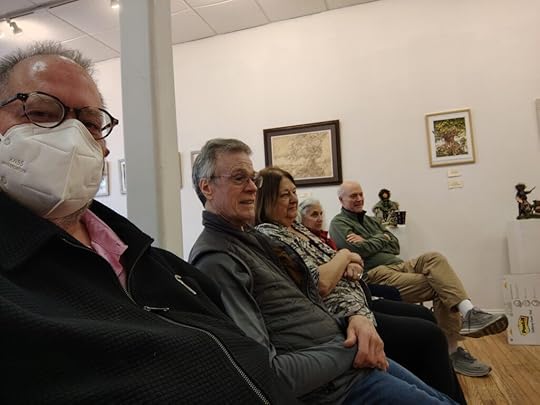
On April 25, 2026, the leadership of the Straw Dog Writers Guild gathered at the WOW Creative Arts Center in Westfield for a day-long retreat to discuss the organization. Fifteen people — the entire Steering Committee plus a handful of others — spent the day getting to know each other and the organization a bit better. By the end of the day, all of the world’s problems had been solved. Well, maybe not all of them. But we did have a productive conversation.
Due to my chronic health condition, I wore a mask for the event. It appears to me that respiratory illness is not particularly high right now, but I normally avoid spending long periods of time indoors with groups of unmasked people. I really don’t want to end up in the hospital again. The last time I attended an indoor Straw Dog retreat, I had persuaded the participants to mask for my benefit. But it was controversial and unpopular with some people, so I didn’t try to do that this time.
In the interests of full disclosure, I should point out that the post that follows is not a comprehensive report of what happened at the meeting. I did not take sufficiently detailed notes to represent everything that everyone said. This over-represents what I said and offers reactions primarily from my own perspective.
We began with an ice breaker. Becky Jones called on each of us to identify some symbol or metaphor to define ourselves. I broke the ice by saying what I typically say in such circumstances. Other people had similarly whimsical perspectives about themselves.
Ellie Meeropol provided a sheet with a summary of Straw Dog Writers Guild accomplishments from 2025 and 2026. For 2025, there were around ten on-going regular activities (Writer’s Night Out, Straw Dog Writes, Second Sunday readings, etc.) and around twenty one-time events (workshops on the craft and business of writing, Author’s Showcase, etc.) and this looks on track to be similar. It was impressive to see all of our work represented.

Jacquelyn Sheehan and Bill Mailer led a discussion to flesh out a diagram (click to see full size) listing all of the on-going activities. We began with just trying to catalog everything then show how they map into committees and standing bodies. Finally, participants were invited to initial the parts they are involved with. I’m listed for Straw Dog Writes, the Program Committee, and website. I’m currently scheduled to chair a committee to coordinate with Christopher J. Sparks and Electropoetics, that will start redesigning the Straw Dog website in the coming months.
Don Lesser brought forward a question of whether Straw Dog should charge non-members to participate in workshops. This generated a lot of discussion that included a consideration of Straw Dog’s mission and the history of this topic, which was tried before and rejected. Making non-members pay a nominal fee to attend both has the potential to get people to see more value in the workshops and actually show up, if they’ve registered. It also might give members an increased sense of value for their membership. It also could suppress participation and raised concerns about its alignment with Straw Dog’s mission. My primary contribution to the discussion was about practical concerns: It sounds simple, but would require a fair amount of staff support to build out the infrastructure to collect the money, track which registrations were by members, check attendees for payment, integrate with online registration systems, etc.
During the potluck lunch, I stayed inside without eating because I avoid unmasking indoors. The last time I attended a Straw Dog retreat, I took my lunch outside and ate by myself. But I found that rather stigmatizing because everyone else was having conversations that I was excluded from. (I had persuaded people to mask that time, but they all necessarily unmasked during lunch and I didn’t feel safe staying indoors.) So this time, I just didn’t eat and talked with people while they ate. This was also stigmatizing (as if being the only person wearing a mask wasn’t stigmatizing in itself). But it was OK and I had some nice side conversations with people.
After lunch, we did another community building activity where we interviewed another person and then reported a summary of the conversation to the group. I met a young woman named Emily whom I hadn’t met before. At least I don’t think I’d met her before. I summarized the blog post I was writing about work and she talked about how her conception of location or place had evolved as she transitioned from childhood to adulthood. It was charming to get to know her a little better —and to learn a bit more about all of the other participants from their reported conversations.
Julie Schlack and Mary Ann Scognamiglio led the final activity of the day, to brainstorm ideas to aid recruitment and retention of new members. There were a lot ideas about building and sustaining community. I had been spending the day making notes of ideas that I had, which I then shared with the group. My ideas were:
Recruit member representatives for local organizations in the communities we serve to facilitate communication and ensure our activities are made visible on event schedules, bulletin boards, etc.Develop a recruitment presentation that members could use to describe Straw Dog to other audiences.Bring some focus to a national recruitment campaign (as our workshops are increasingly available via zoom, we’ve already picked up a substantial number of members across the country, which we could grow.)Offer support and coordination for book launches to members. (We have a virtual book launch coming up that we’re hoping to use as a template.)More committees or advisory boards for program elements, to provide increased opportunities to members to grow into leadership positions in the organization. (We have only a small number of actual committees currently, but it was pointed out that the WriteAngles conference could always use more volunteers.)Set up book vending machines to sell books for members. This is an idea I’ve seen be successful in other areas. It would require some capital, but I think a lot of authors would jump at the chance to have their books available via vending machines it the machines would serve as advertising for Straw Dog and its authors.Offer more articles via the website and coordinate with the newsletter. Offer posts about writing, about members, about events, and maybe book reviews. Have teasers in the Newsletter and use it to drive more traffic to the website.Use communication software more effectively. Currently most Straw Dog communications occur via email which has a lot of downsides. Committees mostly communicate by people just using “reply-all” to the last message sent to the group, which has the potential to miss some people, propagate typos in email address, or include the wrong people (if someone was copied into a previous message). We could use Discord or a threaded-discussion system (or someone recommended Slack) to communicate more effectively. This would ensure the history of groups remains accessible so that interested members or newcomers could lurk and more easily get up to speed..Use our CRM more effectively. We have a new CRM, but it could track more information about members and our previous contacts with them, so that we can target subpopulations and follow up with people better.There were a number of other ideas as well, but those are the ones that I brought forward.
At the end, Bob Plasse, the President of the Board of Directors of WOW was given an opportunity to comment on our retreat and tell us more about the WOW Center. He had a lot of insight into a community organization like ours and described what WOW was doing that we could consider replicating or articulating with.
The retreat was time well spent and I’m hopeful that we can implement a number of the ideas in the coming year.


April 25, 2026
The Sanctity of Work

After reading Riva’s Escape (a side story of Revin’s Heart), one of my beta readers commented about how they appreciated the way my writing recognized the value and significance of work. In the scene, Revin (who has just transitioned) is pressed into service working in the kitchen of a restaurant washing dishes. This got me thinking about how my own experience with work has impacted how I write about it.
I started working on a farm before I was legally old enough to work. At age 15, a friend and I were hired to bale straw. We rode on a wagon behind a tractor grabbing bales of straw that emerged from the baler — a complicated machine that was powered by a shaft from the tractor. We would take turns carrying the bales back and stacking them up until the wagon was full. It was hot, dirty, and dusty. Looking back, my current lung condition probably wasn’t helped by breathing all the dust. We would often work until it was starting to get dark. I remember coming home in the gathering dark, taking a shower with the dirt sluicing off me, closing my eyes, and feeling like I was still bumping along on the wagon. Years later, I tried bailing hay. As an adult, I was hired to work by myself on the wagon (ie, working twice as hard) and lifting bales that weighed twice as much. I lasted one day.
I spent two summers as a high school student working as an animal caretaker in a toxicology laboratory. It was a bleak, proletarian existence. You were required to punch a time clock within seven minutes (five minutes before the hour or two minutes after) to punch in, then punch out before legally required breaks and lunch, punch back in afterwards, and then punch out at the end of the day. I was on the “large animal” team that cared primarily for beagles. Other teams did mice, rats, rabbits, and monkeys. The entire windowless facility had tan walls, gray floors, and unfinished ceilings with black-painted duct-work, pipes, and wiring. The animal rooms had two banks of stacked cages with a big floor sink at the end. I would go into a room, clean and fill all the water dishes, then pull the trays under the cages one after another, wash them in the sink, then replace them. Finally, I would recheck the water dishes and clean/refill any that were empty. (Some dogs, desperate for stimulation, would dig in their water dish as soon as you filled it.) It became so routine that I could daydream during the process to the extent that, when I got my schedule out after leaving a room, I sometimes had to check to see if I had just finished a room or just arrived.
I worked for a year as a busboy at chain seafood restaurant. There, I had perhaps the worst boss I ever had as an employee. In the restaurant, there was a lounge attached to the restaurant with an entrance for patrons and a passage containing the busboy station near the ice and soft drink dispensers for waitstaff. The boss would walk through those entrances in a big circle and every time she came around, I was doing the wrong thing. “Why are you bussing tables! The floor is dirty! Sweep the floor!” So I’d carry my tub to the dishwasher, get the sweeper and start sweeping the floor and she would return, “Why are you sweeping the floor! There are tables that need to be bussed!” She was pure evil.
I worked for a while as a gas-station attendant. When I was in middle-school, they had kids take the “differential aptitude test” — one of the many standardized tests used for nefarious purposes by educators — that included a component that was supposed to help you identify potential career options. I knew that I wanted to be a field biologist, so I tried to pick options that I thought would be aligned with that goal: Yes, I liked working outside. Yes, I liked working with numbers, etc, etc. Eventually, the computer spat out an answer: it said I should be a gas-station attendant. So, when I actually worked as one years later it was a more than a little ironic. I actually liked it quite a bit, though it was not a particularly good choice as a career, with poor pay and limited options for advancement.
I had a lot of different jobs over the years. I was a dishwasher in a college cafeteria. I worked as an archeological faunal analyst. I was a Spanish-speaking bilingual teacher’s aide for a migrant worker education program. I was a substitute teacher for a time. (That was horrible.) I did scientific field work in many different contexts: catching birds, lizards, mongooses, etc. For several years, I was an “edutainer” traveling to elementary schools to teach about science. I visited hundreds of schools in a dozen different states.
Eventually, I returned to graduate school. I pursued a PhD in Science Education. (I also got a Masters in Earth Science studying wetlands hydrology). While I was doctoral student, I got tasked with setting up a computer lab and then the Internet happened. These experiences led directly to my career as a faculty member serving as the Director of a computer center at an R1 institution. In this role, I performed a vast number of teaching, research, and service activities. (My curriculum vitae is more than 20 pages long.)
These work experiences have all informed my writing in multiple contexts.
I find that “work” is actually a somewhat loaded and conflicted word. On the one hand, it can mean the drudgery you are required to perform. But it can also have the connotation of your calling, your “life’s work,” which for many people becomes nearly their identity. Some people detest work while others strive for the ideal of “do what you love and you’ll never work a day in your life.” I have deep respect for the work that people do in all walks of life. And I was pleased that this was reflected in my writing to the extent that someone noticed it.
April 23, 2026
Bartholomew’s Cobble: Mosses and Lichens and Ferns! Oh, my!
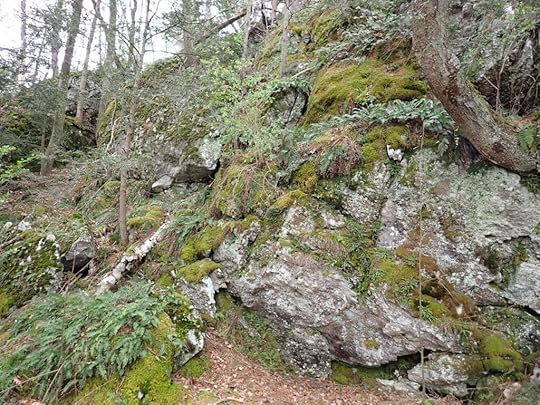
Relatively soon after I moved to the Pioneer Valley, my father gifted me a membership to the Trustees of Reservations and encouraged me to visit Bartholomew’s Cobble. It’s a bit of drive, in the extreme south-west corner of the state. But it’s an amazing place with the highest plant diversity of any site in New England. This spring, I visited again to see the spring wildflowers.
A friend and I made a road trip out of the adventure. We masked up (due to my health issues) and drove on back roads so we could keep the windows down. We drove first to Westfield and stopped at Skyline Trading Company for lunch. Then we took a new (to me) route through the back roads, criss-crossing over the Connecticut border to get there.
I’ve always been fascinated by plants. As a child, I frequently went with my father to natural areas where he introduced me to plant identification. As an undergraduate, I took a lot of botany classes: plant morphology and structure, spring flora, and plant systematics. And, as a graduate student, I studied wetlands hydrology, for which plant identification was essential.
Bartholomew’s Cobble is a promontory of quartzite and marble situated by a bend of the Housatonic river. This creates four distinct zones: cool dry, cool wet, warm wet, and warm dry. Plus the marble limestone, relatively rare in Massachusetts, creates regions with higher pH which adds to the range of available microhabitats. This produces the high plant diversity at the site.
We arrived in mid afternoon and, after paying the admission fee, set out walking. There are several trails through the reservation, but the one I always take is the half-mile Ledges trail. It simply follows a route around the promontory and takes you through each of the habitats. You start at the cool-dry quadrant, then pass into the cool-wet segment along the river, then turn west into the warm-wet, then warm-dry, and then finally return to the parking area.
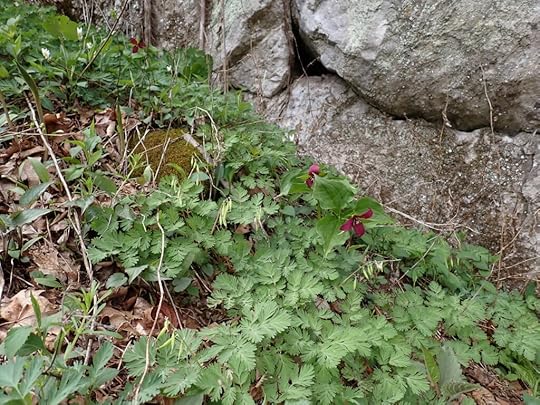
The progression of spring wildflowers was markedly different between the cool and warm sides. In the cooler areas, spring had only just started to arrive. There weren’t many flowers or fiddleheads. But mosses, lichens, and older growth were apparent. The warmer sides had many of the classic early spring wildflowers: triliums, dutchman’s breeches, trout lilies, spring beauties, etc., etc. It was lovely.
My friend is a molecular biologist who was intrigued by the variety of plants. Like me, he teaches the writing class at the University. He was fascinated by the number and variety of plants and began thinking about adapting his version of the course to have students look at plant diversity in the fall. It’s a lot easier than it used to be.

I spent years and years studying plant identification. Nowadays, I find that although I can still recognize a lot of familiar plants, there are vastly more I never learned. I even wrote a haiku (published in Ideoj Ĝermas) about the experience of seeing the plants that bloom after your spring flora class is over.
Also identifications have changed. A lot of the nomenclature I learned has been replaced, as molecular systematics has reorganized the phylogeny of plants.
Nowadays, you don’t need to learn plant identification at all. People can use apps to identify plants. I’ve used LeafSnap and, more recently, iNaturalist, that also keeps a record of plants you’ve observed and has experts that help confirm identifications. This can allow students — even with little experience with plant diversity — to make observations about plant species and distribution.
I’ve visited Bartholomew’s Cobble perhaps five times over the past thirty years. Maybe someday, I’ll walk some of the other trails.
April 4, 2026
When the United States Actually Jumped the Shark

After Donald Trump was elected for a second time, he began to systematically destroy the “rules-based order” that the US had painstaking constructed after World War II. It’s elements included having an independent bureaucracy and judiciary, floating the dollar as the reserve currency of the world, keeping the world’s communications networks centered here, maintaining an enormous military to be the world’s policemen, etc. Although somewhat expensive, this arrangement provided enormous benefits.
In little more than a year, these are all in tatters. The US is now the largest and most powerful corrupt mafia state in the world, run entirely at the whim of a single dictator who maintains a masked paramilitary force to terrorize cities, who arbitrarily attacks dairy farms and fishing boats, who abducts the leaders of other countries, and who unilaterally begins wars.
People argue whether he is the cause or the symptom of an electorate that is too stupid and provincial to understand what immense harm he’s doing to the standing of the country. But I would like to argue that the moment that the US actually jumped the shark and began on the path that led inevitably to this moment was when Ronald Reagan was elected.
I think this graph pretty much sums it up:
Post by @Lightfighter@infosec.exchange View on Mastodon
Ronald Reagan had a handful of bad ideas and pursued them vigorously. He began the process of undermining confidence in the ability of government to be a force for good. He began the Republican practice of appointing cronies to govern incompetently and cynically, so that people would see government negatively.
Critically, he presided over the decoupling of productivity gains from wages for workers. The voodoo economics of “trickle down” began under Reagan. Prior to his administration, as productivity increases, wages for workers increased commensurately. After Reagan, productivity continued to increase, but wages were flat. And basically have been flat until today. The rich got richer, but everyone else got poorer and poorer.
These two factors are what we see playing out today. People no longer believe that government or expertise are forces for good. Even though they enjoy the fruits of science, technology, and medicine, they have been impoverished economically, and they blame government.
To be fair, the Democrats have not distinguished themselves. Under Bill Clinton, the Democratic party became a kind of Republican-lite. He creating the Democratic Leadership Council that began pursuing funding from the wealthiest in the country. Democrats pushed back against the worst excesses of the Republicans, seeking at least to govern competently, but remained in the pockets of the wealthy and failed to effectively advocate for working people.
I could see these things happening when Reagan was President. I kept waiting for the country to realize the enormous damage had done. But they kept naming things after him, as if he had done anything other than preside over the destruction of the American dream. Now, finally, people seem to be realizing the enormity of the injury he inflicted on the country. But the damage is done and things are likely to get worse for a long time to come at this point.
Donald Trump has made the United States an international pariah. The rules-based order isn’t coming back. The rest of the world is never going to trust the United States again. So the country is likely to get poorer for for the foreseeable future. Sorry. I mean the population of the United States. The billionaires will probably keep getting richer.
Donald Trump is the one who actually took an axe to the world order that had been so painstaking constructed to benefit us. But the seeds its destruction were sown by Ronald Reagan. And we are left to reap the bitter harvest of his cynical crop.
March 31, 2026
In the Spotlight

On March 29, I was spotlighted by J. Scott Coatsworth. Scott is the creator of Liminal Fiction and QueerSciFi. On his blog, he runs a series of articles that let authors respond to a range of potential questions to highlight their recent work. I answered questions about my first published work, weird things I’ve done for research, secondary characters in A Familiar Problem, my favorite character to write, fonts, writing without dialog, what I wanted to be when I grew up, pets, what I like to drink, whether I’m afraid of snakes or spiders, and what I’m working on now. I also provided a synopsis of A Familiar Problem and a brief excerpt.
I’m never sure how useful it is to do these kinds of things. I don’t know how often they lead to sales or get people to learn more about me as an author. But I’m not really sure that’s the point. It was fun to answer the questions and give me an excuse to link to Scott’s blog.
March 29, 2026
A Reflection on No Kings and Revin’s Heart
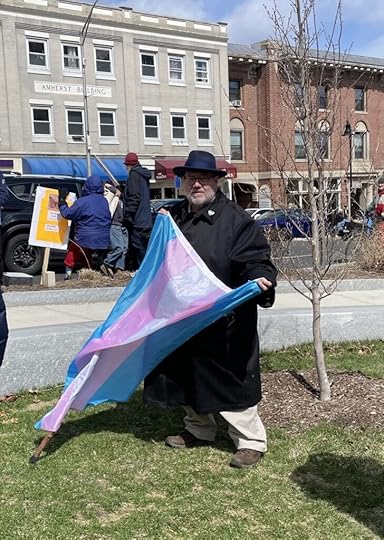
I took a trans flag to the March 28, 2026 No Kings protest in Amherst. There are many things to protest about Trump and the MAGA movement: the misguided war in Iran, the destruction of our global alliances, the endless grifting and profiteering. To me their persecution of the trans community has been among their most odious acts. During the first Trump administration, I recognized that the Republicans were organizing to use trans people as a wedge to divide the country. And this was a motivating force behind my fiction writing.
My debut work was Revin’s Heart, a steampunky fantasy adventure with pirates and airships and a trans protagonist. Part of my goal in writing about trans people was because I was moved by their struggle. It’s monstrous that the Republicans have identified a small minority of people to demonize in order to foster division in our society. Letting trans people live their best lives costs them nothing. Yet, they attack and demonize them in a sadistic and self-serving effort to pander to the worst instincts of hateful people. We must stand united in the face of this hatred.
In point of fact, Revin’s Heart is barely about trans issues at all. It’s just a young man’s adventure story, where the young man happens to be trans. He has some experiences that are unique to his identity as a trans person, but — for the most part — it’s just a young man making friends, finding mentors, confronting challenges, and living his best life.
Where Revin’s Heart becomes a critique of our society, is when it talks about feudalism. During the first Trump administration, I was horrified as he anointed his children with government roles — exactly as a monarch would do — and the Republicans did not revolt. This kind of behavior would never have been accepted in the country I grew up in. Neither would the constant mendacity, self-dealing, or corruption. I saw that there was a striving on the Right for someone to be a king and for people to want to be vassals. So I wrote about a society corrupted by these principals and tried to identify both the strengths and weaknesses — and show someone trying to look beyond to what might be possible instead.
I have written three novella-length sequels to Revin’s Heart that continue this conversation. In the first, Revin must confront a revanchist movement that has taken hold on his home island of Devishire. In the second, he works to quell a populist uprising in the town of Campshire that threatens to provoke the worst impulses of the aristocracy. The third, takes place on a foreign island, Ecorozire, that has been devastated by civil war and social collapse. I hope to be able to share these stories with the public soon.
Back in Amherst, I had considered making a sign for the protest, but decided that carrying the flag was the most eloquent statement I could make. I saw a few other rainbow flags and signs advocating for trans issues. A few people didn’t know what the flag represented and asked me. Several trans people approached me to thank me for bringing the flag and a few asked if they could be photographed holding one side of the flag. It made me feel good to help them feel represented.
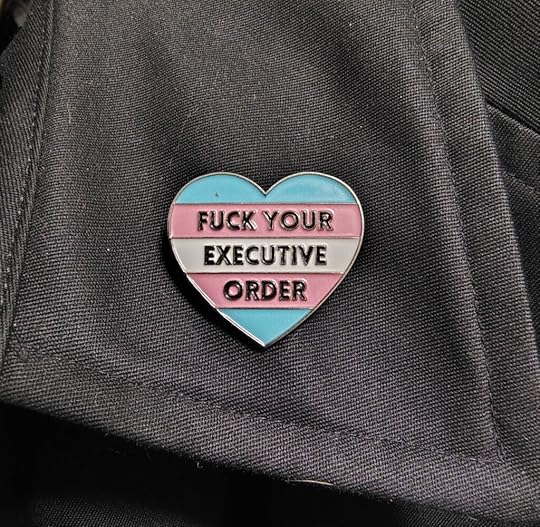
I wore one other small symbol at the protest: a pin that was gifted to me by Oliver Jensen. Among the flurry of executive orders that the Trump administration issued at the very beginning of his term were a number that were targeted at persecuting trans people. Oliver designed this pin and had several produced which he gifted to people on Mastodon. I requested two: one for myself and one for a trans colleague.
When I first got the pin, I wore it on a daily basis for months. I was proud to wear it again for the protest. Oliver has since moved to Germany, but he said that he was honored and grateful that I wore it to the protest to represent him.
The energy at the protest was generally positive. People are angry and horrified by the terrible actions the administration is taking, but they take encouragement from one another. Awful things are happening, but we can support one another and have faith that things can get better. Amherst is a blue, blue drop in a blue lake. We here are largely sheltered from the worst of what is happening in the country. The Commonwealth of Massachusetts is standing up to the worst excesses of the Trump administration. We have not been invaded and assaulted by the masked Brownshirts of the Trump administration. We can protest without fear of being clubbed and beaten by jackbooted thugs. For now. Let us hope for better days for all.
March 26, 2026
Using a Text Editor for Writing
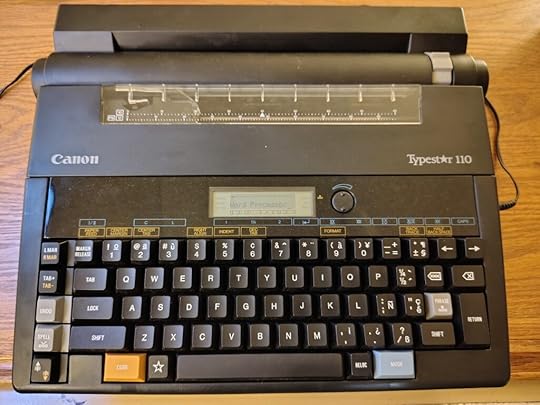
I use a text editor for pretty much all of my draft writing. I can date this pretty much to 1993, when Microsoft Word 6.0 was released. It really sucked and, after many years of using a word processor, I quit using one for writing.
I did most of my early writing by hand or using a typewriter. I took “secretarial typing” in high school — they changed the name that year to “business typing” which was perceived as less sexist. I was the only boy in the class. There was a “personal typing” class that required students to learn to type 45 words per minute. But in secretarial typing, you needed to learn touch typing (to not look at the keyboard) and type 60 words per minute. It was perhaps the single most useful class I ever took in my life.
I also learned to use DEC computers with a paper terminal in high school. Mostly, I was programming in BASIC. There was rather crude text editing, but I could see the potential for writing text. There was a text formatting program called RUNOFF that I experimented with a little bit, but it was too complicated for my purposes and so I never actually used it for anything. But I could see the potential.
When I went to college, my family purchased a Smith Corona electric typewriter for me as a gift for going to college.
As an undergraduate, I learned to use a word processing system — maybe ALL-IN_1 — on the VAX computer at Alma College. It used a “gold key” to access formatting commands and you could do a lot of amazing things. I had been using my typewriter to write papers, but quickly switched to writing everything using the word processor.
Around that time, a friend kept asking to borrow my typewriter. I didn’t mind since it wasn’t like I used it anymore: once you got used to using the word processor, the idea of going back to using a typewriter was a monstrous impossibility. I kept suggesting that he learn to use the word processor, but he always claimed to not have time. So I finally said I would type his paper for him using the word processor.
There was a central terminal room, but we went to a small computer lab in the life science building. I logged in and quickly typed his paper. Then I printed it using the dot-matrix printer in the lab. He looked at it skeptically, then said, “Yeah. OK. But it has a widow.”
“Let’s fix that,” I said. I typed a few keystrokes and printed again. When I handed him the output, his eyes got bigger and bigger and bigger.
“You can print it again?” he breathed.
He got an account the next morning.
I had other computers along the way (including the odd typewriter/wordprocessor hybrid pictured above) but when I started graduate school, I bought a Powerbook 100 and a copy of Microsoft Word 5.1. It was amazing. It was perhaps the best word processing system I ever used. I used it to write all my papers as a graduate student, including my gigantic 200 page dissertation that had 88 figures and 15 tables.
Then Word 6.0 came out and it was garbage. It was clunky and unstable. It frequently crashed and you lost what you’d been working on. Its documents frequently became corrupted and were unrecoverable. I kept using my old copy of Word for a while, but it was clear its days were numbered. So I switched to doing all of my draft writing using a text editor — so at least I wouldn’t lose my writing.
On a Mac, the best GUI text editor for a long time was BBEdit. I used that for a number of years, then (when it quit being shareware) I switched to TextWrangler.
Note: I’m leaving out the whole chapter where I learned Unix and the vi editor. I used vi a lot for programming, but there wasn’t a native vi for classic MacOS, so it wasn’t something that was convenient to use for local files until MacOS X came out. So, although I use vi a lot, I never used it much for writing.
When I began teaching the writing class, at first I chose different packages for Macs and PCs. Then I started using Linux myself and started looking for applications that would work identically on all three platforms. Eventually, I settled on Atom, which was released in 2015 and I started using that.
Atom was an adequate text editor. It was built on Electron, which made it a bit bloated and clunky. But it worked exactly the same on all three platforms. It was also highly configurable and had a lot of community add-ons to provide additional functionality.
In 2018, Microslop purchased Github, and in 2022 killed off development of Atom — probably to force people to use their proprietary development environment. But, because Atom was Free Software, the developers promptly forked it and renamed it Pulsar. It works exactly like Atom did and I still use it today.
I had very little success persuading students to use a text editor to write. And I didn’t see many other people using text editors either until this year. Suddenly EVERYONE seems to be using text editors to write. Weird. I guess everything old is new again.
A bunch of people seem to be using Obsidian. Tobias Buckell described building a whole writing environment based on Obsidian. Other people are using Notion and NotebookLM and there are a bunch of others.
I’ll keep using Pulsar, at least until I finish teaching the writing class. Then, maybe, I’ll look at others to see if I can find something I like better. But I’ll still want something that is Free Software and cross platform.
March 22, 2026
A Much Needed Spring Break
When I was the Director of the Biology Computer Resource Center, Spring Break was just a chance to get caught up with software and hardware updates. Since then, I’ve used it to accomplish significant bits of writing. This year, however, I really needed the break. And I took full advantage.
I used my time for self-care. I slept a lot. I got in a lot of walking. I hung out a friend on the patio. It took some time, but I finally started to feel like myself again.
For the first time since December, I felt like I could write some fiction. I wrote a short story, A Persistent Curse, and submitted it for publication.
With his paws on the back of the sofa, Makul poked his nose through the curtains and looked out. A misty drizzle was falling — it always rained when the curse was bad. The raindrops passed through an assemblage of shadowy spirits clustered just outside the window trying to get in.
Makul waited, watching, until she came around the corner: a short, wizened crone with a dowager’s hump who shuffled along with a stick to hold her up. She gathered her black shawl around her shoulders as she hobbled around the corner and into the shade from the lone cloud that hovered over the apartment building. Her mouth made a hard line when she looked at the building and saw the swarm of spirits jostling around the first-floor apartment of her grandson.
“Tiom da fantomoj!” she muttered. “The curse is bad this morning.”
It was rejected. But at least I feel like I have some creative energy again. It was a long dry spell.
I’m still getting some extra Tanuki time. But little by little, things are returning to baseline.
I remind myself that it’s my last Spring Break. This is my last semester as an active faculty member. I’m trying to be particularly cognizant of the milestones and rhythm of academic life as I experience them for the last time.
In any event, today is the last day. Tomorrow, the students come back and on Tuesday I’ll start teaching again. I have a fair amount of grading I’ve been putting off — and my regular service commitments this week: Faculty Senate and Rules Committee.
Once more unto the breach, dear friends!
March 20, 2026
Languages of Tsukimichi
I read a chapter or two of a manga a couple of years ago and, at the time, it didn’t grab me enough to keep reading it. But my son wanted me to try an anime he liked and, after an episode, I realized it was the same one: Tsukimichi: Moonlit Fantasy. After watching a few episodes, I decided to read the manga, Tsuki ga Michibiku Isekai Douchuu. (I have not read the light novel, though it might be interesting to do so.)
I mentioned to Philip that I was watching the anime. I said something like, “It’s an isekai about a guy who is dropped into a kind of wasteland. He makes some powerful allies and things just go pretty well for him.”
“It sounds like slime,” he said, meaning That Time I Was Reincarnated as a Slime.
“It is!” I said. “It’s exactly like slime! But completely different.”
What I really want to write about, however, is how Tsukimichi manages representing different languages. I’m not sure I’ve ever seen a manga that tries to manage so many languages like this.
The protagonist, Makoto, is picked up from Japan (where he spoke Japanese) and is sent to the other world where he meets with the “goddess” who is repulsed by his ugliness. She banishes him to the “edge of the world” but gives him “the ability to understand what demons, monsters, and other non-human races say”, but not to speak the “hyuman” language.
The Edge of the World is a wasteland inhabited by powerful monsters where hyumans (people) rarely go. And, sure enough, he can seamlessly communicate with monsters and a girl orc that he encounters there. She is rather puzzled that a (seeming) hyuman can speak her language. When she teaches him magic, she apologizes that the chant “isn’t in orcish”. It’s represented in the manga with some weird script.
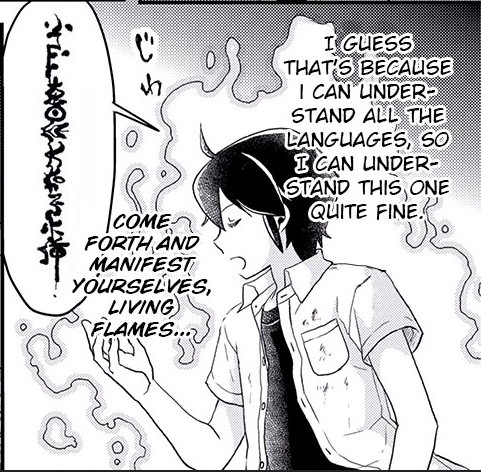
You don’t learn the background of what the script actually represents for another hundred chapters. But this is one of the ways that other languages are represented.
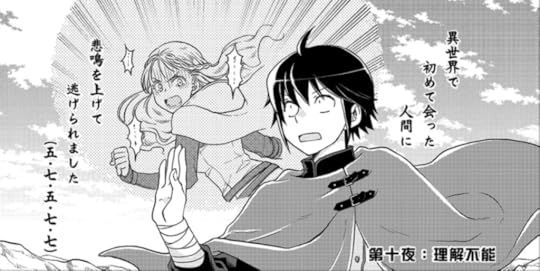
When Makoto first encounters hyumans, their speech is represented in a different odd script and (as the goddess had said) he can’t understand them and they can’t understand him. (He writes a tanka about it — see the top graphic above and read the alt text for the translation of the tanka.)
He subsequently discovers that basically everyone can speak a “common tongue” — except him. Even when he studies it, although he gets so that he can understand it, he can’t make himself understood by speaking. But he discovers he can generate written speech with magic that people can see and read.
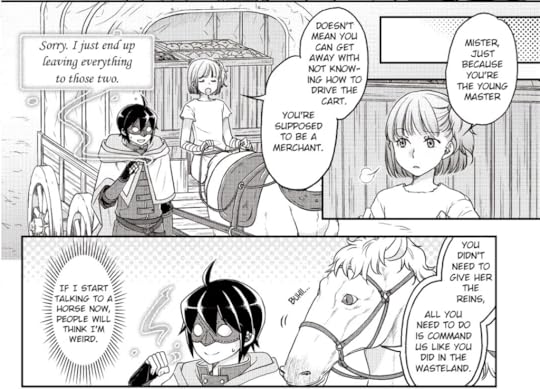
In this graphic, you can see the protagonist using the written speech that someone can see. But you can also see a speech balloon with a doubled line that is a horse (actually a kind of monster called a “bicorn” hiding its two horns) that is talking to him in a language that others can’t read, represented with the doubled line — what others can hear “buhii”. And then his thought balloon with the hashed outline.
A little girl explains the common language to Makoto. She says its a blessing of the goddess that people receive after visiting a shrine. It makes it seem like she considers it something separate from just learning a language as a child. But her description makes it seem indistinguishable from just learning a language as a child. The demihumans, who lack the blessing of the goddess have to learn it in addition to their native language. But basically all of them seem to do so.
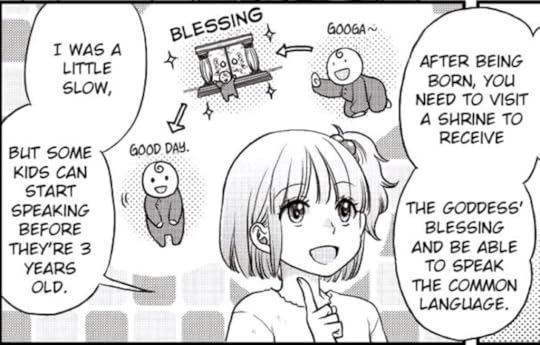
As an aside, I would be interested to learn more about the common language. It seems like it could be Esperanto-like. But we really haven’t learned much about it at this point or why hyumans don’t have separate languages or even regional variation. In Japanese, of course, there are a lot of regional variants (e.g. Kansai and Osaka-ben).
In the end, he needs to address most hyumans using magic writing. But he discovers an alchemist who can speak an “ancient language” (normally used for spellcasting) and can speak with them. He can also speak with demons and all of the demihumans, including bicorns (pictured above), werewolves, forest ogres, etc. There are a vast number of different kinds of demihumans.
In addition to speech, some characters can use telepathy with the protagonist. This one is a bit complicated but represents the linguistic complexity being represented pretty well. Read top-to-bottom, right-to-left.
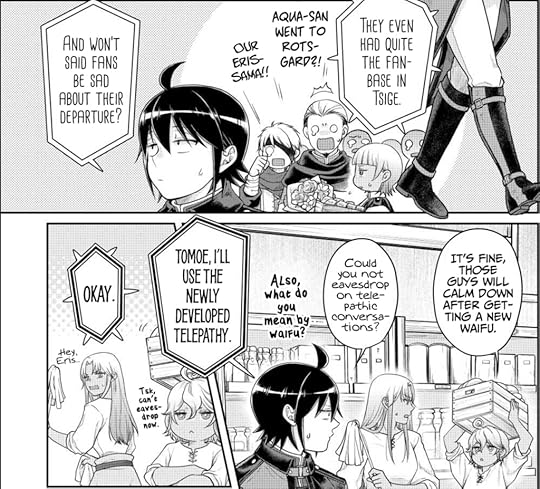
First, the upper panel. The first statement, “They even had quite the fanbase in Tsige” is a telepathic communication by an interlocutor (not the person represented in the panel). The statements, “Aqua-san went to Rotgard?! Our Eris-sama!!” are comments made by those people in the common tongue, but recollections — not part of the current conversation. Makoto says, “And won’t fans be sad about their departure?” is a telepathic communication from him that is part of the conversation.
In the lower panel, Eris (a demihuman forest ogre) is speaking the common tongue (which you can tell by the font), to which Makoto replies in the forest-ogre language. Then Makoto switches to using a new form of secure telepathy that Eris can’t eavesdrop on, which is identified by the thick black inner border.
There are also a number of nods to Japanese. The only characters that can speak Japanese are Makoto and his contracted magical servants, that gain it through their connection with him — plus two other characters that were isekaied from Japan. One of his servants is a dragon who decided to contract with him after studying his memories and becoming fascinated with period dramas. She styles herself as a samurai and adopts various aspects of samurai dress and speech (using “washi” instead of “watashi” as a pronoun, for example.) Another older, more powerful dragon, is revealed to have lived with a previously isekaied person who has since passed away. They haven’t yet had that character speak Japanese, but I’m looking forward to it.
It’s a charming story and I’ve enjoyed reading it so far. I’m looking forward to further releases as they become available.
March 10, 2026
When the Well is Dry

Since December, I’ve basically not written any fiction. I’ve written a few blog posts and managed to keep up with my class — checking my students’ writing and making comments on their papers. But I’ve barely been able to write fiction.
I learned long ago that my creative output is unpredictable. And I generally don’t really worry about it. I know that it will bounce back in time. But it’s still no less frustrating when I try to do some creative writing and the words just aren’t there.
I did manage to write a haiku today. And tonight, I did got a few manuscripts that had been previously rejected back out to calls for submission.
It’s been a discouraging year.
I understand why so many people drop out of trying to get their work published. It’s easy to get depressed and lose hope when your work gets rejected over and over and over again. But this is not my first rodeo.
I know that at some point, the words will come. And, like a geyser, they’ll come pouring forth so fast I’ll be hard pressed to get them down as they come spraying out.
Until then, I just need to hang on.