Marie Jaskulka's Blog
April 3, 2024
The Story Behind: On the Road
If these blogs are going to be published daily, they’ll be shorter. I’m going to have some recurring features, too.
I love all of the benefits of ebooks, like being able to find that random fleeting idea by typing a single word into a search bar, but I do miss the magic of real life books. “The Story Behind the Book” is a tribute to that magic.
I debated on that word: magic. It’s unexplainable. I love the smell of used books, yellowed paper, and the stacks sections of libraries. I worry sometimes that the love of the luddite page is a fading ember of the 20th century. That worry makes my own book collection all the more important to me.
 I love how they tried to sell you more real books in the back of the book you were reading.
What you need to realize is it’s not just about the story inside the book (although that is super important).
“Story is the foundation of all entertainment. You must have a good story. Otherwise it’s just masturbation.”
—George Costanza
You’re not supposed to judge a book by its cover, but you can judge its cover—how it looks and contributes to the overall Story Behind the Book. Take this copy of On the Road that I read in the late 90s. I was in my 20s, figuring out who I was gonna be. I loved the feeling of the book, the mystique, the aesthetic. It led me to learn more about the author and the real people the characters were based on. I sought out and next read the Beat generation of writers and started listening to jazz.

But I was conflicted about the misogyny, that women could never be western kinswomen of the sun, only side pieces or whores or moms or pocketbooks.

Then there’s the personal stuff of real books. The time in my life when I read this particular version of this book, how my personal circumstances affected that reading. Sometimes I remember the particular day or place when a coffee stain or rabbit ear was made. If I’m lucky, the old me left notes for the new me to reflect on and maybe even finally answer.

Do you understand then why it’s so hard for some of us to detach from and abandon our books?
This is the sentence that summed up how I felt about writing then and still:

I’ll be holding on to my books indefinitely, whether or not I ever plan to read them again. I just want to take them down sometimes, remember how they affected me, reflect on all the selves I’ve been.
Each book contains a thousand stories, you know?
K. Bye
The post The Story Behind: On the Road appeared first on marie jaskulka.


April 2, 2024
“Oops, I Did It Again”
Seth Godin, I let you down.
I had to miss the first couple of days of daily blogging . . . right after saying I’d do it every day. But that gives me an opportunity to bring up a tip I’ve learned along the writing path.

Things will happen. Despite your best efforts, you will miss some of the things you set out to do, especially if, like me, you set out to do way too many things.
Part of the reason I have Seth Godin so forefront in my mind is that I’m reading his book The Practice. I started reading it in 2023, and then a bunch of life happened, so I had to stop halfway through (Do you notice a pattern?). Now I’m finishing The Practice, and it kind of seems like the break was meant to be. I was getting back into it, and then a holiday happened.

I have a love/hate relationship with holidays and breaks in general. I want to enjoy them, but they stir up my emotions, and make it impossible to focus on one thing. I always end them feeling both exhausted and like I haven’t done enough. I am really uncomfortable doing the one thing I need most: rest.
Easter weekend was much more difficult than I anticipated. I pre-planned an easy dinner, shopped for gifts early, and stopped myself from going overboard, and I thought I was in a good place. Easter isn’t even that big of a holiday, is it? Not now, anyway.
Growing up in a Catholic family meant Easter was the holiest day of the year. After an entire month dedicated to the idea of sacrifice, there was a jubilant celebration of eggs and bunnies and crucifixions.
Easter confused me. Memories of happily dying eggs with my dad while The Greatest Story Ever Told played in the background. I can smell the vinegar in the dye and the ever-present second-hand smoke of the 1980s. I can see Jesus bloody, and hear him calling from the cross, Father forgive them.
How lucky I was to have parents who did all the things.
I miss them. And even though Easter doesn’t seem as big as it once did, the tremendous guilt persists. This year, Easter was hard. And I wasn’t prepared. Sometimes I feel like all I do is prepare, and yet the time comes, and I am still woefully unprepared.
The thing I’ve learned is that in those moments I have to wing it. I must trust that even though it seems like I’ve forgotten everything, the preparation was not in vain. The information is still in there somewhere, and I just have to feel my way through.

I did write some stuff over the past few days, but nothing I felt comfortable sharing.
The guilt of not posting was swift and intense. But I was nice to the artist. I forgave her.
Today I picked up some of those fleeting ideas, and stitched them into this blog.
I am still getting used to the ebb and flow of this everyday blog stuff. I am stuck on this unrealistic belief that everything I write must be profound, and blogs just aren’t generally profound.
I realize now that part of the importance of daily blogging is to chip away at my tendency toward perfectionism. Lord willing and the creek don’t rise, I will talk to you tomorrow.
K. Bye
The post “Oops, I Did It Again” appeared first on marie jaskulka.
March 28, 2024
meta-FAQs
What is this blog about?
That’s a good question. I’m still trying to figure that out.
Everybody (and by everybody I mean all the people writing about websites) says I need a blog to attract traffic.
But I never know what to say in blogs because my brain is so full of lists like “600 things every post must do.”
Being bombarded with all the things I MUST DO makes me shut down and do nothing.
I’ve attempted to force myself, but quite frankly, I have no desire to add to the proliferation of BS on the interwebs. My first couple of blogs were attempts to fit myself into what a blog should be. It felt kind of weird and forced. I kept editing them to make them seem right, but something was off.
Now, I’m gonna have a “Back in my day …” moment.
Are you ready?
The first blogs were way cooler than this AI-schlock people are posting these days. We had this thing called LiveJournal that was more like reading someone’s diary than their sales copy. Some of the LiveJournalers probably had an agenda, but most were just riffing on life. Literally just individuals screaming into an electronic void.

It’s funny now to look at this whole industry of sales pages and h2 tags and whatever the frack and know it all blossomed from the wordy writing of moody teenagers in the 2000s.
In the spirit of those early blogs, meta-writing is an experiment.
By the way, the name meta-writing has nothing to do with Zuck. Meta-writing means “writing about writing.” In fact, that was my original tagline—”writing about writing,” —but the word writing appeared way too much in a small space, and I almost died.
meta: (adjective) ˈme-tə
showing or suggesting an explicit awareness of itself: cleverly self-referential
Meta-writing is about creative writing, but not marketing or querying. That shiz changes monthly, and I can’t keep up. This blog is an exploration of why some of us spend whole chunks of our lives writing or reading or having some kind of love affair with words.
How come you say you publish every Thursday, but you clearly do not?
Ha, you caught me. Despite writing for most of my life, and finishing several books, you can often hear me complaining that I’m horrible at consistency. I always loved the tagline of Publisher’s Lunch: “Published Daily. Except When Not.” I don’t know what to tell you. Perhaps it’s better to say I fully intend to publish every Thursday.
“Here’s the thing:
The book that will
most change your life is
the book you write.”
—Seth Godin
One of my heroes is Seth Godin. He blogs daily. I resisted the same schedule because it felt daunting, but I think I’m going to try it. Is it easier to blog every day than once a week? Only one way to find out. Join us tomorrow for day 2 (hopefully) of the Seth Godin Experiment.
Sign up to be a subscriber if you want to make sure you don’t miss it.
K. Bye.
The post meta-FAQs appeared first on marie jaskulka.
March 18, 2024
The Proof is in the Portfolio
l used to be an English teacher. I made my students write multiple drafts of essays, workshop them, and keep them organized. You’d think I would’ve picked up some of those techniques myself, but sadly, I have not.
Instead, I’ve been writing like a banshee for a couple decades with the assumption that one day I’ll go back and put all of this work into a portfolio, which is some high-level procrastinating.
I wrote and published nonstop without keeping a record. Now I’m trying to put together a portfolio, one of those things that should “only takes 5 minutes” in principle, but really takes 6000 years when an over-thinker manages the process.
Why is it so difficult to build a portfolio?
Where do I start?
No, literally. Like where do I start? There is so much!
I’ve lived by the rule that it’s always better to be creating than any other part of the process, which is ridiculous because Stephen King, Patron Saint of Writing taught us otherwise.
“To write is human, to edit is divine.”
Stephen King, Patron Saint of Writing
Even though I know better, I still tend to view inspiration and creative flow as a sort of magic alchemy I need to savor and hold onto when it graces me with its presence.
If like me, you’ve been a tad lackadaisical about putting together a portfolio and organizing your writing in general, here is what I’ve learned along the way about how to get it done.
Buy some cool stationery.
Hard work gets easier if you have the right tools. For a while there, perhaps because I came of age in the anti-everything 90s, I eschewed all niceties for writers in favor of minimalism. I began to think that favorite pens, elaborate writing rituals, and, well pretty much anything aside from pen and paper, and later a laptop, were just procrastination in disguise.
I was all, “Quit being a pansy, and write the damn story,” but I’ve since retired drill sergeant Marie. She no longer works here. The head down, don’t think, just work mindset has run its course.
New Marie thinks everything in life should be as enjoyable as possible. If writing with pink gel pens in a bougie Moleskine notebook gets your dopamine flowing, you do you.

Search up your name.
Duh, right? But go down far. I’m talking multiple Google pages. You’ll probably find some stuff you forgot about.
For instance, I wrote so many passages and question sets for educational publishers in the 2000s, that I’m sure a percentage of you were likely forced to read something I wrote when you were in school.
I forgot I wrote this thing years ago and now someone (not me!) is selling it on Teachers Pay Teachers.

People are out there peddling my writing and making money off of it. As a writer-at-large, I’m used to that. Work-for-hire writing isn’t mine. I don’t get to keep it. Even if I pour my soul into it, The Man keeps the rights. The Man = whoever hired me to write the material. That’s fine. I’ve learned not to pour so much of my soul into that sort of thing. I give it only the amount of soul it needs.
While The Man I wrote this for could be the entity selling it on TPT, I highly doubt it. The company posted an excerpt on their site as a sample of what they offer. It’s THEIR portfolio, and do you see what some fool did with it? This is why I’ve been hesitant to make a public portfolio. Scrapers gonna scrape. But I’m not about to let scrapers stop me.
Check yourself.
If you’re a married person who changed your name (or anyone who’s changed their name), don’t forget to search for your prior name. I found some surprises here. Like this turtle book I wrote under my maiden name.

Speaking of turtles…
Pace yourself.
You didn’t make this mess in a day, and it will take some time to clean it up, but it can be done if you don’t let the perfectionist inside tell you it’s not good enough. I have this weird OCD that wants things to be done from beginning to end all in one go. It’s infuriating.
I constantly restart because of some anxiety that I’m missing something. (On the flip side, this need to see the big picture makes me a fantabulous developmental editor!)
Release the illusion of perfectionism. Stop starting over. Just keep moving forward.
Designate file-naming conventions.
When you create lots and lots of documents, organizing is easier if you create rules for file names. For instance, back before AI took everyone’s jobs, I wrote a lot of blogs and I invoiced a lot of blogs. To keep it all straight, I used this file-naming convention:
Client.Year.Mo.Date.Topic.Title
Ferriss.2024.4.1.Edit.I_Wish
All of my blogs sorted themselves into chronological order by client. This made everything from writing to repurposing to invoicing easier.
Use tags to make connections.
Use a spreadsheet or database to organize all works, topics, ideas, etc. in a way that allows sorting and tagging. There are some obvious tags we all share, but every writer’s system will be different.
General Tags
genre
word count
topic
where published
date of publication
link to sample
Following these tips will help you organize your work so you don’t need to go back and do forensic analysis like me. I’d like to think if I had to do it all again, I’d be a much better record keeper, but probably not.
Kids, make your portfolio in real time. But if you have been like me, share with me your tips for pulling it all together.
The post The Proof is in the Portfolio appeared first on marie jaskulka.
March 11, 2024
The Second Rule of Write Club
Last week I introduced you to the first rule of Write Club: Write every day. This week, I bring you rule 2:
Be nice to the artist.
That’s you. You’re an artist. You know why? Because artists have a daily practice, and so do you, right?
Show up every day.Be nice to the artist.Why is being nice so important?
Creative writers spend a lot of time alone. Their inner voice doubles as their boss.
Have you ever had an unappreciative boss who constantly rode your a**? How’d that impact your work ethic?
Starting a daily practice is thorny and rough terrain, even for an old pro, perhaps more for an old pro because we have all these dead vines to cut down, abandoned art that calls to us as we try to find something solid to grasp.

It’s emotionally draining, especially if you ever had aspirations of doing this professionally.
Imagine walking through your childhood home after twenty years of neglect. There’s your once-favorite toy covered in cobwebs and dust, maybe ruined entirely from sitting too long.

The judgmental voice demands–just. start. writing.–but you really can’t judge, shame, and brute yourself into writing well—well being the important word here. You can force yourself to churn out 5K a day right to spec, but that’s not exactly what we’re aiming for here
To get the magic stuff you know you’re capable of, but can’t quite create lately, you gotta woo the muse. You gotta remember what you LOVE about this and block out all the rest. Like the stuff about algorithms. That stuff will kill the artist you.
“You’re a slut and a whore for the algorithm. . . . You start out making art, and hoping that the door will open. You’re looking for that viral moment so it opens up the door and you can do the thing full time. But you start to compromise just to get the door to open: guessing what it wants, debasing yourself, alienating yourself. . . . The algorithm makes you behave in a certain way, create in a certain way, in exchange for being seen. And if something can change what you do, it can change who you are.”
from Humans of New York

It’s a delicate balance—that of being an artist and also requiring an income. Part of me just wants to keep avoiding the daily writing practice. Get a paper-pusher job and secretly jot a poem once in a while, but then I think about Emily Dickinson.
You probably had to read her poetry in high school. She wrote this.

Emily Dickinson never published anything during her life. We have her poetry because her sister found 1800 poems wrapped in bundles in Emily’s bedroom after she died and vowed to get them published.
Then a bunch of people changed stuff and rearranged her poems and made a ton of money selling them. And then those people fought over the money. You know how that goes.

Back to Emily Dickinson.
She knew those poems were good. If she didn’t, they would have been tossed, burned, published under some man’s name. But she never did anything with them, and because she didn’t, other people did.

And because of that, whenever I read Emily Dickinson, I think of her in the great library in the sky, thoroughly annoyed at what well-meaning people did to her vision.
I’m not going out like that.
I often hesitate to push the proverbial publish button because in my heart I am Lloyd Dobler.
But I keep getting nudges, whispers, knowings. They tell me I really owe it to the artist in me to ship her work. Ship, share, publish: whatever you call it. Do it before someone else does.
And in my case, someone else has! More on that next week.
Never putting your work out there is one way to protect yourself from criticism and haters, but saying eff the haters and shipping it anyway is a bigger kind of protection.
So rule number 2 of Write Club is to ask the productivity-focused section of your brain to leave the building. No judging. Writing never gets easy and the troopers who stick it out deserve accolades.
And that’s it. There are only 2 rules to Write Club:

Are you in? Everyone is welcome.
Write Club is not a subscription service you have to pay for. It’s more like OPP.
You down with W.C.?
Yeah, you know me.
Join Write Club by signing up for my mailing list. I’m about to get all creative up in here, and the chaos just might inspire you to get a little creative, too.
The post The Second Rule of Write Club appeared first on marie jaskulka.
March 7, 2024
The Second Rule of Write Club
Last week I introduced you to the first rule of Write Club: Write every day. This week, I bring you rule 2:
Be nice to the artist.
That’s you. You’re an artist. You know why? Because artists have a daily practice, and so do you, right?
Show up every day.Be nice to the artist.Why is being nice so important?
Creative writers spend a lot of time alone. Their inner voice doubles as their boss.
Have you ever had an unappreciative boss who constantly rode your a**? How’d that impact your work ethic?
Starting a daily practice is thorny and rough terrain, even for an old pro, perhaps more for an old pro because we have all these dead vines to cut down, abandoned art that calls to us as we try to find something solid to grasp.
It’s emotionally draining, especially if you ever had aspirations of doing this professionally.
Imagine walking through your childhood home after twenty years of neglect. There’s your once-favorite toy covered in cobwebs and dust, maybe ruined entirely from sitting too long.
The judgmental voice demands–just. start. writing.–but you really can’t judge, shame, and brute yourself into writing well—well being the important word here. You can force yourself to churn out 5K a day right to spec, but that’s not exactly what we’re aiming for here
To get the magic stuff you know you’re capable of, but can’t quite create lately, you gotta woo the muse. You gotta remember what you LOVE about this and block out all the rest. Like the stuff about algorithms. That stuff will kill the artist you.
“You’re a slut and a whore for the algorithm. . . . You start out making art, and hoping that the door will open. You’re looking for that viral moment so it opens up the door and you can do the thing full time. But you start to compromise just to get the door to open: guessing what it wants, debasing yourself, alienating yourself. . . . The algorithm makes you behave in a certain way, create in a certain way, in exchange for being seen. And if something can change what you do, it can change who you are.”
from Humans of New York
It’s a delicate balance—that of being an artist and also requiring an income. Part of me just wants to keep avoiding the daily writing practice. Get a paper-pusher job and secretly jot a poem once in a while, but then I think about Emily Dickinson.
You probably had to read her poetry in high school. She wrote this.
Emily Dickinson never published anything during her life. We have her poetry because her sister found 1800 poems wrapped in bundles in Emily’s bedroom after she died and vowed to get them published.
Then a bunch of people changed stuff and rearranged her poems and made a ton of money selling them. And then those people fought over the money. You know how that goes.
Back to Emily Dickinson.
She knew those poems were good. If she didn’t, they would have been tossed, burned, published under some man’s name. But she never did anything with them, and because she didn’t, other people did.
And because of that, whenever I read Emily Dickinson, I think of her in the great library in the sky, thoroughly annoyed at what well-meaning people did to her vision.
I’m not going out like that.
I often hesitate to push the proverbial publish button because in my heart I am Lloyd Dobler.
I don’t want to sell anything, buy anything, or process anything as a career. I don’t want to sell anything bought or processed, or buy anything sold or processed, or process anything sold, bought, or processed, or repair anything sold, bought, or processed.”
But I keep getting nudges, whispers, knowings. They tell me I really owe it to the artist in me to ship her work. Ship, share, publish: whatever you call it. Do it before someone else does.
And someone else has! More on that next week.
Never putting your work out there is one way to protect yourself from criticism and haters, but saying eff the haters and shipping it anyway is a bigger kind of protection.
So rule number 2 of Write Club is to ask the productivity-focused section of your brain to leave the building. No judging. Writing never gets easy and the troopers who stick it out deserve accolades.
And that’s it. There are only 2 rules to Write Club:
Rule #1: Show up every day. Rule #2: Be nice to the artist.Are you in? Everyone is welcome. Write Club is not a subscription service you have to pay for. It’s more like OPP.
You down with W.C.?
Yeah, you know me.
Join Write Club by signing up for my mailing list. I’m about to get all creative up in here, and the chaos just might inspire you.
The post The Second Rule of Write Club appeared first on marie jaskulka.
February 21, 2024
First Rule of Write Club: Write every day.
Why we write every day
At some point when you sit down to commune with the muse, the saboteur that lives in your brain will ask, “Why do we have to write every single day?”
I don’t mean to quote the annoying grownup from your childhood, but the answer is “because I said so.”
Want proof?
“The writer must have a good imagination to begin with, but the imagination has to be muscular, which means it must be exercised in a disciplined way, day in and day out, by writing, failing, succeeding and revising.”
Stephen King
“Work begets work. Small actions lead us to the larger movements in our creative lives. Take one small daily action instead of indulging in the big questions.”
Julia Cameron
When I need to tackle something difficult and overwhelming, something fuzzy that I can’t quite make out, I’m big on the “one-a-day” principle for achieving just about anything. Small steps lead to big achievements.
One-a-days, or “streaks” as the kids call them, work. That’s why so many apps use them. They know we get a shot of happiness (aka, dopamine) when we keep the streak going. They also know we experience a dose of FOMO when we end a streak.
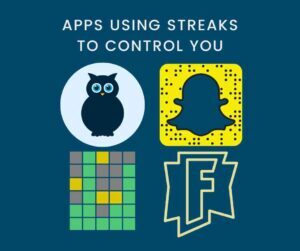
People will log in to a site they hate and don’t have time for just to keep that streak going! Big social media uses your psychological proclivity for streaks to control your behavior. Why shouldn’t you? Take that daily attention back and apply it to your craft, your life’s work. Only you know what that is. Mine’s writing.
Professional writers have a practice.
A couple years ago, like many women who looked around and said “WTF?” I fell down the Brené Brown wormhole. (Have you done that yet? Highly recommend. You’ll come out another person.) She taught me lots, but one of my favorite things was a new understanding of the word practice.
“It would be reasonable to say that I have a yoga attitude. The ideals and beliefs that guide my life are very in line with the ideas and beliefs that I associate with yoga. I value mindfulness, breathing, and the body-mind-spirit connection. I even have yoga outfits. But, let me assure you, my yoga attitude and outfits don’t mean jack if you put me on a yoga mat and ask me to stand on my head or strike a pose. Where it really matters—on the mat—my yoga attitude doesn’t count for much.”
Practice in our daily lives is how we cultivate craft. That includes the craft of writing.
It’s funny she used the example of yoga because a couple years before the Brené Brown wormhole, I went down a yoga wormhole, and you know what my yoga teacher told me again and again and again? Get to the mat. Every. Single. Day. Every day doesn’t have to be a 2-hour yoga sesh, but visit that mat daily if you want any kind of results.
But it’s more than results. Practice impacts mindset. I am a writer. Writers gonna write. I write therefore I am . . . a writer.
Even science says you have to write every day. Newton’s first law of physics:
An object at rest remains at rest, and an object in motion remains in motion at constant speed and in a straight line unless acted on by an unbalanced force.

In other words, picking up where you left off yesterday is easier than restarting from a stop. That’s why even a bad daily writing session is better than no daily writing session.
What about well-practiced writers who have nothing more to learn?
Let me tell you something I’ve realized: Anytime I start thinking I have nothing more to learn on a subject, I know I’m about to be shown just how much I really don’t know.
Perhaps like me, you are a professional who knows how to summon the muse at will and finish lots and lots of pieces of writing in a day. You probably don’t think you need to write every day. You have graduated from “writers gonna write” to “writers get paid to write,” and I’m not sure that’s true.
Hear me out.
According to Seth Godin, any hack can get paid to write, but we’re doing something else when we talk about craft. We’re truth-seeking.
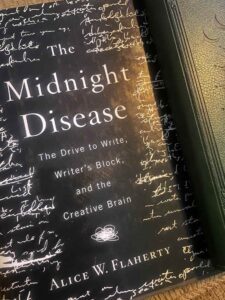
If you’ve experienced any amount of failure in the area of creative writing (i.e., writing you create at will, with no external accountability to motivate you), and you keep coming back, I’m sorry to inform you, but you have the Midnight Disease. It’s chronic but treatable. You treat the Midnight Disease with a daily dose of practice. A writing sesh a day keeps the mental health professionals away.
Newton says the most difficult part is starting.
How do you survive the unbearable FIRST daily writing session?
Ah, I can help you with that, because I’ve been down these forking paths and returned with a flashlight to show you the way. Here’s how you do it.

Step one. You have to make it downright easy.
No, easier than that.
Like, collect pen and paper and put them at desk. Done.
Tomorrow can be slightly more difficult.
Don’t sigh at me. If you’ve been ignoring the muse for days, weeks, years, you need to woo them back slowly.
Yes, I realize you’ve had 10K days. Here’s the thing. You didn’t start with a 10K day. You have to work back up to that. You’re out of shape, bruh. And that’s okay. Creators need rest. To everything, there is a season. What makes 10K days so extraordinary is their rarity. Runners don’t run marathons every day of their lives. Neither should writers.
Most of what we do in life, according to James Clear, is out of habit. If we make habits of the stuff we most wish we could do, we become the people we aspire to be.
So will you do it?
One tiny act in the direction of your life’s work, your craft?
I designated 2024 the year I wake up my author career. The gradual awakening started with a daily writing practice. That led to a site refresh. And that led to this blog.
The next step is another blog, which you can expect next Thursday. From now on, blogging on Thursdays is a practice of mine.
Want to join me in my return to a daily writing practice? Or maybe just follow along as a spectator? Join my newsletter. You’ll get my weekly blog posts sent right to your inbox.
The post First Rule of Write Club: Write every day. appeared first on marie jaskulka.
January 24, 2024
My Novel As Seen From the Moon
Talk about seeing your manuscript from a new perspective!
When I revise, I highlight areas that need work. The amount of yellow in my manuscript shows me how much work I’ve yet to do. Here is a Print Preview of several pages from the last quadrant of my novel in its current state:

As you can see, I still have miles to go before I query. Put the coffee on. It’s going to be a long night.
I dare you to open up your manuscript and view its Print Preview. At the very least, you will be amazed at all those words you wrote–your entire novel splayed out before you.
The main thing is to get a new perspective on your work.
7 Ways to Get Perspective on Creative Writing
1. Use the Print Preview
Look at the manuscript from far away. Is it even? Are some chapters big and bulky while others are light and filled with white space? Is there a reason for that? If not, fix it. Make all those pages look like they’re from the same manuscript.
2. Print it Out
If you’re writing a novel, don’t print a new copy every day, but you deserve to see that bad boy printed out at least once. It makes your whole office smell like a book factory. You struggled to push that 300-page beast out of your imagination, and when you print it, you get a real tangible thing you can hold. That’s some powerful stuff. If you have an environment-saving judge in your head, try:
printing double-sided
printing 4 pages to each one page (or 2 pages on each page depending on your eyesight)
printing on the back of used paper
3. Put it in a drawer
The drawer method harkens back to when all manuscripts were paper. You’d print out your fresh manuscript and stick it in a drawer. Then you’d go live life for a while. You come back in six weeks or so, open the drawer, and being a new person, you can suddenly see all of the things you couldn’t see before.
4. Sleep on it
The sleep-on-it method works for people who want perspective but don’t have sixty days to wait. You don’t even need to print for this. Just shut down your computer and go to bed. Edit it in the morning. Even one night is enough to give you perspective.
5. Read it aloud
I’m not talking about quietly whispering to yourself. Read that thing like you mean it. Like you hear it in your mind. Like you’re performing it on Broadway.
6. Have someone else read it aloud
The more you read something, the more difficult it gets to see it. Your brain is working on what it thinks is there. It will fill in missing words. It will look at a word you’ve written a few million times and question the spelling. Other people will stumble over clunky sentences that you’ve mastered. You don’t want readers stumbling. You want them gliding to the next page with zero hesitation.
7. Workshop it
In a writers’ workshop, a bunch of writers read your work and then talk about it as if you weren’t there. You’re not allowed to chime in and say, “What you don’t understand is…” That’s what a lot of us want to do–explain to people what they should have taken from it. Workshop let’s you see what people DID take from it. You don’t get to explain it. You have to edit to get the response you intended.
My favorite method to gain perspective is printing out the manuscript, but the environmentalist in me judges me for that. I sometimes print anyway. It’s that important to me to see ink on paper.
Are you a writer? What methods do you use to get perspective?
The post My Novel As Seen From the Moon appeared first on marie jaskulka.
January 23, 2024
How can I tell if my writing is any good?
According to Wikipedia, the most freaked-about flaw in people who have body dysmorphia is acne. Wrong again, Wikipedia. Meet my new anxiety disorder
Writing Dysmorphia
I have no clue if my writing is any good. How does one tell? Just this week, I’ve described my writing with one or more of the following adjectives:
crisp / stilted
funny / cheesy
gripping / WTF?
You know those people on American Idol? You know the ones! So confident they’re going to blow the judges away, they open their mouths and we viewers are stuck between laughter and the immense guilt of watching someone’s genuine dreams crushed on international television for our entertainment.
What if I’m one of those people?
Perusing the web definitions of dysmorphia, I came across this tidbit:
“Body dysmorphic disorder interferes with functioning and may lead to social isolation…”
Another symptom I exhibit. While my friends hit the local hipster hangout, I lock myself in a tiny upstairs room, deleting and re-entering commas, reading aloud, pacing. I am sick, y’all.
Ira Glass may have said it best in his This American Life interview, visualized here by Daniel Sax:
Writing brethren, two of my writer friends tell me that writing dysmorphia is rampant. They say everyone has it. Is this true?
Do you have writing dysmorphia? Have you any idea whether your writing is good, bad, or fugly? How do you gain this objectivity? Or perhaps, as I suspect, we never do close the gap completely.
Do you feel the pull to create and the agony of good taste? What do you long to create? And what stops you from closing the gap? Tell me about it. Seriously. I want to know.
The post How can I tell if my writing is any good? appeared first on marie jaskulka.
Welcome to Creative Writing 101
I’ve been procrastinating on writing (which I allegedly love) so long that I’ve become a self-professed expert on the problem.
I don’t sit down and write so much as fly around my ideas like a buzzard, dropping in once in a while to peck at them and check for life. When I try to zoom in and work on one book, one paragraph, one blog, my mind wants to take flight and scan the file cabinet horizons for other unfinished stories.
I feel all kinds of guilt for the unchosen projects, the higher paying undone work, the cleaning and cooking that I feel guilty about feeling guilty about because I’m a feminist for Pete’s sake.
But here I am, coming in for a landing.
Remember this scene from Dead Poets Society that launched a thousand English majors?
O Me! O Life! Why now for a blog relaunch?
Because the powerful reality show goes on, and I may contribute a season.
I can’t not write. I have the writing disease, which sounds like a made-up thing, but it’s not. There are whole books about Hypergraphia: the Incurable Disease of Writing. The word disease comes from dis-ease. I am uneasy when not writing.
Procrastinating for writers isn’t really about writing because we’re always writing. It’s about not finishing what we write. Not sharing, publishing, or “shipping.”
I’m an expert on creative writing because I developed the writing disease when I was a kid.
It’s recently come to my attention that despite armageddon fast approaching, and AI threatening to take over all creativity, teenagers are still writing. That gives me hope and reminds me how writing helped me navigate all kinds of tough stuff when I was young. And reading gave me a safe place to escape.
When people hear I write, they often want to talk about it. But if they write, they want me to read their work because I get their dis-ease. I’m not going to just listen. I’m going to genuinely feel their emotions for a while. People who get it are in an exclusive club just like the Jeep people.
We get that human beings feel emotions that can’t be explained or processed logically or even looked at directly sometimes. But they can be circled, pecked at slowly, and devoured. And that doing so has value.
This is a blog about writing for those people. Yeah, AI could do it, but that’s not the point. Step off, AI. We got this. What do you write and why? Send me your answers for real. I want to know.
The post Welcome to Creative Writing 101 appeared first on marie jaskulka.