
Liz Orwin's Blog
September 25, 2016
Fifteenth Century Surprises
Occasionally, life catches you out, presenting you with something you should know all about, but for a myriad of reasons, do not. Recently, this happened to me. Having finally read a fascinating book published some years ago but recently updated by the renowned historian John Ashdown-Hill, I was interested to discover more of Eleanor Talbot (Edward’s IV’s secret wife – the first and arguably most contentious one and, in John’s words, ‘the woman who put Richard III on the throne’) read about Eleanor here. In his book, amongst the many details about this esteemed and virtuous lady, I learned there is a possible depiction of Eleanor on the Coventry Tapestry.
This was unexpected. I could recall only Graham Sutherland’s magnificent image of Christ, commissioned for the city’s modern cathedral, built in the 1950s. The stunning tapestry was one I had viewed as a child when visiting the cathedral but, to the best of my knowledge, did not contain any images of forgotten noble ladies. As I have since discovered, there is another tapestry quietly residing in Coventry, one equally impressive, but that is five hundred years old and has connections (albeit Tudor-related) to Richard III.
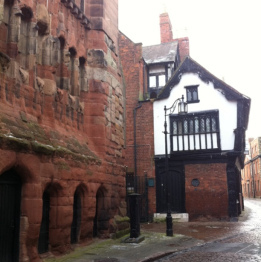
St Mary’s Guildhall
Adjacent to the ruins of the cathedral of St Michael, stands the ancient Guildhall of St Mary’s and it is here the secrets of the tapestry lie. Those in the know will no doubt wonder why the cathedral and the guildhall are dedicated to different saints. Coventry is a curious city in that it has hosted three different cathedrals on three different sites, over the course of a thousand years. The first, St Mary’s, was originally a monastic church – and no doubt why the ancient guildhall took the same name. Founded before the Norman Conquest by the rich and powerful Leofric, Earl of Mercia, and his wife, Lady Godiva (of the clothing-less ride round the city fame), it was a Benedictine community, built upon an already religious site that had housed nuns. John of Worcester praised the monastery, saying the earl and his wife had bestowed lands and ornaments that no other monastery in England could boast such an abundance of riches.

While many royals visited the city during the following centuries, King Richard III is recorded as having visited Coventry in 1483, 1484 and 1485. It is also highly likely he visited the city numerous times as Duke of Gloucester, and most probably after the Battle of Tewkesbury when King Edward spent time there. All three York brothers may well have visited the Cathedral and Guildhall during their stay in the city. St Mary’s continued to serve the city for over five centuries, until those under orders from the Tudor King whose-name-we-shall-not-mention-here, stripped it of its wealth and finery during The Dissolution of the Monasteries.
The cathedral of St Mary’s fell into disrepair after the dissolution, the See of Coventry and Lichfield being moved to Lichfield at this time. The parish church of St Michael became the city’s main focus of worship but it was still only a parish church, the bishop’s seat being in the county of Staffordshire where it remained. In 1918, the modern diocese of Coventry was created and the church of St Michael duly became a cathedral.
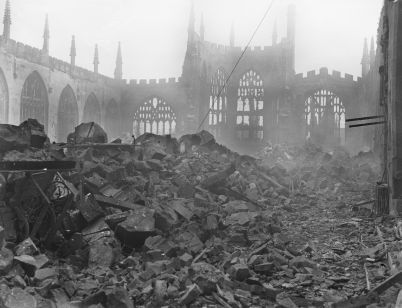
The ruins of St Michael’s – November 1940
Sadly, its glory was short-lived. On the night of 14 November 1940, the city was pounded by bombs dropped by the Luftwaffe. In the ensuing chaos and devastation, the cathedral burned, having been hit by a number of incendiary devices. Coventry had once again lost its cathedral through an act of violence. Yet from the ashes of WWII rose the city’s third cathedral, also dedicated to St Michael. It is a fine example of modern design and architecture, its foundation stone being laid by Her Majesty, the Queen, in 1952. The cathedral was finally consecrated in 1962, with the ruins of the older cathedral remaining hallowed ground.
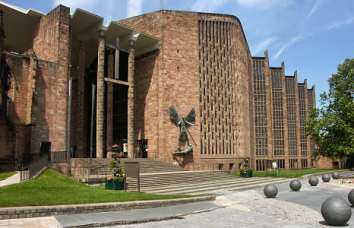
The most recent of Coventry’s cathedrals
But back to my original discovery. I knew something of the ‘modern’ cathedral from family stories, having been told how the ‘old’ cathedral had been destroyed along with large parts of the city on that war-torn night in 1940, including the home of my great-aunt (she and her husband survived but lost everything save a small china ornament in the shape of a black cat). Yet I knew nothing about the far older cathedral of St Mary’s, nor it seemed, did my family.
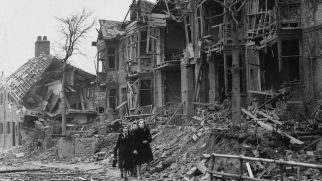
The Coventry Blitz – 1940
I had grown up in the Midlands thinking of Coventry as a purely modern city, rising from the ashes of its wartime nightmare, its medieval heart lost on that terrible November night during WWII. Only lately have I discovered that somehow St Mary’s Guildhall survived the destruction and, inside it, a tapestry that has seen both war and peacetime, hanging upon its walls since the end of the fifteen century.
According to the Guildhall’s website (read more here), the tapestry was created around 1495-1500 to hang on a particular wall. It is remarkable to think it still hangs in the place it was commissioned for, especially given the extent of destruction in the city during WWII as well as the numerous wars and skirmishes that have occurred since its creation. 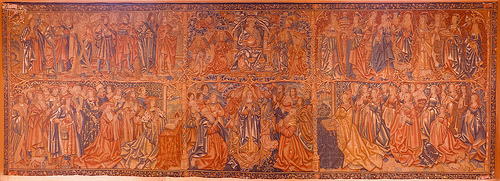 Three metres high and over nine metres long, the tapestry was made by skilled Flemish weavers. To have commissioned such an ambitious work, demonstrates the wealth of the city at that time. Though created during the reign of King Henry VII, it depicts his Lancastrian ancestor, Henry VI, who was fondly remembered in Coventry where he chose to base his court for a time during The Wars of the Roses. There are seventy-five individual characters depicted on the tapestry, from angels, saints and apostles to nobles and a king, all centred around an image of The Virgin. John Ashdown-Hill notes in his book that two of the figures have been identified as sisters; Margaret Beauchamp, Countess of Shrewsbury (mother to Eleanor Talbot), and Anne Beauchamp, Countess of Warwick (wife to Richard Neville the Kingmaker and mother to Richard III’s Queen Anne). The Beauchamp family were a significant power in Warwickshire over several centuries and their family seat was relatively close by at Warwick Castle. John questions whether two female figures close to the Beauchamp women could be Margaret’s two daughters by the Earl of Shrewsbury – Eleanor and Elizabeth (Duchess of Norfolk).
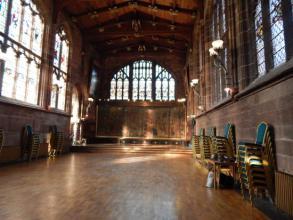
The Guildhall with the tapestry at the far end
It was this reference that prompted me to search up the tapestry in the first place, thus discovering the link to Richard. Though curious to learn of the possible depiction of Richard, I was left with far more questions than answers. Quite why Margaret’s two daughters were depicted when Anne’s were not, is not answered. Although it might have been prudent for the Tudor designers to deliberately omit Anne Beauchamp’s daughters, Isobel and Anne, because of their direct connections to the recently-defeated House of York (marriages to the Dukes of Clarence and Gloucester respectively).
Having said all that, and the primary reason for this post, is there appears to be a line of thought that one of the figures depicted in the tapestry is of a young Richard III, while still Duke of Gloucester. Though the image itself is pleasing enough, according to the website there are a number of pointers that suggest it is indeed Richard – but viewed from a purely Tudor-placating point of view. Firstly, the image of the young man reflects the earliest-known (and referred to in some places as the most trusted) portrait of Richard, in the possession of the Society of Antiquaries. 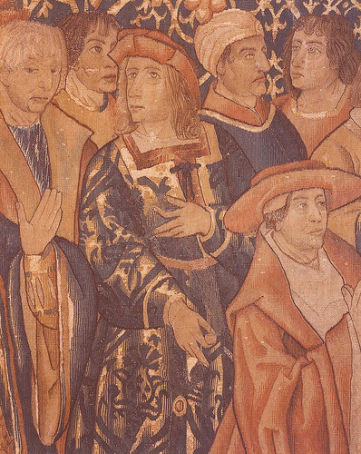 There are also other similarities according to the Guildhall’s website, including eye-colour, hair curls, ‘deformed fingers and misshapen shoulders’. The figure is also shown as carrying a coin in the right hand, often used to represent a Judas-type character and the inevitable treachery conducted by such a character. Apparently, the figure originally held a snake in his left hand, another known representation of evil or cunning. It seems the snake was removed at a later date but a distinct outline has been left thus revealing its inclusion in the original design.
While this is certainly not the most flattering depiction of Richard in terms of character (rather than image), it is along the lines of the Shakespearian villain many are familiar with and certainly indicative of later opinion. Yet the image of Richard (if it is indeed meant to be him), is not out of place with the others in the tapestry, showing a well-dressed and almost handsome young nobleman who does not stand out amongst the crowd. However, given the iconography, the accoutrements he holds plainly make him out to be different – and deliberately so if he is representing the villain. Quite why Richard should be depicted on the tapestry when his parents, the Duke and Duchess of York, who were at the epicentre of events during King Henry VI’s reign, were not, is interesting. Was it an obvious sop to the new king, Henry VII, the man who had defeated Richard at Bosworth and who was busy reasserting his claim to the throne which was tenuous at best? Perhaps. There also remains the question of why the snake was removed. Was someone who remembered Richard – or his reputation as a benevolent prince – trying to redress the balance without making it obvious that was occurring? We shall probably never know. The king represented in the tapestry is the pious but ineffectual Henry VI, who was revered for many years after his death, with miracles even recorded in his name. While such reverence might never be paid to King Richard, the tapestry is glimpse into the Tudor propaganda machine that was already in full operation a few short years after his death in battle.
Whether the Coventry Tapestry contains representations of Richard and Eleanor Talbot or not, and in whatever context they appear, the work itself is a survivor of tumultuous times. That it remains in the place it was created for is reason enough to be thankful. England has a rich and deep history but also a turbulent one, and the very fact this beautiful artefact is still with us and accessible to view is remarkable. Perhaps we should not concern ourselves too much with the ‘what ifs’, but simple admire it for what it is – a grand old lady revealing glimpses of days long gone by.
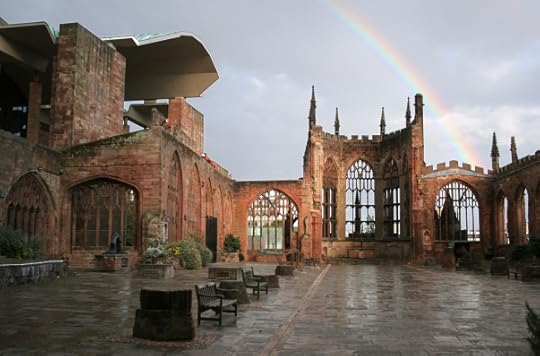
The ruined cathedral of St Michael with the modern cathedral to the left. The remains of St Mary’s are close by, as is the Guildhall.



August 13, 2016
All Roads lead to Richard
All roads lead to Richard – really? Of course not but, just occasionally, when you are searching for something related to the fifteenth century, it can often seem that way.
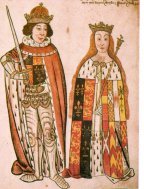
Richard and Anne – The Salisbury Roll
Whilst trying to find a picture for the frontispiece of The Maid’s Tale, I looked over numbers of medieval images from manuscripts, stained glass windows, portraits, and any other source I could think of, even more modern images with copyrights that I shouldn’t have been contemplating! The choice was endless – and yet limiting at the same time. My story revolves around the life of the young Anne Neville and, as any Ricardian knows, images of Anne are few and far between and there are none at all from her youth. The few images I could find include those taken from: the Salisbury Roll, the Rous Roll and the Beauchamp Pageant. The Rolls were collections of coats of arms while the pageant was an illustrated life of Richard Beauchamp, Earl of Warwick, and Anne’s grandfather. The images are vague depictions of a young, medieval woman, with a face that could have belonged to any woman from the last five hundred years.
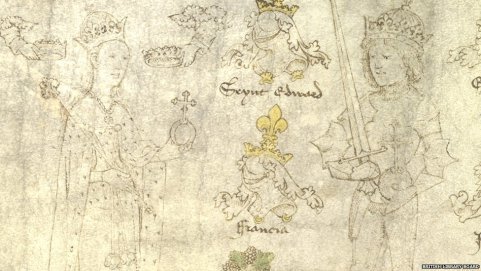
Anne (left) with Richard in the Rous Roll
Despite the vagueness of Anne’s images, I should mention a certain John Rous, a canon in the collegiate church at Warwick and possibly the man responsible for creating the Rous Roll. The same John Rous most likely had input into the Beauchamp Pageant (possibly commissioned by Anne’s mother, Anne, Countess of Warwick), and therefore may even have seen Anne Neville as a young woman when she spent time at Warwick Castle. However, tempting though it is to believe these images are portraits, we cannot say for certain.
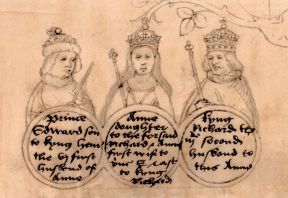
Anne with both her husbands – (Edward, Prince of Wales, left, and Richard, right) as depicted in The Beauchamp Pageant
Interesting though these illustrations are, none were quite what I was looking for so the search continued. There are more modern depictions of Anne, the stained glass window at Cardiff Castle in especially lovely, but it is exactly that; modern and speculative, an artist’s impression of the woman who once graced Richard’s side. What to do? I had an idea for the cover in my mind and wasn’t about to consider others till I’d exhausted every route available. With little extant material to work with, the only option seemed to be to continue searching through countless images of fifteenth-century women and see if one stood out above the others.
Eventually, I came upon the image in the header. Nice, I thought, a pretty maiden, sitting in a garden with red and white roses in the background. Given Anne’s family history, the time into which she was born and with her marriages to the houses of both York and Lancaster, the colour of the roses alone ticked a few boxes for me, so I began to look a little closer (yes, I realise the red/white rose thing wasn’t really relevant at the time but we’ve come to expect such depictions nowadays).
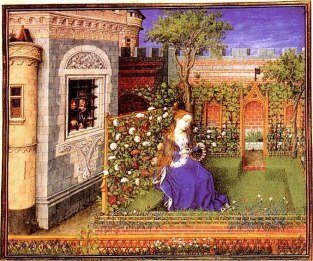
Emilia in her garden, watched by Palemon and Arcita
The young woman in blue is named Emilia and the illustration is taken from the poem Il Teseida, written by Giovanni Boccaccio around 1340. So far, so good. I liked the look of the maid and liked her garden even more. I liked the fact she originated from an epic poem and I especially liked the wistful expression upon her face as though she sat thinking of something she ought not while believing she was alone with her thoughts.
The poem Il Teseida is long. It runs to almost 10,000 lines and is divided into twelve books that follow the career and rule of the Greek hero Theseus (Teseo). However, a large part of the poem concentrates upon the rivalry of Palemone and Arcita, who compete for the love of the aforementioned Emilia. Interesting though their story is, that’s not what drew me in. The flowing, golden hair of Emilia, along with the rich blue of her gown draws parallels with depictions of The Virgin (for many years only brides and virgin-maids were allowed to wear their hair loose and on display) and was most likely far more relevant to the medieval mind with its understanding of imagery, than ours. It was also closer to what I’d had in mind for Anne – young, pretty, definitely unwed and so a maid in the true sense of the word. As I looked upon Emilia, I decided this image was the one I wanted and continued to investigate a little further.
The manuscript featuring this particular image dated to around 1460. Again, I took the information and decided it was close enough to make it an acceptable image to use. Anne was born in 1456, so while far younger than Emilia in the image at the beginning of my tale, she grew up to be a young, unwed maiden in my story and, yes, at one point, I wrote of Anne seated in a garden, dreaming of her (prospective) lover. Exploring further, I discovered the illuminated miniature of Emilia was believed to have been produced by a certain Barthelemy d’Eyck, noted by contemporary authors as the finest painter of the time. Though no works can be documented exactly as his, a number are generally accepted as being produced by Barthelemy. Moreover, a painter of the same name is recorded as working in Dijon for Philip the Good, Duke of Burgundy, in 1440, and this may well have been him. Notably, Duke Rene of Anjou, who would later become Barthelemy d’Eyck’s main patron, had been held prisoner there by Philip. A coincidence? Probably not, an artist and poet himself, Rene would have known talent when he saw it.
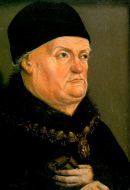
Rene d’Anjou
Duke Rene was also Count of Piedmont, Duke of Bar, Duke of Lorraine, Count of Provence,King of Naples and titular King of Jerusalem and Aragon, including Sicily, Majorca and Corsica. Impressive credentials. He became known for his patronage of the arts, as well as being an amateur painter and poet of some talent himself. He employed Barthelemy for most of his career, and certainly from about 1447 when he is recorded as a ‘peintre et varlet de chamber‘. Several of the miniature illuminations in the manuscript have been attributed to Barthelemy d’Eyck, including that of Emilia. It is possible Duke Rene ‘collected’ talented individuals as the translation of Il Teseida was attributed to those ‘in the circle of Rene d’Anjou‘.
Nice, but irrelevant, might be your response at this point. Yet it was here that an interesting and important link became apparent. The renowned Duke of Anjou was the father of Margaret, the woman who became the wife of King Henry VI, and a thorn in the side of the House of York for many of years until the eventual defeat of the Lancastrian threat at the Battle of Tewkesbury. In December, 1470, Margaret and Henry’s son Edward, Prince of Wales, and Anne Neville were married, primarily to secure the support of King Louis of France. Anne’s father, Richard Neville, the famed Earl of Warwick, had allied himself with the House of Lancaster as part of his last and most desperate attempt to keep a hand upon the throne of England. So there it was; the stunning image of Emilia was painted for Anne’s grandfather-by-marriage, linking the illumination to my story in more ways than I could have hoped for. There is nothing documented to say Anne ever met Duke Rene, but perhaps while she was in France, betrothed to the young Prince of Wales and residing within the household of his mother, Queen Margaret, as they waited for the Earl of Warwick to secure England for them, she may have encountered him. I’d like to think so, imaging the two of them discussing poetry and, perhaps, offering the young Anne a brief distraction at one of the most testing times of her young life.
But wait, there’s more!
The story of Palemon and Arcita has another link to offer, this time, one that takes us directly to Richard. The poem is acknowledged as the main source of the ‘Knight’s Tale’ in Geoffrey Chaucer’s Canterbury Tales. Amongst the books Richard owned (and have been documented in recent times) is one he must have obtained as a young man. It is a collection of romances and Old Testament stories including, yes, you’ve guessed it, Chaucer’s Knight’s Tale. There are two stories from Chaucer’s Canterbury tales included in the book, both of which are tales in the courtly genre, according to Anne F. Sutton and Livia Visser-Fuchs who studied the volume and wrote a number of articles about it for The Ricardian (Richard III Society). It has been suggested this type of reading was created for the education of a young nobleman and so it is not beyond the realms of possibility to imagine a young Richard reading the tale of Palemon and Arcita, perhaps even thinking of Emilia seated in her garden as the two men looked upon her beauty.
There we have it: all roads lead to Richard – at least, on this occasion they did. Perhaps it’s just me actively looking for links and coincidences, however tenuous – but then again, if we’re researching life and people of the fifteenth century, most of the roads we follow will lead us to Richard one way or another.
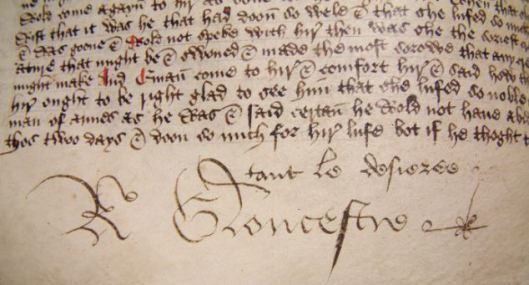
Image of the book of Romances and Old Testament stories, inscribed by Richard with his singular motto: tant le desiree.
The book of romances and Old Testament stories containing Richard’s signature is owned by the Marquis of Bath and is held at Longleat House, England. The manuscript of the poem Tesieda, with some illuminations by Barthelemy d’Eyck, is now preserved in the Austrian National Library, Vienna.
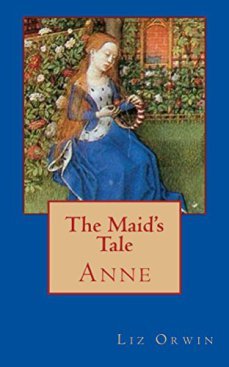
My novel of Anne Neville featuring the image of Emila – available from Amazon in paperback and e-format


August 6, 2016
A Tale for All Ages.
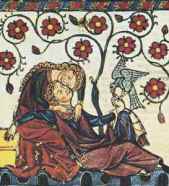 When Richard, Duke of Gloucester, bought, acquired or was gifted a copy of the Prose Tristan during the 1470’s, he held one of the most popular and influential romances of the middle ages. The story Richard had acquired was already centuries old but, unlike some of his other acquisitions, was not a religious text, a historical record, a military memoir or a moral lesson. Nor was it a tale that had its roots in ancient civilisations or a different county. The Prose Tristan, while both a romance and a tragedy, is also a lesson in chivalry and the conduct of the knight and, unlike most other tales Richard owned, has it origins firmly entrenched in England.
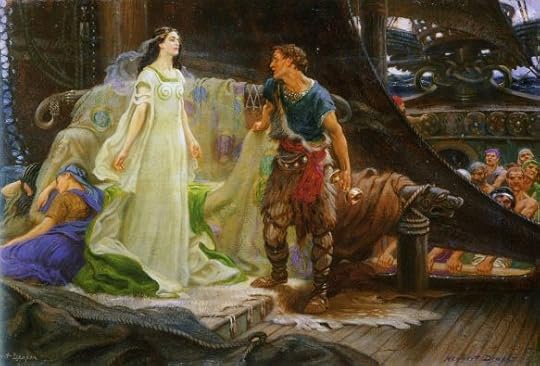
Tristan and Iseult painted by English classicist Herbert Draper (1863-1920)
The roots of the tale are lost deep in Celtic past. It is believed Pictish, Irish, Welsh, Cornish and Breton stories were passed on through Breton storytellers, eventually reaching twelfth-century romances and poems that were recorded in French. There are traces of the tale that can be traced back to the ninth century, as well as some written down in Irish in the tenth, but essentially, the earliest recoded traces are those of the twelfth century poems. The magical, potion-induced love-triangle of the three main characters, Tristan, Iseult and Mark, appear to have been developed in both the Welsh and Irish tales, and it has been suggested it was the Welsh storytellers who elaborated upon Mark being king of Cornwall and Tristan’s uncle. Over time, additions were made to the story, introducing more exotic details from farther afield like Arabia (the suggestion for the Persian influence is circumstantial and different theories have arisen as to how such influences reached the West. Some scholars have suggested story-telling during the Crusades and from minstrels who had the freedom to move between both Crusader and Saracen camps). By the late twelfth century, these variations has been drawn together to form a more complete story that was certainly circulating in France. Within a few decades, several poems retelling the legend of Tristan had been produced and it is these poems that dominate modern understanding of the tale, influencing in particular those versions told by Sir Thomas Malory and Alfred Tennyson.
The story is centred around the adulterous love between Tristan (also written as Tristram) and a beautiful Irish princess named Iseult (also Isolde, Yseult and other variations). Tristan is a Cornish knight and nephew of the king of Cornwall: Mark. After defeating an Irish knight named Morholt, Tristan travels to Ireland to bring back Iseult to be married to Mark. During the return journey, they both accidentally partake of a love-potion (in one version supplied to ensure Iseult’s marriage to King Mark is a happy one, in another, Iseult deliberately gives the potion to to Tristan). The effects of the potion are meant to last a life-time and so, after marrying King Mark, Tristan and Iseult are driven to seek out each other as lovers.
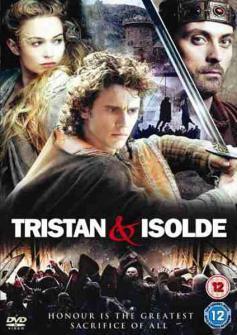
James Franco, Sophia Myles and Rufus Sewel in the 2006 movie.
Though this behaviour is clearly sinful and something the medieval mindset would not have approved of in any form, it is suggested in the story that the potion frees both parties from responsibility for their actions. King Mark discovers what is occurring after some of his men become suspicious, and the adulterous pair are forced to flee. Though together, both wrestle with their conscience over their forbidden love and the treatment of Mark. They eventually make peace with Mark and Iseult returns to the king’s side, but Tristan flees the country. In Brittany, he marries Iseult of The White Hands (for her beauty and her name). The marriage is an unhappy one because Tristan cannot forget his true love, Iseult. Soon after, Tristan is mortally wounded and, fearing he will die, sends a friend to Cornwall to find his true love, Iseult, the only one he says can heal him. They arrange a signal to identify whether the friend has Iseult aboard ship upon his return. However Tristan’s new wife is jealous (not so surprising!) and lies to Tristan about the colour of the sails when she realises Iseult is aboard and has come to her lover. Tristan dies of grief, thinking his love has forsaken him, then Iseult (his true love) dies also upon seeing his lifeless corpse. Iseult of The White hands is left to reflect on what she has done.
Inevitably, interest in the tale waned over the centuries, but enjoyed a revival in the late nineteenth and early twentieth centuries. Works include Alfred Tennyson’s The Last Tournament – one of his Idylls of the King, Matthew Arnold’s Tristram and Iseult , Algernon Charles Swinbourne’s poem Tristram of Lyonesse. Even the imagination of Thomas Hardy was captured by the tale, writing a one-act play: The Famous Tragedy of the Queen of Cornwall at Tintagel in Lyonesse.
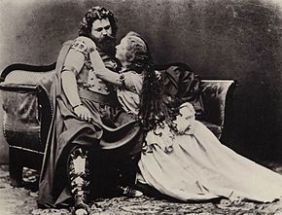
Ludwig and Maria Schnorr von Carolsfeld as Tristan and Isolde in the first performance in 1865
The adulterous couple inspired composers too, perhaps the best-known being Wagner’s Tristan und Isolde. This is now considered one of the most influential pieces of music of all time. Numerous other pieces have been written, though many have distinct Wagner overtones. Film has seen one of the most prolific re-tellings of the tale, with numerous movies being produced over the years. The first was a silent French picture, made in 1909, while the most recent was in 2006.
Art too, was inspired by the doomed lovers, and several paintings including Herbert Draper and Edmund Blair Leighton amongst many.
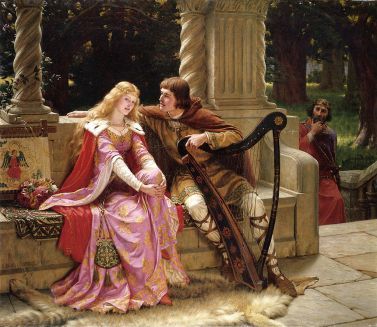
Tristan and Iseult depicted by Edmund Blair Leighton (1853-1922)
I was first drawn to this story after discovering the British Library held Richard’s copy of the Prose Tristan. According to the study of this particular book (printed in The Ricardian, March 1991) carried out by Anne F. Suton and Livia Visser-Fuchs, King Richard, or the Duke of Gloucester as he was then, may well have been drawn to the tale for its depiction of the hero’s hunting abilities and as master of the hunt or, more likely, its depiction of chivalric
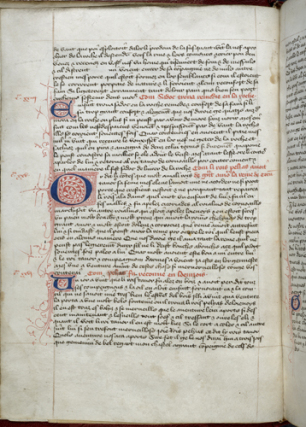
Decorated initials from Richard’s copy of the Prose Tristan.
conduct. The prose has been referred to as ‘a manual of courtesy’, depicting the nobilities’ concern with etiquette and education of the knight. The study also suggests it might have appealed to the fifteenth-century man because of its relevance to a ‘restless and divided world’. Certainly a phrase to describe the world into which Richard was born.
Whatever the reasons for his ownership – and it might have been as simple as it was a popular and desired read for a young nobleman – that Richard owned a copy of this tragic romance is not in dispute. His inscribed copy is now held by the British Library, bearing the words Iste liber constat Ricardo duci Gloucestre. Clearly, he owned the volume as a young man, but whether he was moved by the trials of the love-lorn couple at the centre of the tale, and whether he approved or disapproved of their forbidden love, is not known. However, it is interesting to consider than while Richard might have been fascinated by one facet of the tale, his niece, Elizabeth of York, who also owned and inscribed the book, might have held a completely different view. Certainly to the modern reader, it is the romantic element that captures the imagination first. Perhaps Elizabeth was also drawn to that element while her uncle preferred the chivalric depictions and hunting prowess of the hero.
Elizabeth of York also inscribed the volume (with a singular motto, one she appears not to have used again – sans remevyr, Elizabeth) and this only adds to the mystery surrounding the volume. As many of you will know, when I wrote The King’s Niece and The King’s Wife based around King Richard and his niece, Elizabeth, I intertwined their story with the tale of Tristan and Iseult. For me, the fact both these individuals had owned the book linked them in a way that begged to explored. Whatever your views upon Richard’s friendship with his late brother’s daughter, the fact she marked his personal copy of this tale can only fuel the fact there was some form of affection between them.
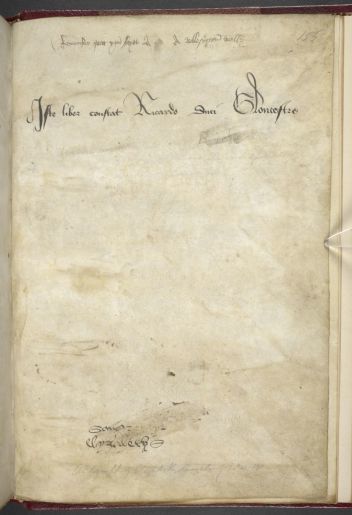
The claim of ownership by Richard, Duke of Gloucester in bold at the top of thepage. The motto and signature of Elizabeth at the bottom
Whatever may – or may not – have occurred during those dark months prior to Queen Anne’s death, Richard and Elizabeth must have shared some enjoyment of this tale for the book to have been passed between them. However, this does not take into account Queen Anne’s opinion in all of this. As an educated and well-read woman, it may have been the queen who generously offered the young Elizabeth opportunity to read the tale of doomed lovers. Indeed, Queen Anne might have been as captivated with the romance as her niece-by-marriage – but perhaps that’s another story altogether!
Somehow, and often these things are purely by chance, Richard’s book survived the centuries. It has been preserved (often inscribed by its many subsequent owners) and included in several collections by astute men, eventually forming part of a bequest by Edward Harley that was, in turn, sold to the nation to form one of the foundations of the British Library. It is still held in the library today and, though not as stunning as many of the illuminated manuscripts that have also survived, the book is special for several reasons. For me, it is because it bears the personal mark of King Richard and it is a privilege to be able to look upon some of its pages thanks to the British Library’s on line manuscripts.
There is a footnote to the remarkable tale of Tristan and Iseult. Quietly sitting beside a road not far from Fowey, Cornwall, there is a stone purporting to be the grave-marker of

The Tristan Stone.
Tristan. Though the plinth upon which it stands is not original, and the stone has been moved on a number of occasions (and is set to be so again if a housing estate is built), there are certain elements that invite curiosity. There are two inscriptions on the stone, one is believed to be an early Christian cross, the other, a faint Latin text.
The inscription is believed to be sixth-century in origin and says: DRUSTANS HIC IACET CUNOMORI FILIOUS. Apparently translated as ‘Here lies Drustanus, son of Cunomorus‘. According to a Cornish history site, Drustanus might be an old version of Tristan. The stone was originally nearer to Castle Dore, which is believed to have been where King Mark (Cumomorus) had his stronghold. Note that Castle Dore is not a castle as we might imagine – but the remains of an Iron-Age fort, the perfect place for a Dark-Age king to have his base.
It is curious to think that while the story of the lovers has changed and been embellished over the centuries, a man named Tristan might have actually existed. Perhaps he even loved a woman named Iseult.
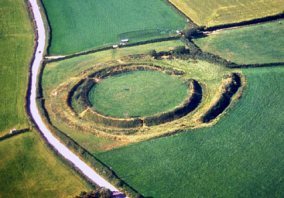
Castle Dore Cornwall.


July 25, 2016
Gifts Intended to Impress
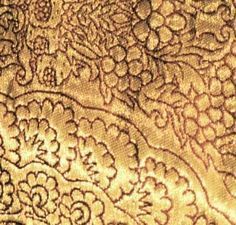
Curt, disapproving words about gifts presented to ladies made a significant impression upon me. After reading these words, I set out upon another writing journey, this time with my first historical fiction work. The words that had captured my imagination speak of events at the Christmas Court of King Richard III in 1484.
The Croyland Chronicle (more on that later) states that ‘immoderate and unseemly stress was laid upon dancing and festivity’. Fair enough, the chronicler was a man of the cloth, one presumably given to modesty and restraint but it was also Christmas, one of the most significant Christian festivals in the church calendar and a time of celebration. Moreover, this was also the court of The King of England and, given there would be large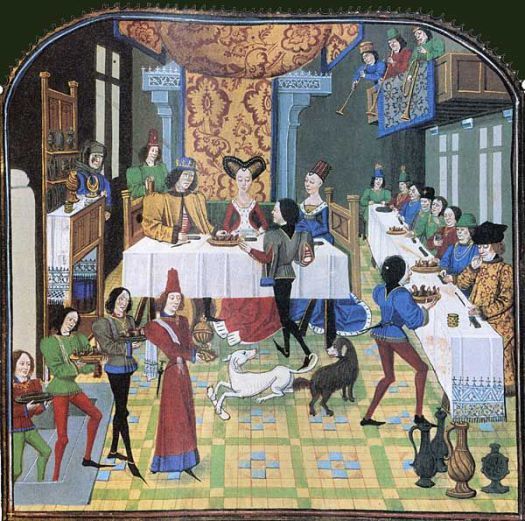 numbers of guests, a good show was expected. Imagine what would have been written if it had been a significantly more paltry affair!
The disapproval I mentioned comes to the fore barely a line later, saying ‘vain changes of apparel of similar colour and shape being presented to Queen Anne and the Lady Elizabeth’. The chronicler records how this caused the people present to murmur and the nobles and prelates to wonder ‘thereat‘. Why? All because the king thought it was a great idea to give the foremost ladies of the land smart clothes for Christmas, gifts they might actually want and like? Heaven forbid! But the chronicler continues to have a go at Richard and his ladies, inferring all was not above board within this family. Quite what information the chronicler received has not been explained, apart from a rather veiled reference to ‘matters which are not in this book because it is shameful to speak of them’. I was captivated by those acidic words, as well of those referring to the clothing gifted to the royal ladies, and began writing a short story based upon these ‘vain changes of apparel’. From there, I began to explore what else was said about Richard and his eighteen-year-old niece, Elizabeth, eldest daughter of the late King Edward IV.
The pendulum of opinion swings wide over what might – or might not – have happened between these two people but, as that is not the subject of this particular piece, we’ll leave it there for the present (though if you’ve read my books The King’s Niece and The King’s Wife, you’ll know what I think). What intrigues me more is the nature of the garments the ladies were presented with that ignited the ire of a medieval chronicler.
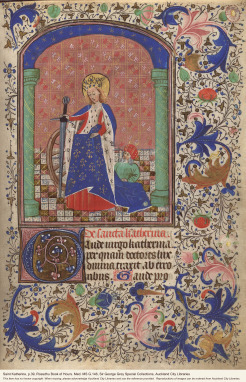
St Katherine as depicted in The Rossdhu Hours (Auckland Public Library.) Her attire is contemporary with the mid-fifteenth century.
While I am no expert in fifteenth-century fashion, it seems to me a queen and a king’s daughter would have had access to the finest cloth money could buy, be that English wool-cloth or imported silks and brocades from Burgundy and Italy. Elizabeth might have had some catching-up to do after months in sanctuary but, in essence, these women stood beside the throne and their appearances would have reflected such status and position. Though we can look at illuminated manuscripts to gain some idea of what women wore at this time (there were so few portraits, especially of English royalty), the images are not overly helpful. The illustrations were painted by men, usually monks, who had little or no interest in women and certainly not their attire. Though we can often see a style depicted, the finer details of garments are usually overlooked.
For finer details we would usually look to surviving artefacts, but so few garments have survived the centuries. Perhaps this is partly because cloth perishes but possibly for more practical reasons. Cloth was expensive and even in the wealthiest of households it made sense to reuse discarded garments when no longer wanted, or after the owner had died. Perhaps a particularly fine gown might have been gifted to another, or possibly cut, remade, used to trim and liven up other clothing, recycled in any number of thrifty ways our throw-away society has forgotten how to do.
There are some surviving garments from this time, though sadly none from England.
One 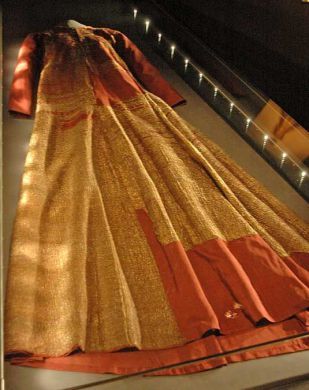 is the stunning Uppsala Gown, or Golden Gown. The gown belonged to Queen Margarete of Denmark (Sweden and Norway 1353-1412). The gold brocade was made in Italy, and has been carbon-dated to reveal it was woven during the first thirty years of the fifteenth century. The original is so fragile it is kept under low lights and special conditions to preserve it.
There is a great deal of information about Margarete’s gown available online, including how to reconstruct the design as well as studies of the original. There is also a theory the gown was made for a younger woman, so may not have been for Margarete, but for her daughter-in-law, Philippa of England, the daughter of King Henry IV, and younger sister of Henry V.
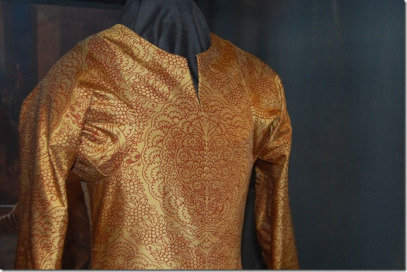
Replica of Margarete’s gown – on display in Stockholm.
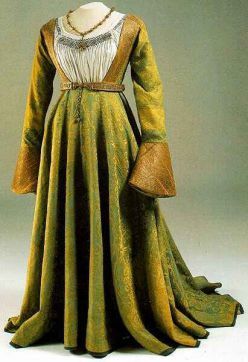 Another surviving gown is this stunning example that belonged to Queen Mary of Habsburg (1505-1558), also known as Mary of Hungary. The gown, made of green silk damask is obviously later than the royal gowns I am interested in, although there is an example of an Hungarian tile c1490 depicting a woman wearing a gown of similar design. The gown is now displayed in the Hungarian National Museum – Magyar Nemzetl Muzem.
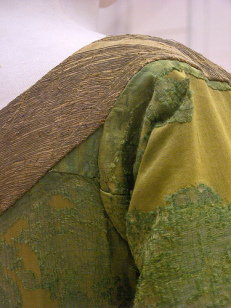
To link Mary to our period of interest, she was the grand-daughter of Mary of Burgundy and Charles the Bold.
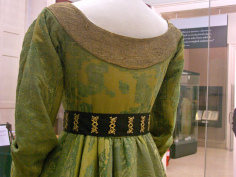
A third relic is that of Leonora of Aragon, though several centuries earlier than the others I have shown. It is an example of a thirteenth century surcote; a sideless surcote or pelotte, worn over an underdress. The style became popular in Spain, spreading through to France and so on to England. This particular surcote is made from ‘Arabian brocade’ and is now in the museum at the Monastery of Las Huelgas, Burgos, Spain.
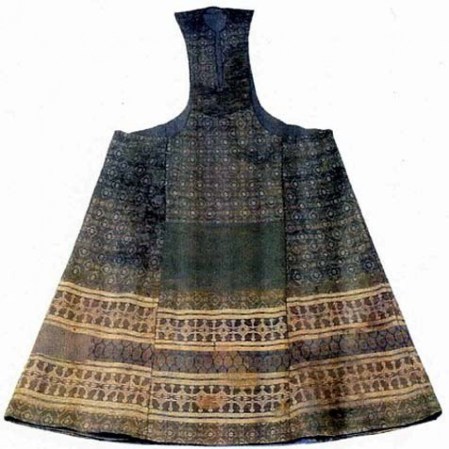
Although these gowns come from opposite sides of Europe, and from across almost three hundred years, they are all stunning in their own way. The cloth from which each gown was made undoubtedly was the finest money could buy at the time, for the women that wore these gowns were at the top of their social tree. One can only deduce if the gowns presented to the royal ladies of King Richard’s court were of similar cut and cloth, they must have been astonishingly beautiful. It is not difficult to imagine the reactions of the court when the gifts were brought out for all to see, nor is it difficulty to image the envy or disapproval at the obvious expense lavished upon the ladies. However, to bring us back to this century and, without wishing to sound feminist, it is lovely to see something so feminine in a world that was dominated, and recorded, by men.
Front view of the cloth in The Golden Gown
The Croyland Chronicle was written at the Benedictine Abbey of Croyland (or Crowland) in Lincolnshire, England, between the seventh and fifteenth centuries. The part that covers the years 1459-1486 was recorded in 1486, after Henry VII had been crowned king, but by someone who clearly had access to information from the court of King Richard III. One suspect is Bishop John Russell, Richard’s chancellor and a man who had served King Edward IV and went on to serve Henry VII. It has been suggested Russell was reluctant to accept the chancellorship of Richard III, and indeed, was dismissed by Richard in July 1485. He was also at Croyland Abbey in April 1486 when the entries relating to Richard’s short reign were recorded. Perhaps he was keen to recommend himself to the new king, hence his keenness to record gossip and conjecture.
The Chronicle, though often considered unreliable, provides an fascinating window into the past.


July 23, 2016
Jack’s Journey

Or – how it all began for me.
Continuing on from the comments in the ‘About Liz’, I’ve always day-dreamed, always had scenes running through my mind, day and night. Only when Jack appeared demanding to be let out, did I begin to write.
The tale of Jack is a long and convoluted one, involving past lives, invaders, supernatural beings and ancient gods. It is intended to be a fantasy romance, and though the bulk of Jack’s adventures are drawn from my imagination, I have added touches of truth here and there.
One of these truths related to Jack’s fixation with finding a certain woman. He is driven on to look for a particular face, a distinctive ‘look’. Here, Jack’s tale becomes intertwined with my own life. Many years ago, a family friend’s relationship broke down. They separated, of course, each trying to pick up the threads of a life. My friend later went out with other women, which was the right thing to do, but what caught my attention was the fact more than one of these women were frighteningly similar in appearance to his ex.
Yes, we’ve all seen that before! Open any trashy magazine at the hairdressers or coffee shop and you’ll see ageing rock-stars and Hollywood beaus escorting women who are younger versions of their exes. All the time. While perhaps, this behaviour is grossly unfair on the older woman, I began to wonder if there was more to it than the need of male to continually prove his virility. What if there was something drawing him to a particular face, a face he couldn’t find but sought everywhere he went? Inevitably, he would come across those bearing similar features, after all, we all supposed to have a doppelganger out there somewhere, and he would be drawn to them.
The idea for Jack’s story sprang from this one idea that I expanded over time, drawing on more supernatural reasons why he searched for a particular woman. As I noted in, Edge of the Circle, many cultures believe in reincarnation in one form or another. The idea love could be carried from one life into another also fascinated me.
Although the village of Bramcote is fictional, it is also based upon a place I know. The real village has a playing field behind a row of houses, exactly as I described. It also has a small, country church a number of pubs and a river nearby with willow trees along its banks. There is even a crumbling ruin of an old hall tucked away on the outskirts of the village. I used an existing place because I needed to visualize a layout, walk streets and revisit any time I needed to – in my mind rather than in person. Just like Bramcote, the real village is not particularly old but, the surrounding area, along with many neighbouring villages, is steeped in history. So much so, it almost seems echoes of the past seep out of the earth to remind its latest inhabitants what has gone before. Echoes of Iron-Age peoples, Anglo-Saxon invaders, ferocious kings and brave queens, determined abbesses and Viking maurauders all lurk there, as do Norman knights and lords, medieval tradespeople, Victorian refomers and the array of humanity I describe participating in the village carnival which, you’ve guessed it, is also real.
So despite the fact Jack discovers there are beings and voices existing in a world-between-worlds, there are a few touches of reality around Jack.
And just in case you were wondering, his ageing, Italian motorbike is real too!



