Laurence Shames's Blog
January 18, 2024
The Idea That Wouldn’t Go Away

Some years ago, I got what I thought was a pretty good book idea.
Two ghostwriters, strangers, happen to meet in a Key West bar. Both are fairly successful, meaning they’re scraping by without a day job. But both are regarded by their publishers as one-trick ponies. One does Mafia memoirs, the other cranks out detective stories under the names of bestselling authors who have died. So they get the same sorts of assignments over and over again, and both are bored stiff.
After a couple of drinks, they fall prey to a subversive but giddily liberating notion. What if they swapped gigs and didn’t tell anyone? They were anonymous anyway; why not just pretend to be each other? Could they bluff their way through the entire process? Might the change of turf bring back some of the joy they used to take from writing? And, by the way, what could possibly go wrong?
Well, the idea tickled me but I quickly decided I would never write that book. I wasn’t sure I wanted to write about writers; there are other professions and other types of characters, after all. Also, telling the story truly (and amusingly, let’s hope) would require some less than flattering commentary about the publishing business, and I was concerned about crossing the line between fair-game comedy and mean-spirited snark, of which there’s more than enough in the book world without me piling on.
So I put the notion aside and moved on to other projects. But the book-swap idea wouldn’t go away and, five or six years later, it has finally taken the form of the eighteenth Key West Caper, Sunset Bluff. Now that I’ve actually written the book, I think I understand why the concept tickled me in the first place and why I couldn’t shrug it off: It turned out to be a natural way, cockeyed but resonant, to approach the theme of authenticity—by which, in this connection, I mean writing in your own true voice.
Which, of course, is exactly what ghostwriters are paid not to do.
It’s a poignant situation. You spend a decade or so honing your style, finding your particular cadence, learning to write like no one but yourself, and then the world tells you, basically, Nice try, kid. Your stuff won’t make you a living, but you do have some chops. Maybe you have a future as a fake.
Admittedly, there are worse fates for a writer, such as having to get a real job. And it’s not that ghostwritten books can’t sometimes be quite good. But what they can’t ever be is entirely honest or trustworthy or owned. There’s always a whiff of fraud about them, a queasy doubt about whose work they actually are, a coy dance about who deserves the credit. I’ve been there, so trust me; it can get pretty demoralizing.
But here’s the twist that finally convinced me it would be worth the trouble to write Sunset Bluff: In this story, the ghostwriters fight back! Sick and tired of writing the same old inauthentic stuff, they grab a last opportunity, at the risk of their careers and maybe their lives, to write something genuine and fresh. True, the gambit requires a lot of fibbing and faking and a bit of counter-fraud to pull it off. But hey, that’s how the world works, right?
I’ll leave it at that for now rather than drifting into spoiler territory. But I can tell you I was rooting for these knuckleheads from page one. I hope you’ll be rooting for them, too.


November 14, 2022
NEW Key West Caper pre-sale!

Well, it’s been awhile, so I’ll begin with a simple wish that all of you are safe, well, and happy. Then I’ll move on to my best excuse for being out-of-touch: I’ve been hard at work on a new Key West Caper–#17!–and am pleased to announce that the Kindle version is now up for pre-sale on Amazon.
Order anytime between now and the release date, January 26th, and the book will magically appear on your device at one minute after midnight. The print version will go on sale January 11th, with audio to follow.
And what’s the book about? Well, for now, here’s just a little tease:
Ever notice how things get sticky when family comes to town?For more, please click the link and have a look! As ever, thanks for your interest and support. Now I’m getting back to work!
October 30, 2021
Voices in My Head
 If you are ever in the mood for a surreal experience, you might want to try this:
Pick up a book that you’ve just finished writing. Bring it to a world-class recording studio. Spend twenty or so hours reading it aloud into a microphone just inches from your nose while an expert engineer catches every goof and gurgle and asks you to re-record sentence after sentence.
Then listen to the edited version and try to remember that the guy doing all those different voices from the mouths of all those different characters is actually you!The process is both humbling and exhilarating; humbling because you will probably sense the gap between your own best efforts on the one hand and, on the other, the greater range and versatility of a truly gifted voice actor. Good, trained voice actors just have a bigger toolbox. They’d better, or they’d be out of business. But here’s what I found so exhilarating about doing the recording myself:
An actor, new to the material, might have a done a slicker performance, but I don’t think anyone could have done a truer one.No one knows an author’s cadences better than the author himself. No two people agree on exactly what is meant by the term “deadpan.” No two people have exactly the same instincts for how to set up a laugh-line, or how to play or underplay a plot reveal, or by what precise increments to ratchet up an argument. For that matter, no two people exactly agree about how much of a Brooklyn accent is endearing and believable, and at what point it’s just too-too.
In narrating a book, then, every spoken word is a decision–no less than when choosing words to put on the page. Every syllable matters; every space between the syllables matters. It’s damn hard work, believe me. But every now and then, when I was listening to the playback, something wonderful happened. I truly forgot it was me performing all the parts. I felt like I was eavesdropping on conversations between characters who didn’t even know or care that I was there. There was something quietly ecstatic and complete in the experience of mouthing the words I had first put into the mouths of made-up people. Somehow it all came back around…I hope my listeners will share in the joy I felt while doing my very best to bring the written book to fresh life in audio.
—————–
The audiobook will be released on November 12th, but you can pre-order it right here from Amazon or AudibleJust click on the company name…and enjoy!
October 17, 2021
Back to…Normal?
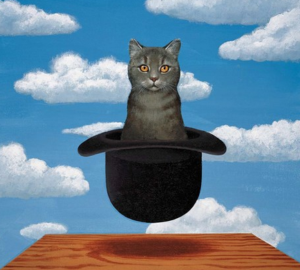
Anyway, what I’ve been finding kind of interesting is that, for all the talk about getting back to normal, no one really specifies what normal is. People talk about “normal” as though it were a timeless Platonic ideal or some fixed point in the heavens, like the North Star. But that’s not how it is. What we call “normal” actually has a lot of the random and the arbitrary in it. Is it “normal” that there are twelve eggs in a carton? Twenty-five point four ounces in a bottle of tequila? Is it normal that if someone crosses a line with a football in his hand, it’s worth six points, but if someone kicks it through a goalpost it only counts for three? Why? Who decided? Fact is, there’s nothing self-evidently “normal” about any of those things. We think of them as “normal” because they happen to be what we’re used to.
In turn, what we’re used to has a lot to do with where we live. If you live in Seattle, it’s “normal” to carry an umbrella. If you carry an umbrella in San Diego, you look like an idiot. In Manhattan, it’s “normal” to race around with high blood pressure and an elevated heart rate; in a small French village, these abnormal symptoms might get you a ride in an ambulance.
But what if you live in Key West?Well, then you’d have your own version of “normal” and it wouldn’t look too damn much like anybody else’s. Wearing body paint in place of clothing would seem “normal,” as would walking around town with a cockatoo on your head. Likewise watching sunset in shorts and sandals almost every evening of the year. Likewise mingling with an endless array of seekers and eccentrics who gather in places at the end of the road to reinvent themselves.
Mostly, though, what I believe is truly special about Key West’s version of “normal” is the way things are just taken in stride there. The mainland and its controversies seem very far away. The clock and the calendar don’t seem to matter much. Anything seems possible; the line between the probable and the improbable all but disappears, so there are surprises but no rude shocks. The sorts of things that, in other places, make people angry or indignant are, in Key West, more likely to be met with a smile and a shrug.
It’s this smile-and-a-shrug version of “normal” that I’ve always cherished about Key West and always tried to celebrate in my work—though usually between the lines. With Key West Normal, however, this theme has moved front and center. I spent many happy hours noodling with the implications of this smile-and-a-shrug philosophy as applied to a droll but sweet story that could only have happened in the Southernmost City. In the process of writing it, I had some laughs and might have even stumbled across a shred or two of insight regarding what “normal” actually means.
So there’s one thing I can say for sure: The next person’s “normal” is every bit as normal to him or her as yours is to you. Nice to remember that when things start seeming weird…
July 25, 2020
Forgiveness vs. Grudge–The Votes Are In!
A week or so ago, I sent a mailing to some readers and friends in which I aired out a few feelings on a subject close to my heart: Holding a grudge.
Specifically, I was trying to weigh the virtue and karmic advantage of forgiveness against the nasty invigoration of staying pissed off and dreaming of, or even plotting, revenge. I was pondering this subject because I’d been searching for a next book idea, and it occurred to me that this could be a central theme. Typically, the notion came to me not in the tidy form of an essay, but in a few scraps of dialogue between Bert the Shirt and his reluctant detective pal, Pete Amsterdam:
“Never trust a guy,” says Bert, “who claims he doesn’t hold a grudge.”
Pete says, “But if he comes right out and says he doesn’t—”
“My point exactly,” the old man counters. “He says he doesn’t. Okay, fine. Why? Why does he say he doesn’t? Why does he even raise the subject? Why does he use the word at all? Grudge, I mean. Why? Because it’s on his mind. If it wasn’t on his mind, he wouldn’t say it, right?”
“So, if a guy says he doesn’t hold a grudge, that automatically means he does?”
“Of course. It’s human nature. Same wit’ no hard feelings. Why would someone say no hard feelings unless there was hard feelings but he was tryin’ to kid himself there wasn’t, kinda tryin’ to choke ‘em down, except ya can’t choke ‘em down forever, because eventually hard feelings will bite back.”
“Okay, okay,” says Pete. “But sometimes people just get over things, right? Or just decide to let them go. Or rise above. Or even forgive. What about forgiveness, Bert? Do you even believe there is such a thing?”
“Forgiveness?” the old man murmurs. “Now you’re gettin’ deep on me, Pete. Lemme think on that a minute.”
Anyway, so I sent those lines to readers and friends (apologies to those of you reading them twice), and I asked people to consider a few basic questions:
Is true forgiveness possible? And, if so, is it necessarily a good thing? Priests and shrinks and gurus are quick to remind us of what we may gain when we forgive–serenity, peace, a chance for a fresh start. But what do we LOSE when we give up a grudge? We give up the chance to get even, sure. But we also give up something to focus on, something that provides meaning and purpose…something to live for! Haven’t you ever felt the sweet burn of a lingering grudge? Wouldn’t you miss it if it went away? If you gave up on revenge, would that be forgiveness or just fatigue? What would fill the slot in your soul where the grudge used to be?
I raised those questions and asked people to share their thoughts if so inclined…and I was absolutely blown away not only by the number and range of responses, but also by how thoughtful and deeply felt many of them were. Clearly, this was a theme that hit a nerve. And, while my little survey was hardly a scientific poll, it did yield some interesting results.
The majority of responses–though less of a majority than you might expect–came down on the side of forgiveness.
Reasons ranged from the religious–whether the Christian imperative to turn the other cheek or the Buddhist and Hindu ideal of letting go–to the kind of hard-earned practical wisdom that sometimes takes years of struggle or therapy to acquire; namely, that one forgives as a necessary kindness to oneself, and not necessarily to the person forgiven.
But quite a number of you, sometimes with tongue in cheek, stood up for your cherished grudges.
Arguments in favor sometimes boiled down to the simple dictum Don’t get mad, get even. But other reasoning was more elaborate. One Catholic reader observed that, while the faith required seeking forgiveness from God, that had nothing to do with forgiving the lousy bastard who done you wrong. He further suggested that, even within the Church, Italians should be exempted from forgiving on the grounds that it runs smack up against the time-honored cultural tradition of the vendetta. Anyone who’s ever seen an Italian opera will understand this line of thought. Another respondent was candid enough to admit that, even at that very moment, she was savoring a blissful revenge fantasy against a long-ago transgressor.
And one reader sent me this beautiful quote from Mark Twain:
“Forgiveness is the fragrance that the violet sheds on the heel that has crushed it.”
Honestly, I have no idea what that means, but isn’t it gorgeously phrased? In any case, what is one to make of this range of opinions about forgiveness versus grudges? For me, the central takeaway is clear, as it’s the only thing that the forgivers and the avengers seem to agree on:
Forgiveness takes a lot of long, hard work, but holding a grudge comes naturally as breathing.
What this says about the difficult and contrary race known as human beings, I’m really not sure. But it’s something I’ll be thinking a lot about in the upcoming months. Which is to say, I guess I’m stuck with the idea. Anyway, my deep thanks to everyone who weighed in with feelings and opinions. Stay safe, pick your battles and your enemies with care, and please keep reading!
May 22, 2020
The Time Between
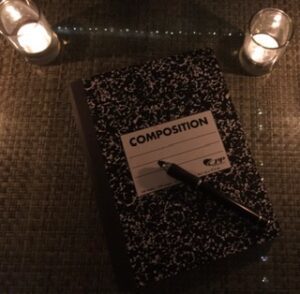
Most people in most places live through four seasons a year.
But those of us with the hard-to-kick habit of writing books also experience another four-part cycle—different from the familiar quartet of autumn, winter, spring, and summer in that it has little or nothing to do with the calendar or the weather. I think of this alternative set of seasons as Starting a Book, Mostly Middle, Finishing and Hoping, and The Time Between. Each of these seasons has its charms, its terrors, its frustrations, and its joys.
Starting a Book is when it just seems flat out impossible. It can’t be done. It’s not that you’re afraid it’ll suck—that fear comes later—but that it seems absurd to believe it’ll get written at all, because you’ve somehow forgotten the little you thought you knew about storytelling, you’ve lost the knack of setting a scene, and, by the way, you have no idea what the plot should be. This is the season when you scrawl little notes in the middle of the night and find them either totally illegible or completely idiotic in the morning. It’s pretty exciting!
But books—like, say, good apple pies—are Mostly Middle, so once you have five thousand words or so, you find yourself in the long season of that same name. That’s when you start to be afraid it’ll suck. That it just won’t come together. That you’ll fall through a narrative manhole and find yourself in a sewer full of people you don’t like much having an argument that makes no sense and that you’ll have to live there for many months. Not so pleasant. On the other hand, Mostly Middle also has its share of wonderful redeeming moments when a character suddenly surprises you, or you write something that you didn’t know you knew, or you crack yourself up at the desk and hope that no one can hear you giggling. Though, honestly, what’s the harm in laughing at your own jokes now and then?
Anyway, Mostly Middle eventually leads on to Finishing and Hoping—hoping that maybe it doesn’t suck after all, that maybe the story offers an emotional payoff and a dose of justice, that maybe this book is at least a small step forward from stuff you’ve done before. You hope for readers, you hope for reviews. You hope for a call from Hollywood. You hope to be anointed by Oprah or at least interviewed by Teri Gross. You hope for an out-of-the-blue endorsement from some huge celebrity you’ve never heard of but whose cachet will make you suddenly really cool among Millennials.
All this hoping is invigorating, but at some point it gets to feel a bit undignified, and as it gradually wanes you move into The Time Between, which happens to be my current season.
It’s the toughest to describe, because it doesn’t really have a shape or a predictable duration. I’ve had episodes when The Time Between lasted two or three weeks then sprang abruptly forward to Starting a Book again. On the other hand, there was a stage when I got into a snit about something or other, and The Time Between went on for twelve years. Hard to remember what I did during those twelve years…except live my life, and that was fine. The Time Between is neither good nor bad. True, it can feel a little drifty, but that’s also sort of liberating. True, there’s a certain mental torpor involved (especially when there’s a pandemic going on), so it needs to be taken on faith that thoughts and fresh ideas are ripening in there somewhere.
Anyway, The Time Between is also when I tend to hear from readers telling me they’re looking forward to a next book and asking if I’m back to work yet. Truly, I am hugely grateful for the interest and appreciate the gentle nudges, even though my first impulse—ever since I was a stubborn kid and before I became a stubborn grownup–has always been to resist. Sometimes I wish I was one of those guys who could knock off a novel every three months and keep the market stocked…But actually, I don’t wish that, because if I wrote that fast I couldn’t give the books the care that makes them worth writing in the first place. I’d have to boss my characters around rather than giving them time to talk to me. I wouldn’t have the luxury of trying to describe every individual aroma of the Key West air. It just wouldn’t be much fun.
So I guess I’m stuck with my process and will have to ask readers to please bear with me while I muddle through. In the meantime, may I humbly suggest re-reading? Or glancing back over the Capers series and seeing if there are any you’ve missed? Or, better yet, checking out some of my non-Key West stuff, like Money Talks or The Angels’ Share. I happen to be fond of those one-offs, just as I’m fond of NY and CA, where they’re set. Anyway, please know that, as I daydream through this peculiar season, I’ll be looking forward to the next flip of the cycle and the privilege of sending some fresh work your way. Thanks for hanging in!
April 28, 2020


April 13, 2020
How Hot Are The Beatles Right Now?
Among the items on offer was an ashtray that Ringo had used at the Abbey Road recording studio. A rather ordinary ashtray. Want to guess what it went for? $32,500.
Which was dwarfed by the price of a drumhead—not even the whole drum, mind you, just the skin with the Beatles logo—used during the 1964 U.S. tour: $200,000.
But the big deal of the day was Paul McCartney’s scribbled notes for “Hey Jude.” Understand, these notes did not include the tune or even all the lyrics; they were just a little cheat-sheet to remind the band where the verses ended and the break came in. Still, the single piece of paper was in Sir Paul’s handwriting, and it sold for $910,000.
This made me smile because—as some of you already know, and as others, I hope, will find out—the plot of my current novel, THE PARADISE GIG (https://tinyurl.com/rnpyt4h), revolves around a notebook filled with dozens, maybe hundreds, of such song sketches scrawled by Lennon and McCartney. So let’s do some simple math. Say the notebook held a hundred songs at nearly a million bucks per. I just wrote myself a fortune!
Unfortunately, my Beatles notebook was purely fictional. Oh, well. Still, it tickles me to see the current vogue surrounding all things Fab Four. The craze seems to extend to every corner of the world and to bring together all the generations. I recently joined a fan site on Facebook with 80,000 members. The first three posts I saw were from Estonia, Spain, and the Philippines. More than a few of the active members seem to be 13-year olds uploading their solo covers of “Blackbird.” Honestly, I find this both charming and hopeful.
But this rebirth, this rediscovery–what’s it all about? True, 2020 marks the fiftieth anniversary of the band’s traumatic break-up. True, in distressing and uncertain times, people tend to get nostalgic—though that doesn’t explain the 13-year olds with their earnest looks and cracking adolescent voices. Why, out of the blue, was there suddenly a Beatles-themed indie film called Yesterday, and why did it, improbably, become a cult hit? Why, for that matter, did it first fly into my head, eighteen or so months ago, that it might be fun to insert the Beatles into a Key West Caper? I’d never put real historical figures into a novel before. Why then? Why them?
I really can’t remember how it happened. One moment the idea wasn’t there; next moment it was. It would be tempting to claim some gift of prophecy, to pretend that I knew all along that a big Beatles resurgence was coming. But I didn’t. Probably I was just swept up into this mysterious bit of zeitgeist along with all the other fan-site groupies and the millions of folks, young and old, who laughed and wept at Yesterday. Maybe I’m just along for the ride, and The Paradise Gig is my ticket?
In any case, it sure would have been nice if my made-up Beatles notebook had been the genuine, actual, factual, hand-scrawled treasure trove…
March 25, 2020
Bert Meets the Beatles
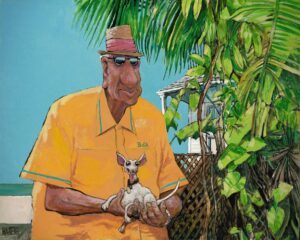
Bert and Nacho in their natural habitat
Turned out the Fab Four made an unplanned visit to Key West in 1964. Turned out they stayed at the Key Wester Motel–since demolished–just down the road from the Paradiso condominium. Turned out they played a free, impromptu concert that night in the hotel bar…Hmm.
This got me thinking. Where was Bert the Shirt in 1964? He would have been a relatively young man then. Still doing his day-job as a mafioso at least part-time, but spending every spare moment at his beloved tropical retreat. Which would have meant that he was making a lot of phone calls to New York. And, since no mafioso in his right mind ever used a private line for business calls, he would have spent a lot of time on pay phones.
What if the nearest pay phone was at the Key Wester? And what if he just happened to use that phone while The Beatles were guests at the motel? And what if he just happened to be strolling past the pool while John, Paul, George, and Ringo were frolicking around in it and working out a harmony to an exceptionally beautiful song?
Bert would have stopped to listen, right? Who wouldn’t?
And–Bert being Bert–he would also have struck up a conversation…
Well, this seems to be how novels get born. Some small fact or moment or scrap of history sticks in the mind and takes on resonance. Possibilities start presenting themselves and refuse to go away. What if, what if, what if? Follow those what-ifs every waking hour (and more than a few dreaming ones) for most of a year, and you might end up with a book.
At least that’s how it happened with THE PARADISE GIG. An incident from 1964 suggested a whole lot of weirdness in present day Key West. Understanding the weirdness called for due consideration of things like the power of music and both the stubbornness and unreliability of memory. Talking about memory yanked the tale back to The Beatles in ’64 again. Which brought us back to the weirdness of the present, including–inevitably!–a love story, a talking chihuahua, some bad guys who sing karaoke, and a rock’em-sock’em ending that brings in everybody and sums it up like the last chord on an album.
Well, you just never know where one little factoid might lead…Enjoy!
October 26, 2019
The Beatles in Key West–A Short quiz
For those who just happened to come across this post while perusing the website—thanks for that!—a recap is in order.
So here’s the quiz. Answers below.

On what date in what year did the Fab Four visit Key West?
What unforeseen circumstance brought them there?
Where did they stay? What’s there now?
At what Key West venue were they scheduled to perform?
Did they meet Bert the Shirt while they were in town?
****************
Answers:
The Beatles landed in Key West on September 10, 1964 and left on 9/11.
2. Hurricane Dora. The band had been scheduled to play a concert at the Gator Bowl in Jacksonville, but the approaching storm forced the re-routing of their private flight. Key West was far enough south to be out of the path.
3. The Key Wester motel, across from Smathers Beach. The place was demolished in 1999. The site is now occupied by the Hyatt Windward Pointe. (That’s not a paid plug, just a bit of information!)
Okay, this is a trick question. They weren’t scheduled to perform at all, but ended up doing an impromptu gig in the Key Wester’s bar. It went on until four a.m. and is the stuff of legend.
Why not? Anything can happen in a novel…